Amos 8:9

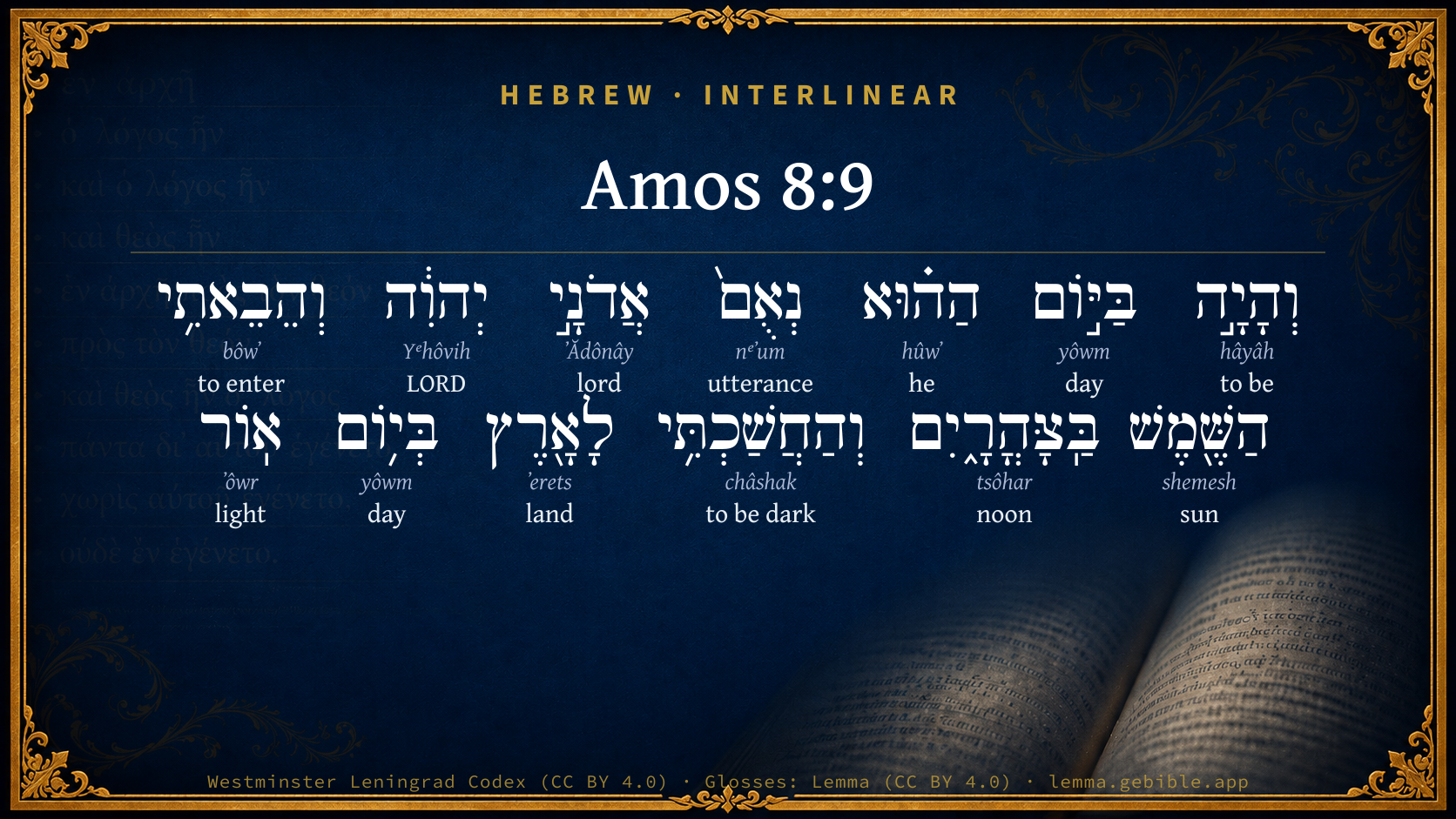
Hebrew (Westminster Leningrad Codex) Amos 8:9 appears in the Hebrew Old Testament. The text above is from the Westminster Leningrad Codex. Each word links to its Strong’s number, a concise gloss, and parsing drawn from the Open Scriptures Hebrew Bible morphology. Click any word for its full Brown-Driver-Briggs (BDB) entry.
Download image
Cite this verse

Amos 8:9 (World English Bible). Public Domain. Lemma interlinear Bible study tool, https://lemma.gebible.app/v/amos/8/9.

Show BibTeX & RIS
BibTeX
RIS
English Translation
"It will happen in that day," says the Lord Yahweh, "That I will cause the sun to go down at noon, And I will darken the earth in the clear day.
World English Bible · Public Domain
Download a study sheet

One document with this verse’s original text, its word-by-word gloss line, the meaning frame, cross-references with their text, attributed commentary, and full source and license credits — printable, and it pastes into notes with its structure intact.

This verse Autodidact and up

Study sheet (.html) Plain text (.txt)

A passage Seminary Student

Up to 50 verses in one chapter. A passage sheet keeps up to 6 commentary sources and 12 cross-references per verse, in the order this page ranks them, and says so on the sheet whenever that leaves anything out. Ask for a single verse and you get the Autodidact verse sheet above.

Everything on this page stays free to read, with no account — the sheet is a download of what is already on screen, not access to it.

Want to remove ads? Support Godless Engineer
Compare translations 3

The same verse in 3 English versions, stacked beneath the original-language interlinear above. Click any original word for its lexicon entry.

Each is an independent rendering of the whole verse — the interlinear is not word-aligned to these translations.

Highlighted words mark where these versions differ — a whole-verse word diff, not a word-by-word alignment.

  • World English Bible Public Domain
    "It will happen in that day," says the Lord Yahweh, "That I will cause the sun to go down at noon, And I will darken the earth in the clear day.
  • King James Version Public Domain
    And it shall come to pass in that day, saith the Lord GOD, that I will cause the sun to go down at noon, and I will darken the earth in the clear day:
  • unfoldingWord Literal Text CC BY-SA 4.0
    “It will come in that day— this is the declaration of the Lord Yahweh— that I will make the sun set at noon, and I will darken the earth at daylight.

unfoldingWord Literal Text — © unfoldingWord, licensed CC BY-SA 4.0. Word-aligned USFM3 via Door43 (git.door43.org/unfoldingWord/en_ult).

Versions to compare (up to 4)

3 of 4 selected

Show all 18 translations

Every available English version of this verse, each an independent rendering of the whole verse.

  • World English Bible Public Domain
    "It will happen in that day," says the Lord Yahweh, "That I will cause the sun to go down at noon, And I will darken the earth in the clear day.
  • Berean Standard Bible Public Domain
    And in that day, declares the Lord GOD, I will make the sun go down at noon, and I will darken the earth in the daytime.
  • Majority Standard Bible Public Domain
    And in that day, declares the Lord GOD, I will make the sun go down at noon, and I will darken the earth in the daytime.
  • King James Version Public Domain
    And it shall come to pass in that day, saith the Lord GOD, that I will cause the sun to go down at noon, and I will darken the earth in the clear day:
  • American Standard Version (1901) Public Domain
    And it shall come to pass in that day, saith the Lord Jehovah, that I will cause the sun to go down at noon, and I will darken the earth in the clear day.
  • Revised Version (1885) Public Domain
    And it shall come to pass in that day, saith the Lord GOD, that I will cause the sun to go down at noon, and I will darken the earth in the clear day.
  • Geneva Bible (1599) Public Domain
    And in that day, saith the Lord God, I will euen cause the sunne to go downe at noone: and I will darken the earth in the cleare day.
  • Douay-Rheims (1899) Public Domain
    And it shall come to pass in that day, saith the Lord God, that the sun shall go down at midday, and I will make the earth dark in the day of light:
  • Young's Literal Translation Public Domain
    And it hath come to pass in that day, An affirmation of the Lord Jehovah, I have caused the sun to go in at noon, And caused darkness on the land in a day of light,
  • Literal Standard Version CC BY-SA 4.0
    And it has come to pass in that day,” || A declaration of Lord YHWH, || “I have caused the sun to go in at noon, || And caused darkness on the land in a day of light,
  • Unlocked Literal Bible CC BY-SA 4.0
    “It will come in that day —this is the declaration of the Lord Yahweh— that I will make the sun set at noon, and I will darken the earth at daylight.
  • unfoldingWord Literal Text CC BY-SA 4.0
    “It will come in that day— this is the declaration of the Lord Yahweh— that I will make the sun set at noon, and I will darken the earth at daylight.
  • Darby Bible Public Domain
    And it shall come to pass in that day, saith the Lord Jehovah, that I will cause the sun to go down at noon, and I will darken the land in the clear day.
  • World Messianic Bible Public Domain
    It will happen in that day,” says the Lord GOD, “that I will cause the sun to go down at noon, and I will darken the earth in the clear day.
  • Webster's Bible Public Domain
    And it shall come to pass in that day, saith the Lord GOD, that I will cause the sun to go down at noon, and I will darken the earth in the clear day:
  • Free Bible Version CC BY-SA 4.0
    On that day, declares the Lord God, I will make the sun go down at noon, and darken the land during the daytime.
  • Bible in Basic English Public Domain
    And it will come about in that day, says the Lord God, that I will make the sun go down in the middle of the day, and I will make the earth dark in daylight:
  • JPS Tanakh (1917) Public Domain
    And it shall come to pass in that day, saith the Lord GOD, that I will cause the sun to go down at noon, and I will darken the earth in the clear day.

Literal Standard Version (2020), Covenant Press — licensed CC BY-SA 4.0. Text via the HelloAO Bible API (eBible.org). Unlocked Literal Bible (unfoldingWord) — licensed CC BY-SA 4.0. Text via the HelloAO Bible API (eBible.org). unfoldingWord Literal Text — © unfoldingWord, licensed CC BY-SA 4.0. Word-aligned USFM3 via Door43 (git.door43.org/unfoldingWord/en_ult). Free Bible Version, Dr. Jonathan Gallagher — licensed CC BY-SA 4.0. Text via the HelloAO Bible API (eBible.org).

Word by word

More ways to search: Search by grammar → Find every occurrence → Compare this word →

Practice this passage: Drill this verse → Learn its vocabulary →

וְהַחֲשַׁכְתִּ֥י
châshak
H2821
“and · to be dark”
Conjunction + Verb, Hiphil, Sequential Perfect, 1st Person, Common, Singular
Part of Speech
Conjunction + Verb
Stem
Hiphil
Form
Sequential Perfect
Person
1st Person
Gender
Common
Number
Singular
Full BDB Definition

Origin: a primitive root

TWOT: 769

to be or become dark, grow dim, be darkened, be black, be hidden - (Qal) - to be or grow dark - to have a dark colour - to grow dim - (Hiphil) - to make dark, cause to be dark - to hide, conceal - to obscure, confuse (figuratively)
  1. וְהָיָ֣ה hâyâh H1961 “and · to be” Conjunction + Verb, Qal, Sequential Perfect, 3rd Person, Masculine, Singular
  2. בַּיּ֣וֹם yôwm H3117 “in/at the · day” Preposition, Determined + Noun, Common, Masculine, Singular, Absolute
  3. הַה֗וּא hûwʼ H1931 “the · he” Particle, Definite Article + Pronoun, Personal, 3rd Person, Masculine, Singular
  4. נְאֻם֙ nᵉʼum H5002 “utterance of” Noun, Common, Masculine, Singular, Construct
  5. אֲדֹנָ֣י ʼĂdônây H136 “Lord · my” Noun, Common, Masculine, Plural, Construct + Suffix, Personal, 1st Person, Common, Singular
  6. יְהוִ֔ה Yᵉhôvih H3069 “LORD” Noun, Proper
  7. וְהֵבֵאתִ֥י bôwʼ H935 “and · to enter” Conjunction + Verb, Hiphil, Sequential Perfect, 1st Person, Common, Singular
  8. הַשֶּׁ֖מֶשׁ shemesh H8121 “the · sun” Particle, Definite Article + Noun, Common, Both, Singular, Absolute
  9. בַּֽצָּהֳרָ֑יִם tsôhar H6672 “in/at the · noon” Preposition, Determined + Noun, Common, Masculine, Plural, Absolute
  10. לָאָ֖רֶץ ʼerets H776 “to/for the · land” Preposition, Determined + Noun, Common, Both, Singular, Absolute
  11. בְּי֥וֹם yôwm H3117 “in/at · day of” Preposition + Noun, Common, Masculine, Singular, Construct
  12. אֽוֹר ʼôwr H216 “light” Noun, Common, Both, Singular, Absolute

About this verse

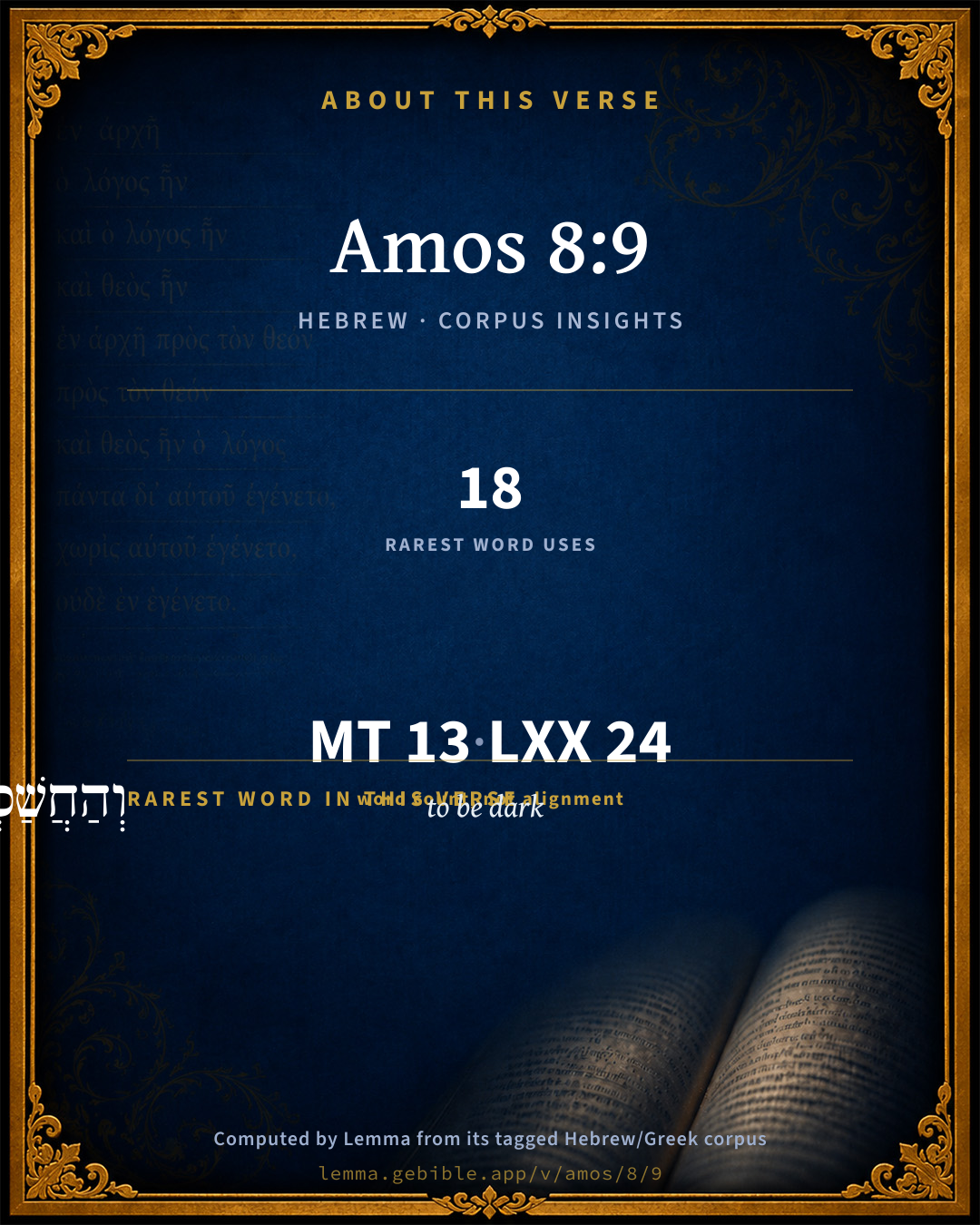
These counts appear in no published source. They are computed here, from the morphology-tagged text and Lemma’s own curated glosses. What Lemma adds →

13
words
12
distinct lemmas
Prophets
section

Notable vocabulary

The rarest word here is וְהַחֲשַׁכְתִּ֥י to be dark H2821 — appearing just 18 times in the whole Hebrew Bible.

Shared distinctive vocabulary

וְהַחֲשַׁכְתִּ֥י to be dark H2821 occurs in 18 verses of the Hebrew Bible. Also found in:

Grammatical profile

  • 3 verbs
  • 9 nouns
  • 1 pronoun

Verb forms

  • וְהָיָ֣ה Qal · Sequential Perfect
  • וְהֵבֵאתִ֥י Hiphil · Sequential Perfect
  • וְהַחֲשַׁכְתִּ֥י Hiphil · Sequential Perfect

Repetition

A word recurs within this verse — often emphatic in Hebrew:

  • בַּיּ֣וֹם day H3117 ×2

Hebrew & Septuagint length

In English translation the verse runs 31 words from the Hebrew and 32 from the Septuagint (LXX English) — closely comparable.

A rough comparison of the two English renderings, which tokenize alike — not a word-level alignment.

Word counts can differ between the Hebrew and the Greek without any difference in meaning — e.g. the Hebrew direct-object marker אֵת has no separate Greek word, and Greek often adds the article ὁ.

In the original languages it is 13 Hebrew tokens and 24 Greek tokens — but the two are counted differently (Hebrew bundles its prefixes and suffixes into one token; the Greek is in lemma form), so that isn’t a like-for-like length.

Cross-references

15

Topical passages linked to Amos 8:9 in the Treasury of Scripture Knowledge — connected by theme and wording, ordered by reader-vote popularity; previews shown in the World English Bible.

  • Mark 15:33 When the sixth hour had come, there was darkness over the whole land until the ninth hour.
  • Matthew 27:45 Now from the sixth hour there was darkness over all the land until the ninth hour.
  • Jeremiah 15:9 She who has borne seven languishes; she has given up the spirit; her sun is gone down while it was yet day; she has been disappointed and confounded: and the residue of them will I deliver to the sword before their enemies, says Yahweh.
  • Luke 23:44 It was now about the sixth hour, and darkness came over the whole land until the ninth hour.
  • Micah 3:6 "Therefore night is over you, with no vision, And it is dark to you, that you may not divine; And the sun will go down on the prophets, And the day will be black over them.
  • Matthew 24:29 But immediately after the oppression of those days, the sun will be darkened, the moon will not give its light, the stars will fall from the sky, and the powers of the heavens will be shaken;
  • Isaiah 59:9–10 Therefore is justice far from us, neither does righteousness overtake us: we look for light, but, behold, darkness; for brightness, but we walk in obscurity.
  • Amos 5:8 Seek him who made the Pleiades and Orion, And turns the shadow of death into the morning, And makes the day dark with night; Who calls for the waters of the sea, And pours them out on the surface of the earth, Yahweh is his name,
  • Job 5:14 They meet with darkness in the day-time, And grope at noonday as in the night.
  • Isaiah 13:10 For the stars of the sky and the constellations of it shall not give their light; the sun shall be darkened in its going forth, and the moon shall not cause its light to shine.
  • Amos 4:13 For, behold, he who forms the mountains, And creates the wind, And declares to man what is his thought; Who makes the morning darkness, And treads on the high places of the Earth: Yahweh, the God of hosts, is his name."
  • Revelation 6:12 I saw when he opened the sixth seal, and there was a great earthquake. The sun became black as sackcloth made of hair, and the whole moon became as blood.
  • Exodus 10:21–23 Yahweh said to Moses, "Stretch out your hand toward the sky, that there may be darkness over the land of Egypt, even darkness which may be felt."
  • Isaiah 29:9–10 Stay you and wonder; take your pleasure and be blind: they are drunken, but not with wine; they stagger, but not with strong drink.
  • Revelation 8:12 The fourth angel sounded, and one third of the sun was struck, and one third of the moon, and one third of the stars; so that one third of them would be darkened, and the day wouldn't shine for one third of it, and the night in the same way.

Cross-references courtesy of OpenBible.info (CC BY 4.0).

Hebrew and Greek witnesses Masoretic Hebrew ↔ Greek Septuagint

The same verse in the two great witnesses to the Old Testament, shown verse-for-verse.

These are two independent witnesses, not word-aligned to each other, and the Septuagint is shown in lemma (dictionary) form.

Hebrew Amos 8:9 Masoretic · Westminster Leningrad Codex

וְהָיָ֣ה בַּיּ֣וֹם הַה֗וּא נְאֻם֙ אֲדֹנָ֣י יְהוִ֔ה וְהֵבֵאתִ֥י הַשֶּׁ֖מֶשׁ בַּֽצָּהֳרָ֑יִם וְהַחֲשַׁכְתִּ֥י לָאָ֖רֶץ בְּי֥וֹם אֽוֹר

"It will happen in that day," says the Lord Yahweh, "That I will cause the sun to go down at noon, And I will darken the earth in the clear day.

World English Bible · Public Domain

Greek LXX Amos 8:9 Septuagint · lemma form

καί εἰμί ἐν ἐκεῖνος ὁ ἡμέρα λέγω κύριος ὁ θεός καί δύω ὁ ἥλιος μεσημβρία καί συνσκοτάζω ἐπί ὁ γῆ ἐν ἡμέρα ὁ φῶς

And it shall come to pass in that day, says the Lord God, that the sun shall go down at noon, and the light shall be darkened on the earth by day:

LXX2012 (modern English Septuagint) · Public Domain

Hebrew: Westminster Leningrad Codex (CC BY 4.0). Greek: Septuagint (public domain); English from LXX2012 (modern English Septuagint) (Public Domain). How the Septuagint differs from the Hebrew →

Targum (Aramaic paraphrase)

1

The Targum is the ancient Jewish Aramaic paraphrase of the Hebrew Scriptures — an interpretive translation, not the Hebrew text itself. Onkelos (literal) and Pseudo-Jonathan (expansive) render the Torah, and Jonathan the Prophets. Coverage is partial: where no permissively-licensed English translation exists for a verse, only the Aramaic is shown. This is verse-level text, not a word-by-word alignment to the Hebrew.

  1. Targum Jonathan Prophets (Joshua–Malachi)
    וִיהֵי בְּעִדָנָא הַהִיא אֲמַר יְיָ אֱלֹהִים וַאֲכַסֵי שִׁמְשָׁא כַּד בְּטַהֲרָא וְאַקְבֵּיל לְאַרְעָא בְיוֹם נְהוֹר:

    (no public-domain English translation for this verse)

    Targum Jonathan — Aramaic: “Mikraot Gedolot” (public domain). English: “Sefaria Community Translation” (CC0 1.0 (public-domain dedication)); “London "Chaldee Paraphrase," 1871” (public domain). Text via Sefaria.

Commentary

Notes on Amos 8:9 from classic Christian and Jewish commentators (each source and its license shown beneath its notes). The classic Christian expositions comment on the surrounding passage and are grouped to its opening verse, so a note may address several verses; the Jewish commentaries on the Tanakh (Rashi and others) are per-verse, so they appear only where the commentator wrote on this verse.

Lemma curates 59 commentaries, every one of them public domain or Creative Commons licensed, each selected and text-cleaned for this edition rather than reprinted as found. About our sources →

Ellicott's Commentary for English Readers

(9) Darken the earth.—The darkening of the sun at noon-day gives an image of confusion and terror (comp. Amo_5:20). The eclipse of the sun that is here alluded to (see Excursus C), like the earthquake in the preceding verse, is employed as a powerful image of national calamity, the extinction of the royal house, and perhaps the final overthrow of Israel. (Comp. Jer_15:9; Eze_32:7-10.)

EXCURSUS C (Amos 8:9).

That an eclipse is here referred to, and employed as a figure to express the overwhelming calamities which were to darken Israel, can hardly admit of doubt, when we compare the similar figurative use of the earthquake in the preceding verse. But to what eclipse does the prophet refer? Mr. J. W. Bosanquet has attempted to identify it with a very special one, mentioned in the Assyrian annals:—“In the eponymy of Bursagale, prefect of Gozan, the city of Asshur revolted, and in the month Sivan the sun was eclipsed.” This has been calculated by Hind to have occurred on June 15, 763 B.C. (So Rawlinson, Schrader, G. Smith, &c., as against Oppert’s view, which is untenable.) If this eclipse was in the mind of the prophet, it is a fact of considerable importance in chronology. On the whole, however, it is more probable that the prophet was thinking of an earlier eclipse, which took place in 784 B.C., Feb. 9. It was a total eclipse, the time of totality being about 1 p.m. at Jerusalem, thus exactly corresponding with the phraseology of this verse. So remarkable a phenomenon would naturally stamp itself for many years upon the mind of the people, and this vivid impression the prophet summons to his aid in foreshadowing the calamities of the last time.

A Bible Commentary for English Readers, edited by Charles John Ellicott (1878–1897) — public domain. Text from a community e-Sword module.

Trapp's Complete Commentary

John Trapp

Amo 8:9 And it shall come to pass in that day, saith the Lord GOD, that I will cause the sun to go down at noon, and I will darken the earth in the clear day:

Ver. 9. And it shall come to pass in that day, &c.] Here the Lord threateneth (saith Mr Diodati) to encumber the land with horrible and mournful calamities, when it shall be least thought of. Earthquakes, inundations, sudden and dreadful darkness, are sure effects and signs of God’s heavy displeasure against men’s sins, Psa 18:8; Psa 18:12 Mat 24:6-7 Luk 21:10-11 Joe 2:10 Jer 15:8-9, and promise contrary to this threat, Job 18:5-6.

I will cause the sun to go down at noon] A sudden change, as was at Sodom; the sun was fair risen upon it that very day that it was destroyed in, Gen 19:23-24; as at Babylon, when surprised by Cyrus, they could not at first believe their own calamity; as it was with Jerusalem often, and shall be with Rome: Rev 18:7-8, "She saith in her heart, I shall see no sorrow. Therefore shall her plagues come in one day, death, and mourning, and famine," &c., to confute their fond conceit of an eternal empire. "For when they shall say, Peace and safety, then shall sudden destruction come upon them, as travail upon a woman with child, and they shall not escape," 1Th 5:3. Philosophers say, that before a snow the weather will be warmish; when the wind lies the great rain falls; and the air is most quiet when suddenly there will be an earthquake. Pharaoh had all fair weather made before him till the instant that he was drowned in the sea. Nebuchadnezzar, Herod, and other tyrants were smitten in the height of their pride and ruff of their jollity. Jerusalem had three years’ great plenty before her last destruction, of which some interpret this text. Those seven once flourishing Churches of Asia, how glorious and resplendent were they till they had sinned away their light! The same might be said of many others; and who knows how soon it may be said also of us? who knows whether we be not, even now, upon the very tropics and turning points of time? Surely God’s patience towards us, quo diuturnior eo minacior, the longer it lasteth the more evil is toward us, if we abuse it. If in a land of light we love darkness better than light, we may soon have enough of it. Solem in Britannia non occidere nec resurgero retulit Tacitus. Tacitus telleth us that at some time of the year the sun seemeth neither to rise nor fall in this country; but so lightly to pass from us in the night that you can scarce discern day from night. Of England for this many years it may be said, as Solinus doth of the Rhodes, that it is semper in sole sita, ever in the sun. How long it shall be so, he alone knows that knows all. Walk while ye have the light; and pray that God would discloud these gloomy days with the beams of his mercy, and not cause our sun to go down at noon, nor our land to be darkened in the clear day. Oh stop this Sun of righteousness posting as it may seem from us (when the blind man cried lustily, Jesus, though journeying, stood still), stay him by your importunities, as those two did at Emmaus, and say,

“ Vespers iam venit; nobiscum, Christe maneto,

Extingui lucem nec patiare tuam. ”

John Trapp, A Commentary or Exposition upon All the Books of the Old and New Testament (1647–1656) — public domain. Text from a community e-Sword module.

The Biblical Illustrator

Joseph S. Exell

Amo_8:9

And it shall come to pass in that day, saith the Lord God, that I will cause the sun to go down at noon, and I will darken the earth in the clear day.

The eclipse of the sun spiritually considered

Though the heavens are full of the glory of the Lord, yet they rarely engage our devout attention, or make their voice so to be heard as that we notice it and listen. The sight and the music are so constantly repeated, and become so common, that they cease to impress us. It is well, then, that God has so wisely ordered the universe that ever and anon the monotony of these ordinary phenomena should be broken by those that are more startling and extraordinary,--such as the visitations of eclipses, comets, and earthquakes, that so men might be compelled to see their Makers hand and hear their Authors voice, and know that there is indeed a God that created and that governeth the earth.

1. Such a phenomenon as the eclipse is calculated powerfully to impress upon us a lesson of gratitude for the inestimable blessing of sunlight. Like some of our greatest mercies, it is a common one, and therefore it is unappreciated. From how few hearts arise the morning orison of thankfulness, and the noonday hymn of praise. Of this, like most of Gods blessings, we need to be now and then deprived, in order to teach us how great it is. If suddenly at midday God were now and then to place the shadow of His hand before the sun, we should then feel to the full the horror of the deprivation and the great blessing of the gift. We read of those, like the Persians, who worship the Sun, and pay to it the homage that is due to its Creator. And far nobler it is to worship the sun than to walk day by day in his light with a heart thankless for the blessing.

2. A more solemn truth, of which this phenomenon may remind us, is the effect of sin on the soul of man. The darkness of eclipse will be caused by a large and opaque body coming between us and the sun. The moon will come between us and the sun. Were it not for some intervening object, Gods light would be ever shining down upon us. The eclipse will not be caused by the suns withdrawing his shining. God never changes. If there is darkness in the soul of man, it is to be accounted for by the fact that something or other has come between his soul and God, and eclipsed the light. Scripture teaches us that this object is sin. Your iniquities have separated between you and God. Every soul who is under the dominion of sin may see in the eclipse a faint image, in the natural world of the position of his soul in relation to God. It is cut off from God, and so abideth in darkness.

3. This eclipse may bring to remembrance the awful death of Him through whose work alone those sins can be removed. During His supreme agony upon the Cross there occurred a preternatural eclipse of the sun. The sun was darkened. It was truly a time for both nature and man to mourn.

4. The eclipse should enable us in some sort to realise the great day of the wrath of the Lord. Then there shall be signs in the sun; the sun shall withdraw his shining. That appalling eclipse will not only be total but final, and to no man who is not then found to be a child of God, and a servant of Christ, will light evermore return. (Richard Glover.)

Untimely sunset

I. The Divine hand in an apparently untimely event. The peculiar reference of the text is some sudden calamity which was to befall Israel. In nothing is the Divine sovereignty more conspicuous than in the untimely removal of useful and excellent characters from the world. The mystery attending it, however, arises more from ignorance and shortsightedness than from any other cause. We can only judge from appearances. With the real nature of the case, and the actual reasons which govern the decisions of the Eternal, we are equally unacquainted. Humanity seems to weep when her favourite sons are removed. Patriotism bears a dejected head when her brightest ornaments are no more. The world trembles when its best pillars bow before the stern hand of time and death--when the earth is darkened in the clear day. Even religion cannot be unmoved. Religion contemplates, and teaches us to contemplate, this world in its true light, as introductory only to a more finished state of being--as connected with the purposes and plans of heaven. It is succeeded by an emotion of triumph, that in that world in which their splendours are renewed the same voice proclaims, My sun shall no more go down.

II. The divine dispensations demand particular attention. The very language of the text denotes surprise, and seems intended to awaken attention--and it shall come to pass. So it is especially when God takes from the world important characters,--He expressly designs to arouse men from their lethargy. Fear should produce seriousness and desire for the true salvation. (Homiletic Magazine.)

Early graves

The words are suggestive of early graves, and these abound. The vast majority of the race die in early life, the greater number by far in childhood; the sun goes down just as it appears in the horizon. What do these early graves show?

I. That life is absolutely in the Hands of God. Who causes the sun to go down whilst it is yet noon? He alone can arrest its majestic progress, and turn it back. So it is with human life. The human creature seems organised to live on for years; but its Maker puts an end to its course at any time He pleases, so that the first breath is often immediately succeeded by the last.

II. That man in all stages of life should hold himself ready to leave the world. He should regard himself not as a settler, but as a sojourner; not as a tree, to root itself in the earth, but a bark to float down the stream to sunnier shores.

III. That there must be a future state for the free development of human nature. What a universe of thought and sympathy and effort are crushed in germ every year by death! Potential poets, artists, statesmen, authors, preachers, buried in early graves. Why the creation of these germs--these seeds of majestic forests? Surely the wise and benevolent Author intended their full development; and for that there must be another world. (Homilist.)

Lessons of an eclipse

If the text were taken literally it would be very nearly verified in an eclipse. But the words are to be spiritually understood. Here is intended some dispensation of Divine Providence towards mankind, of which the suns eclipse is a suitable and proper emblem.

1. Such a day is that wherein God makes a sudden and unlooked-for change in a mans circumstances. All may go well with a man, and his heart may be lifted up within him. Then, in great mercy to his soul, God may send him an eclipse. The bright sun of prosperity is suddenly put out.

2. God eclipses a mans sun when He calls him suddenly and prematurely from the world. How many a bright sun is thus extinguished every day!

3. The day on which the Lord maketh a mans sun to go down at noon is the day on which He is pleased to strip such a man of his opportunities and means of grace. There is a clear day of blessed opportunity for every penitent, awakened sinner in existence. None shall seek and seek in vain. But will the light shine for ever on those who will not comprehend it? And there are eclipse times for sincere believers. Now, for a season, if need be, ye are in heaviness through manifold temptations. And the Lord Himself sometimes appears to hide from him, and withdraw from him His customary favour, then indeed his sun is gone--his day is darkened. Seasons like these may well be called the eclipses of believers. But, blessed be God! they are, like eclipses, of short continuance. (A. Roberts, M. A.)

The solar eclipse

The darkness of an eclipse may be considered--

I. As an excitement to gratitude. The present state of knowledge affords abundant reason for gratitude. We axe not ignorant of nature as our distant fathers were. Ignorance is never a simple privation of knowledge; in the absence of correct knowledge there will always be erroneous conclusions; and hence ignorance is always injurious. The regularity of the course of nature claims our gratitude on an occasion like the present. Deviations from the ordinary course are not of frequent occasion, but we are acquainted with their arrival. One reason for such deviations may be, that our sluggish faculties may be awakened to observe the wonderful works of God.

II. The darkness of an eclipse as a memoral of past facts.

1. We are reminded of the creation of the world, when darkness was upon the face of the deep. How concerned is God for mans comfort! Surely man ought to be concerned for Gods glory!

2. Of the darkness with which God has surrounded Himself in His intercourse with man. How superior are the spiritual manifestations of Deity under the Gospel, to the personal manifestations of Deity under the law.

3. Of the plague of darkness which was inflicted on the Egyptians. The bewildering and distressing effects of darkness may be illustrated by a familiar example. It may have happened to us to lose our way in a field at night. Once bewildered, you wander without the least conception whither. So this plague of darkness gives us an impressive view of the value of that light which will be temporalily darkened by the expected eclipse.

4. Of the supernatural darkness at the time of the death of Jesus Christ. This could not have been occasioned by an eclipse, as the Passover was held at the time of the full moon. On this memorable instance we are taught how easily God can reverse the order of nature. The course of nature is but the will and energy of God, who worketh all in all.

III. The darkness of an eclipse as a reminder of events which are to come.

1. We are reminded of the time when we shall go whence we shall not return, even to the land of darkness and the shadow of death. The grave is dark, but we shall not perceive its darkness if we are the disciples of Jesus Christ.

2. We are reminded of the punishment of the wicked. This is spoken of as the outer darkness. As figurative, this seems rather to heighten our apprehensions of distress than to diminish them. (The Essex Remembrancer.)

The Biblical Illustrator, edited by Joseph S. Exell (c. 1880s–1900s) — public domain. Text from a community e-Sword module.

Joseph Benson's Commentary

Amo 8:9. I will cause the sun to go down at noon — Calamitous times are often expressed in the Scriptures by the failing of the light of the sun, and the day’s being overspread with darkness. So Israel’s sun did begin to go down, as at noon, under the dark cloud of conspiracies and civil wars by Shallum, Menahem, Pekah, and Hoshea, till it entirely set, and total darkness came on through the Assyrian invasions by Pul, Tiglath-pileser, and Shalmanezer, and by the entire desolation and destruction of the country produced thereby. And I will darken the earth — By bringing a thick cloud of troubles and afflictions over it; in the clear day — When they think all is safe, well settled, and hopeful.

Joseph Benson's Commentary on the Old and New Testaments (1811–1818) — public domain. Text from a community e-Sword module.

Tyndale Open Study Notes

Tyndale Open Resources

8:9 The day of the Lord would invert the cosmos. Jeremiah used similar imagery to describe the desecration of Judah as the Babylonian armies approached (Jer 4:23; see also Isa 13:10; 34:4; 50:3; Ezek 32:7-8; Joel 2:10, 31; Mic 3:6).

Tyndale Open Study Notes — © Tyndale Open Resources, licensed CC BY-SA 4.0. Text via the HelloAO Bible API.

Geneva Bible (1599)

Geneva Bible translators

In the midst of their prosperity, I will send great affliction.

Geneva Bible (1599) marginal notes — public domain. Text via Bolls.life.

Jamieson, Fausset & Brown

Robert Jamieson, A. R. Fausset & David Brown

"Darkness" made to rise "at noon" is the emblem of great calamities (Jer 15:9; Eze 32:7-10).

Jamieson, Fausset & Brown — Commentary Critical and Explanatory on the Whole Bible (1871) — public domain (CC PDM 1.0). Text via the HelloAO Bible API.

Adam Clarke's Commentary

Verse 9. I will cause the sun to go down at noon] This may either refer to that darkness which often precedes and accompanies earthquakes, or to an eclipse. Abp. Usher has shown that about eleven years after Amos prophesied there were two great eclipses of the sun; one at the feast of tabernacles, and the other some time before the passover. The prophet may refer to the darkness occasioned by those eclipses; yet I rather think the whole may refer to the earthquake.

Adam Clarke's Commentary on the Bible (1810–1826) — public domain. Text from a community e-Sword/MySword module.

John Calvin's Commentaries

The Prophet speaks here metaphorically of the punishments which were then to the people nigh at hand: and as prosperity and success deceived the Israelites, the Prophet makes use of this significative mode of speaking: “Ye congratulate yourselves on account of your wealth and other things which delight you, as though God could not turn light into darkness; and as God spares you, ye think that it will ever be the same with you; but God can, he says, turn light into darkness: a dark night therefore will overtake you even at mid-day.” We now understand why the Prophet employed this figurative expression, — that God would obscure the sun, or cause it to go down, and would on a clear day send darkness to obscure the earth. It was not, it is certain, the eclipse of the sun; and the Prophet did not mean this. But these figurative expressions must be first noticed, and then we must see what they import.

Were any one disposed to lay-hold on what is literal and to cleave to it, his notions would be gross and insipid, not only with regard to the writings of the Prophets, but also with regard to all other writings; for there is no language which has not its figurative expressions. There is then in this passage a remarkably significative mode of speaking, — that God would make the sun to go down or to become cloudy at mid-day. But we must especially notice the design of the Prophet, which was to show, that the Israelites trusting in their prosperity, thought themselves to be beyond the reach of danger; hence their security and hence their torpor, and at length their perverseness and their contempt of God: since then the Prophet saw that they abused the benefits of God, he says, “What! the Lord indeed has caused your sun to rise; but cannot he make it to set, yea, even at mid-day? Ye now exult in its light; but God will suddenly and unexpectedly send darkness to cover your heads.” There is then no reason for hypocrites to flatter themselves, when God smiles on them and treats them indulgently; for in this manner he invites them to repentance by the sweetness of his goodness, as Paul says in the second chapter to the Romans. But when he sees them stubbornly wanton, then he turns his benefits into punishments. This then is what the Prophet means: “God,” he says, “will make the sun to set at mid-day, and will darken the clear day.” Let us go on —

John Calvin's Commentaries (1540-1563) — public domain. Text from the Calvin Translation Society English edition (1840s-50s) via the Christian Classics Ethereal Library (ccel.org). Calvin's coverage is partial (roughly two-thirds of the Bible); uncommented books and verses are honest gaps, never fabricated. The 19th-century editor's footnotes and remarks are omitted so the notes are faithfully Calvin's own voice.

The Cambridge Bible for Schools and Colleges

gen. ed. J. J. S. Perowne

9. Celestial wonders, which Amos pictures as accompanying the day of retribution (comp. Isa_13:10; Joe_2:10, Joel 4:15). It is possible that the imagery is borrowed from an eclipse of the sun; and one which occurred June 15, b.c. 763, has been thought of as having suggested it. According to von Oppolzer’s chart[192], the centre of totality of this eclipse passed through Asia Minor at about 38–39˚ N.; and it may therefore be reasonably inferred that it was visible in the latitude of Jerusalem (31˚ 46′ N.) as a fairly large partial eclipse. (To go down is lit. to go in, as regularly in Heb., when said of the sun.)

[192] In his elaborate “Canon der Finsternisse” (particulars of 8000 solar eclipses from b.c. 1207 to a.d 2161, with 160 charts, exhibiting their tracks), in vol. 52 (1887) of the Denkschriften of the Vienna Academy. The eclipse is mentioned in the Assyrian annals (G. Smith, Eponym Canon, pp. 46, 47); and its course has also been calculated independently (ib. p. 83).

The Cambridge Bible for Schools and Colleges (gen. ed. J. J. S. Perowne; Cambridge University Press, 1878–1918) — public domain. Text from a community e-Sword module.

John Gill's Exposition

And it shall come to pass in that day, saith the Lord God,.... When this deluge and desolation of the land shall be, now spoken of:

that I will cause the sun to go down at noon: or to he so dark as if it was set; as at the time of our Lord's crucifixion, to which many of the ancient fathers refer this prophecy, though it has respect to other times and things. Jarchi interprets it of the kingdom of the house of David. It doubtless designs the kingdom of Israel, their whole policy, civil and ecclesiastic, and the destruction of it; particularly their king, princes, and nobles, that should be in great adversity, and that suddenly and unexpectedly; it being a fine sunshine morning with them, and they in great prosperity, and yet by noon their sun would be set, and they in the utmost darkness and distress;

and I will darken the earth in a clear day; the land of Israel, the people of it, the common people, who should have their share, in this calamity and affliction; and though it had been a clear day with them, and they promised themselves much and long felicity, yet on a sudden their light would be turned into darkness, and their joy into sadness and sorrow.

John Gill's Exposition of the Whole Bible (1746–1763) — public domain (CC PDM 1.0). Text via the HelloAO Bible API.

Albert Barnes' Notes on the Bible

I will cause the sun to go down - Darkness is heaviest and blackest in contrast with the brightest light; sorrow is saddest, when it comes upon fearless joy. God commonly, in His mercy, sends heralds of coming sorrow; very few burst suddenly on man. Now, in the meridian brightness of the day of Israel, the blackness of night should fall at once upon him. Not only was light to be displaced by darkness, but “then,” when it was most opposite to the course of nature. Not by gradual decay, but by a sudden unlooked-for crash, was Israel to perish. Pekah was a military chief; he had reigned more than seventeen years over Israel in peace, when, together with Rezin king of Damascus, he attempted to extirpate the line of David, and to set a Syrian, one “on of Tabea” Isa 7:6, on his throne. Ahaz was weak, with no human power to resist; his “heart was moved, and the heart of his people, as the trees of the forest are moved with the wind” Isa 7:2. Tiglath-pileser came upon Pekah and carried off the tribes beyond Jordan 2Ki 15:29. Pekah’s sun set, and all was night with no dawn. Shortly after, Pekah himself was murdered by Hoshea 2Ki 15:30, as he had himself murdered Pekahiah. After an anarchy of nine years, Hoshea established himself on the throne; the nine remaining years were spent in the last convulsive efforts of an expiring monarchy, subdual to Shalmaneser, rebellious alliance with So, king of Egypt, a three years’ siege, and the lamp went out 2Ki 17:1-9.

And I will darken the earth at noon-day - To the mourner “all nature seems to mourn.” “Not the ground only,” says Chrysostom in the troubles at Antioch , “but the very substance of the air, and the orb of the solar rays itself seems to me now in a manner to mourn and to shew a duller light. Not that the elements change their nature, but that our eyes, confused by a cloud of sorrow, cannot receive the light from it’s rays purely, nor are they alike impressible. This is what the prophet of old said mourning, ‘Their sun shall set to them at noon, and the day shall be darkened.’ Not that the sun was hidden, or the day disappeared, but that tile mourners could see no light even in mid-day, for the darkness of their grief.” No eclipse of the sun, in which the sun might seem to be shrouded in darkness at mid-day, has been calculated which should have suggested this image to the prophet’s mind.

It had been thought, however, that there might be reference to an eclipse of the sun which took place a few years after this prophecy, namely, Feb. 9. 784, b.c. the year of the death of Jeroboam II. This eclipse did reach its height at Jerusalem a little before mid-day, at 11:24 a.m..

An accurate calculation, however, shows that, although total in southern latitudes, the line of totality was, at the longitude of Jerusalem or Samaria, about 11 degrees south Latitude, and so above 43 degrees south of Samaria, and that it did not reach the same latitude as Samaria until near the close of the eclipse, about 64 degrees west of Samaria in the easternmost part of Thibet . : “The central eclipse commenced in the southern Atlantic Ocean, passed nearly exactly over Helena , reached the continent of Africa in Lower Guinea, traversed the interior of Africa, and left it near Zanzibar, went through the Indian Ocean and entered India in the Gulf of Gambay, passed between Agra and Allahabad into Tibet and reached its end on the frontiers of China.” The eclipse then would hardly have been noticeable at Samaria, certainly very far indeed from being an eclipse of such magnitude, as could in any degree correspond with the expression, “I will cause the sun to go down at noon.”

Ussher suggests, if true, a different coincidence. “There was an eclipse of the sun of about 10 digits in the Julian year 3923 (791 b.c.,) June 24, in the Feast of Pentecost; another, of about 12 digits, 20 years afterward, 3943, 771 b.c., Nov. 8, on the Day of the Feast of Tabernacles; and a third of more than 11 digits, on the following year 3944, May 5, on the Feast of the Passover. Consider whether that prophecy of Amos does not relate to it, “I will cause the sun to go down at noon, and I will darken the earth in the clear day, and I will turn your feasts into mourning.”

Which, as the Christian fathers have adapted in an allegorical sense to the darkness at the time of our Lord’s Passion in the Feast of the Passover, so it may have been fulfilled, in the letter, in these three great eclipses, which darkened the day of the three festivals in which all the males were bound to appear before the Lord. So that as, among the Greeks, Thales, first, by astronomical science, predicted eclipses of the sun , so, among the Hebrews, Amos first seems to have foretold them by inspiration of the Holy Spirit.” The eclipses, pointed out by Ussher, must have been the one total, the others very considerable . Beforehand, one should not have expected that an eclipsc of the sun, being itself a regular natural phaenomenon, and having no connection with the moral government of God, should have been the subject of the prophet’s prediction.

Still it had a religious impressiveness then, above what it has now, on account of that wide-prevailing idolatry of the sun. It exhibited the object of their false worship, shorn of its light and passive. If Ussher is right as to the magnitude of those eclipses in the latitude of Jerusalem, and as to the correspondence of the days of the solar year, June 24, Nov. 8, May 5, in those years, with the days of the lunar year upon which the respective feasts fell, it would be a remarkable correspondence. Still the years are somewhat arbitrarily chosen, the second only 771 b.c., (on which the house of Jehu came to an end through the murder of the weak and sottish Zechariah,) corresponding with any marked event in the kingdom of Israel. On the other hand, it is the more likely that the words, “I will cause the sun to go down at noon,” are an image of a sudden reverse, in that Micah also uses the words as an image, “the sun shall go down upon the prophets and the day shall be dark upon” (or, “over”) “them” Mic 2:6.

Albert Barnes' Notes on the Bible (1834–1885) — public domain. Text from a community e-Sword/MySword module.

Haydock's Catholic Bible Commentary

Light. Usher (the year of the world 3213.) explains this of an eclipse, at Pentecost. The Fathers generally understand that which accompanied the death of Christ; but it only implies great desolation and terror, Jeremias xv. 9., and Joel iii. 11. (St. Jerome, &c.) (Calmet) --- In their greatest prosperity, calamities shall unexpectedly fall upon them. (Worthington)

George Leo Haydock (1774–1849), Haydock's Catholic Family Bible and Commentary, 1859 edition — public domain. Excludes Psalms (Douay-Rheims chapter numbering differs from Protestant) and Deuterocanonical books (Catholic canon only).

Matthew Poole's English Annotations

It shall come to pass, most certainly it will be,

in that day, when God begins to execute these his just and severe judgments on the ten tribes.

I will cause; the great, just, holy, and terrible God, who is provoked by these sins, and hath denounced these judgments, my hand shall be evident in it.

The sun; literally, say some, but erroneously; by sun I understand rather the settled state of their prosperity under their present government in the house of Jehu; or it may refer particularly to their king and court, which Jeroboam at his death left like the sun at noon in the height of their glory, as all know who know the history of those times.

To go down at noon; so Israel’s sun did as at noon set under the dark cloud of home-bred conspiracies and civil wars by Shallum, Menahem, Pekah, and Hoshea, till the midnight darkness drew on by Pul, Tiglath-pileser, and Shalmaneser.

I will darken; bring a thick cloud of troubles and afflictions.

The earth; the common people, the whole body of the nation; so the sun speaks the royalty, nobility, and great ones of this kingdom, by an allusion well known in Scripture, and the earth speaks the common sort of people; and all are here threatened.

In the clear day; when they did think (as in Jeroboam’s time) all was safe, sure, and well settled, far from the night of sorrow and trouble, then will God bring all this he threateneth upon them.

Matthew Poole's English Annotations on the Holy Bible (1683–1685) — public domain. Text from a community e-Sword/MySword module.

The Pulpit Commentary

I will cause the sun to go down at noon. This is probably to be taken metaphorically of a sudden calamity occurring in the very height of seeming prosperity, such as the fate of Israel in Pekah"s time, and Pekah"s own murder. (2Ki_15:29, 2Ki_15:30; see also 2Ki_17:1-6) A like metaphor is common enough; e.g. Joe_2:2:3:15; Mic_3:6; Job_5:14; Isa_13:10; Jer_15:9. Hind calculates that there were two solar eclipses visible in Palestine in Amos"s time, viz. June 15, B.C. 763, and February 9, B.C. 784. Some have suggested that the prophethere predicts the latter in the year of Jeroboam"s death; but this, it is discovered, would have been so partial as hardly to be noticeable at Samaria. And it is improbable that such natural phenomena, unconnected with God"s moral government, should be the subject of the prophet"s prediction (Pusey). Doubtless a sudden reverse is signified, (comp. Mat_24:29, etc.) expressed in terms rendered particularly appropriate by some late and well remembered eclipse. The Fathers note here how the earth was darkened at the Passion of our Lord.

A sunset at noon.

This language is at once prophetic and figurative. It predicts an event in the moral world under the figure of an analogous event in the physical world. The symbolical event is not an eclipse of the sun, which the language does not suit, but his going down at midday; and the event symbolized is clearly death in the midst of young life. Israel was rich and prosperous and young. To all outward seeming she was just in the meridian of her life. But her sun would never reach the west. Her end would be premature, sudden, and tragic. As if the sun dropped in an instant beneath the horizon from mid-sky, and the radiancy of noon gave place in that instant to the darkness of night; so Israel"s day would darken suddenly, and the night of death fall in a sky all lit with the golden glow of noon.

I THERE IS TO MEN A NATURAL TERM OF EXISTENCE, WHICH IS THEIR DAY. There is a natural life term to all earthly creatures. This varies endlessly for each, between limits so far apart as a millennium and a day. There are cheloniae that lengthen out their slow existence to centuries, and there are insects that sport out their little life in an afternoon.

Intermediate between these widely distant limits is man with his three score years and ten. (Psa_90:10) This period is his day. Beyond it few may hope, and none expect, to live. To reach it even there must be normal conditions of life within and around. This is not a long time at best, Let the utmost diligence be used, and the work that can be done in it is not much. Take from it the two childhoods, infancy and infirm age, and it becomes greatly shorter still. Not more than fifty active years enter into the longest life. On the most sanguine assumption these are the working hours of our day of life. What we do for God and men is done while they pass. They may not be so many, but they can scarcely be more, and if they are all given us we may thankfully reckon that we have lived our time.

II THERE ARE EXCEPTIONAL OASES IN WHICH THIS PERIOD IS CUT SHORT. The normal life term is not the actual one. The overwhelming majority never see it. When the septuagenarian has his birthday feast, the friends of his youth are not one in ten among the guests. From childhood till that hour they have been dropping off, and now nine-tenths and more are gone.

1. A moiety of the race die in childhood. Infant mortality is an obscure subject. Whether from the standpoint of equity or economy, there is much in it we cannot explain. Their death before they have transgressed brings up the solemn mystery of original sin, and the suffering of one for the sin of another. (Rom_5:14) Then their death before activity begins or consciousness dawns, and so apparently before they have been used, raises the almost equally perplexing question Is there, so far as this life goes, a single human being made in vain?

2. Many more die before or at maturity. They are healthy till growth is almost complete. The body has acquired the strength and hardness needed for the burden of life"s work. The mind has received the training which fits it to solve the problems of existence, and govern and use the body in accomplishing the highest purposes of both. Yet just now, when the tool has been formed and tempered and finished, it is broken before it has once been used at its best in the more serious work of life. Here we are face to face not only with an apparently purposeless creation, but also with what seems an unproductive training.

3. Many also die with their work to all appearance unfinished, or only well begun. Their capacity is growing; their field is widening; their influence is increasing. They are in the full swing of activity and usefulness. Yet at the very moment when the richest fruit of their life work is beginning to form, they are cut down cut down, too, where their death leaves a permanent blank, and no one is available to take up their work. Their mysterious character and solemn interest prepare a field for faith in the fact that

III THESE SUNSETS AT NOON ARE DIVINELY ORDERED. "I will cause," etc. To kill and to make alive are Divine prerogatives. Let the sun set where he will, the event is God"s doing. And, in the light of Scripture and observation, a philosophy of such events is not altogether impossible to conceive.

1. Take noon sunsets in sin. These are often untimely and far from unaccountable.

(1) Sin is war against God; and while he is omnipotent and righteous and the Disposer of life, it cannot conduce to length of days. The wickedness of men is a continual provocation of his just judgment, and therefore an inevitable shortener of life.

(2) Sin is also war against the species. The wicked are hateful and hating one another. The essential selfishness of the corrupt heart is misanthropy in another aspect. Misanthropy, again, is murder in its earlier stage, (1Jn_3:15) leading on to the other stages of it; (Jam_4:1, Jam_4:2) and a dispensation of universal murder must mean many a life cut short and many a sun untimely set.

(3) Sin does violence to our cure nature The normal life of the body is a pure one; the direction of appetites only to their legitimate objects, and to these in the strictest moderation. This is obviously the royal road to health and length of days. Perversion of appetite on the one hand, and excessive indulgence of it on the other, do violence to the natural order. If the life is impure, in fact, and as it is impure, it is unnatural, and therefore likely to be short. There is no "fleshly lust" which does not "war against the life" (1Pe_2:11) of soul and body both. Of course, the operation of second causes, such as the laws of reciprocity and health, is not something distinct from the Divine agency, but the instrumentality it employs. The laws of nature are simply God"s executive, the hands and fingers which weave the threads of his purpose into the web of his work.

2. Take noon sunsets in grace. These also are not unknown. The good die young. Sometimes they die through the sin of others, sometimes in consequence of sin of their own. These, however, are the occasions only of their removal. The reason of it lies deep in the purposes of God.

(1) Some are taken away from the evil to come. (Isa_57:1) The young Ahijah, "because in him was found some good thing toward the Lord God of Israel in the house of Jeroboam" was carried peacefully to his rest before the failing of the provoked disaster. (1Ki_14:10-14) The good King Josiah also, because he the previous removal of some gentle spirit from their circle becomes intelligible as a merciful folding of the tender lamb before the crash of the nearing storm.

(2) Some are taken away because their work, although apparently only beginning, is really done. Not every man"s life work can be identified, during its progress, by either his cotemporaries or himself. Sometimes it is incidental, aside from his line of effort, and altogether unconscious. A child lives to awake by its endearing ways a parent"s sleeping heart. A youth lives by the tokens of early grace to bring brothers and sisters to look at the unseen, and the life for God. A man lives to carry some movement over its crisis, which, in its after stages, will require a different hand. If we only knew "the end of the Lord", (Jam_5:11) we should see that it is always attained before the means are discontinued; that he never breaks a tool till its work is done.

(3) Some can only do their work by dying. The errand of Bathsheba"s first child into the world was by its death to bring David to his knees and a right. (2Sa_12:18-23) And how many an early death in a careless family has been that family"s salvation! Even the minister cut down in his early prime, with a life of usefulness opening out, as it seems, before him, may preach a sermon by his death mere potent for good than all he could have said alive. Untimely death may even in certain cases anticipate the loss of influence for good. We know men of influence in the Church who in their erratic age are undoing the good they were honoured to do in their earlier years. Such men have only lived too long. If their sun had set at noon their life work would have been far greater, humanly speaking, than it will now be. Looking as we do at the surface of things, and blind to their deeper relations and far-reaching issues, we are not in a position to criticize the providential arrangements of God. To believe that there is order in the seeming tangle, and ultimate and wider good behind the present partial evil, is the attitude of that enlightened faith which argues that Infinite Wisdom, omnipotent on the one hand and benevolent on the other, being at the helm of things, will steer in character.

The Pulpit Commentary (1880–1919), ed. H.D.M. Spence-Jones & Joseph S. Exell — public domain. Text from a community e-Sword module.

John Wesley's Explanatory Notes

At noon - So Israel's sun did as at noon set under the dark cloud of conspiracies and civil wars by Shallum, Menahem, Pekah, and Hosea, 'till the midnight darkness drew on by Pul, Tiglath- Pilneser, and Salmaneser. Darken - Bring a thick cloud of troubles and afflictions. In the clear day - When they think all is safe, sure, and well settled.

John Wesley, Explanatory Notes Upon the Whole Bible (1754–1765) — public domain. Text via the GEBible commentary corpus.

Keil & Delitzsch

C. F. Keil & F. Delitzsch

"And it will come to pass on that day, is the saying of the Lord Jehovah, I cause the sun to set at noon, and make it dark to the earth in clear day. Amo 8:10. And turn your feasts into mourning, and all your songs into lamentation: and bring mourning clothes upon all loins, and baldness upon every head; and make it like mourning for an only one, and the end thereof like a bitter day." The effect of the divine judgment upon the Israelites is depicted here. Just as the wicked overturn the moral order of the universe, so will the Lord, with His judgment, break through the order of nature, cause the sun to go down at noon, and envelope the earth in darkness in clear day. The words of the ninth verse are not founded upon the idea of an eclipse of the sun, though Michaelis and Hitzig not only assume that they are, but actually attempt to determine the time of its occurrence. An eclipse of the sun is not the setting of the sun (כּוא). But to any man the sun sets at noon, when he is suddenly snatched away by death, in the very midst of his life. And this also applies to a nation when it is suddenly destroyed in the midst of its earthly prosperity. But it has a still wider application. When the Lord shall come to judgment, at a time when the world, in its self-security, looketh not for Him (cf. Mat 24:37.), this earth's sun will set at noon, and the earth be covered with darkness in bright daylight. And every judgment that falls upon an ungodly people or kingdom, as the ages roll away, is a harbinger of the approach of the final judgment. Amo 8:10. When the judgment shall burst upon Israel, then will all the joyous feasts give way to mourning and lamentation (compare Amo 8:3 and Amo 5:16; Hos 2:13). On the shaving of a bald place as a sign of mourning, see Isa 3:24. This mourning will be very deep, like the mourning for the death of an only son (cf. Jer 6:26 and Zac 12:10). The suffix in שׂמתּיה (I make it) does not refer to אבל (mourning), but to all that has been previously mentioned as done upon that day, to their weeping and lamenting (Hitzig). אחריתהּ, the end thereof, namely, of this mourning and lamentation, will be a bitter day (כ is caph verit.; see at Joe 1:15). This implies that the judgment will not be a passing one, but will continue.

Keil & Delitzsch — Biblical Commentary on the Old Testament (1861–1891) — public domain (CC PDM 1.0). Text via the HelloAO Bible API. (Old Testament only.)

unfoldingWord translationNotes

Door43 World Missions Community

It will come in that day

"It will happen at that time"

this is the declaration of the Lord Yahweh

Yahweh speaks of himself by name to express the certainty of what he is declaring. See how you translated this in Amos 4:5. AT: "this is what the Lord Yahweh declares" or "this is what I, the Lord Yahweh, have declared" (See: First, Second, or Third Person)

have baldness on every head

A person shaves his head to show that he is grieving. AT: "cause you all to shave your heads" (See: Symbolic Action)

like mourning for an only son

It is understood that the only son has died. AT: "like mourning for an only son who has died" (See: Ellipsis)

a bitter day to its end

Terrible and sad things happening during a day is spoken of as if the day had a bitter taste. AT: "everything that happens at that time will cause you great sorrow" (See: Metaphor)

translationWords

festival

lament

sackcloth

unfoldingWord translationNotes — © Distant Shores Media and the Door43 World Missions Community, licensed CC BY-SA 4.0. Source: git.door43.org/Door43/en_tn.

Rashi

Rabbi Shlomo Yitzchaki (Rashi)

I will cause the sun to set at midday—When there will be exceeding tranquility, a sudden downfall will come and our Rabbis said: This refers to the day of Josiah who died by the “peaceful sword” as our Rabbis said: There was no more peaceful sword than Pharaoh-Neco who said to Josiah, (II Chron. 35:21) “What do I have to do with you, O king of Judah; not upon you yourself today.” Not upon you do I come today, but to pass through your land “to the house against which I wage war etc.” [from Mo’ed Katan, Ta’anith 22a]

the sun—The kingdom of the house of David is compared to the sun, as it is said: (Psalms 89:37) “And his throne is like the sun opposite Me.”

Rashi on the Tanakh — English translations: “The Judaica Press complete Tanach with Rashi, translated by A. J. Rosenberg” (CC BY 4.0); “Pentateuch with Rashi's commentary by M. Rosenbaum and A.M. Silbermann, 1929-1934” (public domain); “The Metsudah Tanach series, Lakewood, N.J” (CC BY 4.0); and “The Book of Joshua, Metsudah Publications, 1997” (CC BY 4.0). Text via Sefaria.

Lesson kit

Teaching starters — assembled from the data on this page, not authored interpretation. Every prompt links to the verse data it draws on. Edit before teaching.

Amos, in the Prophets, opens this verse with 13 words (12 distinct Hebrew lemmas). Its most distinctive word is châshak (“to be dark”). A historical commentator’s framing appears above. Read the whole chapter for the surrounding context.

Discussion questions

  1. What does “to be dark” (châshak) contribute to the verse as a whole?
  2. How does Exodus 10:15, which shares the word «to be dark», read alongside this verse?
  3. What does the repetition of “day” (2× in this one verse) do in this verse?
  4. These translations render this verse differently. What is at stake in choosing one wording over another?
  5. «וְהָיָ֣ה» is a Qal Sequential Perfect verb. How does that grammatical form shape the action described?
  6. Compare how Ellicott's Commentary for English Readers and Trapp's Complete Commentary read this verse. Where do they agree or differ?

Things to notice

Reading settings

Reading text

Shown beneath each verse's original-language words.

Old Testament
Old Testament edition

Read the OT as the Masoretic Hebrew (MT) or the Greek Septuagint (LXX).

English shown for the Greek Septuagint (in the Hebrew ↔ Greek comparison).

Comparing translations? Open the Compare panel on any verse page to stack up to four side by side.