
Genesis 19:34

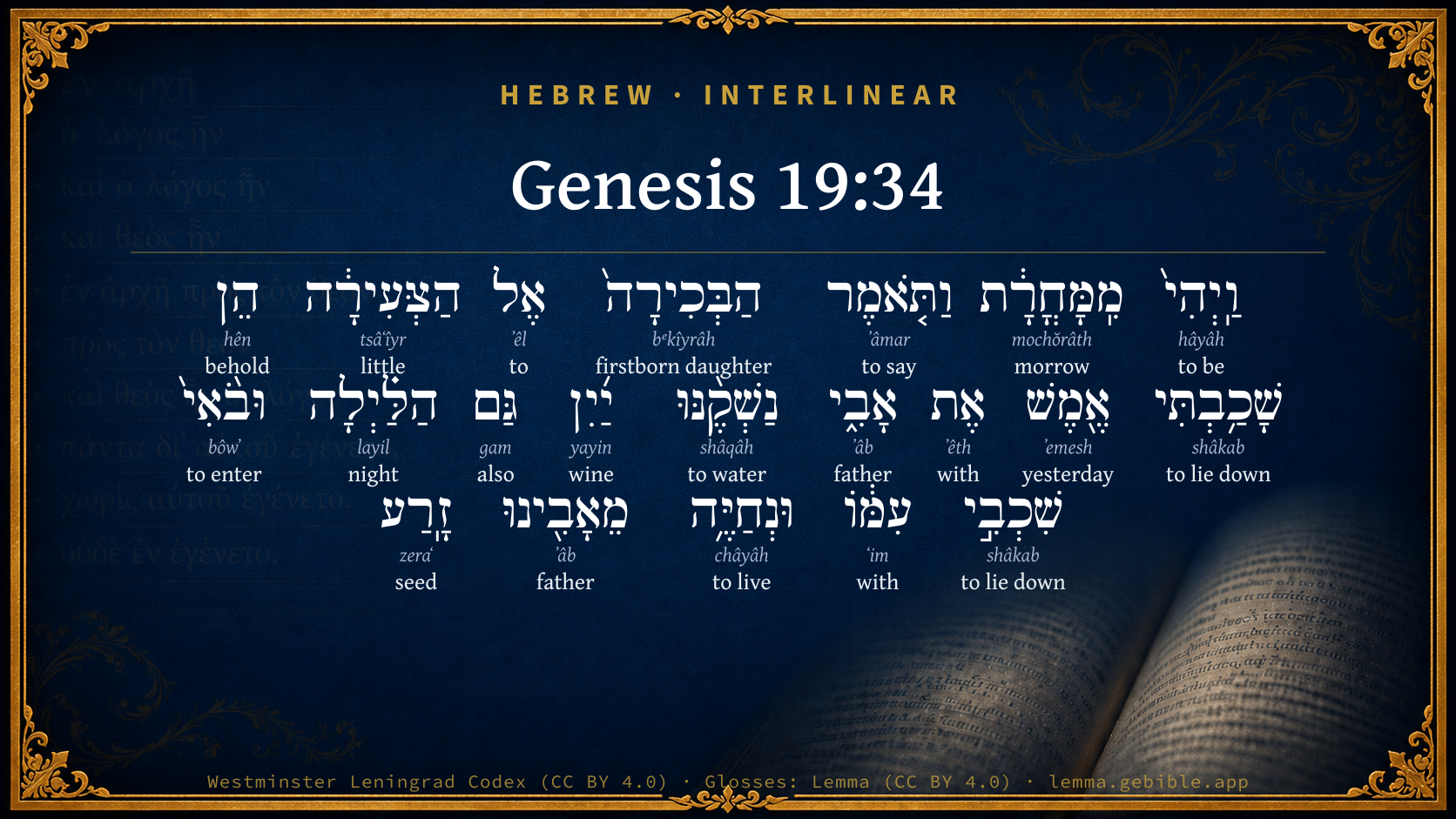
Hebrew (Westminster Leningrad Codex) Genesis 19:34 appears in the Hebrew Old Testament. The text above is from the Westminster Leningrad Codex. Each word links to its Strong’s number, a concise gloss, and parsing drawn from the Open Scriptures Hebrew Bible morphology. Click any word for its full Brown-Driver-Briggs (BDB) entry.
Download image
Cite this verse

Genesis 19:34 (World English Bible). Public Domain. Lemma interlinear Bible study tool, https://lemma.gebible.app/v/genesis/19/34.

Show BibTeX & RIS
BibTeX
RIS
English Translation
It came to pass on the next day, that the firstborn said to the younger, "Behold, I lay last night with my father. Let us make him drink wine again, tonight. You go in, and lie with him, that we may preserve our father's seed."
World English Bible · Public Domain
Highlights
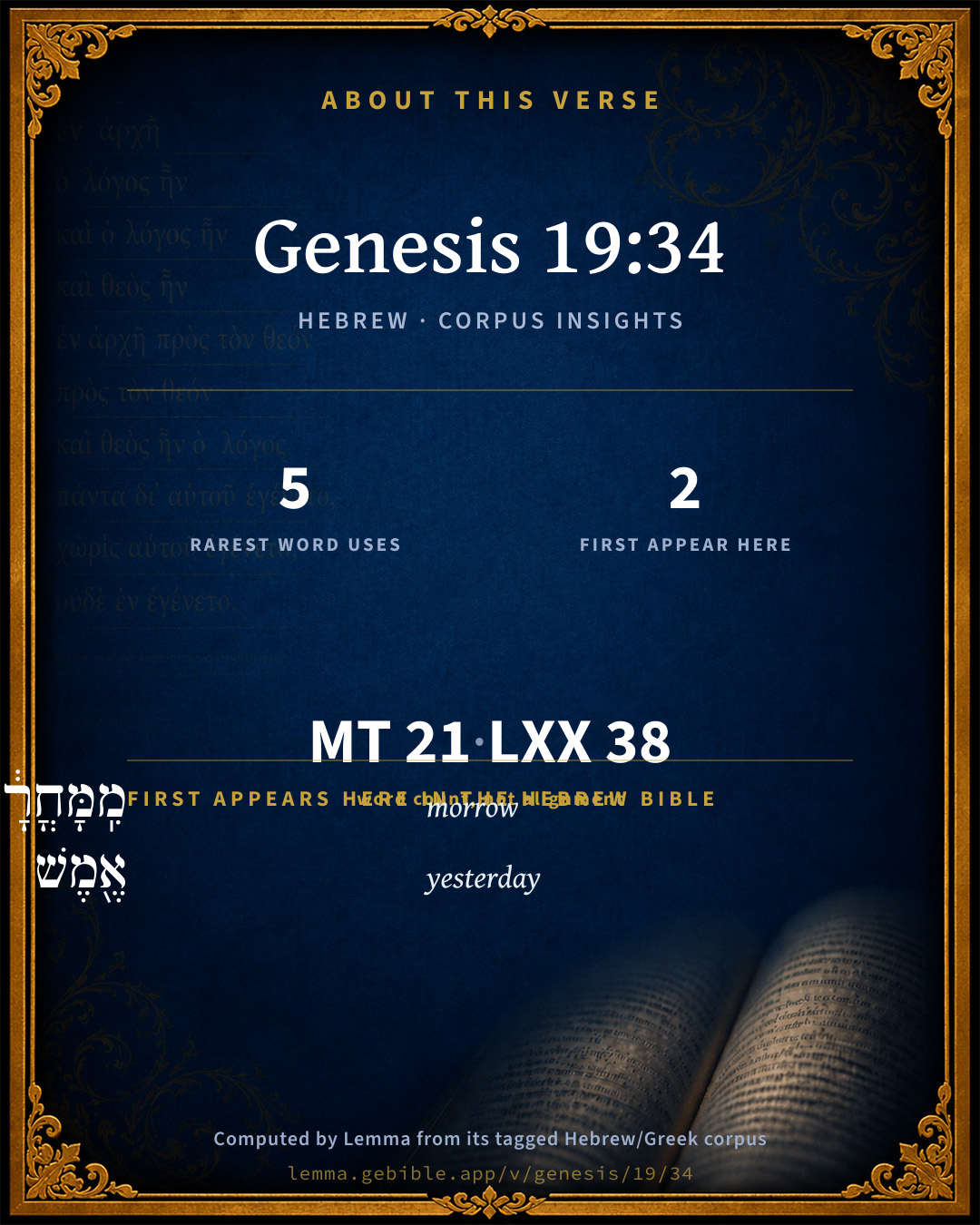
  • 2 first appearances in the Hebrew Bible
Full analysis ↓
Download a study sheet

One document with this verse’s original text, its word-by-word gloss line, the meaning frame, cross-references with their text, attributed commentary, and full source and license credits — printable, and it pastes into notes with its structure intact.

This verse Autodidact and up

Study sheet (.html) Plain text (.txt)

A passage Seminary Student

Up to 50 verses in one chapter. A passage sheet keeps up to 6 commentary sources and 12 cross-references per verse, in the order this page ranks them, and says so on the sheet whenever that leaves anything out. Ask for a single verse and you get the Autodidact verse sheet above.

Everything on this page stays free to read, with no account — the sheet is a download of what is already on screen, not access to it.

Want to remove ads? Support Godless Engineer
Compare translations 3

The same verse in 3 English versions, stacked beneath the original-language interlinear above. Click any original word for its lexicon entry.

Each is an independent rendering of the whole verse — the interlinear is not word-aligned to these translations.

Highlighted words mark where these versions differ — a whole-verse word diff, not a word-by-word alignment.

  • World English Bible Public Domain
    It came to pass on the next day, that the firstborn said to the younger, "Behold, I lay last night with my father. Let us make him drink wine again, tonight. You go in, and lie with him, that we may preserve our father's seed."
  • King James Version Public Domain
    And it came to pass on the morrow, that the firstborn said unto the younger, Behold, I lay yesternight with my father: let us make him drink wine this night also; and go thou in, and lie with him, that we may preserve seed of our father.
  • unfoldingWord Literal Text CC BY-SA 4.0
    And it happened on the next day that the firstborn said to the younger, “Behold, last night I lay with my father. Let us get him to drink wine again tonight. Then you go lie with him so that we will give life to offspring through our father.”

unfoldingWord Literal Text — © unfoldingWord, licensed CC BY-SA 4.0. Word-aligned USFM3 via Door43 (git.door43.org/unfoldingWord/en_ult).

Versions to compare (up to 4)

3 of 4 selected

Show all 18 translations

Every available English version of this verse, each an independent rendering of the whole verse.

  • World English Bible Public Domain
    It came to pass on the next day, that the firstborn said to the younger, "Behold, I lay last night with my father. Let us make him drink wine again, tonight. You go in, and lie with him, that we may preserve our father's seed."
  • Berean Standard Bible Public Domain
    The next day the older daughter said to the younger, “Look, I slept with my father last night. Let us get him drunk with wine again tonight so you can go in and sleep with him and we can preserve our father’s line.”
  • Majority Standard Bible Public Domain
    The next day the older daughter said to the younger, “Look, I slept with my father last night. Let us get him drunk with wine again tonight so you can go in and sleep with him and we can preserve our father’s line.”
  • King James Version Public Domain
    And it came to pass on the morrow, that the firstborn said unto the younger, Behold, I lay yesternight with my father: let us make him drink wine this night also; and go thou in, and lie with him, that we may preserve seed of our father.
  • American Standard Version (1901) Public Domain
    And it came to pass on the morrow, that the first-born said unto the younger, Behold, I lay yesternight with my father: let us make him drink wine this night also; and go thou in, and lie with him, that we may preserve seed of our father.
  • Revised Version (1885) Public Domain
    And it came to pass on the morrow, that the firstborn said unto the younger, Behold, I lay yesternight with my father: let us make him drink wine this night also; and go thou in, and lie with him, that we may preserve seed of our father.
  • Geneva Bible (1599) Public Domain
    And on the morowe the elder saide to the yonger, Behold, yester night lay I with my father: let vs make him drinke wine this night also, and goe thou and lie with him, that we may preserue seede of our father.
  • Douay-Rheims (1899) Public Domain
    And the next day the elder said to the younger: Behold I lay last night with my father, let us make him drink wine also to night, and thou shalt lie with him, that we may save seed of our father.
  • Young's Literal Translation Public Domain
    And it cometh to pass, on the morrow, that the first-born saith unto the younger, `Lo, I have lain yesterday-night with my father: we cause him to drink wine also to-night, and go thou in, lie with him, and we preserve from our father -- a seed.'
  • Literal Standard Version CC BY-SA 4.0
    And it comes to pass, on the next day, that the firstborn says to the younger, “Behold, I have lain with my father last night: we also cause him to drink wine tonight, then go in, lie with him, and we preserve a seed from our father.”
  • Unlocked Literal Bible CC BY-SA 4.0
    The next day the firstborn said to the younger, “Listen, last night I slept with my father. Let us make him drink wine tonight also, and you should go in and sleep with him, so that we may extend our father's line.”
  • unfoldingWord Literal Text CC BY-SA 4.0
    And it happened on the next day that the firstborn said to the younger, “Behold, last night I lay with my father. Let us get him to drink wine again tonight. Then you go lie with him so that we will give life to offspring through our father.”
  • Darby Bible Public Domain
    And it came to pass on the next day that the first-born said to the younger, Lo, I lay last night with my father: let us give him wine to drink to-night also, and go thou in, lie with him, that we may preserve seed alive of our father.
  • World Messianic Bible Public Domain
    It came to pass on the next day, that the firstborn said to the younger, “Behold, I lay last night with my father. Let’s make him drink wine again tonight. You go in, and lie with him, that we may preserve our father’s family line.”
  • Webster's Bible Public Domain
    And it came to pass on the morrow that the first born said to the younger, Behold, I lay yesternight with my father; let us make him drink wine this night also; and go thou in, and lie with him, that we may preserve seed of our father.
  • Free Bible Version CC BY-SA 4.0
    The next day the older daughter said to the younger one, “Last night I slept with our father. Let's get him drunk with wine again tonight and you can go and sleep with him so we can keep his family line going.”
  • Bible in Basic English Public Domain
    And on the day after, the older daughter said to the younger, Last night I was with my father; let us make him take much wine this night again, and do you go to him, so that we may have offspring by our father.
  • JPS Tanakh (1917) Public Domain
    And it came to pass on the morrow, that the first-born said unto the younger: 'Behold, I lay yesternight with my father. Let us make him drink wine this night also; and go thou in, and lie with him, that we may preserve seed of our father.'

Literal Standard Version (2020), Covenant Press — licensed CC BY-SA 4.0. Text via the HelloAO Bible API (eBible.org). Unlocked Literal Bible (unfoldingWord) — licensed CC BY-SA 4.0. Text via the HelloAO Bible API (eBible.org). unfoldingWord Literal Text — © unfoldingWord, licensed CC BY-SA 4.0. Word-aligned USFM3 via Door43 (git.door43.org/unfoldingWord/en_ult). Free Bible Version, Dr. Jonathan Gallagher — licensed CC BY-SA 4.0. Text via the HelloAO Bible API (eBible.org).

Word by word

More ways to search: Search by grammar → Find every occurrence → Compare this word →

Practice this passage: Drill this verse → Learn its vocabulary →

אֶ֖מֶשׁ
ʼemesh
H570
“yesterday”
Adverb
Part of Speech
Adverb
Full BDB Definition

Origin: unknown derivation

TWOT: 120

yesterday, last night - recently (figuratively)
  1. וַֽיְהִי֙ hâyâh H1961 “and · to be” Conjunction + Verb, Qal, Sequential Imperfect, 3rd Person, Masculine, Singular
  2. מִֽמָּחֳרָ֔ת mochŏrâth H4283 “from · morrow” Preposition + Noun, Common, Feminine, Singular, Absolute
  3. וַתֹּ֤אמֶר ʼâmar H559 “and · to say” Conjunction + Verb, Qal, Sequential Imperfect, 3rd Person, Feminine, Singular
  4. הַבְּכִירָה֙ bᵉkîyrâh H1067 “the · firstborn daughter” Particle, Definite Article + Noun, Common, Feminine, Singular, Absolute
  5. אֶל ʼêl H413 “to” Preposition
  6. הַצְּעִירָ֔ה tsâʻîyr H6810 “the · little” Particle, Definite Article + Adjective, Adjective, Feminine, Singular, Absolute
  7. הֵן hên H2005 “behold” Particle, Demonstrative
  8. שָׁכַ֥בְתִּי shâkab H7901 “to lie down” Verb, Qal, Perfect, 1st Person, Common, Singular
  9. אֶת ʼêth H854 “with” Preposition
  10. אָבִ֑י ʼâb H1 “father · my” Noun, Common, Masculine, Singular, Construct + Suffix, Personal, 1st Person, Common, Singular
  11. נַשְׁקֶ֨נּוּ shâqâh H8248 “to water · him” Verb, Hiphil, Cohortative, 1st Person, Common, Plural + Suffix, Personal, 3rd Person, Masculine, Singular
  12. יַ֜יִן yayin H3196 “wine” Noun, Common, Masculine, Singular, Absolute
  13. גַּם gam H1571 “also” Particle, Accusative
  14. הַלַּ֗יְלָה layil H3915 “the · night” Particle, Definite Article + Noun, Common, Masculine, Singular, Absolute
  15. וּבֹ֨אִי֙ bôwʼ H935 “and · enter” Conjunction + Verb, Qal, Imperative, 2nd Person, Feminine, Singular
  16. שִׁכְבִ֣י shâkab H7901 “lie down” Verb, Qal, Imperative, 2nd Person, Feminine, Singular
  17. עִמּ֔וֹ ʻim H5973 “with · him” Preposition + Suffix, Personal, 3rd Person, Masculine, Singular
  18. וּנְחַיֶּ֥ה châyâh H2421 “and · to live” Conjunction + Verb, Piel, Imperfect, 1st Person, Common, Plural
  19. מֵאָבִ֖ינוּ ʼâb H1 “from · father · our” Preposition + Noun, Common, Masculine, Singular, Construct + Suffix, Personal, 1st Person, Common, Plural
  20. זָֽרַע zeraʻ H2233 “seed” Noun, Common, Masculine, Singular, Absolute

About this verse

These counts appear in no published source. They are computed here, from the morphology-tagged text and Lemma’s own curated glosses. What Lemma adds →

21
words
19
distinct lemmas
Pentateuch
section

Notable vocabulary

The rarest word here is אֶ֖מֶשׁ yesterday H570 — appearing just 5 times in the whole Hebrew Bible.

First appearance in Scripture

These words make their first canonical appearance in the Hebrew Bible here:

  • מִֽמָּחֳרָ֔ת morrow H4283
  • אֶ֖מֶשׁ yesterday H570

Shared distinctive vocabulary

אֶ֖מֶשׁ yesterday H570 occurs in 5 verses of the Hebrew Bible. Also found in:

Grammatical profile

  • 7 verbs
  • 7 nouns
  • 1 adjective
  • 3 prepositions
  • 1 adverb
  • 2 particles

Verb forms

  • וַֽיְהִי֙ Qal · Sequential Imperfect
  • וַתֹּ֤אמֶר Qal · Sequential Imperfect
  • שָׁכַ֥בְתִּי Qal · Perfect
  • נַשְׁקֶ֨נּוּ Hiphil · Cohortative
  • וּבֹ֨אִי֙ Qal · Imperative
  • שִׁכְבִ֣י Qal · Imperative
  • וּנְחַיֶּ֥ה Piel · Imperfect

Repetition

Words recur within this verse — often emphatic in Hebrew:

  • שָׁכַ֥בְתִּי to lie down H7901 ×2
  • אָבִ֑י father H1 ×2

Hebrew & Septuagint length

In English translation the verse runs 45 words from the Hebrew and 50 from the Septuagint (LXX English) — closely comparable.

A rough comparison of the two English renderings, which tokenize alike — not a word-level alignment.

Word counts can differ between the Hebrew and the Greek without any difference in meaning — e.g. the Hebrew direct-object marker אֵת has no separate Greek word, and Greek often adds the article ὁ.

In the original languages it is 21 Hebrew tokens and 38 Greek tokens — but the two are counted differently (Hebrew bundles its prefixes and suffixes into one token; the Greek is in lemma form), so that isn’t a like-for-like length.

Cross-references

5

Topical passages linked to Genesis 19:34 in the Treasury of Scripture Knowledge — connected by theme and wording, ordered by reader-vote popularity; previews shown in the World English Bible.

  • Isaiah 3:9 The look of their faces testify against them. They parade their sin like Sodom. They don't hide it. Woe to their soul! For they have brought disaster upon themselves.
  • Jeremiah 3:3 Therefore the showers have been withheld, and there has been no latter rain; yet you have a prostitute's forehead, you refused to be ashamed.
  • Jeremiah 5:3 O Yahweh, don't your eyes look on truth? you have stricken them, but they were not grieved; you have consumed them, but they have refused to receive correction: they have made their faces harder than a rock; they have refused to return.
  • Jeremiah 6:15 Were they ashamed when they had committed abomination? nay, they were not at all ashamed, neither could they blush: therefore they shall fall among those who fall; at the time that I visit them they shall be cast down, says Yahweh.
  • Jeremiah 8:12 Were they ashamed when they had committed abomination? nay, they were not at all ashamed, neither could they blush: therefore shall they fall among those who fall; in the time of their visitation they shall be cast down, says Yahweh.

Cross-references courtesy of OpenBible.info (CC BY 4.0).

Hebrew and Greek witnesses Masoretic Hebrew ↔ Greek Septuagint

The same verse in the two great witnesses to the Old Testament, shown verse-for-verse.

These are two independent witnesses, not word-aligned to each other, and the Septuagint is shown in lemma (dictionary) form.

Hebrew Genesis 19:34 Masoretic · Westminster Leningrad Codex

וַֽיְהִי֙ מִֽמָּחֳרָ֔ת וַתֹּ֤אמֶר הַבְּכִירָה֙ אֶל הַצְּעִירָ֔ה הֵן שָׁכַ֥בְתִּי אֶ֖מֶשׁ אֶת אָבִ֑י נַשְׁקֶ֨נּוּ יַ֜יִן גַּם הַלַּ֗יְלָה וּבֹ֨אִי֙ שִׁכְבִ֣י עִמּ֔וֹ וּנְחַיֶּ֥ה מֵאָבִ֖ינוּ זָֽרַע

It came to pass on the next day, that the firstborn said to the younger, "Behold, I lay last night with my father. Let us make him drink wine again, tonight. You go in, and lie with him, that we may preserve our father's seed."

World English Bible · Public Domain

Greek LXX Genesis 19:34 Septuagint · lemma form

γίγνομαι δέ ὁ ἐπαύριον καί εἶπον ὁ πρεσβύτερος πρός ὁ νέος ἰδού κοιμάω χθές μετά ὁ πατήρ ἐγώ ποτίζω αὐτός οἶνος καί ὁ νύξ οὗτος καί εἰςἔρχομαι κοιμάω μετά αὐτός καί ἐκ ἀναἵστημι ἐκ ὁ πατήρ ἐγώ σπέρμα

And it came to pass on the morrow, that the elder said to the younger, Behold, I slept yesternight with our father, let us make him drink wine in this night also, and do you go in and sleep with him, and let us raise up seed of our father.

LXX2012 (modern English Septuagint) · Public Domain

Hebrew: Westminster Leningrad Codex (CC BY 4.0). Greek: Septuagint (public domain); English from LXX2012 (modern English Septuagint) (Public Domain). How the Septuagint differs from the Hebrew →

Targum (Aramaic paraphrase)

2

The Targum is the ancient Jewish Aramaic paraphrase of the Hebrew Scriptures — an interpretive translation, not the Hebrew text itself. Onkelos (literal) and Pseudo-Jonathan (expansive) render the Torah, and Jonathan the Prophets. Coverage is partial: where no permissively-licensed English translation exists for a verse, only the Aramaic is shown. This is verse-level text, not a word-by-word alignment to the Hebrew.

  1. Targum Onkelos Torah (Genesis–Deuteronomy)
    וַהֲוָה בְּיוֹמָא דְבַתְרוֹהִי וַאֲמֶרֶת רַבְּתָא לִזְעֶרְתָּא הָא שְׁכֵיבִית רַמְשָׁא עִם אַבָּא נַשְׁקִנֵּהּ חַמְרָא אַף בְּלֵילְיָא וְעוּלִי שְׁכִיבִי עִמֵּהּ וּנְקַיֵּם מֵאֲבוּנָא בְּנִין

    (no public-domain English translation for this verse)

    Targum Onkelos — Aramaic: “Onkelos Genesis” (public domain); “Onkelos Exodus” (public domain); “Onkelos Leviticus” (public domain); “Onkelos Numbers” (public domain); “Onkelos Deuteronomy” (public domain). English: “Sefaria Community Translation” (CC0 1.0 (public-domain dedication)); “J.W. Etheridge. The Targums of Onkelos and Jonathan Ben Uzziel on the Pentateuch. London: Longmans, Green, 1862” (public domain). Text via Sefaria.

  2. Targum Pseudo-Jonathan Torah (Genesis–Deuteronomy)
    וַהֲוָה מִיוֹמָחֳרָא וַאֲמָרַת רַבְּתָא לִזְעֵירְתָּא הָא כְּבַר שִׁמְשֵׁית רַמְשִׁי עִם אַבָּא נַשְׁקִינֵיהּ חַמְרָא אוּף בְּלֵילָא דֵין וִירְוֵי וְעוּלִי שִׁימוּשִׁי עִמֵיהּ וּנְקַיֵים מֵאָבוּנָא בְּנִין

    And it was the day following, and the elder said to the less, Behold, now, I lay my evening with the father; let us make him drink wine this night also, that he may be drunk; and go thou and lie with him, that we may raise up sons from our father.

    Targum Pseudo-Jonathan — Aramaic: “Targum Jonathan on Genesis” (public domain); “Targum Jonathan on Exodus” (public domain); “Targum Jonathan on Leviticus” (public domain); “Targum Jonathan on Numbers” (public domain); “Targum Jonathan on Deuteronomy” (public domain). English: “The Targum of Jonathan ben Uzziel, trans. J. W. Etheridge, London, 1862” (public domain). Text via Sefaria.

Commentary

Notes on Genesis 19:34 from classic Christian and Jewish commentators (each source and its license shown beneath its notes). The classic Christian expositions comment on the surrounding passage and are grouped to its opening verse, so a note may address several verses; the Jewish commentaries on the Tanakh (Rashi and others) are per-verse, so they appear only where the commentator wrote on this verse.

Lemma curates 59 commentaries, every one of them public domain or Creative Commons licensed, each selected and text-cleaned for this edition rather than reprinted as found. About our sources →

Trapp's Complete Commentary

John Trapp

Gen 19:34 And it came to pass on the morrow, that the firstborn said unto the younger, Behold, I lay yesternight with my father: let us make him drink wine this night also; and go thou in, [and] lie with him, that we may preserve seed of our father.

Ver. 34. The firstborn said unto the younger.] Lot offended against both their chastities, in offering them up to the Sodomites: and they both now conspire against his chastity.

John Trapp, A Commentary or Exposition upon All the Books of the Old and New Testament (1647–1656) — public domain. Text from a community e-Sword module.

Geneva Bible (1599)

Geneva Bible translators

Hebrew, keep alive.

Geneva Bible (1599) marginal notes — public domain. Text via Bolls.life.

John Gill's Exposition

And they made their father drink wine that night also,.... Until he was drunk; which is an aggravation of his sin, that he should be overtaken a second time, and that so soon as the next night, when he ought to have been upon his guard, knowing how he had fallen into it the night before:

and the younger arose and lay with him; arose from her own bed, and went to her father's, and lay down by him:

and he perceived not when she lay down, nor when she arose; See Gill on Gen 19:33.

John Gill's Exposition of the Whole Bible (1746–1763) — public domain (CC PDM 1.0). Text via the HelloAO Bible API.

The Pulpit Commentary

And it came to pass on the morrow, that the firstborn said unto the younger, Behold, I lay yester night with my father: let us make him drink wine this night also; and go thou in, and lie with him, that we may preserve seed of our father.

The Pulpit Commentary (1880–1919), ed. H.D.M. Spence-Jones & Joseph S. Exell — public domain. Text from a community e-Sword module.

unfoldingWord translationNotes

Door43 World Missions Community

Let us make him drink wine ... nor when she arose

See how you translated these phrases in Genesis 19:32-33.

drink wine

It can be made explicit that their goal was to get him drunk. AT: "drink wine until he gets drunk" or "get drunk with wine" (See: Assumed Knowledge and Implicit Information)

so that we may extend our father's line

This speaks about giving Lot descendants as if his family were a line that they are making longer. AT: "so that we can bear children who will be our father's descendants" (See: Metaphor)

He did not know when she lay down, nor when she arose

"he did not know anything about it" or "he did not know that she had slept with him"

translationWords

had relations with

wine

unfoldingWord translationNotes — © Distant Shores Media and the Door43 World Missions Community, licensed CC BY-SA 4.0. Source: git.door43.org/Door43/en_tn.

Radak

Rabbi David Kimhi (Radak)

ויהי...אמש, the previous night; the same word is used to describe a previous night when Lavan had been chastised by G’d and warned not to harm Yaakov in Genesis 31,42.

Radak on the Tanakh — English translations: “Sefaria Community Translation” (CC0 1.0 (public-domain dedication)); “Eliyahu Munk, HaChut Hameshulash” (CC BY 4.0); “Rabbi Mike Feuer, Jerusalem Anthology” (CC BY 4.0); and “R. David Kimhi on the first book of Psalms, Translated by R.G. Finch, London, 1919” (public domain). Text via Sefaria.

Lesson kit

Teaching starters — assembled from the data on this page, not authored interpretation. Every prompt links to the verse data it draws on. Edit before teaching.

Genesis, in the Pentateuch, opens this verse with 21 words (19 distinct Hebrew lemmas). Its most distinctive word is ʼemesh (“yesterday”). A historical commentator’s framing appears above. Read the whole chapter for the surrounding context.

Discussion questions

  1. What does “yesterday” (ʼemesh) contribute to the verse as a whole?
  2. 2 words make their first appearance in Scripture here. What does this debut establish?
  3. How does Genesis 31:29, which shares the word «yesterday», read alongside this verse?
  4. What does the repetition of “to lie down” (2× in this one verse) do in this verse?
  5. The translations on this page render this verse differently — a whole-verse word diff, not a word-by-word alignment. What might account for the different wordings?
  6. «וַֽיְהִי֙» is a Qal Sequential Imperfect verb. How does that grammatical form shape the action described?
  7. Compare how Trapp's Complete Commentary and Geneva Bible (1599) read this verse. Where do they agree or differ?

Things to notice

Reading settings

Reading text

Shown beneath each verse's original-language words.

Old Testament
Old Testament edition

Read the OT as the Masoretic Hebrew (MT) or the Greek Septuagint (LXX).

English shown for the Greek Septuagint (in the Hebrew ↔ Greek comparison).

Comparing translations? Open the Compare panel on any verse page to stack up to four side by side.