
Genesis 23:10

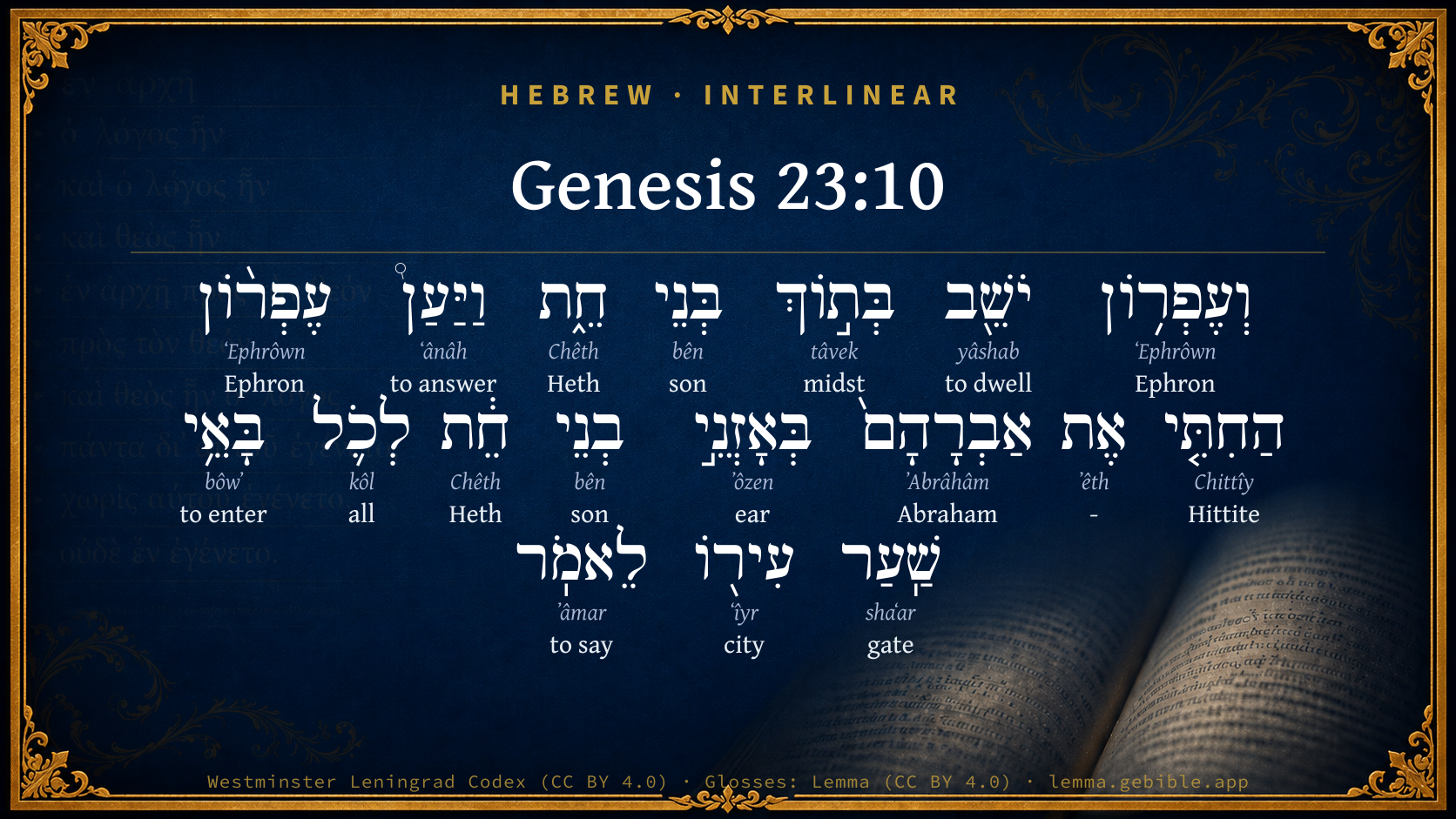
Hebrew (Westminster Leningrad Codex) Genesis 23:10 appears in the Hebrew Old Testament. The text above is from the Westminster Leningrad Codex. Each word links to its Strong’s number, a concise gloss, and parsing drawn from the Open Scriptures Hebrew Bible morphology. Click any word for its full Brown-Driver-Briggs (BDB) entry.
Download image
Cite this verse

Genesis 23:10 (World English Bible). Public Domain. Lemma interlinear Bible study tool, https://lemma.gebible.app/v/genesis/23/10.

Show BibTeX & RIS
BibTeX
RIS
English Translation
Now Ephron was sitting in the midst of the children of Heth. Ephron the Hittite answered Abraham in the hearing of the children of Heth, even of all who went in at the gate of his city, saying,
World English Bible · Public Domain
Download a study sheet

One document with this verse’s original text, its word-by-word gloss line, the meaning frame, cross-references with their text, attributed commentary, and full source and license credits — printable, and it pastes into notes with its structure intact.

This verse Autodidact and up

Study sheet (.html) Plain text (.txt)

A passage Seminary Student

Up to 50 verses in one chapter. A passage sheet keeps up to 6 commentary sources and 12 cross-references per verse, in the order this page ranks them, and says so on the sheet whenever that leaves anything out. Ask for a single verse and you get the Autodidact verse sheet above.

Everything on this page stays free to read, with no account — the sheet is a download of what is already on screen, not access to it.

Want to remove ads? Support Godless Engineer
Compare translations 3

The same verse in 3 English versions, stacked beneath the original-language interlinear above. Click any original word for its lexicon entry.

Each is an independent rendering of the whole verse — the interlinear is not word-aligned to these translations.

Highlighted words mark where these versions differ — a whole-verse word diff, not a word-by-word alignment.

  • World English Bible Public Domain
    Now Ephron was sitting in the midst of the children of Heth. Ephron the Hittite answered Abraham in the hearing of the children of Heth, even of all who went in at the gate of his city, saying,
  • King James Version Public Domain
    And Ephron dwelt among the children of Heth: and Ephron the Hittite answered Abraham in the audience of the children of Heth, even of all that went in at the gate of his city, saying,
  • unfoldingWord Literal Text CC BY-SA 4.0
    Now Ephron was sitting among the sons of Heth, so Ephron the Hittite responded to Abraham in the ears of the sons of Heth, for everyone who had come the gate of his city, saying,

unfoldingWord Literal Text — © unfoldingWord, licensed CC BY-SA 4.0. Word-aligned USFM3 via Door43 (git.door43.org/unfoldingWord/en_ult).

Versions to compare (up to 4)

3 of 4 selected

Show all 18 translations

Every available English version of this verse, each an independent rendering of the whole verse.

  • World English Bible Public Domain
    Now Ephron was sitting in the midst of the children of Heth. Ephron the Hittite answered Abraham in the hearing of the children of Heth, even of all who went in at the gate of his city, saying,
  • Berean Standard Bible Public Domain
    Now Ephron was sitting among the sons of Heth. So in the presence of all the Hittites who had come to the gate of his city, Ephron the Hittite answered Abraham,
  • Majority Standard Bible Public Domain
    Now Ephron was sitting among the sons of Heth. So in the presence of all the Hittites who had come to the gate of his city, Ephron the Hittite answered Abraham,
  • King James Version Public Domain
    And Ephron dwelt among the children of Heth: and Ephron the Hittite answered Abraham in the audience of the children of Heth, even of all that went in at the gate of his city, saying,
  • American Standard Version (1901) Public Domain
    Now Ephron was sitting in the midst of the children of Heth. And Ephron the Hittite answered Abraham in the audience of the children of Heth, even of all that went in at the gate of his city, saying,
  • Revised Version (1885) Public Domain
    Now Ephron was sitting in the midst of the children of Heth: and Ephron the Hittite answered Abraham in the audience of the children of Heth, even of all that went in at the gate of his city, saying,
  • Geneva Bible (1599) Public Domain
    (For Ephron dwelt among the Hittites) Then Ephron the Hittite answered Abraham in the audience of all the Hittites that went in at the gates of his citie, saying,
  • Douay-Rheims (1899) Public Domain
    Now Ephron dwelt in the midst of the children of Heth. And Ephron made answer to Abraham in the hearing of all that went in at the gate of the city, saying:
  • Young's Literal Translation Public Domain
    And Ephron is sitting in the midst of the sons of Heth, and Ephron the Hittite answereth Abraham in the ears of the sons of Heth, of all those entering the gate of his city, saying,
  • Literal Standard Version CC BY-SA 4.0
    And Ephron is sitting in the midst of the sons of Heth, and Ephron the Hittite answers Abraham in the ears of the sons of Heth, of all those entering the gate of his city, saying,
  • Unlocked Literal Bible CC BY-SA 4.0
    Now Ephron was sitting among the sons of Heth, and Ephron the Hittite answered Abraham in the hearing of the sons of Heth, of all those who had come into the gate of his city, saying,
  • unfoldingWord Literal Text CC BY-SA 4.0
    Now Ephron was sitting among the sons of Heth, so Ephron the Hittite responded to Abraham in the ears of the sons of Heth, for everyone who had come the gate of his city, saying,
  • Darby Bible Public Domain
    And Ephron was dwelling among the sons of Heth. And Ephron the Hittite answered Abraham, in the ears of the sons of Heth, [even] of all that went in at the gate of his city, saying,
  • World Messianic Bible Public Domain
    Now Ephron was sitting in the middle of the children of Heth. Ephron the Hittite answered Abraham in the hearing of the children of Heth, even of all who went in at the gate of his city, saying,
  • Webster's Bible Public Domain
    And Ephron dwelt among the children of Heth. And Ephron the Hittite answered Abraham in the audience of the children of Heth, of all that entered the gates of his city, saying,
  • Free Bible Version CC BY-SA 4.0
    Ephron the Hittite was sitting there among his people. He replied to Abraham in the presence of the Hittites who were there at the town gate.
  • Bible in Basic English Public Domain
    Now Ephron was seated among the children of Heth: and Ephron the Hittite gave Abraham his answer in the hearing of the children of Heth, and of all those who came into his town, saying,
  • JPS Tanakh (1917) Public Domain
    Now Ephron was sitting in the midst of the children of Heth; and Ephron the Hittite answered Abraham in the hearing of the children of Heth, even of all that went in at the gate of his city, saying:

Literal Standard Version (2020), Covenant Press — licensed CC BY-SA 4.0. Text via the HelloAO Bible API (eBible.org). Unlocked Literal Bible (unfoldingWord) — licensed CC BY-SA 4.0. Text via the HelloAO Bible API (eBible.org). unfoldingWord Literal Text — © unfoldingWord, licensed CC BY-SA 4.0. Word-aligned USFM3 via Door43 (git.door43.org/unfoldingWord/en_ult). Free Bible Version, Dr. Jonathan Gallagher — licensed CC BY-SA 4.0. Text via the HelloAO Bible API (eBible.org).

Word by word

More ways to search: Search by grammar → Find every occurrence → Compare this word →

Practice this passage: Drill this verse → Learn its vocabulary →

חֵ֑ת
Chêth
H2845
“Heth”
Noun, Proper
Part of Speech
Noun
Type
Proper
Full BDB Definition

Origin: from H2865

TWOT: 776

Heth = "terror" - a son of Canaan and the progenitor of the Hittites
  1. וְעֶפְר֥וֹן ʻEphrôwn H6085 “and · Ephron” Conjunction + Noun, Proper
  2. יֹשֵׁ֖ב yâshab H3427 “dwelling” Verb, Qal, Participle Active, Masculine, Singular, Absolute
  3. בְּת֣וֹךְ tâvek H8432 “in/at · midst of” Preposition + Noun, Common, Masculine, Singular, Construct
  4. בְּנֵי bên H1121 “sons of” Noun, Common, Masculine, Plural, Construct
  5. וַיַּעַן֩ ʻânâh H6030 “and · to answer” Conjunction + Verb, Qal, Sequential Imperfect, 3rd Person, Masculine, Singular
  6. עֶפְר֨וֹן ʻEphrôwn H6085 “Ephron” Noun, Proper
  7. הַחִתִּ֤י Chittîy H2850 “the · Hittite” Particle, Definite Article + Noun, Gentilic, Masculine, Singular, Absolute
  8. אֶת ʼêth H853 “-” Particle, Direct Object
  9. אַבְרָהָם֙ ʼAbrâhâm H85 “Abraham” Noun, Proper
  10. בְּאָזְנֵ֣י ʼôzen H241 “in/at · ears of” Preposition + Noun, Common, Feminine, Dual, Construct
  11. בְנֵי bên H1121 “sons of” Noun, Common, Masculine, Plural, Construct
  12. חֵ֔ת Chêth H2845 “Heth” Noun, Proper
  13. לְכֹ֛ל kôl H3605 “to/for · all of” Preposition + Noun, Common, Masculine, Singular, Construct
  14. בָּאֵ֥י bôwʼ H935 “entering” Verb, Qal, Participle Active, Masculine, Plural, Construct
  15. שַֽׁעַר shaʻar H8179 “gate of” Noun, Common, Masculine, Singular, Construct
  16. עִיר֖וֹ ʻîyr H5892 “city · his” Noun, Common, Feminine, Singular, Construct + Suffix, Personal, 3rd Person, Masculine, Singular
  17. לֵאמֹֽר ʼâmar H559 “to say” Preposition + Verb, Qal, Infinitive Construct

About this verse

These counts appear in no published source. They are computed here, from the morphology-tagged text and Lemma’s own curated glosses. What Lemma adds →

18
words
15
distinct lemmas
Pentateuch
section

Notable vocabulary

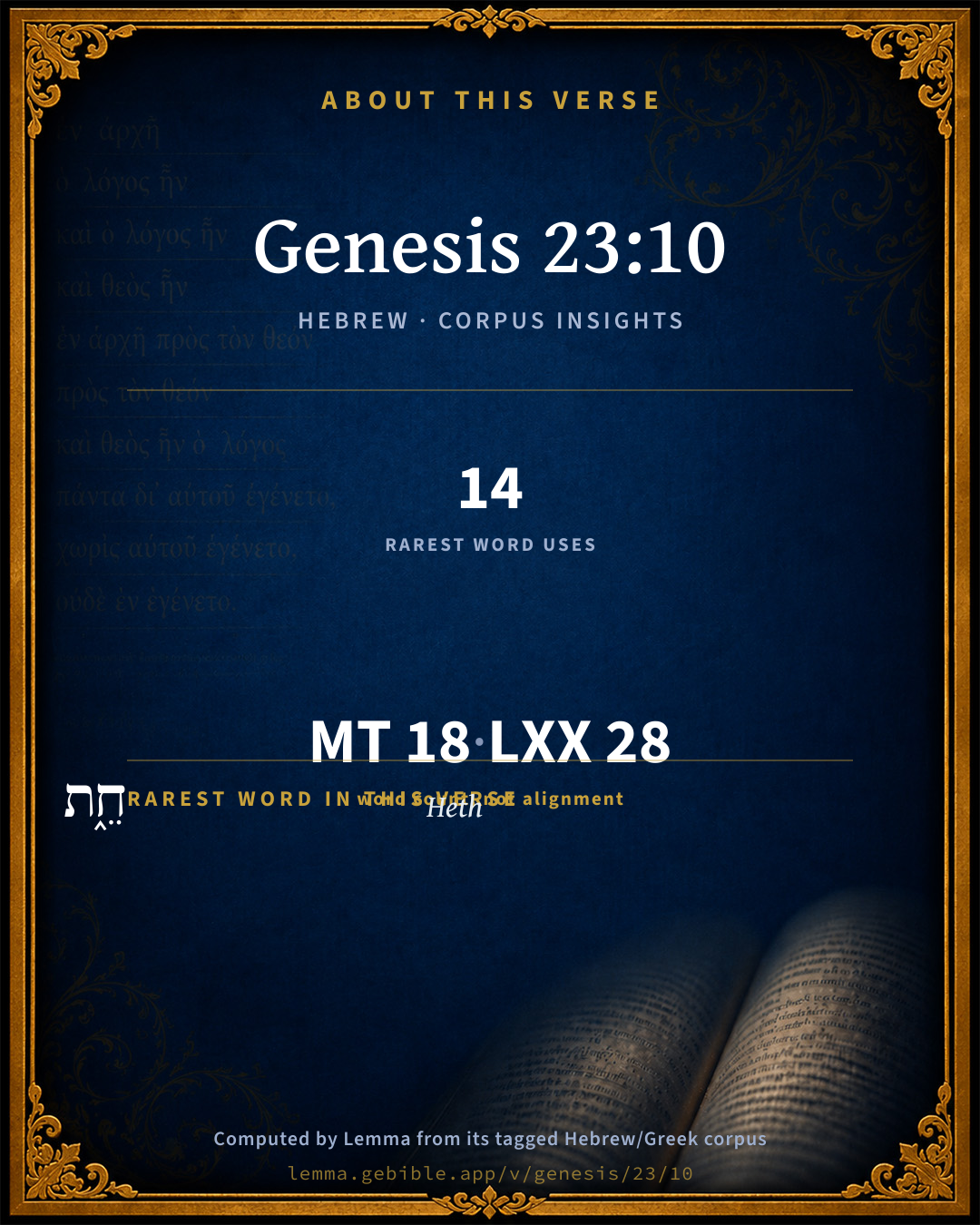
The rarest word here is חֵ֑ת Heth H2845 — appearing just 14 times in the whole Hebrew Bible.

Shared distinctive vocabulary

חֵ֑ת Heth H2845 occurs in 12 verses of the Hebrew Bible. Also found in:

Grammatical profile

  • 4 verbs
  • 13 nouns
  • 1 particle

Verb forms

  • יֹשֵׁ֖ב Qal · Participle Active
  • וַיַּעַן֩ Qal · Sequential Imperfect
  • בָּאֵ֥י Qal · Participle Active
  • לֵאמֹֽר Qal · Infinitive Construct

Repetition

Words recur within this verse — often emphatic in Hebrew:

  • וְעֶפְר֥וֹן Ephron H6085 ×2
  • בְּנֵי son H1121 ×2
  • חֵ֑ת Heth H2845 ×2

Hebrew & Septuagint length

In English translation the verse runs 38 words from the Hebrew and 36 from the Septuagint (LXX English) — closely comparable.

A rough comparison of the two English renderings, which tokenize alike — not a word-level alignment.

Word counts can differ between the Hebrew and the Greek without any difference in meaning — e.g. the Hebrew direct-object marker אֵת has no separate Greek word, and Greek often adds the article ὁ.

In the original languages it is 18 Hebrew tokens and 28 Greek tokens — but the two are counted differently (Hebrew bundles its prefixes and suffixes into one token; the Greek is in lemma form), so that isn’t a like-for-like length.

Cross-references

9

Topical passages linked to Genesis 23:10 in the Treasury of Scripture Knowledge — connected by theme and wording, ordered by reader-vote popularity; previews shown in the World English Bible.

  • Genesis 34:20 Hamor and Shechem, his son, came to the gate of their city, and talked with the men of their city, saying,
  • Genesis 34:24 All who went out of the gate of his city listened to Hamor, and to Shechem his son; and every male was circumcised, all who went out of the gate of his city.
  • Genesis 23:18 to Abraham for a possession in the presence of the children of Heth, before all who went in at the gate of his city.
  • Genesis 24:10 The servant took ten camels, of his master's camels, and departed, having all goodly things of his master's in his hand. He arose, and went to Mesopotamia, to the city of Nahor.
  • Ruth 4:1–4 Now Boaz went up to the gate, and sat him down there: and, behold, the near kinsman of whom Boaz spoke came by; to whom he said, Ho, such a one! turn aside, sit down here. He turned aside, and sat down.
  • Job 29:7 When I went forth to the city gate, When I prepared my seat in the street,
  • Isaiah 28:6 and a spirit of justice to him who sits in judgment, and strength to those who turn back the battle at the gate.
  • Matthew 9:1 He entered into a boat, and crossed over, and came into his own city.
  • Luke 2:3–4 All went to enroll themselves, everyone to his own city.

Cross-references courtesy of OpenBible.info (CC BY 4.0).

Hebrew and Greek witnesses Masoretic Hebrew ↔ Greek Septuagint

The same verse in the two great witnesses to the Old Testament, shown verse-for-verse.

These are two independent witnesses, not word-aligned to each other, and the Septuagint is shown in lemma (dictionary) form.

Hebrew Genesis 23:10 Masoretic · Westminster Leningrad Codex

וְעֶפְר֥וֹן יֹשֵׁ֖ב בְּת֣וֹךְ בְּנֵי חֵ֑ת וַיַּעַן֩ עֶפְר֨וֹן הַחִתִּ֤י אֶת אַבְרָהָם֙ בְּאָזְנֵ֣י בְנֵי חֵ֔ת לְכֹ֛ל בָּאֵ֥י שַֽׁעַר עִיר֖וֹ לֵאמֹֽר

Now Ephron was sitting in the midst of the children of Heth. Ephron the Hittite answered Abraham in the hearing of the children of Heth, even of all who went in at the gate of his city, saying,

World English Bible · Public Domain

Greek LXX Genesis 23:10 Septuagint · lemma form

εφρων δέ κάθημαι ἐν μέσος ὁ υἱός χετ ἀποκρίνω δέ εφρων ὁ χετταῖος πρός αβρααμ εἶπον ἀκούω ὁ υἱός χετ καί πᾶς ὁ εἰςπορεύομαι εἰς ὁ πόλις λέγω

Now Ephron was sitting in the midst of the children of Chet, and Ephron the Chettite answered Abraam and spoke in the hearing of the sons of Chet, and of all who entered the city, saying,

LXX2012 (modern English Septuagint) · Public Domain

On this verse, The Pulpit Commentary discusses the Septuagint’s reading. Read the note in Commentary ↓

Hebrew: Westminster Leningrad Codex (CC BY 4.0). Greek: Septuagint (public domain); English from LXX2012 (modern English Septuagint) (Public Domain). How the Septuagint differs from the Hebrew →

Targum (Aramaic paraphrase)

2

The Targum is the ancient Jewish Aramaic paraphrase of the Hebrew Scriptures — an interpretive translation, not the Hebrew text itself. Onkelos (literal) and Pseudo-Jonathan (expansive) render the Torah, and Jonathan the Prophets. Coverage is partial: where no permissively-licensed English translation exists for a verse, only the Aramaic is shown. This is verse-level text, not a word-by-word alignment to the Hebrew.

  1. Targum Onkelos Torah (Genesis–Deuteronomy)
    וְעֶפְרוֹן יָתֵב בְּגוֹ בְּנֵי חִתָּאָה וְאָתֵיב עֶפְרוֹן חִתָּאָה יָת אַבְרָהָם קֳדָם בְּנֵי חִתָּאָה לְכֹל עָלֵי תְּרַע קַרְתֵּהּ לְמֵימָר

    (no public-domain English translation for this verse)

    Targum Onkelos — Aramaic: “Onkelos Genesis” (public domain); “Onkelos Exodus” (public domain); “Onkelos Leviticus” (public domain); “Onkelos Numbers” (public domain); “Onkelos Deuteronomy” (public domain). English: “Sefaria Community Translation” (CC0 1.0 (public-domain dedication)); “J.W. Etheridge. The Targums of Onkelos and Jonathan Ben Uzziel on the Pentateuch. London: Longmans, Green, 1862” (public domain). Text via Sefaria.

  2. Targum Pseudo-Jonathan Torah (Genesis–Deuteronomy)
    וְעֶפְרוֹן יָתֵיב בְּגוֹ בְּנֵי חִיתָּאָה וְאָתֵיב עֶפְרוֹן חִיתָּאָה יַת אַבְרָהָם בְּאַנְפֵּי בְּנֵי חִיתָּאָה לְכָל עָלֵי תְרַע קַרְתֵּיהּ לְמֵימַר

    But Ephron the Hittite answered Abraham in the presence of the sons of Hittah, of all who entered the gate of his city, saying,

    Targum Pseudo-Jonathan — Aramaic: “Targum Jonathan on Genesis” (public domain); “Targum Jonathan on Exodus” (public domain); “Targum Jonathan on Leviticus” (public domain); “Targum Jonathan on Numbers” (public domain); “Targum Jonathan on Deuteronomy” (public domain). English: “The Targum of Jonathan ben Uzziel, trans. J. W. Etheridge, London, 1862” (public domain). Text via Sefaria.

Commentary

Notes on Genesis 23:10 from classic Christian and Jewish commentators (each source and its license shown beneath its notes). The classic Christian expositions comment on the surrounding passage and are grouped to its opening verse, so a note may address several verses; the Jewish commentaries on the Tanakh (Rashi and others) are per-verse, so they appear only where the commentator wrote on this verse.

Lemma curates 59 commentaries, every one of them public domain or Creative Commons licensed, each selected and text-cleaned for this edition rather than reprinted as found. About our sources →

Trapp's Complete Commentary

John Trapp

Gen 23:10 And Ephron dwelt among the children of Heth: and Ephron the Hittite answered Abraham in the audience of the children of Heth, [even] of all that went in at the gate of his city, saying,

Ver. 10. And Ephron dwelt.] Or, was sitting, sc., as a city counsellor.

John Trapp, A Commentary or Exposition upon All the Books of the Old and New Testament (1647–1656) — public domain. Text from a community e-Sword module.

Geneva Bible (1599)

Geneva Bible translators

Meaning, all the citizens and inhabitants.

Geneva Bible (1599) marginal notes — public domain. Text via Bolls.life.

Jamieson, Fausset & Brown

Robert Jamieson, A. R. Fausset & David Brown

Ephron dwelt--literally, was "sitting" among the children of Heth in the gate of the city where all business was transacted. But, though a chief man among them, he was probably unknown to Abraham.

Jamieson, Fausset & Brown — Commentary Critical and Explanatory on the Whole Bible (1871) — public domain (CC PDM 1.0). Text via the HelloAO Bible API.

Adam Clarke's Commentary

Verse 10. And Ephron dwelt among the children of Heth] And Ephron ישב yosheb, was sitting among the children of Heth, but, as was before conjectured, was personally unknown to Abraham; he therefore answered for himself, making a free tender of the field, &c., to Abraham, in the presence of all the people, which amounted to a legal conveyance of the whole property to the patriarch.

Adam Clarke's Commentary on the Bible (1810–1826) — public domain. Text from a community e-Sword/MySword module.

Ellicott's Commentary for English Readers

(10) And Ephron dwelt among . . . —Again a mistranslation. The Heb. is, Ephron was sitting in the midst of the Hittites. At these assemblies held at the gate of the city every free-born citizen had a right to be present, and matters were settled by common consent. As Ephron was the owner of the cave, his approval was necessary, and this Abraham treats as a favour, and requests that Ephron’s fellow-citizens will intercede in his behalf.

A Bible Commentary for English Readers, edited by Charles John Ellicott (1878–1897) — public domain. Text from a community e-Sword module.

The Cambridge Bible for Schools and Colleges

gen. ed. J. J. S. Perowne

10. audience] Lit. “ears,” as in Gen_23:13; Gen_23:16. The presence of witnesses is evidently requisite for the validity of the transaction: cf. Rth_4:9-11.

all that went in at the gate of his city] Cf. Gen_23:18. A technical phrase to denote full citizens. The gate was the place of popular assembly for the elders of a city; cf. Gen_19:1.

A similar phrase occurs in Gen_34:24, “all that went out at the gate.” The classical illustration of business transactions conducted at “the gate” of a city is to be found in the Book of Ruth, chap. Gen_4:1 ff.

The Cambridge Bible for Schools and Colleges (gen. ed. J. J. S. Perowne; Cambridge University Press, 1878–1918) — public domain. Text from a community e-Sword module.

John Gill's Exposition

And Ephron dwelt among the children of Heth,.... Or "sat" (b) among them, in the present assembly of them; and, according to Jarchi, as their president for the time on this occasion; but if so, Abraham would have directed his speech to him: however, he was upon the spot, as appears from what follows:

and Ephron the Hittite answered Abraham in the audience of the children of Heth; he rose up in the assembly upon the mention of his name, and in the hearing of the rest of the princes gave an answer himself to Abraham's request:

even of all that went in at the gates of his city; the city of Kirjatharba, afterwards called Hebron, Gen 23:2, where he was born, or however where he now lived; and perhaps it, or the greater part of it, was his possession and property: it was now at one of the gates of this city, where the assembly of the princes was held; it being usual to hold assemblies on any business, or courts of judicature, in such places, they being public, where multitudes resorted, or were continually passing and repassing, and so had the opportunity of hearing, and of being witnesses:

saying; as follows:

(b) Sept. "sedens", Montanus; "sedebat", Junius & Tremellius, Piscator, Drusius, Schmidt.

John Gill's Exposition of the Whole Bible (1746–1763) — public domain (CC PDM 1.0). Text via the HelloAO Bible API.

Matthew Poole's English Annotations

Ephron dwelt, Heb. did sit, to wit, at that time, as one of the chief or rulers of the people; for so the word sitting is oft used, as we shall see hereafter.

His city; either where he was born, or at least where he lived.

Matthew Poole's English Annotations on the Holy Bible (1683–1685) — public domain. Text from a community e-Sword/MySword module.

Whedon's Commentary on the Bible

Daniel D. Whedon

10. Ephron… at the gate of his city — Here note that the scene has changed. Those children of Heth with whom Abraham first communed (Gen_23:8) on the purchase of the cave, have broken the matter to the owner, and he now appears sitting ישׁבat the gate, where all such business is publicly transacted in the audience, or hearing, of all that congregated there, and speaks. See further on Gen_23:17.

Daniel D. Whedon (gen. ed.), Commentary on the Old and New Testaments (1874–1909) — public domain. Text from a community e-Sword module.

The Pulpit Commentary

And Ephron dwelt among the children of Heth. Not habitabat (Vulgate), in the sense of resided amongst, but sedebat, ejkaqhto (LXX); was then present sitting amongst the townspeople (Rosenm but whether in the capacity of a magistrate or councilor is not stated. And Ephron the Hittite answered Abraham in the audience of the children of Hath, even of all that went in at the gate of his city, this does not imply that he was the chief magistrate (Keil), but only thathe was a prominent citizen (Murphy). On the gate of the city as a place for transacting business vide Gen 19:1saying

The Pulpit Commentary (1880–1919), ed. H.D.M. Spence-Jones & Joseph S. Exell — public domain. Text from a community e-Sword module.

Kretzmann's Popular Commentary

Paul E. Kretzmann

The Purchase of Machpelah

v. 10. And Ephron dwelt among the children of Heth. And Ephron, the Hittite, answered Abraham in the audience of the children of Heth, even of all that went in at the gate of his city, saying,

v. 11. Nay, my lord, hear me: the field give I thee, and the cave that is therein, I give it thee; in the presence of the sons of my people give I it thee; bury thy dead. The same Oriental politeness continued to be exercised throughout. The offer of Ephron, the Hittite, made before the ears of all the members of his tribe and of all his fellow-citizens, was hardly intended seriously; for if Abraham had accepted his offer, he would, according to custom, have expected a very rich counter-present, and, in case Abraham chose to purchase the land, Ephron’s offer was designed to prevent any abatement of the price he had fixed in his mind.

v. 12. And Abraham bowed down himself before the people of the land. He once more gratefully acknowledged the kind intention of the Hittites, also in this offer as made by Ephron; he was not to be outdone in politeness.

v. 13. And he spake unto Ephron in the audience of the people of the land, saying, But if thou wilt give it, I pray thee, hear me: I will give thee money for the field; take it of me, and I will bury my dead there. The words of Abraham at this point indicate some measure of agitation and a shade of impatience: But if thou-Oh, that thou wouldest listen to me! As he had indicated from the start, he did not want the cave as a gift, but had come prepared to pay for it.

v. 14. And Ephron answered Abraham, saying unto him,

v. 15. My lord, hearken unto me: the land is worth four hundred shekels of silver; what is that betwixt me and thee? Bury therefore thy dead. Ephron here named his price: "The field-four hundred shekels silver; between me and thee, what is that?" It is named in courtly terms and intimates an apology for the demand, since Abraham would insist upon having it thus. The silver shekel being worth about 50 cents, the piece of land with the cave Machpelah cost Abraham two hundred dollars. "A piece of land of so little value could not be the matter of a long transaction between two rich men. "

v. 16. And Abraham hearkened unto Ephron; and Abraham weighed to Ephron the silver which he had named in the audience of the sons of Heth, four hundred shekels of silver, current money with the merchant. There were no stamped coins with a fixed value in Canaan at that time, but there seem to have been pieces of silver of a definite weight, which could readily be weighed out. In a transaction such as that recorded here, these pieces were weighed out in order to show that no fraud was being attempted. Abraham weighed out full measure, as it was required with the merchants, in honest business Christians, as the apostle rightly says, will avoid even the appearance of evil. Abraham here gave evidence of his faith by buying a small piece of land in the country which was promised to his descendants, being sure that the Lord would keep His promise.

Paul E. Kretzmann, Popular Commentary of the Bible (1921–1924) — public domain. Text from a community e-Sword module.

unfoldingWord translationNotes

Door43 World Missions Community

Now Ephron was sitting among the sons of Heth

Here "Now" is used here to mark a change from the story to background information about Ephron. (See: Background Information)

Ephron

This is the name of a man. See how you translated this in Genesis 23:8. (See: How to Translate Names)

the sons of Heth

Here "sons" stands for those who descended from Heth. See how you translated this in Genesis 23:3. AT: "the descendants of Heth" (See: How to Translate Names)

in the hearing of the sons of Heth

The abstract noun "the hearing" can be stated as "hear" or "listening." AT: "so that all the sons of Heth could hear him" or "while all the sons of Heth were listening" (See: Abstract Nouns)

all those who had come into the gate of his city

This tells which sons of Heth were listening. AT: "all those who had gathered at the gate of his city" (See: Distinguishing versus Informing or Reminding)

gate of his city

The city gate was where the leaders of the city would meet to make important decisions.

his city

"the city where he lived." This phrase shows that Ephron belonged to that city. It does not mean that he owned it.

my master

This phrase is used to show respect to Abraham.

in the presence of the sons of my people

Here "presence" stands for the people serving as witnesses. AT: "with my fellow countrymen as my witnesses" (See: Metonymy)

sons of my people

This means "my fellow countrymen" or "my fellow Hittites"

my people

This phrase shows that Ephron was part of that group of people. It does not mean that he was their leader.

I give it to you to bury your dead

"I give it to you. Bury your dead"

your dead

The nominal adjective "dead" can be stated as a verb or simply as "wife." AT: "your wife who has died" or "your wife" (See: Nominal Adjectives)

translationWords

Hittite

Abraham

gate

unfoldingWord translationNotes — © Distant Shores Media and the Door43 World Missions Community, licensed CC BY-SA 4.0. Source: git.door43.org/Door43/en_tn.

Rashi

Rabbi Shlomo Yitzchaki (Rashi)

ועפרון ישב The verb is written without a ו so that it may be read ישב he sat, thus indicating that on that very day they had appointed him (Ephron) to be an officer over them. Because of the high standing of Abraham who needed to negotiate with him, he was elevated to a dignified position (so that Abraham whom they esteemed as a great prince might have to negotiate with an equal and not with an inferior person (Genesis Rabbah 58:7).

לכל באי שער עירו OF ALL THAT CAME IN AT THE GATE OF HIS CITY — for they all left their work and came to pay their last respect to Sarah (Genesis Rabbah 58:7).

Rashi on the Tanakh — English translations: “The Judaica Press complete Tanach with Rashi, translated by A. J. Rosenberg” (CC BY 4.0); “Pentateuch with Rashi's commentary by M. Rosenbaum and A.M. Silbermann, 1929-1934” (public domain); “The Metsudah Tanach series, Lakewood, N.J” (CC BY 4.0); and “The Book of Joshua, Metsudah Publications, 1997” (CC BY 4.0). Text via Sefaria.

Radak

Rabbi David Kimhi (Radak)

ועפרון..באזני בני חת, in a loud voice, making sure they could all hear him. In this verse the Torah emphasises the aural aspect of the negotiations, whereas in verse 18, at the conclusion of the transaction the visible aspect, לעיני בני חת is stressed, as at that point eye-witnesses were more important. We find such a sequence of aural perception and visual perception also in Job 29,11 כי אזן שמעה ותאשרני ועין ראתה ותעידני, “for the ear that heard acclaimed me, and the eyes that saw were my witness.”

לכל באי שער עירו, including all the people of his city, prominent or plain people. באי שער, people who enter or leave through the gate. In other words, everybody. Sometimes the Torah refers to באי שער, people entering through the gate, other times יוצאי עירו, people leaving via the gate. (compare Genesis 34,24) It all amounts to the same thing. For the sake of brevity the Torah mentions only either באי or יוצאי. Sometimes it mentions both, as in Jeremiah 17,19.

Radak on the Tanakh — English translations: “Sefaria Community Translation” (CC0 1.0 (public-domain dedication)); “Eliyahu Munk, HaChut Hameshulash” (CC BY 4.0); “Rabbi Mike Feuer, Jerusalem Anthology” (CC BY 4.0); and “R. David Kimhi on the first book of Psalms, Translated by R.G. Finch, London, 1919” (public domain). Text via Sefaria.

Lesson kit

Teaching starters — assembled from the data on this page, not authored interpretation. Every prompt links to the verse data it draws on. Edit before teaching.

Genesis, in the Pentateuch, opens this verse with 18 words (15 distinct Hebrew lemmas). Its most distinctive word is Chêth (“Heth”). A historical commentator’s framing appears above. Read the whole chapter for the surrounding context.

Discussion questions

  1. How does “Heth” (Chêth) shape what this verse is saying?
  2. Genesis 10:15 shares the word «Heth» with this verse. How do the two illuminate each other?
  3. “Ephron” occurs 2× in this one verse. What is the effect of the repetition?
  4. These translations render this verse differently; the difference is in the English rendering, not the original. What questions does that raise?
  5. The verb «יֹשֵׁ֖ב» is Qal Participle Active. How does its form color the action?
  6. Reading how Trapp's Complete Commentary and Geneva Bible (1599) read this verse, where do the two commentators agree and where do they part?

Things to notice

Reading settings

Reading text

Shown beneath each verse's original-language words.

Old Testament
Old Testament edition

Read the OT as the Masoretic Hebrew (MT) or the Greek Septuagint (LXX).

English shown for the Greek Septuagint (in the Hebrew ↔ Greek comparison).

Comparing translations? Open the Compare panel on any verse page to stack up to four side by side.