
Genesis 37:10

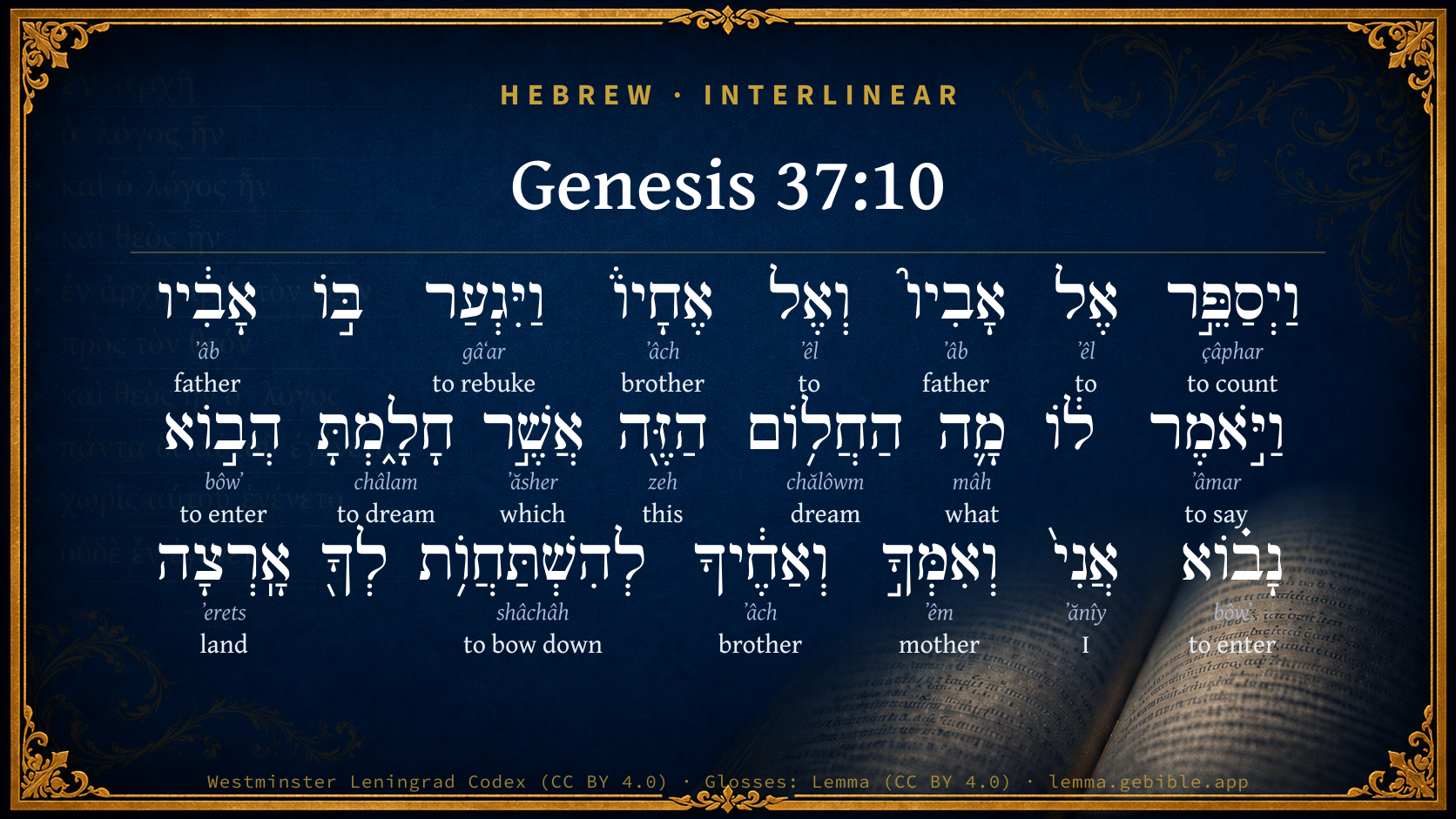
Hebrew (Westminster Leningrad Codex) Genesis 37:10 appears in the Hebrew Old Testament. The text above is from the Westminster Leningrad Codex. Each word links to its Strong’s number, a concise gloss, and parsing drawn from the Open Scriptures Hebrew Bible morphology. Click any word for its full Brown-Driver-Briggs (BDB) entry.
Download image
Cite this verse

Genesis 37:10 (World English Bible). Public Domain. Lemma interlinear Bible study tool, https://lemma.gebible.app/v/genesis/37/10.

Show BibTeX & RIS
BibTeX
RIS
English Translation
He told it to his father and to his brothers. His father rebuked him, and said to him, "What is this dream that you have dreamed? Will I and your mother and your brothers indeed come to bow ourselves down to you to the earth?"
World English Bible · Public Domain
Highlights
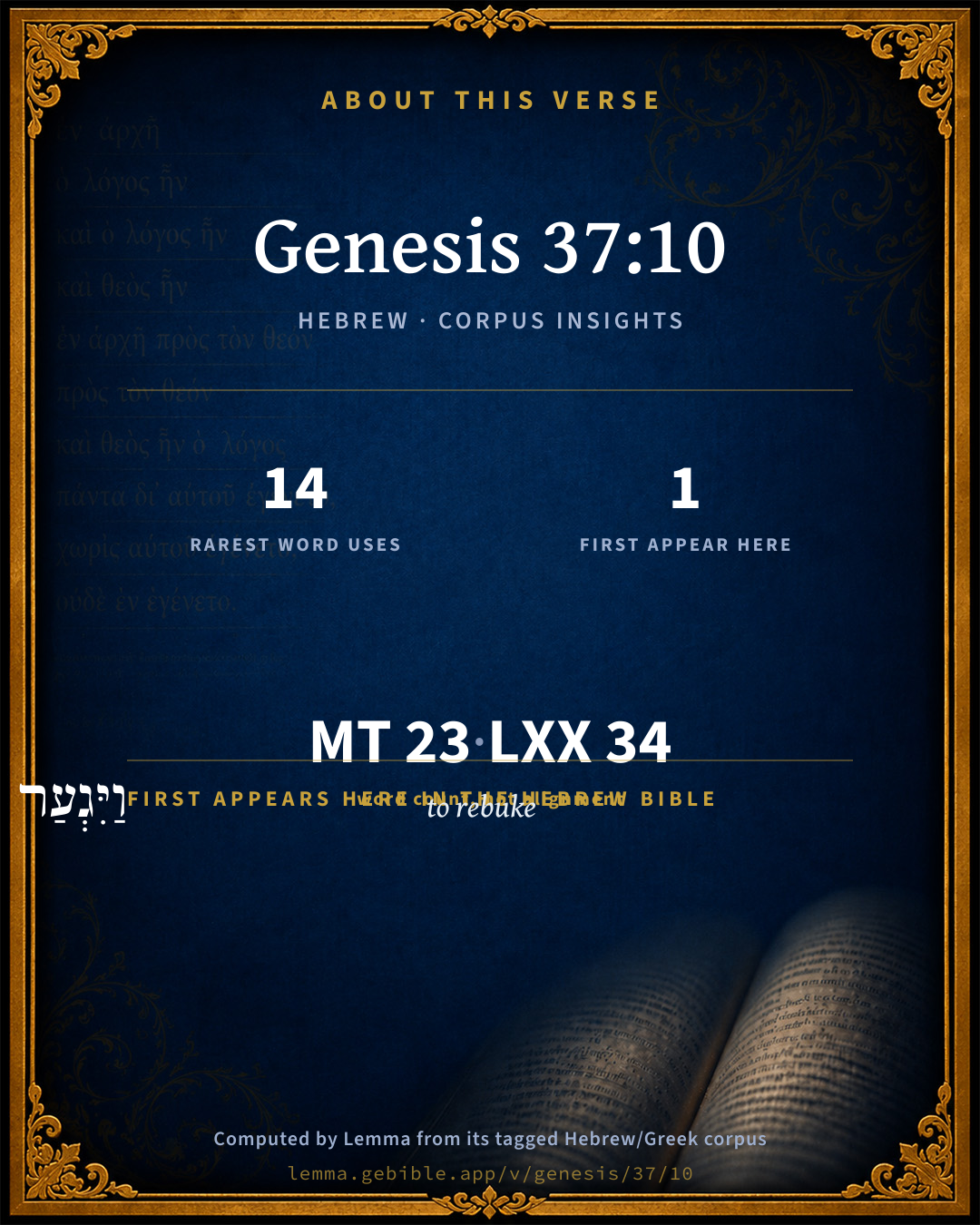
  • 1 first appearance in the Hebrew Bible
Full analysis ↓
Download a study sheet

One document with this verse’s original text, its word-by-word gloss line, the meaning frame, cross-references with their text, attributed commentary, and full source and license credits — printable, and it pastes into notes with its structure intact.

This verse Autodidact and up

Study sheet (.html) Plain text (.txt)

A passage Seminary Student

Up to 50 verses in one chapter. A passage sheet keeps up to 6 commentary sources and 12 cross-references per verse, in the order this page ranks them, and says so on the sheet whenever that leaves anything out. Ask for a single verse and you get the Autodidact verse sheet above.

Everything on this page stays free to read, with no account — the sheet is a download of what is already on screen, not access to it.

Want to remove ads? Support Godless Engineer
Compare translations 3

The same verse in 3 English versions, stacked beneath the original-language interlinear above. Click any original word for its lexicon entry.

Each is an independent rendering of the whole verse — the interlinear is not word-aligned to these translations.

Highlighted words mark where these versions differ — a whole-verse word diff, not a word-by-word alignment.

  • World English Bible Public Domain
    He told it to his father and to his brothers. His father rebuked him, and said to him, "What is this dream that you have dreamed? Will I and your mother and your brothers indeed come to bow ourselves down to you to the earth?"
  • King James Version Public Domain
    And he told it to his father, and to his brethren: and his father rebuked him, and said unto him, What is this dream that thou hast dreamed? Shall I and thy mother and thy brethren indeed come to bow down ourselves to thee to the earth?
  • unfoldingWord Literal Text CC BY-SA 4.0
    And he related it to his father and to his brothers, but his father rebuked him and said to him, “What this dream that you dreamed? Will your mother and I and your brothers really come to bow down to the ground to you?”

unfoldingWord Literal Text — © unfoldingWord, licensed CC BY-SA 4.0. Word-aligned USFM3 via Door43 (git.door43.org/unfoldingWord/en_ult).

Versions to compare (up to 4)

3 of 4 selected

Show all 18 translations

Every available English version of this verse, each an independent rendering of the whole verse.

  • World English Bible Public Domain
    He told it to his father and to his brothers. His father rebuked him, and said to him, "What is this dream that you have dreamed? Will I and your mother and your brothers indeed come to bow ourselves down to you to the earth?"
  • Berean Standard Bible Public Domain
    He told his father and brothers, but his father rebuked him and said, “What is this dream that you have had? Will your mother and brothers and I actually come and bow down to the ground before you?”
  • Majority Standard Bible Public Domain
    He told his father and brothers, but his father rebuked him and said, “What is this dream that you have had? Will your mother and brothers and I actually come and bow down to the ground before you?”
  • King James Version Public Domain
    And he told it to his father, and to his brethren: and his father rebuked him, and said unto him, What is this dream that thou hast dreamed? Shall I and thy mother and thy brethren indeed come to bow down ourselves to thee to the earth?
  • American Standard Version (1901) Public Domain
    And he told it to his father, and to his brethren; and his father rebuked him, and said unto him, What is this dream that thou hast dreamed? Shall I and thy mother and thy brethren indeed come to bow down ourselves to thee to the earth?
  • Revised Version (1885) Public Domain
    And he told it to his father, and to his brethren; and his father rebuked him, and said unto him, What is this dream that thou hast dreamed? Shall I and thy mother and thy brethren indeed come to bow down ourselves to thee to the earth?
  • Geneva Bible (1599) Public Domain
    Then he tolde it vnto his father and to his brethren, and his father rebuked him, and saide vnto him, What is this dreame, which thou hast dreamed? shall I, and thy mother, and thy brethren come in deede and fall on the ground before thee?
  • Douay-Rheims (1899) Public Domain
    And when he had told this to his father and brethren, his father rebuked him, and said: What meaneth this dream that thou hast dreamed? shall I and thy mother, and thy brethren worship thee upon the earth?
  • Young's Literal Translation Public Domain
    And he recounteth unto his father, and unto his brethren; and his father pusheth against him, and saith to him, `What `is' this dream which thou hast dreamt? do we certainly come -- I, and thy mother, and thy brethren -- to bow ourselves to thee, to the earth?'
  • Literal Standard Version CC BY-SA 4.0
    And he recounts to his father, and to his brothers; and his father pushes against him, and says to him, “What [is] this dream which you have dreamed? Do we certainly come, I, and your mother, and your brothers—to bow ourselves to you, to the earth?”
  • Unlocked Literal Bible CC BY-SA 4.0
    He told it to his father just as to his brothers, and his father rebuked him. He said to him, “What is this dream that you have dreamed? Will your mother and I and your brothers actually come to bow down to the ground to you?”
  • unfoldingWord Literal Text CC BY-SA 4.0
    And he related it to his father and to his brothers, but his father rebuked him and said to him, “What this dream that you dreamed? Will your mother and I and your brothers really come to bow down to the ground to you?”
  • Darby Bible Public Domain
    And he told [it] to his father and to his brethren. And his father rebuked him, and said to him, What is this dream which thou hast dreamt? Shall we indeed come, I and thy mother and thy brethren, to bow down ourselves to thee to the earth?
  • World Messianic Bible Public Domain
    He told it to his father and to his brothers. His father rebuked him, and said to him, “What is this dream that you have dreamed? Will I and your mother and your brothers indeed come to bow ourselves down to the earth before you?”
  • Webster's Bible Public Domain
    And he told it to his father, and to his brethren: and his father rebuked him, and said to him, what is this dream that thou hast dreamed? Shall I and thy mother and thy brethren indeed come to bow down ourselves to thee to the earth?
  • Free Bible Version CC BY-SA 4.0
    He also told his father as well as his brothers, and his father told him off, saying, “What's this dream that you've had? Are we—I and your mother and brothers—really going to come and bow down to the ground before you?”
  • Bible in Basic English Public Domain
    And he gave word of it to his father and his brothers; but his father protesting said, What sort of a dream is this? am I and your mother and your brothers to go down on our faces to the earth before you?
  • JPS Tanakh (1917) Public Domain
    And he told it to his father, and to his brethren; and his father rebuked him, and said unto him: 'What is this dream that thou hast dreamed? Shall I and thy mother and thy brethren indeed come to bow down to thee to the earth?'

Literal Standard Version (2020), Covenant Press — licensed CC BY-SA 4.0. Text via the HelloAO Bible API (eBible.org). Unlocked Literal Bible (unfoldingWord) — licensed CC BY-SA 4.0. Text via the HelloAO Bible API (eBible.org). unfoldingWord Literal Text — © unfoldingWord, licensed CC BY-SA 4.0. Word-aligned USFM3 via Door43 (git.door43.org/unfoldingWord/en_ult). Free Bible Version, Dr. Jonathan Gallagher — licensed CC BY-SA 4.0. Text via the HelloAO Bible API (eBible.org).

Word by word

More ways to search: Search by grammar → Find every occurrence → Compare this word →

Practice this passage: Drill this verse → Learn its vocabulary →

וַיִּגְעַר
gâʻar
H1605
“and · to rebuke”
Conjunction + Verb, Qal, Sequential Imperfect, 3rd Person, Masculine, Singular
Part of Speech
Conjunction + Verb
Stem
Qal
Form
Sequential Imperfect
Person
3rd Person
Gender
Masculine
Number
Singular
Full BDB Definition

Origin: a primitive root

TWOT: 370

(Qal) to rebuke, reprove, corrupt
  1. וַיְסַפֵּ֣ר çâphar H5608 “and · to count” Conjunction + Verb, Piel, Sequential Imperfect, 3rd Person, Masculine, Singular
  2. אֶל ʼêl H413 “to” Preposition
  3. אָבִיו֮ ʼâb H1 “father · his” Noun, Common, Masculine, Singular, Construct + Suffix, Personal, 3rd Person, Masculine, Singular
  4. וְאֶל ʼêl H413 “and · to” Conjunction + Preposition
  5. אֶחָיו֒ ʼâch H251 “brothers · his” Noun, Common, Masculine, Plural, Construct + Suffix, Personal, 3rd Person, Masculine, Singular
  6. אָבִ֔יו ʼâb H1 “father · his” Noun, Common, Masculine, Singular, Construct + Suffix, Personal, 3rd Person, Masculine, Singular
  7. וַיֹּ֣אמֶר ʼâmar H559 “and · to say” Conjunction + Verb, Qal, Sequential Imperfect, 3rd Person, Masculine, Singular
  8. מָ֛ה mâh H4100 “what” Particle, Interrogative
  9. הַחֲל֥וֹם chălôwm H2472 “the · dream” Particle, Definite Article + Noun, Common, Masculine, Singular, Absolute
  10. הַזֶּ֖ה zeh H2088 “the · this” Particle, Definite Article + Pronoun, Demonstrative, Masculine, Singular
  11. אֲשֶׁ֣ר ʼăsher H834 “which” Particle, Relative
  12. חָלָ֑מְתָּ châlam H2492 “to dream” Verb, Qal, Perfect, 2nd Person, Masculine, Singular
  13. הֲב֣וֹא bôwʼ H935 “to enter” Particle, Interrogative + Verb, Qal, Infinitive Absolute
  14. נָב֗וֹא bôwʼ H935 “to enter” Verb, Qal, Imperfect, 1st Person, Common, Plural
  15. אֲנִי֙ ʼănîy H589 “I” Pronoun, Personal, 1st Person, Common, Singular
  16. וְאִמְּךָ֣ ʼêm H517 “and · mother · your” Conjunction + Noun, Common, Feminine, Singular, Construct + Suffix, Personal, 2nd Person, Masculine, Singular
  17. וְאַחֶ֔יךָ ʼâch H251 “and · brothers · your” Conjunction + Noun, Common, Masculine, Plural, Construct + Suffix, Personal, 2nd Person, Masculine, Singular
  18. לְהִשְׁתַּחֲוֺ֥ת shâchâh H7812 “to bow down” Preposition + Verb, Hithpael, Infinitive Construct
  19. אָֽרְצָה ʼerets H776 “land · toward” Noun, Common, Both, Singular, Absolute + Suffix, Demonstrative

About this verse

These counts appear in no published source. They are computed here, from the morphology-tagged text and Lemma’s own curated glosses. What Lemma adds →

23
words
16
distinct lemmas
Pentateuch
section

Notable vocabulary

The rarest word here is וַיִּגְעַר to rebuke H1605 — appearing just 14 times in the whole Hebrew Bible.

First appearance in Scripture

This word makes its first canonical appearance in the Hebrew Bible here:

  • וַיִּגְעַר to rebuke H1605

Shared distinctive vocabulary

וַיִּגְעַר to rebuke H1605 occurs in 13 verses of the Hebrew Bible. Also found in:

Grammatical profile

  • 7 verbs
  • 7 nouns
  • 2 pronouns
  • 5 prepositions
  • 2 particles

Verb forms

  • וַיְסַפֵּ֣ר Piel · Sequential Imperfect
  • וַיִּגְעַר Qal · Sequential Imperfect
  • וַיֹּ֣אמֶר Qal · Sequential Imperfect
  • חָלָ֑מְתָּ Qal · Perfect
  • הֲב֣וֹא Qal · Infinitive Absolute
  • נָב֗וֹא Qal · Imperfect
  • לְהִשְׁתַּחֲוֺ֥ת Hithpael · Infinitive Construct

Repetition

Words recur within this verse — often emphatic in Hebrew:

  • אָבִיו֮ father H1 ×2
  • אֶחָיו֒ brother H251 ×2
  • הֲב֣וֹא to enter H935 ×2
  • אֶל to H413 ×2

Hebrew & Septuagint length

In English translation the verse runs 45 words from the Hebrew and 35 from the Septuagint (LXX English) — closely comparable.

A rough comparison of the two English renderings, which tokenize alike — not a word-level alignment.

Word counts can differ between the Hebrew and the Greek without any difference in meaning — e.g. the Hebrew direct-object marker אֵת has no separate Greek word, and Greek often adds the article ὁ.

In the original languages it is 23 Hebrew tokens and 34 Greek tokens — but the two are counted differently (Hebrew bundles its prefixes and suffixes into one token; the Greek is in lemma form), so that isn’t a like-for-like length.

Cross-references

4

Topical passages linked to Genesis 37:10 in the Treasury of Scripture Knowledge — connected by theme and wording, ordered by reader-vote popularity; previews shown in the World English Bible.

  • Genesis 27:29 Let peoples serve you, Nations bow down to you. Be lord over your brothers, Let your mother's sons bow down to you. Cursed be everyone who curses you, Blessed be everyone who blesses you."
  • Genesis 37:7 for, behold, we were binding sheaves in the field, and behold, my sheaf arose and also stood upright; and behold, your sheaves came around, and bowed down to my sheaf."
  • Isaiah 60:14 The sons of those who afflicted you shall come bending to you; and all those who despised you shall bow themselves down at the soles of your feet; and they shall call you The city of Yahweh, The Zion of the Holy One of Israel.
  • Philippians 2:10–11 that at the name of Jesus every knee should bow, of those in heaven, those on earth, and those under the earth,

Cross-references courtesy of OpenBible.info (CC BY 4.0).

Hebrew and Greek witnesses Masoretic Hebrew ↔ Greek Septuagint

The same verse in the two great witnesses to the Old Testament, shown verse-for-verse.

These are two independent witnesses, not word-aligned to each other, and the Septuagint is shown in lemma (dictionary) form.

Hebrew Genesis 37:10 Masoretic · Westminster Leningrad Codex

וַיְסַפֵּ֣ר אֶל אָבִיו֮ וְאֶל אֶחָיו֒ וַיִּגְעַר בּ֣וֹ אָבִ֔יו וַיֹּ֣אמֶר ל֔וֹ מָ֛ה הַחֲל֥וֹם הַזֶּ֖ה אֲשֶׁ֣ר חָלָ֑מְתָּ הֲב֣וֹא נָב֗וֹא אֲנִי֙ וְאִמְּךָ֣ וְאַחֶ֔יךָ לְהִשְׁתַּחֲוֺ֥ת לְךָ֖ אָֽרְצָה

He told it to his father and to his brothers. His father rebuked him, and said to him, "What is this dream that you have dreamed? Will I and your mother and your brothers indeed come to bow ourselves down to you to the earth?"

World English Bible · Public Domain

Greek LXX Genesis 37:10 Septuagint · lemma form

καί ἐπιτιμάω αὐτός ὁ πατήρ αὐτός καί εἶπον αὐτός τίς ὁ ἐνύπνιον οὗτος ὅς ἐνὑπνιάζω ἆρα γέ ἔρχομαι ἔρχομαι ἐγώ τε καί ὁ μήτηρ σύ καί ὁ ἀδελφός σύ προςκυνέω σύ ἐπί ὁ γῆ

And his father rebuked him, and said to him, What is this dream which you have dreamed? shall indeed both I and your mother and your brethren come and bow before you to the earth?

LXX2012 (modern English Septuagint) · Public Domain

Hebrew: Westminster Leningrad Codex (CC BY 4.0). Greek: Septuagint (public domain); English from LXX2012 (modern English Septuagint) (Public Domain). How the Septuagint differs from the Hebrew →

Targum (Aramaic paraphrase)

2

The Targum is the ancient Jewish Aramaic paraphrase of the Hebrew Scriptures — an interpretive translation, not the Hebrew text itself. Onkelos (literal) and Pseudo-Jonathan (expansive) render the Torah, and Jonathan the Prophets. Coverage is partial: where no permissively-licensed English translation exists for a verse, only the Aramaic is shown. This is verse-level text, not a word-by-word alignment to the Hebrew.

  1. Targum Onkelos Torah (Genesis–Deuteronomy)
    וְאִשְׁתָּעֵי לַאֲבוּהִי וְלַאֲחוֹהִי וּנְזַף בֵּהּ אֲבוּהִי וַאֲמַר לֵהּ מָה חֶלְמָא הָדֵין דִּי חֲלֵמְתָּא הֲמֵיתָא נֵיתֵי אֲנָא וְאִמָּךְ וְאַחָיךְ לְמִסְגֻד לָךְ עַל אַרְעָא

    (no public-domain English translation for this verse)

    Targum Onkelos — Aramaic: “Onkelos Genesis” (public domain); “Onkelos Exodus” (public domain); “Onkelos Leviticus” (public domain); “Onkelos Numbers” (public domain); “Onkelos Deuteronomy” (public domain). English: “Sefaria Community Translation” (CC0 1.0 (public-domain dedication)); “J.W. Etheridge. The Targums of Onkelos and Jonathan Ben Uzziel on the Pentateuch. London: Longmans, Green, 1862” (public domain). Text via Sefaria.

  2. Targum Pseudo-Jonathan Torah (Genesis–Deuteronomy)
    וְאִשְׁתְּעִי לְאָבוֹי וּלְאָחוֹי וּנְזַף בֵּיהּ אָבוֹי וַאֲמַר לֵיהּ מָה חֶלְמָא הָדֵין דְחַלֵימְתָּא הֲמֵיתָא נֵיתֵי אֲנָא וְאִמָךְ וְאָחָךְ לְמִגְחַן לָךְ עַל אַרְעָא

    And he related it to his father and to his brethren: but his father rebuked him, and said to him, What dream is this that thou hast dreamed? Shall I, and thy mother, and thy brethren, really come and bow before thee to the ground?

    Targum Pseudo-Jonathan — Aramaic: “Targum Jonathan on Genesis” (public domain); “Targum Jonathan on Exodus” (public domain); “Targum Jonathan on Leviticus” (public domain); “Targum Jonathan on Numbers” (public domain); “Targum Jonathan on Deuteronomy” (public domain). English: “The Targum of Jonathan ben Uzziel, trans. J. W. Etheridge, London, 1862” (public domain). Text via Sefaria.

Commentary

Notes on Genesis 37:10 from classic Christian and Jewish commentators (each source and its license shown beneath its notes). The classic Christian expositions comment on the surrounding passage and are grouped to its opening verse, so a note may address several verses; the Jewish commentaries on the Tanakh (Rashi and others) are per-verse, so they appear only where the commentator wrote on this verse.

Lemma curates 59 commentaries, every one of them public domain or Creative Commons licensed, each selected and text-cleaned for this edition rather than reprinted as found. About our sources →

Trapp's Complete Commentary

John Trapp

Gen 37:10 And he told [it] to his father, and to his brethren: and his father rebuked him, and said unto him, What [is] this dream that thou hast dreamed? Shall I and thy mother and thy brethren indeed come to bow down ourselves to thee to the earth?

Ver. 10. And his father rebuked him.] Either as not yet understanding the mystery, or dissembling it. It is wisdom, at some time, and in some place, to pretend a dislike of another man’s fact (so far as we may with truth), for the preventing of envy. This, some think, was Jacob’s drift here. And therefore he draws an argument, ab impossibili et absurdo; Shall thy dead mother rise and reverence thee? A likely matter: and yet, as light as Jacob made of it, to unload Joseph of the envy, he laid it to heart. {Gen 37:11}

John Trapp, A Commentary or Exposition upon All the Books of the Old and New Testament (1647–1656) — public domain. Text from a community e-Sword module.

Joseph Benson's Commentary

Gen 37:10. He told it to his father — The dream was so strongly impressed upon his mind, and that, no doubt, by the Spirit of God, that he could not rest till he had acquainted his father with it. His father rebuked him — Not through anger or contempt of his dream, for it follows, he observed it; but partly lest Joseph should be elated with the idea of superiority over his brethren, and give place to pride on account of his dreams, and principally to allay the envy and hatred of his brethren. In his thus rebuking him, although in regard to Joseph without cause, Jacob is an example worthy of the imitation of all parents, who, when they observe any appearance of arrogance, self-exaltation, or aspiring after high things in any of their children, ought always to check it, as being a sinful disposition, and often productive of very evil consequences. Shall I and thy mother — Leah, his step-mother, one that filled his mother’s place, and was now Jacob’s only wife, and the mother of the family. Or he means, “Shall thy mother Rachel rise from the dead to come and join with me in worshipping thee?” In which sense of the words he seems to infer the idleness of the dream, the fulfilling of it being impossible.

Joseph Benson's Commentary on the Old and New Testaments (1811–1818) — public domain. Text from a community e-Sword module.

Tyndale Open Study Notes

Tyndale Open Resources

37:10 your mother and I: Joseph’s birth mother, Rachel, was dead (35:19). Leah was now the matriarch of the clan.

Tyndale Open Study Notes — © Tyndale Open Resources, licensed CC BY-SA 4.0. Text via the HelloAO Bible API.

Geneva Bible (1599)

Geneva Bible translators

Not despising the vision, but seeking to appease his brethren.

Geneva Bible (1599) marginal notes — public domain. Text via Bolls.life.

John Calvin's Commentaries

10. And his father rebuked him. If Jacob suspected that the dream originated in vain ambition, he rightly rebuked his son; but if he knew that God was the author of the dream, he ought not to have expostulated with him. But what he did know it, may be hence inferred, because he is afterwards said seriously to have considered it. For Moses, making a distinction between him and his sons, says that they breathed nothing but the virus of envy; while he revolved in his own mind what this might mean; which could not have happened, unless he had been affected with reverence. But seeing that a certain religious impression on the subject rested on his mind, how was it that he rebuked his son? This truly was not giving honor to God and to his word. For it ought to have occurred to the mind of Jacob that, although Joseph was under his authority, he yet sustained a prophetic character. It is probable, when he saw his sons so malevolent, that he wished to meet the danger by feigning what he did not feel: for he was not offended at the dream, but he was unwilling to exasperate the minds of those who, on account of their pride, would not bear to be in subjection. Therefore I do not doubt that he feignedly reproved his son, from a desire to appease contention. Nevertheless, this method of pretending to be adverse to the truth, when we are endeavoring to appease the anger of those who rage against it, is by no means approved by God. He ought rather ingenuously to have exhorted his sons not to “kick against the pricks.” Or at least he should have used this moderate address, “If this is a common dream, let it be treated with ridicule rather than with anger; but if it has proceeded from God, it is wicked to speak against it.” It is even possible that the unsuitableness of the dream had struck the mind of the old man. For we know how difficult it is entirely to throw off all sense of superiority. Certainly, though Jacob declines slightly from the right course, yet his piety appears to be of no common order; because his reverence for the oracle so easily prevailed over every other feeling. But the most wicked obstinacy betrays itself in his sons, seeing they break out into greater enmity. For though they despise the dream, yet they are not made angry about nothing. Gladly would they have had their brother as a laughing-stock; but a certain secret sense of the Deity constrains them, so that, with or against their will, they are compelled to feel that there is something authentic in the dream. Meanwhile, a blind ferocity impels them to an unintentional resistance against God. Therefore, that we may be held in obedience to God, let us learn to bring down our high spirits; because the beginning of docility is for men to submit to be brought into order. This obstinacy in the sons of Jacob was most censurable, because they not only rejected the oracle of God through their hatred of subjection, but were hostile to his messenger and herald. How much less excusable, then, will be our hardness, if we do not meekly submit our necks to the yoke of God; since the doctrine of humility, which subdues and even mortifies us, is not only more clearly revealed, but also confirmed by the precious blood of Christ? If, however, we see many refractory persons at this day, who refuse to embrace the gospel, and who perversely rise up against it, let us not be disturbed as by some new thing, seeing that the whole human race is infected with the disease of pride; for by the gospel all the glory of the flesh is reduced to nothing; rather let us know that all remain obstinate, except those who are rendered meek by the subduing influence of the Spirit.

John Calvin's Commentaries (1540-1563) — public domain. Text from the Calvin Translation Society English edition (1840s-50s) via the Christian Classics Ethereal Library (ccel.org). Calvin's coverage is partial (roughly two-thirds of the Bible); uncommented books and verses are honest gaps, never fabricated. The 19th-century editor's footnotes and remarks are omitted so the notes are faithfully Calvin's own voice.

Ellicott's Commentary for English Readers

(10) His father rebuked him.—In making the sun and moon bow down before him. Joseph’s dream seemed to violate the respect due to parents. As Jacob probably regarded his son’s dreams as the result of his letting his fancy dwell upon ideas of self-exaltation, he rightly rebuked him; while, nevertheless, “observing his saying.” (Comp. Luk_2:51.)

Thy mother.—Rachel was certainly dead, as Joseph had at this time eleven brethren. Nor did Leah ever bow down before him; for she died at Hebron (Gen_49:31). The enumeration of “sun, moon, and stars,” means Jacob, his wives, and his children, that is, the whole family, elders and juniors, were to make obeisance to Joseph. It is a general phrase, like that in Gen_35:26, and is not to be too literally interpreted. But as the handmaids were both of them younger than either Rachel or Leah, they may have gone down with Jacob into Egypt; and probably Bilhah had done a mother’s part by Joseph after Rachel’s death.

A Bible Commentary for English Readers, edited by Charles John Ellicott (1878–1897) — public domain. Text from a community e-Sword module.

The Cambridge Bible for Schools and Colleges

gen. ed. J. J. S. Perowne

10. thy mother] Implying that Rachel was still alive. Her death was recorded in Gen_35:19 (J). Presumably this version (E) assumed that her death occurred later.

The sun represented his father, and the moon his mother; each of his brethren is represented by a star. There is nothing in this scene which really favours astronomical or astral theories of interpretation.

The Cambridge Bible for Schools and Colleges (gen. ed. J. J. S. Perowne; Cambridge University Press, 1878–1918) — public domain. Text from a community e-Sword module.

John Gill's Exposition

And his brethren envied him,.... Notwithstanding all the precaution Jacob took to prevent it; they suspecting and fearing that these dreams portended the pre-eminence of Joseph over them, or however served to fill his mind with the hopes and expectation of it:

but his father observed the saying; what Joseph had said in relating his dream; he laid it up in his mind and kept it there, often thought of it, and waited to see its accomplishment.

John Gill's Exposition of the Whole Bible (1746–1763) — public domain (CC PDM 1.0). Text via the HelloAO Bible API.

Haydock's Catholic Bible Commentary

Worship. This word is not used here to signify divine worship, but an inferior veneration, expressed by the bowing of the body, and that, according to the manner of the eastern nations, down to the ground.

George Leo Haydock (1774–1849), Haydock's Catholic Family Bible and Commentary, 1859 edition — public domain. Excludes Psalms (Douay-Rheims chapter numbering differs from Protestant) and Deuterocanonical books (Catholic canon only).

Matthew Poole's English Annotations

His father rebuked him; not through anger at Joseph, or contempt of his dream, for it follows, he observed it; but partly lest Joseph should be puffed up upon the account of his dreams, and principally to allay the envy and hatred of his brethren.

Thy mother: either,

1. Rachel, who was now dead, and therefore must rise again and worship thee; whence he may seem to infer the idleness of the dream, because the fulfilling it was impossible. Or rather,

2. Leah, his stepmother, one that filled his mother’s place, being now Jacob’s only wife, and the mother of the family.

Matthew Poole's English Annotations on the Holy Bible (1683–1685) — public domain. Text from a community e-Sword/MySword module.

The Pulpit Commentary

And he told it to his father, and to his brethren whom it manifestly concerned, as, for the like reason, he had reported the first dream only to his brethren. That he does not tell it to his mother may be an indication that Rachel was by this time dead. And his father rebuked him, either to avoid irritating his brethren (Calvin), or to repress an appearance of pride in Joseph (Lange, Murphy, Inglis), or to express his own surprise (Candlish) or irritation (Keil), or sense of the absurdity of the dream (Lawson), which he further demonstrated when he addedand said unto him, What is this dream that thou hast dreamed! Shall I and thy mother

(1) "Rachel, who was neither forgotten nor lost" (Keil), who may possibly have been living at the date of the dream ("Speaker"s Commentary"), though then Joseph could not "have had eleven brothers; who, being dead, was referred to in order to show the impossibility of its ever being fulfilled (Kalisch, Pererius); or

(2) Leah, as the chief mistress of Jacob"s household (Willet, Hughes, Inglis); or

(3) Bilhah, Rachel,s maid, who had probably acted as Joseph s mother after Rachel"s death (Jewish interpreters, Grotius, and others); or, what seems more probable,

(4) the term "mother" is here introduced simply for the sake of giving completeness to the symbol (Kurtz, Murphy)and thy brethren indeed come to bow down ourselves to thee Joseph"s brethren ultimately did so in Egypt; (Gen_41:6) Joseph"s father practically did so when he recognized Joseph"s greatness and depended on him for support. (Gen_47:12) It is certain that Leah died before the immigration to, (Gen_49:31) and it cannot be determined whether Bilhah or Zilpah went to Egyptto the earth. Jacob seems here, by intensifying Joseph"s language, to resent the claim which it conveyed.

The Pulpit Commentary (1880–1919), ed. H.D.M. Spence-Jones & Joseph S. Exell — public domain. Text from a community e-Sword module.

John Wesley's Explanatory Notes

His father rebuked him - Probably to lessen the offense which his brethren would take at it; yet he took notice of it more than he seemed to do.

John Wesley, Explanatory Notes Upon the Whole Bible (1754–1765) — public domain. Text via the GEBible commentary corpus.

Rashi

Rabbi Shlomo Yitzchaki (Rashi)

ויספר אל אביו ואל אחיו AND HE TOLD IT TO HIS FATHER AND TO HIS BRETHREN — After he had related it to his brothers (see 5:9) he again related it to his father in their presence.

ויגער בו AND HIS FATHER REBUKED HIM because he was arousing hatred against himself by relating the dream.

הבוא נבוא SHALL WE INDEED COME — “Is not your mother long since dead?” He did not, however, understand that the statement really alluded to Bilhah who had brought him up as though she were his own mother (Genesis Rabbah 84:11). Our Rabbis inferred from here that there is no dream but has some absurd incidents (Berakhot 55). Jacob’s intention in pointing out the absurdity of Joseph’s mother, who was dead, bowing down to him was to make his sons forget the whole matter so that they should not envy him, and on this account he said to him, “Shall we indeed come etc.” — meaning, just as it (the fulfillment of the dream) is impossible in the case of your mother so the remainder of the dream is absurd.

Rashi on the Tanakh — English translations: “The Judaica Press complete Tanach with Rashi, translated by A. J. Rosenberg” (CC BY 4.0); “Pentateuch with Rashi's commentary by M. Rosenbaum and A.M. Silbermann, 1929-1934” (public domain); “The Metsudah Tanach series, Lakewood, N.J” (CC BY 4.0); and “The Book of Joshua, Metsudah Publications, 1997” (CC BY 4.0). Text via Sefaria.

Ramban (Nachmanides)

Rabbi Moshe ben Nachman (Ramban / Nachmanides)

AND HE RELATED IT TO HIS FATHER. He told his father of this dream concerning the sun, moon and stars, but not of the first one concerning the sheaves because he himself recognized its interpretation and knew that the sun alluded to his father, and his father rebuked him. The meaning of the expression, And he related it to his father and to his brothers, is that he related it to them a second time, as he told it to his father in their presence, and his father rebuked him in order to dissipate their anger towards him.The meaning of the expression, What is this dream that thou hast dreamed? is the same as, What is man that Thou shouldst take cognizance of him? That is to say, “What is this dream? It is nothing that you should relate for it is nothing but idle talk.” Alternatively, the meaning of the rebuke may be: “How dare you dream such a dream? It is but your conceit and youth that bring up such matters in your heart,” just as it says concerning dreams, Thy thoughts came upon thy bed; And imaginings upon my bed., 4:2. Understood in the same sense as above.

SHALL I AND THY MOTHER AND THY BRETHREN INDEED COME TO PROSTRATE OURSELVES TO THEE TO THE EARTH? “Is not your mother long since dead?” Jacob, however, was not aware that the matter alluded to Bilhah who had raised him as if she were his mother. From here, our Rabbis derived the principle that there is no dream that does not contain invalid matters. Jacob’s intention in pointing out the invalidity of the dream was to cause his sons to forget the matter so that they should not be envious of him because of it. Jacob said to Joseph: “Just as it is impossible for the dream to be fulfilled with respect to your mother, so is the remainder invalid.” Thus the language of Rashi.In my opinion, at the time when Jacob went down to Egypt, Bilhah and Zilpah had already died since, in enumerating the seventy souls that went down to Egypt, Scripture states, Besides Jacob’s sons’ wives, and it does not say “besides Jacob’s wives and his sons’ wives.” And if you say that because they were concubines Scripture does not want to say “besides Jacob’s sons’ wives and his concubines,” yet we find that they are referred to as his father’s wives. Besides, it is unlikely that “the moon” in the dream alludes to his concubine. Instead, my opinion concerning the matter of the dream is that the sun is an allusion to Jacob, and the moon alludes to the children of his household and all his wives, which comprised Jacob’s seed. Thus, the moon alludes to the fact that all his seed will prostrate themselves to Joseph, these being all the seventy souls that issued from his loins, since they all prostrated themselves when they came before him. The eleven stars represent the brothers who bowed down before him separately, before their father arrived, as it is written, And when Joseph came into the house, they brought him the present which was in their hand into the house, and prostrated themselves to him to the earth.

Ramban (Nachmanides) on the Tanakh — English translation: “Commentary on the Torah by Ramban (Nachmanides). Translated and annotated by Charles B. Chavel. New York, Shilo Pub. House, 1971-1976” (CC BY 4.0). Text via Sefaria.

Radak

Rabbi David Kimhi (Radak)

ויספר אל אביו, the reason why he told only this dream to his father was because his father appeared in that dream, whereas neither his father nor his mother had been featured in his other dreams.

אני ואמך, I and your mother? Just as the dream could not possibly relate to your mother who has died already, so it cannot very well relate to me either. Therefore, you would do well to dismiss this dream entirely. Our sages, on the other hand, learn from this dream that every dream no matter how accurately it foreshadows an event in the future, contains some element which is not going to come true. (Berachot 55)

Radak on the Tanakh — English translations: “Sefaria Community Translation” (CC0 1.0 (public-domain dedication)); “Eliyahu Munk, HaChut Hameshulash” (CC BY 4.0); “Rabbi Mike Feuer, Jerusalem Anthology” (CC BY 4.0); and “R. David Kimhi on the first book of Psalms, Translated by R.G. Finch, London, 1919” (public domain). Text via Sefaria.

Lesson kit

Teaching starters — assembled from the data on this page, not authored interpretation. Every prompt links to the verse data it draws on. Edit before teaching.

Genesis, in the Pentateuch, opens this verse with 23 words (16 distinct Hebrew lemmas). Its most distinctive word is gâʻar (“to rebuke”). A historical commentator’s framing appears above. Read the whole chapter for the surrounding context.

Discussion questions

  1. The word gâʻar carries the sense “to rebuke.” How does it shape the verse?
  2. This is the first place “to rebuke” appears in Scripture (first appears here). What does its debut here establish?
  3. How does Ruth 2:16, which shares the word «to rebuke», read alongside this verse?
  4. What does the repetition of “father” (2× in this one verse) do in this verse?
  5. These translations render this verse differently; the difference is in the English rendering, not the original. What questions does that raise?
  6. «וַיְסַפֵּ֣ר» is a Piel Sequential Imperfect verb. How does that grammatical form shape the action described?
  7. Compare how Trapp's Complete Commentary and Joseph Benson's Commentary read this verse. Where do they agree or differ?

Things to notice

Reading settings

Reading text

Shown beneath each verse's original-language words.

Old Testament
Old Testament edition

Read the OT as the Masoretic Hebrew (MT) or the Greek Septuagint (LXX).

English shown for the Greek Septuagint (in the Hebrew ↔ Greek comparison).

Comparing translations? Open the Compare panel on any verse page to stack up to four side by side.