Genesis 49:6

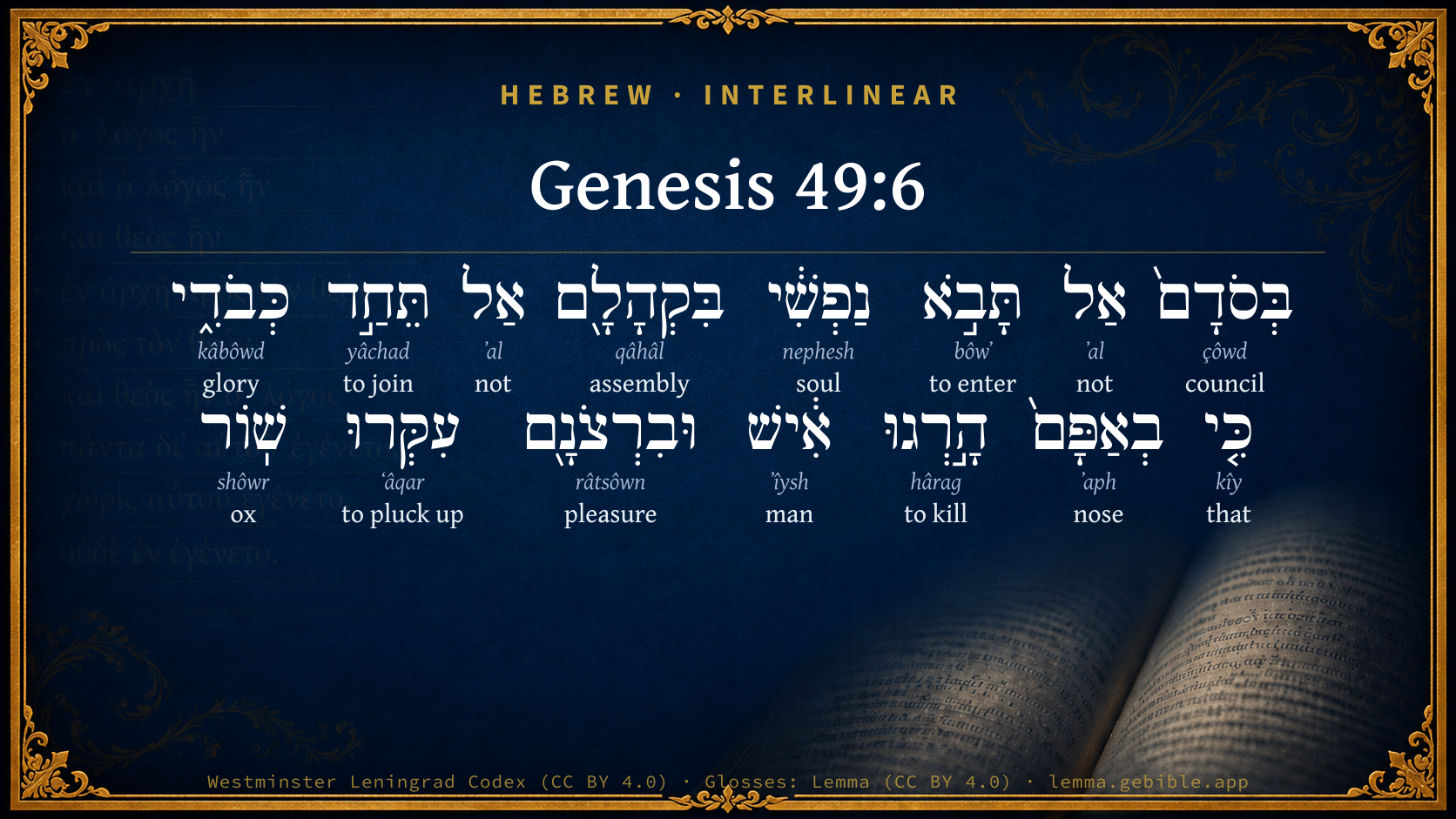
Hebrew (Westminster Leningrad Codex) Genesis 49:6 appears in the Hebrew Old Testament. The text above is from the Westminster Leningrad Codex. Each word links to its Strong’s number, a concise gloss, and parsing drawn from the Open Scriptures Hebrew Bible morphology. Click any word for its full Brown-Driver-Briggs (BDB) entry.
Download image
Cite this verse

Genesis 49:6 (World English Bible). Public Domain. Lemma interlinear Bible study tool, https://lemma.gebible.app/v/genesis/49/6.

Show BibTeX & RIS
BibTeX
RIS
English Translation
My soul, don't come into their council; My glory, don't be united to their assembly; For in their anger they killed a man, In their self-will they hamstrung an ox.
World English Bible · Public Domain
Highlights
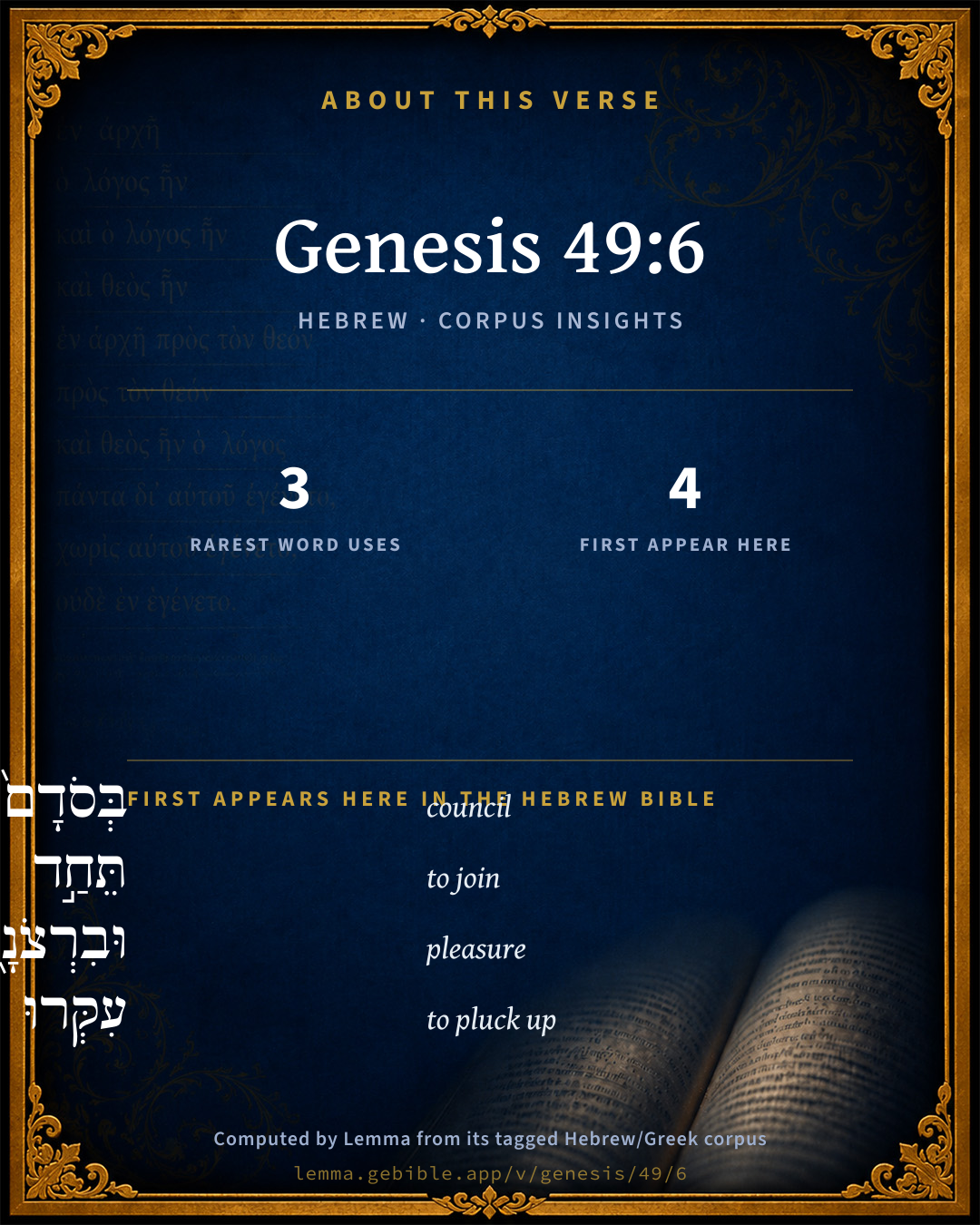
  • 4 first appearances in the Hebrew Bible
Full analysis ↓
Download a study sheet

One document with this verse’s original text, its word-by-word gloss line, the meaning frame, cross-references with their text, attributed commentary, and full source and license credits — printable, and it pastes into notes with its structure intact.

This verse Autodidact and up

Study sheet (.html) Plain text (.txt)

A passage Seminary Student

Up to 50 verses in one chapter. A passage sheet keeps up to 6 commentary sources and 12 cross-references per verse, in the order this page ranks them, and says so on the sheet whenever that leaves anything out. Ask for a single verse and you get the Autodidact verse sheet above.

Everything on this page stays free to read, with no account — the sheet is a download of what is already on screen, not access to it.

Want to remove ads? Support Godless Engineer
Compare translations 3

The same verse in 3 English versions, stacked beneath the original-language interlinear above. Click any original word for its lexicon entry.

Each is an independent rendering of the whole verse — the interlinear is not word-aligned to these translations.

Highlighted words mark where these versions differ — a whole-verse word diff, not a word-by-word alignment.

  • World English Bible Public Domain
    My soul, don't come into their council; My glory, don't be united to their assembly; For in their anger they killed a man, In their self-will they hamstrung an ox.
  • King James Version Public Domain
    O my soul, come not thou into their secret; unto their assembly, mine honor, be not thou united: for in their anger they slew a man, and in their self-will they digged down a wall.
  • unfoldingWord Literal Text CC BY-SA 4.0
    Do not let my soul enter into their council! Do not let my glory join in their assembly, because in their anger they killed a man, and for their pleasure they hamstrung an ox.

unfoldingWord Literal Text — © unfoldingWord, licensed CC BY-SA 4.0. Word-aligned USFM3 via Door43 (git.door43.org/unfoldingWord/en_ult).

Versions to compare (up to 4)

3 of 4 selected

Show all 18 translations

Every available English version of this verse, each an independent rendering of the whole verse.

  • World English Bible Public Domain
    My soul, don't come into their council; My glory, don't be united to their assembly; For in their anger they killed a man, In their self-will they hamstrung an ox.
  • Berean Standard Bible Public Domain
    May I never enter their council; may I never join their assembly. For they kill men in their anger, and hamstring oxen on a whim.
  • Majority Standard Bible Public Domain
    May I never enter their council; may I never join their assembly. For they kill men in their anger, and hamstring oxen on a whim.
  • King James Version Public Domain
    O my soul, come not thou into their secret; unto their assembly, mine honor, be not thou united: for in their anger they slew a man, and in their self-will they digged down a wall.
  • American Standard Version (1901) Public Domain
    O my soul, come not thou into their council; Unto their assembly, my glory, be not thou united; For in their anger they slew a man, And in their self-will they hocked an ox.
  • Revised Version (1885) Public Domain
    O my soul, come not thou into their council; Unto their assembly, my glory, be not thou united; For in their anger they slew a man, And in their selfwill they houghed an ox.
  • Geneva Bible (1599) Public Domain
    Into their secret let not my soule come: my glory, be not thou ioyned with their assembly: for in their wrath they slew a man, and in their selfe will they digged downe a wall.
  • Douay-Rheims (1899) Public Domain
    Let not my soul go into their counsel, nor my glory be in their assembly: "be- cause in their fury they slew a man, and in their selfwill they undermined a wall.
  • Young's Literal Translation Public Domain
    Into their secret, come not, O my soul! Unto their assembly be not united, O mine honour; For in their anger they slew a man, And in their self-will eradicated a prince.
  • Literal Standard Version CC BY-SA 4.0
    Into their secret, do not come, O my soul! Do not be united to their assembly, O my glory; For in their anger they slew a man, || And in their self-will eradicated a prince.
  • Unlocked Literal Bible CC BY-SA 4.0
    O my soul, do not come into their council; do not join in their meetings, for my heart has too much honor for that. For in their anger they killed men. It was for pleasure that they hamstrung oxen.
  • unfoldingWord Literal Text CC BY-SA 4.0
    Do not let my soul enter into their council! Do not let my glory join in their assembly, because in their anger they killed a man, and for their pleasure they hamstrung an ox.
  • Darby Bible Public Domain
    My soul, come not into their council; Mine honour, be not united with their assembly; For in their anger they slew men, And in their wantonness houghed oxen.
  • World Messianic Bible Public Domain
    My soul, don’t come into their council. My glory, don’t be united to their assembly; for in their anger they killed men. In their self-will they hamstrung cattle.
  • Webster's Bible Public Domain
    O my soul, come not thou into their secret; to their assembly, my honor, be not thou united: for in their anger they slew a man, and in their self-will they digged down a wall.
  • Free Bible Version CC BY-SA 4.0
    I refuse to be part of their decisions; I refuse to participate in what they do. For they killed men in their anger; they crippled cattle just for fun.
  • Bible in Basic English Public Domain
    Take no part in their secrets, O my soul; keep far away, O my heart, from their meetings; for in their wrath they put men to death, and for their pleasure even oxen were wounded.
  • JPS Tanakh (1917) Public Domain
    Let my soul not come into their council; unto their assembly let my glory not be united; for in their anger they slew men, and in their self-will they houghed oxen.

Literal Standard Version (2020), Covenant Press — licensed CC BY-SA 4.0. Text via the HelloAO Bible API (eBible.org). Unlocked Literal Bible (unfoldingWord) — licensed CC BY-SA 4.0. Text via the HelloAO Bible API (eBible.org). unfoldingWord Literal Text — © unfoldingWord, licensed CC BY-SA 4.0. Word-aligned USFM3 via Door43 (git.door43.org/unfoldingWord/en_ult). Free Bible Version, Dr. Jonathan Gallagher — licensed CC BY-SA 4.0. Text via the HelloAO Bible API (eBible.org).

Word by word

More ways to search: Search by grammar → Find every occurrence → Compare this word →

Practice this passage: Drill this verse → Learn its vocabulary →

תֵּחַ֣ד
yâchad
H3161
“to join”
Verb, Qal, Jussive, 3rd Person, Feminine, Singular
Part of Speech
Verb
Stem
Qal
Form
Jussive
Person
3rd Person
Gender
Feminine
Number
Singular
Full BDB Definition

Origin: a primitive root

TWOT: 858

to join, unite, be joined, be united - (Qal) to be united - (Piel) to unite
  1. בְּסֹדָם֙ çôwd H5475 “in/at · council · their” Preposition + Noun, Common, Masculine, Singular, Construct + Suffix, Personal, 3rd Person, Masculine, Plural
  2. אַל ʼal H408 “not” Particle, Negative
  3. תָּבֹ֣א bôwʼ H935 “to enter” Verb, Qal, Jussive, 3rd Person, Feminine, Singular
  4. נַפְשִׁ֔י nephesh H5315 “soul · my” Noun, Common, Both, Singular, Construct + Suffix, Personal, 1st Person, Common, Singular
  5. בִּקְהָלָ֖ם qâhâl H6951 “in/at · assembly · their” Preposition + Noun, Common, Masculine, Singular, Construct + Suffix, Personal, 3rd Person, Masculine, Plural
  6. אַל ʼal H408 “not” Particle, Negative
  7. כְּבֹדִ֑י kâbôwd H3519 “glory · my” Noun, Common, Both, Singular, Construct + Suffix, Personal, 1st Person, Common, Singular
  8. כִּ֤י kîy H3588 “that” Conjunction
  9. בְאַפָּם֙ ʼaph H639 “in/at · nose · their” Preposition + Noun, Common, Masculine, Singular, Construct + Suffix, Personal, 3rd Person, Masculine, Plural
  10. הָ֣רְגוּ hârag H2026 “to kill” Verb, Qal, Perfect, 3rd Person, Common, Plural
  11. אִ֔ישׁ ʼîysh H376 “man” Noun, Common, Masculine, Singular, Absolute
  12. וּבִרְצֹנָ֖ם râtsôwn H7522 “and · in/at · pleasure · their” Conjunction + Preposition + Noun, Common, Masculine, Singular, Construct + Suffix, Personal, 3rd Person, Masculine, Plural
  13. עִקְּרוּ ʻâqar H6131 “to pluck up” Verb, Piel, Perfect, 3rd Person, Common, Plural
  14. שֽׁוֹר shôwr H7794 “ox” Noun, Common, Masculine, Singular, Absolute

About this verse

These counts appear in no published source. They are computed here, from the morphology-tagged text and Lemma’s own curated glosses. What Lemma adds →

15
words
14
distinct lemmas
Pentateuch
section

Notable vocabulary

The rarest word here is תֵּחַ֣ד to join H3161 — appearing just 3 times in the whole Hebrew Bible.

First appearance in Scripture

These words make their first canonical appearance in the Hebrew Bible here:

  • בְּסֹדָם֙ council H5475
  • תֵּחַ֣ד to join H3161
  • וּבִרְצֹנָ֖ם pleasure H7522
  • עִקְּרוּ to pluck up H6131

Shared distinctive vocabulary

תֵּחַ֣ד to join H3161 occurs in 3 verses of the Hebrew Bible. Also found in:

Grammatical profile

  • 4 verbs
  • 8 nouns
  • 1 conjunction
  • 2 particles

Verb forms

  • תָּבֹ֣א Qal · Jussive
  • תֵּחַ֣ד Qal · Jussive
  • הָ֣רְגוּ Qal · Perfect
  • עִקְּרוּ Piel · Perfect

Repetition

A word recurs within this verse — often emphatic in Hebrew:

  • אַל not H408 ×2

Hebrew & Septuagint length

In English translation the verse runs 30 words from the Hebrew and 33 from the Septuagint (LXX English) — closely comparable.

A rough comparison of the two English renderings, which tokenize alike — not a word-level alignment.

Word counts can differ between the Hebrew and the Greek without any difference in meaning — e.g. the Hebrew direct-object marker אֵת has no separate Greek word, and Greek often adds the article ὁ.

Cross-references

26

Topical passages linked to Genesis 49:6 in the Treasury of Scripture Knowledge — connected by theme and wording, ordered by reader-vote popularity; previews shown in the World English Bible.

  • Genesis 34:30 Jacob said to Simeon and Levi, "You have troubled me, to make me odious to the inhabitants of the land, among the Canaanites and the Perizzites. I am few in number. They will gather themselves together against me and strike me, and I will be destroyed, I and my house."
  • Psalms 26:9 Don't gather my soul with sinners, Nor my life with bloodthirsty men;
  • Psalms 16:9 Therefore my heart is glad, and my tongue rejoices. My body shall also dwell in safety.
  • Genesis 34:25–26 It happened on the third day, when they were sore, that two of Jacob's sons, Simeon and Levi, Dinah's brothers, each took his sword, came upon the unsuspecting city, and killed all the males.
  • Psalms 26:4–5 I have not sat with deceitful men, Neither will I go in with hypocrites.
  • Psalms 57:8 Wake up, my glory! Wake up, psaltery and harp! I will wake up the dawn.
  • Psalms 64:2 Hide me from the conspiracy of the wicked, From the noisy crowd of the ones doing evil;
  • Proverbs 1:15–16 My son, don't walk in the way with them. Keep your foot from their path,
  • Jeremiah 4:19 My anguish, my anguish! I am pained at my very heart; my heart is disquieted in me; I can't hold my peace; because you have heard, O my soul, the sound of the trumpet, the alarm of war.
  • Jeremiah 15:17 I didn't sit in the assembly of those who make merry, nor rejoiced; I sat alone because of your hand; for you have filled me with indignation.
  • Luke 12:19 I will tell my soul, "Soul, you have many goods laid up for many years. Take your ease, eat, drink, be merry."'
  • 2 Corinthians 6:14 Don't be unequally yoked with unbelievers, for what fellowship have righteousness and iniquity? Or what communion has light with darkness?
  • Deuteronomy 27:24 Cursed be he who strikes his neighbor in secret. All the people shall say, Amen.
  • Judges 5:21 The river Kishon swept them away, That ancient river, the river Kishon. My soul, march on with strength.
  • Psalms 1:1 Blessed is the man who doesn't walk in the counsel of the wicked, Nor stand in the way of sinners, Nor sit in the seat of scoffers;
  • Psalms 5:10 Hold them guilty, God. Let them fall by their own counsels; Thrust them out in the multitude of their transgressions, For they have rebelled against you.
  • Psalms 28:3 Don't draw me away with the wicked, With the workers of iniquity who speak peace with their neighbors, But mischief is in their hearts.
  • Psalms 30:12 To the end that my heart may sing praise to you, and not be silent. Yahweh my God, I will give thanks to you forever!
  • Psalms 42:5 Why are you in despair, my soul? Why are you disturbed within me? Hope in God! For I shall still praise him for the saving help of his presence.
  • Psalms 42:11 Why are you in despair, my soul? Why are you disturbed within me? Hope in God! For I shall still praise him, The saving help of my countenance, and my God.
  • Psalms 43:5 Why are you in despair, my soul? Why are you disturbed within me? Hope in God! For I shall still praise him: My Savior, my helper, and my God.
  • Psalms 94:20–21 Shall the throne of wickedness have fellowship with you, Which brings about mischief by statute?
  • Psalms 103:1 Praise Yahweh, my soul! All that is within me, praise his holy name!
  • Psalms 139:19 If only you, God, would kill the wicked. Get away from me, you bloodthirsty men!
  • Proverbs 1:11 If they say, "Come with us, Let's lay in wait for blood; Let's lurk secretly for the innocent without cause;
  • Proverbs 12:5 The thoughts of the righteous are just, But the advice of the wicked is deceitful.

Cross-references courtesy of OpenBible.info (CC BY 4.0).

Hebrew and Greek witnesses Masoretic Hebrew ↔ Greek Septuagint

The same verse in the two great witnesses to the Old Testament, shown verse-for-verse.

These are two independent witnesses, not word-aligned to each other, and the Septuagint is shown in lemma (dictionary) form.

Hebrew Genesis 49:6 Masoretic · Westminster Leningrad Codex

בְּסֹדָם֙ אַל תָּבֹ֣א נַפְשִׁ֔י בִּקְהָלָ֖ם אַל תֵּחַ֣ד כְּבֹדִ֑י כִּ֤י בְאַפָּם֙ הָ֣רְגוּ אִ֔ישׁ וּבִרְצֹנָ֖ם עִקְּרוּ שֽׁוֹר

My soul, don't come into their council; My glory, don't be united to their assembly; For in their anger they killed a man, In their self-will they hamstrung an ox.

World English Bible · Public Domain

Greek LXX Genesis 49:6 Septuagint · lemma form

εἰς βουλή αὐτός μή ἔρχομαι ὁ ψυχή ἐγώ καί ἐπί ὁ σύστασις αὐτός μή ἐρείδω ὁ ἧπαρ ἐγώ ὅτι ἐν ὁ θυμός αὐτός ἀποκτείνω ἄνθρωπος καί ἐν ὁ ἐπιθυμία αὐτός νευροκοπέω ταῦρος

Let not my soul come into their counsel, and let not my inward parts contend in their conspiracy, for in their wrath they killed men, and in their passion they houghed a bull.

LXX2012 (modern English Septuagint) · Public Domain

On this verse, Ellicott's Commentary for English Readers discusses the Septuagint’s reading. Read the note in Commentary ↓

Hebrew: Westminster Leningrad Codex (CC BY 4.0). Greek: Septuagint (public domain); English from LXX2012 (modern English Septuagint) (Public Domain). How the Septuagint differs from the Hebrew →

Targum (Aramaic paraphrase)

2

The Targum is the ancient Jewish Aramaic paraphrase of the Hebrew Scriptures — an interpretive translation, not the Hebrew text itself. Onkelos (literal) and Pseudo-Jonathan (expansive) render the Torah, and Jonathan the Prophets. Coverage is partial: where no permissively-licensed English translation exists for a verse, only the Aramaic is shown. This is verse-level text, not a word-by-word alignment to the Hebrew.

  1. Targum Onkelos Torah (Genesis–Deuteronomy)
    בְּרָזְהוֹן לָא הֲוַת נַפְשִׁי בְּאִתְכַּנְשֵׁהוֹן לִמְהַךְ לָא נְחָתִית מִן יְקָרִי אֲרֵי בְרָגְזְהוֹן קְטָלוּ קְטוֹל וּבִרְעוּתְהוֹן תַּרָעוּ שׁוּר סַנְּאָה

    (no public-domain English translation for this verse)

    Targum Onkelos — Aramaic: “Onkelos Genesis” (public domain); “Onkelos Exodus” (public domain); “Onkelos Leviticus” (public domain); “Onkelos Numbers” (public domain); “Onkelos Deuteronomy” (public domain). English: “Sefaria Community Translation” (CC0 1.0 (public-domain dedication)); “J.W. Etheridge. The Targums of Onkelos and Jonathan Ben Uzziel on the Pentateuch. London: Longmans, Green, 1862” (public domain). Text via Sefaria.

  2. Targum Pseudo-Jonathan Torah (Genesis–Deuteronomy)
    בְּעִטַתְהוֹן לָא אִתְרְעִיַית נַפְשִׁי וּבְמִכְנַשְׁהוֹן לִשְׁכֶם לְמֵחַרְבָהּ לָא אִתְיַחַד יְקָרָא אֲרוּם בְּרוּגְזֵיהוֹן קָטְלוּ מַלְכָּא וּשׁוּלְטָנֵיהּ וּבִרְעוּתְהוֹן פָּכְרוּ שׁוּר בַּעֲלֵי דְבָבֵיהוֹן

    In their counsel my soul hath not had pleasure, and in their gathering against Shekem. to destroy it mine honour was not united; for in their anger they slew the prince and his ruler, and in their ill will they demolished the wall of their adversary.

    Targum Pseudo-Jonathan — Aramaic: “Targum Jonathan on Genesis” (public domain); “Targum Jonathan on Exodus” (public domain); “Targum Jonathan on Leviticus” (public domain); “Targum Jonathan on Numbers” (public domain); “Targum Jonathan on Deuteronomy” (public domain). English: “The Targum of Jonathan ben Uzziel, trans. J. W. Etheridge, London, 1862” (public domain). Text via Sefaria.

Commentary

Notes on Genesis 49:6 from classic Christian and Jewish commentators (each source and its license shown beneath its notes). The classic Christian expositions comment on the surrounding passage and are grouped to its opening verse, so a note may address several verses; the Jewish commentaries on the Tanakh (Rashi and others) are per-verse, so they appear only where the commentator wrote on this verse.

Lemma curates 59 commentaries, every one of them public domain or Creative Commons licensed, each selected and text-cleaned for this edition rather than reprinted as found. About our sources →

Trapp's Complete Commentary

John Trapp

Gen 49:6 O my soul, come not thou into their secret; unto their assembly, mine honour, be not thou united: for in their anger they slew a man, and in their selfwill they digged down a wall.

Ver. 6. O my soul, come not thou, &c.] Jacob here meaneth that neither should any, neither would he approve of their perfidy, saith an interpreter. And yet Thuanus writes that the Pope caused the massacre of Paris to be painted in his palace. Another of them highly extolled in his consistory the noble act of Clement the monk, that killed the king of France, comparing it with the work of creation, incarnation, &c. Friar Garnet, our chief gunpowder plotter, had his picture set among the rest of their saints, in the Jesuits’ Church at Rome. And Cornel. a Lapide, upon Apoc. vii. 3, crowns this traitor with fresh encomiastics. {a}

In their anger they slew a man.] Yea, many innocents; and then cried out, O rem regiam! as Valesius did when he had slain three hundred. O pulchrum spectaculum! as Hannibal, when he saw a pit full of man’s blood. Quam bonus est odor hostis mortui! as Charles IX, in the massacre of Paris; where they poisoned the Queen of Navarre; pistoled the Prince of Conde; murdered the most part of the peerless peers of France, their wives and children; with a great sort of the common people, in various parts of the realm, - thirty thousand in one month, three hundred thousand in the space of a year! Mohammed I, Emperor of the Turks, was thought, in his time, to have been the death of eighty thousand men. Selymus II, in revenge of the loss he had received at the battle of Lepanto, would have put to death all the Christians in his dominion, in number infinite. Mithridates, king of Pontus, with one letter, slew eighty thousand citizens of Rome in Asia, that were scattered up and down the country for traffic’s sake. It was the cruel manner of Uladus, prince of Wallachia, together with the offenders, to execute the whole family; yea, sometimes the whole kindred. {b} Did not these two brethren in sin do so, and worse?

{a} Jacob Revius, De Vitis Pont., p. 291. Gir. i. Apol. contra Jesuit.

{b} Answ. to Cathol. Supplic., by Gab. Powel, 885. Val. Max., lib. ix. Turk. Hist., fol. 363.

John Trapp, A Commentary or Exposition upon All the Books of the Old and New Testament (1647–1656) — public domain. Text from a community e-Sword module.

Joseph Benson's Commentary

Gen 49:6. My soul, come not thou into their secret — Their cursed plot hatched in secret: far be it from me to approve of their secret designs. And let not mine honour — Or good name, be stained by being associated with theirs. Thus he signifies to all posterity that that bloody enterprise was undertaken without his consent, and that he could not think of it without detestation, nor let it pass without a severe censure. For in their anger they slew a man — Shechem himself, and many others: and to effect that wickedness they digged down a wall — Broke into their houses to plunder them, and murder the inhabitants.

Joseph Benson's Commentary on the Old and New Testaments (1811–1818) — public domain. Text from a community e-Sword module.

Geneva Bible (1599)

Geneva Bible translators

Or, tongue: meaning that he neither consented to them in word nor thought.

The Shechemites, Gen. 34:26.

Geneva Bible (1599) marginal notes — public domain. Text via Bolls.life.

Adam Clarke's Commentary

Verse 6. Into their secret council, c.] Jacob here exculpates himself from all participation in the guilt of Simeon and Levi in the murder of the Shechemites. He most solemnly declares that he knew nothing of the confederacy by which it was executed, nor of the secret council in which it was plotted.

If it should be said that the words תבא tabo and תחד techad should be translated in the future tense or in the imperative, as in our translation, I shall not contend though it is well known that the preterite is often used for the future in Hebrew, and vice versa. Taken thus, the words mark the strong detestation which this holy man's soul felt for the villany of his sons: "My soul shall not come into their secret council. My honour shall not be united to their confederacy.

For in their anger they slew a man] איש ish, a noble, an honourable man, viz., Shechem.

And in their pleasure] This marks the highest degree of wickedness and settled malice, they were delighted with their deed. A similar spirit Saul of Tarsus possessed previously to his conversion; speaking of the martyrdom of St. Stephen, St. Luke says, Ac 8:1: Σαυλος δε ην συνευδοκων τῃ αναιρεσει αυτου· And Saul was gladly consenting to his death. He was with the others highly delighted with it; and thus the prediction of our Lord was fulfilled, Joh 16:2: Yea, the time cometh, that whosoever killeth you will think that he doeth God service. And it is represented as the highest pitch of profligacy and wickedness, not only to sin, but to delight in it; see Ro 1:32. As the original word רצון ratson signifies, in general, pleasure, benevolence, delight, c., it should neither be translated self-will nor wilfulness, as some have done, but simply as above and the reasons appear sufficiently obvious. They murdered a prince - Hamor, the father of Shechem. Instead of שור shor, which we have translated a wall, and others an ox, I read שר sar, a prince, which makes a consistent sense; (see Kennicott's first Dissertation, p. 56, c.) as there is no evidence whatever that Simeon and Levi either dug down a wall or houghed the oxen, as some have translated the passage; (see the margin;) on the contrary, the text, Ge 34:28-29, proves that they had taken for their own use the sheep, oxen, asses, all their wealth, their wives, and their little ones.

Adam Clarke's Commentary on the Bible (1810–1826) — public domain. Text from a community e-Sword/MySword module.

Ellicott's Commentary for English Readers

(6) Their secret.—The word sôd used here is literally the little carpet, or cushion, upon which an Oriental sits. Consequently, for two persons to sit upon the same carpet marks a high degree of friendship and familiarity. It would therefore be more exactly translated alliance, or intimacy.

Unto their assembly, mine honour, be not thou united.—For assembly (Heb. congregation), see Gen_28:3; Gen_35:11. It means here their union, or confederacy. In the first clause Jacob bids his soul, his true self, not to enter their alliance; here, after the manner of the parallelism of Hebrew poetry, he intensifies the meaning. For by mine honour, he signifies all that gave him dignity and worth in the sight of God and man. And this nobleness would be degraded and lost by union with men banded together for evil.

In their self-will they digged down a wall—Self-will is worse than anger, and signifies that arrogant temper which leads on to wanton cruelty. The last words mean, they houghed an ox. The Vulgand Syriac took it as our version does, and understood it of making a breach in the walls of Shechem; but they had a different reading, shur, whereas the word in the Hebrew is shor, an ox, and it is so rendered by the LXX. The ox was in old times the symbol of majesty, and thus bulls are put for princes in Psa_22:12; Psa_68:30. Thus, then, the meaning is, “In their anger at the wrong done to their sister they slew Hamor, prince of Shechem, with his people; and from wanton cruelty, without any just cause for indignation, they hamstrung the noblest of their brethren, not killing Joseph outright, but disabling him by selling him into slavery, that he might there perish.”

A Bible Commentary for English Readers, edited by Charles John Ellicott (1878–1897) — public domain. Text from a community e-Sword module.

The Cambridge Bible for Schools and Colleges

gen. ed. J. J. S. Perowne

6. council] or, as R.V. marg., secret. The word means either a secret confederacy, or its secret purpose. The parallelism of the clauses rather favours the former rendering.

The true spirit of Israel will have nothing to do with the savage policy hatched in the secret conclaves of these two tribes.

my glory] The word “glory” is used to denote the “soul,” or the “spirit,” as man’s most glorious possession. Cf. Psa_16:9, “my heart is glad and my glory rejoiceth”; Psa_30:12; Psa_57:8; Psa_108:2. The LXX, reading the same Hebrew consonants with different vowels, translates “my liver” = “my affections,” and, instead of “united,” renders a slightly different text “contend,” μὴ ἐρίσαι τὰ ἥπατά μου.

a man] or, as R.V. marg., men.

houghed] i.e. “mutilated,” by cutting the sinews of the leg. Cf. Jos_11:6; Jos_11:9; 2Sa_8:4. LXX gives an exact rendering ἐνευροκόπησαν. The Old English “hox” is the form found in Shakespeare: Wint. Tale, i. 2, “thou art a coward, Which hoxes honesty behind.”

an ox] or, as R.V. marg., oxen: so A.V. Instead of the Heb. shor, another reading, shur, “a wall,” is followed by Lat. suffoderunt murum, and by Targ. Onk., Syr. Pesh., Symmachus, and Jerome; probably on account of the apparent contradiction in Gen_34:28-29, where the sheep and oxen are not mutilated, but carried off as booty.

The Cambridge Bible for Schools and Colleges (gen. ed. J. J. S. Perowne; Cambridge University Press, 1878–1918) — public domain. Text from a community e-Sword module.

John Gill's Exposition

O my soul, come not thou into their secret,.... Their cabinet counsels, combinations and conspiracies; this Jacob said, as abhorring the wicked counsel they had took of slaying the Shechemites; and lest any should think he was concerned in it, or connived at it, he expressed a detestation of the fact on his dying bed: the future tense may be put for the past; and so Onkelos renders it, "my soul was not in their secret"; and so the other two Targums paraphrase it, that when they got and consulted together, his soul was not pleased and delighted with their counsel, but abhorred it; or "my soul shall not come", which Jarchi thinks prophetical refers to the case of Zimri, the son of Salu, of the tribe of Simeon, as the following clause to the affair of Korah, of the tribe of Levi, as foreseeing and disapproving them, and desiring they might not be called by his name, or his name called upon them, Num 25:14.

unto their assembly, mine honour, be not thou united; the same thing expressed in different words; by his "honour or glory" he means his soul, the more honourable part of man, or his tongue, with which man glorifies God; and hereby Jacob intimates, that he did not in thought, and much less in express words, give any consent unto, and approbation of the deed of those two sons of his, and that he never was, nor never desired to be with them in their meetings and consultations:

for in their anger they slew a man; Hamor or Shechem, together with all the males of the city; and so "man" may be put for "men", the singular for the plural, as is frequent. The Targum of Jonathan is, a king and his governor; and the Targum of Jerusalem, kings with governors:

and in their selfwill they digged down a wall; not the wall of the city of Shechem, which does not appear to be walled, by their easy access into it; and if it was, they do not seem to have had proper instruments for such an undertaking, nor a sufficient number for such work, and which would have required longer time than they used, unless it was a poor wall indeed: rather the wall of Shechem's house, or the court before it, which they dug down, or broke through to get in and slay Hamor and Shechem, and take away their sister; though the word, as here pointed, always signifies an ox; and so the Samaritan and Septuagint versions render it, they hamstringed a bull, or houghed an ox, just in like manner as horses are said to be houghed, Jos 11:6 and which some understand (l) figuratively of a prince or ruler; so great personages are called bulls of Bashan, Psa 22:12 and interpret it either of Hamor or of Shechem, who was a prince among his people, and furious in his lust towards Dinah, and so this clause is much the same with the former: and besides, him they enervated by circumcision, and took the advantage of this his condition at the worst, and slew him, which seems to be the true sense of the text, agreeably to Gen 34:25 but the Jerusalem Targum paraphrases it of Joseph, whom his brethren sold, who was like unto an ox; and so Jarchi interprets it of him, whom they designed to slay, see Deu 33:17 but it is better to take the words in a literal sense, either of the oxen that Simeon and Levi took from the Shechemites, which they plucked or drove away from their mangers, as some render the words (m); and some of them they might hough or hamstring, that they might not get away from them, see Gen 34:28 or rather of Shechem himself, who was "a prince", a word which has some likeness and affinity to this in the text.

(l) R. Jacob Ben Eleazer in Ben Melech, in loc. (m) "avulserunt boves", Junius & Tremellius, Piscator; others, "enervarunt bovem", Schmidt; so Ainsworth.

John Gill's Exposition of the Whole Bible (1746–1763) — public domain (CC PDM 1.0). Text via the HelloAO Bible API.

Haydock's Catholic Bible Commentary

Slew a man, viz., Sichem, the son of Hemor, with all his people, chap. xxxiv. Mystically and prophetically it alludes to Christ; whom their posterity, viz., the priests and the scribes, put to death. (Challoner) --- A wall, Sichem, which they destroyed: or, according to the Septuagint, "they ham-strung" a bull, as the same Hebrew word signifies; both which may refer to the prince of the town, or to Joseph, (Calmet) in whose persecution these two were principally concerned. Jacob declares, he had no share in their attack upon the people of Sichem: his soul, or his glory, was not impaired by their misconduct. (Haydock)

George Leo Haydock (1774–1849), Haydock's Catholic Family Bible and Commentary, 1859 edition — public domain. Excludes Psalms (Douay-Rheims chapter numbering differs from Protestant) and Deuterocanonical books (Catholic canon only).

Matthew Poole's English Annotations

Their secret; or, counsel, or company, as the word is used, Psa 64:2; Jer 15:17; i.e. do not partake with them in their secret and wicked designs. Hereby he signifies to all posterity, that that bloody enterprise was undertaken without his consent or approbation, and that he could not think of it without detestation, nor let it pass without a severe censure. Or, O my soul, thou wast not in their secret, as the Chaldee, Syriae, and Arabic take it, by a common enallage of the future tense for the past.

Mine honour; either,

1. Properly so called. So the sense is, Let not my honour or good name be bound up with theirs; they gloried in this wickedness, which I abominate, and which indeed is their shame. Or,

2. Improperly; so he understands either,

1. His soul, which is indeed the glory of a man, though I do not remember any place of Scripture where that word must necessarily be so understood. So this is a repetition of the same thing in other words, which is usual in Scripture. Or rather,

2. His tongue, for which the word honour or glory is commonly put, as Psa 16:9, compared with Act 2:26; Psa 30:12; 57:8; 108:1, because the tongue or speech is the glory of a man, by which he is distinguished from unreasonable creatures, and, if well used, it brings much honour to God, and to the man that speaks with it. So the sense is, As my soul did not approve of that wicked action, so my tongue never gave consent to it, nor shall it now by silence seem to own it, but shall publicly witness my abhorrence of it.

In their anger they slew a man, i.e. men, the Shechemites, Gen 34:25,26, the singular number for the plural, as Gen 3:2; 32:5; 1Ch 10:1, compared with 1Sa 31:1. He saith man rather then men, either with respect unto the prince, whose slaughter was principally designed, or to show that they slew them all to a man.

In their self-will: it may note, that this cruelty of theirs was committed,

1. By their own will and choice, not by Jacob’s will or consent, which they never asked nor obtained.

2. Without any necessity or sufficient provocation, but merely by their own will and proper motion.

3. Not rashly and hastily, but wilfully and resolvedly, after mature deliberation.

4. Not unwillingly, but cheerfully, and with delight and good will, as that word commonly signifies.

They digged down a wall; not the walls of the city, but of private houses; it may be only of the prince’s house, who upon the first noise of the tumult might, and probably did, retire and secure himself in some strong room of the house, whose wall they brake down that they might come at him. For neither were the walls of houses or cities so strong then as now many are; nor were Simeon and Levi destitute of fit instruments to break down a wall, which doubtless they brought with them, as easily foreseeing that difficulty in their enterprise. But because the Hebrew word is not shur, a wall, but schor, an ox, others translate the words thus, they houghed, or killed an ox, or bull, meaning Shechem, so called either from his lust, or from his strength and power, from which princes are oft so called, as Deu 33:17; Psa 22:12; 68:30. Or rather thus, they rooted out, or drove away an ox, i.e. the oxen, the singular number for the plural, as before; and under them are comprehended the other cattle of the Shechemites, which they drove away, as we read they did, Gen 34:28. For as the words may bear this sense, so it seems more reasonable to understand them of that which certainly was done by them, than of their breaking a wall, of which we do not read any thing in the history.

Matthew Poole's English Annotations on the Holy Bible (1683–1685) — public domain. Text from a community e-Sword/MySword module.

Whedon's Commentary on the Bible

Daniel D. Whedon

6. Their secret council — Allusion to their private conspiracy to massacre the men of Shechem.

Unite not — This uniting in secret assembly is to be punished by dividing and scattering them. Gen_49:7.

My honour — Used of the heart or soul, as the noblest and most honourable part of man’s nature. Compare Psa_7:5; Psa_16:9; Psalm 30:13. But at the same time the ordinary meaning of the word may be here kept prominent: Let not my honour be compromised or tarnished by any union with their counsels.

They slaughtered men — Hebrews, a man. The singular, though used collectively, gives peculiar vividness to the thought as conceived in the Hebrew idiom.

They houghed oxen — Here, too, the Hebrew employs the singular in the same collective sense. The fact stated illustrates the wanton cruelty of these brothers. The common version, they digged down a wall, follows the Chaldee, Syriac, Vulgate, Aquila, and Symmachus; but the authority of these versions, which have copied from one another, is outweighed by the fact that in all other passages where the Piel of this word (עקר) occurs, it means to hamstring or hough an animal. Such uniform usage has greater authority than the testimony of many versions.

Daniel D. Whedon (gen. ed.), Commentary on the Old and New Testaments (1874–1909) — public domain. Text from a community e-Sword module.

John Wesley's Explanatory Notes

They slew a man - Shechem himself, and many others; and to effect that, they digged down a wall, broke the houses to plunder them, and murder the inhabitants. O my soul, come not thou into their secret - Hereby he professeth not only his abhorrence of such practices in general, but his innocency particularly in that matter. Perhaps he had been suspected as under-hand aiding and abetting; he therefore solemnly expresseth his detestation of the fact.

John Wesley, Explanatory Notes Upon the Whole Bible (1754–1765) — public domain. Text via the GEBible commentary corpus.

Rashi

Rabbi Shlomo Yitzchaki (Rashi)

בסדם אל תבא נפשי O MY SOUL, COME NOT THOU INTO THEIR SECRET DELIBERATION (סוד may have the sense of plot) — this has reference to the story of Zimri, (Numbers 25:6-15) when the tribe of Simeon assembled and brought the Midianitish woman before Moses, saying, “Is this woman forbidden or permitted to be taken as a wife? If you say she is forbidden, who made the daughter of Jethro permissible to you in marriage” (See Sanhedrin 82b) — let not my name be mentioned in connection with that event! Indeed, it is said (Numbers 25:14) “Zimri, the son of Zalu, a prince of a father’s house among the Simeonites” — but Scripture does not state “a son of Jacob”.

בקהלם UNTO THEIR ASSEMBLY — when Korah of the tribe of Levi will assemble the entire congregation against Moses and Aaron —

אל תחד כבודי MY GLORY BE NOT THOU UNITED — let my name not be associated there with them! (Genesis Rabbah 98:5) And so it was, for it is said (Numbers 16:1) “Korah, the son of Izhar, the son of Kohath. the son of Levi” — but it does not say “the son of Jacob”. In Chronicles, however, (1 Chronicles 6:22,23), where the genealogy of Korah is traced in connection with the “Duchan” (properly, the platform — the place on which the Levites were stationed for the service of song in the Temple) it is said, “the son of Korah, the son of Izhar, the son of Kohath, the son of Levi, the son of Israel (Genesis Rabbah 98:5).

אל תחד כבדי MY GLORY BE NOT THOU UNITED — כבוד is masculine and therefore you must needs explain the phrase as though he were addressing himself to “the glory” saying, “thou, my glory, be not united with them!” תחד is exactly the same grammatical form (2nd masc. sing. and not 3rd fem. sing.) as (Isaiah 14:20) “Thou shall not be united (אל תחד) with them in burial”

כי באפם הרגו איש FOR IN THEIR WRATH THEY SLEW A MAN — This refers to Hamor and the people of Shechem, and they are spoken of as איש “one” man because they were all regarded as of no more account than one man when it was a matter of attacking them. It likewise states in the history of Gideon, (Judges 6:16) “And thou shalt smite the Midianites as one man”, and similarly concerning Egypt, (Exodus 15:1) “The horse (singular) and its rider (singular) hath he thrown into the sea” (i.e. the whole army as though it consisted of but one horse and its rider). This is a Midrashic interpretation (Genesis Rabbah 99:6). The plain meaning of the use of the singular form is: a group of men is called “a man” having in mind each one separately, so that the meaning is: they slew every man with whom they were angry. Similar is (Ezekiel 19:3) “and he learned to catch the prey, he devoured (אדם) a man” (which is the same as בני אדם “men”)

וברצונם עקרו שור AND IN THEIR SELFWILL THEY LAMED AN OX — they desired to exterminate Joseph who is called שור, as it is said, (Deuteronomy 33:17) “His firstling bullock (שורו) (Joseph), majesty is his”. עקרו means in old French essarter. It has the same meaning as in (Joshua 11:6) “Thou shalt hamstring (תעקר) their horses”.

Rashi on the Tanakh — English translations: “The Judaica Press complete Tanach with Rashi, translated by A. J. Rosenberg” (CC BY 4.0); “Pentateuch with Rashi's commentary by M. Rosenbaum and A.M. Silbermann, 1929-1934” (public domain); “The Metsudah Tanach series, Lakewood, N.J” (CC BY 4.0); and “The Book of Joshua, Metsudah Publications, 1997” (CC BY 4.0). Text via Sefaria.

Ramban (Nachmanides)

Rabbi Moshe ben Nachman (Ramban / Nachmanides)

FOR IN THEIR ANGER THEY SLEW A MAN AND IN THEIR SELF-WILL THEY DISABLED AN OX (‘SHOR’). The meaning of this is that they committed violence in their wrath in that they were angry at Shechem, and it was to satisfy their own desire and not because of the guilt or sins of the slain.Now Onkelos says that the word shor (ox) should be understood as shur (wall) with a shuruk,. Thus the word should be understood as shur (wall) rather than shor (ox). The Torah-script has no vowel signs, and for the sake of interpretation, a difficult word may sometimes be interpreted as if it were vowelled differently than the traditional reading. as in the verse, Daughters treaded on the wall (‘shur’). Thus Onkelos translated the word shor in the present verse as “the wall of the enemy,” similar in expression to the verse: Mine eye also hath gazed on them that lie in wait for me (‘b’shuroi’). The meaning of the verse is thus: “and they uprooted a city surrounded with a wall, slaying their children and women after having killed the men of the city.” The word ikru (disabled) would then be similar in use to the verse, Ekron shall be rooted up (‘tei’akeir’). Others have explained that the ox, which is the largest of cattle, is an allusion to Hamor and his son Shechem, the prince of the country, just as in the verses: His firstling bull, majesty is his; Ye kine of Bashan, that are in the mountain of Samaria. Similarly do the verses surname the great princes “rams” is generally translated, “the mighty men of Moab,” but literally it means “the rams of Moab.” and “he-goats.” is generally translated, “the chief ones of the earth,” but literally it means “the he-goats of the earth.”The correct interpretation appears to me to be that the verse is to be understood in its usual sense as stating that in their anger they killed each man of whom they were wrathful; and in their self-will, after their anger had been calmed by the slaying of the men, they uprooted all oxen, this being an allusion to their cattle and their possessions, including everything that was in the home and everything in the field. Now Jacob mentioned this in order to state that he had no part in all these secret deliberations of theirs, even in the removal of the cattle and possessions, or any aspect of the spoiling and plundering of the people of the city of Shechem. The word ikru [in the expression, ikru shor], has the same meaning as in the verse: Thou shalt hemstring (‘te’akeir’) their horses. But the expression and purport is all one.

Ramban (Nachmanides) on the Tanakh — English translation: “Commentary on the Torah by Ramban (Nachmanides). Translated and annotated by Charles B. Chavel. New York, Shilo Pub. House, 1971-1976” (CC BY 4.0). Text via Sefaria.

Radak

Rabbi David Kimhi (Radak)

בסודם אל תבא נפשי. At the time they planned their revenge I had not been taken into their confidence either about what they were going to do or about how they were going to do it. It had not been done at my suggestion. Yaakov repeats what he said in different words, continuing אל תחד כבודי, the word תחד is in the feminine mode seeing it refers to כבוד which is another word for נפש which is a feminine noun.

כי באפם הרגו איש, the word איש refers to people generally, as in Samuel I 14,24 ואיש ישראל נגש, where it also did not refer to a single Israelite but to the Israelite troops who were pressing for action. Yaakov too describes the whole population of the city of Shechem as איש, as if a single unit. We find that the word שור is often used also as a reference to many oxen although it is in the singular mode. Other examples of such constructions are Exodus 15,19 כי בא סוס פרעה, where the Torah speaks of all of Pharaoh’s (Egypt’s) horses, not just of Pharaoh’s personal horse. Some commentators understand the words שור as meaning the ruling prince of the land, Chamor. We have several examples of someone in a high position being referred to as שור, as for instance in Deuteronomy 33,17 בכור שורו. The word עקרו in our verse, is another word for הרגו, “they killed.” The word שור may also mean “wall, fortification,” as understood by Onkelos.

וברצונם, “in order to carry out their will; their urgent desire.” In our homiletic literature, (compare Rashi) the entire line starting with אל תבא is understood as referring to misdeeds carried out by members of the tribe of Shimon in the distant future such as the leader of that tribe Zimri who slept with a Midianirte princess in an act of defiance of Jewish mores, and the infamous Korach of the tribe of Levi who wanted to usurp the position of Moses and Aaron. Due to Yaakov’s express wish here, neither of these two men had his genealogy traced all the way back to Yisrael when the Torah explains who they were. (compare Numbers 16,1 and Numbers 25,15)

Radak on the Tanakh — English translations: “Sefaria Community Translation” (CC0 1.0 (public-domain dedication)); “Eliyahu Munk, HaChut Hameshulash” (CC BY 4.0); “Rabbi Mike Feuer, Jerusalem Anthology” (CC BY 4.0); and “R. David Kimhi on the first book of Psalms, Translated by R.G. Finch, London, 1919” (public domain). Text via Sefaria.

Lesson kit

Teaching starters — assembled from the data on this page, not authored interpretation. Every prompt links to the verse data it draws on. Edit before teaching.

Genesis, in the Pentateuch, opens this verse with 15 words (14 distinct Hebrew lemmas). Its most distinctive word is yâchad (“to join”). A historical commentator’s framing appears above. Read the whole chapter for the surrounding context.

Discussion questions

  1. The word yâchad carries the sense “to join.” How does it shape the verse?
  2. 4 words make their first appearance in Scripture here. What does this debut establish?
  3. How does Psalms 86:11, which shares the word «to join», read alongside this verse?
  4. What does the repetition of “not” (2× in this one verse) do in this verse?
  5. These translations render this verse differently; the difference is in the English rendering, not the original. What questions does that raise?
  6. «תָּבֹ֣א» is a Qal Jussive verb. How does that grammatical form shape the action described?
  7. Compare how Trapp's Complete Commentary and Joseph Benson's Commentary read this verse. Where do they agree or differ?

Things to notice

  • 4 words make their first canonical appearance in Scripture here.
  • These translations choose different wording for 23 words in this verse.
  • “not” occurs 2× in this single verse.
  • 14 distinct Hebrew lemmas span 15 words in this verse.

Reading settings

Reading text

Shown beneath each verse's original-language words.

Old Testament
Old Testament edition

Read the OT as the Masoretic Hebrew (MT) or the Greek Septuagint (LXX).

English shown for the Greek Septuagint (in the Hebrew ↔ Greek comparison).

Comparing translations? Open the Compare panel on any verse page to stack up to four side by side.