Genesis 6:18

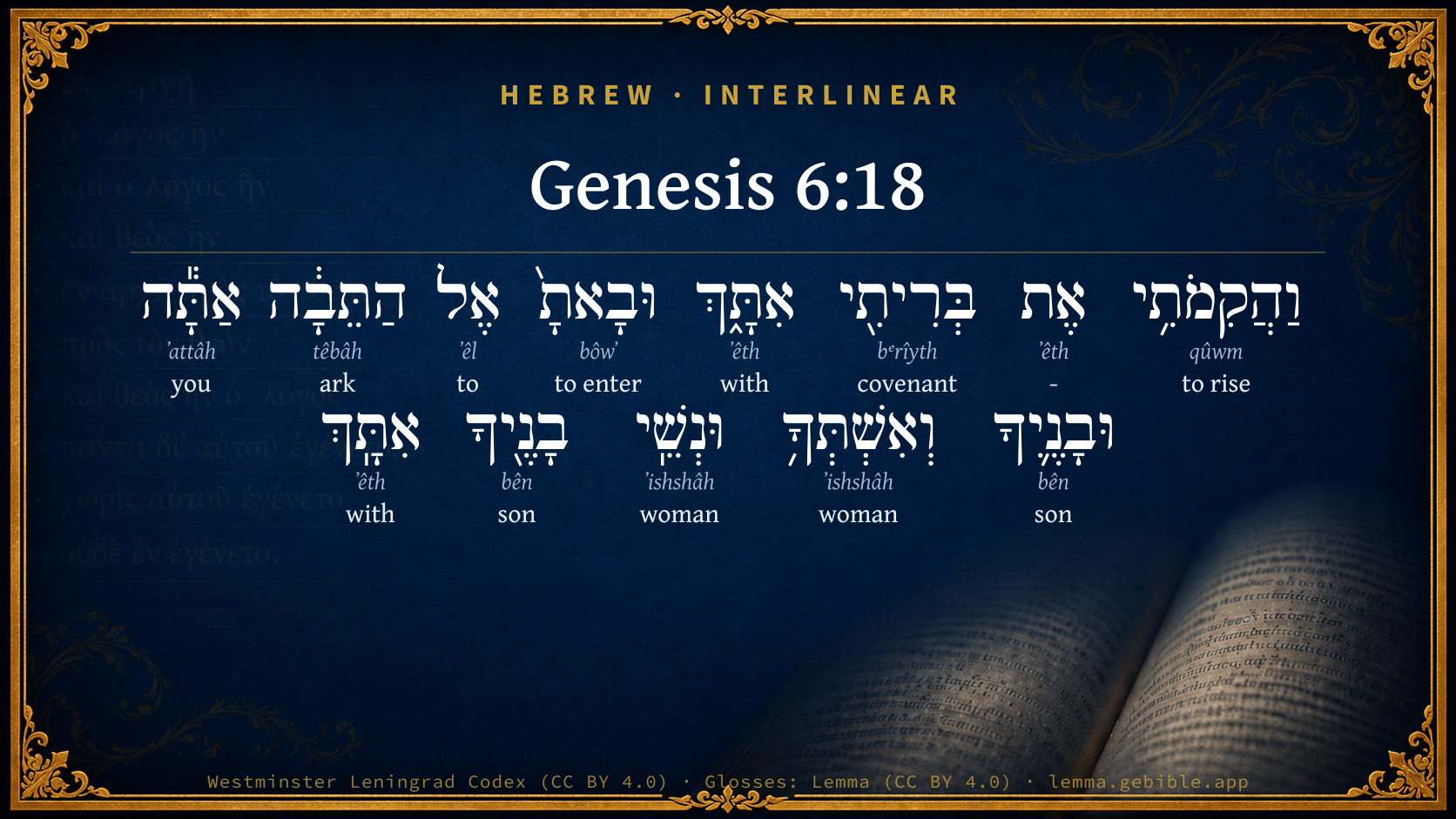
Hebrew (Westminster Leningrad Codex) Genesis 6:18 appears in the Hebrew Old Testament. The text above is from the Westminster Leningrad Codex. Each word links to its Strong’s number, a concise gloss, and parsing drawn from the Open Scriptures Hebrew Bible morphology. Click any word for its full Brown-Driver-Briggs (BDB) entry.
Download image
Cite this verse

Genesis 6:18 (World English Bible). Public Domain. Lemma interlinear Bible study tool, https://lemma.gebible.app/v/genesis/6/18.

Show BibTeX & RIS
BibTeX
RIS
English Translation
But I will establish my covenant with you. You shall come into the ark, you, your sons, your wife, and your sons' wives with you.
World English Bible · Public Domain
Highlights
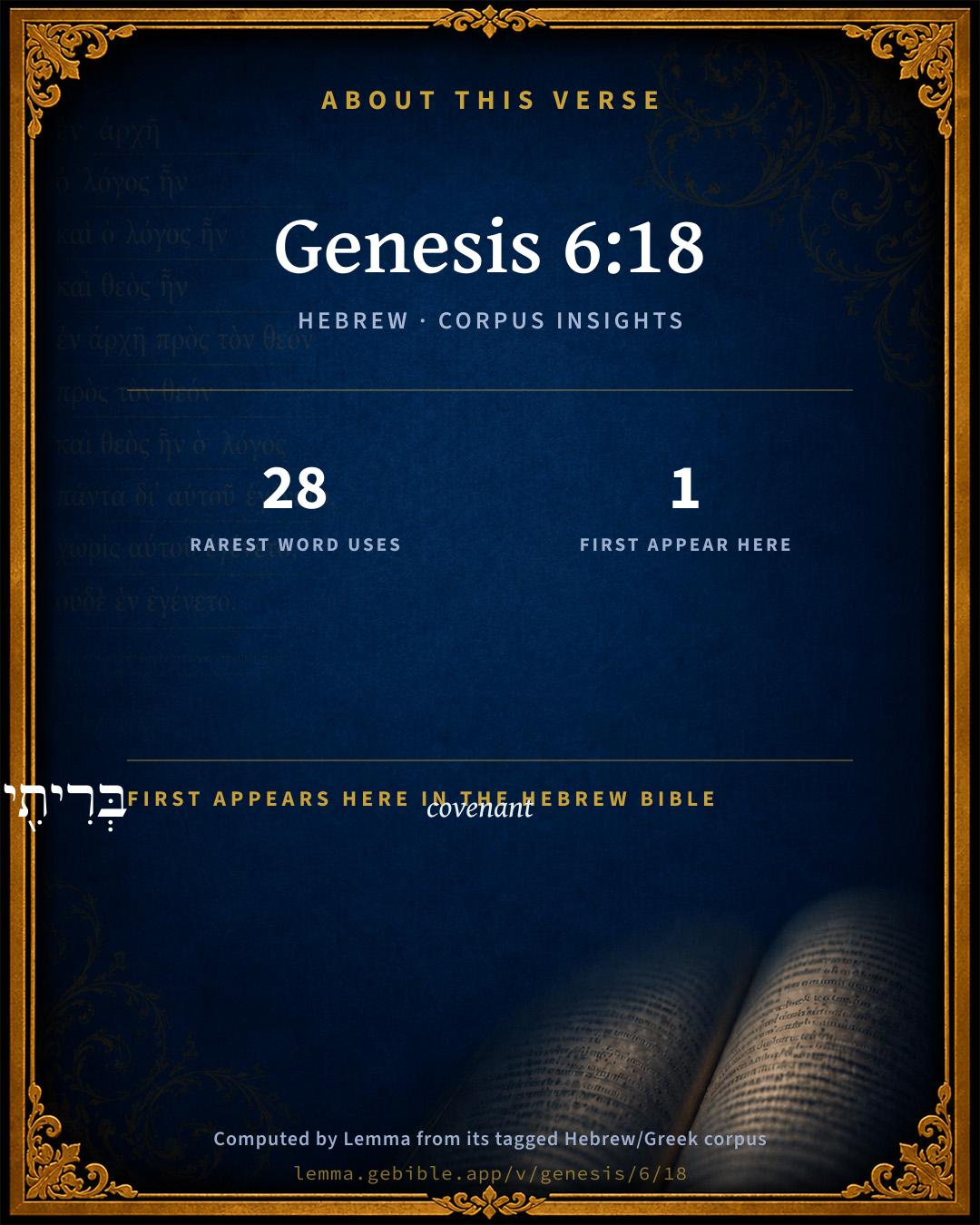
  • 1 first appearance in the Hebrew Bible
Full analysis ↓
Download a study sheet

One document with this verse’s original text, its word-by-word gloss line, the meaning frame, cross-references with their text, attributed commentary, and full source and license credits — printable, and it pastes into notes with its structure intact.

This verse Autodidact and up

Study sheet (.html) Plain text (.txt)

A passage Seminary Student

Up to 50 verses in one chapter. A passage sheet keeps up to 6 commentary sources and 12 cross-references per verse, in the order this page ranks them, and says so on the sheet whenever that leaves anything out. Ask for a single verse and you get the Autodidact verse sheet above.

Everything on this page stays free to read, with no account — the sheet is a download of what is already on screen, not access to it.

Want to remove ads? Support Godless Engineer
Compare translations 3

The same verse in 3 English versions, stacked beneath the original-language interlinear above. Click any original word for its lexicon entry.

Each is an independent rendering of the whole verse — the interlinear is not word-aligned to these translations.

Highlighted words mark where these versions differ — a whole-verse word diff, not a word-by-word alignment.

  • World English Bible Public Domain
    But I will establish my covenant with you. You shall come into the ark, you, your sons, your wife, and your sons' wives with you.
  • King James Version Public Domain
    But with thee will I establish my covenant; and thou shalt come into the ark, thou, and thy sons, and thy wife, and thy sons' wives with thee.
  • unfoldingWord Literal Text CC BY-SA 4.0
    But I will establish my covenant with you, so you must go into the ark, you and your sons and your wife and the wives of your sons with you.

unfoldingWord Literal Text — © unfoldingWord, licensed CC BY-SA 4.0. Word-aligned USFM3 via Door43 (git.door43.org/unfoldingWord/en_ult).

Versions to compare (up to 4)

3 of 4 selected

Show all 18 translations

Every available English version of this verse, each an independent rendering of the whole verse.

  • World English Bible Public Domain
    But I will establish my covenant with you. You shall come into the ark, you, your sons, your wife, and your sons' wives with you.
  • Berean Standard Bible Public Domain
    But I will establish My covenant with you, and you will enter the ark—you and your sons and your wife and your sons’ wives with you.
  • Majority Standard Bible Public Domain
    But I will establish My covenant with you, and you will enter the ark—you and your sons and your wife and your sons’ wives with you.
  • King James Version Public Domain
    But with thee will I establish my covenant; and thou shalt come into the ark, thou, and thy sons, and thy wife, and thy sons' wives with thee.
  • American Standard Version (1901) Public Domain
    But I will establish my covenant with thee; and thou shalt come into the ark, thou, and thy sons, and thy wife, and thy sons' wives with thee.
  • Revised Version (1885) Public Domain
    But I will establish my covenant with thee; and thou shalt come into the ark, thou, and thy sons, and thy wife, and thy sons’ wives with thee.
  • Geneva Bible (1599) Public Domain
    But with thee will I establish my couenant, and thou shalt goe into the Arke, thou, and thy sonnes, and thy wife, and thy sonnes wiues with thee.
  • Douay-Rheims (1899) Public Domain
    And I will establish my covenant with thee, and thou shalt enter into the ark, thou and thy sons, and thy wife, and the wives of thy sons with thee.
  • Young's Literal Translation Public Domain
    `And I have established My covenant with thee, and thou hast come in unto the ark, thou, and thy sons, and thy wife, and thy son's wives with thee;
  • Literal Standard Version CC BY-SA 4.0
    And I have established My covenant with you, and you have come into the Ark—you, and your sons, and your wife, and your son’s wives with you;
  • Unlocked Literal Bible CC BY-SA 4.0
    But I will establish my covenant with you. You will come into the ark, you, and your sons, and your wife, and your sons' wives with you.
  • unfoldingWord Literal Text CC BY-SA 4.0
    But I will establish my covenant with you, so you must go into the ark, you and your sons and your wife and the wives of your sons with you.
  • Darby Bible Public Domain
    But with thee will I establish my covenant; and thou shalt go into the ark, thou, and thy sons, and thy wife, and thy sons' wives with thee.
  • World Messianic Bible Public Domain
    But I will establish my covenant with you. You shall come into the ship, you, your sons, your wife, and your sons’ wives with you.
  • Webster's Bible Public Domain
    But with thee will I establish my covenant: and thou shalt come into the ark, thou, and thy sons, and thy wife, and thy sons' wives with thee.
  • Free Bible Version CC BY-SA 4.0
    But I will keep my agreement with you. You are to go into the ark, taking with you your wife and your sons and their wives.
  • Bible in Basic English Public Domain
    But with you I will make an agreement; and you will come into the ark, you and your sons and your wife and your sons' wives with you.
  • JPS Tanakh (1917) Public Domain
    But I will establish My covenant with thee; and thou shalt come into the ark, thou, and thy sons, and thy wife, and thy sons' wives with thee.

Literal Standard Version (2020), Covenant Press — licensed CC BY-SA 4.0. Text via the HelloAO Bible API (eBible.org). Unlocked Literal Bible (unfoldingWord) — licensed CC BY-SA 4.0. Text via the HelloAO Bible API (eBible.org). unfoldingWord Literal Text — © unfoldingWord, licensed CC BY-SA 4.0. Word-aligned USFM3 via Door43 (git.door43.org/unfoldingWord/en_ult). Free Bible Version, Dr. Jonathan Gallagher — licensed CC BY-SA 4.0. Text via the HelloAO Bible API (eBible.org).

Word by word

More ways to search: Search by grammar → Find every occurrence → Compare this word →

Practice this passage: Drill this verse → Learn its vocabulary →

הַתֵּבָ֔ה
têbâh
H8392
“the · ark”
Particle, Definite Article + Noun, Common, Feminine, Singular, Absolute
Part of Speech
Particle + Noun
Type
Common
Gender
Feminine
Number
Singular
State
Absolute
Full BDB Definition

Origin: perhaps of foreign derivation

TWOT: 2492

ark - vessel which Noah built - basket vessel in which Moses was placed
  1. וַהֲקִמֹתִ֥י qûwm H6965 “and · to rise” Conjunction + Verb, Hiphil, Perfect, 1st Person, Common, Singular
  2. אֶת ʼêth H853 “-” Particle, Direct Object
  3. בְּרִיתִ֖י bᵉrîyth H1285 “covenant · my” Noun, Common, Feminine, Singular, Construct + Suffix, Personal, 1st Person, Common, Singular
  4. אִתָּ֑ךְ ʼêth H854 “with · you” Preposition + Suffix, Personal, 2nd Person, Feminine, Singular
  5. וּבָאתָ֙ bôwʼ H935 “and · to enter” Conjunction + Verb, Qal, Sequential Perfect, 2nd Person, Masculine, Singular
  6. אֶל ʼêl H413 “to” Preposition
  7. אַתָּ֕ה ʼattâh H859 “you” Pronoun, Personal, 2nd Person, Masculine, Singular
  8. וּבָנֶ֛יךָ bên H1121 “and · sons · your” Conjunction + Noun, Common, Masculine, Plural, Construct + Suffix, Personal, 2nd Person, Masculine, Singular
  9. וְאִשְׁתְּךָ֥ ʼishshâh H802 “and · woman · your” Conjunction + Noun, Common, Feminine, Singular, Construct + Suffix, Personal, 2nd Person, Masculine, Singular
  10. וּנְשֵֽׁי ʼishshâh H802 “and · women of” Conjunction + Noun, Common, Feminine, Plural, Construct
  11. בָנֶ֖יךָ bên H1121 “sons · your” Noun, Common, Masculine, Plural, Construct + Suffix, Personal, 2nd Person, Masculine, Singular
  12. אִתָּֽךְ ʼêth H854 “with · you” Preposition + Suffix, Personal, 2nd Person, Feminine, Singular

About this verse

These counts appear in no published source. They are computed here, from the morphology-tagged text and Lemma’s own curated glosses. What Lemma adds →

13
words
10
distinct lemmas
Pentateuch
section

First appearance in Scripture

This word makes its first canonical appearance in the Hebrew Bible here:

  • בְּרִיתִ֖י covenant H1285

Shared distinctive vocabulary

הַתֵּבָ֔ה ark H8392 occurs in 25 verses of the Hebrew Bible. Also found in:

Grammatical profile

  • 2 verbs
  • 6 nouns
  • 1 pronoun
  • 3 prepositions
  • 1 particle

Verb forms

  • וַהֲקִמֹתִ֥י Hiphil · Perfect
  • וּבָאתָ֙ Qal · Sequential Perfect

Repetition

Words recur within this verse — often emphatic in Hebrew:

  • וּבָנֶ֛יךָ son H1121 ×2
  • וְאִשְׁתְּךָ֥ woman H802 ×2
  • אִתָּ֑ךְ with H854 ×2

Hebrew & Septuagint length

In English translation the verse runs 25 words from the Hebrew and 27 from the Septuagint (LXX English) — closely comparable.

A rough comparison of the two English renderings, which tokenize alike — not a word-level alignment.

Word counts can differ between the Hebrew and the Greek without any difference in meaning — e.g. the Hebrew direct-object marker אֵת has no separate Greek word, and Greek often adds the article ὁ.

Cross-references

11

Topical passages linked to Genesis 6:18 in the Treasury of Scripture Knowledge — connected by theme and wording, ordered by reader-vote popularity; previews shown in the World English Bible.

  • Hebrews 11:7 By faith, Noah, being warned about things not yet seen, moved with godly fear, prepared an ark for the saving of his house, through which he condemned the world, and became heir of the righteousness which is according to faith.
  • Genesis 7:7 Noah went into the ark with his sons, his wife, and his sons' wives, because of the waters of the flood.
  • Genesis 7:13 In the same day Noah, and Shem, Ham, and Japheth, the sons of Noah, and Noah's wife, and the three wives of his sons with them, entered into the ark;
  • Genesis 17:7 I will establish my covenant between me and you and your seed after you throughout their generations for an everlasting covenant, to be a God to you and to your seed after you.
  • Isaiah 26:20 Come, my people, enter you into your chambers, and shut your doors about you: hide yourself for a little moment, until the indignation be past.
  • Genesis 7:1 Yahweh said to Noah, "Come with all of your household into the ark, for I have seen your righteousness before me in this generation.
  • Genesis 9:9–16 "As for me, behold, I establish my covenant with you, and with your offspring after you,
  • 1 Peter 3:20 who before were disobedient, when God waited patiently in the days of Noah, while the ark was being built. In it, few, that is, eight souls, were saved through water.
  • 2 Peter 2:5 and didn't spare the ancient world, but preserved Noah with seven others, a preacher of righteousness, when he brought a flood on the world of the ungodly;
  • Genesis 17:4 "As for me, behold, my covenant is with you. You will be the father of a multitude of nations.
  • Genesis 17:21 But my covenant I establish with Isaac, whom Sarah will bear to you at this set time in the next year."

Cross-references courtesy of OpenBible.info (CC BY 4.0).

Hebrew and Greek witnesses Masoretic Hebrew ↔ Greek Septuagint

The same verse in the two great witnesses to the Old Testament, shown verse-for-verse.

These are two independent witnesses, not word-aligned to each other, and the Septuagint is shown in lemma (dictionary) form.

Hebrew Genesis 6:18 Masoretic · Westminster Leningrad Codex

וַהֲקִמֹתִ֥י אֶת בְּרִיתִ֖י אִתָּ֑ךְ וּבָאתָ֙ אֶל הַתֵּבָ֔ה אַתָּ֕ה וּבָנֶ֛יךָ וְאִשְׁתְּךָ֥ וּנְשֵֽׁי בָנֶ֖יךָ אִתָּֽךְ

But I will establish my covenant with you. You shall come into the ark, you, your sons, your wife, and your sons' wives with you.

World English Bible · Public Domain

Greek LXX Genesis 6:18 Septuagint · lemma form

καί ἵστημι ὁ διαθήκη ἐγώ πρός σύ εἰςἔρχομαι δέ εἰς ὁ κιβωτός σύ καί ὁ υἱός σύ καί ὁ γυνή σύ καί ὁ γυνή ὁ υἱός σύ μετά σύ

And I will establish my covenant with you, and you shall enter into the ark, and your sons and your wife, and your sons' wives with you.

LXX2012 (modern English Septuagint) · Public Domain

On this verse, The Cambridge Bible for Schools and Colleges discusses the Septuagint’s reading. Read the note in Commentary ↓

Hebrew: Westminster Leningrad Codex (CC BY 4.0). Greek: Septuagint (public domain); English from LXX2012 (modern English Septuagint) (Public Domain). How the Septuagint differs from the Hebrew →

Targum (Aramaic paraphrase)

2

The Targum is the ancient Jewish Aramaic paraphrase of the Hebrew Scriptures — an interpretive translation, not the Hebrew text itself. Onkelos (literal) and Pseudo-Jonathan (expansive) render the Torah, and Jonathan the Prophets. Coverage is partial: where no permissively-licensed English translation exists for a verse, only the Aramaic is shown. This is verse-level text, not a word-by-word alignment to the Hebrew.

  1. Targum Onkelos Torah (Genesis–Deuteronomy)
    וְאָקֵם יָת קְיָמִי עִמָּךְ וְתֵעוֹל לְתֵבוֹתָא אַתְּ וּבְנָךְ וְאִתְּתָךְ וּנְשֵׁי בְנָיךְ עִמָּךְ

    And I will establish My covenant with thee; and thou shalt enter into the ark, thou, and thy sons, and thy wife, and the wives of thy sons with thee.

    Targum Onkelos — Aramaic: “Onkelos Genesis” (public domain); “Onkelos Exodus” (public domain); “Onkelos Leviticus” (public domain); “Onkelos Numbers” (public domain); “Onkelos Deuteronomy” (public domain). English: “Sefaria Community Translation” (CC0 1.0 (public-domain dedication)); “J.W. Etheridge. The Targums of Onkelos and Jonathan Ben Uzziel on the Pentateuch. London: Longmans, Green, 1862” (public domain). Text via Sefaria.

  2. Targum Pseudo-Jonathan Torah (Genesis–Deuteronomy)
    וְאָקִים יַת קְיָימִי עִמָךְ וְתֵיעוֹל לְתֵיבוּתָא אַנְתְּ וּבְנָךְ וְאִנְתְּתָךְ וּנְשֵׁי בְנָךְ עִמָּךְ

    But I will establish my covenant with thee; and thou shalt go into the ark, thou, and thy sons, and thy wife, and the wives of thy sons with thee.

    Targum Pseudo-Jonathan — Aramaic: “Targum Jonathan on Genesis” (public domain); “Targum Jonathan on Exodus” (public domain); “Targum Jonathan on Leviticus” (public domain); “Targum Jonathan on Numbers” (public domain); “Targum Jonathan on Deuteronomy” (public domain). English: “The Targum of Jonathan ben Uzziel, trans. J. W. Etheridge, London, 1862” (public domain). Text via Sefaria.

Commentary

Notes on Genesis 6:18 from classic Christian and Jewish commentators (each source and its license shown beneath its notes). The classic Christian expositions comment on the surrounding passage and are grouped to its opening verse, so a note may address several verses; the Jewish commentaries on the Tanakh (Rashi and others) are per-verse, so they appear only where the commentator wrote on this verse.

Lemma curates 59 commentaries, every one of them public domain or Creative Commons licensed, each selected and text-cleaned for this edition rather than reprinted as found. About our sources →

Trapp's Complete Commentary

John Trapp

Gen 6:18 But with thee will I establish my covenant; and thou shalt come into the ark, thou, and thy sons, and thy wife, and thy sons’ wives with thee.

Ver. 18. Thou and thy sons.] Yet Ham, soon after, degenerated: for the present he concealed his wickedness from men; from God he could not. He bears with hypocrites in his visible Church for a season, till the time of separation. In area nobiscum esse possunt, in horreo non possunt ,{ a} "He will thoroughly purge his floor". {Mat 3:12} "The Canaanite shall not be in the land any longer"; nor "the unclean spirit". {Zec 13:2; Zec 14:21} O foelicem illam dieculam !

Two of every sort,] i.e., Two at least: for of clean creatures (fit for sacrifice) {b} there were more.

{a} Augustin.

{b} Rab. Solom.

John Trapp, A Commentary or Exposition upon All the Books of the Old and New Testament (1647–1656) — public domain. Text from a community e-Sword module.

The Biblical Illustrator

Joseph S. Exell

Gen_6:18

With thee will I establish My covenant

Gods covenant with Noah

1.

The leading ideas suggested by a covenant are those of peace and goodwill between the parties, and if differences have subsisted, forgiveness of the past, and security for the future. Such were the friendly alliances between Abram and Abimelech, Isaac and another of the same name, and between Jacob and Laban. God was highly displeased with the world, and would, therefore, destroy that generation by a flood, but when He should have done this, He would return in loving kindness and tender mercies, and would look upon the earth with a propitious eye. Nor should they be kept in fearful expectation of being so destroyed again; for He would pledge His word no more to be wroth with them in such a way, nor to rebuke them forever.

2. In covenants wherein one or both the parties had been offended, it was usual to offer sacrifices, in which a kind of atonement was made for past offences, and a perfect reconciliation followed. Such were the covenants before referred to; and such, as we shall see at the close of the eighth chapter, was the covenant in question. Noah offered sacrifices, and the

Lord smelled a sweet savour, and promised to curse the ground no more for mans sake.

3. In covenants which include a blessing on many, and they unworthy, it is Gods ordinary method to bestow it in reward, or for the sake of one who was dear to Him. God loves men, but He also loves righteousness: hence He delights to bestow His blessings in such a way as manifest His true character. If there had been any dependence on Noahs posterity, that they would all have walked in his steps, the covenant might have been established with them as well as him; but they would soon degenerate into idolatry, and all manner of wickedness. If, therefore, He will bestow favour on them in such a way as to express His love of righteousness, it must be for their father Noahs sake, and in reward of his righteousness. To say, With thee will I establish My covenant, was saying in effect, I will not treat with thy ungodly posterity: whatever favour I show them, it shall be for thy sake. (A. Fuller.)

The Biblical Illustrator, edited by Joseph S. Exell (c. 1880s–1900s) — public domain. Text from a community e-Sword module.

Tyndale Open Study Notes

Tyndale Open Resources

6:18 This first explicit mention of a covenant in the Bible refers to the unilateral pact that God made with humankind and the world after the flood (see 9:9, 11, 14-17).

Tyndale Open Study Notes — © Tyndale Open Resources, licensed CC BY-SA 4.0. Text via the HelloAO Bible API.

Geneva Bible (1599)

Geneva Bible translators

To the intent that in this great enterprise and mockings of the whole world, thou mayest be confirmed, that thy faith fail not.

Geneva Bible (1599) marginal notes — public domain. Text via Bolls.life.

Jamieson, Fausset & Brown

Robert Jamieson, A. R. Fausset & David Brown

But with thee will I establish my covenant--a special promise of deliverance, called a covenant, to convince him of the confidence to be reposed in it. The substance and terms of this covenant are related at Gen 6:19-21.

Jamieson, Fausset & Brown — Commentary Critical and Explanatory on the Whole Bible (1871) — public domain (CC PDM 1.0). Text via the HelloAO Bible API.

Adam Clarke's Commentary

Verse 18. With thee will I establish my covenant] The word ברית berith, from בר bar, to purify or cleanse, signifies properly a purification or purifier, (see on chap. xv.,) because in all covenants made between God and man, sin and sinfulness were ever supposed to be on man's side, and that God could not enter into any covenant or engagement with him without a purifier; hence, in all covenants, a sacrifice was offered for the removal of offences, and the reconciliation of God to the sinner; and hence the word ברית berith signifies not only a covenant, but also the sacrifice offered on the occasion, Ex 24:8; Ps 50:5; and Jesus Christ, the great atonement and purifier, has the same word for his title, Isa 42:6; Isa 49:8; and Zec 9:11.

Almost all nations, in forming alliances, c., made their covenants or contracts in the same way. A sacrifice was provided, its throat was cut, and its blood poured out before God then the whole carcass was divided through the spinal marrow from the head to the rump; so as to make exactly two equal parts; these were placed opposite to each other, and the contracting parties passed between them, or entering at opposite ends met in the centre, and there took the covenant oath. This is particularly referred to by Jeremiah, Jer 34:18-20: "I will give the men (into the hands of their enemies, Jer 34:20) that have transgressed my covenant, which have not performed the words of the covenant which they made before me, when they cut the calf in twain, and passed between the parts thereof," c. See also De 29:12.

A covenant, says Mr. Ainsworth, is a disposition of good things faithfully declared, which God here calls his, as arising from his grace towards Noah (Ge 6:8) and all men but implying also conditions on man's part, and therefore is called our covenant, Zec 9:11. The apostles call it διαθηκη, a testament or disposition; and it is mixed of the properties both of covenant and testament, as the apostle shows, Heb 9:16, c., and of both may be named a testamental covenant, whereby the disposing of God's favours and good things to us is declared. The covenant made with Noah signified, on God's part, that he should save Noah and his family from death by the ark. On Noah's part, that he should in faith and obedience make and enter into the ark -Thou shalt come into the ark, c., so committing himself to God's preservation, Heb 11:7. And under this the covenant or testament of eternal salvation by Christ was also implied, the apostle testifying, 1Pe 3:21, that the antitype, baptism, doth also now save us for baptism is a seal of our salvation, Mr 16:16. To provide a Saviour, and the means of salvation, is GOD'S part: to accept this Saviour, laying hold on the hope set before us, is ours. Those who refuse the way and means of salvation must perish; those who accept of the great Covenant Sacrifice cannot perish, but shall have eternal life. See Clarke on Ge 15:10, &c.

Adam Clarke's Commentary on the Bible (1810–1826) — public domain. Text from a community e-Sword/MySword module.

John Calvin's Commentaries

18. But with thee will I establish my covenant. Since the construction of the ark was very difficult, and innumerable obstacles might perpetually arise to break off the work when begun, God confirms his servant by a super added promise. Thus was Noah encouraged to obey God; seeing that he relied on the Divine promise, and was confident that his labor would not be in vain. For then do we freely embrace the commands of God, when a promise is attached to them, which teaches us that we shall not spend our strength for nought. Whence it appears how foolishly the Papists are deceived, who triflingly argue, that men are led away by the doctrine of faith from the desire of doing well. For what will be the degree of our alacrity in well-doing, unless faith enlighten us? Let us therefore know, that the promises of God alone, are they which quicken us, and inspire each of our members with vigor to yield obedience to God: but that without these promises, we not only lie torpid in indolence, but are almost lifeless, so that neither hands nor feet can do their duty. And hence, as often as we become languid, or more remiss than we ought to be, in good works, let the promises of God recur to us, to correct our tardiness. For thus, according to the testimony of Paul, (Colossians 1:5,) love flourishes in the saints, on account of the hope laid up for them in heaven. It is especially necessary that the faithful should be confirmed by the word of God, lest they faint in the midst of their course; to the end that they may certainly be assured that they are not beating the air, as they say; but that, acquiescing in the promise given them, and being sure of success, they follow God who calls them. This connection, then, is to be borne in mind, that when God was instructing his servant Moses what he would have him do, he declares, for the purpose of retaining him in obedience to himself, that he requires nothing of him in vain. Now, the sum of this covenant of which Moses speaks was, that Noah should be safe, although the whole world should perish in the deluge. For there is an understood antithesis, that the whole world being rejected, the Lord would establish a peculiar covenant with Noah alone. Wherefore, it was the duty of Noah to oppose this promise of God, like a wall of iron, against all the terrors of death; just as if it were the purpose of God, by this sole word, to discriminate between life and death. But the covenant with him is confirmed, with this condition annexed, that his family shall be preserved for his sake; and also the brute animals, for the replenishing of the new world; concerning which I shall say more in the ninth chapter. Genesis 9:1

John Calvin's Commentaries (1540-1563) — public domain. Text from the Calvin Translation Society English edition (1840s-50s) via the Christian Classics Ethereal Library (ccel.org). Calvin's coverage is partial (roughly two-thirds of the Bible); uncommented books and verses are honest gaps, never fabricated. The 19th-century editor's footnotes and remarks are omitted so the notes are faithfully Calvin's own voice.

Ellicott's Commentary for English Readers

(18) My covenant.—There had been no covenant with Adam or with the Sethites, but in the higher state of things which began with Noah, man was to hold a more exactly defined relation to God; and though they had begun to attach the notion of Deity to the name Jehovah in the days of Enos (Gen_4:26), yet it was not till the time of Moses that it became the distinct title of God in covenant with man. Of this relation a necessary result was revelation, as in no other way could there be a communication between the two contracting parties. Hence the Bible is called “The Old and New Covenant,” or “The Old and New Testament,” the Greek term being of wider meaning than either word with us, and signifying either an agreement between the living or the document by which a testator disposes of his property after his death (Heb_9:16-17). The title of covenant is more applicable to the Scriptures of the prior dispensation, which contain a series of such relations, all preparing for the last and best and most perfect, which was a Testament ratified in the blood of Christ.

A Bible Commentary for English Readers, edited by Charles John Ellicott (1878–1897) — public domain. Text from a community e-Sword module.

The Cambridge Bible for Schools and Colleges

gen. ed. J. J. S. Perowne

18. I will establish my covenant] We have here the first mention of a covenant relation between God and man. In the writing of P great stress is laid upon the covenant with Noah, here and in Gen_9:8-17, and with the patriarchs, e.g. in Gen_17:2-14. The word “covenant” (b’rîth, LXX διαθήκη, Lat. foedus) plays an important part in O.T. theology. Its place here in relation to the manifestation of sin on the one side, and of Divine salvation on the other, is typical of its permanent significance in the history of the Chosen People. It is this relationship of covenant (διαθήκη) which is renewed by our Lord and ratified at the institution of the Lord’s Supper, Mat_26:28. A covenant means an agreement, or compact between two parties, for the observance of which promises and pledges are given. Cf. on Gen_9:7.

thou, and thy sons, &c.] This is the redundant style of P, cf. Gen_7:13, Gen_8:16; Gen_8:18.

The Cambridge Bible for Schools and Colleges (gen. ed. J. J. S. Perowne; Cambridge University Press, 1878–1918) — public domain. Text from a community e-Sword module.

John Gill's Exposition

Of fowls after their kind, and of cattle after their kind, of every creeping thing of the earth after his kind,.... What before is generally expressed by "every living thing", is here particularly explained of every sort of them; and from the order of them some have thought that in the same manner they were disposed of in the ark, the fowls in the first story, the cattle in the next, and the creeping things in the lowermost: but others place them in a different manner; see Gill on Gen 6:16 the roots and grain in the lower story, the living creatures of all sorts in the second, and their hay and litter in the third: the second story being three hundred cubits long, and fifty broad, contained in the whole fifteen thousand cubits, which is supposed to be divided into an hundred and fifty equal rooms; so the Targum of Jonathan on Gen 6:14 of these, four are allowed for Noah and his family, two with earth for those animals that live underground, one for those which live on herbs and roots, and the other for those which live on flesh; and the other one hundred and forty four rooms are divided into three parts, that is, twenty four for birds, twenty five for beasts, and the other ninety five for such animals as are designed to be food for the rest; and according to the calculations of learned men, there appear to have been in this story rooms sufficient for all sorts of birds, beasts, and creeping things (k):

two of every sort shall come unto thee, to keep them alive; that is, they shall come of themselves, as Jarchi and Aben Ezra observe, the providence of God so directing and impelling them, just as the creatures came to Adam; so that there was no need for Noah to take any pains by hunting or hawking to get such a number together: the Targum of Jonathan is,"they shall come unto thee by the hand of an angel, who shall take and cause them to come.''So says another Jewish (l) writer, that they were collected by the angels who presided over each species; in which, except the notion of angels presiding over every kind of creature, there is no incongruity, as Bishop Patrick observes; and two of every sort were to come to the ark, to be preserved alive there, that they might propagate their species. So Lucian says (m), that swine, and horses, and lions, and serpents, and all other creatures which were on the earth, entered into the ark "by pairs".

(k) Vid. Bedford's Scripture Chronology, c. 12. p. 155. (l) Pirke Eliezer, c. 23. (m) De Dea Syria.

John Gill's Exposition of the Whole Bible (1746–1763) — public domain (CC PDM 1.0). Text via the HelloAO Bible API.

Haydock's Catholic Bible Commentary

My covenant, that thou shalt be saved, amid the general ruin. This is the second covenant of God with men: the first was with Adam, the third with Abraham, when circumcision was instituted, and the last with Moses, Exodus xix. All others were only ratifications of these; and even these were only figures of that which our Saviour entered into with men, when he undertook to make satisfaction for them to his Father. (Calmet)

George Leo Haydock (1774–1849), Haydock's Catholic Family Bible and Commentary, 1859 edition — public domain. Excludes Psalms (Douay-Rheims chapter numbering differs from Protestant) and Deuterocanonical books (Catholic canon only).

Matthew Poole's English Annotations

Either,

1. My promise to preserve thee and thine, both till the flood and in it, notwithstanding all the scoffs and threats of the wicked world against thee all the time of thy preaching and building of the ark. The word

covenant being here understood, not of a mutual compact or agreement, but of a single and gracious promise, as it is also used Num 18:19; 25:12, and in other places. Which promise, though only here mentioned, was doubtless made before, as may easily be gathered, both from these words and some foregoing passages, and from the need which Noah had of such a support and encouragement during all the time of his ministry. Or,

2. My covenant concerning the sending of the promised Seed, and the redemption of mankind by the Messias, who shall come out of thy loins, and therefore thou shalt be preserved.

Matthew Poole's English Annotations on the Holy Bible (1683–1685) — public domain. Text from a community e-Sword/MySword module.

Whedon's Commentary on the Bible

Daniel D. Whedon

18. With thee will I establish my covenant — ברית, covenant; Septuagint and New Testament, διαθηχη. For the origin of the word, see notes on chap. 15. This word and act contain the weightiest and most vital truths. God’s personal condescension and love, man’s dignity and sonship, with all the duties and obligation involved in these exalted relations, are contained in this word. It is a rich, strong, elevating, and consoling word. Man, God’s image, God’s son, is accepted by him as a partner in promises and obligations. There is something indescribably ennobling and inspiring in the thought. God’s fatherly nearness and man’s immortal nature and destiny are implied in the word. 1) It was solemnly repeated to Abraham, the father of the covenant people; revealed to Isaac and Jacob; enlarged, explained, and more formally ratified with Moses, and all of these covenants were but typical of that sublimest and most mysterious transaction, “the new testament,” διαθηχη,) revealing that infinite condescension and love which “the angels desire to look into,” ratified by the blood of the Son of God. A covenant of works was made with Adam at his creation, wherein man, as his part, was to furnish legal obedience, and God, as his part, eternal life; but when the promise came to sinful man, “faith was counted for righteousness” in the covenant of mercy. How empty, belittling, and cold are those systems of religion that would substitute obedience to the laws of nature for worship in faith and love, which takes hold on a personal, covenant-keeping Father! A covenant with man was implied in his moral nature; it was first expressed in the promise of the woman’s seed, but now, for the first time, appears under the covenant name.

Daniel D. Whedon (gen. ed.), Commentary on the Old and New Testaments (1874–1909) — public domain. Text from a community e-Sword module.

The Pulpit Commentary

But with thee will I establish my covenant. tyrB (diaqhkh, LXX; foe-due, Vulgate; testamentum, N.T.), from arB; to cut or carve; hence a covenant, from the custom of passing between the divided pieces of the victims slain on the occasion of making such solemn compacts (cf.; Gen_15:9; Gesenius) from hrB; to eat, hence an eating together, a banquet (cf. Gen_31:54; Lee) On the Bible idea of covenant see Gen_15:9. My covenant = the already well-known covenant which I have made with man. And thou shalt come into the ark, thou, and thy sons, and thy wife, and thy son"s wives with thee.

This was the substance of the covenant agreement so far as Noah was concerned. The next three verses describe the arrangements about the animals.

The Pulpit Commentary (1880–1919), ed. H.D.M. Spence-Jones & Joseph S. Exell — public domain. Text from a community e-Sword module.

John Wesley's Explanatory Notes

But with thee will I establish my covenant - (1.) The covenant of Providence, that the course of nature shall be continued to the end of time, not withstanding the interruption which the flood would give to it: this promise was immediately made to Noah and his sons, chap. ix, 8, &c. they were as trustees for all this part of the creation, and a great honour was thereby put upon him and his. God would be to him a God, and that out of his seed God would take to himself a people.

John Wesley, Explanatory Notes Upon the Whole Bible (1754–1765) — public domain. Text via the GEBible commentary corpus.

unfoldingWord translationNotes

Door43 World Missions Community

establish my covenant with you

"make a covenant between you and me"

with you

with Noah

You will come into the ark

"You will enter the ark." Some translations say "You will go into the ark."

Of every living creature of all flesh, two of every kind you must bring into the ark

"You must bring into the ark two of every kind of living creature"

creature

an animal God created

all flesh

See how you translated these words in Genesis 6:12.

translationWords

covenant

creature

unfoldingWord translationNotes — © Distant Shores Media and the Door43 World Missions Community, licensed CC BY-SA 4.0. Source: git.door43.org/Door43/en_tn.

Rashi

Rabbi Shlomo Yitzchaki (Rashi)

והקמתי את בריתי BUT I WILL ESTABLISH MY COVENANT — A covenant was necessary for the sake of the fruits that they should not rot or decay; and also that the wicked people of that generation should not kill him (Genesis Rabbah 31:12)

אתה ובניך ואשתך THOU, AND THY SONS AND THY WIFE — Males separately and females separately. From this one may infer that they were not permitted to live together in the Ark as man and wife (Sanhedrin 108b).

Rashi on the Tanakh — English translations: “The Judaica Press complete Tanach with Rashi, translated by A. J. Rosenberg” (CC BY 4.0); “Pentateuch with Rashi's commentary by M. Rosenbaum and A.M. Silbermann, 1929-1934” (public domain); “The Metsudah Tanach series, Lakewood, N.J” (CC BY 4.0); and “The Book of Joshua, Metsudah Publications, 1997” (CC BY 4.0). Text via Sefaria.

Ramban (Nachmanides)

Rabbi Moshe ben Nachman (Ramban / Nachmanides)

AND I WILL ESTABLISH MY COVENANT. Rabbi Abraham ibn Ezra said that this is a sign that G-d had sworn to Noah that during the flood, neither he nor his children would die even though it is not clearly written at first. This is similar to what we find in Deuteronomy: And ye came near unto me every one of you, and said: Let us send men before us, that they may search the land for us. Ramban cites this as another case where the first account lacks some of the details of the later account.The meaning of V’hakimothi (And I will establish) is “I will fulfill My oath.” It appears likely to me that this covenant mentioned here refers to the rainbow, [Thus G-d hinted to Noah that after the flood He will make a covenant with him if he will fulfill the commandment concerning the making of the ark.] The meaning of the word b’rith (covenant) is an agreement and accord which two have chosen, stemming from the root, ‘b’ru’ (choose) you. And the word b’rith takes the same form in construct and in separateness. A similar case is [the word sh’vith, captivity]: ‘sh’vith’ (the captivity of) Jacob; is in construct. And his daughters ‘bash’vith’ (in captivity). is separate. And some say that the word b’rith means the establishment of a boundary [to which each party to the covenant should adhere]. All these are Abraham ibn Ezra’s words.A more correct explanation in line with the simple meaning of Scripture is that the purport of the expression, And I will establish My covenant, is, “At the time of the coming of the flood, My covenant will be established with you so that you and your family and two of all flesh will come into the ark to remain alive, that is to say, so that you will live there and maintain yourself in order to go forth from there alive.” And b’rith (covenant) means G-d’s word when He decrees something without any condition and residuary and fulfills it. Now He mentions the b’rith and mentions that it will be fulfilled, [which, according to the present interpretation is an apparent redundancy], just as we find the verse, The Jews ordained and took upon them, and upon their seed, meaning they accepted upon themselves a matter which was to exist. [Thus our verse is to be explained in a similar way, i.e., He established an unconditional covenant.]By way of the truth, [the mystic lore of the Cabala], the b’rith is everlasting, the word being derived from. In the beginning G-d ‘bara’ (created). Thus brithi (My covenant) is similar to b’riyothi (My creation), and the word is alike in construct form because it is adjoined to the times there were before us. He thus commanded that the b’rith exist and be with the righteous one [Noah]. In a similar sense are the verses: As for Me, behold, I establish My covenant with you; My covenant was with him. The learned student [in the mystic lore of the Cabala] will understand.

Ramban (Nachmanides) on the Tanakh — English translation: “Commentary on the Torah by Ramban (Nachmanides). Translated and annotated by Charles B. Chavel. New York, Shilo Pub. House, 1971-1976” (CC BY 4.0). Text via Sefaria.

Radak

Rabbi David Kimhi (Radak)

והקימותי את בריתי אתך, the covenant that I am going to make with you as part of the deal that you and your family will be saved. I will keep this promise for you and your descendants.

ובאת אל התבה, the ark in which I told you that I would save you from the waters of the deluge.

אתה ובניך, the absence of a reference to the females, shows that copulation was forbidden in the ark, seeing that the women were to have separate quarters. (Chulin 70) G’d separated them by writing: אתה ובניך, אשתך ונשי בניך, The moral lesson in all this is that a time when the entire human species is being wiped out, it is not appropriate for the survivors to indulge in physical pleasures. All they were allowed to do was to eat enough in order to keep themselves alive and well.

Radak on the Tanakh — English translations: “Sefaria Community Translation” (CC0 1.0 (public-domain dedication)); “Eliyahu Munk, HaChut Hameshulash” (CC BY 4.0); “Rabbi Mike Feuer, Jerusalem Anthology” (CC BY 4.0); and “R. David Kimhi on the first book of Psalms, Translated by R.G. Finch, London, 1919” (public domain). Text via Sefaria.

Lesson kit

Teaching starters — assembled from the data on this page, not authored interpretation. Every prompt links to the verse data it draws on. Edit before teaching.

Genesis, in the Pentateuch, opens this verse with 13 words (10 distinct Hebrew lemmas). Its most distinctive word is têbâh (“ark”). A historical commentator’s framing appears above. Read the whole chapter for the surrounding context.

Discussion questions

  1. How does “ark” (têbâh) shape what this verse is saying?
  2. This is the first place “covenant” appears in Scripture (first appears here). What does its debut here establish?
  3. How does Genesis 6:14, which shares the word «ark», read alongside this verse?
  4. What does the repetition of “son” (2× in this one verse) do in this verse?
  5. These translations render this verse differently; the difference is in the English rendering, not the original. What questions does that raise?
  6. «וַהֲקִמֹתִ֥י» is a Hiphil Perfect verb. How does that grammatical form shape the action described?
  7. Compare how Trapp's Complete Commentary and The Biblical Illustrator read this verse. Where do they agree or differ?

Things to notice

  • 1 word makes its first canonical appearance in Scripture here.
  • These translations choose different wording for 5 words in this verse.
  • “son” occurs 2× in this single verse.
  • 10 distinct Hebrew lemmas span 13 words in this verse.

Reading settings

Reading text

Shown beneath each verse's original-language words.

Old Testament
Old Testament edition

Read the OT as the Masoretic Hebrew (MT) or the Greek Septuagint (LXX).

English shown for the Greek Septuagint (in the Hebrew ↔ Greek comparison).

Comparing translations? Open the Compare panel on any verse page to stack up to four side by side.