
Genesis 40:6

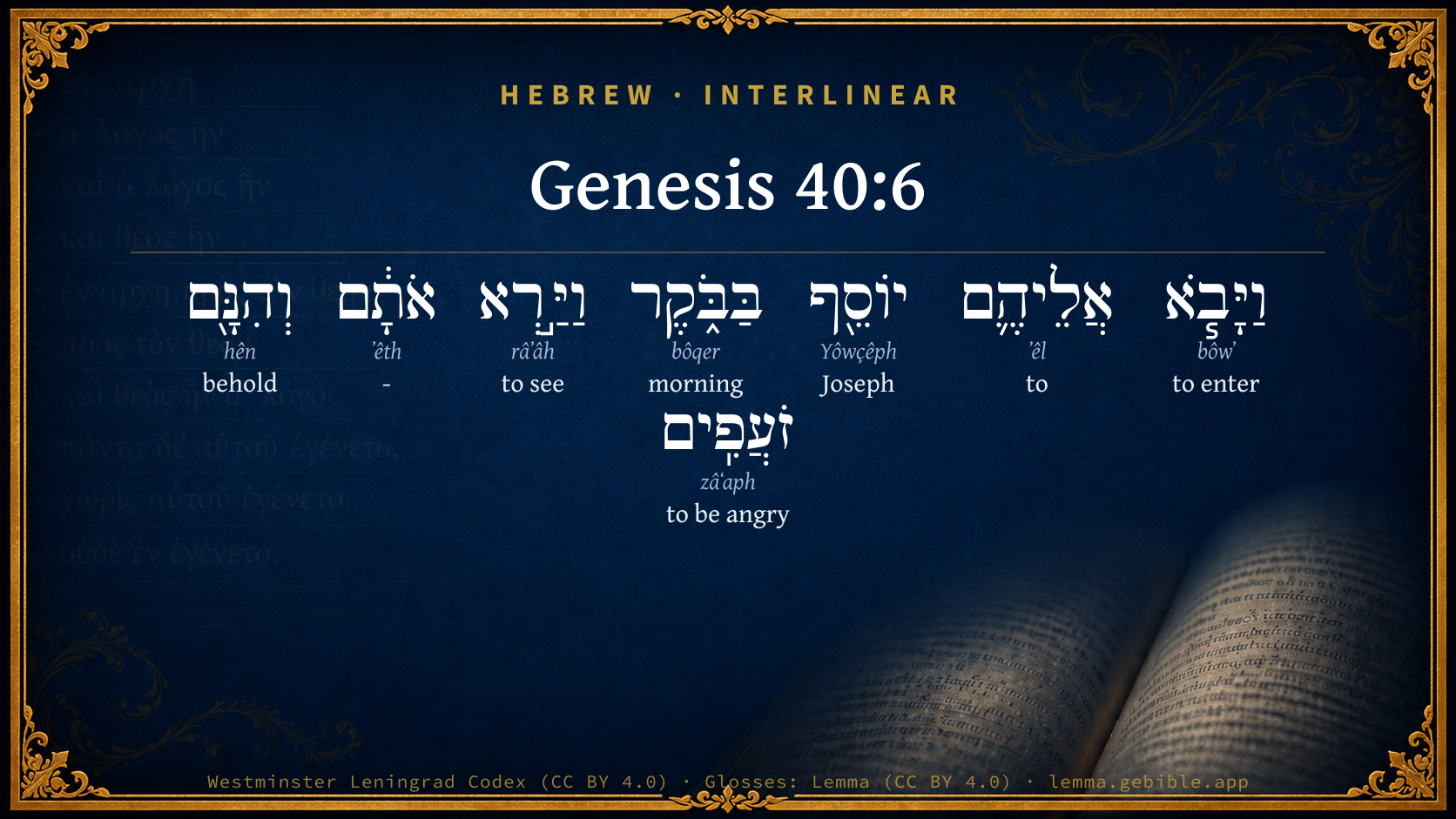
Hebrew (Westminster Leningrad Codex) Genesis 40:6 appears in the Hebrew Old Testament. The text above is from the Westminster Leningrad Codex. Each word links to its Strong’s number, a concise gloss, and parsing drawn from the Open Scriptures Hebrew Bible morphology. Click any word for its full Brown-Driver-Briggs (BDB) entry.
Download image
Cite this verse

Genesis 40:6 (World English Bible). Public Domain. Lemma interlinear Bible study tool, https://lemma.gebible.app/v/genesis/40/6.

Show BibTeX & RIS
BibTeX
RIS
English Translation
Joseph came in to them in the morning, and saw them, and saw that they were sad.
World English Bible · Public Domain
Highlights
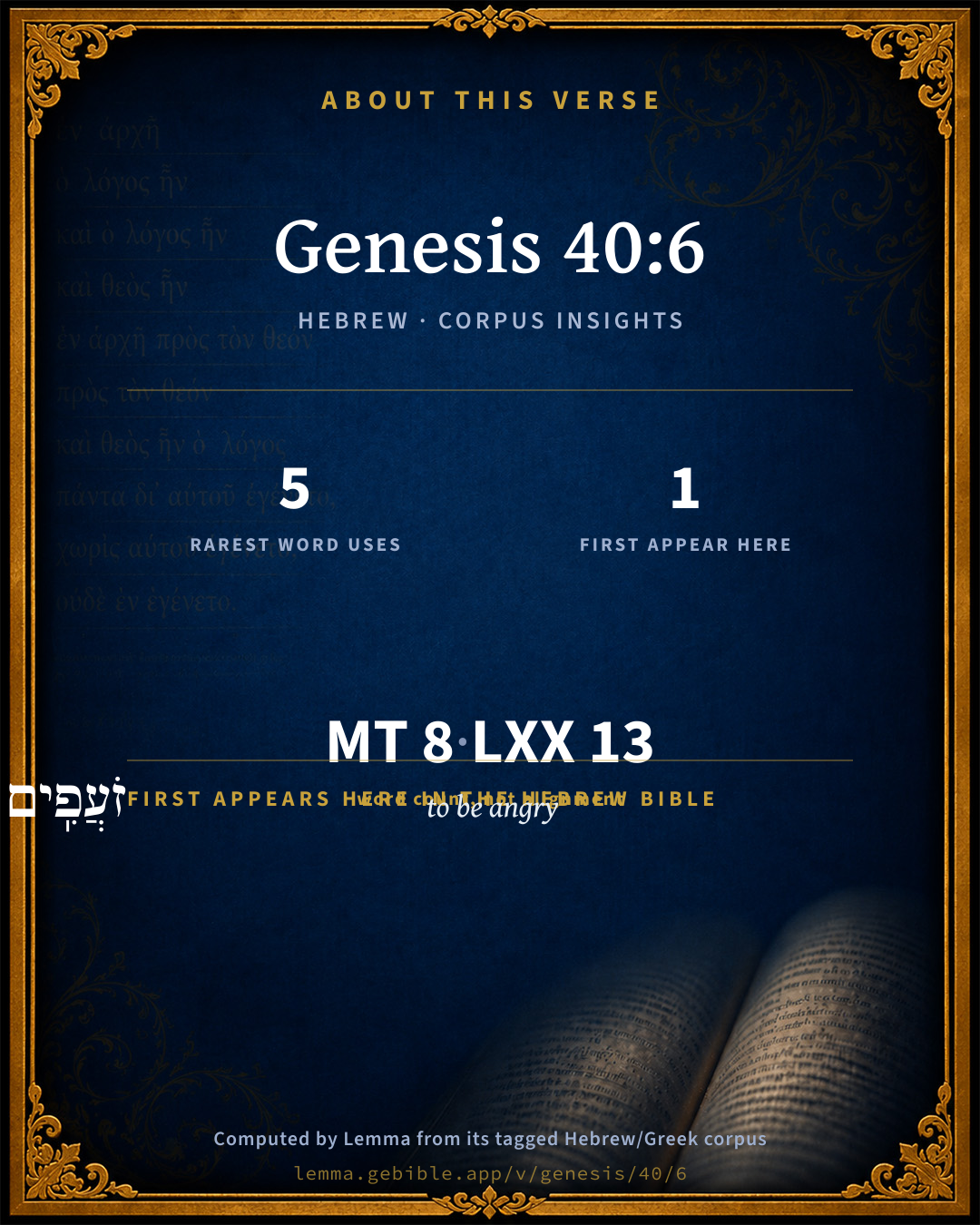
  • 1 first appearance in the Hebrew Bible
Full analysis ↓
Download a study sheet

One document with this verse’s original text, its word-by-word gloss line, the meaning frame, cross-references with their text, attributed commentary, and full source and license credits — printable, and it pastes into notes with its structure intact.

This verse Autodidact and up

Study sheet (.html) Plain text (.txt)

A passage Seminary Student

Up to 50 verses in one chapter. A passage sheet keeps up to 6 commentary sources and 12 cross-references per verse, in the order this page ranks them, and says so on the sheet whenever that leaves anything out. Ask for a single verse and you get the Autodidact verse sheet above.

Everything on this page stays free to read, with no account — the sheet is a download of what is already on screen, not access to it.

Want to remove ads? Support Godless Engineer
Compare translations 3

The same verse in 3 English versions, stacked beneath the original-language interlinear above. Click any original word for its lexicon entry.

Each is an independent rendering of the whole verse — the interlinear is not word-aligned to these translations.

Highlighted words mark where these versions differ — a whole-verse word diff, not a word-by-word alignment.

  • World English Bible Public Domain
    Joseph came in to them in the morning, and saw them, and saw that they were sad.
  • King James Version Public Domain
    And Joseph came in unto them in the morning, and looked upon them, and, behold, they were sad.
  • unfoldingWord Literal Text CC BY-SA 4.0
    And Joseph came to them in the morning and saw them, and behold, they were upset.

unfoldingWord Literal Text — © unfoldingWord, licensed CC BY-SA 4.0. Word-aligned USFM3 via Door43 (git.door43.org/unfoldingWord/en_ult).

Versions to compare (up to 4)

3 of 4 selected

Show all 18 translations

Every available English version of this verse, each an independent rendering of the whole verse.

  • World English Bible Public Domain
    Joseph came in to them in the morning, and saw them, and saw that they were sad.
  • Berean Standard Bible Public Domain
    When Joseph came to them in the morning, he saw that they were distraught.
  • Majority Standard Bible Public Domain
    When Joseph came to them in the morning, he saw that they were distraught.
  • King James Version Public Domain
    And Joseph came in unto them in the morning, and looked upon them, and, behold, they were sad.
  • American Standard Version (1901) Public Domain
    And Joseph came in unto them in the morning, and saw them, and, behold, they were sad.
  • Revised Version (1885) Public Domain
    And Joseph came in unto them in the morning, and saw them, and, behold, they were sad.
  • Geneva Bible (1599) Public Domain
    And when Ioseph came in vnto them in the morning, and looked vpon them, beholde, they were sad.
  • Douay-Rheims (1899) Public Domain
    And when Joseph was come in to them in the morning, and saw them sad,
  • Young's Literal Translation Public Domain
    And Joseph cometh in unto them in the morning, and seeth them, and lo, they `are' morose;
  • Literal Standard Version CC BY-SA 4.0
    And Joseph comes to them in the morning, and sees them, and behold, they [are] morose;
  • Unlocked Literal Bible CC BY-SA 4.0
    Joseph came to them in the morning and saw them. Behold, they were sad.
  • unfoldingWord Literal Text CC BY-SA 4.0
    And Joseph came to them in the morning and saw them, and behold, they were upset.
  • Darby Bible Public Domain
    And Joseph came in to them in the morning, and looked on them, and behold, they were sad.
  • World Messianic Bible Public Domain
    Joseph came in to them in the morning, and saw them, and saw that they were sad.
  • Webster's Bible Public Domain
    And Joseph came to them in the morning, and looked upon them, and behold, they were sad.
  • Free Bible Version CC BY-SA 4.0
    When Joseph arrived the next morning he noticed they both looked depressed.
  • Bible in Basic English Public Domain
    And in the morning when Joseph came to them he saw that they were looking sad.
  • JPS Tanakh (1917) Public Domain
    And Joseph came in unto them in the morning, and saw them, and, behold, they were sad.

Literal Standard Version (2020), Covenant Press — licensed CC BY-SA 4.0. Text via the HelloAO Bible API (eBible.org). Unlocked Literal Bible (unfoldingWord) — licensed CC BY-SA 4.0. Text via the HelloAO Bible API (eBible.org). unfoldingWord Literal Text — © unfoldingWord, licensed CC BY-SA 4.0. Word-aligned USFM3 via Door43 (git.door43.org/unfoldingWord/en_ult). Free Bible Version, Dr. Jonathan Gallagher — licensed CC BY-SA 4.0. Text via the HelloAO Bible API (eBible.org).

Word by word

More ways to search: Search by grammar → Find every occurrence → Compare this word →

Practice this passage: Drill this verse → Learn its vocabulary →

זֹעֲפִֽים
zâʻaph
H2196
“being angry”
Verb, Qal, Participle Active, Masculine, Plural, Absolute
Part of Speech
Verb
Stem
Qal
Form
Participle Active
Gender
Masculine
Number
Plural
State
Absolute
Full BDB Definition

Origin: a primitive root

TWOT: 569

to fret, be sad, be wroth, be vexed, be enraged, be out of humour - (Qal) - to be out of humour - to be enraged, be angry - (Qal) - to appear perplexed, appear troubled - to be sad-looking
  1. וַיָּבֹ֧א bôwʼ H935 “and · to enter” Conjunction + Verb, Qal, Sequential Imperfect, 3rd Person, Masculine, Singular
  2. אֲלֵיהֶ֛ם ʼêl H413 “to · them” Preposition + Suffix, Personal, 3rd Person, Masculine, Plural
  3. יוֹסֵ֖ף Yôwçêph H3130 “Joseph” Noun, Proper
  4. בַּבֹּ֑קֶר bôqer H1242 “in/at the · morning” Preposition, Determined + Noun, Common, Masculine, Singular, Absolute
  5. וַיַּ֣רְא râʼâh H7200 “and · to see” Conjunction + Verb, Qal, Sequential Imperfect, 3rd Person, Masculine, Singular
  6. אֹתָ֔ם ʼêth H853 “- · them” Particle, Direct Object + Suffix, Personal, 3rd Person, Masculine, Plural
  7. וְהִנָּ֖ם hên H2005 “and · behold · them” Conjunction + Particle, Demonstrative + Suffix, Personal, 3rd Person, Masculine, Plural

About this verse

These counts appear in no published source. They are computed here, from the morphology-tagged text and Lemma’s own curated glosses. What Lemma adds →

8
words
8
distinct lemmas
Pentateuch
section

Notable vocabulary

The rarest word here is זֹעֲפִֽים to be angry H2196 — appearing just 5 times in the whole Hebrew Bible.

First appearance in Scripture

This word makes its first canonical appearance in the Hebrew Bible here:

  • זֹעֲפִֽים to be angry H2196

Shared distinctive vocabulary

זֹעֲפִֽים to be angry H2196 occurs in 4 verses of the Hebrew Bible. Also found in:

Grammatical profile

  • 3 verbs
  • 2 nouns
  • 1 preposition
  • 2 particles

Verb forms

  • וַיָּבֹ֧א Qal · Sequential Imperfect
  • וַיַּ֣רְא Qal · Sequential Imperfect
  • זֹעֲפִֽים Qal · Participle Active

Hebrew & Septuagint length

In English translation the verse runs 17 words from the Hebrew and 16 from the Septuagint (LXX English) — closely comparable.

A rough comparison of the two English renderings, which tokenize alike — not a word-level alignment.

Word counts can differ between the Hebrew and the Greek without any difference in meaning — e.g. the Hebrew direct-object marker אֵת has no separate Greek word, and Greek often adds the article ὁ.

In the original languages it is 8 Hebrew tokens and 13 Greek tokens — but the two are counted differently (Hebrew bundles its prefixes and suffixes into one token; the Greek is in lemma form), so that isn’t a like-for-like length.

Cross-references

7

Topical passages linked to Genesis 40:6 in the Treasury of Scripture Knowledge — connected by theme and wording, ordered by reader-vote popularity; previews shown in the World English Bible.

  • Genesis 40:8 They said to him, "We have dreamed a dream, and there is no one who can interpret it." Joseph said to them, "Don't interpretations belong to God? Please tell it to me."
  • Genesis 41:8 It happened in the morning that his spirit was troubled, and he sent and called for all the magicians of Egypt, and all the wise men of it. Pharaoh told them his dream, but there was no one who could interpret them to Pharaoh.
  • Daniel 2:1–3 In the second year of the reign of Nebuchadnezzar, Nebuchadnezzar dreamed dreams; and his spirit was troubled, and his sleep went from him.
  • Daniel 4:5 I saw a dream which made me afraid; and the thoughts on my bed and the visions of my head troubled me.
  • Daniel 5:6 Then the king's face was changed in him, and his thoughts troubled him; and the joints of his loins were loosened, and his knees struck one against another.
  • Daniel 7:28 Here is the end of the matter. As for me, Daniel, my thoughts much troubled me, and my face was changed in me: but I kept the matter in my heart.
  • Daniel 8:27 I, Daniel, fainted, and was sick certain days; then I rose up, and did the king's business: and I wondered at the vision, but none understood it.

Cross-references courtesy of OpenBible.info (CC BY 4.0).

Hebrew and Greek witnesses Masoretic Hebrew ↔ Greek Septuagint

The same verse in the two great witnesses to the Old Testament, shown verse-for-verse.

These are two independent witnesses, not word-aligned to each other, and the Septuagint is shown in lemma (dictionary) form.

Hebrew Genesis 40:6 Masoretic · Westminster Leningrad Codex

וַיָּבֹ֧א אֲלֵיהֶ֛ם יוֹסֵ֖ף בַּבֹּ֑קֶר וַיַּ֣רְא אֹתָ֔ם וְהִנָּ֖ם זֹעֲפִֽים

Joseph came in to them in the morning, and saw them, and saw that they were sad.

World English Bible · Public Domain

Greek LXX Genesis 40:6 Septuagint · lemma form

εἰςἔρχομαι δέ πρός αὐτός ιωσηφ ὁ πρωΐ καί ὁράω αὐτός καί εἰμί ταράσσω

Joseph went in to them in the morning, and saw them, and they had been troubled.

LXX2012 (modern English Septuagint) · Public Domain

On this verse, The Pulpit Commentary discusses the Septuagint’s reading. Read the note in Commentary ↓

Hebrew: Westminster Leningrad Codex (CC BY 4.0). Greek: Septuagint (public domain); English from LXX2012 (modern English Septuagint) (Public Domain). How the Septuagint differs from the Hebrew →

Targum (Aramaic paraphrase)

2

The Targum is the ancient Jewish Aramaic paraphrase of the Hebrew Scriptures — an interpretive translation, not the Hebrew text itself. Onkelos (literal) and Pseudo-Jonathan (expansive) render the Torah, and Jonathan the Prophets. Coverage is partial: where no permissively-licensed English translation exists for a verse, only the Aramaic is shown. This is verse-level text, not a word-by-word alignment to the Hebrew.

  1. Targum Onkelos Torah (Genesis–Deuteronomy)
    וַאֲתָא לְוָתְהוֹן יוֹסֵף בְּצַפְרָא וַחֲזָא יָתְהוֹן והָא אִנּוּן נְסִיסִין

    (no public-domain English translation for this verse)

    Targum Onkelos — Aramaic: “Onkelos Genesis” (public domain); “Onkelos Exodus” (public domain); “Onkelos Leviticus” (public domain); “Onkelos Numbers” (public domain); “Onkelos Deuteronomy” (public domain). English: “Sefaria Community Translation” (CC0 1.0 (public-domain dedication)); “J.W. Etheridge. The Targums of Onkelos and Jonathan Ben Uzziel on the Pentateuch. London: Longmans, Green, 1862” (public domain). Text via Sefaria.

  2. Targum Pseudo-Jonathan Torah (Genesis–Deuteronomy)
    וְאָתָא לְוַתְהוֹן יוֹסֵף בְּצַפְרָא וַחֲמָא יַתְהוֹם וְהָא אִינוּן כְּנִיסִין

    And Joseph came to them in the morning, and saw them, and, behold, they were troubled.

    Targum Pseudo-Jonathan — Aramaic: “Targum Jonathan on Genesis” (public domain); “Targum Jonathan on Exodus” (public domain); “Targum Jonathan on Leviticus” (public domain); “Targum Jonathan on Numbers” (public domain); “Targum Jonathan on Deuteronomy” (public domain). English: “The Targum of Jonathan ben Uzziel, trans. J. W. Etheridge, London, 1862” (public domain). Text via Sefaria.

Commentary

Notes on Genesis 40:6 from classic Christian and Jewish commentators (each source and its license shown beneath its notes). The classic Christian expositions comment on the surrounding passage and are grouped to its opening verse, so a note may address several verses; the Jewish commentaries on the Tanakh (Rashi and others) are per-verse, so they appear only where the commentator wrote on this verse.

Lemma curates 59 commentaries, every one of them public domain or Creative Commons licensed, each selected and text-cleaned for this edition rather than reprinted as found. About our sources →

Trapp's Complete Commentary

John Trapp

Gen 40:6 And Joseph came in unto them in the morning, and looked upon them, and, behold, they [were] sad.

Ver. 6. And, behold, they were sad.] Or, Angry; and yet knew not how to help themselves. But carnal men digest their passions, as horses do their choler, by chewing on the bit. Pope Boniface being kept prisoner by Cardinal Columnus, tore his own flesh with his own teeth, and died raving. {a} Bajazet, the great Turk, could not be pacified in three days, after he was taken by Tamerlane; but, as a desperate man, still sought after death, and called for it. {b} Vivere noluit, mori nesciit; as it is said of that bishop of Salisbury, {c} prisoner in King Stephen’s days.

{a} Revius.

{b} Turk. Hist., fol. 220.

{c} Roger, Bishop of Salisbury.

John Trapp, A Commentary or Exposition upon All the Books of the Old and New Testament (1647–1656) — public domain. Text from a community e-Sword module.

Joseph Benson's Commentary

Gen 40:6. They were sad — It was not the prison that made them sad; they were pretty well used to that, but the dream; God has more ways than one to sadden the spirits of those that are to be made sad. Those sinners that are hardy enough under outward trouble, yet God can find a way to trouble them, and take off their wheels, by wounding their spirits, and laying a load upon them.

Joseph Benson's Commentary on the Old and New Testaments (1811–1818) — public domain. Text from a community e-Sword module.

Adam Clarke's Commentary

Verse 6. They were sad.] They concluded that their dreams portended something of great importance, but they could not tell what.

Adam Clarke's Commentary on the Bible (1810–1826) — public domain. Text from a community e-Sword/MySword module.

John Calvin's Commentaries

6. And Joseph came in unto them, in the morning. As I have lately said, we ought here to behold, with the eyes of faith, the wonderful providence of God. For, although the butler and baker are certainly informed of their own fate; yet this was not done so much out of regard to them, as in favor of Joseph; whom God designed, by this method, to make known to the king. Therefore, by a secret instinct he had rendered them sad and astonished, as if he would lead them by the hand to his servant Joseph. It is, however, to be observed, that by a new inspiration of the Spirit, the gift of prophecy, which he had not before possessed, was imparted to him in the prison. When he had previously dreamed himself, he remained, for a while, in suspense and doubt respecting the divine revelation; but now he is a certain interpreter to others. And though, when he was inquiring into the cause of their sadness, he perhaps did not think of dreams; yet, from the next verse it appears that he was conscious to himself of having received the gift of the Spirit; and, in this confidence, he exhorts them to relate the dreams, of which he was about to be the interpreter. Do not interpretations (he says) belong to God? Certainly he does not arrogantly transfer to himself what he acknowledges to be peculiar to God; but according to the means which his vocation supplied, he offers them his service. This must be noted, in order that no one may undesignedly usurp more to himself than he knows that God has granted him. For, on this account, Paul so diligently teaches that the gifts of the Spirit are variously distributed, (1 Corinthians 12:4,) and that God has assigned to each a certain post, in order that no one may act ambitiously, or intrude himself into another’s office; but rather that each should keep himself within the bounds of his own calling. Unless this degree of moderation shall prevail, all things will necessarily be thrown into confusion; because the truth of God will be distorted by the foolish temerity of many; peace and concord will be disturbed, and, in short, no good order will be maintained. Let us learn, therefore, that Joseph confidently promised an interpretation of the dreams, because he knew that he was furnished and adorned with this gift by God. The same remark applies to his interrogation respecting the dreams. For he does not attempt to proceed beyond what his own power authorized him to do: he does not, therefore, divine what they had dreamed, but confesses it was hidden from him. The method pursued by Daniel was different, for he was enabled, by a direct revelation, to state and interpret the dream which had entirely escaped the memory of the king of Babylon. (Daniel 2:28.) He, therefore, relying upon a larger measure of the Spirit, does not hesitate to profess that he can both divine and interpret dreams. But Joseph, to whom the half only of these gifts was imparted, keeps himself within legitimate bounds. Besides, he not only guards himself against presumption; but, by declaring that whatever he has received is from God, he ingenuously testifies that he has nothing from himself. He does not, therefore, boast of his own quickness or clear-sightedness, but wishes only to be known as the servant of God. Let those who excel, follow this rule; lest, by ascribing too much to themselves, (which commonly happens,) they obscure the grace of God. Moreover, this vanity is to be restrained, not only that God alone may be glorified, and may not be robbed of his right; but that prophets, and teachers, and all others who are indued with heavenly grace, may humbly submit themselves to the direction of the Spirit. What Moses says is also to be observed, that Joseph was concerned at the sadness of those who were with him in prison. For thus men become softened by their own afflictions, so that they do not despise others who are in misery; and, in this way, common sufferings generate sympathy. Wherefore it is not wonderful that God should exercise us with various sorrows; since nothing is more becoming than humanity towards our brethren, who, being weighed down with trials, lie under contempt. This humanity, however, must be learned by experience; because our innate ferocity is more and more inflated by prosperity.

John Calvin's Commentaries (1540-1563) — public domain. Text from the Calvin Translation Society English edition (1840s-50s) via the Christian Classics Ethereal Library (ccel.org). Calvin's coverage is partial (roughly two-thirds of the Bible); uncommented books and verses are honest gaps, never fabricated. The 19th-century editor's footnotes and remarks are omitted so the notes are faithfully Calvin's own voice.

The Cambridge Bible for Schools and Colleges

gen. ed. J. J. S. Perowne

6. sad] Gloomy and depressed, the word rendered “worse liking” in Dan_1:10. There was a general belief in dreams, as a means of conveying supernatural information. In the case of these two officers, their anxiety as to their fate added to the desire to learn the meaning of the strange dreams which had so deeply impressed them. The coincidence in time and the general resemblance between the two dreams could not be accidental.

The Cambridge Bible for Schools and Colleges (gen. ed. J. J. S. Perowne; Cambridge University Press, 1878–1918) — public domain. Text from a community e-Sword module.

John Gill's Exposition

And Joseph came in unto them in the morning,.... For though Joseph and they were in the same prison, yet not in the same ward. Aben Ezra thinks that Joseph lodged in the dungeon in the night, Gen 40:15; and was let out in the morning to wait on these prisoners; but the great interest he had in the keeper of the prison, and the favour shown him by the captain of the guard, in putting such prisoners under his care, will easily make one conclude, that Joseph now had a better lodging than that; though it had been his case, he was now provided with a better apartment in the prison; and when he arose in the morning, like a careful and faithful servant, he came to the ward where the prisoners under his care were, to see that they were safe, and what they wanted:

and looked upon them, and, behold, they were sad; they looked sorrowful, dejected, and uneasy.

John Gill's Exposition of the Whole Bible (1746–1763) — public domain (CC PDM 1.0). Text via the HelloAO Bible API.

Matthew Poole's English Annotations

Perplexed and terrified both, because they perceived the dream was extraordinary and sent from God; compare Gen 41:8; Dan 2:1; Mat 27:19; and because they understood not the meaning of it.

Matthew Poole's English Annotations on the Holy Bible (1683–1685) — public domain. Text from a community e-Sword/MySword module.

The Pulpit Commentary

Vers. 6, 7. And Joseph came in unto them in the morning (a proof that Joseph at this time enjoyed comparative freedom from corporeal restraint in the prison), and looked upon them, and, behold, they were sad. The word from pz to be angry, originally signifying irate, wrathful, tetaragmenoi (LXX), is obviously intended rather to convey the idea of dejection, tristes (Vulgate). And he asked Pharaoh"s officers that were With him in the ward of his lord"s house, saying, Wherefore look ye so sadly today? literally, knowing what (WDm Wdy; hm; ti maqwn) are your faces evil, or bad (proswpa skuqrwpa, LXX; tristier solito, Vulgate), today?

The Pulpit Commentary (1880–1919), ed. H.D.M. Spence-Jones & Joseph S. Exell — public domain. Text from a community e-Sword module.

John Wesley's Explanatory Notes

They were sad - It was not the prison that made them sad; they were pretty well used to that, but the dream. God has more ways than one to sadden the spirits of those that are to be made sad. Those sinners that are hardy enough under outward trouble, yet God can find a way to trouble them, and take off their wheels, by wounding their spirits, and laying a load upon them.

John Wesley, Explanatory Notes Upon the Whole Bible (1754–1765) — public domain. Text via the GEBible commentary corpus.

unfoldingWord translationNotes

Door43 World Missions Community

Joseph came to them

"Joseph came to the cupbearer and the baker"

Behold, they were sad

The word "behold" here shows that Joseph was surprised by what he saw. AT: "He was surprised to see that they were sad" (See: Assumed Knowledge and Implicit Information)

Pharaoh's officials who were with him

This refers to the cupbearer and the baker.

in custody in his master's house

"In prison in him master's house." "His master" refers to Joseph's master, the captain of the guard.

Do not interpretations belong to God?

Joseph uses a question for emphasis. This can be written as a statement. AT: "Interpretations belong to God!" or "It is God who can tell the meaning of dreams!" (See: Rhetorical Question)

Tell me, please

Joseph asks for them to tell him their dreams. AT: "Tell me the dreams, please" (See: Ellipsis)

translationWords

Pharaoh

God

unfoldingWord translationNotes — © Distant Shores Media and the Door43 World Missions Community, licensed CC BY-SA 4.0. Source: git.door43.org/Door43/en_tn.

Rashi

Rabbi Shlomo Yitzchaki (Rashi)

זעפים means SAD. Similar are (1 Kings 20:43) “sullen and displeased (וזעף)”; (Micah 7:9) “I will bear the displeasure (זעף) of the Lord (the sadness which the Lord has imposed on me).’

Rashi on the Tanakh — English translations: “The Judaica Press complete Tanach with Rashi, translated by A. J. Rosenberg” (CC BY 4.0); “Pentateuch with Rashi's commentary by M. Rosenbaum and A.M. Silbermann, 1929-1934” (public domain); “The Metsudah Tanach series, Lakewood, N.J” (CC BY 4.0); and “The Book of Joshua, Metsudah Publications, 1997” (CC BY 4.0). Text via Sefaria.

Radak

Rabbi David Kimhi (Radak)

זעפים, each one of them was deeply upset about the dream he had had as they could not figure out its significance.

Radak on the Tanakh — English translations: “Sefaria Community Translation” (CC0 1.0 (public-domain dedication)); “Eliyahu Munk, HaChut Hameshulash” (CC BY 4.0); “Rabbi Mike Feuer, Jerusalem Anthology” (CC BY 4.0); and “R. David Kimhi on the first book of Psalms, Translated by R.G. Finch, London, 1919” (public domain). Text via Sefaria.

Lesson kit

Teaching starters — assembled from the data on this page, not authored interpretation. Every prompt links to the verse data it draws on. Edit before teaching.

Genesis, in the Pentateuch, opens this verse with 8 words (8 distinct Hebrew lemmas). Its most distinctive word is zâʻaph (“to be angry”). A historical commentator’s framing appears above. Read the whole chapter for the surrounding context.

Discussion questions

  1. The word zâʻaph carries the sense “to be angry.” How does it shape the verse?
  2. The word “to be angry” first appears here in Scripture. What is being introduced at this debut?
  3. 2 Chronicles 26:19 shares the word «to be angry» with this verse. How do the two illuminate each other?
  4. These translations render this verse differently; the difference is in the English rendering, not the original. What questions does that raise?
  5. The verb «וַיָּבֹ֧א» is Qal Sequential Imperfect. How does its form color the action?
  6. Reading how Trapp's Complete Commentary and Joseph Benson's Commentary read this verse, where do the two commentators agree and where do they part?

Things to notice

Reading settings

Reading text

Shown beneath each verse's original-language words.

Old Testament
Old Testament edition

Read the OT as the Masoretic Hebrew (MT) or the Greek Septuagint (LXX).

English shown for the Greek Septuagint (in the Hebrew ↔ Greek comparison).

Comparing translations? Open the Compare panel on any verse page to stack up to four side by side.