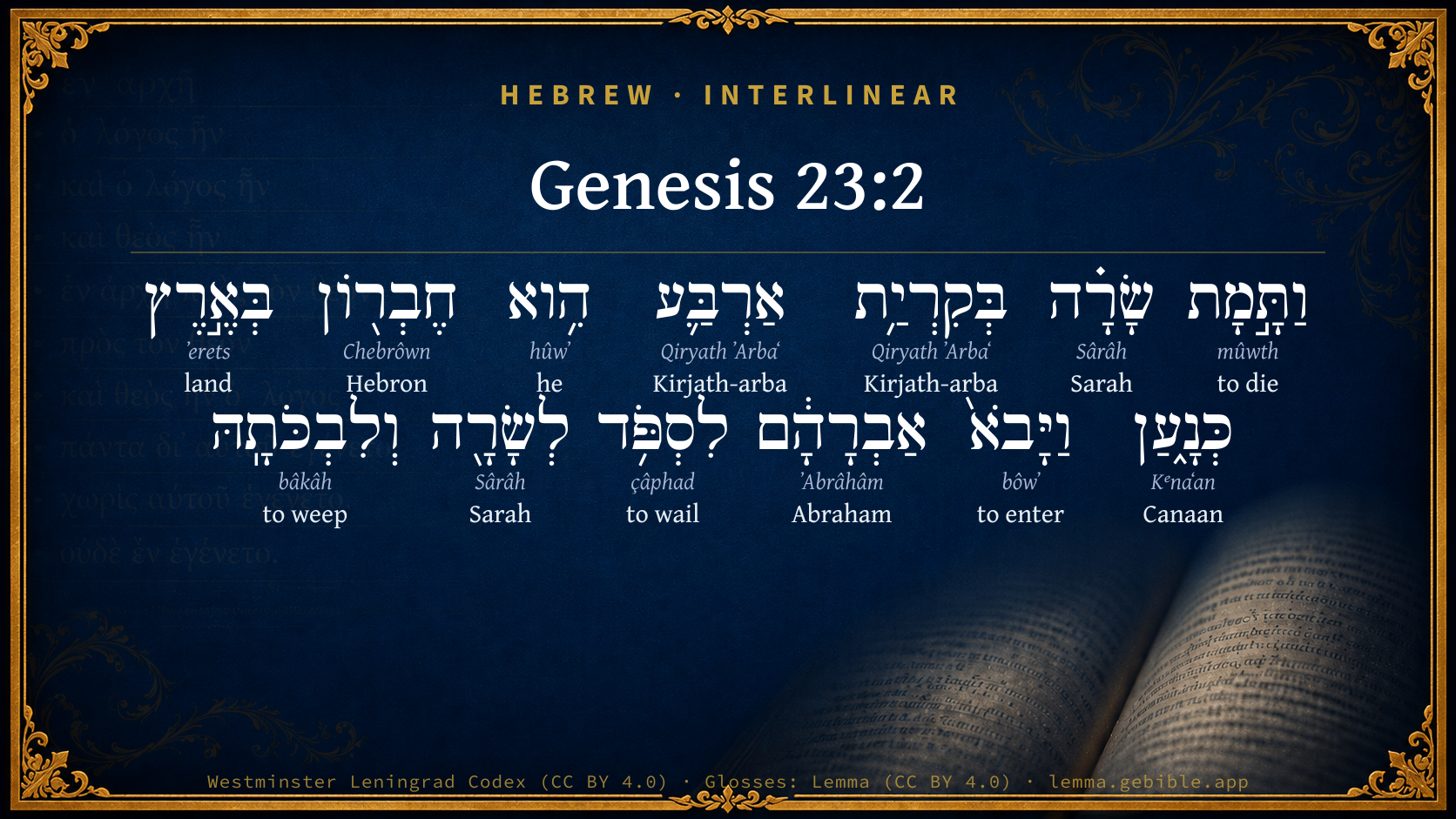
Genesis 23:2

Hebrew (Westminster Leningrad Codex) Genesis 23:2 appears in the Hebrew Old Testament. The text above is from the Westminster Leningrad Codex. Each word links to its Strong’s number, a concise gloss, and parsing drawn from the Open Scriptures Hebrew Bible morphology. Click any word for its full Brown-Driver-Briggs (BDB) entry.
Download image
Cite this verse

Genesis 23:2 (World English Bible). Public Domain. Lemma interlinear Bible study tool, https://lemma.gebible.app/v/genesis/23/2.

Show BibTeX & RIS
BibTeX
RIS
English Translation
Sarah died in Kiriath Arba (the same is Hebron), in the land of Canaan. Abraham came to mourn for Sarah, and to weep for her.
World English Bible · Public Domain
Highlights
  • 2 first appearances in the Hebrew Bible
Full analysis ↓
Download a study sheet

One document with this verse’s original text, its word-by-word gloss line, the meaning frame, cross-references with their text, attributed commentary, and full source and license credits — printable, and it pastes into notes with its structure intact.

This verse Autodidact and up

Study sheet (.html) Plain text (.txt)

A passage Seminary Student

Up to 50 verses in one chapter. A passage sheet keeps up to 6 commentary sources and 12 cross-references per verse, in the order this page ranks them, and says so on the sheet whenever that leaves anything out. Ask for a single verse and you get the Autodidact verse sheet above.

Everything on this page stays free to read, with no account — the sheet is a download of what is already on screen, not access to it.

Want to remove ads? Support Godless Engineer
Compare translations 3

The same verse in 3 English versions, stacked beneath the original-language interlinear above. Click any original word for its lexicon entry.

Each is an independent rendering of the whole verse — the interlinear is not word-aligned to these translations.

Highlighted words mark where these versions differ — a whole-verse word diff, not a word-by-word alignment.

  • World English Bible Public Domain
    Sarah died in Kiriath Arba (the same is Hebron), in the land of Canaan. Abraham came to mourn for Sarah, and to weep for her.
  • King James Version Public Domain
    And Sarah died in Kirjatharba; the same is Hebron in the land of Canaan: and Abraham came to mourn for Sarah, and to weep for her.
  • unfoldingWord Literal Text CC BY-SA 4.0
    Then Sarah died in Kiriath Arba, which Hebron, in the land of Canaan. And Abraham went to mourn for Sarah and to weep for her.

unfoldingWord Literal Text — © unfoldingWord, licensed CC BY-SA 4.0. Word-aligned USFM3 via Door43 (git.door43.org/unfoldingWord/en_ult).

Versions to compare (up to 4)

3 of 4 selected

Show all 18 translations

Every available English version of this verse, each an independent rendering of the whole verse.

  • World English Bible Public Domain
    Sarah died in Kiriath Arba (the same is Hebron), in the land of Canaan. Abraham came to mourn for Sarah, and to weep for her.
  • Berean Standard Bible Public Domain
    She died in Kiriath-arba (that is, Hebron) in the land of Canaan, and Abraham went out to mourn and to weep for her.
  • Majority Standard Bible Public Domain
    She died in Kiriath-arba (that is, Hebron) in the land of Canaan, and Abraham went out to mourn and to weep for her.
  • King James Version Public Domain
    And Sarah died in Kirjatharba; the same is Hebron in the land of Canaan: and Abraham came to mourn for Sarah, and to weep for her.
  • American Standard Version (1901) Public Domain
    And Sarah died in Kiriath-arba (the same is Hebron), in the land of Canaan. And Abraham came to mourn for Sarah, and to weep for her.
  • Revised Version (1885) Public Domain
    And Sarah died in Kiriath-arba (the same is Hebron), in the land of Canaan: and Abraham came to mourn for Sarah, and to weep for her.
  • Geneva Bible (1599) Public Domain
    Then Sarah dyed in Kiriath-arba: the same is Hebron in the land of Canaan. and Abraham came to mourne for Sarah and to weepe for her.
  • Douay-Rheims (1899) Public Domain
    And she died in the city of Arbee which is Hebron, in the land of Chanaan: and Abraham came to mourn and weep for her.
  • Young's Literal Translation Public Domain
    and Sarah dieth in Kirjath-Arba, which `is' Hebron, in the land of Caanan, and Abraham goeth in to mourn for Sarah, and to bewail her.
  • Literal Standard Version CC BY-SA 4.0
    and Sarah dies in Kirjath-Arba, which [is] Hebron, in the land of Canaan, and Abraham goes to mourn for Sarah, and to lament her.
  • Unlocked Literal Bible CC BY-SA 4.0
    Sarah died in Kiriath Arba, that is, Hebron, in the land of Canaan. Abraham mourned and wept for Sarah.
  • unfoldingWord Literal Text CC BY-SA 4.0
    Then Sarah died in Kiriath Arba, which Hebron, in the land of Canaan. And Abraham went to mourn for Sarah and to weep for her.
  • Darby Bible Public Domain
    And Sarah died in Kirjath-Arba: that is Hebron, in the land of Canaan. And Abraham came to mourn for Sarah, and to weep for her.
  • World Messianic Bible Public Domain
    Sarah died in Kiriath Arba (also called Hebron), in the land of Canaan. Abraham came to mourn for Sarah, and to weep for her.
  • Webster's Bible Public Domain
    And Sarah died in Kirjath-arba; the same is Hebron in the land of Canaan: And Abraham came to mourn for Sarah, and to weep for her.
  • Free Bible Version CC BY-SA 4.0
    and then she died at Kiriath-arba (or Hebron) in the land of Canaan. Abraham went in to mourn her death and to weep over her.
  • Bible in Basic English Public Domain
    And Sarah's death took place in Kiriath-arba, that is, Hebron, in the land of Canaan: and Abraham went into his house, weeping and sorrowing for Sarah.
  • JPS Tanakh (1917) Public Domain
    And Sarah died in Kiriatharba — the same is Hebron — in the land of Canaan; and Abraham came to mourn for Sarah, and to weep for her.

Literal Standard Version (2020), Covenant Press — licensed CC BY-SA 4.0. Text via the HelloAO Bible API (eBible.org). Unlocked Literal Bible (unfoldingWord) — licensed CC BY-SA 4.0. Text via the HelloAO Bible API (eBible.org). unfoldingWord Literal Text — © unfoldingWord, licensed CC BY-SA 4.0. Word-aligned USFM3 via Door43 (git.door43.org/unfoldingWord/en_ult). Free Bible Version, Dr. Jonathan Gallagher — licensed CC BY-SA 4.0. Text via the HelloAO Bible API (eBible.org).

Word by word

More ways to search: Search by grammar → Find every occurrence → Compare this word →

Practice this passage: Drill this verse → Learn its vocabulary →

בְּקִרְיַ֥ת
Qiryath ʼArbaʻ
H7153
“in/at · Kirjath-arba”
Preposition + Noun, Proper
Part of Speech
Preposition + Noun
Type
Proper
Full BDB Definition

Origin: from H7151 and H704 or H702

TWOT: None

Kirjath-arba = "city of Arba" - early name of the city which after the conquest was called 'Hebron'
  1. וַתָּ֣מָת mûwth H4191 “and · to die” Conjunction + Verb, Qal, Sequential Imperfect, 3rd Person, Feminine, Singular
  2. שָׂרָ֗ה Sârâh H8283 “Sarah” Noun, Proper
  3. אַרְבַּ֛ע Qiryath ʼArbaʻ H7153 “Kirjath-arba” Adjective, Cardinal number, Feminine, Singular, Absolute
  4. הִ֥וא hûwʼ H1931 “he” Pronoun, Personal, 3rd Person, Feminine, Singular
  5. חֶבְר֖וֹן Chebrôwn H2275 “Hebron” Noun, Proper
  6. בְּאֶ֣רֶץ ʼerets H776 “in/at · land of” Preposition + Noun, Common, Both, Singular, Construct
  7. כְּנָ֑עַן Kᵉnaʻan H3667 “Canaan” Noun, Proper
  8. וַיָּבֹא֙ bôwʼ H935 “and · to enter” Conjunction + Verb, Qal, Sequential Imperfect, 3rd Person, Masculine, Singular
  9. אַבְרָהָ֔ם ʼAbrâhâm H85 “Abraham” Noun, Proper
  10. לִסְפֹּ֥ד çâphad H5594 “to wail” Preposition + Verb, Qal, Infinitive Construct
  11. לְשָׂרָ֖ה Sârâh H8283 “to/for · Sarah” Preposition + Noun, Proper
  12. וְלִבְכֹּתָֽהּ bâkâh H1058 “and · to weep · her” Conjunction + Preposition + Verb, Qal, Infinitive Construct + Suffix, Personal, 3rd Person, Feminine, Singular

About this verse

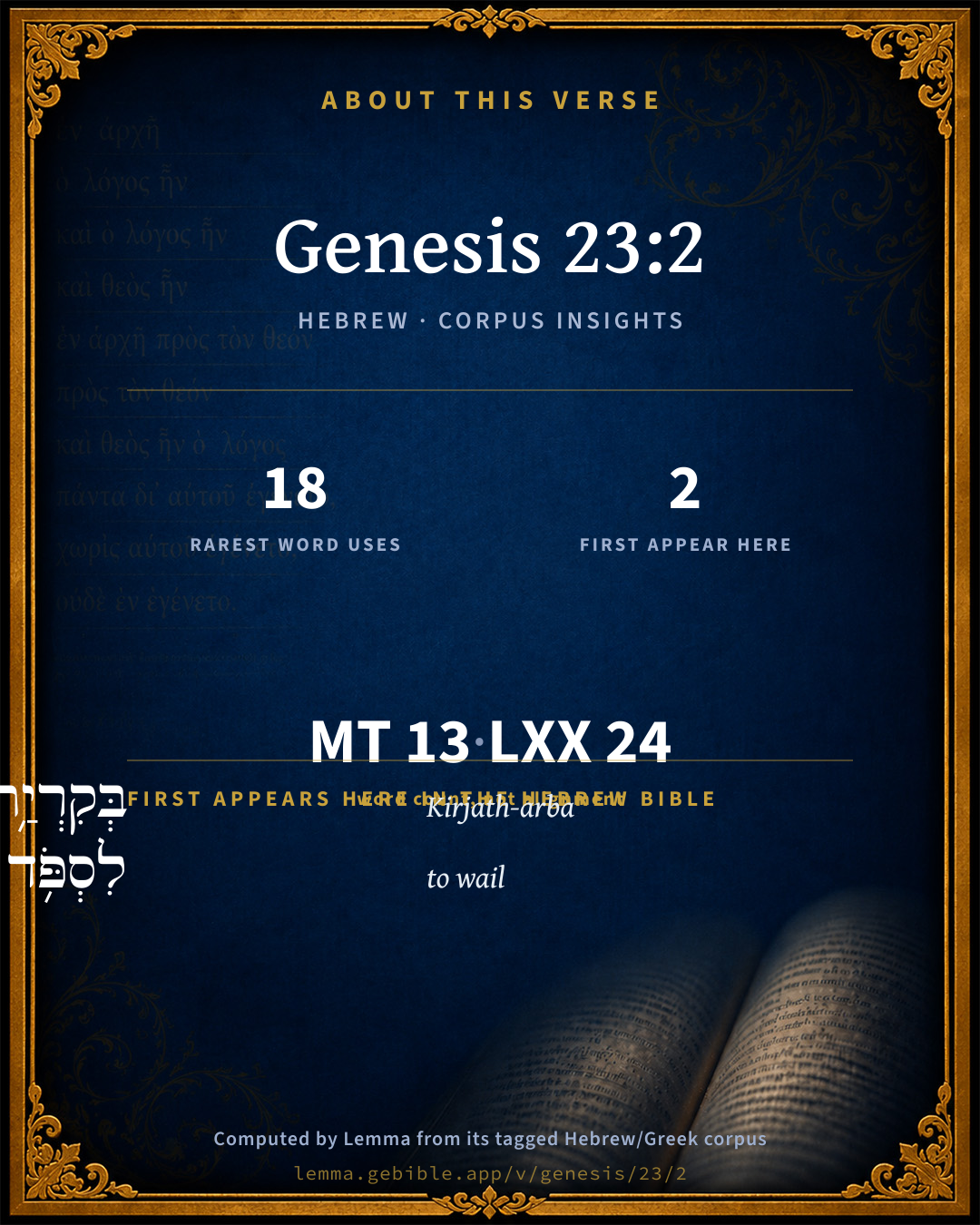
These counts appear in no published source. They are computed here, from the morphology-tagged text and Lemma’s own curated glosses. What Lemma adds →

13
words
11
distinct lemmas
Pentateuch
section

Notable vocabulary

The rarest word here is בְּקִרְיַ֥ת Kirjath-arba H7153 — appearing just 18 times in the whole Hebrew Bible.

First appearance in Scripture

These words make their first canonical appearance in the Hebrew Bible here:

  • בְּקִרְיַ֥ת Kirjath-arba H7153
  • לִסְפֹּ֥ד to wail H5594

Shared distinctive vocabulary

בְּקִרְיַ֥ת Kirjath-arba H7153 occurs in 9 verses of the Hebrew Bible. Also found in:

Grammatical profile

  • 4 verbs
  • 7 nouns
  • 1 adjective
  • 1 pronoun

Verb forms

  • וַתָּ֣מָת Qal · Sequential Imperfect
  • וַיָּבֹא֙ Qal · Sequential Imperfect
  • לִסְפֹּ֥ד Qal · Infinitive Construct
  • וְלִבְכֹּתָֽהּ Qal · Infinitive Construct

Repetition

Words recur within this verse — often emphatic in Hebrew:

  • שָׂרָ֗ה Sarah H8283 ×2
  • בְּקִרְיַ֥ת Kirjath-arba H7153 ×2

Hebrew & Septuagint length

In English translation the verse runs 25 words from the Hebrew and 31 from the Septuagint (LXX English) — closely comparable.

A rough comparison of the two English renderings, which tokenize alike — not a word-level alignment.

Word counts can differ between the Hebrew and the Greek without any difference in meaning — e.g. the Hebrew direct-object marker אֵת has no separate Greek word, and Greek often adds the article ὁ.

In the original languages it is 13 Hebrew tokens and 24 Greek tokens — but the two are counted differently (Hebrew bundles its prefixes and suffixes into one token; the Greek is in lemma form), so that isn’t a like-for-like length.

Cross-references

26

Topical passages linked to Genesis 23:2 in the Treasury of Scripture Knowledge — connected by theme and wording, ordered by reader-vote popularity; previews shown in the World English Bible.

  • Genesis 23:19 After this, Abraham buried Sarah his wife in the cave of the field of Machpelah before Mamre (the same is Hebron), in the land of Canaan.
  • Genesis 13:18 Abram moved his tent, and came and lived by the oaks of Mamre, which are in Hebron, and built an altar there to Yahweh.
  • 1 Chronicles 6:57 To the sons of Aaron they gave the cities of refuge, Hebron; Libnah also with its suburbs, and Jattir, and Eshtemoa with its suburbs,
  • Judges 1:10 Judah went against the Canaanites who lived in Hebron (now the name of Hebron before was Kiriath Arba); and they struck Sheshai, and Ahiman, and Talmai.
  • Genesis 27:41 Esau hated Jacob because of the blessing with which his father blessed him. Esau said in his heart, "The days of mourning for my father are at hand. Then I will kill my brother Jacob."
  • Genesis 50:10 They came to the threshing floor of Atad, which is beyond the Jordan, and there they lamented with a very great and sore lamentation. He mourned for his father seven days.
  • Numbers 13:22 They went up by the South, and came to Hebron; and Ahiman, Sheshai, and Talmai, the children of Anak, were there. (Now Hebron was built seven years before Zoan in Egypt.)
  • Numbers 20:29 When all the congregation saw that Aaron was dead, they wept for Aaron thirty days, even all the house of Israel.
  • Deuteronomy 34:8 The children of Israel wept for Moses in the plains of Moab thirty days: so the days of weeping in the mourning for Moses were ended.
  • Joshua 10:39 and he took it, and the king of it, and all the cities of it; and they struck them with the edge of the sword, and utterly destroyed all the souls who were therein; he left none remaining: as he had done to Hebron, so he did to Debir, and to the king of it; as he had done also to Libnah, and to the king of it.
  • Joshua 14:14–15 Therefore Hebron became the inheritance of Caleb the son of Jephunneh the Kenizzite to this day; because that he wholly followed Yahweh, the God of Israel.
  • Joshua 20:7 They set apart Kedesh in Galilee in the hill-country of Naphtali, and Shechem in the hill-country of Ephraim, and Kiriath Arba (the same is Hebron) in the hill-country of Judah.
  • 1 Samuel 20:31 For as long as the son of Jesse lives on the earth, you shall not be established, nor your kingdom. Therefore now send and bring him to me, for he shall surely die.
  • 1 Samuel 28:3 Now Samuel was dead, and all Israel had lamented him, and buried him in Ramah, even in his own city. Saul had put away those who had familiar spirits, and the wizards, out of the land.
  • 2 Samuel 1:12 and they mourned, and wept, and fasted until even, for Saul, and for Jonathan his son, and for the people of Yahweh, and for the house of Israel; because they were fallen by the sword.
  • 2 Samuel 1:17 David lamented with this lamentation over Saul and over Jonathan his son
  • 2 Samuel 2:11 The time that David was king in Hebron over the house of Judah was seven years and six months.
  • 2 Samuel 5:3 So all the elders of Israel came to the king to Hebron; and king David made a covenant with them in Hebron before Yahweh: and they anointed David king over Israel.
  • 2 Samuel 5:5 In Hebron he reigned over Judah seven years and six months; and in Jerusalem he reigned thirty-three years over all Israel and Judah.
  • 2 Chronicles 35:25 Jeremiah lamented for Josiah: and all the singing men and singing women spoke of Josiah in their lamentations to this day; and they made them an ordinance in Israel: and, behold, they are written in the lamentations.
  • Jeremiah 22:10 Don't you weep for the dead, neither bemoan him; but weep sore for him who goes away; for he shall return no more, nor see his native country.
  • Jeremiah 22:18 Therefore thus says Yahweh concerning Jehoiakim the son of Josiah, king of Judah: they shall not lament for him, [saying], Ah my brother! or, Ah sister! They shall not lament for him, [saying] Ah lord! or, Ah his glory!
  • Ezekiel 24:16–18 Son of man, behold, I take away from you the desire of your eyes with a stroke: yet you shall neither mourn nor weep, neither shall your tears run down.
  • John 11:31 Then the Jews who were with her in the house, and were consoling her, when they saw Mary, that she rose up quickly and went out, followed her, saying, "She is going to the tomb to weep there."
  • John 11:35 Jesus wept.
  • Acts 8:2 Devout men buried Stephen, and lamented greatly over him.

Cross-references courtesy of OpenBible.info (CC BY 4.0).

Hebrew and Greek witnesses Masoretic Hebrew ↔ Greek Septuagint

The same verse in the two great witnesses to the Old Testament, shown verse-for-verse.

These are two independent witnesses, not word-aligned to each other, and the Septuagint is shown in lemma (dictionary) form.

Hebrew Genesis 23:2 Masoretic · Westminster Leningrad Codex

וַתָּ֣מָת שָׂרָ֗ה בְּקִרְיַ֥ת אַרְבַּ֛ע הִ֥וא חֶבְר֖וֹן בְּאֶ֣רֶץ כְּנָ֑עַן וַיָּבֹא֙ אַבְרָהָ֔ם לִסְפֹּ֥ד לְשָׂרָ֖ה וְלִבְכֹּתָֽהּ

Sarah died in Kiriath Arba (the same is Hebron), in the land of Canaan. Abraham came to mourn for Sarah, and to weep for her.

World English Bible · Public Domain

Greek LXX Genesis 23:2 Septuagint · lemma form

καί ἀποθνήσκω σαρρα ἐν πόλις αρβοκ ὅς εἰμί ἐν ὁ κοίλωμα οὗτος εἰμί χεβρων ἐν γῆ χανααν ἔρχομαι δέ αβρααμ κόπτω σαρρα καί πενθέω

And Sarrha died in the city of Arboc, which is in the valley, this is Chebron in the land of Chanaan; and Abraam came to lament for Sarrha and to mourn.

LXX2012 (modern English Septuagint) · Public Domain

On this verse, The Pulpit Commentary discusses the Septuagint’s reading. Read the note in Commentary ↓

Hebrew: Westminster Leningrad Codex (CC BY 4.0). Greek: Septuagint (public domain); English from LXX2012 (modern English Septuagint) (Public Domain). How the Septuagint differs from the Hebrew →

Targum (Aramaic paraphrase)

2

The Targum is the ancient Jewish Aramaic paraphrase of the Hebrew Scriptures — an interpretive translation, not the Hebrew text itself. Onkelos (literal) and Pseudo-Jonathan (expansive) render the Torah, and Jonathan the Prophets. Coverage is partial: where no permissively-licensed English translation exists for a verse, only the Aramaic is shown. This is verse-level text, not a word-by-word alignment to the Hebrew.

  1. Targum Onkelos Torah (Genesis–Deuteronomy)
    וּמִיתַת שָׂרָה בְּקִרְיַת אַרְבַּע הִיא חֶבְרוֹן בְּאַרְעָא דִּכְנָעַן וַאֲתָא אַבְרָהָם לְמִסְפְּדָה לְשָׂרָה וּלְמִבְכַּהּ

    (no public-domain English translation for this verse)

    Targum Onkelos — Aramaic: “Onkelos Genesis” (public domain); “Onkelos Exodus” (public domain); “Onkelos Leviticus” (public domain); “Onkelos Numbers” (public domain); “Onkelos Deuteronomy” (public domain). English: “Sefaria Community Translation” (CC0 1.0 (public-domain dedication)); “J.W. Etheridge. The Targums of Onkelos and Jonathan Ben Uzziel on the Pentateuch. London: Longmans, Green, 1862” (public domain). Text via Sefaria.

  2. Targum Pseudo-Jonathan Torah (Genesis–Deuteronomy)
    וּמִיתַת שָרָה בְּקִרְיַית אַרְבַּע הוּא חֶבְרוֹן בְּאַרְעָא דִכְנָעַן וְאָתָא אַבְרָהָם מִן טַוָור פּוּלְחָנָא וְאַשְׁכְּחָהּ דְמִיתַת וְיָתִיב לְמִסְפַּד לְשָרָה וּלְמִבְכְּיָיהּ

    And Sarah died in Kiryath Arba, which is Hebron. And Abraham came from the mountain of worship, and found that she was dead; and he sat to mourn for Sarah, and to weep for her.

    Targum Pseudo-Jonathan — Aramaic: “Targum Jonathan on Genesis” (public domain); “Targum Jonathan on Exodus” (public domain); “Targum Jonathan on Leviticus” (public domain); “Targum Jonathan on Numbers” (public domain); “Targum Jonathan on Deuteronomy” (public domain). English: “The Targum of Jonathan ben Uzziel, trans. J. W. Etheridge, London, 1862” (public domain). Text via Sefaria.

Commentary

Notes on Genesis 23:2 from classic Christian and Jewish commentators (each source and its license shown beneath its notes). The classic Christian expositions comment on the surrounding passage and are grouped to its opening verse, so a note may address several verses; the Jewish commentaries on the Tanakh (Rashi and others) are per-verse, so they appear only where the commentator wrote on this verse.

Lemma curates 59 commentaries, every one of them public domain or Creative Commons licensed, each selected and text-cleaned for this edition rather than reprinted as found. About our sources →

Trapp's Complete Commentary

John Trapp

Gen 23:2 And Sarah died in Kirjatharba; the same [is] Hebron in the land of Canaan: and Abraham came to mourn for Sarah, and to weep for her.

Ver. 2. And Sarah died.] The Jews would persuade us that the devil represented to her the offering of Isaac, whereat she took sick and died. This is but a mere conceit of theirs; for Abraham then dwelt at Beersheba, now at Hebron.

And Abraham came to mourn for Sarah.] So she was the first that we read of mourned for at death; and it is mentioned as an honour to her. Solon’s Mors mea ne careat lachrymis , is to be preferred before Ennius’s Nemo me decoret lachrymis . It is one of the dues of the dead, {a} to be lamented at their funerals; and the want of it is threatened as a curse in many scriptures. It is a practice warranted by the best in all ages; and mourn we may in death of friends, so we mourn (1.) in truth, and not feignedly; (2.) in measure, and not as men without hope. For the first, how grossly did Tiberius dissemble at the death of Augustus, {b} and at the funeral of Drusus! Whereupon Tacitus makes his note, Vana et irrisa vero et honesto fidem adimunt . So when Julius Caesar wept over Pompey’s head, presented to him in Egypt, they that saw it, laughed in their sleeves, {c} and held them no better than crocodile’s tears. So the mourning that Nero and his mother made over the Emperor Claudius, whose death they had conspired and effected, was deep dissimulation. {d} This is no less hateful, than to mourn heartily, but yet immoderately, is unlawful. Here Jacob forgat himself, when so overgrown with grief for his Joseph, {Gen 37:35} and Rachel for the rest of their children, that they would not be comforted. {Jer 31:15} So David for his Absalom: Alexander the Great for his friend Hephestion; when he not only clipped his horses’ and mules’ hair, but plucked down also the battlements of the walls of the city, &c. The soldiers of Pelopidas {e} were no less excessive, when for grief of his death they would neither unbridle their horses, nor untie their armour, nor dress their wounds. Something here may be yielded to nature, nothing to impatience. Immoderate sorrow for losses past hope of recovery is more sullen than useful. Our stomach may be bewrayed by it, not our wisdom. The Egyptians mourned seventy days for Jacob: Joseph (who had more cause, but with it more grace) mourned but twenty days. God flatly forbade his people those heathenish customs, of shaving their heads and cutting their flesh, {Lev 21:1} in token of mourning for the dead. We read in the gospel of minstrels and people making a noise {f} at the terming-house, as they call it. {Mat 9:23} And the Jews that were comforting Mary, when they saw her rise up hastily and go forth, followed her, saying, "She goeth unto the grave to weep there". {Joh 11:31} Such customs, it seems, they had in those days among them, to provoke themselves to weeping and lamentation; which was, saith one, {g} as if they that have the dropsy should eat salt meats. How much better father Abraham here, who came indeed from his own tent to Sarah’s, to mourn for her (as good reason he had), but exceeded not, as the Jews think is signified by that one letter less than ordinary in the Hebrew word for weep (Libcothah) used here in the text. {Hebrew Text Note} Baal-turim gives but a bald reason of it: Parum flevit; erat enim vetula ; Abraham wept not much for her, she being but an old wife, and past her best. Buxtorf gives a better: Potius quia luctus eius fuit moderatus . And therefore also in the next verse it is said, that he stood up from before his dead - where in likelihood he had sat a while on the earth, as was the manner of mourners to do {Job 2:12-13 Isa 47:1} - to take order for her burial, as having good hopes of a glorious resurrection. Excellent for our purpose is that of St Jerome, Lugeatur mortuus, sed ille quem Gehenna suscipit, quem Tartarns devorat, in cuius poenam aeternus ignis aestuat. Nos, quorum exitum Angelorum turba comitatur, quibus obviam Christus occurret, &c., gravemur magis, si diutius in tabernaculo isto habitemus . Mourn for none, but such as are dead in their sins, killed with death, as those in Rev 2:23.

{a} Hinc νομιζομενα, et Iusta defunctorim .

{b} Testamentum Augusti praelegit tanto simulato gemitu, ut non modo vox, sed et spiritus deficeret .

{c} Eπι μεν τη προσποιησει ταυτη γελωτη ωφλισκανε.

{d} Eum se lugere simulabant quem necaverant . - Dio in Claud.

{e} Plutar. in Vita Pelop.

{f} Mar 5:38; Aλαλαζοντας, vel Oλολυζοντες; ut Jas 5:1.

{g} Perinde ac si intercute laborantes falsamenta comederent - Cartur.

John Trapp, A Commentary or Exposition upon All the Books of the Old and New Testament (1647–1656) — public domain. Text from a community e-Sword module.

Joseph Benson's Commentary

Gen 23:2. Sarah died in Kirjath-arba, or city of Arba — So called, it seems, from Arba, a giant, who lived and ruled in those parts, Jos 14:15; Jos 15:13. Abraham came into Sarah’s tent to mourn for Sarah. He did not only perform the ceremonies of mourning according to the custom of those times, but did sincerely lament the great loss he had sustained, and gave proof of the constancy of his affection. Therefore these two words are used, he came both to mourn and to weep.

Joseph Benson's Commentary on the Old and New Testaments (1811–1818) — public domain. Text from a community e-Sword module.

Jamieson, Fausset & Brown

Robert Jamieson, A. R. Fausset & David Brown

Abraham came to mourn for Sarah, &c.--He came from his own tent to take his station at the door of Sarah's. The "mourning" describes his conformity to the customary usage of sitting on the ground for a time; while the "weeping" indicates the natural outburst of his sorrow.

Jamieson, Fausset & Brown — Commentary Critical and Explanatory on the Whole Bible (1871) — public domain (CC PDM 1.0). Text via the HelloAO Bible API.

Adam Clarke's Commentary

Verse 2. Sarah died in Kirjath-arba] Literally in the city of the four. Some suppose this place was called the city of the four because it was the burial place of Adam, Abraham, Isaac, and Jacob; others, because according to the opinion of the rabbins, Eve was buried there. with Sarah, Rebekah, and Leah. But it seems evidently to have had its name from a Canaanite, one of the Anakim, probably called Arba (for the text, Jos 14:14, does not actually say this was his name,) who was the chief of the four brothers who dwelt there; the names of the others being Sheshai, Ahiman, and Talmai. See Jdg 1:10. These three were destroyed by the tribe of Judah; probably the other had been previously dead.

Abraham came to mourn for Sarah] From verse 19 of the preceding chapter Ge 22:19 it appears that Abraham had settled at Beer-sheba; and here we find that Sarah died at Hebron, which was about twenty-four miles distant from Beersheba. For the convenience of feeding his numerous flocks, Abraham had probably several places of temporary residence, and particularly one at Beer-sheba, and another at Hebron; and it is likely that while he sojourned at Beersheba, Sarah died at Hebron; and his coming to mourn and weep for her signifies his coming from the former to the latter place on the news of her death.

Adam Clarke's Commentary on the Bible (1810–1826) — public domain. Text from a community e-Sword/MySword module.

John Calvin's Commentaries

2. And Sarah died in Kirjath-arba. It appears from Joshua 15:54, that this was the more ancient name of the city, which afterwards began to be called Hebron. But there is a difference of opinion respecting the etymology. Some think the name is derived from the fact, that the city consisted of four parts; as the Greeks call the city divided into three orders, Tripoli, and a given region, Decapolis, from the ten cities it contained. Others suppose that Arba is the name of a giant, whom they believe to have been the king or the founder of the city. Others again prefer the notion, that the name was given to the place from four of the Fathers, Adam, Abraham, Isaac, and Jacob, who were buried there with their wives. I willingly suspend my judgment on a matter of uncertainty, and not very necessary to be known. It more concerns the present history to inquire, how it happened that Sarah died in a different place from that in which Abraham dwelt. If any one should reply, that they had both changed their abode, the words of Moses are opposed to that, for he says that Abraham came to bury his dead. It is hence easily inferred, that he was not present at her death; nor is it probable that they were separated, merely by being in different tents; so that he might walk ten or twenty paces for the sake of mourning, while a more important duty had been neglected. For this reason, some suspect that he was on a journey at the time. But to me it seems more likely that their abode was then at Heron, or at least in the vale of Mamre, which adjoins the city. For, after a little breathing time had been granted him he was soon compelled to return to his accustomed wanderings. And although Moses does not say, that Abraham had paid to his wife while yet alive, the due attentions of a husband; I think that he omits it, as a thing indubitably certain, and that he speaks particularly of the mourning, as a matter connected with the care of sepulture. That they dwelt separately we shall afterwards see: not as being in different regions, but because each inhabited separate, though contiguous, tents. And this was no sign of dissension or of strife, but is rather to be ascribed to the size of the family. For as Abraham had much trouble in governing so large a herd of servants; so his wife would have equal difficulty to retain her maids under chaste and honest custody. Therefore the great number of domestics which it was not safe to mingle together, compelled them to divide the family.

But it may be asked, what end could it answer to approach the body for the sake of mourning over it? Was not the death of his wife sufficiently sad and bitter to call forth his grief, without this additional means of excitement? It would have been better to seek the alleviation of his sorrow, than to cherish and even augment it, by indulgence. I answer; if Abraham came to his dead wife, in order to produce excessive weeping, and to pierce his heart afresh with new wounds, his example is not to be approved. But if he both privately wept over the death of his wife, so far as humanity prescribed, exercising self-government in doing it; and also voluntarily mourned over the common curse of mankind; there is no fault in either of these. For to feel no sadness at the contemplation of death, is rather barbarism and stupor than fortitude of mind. Nevertheless, as Abraham was a man, it might be, that his grief was excessive. And yet, what Moses soon after subjoins, that he rose up from his dead, is spoken in praise of his moderation; whence Ambrose prudently infers, that we are taught by this example, how perversely they act, who occupy themselves too much in mourning for the dead. Now, if Abraham at that time, assigned a limit to his grief; and put a restraint on his feelings, when the doctrine of the resurrection was yet obscure; they are without excuse, who, at this day, give the reins to impatience, since the most abundant consolation is supplied to us in the resurrection cf Christ.

John Calvin's Commentaries (1540-1563) — public domain. Text from the Calvin Translation Society English edition (1840s-50s) via the Christian Classics Ethereal Library (ccel.org). Calvin's coverage is partial (roughly two-thirds of the Bible); uncommented books and verses are honest gaps, never fabricated. The 19th-century editor's footnotes and remarks are omitted so the notes are faithfully Calvin's own voice.

Ellicott's Commentary for English Readers

(2) Kirjath-arba; the same is Hebron.—This was a very ancient city, built seven years before Zoan in Egypt (Num_13:22), probably by a tribe of Semites on their way to the Delta. It lies upon the very border of the Negeb of Judah, about twenty-two miles south of Jerusalem. Originally it was named Kirjath-arba, and though Arba is called “the father of Anak” (Jos_15:13), yet the literal meaning City of Four (arba being the Hebrew numeral four), coupled with the fact that Hebron means alliance (Gen_13:18), suggests that its building was the result of the union of four families; and afterwards, from the name of the city, Arba may have been often used as a proper name. At the conquest of Palestine there were descendants of Anak still dwelling there, and apparently they had restored the old title, but were expelled by Caleb (Jos_15:14), who took it as his possession, and seems to have given its name to a grandchild, as a memorial of his victory (1Ch_2:42). It is still an important town, with a population of 17,000 Moslems and about 600 Jews.

Abraham came to mourn.—At this period Abraham was in quiet possession of several headquarters, and apparently was himself at Beer-sheba when Sarah died at Hebron, where probably he had left Isaac in charge of his mother and the cattle.

A Bible Commentary for English Readers, edited by Charles John Ellicott (1878–1897) — public domain. Text from a community e-Sword module.

The Cambridge Bible for Schools and Colleges

gen. ed. J. J. S. Perowne

2. Kiriath-arba (the same is Hebron)] Cf. Gen_35:27 (P). Kiriath-arba means “the city of four,” probably four confederate tribes. It was the earlier name of Hebron, which itself may mean “Confederation.” The two names are mentioned in Jdg_1:10. In Jos_14:15; Jos_15:13, where the early name is also mentioned, Arba is regarded as a proper name. For Hebron as one of the dwelling-places of Abraham, see Gen_13:18.

Abraham came to mourn for Sarah] As if, at the time of Sarah’s death, Abraham had been residing in some different place. He came to “mourn”; and this word refers to the Oriental solemnity of wailing for the departed.

The Cambridge Bible for Schools and Colleges (gen. ed. J. J. S. Perowne; Cambridge University Press, 1878–1918) — public domain. Text from a community e-Sword module.

John Gill's Exposition

And Sarah died in Kirjatharba,.... Which was so called, either, as Jarchi says, from the four Anakims or giants that dwelt here, Jos 15:13; or else, as the same writer observes, from the four couple buried here, Adam and Eve, Abraham and Sarah, Isaac and Rebekah, Jacob and Leah; but then it must be so called by anticipation; rather, as Aben Ezra thinks, it had its name from Arba, a great man among the Anakims, and the father of Anak, Jos 14:15; though some take it to be a Tetrapolls, a city consisting of four parts; but be it as it will, here Abraham and Sarah were at the time of her death; when they removed from Beersheba hither is not said:

the same is Hebron, in the land of Canaan; so it was afterwards called: here Abraham and Sarah had lived many years ago, see Gen 13:18; and hither they returned, and here they ended their days and were buried:

and Abraham came to mourn for Sarah, and to weep for her; Aben Ezra observes, that, when Sarah died, Abraham was in another place, and therefore is said to come to mourn for her; and the Targum of Jonathan is,"and Abraham came from the mount of worship (Moriah), and found that she was dead, and he sat down to mourn for Sarah, and to weep for her.''Others (u) report, that, upon hearing of the offering up of Isaac, she swooned away and died. But the meaning is, that he came from his own tent to Sarah's, see Gen 24:67, where her corpse was, to indulge his passion of grief and sorrow for her; which, in a moderate way, was lawful, and what natural affection and conjugal relation obliged him to. The Hebrews (w) observe, that, in the word for "weep", one of the letters is lesser than usual, and which they think denotes, that his weeping for her was not excessive, but little; but both phrases put together seem to denote that his sorrow was very great; and the one perhaps may refer to his private, and the other to his public mourning for her, according to the custom of those times.

(u) Pirke Eliezer, c. 32. Jarchi in loc. (w) Baal Hatturim in loc.

John Gill's Exposition of the Whole Bible (1746–1763) — public domain (CC PDM 1.0). Text via the HelloAO Bible API.

Haydock's Catholic Bible Commentary

City. Hebrew, Cariath arbah, Josue xiv. 15. --- Which is Hebron. Serarius thinks it took its name from the society (cherber) between Abraham and the princes of the city. Hebron the son of Caleb possessed it afterwards. --- Came from Bersabee, (chap. xxii. 19.) or to the place where the corpse lay, at Arbee, which signifies four; as Adam, Abraham, Isaac, and Jacob, with their four wives, reposed there. (Calmet) --- And weep. In the middle of this word, in the printed Hebrew, there is left a small c; whence the Rabbins ridiculously infer, that Abraham wept but a short time. But the retaining of greater, less, suspended and inverted letters in the Hebrew Bible, can be attributed to no other cause than a scrupulous veneration even for the faults of transcribers. (Kennicott)

George Leo Haydock (1774–1849), Haydock's Catholic Family Bible and Commentary, 1859 edition — public domain. Excludes Psalms (Douay-Rheims chapter numbering differs from Protestant) and Deuterocanonical books (Catholic canon only).

Matthew Poole's English Annotations

Kirjath-arba, or, the city of Arba; so called probably from a giant or great man called Arba, who lived and ruled in those parts. See Jos 14:15; 15:13. It is objected against this scripture, that this city was not called Hebron till Joshua's time, Jos 14:15; but this is a mistake, Joshua doth not say so, but only that the name of Hebron before, ( or in old time), as this very particle is rendered, Deu 2:20, and elsewhere. So the sense is, the most ancient name of it was Kirjath-arba. Nor doth Joshua there give any account or reason of this change of the name at that time, or upon that occasion, as the sacred writers used to do in such cases, but rather supposeth that Hebron was the name of it before he came thither; and how long before that time he doth not express.

Abraham came into Sarah's tent, (see Gen 18:6-9)

to weep for her, according to the laudable custom of all ages and nations, to manifest their sense of God's hand upon them, and of their own loss. See Gen 50:3; Deu 34:8, &c.

Matthew Poole's English Annotations on the Holy Bible (1683–1685) — public domain. Text from a community e-Sword/MySword module.

Whedon's Commentary on the Bible

Daniel D. Whedon

2. Sarah died in Kirjath-arba — To this place Abraham had again brought his family after his residence in Beer-sheba. Gen_22:19. Kirjath-arba appears to have been the original name of Hebron, named after its founder or distinguished resident, Arba, a chief among the Anakim. Jos_14:15. Mamre was in the immediate neighbourhood. See on Gen_13:18.

In the land of Canaan — As distinguished from the land of the Philistines. Gen_21:34.

Came to mourn — This implies that he was absent from Hebron when she died. His coming may have been from Beer-sheba, whither he had gone for some business with his distant herdsmen, (comp. Gen_37:12-17,) or from some other similar field of his flocks; or perhaps from the neighbouring Mamre. Some suppose that the expression is only a formal mode of statement, not necessarily implying absence from home.

To mourn… to weep — A great display of loud lamentation and bitter weeping would be made on occasion of the death of one so distinguished as Sarah. This is a part of Oriental reverence and respect for the dead. Comp. Gen_50:1-4; Gen_50:10.

Daniel D. Whedon (gen. ed.), Commentary on the Old and New Testaments (1874–1909) — public domain. Text from a community e-Sword module.

The Pulpit Commentary

And Sarah died in Kirjath-arba or city of Arba, Abraham having again removed thither after an absence of nearly forty years, during which interval Murphy thinks the reign of Arba the Anakite may have commenced, though Keil postpones it to a later period. (cf. Jos_14:15) The same is Hebron the Original name of the city, which was supplanted by that of Kir-jath-arba, but restored at the conquest (Keil, Hengstenberg, Murphy; vide (Gen_13:18) in the land of Canaan indicating that the writer was not then in Palestine ("Speaker"s Commentary"); perhaps rather designed to emphasize the circumstance that Sarah"s death occurred not in the Philistines" country, but in the promised land (Rosenm Keil, Murphy). And Abraham came or went; hlqe (LXX), venit (Vulgate); not as if he had been absent at her death (Calvin), either in Beersheba, where he retained a location (Clarke), or in Gerar, whither.he had gone to sell the lands and other properties he held there (Luther), or in the pasture grounds adjoining Hebron (Keil, Murphy)"; but as addressing himself to the work of mourning for his deceased wife (Vatablus, Rosenm or perhaps as going into Sarah"s tent (Maimonides, Ainsworth, Wordsworth, "Speaker"s Commentary")to mourn for Sarah, and to weep for her. To arrange for the customary mourning ceremony" (Keil); the first verb, dps; (cf. sfadazw), referring to the beating of the breast as a sign of grief; (cf. 1Ki_14:13) and the second, hkB to flow by drops, intimating a quieter and more moderate sorrow. Beyond sitting on the ground and weeping in presence of (or upon the face of) the dead, no other rites are mentioned as having been observed by Abraham; though afterwards, as practiced among the Hebrews, Egyptians, and other nations of antiquity, mourning for the dead developed into an elaborate ritual, including such ceremonies as rending the garments, shaving the head, wearing sackcloth, covering the head with dust and ashes (vide 2Sa_3:31, 35 21:10; Job_1:20 Job_2:12 Job_16:15, Job_16:16) Cf. the mourning for Patroclus ("Il.," 19:211-213).

The Pulpit Commentary (1880–1919), ed. H.D.M. Spence-Jones & Joseph S. Exell — public domain. Text from a community e-Sword module.

John Wesley's Explanatory Notes

Abraham came to mourn for Sarah and to weep - He did not only perform the ceremonies of mourning according to the custom of those times, but did sincerely lament the great loss he had, and gave proof of the constancy of his affection. Therefore these two words are used, he came both to mourn and to weep.

John Wesley, Explanatory Notes Upon the Whole Bible (1754–1765) — public domain. Text via the GEBible commentary corpus.

Rashi

Rabbi Shlomo Yitzchaki (Rashi)

בקרית ארבע literally, the city of the Four, and it was so called because of the four giants who lived there: Ahiman, Sheshai, Talmai and their father (Numbers 13:22). Another explanation is that it was so called because of the four couples who were buried there, man and wife — Adam and Eve, Abraham and Sarah, Isaac and Rebecca, Jacob and Leah (Genesis Rabbah 58:4).

ויבא אברהם AND ABRAHAM CAME from Beer-Sheba

לספוד לשרה ולבכותה TO BEWAIL SARAH AND TO WEEP FOR HER — The narrative of the death of Sarah follows immediately on that of the Binding of Isaac, because through the announcement of the Binding — that her son had been made ready for sacrifice and had almost been sacrificed — she received a great shock (literally, her soul flew from her) and she died (Pirkei DeRabbi Eliezer 32).

Rashi on the Tanakh — English translations: “The Judaica Press complete Tanach with Rashi, translated by A. J. Rosenberg” (CC BY 4.0); “Pentateuch with Rashi's commentary by M. Rosenbaum and A.M. Silbermann, 1929-1934” (public domain); “The Metsudah Tanach series, Lakewood, N.J” (CC BY 4.0); and “The Book of Joshua, Metsudah Publications, 1997” (CC BY 4.0). Text via Sefaria.

Ramban (Nachmanides)

Rabbi Moshe ben Nachman (Ramban / Nachmanides)

AND ABRAHAM CAME. Rashi comments: “From Beer-sheba.” Now this does not mean to imply that Abraham remained in Beer-sheba — as is indicated in the verse, And Abraham abode at Beer-sheba, for how then would Sarah have been in Hebron? Rather, the intent is to state that Abraham had gone to Beer-sheba for the day for some purpose, and while there he heard of the death of Sarah and came from there to Hebron to mourn and weep for her. However, the expression of our Rabbis is, “And Abraham came — from Mount Moriah.” This is in accord with the Midrash which the Rabbi [Rashi] previously cited which states that hearing of the Binding [in which her son had been made ready for sacrifice and had indeed almost been sacrificed] her soul flew from her and she died.It would appear that the Divine command concerning the Binding was delivered to Abraham in Beer-sheba for there he dwelt and he returned thereto after the Binding, for so it is written at the outset: And Abraham planted a tamarisk-tree in Beer-sheba and called there on the name of the Eternal, the Everlasting G-d. It further states, And Abraham sojourned in the land of the Philistines many days., Verse 34. This refers to his dwelling in Beer-sheba, which is in the land of the Philistines, and it is there that he was commanded concerning the Binding. It is for this reason that he expended three days on the journey to Mount Moriah, 22:4. for the land of the Philistines is distant from Jerusalem. On the other hand, Hebron is in the mountains of Judah, as Scripture testifies, and is therefore near to Jerusalem. Thus, when coming from the Binding, he returned to Beer-sheba, as it is said, So Abraham returned to his lads and they rose and went together to Beer-sheba. This teaches us that he tarried there and dwelled in Beer-sheba for a period of years. Now if this was the case, Sarah did not die during that period immediately following the Binding for it would not be that Abraham lived in Beer-sheba while Sarah dwelt in Hebron. And so it also appears since Isaac was born in Beer-sheba for it is previously written, And Abraham journeyed from there towards the land of the south and abode between Kadesh and Shur and sojourned in Gerar, 20:1. and Abimelech said to him, Behold, my land is before thee; abide where it is good in thine eyes., Verse 15. There in that land Abraham settled in the city of Beer-sheba, for so it is written, And it came to pass at that time that Abimelech and Phicol the captain of his host spoke unto Abraham, saying., 21:22. Though it is not written there that they came to him from Gerar, [as it is written in the case of Isaac], from which you might infer that Abraham lived in Gerar, this is not the case. Scripture clearly states that it was in Beer-sheba that they made the covenant. Similarly, you will see that when Hagar was sent away from the house of Abraham on the day that Isaac was weaned, Verse 8. she walked in the desert of Beer-sheba, Verse 14. for it was there that they lived. However, after many days, he [Abraham] journeyed from the land of the Philistines and came to Hebron, and there the righteous woman Sarah passed away.However, according to the Midrash [which states that Sarah died at the time of the Binding], we must say that Abraham and Sarah lived in Hebron at the time of the Binding, and there Abraham was commanded concerning it. The verse which states that On the third day Abraham lifted up his eyes, 22:4. poses this difficulty: Since Hebron is near Mount Moriah, which is in Jerusalem, why did he not arrive at the mountain until the third day? The answer is as follows: The mountain which G-d had desired for His abode was not revealed to him until the third day. Thus for two days he wandered in the environs of Jerusalem, and it was not yet the Divine Will to indicate the mountain to him. After the Binding, Abraham did not return to his place in Hebron. Rather, he went first to Beer-sheba, the place of his tamarisk-tree, to give thanks for the miracle that befell him. It was there that he heard of the death of Sarah, and he came to Hebron. The two apparently divergent opinions — namely, that Abraham came from Mount Moriah and that he came from Beer-sheba — are thus one [since, as explained, on his way from Mount Moriah he went to the tamarisk-tree which was in Beer-sheba, there to give thanks for the miracle]. Accordingly, the verse which states, And Abraham abode at Beer-sheba, is intended to indicate that upon his return from the Binding he went to Beer-sheba, and from there he went to bury Sarah. After the internment he immediately returned to Beer-sheba and settled there for years. Scripture, however, concludes the subject of Beer-sheba all at once, and following that it tells of the burial, [which explains the lack of chronology in the verse, And Abraham dwelt in Beer-sheba]. It was there in Beer-sheba that Isaac married Rebekah, as it says, For he dwelt in the land of the South, the locus of Beer-sheba. It is thus the opinion of all the commentators that Abraham was in another place, and it was from there that he came to the burial.In my opinion, Sarah had a tent for herself and her attendants. And so it is written elsewhere into Jacob’s tent, and into Leah’s tent, and into the tent of the two maid servants., 31:33. Sarah thus died in her tent, and Abraham came into her tent with a group of his friends to bewail her. [This is a simple explanation of the expression, and Abraham came.] It may be that the word vayavo (and he came) indicates that Abraham was bestirred to make this eulogy, and he began to make it, for all who bestir themselves to begin doing a certain task are spoken of in Hebrew as “coming to it.” This usage is quite common in the language of Sages, as we learn in Tractate Tamid: “He came to the neck and left with it two ribs on either side…. He came to the left flank…. He came to the rump.” And also (you have) their expression, “I have not come to this principle.” In Scripture, likewise, you find, he came for his hire, meaning that he came for the purpose of this work and did it for his hire. However, it does not appear to me feasible that Abraham came from another city to Hebron. If that were the case, Scripture would have mentioned that place and would have expressly written: “and Abraham heard, and he came from such and such a place.”

Ramban (Nachmanides) on the Tanakh — English translation: “Commentary on the Torah by Ramban (Nachmanides). Translated and annotated by Charles B. Chavel. New York, Shilo Pub. House, 1971-1976” (CC BY 4.0). Text via Sefaria.

Sforno

Rabbi Ovadia Sforno

Sarah died. She did not die until a fitting successor was born and Avraham was apprised of the fact.

To eulogize Sarah. Literally, “to eulogize for Sarah” — a eulogy is for the honor of the deceased.

Sforno on the Tanakh — English translation: “Yalkut, Sifsei Chachomim Chumash, Metsudah Publications, 2009” (CC BY 4.0). Text via Sefaria.

Radak

Rabbi David Kimhi (Radak)

ותמת שרה בקרית ארבע, this is where Avraham and Sarah resided after they had left Beer Sheva.

בקרית ארבע, Arba was the name of a man whose was known by this “nickname” as he had three sons, and they, just as he himself were giants, so that there were four giants. Compare Joshua 21,11. His three sons were called ששי,חימן, תלמי.

ויבא אברהם, he came from outside the house as he had not been present when Sarah died.. Alternately, he had been out of town at the time when Sarah died.

לספד, to eulogise her with words and elegies.

ולבכותה, and to weep for her. These two verbs are used on occasion without the prepositions אל and על as for instance in Psalms 69,11 ואבכה בצום נפשי, “when I wept and fasted;” the meaning of the prefix ב in front of צום is equivalent to the preposition על, “I fasted on account of the threat to my soul.” Compare also Genesis 36,35 ויבך אותו אביו, “his father wept for him.”

Radak on the Tanakh — English translations: “Sefaria Community Translation” (CC0 1.0 (public-domain dedication)); “Eliyahu Munk, HaChut Hameshulash” (CC BY 4.0); “Rabbi Mike Feuer, Jerusalem Anthology” (CC BY 4.0); and “R. David Kimhi on the first book of Psalms, Translated by R.G. Finch, London, 1919” (public domain). Text via Sefaria.

Lesson kit

Teaching starters — assembled from the data on this page, not authored interpretation. Every prompt links to the verse data it draws on. Edit before teaching.

Genesis, in the Pentateuch, opens this verse with 13 words (11 distinct Hebrew lemmas). Its most distinctive word is Qiryath ʼArbaʻ (“Kirjath-arba”). A historical commentator’s framing appears above. Read the whole chapter for the surrounding context.

Discussion questions

  1. What does “Kirjath-arba” (Qiryath ʼArbaʻ) contribute to the verse as a whole?
  2. 2 words make their first appearance in Scripture here. What does this debut establish?
  3. How does Genesis 35:27, which shares the word «Kirjath-arba», read alongside this verse?
  4. What does the repetition of “Sarah” (2× in this one verse) do in this verse?
  5. These translations render this verse differently. What is at stake in choosing one wording over another?
  6. «וַתָּ֣מָת» is a Qal Sequential Imperfect verb. How does that grammatical form shape the action described?
  7. Compare how Trapp's Complete Commentary and Joseph Benson's Commentary read this verse. Where do they agree or differ?

Things to notice

Reading settings

Reading text

Shown beneath each verse's original-language words.

Old Testament
Old Testament edition

Read the OT as the Masoretic Hebrew (MT) or the Greek Septuagint (LXX).

English shown for the Greek Septuagint (in the Hebrew ↔ Greek comparison).

Comparing translations? Open the Compare panel on any verse page to stack up to four side by side.