1 Chronicles 11:21

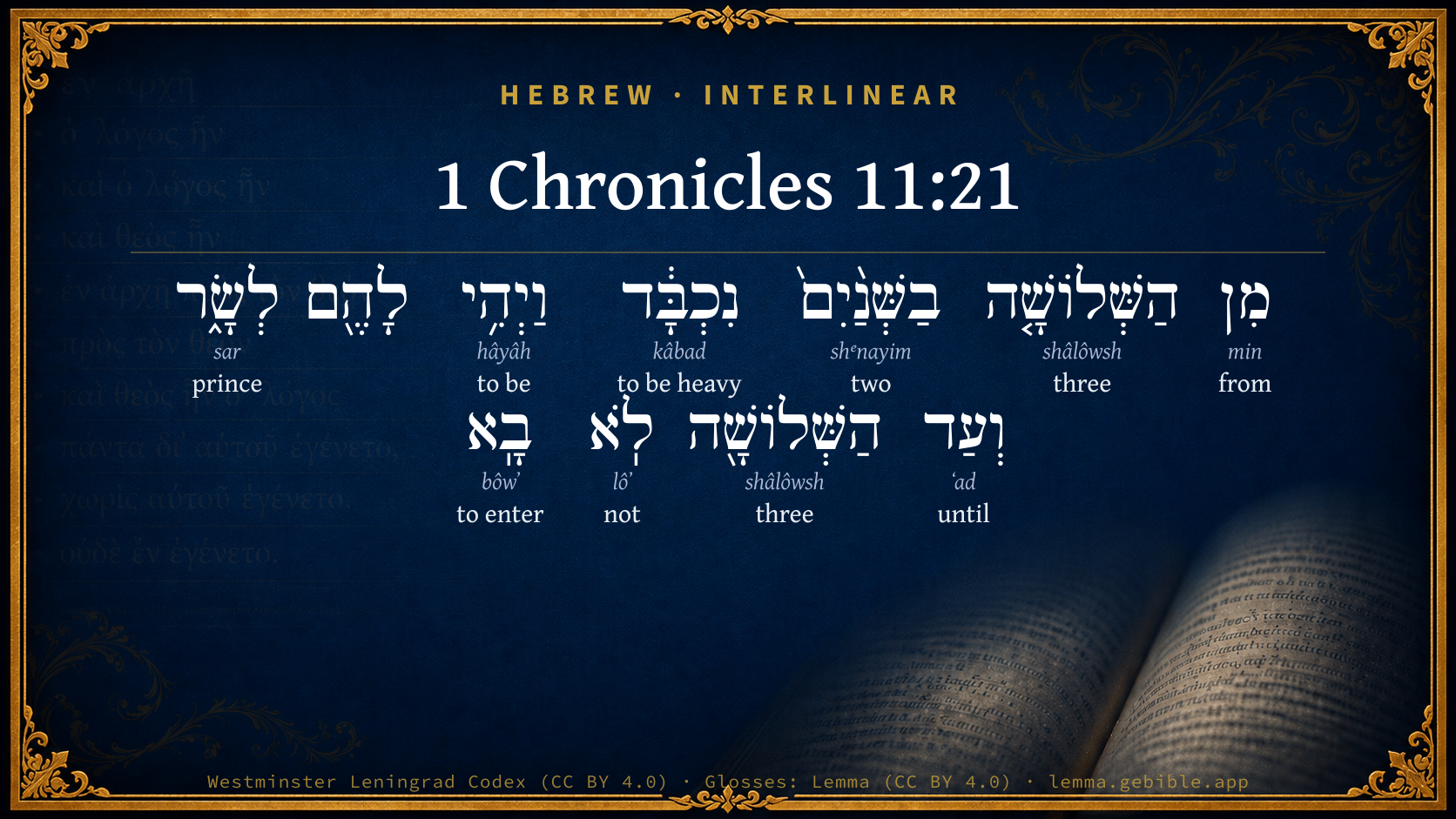
Hebrew (Westminster Leningrad Codex) 1 Chronicles 11:21 appears in the Hebrew Old Testament. The text above is from the Westminster Leningrad Codex. Each word links to its Strong’s number, a concise gloss, and parsing drawn from the Open Scriptures Hebrew Bible morphology. Click any word for its full Brown-Driver-Briggs (BDB) entry.
Download image
Cite this verse

1 Chronicles 11:21 (World English Bible). Public Domain. Lemma interlinear Bible study tool, https://lemma.gebible.app/v/1-chronicles/11/21.

Show BibTeX & RIS
BibTeX
RIS
English Translation
Of the three, he was more honorable than the two, and was made their captain: however he didn't attain to the [first] three.
World English Bible · Public Domain
Download a study sheet

One document with this verse’s original text, its word-by-word gloss line, the meaning frame, cross-references with their text, attributed commentary, and full source and license credits — printable, and it pastes into notes with its structure intact.

This verse Autodidact and up

Study sheet (.html) Plain text (.txt)

A passage Seminary Student

Up to 50 verses in one chapter. A passage sheet keeps up to 6 commentary sources and 12 cross-references per verse, in the order this page ranks them, and says so on the sheet whenever that leaves anything out. Ask for a single verse and you get the Autodidact verse sheet above.

Everything on this page stays free to read, with no account — the sheet is a download of what is already on screen, not access to it.

Want to remove ads? Support Godless Engineer
Compare translations 3

The same verse in 3 English versions, stacked beneath the original-language interlinear above. Click any original word for its lexicon entry.

Each is an independent rendering of the whole verse — the interlinear is not word-aligned to these translations.

Highlighted words mark where these versions differ — a whole-verse word diff, not a word-by-word alignment.

  • World English Bible Public Domain
    Of the three, he was more honorable than the two, and was made their captain: however he didn't attain to the [first] three.
  • King James Version Public Domain
    Of the three, he was more honorable than the two; for he was their captain: howbeit he attained not to the first three.
  • unfoldingWord Literal Text CC BY-SA 4.0
    From the Three, in the second, he was honored. And he became a commander to them. But he did not come to the Three.

unfoldingWord Literal Text — © unfoldingWord, licensed CC BY-SA 4.0. Word-aligned USFM3 via Door43 (git.door43.org/unfoldingWord/en_ult).

Versions to compare (up to 4)

3 of 4 selected

Show all 18 translations

Every available English version of this verse, each an independent rendering of the whole verse.

  • World English Bible Public Domain
    Of the three, he was more honorable than the two, and was made their captain: however he didn't attain to the [first] three.
  • Berean Standard Bible Public Domain
    He was doubly honored above the Three, and he became their commander, even though he was not included among the Three.
  • Majority Standard Bible Public Domain
    He was doubly honored above the Three, and he became their commander, even though he was not included among the Three.
  • King James Version Public Domain
    Of the three, he was more honorable than the two; for he was their captain: howbeit he attained not to the first three.
  • American Standard Version (1901) Public Domain
    Of the three, he was more honorable than the two, and was made their captain: howbeit he attained not to the `first' three.
  • Revised Version (1885) Public Domain
    Of the three, he was more honourable than the two and was made their captain: howbeit he attained not to the first three.
  • Geneva Bible (1599) Public Domain
    Among the three he was more honourable then the two, and he was their captaine: but he attained not vnto the first three.
  • Douay-Rheims (1899) Public Domain
    And illustrious among the second three, and their captain: but yet he attained not to the first three.
  • Young's Literal Translation Public Domain
    Of the three by the two he is honoured, and becometh their head; and unto the `first' three he hath not come.
  • Literal Standard Version CC BY-SA 4.0
    Of the three he is more honored than the [other] two, and becomes their head; but he has not come to the [first] three.
  • Unlocked Literal Bible CC BY-SA 4.0
    Of the Three, he was given double honor and became their captain, even though he was not one of them.
  • unfoldingWord Literal Text CC BY-SA 4.0
    From the Three, in the second, he was honored. And he became a commander to them. But he did not come to the Three.
  • Darby Bible Public Domain
    Of the three he was more honourable than the two, and he was their captain; but he did not attain to the [first] three.
  • World Messianic Bible Public Domain
    Of the three, he was more honorable than the two, and was made their captain; however he wasn’t included in the three.
  • Webster's Bible Public Domain
    Of the three, he was more honorable than the two; for he was their captain: but he attained not to the first three.
  • Free Bible Version CC BY-SA 4.0
    He was the most highly regarded of the Three and was their commander, though he was not one of the first Three.
  • Bible in Basic English Public Domain
    Of the thirty, he was the noblest, and was made their captain, but he was not equal to the first three.
  • JPS Tanakh (1917) Public Domain
    Of the three in the second rank he was the most honourable, and was made their captain; howbeit he attained not to the first three.

Literal Standard Version (2020), Covenant Press — licensed CC BY-SA 4.0. Text via the HelloAO Bible API (eBible.org). Unlocked Literal Bible (unfoldingWord) — licensed CC BY-SA 4.0. Text via the HelloAO Bible API (eBible.org). unfoldingWord Literal Text — © unfoldingWord, licensed CC BY-SA 4.0. Word-aligned USFM3 via Door43 (git.door43.org/unfoldingWord/en_ult). Free Bible Version, Dr. Jonathan Gallagher — licensed CC BY-SA 4.0. Text via the HelloAO Bible API (eBible.org).

Word by word

More ways to search: Search by grammar → Find every occurrence → Compare this word →

Practice this passage: Drill this verse → Learn its vocabulary →

נִכְבָּ֔ד
kâbad
H3513
“being heavy”
Verb, Niphal, Participle Active, Masculine, Singular, Absolute
Part of Speech
Verb
Stem
Niphal
Form
Participle Active
Gender
Masculine
Number
Singular
State
Absolute
Full BDB Definition

Origin: a primitive root

TWOT: 943

to be heavy, be weighty, be grievous, be hard, be rich, be honourable, be glorious, be burdensome, be honoured - (Qal) - to be heavy - to be heavy, be insensible, be dull - to be honoured - (Niphal) - to be made heavy, be honoured, enjoy honour, be made abundant - to get oneself glory or honour, gain glory - (Piel) - to make heavy, make dull, make insensible - to make honourable, honour, glorify - (Pual) to be made honourable, be honoured - (Hiphil) - to make heavy - to make heavy, make dull, make unresponsive - to cause to be honoured - (Hithpael) - to make oneself heavy, make oneself dense, make oneself numerous - to honour oneself

  1. מִן min H4480 “from” Preposition
  2. הַשְּׁלוֹשָׁ֤ה shâlôwsh H7969 “the · three” Particle, Definite Article + Adjective, Cardinal number, Masculine, Singular, Absolute
  3. בַשְּׁנַ֨יִם֙ shᵉnayim H8147 “in/at the · two” Preposition, Determined + Adjective, Cardinal number, Masculine, Dual, Absolute
  4. וַיְהִ֥י hâyâh H1961 “and · to be” Conjunction + Verb, Qal, Sequential Imperfect, 3rd Person, Masculine, Singular
  5. לְשָׂ֑ר sar H8269 “to/for · prince” Preposition + Noun, Common, Masculine, Singular, Absolute
  6. וְעַד ʻad H5704 “and · until” Conjunction + Preposition
  7. הַשְּׁלוֹשָׁ֖ה shâlôwsh H7969 “the · three” Particle, Definite Article + Adjective, Cardinal number, Masculine, Singular, Absolute
  8. לֹֽא lôʼ H3808 “not” Particle, Negative
  9. בָֽא bôwʼ H935 “to enter” Verb, Qal, Perfect, 3rd Person, Masculine, Singular

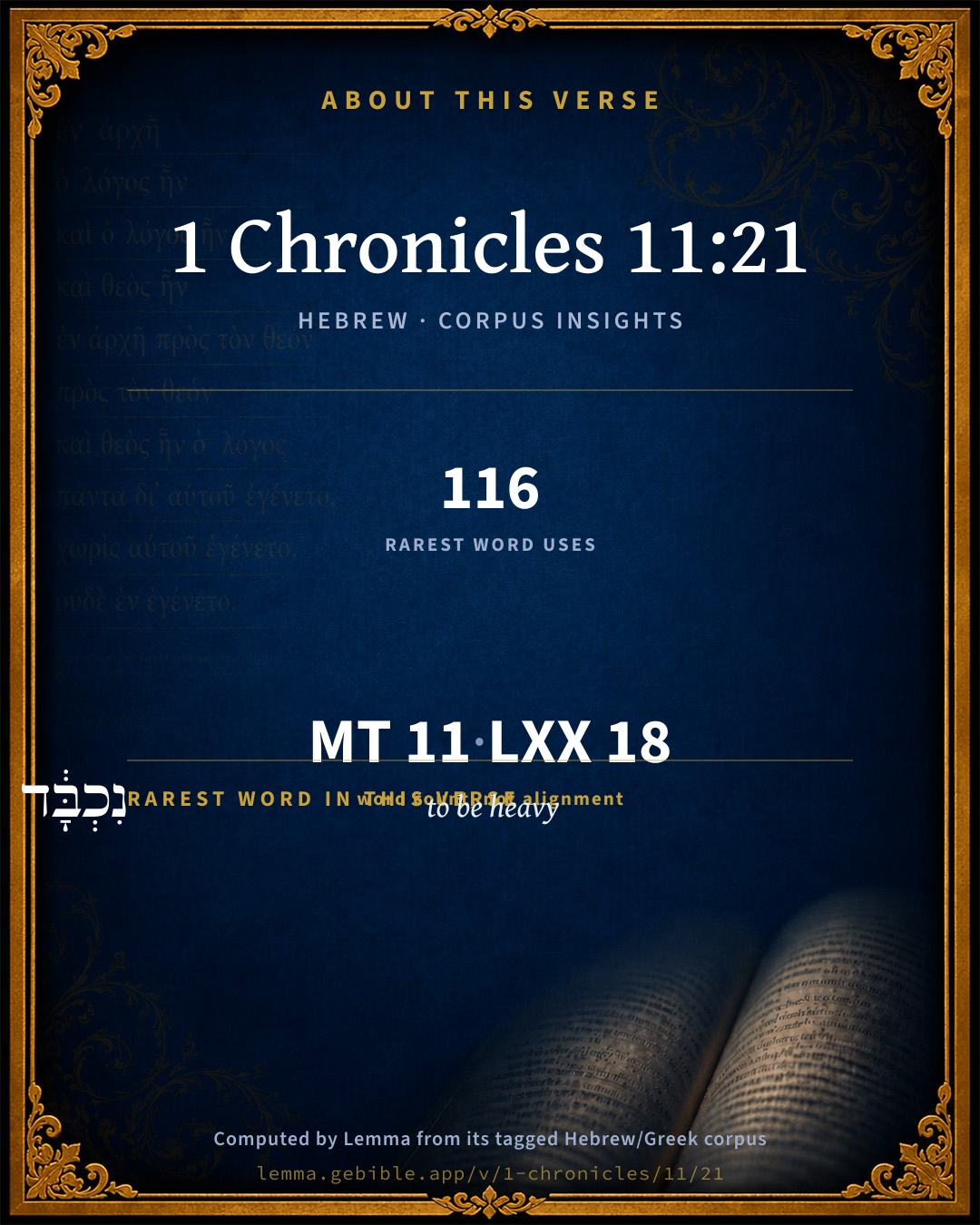
About this verse

These counts appear in no published source. They are computed here, from the morphology-tagged text and Lemma’s own curated glosses. What Lemma adds →

11
words
9
distinct lemmas
Historical
section

Grammatical profile

  • 3 verbs
  • 1 noun
  • 3 adjectives
  • 3 prepositions
  • 1 particle

Verb forms

  • נִכְבָּ֔ד Niphal · Participle Active
  • וַיְהִ֥י Qal · Sequential Imperfect
  • בָֽא Qal · Perfect

Repetition

A word recurs within this verse — often emphatic in Hebrew:

  • הַשְּׁלוֹשָׁ֤ה three H7969 ×2

Hebrew & Septuagint length

In English translation the verse runs 23 words from the Hebrew and 25 from the Septuagint (LXX English) — closely comparable.

A rough comparison of the two English renderings, which tokenize alike — not a word-level alignment.

Word counts can differ between the Hebrew and the Greek without any difference in meaning — e.g. the Hebrew direct-object marker אֵת has no separate Greek word, and Greek often adds the article ὁ.

In the original languages it is 11 Hebrew tokens and 18 Greek tokens — but the two are counted differently (Hebrew bundles its prefixes and suffixes into one token; the Greek is in lemma form), so that isn’t a like-for-like length.

Cross-references

2

Topical passages linked to 1 Chronicles 11:21 in the Treasury of Scripture Knowledge — connected by theme and wording, ordered by reader-vote popularity; previews shown in the World English Bible.

  • Matthew 13:8 and others fell on good soil, and yielded fruit: some one hundred times as much, some sixty, and some thirty.
  • 1 Corinthians 15:41 There is one glory of the sun, another glory of the moon, and another glory of the stars; for one star differs from another star in glory.

Cross-references courtesy of OpenBible.info (CC BY 4.0).

Hebrew and Greek witnesses Masoretic Hebrew ↔ Greek Septuagint

The same verse in the two great witnesses to the Old Testament, shown verse-for-verse.

These are two independent witnesses, not word-aligned to each other, and the Septuagint is shown in lemma (dictionary) form.

Hebrew 1 Chronicles 11:21 Masoretic · Westminster Leningrad Codex

מִן הַשְּׁלוֹשָׁ֤ה בַשְּׁנַ֨יִם֙ נִכְבָּ֔ד וַיְהִ֥י לָהֶ֖ם לְשָׂ֑ר וְעַד הַשְּׁלוֹשָׁ֖ה לֹֽא בָֽא

Of the three, he was more honorable than the two, and was made their captain: however he didn't attain to the [first] three.

World English Bible · Public Domain

Greek LXX 1 Chronicles 11:21 Septuagint · lemma form

ἀπό ὁ τρεῖς ὑπέρ ὁ δύο ἔνδοξος καί εἰμί αὐτός εἰς ἄρχων καί ἕως ὁ τρεῖς οὐ ἄρχω

He was more famous than the two others of the three, and he was chief over them; yet he reached not to the first three.

LXX2012 (modern English Septuagint) · Public Domain

On this verse, Ellicott's Commentary for English Readers discusses the Septuagint’s reading. Read the note in Commentary ↓

Hebrew: Westminster Leningrad Codex (CC BY 4.0). Greek: Septuagint (public domain); English from LXX2012 (modern English Septuagint) (Public Domain). How the Septuagint differs from the Hebrew →

Commentary

Notes on 1 Chronicles 11:21 from classic Christian and Jewish commentators (each source and its license shown beneath its notes). The classic Christian expositions comment on the surrounding passage and are grouped to its opening verse, so a note may address several verses; the Jewish commentaries on the Tanakh (Rashi and others) are per-verse, so they appear only where the commentator wrote on this verse.

Lemma curates 59 commentaries, every one of them public domain or Creative Commons licensed, each selected and text-cleaned for this edition rather than reprinted as found. About our sources →

Ellicott's Commentary for English Readers

(21) Of the three, he was more honourable than the two.—The Hebrew text here varies from Samuel, which has “Above (or out of) the three, was he not honoured? n The reading of Chronicles seems to be an exegetical alteration of this, and should probably be rendered, “Above the three of the second rank he was honoured,” i.e., he was the most honoured member of the second triad. So the Vulg., et inter tres secun-dos inclitus. The LXX. has ἀπὸ τῶν τριῶν ὑπὲρ δύο ένδοξος (“Of the three, renowned above the two”). But the Hebrew expression, which means literally, “in the two,” seems plainly to indicate a second group of three. Otherwise, we might translate: “Of the three he was honoured among the two,” that is, above the other two members of his triad. Both here and in 1Ch_11:20 the Syriac reads thirty instead of three: “Above the thirty he was honoured, and he became chief over them and warlike; the thirty he used to make” (1Ch_11:21). The Arabic is more correct: “And he was mightier than the two, and chief over them twain, and he came not to the three.”

Howbeit he attained not . . .—Literally, but to the three he came not, i.e., the first triad of warriors (1Ch_11:11-14).

A Bible Commentary for English Readers, edited by Charles John Ellicott (1878–1897) — public domain. Text from a community e-Sword module.

Jamieson, Fausset & Brown

Robert Jamieson, A. R. Fausset & David Brown

howbeit he attained not to the first three--(See on Sa2 23:19).

Jamieson, Fausset & Brown — Commentary Critical and Explanatory on the Whole Bible (1871) — public domain (CC PDM 1.0). Text via the HelloAO Bible API.

The Cambridge Bible for Schools and Colleges

gen. ed. J. J. S. Perowne

21. Of the three he was more honourable than the two] R.V. mg. “Of the three in the second rank he was the most honourable.” The word, translated “in the second rank,” is however certainly corrupt (cp. 2Sa_23:19), and should be corrected. We then translate: He was more honourable than the three. The verse probably comes from a lost poem. What is meant by the three and by the first three cannot be determined owing to the loss of the context.

The Cambridge Bible for Schools and Colleges (gen. ed. J. J. S. Perowne; Cambridge University Press, 1878–1918) — public domain. Text from a community e-Sword module.

Haydock's Catholic Bible Commentary

Second and (Haydock) first occur not in Hebrew and Septuagint. (Calmet) --- Hebrew, "Of the three he was more honourable than two; therefore he was their captain: and yet he attained not unto the first three." (Kennicott) --- First is indeed the sense, but it is not expressed in the original. We have here the exact order of these mighty men sufficiently marked out. Abisai is the first captain (Haydock) of the second ternary. (Tirinus)

George Leo Haydock (1774–1849), Haydock's Catholic Family Bible and Commentary, 1859 edition — public domain. Excludes Psalms (Douay-Rheims chapter numbering differs from Protestant) and Deuterocanonical books (Catholic canon only).

Matthew Poole's English Annotations

He did not equal them in valiant exploits.

Matthew Poole's English Annotations on the Holy Bible (1683–1685) — public domain. Text from a community e-Sword/MySword module.

The Pulpit Commentary

Than the two. The Hebrew (syinvb) cannot be thus translated, but possibly the words may mark the second set of three.

The Pulpit Commentary (1880–1919), ed. H.D.M. Spence-Jones & Joseph S. Exell — public domain. Text from a community e-Sword module.

John Wesley's Explanatory Notes

Attained not - He did not equal them.

John Wesley, Explanatory Notes Upon the Whole Bible (1754–1765) — public domain. Text via the GEBible commentary corpus.

Rashi

Rabbi Shlomo Yitzchaki (Rashi)

Of the three, he was honored like two He was not honored like those three. His heroism equalled that of the two, but he did not attain the amount of heroism of the three, and that is the meaning of “but to the three he did not come.”

Rashi on the Tanakh — English translations: “The Judaica Press complete Tanach with Rashi, translated by A. J. Rosenberg” (CC BY 4.0); “Pentateuch with Rashi's commentary by M. Rosenbaum and A.M. Silbermann, 1929-1934” (public domain); “The Metsudah Tanach series, Lakewood, N.J” (CC BY 4.0); and “The Book of Joshua, Metsudah Publications, 1997” (CC BY 4.0). Text via Sefaria.

Lesson kit

Teaching starters — assembled from the data on this page, not authored interpretation. Every prompt links to the verse data it draws on. Edit before teaching.

1 Chronicles, in the Historical, opens this verse with 11 words (9 distinct Hebrew lemmas). Its most distinctive word is kâbad (“to be heavy”). A historical commentator’s framing appears above. Read the whole chapter for the surrounding context.

Discussion questions

  1. How does “to be heavy” (kâbad) shape what this verse is saying?
  2. Matthew 13:8 shares this passage’s theme. How do the two illuminate each other?
  3. “three” occurs 2× in this one verse. What is the effect of the repetition?
  4. These translations render this verse differently; the difference is in the English rendering, not the original. What questions does that raise?
  5. The verb «נִכְבָּ֔ד» is Niphal Participle Active. How does its form color the action?
  6. Reading how Ellicott's Commentary for English Readers and Jamieson, Fausset & Brown read this verse, where do the two commentators agree and where do they part?

Things to notice

Reading settings

Reading text

Shown beneath each verse's original-language words.

Old Testament
Old Testament edition

Read the OT as the Masoretic Hebrew (MT) or the Greek Septuagint (LXX).

English shown for the Greek Septuagint (in the Hebrew ↔ Greek comparison).

Comparing translations? Open the Compare panel on any verse page to stack up to four side by side.