Genesis 48:2

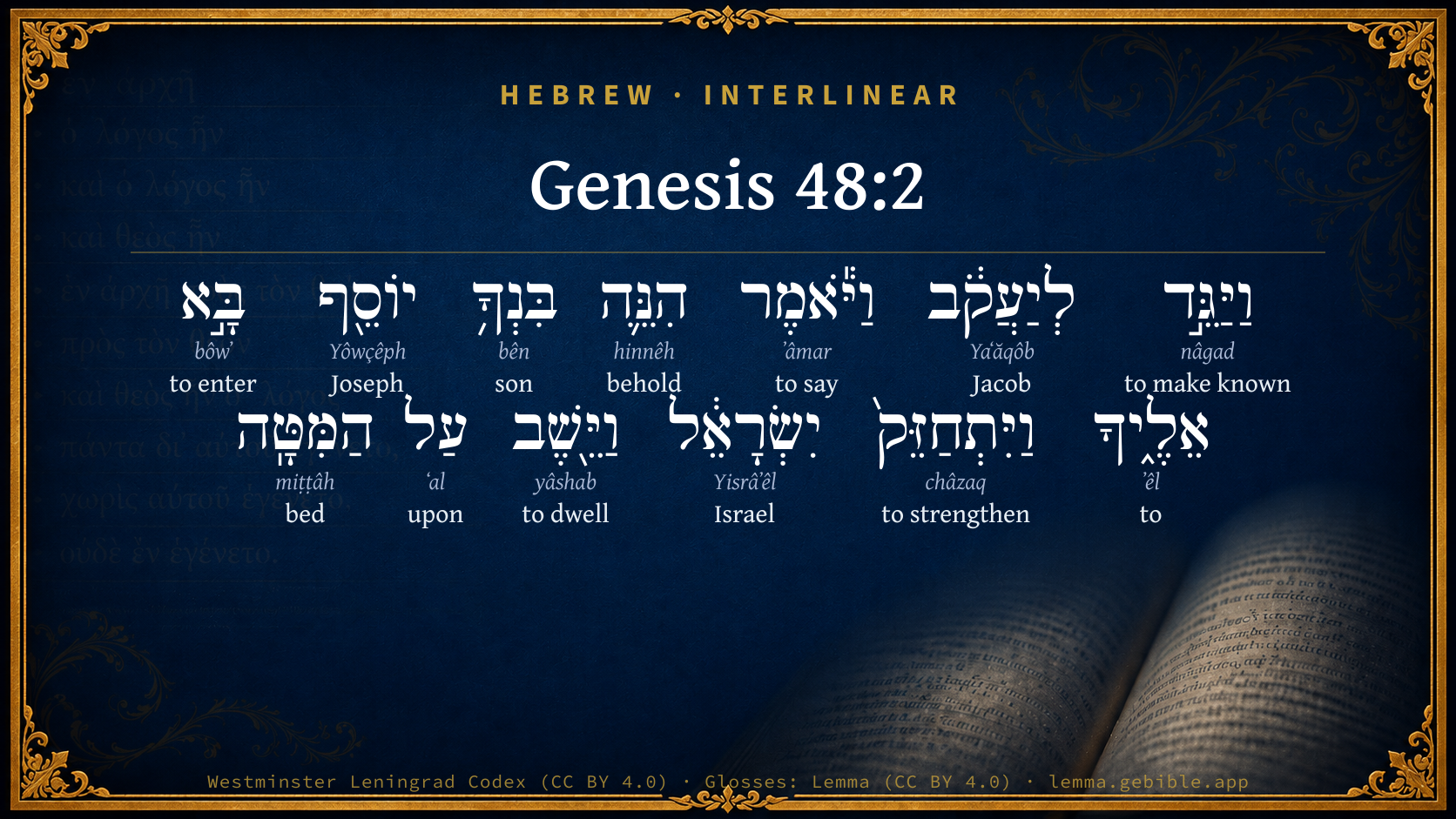
Hebrew (Westminster Leningrad Codex) Genesis 48:2 appears in the Hebrew Old Testament. The text above is from the Westminster Leningrad Codex. Each word links to its Strong’s number, a concise gloss, and parsing drawn from the Open Scriptures Hebrew Bible morphology. Click any word for its full Brown-Driver-Briggs (BDB) entry.
Download image
Cite this verse

Genesis 48:2 (World English Bible). Public Domain. Lemma interlinear Bible study tool, https://lemma.gebible.app/v/genesis/48/2.

Show BibTeX & RIS
BibTeX
RIS
English Translation
Someone told Jacob, and said, "Behold, your son Joseph comes to you," and Israel strengthened himself, and sat on the bed.
World English Bible · Public Domain
Download a study sheet

One document with this verse’s original text, its word-by-word gloss line, the meaning frame, cross-references with their text, attributed commentary, and full source and license credits — printable, and it pastes into notes with its structure intact.

This verse Autodidact and up

Study sheet (.html) Plain text (.txt)

A passage Seminary Student

Up to 50 verses in one chapter. A passage sheet keeps up to 6 commentary sources and 12 cross-references per verse, in the order this page ranks them, and says so on the sheet whenever that leaves anything out. Ask for a single verse and you get the Autodidact verse sheet above.

Everything on this page stays free to read, with no account — the sheet is a download of what is already on screen, not access to it.

Want to remove ads? Support Godless Engineer
Compare translations 3

The same verse in 3 English versions, stacked beneath the original-language interlinear above. Click any original word for its lexicon entry.

Each is an independent rendering of the whole verse — the interlinear is not word-aligned to these translations.

Highlighted words mark where these versions differ — a whole-verse word diff, not a word-by-word alignment.

  • World English Bible Public Domain
    Someone told Jacob, and said, "Behold, your son Joseph comes to you," and Israel strengthened himself, and sat on the bed.
  • King James Version Public Domain
    And one told Jacob, and said, Behold, thy son Joseph cometh unto thee: and Israel strengthened himself, and sat upon the bed.
  • unfoldingWord Literal Text CC BY-SA 4.0
    And announced to Jacob and said, “Behold, your son Joseph has come to you.” Then Israel gathered his strength and sat up on the bed.

unfoldingWord Literal Text — © unfoldingWord, licensed CC BY-SA 4.0. Word-aligned USFM3 via Door43 (git.door43.org/unfoldingWord/en_ult).

Versions to compare (up to 4)

3 of 4 selected

Show all 18 translations

Every available English version of this verse, each an independent rendering of the whole verse.

  • World English Bible Public Domain
    Someone told Jacob, and said, "Behold, your son Joseph comes to you," and Israel strengthened himself, and sat on the bed.
  • Berean Standard Bible Public Domain
    When Jacob was told, “Your son Joseph has come to you,” Israel rallied his strength and sat up in bed.
  • Majority Standard Bible Public Domain
    When Jacob was told, “Your son Joseph has come to you,” Israel rallied his strength and sat up in bed.
  • King James Version Public Domain
    And one told Jacob, and said, Behold, thy son Joseph cometh unto thee: and Israel strengthened himself, and sat upon the bed.
  • American Standard Version (1901) Public Domain
    And one told Jacob, and said, Behold, thy son Joseph cometh unto thee: and Israel strengthened himself, and sat upon the bed.
  • Revised Version (1885) Public Domain
    And one told Jacob, and said, Behold, thy son Joseph cometh unto thee: and Israel strengthened himself, and sat upon the bed.
  • Geneva Bible (1599) Public Domain
    Also one told Iaakob, and said, Behold, thy sonne Ioseph is come to thee, and Israel tooke his strength vnto him and sate vpon the bed.
  • Douay-Rheims (1899) Public Domain
    And it was told the old man: Behold I thy son Joseph cometh to thee. And being strengthened he sat on his bed.
  • Young's Literal Translation Public Domain
    And `one' declareth to Jacob, and saith, `Lo, thy son Joseph is coming unto thee;' and Israel doth strengthen himself, and sit upon the bed.
  • Literal Standard Version CC BY-SA 4.0
    And [one] declares [it] to Jacob and says, “Behold, your son Joseph is coming to you”; and Israel strengthens himself, and sits on the bed.
  • Unlocked Literal Bible CC BY-SA 4.0
    When Jacob was told, “Look, your son Joseph has arrived to see you,” Israel gathered strength and sat up in bed.
  • unfoldingWord Literal Text CC BY-SA 4.0
    And announced to Jacob and said, “Behold, your son Joseph has come to you.” Then Israel gathered his strength and sat up on the bed.
  • Darby Bible Public Domain
    And one told Jacob and said, Behold, thy son Joseph is coming to thee. And Israel strengthened himself, and sat upon the bed.
  • World Messianic Bible Public Domain
    Someone told Jacob, and said, “Behold, your son Joseph comes to you,” and Israel strengthened himself, and sat on the bed.
  • Webster's Bible Public Domain
    And one told Jacob, and said, Behold, thy son Joseph cometh to thee: and Israel strengthened himself, and sat upon the bed.
  • Free Bible Version CC BY-SA 4.0
    When Jacob was told, “Your son Joseph has come to you,” he gathered his strength and sat up in bed.
  • Bible in Basic English Public Domain
    And when they said to Jacob, Your son Joseph is coming to see you: then Israel, getting all his strength together, had himself lifted up in his bed.
  • JPS Tanakh (1917) Public Domain
    And one told Jacob, and said: 'Behold, thy son Joseph cometh unto thee.' And Israel strengthened himself, and sat upon the bed.

Literal Standard Version (2020), Covenant Press — licensed CC BY-SA 4.0. Text via the HelloAO Bible API (eBible.org). Unlocked Literal Bible (unfoldingWord) — licensed CC BY-SA 4.0. Text via the HelloAO Bible API (eBible.org). unfoldingWord Literal Text — © unfoldingWord, licensed CC BY-SA 4.0. Word-aligned USFM3 via Door43 (git.door43.org/unfoldingWord/en_ult). Free Bible Version, Dr. Jonathan Gallagher — licensed CC BY-SA 4.0. Text via the HelloAO Bible API (eBible.org).

Word by word

More ways to search: Search by grammar → Find every occurrence → Compare this word →

Practice this passage: Drill this verse → Learn its vocabulary →

הַמִּטָּֽה
miṭṭâh
H4296
“the · bed”
Particle, Definite Article + Noun, Common, Feminine, Singular, Absolute
Part of Speech
Particle + Noun
Type
Common
Gender
Feminine
Number
Singular
State
Absolute
Full BDB Definition

Origin: from H5186

TWOT: 1352c

couch, bed, bier
  1. וַיַּגֵּ֣ד nâgad H5046 “and · to make known” Conjunction + Verb, Hiphil, Sequential Imperfect, 3rd Person, Masculine, Singular
  2. לְיַעֲקֹ֔ב Yaʻăqôb H3290 “to/for · Jacob” Preposition + Noun, Proper
  3. וַיֹּ֕אמֶר ʼâmar H559 “and · to say” Conjunction + Verb, Qal, Sequential Imperfect, 3rd Person, Masculine, Singular
  4. הִנֵּ֛ה hinnêh H2009 “behold” Particle, Demonstrative
  5. בִּנְךָ֥ bên H1121 “son · your” Noun, Common, Masculine, Singular, Construct + Suffix, Personal, 2nd Person, Masculine, Singular
  6. יוֹסֵ֖ף Yôwçêph H3130 “Joseph” Noun, Proper
  7. בָּ֣א bôwʼ H935 “entering” Verb, Qal, Participle Active, Masculine, Singular, Absolute
  8. אֵלֶ֑יךָ ʼêl H413 “to · you” Preposition + Suffix, Personal, 2nd Person, Masculine, Singular
  9. וַיִּתְחַזֵּק֙ châzaq H2388 “and · to strengthen” Conjunction + Verb, Hithpael, Sequential Imperfect, 3rd Person, Masculine, Singular
  10. יִשְׂרָאֵ֔ל Yisrâʼêl H3478 “Israel” Noun, Proper
  11. וַיֵּ֖שֶׁב yâshab H3427 “and · to dwell” Conjunction + Verb, Qal, Sequential Imperfect, 3rd Person, Masculine, Singular
  12. עַל ʻal H5921 “upon” Preposition

About this verse

These counts appear in no published source. They are computed here, from the morphology-tagged text and Lemma’s own curated glosses. What Lemma adds →

13
words
13
distinct lemmas
Pentateuch
section

Shared distinctive vocabulary

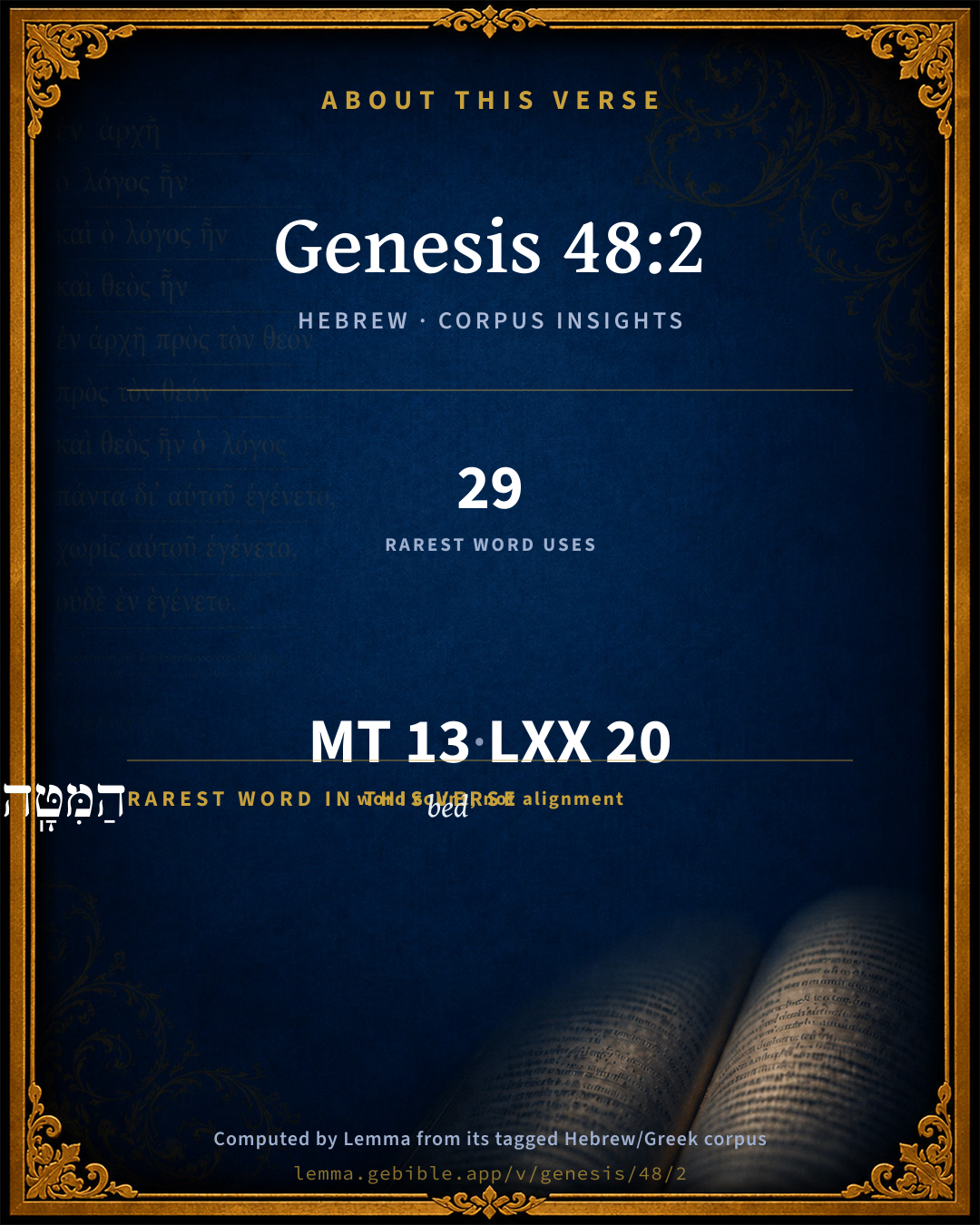
הַמִּטָּֽה bed H4296 occurs in 29 verses of the Hebrew Bible. Also found in:

Grammatical profile

  • 5 verbs
  • 5 nouns
  • 2 prepositions
  • 1 particle

Verb forms

  • וַיַּגֵּ֣ד Hiphil · Sequential Imperfect
  • וַיֹּ֕אמֶר Qal · Sequential Imperfect
  • בָּ֣א Qal · Participle Active
  • וַיִּתְחַזֵּק֙ Hithpael · Sequential Imperfect
  • וַיֵּ֖שֶׁב Qal · Sequential Imperfect

Hebrew & Septuagint length

In English translation the verse runs 21 words from the Hebrew and 23 from the Septuagint (LXX English) — closely comparable.

A rough comparison of the two English renderings, which tokenize alike — not a word-level alignment.

Word counts can differ between the Hebrew and the Greek without any difference in meaning — e.g. the Hebrew direct-object marker אֵת has no separate Greek word, and Greek often adds the article ὁ.

In the original languages it is 13 Hebrew tokens and 20 Greek tokens — but the two are counted differently (Hebrew bundles its prefixes and suffixes into one token; the Greek is in lemma form), so that isn’t a like-for-like length.

Cross-references

6

Topical passages linked to Genesis 48:2 in the Treasury of Scripture Knowledge — connected by theme and wording, ordered by reader-vote popularity; previews shown in the World English Bible.

  • Deuteronomy 3:28 But charge Joshua, and encourage him, and strengthen him; for he shall go over before this people, and he shall cause them to inherit the land which you shall see.
  • 1 Samuel 23:16 Jonathan, Saul's son, arose, and went to David into the wood, and strengthened his hand in God.
  • Psalms 41:3 Yahweh will sustain him on his sickbed, And restore him from his bed of illness.
  • Proverbs 23:15 My son, if your heart is wise, Then my heart will be glad, even mine:
  • Ephesians 6:10 Finally, be strong in the Lord, and in the strength of his might.
  • Nehemiah 2:18 I told them of the hand of my God which was good on me, as also of the king's words that he had spoken to me. They said, Let us rise up and build. So they strengthened their hands for the good [work].

Cross-references courtesy of OpenBible.info (CC BY 4.0).

Hebrew and Greek witnesses Masoretic Hebrew ↔ Greek Septuagint

The same verse in the two great witnesses to the Old Testament, shown verse-for-verse.

These are two independent witnesses, not word-aligned to each other, and the Septuagint is shown in lemma (dictionary) form.

Hebrew Genesis 48:2 Masoretic · Westminster Leningrad Codex

וַיַּגֵּ֣ד לְיַעֲקֹ֔ב וַיֹּ֕אמֶר הִנֵּ֛ה בִּנְךָ֥ יוֹסֵ֖ף בָּ֣א אֵלֶ֑יךָ וַיִּתְחַזֵּק֙ יִשְׂרָאֵ֔ל וַיֵּ֖שֶׁב עַל הַמִּטָּֽה

Someone told Jacob, and said, "Behold, your son Joseph comes to you," and Israel strengthened himself, and sat on the bed.

World English Bible · Public Domain

Greek LXX Genesis 48:2 Septuagint · lemma form

ἀποἀγγέλλω δέ ὁ ἰακώβ λέγω ἰδού ὁ υἱός σύ ιωσηφ ἔρχομαι πρός σύ καί ἐνἰσχύω ἰσραήλ καταἵζω ἐπί ὁ κλίνη

And it was reported to Jacob, saying, Behold, your son Joseph comes to you; and Israel having strengthened himself, sat upon the bed.

LXX2012 (modern English Septuagint) · Public Domain

Hebrew: Westminster Leningrad Codex (CC BY 4.0). Greek: Septuagint (public domain); English from LXX2012 (modern English Septuagint) (Public Domain). How the Septuagint differs from the Hebrew →

Targum (Aramaic paraphrase)

2

The Targum is the ancient Jewish Aramaic paraphrase of the Hebrew Scriptures — an interpretive translation, not the Hebrew text itself. Onkelos (literal) and Pseudo-Jonathan (expansive) render the Torah, and Jonathan the Prophets. Coverage is partial: where no permissively-licensed English translation exists for a verse, only the Aramaic is shown. This is verse-level text, not a word-by-word alignment to the Hebrew.

  1. Targum Onkelos Torah (Genesis–Deuteronomy)
    וְחַוִּי לְיַעֲקֹב וַאֲמַר הָא בְּרָךְ יוֹסֵף אֲתָא לְוָתָךְ וְאִתַּקַף יִשְׂרָאֵל וִיתֵיב עַל עַרְסָא

    (no public-domain English translation for this verse)

    Targum Onkelos — Aramaic: “Onkelos Genesis” (public domain); “Onkelos Exodus” (public domain); “Onkelos Leviticus” (public domain); “Onkelos Numbers” (public domain); “Onkelos Deuteronomy” (public domain). English: “Sefaria Community Translation” (CC0 1.0 (public-domain dedication)); “J.W. Etheridge. The Targums of Onkelos and Jonathan Ben Uzziel on the Pentateuch. London: Longmans, Green, 1862” (public domain). Text via Sefaria.

  2. Targum Pseudo-Jonathan Torah (Genesis–Deuteronomy)
    וְתַנִיאוּ לְיַעֲקב לְמֵימַר הָא בְּרָךְ יוֹסֵף אָתֵי לְוָתָךְ וְאִתְקֵף יִשְרָאֵל וִיתֵיב עַל דַרְגְשָׁא

    And it was announced to Jakob, saying, Behold, thy son Joseph hath come to thee: and Israel strengthened himself, and sat upon the bed.

    Targum Pseudo-Jonathan — Aramaic: “Targum Jonathan on Genesis” (public domain); “Targum Jonathan on Exodus” (public domain); “Targum Jonathan on Leviticus” (public domain); “Targum Jonathan on Numbers” (public domain); “Targum Jonathan on Deuteronomy” (public domain). English: “The Targum of Jonathan ben Uzziel, trans. J. W. Etheridge, London, 1862” (public domain). Text via Sefaria.

Commentary

Notes on Genesis 48:2 from classic Christian and Jewish commentators (each source and its license shown beneath its notes). The classic Christian expositions comment on the surrounding passage and are grouped to its opening verse, so a note may address several verses; the Jewish commentaries on the Tanakh (Rashi and others) are per-verse, so they appear only where the commentator wrote on this verse.

Lemma curates 59 commentaries, every one of them public domain or Creative Commons licensed, each selected and text-cleaned for this edition rather than reprinted as found. About our sources →

Trapp's Complete Commentary

John Trapp

Gen 48:2 And [one] told Jacob, and said, Behold, thy son Joseph cometh unto thee: and Israel strengthened himself, and sat upon the bed.

Ver. 2. And Israel strengthened himself.] Ipse aspectus viri boni delectat, saith Seneca; sure it is that the sight of a dear friend reviveth the sick. One man, for comfort and counsel, may be an angel to another; nay, as God himself. Such was Nathan to David; Bishop Ridley to King Edward VI; and that poor priest to Edward III, who, when all the king’s friends and favourites forsook him in his last agony, leaving his chamber quite empty, called upon him to remember his Saviour, and to ask mercy for his sins. This none before him would do, every one putting him still in hope of life, though they knew death was upon him. But now, stirred up by the voice of this priest, he showed all signs of contrition; and, at his last breath, expresses the name of Jesus. {a}

{a} Dan., Hist. of Engl., 255.

John Trapp, A Commentary or Exposition upon All the Books of the Old and New Testament (1647–1656) — public domain. Text from a community e-Sword module.

Joseph Benson's Commentary

Gen 48:2; Gen 48:4. Israel strengthened himself — The tidings of Joseph’s approach refreshed his spirits, and gave him new strength: and he put forth all the strength he had. God blessed me — And let that blessing be entailed upon them. God had promised him two things, a numerous issue, and Canaan for an inheritance. And Joseph’s sons, pursuant hereunto, should each of them multiply into a tribe, and each of them have a distinct lot in Canaan, equal with Jacob’s own sons. Set how he blessed them by faith in that which God had said to him, Heb 11:21.

Joseph Benson's Commentary on the Old and New Testaments (1811–1818) — public domain. Text from a community e-Sword module.

Jamieson, Fausset & Brown

Robert Jamieson, A. R. Fausset & David Brown

Israel strengthened himself, and sat upon the bed--In the chamber where a good man lies, edifying and spiritual discourse may be expected.

Jamieson, Fausset & Brown — Commentary Critical and Explanatory on the Whole Bible (1871) — public domain (CC PDM 1.0). Text via the HelloAO Bible API.

Adam Clarke's Commentary

Verse 2. Israel strengthened himself, and sat upon the bed.] He had been confined to his bed before, (see Ge 47:31), and now, hearing that Joseph was come to see him, he made what efforts his little remaining strength would admit, to sit up in bed to receive his son. This verse proves that a bed, not a staff, is intended in the preceding chapter, Ge 47:31.

Adam Clarke's Commentary on the Bible (1810–1826) — public domain. Text from a community e-Sword/MySword module.

Ellicott's Commentary for English Readers

(2) Strengthened himself.—Jacob thus prepared himself, not merely because he wished to receive Joseph in a maimer suitable to his rank, but chiefly because he was about himself to perform a sacred act, under the influence of the Divine Spirit.

Sat upon the bed.—We learn that he left his bed, and placed himself upon it in a sitting posture, from what is recorded in Gen_48:12.

A Bible Commentary for English Readers, edited by Charles John Ellicott (1878–1897) — public domain. Text from a community e-Sword module.

John Gill's Exposition

And one told Jacob,.... The same that came from Jacob to Joseph might be sent back by him to, his father, to let him know that he was coming to see him, or some other messenger sent on purpose; for it can hardly be thought that this was an accidental thing on either side:

and said, behold, thy son Joseph cometh unto thee; to pay him a visit, and which no doubt gave him a pleasure, he being his beloved son, as well as he was great and honourable:

and Israel strengthened himself, and sat upon his bed; his spirits revived, his strength renewed, he got fresh vigour on hearing his son Joseph was coming; and he exerted all his strength, and raised himself up by the help of his staff, and sat upon his bed to receive his son's visit; for now it was when he blessed the sons of Joseph, that he leaned upon the top of his staff and worshipped, as the apostle says, Heb 11:21.

John Gill's Exposition of the Whole Bible (1746–1763) — public domain (CC PDM 1.0). Text via the HelloAO Bible API.

Haydock's Catholic Bible Commentary

Strengthened: with the thought of seeing this beloved son, and also with the prophetic spirit (Menochius) of God, which filled him with joy, &c, Galatians v. 22. (Haydock)

George Leo Haydock (1774–1849), Haydock's Catholic Family Bible and Commentary, 1859 edition — public domain. Excludes Psalms (Douay-Rheims chapter numbering differs from Protestant) and Deuterocanonical books (Catholic canon only).

Matthew Poole's English Annotations

He got new strength, his spirits being quickened and refreshed by the tidings of Joseph’s approach, and he put forth all the strength which he had.

Matthew Poole's English Annotations on the Holy Bible (1683–1685) — public domain. Text from a community e-Sword/MySword module.

Whedon's Commentary on the Bible

Daniel D. Whedon

2. Strengthened himself — “Gathered up his energies for the last interview, and sat upon the bed. If Jacob leaned upon the top of his staff (Heb_11:21, and Gen_47:31, in the Sept.,) the bed must have been elevated upon a divan, or a bedstead. Bedsteads were not common among the Hebrews, but are represented in the Egyptian monuments, according to Wilkinson, elevated and richly sculptured.” — Newhall.

Daniel D. Whedon (gen. ed.), Commentary on the Old and New Testaments (1874–1909) — public domain. Text from a community e-Sword module.

Rashi

Rabbi Shlomo Yitzchaki (Rashi)

ויגד literally, AND HE TOLD — “he” means the messenger whoever it was — TO JACOB. It does not state plainly who told it; there are many such elliptical verses

ויתחזק ישראל AND ISRAEL STRENGTHENED HIMSELF — he said, “Although he is my son, he is a king, and I will do honour to him” (Midrash Tanchuma, Bo 6). From this we may infer that we must show honour to a person of royal rank (Cf. Menachot 98a). Similarly, Moses showed honour to the king when he said, (Exodus 11:8) “And all these, thy servants, shall come down to me” (which was only a polite way of saying. “Thou, thyself, wilt be forced to come down to me”); so, too, did Elijah: (1 Kings 18:46) “and he girded up his loins [and ran before Ahab] etc.” (Midrash Tanchuma, Bo 7)

Rashi on the Tanakh — English translations: “The Judaica Press complete Tanach with Rashi, translated by A. J. Rosenberg” (CC BY 4.0); “Pentateuch with Rashi's commentary by M. Rosenbaum and A.M. Silbermann, 1929-1934” (public domain); “The Metsudah Tanach series, Lakewood, N.J” (CC BY 4.0); and “The Book of Joshua, Metsudah Publications, 1997” (CC BY 4.0). Text via Sefaria.

Radak

Rabbi David Kimhi (Radak)

ויגד, the one who had carried the news to Joseph now returned to tell Yaakov that his son Joseph was about to visit him.

Radak on the Tanakh — English translations: “Sefaria Community Translation” (CC0 1.0 (public-domain dedication)); “Eliyahu Munk, HaChut Hameshulash” (CC BY 4.0); “Rabbi Mike Feuer, Jerusalem Anthology” (CC BY 4.0); and “R. David Kimhi on the first book of Psalms, Translated by R.G. Finch, London, 1919” (public domain). Text via Sefaria.

Lesson kit

Teaching starters — assembled from the data on this page, not authored interpretation. Every prompt links to the verse data it draws on. Edit before teaching.

Genesis, in the Pentateuch, opens this verse with 13 words (13 distinct Hebrew lemmas). Its most distinctive word is miṭṭâh (“bed”). A historical commentator’s framing appears above. Read the whole chapter for the surrounding context.

Discussion questions

  1. How does “bed” (miṭṭâh) shape what this verse is saying?
  2. Genesis 47:31 shares the word «bed» with this verse. How do the two illuminate each other?
  3. These translations render this verse differently. What is at stake in choosing one wording over another?
  4. The verb «וַיַּגֵּ֣ד» is Hiphil Sequential Imperfect. How does its form color the action?
  5. Reading how Trapp's Complete Commentary and Joseph Benson's Commentary read this verse, where do the two commentators agree and where do they part?

Things to notice

Reading settings

Reading text

Shown beneath each verse's original-language words.

Old Testament
Old Testament edition

Read the OT as the Masoretic Hebrew (MT) or the Greek Septuagint (LXX).

English shown for the Greek Septuagint (in the Hebrew ↔ Greek comparison).

Comparing translations? Open the Compare panel on any verse page to stack up to four side by side.