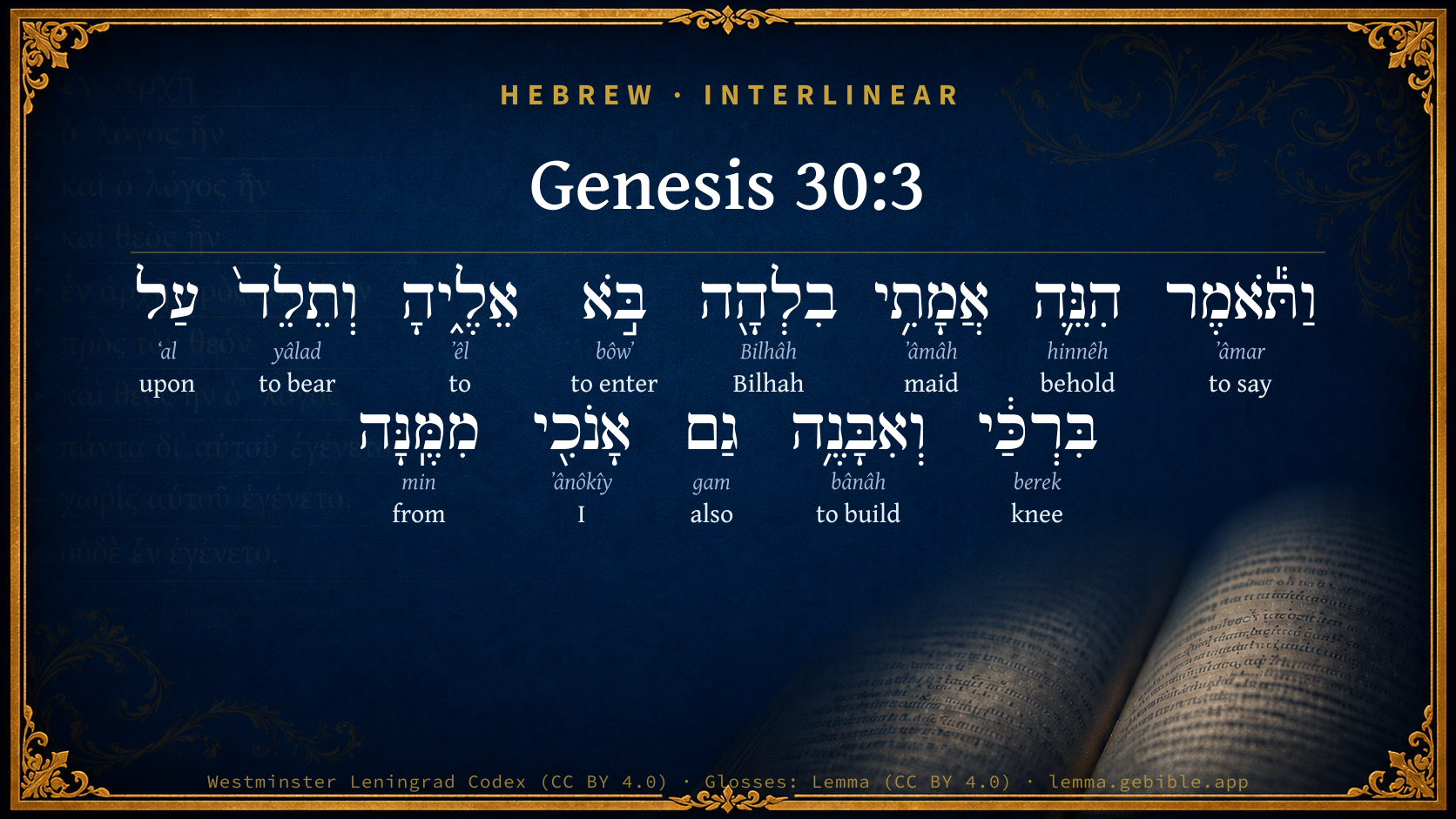
Genesis 30:3

Hebrew (Westminster Leningrad Codex) Genesis 30:3 appears in the Hebrew Old Testament. The text above is from the Westminster Leningrad Codex. Each word links to its Strong’s number, a concise gloss, and parsing drawn from the Open Scriptures Hebrew Bible morphology. Click any word for its full Brown-Driver-Briggs (BDB) entry.
Download image
Cite this verse

Genesis 30:3 (World English Bible). Public Domain. Lemma interlinear Bible study tool, https://lemma.gebible.app/v/genesis/30/3.

Show BibTeX & RIS
BibTeX
RIS
English Translation
She said, "Behold, my maid Bilhah. Go in to her, that she may bear on my knees, and I also may obtain children by her."
World English Bible · Public Domain
Highlights
  • 1 first appearance in the Hebrew Bible
Full analysis ↓
Download a study sheet

One document with this verse’s original text, its word-by-word gloss line, the meaning frame, cross-references with their text, attributed commentary, and full source and license credits — printable, and it pastes into notes with its structure intact.

This verse Autodidact and up

Study sheet (.html) Plain text (.txt)

A passage Seminary Student

Up to 50 verses in one chapter. A passage sheet keeps up to 6 commentary sources and 12 cross-references per verse, in the order this page ranks them, and says so on the sheet whenever that leaves anything out. Ask for a single verse and you get the Autodidact verse sheet above.

Everything on this page stays free to read, with no account — the sheet is a download of what is already on screen, not access to it.

Want to remove ads? Support Godless Engineer
Compare translations 3

The same verse in 3 English versions, stacked beneath the original-language interlinear above. Click any original word for its lexicon entry.

Each is an independent rendering of the whole verse — the interlinear is not word-aligned to these translations.

Highlighted words mark where these versions differ — a whole-verse word diff, not a word-by-word alignment.

  • World English Bible Public Domain
    She said, "Behold, my maid Bilhah. Go in to her, that she may bear on my knees, and I also may obtain children by her."
  • King James Version Public Domain
    And she said, Behold my maid Bilhah, go in unto her; and she shall bear upon my knees, that I may also have children by her.
  • unfoldingWord Literal Text CC BY-SA 4.0
    Then she said, “Behold my slave woman Bilhah. Go to her so that she will bear on my knees, and I also will be built up from her.”

unfoldingWord Literal Text — © unfoldingWord, licensed CC BY-SA 4.0. Word-aligned USFM3 via Door43 (git.door43.org/unfoldingWord/en_ult).

Versions to compare (up to 4)

3 of 4 selected

Show all 18 translations

Every available English version of this verse, each an independent rendering of the whole verse.

  • World English Bible Public Domain
    She said, "Behold, my maid Bilhah. Go in to her, that she may bear on my knees, and I also may obtain children by her."
  • Berean Standard Bible Public Domain
    Then she said, “Here is my maidservant Bilhah. Sleep with her, that she may bear children for me, so that through her I too can build a family.”
  • Majority Standard Bible Public Domain
    Then she said, “Here is my maidservant Bilhah. Sleep with her, that she may bear children for me, so that through her I too can build a family.”
  • King James Version Public Domain
    And she said, Behold my maid Bilhah, go in unto her; and she shall bear upon my knees, that I may also have children by her.
  • American Standard Version (1901) Public Domain
    And she said, Behold, my maid Bilhah, go in unto her; that she may bear upon my knees, and I also may obtain children by her.
  • Revised Version (1885) Public Domain
    And she said, Behold my maid Bilhah, go in unto her; that she may bear upon my knees, and I also may obtain children by her.
  • Geneva Bible (1599) Public Domain
    And she said, Behold my maide Bilhah, goe in to her, and she shall beare vpon my knees, and I shall haue children also by her.
  • Douay-Rheims (1899) Public Domain
    But she said: I have here my servant Bala: go in unto her, that she may bear upon my knees, and I may have children by her.
  • Young's Literal Translation Public Domain
    And she saith, `Lo, my handmaid Bilhah, go in unto her, and she doth bear on my knees, and I am built up, even I, from her;'
  • Literal Standard Version CC BY-SA 4.0
    And she says, “Behold, my handmaid Bilhah, go in to her, and she bears on my knees, and I am built up, even I, from her”;
  • Unlocked Literal Bible CC BY-SA 4.0
    She said, “See, there is my servant Bilhah. Sleep with her, so she might give birth to children on my knees, and I will have children by her.”
  • unfoldingWord Literal Text CC BY-SA 4.0
    Then she said, “Behold my slave woman Bilhah. Go to her so that she will bear on my knees, and I also will be built up from her.”
  • Darby Bible Public Domain
    And she said, Behold, there is my maid, Bilhah: go in to her, in order that she may bear on my knees, and I may also be built up by her.
  • World Messianic Bible Public Domain
    She said, “Behold, my maid Bilhah. Go in to her, that she may bear on my knees, and I also may obtain children by her.”
  • Webster's Bible Public Domain
    And she said, Behold, my maid Bilhah, go in to her; and she shall bear upon my knees, that I may also have children by her.
  • Free Bible Version CC BY-SA 4.0
    “Here's my personal maid Bilhah,” Rachel replied. “Sleep with her and she can have children for me so I'll have a family too.”
  • Bible in Basic English Public Domain
    Then she said, Here is my servant Bilhah, go in to her, so that she may have a child on my knees, and I may have a family by her.
  • JPS Tanakh (1917) Public Domain
    And she said: 'Behold my maid Bilhah, go in unto her; that she may bear upon my knees, and I also may be builded up through her.'

Literal Standard Version (2020), Covenant Press — licensed CC BY-SA 4.0. Text via the HelloAO Bible API (eBible.org). Unlocked Literal Bible (unfoldingWord) — licensed CC BY-SA 4.0. Text via the HelloAO Bible API (eBible.org). unfoldingWord Literal Text — © unfoldingWord, licensed CC BY-SA 4.0. Word-aligned USFM3 via Door43 (git.door43.org/unfoldingWord/en_ult). Free Bible Version, Dr. Jonathan Gallagher — licensed CC BY-SA 4.0. Text via the HelloAO Bible API (eBible.org).

Word by word

More ways to search: Search by grammar → Find every occurrence → Compare this word →

Practice this passage: Drill this verse → Learn its vocabulary →

בִלְהָ֖ה
Bilhâh
H1090
“Bilhah”
Noun, Proper
Part of Speech
Noun
Type
Proper
Full BDB Definition

Origin: from H1089

TWOT: None

Bilhah = "troubled" - Rachel's handmaid whom she gave to Jacob as a concubine, mother to two of Jacob's children, Dan and Naphtali (noun proper feminine) - a city in Simeon (noun proper locative)
  1. וַתֹּ֕אמֶר ʼâmar H559 “and · to say” Conjunction + Verb, Qal, Sequential Imperfect, 3rd Person, Feminine, Singular
  2. הִנֵּ֛ה hinnêh H2009 “behold” Particle, Demonstrative
  3. אֲמָתִ֥י ʼâmâh H519 “maid · my” Noun, Common, Feminine, Singular, Construct + Suffix, Personal, 1st Person, Common, Singular
  4. בֹּ֣א bôwʼ H935 “enter” Verb, Qal, Imperative, 2nd Person, Masculine, Singular
  5. אֵלֶ֑יהָ ʼêl H413 “to · her” Preposition + Suffix, Personal, 3rd Person, Feminine, Singular
  6. וְתֵלֵד֙ yâlad H3205 “and · to bear” Conjunction + Verb, Qal, Jussive, 3rd Person, Feminine, Singular
  7. עַל ʻal H5921 “upon” Preposition
  8. בִּרְכַּ֔י berek H1290 “knees · my” Noun, Common, Feminine, Dual, Construct + Suffix, Personal, 1st Person, Common, Singular
  9. וְאִבָּנֶ֥ה bânâh H1129 “and · to build” Conjunction + Verb, Niphal, Imperfect, 1st Person, Common, Singular
  10. גַם gam H1571 “also” Adverb
  11. אָנֹכִ֖י ʼânôkîy H595 “I” Pronoun, Personal, 1st Person, Common, Singular
  12. מִמֶּֽנָּה min H4480 “from · her” Preposition + Suffix, Personal, 3rd Person, Feminine, Singular

About this verse

These counts appear in no published source. They are computed here, from the morphology-tagged text and Lemma’s own curated glosses. What Lemma adds →

13
words
13
distinct lemmas
Pentateuch
section

Notable vocabulary

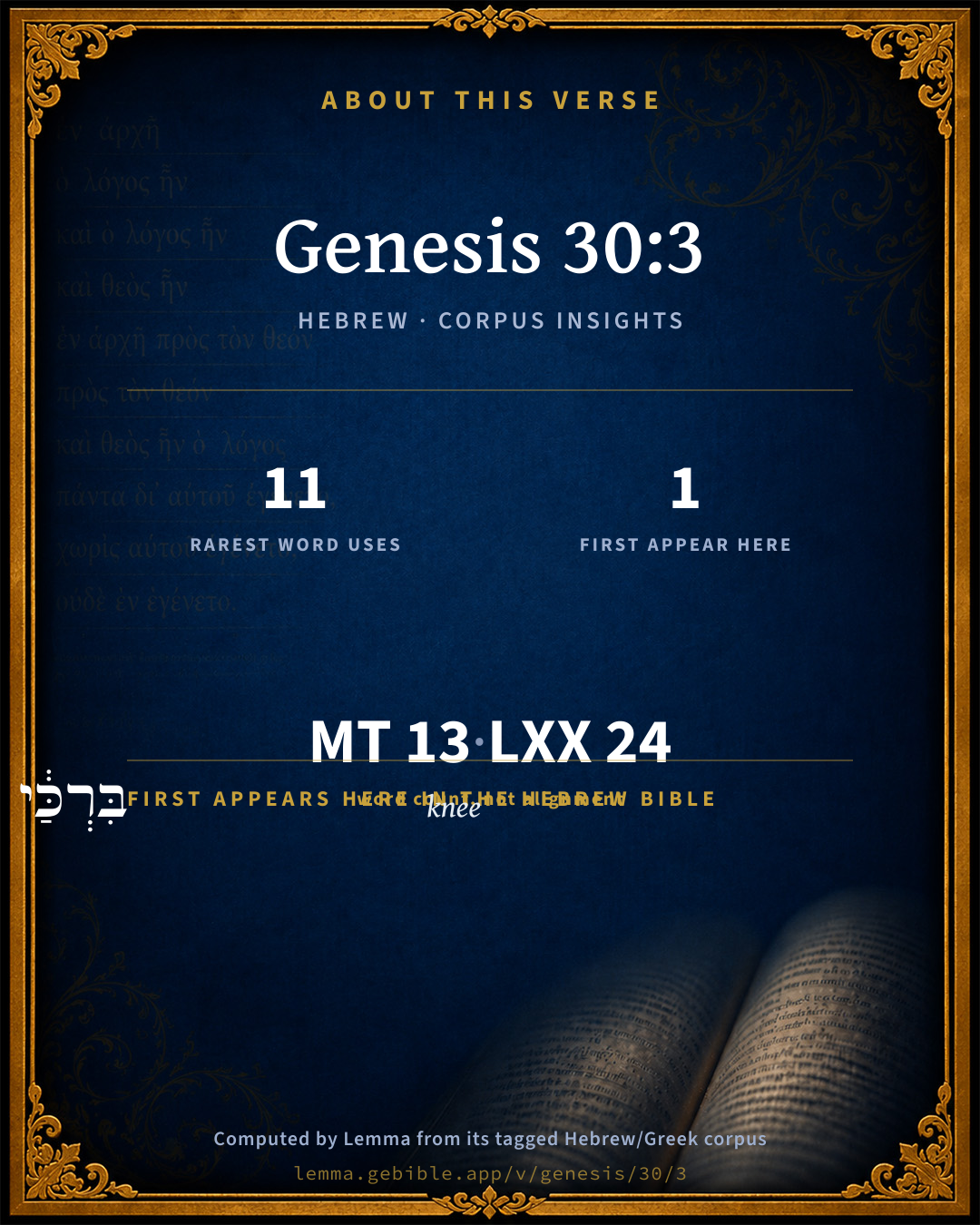
The rarest word here is בִלְהָ֖ה Bilhah H1090 — appearing just 11 times in the whole Hebrew Bible.

First appearance in Scripture

This word makes its first canonical appearance in the Hebrew Bible here:

  • בִּרְכַּ֔י knee H1290

Shared distinctive vocabulary

בִלְהָ֖ה Bilhah H1090 occurs in 11 verses of the Hebrew Bible. Also found in:

Grammatical profile

  • 4 verbs
  • 3 nouns
  • 1 pronoun
  • 3 prepositions
  • 1 adverb
  • 1 particle

Verb forms

  • וַתֹּ֕אמֶר Qal · Sequential Imperfect
  • בֹּ֣א Qal · Imperative
  • וְתֵלֵד֙ Qal · Jussive
  • וְאִבָּנֶ֥ה Niphal · Imperfect

Hebrew & Septuagint length

In English translation the verse runs 25 words from the Hebrew and 28 from the Septuagint (LXX English) — closely comparable.

A rough comparison of the two English renderings, which tokenize alike — not a word-level alignment.

Word counts can differ between the Hebrew and the Greek without any difference in meaning — e.g. the Hebrew direct-object marker אֵת has no separate Greek word, and Greek often adds the article ὁ.

In the original languages it is 13 Hebrew tokens and 24 Greek tokens — but the two are counted differently (Hebrew bundles its prefixes and suffixes into one token; the Greek is in lemma form), so that isn’t a like-for-like length.

Cross-references

5

Topical passages linked to Genesis 30:3 in the Treasury of Scripture Knowledge — connected by theme and wording, ordered by reader-vote popularity; previews shown in the World English Bible.

  • Genesis 50:23 Joseph saw Ephraim's children to the third generation. The children also of Machir, the son of Manasseh, were born on Joseph's knees.
  • Job 3:12 Why did the knees receive me? Or why the breast, that I should suck?
  • Genesis 16:2–3 Sarai said to Abram," See now, Yahweh has restrained me from bearing. Please go in to my handmaid. It may be that I will obtain children by her." Abram listened to the voice of Sarai.
  • Genesis 30:9 When Leah saw that she had finished bearing, she took Zilpah, her handmaid, and gave her to Jacob as a wife.
  • Ruth 4:11 All the people who were in the gate, and the elders, said, We are witnesses. Yahweh make the woman who has come into your house like Rachel and like Leah, which two built the house of Israel: and do you worthily in Ephrathah, and be famous in Bethlehem:

Cross-references courtesy of OpenBible.info (CC BY 4.0).

Hebrew and Greek witnesses Masoretic Hebrew ↔ Greek Septuagint

The same verse in the two great witnesses to the Old Testament, shown verse-for-verse.

These are two independent witnesses, not word-aligned to each other, and the Septuagint is shown in lemma (dictionary) form.

Hebrew Genesis 30:3 Masoretic · Westminster Leningrad Codex

וַתֹּ֕אמֶר הִנֵּ֛ה אֲמָתִ֥י בִלְהָ֖ה בֹּ֣א אֵלֶ֑יהָ וְתֵלֵד֙ עַל בִּרְכַּ֔י וְאִבָּנֶ֥ה גַם אָנֹכִ֖י מִמֶּֽנָּה

She said, "Behold, my maid Bilhah. Go in to her, that she may bear on my knees, and I also may obtain children by her."

World English Bible · Public Domain

Greek LXX Genesis 30:3 Septuagint · lemma form

εἶπον δέ ραχηλ ὁ ἰακώβ ἰδού ὁ παιδίσκη ἐγώ βαλλα εἰςἔρχομαι πρός αὐτός καί τίκτω ἐπί ὁ γόνυ ἐγώ καί τεκνοποιέω καΐἐγώ ἐκ αὐτός

And Rachel said to Jacob, Behold my handmaid Balla, go in to her, and she shall bear upon my knees, and I also shall have children by her.

LXX2012 (modern English Septuagint) · Public Domain

Hebrew: Westminster Leningrad Codex (CC BY 4.0). Greek: Septuagint (public domain); English from LXX2012 (modern English Septuagint) (Public Domain). How the Septuagint differs from the Hebrew →

Targum (Aramaic paraphrase)

2

The Targum is the ancient Jewish Aramaic paraphrase of the Hebrew Scriptures — an interpretive translation, not the Hebrew text itself. Onkelos (literal) and Pseudo-Jonathan (expansive) render the Torah, and Jonathan the Prophets. Coverage is partial: where no permissively-licensed English translation exists for a verse, only the Aramaic is shown. This is verse-level text, not a word-by-word alignment to the Hebrew.

  1. Targum Onkelos Torah (Genesis–Deuteronomy)
    וַאֲמֶרֶת הָא אַמְתִי בִלְהָה עוּל לְוָתַהּ וּתְלִיד וַאֲנָא אֱרַבֵּי וְאִתְבְּנֵי אַף אֲנָא מִנַּהּ

    (no public-domain English translation for this verse)

    Targum Onkelos — Aramaic: “Onkelos Genesis” (public domain); “Onkelos Exodus” (public domain); “Onkelos Leviticus” (public domain); “Onkelos Numbers” (public domain); “Onkelos Deuteronomy” (public domain). English: “Sefaria Community Translation” (CC0 1.0 (public-domain dedication)); “J.W. Etheridge. The Targums of Onkelos and Jonathan Ben Uzziel on the Pentateuch. London: Longmans, Green, 1862” (public domain). Text via Sefaria.

  2. Targum Pseudo-Jonathan Torah (Genesis–Deuteronomy)
    וַאֲמָרַת הָא אַמְתִי בִלְהָה עוּל לְוָותָהּ וְתֵילִיד וַאֲנָא אִירַבֵּי וְאִתְבְּנִי אוּף אֲנָא מִינָהּ

    And she said, Behold my handmaid Bilhah, enter with her, that she may bear, and I may increase and may be builded up from her.

    Targum Pseudo-Jonathan — Aramaic: “Targum Jonathan on Genesis” (public domain); “Targum Jonathan on Exodus” (public domain); “Targum Jonathan on Leviticus” (public domain); “Targum Jonathan on Numbers” (public domain); “Targum Jonathan on Deuteronomy” (public domain). English: “The Targum of Jonathan ben Uzziel, trans. J. W. Etheridge, London, 1862” (public domain). Text via Sefaria.

Commentary

Notes on Genesis 30:3 from classic Christian and Jewish commentators (each source and its license shown beneath its notes). The classic Christian expositions comment on the surrounding passage and are grouped to its opening verse, so a note may address several verses; the Jewish commentaries on the Tanakh (Rashi and others) are per-verse, so they appear only where the commentator wrote on this verse.

Lemma curates 59 commentaries, every one of them public domain or Creative Commons licensed, each selected and text-cleaned for this edition rather than reprinted as found. About our sources →

Trapp's Complete Commentary

John Trapp

Gen 30:3 And she said, Behold my maid Bilhah, go in unto her; and she shall bear upon my knees, that I may also have children by her.

Ver. 3. Behold my maid Bilhah.] Given her by her father on purpose, it may seem; that in case she proved barren, she might be built up by her. So Stratonice, the wife of King Dejotarus, being barren, gave secretly her maid Electra unto her husband; by whom she had an heir to the crown, as Plutarch relateth.

John Trapp, A Commentary or Exposition upon All the Books of the Old and New Testament (1647–1656) — public domain. Text from a community e-Sword module.

Joseph Benson's Commentary

Gen 30:3. Behold my maid Bilhah — She will rather have children by reputation than none at all; children that she can call her own, though they be not so. But had she not considered her sister as her rival, and envied her, she would have thought Leah’s children nearer to her, and more entitled to her care than Bilhah’s could be. As an early instance of her dominion over the children born in her apartment, she takes a pleasure in giving them names that carry in them nothing but marks of emulation with her sister. As if she had overcome her, 1st, At law, she calls the first son of her handmaid Dan, judgment; saying, God hath judged me — That is, given sentence in my favour. 2d, In battle, she calls the next Naphtali, wrestlings, saying, I have wrestled with my sister, and have prevailed — See what roots of bitterness envy and strife are, and what mischief they make among relations!

Joseph Benson's Commentary on the Old and New Testaments (1811–1818) — public domain. Text from a community e-Sword module.

Tyndale Open Study Notes

Tyndale Open Resources

30:3-4 Rachel’s decision to have children through her servant, and Jacob’s compliance, recall Sarai’s use of Hagar (16:1-4).

Tyndale Open Study Notes — © Tyndale Open Resources, licensed CC BY-SA 4.0. Text via the HelloAO Bible API.

Geneva Bible (1599)

Geneva Bible translators

Hebrew, I shall be built.

I will receive her children on my lap, as though they were mine own.

Geneva Bible (1599) marginal notes — public domain. Text via Bolls.life.

Jamieson, Fausset & Brown

Robert Jamieson, A. R. Fausset & David Brown

Bilhah . . . Zilpah--Following the example of Sarah with regard to Hagar, an example which is not seldom imitated still, she adopted the children of her maid. Leah took the same course. A bitter and intense rivalry existed between them, all the more from their close relationship as sisters; and although they occupied separate apartments, with their families, as is the uniform custom where a plurality of wives obtains, and the husband and father spends a day with each in regular succession, that did not allay their mutual jealousies. The evil lies in the system, which being a violation of God's original ordinance, cannot yield happiness.

Jamieson, Fausset & Brown — Commentary Critical and Explanatory on the Whole Bible (1871) — public domain (CC PDM 1.0). Text via the HelloAO Bible API.

Adam Clarke's Commentary

Verse 3. She shall bear upon my knees] The handmaid was the sole property of the mistress, as has already been remarked in the case of Hagar; and therefore not only all her labour, but even the children borne by her, were the property of the mistress. These female slaves, therefore, bore children vicariously for their mistresses; and this appears to be the import of the term, she shall bear upon my knees.

That I may also have children by her.] ואבנה ממנה veibbaneh mimmennah, and I shall be built up by her. Hence בן ben, a son or child, from בנה banah, to build; because, as a house is formed of the stones, &c., that enter into its composition, so is a family by children.

Adam Clarke's Commentary on the Bible (1810–1826) — public domain. Text from a community e-Sword/MySword module.

John Calvin's Commentaries

3. Behold my maid Bilhah. Here the vanity of the female disposition appears. For Rachel is not induced to flee unto the Lord, but strives to gain a triumph by illicit arts. Therefore she hurries Jacob into a third marriage. Whence we infer, that there is no end of sinning, when once the Divine institution is treated with neglect. And this is what I have said, that Jacob was not immediately brought back to a right state of mind by Divine chastisements. He acts, indeed, in this instance, at the instigation of his wife: but is his wife in the place of God, from whom alone the law of marriage proceeds? But to please his wife, or to yield to her importunity, he does not scruple to depart from the command of God. To bear upon the knees, is nothing more than to commit the child when born to another to be brought up. Bilhah was a maidservant; and therefore did not bear for herself but for her mistress, who, claiming the child as her own, thus procured the honor of a mother. Therefore it is added, in the way of explanation, I shall have children, or I shall be built up by her. For the word which Moses here uses, is derived from בן (ben,) a son: because children are as the support and stay of a house. But Rachel acted sinfully, because she attempted, by an unlawful method, and in opposition to the will of God, to become a mother.

John Calvin's Commentaries (1540-1563) — public domain. Text from the Calvin Translation Society English edition (1840s-50s) via the Christian Classics Ethereal Library (ccel.org). Calvin's coverage is partial (roughly two-thirds of the Bible); uncommented books and verses are honest gaps, never fabricated. The 19th-century editor's footnotes and remarks are omitted so the notes are faithfully Calvin's own voice.

Ellicott's Commentary for English Readers

(3) Behold my maid Bilhàh.—Rachel had little excuse for this action; for there was no religious hope involved, as when Sarah gave Hagar to Abraham (Gen_16:2), but solely vexation at her own barrenness, and envy of her sister. All that can be said in her defence is, that the custom existed, and, perhaps, because it was distasteful to the wife, was looked upon as meritorious (Gen_30:18).

She shall bear upon my knees.—So in Gen_1:23, it is said, in the Hebrew, that “the children of Machir were born upon Joseph’s knees,” not borne, as in our margin. It appears that there was a custom of placing the new-born child upon the knees, first of the father, who, by accepting it. acknowledged the infant as his own; and secondly, upon those of the mother. In this case, as Bilhah’s children were regarded as legally born of Rachel, they would be placed upon Rachel’s knees. Probably, too, the children of Machir, by being placed upon Joseph’s knees, were in some way adopted by him.

That I may also have children by her.—Heb., be built by her. (See Note on Gen_16:2.)

A Bible Commentary for English Readers, edited by Charles John Ellicott (1878–1897) — public domain. Text from a community e-Sword module.

The Cambridge Bible for Schools and Colleges

gen. ed. J. J. S. Perowne

3. bear upon my knees] By this phrase Rachel means that she will recognize and adopt as her own the children by her handmaid, Bilhah. For the phrase, cf. Gen_50:23; Job_3:12. The child being received on the knees of the parent was regarded as being accepted into the family. The words retain the trace of a primitive ceremony of legitimatization and adoption.

obtain children] Heb. be builded by her. The same figure of a house is used by Sarah, referring to Hagar in Gen_16:2, where see note.

The Cambridge Bible for Schools and Colleges (gen. ed. J. J. S. Perowne; Cambridge University Press, 1878–1918) — public domain. Text from a community e-Sword module.

John Gill's Exposition

And she said,.... in order to pacify Jacob, and explain her meaning to him; which was, not that she thought it was in his power to make her the mother of children, but that he would think of some way or another of obtaining children for her, that might go for hers; so the Arabic version, "obtain a son for me": but, since no method occurred to him, she proposes one:

behold my maid Bilhah, go in unto her, take her and use her as thy wife:

and she shall bear upon my knees; either sit on her knees in the time of labour, and so bring forth as if it was she herself; or rather bear a child, which Rachel would take and nurse, and dandle upon her knees as her own, see Isa 66:12,

that I may also have children by her; children as well as her sister, though by her maid, and as Sarah proposed to have by Hagar, whose example, in all probability, she had before her, and uses her very words; See Gill on Gen 16:2.

John Gill's Exposition of the Whole Bible (1746–1763) — public domain (CC PDM 1.0). Text via the HelloAO Bible API.

Haydock's Catholic Bible Commentary

Servant, like a maid of honour. Josephus says she was not a slave, no more than Zelpha. --- My knees, whom I may nurse with pleasure. It was an ancient custom to place the new-born infants upon the knees of some near relation, who gave them a name, and thus in a manner adopted them. (chap. l. 22; Job iii. 12; Psalm xxi. 11) (Homer.) (Calmet)

George Leo Haydock (1774–1849), Haydock's Catholic Family Bible and Commentary, 1859 edition — public domain. Excludes Psalms (Douay-Rheims chapter numbering differs from Protestant) and Deuterocanonical books (Catholic canon only).

Matthew Poole's English Annotations

She shall bear upon my knees; an ellipsis or short speech; She shall bear a child which may be laid upon my knees, or in my lap, which I may adopt and bring up as if it were my own. See Gen 50:23; Isa 66:12.

That I may also have children by her; for as servants, so their work and fruit, were not their own, but their masters’.

Matthew Poole's English Annotations on the Holy Bible (1683–1685) — public domain. Text from a community e-Sword/MySword module.

Whedon's Commentary on the Bible

Daniel D. Whedon

3. Children by her — In her impatience she resorts to the expedient of Sarai. Gen_16:2, note.

Daniel D. Whedon (gen. ed.), Commentary on the Old and New Testaments (1874–1909) — public domain. Text from a community e-Sword module.

The Pulpit Commentary

And she said, resorting to the sinful expedient of Sarah, (Gen_16:2) though without Sarah"s excuse, since there was no question whatever about an heir for Jacob; which, even if there had been, would not have justified a practice which, in the case of her distinguished relative, had been so palpably condemnedBehold my maid Bilhah (Gen_29:29) go in unto her; and she shall bear upon my knees, i.e. children that I may place upon my knees, as mothers do (Piscator, A Lapide, Calvin, Rosenm Lange, Ainsworth); the literal sense of the words being too absurd to require refutationthat I may also have children literally, be builded up (cf. Gen_16:2) by her.

The Pulpit Commentary (1880–1919), ed. H.D.M. Spence-Jones & Joseph S. Exell — public domain. Text from a community e-Sword module.

John Wesley's Explanatory Notes

Behold my maid, Bilhah - At the persuasion of Rachel he took Bilhah her handmaid to wife, that, according to the usage of those times, his children by her might be adopted and owned as her mistresses children. She would rather have children by reputation than none at all; children that she might call her own, though they were not so. And as an early instance of her dominion over the children born in her apartment, she takes a pleasure in giving them names, that carry in them nothing but marks of emulation with her sister. As if she had overcome her,

1. At law, she calls the flrst son of her handmaid, Daniel, Judgment, saying, God hath Judged me - That is, given sentence in my favour.

2. In battle, she calls the next Naphtali, Wrestlings, saying, I have wrestled with my sister, and have prevailed - See what roots of bitterness envy and strife are, and what mischief they make among relations!

John Wesley, Explanatory Notes Upon the Whole Bible (1754–1765) — public domain. Text via the GEBible commentary corpus.

unfoldingWord translationNotes

Door43 World Missions Community

She said

"Rachel said"

See

"Look" or "Listen" or "Pay attention to what I am about to tell you"

there is my servant Bilhah ... I will have children by her

At that time, this was an acceptable way for a barren woman to have children that would legally belong to her. The full meaning of this may be made explicit. (See: Assumed Knowledge and Implicit Information)

Bilhah

This is the name of Rachel's female servant. See how you translated this name in Genesis 29:29.

on my knees

This is a way of saying that the child that Bilhah gives birth to will belong to Rachel. AT: "for me" (See: Idiom)

I will have children by her

"and in this way she will cause me to have children"

translationWords

servant

had relations with

unfoldingWord translationNotes — © Distant Shores Media and the Door43 World Missions Community, licensed CC BY-SA 4.0. Source: git.door43.org/Door43/en_tn.

Rashi

Rabbi Shlomo Yitzchaki (Rashi)

על ברכי UPON MY KNEES — as the Targum takes it: she will bear children and I will rear them.

ואבנה גם אנכי AND I ALSO MAY HAVE CHILDREN — What force has “also”? She said to him, “Your grandfather, Abraham, had children from Hagar and yet he girded up his loins (actively interceded) for Sarah and she afterwards was blessed with a child”. He replied, “But my grandmother brought an associate wife unto her house”. She retorted, “If that is what prevents me being blessed with children, הנה אמתי BEHOLD MY HANDMAID” etc.

ואבנה נם אנכי AND I ALSO MAY HAVE CHILDREN through her as Sarah was built up through her handmaid (Genesis Rabbah 71:7).

Rashi on the Tanakh — English translations: “The Judaica Press complete Tanach with Rashi, translated by A. J. Rosenberg” (CC BY 4.0); “Pentateuch with Rashi's commentary by M. Rosenbaum and A.M. Silbermann, 1929-1934” (public domain); “The Metsudah Tanach series, Lakewood, N.J” (CC BY 4.0); and “The Book of Joshua, Metsudah Publications, 1997” (CC BY 4.0). Text via Sefaria.

Radak

Rabbi David Kimhi (Radak)

ותאמר, she said that after Yaakov had explained to her that her failure to have children was G’d’s doing, she suggested what Sarah had suggested to Avraham, that she was willing to become a vicarious mother through her servant maid having a child by him. She therefore asked Yaakov to sleep with Bilhah.

ותלד על ברכי, whomsoever she will give birth to shall be considered as having been born on my knees, my becoming his foster mother seeing he will be part of my family.

ואבנה גם אנכי, so that I too will be built through her (Bilhah). The word גם here refers to Leah, Rachel saying that she too, as a foster mother, would consider herself as “built,” i.e. as leaving something of herself to posterity. We have explained the meaning of the word ואבנה in Genesis 16,2.

Radak on the Tanakh — English translations: “Sefaria Community Translation” (CC0 1.0 (public-domain dedication)); “Eliyahu Munk, HaChut Hameshulash” (CC BY 4.0); “Rabbi Mike Feuer, Jerusalem Anthology” (CC BY 4.0); and “R. David Kimhi on the first book of Psalms, Translated by R.G. Finch, London, 1919” (public domain). Text via Sefaria.

Lesson kit

Teaching starters — assembled from the data on this page, not authored interpretation. Every prompt links to the verse data it draws on. Edit before teaching.

Genesis, in the Pentateuch, opens this verse with 13 words (13 distinct Hebrew lemmas). Its most distinctive word is Bilhâh (“Bilhah”). A historical commentator’s framing appears above. Read the whole chapter for the surrounding context.

Discussion questions

  1. The word Bilhâh carries the sense “Bilhah.” How does it shape the verse?
  2. The word “knee” first appears here in Scripture. What is being introduced at this debut?
  3. Genesis 29:29 shares the word «Bilhah» with this verse. How do the two illuminate each other?
  4. These translations render this verse differently; the difference is in the English rendering, not the original. What questions does that raise?
  5. The verb «וַתֹּ֕אמֶר» is Qal Sequential Imperfect. How does its form color the action?
  6. Reading how Trapp's Complete Commentary and Joseph Benson's Commentary read this verse, where do the two commentators agree and where do they part?

Things to notice

Reading settings

Reading text

Shown beneath each verse's original-language words.

Old Testament
Old Testament edition

Read the OT as the Masoretic Hebrew (MT) or the Greek Septuagint (LXX).

English shown for the Greek Septuagint (in the Hebrew ↔ Greek comparison).

Comparing translations? Open the Compare panel on any verse page to stack up to four side by side.