Genesis 45:17

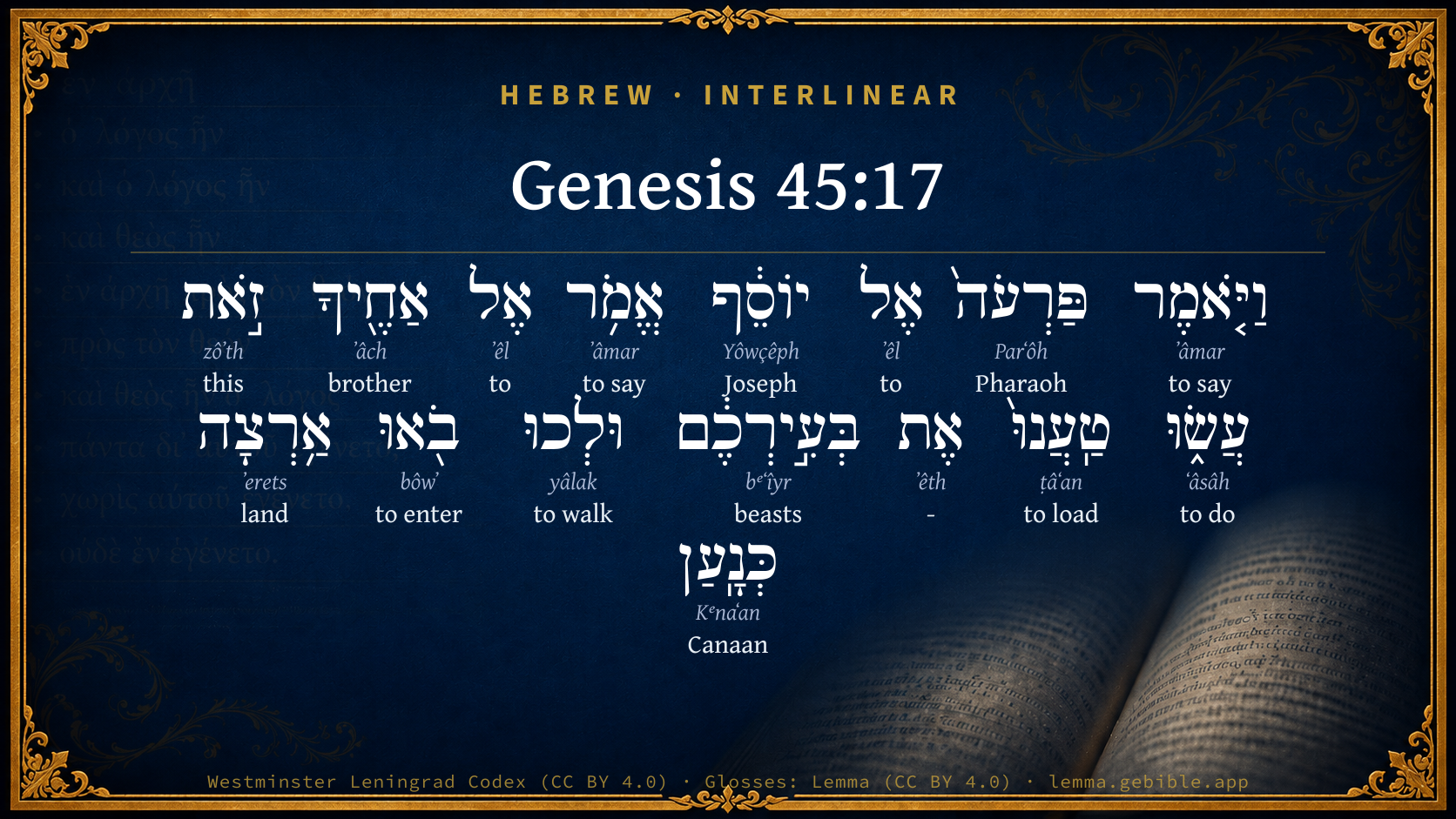
Hebrew (Westminster Leningrad Codex) Genesis 45:17 appears in the Hebrew Old Testament. The text above is from the Westminster Leningrad Codex. Each word links to its Strong’s number, a concise gloss, and parsing drawn from the Open Scriptures Hebrew Bible morphology. Click any word for its full Brown-Driver-Briggs (BDB) entry.
Download image
Cite this verse

Genesis 45:17 (World English Bible). Public Domain. Lemma interlinear Bible study tool, https://lemma.gebible.app/v/genesis/45/17.

Show BibTeX & RIS
BibTeX
RIS
English Translation
Pharaoh said to Joseph, "Tell your brothers, 'Do this. Load your animals, and go, travel to the land of Canaan.
World English Bible · Public Domain
Highlights
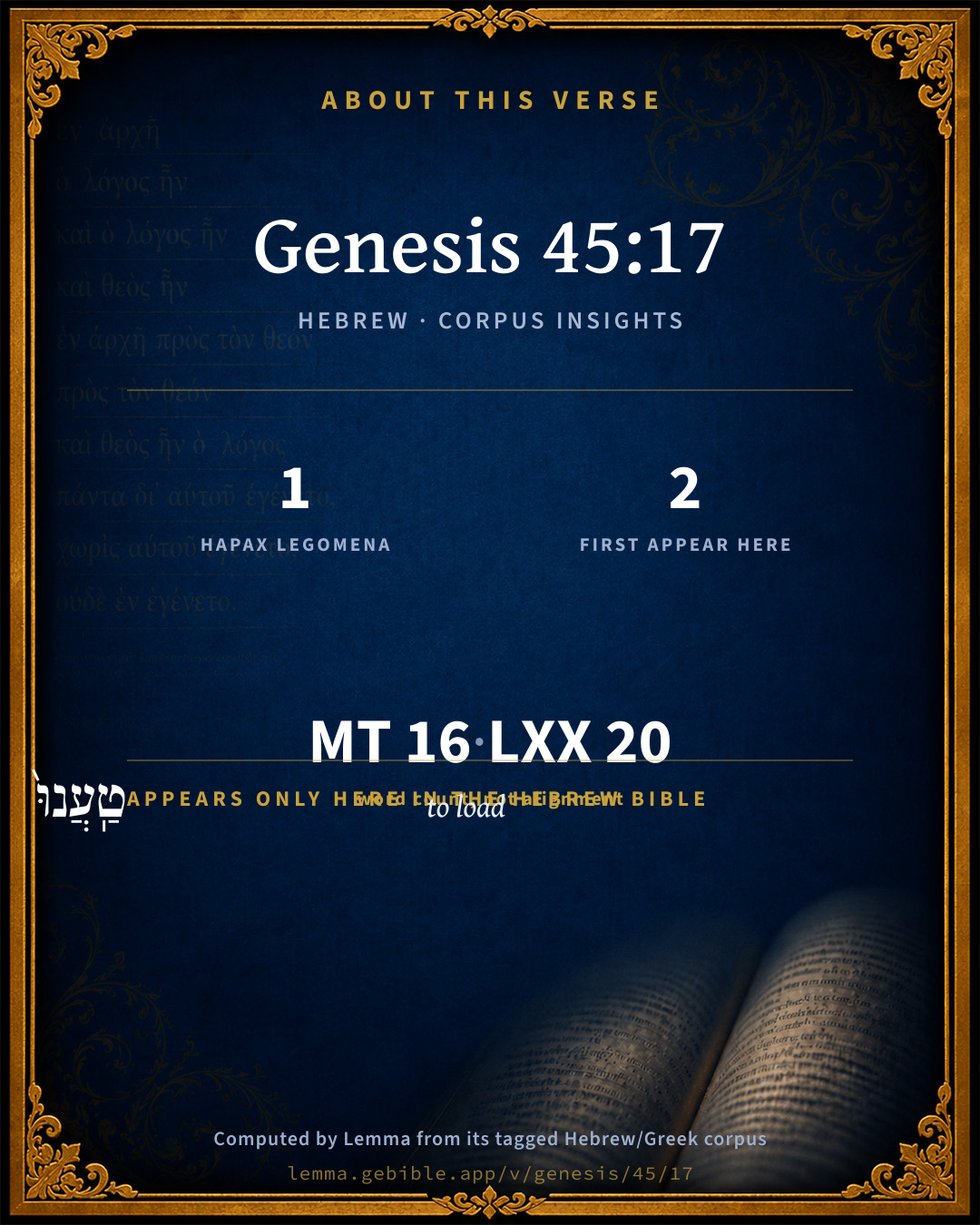
  • 1 hapax legomenon — only here in the Hebrew Bible
  • 2 first appearances in the Hebrew Bible
Full analysis ↓
Download a study sheet

One document with this verse’s original text, its word-by-word gloss line, the meaning frame, cross-references with their text, attributed commentary, and full source and license credits — printable, and it pastes into notes with its structure intact.

This verse Autodidact and up

Study sheet (.html) Plain text (.txt)

A passage Seminary Student

Up to 50 verses in one chapter. A passage sheet keeps up to 6 commentary sources and 12 cross-references per verse, in the order this page ranks them, and says so on the sheet whenever that leaves anything out. Ask for a single verse and you get the Autodidact verse sheet above.

Everything on this page stays free to read, with no account — the sheet is a download of what is already on screen, not access to it.

Want to remove ads? Support Godless Engineer
Compare translations 3

The same verse in 3 English versions, stacked beneath the original-language interlinear above. Click any original word for its lexicon entry.

Each is an independent rendering of the whole verse — the interlinear is not word-aligned to these translations.

Highlighted words mark where these versions differ — a whole-verse word diff, not a word-by-word alignment.

  • World English Bible Public Domain
    Pharaoh said to Joseph, "Tell your brothers, 'Do this. Load your animals, and go, travel to the land of Canaan.
  • King James Version Public Domain
    And Pharaoh said unto Joseph, Say unto thy brethren, This do ye; lade your beasts, and go, get you unto the land of Canaan;
  • unfoldingWord Literal Text CC BY-SA 4.0
    Then Pharaoh said to Joseph, “Say to your brothers, ‘Do this: Load your animals and leave; go to the land of Canaan.

unfoldingWord Literal Text — © unfoldingWord, licensed CC BY-SA 4.0. Word-aligned USFM3 via Door43 (git.door43.org/unfoldingWord/en_ult).

Versions to compare (up to 4)

3 of 4 selected

Show all 18 translations

Every available English version of this verse, each an independent rendering of the whole verse.

  • World English Bible Public Domain
    Pharaoh said to Joseph, "Tell your brothers, 'Do this. Load your animals, and go, travel to the land of Canaan.
  • Berean Standard Bible Public Domain
    Pharaoh said to Joseph, “Tell your brothers, ‘Do as follows: Load your animals and return to the land of Canaan.
  • Majority Standard Bible Public Domain
    Pharaoh said to Joseph, “Tell your brothers, ‘Do as follows: Load your animals and return to the land of Canaan.
  • King James Version Public Domain
    And Pharaoh said unto Joseph, Say unto thy brethren, This do ye; lade your beasts, and go, get you unto the land of Canaan;
  • American Standard Version (1901) Public Domain
    And Pharaoh said unto Joseph, Say unto thy brethren, This do ye: lade your beasts, and go, get you unto the land of Canaan;
  • Revised Version (1885) Public Domain
    And Pharaoh said unto Joseph, Say unto thy brethren, This do ye; lade your beasts, and go, get you unto the land of Canaan;
  • Geneva Bible (1599) Public Domain
    Then Pharaoh said vnto Ioseph, Say to thy brethren, This doe ye, lade your beastes and depart, go to the land of Canaan,
  • Douay-Rheims (1899) Public Domain
    And he spoke to Joseph that he should give orders to his brethren, saying: Load your beasts, and go into the land of Chanaan.
  • Young's Literal Translation Public Domain
    and Pharaoh saith unto Joseph, `Say unto thy brethren, This do ye: lade your beasts, and go, enter ye the land of Canaan,
  • Literal Standard Version CC BY-SA 4.0
    and Pharaoh says to Joseph, “Say to your brothers, This you do: load your beasts, and go, enter the land of Canaan,
  • Unlocked Literal Bible CC BY-SA 4.0
    Pharaoh said to Joseph, “Say to your brothers, 'Do this: Load your animals and go to the land of Canaan.
  • unfoldingWord Literal Text CC BY-SA 4.0
    Then Pharaoh said to Joseph, “Say to your brothers, ‘Do this: Load your animals and leave; go to the land of Canaan.
  • Darby Bible Public Domain
    And Pharaoh said to Joseph, Say to thy brethren, Do this: load your beasts and depart, go into the land of Canaan,
  • World Messianic Bible Public Domain
    Pharaoh said to Joseph, “Tell your brothers, ‘Do this: Load your animals, and go, travel to the land of Canaan.
  • Webster's Bible Public Domain
    And Pharaoh said to Joseph, Say to thy brethren, This do ye; load your beasts, and go, return to the land of Canaan;
  • Free Bible Version CC BY-SA 4.0
    Pharaoh said to Joseph, “Tell your brothers, ‘This is what you are to do: Load your donkeys with grain and go back to the country of Canaan.
  • Bible in Basic English Public Domain
    And Pharaoh said to Joseph, Say to your brothers, Put your goods on your beasts and go back to the land of Canaan;
  • JPS Tanakh (1917) Public Domain
    And Pharaoh said unto Joseph: 'Say unto thy brethren: This do ye: lade your beasts, and go, get you unto the land of Canaan;

Literal Standard Version (2020), Covenant Press — licensed CC BY-SA 4.0. Text via the HelloAO Bible API (eBible.org). Unlocked Literal Bible (unfoldingWord) — licensed CC BY-SA 4.0. Text via the HelloAO Bible API (eBible.org). unfoldingWord Literal Text — © unfoldingWord, licensed CC BY-SA 4.0. Word-aligned USFM3 via Door43 (git.door43.org/unfoldingWord/en_ult). Free Bible Version, Dr. Jonathan Gallagher — licensed CC BY-SA 4.0. Text via the HelloAO Bible API (eBible.org).

Word by word

More ways to search: Search by grammar → Find every occurrence → Compare this word →

Practice this passage: Drill this verse → Learn its vocabulary →

טַֽעֲנוּ֙
ṭâʻan
H2943
“load”
Verb, Qal, Imperative, 2nd Person, Masculine, Plural
Part of Speech
Verb
Stem
Qal
Form
Imperative
Person
2nd Person
Gender
Masculine
Number
Plural
Full BDB Definition

Origin: a primitive root

TWOT: 816

(Qal) to load
  1. וַיֹּ֤אמֶר ʼâmar H559 “and · to say” Conjunction + Verb, Qal, Sequential Imperfect, 3rd Person, Masculine, Singular
  2. פַּרְעֹה֙ Parʻôh H6547 “Pharaoh” Noun, Proper
  3. אֶל ʼêl H413 “to” Preposition
  4. יוֹסֵ֔ף Yôwçêph H3130 “Joseph” Noun, Proper
  5. אֱמֹ֥ר ʼâmar H559 “say” Verb, Qal, Imperative, 2nd Person, Masculine, Singular
  6. אֶל ʼêl H413 “to” Preposition
  7. אַחֶ֖יךָ ʼâch H251 “brothers · your” Noun, Common, Masculine, Plural, Construct + Suffix, Personal, 2nd Person, Masculine, Singular
  8. זֹ֣את zôʼth H2063 “this” Pronoun, Demonstrative, Feminine, Singular
  9. עֲשׂ֑וּ ʻâsâh H6213 “do” Verb, Qal, Imperative, 2nd Person, Masculine, Plural
  10. אֶת ʼêth H853 “-” Particle, Direct Object
  11. בְּעִ֣ירְכֶ֔ם bᵉʻîyr H1165 “beasts · your” Noun, Common, Masculine, Singular, Construct + Suffix, Personal, 2nd Person, Masculine, Plural
  12. וּלְכוּ yâlak H3212 “and · walk” Conjunction + Verb, Qal, Imperative, 2nd Person, Masculine, Plural
  13. בֹ֖אוּ bôwʼ H935 “enter” Verb, Qal, Imperative, 2nd Person, Masculine, Plural
  14. אַ֥רְצָה ʼerets H776 “land · toward” Noun, Common, Both, Singular, Construct + Suffix, Demonstrative
  15. כְּנָֽעַן Kᵉnaʻan H3667 “Canaan” Noun, Proper

About this verse

These counts appear in no published source. They are computed here, from the morphology-tagged text and Lemma’s own curated glosses. What Lemma adds →

16
words
14
distinct lemmas
Pentateuch
section

Notable vocabulary

1 hapax legomenon — a word that appears only here in the entire Hebrew Bible:

  • טַֽעֲנוּ֙ to load H2943

First appearance in Scripture

These words make their first canonical appearance in the Hebrew Bible here:

  • טַֽעֲנוּ֙ to load H2943
  • בְּעִ֣ירְכֶ֔ם beasts H1165

Shared distinctive vocabulary

בְּעִ֣ירְכֶ֔ם beasts H1165 occurs in 6 verses of the Hebrew Bible. Also found in:

Grammatical profile

  • 6 verbs
  • 6 nouns
  • 1 pronoun
  • 2 prepositions
  • 1 particle

Verb forms

  • וַיֹּ֤אמֶר Qal · Sequential Imperfect
  • אֱמֹ֥ר Qal · Imperative
  • עֲשׂ֑וּ Qal · Imperative
  • טַֽעֲנוּ֙ Qal · Imperative
  • וּלְכוּ Qal · Imperative
  • בֹ֖אוּ Qal · Imperative

Repetition

Words recur within this verse — often emphatic in Hebrew:

  • וַיֹּ֤אמֶר to say H559 ×2
  • אֶל to H413 ×2

Hebrew & Septuagint length

In English translation the verse runs 20 words from the Hebrew and 21 from the Septuagint (LXX English) — closely comparable.

A rough comparison of the two English renderings, which tokenize alike — not a word-level alignment.

Word counts can differ between the Hebrew and the Greek without any difference in meaning — e.g. the Hebrew direct-object marker אֵת has no separate Greek word, and Greek often adds the article ὁ.

In the original languages it is 16 Hebrew tokens and 20 Greek tokens — but the two are counted differently (Hebrew bundles its prefixes and suffixes into one token; the Greek is in lemma form), so that isn’t a like-for-like length.

Cross-references

2

Topical passages linked to Genesis 45:17 in the Treasury of Scripture Knowledge — connected by theme and wording, ordered by reader-vote popularity; previews shown in the World English Bible.

  • Genesis 42:25–26 Then Joseph commanded to fill their bags with grain, and to restore every man's money into his sack, and to give them food for the way. So it done to them.
  • Genesis 44:1–2 He commanded the steward of his house, saying, "Fill the men's sacks with food, as much as they can carry, and put every man's money in his sack's mouth.

Cross-references courtesy of OpenBible.info (CC BY 4.0).

Hebrew and Greek witnesses Masoretic Hebrew ↔ Greek Septuagint

The same verse in the two great witnesses to the Old Testament, shown verse-for-verse.

These are two independent witnesses, not word-aligned to each other, and the Septuagint is shown in lemma (dictionary) form.

Hebrew Genesis 45:17 Masoretic · Westminster Leningrad Codex

וַיֹּ֤אמֶר פַּרְעֹה֙ אֶל יוֹסֵ֔ף אֱמֹ֥ר אֶל אַחֶ֖יךָ זֹ֣את עֲשׂ֑וּ טַֽעֲנוּ֙ אֶת בְּעִ֣ירְכֶ֔ם וּלְכוּ בֹ֖אוּ אַ֥רְצָה כְּנָֽעַן

Pharaoh said to Joseph, "Tell your brothers, 'Do this. Load your animals, and go, travel to the land of Canaan.

World English Bible · Public Domain

Greek LXX Genesis 45:17 Septuagint · lemma form

εἶπον δέ φαραώ πρός ιωσηφ εἶπον ὁ ἀδελφός σύ οὗτος ποιέω γεμίζω ὁ πορεῖον σύ καί ἀποἔρχομαι εἰς γῆ χανααν

And Pharao said to Joseph, Say to your brethren, Do this; fill your wagons, and depart into the land of Chanaan.

LXX2012 (modern English Septuagint) · Public Domain

Hebrew: Westminster Leningrad Codex (CC BY 4.0). Greek: Septuagint (public domain); English from LXX2012 (modern English Septuagint) (Public Domain). How the Septuagint differs from the Hebrew →

Targum (Aramaic paraphrase)

2

The Targum is the ancient Jewish Aramaic paraphrase of the Hebrew Scriptures — an interpretive translation, not the Hebrew text itself. Onkelos (literal) and Pseudo-Jonathan (expansive) render the Torah, and Jonathan the Prophets. Coverage is partial: where no permissively-licensed English translation exists for a verse, only the Aramaic is shown. This is verse-level text, not a word-by-word alignment to the Hebrew.

  1. Targum Onkelos Torah (Genesis–Deuteronomy)
    וַאֲמַר פַּרְעֹה לְיוֹסֵף אֱמַר לְאַחָיךְ דָּא עִיבִידוּ טְעוּנוּ יָת בְּעִירְכוֹן וֶאֱזִילוּ אוֹבִילוּ לְאַרְעָא דִּכְנָעַן

    (no public-domain English translation for this verse)

    Targum Onkelos — Aramaic: “Onkelos Genesis” (public domain); “Onkelos Exodus” (public domain); “Onkelos Leviticus” (public domain); “Onkelos Numbers” (public domain); “Onkelos Deuteronomy” (public domain). English: “Sefaria Community Translation” (CC0 1.0 (public-domain dedication)); “J.W. Etheridge. The Targums of Onkelos and Jonathan Ben Uzziel on the Pentateuch. London: Longmans, Green, 1862” (public domain). Text via Sefaria.

  2. Targum Pseudo-Jonathan Torah (Genesis–Deuteronomy)
    וַאֲמַר פַּרְעה לְיוֹסֵף אֵימַר לְאָחָךְ דָא עִיבִידוּ טְעִינוּ יַת בְּעִירְכוֹן וְטַיְילוּ אוֹבִילוּ לְאַרְעָא דִכְנָעַן

    And he said to Joseph, Tell thy brethren, Do this. Lade your beasts, and go, carry into the land of Kenaan;

    Targum Pseudo-Jonathan — Aramaic: “Targum Jonathan on Genesis” (public domain); “Targum Jonathan on Exodus” (public domain); “Targum Jonathan on Leviticus” (public domain); “Targum Jonathan on Numbers” (public domain); “Targum Jonathan on Deuteronomy” (public domain). English: “The Targum of Jonathan ben Uzziel, trans. J. W. Etheridge, London, 1862” (public domain). Text via Sefaria.

Commentary

Notes on Genesis 45:17 from classic Christian and Jewish commentators (each source and its license shown beneath its notes). The classic Christian expositions comment on the surrounding passage and are grouped to its opening verse, so a note may address several verses; the Jewish commentaries on the Tanakh (Rashi and others) are per-verse, so they appear only where the commentator wrote on this verse.

Lemma curates 59 commentaries, every one of them public domain or Creative Commons licensed, each selected and text-cleaned for this edition rather than reprinted as found. About our sources →

Trapp's Complete Commentary

John Trapp

Gen 45:17 And Pharaoh said unto Joseph, Say unto thy brethren, This do ye; lade your beasts, and go, get you unto the land of Canaan;

Ver. 17. And Pharaoh said unto Joseph.] Pharaoh is good to Jacob and his house, for Joseph’s sake; so is God to us and ours, for Jesus’ sake. As any man was intimate with Sejanus, so he found favour with Tiberius. As if any were at odds with him, they lived in continual danger and durance, saith Tacitus; {a} so here.

O miserabilis humana conditio, et sine Christo, vanum omne quod vivimus, saith Jerome. - Epitaph. Nep., tom. i. p. 25.

O the misery of those that be without Christ in the world!

{a} Ut quisque Seiano intimus, ita ad Caesaris amicitiam validus: contra, quibus infensus esset, metu ac sordibus conflictabantur. - Tacit.

John Trapp, A Commentary or Exposition upon All the Books of the Old and New Testament (1647–1656) — public domain. Text from a community e-Sword module.

Jamieson, Fausset & Brown

Robert Jamieson, A. R. Fausset & David Brown

Pharaoh said unto Joseph, Say unto thy brethren--As Joseph might have been prevented by delicacy, the king himself invited the patriarch and all his family to migrate into Egypt; and he made most liberal arrangements for their removal and their subsequent settlement. It displays the character of this Pharaoh to advantage, that he was so kind to the relatives of Joseph; but indeed the greatest liberality he could show could never recompense the services of so great a benefactor of his kingdom.

Jamieson, Fausset & Brown — Commentary Critical and Explanatory on the Whole Bible (1871) — public domain (CC PDM 1.0). Text via the HelloAO Bible API.

John Gill's Exposition

And Pharaoh said unto Joseph,.... Who, it is highly probable, waited upon Pharaoh to acquaint him with the coming of his brethren; for it cannot be imagined that Pharaoh should say what follows upon a bare report, without having a further account of things from Joseph, or that he would neglect giving it, but take the first opportunity to inform him, whereupon he gave him the following order:

say unto thy brethren, this do ye; give them directions and instructions to do as follows:

lade your asses: with provisions for the present necessity of their father's household in Canaan, and for their journey back to Egypt:

and go, get you into the land of Canaan; with all the haste they could make.

John Gill's Exposition of the Whole Bible (1746–1763) — public domain (CC PDM 1.0). Text via the HelloAO Bible API.

The Pulpit Commentary

Vers. 17, 18. And Pharaoh said unto Joseph, Say unto thy brethren, This do ye; lade your beasts, and go, get you unto the land of Canaan; and take your father and your households, and come unto me. This may have been an independent invitation given by the Egyptian king to Joseph"s relatives; but it is more than likely that Joseph had already told him of the proposal he had made to his brethren, and that he here receives a royal confirmation of the same). And I will give you the good of the land of Egypt,i.e. the best part of the land, viz., Goshen (Rosenm Lange, and others); though the phrase is probably synonymous with that which followsand ye shall eat the fat of the land. The fat of the land meant either the richest and most fertile portion of it (Lunge, Kalisch), or the best and choicest of its productions (Gesenius, Keil). (Cf. Deu_32:14; Psa_147:14.

The Pulpit Commentary (1880–1919), ed. H.D.M. Spence-Jones & Joseph S. Exell — public domain. Text from a community e-Sword module.

Rashi

Rabbi Shlomo Yitzchaki (Rashi)

טענו את בעירכם LADE YOUR BEASTS — with grain.

Rashi on the Tanakh — English translations: “The Judaica Press complete Tanach with Rashi, translated by A. J. Rosenberg” (CC BY 4.0); “Pentateuch with Rashi's commentary by M. Rosenbaum and A.M. Silbermann, 1929-1934” (public domain); “The Metsudah Tanach series, Lakewood, N.J” (CC BY 4.0); and “The Book of Joshua, Metsudah Publications, 1997” (CC BY 4.0). Text via Sefaria.

Radak

Rabbi David Kimhi (Radak)

טענו את בעירכם, the word טען is an expression for “loading;” we find it used in this sense in Sanhedrin 32 אחת טעונה ואחת שאינה טעונה, “one which was loaded whereas the other was not loaded.” My grandfather of blessed memory explained the word טען as related to Isaiah 14,19 מטועני חרב, meaning that something had been stabbed, pierced. Accordingly, Joseph urged his brothers to spur on their beasts of burden by means of the דרבן, a spur or goad in order that the good news of his survival should reach his father sooner. Rabbi Saadyah gaon also translated the word in this fashion into Arabic.

בעירכם, a collective term [seeing that surely each brother had an animal of his own to ride on and to carry the grain. Ed.] Other examples of the collective term being used where a plural seemed indicated are Samuel II 10,5 עד יצמח זקנכם “until your beard (sing.) grows back.” [David had addressed several people, each of whose beard had been shaved off on one side of his face. Ed.] Joshua 1,3 is another such construction where we read כף רגלכם, “the sole of your feet,” instead of “the soles of your feet.” There are many other similar examples in Scripture.

Radak on the Tanakh — English translations: “Sefaria Community Translation” (CC0 1.0 (public-domain dedication)); “Eliyahu Munk, HaChut Hameshulash” (CC BY 4.0); “Rabbi Mike Feuer, Jerusalem Anthology” (CC BY 4.0); and “R. David Kimhi on the first book of Psalms, Translated by R.G. Finch, London, 1919” (public domain). Text via Sefaria.

Lesson kit

Teaching starters — assembled from the data on this page, not authored interpretation. Every prompt links to the verse data it draws on. Edit before teaching.

Genesis, in the Pentateuch, opens this verse with 16 words (14 distinct Hebrew lemmas). Its most distinctive word is ṭâʻan (“to load”). A historical commentator’s framing appears above. Read the whole chapter for the surrounding context.

Discussion questions

  1. How does “to load” (ṭâʻan) shape what this verse is saying?
  2. 1 word here appears nowhere else in the Hebrew Bible. Why might the author reach for such rare wording?
  3. 2 words make their first appearance in Scripture here. What does this debut establish?
  4. How does Exodus 22:5, which shares the word «beasts», read alongside this verse?
  5. What does the repetition of “to say” (2× in this one verse) do in this verse?
  6. These translations render this verse differently. What is at stake in choosing one wording over another?
  7. «וַיֹּ֤אמֶר» is a Qal Sequential Imperfect verb. How does that grammatical form shape the action described?
  8. Compare how Trapp's Complete Commentary and Jamieson, Fausset & Brown read this verse. Where do they agree or differ?

Things to notice

  • 1 word in this verse appears nowhere else in the Hebrew Bible.
  • 2 words make their first canonical appearance in Scripture here.
  • This verse counts 16 Hebrew ↔ 20 Greek words.
  • These translations choose different wording for 12 words in this verse.
  • “to say” occurs 2× in this single verse.

Reading settings

Reading text

Shown beneath each verse's original-language words.

Old Testament
Old Testament edition

Read the OT as the Masoretic Hebrew (MT) or the Greek Septuagint (LXX).

English shown for the Greek Septuagint (in the Hebrew ↔ Greek comparison).

Comparing translations? Open the Compare panel on any verse page to stack up to four side by side.