Genesis 41:57

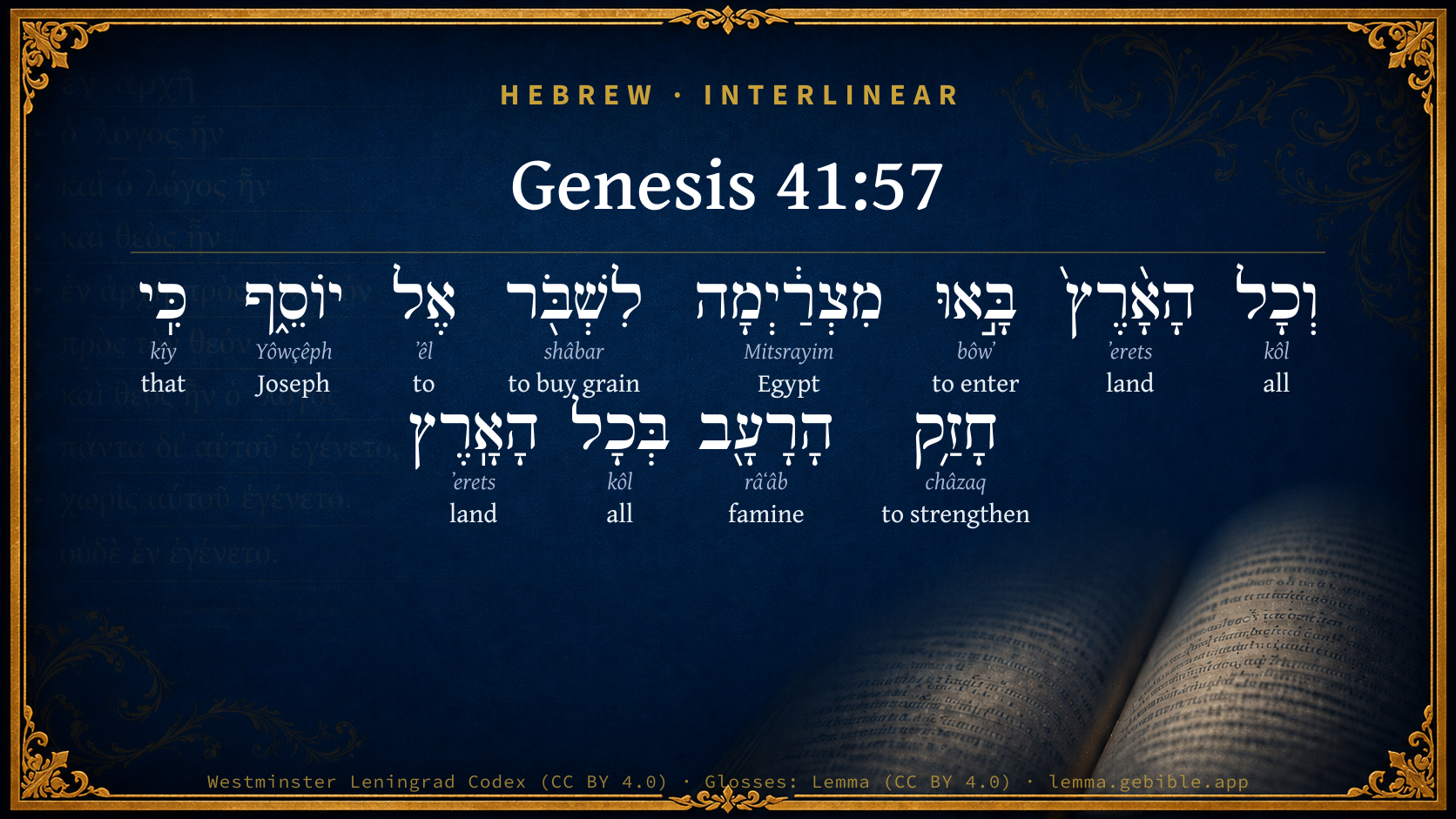
Hebrew (Westminster Leningrad Codex) Genesis 41:57 appears in the Hebrew Old Testament. The text above is from the Westminster Leningrad Codex. Each word links to its Strong’s number, a concise gloss, and parsing drawn from the Open Scriptures Hebrew Bible morphology. Click any word for its full Brown-Driver-Briggs (BDB) entry.
Download image
Cite this verse

Genesis 41:57 (World English Bible). Public Domain. Lemma interlinear Bible study tool, https://lemma.gebible.app/v/genesis/41/57.

Show BibTeX & RIS
BibTeX
RIS
English Translation
All countries came into Egypt, to Joseph, to buy grain, because the famine was severe in all the earth.
World English Bible · Public Domain
Download a study sheet

One document with this verse’s original text, its word-by-word gloss line, the meaning frame, cross-references with their text, attributed commentary, and full source and license credits — printable, and it pastes into notes with its structure intact.

This verse Autodidact and up

Study sheet (.html) Plain text (.txt)

A passage Seminary Student

Up to 50 verses in one chapter. A passage sheet keeps up to 6 commentary sources and 12 cross-references per verse, in the order this page ranks them, and says so on the sheet whenever that leaves anything out. Ask for a single verse and you get the Autodidact verse sheet above.

Everything on this page stays free to read, with no account — the sheet is a download of what is already on screen, not access to it.

Want to remove ads? Support Godless Engineer
Compare translations 3

The same verse in 3 English versions, stacked beneath the original-language interlinear above. Click any original word for its lexicon entry.

Each is an independent rendering of the whole verse — the interlinear is not word-aligned to these translations.

Highlighted words mark where these versions differ — a whole-verse word diff, not a word-by-word alignment.

  • World English Bible Public Domain
    All countries came into Egypt, to Joseph, to buy grain, because the famine was severe in all the earth.
  • King James Version Public Domain
    And all countries came into Egypt to Joseph for to buy corn; because that the famine was so sore in all lands.
  • unfoldingWord Literal Text CC BY-SA 4.0
    Then all the earth came to Egypt to Joseph to buy, because the famine was severe in all the earth.

unfoldingWord Literal Text — © unfoldingWord, licensed CC BY-SA 4.0. Word-aligned USFM3 via Door43 (git.door43.org/unfoldingWord/en_ult).

Versions to compare (up to 4)

3 of 4 selected

Show all 18 translations

Every available English version of this verse, each an independent rendering of the whole verse.

  • World English Bible Public Domain
    All countries came into Egypt, to Joseph, to buy grain, because the famine was severe in all the earth.
  • Berean Standard Bible Public Domain
    And every nation came to Joseph in Egypt to buy grain, because the famine was severe over all the earth.
  • Majority Standard Bible Public Domain
    And every nation came to Joseph in Egypt to buy grain, because the famine was severe over all the earth.
  • King James Version Public Domain
    And all countries came into Egypt to Joseph for to buy corn; because that the famine was so sore in all lands.
  • American Standard Version (1901) Public Domain
    And all countries came into Egypt to Joseph to buy grain, because the famine was sore in all the earth.
  • Revised Version (1885) Public Domain
    And all countries came into Egypt to Joseph for to buy corn; because the famine was sore in all the earth.
  • Geneva Bible (1599) Public Domain
    And all countries came to Egypt to bye corne of Ioseph, because the famine was sore in all landes.
  • Douay-Rheims (1899) Public Domain
    And when there also they began to be famished, the people cried to Pharao for food. And he said to them: Go to Joseph: and do all that he shall say to you.
  • Young's Literal Translation Public Domain
    and all the earth hath come to Egypt, to buy, unto Joseph, for the famine was severe in all the earth.
  • Literal Standard Version CC BY-SA 4.0
    and all the earth has come to Egypt, to buy, to Joseph, for the famine was severe in all the earth.
  • Unlocked Literal Bible CC BY-SA 4.0
    All the earth was coming to Egypt to buy grain from Joseph, because the famine was severe in all the earth.
  • unfoldingWord Literal Text CC BY-SA 4.0
    Then all the earth came to Egypt to Joseph to buy, because the famine was severe in all the earth.
  • Darby Bible Public Domain
    And all countries came into Egypt to Joseph, to buy [grain], because the famine was grievous on the whole earth.
  • World Messianic Bible Public Domain
    All countries came into Egypt, to Joseph, to buy grain, because the famine was severe in all the earth.
  • Webster's Bible Public Domain
    And all countries came into Egypt to Joseph to buy corn; because the famine was distressing in all lands.
  • Free Bible Version CC BY-SA 4.0
    in fact the famine was very bad everywhere, so people from other countries all around came to Egypt to buy grain from Joseph.
  • Bible in Basic English Public Domain
    And all lands sent to Egypt, to Joseph, to get grain, for the need was great over all the earth.
  • JPS Tanakh (1917) Public Domain
    And all countries came into Egypt to Joseph to buy corn; because the famine was sore in all the earth.

Literal Standard Version (2020), Covenant Press — licensed CC BY-SA 4.0. Text via the HelloAO Bible API (eBible.org). Unlocked Literal Bible (unfoldingWord) — licensed CC BY-SA 4.0. Text via the HelloAO Bible API (eBible.org). unfoldingWord Literal Text — © unfoldingWord, licensed CC BY-SA 4.0. Word-aligned USFM3 via Door43 (git.door43.org/unfoldingWord/en_ult). Free Bible Version, Dr. Jonathan Gallagher — licensed CC BY-SA 4.0. Text via the HelloAO Bible API (eBible.org).

Word by word

More ways to search: Search by grammar → Find every occurrence → Compare this word →

Practice this passage: Drill this verse → Learn its vocabulary →

לִשְׁבֹּ֖ר
shâbar
H7666
“to buy grain”
Preposition + Verb, Qal, Infinitive Construct
Part of Speech
Preposition + Verb
Stem
Qal
Form
Infinitive Construct
Full BDB Definition

Origin: denominative from H7668

TWOT: 2322

to buy or purchase grain - (Qal) to buy grain - (Hiphil) to sell grain
  1. וְכָל kôl H3605 “and · all of” Conjunction + Noun, Common, Masculine, Singular, Construct
  2. הָאָ֨רֶץ֙ ʼerets H776 “the · land” Particle, Definite Article + Noun, Common, Both, Singular, Absolute
  3. בָּ֣אוּ bôwʼ H935 “to enter” Verb, Qal, Perfect, 3rd Person, Common, Plural
  4. מִצְרַ֔יְמָה Mitsrayim H4714 “Egypt · toward” Noun, Proper + Suffix, Demonstrative
  5. אֶל ʼêl H413 “to” Preposition
  6. יוֹסֵ֑ף Yôwçêph H3130 “Joseph” Noun, Proper
  7. כִּֽי kîy H3588 “that” Conjunction
  8. חָזַ֥ק châzaq H2388 “to strengthen” Verb, Qal, Perfect, 3rd Person, Masculine, Singular
  9. הָרָעָ֖ב râʻâb H7458 “the · famine” Particle, Definite Article + Noun, Common, Masculine, Singular, Absolute
  10. בְּכָל kôl H3605 “in/at · all of” Preposition + Noun, Common, Masculine, Singular, Construct
  11. הָאָֽרֶץ ʼerets H776 “the · land” Particle, Definite Article + Noun, Common, Both, Singular, Absolute

About this verse

These counts appear in no published source. They are computed here, from the morphology-tagged text and Lemma’s own curated glosses. What Lemma adds →

12
words
10
distinct lemmas
Pentateuch
section

Notable vocabulary

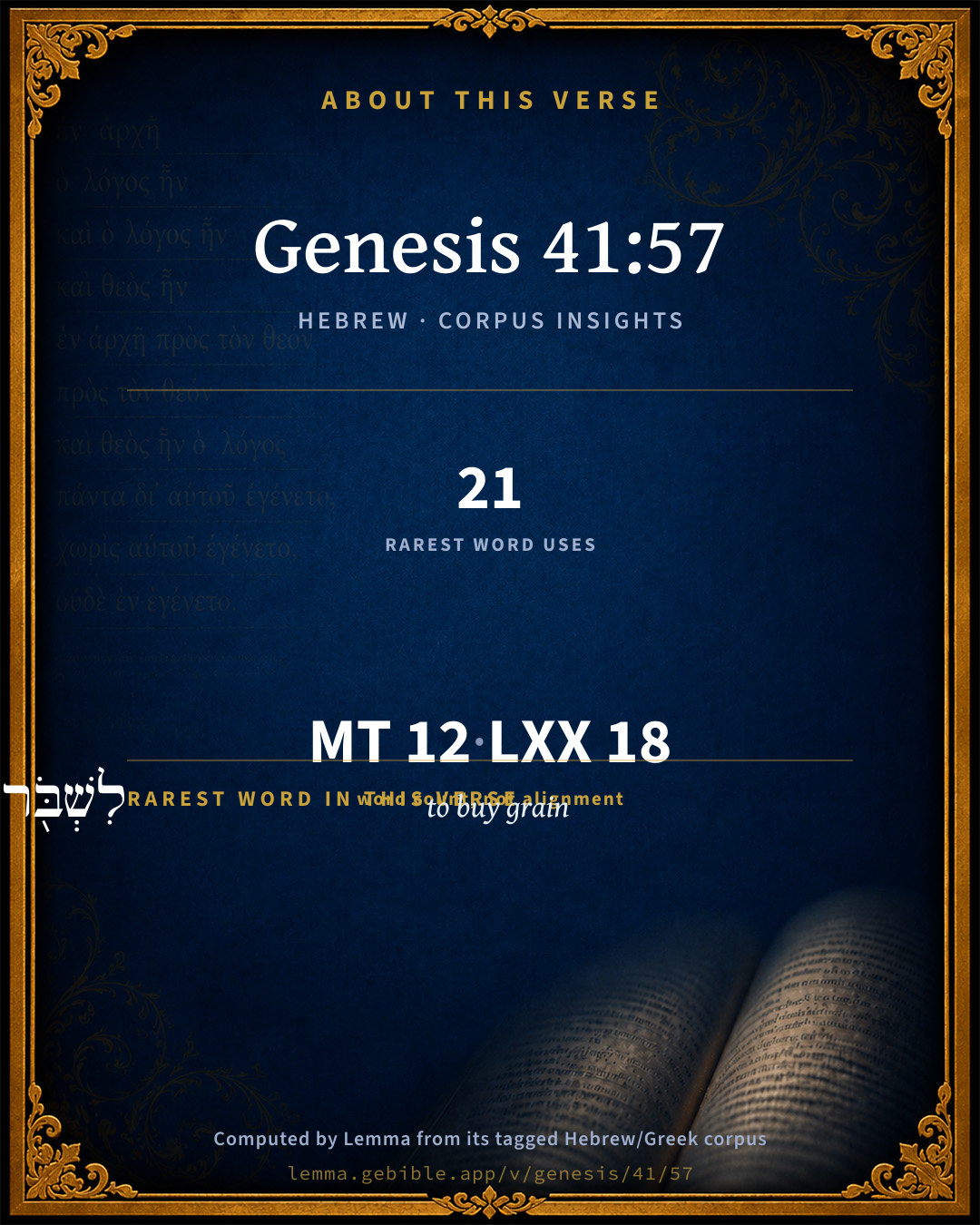
The rarest word here is לִשְׁבֹּ֖ר to buy grain H7666 — appearing just 21 times in the whole Hebrew Bible.

Shared distinctive vocabulary

לִשְׁבֹּ֖ר to buy grain H7666 occurs in 20 verses of the Hebrew Bible. Also found in:

Grammatical profile

  • 3 verbs
  • 7 nouns
  • 1 preposition
  • 1 conjunction

Verb forms

  • בָּ֣אוּ Qal · Perfect
  • לִשְׁבֹּ֖ר Qal · Infinitive Construct
  • חָזַ֥ק Qal · Perfect

Repetition

Words recur within this verse — often emphatic in Hebrew:

  • וְכָל all H3605 ×2
  • הָאָ֨רֶץ֙ land H776 ×2

Hebrew & Septuagint length

In English translation the verse runs 19 words from the Hebrew and 18 from the Septuagint (LXX English) — closely comparable.

A rough comparison of the two English renderings, which tokenize alike — not a word-level alignment.

Word counts can differ between the Hebrew and the Greek without any difference in meaning — e.g. the Hebrew direct-object marker אֵת has no separate Greek word, and Greek often adds the article ὁ.

In the original languages it is 12 Hebrew tokens and 18 Greek tokens — but the two are counted differently (Hebrew bundles its prefixes and suffixes into one token; the Greek is in lemma form), so that isn’t a like-for-like length.

Cross-references

7

Topical passages linked to Genesis 41:57 in the Treasury of Scripture Knowledge — connected by theme and wording, ordered by reader-vote popularity; previews shown in the World English Bible.

  • Genesis 41:54 The seven years of famine began to come, just as Joseph had said. There was famine in all lands, but in all the land of Egypt there was bread.
  • Genesis 41:56 The famine was over all the surface of the earth. Joseph opened all the store-houses, and sold to the Egyptians. The famine was severe in the land of Egypt.
  • Genesis 42:1 Now Jacob saw that there was grain in Egypt, and Jacob said to his sons, "Why do you look at one another?"
  • Genesis 42:5 The sons of Israel came to buy among those who came, for the famine was in the land of Canaan.
  • Genesis 50:20 As for you, you meant evil against me, but God meant it for good, to bring to pass, as it is this day, to save many people alive.
  • Deuteronomy 9:28 lest the land whence you brought us out say, Because Yahweh was not able to bring them into the land which he promised to them, and because he hated them, he has brought them out to kill them in the wilderness.
  • Psalms 105:16–17 He called for a famine on the land. He destroyed the food supplies.

Cross-references courtesy of OpenBible.info (CC BY 4.0).

Hebrew and Greek witnesses Masoretic Hebrew ↔ Greek Septuagint

The same verse in the two great witnesses to the Old Testament, shown verse-for-verse.

These are two independent witnesses, not word-aligned to each other, and the Septuagint is shown in lemma (dictionary) form.

Hebrew Genesis 41:57 Masoretic · Westminster Leningrad Codex

וְכָל הָאָ֨רֶץ֙ בָּ֣אוּ מִצְרַ֔יְמָה לִשְׁבֹּ֖ר אֶל יוֹסֵ֑ף כִּֽי חָזַ֥ק הָרָעָ֖ב בְּכָל הָאָֽרֶץ

All countries came into Egypt, to Joseph, to buy grain, because the famine was severe in all the earth.

World English Bible · Public Domain

Greek LXX Genesis 41:57 Septuagint · lemma form

καί πᾶς ὁ χώρα ἔρχομαι εἰς αἴγυπτος ἀγοράζω πρός ιωσηφ ἐπικρατέω γάρ ὁ λιμός ἐν πᾶς ὁ γῆ

And all countries came to Egypt to buy of Joseph, for the famine prevailed in all the earth.

LXX2012 (modern English Septuagint) · Public Domain

Hebrew: Westminster Leningrad Codex (CC BY 4.0). Greek: Septuagint (public domain); English from LXX2012 (modern English Septuagint) (Public Domain). How the Septuagint differs from the Hebrew →

Targum (Aramaic paraphrase)

2

The Targum is the ancient Jewish Aramaic paraphrase of the Hebrew Scriptures — an interpretive translation, not the Hebrew text itself. Onkelos (literal) and Pseudo-Jonathan (expansive) render the Torah, and Jonathan the Prophets. Coverage is partial: where no permissively-licensed English translation exists for a verse, only the Aramaic is shown. This is verse-level text, not a word-by-word alignment to the Hebrew.

  1. Targum Onkelos Torah (Genesis–Deuteronomy)
    וְכָל דָּיְרֵי אַרְעָא עַלּוּ לְמִצְרַיִם לְמִזְבַּן עִיבוּרָא מִן יוֹסֵף אֲרֵי תְקֵיף כַּפְנָא בְּכָל אַרְעָא

    (no public-domain English translation for this verse)

    Targum Onkelos — Aramaic: “Onkelos Genesis” (public domain); “Onkelos Exodus” (public domain); “Onkelos Leviticus” (public domain); “Onkelos Numbers” (public domain); “Onkelos Deuteronomy” (public domain). English: “Sefaria Community Translation” (CC0 1.0 (public-domain dedication)); “J.W. Etheridge. The Targums of Onkelos and Jonathan Ben Uzziel on the Pentateuch. London: Longmans, Green, 1862” (public domain). Text via Sefaria.

  2. Targum Pseudo-Jonathan Torah (Genesis–Deuteronomy)
    וְכָל דַיְירֵי אַרְעָא עָלוּ לְמִצְרַיִם לְמִיזְבַּן עִיבּוּרָא מִן יוֹסֵף אֲרוּם תַּקִיף כַּפְנָא בְּכָל אַרְעָא

    and all the inhabitants of the earth came into Mizraim to buy provision of Joseph; for the famine was mighty in all the earth.

    Targum Pseudo-Jonathan — Aramaic: “Targum Jonathan on Genesis” (public domain); “Targum Jonathan on Exodus” (public domain); “Targum Jonathan on Leviticus” (public domain); “Targum Jonathan on Numbers” (public domain); “Targum Jonathan on Deuteronomy” (public domain). English: “The Targum of Jonathan ben Uzziel, trans. J. W. Etheridge, London, 1862” (public domain). Text via Sefaria.

Commentary

Notes on Genesis 41:57 from classic Christian and Jewish commentators (each source and its license shown beneath its notes). The classic Christian expositions comment on the surrounding passage and are grouped to its opening verse, so a note may address several verses; the Jewish commentaries on the Tanakh (Rashi and others) are per-verse, so they appear only where the commentator wrote on this verse.

Lemma curates 59 commentaries, every one of them public domain or Creative Commons licensed, each selected and text-cleaned for this edition rather than reprinted as found. About our sources →

Trapp's Complete Commentary

John Trapp

Gen 41:57 And all countries came into Egypt to Joseph for to buy [corn]; because that the famine was [so] sore in all lands.

Ver. 57. All countries came to Joseph, &c.] Foreigners also should be relieved so much as may be. King Edward VI sent five thousand pounds to relieve Protestants beyond the seas. {a} Geneva received our fugitives for religion in Queen Mary’s time: and Strasburg, the poor banished Lorrainers, that were well nigh famished, being forced to feed on hips and haws, &c.

{a} Hi frondibus et gramine vescebantur. - Scultet., Annal., p. 315.

John Trapp, A Commentary or Exposition upon All the Books of the Old and New Testament (1647–1656) — public domain. Text from a community e-Sword module.

Geneva Bible (1599)

Geneva Bible translators

Or, came to Egypt to Joseph.

Geneva Bible (1599) marginal notes — public domain. Text via Bolls.life.

Jamieson, Fausset & Brown

Robert Jamieson, A. R. Fausset & David Brown

The famine was sore in all lands--that is, the lands contiguous to Egypt--Canaan, Syria, and Arabia.

Next: Genesis Chapter 42

Jamieson, Fausset & Brown — Commentary Critical and Explanatory on the Whole Bible (1871) — public domain (CC PDM 1.0). Text via the HelloAO Bible API.

Adam Clarke's Commentary

Verse 57. All countries came into Egypt - to buy] As there had not been a sufficiency of rains, vapours, c., to swell the Nile, to effect a proper inundation in Egypt, the same cause would produce drought, and consequently scarcity, in all the neighbouring countries and this may be all that is intended in the text.

1. As the providence of God evidently led the butler and baker of Pharaoh, as well as the king himself, to dream the prophetic dreams mentioned in this and the preceding chapter, so his Spirit in Joseph led to the true interpretation of them. What a proof do all these things give us of a providence that is so general as to extend its influence to every part, and so particular as to notice, influence, and direct the most minute circumstances! Surely God "has way every where, and all things serve his will."

2. Dreams have been on one hand superstitiously regarded, and on the other skeptically disregarded. That some are prophetic there can be no doubt; that others are idle none can hesitate to believe. Dreams may be divided into the six following kinds:

1. Those which are the mere nightly result of the mind's reflections and perplexities during the business of the day.

2. Those which spring from a diseased state of the body, occasioning startings, terrors, c.

3. Those which spring from an impure state of the heart, mental repetitions of those acts or images of illicit pleasure, riot, and excess, which form the business of a profligate life.

4. Those which proceed from a diseased mind, occupied with schemes of pride, ambition, grandeur, c. These, as forming the characteristic conduct of the life, are repeatedly reacted in the deep watches of the night, and strongly agitate the soul with illusive enjoyments and disappointments.

5. Those which come immediately from Satan, which instil thoughts and principles opposed to truth and righteousness, leaving strong impressions on the mind suited to its natural bent and turn, which, in the course of the day, by favouring circumstances, may be called into action.

6. Those which come from God, and which necessarily lead to him, whether prophetic of future good or evil, or impressing holy purposes and heavenly resolutions. Whatever lends away from God, truth, and righteousness, must be from the source of evil whatever leads to obedience to God, and to acts of benevolence to man, must be from the source of goodness and truth. Reader, there is often as much superstition in disregarding as in attending to dreams and he who fears God will escape it in both.

Adam Clarke's Commentary on the Bible (1810–1826) — public domain. Text from a community e-Sword/MySword module.

The Cambridge Bible for Schools and Colleges

gen. ed. J. J. S. Perowne

57. all countries] Cf. Gen_41:52, as we should say, “the whole world.” This verse prepares us for the crisis in the Joseph narrative recorded in the following chapter.

The Cambridge Bible for Schools and Colleges (gen. ed. J. J. S. Perowne; Cambridge University Press, 1878–1918) — public domain. Text from a community e-Sword module.

Haydock's Catholic Bible Commentary

All provinces in the neighbourhood: for the stores laid up would not have supplied all mankind even for a few months. (Calmet)

George Leo Haydock (1774–1849), Haydock's Catholic Family Bible and Commentary, 1859 edition — public domain. Excludes Psalms (Douay-Rheims chapter numbering differs from Protestant) and Deuterocanonical books (Catholic canon only).

Rashi

Rabbi Shlomo Yitzchaki (Rashi)

וכל הארץ באו מצרימה —Transpose the words and explain it thus: “and all the countries came into Egypt אל יוסף to Joseph לשבר to buy corn”, for if you explain the words in the order in which they are written it ought to state לשבור מן יוסף to buy from Joseph.

Rashi on the Tanakh — English translations: “The Judaica Press complete Tanach with Rashi, translated by A. J. Rosenberg” (CC BY 4.0); “Pentateuch with Rashi's commentary by M. Rosenbaum and A.M. Silbermann, 1929-1934” (public domain); “The Metsudah Tanach series, Lakewood, N.J” (CC BY 4.0); and “The Book of Joshua, Metsudah Publications, 1997” (CC BY 4.0). Text via Sefaria.

Radak

Rabbi David Kimhi (Radak)

לשבור אל יוסף, the words have been inverted and mean the same as if the Torah had written באו אל יוסף לשבור, “they came to Joseph to trade in grain.”

Radak on the Tanakh — English translations: “Sefaria Community Translation” (CC0 1.0 (public-domain dedication)); “Eliyahu Munk, HaChut Hameshulash” (CC BY 4.0); “Rabbi Mike Feuer, Jerusalem Anthology” (CC BY 4.0); and “R. David Kimhi on the first book of Psalms, Translated by R.G. Finch, London, 1919” (public domain). Text via Sefaria.

Lesson kit

Teaching starters — assembled from the data on this page, not authored interpretation. Every prompt links to the verse data it draws on. Edit before teaching.

Genesis, in the Pentateuch, opens this verse with 12 words (10 distinct Hebrew lemmas). Its most distinctive word is shâbar (“to buy grain”). A historical commentator’s framing appears above. Read the whole chapter for the surrounding context.

Discussion questions

  1. The word shâbar carries the sense “to buy grain.” How does it shape the verse?
  2. How does Genesis 41:56, which shares the word «to buy grain», read alongside this verse?
  3. What does the repetition of “all” (2× in this one verse) do in this verse?
  4. These translations render this verse differently. What is at stake in choosing one wording over another?
  5. «בָּ֣אוּ» is a Qal Perfect verb. How does that grammatical form shape the action described?
  6. Compare how Trapp's Complete Commentary and Geneva Bible (1599) read this verse. Where do they agree or differ?

Things to notice

Reading settings

Reading text

Shown beneath each verse's original-language words.

Old Testament
Old Testament edition

Read the OT as the Masoretic Hebrew (MT) or the Greek Septuagint (LXX).

English shown for the Greek Septuagint (in the Hebrew ↔ Greek comparison).

Comparing translations? Open the Compare panel on any verse page to stack up to four side by side.