Genesis 37:23

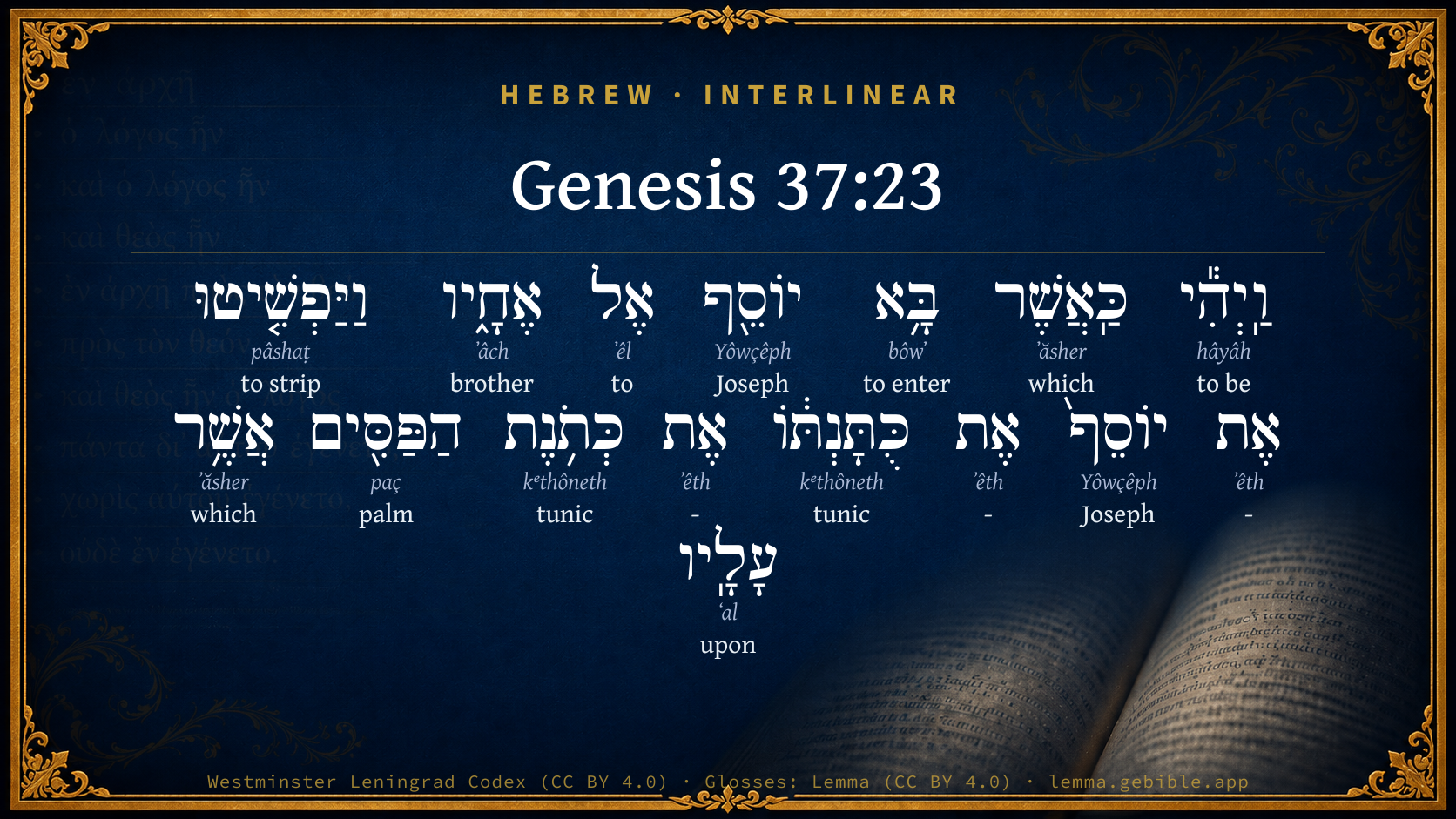
Hebrew (Westminster Leningrad Codex) Genesis 37:23 appears in the Hebrew Old Testament. The text above is from the Westminster Leningrad Codex. Each word links to its Strong’s number, a concise gloss, and parsing drawn from the Open Scriptures Hebrew Bible morphology. Click any word for its full Brown-Driver-Briggs (BDB) entry.
Download image
Cite this verse

Genesis 37:23 (World English Bible). Public Domain. Lemma interlinear Bible study tool, https://lemma.gebible.app/v/genesis/37/23.

Show BibTeX & RIS
BibTeX
RIS
English Translation
It happened, when Joseph came to his brothers, that they stripped Joseph of his coat, the coat of many colors that was on him;
World English Bible · Public Domain
Highlights
  • 1 first appearance in the Hebrew Bible
Full analysis ↓
Download a study sheet

One document with this verse’s original text, its word-by-word gloss line, the meaning frame, cross-references with their text, attributed commentary, and full source and license credits — printable, and it pastes into notes with its structure intact.

This verse Autodidact and up

Study sheet (.html) Plain text (.txt)

A passage Seminary Student

Up to 50 verses in one chapter. A passage sheet keeps up to 6 commentary sources and 12 cross-references per verse, in the order this page ranks them, and says so on the sheet whenever that leaves anything out. Ask for a single verse and you get the Autodidact verse sheet above.

Everything on this page stays free to read, with no account — the sheet is a download of what is already on screen, not access to it.

Want to remove ads? Support Godless Engineer
Compare translations 3

The same verse in 3 English versions, stacked beneath the original-language interlinear above. Click any original word for its lexicon entry.

Each is an independent rendering of the whole verse — the interlinear is not word-aligned to these translations.

Highlighted words mark where these versions differ — a whole-verse word diff, not a word-by-word alignment.

  • World English Bible Public Domain
    It happened, when Joseph came to his brothers, that they stripped Joseph of his coat, the coat of many colors that was on him;
  • King James Version Public Domain
    And it came to pass, when Joseph was come unto his brethren, that they stripped Joseph out of his coat, his coat of many colors that was on him;
  • unfoldingWord Literal Text CC BY-SA 4.0
    Then it happened when Joseph came to his brothers, then they stripped Joseph of his tunic, the multicolored tunic that on him.

unfoldingWord Literal Text — © unfoldingWord, licensed CC BY-SA 4.0. Word-aligned USFM3 via Door43 (git.door43.org/unfoldingWord/en_ult).

Versions to compare (up to 4)

3 of 4 selected

Show all 18 translations

Every available English version of this verse, each an independent rendering of the whole verse.

  • World English Bible Public Domain
    It happened, when Joseph came to his brothers, that they stripped Joseph of his coat, the coat of many colors that was on him;
  • Berean Standard Bible Public Domain
    So when Joseph came to his brothers, they stripped him of his robe—the robe of many colors he was wearing—
  • Majority Standard Bible Public Domain
    So when Joseph came to his brothers, they stripped him of his robe—the robe of many colors he was wearing—
  • King James Version Public Domain
    And it came to pass, when Joseph was come unto his brethren, that they stripped Joseph out of his coat, his coat of many colors that was on him;
  • American Standard Version (1901) Public Domain
    And it came to pass, when Joseph was come unto his brethren, that they stripped Joseph of his coat, the coat of many colors that was on him;
  • Revised Version (1885) Public Domain
    And it came to pass, when Joseph was come unto his brethren, that they stript Joseph of his coat, the coat of many colours that was on him;
  • Geneva Bible (1599) Public Domain
    Now when Ioseph was come vnto his brethren, they stript Ioseph out of his coate, his particoloured coate that was vpon him.
  • Douay-Rheims (1899) Public Domain
    And as soon as he came to his brethren, they forthwith stript him of his outside coat, that was of divers colours:
  • Young's Literal Translation Public Domain
    And it cometh to pass, when Joseph hath come unto his brethren, that they strip Joseph of his coat, the long coat which `is' upon him,
  • Literal Standard Version CC BY-SA 4.0
    And it comes to pass, when Joseph has come to his brothers, that they strip Joseph of his coat, the long coat which [is] on him,
  • Unlocked Literal Bible CC BY-SA 4.0
    It came about that when Joseph reached his brothers, they stripped him of his beautiful garment.
  • unfoldingWord Literal Text CC BY-SA 4.0
    Then it happened when Joseph came to his brothers, then they stripped Joseph of his tunic, the multicolored tunic that on him.
  • Darby Bible Public Domain
    And it came to pass when Joseph came to his brethren, that they stripped Joseph of his vest, the vest of many colours, which he had on;
  • World Messianic Bible Public Domain
    When Joseph came to his brothers, they stripped Joseph of his tunic, the tunic of many colors that was on him;
  • Webster's Bible Public Domain
    And it came to pass when Joseph had come to his brethren, that they stripped Joseph of his coat, his coat of many colors that was on him.
  • Free Bible Version CC BY-SA 4.0
    So when Joseph arrived, his brothers ripped off his robe—the colorful long-sleeved robe he was wearing—
  • Bible in Basic English Public Domain
    So when Joseph came to his brothers, they took off his long coat which he had on;
  • JPS Tanakh (1917) Public Domain
    And it came to pass, when Joseph was come unto his brethren, that they stripped Joseph of his coat, the coat of many colours that was on him;

Literal Standard Version (2020), Covenant Press — licensed CC BY-SA 4.0. Text via the HelloAO Bible API (eBible.org). Unlocked Literal Bible (unfoldingWord) — licensed CC BY-SA 4.0. Text via the HelloAO Bible API (eBible.org). unfoldingWord Literal Text — © unfoldingWord, licensed CC BY-SA 4.0. Word-aligned USFM3 via Door43 (git.door43.org/unfoldingWord/en_ult). Free Bible Version, Dr. Jonathan Gallagher — licensed CC BY-SA 4.0. Text via the HelloAO Bible API (eBible.org).

Word by word

More ways to search: Search by grammar → Find every occurrence → Compare this word →

Practice this passage: Drill this verse → Learn its vocabulary →

הַפַּסִּ֖ים
paç
H6446
“the · palms”
Particle, Definite Article + Noun, Common, Masculine, Plural, Absolute
Part of Speech
Particle + Noun
Type
Common
Gender
Masculine
Number
Plural
State
Absolute
Full BDB Definition

Origin: from H6461

TWOT: 1789a

flat (of the hand or foot), palm, sole - of the tunic reaching to palms and soles (figuratively)
  1. וַֽיְהִ֕י hâyâh H1961 “and · to be” Conjunction + Verb, Qal, Sequential Imperfect, 3rd Person, Masculine, Singular
  2. כַּֽאֲשֶׁר ʼăsher H834 “like/as · which” Preposition + Particle, Relative
  3. בָּ֥א bôwʼ H935 “to enter” Verb, Qal, Perfect, 3rd Person, Masculine, Singular
  4. יוֹסֵ֖ף Yôwçêph H3130 “Joseph” Noun, Proper
  5. אֶל ʼêl H413 “to” Preposition
  6. אֶחָ֑יו ʼâch H251 “brothers · his” Noun, Common, Masculine, Plural, Construct + Suffix, Personal, 3rd Person, Masculine, Singular
  7. וַיַּפְשִׁ֤יטוּ pâshaṭ H6584 “and · to strip” Conjunction + Verb, Hiphil, Sequential Imperfect, 3rd Person, Masculine, Plural
  8. אֶת ʼêth H853 “-” Particle, Direct Object
  9. יוֹסֵף֙ Yôwçêph H3130 “Joseph” Noun, Proper
  10. אֶת ʼêth H853 “-” Particle, Direct Object
  11. כֻּתָּנְתּ֔וֹ kᵉthôneth H3801 “tunic · his” Noun, Common, Feminine, Singular, Construct + Suffix, Personal, 3rd Person, Masculine, Singular
  12. אֶת ʼêth H853 “-” Particle, Direct Object
  13. כְּתֹ֥נֶת kᵉthôneth H3801 “tunic of” Noun, Common, Feminine, Singular, Construct
  14. אֲשֶׁ֥ר ʼăsher H834 “which” Particle, Relative
  15. עָלָֽיו ʻal H5921 “upon · him” Preposition + Suffix, Personal, 3rd Person, Masculine, Singular

About this verse

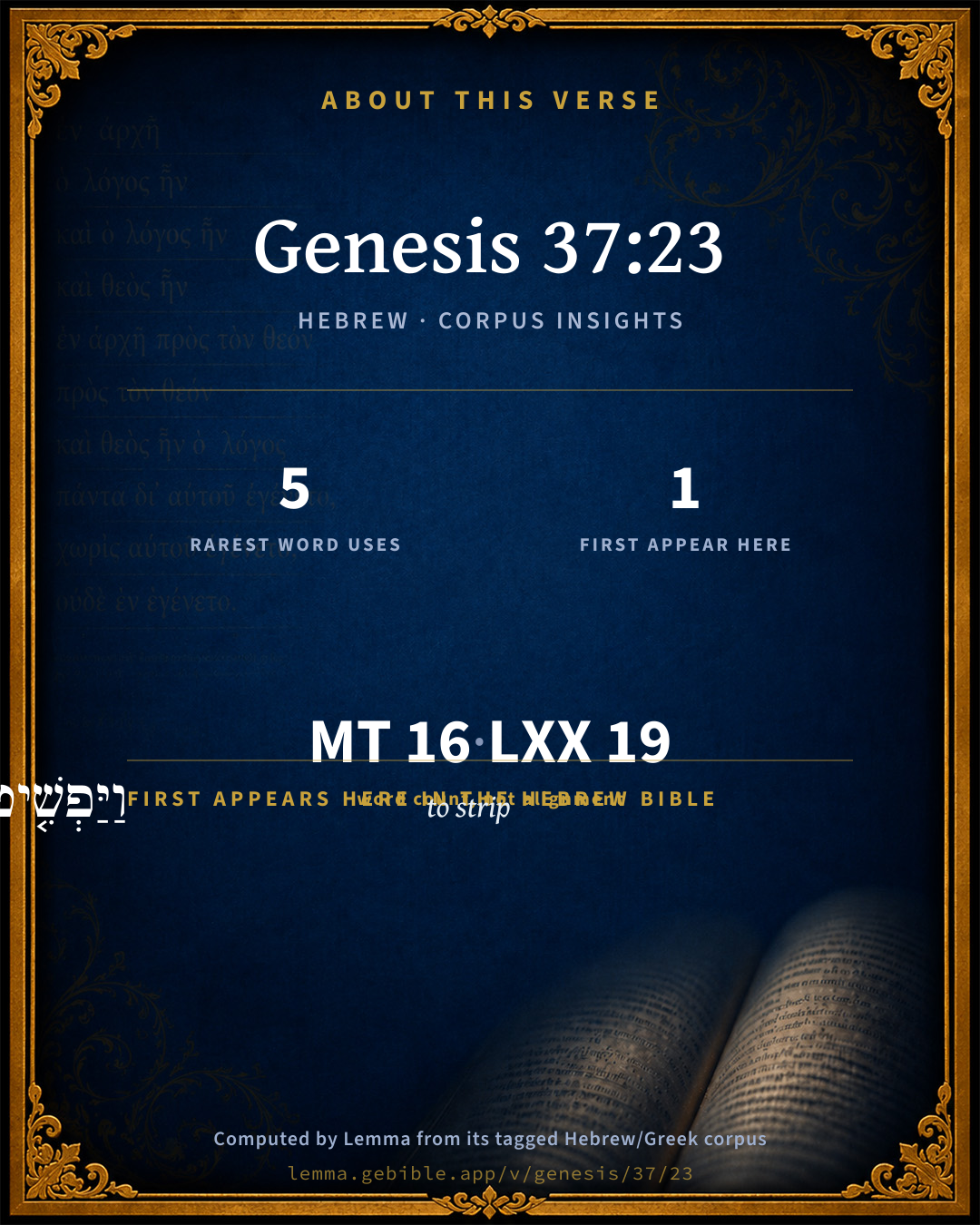
These counts appear in no published source. They are computed here, from the morphology-tagged text and Lemma’s own curated glosses. What Lemma adds →

16
words
11
distinct lemmas
Pentateuch
section

Notable vocabulary

The rarest word here is הַפַּסִּ֖ים palm H6446 — appearing just 5 times in the whole Hebrew Bible.

First appearance in Scripture

This word makes its first canonical appearance in the Hebrew Bible here:

  • וַיַּפְשִׁ֤יטוּ to strip H6584

Shared distinctive vocabulary

הַפַּסִּ֖ים palm H6446 occurs in 5 verses of the Hebrew Bible. Also found in:

Grammatical profile

  • 3 verbs
  • 6 nouns
  • 2 prepositions
  • 5 particles

Verb forms

  • וַֽיְהִ֕י Qal · Sequential Imperfect
  • בָּ֥א Qal · Perfect
  • וַיַּפְשִׁ֤יטוּ Hiphil · Sequential Imperfect

Repetition

Words recur within this verse — often emphatic in Hebrew:

  • יוֹסֵ֖ף Joseph H3130 ×2
  • כֻּתָּנְתּ֔וֹ tunic H3801 ×2
  • כַּֽאֲשֶׁר which H834 ×2

Hebrew & Septuagint length

In English translation the verse runs 24 words from the Hebrew and 23 from the Septuagint (LXX English) — closely comparable.

A rough comparison of the two English renderings, which tokenize alike — not a word-level alignment.

Word counts can differ between the Hebrew and the Greek without any difference in meaning — e.g. the Hebrew direct-object marker אֵת has no separate Greek word, and Greek often adds the article ὁ.

In the original languages it is 16 Hebrew tokens and 19 Greek tokens — but the two are counted differently (Hebrew bundles its prefixes and suffixes into one token; the Greek is in lemma form), so that isn’t a like-for-like length.

Cross-references

5

Topical passages linked to Genesis 37:23 in the Treasury of Scripture Knowledge — connected by theme and wording, ordered by reader-vote popularity; previews shown in the World English Bible.

  • Genesis 37:3 Now Israel loved Joseph more than all his children, because he was the son of his old age, and he made him a coat of many colors.
  • Genesis 37:31–33 They took Joseph's coat, and killed a male goat, and dipped the coat in the blood.
  • Genesis 42:21 They said one to another, "We are most assuredly guilty concerning our brother, in that we saw the distress of his soul, when he begged us, and we wouldn't listen. Therefore this distress has come on us."
  • Matthew 27:28 They stripped him, and put a scarlet robe on him.
  • Psalms 22:18 They divide my garments among them. They cast lots for my clothing.

Cross-references courtesy of OpenBible.info (CC BY 4.0).

Hebrew and Greek witnesses Masoretic Hebrew ↔ Greek Septuagint

The same verse in the two great witnesses to the Old Testament, shown verse-for-verse.

These are two independent witnesses, not word-aligned to each other, and the Septuagint is shown in lemma (dictionary) form.

Hebrew Genesis 37:23 Masoretic · Westminster Leningrad Codex

וַֽיְהִ֕י כַּֽאֲשֶׁר בָּ֥א יוֹסֵ֖ף אֶל אֶחָ֑יו וַיַּפְשִׁ֤יטוּ אֶת יוֹסֵף֙ אֶת כֻּתָּנְתּ֔וֹ אֶת כְּתֹ֥נֶת הַפַּסִּ֖ים אֲשֶׁ֥ר עָלָֽיו

It happened, when Joseph came to his brothers, that they stripped Joseph of his coat, the coat of many colors that was on him;

World English Bible · Public Domain

Greek LXX Genesis 37:23 Septuagint · lemma form

γίγνομαι δέ ἡνίκα ἔρχομαι ιωσηφ πρός ὁ ἀδελφός αὐτός ἐκδύω ὁ ιωσηφ ὁ χιτών ὁ ποικίλος ὁ περί αὐτός

And it came to pass, when Joseph came to his brethren, that they stripped Joseph of his many-coloured coat that was upon him.

LXX2012 (modern English Septuagint) · Public Domain

Hebrew: Westminster Leningrad Codex (CC BY 4.0). Greek: Septuagint (public domain); English from LXX2012 (modern English Septuagint) (Public Domain). How the Septuagint differs from the Hebrew →

Targum (Aramaic paraphrase)

2

The Targum is the ancient Jewish Aramaic paraphrase of the Hebrew Scriptures — an interpretive translation, not the Hebrew text itself. Onkelos (literal) and Pseudo-Jonathan (expansive) render the Torah, and Jonathan the Prophets. Coverage is partial: where no permissively-licensed English translation exists for a verse, only the Aramaic is shown. This is verse-level text, not a word-by-word alignment to the Hebrew.

  1. Targum Onkelos Torah (Genesis–Deuteronomy)
    וַהֲוָה כַּד אָתָא יוֹסֵף לְוַת אֲחוֹהִי וְאַשְׁלָחוּ יָת יוֹסֵף יָת כִּתּוּנֵהּ יָת כִּתּוּנָא דְפַסֵּי דִי עֲלוֹהִי

    (no public-domain English translation for this verse)

    Targum Onkelos — Aramaic: “Onkelos Genesis” (public domain); “Onkelos Exodus” (public domain); “Onkelos Leviticus” (public domain); “Onkelos Numbers” (public domain); “Onkelos Deuteronomy” (public domain). English: “Sefaria Community Translation” (CC0 1.0 (public-domain dedication)); “J.W. Etheridge. The Targums of Onkelos and Jonathan Ben Uzziel on the Pentateuch. London: Longmans, Green, 1862” (public domain). Text via Sefaria.

  2. Targum Pseudo-Jonathan Torah (Genesis–Deuteronomy)
    וַהֲוָה כַּד אָתָא יוֹסֵף לְוַת אָחוֹהִי וְאַשְׁלָחוּ יַת יוֹסֵף יַת פַּרְגוּדֵיהּ יַת פַּרְגוֹד מְצַיָיר דִעֲלוֹי

    And when Joseph came to his brothers, they stripped him of his garment, the figured garment that was on him,

    Targum Pseudo-Jonathan — Aramaic: “Targum Jonathan on Genesis” (public domain); “Targum Jonathan on Exodus” (public domain); “Targum Jonathan on Leviticus” (public domain); “Targum Jonathan on Numbers” (public domain); “Targum Jonathan on Deuteronomy” (public domain). English: “The Targum of Jonathan ben Uzziel, trans. J. W. Etheridge, London, 1862” (public domain). Text via Sefaria.

Commentary

Notes on Genesis 37:23 from classic Christian and Jewish commentators (each source and its license shown beneath its notes). The classic Christian expositions comment on the surrounding passage and are grouped to its opening verse, so a note may address several verses; the Jewish commentaries on the Tanakh (Rashi and others) are per-verse, so they appear only where the commentator wrote on this verse.

Lemma curates 59 commentaries, every one of them public domain or Creative Commons licensed, each selected and text-cleaned for this edition rather than reprinted as found. About our sources →

Matthew Henry's Commentary

We have here the execution of their plot against Joseph. 1. They stripped him, each striving to seize the envied coat of many colours, Gen 37:23. Thus, in imagination, they degraded him from the birthright, of which perhaps this was the badge, grieving him, affronting their father, and making themselves sport, while they insulted over him. "Now, Joseph, where is the fine coat?" Thus our Lord Jesus was stripped of his seamless coat, and thus his suffering saints have first been industriously divested of their privileges and honours, and then made the off-scouring of all things. 2. They went about to starve him, throwing him into a dry pit, to perish there with hunger and cold, so cruel were their tender mercies, Gen 37:24. Note, Where envy reigns pity is banished, and humanity itself is forgotten, Pro 27:4. So full of deadly poison is malice that the more barbarous any thing is the more grateful it is. Now Joseph begged for his life, in the anguish of his soul (Gen 42:21), entreated, by all imaginable endearments, that they would be content with his coat and spare his life. He pleads innocence, relation, affection, submission; he weeps and makes supplication, but all in vain. Reuben alone relents and intercedes for him, Gen 42:22. But he cannot prevail to save Joseph from the horrible pit, in which they resolve he shall die by degrees, and be buried alive. Is this he to whom his brethren must do homage? Note, God's providences often seem to contradict his purposes, even then they are serving them, and working at a distance towards the accomplishment of them. 3. They slighted him when he was in distress, and were not grieved for the affliction of Joseph; for when he was pining away in the pit, bemoaning his own misery, and with a languishing cry calling to them for pity, they sat down to eat bread, Gen 37:25. (1.) They felt no remorse of conscience for the sin; if they had, it would have spoiled their appetite for their meat, and the relish of it. Note, A great force put upon conscience commonly stupefies it, and for the time deprives it both of sense and speech. Daring sinners are secure ones. But the consciences of Joseph's brethren, though asleep now, were roused long afterwards, Gen 42:21. (2.) They were now pleased to think how they were freed from the fear of their brother's dominion over them, and that, on the contrary, they had turned the wheel upon him. They made merry over him, as the persecutors over the two witnesses that had tormented them, Rev 11:10. Note, Those that oppose God's counsels may possibly prevail so far as to think they have gained their point, and yet be deceived. 4. They sold him. A caravan of merchants very opportunely passed by (Providence so ordering it), and Judah made the motion that they should sell Joseph to them, to be carried far enough off into Egypt, where, in all probability, he would be lost, and never heard of more. (1.) Judah proposed it in compassion to Joseph (Gen 37:26): "What profit is it if we slay our brother? it will be less guilt, and more gain, to sell him." Note, When we are tempted to sin, we should consider the unprofitableness of it. It is what there is nothing to be got by. (2.) They acquiesced in it, because they thought that if he were sold for a slave he would never be a lord, if sold into Egypt he would never be their lord; yet all this was working towards it. Note, The wrath of man shall praise God, and the remainder of wrath he will restrain, Psa 76:10. Joseph's brethren were wonderfully restrained from murdering him, and their selling him was as wonderfully turned to God's praise. As Joseph was sold by the contrivance of Judah for twenty pieces of silver, so was our Lord Jesus for thirty, and by one of the same name too, Judas. Reuben (it seems) had gone away from his brethren, when they sold Joseph, intending to come round some other way to the pit, and to help Joseph out of it, and return him safely to his father. This was a kind project, but, if it had taken effect, what had become of God's purpose concerning his preferment in Egypt? Note, There are many devices in man's heart, many devices of the enemies of God's people to destroy them and of their friends to help them, which perhaps are both disappointed, as these were; but the counsel of the Lord, that shall stand. Reuben thought himself undone, because the child was sold: I, whither shall I go? Gen 37:30. He being the eldest, his father would expect from him an accounts of Joseph; but, as it proved, they would all have been undone if he had not been sold.

Matthew Henry's Commentary on the Whole Bible (1708–1710) — public domain (CC PDM 1.0). Text via the HelloAO Bible API.

Trapp's Complete Commentary

John Trapp

Gen 37:23 And it came to pass, when Joseph was come unto his brethren, that they stript Joseph out of his coat, [his] coat of [many] colours that [was] on him;

Ver. 23. They stripe Joseph out of his coat.] For, (1) It an eyesore to them; (2.) There with they would colour their cruelty. And this while they were doing, Joseph used many entreaties for himself, but they would not hear him. {Gen 42:21} Reuben also pleaded hard for the child, but all to no purpose. {Gen 37:22} Their tender mercies were cruelties.

John Trapp, A Commentary or Exposition upon All the Books of the Old and New Testament (1647–1656) — public domain. Text from a community e-Sword module.

MacLaren's Expositions of Holy Scripture

Alexander MacLaren

Genesis

MAN’S PASSIONS AND GOD’S PURPOSE

Gen 37:23 - Gen 37:36.

We have left the serene and lofty atmosphere of communion and saintship far above us. This narrative takes us down into foul depths. It is a hideous story of vulgar hatred and cruelty. God’s name is never mentioned in it; and he is as far from the actors’ thoughts as from the writer’s words. The crime of the brothers is the subject, and the picture is painted in dark tones to teach large truths about sin.

1. The broad teaching of the whole story, which is ever being reiterated in Old Testament incidents, is that God works out His great purposes through even the crimes of unconscious men. There is an irony, if we may so say, in making the hatred of these men the very means of their brother’s advancement, and the occasion of blessing to themselves. As coral insects work, not knowing the plan of their reef, still less the fair vegetation and smiling homes which it will one day carry, but blindly building from the material supplied by the ocean a barrier against it; so even evil-doers are carrying on God’s plan, and sin is made to counterwork itself, and be the black channel through which the flashing water of life pours. Joseph’s words {Gen 50:20} give the point of view for the whole story: ‘Ye thought evil against me; but God meant it unto good . . .to save much people alive.’ We can scarcely forget the still more wonderful example of the same thing, in the crime of crimes, when his brethren slew the Son of God-like Joseph, the victim of envy-and, by their crime, God’s counsel of mercy for them and for all was fulfilled.

2. Following the narrative, Gen 37:23 - Gen 37:25 show us the poisonous fruit of brotherly hatred. The family, not the nation, is the social unit in Genesis. From the beginning, we find the field on which sin works is the family relation. Cain and Abel, Ishmael and Isaac, Esau and Jacob, and now the other children of Jacob and Joseph, attest the power of sin when it enters there, and illustrate the principle that the corruption of the best is the worst. The children of Rachel could not but be hated by the children of other mothers. Jacob’s undisguised partiality for Joseph was a fault too, which wrought like yeast on the passions of his wild sons. The long-sleeved garment which he gave to the lad probably meant to indicate his purpose to bestow on him the right of the first-born forfeited by Reuben, and so the violent rage which it excited was not altogether baseless. The whole miserable household strife teaches the rottenness of the polygamous relation on which it rested, and the folly of paternal favouritism. So it carries teaching especially needed then, but not out of date now.

The swift passage of the purely inward sin of jealous envy into the murderous act, as soon as opportunity offered, teaches the short path which connects the inmost passions with the grossest outward deeds. Like Jonah’s gourd, the smallest seed of hate needs but an hour or two of favouring weather to become a great tree, with all obscene and blood-seeking birds croaking in its branches. ‘Whosoever hateth his brother is a murderer,’ Therefore the solemn need for guarding the heart from the beginnings of envy, and for walking in love.

The clumsy contrivance for murder without criminality, which Reuben suggested, is an instance of the shallow pretexts with which the sophistry of sin fools men before they have done the wrong thing. Sin’s mask is generally dropped very soon after. The bait is useless when the hook is well in the fish’s gills. ‘Don’t let us kill him. Let us put him into a cistern. He cannot climb up its bottle-shaped, smooth sides. But that is not our fault. Nobody will ever hear his muffled cries from its depths. But there will be no blood on our hands.’ It was not the first time, nor is it the last, that men have tried to blink their responsibility for the consequences which they hoped would come of their crimes. Such excuses seem sound when we are being tempted; but, as soon as the rush of passion is past, they are found to be worthless. Like some cheap castings, they are only meant to be seen in front, where they are rounded and burnished. Get behind them, and you find them hollow.

‘They sat down to eat bread,’ Thomas Fuller pithily says: ‘With what heart could they say grace, either before or after meat?’ What a grim meal! And what an indication of their rude natures, seared consciences, and deadened affections!

This picture of the moral condition of the fathers of the Jewish tribes is surely a strong argument for the historical accuracy of the narrative. It would be strange if the legends of a race, instead of glorifying, should blacken, the characters of its founders. No motive can be alleged which would explain such a picture; its only explanation is its truth. The ugly story, too, throws vivid light on that thought, which prophets ever reiterated, ‘not for your sakes, but for My name’s sake.’ The divine choice of Israel was grounded, not on merit, but on sovereign purpose. And the undisguised plainness of the narrative of their sins is but of a piece with the tone of Scripture throughout. It never palliates the faults even of its best men. It tells its story without comment. It never indulges in condemnation any more than in praise. It is a perfect mirror; its office is to record, not to criticise. Many misconceptions of Old Testament morality would have been avoided by keeping that simple fact in view.

3. The ill-omened meal is interrupted by the sudden appearance, so picturesquely described, of the caravan of Ishmaelites with their loaded camels. Dothan was on or near the great trade route to Egypt, where luxury, and especially the custom of embalming, opened a profitable market for spices. The traders would probably not be particular as to the sort of merchandise they picked up on their road, and such an ‘unconsidered trifle’ as a slave or two would be neither here nor there. This opportune advent of the caravan sets a thought buzzing in Judah’s brain, which brings out a new phase of the crime. Hatred darkening to murder is bad enough; but hatred which has also an eye to business, and makes a profit out of a brother, is a shade or two blacker, because it means cold-blooded calculation and selfish advantage instead of raging passion. Judah’s cynical question avows the real motive of his intervention. He prefers the paltry gain from selling Joseph to the unprofitable luxury of killing him. It brings in regard to brotherly ties at the end, as a kind of homage paid to propriety, as if the obligations they involved were not broken as really by his proposal as by murder. Certainly it is strange logic which can say in one breath, ‘Let us sell him; . . .for he is our brother,’ and finds the clause between buffer enough to keep these two contradictories from collision.

If any touch of conscience made the brothers prefer the less cruel alternative, one can only see here another illustration of the strange power which men have of limiting the working of conscience, and of the fact that when a greater sin has been resolved on, a smaller one gets to look almost like a virtue. Perhaps Judah and the rest actually thought themselves very kind and brotherly when they put their brother into strangers’ power, and so went back to their meal with renewed cheerfulness, both because they had gained their end without bloodshed, and because they had got the money. They did not think that every tear and pang which Joseph would shed and feel would be laid at their door.

We do not suppose that Joseph was meant to be, in the accurate sense of the word, a type of Christ. But the coincidence is not to be passed by, that these same powerful motives of envy and of greed were combined in His case too, and that there again a Judah {Judas} appears as the agent of the perfidy.

We may note that the appearance of the traders in the nick of time, suggesting the sale of Joseph, points the familiar lesson that the opportunity to do ill deeds often makes ill deeds done. The path for entering on evil is made fatally easy at first; that gate always stands wide. The Devil knows how to time his approaches. A weak nature, with an evil bias in it, finds everywhere occasions and suggestions to do wrong. But it is the evil nature which makes innocent things opportunities for evil. Therefore we have to be on our guard, as knowing that if we fall it is not circumstances, but ourselves, that made stumbling-blocks out of what might have been stepping-stones.

4. Leaving Joseph to pursue his sad journey, our narrative introduces for the first time Reuben, whose counsel, as the verses before the text tell us, it had been to cast the poor lad into the cistern. His motive had been altogether good; he wished to save life, and as soon as the others were out of the way, to bring Joseph up again and get him safely back to Jacob. In Gen 42:22, Reuben himself reminds his brothers of what had passed. There he says that he had besought them not to ‘sin against the child,’ which naturally implies that he had wished them to do nothing to him, and that they ‘would not hear.’ In the verses before the text he proposes the compromise of the pit, and the others ‘hear.’ So there seem to have been two efforts made by him-first, to shield Joseph from any harm, and then that half-and-half measure which was adopted. He is absent, while they carry out the plan, and from the cruel merriment of the feast-perhaps watching his opportunity to rescue, perhaps in sickness of heart and protest against the deed. Well meant and kindly motived as his action was-and self-sacrificing too, if, as is probable, Joseph was meant by Jacob as his successor in the forfeited birthright-his scheme breaks down, as attempts to mitigate evil by compliance and to make compromises with sinners usually do. The only one of the whole family who had some virtue in him, was too timid to take up a position of uncompromising condemnation. He thought it more polite to go part of the way, and to trust to being able to prevent the worst. That is always a dangerous experiment. It is often tried still; it never answers. Let a man stand to his guns, and speak out the condemnation that is in his heart; otherwise, he will be sure to go farther than he meant, he will lose all right of remonstrance, and will generally find that the more daring sinners have made his well-meant schemes to avert the mischief impossible.

5. The cruel trick by which Jacob was deceived is perhaps the most heartless bit of the whole heartless crime. It came as near an insult as possible. It was maliciously meant. The snarl about the coat, the studied use of ‘thy son’ as if the brothers disowned the brotherhood, the unfeeling harshness of choosing such a way of telling their lie-all were meant to give the maximum of pain, and betray their savage hatred of father and son, and its causes. Was Reuben’s mouth shut all this time? Evidently. From his language in Gen 42:22, ‘His blood is required,’ he seems to have believed until then that Joseph had been killed in his absence. But he dared not speak. Had he told what he did know, the brothers had but to add, ‘And he proposed it himself,’ and his protestations of his good intentions would have been unheeded. He believed his brother dead, and perhaps thought it better that Jacob should think him slain by wild beasts than by brothers’ hands, as Reuben supposed him to be. But his shut mouth teaches again how dangerous his policy had been, and how the only road, which it is safe, in view of the uncertainties of the future, to take, is the plain road of resistance to evil and non-fellowship with its doers.

6. And what of the poor old father? His grief is unworthy of God’s wrestler. It is not the part of a devout believer in God’s providence to refuse to be comforted. There was no religious submission in his passionate sorrow. How unlike the quiet resignation which should have marked the recognition that the God who had been his guide was working here too! No doubt the hypocritical condolences of his children were as vinegar upon nitre. No doubt the loss of Joseph had taken away the one gentle and true son on whom his loneliness rested since his Rachel’s death, while he found no solace in the wild, passionate men who called him ‘father’ and brought him no ‘honour.’ But still his grief is beyond the measure which a true faith in God would have warranted; and we cannot but see that the dark picture which we have just been looking at gets no lighter or brighter tints from the demeanour of Jacob.

There are few bitterer sorrows than for a parent to see the children of his own sin in the sins of his children. Jacob might have felt that bitterness, as he looked round on the lovelessness and dark, passionate selfishness of his children, and remembered his own early crimes against Esau. He might have seen that his unwise fondness for the son of his Rachel had led to the brothers’ hatred, though he did not know that that hatred had plunged the arrow into his soul. Whether he knew it or not, his own conduct had feathered the arrow. He was drinking as he had brewed; and the heart-broken grief which darkened his later years had sprung from seed of his own sowing. So it is always. ‘Whatsoever a man soweth, that shall he also reap.’

It is a miserable story of ignoble jealousy and cruel hate; and yet, over all this foaming torrent, God’s steadfast bow of peace shines. These crimes and this ‘affliction of Joseph’ were the direct path to the fulfilment of His purposes. As blind instruments, even in their rebellion and sin, men work out His designs. The lesson of Joseph’s bondage will one day be the summing up of the world’s history. ‘Thou makest the wrath of man to praise Thee: and with the remainder thereof Thou girdest Thyself.’

Alexander MacLaren, Expositions of Holy Scripture (1904–1910) — public domain. Text from a community e-Sword module.

Tyndale Open Study Notes

Tyndale Open Resources

37:23 The recurring motif of changed clothes signifies changes in status, position, and authority (see 37:3, 23; 38:14, 19; 39:15-18; 41:14, 42).

Tyndale Open Study Notes — © Tyndale Open Resources, licensed CC BY-SA 4.0. Text via the HelloAO Bible API.

Jamieson, Fausset & Brown

Robert Jamieson, A. R. Fausset & David Brown

they stripped Joseph out of his coat . . . of many colors--Imagine him advancing in all the unsuspecting openness of brotherly affection. How astonished and terrified must he have been at the cold reception, the ferocious aspect, the rough usage of his unnatural assailants! A vivid picture of his state of agony and despair was afterwards drawn by themselves (compare Gen 42:21).

Jamieson, Fausset & Brown — Commentary Critical and Explanatory on the Whole Bible (1871) — public domain (CC PDM 1.0). Text via the HelloAO Bible API.

Adam Clarke's Commentary

Verse 23. They stripped Joseph out of his coat] This probably was done that, if ever found, he might not be discerned to be a person of distinction, and consequently, no inquiry made concerning him.

Adam Clarke's Commentary on the Bible (1810–1826) — public domain. Text from a community e-Sword/MySword module.

John Calvin's Commentaries

23. They stripped Joseph out of his coat We see that these men are full of fictions and lies. They carelessly strip their brother; they feel no dread at casting him with their own hands into the pit, where hunger worse than ten swords might consume him; because they hope their crime will be concealed; and in taking home his clothes, no suspicion of his murder would be excited; because, truly, their father would believe that he had been torn by a wild beast. Thus Satan infatuates wicked minds, so that they entangle themselves by frivolous evasions. Conscience is indeed the fountain of modesty; but Satan so soothes by his allurements those whom he has entangled in his snares, that conscience itself, which ought to have cited them as guilty before the bar of God, only hardens them the more. For, having found out subterfuges, they break forth far more audaciously into sin, as if they might commit with impunity whatever escapes the eyes of men. Surely it is a reprobate sense, a spirit of frenzy and of stupor, which is withheld from any daring attempt, only by a fear of the shame of men; while the fear of divine judgment is trodden under foot. And although all are not carried thus far, yet the fault of paying more honor to men than to God, is too common. The repetition of the word coat in the sentence of Moses is emphatical, showing that this mark of the father’s love could not mollify their minds.

John Calvin's Commentaries (1540-1563) — public domain. Text from the Calvin Translation Society English edition (1840s-50s) via the Christian Classics Ethereal Library (ccel.org). Calvin's coverage is partial (roughly two-thirds of the Bible); uncommented books and verses are honest gaps, never fabricated. The 19th-century editor's footnotes and remarks are omitted so the notes are faithfully Calvin's own voice.

John Gill's Exposition

And they took him, and cast him into a pit,.... Into the same that Reuben pointed to them, whose counsel they gladly took and readily executed, supposing he meant the same thing they did, starving him to death:

and the pit was empty, there was no water in it; only serpents and scorpions, as the Targum of Jonathan; and Jarchi adds, this remark, that there was no water in it, seems to be made either to furnish out a reason why Reuben directed to it, that he might be the more easily got out of it, and not be in danger of losing his life at once, or of being drowned in it; or else to show the uncomfortable situation he was in, having not so much as a drop of water to refresh him; see Zac 9:11. Dothan is said to remain to this day, and the inhabitants of it show the ancient ditch into which Joseph was cast (u).

(u) Bunting's Travels, p. 80.

John Gill's Exposition of the Whole Bible (1746–1763) — public domain (CC PDM 1.0). Text via the HelloAO Bible API.

Whedon's Commentary on the Bible

Daniel D. Whedon

23. Stripped Joseph — He wore the garment which gave so much offence, (Gen_37:3,) and this, first of all, they tore savagely away from him.

Daniel D. Whedon (gen. ed.), Commentary on the Old and New Testaments (1874–1909) — public domain. Text from a community e-Sword module.

The Pulpit Commentary

And it came to pass, when Joseph was come unto his brethren, that they stripped Joseph out of his coat, his coat of many colorsi.e. his coat of ends, or coat of pieces (vide on ver. 3)that was on him.

The Pulpit Commentary (1880–1919), ed. H.D.M. Spence-Jones & Joseph S. Exell — public domain. Text from a community e-Sword module.

Kretzmann's Popular Commentary

Paul E. Kretzmann

Joseph Sold to the Ishmaelites

v. 23. And it came to pass, when Joseph was come unto his brethren, that they stripped Joseph out of his coat, his coat of many colors that was on him, the fine long-sleeved tunic which his father had procured for him;

v. 24. and they took him, and cast him in to a pit; and the pit was empty, there was no water in it. So Reuben’s suggestion prevailed, and Joseph was thrown into the empty cistern, although his cries for mercy rang in the ears of his brothers for many long years afterward, Gen 41:21.

v. 25. And they sat down to eat bread; and they lifted up their eyes and looked, and, behold, a company of Ishmaelites came from Gilead with their camels bearing spicery and balm and myrrh, going to carry it down to Egypt. In the century and a half since Midian, the son of Keturah, and Ishmael had been dismissed from the house of Abraham, their descendants must have become a tribe of some number. The Midianites and the Ishmaelites were largely engaged in trading, the present caravan being loaded with gum-tragacanth of Syria, with terebinth-balm of Gilead, and with the fragrant gum of the cistus-rose found throughout Arabia. The merchants had crossed the Jordan near what was afterwards Beth-Shean and were following the caravan road through the plain of Tell-Dothan to Ramleh and then down to Egypt, where they hoped to dispose of their merchandise.

v. 26. And Judah said unto his brethren, What profit is it if we slay our brother, and conceal his blood? Judah also did not have the courage to oppose his brothers outright, although the idea of murdering his brother was abhorrent to him. His argument was that they would have no benefit out of it if they would simply put Joseph to death.

v. 27. Come, and let us sell him to the Ishmaelites, and let not our hand be upon him; for he is our brother and our flesh. And his brethren were content. The daring plan of Judah appealed to them, now that the first flare of their hatred had died down. Their consciences would not be burdened with a murder, and they would, in addition, have the slave-money for their profit.

v. 28. Then there passed by Midianites, merchantmen; and they drew and lifted up Joseph out of the pit, and sold Joseph to the Ishmaelites for twenty pieces of silver; and they brought Joseph into Egypt, passing within twenty miles of his father’s home to do so. Twenty pieces, or shekels, of silver was the price of a slave-boy, as fixed in the laws of Moses, Lev 27:5, well over ten dollars in American money. So the sons of Jacob, as they thought, had their revenge, and Judah thought he had salved his conscience. Such is the progress of sin.

Paul E. Kretzmann, Popular Commentary of the Bible (1921–1924) — public domain. Text from a community e-Sword module.

unfoldingWord translationNotes

Door43 World Missions Community

It came about that when

This phrase is used here to mark an important event in the story. If your language has a way for doing this, you could consider using it here.

they stripped him of his beautiful garment

"they tore his beautiful garment off of him"

beautiful garment

"beautiful robe." See how you translated this in Genesis 37:3.

translationWords

Joseph (OT)

unfoldingWord translationNotes — © Distant Shores Media and the Door43 World Missions Community, licensed CC BY-SA 4.0. Source: git.door43.org/Door43/en_tn.

Rashi

Rabbi Shlomo Yitzchaki (Rashi)

את כתנתו HIS GARMENT — this means his shirt.

את כתנת הפסים THE LONG SLEEVED GARMENT — this was the garment that his father had given him additional to those of his brothers (Genesis Rabbah 84:16).

Rashi on the Tanakh — English translations: “The Judaica Press complete Tanach with Rashi, translated by A. J. Rosenberg” (CC BY 4.0); “Pentateuch with Rashi's commentary by M. Rosenbaum and A.M. Silbermann, 1929-1934” (public domain); “The Metsudah Tanach series, Lakewood, N.J” (CC BY 4.0); and “The Book of Joshua, Metsudah Publications, 1997” (CC BY 4.0). Text via Sefaria.

Radak

Rabbi David Kimhi (Radak)

ויהי..את כתנת הפסים, the letter ה at the beginning of the word הפסים, referring to a specific garment, is justified seeing that we had previously been told את כתנתו, “his tunic,” i.e. the same tunic.

Radak on the Tanakh — English translations: “Sefaria Community Translation” (CC0 1.0 (public-domain dedication)); “Eliyahu Munk, HaChut Hameshulash” (CC BY 4.0); “Rabbi Mike Feuer, Jerusalem Anthology” (CC BY 4.0); and “R. David Kimhi on the first book of Psalms, Translated by R.G. Finch, London, 1919” (public domain). Text via Sefaria.

Ibn Ezra

Rabbi Abraham ibn Ezra

They stripped him of his coat. A kutones is actually an undergarment. Thus they cast him into the pit completely naked.

Ibn Ezra on the Tanakh — English translations: “Sefaria Community Translation” (CC0 1.0 (public-domain dedication)); “Yalkut, Sifsei Chachomim Chumash, Metsudah Publications, 2009” (CC BY 4.0); and “Commentary of Ibn Ezra on Isaiah - trans. by M. Friedlander, 1873” (public domain). Text via Sefaria.

Lesson kit

Teaching starters — assembled from the data on this page, not authored interpretation. Every prompt links to the verse data it draws on. Edit before teaching.

Genesis, in the Pentateuch, opens this verse with 16 words (11 distinct Hebrew lemmas). Its most distinctive word is paç (“palm”). A historical commentator’s framing appears above. Read the whole chapter for the surrounding context.

Discussion questions

  1. How does “palm” (paç) shape what this verse is saying?
  2. This is the first place “to strip” appears in Scripture (first appears here). What does its debut here establish?
  3. How does Genesis 37:3, which shares the word «palm», read alongside this verse?
  4. What does the repetition of “Joseph” (2× in this one verse) do in this verse?
  5. These translations render this verse differently. What is at stake in choosing one wording over another?
  6. «וַֽיְהִ֕י» is a Qal Sequential Imperfect verb. How does that grammatical form shape the action described?
  7. Compare how Matthew Henry's Commentary and Trapp's Complete Commentary read this verse. Where do they agree or differ?

Things to notice

Reading settings

Reading text

Shown beneath each verse's original-language words.

Old Testament
Old Testament edition

Read the OT as the Masoretic Hebrew (MT) or the Greek Septuagint (LXX).

English shown for the Greek Septuagint (in the Hebrew ↔ Greek comparison).

Comparing translations? Open the Compare panel on any verse page to stack up to four side by side.