Genesis 29:30

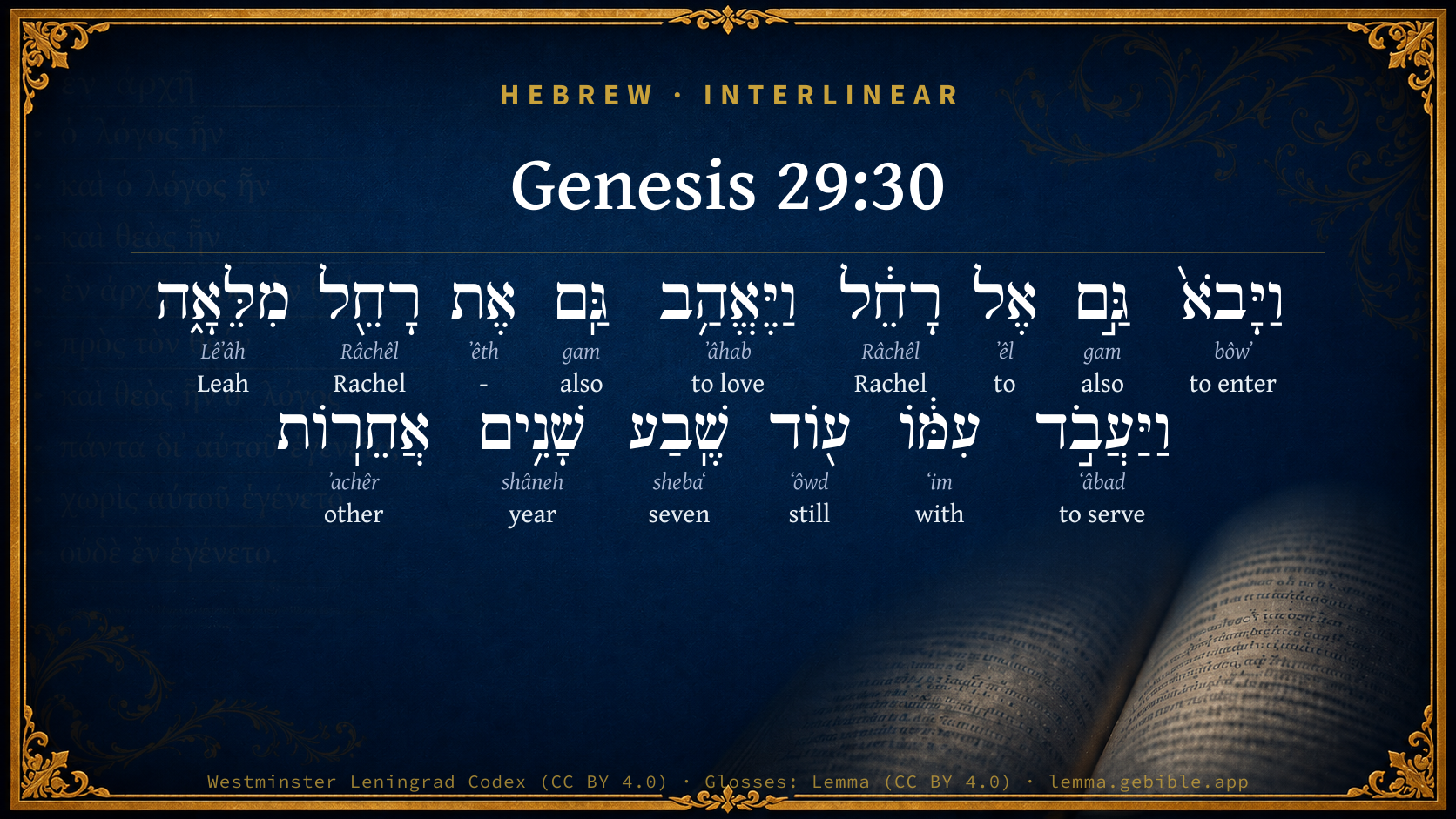
Hebrew (Westminster Leningrad Codex) Genesis 29:30 appears in the Hebrew Old Testament. The text above is from the Westminster Leningrad Codex. Each word links to its Strong’s number, a concise gloss, and parsing drawn from the Open Scriptures Hebrew Bible morphology. Click any word for its full Brown-Driver-Briggs (BDB) entry.
Download image
Cite this verse

Genesis 29:30 (World English Bible). Public Domain. Lemma interlinear Bible study tool, https://lemma.gebible.app/v/genesis/29/30.

Show BibTeX & RIS
BibTeX
RIS
English Translation
He went in also to Rachel, and he loved also Rachel more than Leah, and served with him yet seven other years.
World English Bible · Public Domain
Download a study sheet

One document with this verse’s original text, its word-by-word gloss line, the meaning frame, cross-references with their text, attributed commentary, and full source and license credits — printable, and it pastes into notes with its structure intact.

This verse Autodidact and up

Study sheet (.html) Plain text (.txt)

A passage Seminary Student

Up to 50 verses in one chapter. A passage sheet keeps up to 6 commentary sources and 12 cross-references per verse, in the order this page ranks them, and says so on the sheet whenever that leaves anything out. Ask for a single verse and you get the Autodidact verse sheet above.

Everything on this page stays free to read, with no account — the sheet is a download of what is already on screen, not access to it.

Want to remove ads? Support Godless Engineer
Compare translations 3

The same verse in 3 English versions, stacked beneath the original-language interlinear above. Click any original word for its lexicon entry.

Each is an independent rendering of the whole verse — the interlinear is not word-aligned to these translations.

Highlighted words mark where these versions differ — a whole-verse word diff, not a word-by-word alignment.

  • World English Bible Public Domain
    He went in also to Rachel, and he loved also Rachel more than Leah, and served with him yet seven other years.
  • King James Version Public Domain
    And he went in also unto Rachel, and he loved also Rachel more than Leah, and served with him yet seven other years.
  • unfoldingWord Literal Text CC BY-SA 4.0
    Then he also went to Rachel, and he also loved Rachel more than Leah. And he served him for another seven years. Jacob’s Children 29:31-30:24

unfoldingWord Literal Text — © unfoldingWord, licensed CC BY-SA 4.0. Word-aligned USFM3 via Door43 (git.door43.org/unfoldingWord/en_ult).

Versions to compare (up to 4)

3 of 4 selected

Show all 18 translations

Every available English version of this verse, each an independent rendering of the whole verse.

  • World English Bible Public Domain
    He went in also to Rachel, and he loved also Rachel more than Leah, and served with him yet seven other years.
  • Berean Standard Bible Public Domain
    Jacob slept with Rachel as well, and indeed, he loved Rachel more than Leah. So he worked for Laban another seven years.
  • Majority Standard Bible Public Domain
    Jacob slept with Rachel as well, and indeed, he loved Rachel more than Leah. So he worked for Laban another seven years.
  • King James Version Public Domain
    And he went in also unto Rachel, and he loved also Rachel more than Leah, and served with him yet seven other years.
  • American Standard Version (1901) Public Domain
    And he went in also unto Rachel, and he loved also Rachel more than Leah, and served with him yet seven other years.
  • Revised Version (1885) Public Domain
    And he went in also unto Rachel, and he loved also Rachel more than Leah, and served with him yet seven other years.
  • Geneva Bible (1599) Public Domain
    So entred he in to Rahel also, and loued also Rahel more then Leah, and serued him yet seuen yeeres more.
  • Douay-Rheims (1899) Public Domain
    And having at length obtained the marriage he wished for, he preferred the love of the latter before the former, and served with him other seven years.
  • Young's Literal Translation Public Domain
    And he goeth in also unto Rachel, and he also loveth Rachel more than Leah; and he serveth with him yet seven other years.
  • Literal Standard Version CC BY-SA 4.0
    And he also goes in to Rachel, and he also loves Rachel more than Leah; and he serves with him yet seven other years.
  • Unlocked Literal Bible CC BY-SA 4.0
    So Jacob slept with Rachel, too, but he loved Rachel more than Leah. So Jacob served Laban for seven more years.
  • unfoldingWord Literal Text CC BY-SA 4.0
    Then he also went to Rachel, and he also loved Rachel more than Leah. And he served him for another seven years. Jacob’s Children 29:31-30:24
  • Darby Bible Public Domain
    And he went in also to Rachel; and he loved also Rachel more than Leah. And he served with him yet seven other years.
  • World Messianic Bible Public Domain
    He went in also to Rachel, and he loved also Rachel more than Leah, and served with him seven more years.
  • Webster's Bible Public Domain
    And he went in also to Rachel, and he loved also Rachel more than Leah, and served with him yet seven other years.
  • Free Bible Version CC BY-SA 4.0
    So Jacob slept with Rachel as well, and he loved Rachel more than Leah. He worked for Laban another seven years for Rachel.
  • Bible in Basic English Public Domain
    Then Jacob took Rachel as his wife, and his love for her was greater than his love for Leah; and he went on working for Laban for another seven years.
  • JPS Tanakh (1917) Public Domain
    And he went in also unto Rachel, and he loved Rachel more than Leah, and served with him yet seven other years.

Literal Standard Version (2020), Covenant Press — licensed CC BY-SA 4.0. Text via the HelloAO Bible API (eBible.org). Unlocked Literal Bible (unfoldingWord) — licensed CC BY-SA 4.0. Text via the HelloAO Bible API (eBible.org). unfoldingWord Literal Text — © unfoldingWord, licensed CC BY-SA 4.0. Word-aligned USFM3 via Door43 (git.door43.org/unfoldingWord/en_ult). Free Bible Version, Dr. Jonathan Gallagher — licensed CC BY-SA 4.0. Text via the HelloAO Bible API (eBible.org).

Word by word

More ways to search: Search by grammar → Find every occurrence → Compare this word →

Practice this passage: Drill this verse → Learn its vocabulary →

מִלֵּאָ֑ה
Lêʼâh
H3812
“from · Leah”
Preposition + Noun, Proper
Part of Speech
Preposition + Noun
Type
Proper
Full BDB Definition

Origin: from H3811

TWOT: None

Leah = "weary" - daughter of Laban, first wife of Jacob, and mother of Reuben, Simeon, Levi, Judah, Issachar, Zebulun, and Dinah
  1. וַיָּבֹא֙ bôwʼ H935 “and · to enter” Conjunction + Verb, Qal, Sequential Imperfect, 3rd Person, Masculine, Singular
  2. גַּ֣ם gam H1571 “also” Particle, Accusative
  3. אֶל ʼêl H413 “to” Preposition
  4. רָחֵ֔ל Râchêl H7354 “Rachel” Noun, Proper
  5. וַיֶּאֱהַ֥ב ʼâhab H157 “and · to love” Conjunction + Verb, Qal, Sequential Imperfect, 3rd Person, Masculine, Singular
  6. גַּֽם gam H1571 “also” Particle, Accusative
  7. אֶת ʼêth H853 “-” Particle, Direct Object
  8. רָחֵ֖ל Râchêl H7354 “Rachel” Noun, Proper
  9. וַיַּעֲבֹ֣ד ʻâbad H5647 “and · to serve” Conjunction + Verb, Qal, Sequential Imperfect, 3rd Person, Masculine, Singular
  10. עִמּ֔וֹ ʻim H5973 “with · him” Preposition + Suffix, Personal, 3rd Person, Masculine, Singular
  11. ע֖וֹד ʻôwd H5750 “still” Adverb
  12. שֶֽׁבַע shebaʻ H7651 “seven” Adjective, Cardinal number, Feminine, Singular, Absolute
  13. שָׁנִ֥ים shâneh H8141 “years” Noun, Common, Feminine, Plural, Absolute
  14. אֲחֵרֽוֹת ʼachêr H312 “other” Adjective, Adjective, Feminine, Plural, Absolute

About this verse

These counts appear in no published source. They are computed here, from the morphology-tagged text and Lemma’s own curated glosses. What Lemma adds →

15
words
13
distinct lemmas
Pentateuch
section

Shared distinctive vocabulary

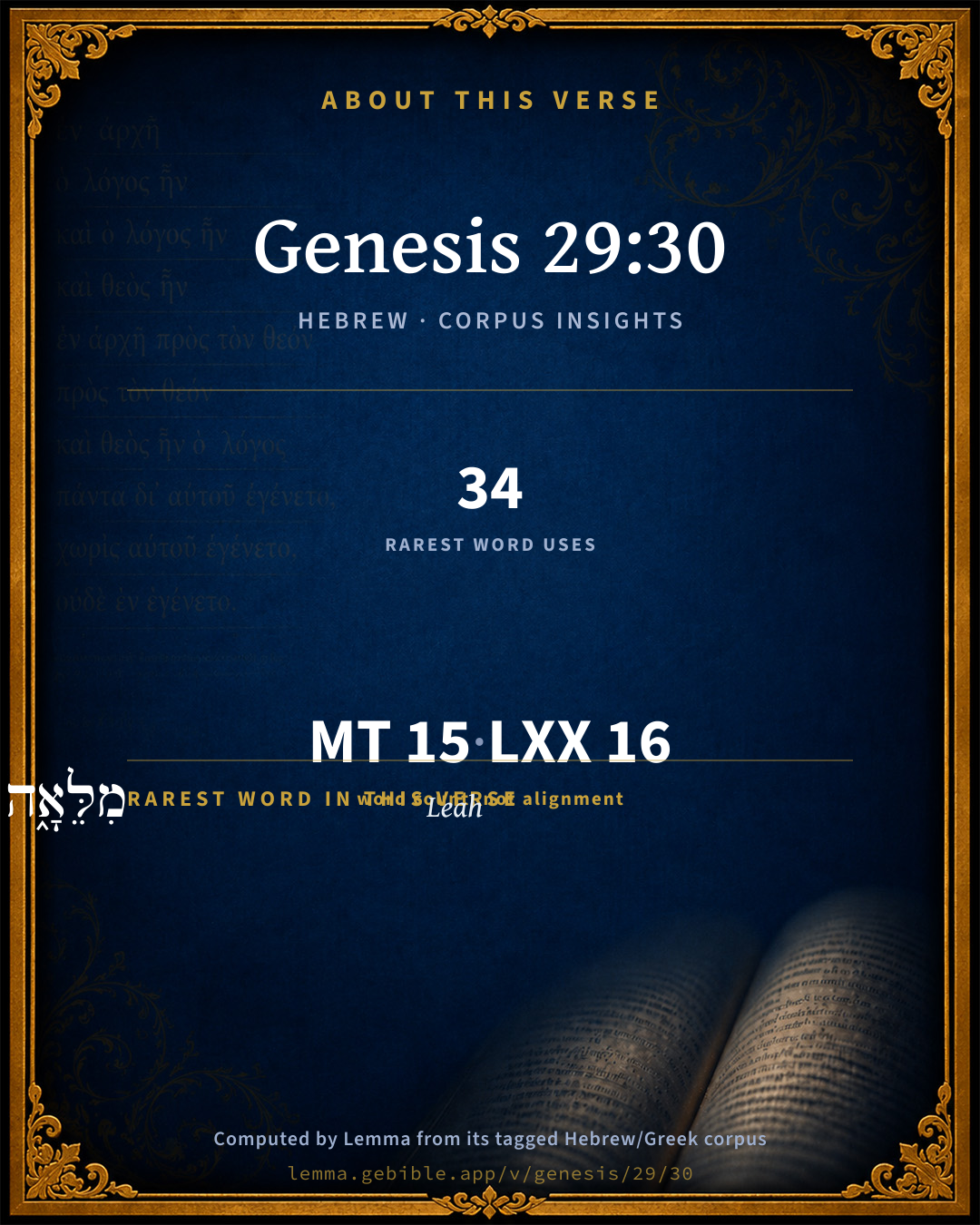
מִלֵּאָ֑ה Leah H3812 occurs in 32 verses of the Hebrew Bible. Also found in:

Grammatical profile

  • 3 verbs
  • 4 nouns
  • 2 adjectives
  • 2 prepositions
  • 1 adverb
  • 3 particles

Verb forms

  • וַיָּבֹא֙ Qal · Sequential Imperfect
  • וַיֶּאֱהַ֥ב Qal · Sequential Imperfect
  • וַיַּעֲבֹ֣ד Qal · Sequential Imperfect

Repetition

Words recur within this verse — often emphatic in Hebrew:

  • גַּ֣ם also H1571 ×2
  • רָחֵ֔ל Rachel H7354 ×2

Hebrew & Septuagint length

In English translation the verse runs 22 words from the Hebrew and 20 from the Septuagint (LXX English) — closely comparable.

A rough comparison of the two English renderings, which tokenize alike — not a word-level alignment.

Word counts can differ between the Hebrew and the Greek without any difference in meaning — e.g. the Hebrew direct-object marker אֵת has no separate Greek word, and Greek often adds the article ὁ.

In the original languages it is 15 Hebrew tokens and 16 Greek tokens — but the two are counted differently (Hebrew bundles its prefixes and suffixes into one token; the Greek is in lemma form), so that isn’t a like-for-like length.

Cross-references

15

Topical passages linked to Genesis 29:30 in the Treasury of Scripture Knowledge — connected by theme and wording, ordered by reader-vote popularity; previews shown in the World English Bible.

  • Genesis 31:41 These twenty years have I been in your house. I served you fourteen years for your two daughters, and six years for your flock, and you have changed my wages ten times.
  • Genesis 29:18 Jacob loved Rachel. He said, "I will serve you seven years for Rachel, your younger daughter."
  • Genesis 29:20 Jacob served seven years for Rachel. They seemed to him but a few days, for the love he had for her.
  • Genesis 31:15 Aren't we accounted by him as foreigners? For he has sold us, and has also quite devoured our money.
  • Genesis 44:27 Your servant, my father, said to us, 'You know that my wife bore me two sons:
  • Matthew 10:37 He who loves father or mother more than me is not worthy of me; and he who loves son or daughter more than me isn't worthy of me.
  • Genesis 29:31 Yahweh saw that Leah was hated, and he opened her womb, but Rachel was barren.
  • Genesis 30:25–26 It happened, when Rachel had borne Joseph, that Jacob said to Laban, "Send me away, that I may go to my own place, and to my country.
  • Genesis 44:20 We said to my lord, 'We have a father, an old man, and a child of his old age, a little one; and his brother is dead, and he alone is left of his mother; and his father loves him.'
  • Deuteronomy 21:15 If a man have two wives, the one beloved, and the other hated, and they have borne him children, both the beloved and the hated; and if the firstborn son be hers who was hated;
  • 1 Samuel 18:17–27 Saul said to David, Behold, my elder daughter Merab, her will I give you as wife: only be valiant for me, and fight Yahweh's battles. For Saul said, Don't let my hand be on him, but let the hand of the Philistines be on him.
  • Hosea 12:12 Jacob fled into the country of Aram, And Israel served to get a wife, And for a wife he tended flocks and herds.
  • John 12:25 He who loves his life will lose it. He who hates his life in this world will keep it to eternal life.
  • Matthew 6:24 "No one can serve two masters, for either he will hate the one and love the other; or else he will be devoted to one and despise the other. You can't serve both God and Mammon.
  • Luke 14:26 "If anyone comes to me, and doesn't hate his own father, mother, wife, children, brothers, and sisters, yes, and his own life also, he can't be my disciple.

Cross-references courtesy of OpenBible.info (CC BY 4.0).

Hebrew and Greek witnesses Masoretic Hebrew ↔ Greek Septuagint

The same verse in the two great witnesses to the Old Testament, shown verse-for-verse.

These are two independent witnesses, not word-aligned to each other, and the Septuagint is shown in lemma (dictionary) form.

Hebrew Genesis 29:30 Masoretic · Westminster Leningrad Codex

וַיָּבֹא֙ גַּ֣ם אֶל רָחֵ֔ל וַיֶּאֱהַ֥ב גַּֽם אֶת רָחֵ֖ל מִלֵּאָ֑ה וַיַּעֲבֹ֣ד עִמּ֔וֹ ע֖וֹד שֶֽׁבַע שָׁנִ֥ים אֲחֵרֽוֹת

He went in also to Rachel, and he loved also Rachel more than Leah, and served with him yet seven other years.

World English Bible · Public Domain

Greek LXX Genesis 29:30 Septuagint · lemma form

καί εἰςἔρχομαι πρός ραχηλ ἀγαπάω δέ ραχηλ μᾶλλον ἤ λεια καί δουλεύω αὐτός ἑπτά ἔτος ἕτερος

And he went in to Rachel; and he loved Rachel more than Lea; and he served him seven other years.

LXX2012 (modern English Septuagint) · Public Domain

Hebrew: Westminster Leningrad Codex (CC BY 4.0). Greek: Septuagint (public domain); English from LXX2012 (modern English Septuagint) (Public Domain). How the Septuagint differs from the Hebrew →

Targum (Aramaic paraphrase)

2

The Targum is the ancient Jewish Aramaic paraphrase of the Hebrew Scriptures — an interpretive translation, not the Hebrew text itself. Onkelos (literal) and Pseudo-Jonathan (expansive) render the Torah, and Jonathan the Prophets. Coverage is partial: where no permissively-licensed English translation exists for a verse, only the Aramaic is shown. This is verse-level text, not a word-by-word alignment to the Hebrew.

  1. Targum Onkelos Torah (Genesis–Deuteronomy)
    וְעַל אַף לְּוַת רָחֵל וּרְחֵים אַף יָת רָחֵל מִלֵּאָה וּפְלַח עִמֵּהּ עוֹד שְׁבַע שְׁנִין אָחֳרָנִין

    (no public-domain English translation for this verse)

    Targum Onkelos — Aramaic: “Onkelos Genesis” (public domain); “Onkelos Exodus” (public domain); “Onkelos Leviticus” (public domain); “Onkelos Numbers” (public domain); “Onkelos Deuteronomy” (public domain). English: “Sefaria Community Translation” (CC0 1.0 (public-domain dedication)); “J.W. Etheridge. The Targums of Onkelos and Jonathan Ben Uzziel on the Pentateuch. London: Longmans, Green, 1862” (public domain). Text via Sefaria.

  2. Targum Pseudo-Jonathan Torah (Genesis–Deuteronomy)
    וְעַל אוּף לְוַת רָחֵל וְרָחֵים אוּף יַת רָחֵל מִלֵאָה וּפְלַח עִמֵיהּ בְּגִינָהּ תּוּב שֵׁב שְׁנִין אוֹחֲרָנִין

    And he went in also unto Rahel; and he loved Rahel also more than Leah. And he served with him for her yet seven other years.

    Targum Pseudo-Jonathan — Aramaic: “Targum Jonathan on Genesis” (public domain); “Targum Jonathan on Exodus” (public domain); “Targum Jonathan on Leviticus” (public domain); “Targum Jonathan on Numbers” (public domain); “Targum Jonathan on Deuteronomy” (public domain). English: “The Targum of Jonathan ben Uzziel, trans. J. W. Etheridge, London, 1862” (public domain). Text via Sefaria.

Commentary

Notes on Genesis 29:30 from classic Christian and Jewish commentators (each source and its license shown beneath its notes). The classic Christian expositions comment on the surrounding passage and are grouped to its opening verse, so a note may address several verses; the Jewish commentaries on the Tanakh (Rashi and others) are per-verse, so they appear only where the commentator wrote on this verse.

Lemma curates 59 commentaries, every one of them public domain or Creative Commons licensed, each selected and text-cleaned for this edition rather than reprinted as found. About our sources →

Trapp's Complete Commentary

John Trapp

Gen 29:30 And he went in also unto Rachel, and he loved also Rachel more than Leah, and served with him yet seven other years.

Ver. 30. And he went in also unto Rachel.] Which incestuous fact cannot ordinarily be justified, nor may at all be imitated. Wicked Julia, soliciting Caracalla to incestuous marriage with her, when he answered, Vellem si liceret , replied impudently (and is therefore, by very heathens, condemned extremely), Si libet, licet: an nescis te Imperatorem esse, leges dare non accipere ?& c. Herod, for marrying his brother’s wife, was reproved, and punished.

John Trapp, A Commentary or Exposition upon All the Books of the Old and New Testament (1647–1656) — public domain. Text from a community e-Sword module.

Tyndale Open Study Notes

Tyndale Open Resources

29:30 Jacob loved Rachel much more than Leah: Favoritism was an ongoing cause of dysfunction in Jacob’s family (cp. 25:28; 37:3). Jacob’s favoritism had lasting effects: his family was never together, and their descendants, the tribes of Israel, were rarely unified.

Tyndale Open Study Notes — © Tyndale Open Resources, licensed CC BY-SA 4.0. Text via the HelloAO Bible API.

John Calvin's Commentaries

30. And he loved also Rachel more than Leah. No doubt Moses intended to exhibit the sins of Jacob, that we might learn to fear, and to conform all our actions to the sole rule of God’s word. For if the holy patriarch fell so grievously, who among us is secure from a similar fall, unless kept by the guardian care of God? At the same time, it appears how dangerous it is to imitate the fathers while we neglect the law of the Lord. And yet the foolish Papists so greatly delight themselves in this imitation, that they do not scruple to observe, as a law, whatever they find to have been practiced by the fathers. Besides which, they own as fathers those who are worthy of such sons, so that any raving monk is of more account with them than all the patriarchs. It was not without fault on Leah’s part that she was despised by her husband; and the Lord justly chastised her, because she, being aware of her father’s fraud, dishonorably obtained possession of her sister’s husband; but her fault forms no excuse for Jacob’s lust.

John Calvin's Commentaries (1540-1563) — public domain. Text from the Calvin Translation Society English edition (1840s-50s) via the Christian Classics Ethereal Library (ccel.org). Calvin's coverage is partial (roughly two-thirds of the Bible); uncommented books and verses are honest gaps, never fabricated. The 19th-century editor's footnotes and remarks are omitted so the notes are faithfully Calvin's own voice.

John Gill's Exposition

And when the Lord saw that Leah was hated,.... Not properly and simply hated by Jacob, as appears by his doing the duty of an husband to her, but comparatively; she was less loved than Rachel: and there are many things to be said for it; she was not beautiful as Rachel was; she was not Jacob's choice, as she was but imposed upon him through deceit, and he was forced to marry her, or he could not have Rachel his beloved wife: but the Lord had pity on her, and that she might have a share in her husband's affections:

he opened her womb; or gave her conception; as Onkelos paraphrases it:

but Rachel was barren; bare no children as yet, and for many years after, Gen 30:22.

John Gill's Exposition of the Whole Bible (1746–1763) — public domain (CC PDM 1.0). Text via the HelloAO Bible API.

Haydock's Catholic Bible Commentary

Latter. Jacob is the figure of Jesus Christ; who rejected the synagogue, and treated his Church, gathered from all nations, with the utmost affection. (Calmet) --- Lia means "painful or labourious;" and Rachel a sheep; denoting, that a quiet contemplative life must be united with an active one; and that the Church must suffer here, and be crowned in heaven. (Haydock) (St. Gregory, Mor. vi. 28.)

George Leo Haydock (1774–1849), Haydock's Catholic Family Bible and Commentary, 1859 edition — public domain. Excludes Psalms (Douay-Rheims chapter numbering differs from Protestant) and Deuterocanonical books (Catholic canon only).

The Pulpit Commentary

And he went in also unto Rachel, and he loved also Rachel more than Leah (implying, however, that Leah had a place in his affections), and served with him yet seven other years. The seven years cunningly exacted for Leah was thus the second fraud practiced upon (Gen_30:26 Gen_31:41; Hos_12:12)

The Pulpit Commentary (1880–1919), ed. H.D.M. Spence-Jones & Joseph S. Exell — public domain. Text from a community e-Sword module.

Rashi

Rabbi Shlomo Yitzchaki (Rashi)

עוד שבע שנים אחרות YET SEVEN OTHER YEARS — Scripture adds the apparently redundant word אחרות another seven years, for the purpose of comparing them to the preceding seven years. — Even as he had worked faithfully during the earlier period (not anticipating any deception on Laban’s part), so he worked faithfully during the latter period, although he (Laban) had practised this deception on him (Genesis Rabbah 70:20).

Rashi on the Tanakh — English translations: “The Judaica Press complete Tanach with Rashi, translated by A. J. Rosenberg” (CC BY 4.0); “Pentateuch with Rashi's commentary by M. Rosenbaum and A.M. Silbermann, 1929-1934” (public domain); “The Metsudah Tanach series, Lakewood, N.J” (CC BY 4.0); and “The Book of Joshua, Metsudah Publications, 1997” (CC BY 4.0). Text via Sefaria.

Ramban (Nachmanides)

Rabbi Moshe ben Nachman (Ramban / Nachmanides)

AND HE LOVED RACHEL MORE THAN LEAH. The reason why Scripture mentions that he also loved Rachel more than Leah is that it is natural for a man to have more love for the woman with whom he first had relations, just as the Sages have mentioned with reference to women: “And she makes a firm commitment only to he who marries her first.” Thus Jacob’s loving Rachel more than Leah was unnatural. This is the sense of the word gam: [and he loved ‘gam’ Rachel than Leah].

Ramban (Nachmanides) on the Tanakh — English translation: “Commentary on the Torah by Ramban (Nachmanides). Translated and annotated by Charles B. Chavel. New York, Shilo Pub. House, 1971-1976” (CC BY 4.0). Text via Sefaria.

Radak

Rabbi David Kimhi (Radak)

ויתן...ויבא גם אל רחל, just as he had slept with Leah previously, he now slept with Rachel.

ויאהב גם את רחל, the Torah had to write this in order to inform us that Yaakov loved Leah also, even though originally he had not chosen her to become his wife. In the event, now that she had become his wife, he loved her just as most husbands love their wives. However, he loved Rachel better.

Radak on the Tanakh — English translations: “Sefaria Community Translation” (CC0 1.0 (public-domain dedication)); “Eliyahu Munk, HaChut Hameshulash” (CC BY 4.0); “Rabbi Mike Feuer, Jerusalem Anthology” (CC BY 4.0); and “R. David Kimhi on the first book of Psalms, Translated by R.G. Finch, London, 1919” (public domain). Text via Sefaria.

Lesson kit

Teaching starters — assembled from the data on this page, not authored interpretation. Every prompt links to the verse data it draws on. Edit before teaching.

Genesis, in the Pentateuch, opens this verse with 15 words (13 distinct Hebrew lemmas). Its most distinctive word is Lêʼâh (“Leah”). A historical commentator’s framing appears above. Read the whole chapter for the surrounding context.

Discussion questions

  1. How does “Leah” (Lêʼâh) shape what this verse is saying?
  2. Genesis 29:16 shares the word «Leah» with this verse. How do the two illuminate each other?
  3. “also” occurs 2× in this one verse. What is the effect of the repetition?
  4. These translations render this verse differently; the difference is in the English rendering, not the original. What questions does that raise?
  5. The verb «וַיָּבֹא֙» is Qal Sequential Imperfect. How does its form color the action?
  6. Reading how Trapp's Complete Commentary and Tyndale Open Study Notes read this verse, where do the two commentators agree and where do they part?

Things to notice

Reading settings

Reading text

Shown beneath each verse's original-language words.

Old Testament
Old Testament edition

Read the OT as the Masoretic Hebrew (MT) or the Greek Septuagint (LXX).

English shown for the Greek Septuagint (in the Hebrew ↔ Greek comparison).

Comparing translations? Open the Compare panel on any verse page to stack up to four side by side.