Genesis 38:8

Hebrew (Westminster Leningrad Codex) Genesis 38:8 appears in the Hebrew Old Testament. The text above is from the Westminster Leningrad Codex. Each word links to its Strong’s number, a concise gloss, and parsing drawn from the Open Scriptures Hebrew Bible morphology. Click any word for its full Brown-Driver-Briggs (BDB) entry.
Download image
Cite this verse

Genesis 38:8 (World English Bible). Public Domain. Lemma interlinear Bible study tool, https://lemma.gebible.app/v/genesis/38/8.

Show BibTeX & RIS
BibTeX
RIS
English Translation
Judah said to Onan, "Go in to your brother's wife, and perform the duty of a husband's brother to her, and raise up seed to your brother."
World English Bible · Public Domain
Highlights
  • 1 first appearance in the Hebrew Bible
Full analysis ↓
Download a study sheet

One document with this verse’s original text, its word-by-word gloss line, the meaning frame, cross-references with their text, attributed commentary, and full source and license credits — printable, and it pastes into notes with its structure intact.

This verse Autodidact and up

Study sheet (.html) Plain text (.txt)

A passage Seminary Student

Up to 50 verses in one chapter. A passage sheet keeps up to 6 commentary sources and 12 cross-references per verse, in the order this page ranks them, and says so on the sheet whenever that leaves anything out. Ask for a single verse and you get the Autodidact verse sheet above.

Everything on this page stays free to read, with no account — the sheet is a download of what is already on screen, not access to it.

Want to remove ads? Support Godless Engineer
Compare translations 3

The same verse in 3 English versions, stacked beneath the original-language interlinear above. Click any original word for its lexicon entry.

Each is an independent rendering of the whole verse — the interlinear is not word-aligned to these translations.

Highlighted words mark where these versions differ — a whole-verse word diff, not a word-by-word alignment.

  • World English Bible Public Domain
    Judah said to Onan, "Go in to your brother's wife, and perform the duty of a husband's brother to her, and raise up seed to your brother."
  • King James Version Public Domain
    And Judah said unto Onan, Go in unto thy brother's wife, and marry her, and raise up seed to thy brother.
  • unfoldingWord Literal Text CC BY-SA 4.0
    Then Judah said to Onan, “Go to the wife of your brother and perform your duty to her and produce offspring for your brother.”

unfoldingWord Literal Text — © unfoldingWord, licensed CC BY-SA 4.0. Word-aligned USFM3 via Door43 (git.door43.org/unfoldingWord/en_ult).

Versions to compare (up to 4)

3 of 4 selected

Show all 18 translations

Every available English version of this verse, each an independent rendering of the whole verse.

  • World English Bible Public Domain
    Judah said to Onan, "Go in to your brother's wife, and perform the duty of a husband's brother to her, and raise up seed to your brother."
  • Berean Standard Bible Public Domain
    Then Judah said to Onan, “Sleep with your brother’s wife. Perform your duty as her brother-in-law and raise up offspring for your brother.”
  • Majority Standard Bible Public Domain
    Then Judah said to Onan, “Sleep with your brother’s wife. Perform your duty as her brother-in-law and raise up offspring for your brother.”
  • King James Version Public Domain
    And Judah said unto Onan, Go in unto thy brother's wife, and marry her, and raise up seed to thy brother.
  • American Standard Version (1901) Public Domain
    And Judah said unto Onan, Go in unto thy brother's wife, and perform the duty of a husband's brother unto her, and raise up seed to thy brother.
  • Revised Version (1885) Public Domain
    And Judah said unto Onan, Go in unto thy brother’s wife, and perform the duty of an husband’s brother unto her, and raise up seed to thy brother.
  • Geneva Bible (1599) Public Domain
    Then Iudah said to Onan, Goe in vnto thy brothers wife, and do the office of a kinsman vnto her, and raise vp seede vnto thy brother.
  • Douay-Rheims (1899) Public Domain
    Juda, therefore add to Onan his son: Go in to thy brother's wife and marry her, that thou mayst raise seed to thy brother.
  • Young's Literal Translation Public Domain
    And Judah saith to Onan, `Go in unto the wife of thy brother, and marry her, and raise up seed to thy brother;'
  • Literal Standard Version CC BY-SA 4.0
    And Judah says to Onan, “Go in to the wife of your brother, and marry her, and raise up seed to your brother”;
  • Unlocked Literal Bible CC BY-SA 4.0
    Judah said to Onan, “Sleep with your brother's wife. Do the duty of a brother-in-law to her, and raise up a child for your brother.”
  • unfoldingWord Literal Text CC BY-SA 4.0
    Then Judah said to Onan, “Go to the wife of your brother and perform your duty to her and produce offspring for your brother.”
  • Darby Bible Public Domain
    Then Judah said to Onan, Go in to thy brother's wife, and fulfil to her the brother-in-law's duty, and raise up seed to thy brother.
  • World Messianic Bible Public Domain
    Judah said to Onan, “Go in to your brother’s wife, and perform the duty of a husband’s brother to her, and raise up offspring for your brother.”
  • Webster's Bible Public Domain
    And Judah said to Onan, Go in to thy brother's wife, and marry her, and raise up seed to thy brother.
  • Free Bible Version CC BY-SA 4.0
    Judah told Onan, “Go and sleep with your brother's wife to fulfill the requirements of a brother-in-law to have children on behalf of your brother.”
  • Bible in Basic English Public Domain
    Then Judah said to Onan, Go in to your brother's wife and do what it is right for a husband's brother to do; make her your wife and get offspring for your brother.
  • JPS Tanakh (1917) Public Domain
    And Judah said unto Onan: 'Go in unto thy brother's wife, and perform the duty of a husband's brother unto her, and raise up seed to thy brother.'

Literal Standard Version (2020), Covenant Press — licensed CC BY-SA 4.0. Text via the HelloAO Bible API (eBible.org). Unlocked Literal Bible (unfoldingWord) — licensed CC BY-SA 4.0. Text via the HelloAO Bible API (eBible.org). unfoldingWord Literal Text — © unfoldingWord, licensed CC BY-SA 4.0. Word-aligned USFM3 via Door43 (git.door43.org/unfoldingWord/en_ult). Free Bible Version, Dr. Jonathan Gallagher — licensed CC BY-SA 4.0. Text via the HelloAO Bible API (eBible.org).

Word by word

More ways to search: Search by grammar → Find every occurrence → Compare this word →

Practice this passage: Drill this verse → Learn its vocabulary →

וְיַבֵּ֣ם
yâbam
H2992
“and · perform levirate marriage”
Conjunction + Verb, Piel, Imperative, 2nd Person, Masculine, Singular
Part of Speech
Conjunction + Verb
Stem
Piel
Form
Imperative
Person
2nd Person
Gender
Masculine
Number
Singular
Full BDB Definition

Origin: a primitive root of doubtful meaning

TWOT: 836

(Piel) to perform levirate marriage, perform the duty of a brother-in-law - the duty due to a brother who died childless - to marry his widow and have a son for his name
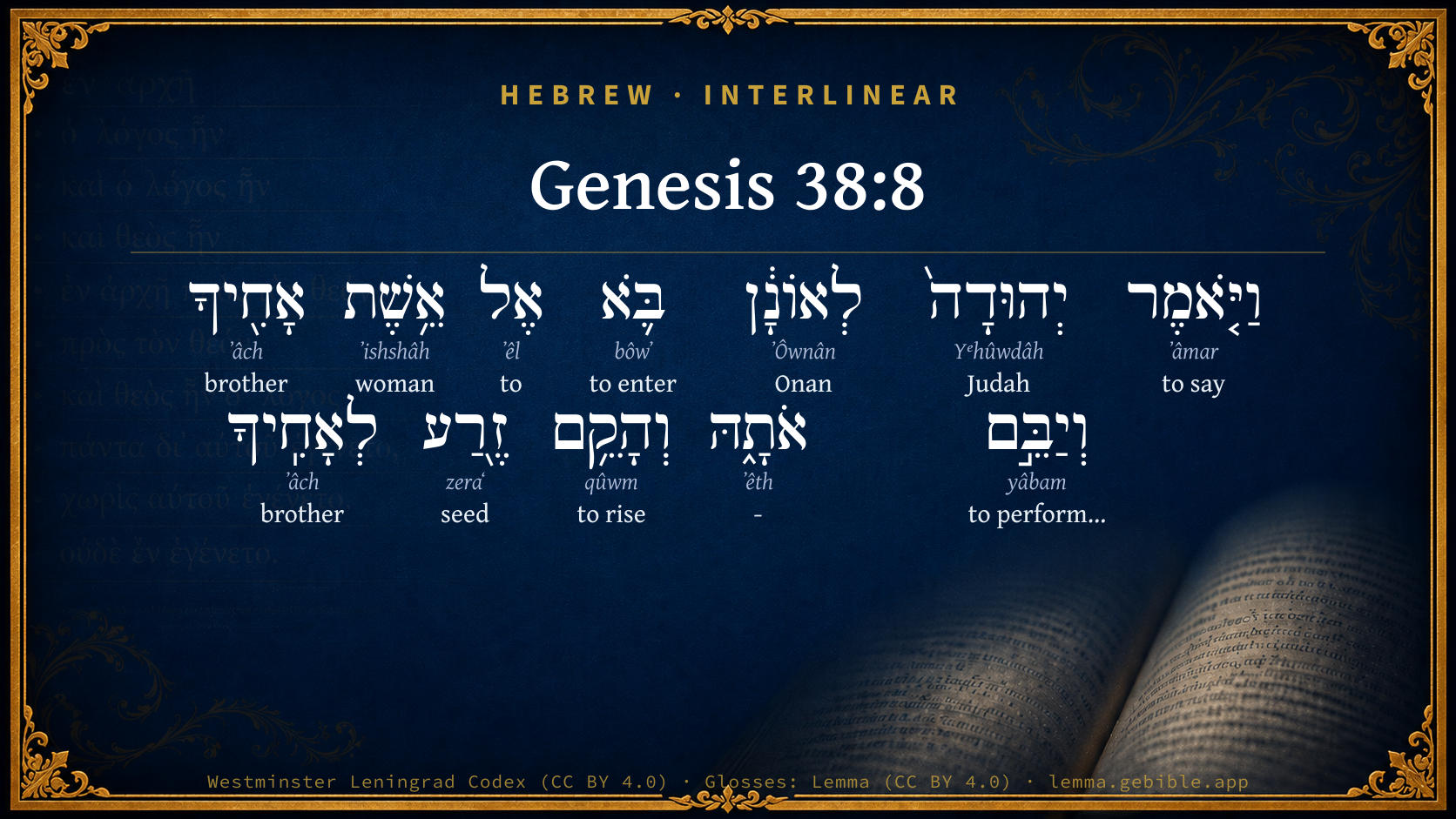
  1. וַיֹּ֤אמֶר ʼâmar H559 “and · to say” Conjunction + Verb, Qal, Sequential Imperfect, 3rd Person, Masculine, Singular
  2. יְהוּדָה֙ Yᵉhûwdâh H3063 “Judah” Noun, Proper
  3. לְאוֹנָ֔ן ʼÔwnân H209 “to/for · Onan” Preposition + Noun, Proper
  4. בֹּ֛א bôwʼ H935 “enter” Verb, Qal, Imperative, 2nd Person, Masculine, Singular
  5. אֶל ʼêl H413 “to” Preposition
  6. אֵ֥שֶׁת ʼishshâh H802 “woman of” Noun, Common, Feminine, Singular, Construct
  7. אָחִ֖יךָ ʼâch H251 “brother · your” Noun, Common, Masculine, Singular, Construct + Suffix, Personal, 2nd Person, Masculine, Singular
  8. אֹתָ֑הּ ʼêth H853 “- · her” Particle, Direct Object + Suffix, Personal, 3rd Person, Feminine, Singular
  9. וְהָקֵ֥ם qûwm H6965 “and · rise” Conjunction + Verb, Hiphil, Imperative, 2nd Person, Masculine, Singular
  10. זֶ֖רַע zeraʻ H2233 “seed” Noun, Common, Masculine, Singular, Absolute
  11. לְאָחִֽיךָ ʼâch H251 “to/for · brother · your” Preposition + Noun, Common, Masculine, Singular, Construct + Suffix, Personal, 2nd Person, Masculine, Singular

About this verse

These counts appear in no published source. They are computed here, from the morphology-tagged text and Lemma’s own curated glosses. What Lemma adds →

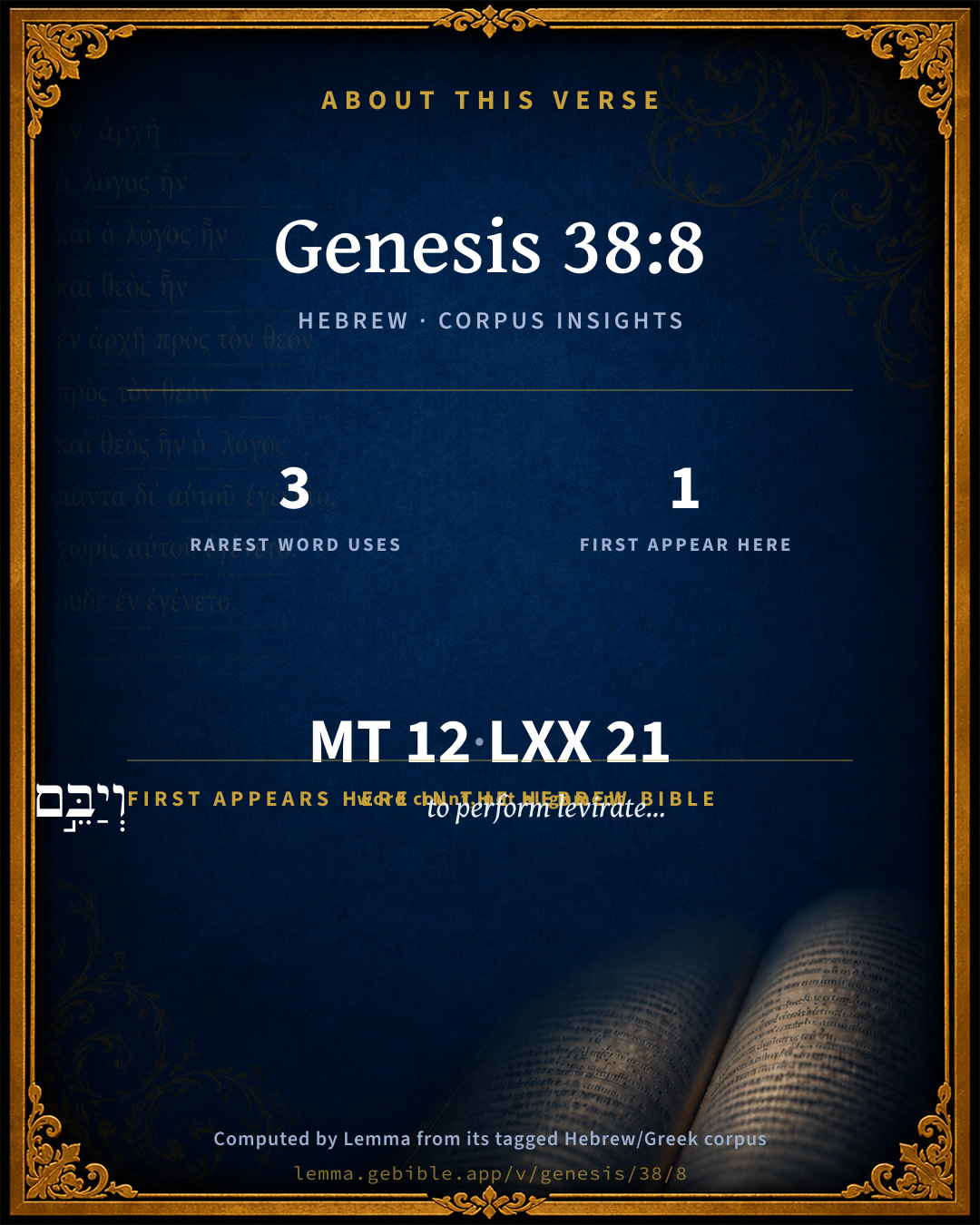
12
words
11
distinct lemmas
Pentateuch
section

Notable vocabulary

The rarest word here is וְיַבֵּ֣ם to perform levirate marriage H2992 — appearing just 3 times in the whole Hebrew Bible.

First appearance in Scripture

This word makes its first canonical appearance in the Hebrew Bible here:

  • וְיַבֵּ֣ם to perform levirate marriage H2992

Shared distinctive vocabulary

וְיַבֵּ֣ם to perform levirate marriage H2992 occurs in 3 verses of the Hebrew Bible. Also found in:

Grammatical profile

  • 4 verbs
  • 6 nouns
  • 1 preposition
  • 1 particle

Verb forms

  • וַיֹּ֤אמֶר Qal · Sequential Imperfect
  • בֹּ֛א Qal · Imperative
  • וְיַבֵּ֣ם Piel · Imperative
  • וְהָקֵ֥ם Hiphil · Imperative

Repetition

A word recurs within this verse — often emphatic in Hebrew:

  • אָחִ֖יךָ brother H251 ×2

Hebrew & Septuagint length

In English translation the verse runs 27 words from the Hebrew and 24 from the Septuagint (LXX English) — closely comparable.

A rough comparison of the two English renderings, which tokenize alike — not a word-level alignment.

Word counts can differ between the Hebrew and the Greek without any difference in meaning — e.g. the Hebrew direct-object marker אֵת has no separate Greek word, and Greek often adds the article ὁ.

In the original languages it is 12 Hebrew tokens and 21 Greek tokens — but the two are counted differently (Hebrew bundles its prefixes and suffixes into one token; the Greek is in lemma form), so that isn’t a like-for-like length.

Cross-references

6

Topical passages linked to Genesis 38:8 in the Treasury of Scripture Knowledge — connected by theme and wording, ordered by reader-vote popularity; previews shown in the World English Bible.

  • Deuteronomy 25:5–10 If brothers dwell together, and one of them die, and have no son, the wife of the dead shall not be married outside to a stranger: her husband's brother shall go in to her, and take her to him as wife, and perform the duty of a husband's brother to her.
  • Matthew 22:23–27 On that day Sadducees (those who say that there is no resurrection) came to him. They asked him,
  • Ruth 1:11 Naomi said, Turn again, my daughters: why will you go with me? have I yet sons in my womb, that they may be your husbands?
  • Ruth 4:5–11 Then said Boaz, What day you buy the field of the hand of Naomi, you must buy it also of Ruth the Moabitess, the wife of the dead, to raise up the name of the dead on his inheritance.
  • Leviticus 18:16 "'You shall not uncover the nakedness of your brother's wife: it is your brother's nakedness.
  • Numbers 36:8–9 Every daughter, who possesses an inheritance in any tribe of the children of Israel, shall be wife to one of the family of the tribe of her father, that the children of Israel may possess every man the inheritance of his fathers.

Cross-references courtesy of OpenBible.info (CC BY 4.0).

Hebrew and Greek witnesses Masoretic Hebrew ↔ Greek Septuagint

The same verse in the two great witnesses to the Old Testament, shown verse-for-verse.

These are two independent witnesses, not word-aligned to each other, and the Septuagint is shown in lemma (dictionary) form.

Hebrew Genesis 38:8 Masoretic · Westminster Leningrad Codex

וַיֹּ֤אמֶר יְהוּדָה֙ לְאוֹנָ֔ן בֹּ֛א אֶל אֵ֥שֶׁת אָחִ֖יךָ וְיַבֵּ֣ם אֹתָ֑הּ וְהָקֵ֥ם זֶ֖רַע לְאָחִֽיךָ

Judah said to Onan, "Go in to your brother's wife, and perform the duty of a husband's brother to her, and raise up seed to your brother."

World English Bible · Public Domain

Greek LXX Genesis 38:8 Septuagint · lemma form

εἶπον δέ ἰούδας ὁ αυναν εἰςἔρχομαι πρός ὁ γυνή ὁ ἀδελφός σύ καί γαμβρεύω αὐτός καί ἀναἵστημι σπέρμα ὁ ἀδελφός σύ

And Judas said to Aunan, Go in to your brother's wife, and marry her as her brother-in-law, and raise up seed to your brother.

LXX2012 (modern English Septuagint) · Public Domain

Hebrew: Westminster Leningrad Codex (CC BY 4.0). Greek: Septuagint (public domain); English from LXX2012 (modern English Septuagint) (Public Domain). How the Septuagint differs from the Hebrew →

Targum (Aramaic paraphrase)

2

The Targum is the ancient Jewish Aramaic paraphrase of the Hebrew Scriptures — an interpretive translation, not the Hebrew text itself. Onkelos (literal) and Pseudo-Jonathan (expansive) render the Torah, and Jonathan the Prophets. Coverage is partial: where no permissively-licensed English translation exists for a verse, only the Aramaic is shown. This is verse-level text, not a word-by-word alignment to the Hebrew.

  1. Targum Onkelos Torah (Genesis–Deuteronomy)
    וַאֲמַר יְהוּדָה לְאוֹנָן עוּל לְוַת אִתַּת אָחוּךְ וְיַבֵּם יָתַהּ וַאֲקֵים זַרְעָא לְאָחוּךְ

    (no public-domain English translation for this verse)

    Targum Onkelos — Aramaic: “Onkelos Genesis” (public domain); “Onkelos Exodus” (public domain); “Onkelos Leviticus” (public domain); “Onkelos Numbers” (public domain); “Onkelos Deuteronomy” (public domain). English: “Sefaria Community Translation” (CC0 1.0 (public-domain dedication)); “J.W. Etheridge. The Targums of Onkelos and Jonathan Ben Uzziel on the Pentateuch. London: Longmans, Green, 1862” (public domain). Text via Sefaria.

  2. Targum Pseudo-Jonathan Torah (Genesis–Deuteronomy)
    וַאֲמַר יְהוּדָה לְאוֹנָן עוֹל לְוַת אִתַּת אָחוּךְ וְיַיבֵּם יָתָהּ וַאֲקֵם זַרְעָא עַל שְׁמָא דְאָחוּךְ

    And Jehuda said unto Onan, Enter thou to thy brother's wife, and marry her, and raise up seed unto the name of thy brother.

    Targum Pseudo-Jonathan — Aramaic: “Targum Jonathan on Genesis” (public domain); “Targum Jonathan on Exodus” (public domain); “Targum Jonathan on Leviticus” (public domain); “Targum Jonathan on Numbers” (public domain); “Targum Jonathan on Deuteronomy” (public domain). English: “The Targum of Jonathan ben Uzziel, trans. J. W. Etheridge, London, 1862” (public domain). Text via Sefaria.

Commentary

Notes on Genesis 38:8 from classic Christian and Jewish commentators (each source and its license shown beneath its notes). The classic Christian expositions comment on the surrounding passage and are grouped to its opening verse, so a note may address several verses; the Jewish commentaries on the Tanakh (Rashi and others) are per-verse, so they appear only where the commentator wrote on this verse.

Lemma curates 59 commentaries, every one of them public domain or Creative Commons licensed, each selected and text-cleaned for this edition rather than reprinted as found. About our sources →

Trapp's Complete Commentary

John Trapp

Gen 38:8 And Judah said unto Onan, Go in unto thy brother’s wife, and marry her, and raise up seed to thy brother.

Ver. 8. And Judah said unto Onan.] At fourteen years of age likewise. For, from the birth of Judah to their going down to Egypt, were but forty-three years. And yet before that, Pharez had Hezron and Hamul, {Gen 46:12} being married about the fourteenth year of his age; which was, doubtless, too soon. Childhood is counted and called the flower of age. {1Co 7:36} And so long the apostle would have marriage forborne. While the flower of the plant sprouteth, the seed is green, unfit to be sown. Either it comes not up, or soon withereth. Too early marriages is one cause of our too short lives. Pursuit of sexual pleasure is death’s best harbinger, saith one.

John Trapp, A Commentary or Exposition upon All the Books of the Old and New Testament (1647–1656) — public domain. Text from a community e-Sword module.

The Biblical Illustrator

Joseph S. Exell

Gen_38:8-10

Onan

The sin of Onan

I.

IT WAS PROMPTED BY A LOW MOTIVE. It was as selfish as it was vile. Onans design was to preserve the whole inheritance for his own house.

II. IT WAS AN ACT OF WILFUL DISOBEDIENCE TO GODS ORDINANCE. Ill deservings of others can be no excuse for our injustice, for our uncharitableness. That which Tamar required, Moses afterward, as from God, commanded--the succession of brothers into the barren bed. Some laws God spake to His Church long ere He wrote them: while the author is certainly known, the voice and the finger of God are worthy of equal respect.

III. IT WAS A DISHONOUR DONE TO HIS OWE BODY. Unchastity in general is a homicidal waste of the generative powers, a demoniac bestiality, an outrage to ancestors, to posterity, and to ones own life. It is a crime against the image of God, and a degradation below the animal. Onans offence, moreover, as committed in marriage, was a most unnatural wickedness, a grievous wrong, and a desecration of the body as the temple of God. It was a proof of the most defective development of what may be called the consciousness of personality, and of personal dignity.

IV. IT WAS AGGRAVATED BY HIS POSITION IN THE COVENANT FAMILY. The Messiah was to descend from the stock of Judah, and for aught he knew from himself. This very Tamar is counted in the genealogy of Christ Mat_1:3). Herein he did despite to the covenant promise. He rejected an honourable destiny. (T. H. Leale.)

Lessons

Vain parents take little knowledge of Gods judgments in the death of one child when they have others.

2. Special law for the marriage of the deceased brothers wife by the brother was given of God for special ends.

3. Seed was much desirable and is so in the Church of God; for which such laws were made (Gen_38:8).

4. Wicked creatures are selfish in duty, therefore unwilling to seek any good but their own.

5. Self-pollution, destruction of the seed of man, envy to brethren, are Onans horrid crimes (Gen_38:9).

6. Onans may be in the visible Church.

7. Such uncleanness is very grievous in Gods sight.

8. Exemplary death may be expected from God by such transgressors (Gen_38:10). (G. Hughes, B. D.)

Onans sin

It must be borne in mind that the propagation of the family name formed one of the most sacred wishes of the Israelites; that excision was looked upon as the most awful indication of Divine wrath; and that polygamy itself was so long maintained, because it offers a greater guarantee of offspring. The Hebrews were not a strictly practical people; sentiment and indefinite aspirations had a large share in their religious views and social institutions: at an early period embracing and fostering the hope of a Messianic time, when all the nations of the earth would be united in love and the knowledge of God, they are eminently capable of prizing the permanent existence of their families. The agrarian character of the Mosaic constitution added power to this idea. Landed property was the foundation of the political edifice, and equality its main pillar. Each family was identified with a certain portion of the sacred soil; its extinction was, therefore, more strongly apprehended by the individual, and was injurious to the prosperity of the state, as the accumulation of wealth in the hands of individuals threatened to disturb the equality of the citizens. It is, therefore, impossible to misunderstand the spirit and tendency of the law concerning the marriage with the brothers widow; it was neither dictated by the desire of preventing the abandoned condition of the widow, or of counteracting some other fancied abuse; its purport is distinctly expressed to have been to procure a descendant to the brother (Gen_38:8); that the name of the deceased be preserved upon his inheritance, and that his name be not erased from among his brethren and from the gate of his town (Rth_4:10). It may suffice to add, in this place, that similar customs prevailed among the Indians, Persians, and some Italian tribes, and that they are still practised by the Tsherkessians and Tartars, the Gallas in Abyssinia, the Afghans, and other nations. It was in conformity with this law that Judah commanded his second son, Onan, to marry the childless widow of his elder brother. But Onan was not more virtuous than the family to which he belonged: unwilling to maintain his brothers name, he knew how to frustrate the hopes of Judah. God took away his life for that reckless wickedness. (M. M. Kalisch, Ph. D.)

The Biblical Illustrator, edited by Joseph S. Exell (c. 1880s–1900s) — public domain. Text from a community e-Sword module.

Tyndale Open Study Notes

Tyndale Open Resources

38:8 as our law requires. . . . You must produce an heir for your brother: The custom that informs this episode is the law for levirate marriage (Latin levir, “husband’s brother”). By this custom, which was later incorporated into God’s law for Israel (Deut 25:5-10), if a man died childless, his brother or nearest relative would marry his widow to produce a child who would carry on the family name of the deceased and inherit his property. Apparently, the near kinsman had a right to refuse, but he would be disgraced in the family for refusing to perpetuate his brother’s name.

Tyndale Open Study Notes — © Tyndale Open Resources, licensed CC BY-SA 4.0. Text via the HelloAO Bible API.

Geneva Bible (1599)

Geneva Bible translators

This order was for the preservation of the stock, that the child begotten by the second brother should have the name and inheritance of the first: which is in the new Testament abolished.

Geneva Bible (1599) marginal notes — public domain. Text via Bolls.life.

Jamieson, Fausset & Brown

Robert Jamieson, A. R. Fausset & David Brown

Judah said unto Onan . . . marry her, and raise up seed to thy brother--The first instance of a custom, which was afterwards incorporated among the laws of Moses, that when a husband died leaving a widow, his brother next of age was to marry her, and the issue, if any, was to be served heir to the deceased (compare Deu 25:5).

Jamieson, Fausset & Brown — Commentary Critical and Explanatory on the Whole Bible (1871) — public domain (CC PDM 1.0). Text via the HelloAO Bible API.

John Calvin's Commentaries

8. Go in unto thy brother’s wife. Although no law had hitherto been prescribed concerning brother’s marriages, that the surviving brother should raise up seed to one who was dead; it is, nevertheless, not wonderful that, by the mere instinct of nature, men should have been inclined to this course. For since each man is born for the preservation of the whole race, if any one dies without children, there seems to be here some defect of nature. It was deemed therefore an act of humanity to acquire some name for the dead, from which it might appear that they had lived. Now, the only reason why the children born to the surviving brother, should be reckoned to him who had died, was, that there might be no dry branch in the family; and in this manner they took away the reproach of barrenness. Besides, since the woman is given as a help to the man, when any woman married into a family, she was, in a certain sense, given up to the name of that family. According to this reasoning, Tamar was not altogether free, but was held under an obligation to the house of Judah, to procreate some seed. Now, though this does not proceed from any rule of piety, yet the Lord had impressed it upon the hearts of man as a duty of humanity; as he afterwards commanded it to the Jews in their polity. Hence we infer the malignity of Onan, who envied his brother this honor, and would not allow him, when dead, to obtain the title of father; and this redounds to the dishonor of the whole family. We see that many grant their own sons to their friends for adoption: it was, therefore, an outrageous act of barbarity to deny to his own brother what is given even to strangers. Moreover he has not only shortened his brother concerning the right due to him, but he rather spilled seed on the ground than to raise a son in his brother’s name.

John Calvin's Commentaries (1540-1563) — public domain. Text from the Calvin Translation Society English edition (1840s-50s) via the Christian Classics Ethereal Library (ccel.org). Calvin's coverage is partial (roughly two-thirds of the Bible); uncommented books and verses are honest gaps, never fabricated. The 19th-century editor's footnotes and remarks are omitted so the notes are faithfully Calvin's own voice.

Ellicott's Commentary for English Readers

(8) Go in unto thy brother’s wife.—We learn from this that the law of the Levirate, by which the brother of the dead husband was required to marry the widow, was of far more ancient date than the law of Moses. Its object, first of all, was to prevent the extinction of any line of descent, a matter of great importance in those genealogical days; and, secondly, it was an obstacle to the accumulation of landed property in few hands, as the son first born after the Levirate marriage inherited the property of his deceased uncle, while the second son was the representative of the real father. A similar custom existed in parts of India, Persia, &c, and prevails now among the Mongols. The Mosaic Law did not institute, but regulated the custom, confining such marriages to cases where the deceased brother had died without children, and permitting the brother to refuse to marry the widow, under a penalty, nevertheless, of disgrace. Onan, by refusing to take Tamar, may have been actuated by the selfish motive of obtaining for himself the rights of primogeniture, which would otherwise have gone to his eldest son, as the heir of his uncle ‘Er.

A Bible Commentary for English Readers, edited by Charles John Ellicott (1878–1897) — public domain. Text from a community e-Sword module.

The Cambridge Bible for Schools and Colleges

gen. ed. J. J. S. Perowne

8. perform] The first instance of the “levirate” (Lat. lêvir, “brother-in-law”) law which made it obligatory for a surviving brother to marry the widow of his brother, if the latter should die childless. See Deu_25:5; Mat_22:24. The eldest son of a levirate marriage succeeded to the deceased’s name and inheritance.

The Cambridge Bible for Schools and Colleges (gen. ed. J. J. S. Perowne; Cambridge University Press, 1878–1918) — public domain. Text from a community e-Sword module.

John Gill's Exposition

And Onan knew that the seed should not be his,.... Should not be called a son of his, but a son of his brother Er; this is to be understood only of the firstborn; all the rest of the children born afterwards were reckoned the children of the real parent of them; this shows this was a custom in use in those times, and well known, and was not a peculiar case:

and it came to pass, when he went in unto his brother's wife; to cohabit with her, as man and wife, he having married her according to his father's direction:

that he spilled it on the ground, lest he should give his seed to his brother: lest his brother's wife he had married should conceive by him, and bear a son that should be called his brother's, and inherit his estate; and this is the sin, which from him is called Onania, a sin condemned by the light of nature, as well as by the word of God, and very prejudicial to mankind, as well as displeasing to God, as follows:

John Gill's Exposition of the Whole Bible (1746–1763) — public domain (CC PDM 1.0). Text via the HelloAO Bible API.

Haydock's Catholic Bible Commentary

Wife. This was then customary among the Chanaanites, as Philo insinuates. It also continued to be practiced in Egypt, till the year of Christ 491 at least, when the marriage had not been consummated. Moses established it as a law, when no issue had sprung from the deceased brother. (Calmet) (Deuteronomy xxv. 5.) The eldest son bore his name; the rest were called after their own father. This law is now abrogated; and the prohibition, which has been issued by the Church, can be dispensed with only by herself, (Worthington) as was the case in the marriage of Henry VIII, with Catherine, the virgin relict of his brother Arthur. (Haydock)

George Leo Haydock (1774–1849), Haydock's Catholic Family Bible and Commentary, 1859 edition — public domain. Excludes Psalms (Douay-Rheims chapter numbering differs from Protestant) and Deuterocanonical books (Catholic canon only).

Matthew Poole's English Annotations

This, as also divers other things, was now instituted and observed amongst God’s people, and afterwards was expressed in a written law, Deu 25:5,6. See also Num 36:6,7; Rth 1:11; Mat 22:24.

Raise up seed to thy brother; beget a child which may have thy brother’s name and inheritance, and may be reputed as his child. So it was with the first child, but the rest were reputed his own.

Matthew Poole's English Annotations on the Holy Bible (1683–1685) — public domain. Text from a community e-Sword/MySword module.

Whedon's Commentary on the Bible

Daniel D. Whedon

8. Seed to thy brother — Here is the first mention of levirate marriage. See our notes on Ruth, at the beginning of chapter 3. “The custom,” says Keil, “is found in different forms among Indians, Persians, and other nations of Asia and Africa, and was not founded upon a divine command, but upon an ancient tradition, originating probably in Chaldea. It was not abolished, however, by the Mosaic law, (Deu_25:5,) but only so far restricted as not to allow it to interfere with the sanctity of marriage; and with this limitation it was enjoined as a duty of affection to build up the brother’s house, and to preserve his family and name.”

Daniel D. Whedon (gen. ed.), Commentary on the Old and New Testaments (1874–1909) — public domain. Text from a community e-Sword module.

The Pulpit Commentary

And Judah said unto Onan (obviously after a sufficient interval), Go in unto thy brother"s wife, and marry her, literally, and perform the part of levir, or husbands brother, to her. The language seems to imply that what was afterwards in the code Mosaic known as the Lex Leviratus (Deu_25:5, Deu_25:6) was at this time a recognized custom. The existence of the practice has been traced in different frames among Indians, Persians, and other nations of Asia and Africaand raise up seed to thy brother. As afterwards explained in the Hebrew legislation, the first. born son of such a Levirate marriage became in the eye of the law the child of the deceased husband, and was regarded as his heir.

The Pulpit Commentary (1880–1919), ed. H.D.M. Spence-Jones & Joseph S. Exell — public domain. Text from a community e-Sword module.

unfoldingWord translationNotes

Door43 World Missions Community

Onan

This is the name of one of Judah's sons. See how you translated this name in Genesis 38:4. (See: How to Translate Names)

Do the duty of a brother-in-law to her

This refers to a custom that when the oldest brother dies before he and his wife have a son, the next oldest brother would marry and have sexual relations with the widow. When the widow gave birth to the first son, that son was considered the son of the oldest brother and he would receive the oldest brother's inheritance.

was evil in the sight of Yahweh

The phrase "in the sight" refers to Yahweh seeing Onan's wickedness. AT: "was evil and Yahweh saw it" (See: Idiom)

Yahweh killed him also

Yahweh killed him because what he did was evil. This can be made clear. AT: "So Yahweh killed him also" (See: Assumed Knowledge and Implicit Information)

translationWords

had relations with

seed

evil

Yahweh

unfoldingWord translationNotes — © Distant Shores Media and the Door43 World Missions Community, licensed CC BY-SA 4.0. Source: git.door43.org/Door43/en_tn.

Rashi

Rabbi Shlomo Yitzchaki (Rashi)

והקם זרע AND RAISE SEED — The son will be called by the name of him who is dead.

Rashi on the Tanakh — English translations: “The Judaica Press complete Tanach with Rashi, translated by A. J. Rosenberg” (CC BY 4.0); “Pentateuch with Rashi's commentary by M. Rosenbaum and A.M. Silbermann, 1929-1934” (public domain); “The Metsudah Tanach series, Lakewood, N.J” (CC BY 4.0); and “The Book of Joshua, Metsudah Publications, 1997” (CC BY 4.0). Text via Sefaria.

Ramban (Nachmanides)

Rabbi Moshe ben Nachman (Ramban / Nachmanides)

AND MARRY HER AS BROTHER-IN-LAW, AND RAISE SEED TO THY BROTHER. The son will be called by the name of the deceased. This is Rashi’s language.But this is not true, for in the same commandment of the Torah it likewise says, And it shall be, that the firstborn that she beareth shall succeed in the name of his brother that is dead, that his name be not blotted out of Israel, and yet the brother-in-law is not commanded to call his son by the name of his dead brother. In the case of Boaz it says, Moreover Ruth the Moabitess, the wife of Machlon, have I acquired to be my wife, to raise up the name of the dead upon his inheritance, that the name of the dead be not cut off from among his brethren, and from the gate of his place, and yet she called him Obed, Verse 21. not Machlon. Moreover, it says here, And Onan knew that the seed would not be his. Now what misfortune would have befallen him — to the point that he wasted his seed from before her — if his son was to be called by the name of his dead brother? Most people even desire to do so. Again, Scripture does not say, “And Onan said,” but instead it says, And Onan ‘knew’ that the seed would not be his. This would indicate that Onan had some definite kind of knowledge in this matter which made him certain that the seed would not be his. The subject is indeed one of the great secrets of the Torah, concerning human reproduction, and it is evident to those observers who have eyes to see, and ears to hear. The ancient wise men who were prior to the Torah knew of the great benefit in marrying a childless dead brother’s wife, and that it was proper for the brother to take precedence in the matter, and upon his failure to do so, his next of kin would come after him, for any kinsman who was related to him, who would inherit his legacy, would derive a benefit from such a marriage. And it was customary for the dead man’s wife to be wed by the brother or father or the next of kin in the family. We do not know whether this was an ancient custom preceding Judah’s era. In Bereshith Rabbah they say that Judah was the one who inaugurated the commandment of marrying a childless person’s widow, for since he had received the secret from his ancestors he was quick to fulfill it. Now when the Torah came and prohibited marrying former wives of certain relatives, it was the will of the Holy One, blessed be He, to abrogate the prohibition against marrying a brother’s wife in case he dies childless, but it was not His will that the prohibition against marrying a father’s brother’s wife or a son’s wife or similar wives of relatives be set aside. It was only in the case of a brother that the custom had established itself, and the benefit is likely with him and not with the others, as I have mentioned. Now it was considered a matter of great cruelty when a brother did not want to marry his dead brother’s wife, and they would call it the house of him that had his shoe loosed, for [after his dead brother’s wife had performed Chalitzah (the loosening of the shoe) of the brother-in-law], he was now removed from them, and it is fitting that this commandment be fulfilled through the loosening of the shoe. Now the ancient wise men of Israel, having knowledge of this important matter, established it as a custom to be practised among all those inheriting the legacy, providing there is no prohibition against the marriage, and they called it Ge’ulah (Redemption). This was the matter concerning Boaz, and the meaning of the words of Naomi and the women neighbors. (Ruth 4:17), meaning that she was thereby given back the son Machlon whom she had lost. This explains why the women did not say, “There is a son born to Ruth or Boaz.” The man of insight will understand.

Ramban (Nachmanides) on the Tanakh — English translation: “Commentary on the Torah by Ramban (Nachmanides). Translated and annotated by Charles B. Chavel. New York, Shilo Pub. House, 1971-1976” (CC BY 4.0). Text via Sefaria.

Radak

Rabbi David Kimhi (Radak)

ויבם אותה, it appears that the practice of the levirate marriage, yibbum, was something accepted long before the Torah was given to the Jewish people.

Radak on the Tanakh — English translations: “Sefaria Community Translation” (CC0 1.0 (public-domain dedication)); “Eliyahu Munk, HaChut Hameshulash” (CC BY 4.0); “Rabbi Mike Feuer, Jerusalem Anthology” (CC BY 4.0); and “R. David Kimhi on the first book of Psalms, Translated by R.G. Finch, London, 1919” (public domain). Text via Sefaria.

Lesson kit

Teaching starters — assembled from the data on this page, not authored interpretation. Every prompt links to the verse data it draws on. Edit before teaching.

Genesis, in the Pentateuch, opens this verse with 12 words (11 distinct Hebrew lemmas). Its most distinctive word is yâbam (“to perform levirate marriage”). A historical commentator’s framing appears above. Read the whole chapter for the surrounding context.

Discussion questions

  1. The word yâbam carries the sense “to perform levirate marriage.” How does it shape the verse?
  2. This is the first place “to perform levirate marriage” appears in Scripture (first appears here). What does its debut here establish?
  3. How does Deuteronomy 25:5, which shares the word «to perform levirate marriage», read alongside this verse?
  4. What does the repetition of “brother” (2× in this one verse) do in this verse?
  5. These translations render this verse differently; the difference is in the English rendering, not the original. What questions does that raise?
  6. «וַיֹּ֤אמֶר» is a Qal Sequential Imperfect verb. How does that grammatical form shape the action described?
  7. Compare how Trapp's Complete Commentary and The Biblical Illustrator read this verse. Where do they agree or differ?

Things to notice

Reading settings

Reading text

Shown beneath each verse's original-language words.

Old Testament
Old Testament edition

Read the OT as the Masoretic Hebrew (MT) or the Greek Septuagint (LXX).

English shown for the Greek Septuagint (in the Hebrew ↔ Greek comparison).

Comparing translations? Open the Compare panel on any verse page to stack up to four side by side.