Genesis 42:29

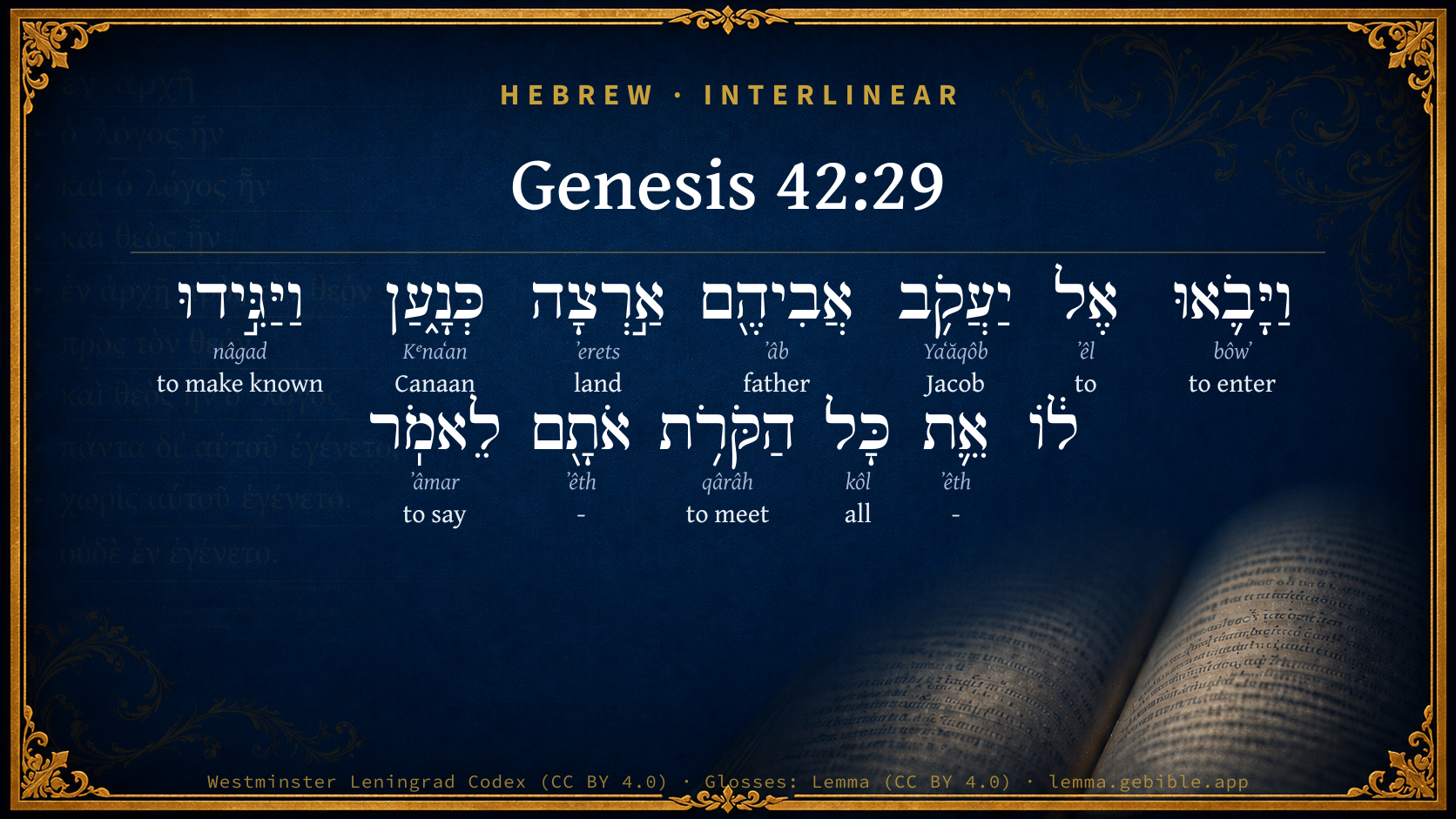
Hebrew (Westminster Leningrad Codex) Genesis 42:29 appears in the Hebrew Old Testament. The text above is from the Westminster Leningrad Codex. Each word links to its Strong’s number, a concise gloss, and parsing drawn from the Open Scriptures Hebrew Bible morphology. Click any word for its full Brown-Driver-Briggs (BDB) entry.
Download image
Cite this verse

Genesis 42:29 (World English Bible). Public Domain. Lemma interlinear Bible study tool, https://lemma.gebible.app/v/genesis/42/29.

Show BibTeX & RIS
BibTeX
RIS
English Translation
They came to Jacob their father to the land of Canaan, and told him all that had happened to them, saying,
World English Bible · Public Domain
Download a study sheet

One document with this verse’s original text, its word-by-word gloss line, the meaning frame, cross-references with their text, attributed commentary, and full source and license credits — printable, and it pastes into notes with its structure intact.

This verse Autodidact and up

Study sheet (.html) Plain text (.txt)

A passage Seminary Student

Up to 50 verses in one chapter. A passage sheet keeps up to 6 commentary sources and 12 cross-references per verse, in the order this page ranks them, and says so on the sheet whenever that leaves anything out. Ask for a single verse and you get the Autodidact verse sheet above.

Everything on this page stays free to read, with no account — the sheet is a download of what is already on screen, not access to it.

Want to remove ads? Support Godless Engineer
Compare translations 3

The same verse in 3 English versions, stacked beneath the original-language interlinear above. Click any original word for its lexicon entry.

Each is an independent rendering of the whole verse — the interlinear is not word-aligned to these translations.

Highlighted words mark where these versions differ — a whole-verse word diff, not a word-by-word alignment.

  • World English Bible Public Domain
    They came to Jacob their father to the land of Canaan, and told him all that had happened to them, saying,
  • King James Version Public Domain
    And they came unto Jacob their father unto the land of Canaan, and told him all that befell unto them; saying,
  • unfoldingWord Literal Text CC BY-SA 4.0
    Then they came to Jacob their father in the land of Canaan, and they reported to him all that had happened to them, saying,

unfoldingWord Literal Text — © unfoldingWord, licensed CC BY-SA 4.0. Word-aligned USFM3 via Door43 (git.door43.org/unfoldingWord/en_ult).

Versions to compare (up to 4)

3 of 4 selected

Show all 18 translations

Every available English version of this verse, each an independent rendering of the whole verse.

  • World English Bible Public Domain
    They came to Jacob their father to the land of Canaan, and told him all that had happened to them, saying,
  • Berean Standard Bible Public Domain
    When they reached their father Jacob in the land of Canaan, they described to him all that had happened to them:
  • Majority Standard Bible Public Domain
    When they reached their father Jacob in the land of Canaan, they described to him all that had happened to them:
  • King James Version Public Domain
    And they came unto Jacob their father unto the land of Canaan, and told him all that befell unto them; saying,
  • American Standard Version (1901) Public Domain
    And they came unto Jacob their father unto the land of Canaan, and told him all that had befallen them, saying,
  • Revised Version (1885) Public Domain
    And they came unto Jacob their father unto the land of Canaan, and told him all that had befallen them; saying,
  • Geneva Bible (1599) Public Domain
    And they came vnto Iaakob their father vnto the lande of Canaan, and tolde him all that had befallen them, saying,
  • Douay-Rheims (1899) Public Domain
    And they came to Jacob their father in the land of Chanaan, and they told him all things that had befallen them, saying:
  • Young's Literal Translation Public Domain
    And they come in unto Jacob their father, to the land of Canaan, and they declare to him all the things meeting them, saying,
  • Literal Standard Version CC BY-SA 4.0
    And they come to their father Jacob, to the land of Canaan, and they declare to him all the things meeting them, saying,
  • Unlocked Literal Bible CC BY-SA 4.0
    They went to Jacob, their father in the land of Canaan and told him all that had happened to them. They said,
  • unfoldingWord Literal Text CC BY-SA 4.0
    Then they came to Jacob their father in the land of Canaan, and they reported to him all that had happened to them, saying,
  • Darby Bible Public Domain
    And they came into the land of Canaan, to Jacob their father, and told him all that had befallen them, saying,
  • World Messianic Bible Public Domain
    They came to Jacob their father, to the land of Canaan, and told him all that had happened to them, saying,
  • Webster's Bible Public Domain
    And they came to Jacob their father to the land of Canaan, and told him all that befell them, saying,
  • Free Bible Version CC BY-SA 4.0
    When they arrived home in Canaan, they told their father Jacob everything that had happened.
  • Bible in Basic English Public Domain
    So when they came to Jacob their father, in the land of Canaan, they gave him an account of all their experiences, saying,
  • JPS Tanakh (1917) Public Domain
    And they came unto Jacob their father unto the land of Canaan, and told him all that had befallen them, saying:

Literal Standard Version (2020), Covenant Press — licensed CC BY-SA 4.0. Text via the HelloAO Bible API (eBible.org). Unlocked Literal Bible (unfoldingWord) — licensed CC BY-SA 4.0. Text via the HelloAO Bible API (eBible.org). unfoldingWord Literal Text — © unfoldingWord, licensed CC BY-SA 4.0. Word-aligned USFM3 via Door43 (git.door43.org/unfoldingWord/en_ult). Free Bible Version, Dr. Jonathan Gallagher — licensed CC BY-SA 4.0. Text via the HelloAO Bible API (eBible.org).

Word by word

More ways to search: Search by grammar → Find every occurrence → Compare this word →

Practice this passage: Drill this verse → Learn its vocabulary →

הַקֹּרֹ֥ת
qârâh
H7136
“the · meeting”
Particle, Definite Article + Verb, Qal, Participle Active, Feminine, Plural, Absolute
Part of Speech
Particle + Verb
Stem
Qal
Form
Participle Active
Gender
Feminine
Number
Plural
State
Absolute
Full BDB Definition

Origin: a primitive root

TWOT: 2068 , 2068e

to encounter, meet, befall, happen, come to meet - (Qal) - to encounter, meet - to befall - (Niphal) - to encounter, meet (without pre-arrangement) - to chance to be present - to come to meet - (Hiphil) to cause to meet, appoint - to build with beams - (Piel) to lay the beams of, furnish with beams
  1. וַיָּבֹ֛אוּ bôwʼ H935 “and · to enter” Conjunction + Verb, Qal, Sequential Imperfect, 3rd Person, Masculine, Plural
  2. אֶל ʼêl H413 “to” Preposition
  3. יַעֲקֹ֥ב Yaʻăqôb H3290 “Jacob” Noun, Proper
  4. אֲבִיהֶ֖ם ʼâb H1 “father · their” Noun, Common, Masculine, Singular, Construct + Suffix, Personal, 3rd Person, Masculine, Plural
  5. אַ֣רְצָה ʼerets H776 “land · toward” Noun, Common, Both, Singular, Construct + Suffix, Demonstrative
  6. כְּנָ֑עַן Kᵉnaʻan H3667 “Canaan” Noun, Proper
  7. וַיַּגִּ֣ידוּ nâgad H5046 “and · to make known” Conjunction + Verb, Hiphil, Sequential Imperfect, 3rd Person, Masculine, Plural
  8. אֵ֛ת ʼêth H853 “-” Particle, Direct Object
  9. כָּל kôl H3605 “all of” Noun, Common, Masculine, Singular, Construct
  10. אֹתָ֖ם ʼêth H853 “- · them” Particle, Direct Object + Suffix, Personal, 3rd Person, Masculine, Plural
  11. לֵאמֹֽר ʼâmar H559 “to say” Preposition + Verb, Qal, Infinitive Construct

About this verse

These counts appear in no published source. They are computed here, from the morphology-tagged text and Lemma’s own curated glosses. What Lemma adds →

13
words
11
distinct lemmas
Pentateuch
section

Shared distinctive vocabulary

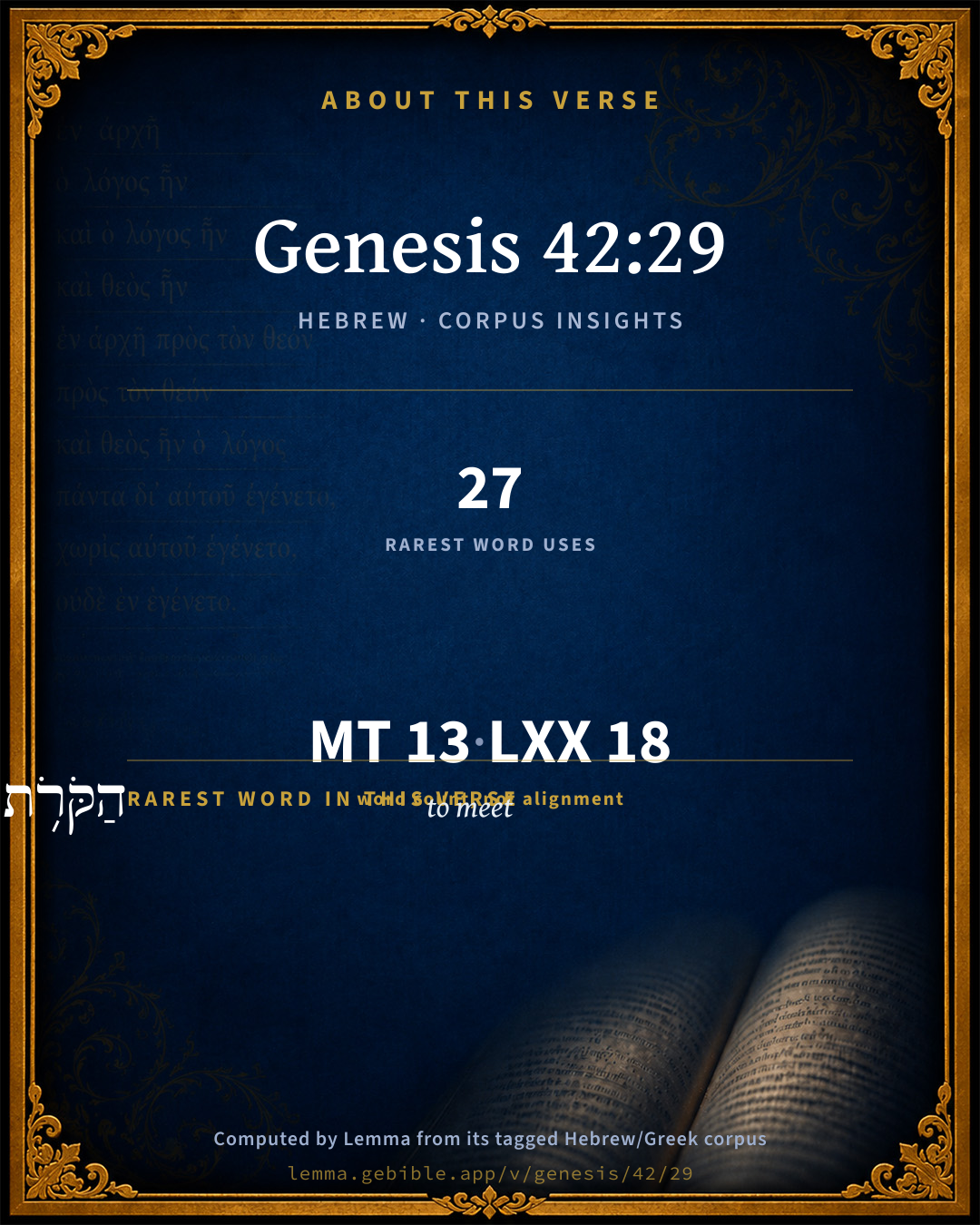
הַקֹּרֹ֥ת to meet H7136 occurs in 27 verses of the Hebrew Bible. Also found in:

Grammatical profile

  • 4 verbs
  • 5 nouns
  • 2 prepositions
  • 2 particles

Verb forms

  • וַיָּבֹ֛אוּ Qal · Sequential Imperfect
  • וַיַּגִּ֣ידוּ Hiphil · Sequential Imperfect
  • הַקֹּרֹ֥ת Qal · Participle Active
  • לֵאמֹֽר Qal · Infinitive Construct

Hebrew & Septuagint length

In English translation the verse runs 21 words from the Hebrew and 23 from the Septuagint (LXX English) — closely comparable.

A rough comparison of the two English renderings, which tokenize alike — not a word-level alignment.

Word counts can differ between the Hebrew and the Greek without any difference in meaning — e.g. the Hebrew direct-object marker אֵת has no separate Greek word, and Greek often adds the article ὁ.

In the original languages it is 13 Hebrew tokens and 18 Greek tokens — but the two are counted differently (Hebrew bundles its prefixes and suffixes into one token; the Greek is in lemma form), so that isn’t a like-for-like length.

Hebrew and Greek witnesses Masoretic Hebrew ↔ Greek Septuagint

The same verse in the two great witnesses to the Old Testament, shown verse-for-verse.

These are two independent witnesses, not word-aligned to each other, and the Septuagint is shown in lemma (dictionary) form.

Hebrew Genesis 42:29 Masoretic · Westminster Leningrad Codex

וַיָּבֹ֛אוּ אֶל יַעֲקֹ֥ב אֲבִיהֶ֖ם אַ֣רְצָה כְּנָ֑עַן וַיַּגִּ֣ידוּ ל֔וֹ אֵ֛ת כָּל הַקֹּרֹ֥ת אֹתָ֖ם לֵאמֹֽר

They came to Jacob their father to the land of Canaan, and told him all that had happened to them, saying,

World English Bible · Public Domain

Greek LXX Genesis 42:29 Septuagint · lemma form

ἔρχομαι δέ πρός ἰακώβ ὁ πατήρ αὐτός εἰς γῆ χανααν καί ἀποἀγγέλλω αὐτός πᾶς ὁ συνβαίνω αὐτός λέγω

And they came to their father, Jacob, into the land of Chanaan, and reported to him all that had happened to them, saying,

LXX2012 (modern English Septuagint) · Public Domain

Hebrew: Westminster Leningrad Codex (CC BY 4.0). Greek: Septuagint (public domain); English from LXX2012 (modern English Septuagint) (Public Domain). How the Septuagint differs from the Hebrew →

Targum (Aramaic paraphrase)

2

The Targum is the ancient Jewish Aramaic paraphrase of the Hebrew Scriptures — an interpretive translation, not the Hebrew text itself. Onkelos (literal) and Pseudo-Jonathan (expansive) render the Torah, and Jonathan the Prophets. Coverage is partial: where no permissively-licensed English translation exists for a verse, only the Aramaic is shown. This is verse-level text, not a word-by-word alignment to the Hebrew.

  1. Targum Onkelos Torah (Genesis–Deuteronomy)
    וַאֲתוֹ לְוַת יַעֲקֹב אֲבוּהוֹן אַרְעָא דִּכְנָעַן וְחַוִּיוּ לֵהּ יָת כָּל דְעַרְעָא יָתְהוֹן לְמֵימָר

    (no public-domain English translation for this verse)

    Targum Onkelos — Aramaic: “Onkelos Genesis” (public domain); “Onkelos Exodus” (public domain); “Onkelos Leviticus” (public domain); “Onkelos Numbers” (public domain); “Onkelos Deuteronomy” (public domain). English: “Sefaria Community Translation” (CC0 1.0 (public-domain dedication)); “J.W. Etheridge. The Targums of Onkelos and Jonathan Ben Uzziel on the Pentateuch. London: Longmans, Green, 1862” (public domain). Text via Sefaria.

  2. Targum Pseudo-Jonathan Torah (Genesis–Deuteronomy)
    וְאָתוּ לְוַת יַעֲקב אֲבוּהוֹן לְאַרְעָא דִכְנָעַן וְתַנִיאוּ לֵיהּ יַת כָּל דְאָרַע יַתְהוֹם לְמֵימָר

    And they came to Jakob their father in the land of Kenaan, and related to him all that had befallen them, saying,

    Targum Pseudo-Jonathan — Aramaic: “Targum Jonathan on Genesis” (public domain); “Targum Jonathan on Exodus” (public domain); “Targum Jonathan on Leviticus” (public domain); “Targum Jonathan on Numbers” (public domain); “Targum Jonathan on Deuteronomy” (public domain). English: “The Targum of Jonathan ben Uzziel, trans. J. W. Etheridge, London, 1862” (public domain). Text via Sefaria.

Commentary

Notes on Genesis 42:29 from classic Christian and Jewish commentators (each source and its license shown beneath its notes). The classic Christian expositions comment on the surrounding passage and are grouped to its opening verse, so a note may address several verses; the Jewish commentaries on the Tanakh (Rashi and others) are per-verse, so they appear only where the commentator wrote on this verse.

Lemma curates 59 commentaries, every one of them public domain or Creative Commons licensed, each selected and text-cleaned for this edition rather than reprinted as found. About our sources →

Trapp's Complete Commentary

John Trapp

Gen 42:29 And they came unto Jacob their father unto the land of Canaan, and told him all that befell unto them; saying,

Ver. 29. And they came to Jacob.] Who had looked many a long look for them, no doubt, and was now glad to see their faces and full sacks. But this joy lasted but a little while; for no sooner had he heard them speak, but he was thunderstruck, as it were: so little stability is there in any worldly felicity. The saints have all here their back burdens of afflictions; yet some have more than others; as Jacob, who was seldom without: God not only gave him a draught of them, but made him a diet drink. Look how your refiners of sugar, taking sugar out of the same chest, some thereof they melt but once; other, again and again: not that it hath more dross in it, but because they would have it more refined: so is it here.

John Trapp, A Commentary or Exposition upon All the Books of the Old and New Testament (1647–1656) — public domain. Text from a community e-Sword module.

The Biblical Illustrator

Joseph S. Exell

Gen_42:29-35

They came unto Jacob

Lessons

1.

Providence carrieth guilty souls in, through, and out of temporal dangers at His will.

2. Gracious fathers are gratified sometimes from God by safe return of sinful children.

3. Reason will instruct men to declare all events of Providence furthering, or hindering in the way (Gen_42:29).

4. In relation of providential events truth must be declared; yet no need of telling all.

5. In relating providences, evil men are willing to hide sins which caused them.

6. It concerns suspected, and accused persons to declare what is required for their purgation. Upon this these sons of Jacob make this narration of themselves and others (Gen_42:30-34). (G. Hughes, B. D.)

Lessons

1. Providence ordereth to creatures strange things at home, as well as abroad.

2. God ordereth good in events to men, which they are apt to think bad.

3. Mistakes of Providence may make men fear where no cause is (Gen_42:35). (G. Hughes, B. D.)

Money causing fear

Gold and silver are bright metals. They dazzle the eye of the greater part of mankind. Achan saw a gold wedge, and, in defiance of an awful curse, took it to his tent. Yet when Jacob and his sons saw heaps of money in the mouths of their sacks, they were terrified as if they had seen a serpent. For what reason were they afraid at a sight so generally desired? They thought that this money was a snare laid for their lives. And have not many rich men still greater reason to tremble when they look at their gold and silver? All money unjustly got, or unrighteously or unmercifully kept, is a snare to the possessor, and will rise up to witness against him in the day of accounts. Such riches are corrupted and cankered, and the rust of them shall be a witness against the owners, and eat their flesh as it were fire. But Jacob and his sons had no good reason to be afraid when they saw the money. It came not from an artful knave, but from a kind son and brother, who was tenderly solicitous about his father and brethren, that they should not come to poverty. Our fears often proceed from our ignorance and mistake. We are afraid of those evils that will never come, and stand in no fear of those that will come. Happy are they who can commit all their affairs to Him who knows everything that shall befall us. Jacobs sons were afraid at the inn, when they were told of money in one of their sacks. But the fears which they had endeavoured to forget were awakened anew at the opening of all their sacks. Every little circumstance heightens the distress of minds already dejected; and therefore, in dangerous circumstances, it is necessary to our peace and happiness to have our minds fortified with the consolations of God. The wicked fleeth when no man pursueth, but the righteous is bold as a lion. (G. Lawson, D. D.)

The Biblical Illustrator, edited by Joseph S. Exell (c. 1880s–1900s) — public domain. Text from a community e-Sword module.

The Preacher's Complete Homiletical Commentary

Joseph S. Exell (gen. ed.)

MAIN HOMILETICS OF THE PARAGRAPH.—Gen_42:29-38

THE INCREASING TROUBLES OF JACOB’S OLD AGE

I. The causes which led to them.

1. The strange perplexity into which his sons had been brought. They related to their father the rough treatment they had received in Egypt, and how one of their brethren was detained in pledge until they should return with their youngest brother. When one of them opened his sack’s mouth, on the journey, he was alarmed to find his money tied up with it; but when they all emptied their sacks in their father’s presence, how great must have been their consternation when they saw that “every man’s bundle of money was in his sack.” (Gen_42:35.) Jacob understood their trouble, and like them he feared the worst. He has the corn, indeed, but with it sorrow upon sorrow.

2. The opening again of an old wound. He is reminded again of Joseph, and all the old trouble comes back to him. (Gen_42:32.) The wound which time had but imperfectly healed bleeds afresh.

3. The loss of all earthly hope. To poor Jacob all was now well nigh gone. Every earthly hope was lost now, save one, and that also was in danger of being taken away. (Gen_42:36.) Looking over his past life, he felt that all had failed. “All these things are against me,” he said. Let there come but one more calamity (and he had too much reason to fear it) then would the cup of his sorrow be full, “then shall ye bring down my grey hairs with sorrow to the grave.” (Gen_42:38.)

II. The weaknesses in Jacob’s character which they reveal.

1. Querulousness and despondency. The former was natural to an old man who had seen so much sorrow. But there was also a prevailing sadness about Jacob’s character which led him to look on the dark side of events. He was inclined to magnify his sorrows until they spread a gloom over his whole life and shut out the light of hope.

2. Want of strong faith in God. Jacob was really reflecting upon Providence when he said, “All these things are against me.” No man who had strong faith to see the “end of the Lord,” which is gracious and loving even through a frowning Providence, could utter such words. And yet Jacob casts these dark reflections upon God’s dealings, though God had once said to him, “I will surely do thee good.” Thus he who once wrestled with God and man, and prevailed, now shows the weakness of his faith. It was not for want of light, and frequent supports, and encouragement that Jacob betrayed this weakness of faith. It is to be traced to the native selfishness of his character. His very religion had, all the way through, a strong trace of selfishness. The idea of bargain entered largely into it. He seemed one who studied his own ease, comfort, and prosperity; getting all he could for himself, and giving as little as possible. He who lives upon this principle will, in the end, find such religion as he has to fail him. Unless he has faith and hope in God above, despite all appearances, he will find every earthly foundation to give way under him until nothing is left. He must go deep down to find his rock in God. Nothing else can stand, for faith can never be secure and constant unless it lays hold upon Him above who is “ever faithful, ever sure.” God’s ways to Jacob were indeed mysterious; he was a much tried man, but yet he ought to have triumphed over all his difficulties. Job was tried with greater sorrows, and yet he had the strength to say of his God who was afflicting him, “Though He slay me, yet will I trust in Him.” (Job_13:15.) We have heard of the patience of Job, and we know how trouble served only to purify his soul and to give him a clear and sure knowledge of Divine things. (Job_42:5-6). Jacob relied too much upon human agents, and upon the course of events. He lacked the faith of that father of believers who could give up his Isaac. He failed to see that if God had promised to be with him, no evil could finally prevail over him. He thinks of the grave only as a refuge from the sorrows of the world. The thought which he utters is painful, but it is only the passionate expression of feelings which had long been pent up within him. He now declares the melancholy suspicion which he had carried in the depths of his own heart for many a year. As time went on, the prospects and fortunes of his family seemed to grow only darker, and now the end had come. There is nothing left for him but to go down to the grave with sorrow, his life uncompleted, his hopes unrealised. He speaks not as one who looks forward to the rest of the grave when his soul is satisfied with life and the blessing of the Lord, whose faith has overcome the world, and who has the blessed prospect of joining the company of those who have triumphed and have entered into their rest. This is a dark moment with Jacob, but he will yet recover his faith, and triumph in the Lord.

SUGGESTIVE COMMENTS ON THE VERSES

Gen_42:29-34. Their narrative must have given their father a very bad idea of the lord of the land. They said nothing of him but the truth. And yet Jacob must have formed an opinion far remote from the truth. Joseph must have appeared to him as an insolent, overbearing tyrant, that made use of his power to crush poor men under his feet. “Surely,” might the patriarch have said, “the fear of God is not before the eyes of this man, who shows so little regard to the comfort, the liberty, the lives of his fellow-men. Yet Joseph’s conduct towards his brethren was full of wisdom and mercy. He dealt hardly with them that he might do them good. So far is the appearance from always corresponding with the reality of things. “Judge nothing before the time.”—(Bush,)

Gen_42:35-36. The mysterious circumstance of the money being found by the way in their sacks, they appear to have concealed. Mention is made of only one of the sacks being opened; yet by what they afterwards said to the steward (Gen_43:21), it appears that they opened them all, and found every man’s money in his sack’s mouth. But they might think their father would have blamed them for not returning with it when they were only a day’s journey from Egypt, and therefore agreed to say nothing to him about it, but leave him to find it out. Hence it is that they are represented as discovering the money in a manner as if they knew nothing of it before; not only participating with their father in his apprehensions, but seeming also to join with him in his surprise.—(Fuller.)

Old Jacob, that was not used to simple and absolute contentments, receives the blessing of seasonable provision, together with the affliction of that heavy message, the loss of one son and the danger of another; and he knows not whether it be better for him to die with hunger or with grief, for the departure of that son of his right-hand. He drives off all till the last. Protraction is a kind of ease in evils that must come.—(Bp. Hall.)

Jacob’s declarations betray a feeling that the brothers were not guiltless respecting Joseph’s disappearance. He knew their jealousy, and he had experienced the violent disposition of Simeon and Levi.—(Lange.)

All these things are against me. How did Jacob know this? Because his feelings, his affections, and the general sense of mankind, told him it was a great misery to lose a son, especially the best and most beloved of sons. But, in fact, the very reverse was the case, as Jacob afterwards found, Joseph was sent before him into Egypt to provide sustenance for his family; Simeon was bound in prison to mortify his haughty spirit; Benjamin was to be taken away that he might find Joseph alive and happy. A great portion of our present trouble arises from our not knowing the whole truth.—(Bush.)

Gen_42:37. Reuben is once more the tender-hearted one. He offers everything that he may prevail with his father. “But it is out of reason what he offers” (Luther).—(Lange.)

The motive may be good when the speech is rash. It is well to beware of strong assertions which are far beyond our meaning, and besides have in them a tincture of levity and impiety.

A simple and sinful offer. Reuben was the eldest, but not the wisest. However, of him we may learn, in our parent’s fear, to be hardy and hearty; in our brethren’s distress to be eager and earnest.—(Trapp.)

Gen_42:38. He puts them in mind of his grey hairs, which always constitute a claim for reverence, but more especially from children. It was natural that he should make the strongest possible appeal to the filial sentiments of his children, to spare him the crushing sorrow which he saw likely to overwhelm him; yet in saying he should die of grief he went beyond the bounds of a reasonable apprehension. But in this Jacob utters the language of human infirmity, and all that are human will be slow to condemn in him what they would probably evince in themselves.—(Bush.)

Painful as it is, this last, bitterest stroke of parting with Benjamin must be endured for the happy issue. “The darkest hour is just before the day.” In the mount of Jehovah shall be seen as it was with Abraham. God brings His chosen people through sorrow to joy, and through labour to rest.—(Jacobus.)

The Preacher's Complete Homiletical Commentary (gen. ed. Joseph S. Exell; Funk & Wagnalls, c. 1892) — public domain (pre-1929). A full-Bible homiletical/sermon-outline anthology covering 65 of 66 books (2 John is absent from the source module). Text from a community e-Sword module.

Tyndale Open Study Notes

Tyndale Open Resources

42:29-34 The brothers’ account focused on the accusation that they were spies and on the need to take Benjamin back to Egypt with them. They omitted their growing realization of divine retribution for their crime against Joseph.

Tyndale Open Study Notes — © Tyndale Open Resources, licensed CC BY-SA 4.0. Text via the HelloAO Bible API.

Matthew Henry's Commentary

Here is, 1. The report which Jacob's sons made to their father of the great distress they had been in in Egypt; how they had been suspected, and threatened, and obliged to leave Simeon a prisoner there, till they should bring Benjamin with them thither. Who would have thought of this when they left home? When we go abroad we should consider how many sad accidents, that we little think of, may befall us before we return home. We know not what a day may bring forth; we ought therefore to be always ready for the worst. 2. The deep impression this made upon the good man. The very bundles of money which Joseph returned, in kindness to his father, frightened him (Gen 42:35); for he concluded it was done with some mischievous design, or perhaps suspected his own sons to have committed some offence, and so to have run themselves into a praemunire - a penalty, which is intimated in what he says (Gen 42:36): Me have you bereaved. He seems to lay the fault upon them; knowing their characters, he feared they had provoked the Egyptians, and perhaps forcibly, or fraudulently, brought home their money. Jacob is here much out of temper. (1.) He has very melancholy apprehensions concerning the present state of his family: Joseph is not, and Simeon is not; whereas Joseph was in honour and Simeon in the way to it. Note, We often perplex ourselves with our own mistakes, even in matters of fact. True griefs may arise from false intelligence and suppositions, Sa2 13:31. Jacob gives up Joseph for gone, and Simeon and Benjamin as being in danger; and he concludes, All these things are against me. It proved otherwise, that all these were for him, were working together for his good and the good of his family: yet here he thinks them all against him. Note, Through our ignorance and mistake, and the weakness of our faith, we often apprehend that to be against us which is really for us. We are afflicted in body, estate, name, and relations; and we think all these things are against us, whereas these are really working for us the weight of glory. (2.) He is at present resolved that Benjamin shall not go down. Reuben will undertake to bring him back in safety (Gen 42:37), not so much as putting in, If the Lord will, nor expecting the common disasters of travellers; but he foolishly bids Jacob slay his two sons (which, it is likely, he was very proud of) if he brought him not back; as if the death of two grandsons could satisfy Jacob for the death of a son. No, Jacob's present thoughts are, My son shall not go down with you. He plainly intimates a distrust of them, remembering that he never saw Joseph since he had been with them; therefore, "Benjamin shall not go with you, by the way in which you go, for you will bring down my gray hairs with sorrow to the grave." Note, It is bad with a family when children conduct themselves so ill that their parents know not how to trust them.

Matthew Henry's Commentary on the Whole Bible (1708–1710) — public domain (CC PDM 1.0). Text via the HelloAO Bible API.

John Calvin's Commentaries

29. And they came unto Jacob their father. Here is a long repetition of the former history, but it is not superfluous; because Moses wished to show how anxiously they made their excuse to their father for having left Simon in chains, and how strenuously they pleaded with him, that, for the sake of obtaining Simeon’s liberty, he should allow them to take their brother Benjamin: for this was greatly to the purpose. We know what a sharp dart is hunger: and yet, though the only method of relieving their want was to fetch corn out of Egypt, Jacob would rather that he and his family should perish, than allow Benjamin to accompany the rest. What can he mean by thus peremptorily refusing what his sons were compelled by necessity to ask, except to show that he was suspicious of them? This also more clearly appears from his own words, when he imputes his bereavement to them. For, though their declaration, that Joseph had been torn by a wild beast, had some color of probability, there still remained in the heart of the holy patriarch a secret wound, arising from suspicion; because he was fully aware of their fierce and cruel hatred of the innocent youth. Moreover, it is useful for us to know this; for it appears hence how miserable was the condition of the holy man, whose mind, during thirteen successive years, had been tortured with dire anxiety. Besides, his very silence added greatly to his torment, because he was compelled to conceal the grief he felt. But the chief burden of the evil was the temptation which oppressed him, that the promise of God might prove illusory and vain. For he had no hope except from the promised seed; but he seemed to be bringing up devils at home, from whom a blessing was no more to be expected than life from death. He thought Joseph to be dead, Benjamin alone remained to him uncorrupted: how could the salvation of the world proceed from such a vicious offspring? He must, therefore, have been endowed with great constancy, seeing he did not cease to rely upon God; and being certainly persuaded that he cherished in his house the Church, of which scarcely any appearance was left, he bore with his sons till they should repent. Let the faithful now apply this example to themselves, lest their minds should give way at the horrible devastation which is almost everywhere perceived.

John Calvin's Commentaries (1540-1563) — public domain. Text from the Calvin Translation Society English edition (1840s-50s) via the Christian Classics Ethereal Library (ccel.org). Calvin's coverage is partial (roughly two-thirds of the Bible); uncommented books and verses are honest gaps, never fabricated. The 19th-century editor's footnotes and remarks are omitted so the notes are faithfully Calvin's own voice.

John Gill's Exposition

And the man, the lord of the country, said unto us, hereby shall I know that you are true men,.... This will be a proof and demonstration of it:

leave one of your brethren here with me; as an hostage; they do not say "bound in the prison", Gen 42:19, as Joseph did, because they would not grieve their father, at least would not tell him of it at once, lest it should too much affect him:

and take food for the famine of your household, and be gone; that is, corn for the relief of their families, being distressed with a famine.

John Gill's Exposition of the Whole Bible (1746–1763) — public domain (CC PDM 1.0). Text via the HelloAO Bible API.

The Pulpit Commentary

Vers. 29-34. And they came unto Jacob their father unto the land of Canaan, and told him all that befell unto them (literally, all the things happening to them, the participle being construed with the accusative); saying, The man, who is the lord of the land, spake roughly to us (literally, spake the man, lord of the country, with us harsh things, the order and arrangement of the words indicating the strong feeling which their treatment in Egypt had excited), and took us for spies of the country. And we said unto him, We are true men; we are no spies: we be twelve brethren, sons of our father; one is not, and the youngest is this day with our father in the land of Canaan (vide vers. 11, 13). And the man, the lord of the country, said unto us, Hereby shall I know that ye are true men; leave one of Our brethren here with me, and take food r the famine of your households, and be gone. It is observable that they do not mention Joseph"s first proposal, probably because of Joseph"s subsequent kindness; neither do they intimate the fact that Simeon was bound, perhaps through a desire to soften the blow as much as possible for their venerable parent. And bring your youngest brother unto me: then shall I know that ye are no spies, but that ye are true men: so will I deliver you your brother, and ye shall traffic in the land (cf. Gen_34:10)

The Pulpit Commentary (1880–1919), ed. H.D.M. Spence-Jones & Joseph S. Exell — public domain. Text from a community e-Sword module.

Keil & Delitzsch

C. F. Keil & F. Delitzsch

On their arrival at home, they told their father all that had occurred.

Keil & Delitzsch — Biblical Commentary on the Old Testament (1861–1891) — public domain (CC PDM 1.0). Text via the HelloAO Bible API. (Old Testament only.)

unfoldingWord translationNotes

Door43 World Missions Community

lord of the land

"the lord of Egypt"

spoke roughly

"spoke harshly"

we were spies

Spies are people who secretly try to get information about a country to help another country. See how you translated "spies" in Genesis 42:9.

We said to him, 'We are honest men. We are not spies. We are twelve brothers, sons of our father. One is no longer alive ... land of Canaan.'

This has a quotation within a quotation. It can be stated as an indirect quotation. AT: "We told him that we are honest men and not spies. We said that we are twelve brothers, sons of our father, and that one brother is no longer alive ... land of Canaan" (See: Quotes Within Quotes and Direct and Indirect Quotations)

One is no longer alive

The word "brother" is understood. AT: "One brother is no longer alive" (See: Ellipsis)

the youngest is this day with our father

The word "brother" is understood. AT: "the youngest brother is with our father right now" (See: Ellipsis)

translationWords

Jacob

Canaan

lord

unfoldingWord translationNotes — © Distant Shores Media and the Door43 World Missions Community, licensed CC BY-SA 4.0. Source: git.door43.org/Door43/en_tn.

Radak

Rabbi David Kimhi (Radak)

ויבאו, the words they told their father are quite clear, although there are minor variations, additions, omissions; changes; the basic subject was reported faithfully

Radak on the Tanakh — English translations: “Sefaria Community Translation” (CC0 1.0 (public-domain dedication)); “Eliyahu Munk, HaChut Hameshulash” (CC BY 4.0); “Rabbi Mike Feuer, Jerusalem Anthology” (CC BY 4.0); and “R. David Kimhi on the first book of Psalms, Translated by R.G. Finch, London, 1919” (public domain). Text via Sefaria.

Lesson kit

Teaching starters — assembled from the data on this page, not authored interpretation. Every prompt links to the verse data it draws on. Edit before teaching.

Genesis, in the Pentateuch, opens this verse with 13 words (11 distinct Hebrew lemmas). Its most distinctive word is qârâh (“to meet”). A historical commentator’s framing appears above. Read the whole chapter for the surrounding context.

Discussion questions

  1. What does “to meet” (qârâh) contribute to the verse as a whole?
  2. How does Genesis 24:12, which shares the word «to meet», read alongside this verse?
  3. These translations render this verse differently. What is at stake in choosing one wording over another?
  4. «וַיָּבֹ֛אוּ» is a Qal Sequential Imperfect verb. How does that grammatical form shape the action described?
  5. Compare how Trapp's Complete Commentary and The Biblical Illustrator read this verse. Where do they agree or differ?

Things to notice

Reading settings

Reading text

Shown beneath each verse's original-language words.

Old Testament
Old Testament edition

Read the OT as the Masoretic Hebrew (MT) or the Greek Septuagint (LXX).

English shown for the Greek Septuagint (in the Hebrew ↔ Greek comparison).

Comparing translations? Open the Compare panel on any verse page to stack up to four side by side.