
Job 14:3

Hebrew (Westminster Leningrad Codex) Job 14:3 appears in the Hebrew Old Testament. The text above is from the Westminster Leningrad Codex. Each word links to its Strong’s number, a concise gloss, and parsing drawn from the Open Scriptures Hebrew Bible morphology. Click any word for its full Brown-Driver-Briggs (BDB) entry.
Download image
Cite this verse

Job 14:3 (World English Bible). Public Domain. Lemma interlinear Bible study tool, https://lemma.gebible.app/v/job/14/3.

Show BibTeX & RIS
BibTeX
RIS
English Translation
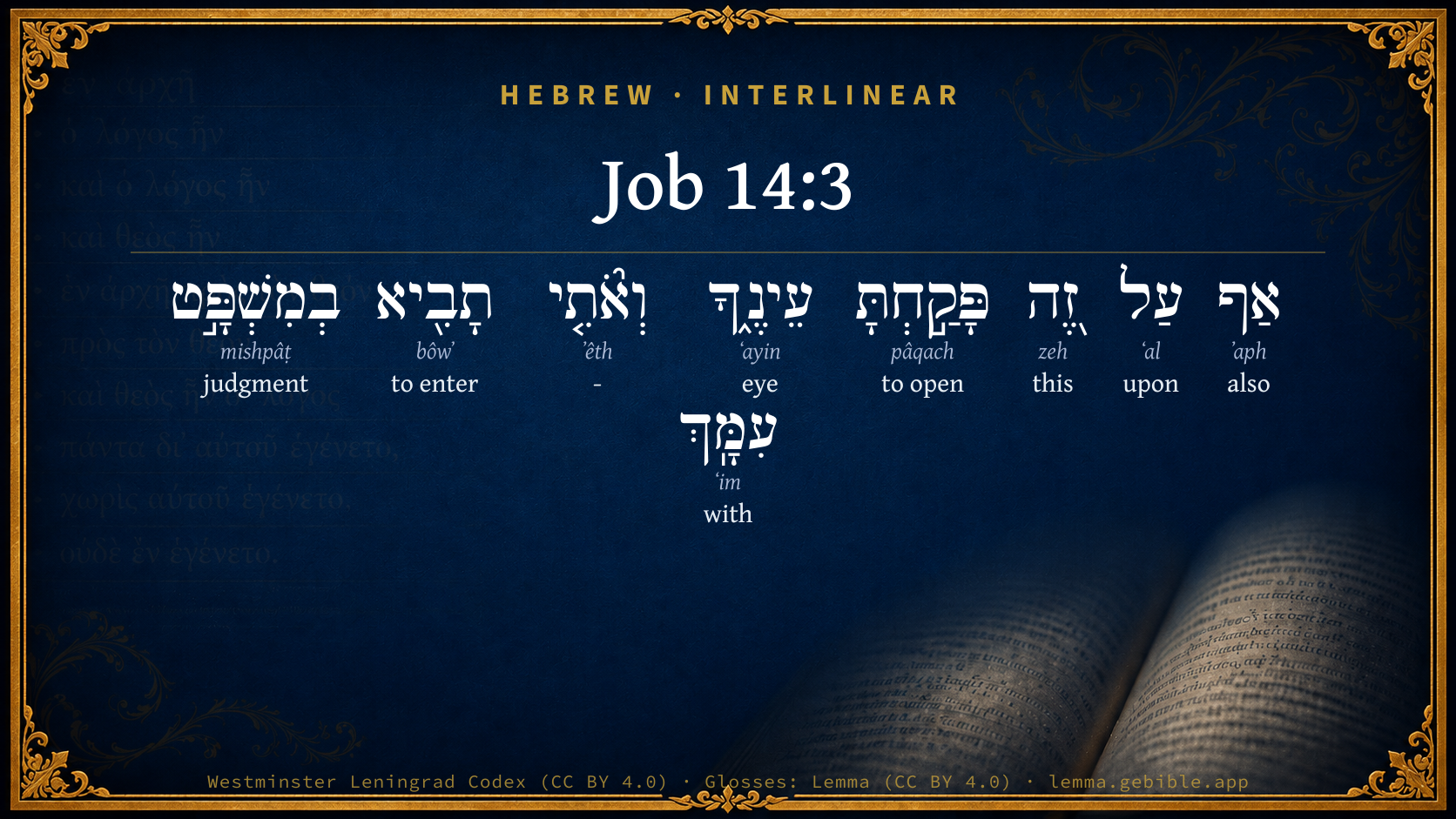
Do you open your eyes on such a one, And bring me into judgment with you?
World English Bible · Public Domain
Download a study sheet

One document with this verse’s original text, its word-by-word gloss line, the meaning frame, cross-references with their text, attributed commentary, and full source and license credits — printable, and it pastes into notes with its structure intact.

This verse Autodidact and up

Study sheet (.html) Plain text (.txt)

A passage Seminary Student

Up to 50 verses in one chapter. A passage sheet keeps up to 6 commentary sources and 12 cross-references per verse, in the order this page ranks them, and says so on the sheet whenever that leaves anything out. Ask for a single verse and you get the Autodidact verse sheet above.

Everything on this page stays free to read, with no account — the sheet is a download of what is already on screen, not access to it.

Want to remove ads? Support Godless Engineer
Compare translations 3

The same verse in 3 English versions, stacked beneath the original-language interlinear above. Click any original word for its lexicon entry.

Each is an independent rendering of the whole verse — the interlinear is not word-aligned to these translations.

Highlighted words mark where these versions differ — a whole-verse word diff, not a word-by-word alignment.

  • World English Bible Public Domain
    Do you open your eyes on such a one, And bring me into judgment with you?
  • King James Version Public Domain
    And doth thou open thine eyes upon such an one, and bringest me into judgment with thee?
  • unfoldingWord Literal Text CC BY-SA 4.0
    Even on such do you open your eye, and do you bring me into judgment with you?

unfoldingWord Literal Text — © unfoldingWord, licensed CC BY-SA 4.0. Word-aligned USFM3 via Door43 (git.door43.org/unfoldingWord/en_ult).

Versions to compare (up to 4)

3 of 4 selected

Show all 18 translations

Every available English version of this verse, each an independent rendering of the whole verse.

  • World English Bible Public Domain
    Do you open your eyes on such a one, And bring me into judgment with you?
  • Berean Standard Bible Public Domain
    Do You open Your eyes to one like this? Will You bring him into judgment before You?
  • Majority Standard Bible Public Domain
    Do You open Your eyes to one like this? Will You bring him into judgment before You?
  • King James Version Public Domain
    And doth thou open thine eyes upon such an one, and bringest me into judgment with thee?
  • American Standard Version (1901) Public Domain
    And dost thou open thine eyes upon such a one, And bringest me into judgment with thee?
  • Revised Version (1885) Public Domain
    And dost thou open thine eyes upon such an one, and bringest me into judgment with thee?
  • Geneva Bible (1599) Public Domain
    And yet thou openest thine eyes vpon such one, and causest me to enter into iudgement with thee.
  • Douay-Rheims (1899) Public Domain
    And dost thou think it meet to open thy eyes upon such an one, and to bring him into judgment with thee?
  • Young's Literal Translation Public Domain
    Also -- on this Thou hast opened Thine eyes, And dost bring me into judgment with Thee.
  • Literal Standard Version CC BY-SA 4.0
    Also—on this You have opened Your eyes, and bring me into judgment with You.
  • Unlocked Literal Bible CC BY-SA 4.0
    Do you look at any of these? Do you bring me into judgment with you?
  • unfoldingWord Literal Text CC BY-SA 4.0
    Even on such do you open your eye, and do you bring me into judgment with you?
  • Darby Bible Public Domain
    Yet dost thou open thine eyes upon such a one, and bringest me into judgment with thee?
  • World Messianic Bible Public Domain
    Do you open your eyes on such a one, and bring me into judgment with you?
  • Webster's Bible Public Domain
    And dost thou open thy eyes upon such one, and bring me into judgment with thee?
  • Free Bible Version CC BY-SA 4.0
    Do you even notice me, God, and why do you have to drag me to court?
  • Bible in Basic English Public Domain
    Is it on such a one as this that your eyes are fixed, with the purpose of judging him?
  • JPS Tanakh (1917) Public Domain
    And dost Thou open Thine eyes upon such a one, and bringest me into judgment with Thee?

Literal Standard Version (2020), Covenant Press — licensed CC BY-SA 4.0. Text via the HelloAO Bible API (eBible.org). Unlocked Literal Bible (unfoldingWord) — licensed CC BY-SA 4.0. Text via the HelloAO Bible API (eBible.org). unfoldingWord Literal Text — © unfoldingWord, licensed CC BY-SA 4.0. Word-aligned USFM3 via Door43 (git.door43.org/unfoldingWord/en_ult). Free Bible Version, Dr. Jonathan Gallagher — licensed CC BY-SA 4.0. Text via the HelloAO Bible API (eBible.org).

Word by word

More ways to search: Search by grammar → Find every occurrence → Compare this word →

Practice this passage: Drill this verse → Learn its vocabulary →

About this verse

These counts appear in no published source. They are computed here, from the morphology-tagged text and Lemma’s own curated glosses. What Lemma adds →

9
words
9
distinct lemmas
Wisdom
section

Notable vocabulary

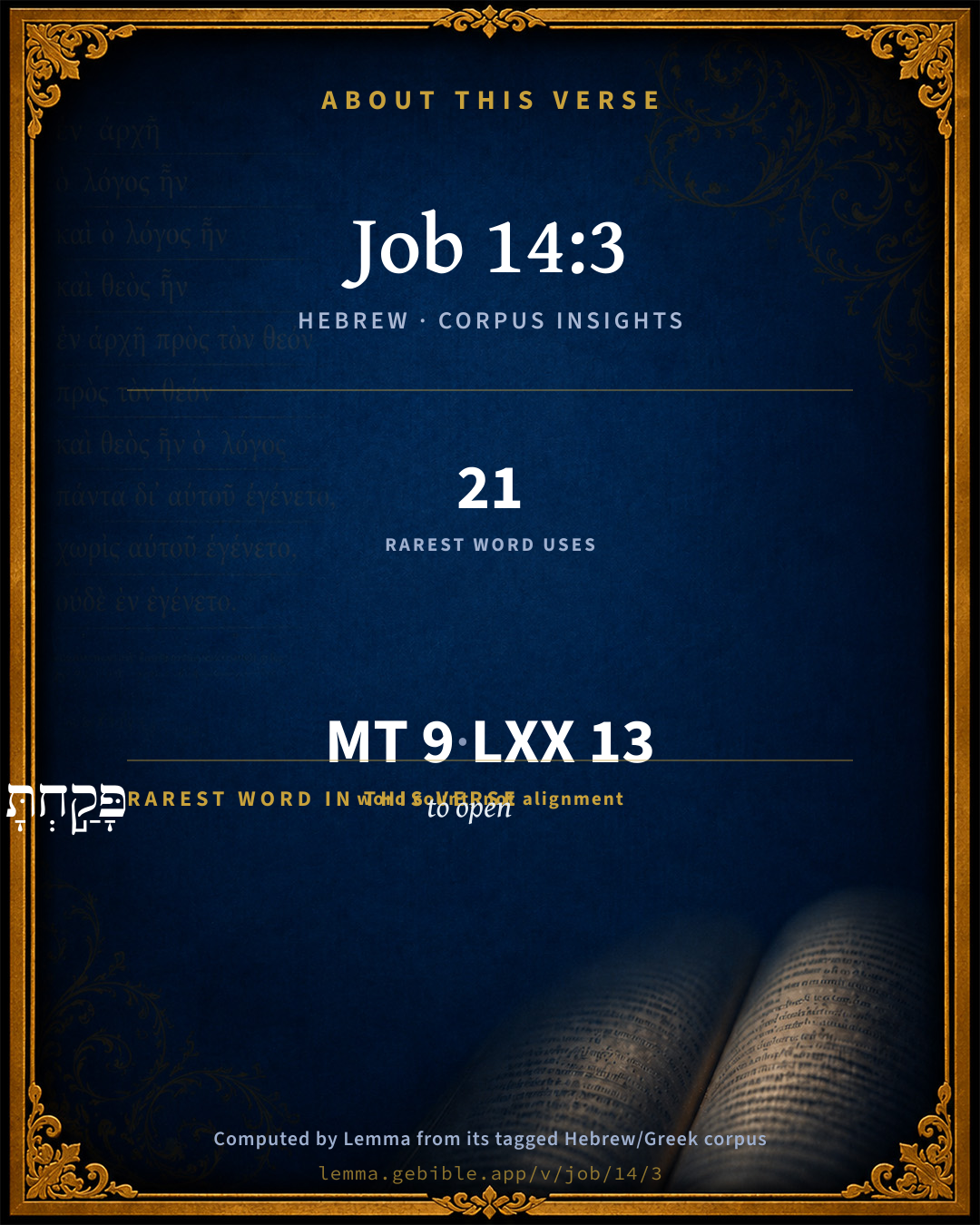
The rarest word here is פָּקַ֣חְתָּ to open H6491 — appearing just 21 times in the whole Hebrew Bible.

Shared distinctive vocabulary

פָּקַ֣חְתָּ to open H6491 occurs in 18 verses of the Hebrew Bible. Also found in:

Grammatical profile

  • 2 verbs
  • 2 nouns
  • 1 pronoun
  • 2 prepositions
  • 2 particles

Verb forms

  • פָּקַ֣חְתָּ Qal · Perfect
  • תָבִ֖יא Hiphil · Imperfect

Hebrew & Septuagint length

In English translation the verse runs 16 words from the Hebrew and 17 from the Septuagint (LXX English) — closely comparable.

A rough comparison of the two English renderings, which tokenize alike — not a word-level alignment.

Word counts can differ between the Hebrew and the Greek without any difference in meaning — e.g. the Hebrew direct-object marker אֵת has no separate Greek word, and Greek often adds the article ὁ.

In the original languages it is 9 Hebrew tokens and 13 Greek tokens — but the two are counted differently (Hebrew bundles its prefixes and suffixes into one token; the Greek is in lemma form), so that isn’t a like-for-like length.

Cross-references

9

Topical passages linked to Job 14:3 in the Treasury of Scripture Knowledge — connected by theme and wording, ordered by reader-vote popularity; previews shown in the World English Bible.

  • Psalms 144:3 Yahweh, what is man, that you care for him? Or the son of man, that you think of him?
  • Psalms 143:2 Don't enter into judgment with your servant, For in your sight no man living is righteous.
  • Psalms 8:4 What is man, that you think of him? The son of man, that you care for him?
  • Job 7:17–18 What is man, that you should magnify him, That you should set your mind on him,
  • Job 9:19–20 If it is a matter of strength, behold, he is mighty! If of justice, 'Who,' says he, 'will summon me?'
  • Job 9:32 For he is not a man, as I am, that I should answer him, That we should come together in judgment.
  • Job 13:25 Will you harass a driven leaf? Will you pursue the dry stubble?
  • Job 13:27 You also put my feet in the stocks, And mark all my paths. You set a bound to the soles of my feet:
  • Romans 3:19 Now we know that whatever things the law says, it speaks to those who are under the law, that every mouth may be closed, and all the world may be brought under the judgment of God.

Cross-references courtesy of OpenBible.info (CC BY 4.0).

Hebrew and Greek witnesses Masoretic Hebrew ↔ Greek Septuagint

The same verse in the two great witnesses to the Old Testament, shown verse-for-verse.

These are two independent witnesses, not word-aligned to each other, and the Septuagint is shown in lemma (dictionary) form.

Hebrew Job 14:3 Masoretic · Westminster Leningrad Codex

אַף עַל זֶ֭ה פָּקַ֣חְתָּ עֵינֶ֑ךָ וְאֹ֘תִ֤י תָבִ֖יא בְמִשְׁפָּ֣ט עִמָּֽךְ

Do you open your eyes on such a one, And bring me into judgment with you?

World English Bible · Public Domain

Greek LXX Job 14:3 Septuagint · lemma form

οὐ καί οὗτος λόγος ποιέω καί οὗτος ποιέω εἰςἔρχομαι ἐν κρίμα ἐνώπιον σύ

Have you not taken account even of him, and caused him to enter into judgment before you?

LXX2012 (modern English Septuagint) · Public Domain

Hebrew: Westminster Leningrad Codex (CC BY 4.0). Greek: Septuagint (public domain); English from LXX2012 (modern English Septuagint) (Public Domain). How the Septuagint differs from the Hebrew →

Commentary

Notes on Job 14:3 from classic Christian and Jewish commentators (each source and its license shown beneath its notes). The classic Christian expositions comment on the surrounding passage and are grouped to its opening verse, so a note may address several verses; the Jewish commentaries on the Tanakh (Rashi and others) are per-verse, so they appear only where the commentator wrote on this verse.

Lemma curates 59 commentaries, every one of them public domain or Creative Commons licensed, each selected and text-cleaned for this edition rather than reprinted as found. About our sources →

Trapp's Complete Commentary

John Trapp

Job 14:3 And dost thou open thine eyes upon such an one, and bringest me into judgment with thee?

Ver. 3. And dost thou open thine eyes upon such an one?] sc. To observe his faults strictly, and to punish him for the same severely? doth this become so great a Majesty? This Job speaketh, non citra stomacbum, not without stomach, as forgetting himself through impatience, saith Mercer, and seeking to ease himself any way of the pains and dolors he sustained, being carried out of himself by his unruly passions. By this question Job doth non tam admirari quam arguere, saith Brentius; not so much wonder as warble with God, that he should care for so poor a creature, whom it might seem to him rather to contemn. But Job should have remembered, that God openeth his eyes upon man, not to punish him only, but to help and relieve him, Psa 34:15. And at another time Job could set it upon the score of God’s favours to man, that he visiteth him every morning (viz. by his fatherly chastisements) and trieth him every moment Job 7:17-18.

And bringest me into judgment with thee?] Poor me, who am τρισανθρωπος, thrice a man; that is most miserable, even me thou questionest in the rigour of thy righteous judgment, Me gravissimis tuis iudiciis extra ordinem divexas (Mera.). See a like expostulation Psa 89:46-51, and all to move God to compassion. Our frailty is a good pleadable argument to this purpose.

John Trapp, A Commentary or Exposition upon All the Books of the Old and New Testament (1647–1656) — public domain. Text from a community e-Sword module.

The Biblical Illustrator

Joseph S. Exell

Job_14:3-4

Who can bring a clean thing out of an unclean?

On the corruption of human nature

The disobedience of our first parents involved their posterity, and entailed a depravity of nature upon their descendants; which depravity, though it is not a sin in us, till the will closes with it, and deliberately consents to it; yet is certainly sinful in itself, and therefore is styled original sin. Adam was formed in the image of God, in righteousness and true holiness; but it is plain that we who are born with strong propensions to vice are not created in righteousness and true holiness. It is clear that we are fallen from our original and primitive state of innocence. Far be it from me to vilify human nature, as if it were totally bad, without any remains or traces of its primitive greatness. But no creature could come originally from Gods hand but what was perfect in its kind; no rational creature can be perfect in his kind, in whom there is a strong propension to vice, that is, to what is unreasonable, and a great irregularity of the appetites and affections. There is a latent stock of corruption in us, though sometimes unsuspected by us, which often discovers itself as soon as there are suitable objects to call it forth. We see the wisest of men, in their unguarded hours, betrayed into unaccountable follies. Reason was originally given us to govern the passions in all cases. It does not now regulate and govern them in all cases; it is certain, therefore, that we are in a fallen, disordered state. If men proceed to action while their passions are warm, they do not see things justly, and therefore are apt to act too hastily; if they stay till their passions are cool, they are apt not to act at all. Moreover, we do not love or hate, rejoice or grieve, hope or fear, so far as is consistent with reason, and no further. We love the things of this world beyond the proportion of good which is in them. The love of virtue and heavenly happiness does not keep pace with the worth of the objects beloved. The truth is that ever since the fall, the body clogs the native energy of the soul, and pins it down to this low, ignoble sphere. Into what can this universal depravation, which prevails everywhere among the sons of men, be resolved, but into an universal cause, the inborn corruption of nature, and an original taint, derived from our first parents? Can it be resolved into education? If mankind were in a state of integrity and primitive uprightness, there could scarce be, one would think, so much evil in the world as there really is. Man was originally formed for the knowledge and worship of God only; yet in all countries men are immersed in idolatry and superstition. Man was formed for loving his neighbour as himself; yet the world is generally inclined to the ill-natured side. Again, we were designed for an exact knowledge of ourselves; and yet we see ourselves through a flattering glass, in the fairest and brightest light. Lastly, we were formed for the attainment of beneficial truth; yet there are not many certain truths, demonstrable from intrinsic evidences, from the abstract nature of the thing; though reason can prove several, by the help of external evidences. Setting revelation aside, mankind would have reason to wish that they did not know so much as they do, or that they knew a great deal more . . . It is one thing to say that God was, or could be, the author of evil; and another to say that when evil was introduced by man, He did not work a miracle to prevent the natural consequences of it; but suffered it for the sake of bringing a greater good out of it; and that, by redemption, He has advanced man to much superior happiness than he could have had any title to, if he had continued in a state of innocence. This is the scriptural solution of the difficulty. What remains but that we strive to recover that happiness, by our humility and meekness, which our first parents lost by pride? The consideration and sense of unworthiness will dispose a man to accept the offers of salvation by Jesus Christ, and make him endeavour to fulfil the terms of it. (J. Seed, M. A.)

Out of nothing comes nothing

Job had a deep sense of the need of being clean before God, and indeed he was clean in heart and band beyond his fellows. But he saw that he could not of himself produce holiness in his own nature, and, therefore, he asked this question, and answered it in the negative without a moments hesitation. The best of men are as incapable as the worst of men of bringing out from human nature that which is not there.

I. Matters of impossibility in nature.

1. Innocent children from fallen parents.

2. A holy nature from the depraved nature of any one individual.

3. Pure acts front an impure heart.

4. Perfect acts from imperfect men.

5. Heavenly life from natures moral death.

II. Subjects for practical consideration for everyone.

1. That we must be clean to be accepted.

2. That our fallen nature is essentially unclean.

3. That this does not deliver us from our responsibility: we are none the less hound to be clean because our nature inclines us to be unclean; a man who is a rogue to the core of his heart is not thereby delivered from the obligation to be honest.

4. That we cannot do the needful work of cleansing by our own strength. Depravity cannot make itself desirous to be right with God. Corruption cannot make itself fit to speak with God. Unholiness cannot make itself meet to dwell with God.

5. That it will be well for us to look to the Strong for strength, to the Righteous One for righteousness, to the Creating Spirit for new creation. Jehovah brought all things out of nothing, light out of darkness, and order out of confusion; and it is to such a Worker as He that we must look for salvation from our fallen state.

III. Provisions to meet the case.

1. The fitness of the Gospel for sinners. When we were yet without strength, in due time Christ died for the ungodly. The Gospel contemplates doing that for us which we cannot attempt for ourselves,

2. The cleansing power of the blood.

3. The renewing work of the Spirit. The Holy Ghost would not regenerate us if we could regenerate ourselves.

4. The omnipotence of God in spiritual creation, resurrection, quickening, preservation, and perfecting. Application--Despair of drawing any good out of the dry well of the creature. Have hope for the utmost cleansing, since God has become the worker of it. (C. H. Spurgeon.)

The Biblical Illustrator, edited by Joseph S. Exell (c. 1880s–1900s) — public domain. Text from a community e-Sword module.

Joseph Benson's Commentary

Job 14:3. And dost thou open thine eyes on such a one? — Dost thou, the infinite Jehovah, the self-existent, independent, and supreme Lord of all, the Almighty, open thine eyes on such an insignificant and helpless creature? Dost thou, the immutable, the eternal God, behold and take account of such a frail, changeable, and short-lived being? Dost thou, ever- blessed and most holy, regard such an infirm, polluted, and miserable object? Dost thou take any thought or care about him? Is he not infinitely beneath thy notice? And dost thou stoop so low as even to observe his ways, yea, all his ways? And bringest me into judgment with thee — Pleadest with me by thy judgments, and thereby, in a manner, forcest me to plead with thee. Dost thou bring me, such a worthless worm as I am, into judgment with thee, who art so quick-sighted to discover the least failing, so holy to hate it, so just to condemn it, so mighty to punish it? The consideration of our inability to contend with God, of our own sinfulness and weakness, should engage us to pray, Lord, enter not into judgment with thy servant.

Joseph Benson's Commentary on the Old and New Testaments (1811–1818) — public domain. Text from a community e-Sword module.

Tyndale Open Study Notes

Tyndale Open Resources

14:3 keep an eye on: Job lamented God’s relentless surveillance (7:8, 17-20; 10:6, 14; 13:27).

Tyndale Open Study Notes — © Tyndale Open Resources, licensed CC BY-SA 4.0. Text via the HelloAO Bible API.

Geneva Bible (1599)

Geneva Bible translators

His meaning is, that seeing that man is so frail a creature, God should not handle him so extremely, wherein Job showeth the wickedness of the flesh, when it is not subject to the Spirit.

Geneva Bible (1599) marginal notes — public domain. Text via Bolls.life.

Jamieson, Fausset & Brown

Robert Jamieson, A. R. Fausset & David Brown

open . . . eyes upon--Not in graciousness; but, "Dost Thou sharply fix Thine eyes upon?" (See on Job 7:20; also see on Job 1:7). Is one so frail as man worthy of such constant watching on the part of God? (Zac 12:4).

me--so frail.

thee--so almighty.

Jamieson, Fausset & Brown — Commentary Critical and Explanatory on the Whole Bible (1871) — public domain (CC PDM 1.0). Text via the HelloAO Bible API.

Adam Clarke's Commentary

Verse 3. Dost thou open thine eyes upon such a one] The whole of this chapter is directed to God alone; in no part of it does he take any notice of his friends.

Adam Clarke's Commentary on the Bible (1810–1826) — public domain. Text from a community e-Sword/MySword module.

The Cambridge Bible for Schools and Colleges

gen. ed. J. J. S. Perowne

3. A question of astonishment at the severity of God’s dealing with a creature of such weakness as man. “To open the eyes” is to look narrowly to, to watch in order to punish.

The Cambridge Bible for Schools and Colleges (gen. ed. J. J. S. Perowne; Cambridge University Press, 1878–1918) — public domain. Text from a community e-Sword module.

John Gill's Exposition

And dost thou open thine eyes on such an one,.... So frail and feeble, so short lived and sorrowful, so soon and easily cut down and destroyed: and by opening of his eyes is not meant his providential care of men; whose eyes indeed are everywhere, run to and fro throughout the earth, and are careful of and provident for all sorts of men, which is very wonderful, Psa 8:4; nor the displays of his special grace and favour towards his own peculiar people, on whom his eyes of love, grace, and mercy, are opened, and are never withdrawn from them, which is marvellous lovingkindness; but the exercise of rigorous justice in punishing, afflicting, and chastising with so much severity, as Job thought to be his own case; the eyes of God, as he thought, were set on him for evil, and not for good; he looked wistly on him, and in a very frowning manner; he sharpened his eye upon him, as the phrase is, Job 16:9; and as some render the word (f) here, looked narrowly into all his ways, and watched every motion and every step he took, and pursued him with great eagerness, and used him with great strictness in a way of justice, which he, a poor, weak creature, was not able to bear; which sense is confirmed by what follows:

and bringeth me into judgment with thee? by this it appears Job has a view to himself all along, and to the procedure of God against him, which he took to be in strict justice, and that was what he was not able to bear; he was not a match for God, being such a frail, weak, sinful, mortal creature; nor was God a man as he was, that they should come together in judgment, or be fit persons to contend together upon the foot of strict justice; sinful man can never be just with God upon this bottom, or be able to answer to one objection or charge of a thousand brought against him; and therefore, as every sensible man will deprecate God's entering into judgment with him, so Job here expostulates with God why he should bring him into judgment with him; when, as he fled to his grace and mercy, he should rather show that to him than in a rigorous manner deal with him.

(f) "super illo acuis oculos tuos", Cocceius; "super hune apertos vibras oculos", Schultens.

John Gill's Exposition of the Whole Bible (1746–1763) — public domain (CC PDM 1.0). Text via the HelloAO Bible API.

Albert Barnes' Notes on the Bible

And dost thou open thine eyes upon such an one? - Is one so weak, so frail, so short-lived, worthy the constant vigilance of the infinite God? In Zec 12:4, the expression “to open the eyes” upon one, means to look angrily upon him. Here it means to observe or watch closely.

And bringest me into judgment with thee - Is it equal or proper that one so frail and feeble should be called to a trial with one so mighty as the infinite God? Does God seek a trial with one so much his inferior, and so unable to stand before him? This is language taken from courts of justice, and the meaning is, that the parties were wholly unequal, and that it was unworthy of God to maintain a controversy in this manner with feeble man. This is a favorite idea with Job, that there was no equality between him and God, and that the whole controversy was, therefore, conducted on his part with great disadvantage; compare the notes at Job 9:34-35.

Albert Barnes' Notes on the Bible (1834–1885) — public domain. Text from a community e-Sword/MySword module.

Haydock's Catholic Bible Commentary

With thee. He seems beneath God’s attention: (Arist.[Aristotle?] Met. viii. 9.; Cicero, Nat. ii.) but as the knowledge and other attributes of the Deity are infinite, he must necessarily attend to the whole creation. The moral actions of men being also infinite in their object, tending to God, or contradicting his ordinances, they are not beneath the consideration of an infinite Being. (Calmet)

George Leo Haydock (1774–1849), Haydock's Catholic Family Bible and Commentary, 1859 edition — public domain. Excludes Psalms (Douay-Rheims chapter numbering differs from Protestant) and Deuterocanonical books (Catholic canon only).

Matthew Poole's English Annotations

Dost thou open thine eyes upon such an one; either,

1. To take thought or care about him. Or rather,

2. To observe all his ways, that thou mayst find cause of punishment. He is not a fit match for thee. It is below thee to contend with him, and to use thy infinite wisdom and power to crush him. This seems best to suit with the scope and context.

Bringest me into judgment with thee, i.e. pleadest with me by thy judgments, and thereby, in a manner, forcest me to plead with thee, without granting me those two necessary and favourable conditions, expressed Job 13:20,21.

Matthew Poole's English Annotations on the Holy Bible (1683–1685) — public domain. Text from a community e-Sword/MySword module.

Whedon's Commentary on the Bible

Daniel D. Whedon

3. Open thine eyes — Dost Thou condescend even to look upon such a being, much less to arraign him in judgment for the deeds of a life so vain?

Daniel D. Whedon (gen. ed.), Commentary on the Old and New Testaments (1874–1909) — public domain. Text from a community e-Sword module.

The Pulpit Commentary

And dost thou open thine eyes upon such a one? Is it compatible with God"s greatness, unchangeableness, and majesty to take any notice of so poor, weak, and unstable a creature as mortal man? The question has been often asked, and answered by many in the negative, as by the Epicureans of old. Job does not really entertain any doubt upon the point; but only intends to express his wonder that it should be so. (comp. Psa_8:4, and above, Job_7:17) And bringest me into judgment with thee? Especially astonishing is it, Job says, that God should condescend to try, pass judgment on, and punish so weak, worthless, and transitory a creature as himself.

The Pulpit Commentary (1880–1919), ed. H.D.M. Spence-Jones & Joseph S. Exell — public domain. Text from a community e-Sword module.

Rashi

Rabbi Shlomo Yitzchaki (Rashi)

also on this one [creature of] futility that decays

have You opened Your eyes to be exact with his sins,

and You bring me into judgment for my iniquities?

Rashi on the Tanakh — English translations: “The Judaica Press complete Tanach with Rashi, translated by A. J. Rosenberg” (CC BY 4.0); “Pentateuch with Rashi's commentary by M. Rosenbaum and A.M. Silbermann, 1929-1934” (public domain); “The Metsudah Tanach series, Lakewood, N.J” (CC BY 4.0); and “The Book of Joshua, Metsudah Publications, 1997” (CC BY 4.0). Text via Sefaria.

Lesson kit

Teaching starters — assembled from the data on this page, not authored interpretation. Every prompt links to the verse data it draws on. Edit before teaching.

Job, in the Wisdom, opens this verse with 9 words (9 distinct Hebrew lemmas). Its most distinctive word is pâqach (“to open”). A historical commentator’s framing appears above. Read the whole chapter for the surrounding context.

Discussion questions

  1. The word pâqach carries the sense “to open.” How does it shape the verse?
  2. How does Genesis 3:5, which shares the word «to open», read alongside this verse?
  3. These translations render this verse differently. What is at stake in choosing one wording over another?
  4. «פָּקַ֣חְתָּ» is a Qal Perfect verb. How does that grammatical form shape the action described?
  5. Compare how Trapp's Complete Commentary and The Biblical Illustrator read this verse. Where do they agree or differ?

Things to notice

Reading settings

Reading text

Shown beneath each verse's original-language words.

Old Testament
Old Testament edition

Read the OT as the Masoretic Hebrew (MT) or the Greek Septuagint (LXX).

English shown for the Greek Septuagint (in the Hebrew ↔ Greek comparison).

Comparing translations? Open the Compare panel on any verse page to stack up to four side by side.