
Genesis 2:19

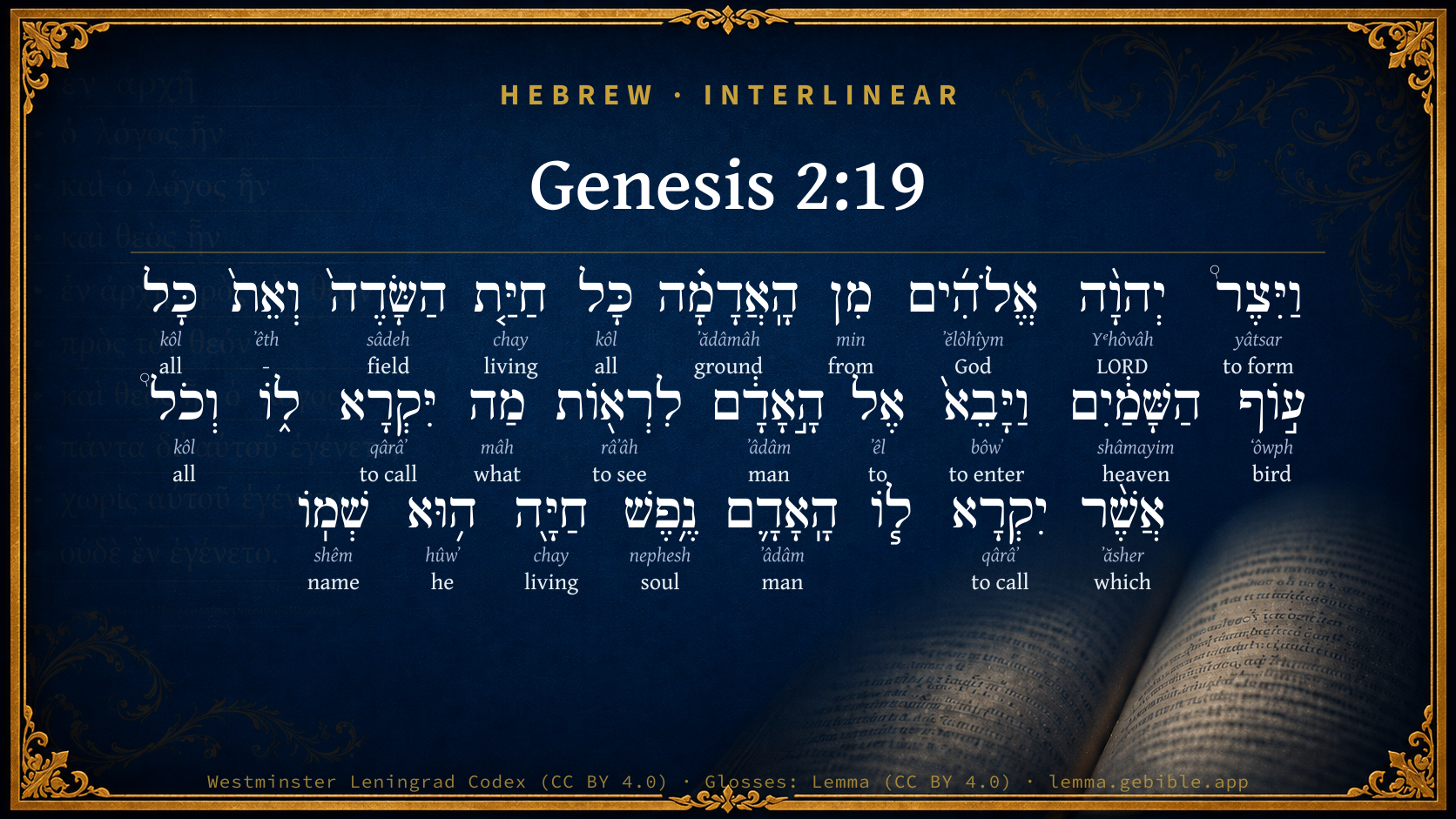
Hebrew (Westminster Leningrad Codex) Genesis 2:19 appears in the Hebrew Old Testament. The text above is from the Westminster Leningrad Codex. Each word links to its Strong’s number, a concise gloss, and parsing drawn from the Open Scriptures Hebrew Bible morphology. Click any word for its full Brown-Driver-Briggs (BDB) entry.
Download image
Cite this verse

Genesis 2:19 (World English Bible). Public Domain. Lemma interlinear Bible study tool, https://lemma.gebible.app/v/genesis/2/19.

Show BibTeX & RIS
BibTeX
RIS
English Translation
Out of the ground Yahweh God formed every animal of the field, and every bird of the sky, and brought them to the man to see what he would call them. Whatever the man called every living creature, that was its name.
World English Bible · Public Domain
Highlights
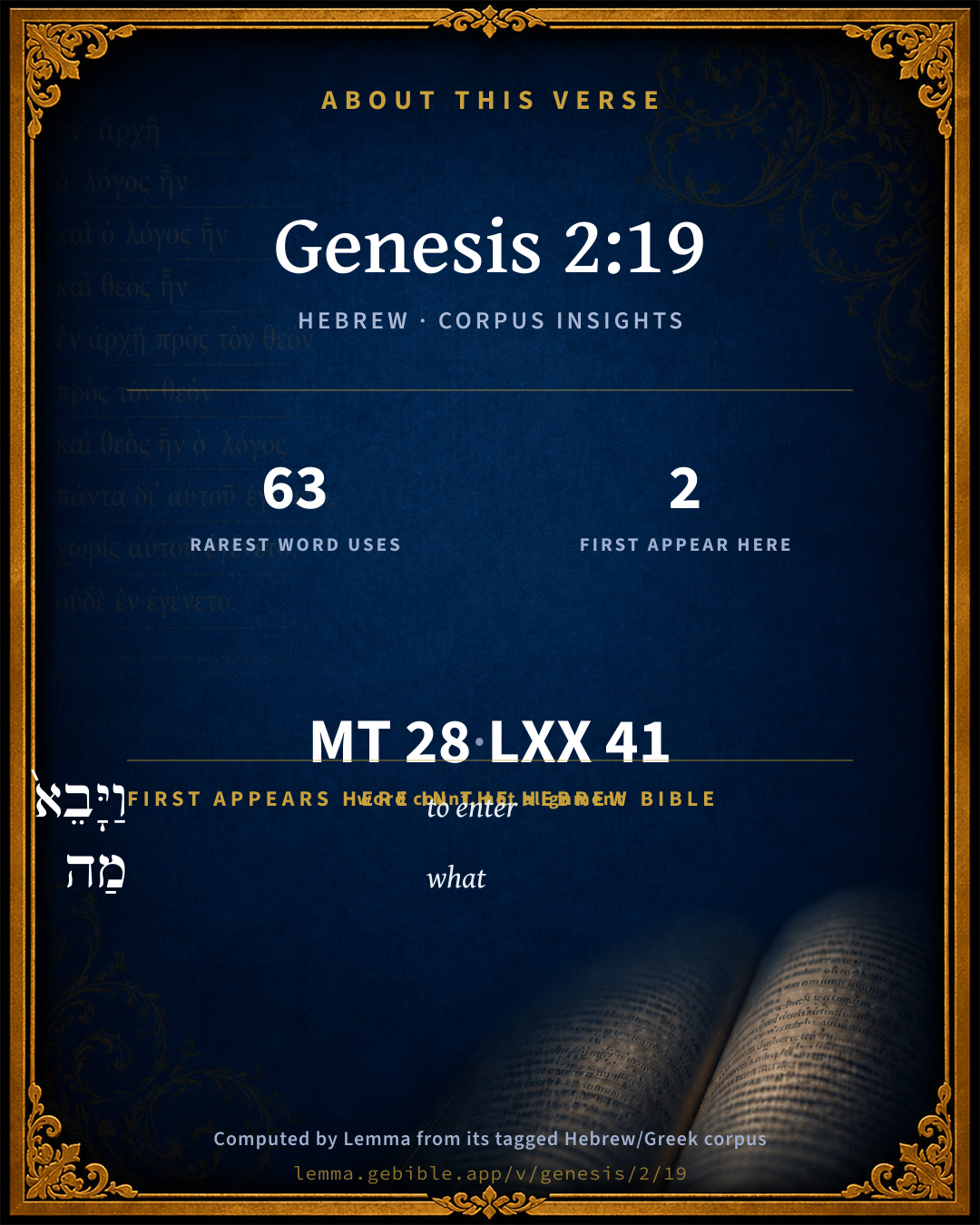
  • 2 first appearances in the Hebrew Bible
Full analysis ↓
Download a study sheet

One document with this verse’s original text, its word-by-word gloss line, the meaning frame, cross-references with their text, attributed commentary, and full source and license credits — printable, and it pastes into notes with its structure intact.

This verse Autodidact and up

Study sheet (.html) Plain text (.txt)

A passage Seminary Student

Up to 50 verses in one chapter. A passage sheet keeps up to 6 commentary sources and 12 cross-references per verse, in the order this page ranks them, and says so on the sheet whenever that leaves anything out. Ask for a single verse and you get the Autodidact verse sheet above.

Everything on this page stays free to read, with no account — the sheet is a download of what is already on screen, not access to it.

Want to remove ads? Support Godless Engineer
Compare translations 3

The same verse in 3 English versions, stacked beneath the original-language interlinear above. Click any original word for its lexicon entry.

Each is an independent rendering of the whole verse — the interlinear is not word-aligned to these translations.

Highlighted words mark where these versions differ — a whole-verse word diff, not a word-by-word alignment.

  • World English Bible Public Domain
    Out of the ground Yahweh God formed every animal of the field, and every bird of the sky, and brought them to the man to see what he would call them. Whatever the man called every living creature, that was its name.
  • King James Version Public Domain
    And out of the ground the LORD God formed every beast of the field, and every fowl of the air; and brought them unto Adam to see what he would call them: and whatsoever Adam called every living creature, that was the name thereof.
  • unfoldingWord Literal Text CC BY-SA 4.0
    Now Yahweh God had formed from the ground every living thing of the field and every bird of the sky. So he brought to the man to see what he would call them, and whatever the man called a living creature, that its name.

unfoldingWord Literal Text — © unfoldingWord, licensed CC BY-SA 4.0. Word-aligned USFM3 via Door43 (git.door43.org/unfoldingWord/en_ult).

Versions to compare (up to 4)

3 of 4 selected

Show all 18 translations

Every available English version of this verse, each an independent rendering of the whole verse.

  • World English Bible Public Domain
    Out of the ground Yahweh God formed every animal of the field, and every bird of the sky, and brought them to the man to see what he would call them. Whatever the man called every living creature, that was its name.
  • Berean Standard Bible Public Domain
    And out of the ground the LORD God formed every beast of the field and every bird of the air, and He brought them to the man to see what he would name each one. And whatever the man called each living creature, that was its name.
  • Majority Standard Bible Public Domain
    And out of the ground the LORD God formed every beast of the field and every bird of the air, and He brought them to the man to see what he would name each one. And whatever the man called each living creature, that was its name.
  • King James Version Public Domain
    And out of the ground the LORD God formed every beast of the field, and every fowl of the air; and brought them unto Adam to see what he would call them: and whatsoever Adam called every living creature, that was the name thereof.
  • American Standard Version (1901) Public Domain
    And out of the ground Jehovah God formed every beast of the field, and every bird of the heavens; and brought them unto the man to see what he would call them: and whatsoever the man called every living creature, that was the name thereof.
  • Revised Version (1885) Public Domain
    And out of the ground the LORD God formed every beast of the field, and every fowl of the air; and brought them unto the man to see what he would call them: and whatsoever the man called every living creature, that was the name thereof.
  • Geneva Bible (1599) Public Domain
    So the Lord God formed of the earth euery beast of the fielde, and euery foule of the heauen, and brought them vnto the man to see howe he would call them: for howsoeuer the man named the liuing creature, so was the name thereof.
  • Douay-Rheims (1899) Public Domain
    And the Lord God having formed out of the ground all the beasts of the earth, and all the fowls of the air, brought them to Adam to see what he would call them: for whatsoever Adam called any living creature the same is its name.
  • Young's Literal Translation Public Domain
    And Jehovah God formeth from the ground every beast of the field, and every fowl of the heavens, and bringeth in unto the man, to see what he doth call it; and whatever the man calleth a living creature, that `is' its name.
  • Literal Standard Version CC BY-SA 4.0
    And YHWH God forms from the ground every beast of the field, and every bird of the heavens, and brings [them] to the man, to see what he calls it; and whatever the man calls a living creature, that [is] its name.
  • Unlocked Literal Bible CC BY-SA 4.0
    Out of the ground Yahweh God formed every animal of the field and every bird of the sky. Then he brought them to the man to see what he would call them. Whatever the man called each living creature, that was its name.
  • unfoldingWord Literal Text CC BY-SA 4.0
    Now Yahweh God had formed from the ground every living thing of the field and every bird of the sky. So he brought to the man to see what he would call them, and whatever the man called a living creature, that its name.
  • Darby Bible Public Domain
    And out of the ground Jehovah Elohim had formed every animal of the field and all fowl of the heavens, and brought [them] to Man, to see what he would call them; and whatever Man called each living soul, that was its name.
  • World Messianic Bible Public Domain
    Out of the ground the LORD God formed every animal of the field, and every bird of the sky, and brought them to the man to see what he would call them. Whatever the man called every living creature became its name.
  • Webster's Bible Public Domain
    And out of the ground the LORD God formed every beast of the field, and every fowl of the air, and brought them to Adam to see what he would call them; and whatsoever Adam called every living creature, that was its name.
  • Free Bible Version CC BY-SA 4.0
    The Lord God used the ground to make all the wild animals, and all the birds. He took them all to Adam to see what he would call them, and Adam named every living creature.
  • Bible in Basic English Public Domain
    And from the earth the Lord God made every beast of the field and every bird of the air, and took them to the man to see what names he would give them: and whatever name he gave to any living thing, that was its name.
  • JPS Tanakh (1917) Public Domain
    And out of the ground the LORD God formed every beast of the field, and every fowl of the air; and brought them unto the man to see what he would call them; and whatsoever the man would call every living creature, that was to be the name thereof.

Literal Standard Version (2020), Covenant Press — licensed CC BY-SA 4.0. Text via the HelloAO Bible API (eBible.org). Unlocked Literal Bible (unfoldingWord) — licensed CC BY-SA 4.0. Text via the HelloAO Bible API (eBible.org). unfoldingWord Literal Text — © unfoldingWord, licensed CC BY-SA 4.0. Word-aligned USFM3 via Door43 (git.door43.org/unfoldingWord/en_ult). Free Bible Version, Dr. Jonathan Gallagher — licensed CC BY-SA 4.0. Text via the HelloAO Bible API (eBible.org).

Word by word

More ways to search: Search by grammar → Find every occurrence → Compare this word →

Practice this passage: Drill this verse → Learn its vocabulary →

וַיִּצֶר֩
yâtsar
H3335
“and · to form”
Conjunction + Verb, Qal, Sequential Imperfect, 3rd Person, Masculine, Singular
Part of Speech
Conjunction + Verb
Stem
Qal
Form
Sequential Imperfect
Person
3rd Person
Gender
Masculine
Number
Singular
Full BDB Definition

Origin: probably identical with H3334 (through the squeezing into shape), ([compare H3331 ])

TWOT: 898

to form, fashion, frame - (Qal) to form, fashion - of human activity - of divine activity - of creation - of original creation - of individuals at conception - of Israel as a people - to frame, pre-ordain, plan (figuratively of divine) purpose of a situation) - (Niphal) to be formed, be created - (Pual) to be predetermined, be pre-ordained - (Hophal) to be formed
  1. יְהוָ֨ה Yᵉhôvâh H3068 “LORD” Noun, Proper
  2. אֱלֹהִ֜ים ʼĕlôhîym H430 “God(s)” Noun, Common, Masculine, Plural, Absolute
  3. מִן min H4480 “from” Preposition
  4. הָֽאֲדָמָ֗ה ʼădâmâh H127 “the · ground” Particle, Definite Article + Noun, Common, Feminine, Singular, Absolute
  5. כָּל kôl H3605 “all of” Noun, Common, Masculine, Singular, Construct
  6. חַיַּ֤ת chay H2416 “living of” Noun, Common, Feminine, Singular, Construct
  7. הַשָּׂדֶה֙ sâdeh H7704 “the · field” Particle, Definite Article + Noun, Common, Masculine, Singular, Absolute
  8. וְאֵת֙ ʼêth H853 “and · -” Conjunction + Particle, Direct Object
  9. כָּל kôl H3605 “all of” Noun, Common, Masculine, Singular, Construct
  10. ע֣וֹף ʻôwph H5775 “bird of” Noun, Common, Masculine, Singular, Construct
  11. הַשָּׁמַ֔יִם shâmayim H8064 “the · heaven(s)” Particle, Definite Article + Noun, Common, Masculine, Plural, Absolute
  12. וַיָּבֵא֙ bôwʼ H935 “and · to enter” Conjunction + Verb, Hiphil, Sequential Imperfect, 3rd Person, Masculine, Singular
  13. אֶל ʼêl H413 “to” Preposition
  14. הָ֣אָדָ֔ם ʼâdâm H120 “the · man” Particle, Definite Article + Noun, Common, Masculine, Singular, Absolute
  15. לִרְא֖וֹת râʼâh H7200 “to see” Preposition + Verb, Qal, Infinitive Construct
  16. מַה mâh H4100 “what” Particle, Interrogative
  17. יִּקְרָא qârâʼ H7121 “to call” Verb, Qal, Imperfect, 3rd Person, Masculine, Singular
  18. וְכֹל֩ kôl H3605 “and · all” Conjunction + Noun, Common, Masculine, Singular, Absolute
  19. אֲשֶׁ֨ר ʼăsher H834 “which” Particle, Relative
  20. יִקְרָא qârâʼ H7121 “to call” Verb, Qal, Imperfect, 3rd Person, Masculine, Singular
  21. הָֽאָדָ֛ם ʼâdâm H120 “the · man” Particle, Definite Article + Noun, Common, Masculine, Singular, Absolute
  22. נֶ֥פֶשׁ nephesh H5315 “soul” Noun, Common, Both, Singular, Absolute
  23. חַיָּ֖ה chay H2416 “living” Adjective, Adjective, Feminine, Singular, Absolute
  24. ה֥וּא hûwʼ H1931 “he” Pronoun, Personal, 3rd Person, Masculine, Singular
  25. שְׁמֽוֹ shêm H8034 “name · his” Noun, Common, Masculine, Singular, Construct + Suffix, Personal, 3rd Person, Masculine, Singular

About this verse

These counts appear in no published source. They are computed here, from the morphology-tagged text and Lemma’s own curated glosses. What Lemma adds →

28
words
21
distinct lemmas
Pentateuch
section

First appearance in Scripture

These words make their first canonical appearance in the Hebrew Bible here:

  • וַיָּבֵא֙ to enter H935
  • מַה what H4100

Grammatical profile

  • 5 verbs
  • 14 nouns
  • 1 adjective
  • 1 pronoun
  • 4 prepositions
  • 3 particles

Verb forms

  • וַיִּצֶר֩ Qal · Sequential Imperfect
  • וַיָּבֵא֙ Hiphil · Sequential Imperfect
  • לִרְא֖וֹת Qal · Infinitive Construct
  • יִּקְרָא Qal · Imperfect
  • יִקְרָא Qal · Imperfect

Repetition

Words recur within this verse — often emphatic in Hebrew:

  • כָּל all H3605 ×3
  • חַיַּ֤ת living H2416 ×2
  • הָ֣אָדָ֔ם man H120 ×2
  • יִּקְרָא to call H7121 ×2

Hebrew & Septuagint length

In English translation the verse runs 42 words from the Hebrew and 49 from the Septuagint (LXX English) — closely comparable.

A rough comparison of the two English renderings, which tokenize alike — not a word-level alignment.

Word counts can differ between the Hebrew and the Greek without any difference in meaning — e.g. the Hebrew direct-object marker אֵת has no separate Greek word, and Greek often adds the article ὁ.

In the original languages it is 28 Hebrew tokens and 41 Greek tokens — but the two are counted differently (Hebrew bundles its prefixes and suffixes into one token; the Greek is in lemma form), so that isn’t a like-for-like length.

Cross-references

6

Topical passages linked to Genesis 2:19 in the Treasury of Scripture Knowledge — connected by theme and wording, ordered by reader-vote popularity; previews shown in the World English Bible.

  • Psalms 8:4–8 What is man, that you think of him? The son of man, that you care for him?
  • Genesis 1:28 God blessed them. God said to them, "Be fruitful, multiply, fill the earth, and subdue it. Have dominion over the fish of the sea, over the birds of the sky, and over every living thing that moves on the earth."
  • Genesis 1:20–26 God said, "Let the waters swarm with swarms of living creatures, and let birds fly above the earth in the open expanse of sky."
  • Genesis 9:2 The fear of you and the dread of you will be on every animal of the earth, and on every bird of the sky. Everything that the ground teems with, and all the fish of the sea are delivered into your hand.
  • Genesis 2:22–23 He made the rib, which Yahweh God had taken from the man, into a woman, and brought her to the man.
  • Genesis 6:20 Of the birds after their kind, of the cattle after their kind, of every creeping thing of the ground after its kind, two of every sort shall come to you, to keep them alive.

Cross-references courtesy of OpenBible.info (CC BY 4.0).

Hebrew and Greek witnesses Masoretic Hebrew ↔ Greek Septuagint

The same verse in the two great witnesses to the Old Testament, shown verse-for-verse.

These are two independent witnesses, not word-aligned to each other, and the Septuagint is shown in lemma (dictionary) form.

Hebrew Genesis 2:19 Masoretic · Westminster Leningrad Codex

וַיִּצֶר֩ יְהוָ֨ה אֱלֹהִ֜ים מִן הָֽאֲדָמָ֗ה כָּל חַיַּ֤ת הַשָּׂדֶה֙ וְאֵת֙ כָּל ע֣וֹף הַשָּׁמַ֔יִם וַיָּבֵא֙ אֶל הָ֣אָדָ֔ם לִרְא֖וֹת מַה יִּקְרָא ל֑וֹ וְכֹל֩ אֲשֶׁ֨ר יִקְרָא ל֧וֹ הָֽאָדָ֛ם נֶ֥פֶשׁ חַיָּ֖ה ה֥וּא שְׁמֽוֹ

Out of the ground Yahweh God formed every animal of the field, and every bird of the sky, and brought them to the man to see what he would call them. Whatever the man called every living creature, that was its name.

World English Bible · Public Domain

Greek LXX Genesis 2:19 Septuagint · lemma form

καί πλάσσω ὁ θεός ἔτι ἐκ ὁ γῆ πᾶς ὁ θηρίον ὁ ἀγρός καί πᾶς ὁ πετεινόν ὁ οὐρανός καί ἄγω αὐτός πρός ὁ αδαμ ὁράω τίς καλέω αὐτός καί πᾶς ὅς ἐάν καλέω αὐτός αδαμ ψυχή ζάω οὗτος ὄνομα αὐτός

And God formed yet farther out of the earth all the wild beasts of the field, and all the birds of the sky, and he brought them to Adam, to see what he would call them, and whatever Adam called any living creature, that was the name of it.

LXX2012 (modern English Septuagint) · Public Domain

On this verse, The Cambridge Bible for Schools and Colleges discusses the Septuagint’s reading. Read the note in Commentary ↓

Hebrew: Westminster Leningrad Codex (CC BY 4.0). Greek: Septuagint (public domain); English from LXX2012 (modern English Septuagint) (Public Domain). How the Septuagint differs from the Hebrew →

Targum (Aramaic paraphrase)

2

The Targum is the ancient Jewish Aramaic paraphrase of the Hebrew Scriptures — an interpretive translation, not the Hebrew text itself. Onkelos (literal) and Pseudo-Jonathan (expansive) render the Torah, and Jonathan the Prophets. Coverage is partial: where no permissively-licensed English translation exists for a verse, only the Aramaic is shown. This is verse-level text, not a word-by-word alignment to the Hebrew.

  1. Targum Onkelos Torah (Genesis–Deuteronomy)
    וּבְרָא יְיָ אֱלֹהִים מִן אַרְעָא כָּל חֵוַת בְּרָא וְיָת כָּל עוֹפָא דִּשְׁמַיָּא וְאַיְתֵהּ לְוַת אָדָם לְמֶחֱזֵי מַה יִּקְרֵי לֵהּ וְכֹל דִּי הֲוָה קָרֵי לֵהּ אָדָם נַפְשָׁא חַיְתָא הוּא שְׁמֵהּ

    (no public-domain English translation for this verse)

    Targum Onkelos — Aramaic: “Onkelos Genesis” (public domain); “Onkelos Exodus” (public domain); “Onkelos Leviticus” (public domain); “Onkelos Numbers” (public domain); “Onkelos Deuteronomy” (public domain). English: “Sefaria Community Translation” (CC0 1.0 (public-domain dedication)); “J.W. Etheridge. The Targums of Onkelos and Jonathan Ben Uzziel on the Pentateuch. London: Longmans, Green, 1862” (public domain). Text via Sefaria.

  2. Targum Pseudo-Jonathan Torah (Genesis–Deuteronomy)
    וּבְרָא יְיָ אֱלהִים מִן אַדְמְתָא כָּל חֵיוַת בְּרָא וְיַת כָּל עוֹפָא דִשְׁמַיָא וְאַיְיתֵי לְוַת אָדָם לְמֵחְמֵי מַה יְהֵי קָרֵי לֵיהּ שׁוּם וְכָל דְקָרֵי לֵיהּ אָדָם נַפְשָׁא מִן חַיְיתָא הוּא שְׁמֵיהּ

    And the Lord God created from the earth every beast of the field, and every fowl of the heavens, and brought them to Adam, to see by what name he would call it. And whatever Adam called the living animal, that was its name.

    Targum Pseudo-Jonathan — Aramaic: “Targum Jonathan on Genesis” (public domain); “Targum Jonathan on Exodus” (public domain); “Targum Jonathan on Leviticus” (public domain); “Targum Jonathan on Numbers” (public domain); “Targum Jonathan on Deuteronomy” (public domain). English: “The Targum of Jonathan ben Uzziel, trans. J. W. Etheridge, London, 1862” (public domain). Text via Sefaria.

Commentary

Notes on Genesis 2:19 from classic Christian and Jewish commentators (each source and its license shown beneath its notes). The classic Christian expositions comment on the surrounding passage and are grouped to its opening verse, so a note may address several verses; the Jewish commentaries on the Tanakh (Rashi and others) are per-verse, so they appear only where the commentator wrote on this verse.

Lemma curates 59 commentaries, every one of them public domain or Creative Commons licensed, each selected and text-cleaned for this edition rather than reprinted as found. About our sources →

Trapp's Complete Commentary

John Trapp

Gen 2:19 And out of the ground the LORD God formed every beast of the field, and every fowl of the air; and brought [them] unto Adam to see what he would call them: and whatsoever Adam called every living creature, that [was] the name thereof.

Ver. 19. To see what he would call them.] If he had been permitted to name himself, it should have been, probably, the son of God, as he is called by Luke, {Luk 3:38} in regard of his creation. But God, to humble him, calls him, first, Adam, and after the fall, Enosh, that is, frail, sorry man, a mass of mortality, a mass of misery.

John Trapp, A Commentary or Exposition upon All the Books of the Old and New Testament (1647–1656) — public domain. Text from a community e-Sword module.

The Biblical Illustrator

Joseph S. Exell

Gen_2:19

That was the name thereof

The naming of the animals by Adam

1.

The man was thus to be made conscious of his lordship over the animal tribes.

2. In token of his relations to them, respectively, he was to give them their respective names.

3. His knowledge of animal nature, (in which he had been created), is at once to be developed, under the special teaching of God.

4. His organs of speech are to be put in exercise.

5. His knowledge of language (Divinely imparted), is to be developed in the use of terms for naming the several classes--under the Divine instruction and guidance.

6. It would seem, from the connection, that the man was to be made sensible of his social need as he should see the animals passing before him in pairs. (M. W. Jacobus.)

Language a Divine gift

The man was created in knowledge, after the Divine image, and thus was endowed with powers of perception and discrimination, by which he could know the habits, characters, and uses of the several species, both of animals and of fowls, yet not without Divine teaching in the matter, and in the use of terms. The names which he gave them were appointed to be their names by which they should be known--and they were, doubtless, significant--as was the name of Eve, (Gen_2:23), Gen_3:20. Language itself could not so early have been a human invention, but a revelation. (M. W. Jacobus.)

Observations

I. GODS MERCIES ARE, OR SHOULD BE, PRECIOUS UNTO US WHEN WE CAN NEITHER BE WITHOUT THEM, NOR HAVE THEM FROM ANY OTHER BUT FROM HIMSELF. That the necessity of creating a woman to be Adams helper might be the more clearly discovered unto him, He brings before him the creatures, that out of his own judgment himself might conclude how unit any of them were to be his companions or helpers.

II. WE MUST KNOW THE UNSERVICEABLENESS OF OTHER THINGS, THAT WE MAY KNOW AND APPROVE THE PROFITABLENESS OF THAT WHICH IS TRULY GOOD.

III. GOD CAN ORDER AND DISPOSE OF THE CREATURES TO DO WHAT, AND TO BE WHERE HE APPOINTS THEM.

IV. MAN MAY LAWFULLY USE THAT POWER OVER THE CREATURES WHICH GOD HIMSELF HATH PUT INTO HIS HAND.

V. GOD IS PLEASED TO HONOUR MEN SO FAR AS TO EMPLOY THEM IN MANY THINGS WHICH OF RIGHT BELONG UNTO AND MIGHT BE DONE BY HIMSELF ALONE.

1. To encourage men to His service in honouring them so far as to make them His fellow workers.

2. To unite men the more in love, one to another.

3. To increase their reward hereafter, by the faithful employment of their talents for the advantage of their Master from whom they received them, Mat_25:21; Mat_25:23. (J. White, M. A.)

Intuition

God now proceeds to show man the exact point where the void lay. Adam had been made to feel that void, but Gods object is to place him in circumstances such as shall lead him step by step to the seat of the unsatisfied longing within. Accordingly, God brings before him all the creatures which He had made, that Adam, in his choice, may have the whole range of creation. Adam surveys them all. He sees by instinctive wisdom the nature and properties of each, so that he can affix names to all in turn. His knowledge is large and full; it has come direct from God, just as his own being had come. It is not discovery, it is not learning, it is not experience, it is not memory, it is intuition. By intuition he knew what the wisest king in after ages only knew by searching. (H. Bonar, D. D.)

The first act of mans sovereignty over the animals

Man was certainly the superior master of nature. This is evident from the next feature which our text mentions. God brought the animals which He had created to man, to see what he would call them; and the names chosen by man were to remain to them forever. This is the first act by which man exercised his sovereignty; and although his intellect was not yet roused, he was sufficiently endowed for that task; for he had been capable of understanding the Divine command and of representing to himself death. In the first cosmogony, God Himself fixed the names of the objects which He had called into existence; He determined the appellations of day and night, of heaven, and sea, and dry land. Here He cedes this right to man, whom He has ordained to have dominion over all the earth. The name was, according to Hebrew and Eastern writers in general, an integral part of the object itself; it was not deemed indifferent; it was no conventional sign; it was an essential attribute. When God revealed Himself to Moses in the burning bush, the latter hastened to inquire under what name He wished to be announced to the Israelites. When a crisis in the life of an individual was imminent, or had been successfully overcome, his name was changed into another one expressive of that event. Kings, at their elevation to the throne, assumed another name. To know the name of God was identical with knowing His internal nature, and even with piously walking in His precepts. The right, therefore, of determining the names includes authority and dominion; but man did not perform this act of his own accord; he did not yet feel his exalted rank; but God, by inviting him to perform it, made him governor over the works of His hands, and placed all under his feet Psa_8:7). It has been frequently observed, that our text explains the origin of language, and attributes its invention solely to man. Language is, indeed, a spontaneous emanation of the human mind; it is implanted in its nature; in furnishing man, besides his external organization, with reason and imagination, God bestowed upon him the principal elements for communication by speech; it is as natural a function of his intellect as reflection; intelligent speech is one of the chief characteristics of man; hence the ancient Greek poets call men simply the speech-gifted; the germ was bestowed by God; man had to do no more than to cultivate it. But our author does not enter upon this abstruse question at all; it is of no practical importance for religious truth; it must have appeared superfluous to one who knows God as the Creator and Framer of all, as the Bestower of every gift, as Him who has made mans mouth, and who maketh dumb Exo_4:11). Pythagoras, and other ancient philosophers, justly considered the invention of names for objects an act of the highest human wisdom; and the Chinese ascribed it to their first and most honoured sovereign Fo-hi, who performed this task so well, that by naming the things their very nature was made known. (M. M. Kalisch, Ph. D.)

The origin of language

Was it an invention? So some have taught. Was it the issue of a convention? So some have taught. Was it an imitation of the sounds of nature? So some have taught. Was it a direct gift from heaven? So some have taught. Most erudite men have pondered the problem; and yet all speculation here is quite afloat. And so we fall back on the childlike, pictorial language of times most hoary archive: Jehovah God formed out of the soil every beast of the field and every fowl of the heavens: and He brought them to the man to see what he would call them: and whatever the man should call every living being, that should be the name thereof; and the man gave names to all cattle, and to the fowl of the heavens, and to every beast of the field. It was mans first recorded act. Observe: it was an act of perception, discrimination, description. The animals were arrayed before him; and animals suggest all the phenomena of life. And the vision of moving life stirred up within him the latent capacity of speech. In brief, it was the origin of humanitys vocabulary. As such, it is a profoundly philosophical account. For nouns, i.e., names, are the rudiments of language, the very A B Cs of speech. Such is the theory of the genesis of language according to Moses. Can your Max Mullers and Wedgwoods and Whitneys give a more philosophical theory? (G. D.Boardman.)

Two-fold use of language

This indicates to us a two-fold use of language. First, it serves to register things and events in the apprehension and the memory. Man has a singular power of conferring with himself. This he carries on by means of language in some form or other. He bears some resemblance to his Maker even in the complexity of his spiritual nature. He is at once speaker and hearer, and yet at the same time he is consciously one. Secondly, it is a medium of intelligent communication between spirits, who cannot read one anothers thoughts by immediate intuition. The first of these uses seems to have preceded the second in the case of Adam, who was the former of the first language. The reflecting reader can tell what varied powers of reason are involved in the use of language, and to what an extent the mind of man was developed, when he proceeded to name the several classes of birds and beasts. He was evidently fitted for the highest enjoyments of social intercourse. (Prof. J. G. Murphy.)

The Biblical Illustrator, edited by Joseph S. Exell (c. 1880s–1900s) — public domain. Text from a community e-Sword module.

Joseph Benson's Commentary

Gen 2:19. God brought all the beasts to Adam — Either by the ministry of angels, or by a special instinct, that he might name them, and so might give a proof of his knowledge, the names he gave them being perfectly descriptive of their inmost nature.

Joseph Benson's Commentary on the Old and New Testaments (1811–1818) — public domain. Text from a community e-Sword module.

Tyndale Open Study Notes

Tyndale Open Resources

2:19-20 to see what he would call them: Following God’s example (1:5, 8, 10), the man chose a name for each of the creatures. In so doing, he was exercising his reign over creation (1:26, 28).

Tyndale Open Study Notes — © Tyndale Open Resources, licensed CC BY-SA 4.0. Text via the HelloAO Bible API.

Geneva Bible (1599)

Geneva Bible translators

By moving them to come and submit themselves to Adam.

Geneva Bible (1599) marginal notes — public domain. Text via Bolls.life.

Jamieson, Fausset & Brown

Robert Jamieson, A. R. Fausset & David Brown

God brought unto Adam--not all the animals in existence, but those chiefly in his immediate neighborhood to be subservient to his use.

whatsoever Adam called every living creature, that was the name thereof--His powers of perception and intelligence were supernaturally enlarged to know the characters, habits, and uses of each species that was brought to him.

Jamieson, Fausset & Brown — Commentary Critical and Explanatory on the Whole Bible (1871) — public domain (CC PDM 1.0). Text via the HelloAO Bible API.

Adam Clarke's Commentary

Verse 19. Out of the ground, &c.] Concerning the formation of the different kinds of animals, see the preceding chapter.

Adam Clarke's Commentary on the Bible (1810–1826) — public domain. Text from a community e-Sword/MySword module.

John Calvin's Commentaries

19. And out of the ground the Lord God formed, etc This is a more ample exposition of the preceding sentence, for he says that, of all the animals, when they had been placed in order, not one was found which might be conferred upon and adapted to Adam; nor was there such affinity of nature, that Adam could choose for himself a companion for life out of any one species. Nor did this occur through ignorance, for each species had passed in review before Adam, and he had imposed names upon them, not rashly but from certain knowledge; yet there was no just proportion between him and them. Therefore, unless a wife had been given him of the same kind with himself, he would have remained destitute of a suitable and proper help. Moreover, what is here said of God’s bringing the animals to Adam signifies nothing else than that he endued them with the disposition to obedience, so that they would voluntarily offer themselves to the man, in order that he, having closely inspected them, might distinguish them by appropriate names, agreeing with the nature of each. This gentleness towards man would have remained also in wild beasts, if Adam, by his defection from God, had not lost the authority he had before received. But now, from the time in which he began to be rebellious against God, he experienced the ferocity of brute animals against himself; for some are tamed with difficulty, others always remain unsubdued, and some, even of their own accord, inspire us with terror by their fierceness. Yet some remains of their former subjection continue to the present time, as we shall see in the second verse of the ninth chapter (Genesis 9:2.) Besides, it is to be remarked that Moses speaks only of those animals which approach the nearest to man, for the fishes live as in another world. As to the names which Adam imposed, I do not doubt that each of them was founded on the best reason; but their use, with many other good things, has become obsolete.

John Calvin's Commentaries (1540-1563) — public domain. Text from the Calvin Translation Society English edition (1840s-50s) via the Christian Classics Ethereal Library (ccel.org). Calvin's coverage is partial (roughly two-thirds of the Bible); uncommented books and verses are honest gaps, never fabricated. The 19th-century editor's footnotes and remarks are omitted so the notes are faithfully Calvin's own voice.

Ellicott's Commentary for English Readers

(19) Out of the ground.—The adâmâh; thus the physical constituents of the animals are the same as those of the body of man. Much curious speculation has arisen from the mistaken idea that the order here is chronological, and that the animals were created subsequently to man, and that it was only upon their failing one and all to supply Adam’s need of a companion that woman was called into being. The real point of the narrative is the insight it gives us into Adam’s intellectual condition, his study of the animal creation, and the nature of the employment in which he spent his time. Then finally, at the end of Gen_2:20, after numerous animals had passed before him, comes the assertion, with cumulative force, that woman alone is a meet companion for man.

A Bible Commentary for English Readers, edited by Charles John Ellicott (1878–1897) — public domain. Text from a community e-Sword module.

The Cambridge Bible for Schools and Colleges

gen. ed. J. J. S. Perowne

19. And out of the ground] The animals also (LXX adds ἔτι; so also Sam.) are “formed,” or “moulded,” out of the ground, like man: see Gen_2:7. They are brought into man’s presence to see whether they could be the needed help to him. Only the beasts of the field and the birds are mentioned in this account.

to see what he would call them] The names which man will give them will determine their use and position in reference to man’s own nature. Their names would reflect the impression produced on the man’s mind. A “name,” in the estimation of the Hebrew, conveyed the idea of personality and character. It was more than a mere label. The animals, in this account, are created after man, and in definite relation to him; an entirely different representation from that in ch. 1.

The Cambridge Bible for Schools and Colleges (gen. ed. J. J. S. Perowne; Cambridge University Press, 1878–1918) — public domain. Text from a community e-Sword module.

John Gill's Exposition

And out of the ground the Lord God formed every beast of the field, and every fowl of the air,.... Or "had formed them" (e) on the fifth and sixth days; and these were formed two and two, male and female, in order to continue their species; whereas man was made single, and had no companion of the same nature with him: and while in these circumstances, God

brought them unto Adam; or "to the man" (f); either by the ministry of angels, or by a kind of instinct or impulse, which brought them to him of their own accord, as to the lord and proprietor of them, who, as soon as he was made, had the dominion of all the creatures given him; just as the creatures at the flood went in unto Noah in the ark; and as then, so now, all creatures, fowl and cattle, came, all but the fishes of the sea: and this was done

to see what he would call them; what names he would give to them; which as it was a trial of the wisdom of man, so a token of his dominion over the creatures, it being an instance of great knowledge of them to give them apt and suitable names, so as to distinguish one from another, and point at something in them that was natural to them, and made them different from each other; for this does not suppose any want of knowledge in God, as if he did this to know what man would do, he knew what names man would give them before he did; but that it might appear he had made one superior to them all in wisdom and power, and for his pleasure, use, and service; and therefore brings them to him, to put them into his hands, and give him authority over them; and being his own, to call them by what names he pleased:

and whatsoever Adam called every living creature, that was the name thereof; it was always afterwards called by it, by him and his posterity, until the confusion of languages, and then every nation called them as they thought proper, everyone in their own language: and as there is a good deal of reason to believe, that the Hebrew language was the first and original language; or however that eastern language, of which the Hebrew, Chaldee, Syriac, and Arabic, are so many dialects; it was this that he spoke, and in it gave names to the creatures suitable to their nature, or agreeable to some property or other observed in them: and Bochart (g) has given us many instances of creatures in the Hebrew tongue, whose names answer to some character or another in them: some think this was done by inspiration; and Plato says, that it seemed to him that that nature was superior to human, that gave names to things; and that this was not the work of vain and foolish man, but the first names were appointed by the gods (h); and so Cicero (i) asks, who was the first, which with Pythagoras was the highest wisdom, who imposed names on all things?

(e) "finxerat", Drusius. (f) "ad ipsum hominem", Pagninus, Montanus. (g) Hierozoic. par. 1. l. 1. c. 9. p. 59, &c. (h) In Cratylo, apud Euseb. Praepar. Evangel. l. 11. c. 6. p. 515. (i) Tusculan. Quaest. l. 1.

John Gill's Exposition of the Whole Bible (1746–1763) — public domain (CC PDM 1.0). Text via the HelloAO Bible API.

Albert Barnes' Notes on the Bible

Here, as in several previous instances Gen 1:5; Gen 2:4, Gen 2:8-9, the narrative reverts to the earlier part of the sixth day. This is, therefore, another example of the connection according to thought overruling that according to time. The order of time, however, is restored, when we take in a sufficient portion of the narrative. We refer, therefore, to the fifth verse, which is the regulative sentence of the present passage. The second clause in the verse, however, which in the present case completes the thought in the mind of the writer, brings up the narrative to a point subsequent to that closing the preceding verse. The first two clauses, therefore, are to be combined into one; and when this is done, the order of time is observed.

Man has already become acquainted with his Maker. He has opened his eyes upon the trees of the garden, and learned to distinguish at least two of them by name. He is now to be introduced to the animal kingdom, with which he is connected by his physical nature, and of which he is the constituted lord. Not many hours or minutes before have they been called into existence. They are not yet, therefore, multiplied or scattered over the earth, and so do not require to be gathered for the purpose. The end of this introduction is said to be to see what he would call them. To name is to distinguish the nature of anything and do denote the thing by a sound bearing some analogy to its nature. To name is also the prerogative of the owner, superior, or head. Doubtless the animals instinctively distinguished man as their lord paramount, so far as his person and eye came within their actual observation. God had given man his first lesson in speech, when he caused him to hear and understand the spoken command. He now places him in a condition to put forth his naming power, and thereby go through the second lesson.

With the infant, the acquisition of language must be a gradual process, inasmuch as the vast multitude of words which constitute its vocabulary has to be heard one by one and noted in the memory. The infant is thus the passive recipient of a fully formed and long-established medium of converse. The first man, on the other hand, having received the conception of language, became himself the free and active inventor of the greatest part of its words. He accordingly discerns the kinds of animals, and gives each its appropriate name. The highly-excited powers of imagination and analogy break forth into utterance, even before he has anyone to hear and understand his words but the Creator himself.

This indicates to us a twofold use of language. First, it serves to register things and events in the apprehension and the memory. Man has a singular power of conferring with himself. This he carries on by means of language, in some form or other. He bears some resemblance to his Maker even in the complexity of his spiritual nature. He is at once speaker and hearer, and yet at the same time he is consciously one. Secondly, it is a medium of intelligent communication between spirits who cannot read another’s thoughts by immediate intuition. The first of these uses seems to have preceded the second in the case of Adam, who was the former of the first language. The reflecting reader can tell what varied powers of reason are involved in the use of language, and to what an extent the mind of man was developed, when he proceeded to name the several classes of birds and beasts. He was evidently suited for the highest enjoyments of social contact.

Among the trees in the garden God took the initiative, named the two that were conspicuous and essential to man’s well being, and uttered the primeval command. Adam has now made acquaintance with the animal world, and, profiting by the lesson of the garden, proceeds himself to exercise the naming power. The names he gives are thenceforth the permanent designations of the different species of living creatures that appeared before him. These names being derived from some prominent quality, were suited to be specific, or common to the class, and not special to the individual.

Albert Barnes' Notes on the Bible (1834–1885) — public domain. Text from a community e-Sword/MySword module.

Matthew Poole's English Annotations

Brought them unto Adam, either by winds, or angels, or by their own secret instinct, by which storks, and cranes, and swallows change their places with the season; partly to own their subjection to him; partly that man, being re-created with their prospect, might adore and praise the Maker of them, and withal be sensible of his want of a meet companion, and so the better prepared to receive God’s mercy therein; and partly for the reason here following.

To see, or, make a discovery; not to God, who knew it already, but to all future generations, who would hereby understand the deep wisdom and knowledge of their first parent.

That was the name thereof, to wit, in the primitive or Hebrew language. And this was done for the manifestation both of man’s dominion over the creatures, and of the largeness of his understanding; it being an act of authority to give names, and an effect of vast knowledge to give convenient names to all the creatures, which supposeth an exact acquaintance with their natures.

Matthew Poole's English Annotations on the Holy Bible (1683–1685) — public domain. Text from a community e-Sword/MySword module.

Whedon's Commentary on the Bible

Daniel D. Whedon

19. Every beast of the field — That is, representative animals of the garden; not, as some would understand, (and thence erect a skeptical objection to the history,) all the genera, species, and individuals of the animal creation of all climates throughout the world. The apparent design of the writer in introducing here this statement of the animals of Paradise was to show that among all these lower orders of animal life there was no proper companion for the man. He gave these several creatures names according to their natures; but for Adam was not found a helper corresponding to him (Gen_2:20) among them all. It required no very long time for God to cause the animals of Paradise to pass before Adam and receive their names from him. This was a very proper prelude to the formation of the woman, for it served to awaken in the man a consciousness of his need of a companion.

Daniel D. Whedon (gen. ed.), Commentary on the Old and New Testaments (1874–1909) — public domain. Text from a community e-Sword module.

The Pulpit Commentary

And out of the ground the Lord God formed every beast of the field, and every fowl of the air. To allege that the Creator"s purpose to provide a helpmeet for Adam seeks realization through the production of the animals (Kalisch, Alford) proceeds upon a misapprehension of the proper nexus which binds the thoughts of the historian, and a want of attention to the peculiar structure of Hebrew composition, besides exhibiting Jehovah Elohim in the character of an empiric who only tentatively discovers the sort of partner that is suitable for man. It is not the time, but simply the fact, of the creation of the animals that the historian records. The Vav. consec. does not necessarily involve time-succession, but is frequently employed to indicate thought-sequence (cf. 2:8; 1Ki_2:13, &c.); The verb (pret.) may also quite legitimately be rendered "had formed (Bush). "Our modern style of expressing the Semitic writer"s thought would be this God brought to Adam the beasts which he had formed (Delitzsch). It is thus unnecessary to defend the record from a charge of inconsistency with the previous section, by supposing this to be the account of a second creation of animals in the district of Eden. Another so-called contradiction, that the present narrative takes no account of the creation of aquatic animals, is disposed of by observing that the writer only notices that those animals which were brought to Adam had been previously formed by God from the ground, and were thus in the line of the onward evolutions of the heavens and the earth which led up to mare As to why the fishes were not brought into the garden, if other reason is required besides that of physical impossibility, the ingenuity of Keil suggests that these were not so nearly related to Adam as the fowls and the beasts, which, besides, were the animals specially ordained for his service. And brought them (literally, brought; not necessarily all the animals in Eden, but specimens of them) unto Adam. We agree with Willet in believing that "neither did Adam gather together the cattle as a shepherd doth his sheep, nor did the angels muster them, nor the animals come themselves, and, passing by, while he sat on some elevation, bow their heads at his resplendent appearance; nor were Adam"s eyes so illuminate that he beheld them all in their places all which," says he, "are but men"s conceits; but that through the secret influence of God upon their natures they were assembled round the inmate of paradise, as afterwards they were collected in the ark. The reasons for this particular action on the part of God were manifold; one of them being stated in the words which followto see what he would call them; literally, to them. Already man had received from God his first lesson in the exercise of speech, in the naming of the trees and the imposition of the prohibition. This was his second the opportunity afforded him of using for himself that gift of language and reason with which he had been endowed. In this it is implied that man was created with the faculty of speech, the distinct gift of articulate and rational utterance, and the capacity of attaching words to ideas, though it also seems to infer that the evolution of a language was for him, as it is for the individual yet, a matter of gradual development. Another reason was to manifest his sovereignty or lordship over the inferior creation. And whatsoever Adam (literally, the man) called every living creature (i.e. that was brought to him), that was the name thereof. That is to say, it not only met the Divine approbation as exactly suitable to the nature of the creature, and thus was a striking attestation of the intelligence and wisdom of the first man, but it likewise adhered to the creature as a name which had been assigned by its master.

The Pulpit Commentary (1880–1919), ed. H.D.M. Spence-Jones & Joseph S. Exell — public domain. Text from a community e-Sword module.

Rashi

Rabbi Shlomo Yitzchaki (Rashi)

ויצר מן האדמה NOW OUT OF THE GROUND THE ETERNAL GOD HAD FORMED — The formation spoken of here is the creation mentioned above (1:25) “And God made the beast of the earth etc.” and this statement comes (is repeated) here to point out that the fowls were created from the swamps; for above it is said that they were created from the waters and here it states that they were created from the earth. Furthermore it teaches you here that when they were created, immediately — on the very same day — He brought them to Adam to give them names (Chullin 27b); and in the statement of the Agada (Genesis Rabbah 17:4) we are told that this expression יצירה means domination and subjugation, like (Deuteronomy 20:19) כי תצור אל עיר “when thou shalt besiege a city", for He subjugated them under the power of Adam.

וכל אשר יקרא לו האדם נפש חיה וגו — Invert it (the phrases of the sentence) and then explain it thus: every living creature to which Adam should give a name — that should remain its name forever.

Rashi on the Tanakh — English translations: “The Judaica Press complete Tanach with Rashi, translated by A. J. Rosenberg” (CC BY 4.0); “Pentateuch with Rashi's commentary by M. Rosenbaum and A.M. Silbermann, 1929-1934” (public domain); “The Metsudah Tanach series, Lakewood, N.J” (CC BY 4.0); and “The Book of Joshua, Metsudah Publications, 1997” (CC BY 4.0). Text via Sefaria.

Ramban (Nachmanides)

Rabbi Moshe ben Nachman (Ramban / Nachmanides)

AND WHATSOEVER ‘YIKRA LO HA’ADAM NEFESH CHAYAH’ (THE MAN WOULD CALL EVERY LIVING CREATURE). Rashi comments: “Invert [the phrasing of the sentence] and explain it thus: and every living creature to which Adam would give a name, that should remain its name forever.” And Rabbi Abraham ibn Ezra said that the letter lamed of the phrase, that the man called ‘lo’ (it), is carried forward [to the word nefesh, making it lenefesh (to the creature), thus]: and whatever the man called to every living creature, that was to be its name.It is possible that the phrase be explained in connection with the matter of “the help” that G-d gave to Adam, and the meaning is that ha’adam nefesh chayah (man is a living soul), as it is said, And man became a living soul, and it is as I have explained it there. And He brought before him all species so that every one of them unto which Adam would give a name and say that it is a living soul like himself, that would remain its name and be a help to him. So Adam gave names to all, but as for himself he found no help which he would be able to call “a living soul” like his own name.

Ramban (Nachmanides) on the Tanakh — English translation: “Commentary on the Torah by Ramban (Nachmanides). Translated and annotated by Charles B. Chavel. New York, Shilo Pub. House, 1971-1976” (CC BY 4.0). Text via Sefaria.

Radak

Rabbi David Kimhi (Radak)

ויצר, this time the word is spelled with only a single letter י, not as in verse 7. In other words, a letter י' which is part of the root of the verb יצר has been omitted from the written text of the Torah. The meaning of the line is: “seeing that G’d had already formed from the earth all the living creatures and all the fowl of the sky, etc.” The expression חית השדה in our verse includes also all the domesticated mammals. This is clear from verse 20, where Adam is portrayed as naming all of them. All of these creatures had been created before Adam had been created. G’d told Adam that he would have authority over all these creatures. He was challenged to name them in accordance with the special qualities each animal possessed; their characteristics should be alluded to in their names.

לראות, G’d did not need to see how clever Adam was. The exercise was designed to show his descendants what a brilliant forbear they had had, someone who had at one glance been able to determine the essence of each of these creatures. Adam was clever enough to divine the nature of the birds which, though described in 1,20 as having been produced by the waters, are treated in our verse here as if they had been products of the earth (or even of the sky). The Talmud, which describes the origin of the birds as being puddles of water, i.e. combination of water and earth, did not tell us anything Adam had not known already and taken into consideration when naming the birds. (Chulin 26) Alternately, the reason the Torah speaks of G’d having fashioned all the categories of creatures listed in our verse as stemming מן האדמה, is that G’d brought all of these creatures to Adam from the earth, seeing that this was the habitat on which all these creatures developed to their maturity. Proof is the fact that even the birds which fly in the sky are described not as flying in the sky, in the atmosphere, but as flying over the ארץ, emphasising that they too are an integral part of “earth” as opposed to the fish whose habitat is not “earth” but the waters. When fish leave that habitat they die. Seeing that this is so, G’d could not parade them in front of Adam who was on land and could not determine the nature of the various water-based creatures from his present vantage point. As a result, the names of fish actually vary, depending in which ocean they are found, and in what climates they make their habitat.

וכל אשר יקרא לו האדם נפש חיה, the meaning of this line is as if the Torah had written: וכל נפש חיה אשר יקרא לו האדם שם, “and any living creature whom Adam assigned a name, etc.” הוא שמו, that remained its name. We find something analogous in Ezekiel 39,11 מקום שם קבר, which is the same as if the prophet had written מקום קבר שם, “a place as a grave there.” There are numerous other examples of what we might consider at first glance as an unusual syntax. The name Adam assigned to each creature described the body, contours of the animal in question. The expression נפש חיה in our verse includes every creature that moves. This expression is the Torah’s way of telling us that Adam realised that no creature is really a “living” creature unless it consists of a male and a female of its species, ensuring that they can reproduce and keep the species alive. This brought home to him the full meaning of his having no female partner. He realised that G’d had done this in his own interest, to show the world that he was not on the same level as all the other creatures.

Radak on the Tanakh — English translations: “Sefaria Community Translation” (CC0 1.0 (public-domain dedication)); “Eliyahu Munk, HaChut Hameshulash” (CC BY 4.0); “Rabbi Mike Feuer, Jerusalem Anthology” (CC BY 4.0); and “R. David Kimhi on the first book of Psalms, Translated by R.G. Finch, London, 1919” (public domain). Text via Sefaria.

Lesson kit

Teaching starters — assembled from the data on this page, not authored interpretation. Every prompt links to the verse data it draws on. Edit before teaching.

Genesis, in the Pentateuch, opens this verse with 28 words (21 distinct Hebrew lemmas). Its most distinctive word is yâtsar (“to form”). A historical commentator’s framing appears above. Read the whole chapter for the surrounding context.

Discussion questions

  1. How does “to form” (yâtsar) shape what this verse is saying?
  2. 2 words here appear for the first time in Scripture. What is being introduced at this debut?
  3. Psalms 8:4–8 shares this passage’s theme. How do the two illuminate each other?
  4. “all” occurs 3× in this one verse. What is the effect of the repetition?
  5. The translations on this page render this verse differently — a whole-verse word diff, not a word-by-word alignment. What might account for the different wordings?
  6. The verb «וַיִּצֶר֩» is Qal Sequential Imperfect. How does its form color the action?
  7. Reading how Trapp's Complete Commentary and The Biblical Illustrator read this verse, where do the two commentators agree and where do they part?

Things to notice

Reading settings

Reading text

Shown beneath each verse's original-language words.

Old Testament
Old Testament edition

Read the OT as the Masoretic Hebrew (MT) or the Greek Septuagint (LXX).

English shown for the Greek Septuagint (in the Hebrew ↔ Greek comparison).

Comparing translations? Open the Compare panel on any verse page to stack up to four side by side.