
Ezekiel 16:33

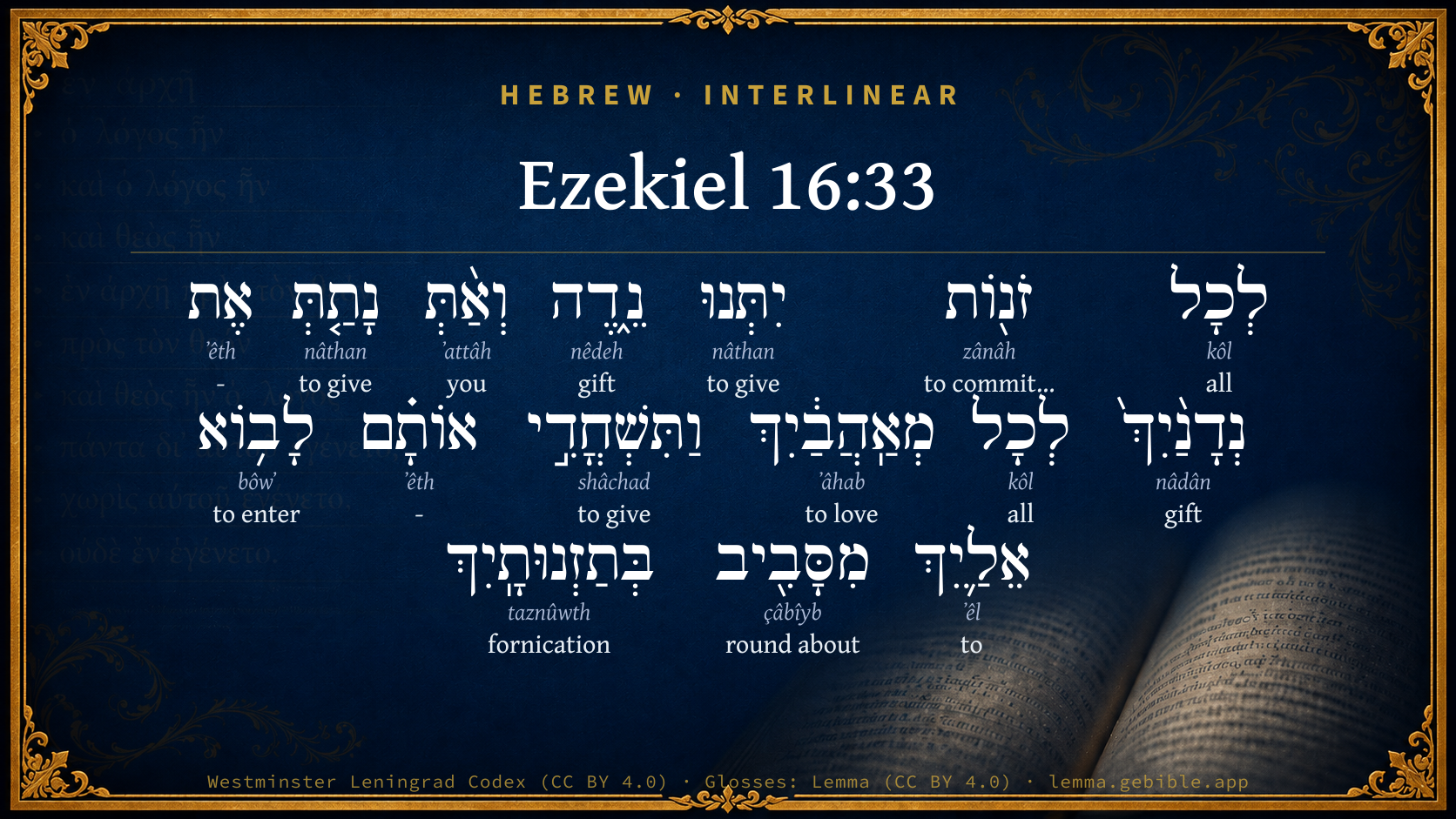
Hebrew (Westminster Leningrad Codex) Ezekiel 16:33 appears in the Hebrew Old Testament. The text above is from the Westminster Leningrad Codex. Each word links to its Strong’s number, a concise gloss, and parsing drawn from the Open Scriptures Hebrew Bible morphology. Click any word for its full Brown-Driver-Briggs (BDB) entry.
Download image
Cite this verse

Ezekiel 16:33 (World English Bible). Public Domain. Lemma interlinear Bible study tool, https://lemma.gebible.app/v/ezekiel/16/33.

Show BibTeX & RIS
BibTeX
RIS
English Translation
They give gifts to all prostitutes; but you give your gifts to all your lovers, and bribe them, that they may come to you on every side for your prostitution.
World English Bible · Public Domain
Highlights
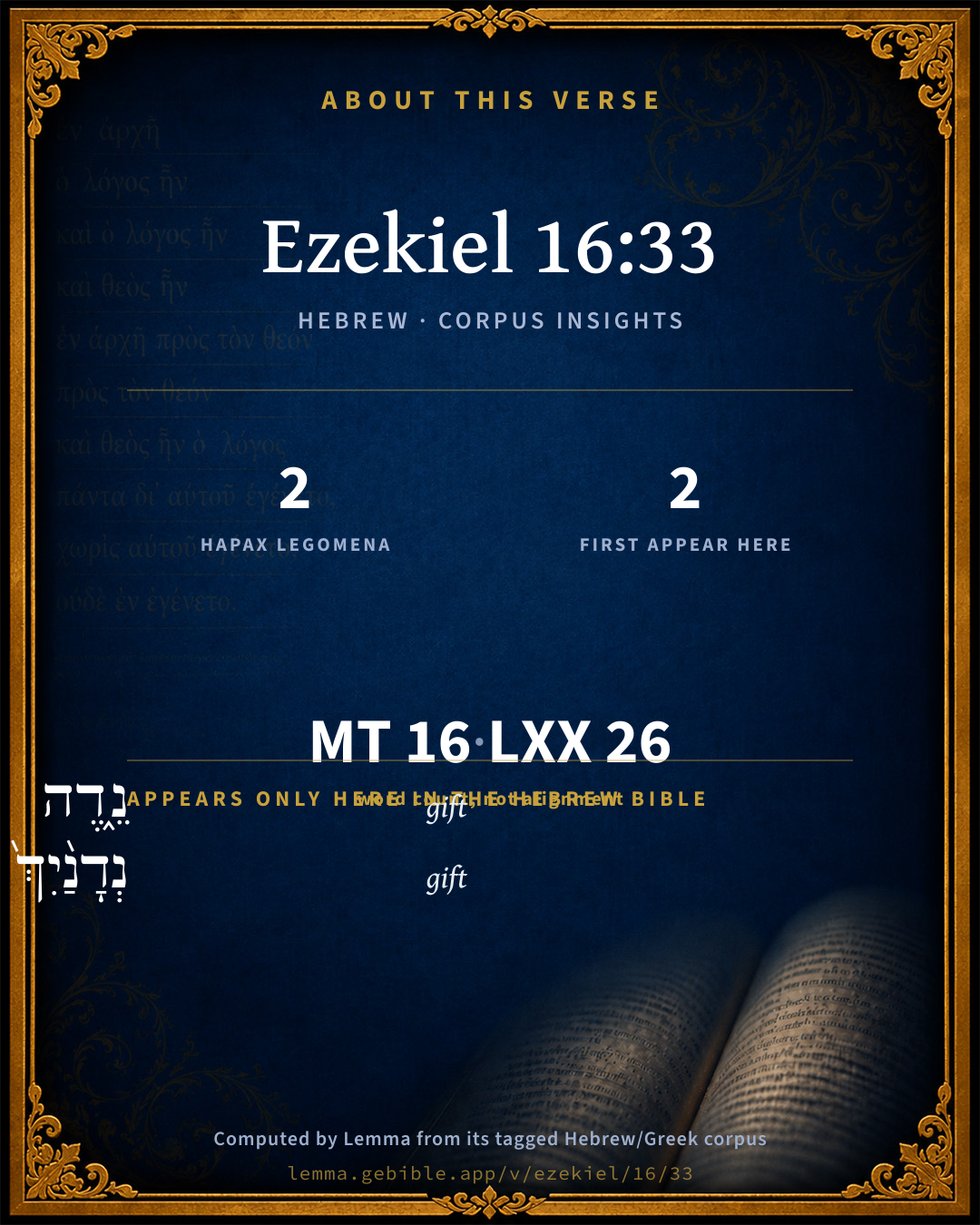
  • 2 hapax legomena — only here in the Hebrew Bible
  • 2 first appearances in the Hebrew Bible
Full analysis ↓
Download a study sheet

One document with this verse’s original text, its word-by-word gloss line, the meaning frame, cross-references with their text, attributed commentary, and full source and license credits — printable, and it pastes into notes with its structure intact.

This verse Autodidact and up

Study sheet (.html) Plain text (.txt)

A passage Seminary Student

Up to 50 verses in one chapter. A passage sheet keeps up to 6 commentary sources and 12 cross-references per verse, in the order this page ranks them, and says so on the sheet whenever that leaves anything out. Ask for a single verse and you get the Autodidact verse sheet above.

Everything on this page stays free to read, with no account — the sheet is a download of what is already on screen, not access to it.

Want to remove ads? Support Godless Engineer
Compare translations 3

The same verse in 3 English versions, stacked beneath the original-language interlinear above. Click any original word for its lexicon entry.

Each is an independent rendering of the whole verse — the interlinear is not word-aligned to these translations.

Highlighted words mark where these versions differ — a whole-verse word diff, not a word-by-word alignment.

  • World English Bible Public Domain
    They give gifts to all prostitutes; but you give your gifts to all your lovers, and bribe them, that they may come to you on every side for your prostitution.
  • King James Version Public Domain
    They give gifts to all whores: but thou givest thy gifts to all thy lovers, and hirest them, that they may come unto thee on every side for thy whoredom.
  • unfoldingWord Literal Text CC BY-SA 4.0
    People give payment to every prostitute, but you give your wages to all your lovers and bribe them to come to you from all around for your acts of prostitution.

unfoldingWord Literal Text — © unfoldingWord, licensed CC BY-SA 4.0. Word-aligned USFM3 via Door43 (git.door43.org/unfoldingWord/en_ult).

Versions to compare (up to 4)

3 of 4 selected

Show all 18 translations

Every available English version of this verse, each an independent rendering of the whole verse.

  • World English Bible Public Domain
    They give gifts to all prostitutes; but you give your gifts to all your lovers, and bribe them, that they may come to you on every side for your prostitution.
  • Berean Standard Bible Public Domain
    Men give gifts to all their prostitutes, but you gave gifts to all your lovers. You bribed them to come to you from everywhere for your illicit favors.
  • Majority Standard Bible Public Domain
    Men give gifts to all their prostitutes, but you gave gifts to all your lovers. You bribed them to come to you from everywhere for your illicit favors.
  • King James Version Public Domain
    They give gifts to all whores: but thou givest thy gifts to all thy lovers, and hirest them, that they may come unto thee on every side for thy whoredom.
  • American Standard Version (1901) Public Domain
    They give gifts to all harlots; but thou givest thy gifts to all thy lovers, and bribest them, that they may come unto thee on every side for thy whoredoms.
  • Revised Version (1885) Public Domain
    They give gifts to all harlots: but thou gavest thy gifts to all thy lovers, and bribest them, that they may come unto thee on every side for thy whoredoms.
  • Geneva Bible (1599) Public Domain
    They giue giftes to all other whores, but thou giuest giftes vnto all thy louers, and rewardest them, that they may come vnto thee on euery side for thy fornication.
  • Douay-Rheims (1899) Public Domain
    Gifts are given to all harlots: but thou hast given hire to all thy lovers, and thou hast given them gifts to come to thee from every side, to commit fornication with thee.
  • Young's Literal Translation Public Domain
    To all whores they give a gift, And -- thou hast given thy gifts to all thy lovers, And dost bribe them to come in unto thee, From round about -- in thy whoredoms.
  • Literal Standard Version CC BY-SA 4.0
    They give a gift to all whores, || And you have given your gifts to all your lovers, || And bribe them to come in to you, || From all around—in your whoredoms.
  • Unlocked Literal Bible CC BY-SA 4.0
    People give payment to every prostitute, but you give your wages to all your lovers and bribe them to come to you from all around for your acts of prostitution.
  • unfoldingWord Literal Text CC BY-SA 4.0
    People give payment to every prostitute, but you give your wages to all your lovers and bribe them to come to you from all around for your acts of prostitution.
  • Darby Bible Public Domain
    They give rewards to all harlots; but thou gavest thy rewards to all thy lovers, and rewardedst them, that they might come unto thee on every side for thy whoredoms.
  • World Messianic Bible Public Domain
    People give gifts to all prostitutes; but you give your gifts to all your lovers, and bribe them, that they may come to you on every side for your prostitution.
  • Webster's Bible Public Domain
    They give gifts to all lewd women: but thou givest thy gifts to all thy lovers, and hirest them, that they may come to thee on every side for thy lewdness.
  • Free Bible Version CC BY-SA 4.0
    Normally all prostitutes are paid, but you were the one giving gifts to all your lovers. You even bribed them to come from all around and have sex with you.
  • Bible in Basic English Public Domain
    They give payment to all loose women: but you give rewards to your lovers, offering them payment so that they may come to you on every side for your cheap love.
  • JPS Tanakh (1917) Public Domain
    to all harlots gifts are given; but thou hast given thy gifts to all thy lovers, and hast bribed them to come unto thee from every side in thy harlotries.

Literal Standard Version (2020), Covenant Press — licensed CC BY-SA 4.0. Text via the HelloAO Bible API (eBible.org). Unlocked Literal Bible (unfoldingWord) — licensed CC BY-SA 4.0. Text via the HelloAO Bible API (eBible.org). unfoldingWord Literal Text — © unfoldingWord, licensed CC BY-SA 4.0. Word-aligned USFM3 via Door43 (git.door43.org/unfoldingWord/en_ult). Free Bible Version, Dr. Jonathan Gallagher — licensed CC BY-SA 4.0. Text via the HelloAO Bible API (eBible.org).

Word by word

More ways to search: Search by grammar → Find every occurrence → Compare this word →

Practice this passage: Drill this verse → Learn its vocabulary →

נֵ֑דֶה
nêdeh
H5078
“gift”
Noun, Common, Masculine, Singular, Absolute
Part of Speech
Noun
Type
Common
Gender
Masculine
Number
Singular
State
Absolute
Full BDB Definition

Origin: from H5077 in the sense of freely flinging money

TWOT: 1303a

gift
  1. לְכָל kôl H3605 “to/for · all of” Preposition + Noun, Common, Masculine, Singular, Construct
  2. זֹנ֖וֹת zânâh H2181 “committing fornication” Verb, Qal, Participle Active, Feminine, Plural, Absolute
  3. יִתְּנוּ nâthan H5414 “to give” Verb, Qal, Imperfect, 3rd Person, Masculine, Plural
  4. וְאַ֨תְּ ʼattâh H859 “and · you” Conjunction + Pronoun, Personal, 2nd Person, Feminine, Singular
  5. נָתַ֤תְּ nâthan H5414 “to give” Verb, Qal, Perfect, 2nd Person, Feminine, Singular
  6. אֶת ʼêth H853 “-” Particle, Direct Object
  7. נְדָנַ֨יִךְ֙ nâdân H5083 “gifts · your” Noun, Common, Masculine, Plural, Construct + Suffix, Personal, 2nd Person, Feminine, Singular
  8. לְכָל kôl H3605 “to/for · all of” Preposition + Noun, Common, Masculine, Singular, Construct
  9. מְאַֽהֲבַ֔יִךְ ʼâhab H157 “loving · you” Verb, Piel, Participle Active, Masculine, Plural, Construct + Suffix, Personal, 2nd Person, Feminine, Singular
  10. וַתִּשְׁחֳדִ֣י shâchad H7809 “and · to give” Conjunction + Verb, Qal, Sequential Imperfect, 2nd Person, Feminine, Singular
  11. אוֹתָ֗ם ʼêth H853 “- · them” Particle, Direct Object + Suffix, Personal, 3rd Person, Masculine, Plural
  12. לָב֥וֹא bôwʼ H935 “to enter” Preposition + Verb, Qal, Infinitive Construct
  13. אֵלַ֛יִךְ ʼêl H413 “to · you” Preposition + Suffix, Personal, 2nd Person, Feminine, Singular
  14. מִסָּבִ֖יב çâbîyb H5439 “from · round about” Preposition + Noun, Common, Both, Singular, Absolute
  15. בְּתַזְנוּתָֽיִךְ taznûwth H8457 “in/at · fornications · your” Preposition + Noun, Common, Feminine, Plural, Construct + Suffix, Personal, 2nd Person, Feminine, Singular

About this verse

These counts appear in no published source. They are computed here, from the morphology-tagged text and Lemma’s own curated glosses. What Lemma adds →

16
words
13
distinct lemmas
Prophets
section

Notable vocabulary

2 hapax legomena — words that appear only here in the entire Hebrew Bible:

  • נֵ֑דֶה gift H5078
  • נְדָנַ֨יִךְ֙ gift H5083

First appearance in Scripture

These words make their first canonical appearance in the Hebrew Bible here:

  • נֵ֑דֶה gift H5078
  • נְדָנַ֨יִךְ֙ gift H5083

Shared distinctive vocabulary

וַתִּשְׁחֳדִ֣י to give H7809 occurs in 2 verses of the Hebrew Bible. Also found in:

Grammatical profile

  • 6 verbs
  • 6 nouns
  • 1 pronoun
  • 1 preposition
  • 2 particles

Verb forms

  • זֹנ֖וֹת Qal · Participle Active
  • יִתְּנוּ Qal · Imperfect
  • נָתַ֤תְּ Qal · Perfect
  • מְאַֽהֲבַ֔יִךְ Piel · Participle Active
  • וַתִּשְׁחֳדִ֣י Qal · Sequential Imperfect
  • לָב֥וֹא Qal · Infinitive Construct

Repetition

Words recur within this verse — often emphatic in Hebrew:

  • לְכָל all H3605 ×2
  • יִתְּנוּ to give H5414 ×2

Hebrew & Septuagint length

In English translation the verse runs 30 words from the Hebrew and 40 from the Septuagint (LXX English) — closely comparable.

A rough comparison of the two English renderings, which tokenize alike — not a word-level alignment.

Word counts can differ between the Hebrew and the Greek without any difference in meaning — e.g. the Hebrew direct-object marker אֵת has no separate Greek word, and Greek often adds the article ὁ.

In the original languages it is 16 Hebrew tokens and 26 Greek tokens — but the two are counted differently (Hebrew bundles its prefixes and suffixes into one token; the Greek is in lemma form), so that isn’t a like-for-like length.

Cross-references

11

Topical passages linked to Ezekiel 16:33 in the Treasury of Scripture Knowledge — connected by theme and wording, ordered by reader-vote popularity; previews shown in the World English Bible.

  • Isaiah 57:9 You went to the king with oil, and did increase your perfumes, and did send your ambassadors far off, and did debase yourself even to Sheol.
  • Hosea 8:9–10 For they have gone up to Assyria, Like a wild donkey wandering alone. Ephraim has hired lovers for himself.
  • Genesis 38:16–18 He turned to her by the way, and said, "Please come, let me come in to you:" for he didn't know that she was his daughter-in-law. She said, "What will you give me, that you may come in to me?"
  • Deuteronomy 23:17–18 There shall be no prostitute of the daughters of Israel, neither shall there be a sodomite of the sons of Israel.
  • Isaiah 30:3 Therefore shall the strength of Pharaoh be your shame, and the refuge in the shadow of Egypt your confusion.
  • Isaiah 30:6–7 The burden of the animals of the South. Through the land of trouble and anguish, from whence come the lioness and the lion, the viper and fiery flying serpent, they carry their riches on the shoulders of young donkeys, and their treasures on the humps of camels, to a people that shall not profit [them].
  • Ezekiel 16:41 They shall burn your houses with fire, and execute judgments on you in the sight of many women; and I will cause you to cease from playing the prostitute, and you shall also give no hire any more.
  • Hosea 2:12 I will lay waste her vines and her fig trees, About which she has said, 'These are my wages that my lovers have given me; And I will make them a forest,' And the animals of the field shall eat them.
  • Joel 3:3 And have cast lots for my people, And have given a boy for a prostitute, And sold a girl for wine, that they may drink.
  • Micah 1:7 All her idols will be beaten to pieces, And all her temple gifts will be burned with fire, And all her images I will destroy; For of the hire of a prostitute has she gathered them, And to the hire of a prostitute shall they return."
  • Luke 15:30 But when this, your son, came, who has devoured your living with prostitutes, you killed the fattened calf for him.'

Cross-references courtesy of OpenBible.info (CC BY 4.0).

Hebrew and Greek witnesses Masoretic Hebrew ↔ Greek Septuagint

The same verse in the two great witnesses to the Old Testament, shown verse-for-verse.

These are two independent witnesses, not word-aligned to each other, and the Septuagint is shown in lemma (dictionary) form.

Hebrew Ezekiel 16:33 Masoretic · Westminster Leningrad Codex

לְכָל זֹנ֖וֹת יִתְּנוּ נֵ֑דֶה וְאַ֨תְּ נָתַ֤תְּ אֶת נְדָנַ֨יִךְ֙ לְכָל מְאַֽהֲבַ֔יִךְ וַתִּשְׁחֳדִ֣י אוֹתָ֗ם לָב֥וֹא אֵלַ֛יִךְ מִסָּבִ֖יב בְּתַזְנוּתָֽיִךְ

They give gifts to all prostitutes; but you give your gifts to all your lovers, and bribe them, that they may come to you on every side for your prostitution.

World English Bible · Public Domain

Greek LXX Ezekiel 16:33 Septuagint · lemma form

πᾶς ὁ ἐκπορνεύω αὐτός προςδίδωμι μίσθωμα καί σύ δίδωμι μίσθωμα πᾶς ὁ ἐραστής σύ καί φορτίζω αὐτός ὁ ἔρχομαι πρός σύ κυκλόθεν ἐν ὁ πορνεία σύ

She has even given rewards to all that went a-whoring after her, and you have given rewards to all your lovers, yes, you did load them with rewards, that they should come to you from every side for your fornication.

LXX2012 (modern English Septuagint) · Public Domain

Hebrew: Westminster Leningrad Codex (CC BY 4.0). Greek: Septuagint (public domain); English from LXX2012 (modern English Septuagint) (Public Domain). How the Septuagint differs from the Hebrew →

Targum (Aramaic paraphrase)

1

The Targum is the ancient Jewish Aramaic paraphrase of the Hebrew Scriptures — an interpretive translation, not the Hebrew text itself. Onkelos (literal) and Pseudo-Jonathan (expansive) render the Torah, and Jonathan the Prophets. Coverage is partial: where no permissively-licensed English translation exists for a verse, only the Aramaic is shown. This is verse-level text, not a word-by-word alignment to the Hebrew.

  1. Targum Jonathan Prophets (Joshua–Malachi)
    לְכָל נַפְקַת בָּרָא יֶהֱבִין אֲגַר וְאַתְּ אַהֲנִית יַת אַגְרִיךְ לְכָל רְחִימָךְ וּשְׁחֵידְתְּ יַתְהוֹן לְמֵיתֵי עֲלָךְ מִסְחוֹר סְחוֹר בְּטַעֲוָתַיִךְ:

    (no public-domain English translation for this verse)

    Targum Jonathan — Aramaic: “Mikraot Gedolot” (public domain). English: “Sefaria Community Translation” (CC0 1.0 (public-domain dedication)); “London "Chaldee Paraphrase," 1871” (public domain). Text via Sefaria.

Commentary

Notes on Ezekiel 16:33 from classic Christian and Jewish commentators (each source and its license shown beneath its notes). The classic Christian expositions comment on the surrounding passage and are grouped to its opening verse, so a note may address several verses; the Jewish commentaries on the Tanakh (Rashi and others) are per-verse, so they appear only where the commentator wrote on this verse.

Lemma curates 59 commentaries, every one of them public domain or Creative Commons licensed, each selected and text-cleaned for this edition rather than reprinted as found. About our sources →

Trapp's Complete Commentary

John Trapp

Eze 16:33 They give gifts to all whores: but thou givest thy gifts to all thy lovers, and hirest them, that they may come unto thee on every side for thy whoredom.

Ver. 33. They give gifts to all whores.] See Eze 16:31. Harlots are cruces and crumenimulgae, saith the comedian, crosses and suck purses. See Luk 15:14.

“ Nuda Venus picta est, nndi pinguntur amores:

Nam quos nuda capit, nudos dimittat oportet. ”

John Trapp, A Commentary or Exposition upon All the Books of the Old and New Testament (1647–1656) — public domain. Text from a community e-Sword module.

Jamieson, Fausset & Brown

Robert Jamieson, A. R. Fausset & David Brown

Israel hired her paramours, instead of being, like other harlots, hired by them; she also followed them without their following her.

Jamieson, Fausset & Brown — Commentary Critical and Explanatory on the Whole Bible (1871) — public domain (CC PDM 1.0). Text via the HelloAO Bible API.

John Calvin's Commentaries

Here the Prophet shows the great folly of the Jews in shamelessly squandering their goods; for gain impels harlots to their occupation: they feel the disgrace of it, but want urges them on. But the Prophet says, that when the Jews committed sin they did it with extravagance, since they spared no expense in attracting their lovers. He pursues the simile which we have had before; for he compares the nation to a perfidious woman who leaves her husband and offers herself to adulterers. We now understand the Prophet’s meaning. It is clear that the Jews did not act thus on purpose, for they thought they would profit by their treaties with the Egyptians and Assyrians’ they were unwilling to serve their idols for nothing, since they hoped for most ample rewards from this their adulterous worship. But the Holy Spirit does not regard either what they wished or hoped for, but speaks of the matter as it was. It is clear, then, that the Jews were very prodigal in their superstitions, and we see this even now in the papacy. Those who grudge even a farthing for the relief of the poor will throw away guineas when they wish to compound for their sins; and there is no end to their extravagance under this madness. The very same rage prevailed among the Jews for which Ezekiel now reproves them. He says, then, that they offered gifts to their lovers; for, as I have said, they were so prodigal in the worship of false gods, that when they desired a treaty with either the Egyptians or Assyrians, they were necessarily loaded with valuable presents; and history bears witness that they entirely exhausted themselves. Lastly, the Prophet here shows that the Jews were so blind, that in leaving God, and devoting themselves to idols, they failed to obtain any advantage. Then, when they implicated themselves in perverse and wicked treaties, he shows that they were so utterly deranged as to deprive themselves of all their goods, and yet to receive nothing but disgrace in return for their extravagance: presents are given to all harlots, but thou bestowest thine. Jerome takes the pronoun passively, meaning the blessings which God had bestowed upon the people: and this passage is like that in Hosea, (Hosea 2:5-8) where God complains that the Jews had profaned the blessings which he had conferred upon them, just as if a wife should bestow on adulterers what she had received from her husband. Foul indeed is this! for a husband thought these would be pledges of chastity when he adorned his wife with precious garments, or enriched her with other presents and ornaments; but when a wife, forgetful of modesty and propriety, throws her husband’s gifts at the feet of adulterers, this is indeed outrageous. Hence this sense does not displease me, although it would be more simple to understand it that the Jews had washed away all their goods. He says, that they had hired their lovers to come in from every side for wickedness. He repeats again what we saw before, that the Jews were abandoned sinners, for some, though impure, are content with a single lover. But as he had before said that the Jews spread their feet widely, so he now adds, that they hired lovers from all sides. Shameful indeed is such conduct in any woman: yet Ezekiel reproves the Jews for this indelicacy, and we saw the reason in yesterday’s lecture. It follows —

John Calvin's Commentaries (1540-1563) — public domain. Text from the Calvin Translation Society English edition (1840s-50s) via the Christian Classics Ethereal Library (ccel.org). Calvin's coverage is partial (roughly two-thirds of the Bible); uncommented books and verses are honest gaps, never fabricated. The 19th-century editor's footnotes and remarks are omitted so the notes are faithfully Calvin's own voice.

Ellicott's Commentary for English Readers

(33) Thou givest thy gifts.—2Ki_16:8-9, may be referred to as an instance in illustration. Ahaz “took the silver and gold that was found in the house of the Lord,” as well as “the treasures of the king’s house,” and used it to secure the alliance of the king of Assyria.

The prophet, having up to this point described the sin, now turns to pronounce the punishment upon Israel (Eze_16:35-52). The same allegory is still preserved, and the punishment is depicted in the same figurative language as the sin. This portion of the prophecy may be subdivided into two parts, in the first of which (Eze_16:35-43) the punishment itself is described in terms taken from the legal punishment of the adulteress and murderess; while in the second (Eze_16:44-52) the justice of this doom is vindicated, especially by a comparison with Samaria on the one side, and with Sodom on the other.

A Bible Commentary for English Readers, edited by Charles John Ellicott (1878–1897) — public domain. Text from a community e-Sword module.

John Gill's Exposition

And the contrary is in thee from other women in thy whoredoms,.... Of which an instance is given before, and another is added, with the repetition of the former:

whereas none followeth thee to commit whoredoms; the Jews followed the examples, customs, and practices of the Gentiles, in worshipping of their idols; but the Gentiles did not follow the Jews, they kept to their own gods, and did not worship the God of Israel; which with respect to their own gods would have been fornication; and whereas it is usual for men to follow after whorish women, and solicit them by gifts and presents, or promises, and not for them to follow the men, court and solicit them; on the other hand, the Jews, who are compared to a whorish woman, followed after their lovers, and not their lovers after them: or, "after thee there was not", or "shall not be fornication" (o); like to thine; it being such as never had been, nor never would be the like again:

and in that thou givest a reward, and no reward is given unto thee,

therefore thou art contrary; to all other lewd women, who take, but give no reward.

(o) "et post te non fornicatio fuit", Pagninus, Montanus; "nec post te fuit sic fornicatum", so some in Vatablus; "post te non erit fornicatio", Calvin.

John Gill's Exposition of the Whole Bible (1746–1763) — public domain (CC PDM 1.0). Text via the HelloAO Bible API.

Albert Barnes' Notes on the Bible

The picture is heightened by the contrast between one who as a prostitute receives hire for her shame, and one who as a wife is so utterly abandoned as to bestow her husband’s goods to purchase her own dishonor. Compare 2Ki 16:8.

Albert Barnes' Notes on the Bible (1834–1885) — public domain. Text from a community e-Sword/MySword module.

Matthew Poole's English Annotations

They, unclean fornicators and adulterers,

give gifts; the word is of a restrictive sense, speaks not any kind of gifts in general, but peculiarly such gifts as are presented by a wooer, or espouser of a woman, with which she is enriched and adorned; and may perhaps imply the arts, pretences, and arguments which are used by loose men to seduce and corrupt virgins; they pretend marriage designed, make presents, and deceive.

To all whores, i.e. to the most of them, it is usually so.

Thy gifts; thy nuptial gifts, which thy generous and bountiful Husband gave thee at the espousals, or on the wedding day. Those gifts which are most highly valued, most carefully preserved, and most unwillingly parted with by all virtuous women, thou most unparalleled adulteress hast given to thy Husband’s greatest enemies, to thy beastly adulterers.

To all thy lovers; thou makest little difference, but, as it happens, any one of thy lewd companions may easily have these gifts of thy hand.

Hirest them, by large gifts, as bribes usually are; and the word used here signifieth, they slight thee, and have no desire after thee. Like despised adulteresses, they would hate thee, but thy bribes change their behaviour, thought not their minds and thoughts of thee.

On every side; women have somewhat of modesty remaining amidst their lewdness for the most part, and if adulteresses, yet have their lovers in some corner or other; but thou, as unsatiable, hast them every where round about thee.

Matthew Poole's English Annotations on the Holy Bible (1683–1685) — public domain. Text from a community e-Sword/MySword module.

Whedon's Commentary on the Bible

Daniel D. Whedon

33. Givest… hirest — Literally, hast given, hast hired.

Daniel D. Whedon (gen. ed.), Commentary on the Old and New Testaments (1874–1909) — public domain. Text from a community e-Sword module.

Rashi

Rabbi Shlomo Yitzchaki (Rashi)

gifts Heb. נֵדֶה, a dowry.

because of your harlotries Because of the great [lust for] harlotry that was in you, you did so.

Rashi on the Tanakh — English translations: “The Judaica Press complete Tanach with Rashi, translated by A. J. Rosenberg” (CC BY 4.0); “Pentateuch with Rashi's commentary by M. Rosenbaum and A.M. Silbermann, 1929-1934” (public domain); “The Metsudah Tanach series, Lakewood, N.J” (CC BY 4.0); and “The Book of Joshua, Metsudah Publications, 1997” (CC BY 4.0). Text via Sefaria.

Lesson kit

Teaching starters — assembled from the data on this page, not authored interpretation. Every prompt links to the verse data it draws on. Edit before teaching.

Ezekiel, in the Prophets, opens this verse with 16 words (13 distinct Hebrew lemmas). Its most distinctive word is nêdeh (“gift”). A historical commentator’s framing appears above. Read the whole chapter for the surrounding context.

Discussion questions

  1. The word nêdeh carries the sense “gift.” How does it shape the verse?
  2. This verse holds 2 words here found nowhere else in the Hebrew Bible. What might the rare words draw attention to?
  3. 2 words here appear for the first time in Scripture. What is being introduced at this debut?
  4. Job 6:22 shares the word «to give» with this verse. How do the two illuminate each other?
  5. “all” occurs 2× in this one verse. What is the effect of the repetition?
  6. The translations on this page render this verse differently — a whole-verse word diff, not a word-by-word alignment. What might account for the different wordings?
  7. The verb «זֹנ֖וֹת» is Qal Participle Active. How does its form color the action?
  8. Reading how Trapp's Complete Commentary and Jamieson, Fausset & Brown read this verse, where do the two commentators agree and where do they part?

Things to notice

  • 2 words in this verse appear nowhere else in the Hebrew Bible.
  • 2 words make their first canonical appearance in Scripture here.
  • This verse counts 16 Hebrew ↔ 26 Greek words.
  • These translations choose different wording for 17 words in this verse.
  • “all” occurs 2× in this single verse.

Reading settings

Reading text

Shown beneath each verse's original-language words.

Old Testament
Old Testament edition

Read the OT as the Masoretic Hebrew (MT) or the Greek Septuagint (LXX).

English shown for the Greek Septuagint (in the Hebrew ↔ Greek comparison).

Comparing translations? Open the Compare panel on any verse page to stack up to four side by side.