
Exodus 8:3

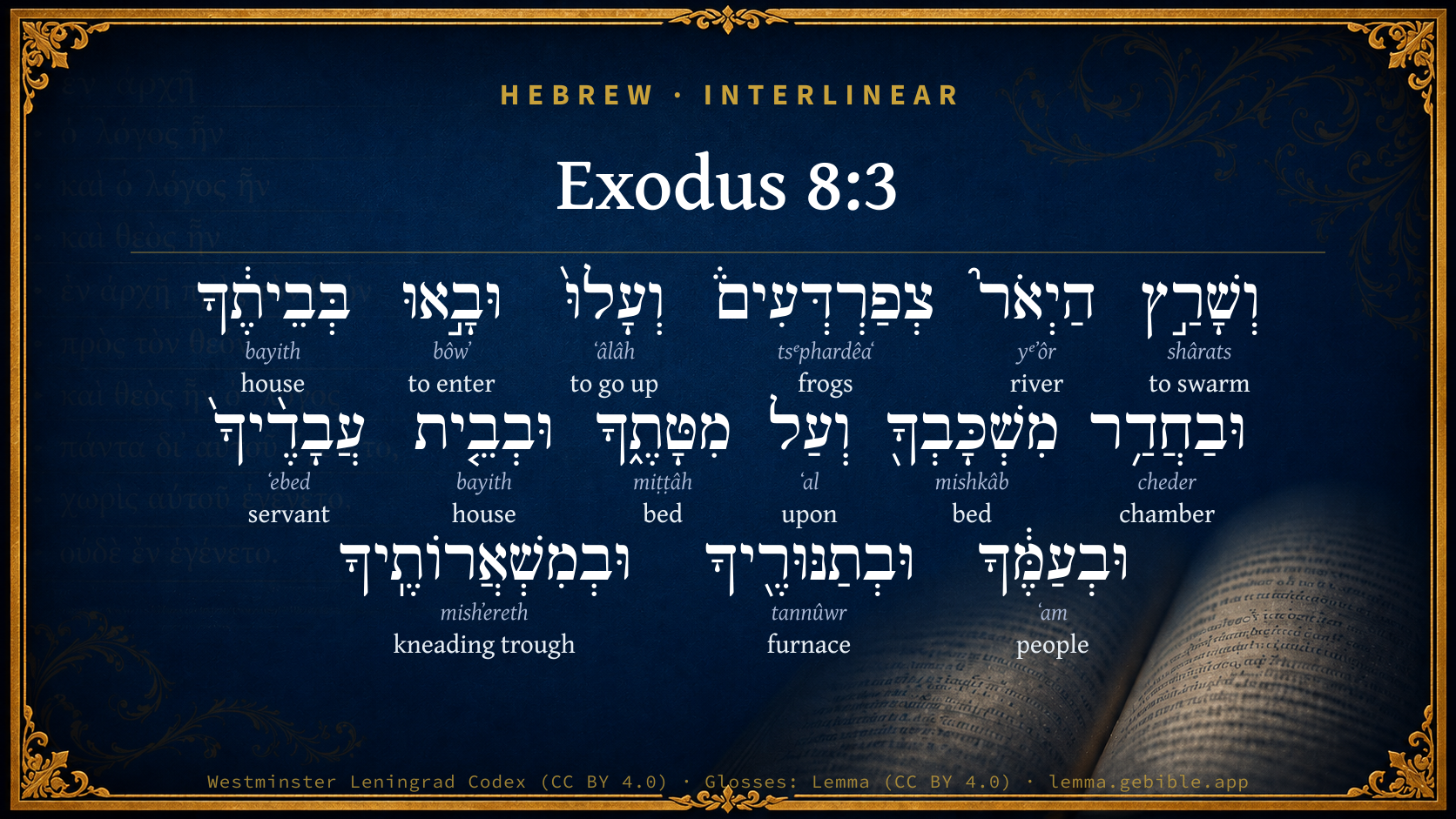
Hebrew (Westminster Leningrad Codex) Exodus 8:3 appears in the Hebrew Old Testament. The text above is from the Westminster Leningrad Codex. Each word links to its Strong’s number, a concise gloss, and parsing drawn from the Open Scriptures Hebrew Bible morphology. Click any word for its full Brown-Driver-Briggs (BDB) entry.
Download image
Cite this verse

Exodus 8:3 (World English Bible). Public Domain. Lemma interlinear Bible study tool, https://lemma.gebible.app/v/exodus/8/3.

Show BibTeX & RIS
BibTeX
RIS
English Translation
and the river shall swarm with frogs, which shall go up and come into your house, and into your bedchamber, and on your bed, and into the house of your servants, and on your people, and into your ovens, and into your kneading-troughs:
World English Bible · Public Domain
Highlights
  • 1 first appearance in the Hebrew Bible
Full analysis ↓
Download a study sheet

One document with this verse’s original text, its word-by-word gloss line, the meaning frame, cross-references with their text, attributed commentary, and full source and license credits — printable, and it pastes into notes with its structure intact.

This verse Autodidact and up

Study sheet (.html) Plain text (.txt)

A passage Seminary Student

Up to 50 verses in one chapter. A passage sheet keeps up to 6 commentary sources and 12 cross-references per verse, in the order this page ranks them, and says so on the sheet whenever that leaves anything out. Ask for a single verse and you get the Autodidact verse sheet above.

Everything on this page stays free to read, with no account — the sheet is a download of what is already on screen, not access to it.

Want to remove ads? Support Godless Engineer
Compare translations 3

The same verse in 3 English versions, stacked beneath the original-language interlinear above. Click any original word for its lexicon entry.

Each is an independent rendering of the whole verse — the interlinear is not word-aligned to these translations.

Highlighted words mark where these versions differ — a whole-verse word diff, not a word-by-word alignment.

  • World English Bible Public Domain
    and the river shall swarm with frogs, which shall go up and come into your house, and into your bedchamber, and on your bed, and into the house of your servants, and on your people, and into your ovens, and into your kneading-troughs:
  • King James Version Public Domain
    And the river shall bring forth frogs abundantly, which shall go up and come into thine house, and into thy bedchamber, and upon thy bed, and into the house of thy servants, and upon thy people, and into thine ovens, and into thy kneadingtroughs:
  • unfoldingWord Literal Text CC BY-SA 4.0
    And frogs will swarm the river, and they will climb, and they will go into your house and in the room of your bed and on your bed and into the house of your servants and among your people and in your ovens and in your kneading bowls,

unfoldingWord Literal Text — © unfoldingWord, licensed CC BY-SA 4.0. Word-aligned USFM3 via Door43 (git.door43.org/unfoldingWord/en_ult).

Versions to compare (up to 4)

3 of 4 selected

Show all 18 translations

Every available English version of this verse, each an independent rendering of the whole verse.

  • World English Bible Public Domain
    and the river shall swarm with frogs, which shall go up and come into your house, and into your bedchamber, and on your bed, and into the house of your servants, and on your people, and into your ovens, and into your kneading-troughs:
  • Berean Standard Bible Public Domain
    The Nile will teem with frogs, and they will come into your palace and up to your bedroom and onto your bed, into the houses of your officials and your people, and into your ovens and kneading bowls.
  • Majority Standard Bible Public Domain
    The Nile will teem with frogs, and they will come into your palace and up to your bedroom and onto your bed, into the houses of your officials and your people, and into your ovens and kneading bowls.
  • King James Version Public Domain
    And the river shall bring forth frogs abundantly, which shall go up and come into thine house, and into thy bedchamber, and upon thy bed, and into the house of thy servants, and upon thy people, and into thine ovens, and into thy kneadingtroughs:
  • American Standard Version (1901) Public Domain
    and the river shall swarm with frogs, which shall go up and come into thy house, and into thy bedchamber, and upon thy bed, and into the house of thy servants, and upon thy people, and into thine ovens, and into thy kneading-troughs:
  • Revised Version (1885) Public Domain
    and the river shall swarm with frogs, which shall go up and come into thine house, and into thy bedchamber, and upon thy bed, and into the house of thy servants, and upon thy people, and into thine ovens, and into thy kneadingtroughs:
  • Geneva Bible (1599) Public Domain
    And the riuer shall scral ful of frogges, which shall goe vp and come into thine house, and into thy chamber, where thou sleepest, and vpon thy bed, and into the house of thy seruants, and vpon thy people, and into thine ouens, and into thy kneading troughes.
  • Douay-Rheims (1899) Public Domain
    And the river shall bring forth an abundance of frogs: which shall come up, and enter into thy house, and thy bedchamber, and upon thy bed, and in the houses of thy servants, and to thy people, and into thy ovens, and into the remains of thy meats;
  • Young's Literal Translation Public Domain
    and the River hath teemed `with' frogs, and they have gone up and gone into thy house, and into the inner-chamber of thy bed, and on thy couch, and into the house of thy servants, and among thy people, and into thine ovens, and into thy kneading-troughs;
  • Literal Standard Version CC BY-SA 4.0
    and the River has teemed [with] frogs, and they have gone up and gone into your house, and into the inner-chamber of your bed, and on your couch, and into the house of your servants, and among your people, and into your ovens, and into your kneading-troughs;
  • Unlocked Literal Bible CC BY-SA 4.0
    The river will swarm with frogs. They will come up and go into your house, your bedroom, and your bed. They will go into your servants' houses. They will go onto your people, into your ovens, and into your kneading bowls.
  • unfoldingWord Literal Text CC BY-SA 4.0
    And frogs will swarm the river, and they will climb, and they will go into your house and in the room of your bed and on your bed and into the house of your servants and among your people and in your ovens and in your kneading bowls,
  • Darby Bible Public Domain
    And the river shall swarm with frogs, and they shall go up and come into thy house, and into thy bedroom, and upon thy bed, and into the house of thy bondmen, and upon thy people, and into thine ovens, and into thy kneading-troughs.
  • World Messianic Bible Public Domain
    The river will swarm with frogs, which will go up and come into your house, and into your bedroom, and on your bed, and into the house of your servants, and on your people, and into your ovens, and into your kneading troughs.
  • Webster's Bible Public Domain
    And the river shall bring forth frogs abundantly, which shall go up and come into thy house, and into thy bed-chamber, and upon thy bed, and into the house of thy servants, and upon thy people, and into thy ovens, and into thy kneading troughs:
  • Free Bible Version CC BY-SA 4.0
    They will swarm out of the Nile, and they will enter your palace and get into your bedroom and jump onto your bed. They will get into the houses of your officials and jump around your people—even into your ovens and breadmaking bowls.
  • Bible in Basic English Public Domain
    The Nile will be full of frogs, and they will come up into your house and into your bedrooms and on your bed, and into the houses of your servants and your people, and into your ovens and into your bread-basins.
  • JPS Tanakh (1917) Public Domain
    (7-28) And the river shall swarm with frogs, which shall go up and come into thy house, and into thy bed-chamber, and upon thy bed, and into the house of thy servants, and upon thy people, and into thine ovens, and into thy kneading-troughs.

Literal Standard Version (2020), Covenant Press — licensed CC BY-SA 4.0. Text via the HelloAO Bible API (eBible.org). Unlocked Literal Bible (unfoldingWord) — licensed CC BY-SA 4.0. Text via the HelloAO Bible API (eBible.org). unfoldingWord Literal Text — © unfoldingWord, licensed CC BY-SA 4.0. Word-aligned USFM3 via Door43 (git.door43.org/unfoldingWord/en_ult). Free Bible Version, Dr. Jonathan Gallagher — licensed CC BY-SA 4.0. Text via the HelloAO Bible API (eBible.org).

Word by word

More ways to search: Search by grammar → Find every occurrence → Compare this word →

Practice this passage: Drill this verse → Learn its vocabulary →

וּבְמִשְׁאֲרוֹתֶֽיךָ
mishʼereth
H4863
“and · in/at · kneading troughs · your”
Conjunction + Preposition + Noun, Common, Feminine, Plural, Construct + Suffix, Personal, 2nd Person, Masculine, Singular
Part of Speech
Conjunction + Preposition + Noun
Type
Common
Gender
Feminine
Number
Plural
State
Construct
Full BDB Definition

Origin: from H7604 in the original sense of swelling

TWOT: 1252

kneading trough or bowl
  1. וְשָׁרַ֣ץ shârats H8317 “and · to swarm” Conjunction + Verb, Qal, Sequential Perfect, 3rd Person, Masculine, Singular
  2. הַיְאֹר֮ yᵉʼôr H2975 “the · river” Particle, Definite Article + Noun, Proper
  3. צְפַרְדְּעִים֒ tsᵉphardêaʻ H6854 “frogs” Noun, Common, Feminine, Plural, Absolute
  4. וְעָלוּ֙ ʻâlâh H5927 “and · to go up” Conjunction + Verb, Qal, Sequential Perfect, 3rd Person, Common, Plural
  5. וּבָ֣אוּ bôwʼ H935 “and · to enter” Conjunction + Verb, Qal, Sequential Perfect, 3rd Person, Common, Plural
  6. בְּבֵיתֶ֔ךָ bayith H1004 “in/at · house · your” Preposition + Noun, Common, Masculine, Singular, Construct + Suffix, Personal, 2nd Person, Masculine, Singular
  7. וּבַחֲדַ֥ר cheder H2315 “and · in/at · chamber of” Conjunction + Preposition + Noun, Common, Masculine, Singular, Construct
  8. מִשְׁכָּבְךָ֖ mishkâb H4904 “bed · your” Noun, Common, Masculine, Singular, Construct + Suffix, Personal, 2nd Person, Masculine, Singular
  9. וְעַל ʻal H5921 “and · upon” Conjunction + Preposition
  10. מִטָּתֶ֑ךָ miṭṭâh H4296 “bed · your” Noun, Common, Feminine, Singular, Construct + Suffix, Personal, 2nd Person, Masculine, Singular
  11. וּבְבֵ֤ית bayith H1004 “and · in/at · house of” Conjunction + Preposition + Noun, Common, Masculine, Singular, Construct
  12. עֲבָדֶ֨יךָ֙ ʻebed H5650 “servants · your” Noun, Common, Masculine, Plural, Construct + Suffix, Personal, 2nd Person, Masculine, Singular
  13. וּבְעַמֶּ֔ךָ ʻam H5971 “and · in/at · people · your” Conjunction + Preposition + Noun, Common, Masculine, Singular, Construct + Suffix, Personal, 2nd Person, Masculine, Singular
  14. וּבְתַנּוּרֶ֖יךָ tannûwr H8574 “and · in/at · furnaces · your” Conjunction + Preposition + Noun, Common, Masculine, Plural, Construct + Suffix, Personal, 2nd Person, Masculine, Singular

About this verse

These counts appear in no published source. They are computed here, from the morphology-tagged text and Lemma’s own curated glosses. What Lemma adds →

15
words
14
distinct lemmas
Pentateuch
section

Notable vocabulary

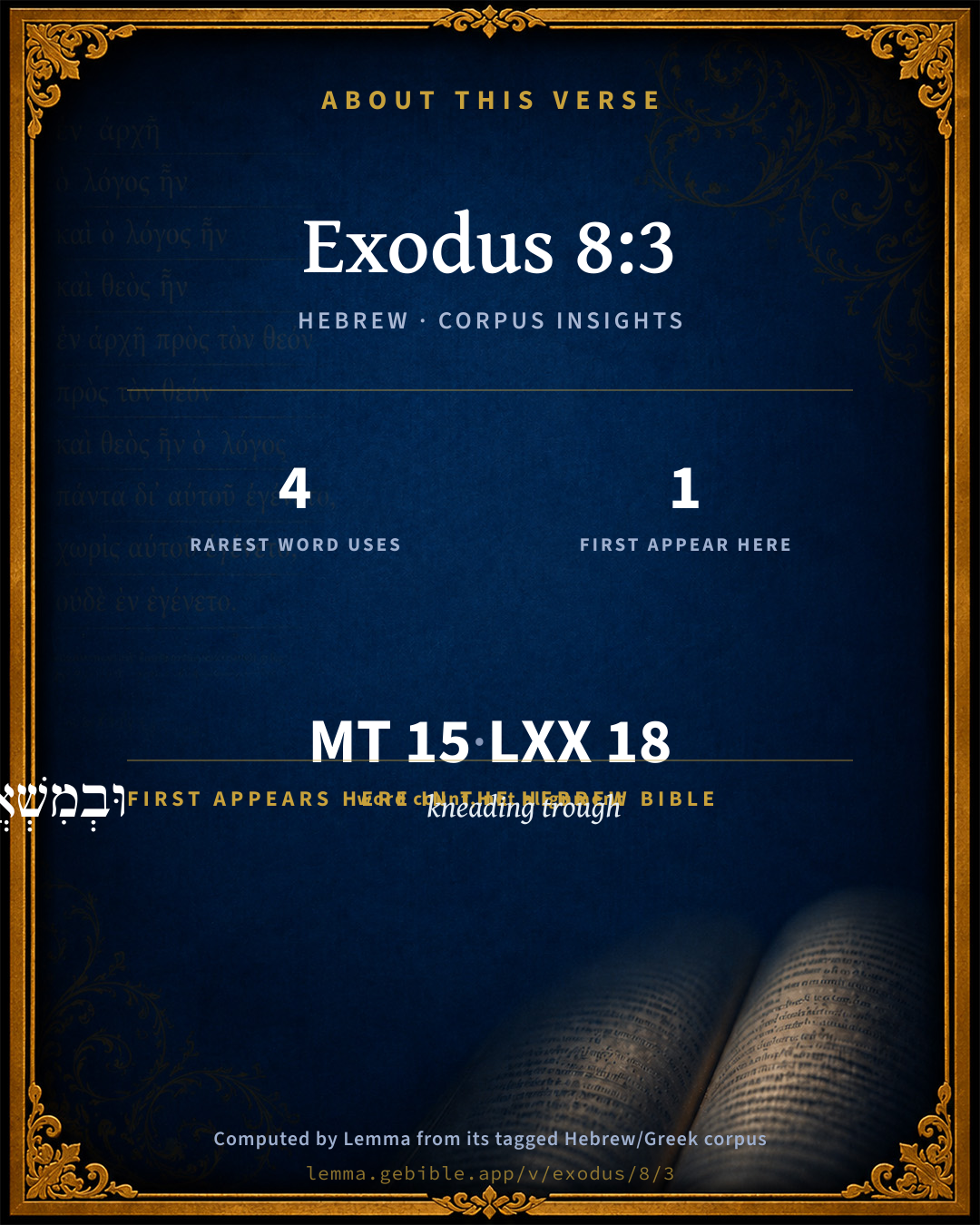
The rarest word here is וּבְמִשְׁאֲרוֹתֶֽיךָ kneading trough H4863 — appearing just 4 times in the whole Hebrew Bible.

First appearance in Scripture

This word makes its first canonical appearance in the Hebrew Bible here:

  • וּבְמִשְׁאֲרוֹתֶֽיךָ kneading trough H4863

Shared distinctive vocabulary

וּבְמִשְׁאֲרוֹתֶֽיךָ kneading trough H4863 occurs in 4 verses of the Hebrew Bible. Also found in:

Grammatical profile

  • 3 verbs
  • 11 nouns
  • 1 preposition

Verb forms

  • וְשָׁרַ֣ץ Qal · Sequential Perfect
  • וְעָלוּ֙ Qal · Sequential Perfect
  • וּבָ֣אוּ Qal · Sequential Perfect

Repetition

A word recurs within this verse — often emphatic in Hebrew:

  • בְּבֵיתֶ֔ךָ house H1004 ×2

Hebrew & Septuagint length

In English translation the verse runs 43 words from the Hebrew and 44 from the Septuagint (LXX English) — closely comparable.

A rough comparison of the two English renderings, which tokenize alike — not a word-level alignment.

Word counts can differ between the Hebrew and the Greek without any difference in meaning — e.g. the Hebrew direct-object marker אֵת has no separate Greek word, and Greek often adds the article ὁ.

In the original languages it is 15 Hebrew tokens and 18 Greek tokens — but the two are counted differently (Hebrew bundles its prefixes and suffixes into one token; the Greek is in lemma form), so that isn’t a like-for-like length.

Cross-references

2

Topical passages linked to Exodus 8:3 in the Treasury of Scripture Knowledge — connected by theme and wording, ordered by reader-vote popularity; previews shown in the World English Bible.

  • Psalms 105:30 Their land swarmed with frogs, Even in the chambers of their kings.
  • Exodus 12:34 The people took their dough before it was leavened, their kneading-troughs being bound up in their clothes on their shoulders.

Cross-references courtesy of OpenBible.info (CC BY 4.0).

Hebrew and Greek witnesses Masoretic Hebrew ↔ Greek Septuagint

The same verse in the two great witnesses to the Old Testament, shown verse-for-verse.

These are two independent witnesses, not word-aligned to each other, and the Septuagint is shown in lemma (dictionary) form.

Hebrew Exodus 8:3 Masoretic · Westminster Leningrad Codex

וְשָׁרַ֣ץ הַיְאֹר֮ צְפַרְדְּעִים֒ וְעָלוּ֙ וּבָ֣אוּ בְּבֵיתֶ֔ךָ וּבַחֲדַ֥ר מִשְׁכָּבְךָ֖ וְעַל מִטָּתֶ֑ךָ וּבְבֵ֤ית עֲבָדֶ֨יךָ֙ וּבְעַמֶּ֔ךָ וּבְתַנּוּרֶ֖יךָ וּבְמִשְׁאֲרוֹתֶֽיךָ

and the river shall swarm with frogs, which shall go up and come into your house, and into your bedchamber, and on your bed, and into the house of your servants, and on your people, and into your ovens, and into your kneading-troughs:

World English Bible · Public Domain

Greek LXX Exodus 8:3 Septuagint · lemma form

ποιέω δέ ὡσαύτως καί ὁ ἐπαοιδός ὁ αἰγύπτιος ὁ φαρμακία αὐτός καί ἀναἄγω ὁ βάτραχος ἐπί γῆ αἴγυπτος

and the river shall teem with frogs, and they shall go up and enter into your houses, and into your bed-chambers, and upon your beds, and upon the houses of your servants, and of your people and on your dough, and on your ovens.

LXX2012 (modern English Septuagint) · Public Domain

On this verse, The Cambridge Bible for Schools and Colleges discusses the Septuagint’s reading. Read the note in Commentary ↓

Hebrew: Westminster Leningrad Codex (CC BY 4.0). Greek: Septuagint (public domain); English from LXX2012 (modern English Septuagint) (Public Domain). How the Septuagint differs from the Hebrew →

Targum (Aramaic paraphrase)

2

The Targum is the ancient Jewish Aramaic paraphrase of the Hebrew Scriptures — an interpretive translation, not the Hebrew text itself. Onkelos (literal) and Pseudo-Jonathan (expansive) render the Torah, and Jonathan the Prophets. Coverage is partial: where no permissively-licensed English translation exists for a verse, only the Aramaic is shown. This is verse-level text, not a word-by-word alignment to the Hebrew.

  1. Targum Onkelos Torah (Genesis–Deuteronomy)
    וַעֲבָדוּ כֵן חָרָשַׁיָא בְּלַחֲשֵׁיהוֹן וְאַסִיקוּ יָת עֻרְדְעָנַיָא עַל אַרְעָא דְמִצְרָיִם:

    (no public-domain English translation for this verse)

    Targum Onkelos — Aramaic: “Onkelos Genesis” (public domain); “Onkelos Exodus” (public domain); “Onkelos Leviticus” (public domain); “Onkelos Numbers” (public domain); “Onkelos Deuteronomy” (public domain). English: “Sefaria Community Translation” (CC0 1.0 (public-domain dedication)); “J.W. Etheridge. The Targums of Onkelos and Jonathan Ben Uzziel on the Pentateuch. London: Longmans, Green, 1862” (public domain). Text via Sefaria.

  2. Targum Pseudo-Jonathan Torah (Genesis–Deuteronomy)
    וְעָבָדוּ הֵיכְדֵין אִיסְטַגְנִינָן בְּלַחְשֵׁיהוֹן וְאַסִיקוּ יַת עוּרְדְעָנַיָא עַל אַרְעָא דְמִצְרָיִם

    And the astrologers did likewise by their burnings, and brought up frogs upon the land of Mizraim.

    Targum Pseudo-Jonathan — Aramaic: “Targum Jonathan on Genesis” (public domain); “Targum Jonathan on Exodus” (public domain); “Targum Jonathan on Leviticus” (public domain); “Targum Jonathan on Numbers” (public domain); “Targum Jonathan on Deuteronomy” (public domain). English: “The Targum of Jonathan ben Uzziel, trans. J. W. Etheridge, London, 1862” (public domain). Text via Sefaria.

Commentary

Notes on Exodus 8:3 from classic Christian and Jewish commentators (each source and its license shown beneath its notes). The classic Christian expositions comment on the surrounding passage and are grouped to its opening verse, so a note may address several verses; the Jewish commentaries on the Tanakh (Rashi and others) are per-verse, so they appear only where the commentator wrote on this verse.

Lemma curates 59 commentaries, every one of them public domain or Creative Commons licensed, each selected and text-cleaned for this edition rather than reprinted as found. About our sources →

Trapp's Complete Commentary

John Trapp

Exo 8:3 And the river shall bring forth frogs abundantly, which shall go up and come into thine house, and into thy bedchamber, and upon thy bed, and into the house of thy servants, and upon thy people, and into thine ovens, and into thy kneadingtroughs:

Ver. 3. And the river shall bring forth frogs.] Instead of fishes. Thus the first and this second plague are about the water; the third and fourth about the earth; the five next about the air; and the last about man.

John Trapp, A Commentary or Exposition upon All the Books of the Old and New Testament (1647–1656) — public domain. Text from a community e-Sword module.

Geneva Bible (1599)

Geneva Bible translators

Or, upon thy dough, or into thine ambries.

Geneva Bible (1599) marginal notes — public domain. Text via Bolls.life.

Jamieson, Fausset & Brown

Robert Jamieson, A. R. Fausset & David Brown

bedchamber . . . bed--mats strewed on the floor as well as more sumptuous divans of the rich.

ovens--holes made in the ground and the sides of which are plastered with mortar.

kneading-troughs--Those used in Egypt were bowls of wicker or rush work. What must have been the state of the people when they could find no means of escape from the cold, damp touch and unsightly presence of the frogs, as they alighted on every article and vessel of food!

Jamieson, Fausset & Brown — Commentary Critical and Explanatory on the Whole Bible (1871) — public domain (CC PDM 1.0). Text via the HelloAO Bible API.

Adam Clarke's Commentary

Verse 3. The river shall bring forth frogs abundantly] The river Nile, which was an object of their adoration, was here one of the instruments of their punishment. The expression, bring forth abundantly, not only shows the vast numbers of those animals, which should now infest the land, but it seems also to imply that all the spawn or ova of those animals which were already in the river and marshes, should be brought miraculously to a state of perfection. We may suppose that the animals were already in an embryo existence, but multitudes of them would not have come to a state of perfection had it not been for this miraculous interference. This supposition will appear the more natural when it is considered that the Nile was remarkable for breeding frogs, and such other animals as are principally engendered in such marshy places as must be left in the vicinity of the Nile after its annual inundations.

Into thine ovens] In various parts of the east, instead of what we call ovens they dig a hole in the ground, in which they insert a kind of earthen pot, which having sufficiently heated, they stick their cakes to the inside, and when baked remove them and supply their places with others, and so on. To find such places full of frogs when they came to heat them, in order to make their bread, must be both disgusting and distressing in the extreme.

Adam Clarke's Commentary on the Bible (1810–1826) — public domain. Text from a community e-Sword/MySword module.

The Cambridge Bible for Schools and Colleges

gen. ed. J. J. S. Perowne

3. The frogs will not only swarm in the river, but fill every part of the houses in Egypt, and even climb up upon the person (v. 4).

frogs] except in the present context, mentioned in the OT. only Psa_78:45; Psa_105:30, with reference to this plague.

the house] read probably, with LXX. Sam., the houses.

upon thy people] read, with LXX., of thy people: ‘upon’ follows in v. 4.

ovens] The ‘oven’ (tannûr) was a portable earthenware stove, about 3 ft. high, of the shape of a truncated cone, heated by the burning embers being placed in it at the bottom. Ovens of this kind are still in use in the East. See DB. i. 318a; and, for an illustration, Whitehouse, Primer of Heb. Antiquities, p. 73. So Gen_15:17 (‘furnace’), Lev_2:4 al.

kneading-bowls] not ‘troughs,’ but shallow wooden bowls, such as are still used for the purpose by the Arabs. So Exo_12:34, Deu_28:5; Deu_28:17†.

The Cambridge Bible for Schools and Colleges (gen. ed. J. J. S. Perowne; Cambridge University Press, 1878–1918) — public domain. Text from a community e-Sword module.

John Gill's Exposition

And the river shall bring forth frogs abundantly,.... The river Nile; and though water, and watery places, naturally produce these creatures, yet not in such vast quantities as to cover a whole country, and so large an one as Egypt, and this done at once, immediately; for they were all produced instantaneously, and in one day were spread all over the nation, and removed the next: and besides what follows is equally miraculous:

which shall go up and come into thine house; which though they may come up out of rivers, and be upon the banks and the meadows adjacent, yet are never known to come into houses, and especially into bedchambers and other places after mentioned, being not a bold but timorous creature, and shuns the sight and company of men; but these came even into the royal palace, nor could his guards keep them out:

and into thy bedchamber, and upon thy bed; and by their leaping upon him, and croaking in his ears, disturb his rest:

and into the house of thy servants, and upon thy people both nobles and common people, and not only get into their houses, but upon their persons, on their hands when about their business, on their laps, and into their bosoms, as they sat; which must be very offensive and troublesome to them, what with their ugly shape, croaking noise and filthy smell, and the disagreeable touch of them, leaping on them, and even upon their food, and all vessels used for the same, which must make it very nauseous and distasteful to them:

and into thy ovens; where they baked their bread, and would be now hindered from the use of them:

and into thy kneadingtroughs; where they kneaded their dough, and made it into loaves, and prepared it for the oven; or the "dough" (r) itself, which they leaped upon and licked, and made it loathsome for use.

(r) "in tuas pastas", Pagninus; "in farinam tuam aquis conspersam", Tigurine version; "in reliquiis ciborum tuorum", V. L.

John Gill's Exposition of the Whole Bible (1746–1763) — public domain (CC PDM 1.0). Text via the HelloAO Bible API.

Albert Barnes' Notes on the Bible

Into thine house - This appears to have been special to the plague, as such. It was especially the visitation which would be felt by the scrupulously-clean Egyptians.

Kneadingtroughs - Not dough, as in the margin. See Exo 12:34.

Albert Barnes' Notes on the Bible (1834–1885) — public domain. Text from a community e-Sword/MySword module.

Haydock's Catholic Bible Commentary

Frogs, not by a new creation; but the spawn was miraculously brought to maturity. (Calmet) --- Angels, or a divine instinct, brought them to infest all places; and thus they became a more grievous plague than that of blood. (Menochius)

George Leo Haydock (1774–1849), Haydock's Catholic Family Bible and Commentary, 1859 edition — public domain. Excludes Psalms (Douay-Rheims chapter numbering differs from Protestant) and Deuterocanonical books (Catholic canon only).

Matthew Poole's English Annotations

The river; under which are comprehended all other rivers, streams, and ponds, as appears from Exo 8:5. But the river Nilus is mentioned, because God would make that an instrument of their misery in which they most gloried, Eze 29:3, and to which they gave divine honours, and which was the instrument of their cruelty against the Israelites, Exo 1:22.

Into thy bed-chamber; either because God made the doors and windows to fly open, which it is easy to believe concerning God, seeing that this hath been many times done by evil angels; or because whensoever men entered into any house, or any room of their house, which their occasions would oft force them to do, the frogs, being always at their heels in great numbers, would go in with them. This plague was worse than the former, because it was more constant and more general; for the former was only in the waters, and did only molest them when they went to drink or use the water; but this infected all liquors, and all places, and at all times, and annoyed all their senses with their filthy substance, and shape, and noise, and stink, and mingled themselves with their meats, and sauces, and drinks, and crawling into their beds made them restless. And many of them probably were of a more ugly shape and infectious nature than ordinary.

Matthew Poole's English Annotations on the Holy Bible (1683–1685) — public domain. Text from a community e-Sword/MySword module.

Whedon's Commentary on the Bible

Daniel D. Whedon

3. Into thine house, and into thy bedchamber — The Egyptian house was built around a rectangular court, which was paved, and open to the sky, often containing trees, and generally a tank or fountain. See notes on Matthew, pp. 121 and 326. The poorer houses had only a basement story, or ground floor, but those of a better class had store rooms, offices, etc., in the basement, and above these were the parlours and sleeping chambers. There was often an additional story in one part on which was a terrace covered with an awning, or a light roof supported on columns, where the ladies of the family sat at work during the day, and where the master of the house took his, afternoon nap. See annexed cut. The reed-like columns with lotus capitals, and the disregard of perspective in showing the end of the house, are especially noticeable as illustrating Egyptian architecture and drawing.

Into thine ovens, and into thy kneading troughs — The Egyptian oven was a jar of clay, or a jar-like structure built up from the ground, about three feet high, and widening toward the bottom, there being a hole in the side for the extraction of the ashes. It was heated by making a fire within it, and the dough was spread on the inside and on the outside. The accompanying cuts, from a representation in a Theban tomb, illustrate the mode of kneading the dough, which was done both with hands and feet, and of carrying the cakes to the oven, which is now lighted.

Daniel D. Whedon (gen. ed.), Commentary on the Old and New Testaments (1874–1909) — public domain. Text from a community e-Sword module.

The Pulpit Commentary

The river shall bring forth frogs. The frogs do not often come directly out of the river. They are bred in the pools and marshes which the Nile leaves as it is retiring. These, however, may be viewed as detached fragments of the river. Thine house thy bed-chamber thy bed. The extreme cleanliness of the Egyptians (Heb 2:37) rendered this visitation peculiarly disagreeable to them. The frogs under ordinary circumstances do not think of entering houses. Ovens in Egypt were probably baking-pans. These were heated from within by a fire of wood, which was withdrawn after a time and the dough attached by pressure to the interior of the vessels. Kneading-troughs were vessels in which the dough was prepared. Both these and ovens are represented in the Egyptian tombs. (See Rosellini," Mon. Civ." pl: 84, 85.)

The Pulpit Commentary (1880–1919), ed. H.D.M. Spence-Jones & Joseph S. Exell — public domain. Text from a community e-Sword module.

John Wesley's Explanatory Notes

The River - Nile. Under which are comprehended all other rivers and waters.

John Wesley, Explanatory Notes Upon the Whole Bible (1754–1765) — public domain. Text via the GEBible commentary corpus.

Lesson kit

Teaching starters — assembled from the data on this page, not authored interpretation. Every prompt links to the verse data it draws on. Edit before teaching.

Exodus, in the Pentateuch, opens this verse with 15 words (14 distinct Hebrew lemmas). Its most distinctive word is mishʼereth (“kneading trough”). A historical commentator’s framing appears above. Read the whole chapter for the surrounding context.

Discussion questions

  1. How does “kneading trough” (mishʼereth) shape what this verse is saying?
  2. This is the first place “kneading trough” appears in Scripture (first appears here). What does its debut here establish?
  3. How does Exodus 12:34, which shares the word «kneading trough», read alongside this verse?
  4. What does the repetition of “house” (2× in this one verse) do in this verse?
  5. These translations render this verse differently; the difference is in the English rendering, not the original. What questions does that raise?
  6. «וְשָׁרַ֣ץ» is a Qal Sequential Perfect verb. How does that grammatical form shape the action described?
  7. Compare how Trapp's Complete Commentary and Geneva Bible (1599) read this verse. Where do they agree or differ?

Things to notice

Reading settings

Reading text

Shown beneath each verse's original-language words.

Old Testament
Old Testament edition

Read the OT as the Masoretic Hebrew (MT) or the Greek Septuagint (LXX).

English shown for the Greek Septuagint (in the Hebrew ↔ Greek comparison).

Comparing translations? Open the Compare panel on any verse page to stack up to four side by side.