
Daniel 8:17

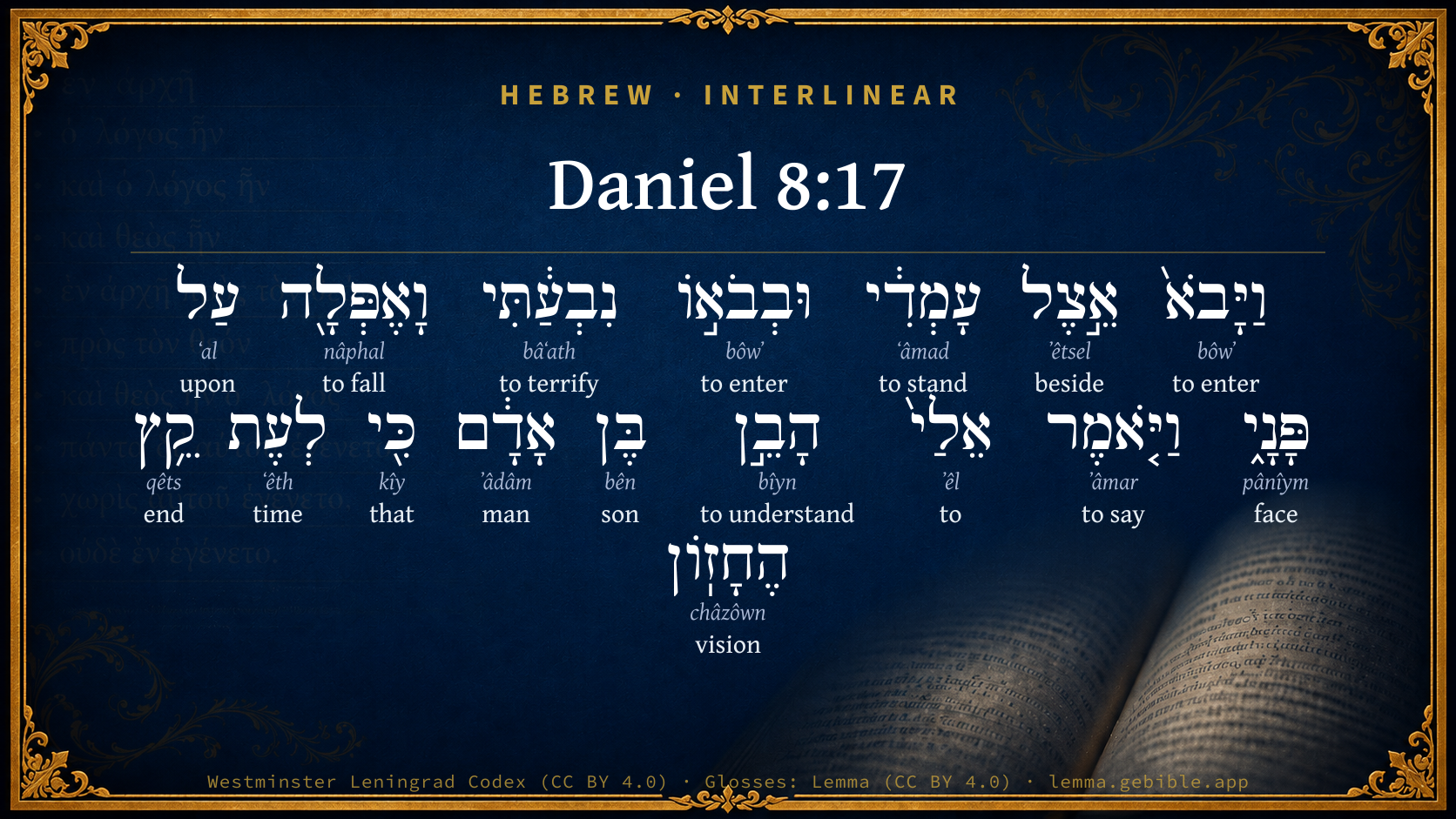
Hebrew (Westminster Leningrad Codex) Daniel 8:17 appears in the Hebrew Old Testament. The text above is from the Westminster Leningrad Codex. Each word links to its Strong’s number, a concise gloss, and parsing drawn from the Open Scriptures Hebrew Bible morphology. Click any word for its full Brown-Driver-Briggs (BDB) entry.
Download image
Cite this verse

Daniel 8:17 (World English Bible). Public Domain. Lemma interlinear Bible study tool, https://lemma.gebible.app/v/daniel/8/17.

Show BibTeX & RIS
BibTeX
RIS
English Translation
So he came near where I stood; and when he came, I was frightened, and fell on my face: but he said to me, Understand, son of man; for the vision belongs to the time of the end.
World English Bible · Public Domain
Download a study sheet

One document with this verse’s original text, its word-by-word gloss line, the meaning frame, cross-references with their text, attributed commentary, and full source and license credits — printable, and it pastes into notes with its structure intact.

This verse Autodidact and up

Study sheet (.html) Plain text (.txt)

A passage Seminary Student

Up to 50 verses in one chapter. A passage sheet keeps up to 6 commentary sources and 12 cross-references per verse, in the order this page ranks them, and says so on the sheet whenever that leaves anything out. Ask for a single verse and you get the Autodidact verse sheet above.

Everything on this page stays free to read, with no account — the sheet is a download of what is already on screen, not access to it.

Want to remove ads? Support Godless Engineer
Compare translations 3

The same verse in 3 English versions, stacked beneath the original-language interlinear above. Click any original word for its lexicon entry.

Each is an independent rendering of the whole verse — the interlinear is not word-aligned to these translations.

Highlighted words mark where these versions differ — a whole-verse word diff, not a word-by-word alignment.

  • World English Bible Public Domain
    So he came near where I stood; and when he came, I was frightened, and fell on my face: but he said to me, Understand, son of man; for the vision belongs to the time of the end.
  • King James Version Public Domain
    So he came near where I stood: and when he came, I was afraid, and fell upon my face: but he said unto me, Understand, O son of man: for at the time of the end shall be the vision.
  • unfoldingWord Literal Text CC BY-SA 4.0
    So he came near where I stood. When he came, I was frightened and fell on my face. But he said to me, “Understand, O son of man, that the vision is for the time of the end.”

unfoldingWord Literal Text — © unfoldingWord, licensed CC BY-SA 4.0. Word-aligned USFM3 via Door43 (git.door43.org/unfoldingWord/en_ult).

Versions to compare (up to 4)

3 of 4 selected

Show all 18 translations

Every available English version of this verse, each an independent rendering of the whole verse.

  • World English Bible Public Domain
    So he came near where I stood; and when he came, I was frightened, and fell on my face: but he said to me, Understand, son of man; for the vision belongs to the time of the end.
  • Berean Standard Bible Public Domain
    As he came near to where I stood, I was terrified and fell facedown. “Son of man,” he said to me, “understand that the vision concerns the time of the end.”
  • Majority Standard Bible Public Domain
    As he came near to where I stood, I was terrified and fell facedown. “Son of man,” he said to me, “understand that the vision concerns the time of the end.”
  • King James Version Public Domain
    So he came near where I stood: and when he came, I was afraid, and fell upon my face: but he said unto me, Understand, O son of man: for at the time of the end shall be the vision.
  • American Standard Version (1901) Public Domain
    So he came near where I stood; and when he came, I was affrighted, and fell upon my face: but he said unto me, Understand, O son of man; for the vision belongeth to the time of the end.
  • Revised Version (1885) Public Domain
    So he came near where I stood; and when he came, I was affrighted, and fell upon my face: but he said unto me, Understand, O son of man; for the vision belongeth to the time of the end.
  • Geneva Bible (1599) Public Domain
    So he came where I stood: and when hee came, I was afraide, and fell vpon my face: but he sayd vnto me, Vnderstand, O sonne of man: for in the last time shalbe the vision.
  • Douay-Rheims (1899) Public Domain
    And he came and stood near where I stood: and when he was come, I fell on my face trembling, and he said to me: Understand, O son of man, for in the time of the end the vision shall be fulfilled.
  • Young's Literal Translation Public Domain
    And he cometh in near my station, and at his coming in I have been afraid, and I fall on my face, and he saith unto me: Understand, son of man, for at the time of the end `is' the vision.
  • Literal Standard Version CC BY-SA 4.0
    And he comes in near my station, and at his coming in I have been afraid, and I fall on my face, and he says to me: Understand, son of man, for at the time of the end [is] the vision.
  • Unlocked Literal Bible CC BY-SA 4.0
    So he came near where I stood. When he came, I was frightened and prostrated myself on the ground. He said to me, “Understand, son of man, that the vision is for the time of the end.”
  • unfoldingWord Literal Text CC BY-SA 4.0
    So he came near where I stood. When he came, I was frightened and fell on my face. But he said to me, “Understand, O son of man, that the vision is for the time of the end.”
  • Darby Bible Public Domain
    And he came near where I stood; and when he came, I was afraid, and fell on my face; and he said unto me, Understand, son of man; for the vision is for the time of the end.
  • World Messianic Bible Public Domain
    So he came near where I stood; and when he came, I was frightened, and fell on my face; but he said to me, “Understand, son of man, for the vision belongs to the time of the end.”
  • Webster's Bible Public Domain
    So he came near where I stood: and when he came, I was afraid, and fell upon my face: but he said to me, Understand, O son of man: for at the time of the end shall be the vision.
  • Free Bible Version CC BY-SA 4.0
    As he approached me, I was terrified and fell facedown before him. “Son of man,” he told me, “You need to understand that this vision refers to the time of the end.”
  • Bible in Basic English Public Domain
    So he came and took his place near where I was; and when he came, I was full of fear and went down on my face: but he said to me, Let it be clear to you, O son of man; for the vision has to do with the time of the end.
  • JPS Tanakh (1917) Public Domain
    So he came near where I stood; and when he came, I was terrified, and fell upon my face; but he said unto me: 'Understand, O son of man; for the vision belongeth to the time of the end.'

Literal Standard Version (2020), Covenant Press — licensed CC BY-SA 4.0. Text via the HelloAO Bible API (eBible.org). Unlocked Literal Bible (unfoldingWord) — licensed CC BY-SA 4.0. Text via the HelloAO Bible API (eBible.org). unfoldingWord Literal Text — © unfoldingWord, licensed CC BY-SA 4.0. Word-aligned USFM3 via Door43 (git.door43.org/unfoldingWord/en_ult). Free Bible Version, Dr. Jonathan Gallagher — licensed CC BY-SA 4.0. Text via the HelloAO Bible API (eBible.org).

Word by word

More ways to search: Search by grammar → Find every occurrence → Compare this word →

Practice this passage: Drill this verse → Learn its vocabulary →

נִבְעַ֔תִּי
bâʻath
H1204
“to terrify”
Verb, Niphal, Perfect, 1st Person, Common, Singular
Part of Speech
Verb
Stem
Niphal
Form
Perfect
Person
1st Person
Gender
Common
Number
Singular
Full BDB Definition

Origin: a primitive root

TWOT: 265

to terrify, startle, fall upon, dismay, be overtaken by sudden terror - (Niphal) to be terrified - (Piel) - to fall upon, overwhelm - to terrify
  1. וַיָּבֹא֙ bôwʼ H935 “and · to enter” Conjunction + Verb, Qal, Sequential Imperfect, 3rd Person, Masculine, Singular
  2. אֵ֣צֶל ʼêtsel H681 “beside” Preposition
  3. עָמְדִ֔י ʻâmad H5975 “standing · my” Noun, Common, Masculine, Singular, Construct + Suffix, Personal, 1st Person, Common, Singular
  4. וּבְבֹא֣וֹ bôwʼ H935 “and · in/at · to enter · him” Conjunction + Preposition + Verb, Qal, Infinitive Construct + Suffix, Personal, 3rd Person, Masculine, Singular
  5. וָאֶפְּלָ֖ה nâphal H5307 “and · to fall” Conjunction + Verb, Qal, Sequential Imperfect, 1st Person, Common, Singular + Suffix, h
  6. עַל ʻal H5921 “upon” Preposition
  7. פָּנָ֑י pânîym H6440 “face(s) · my” Noun, Common, Both, Plural, Construct + Suffix, Personal, 1st Person, Common, Singular
  8. וַיֹּ֤אמֶר ʼâmar H559 “and · to say” Conjunction + Verb, Qal, Sequential Imperfect, 3rd Person, Masculine, Singular
  9. אֵלַי֙ ʼêl H413 “to · me” Preposition + Suffix, Personal, 1st Person, Common, Singular
  10. הָבֵ֣ן bîyn H995 “understand” Verb, Hiphil, Imperative, 2nd Person, Masculine, Singular
  11. בֶּן bên H1121 “son of” Noun, Common, Masculine, Singular, Construct
  12. אָדָ֔ם ʼâdâm H120 “man” Noun, Common, Masculine, Singular, Absolute
  13. כִּ֖י kîy H3588 “that” Conjunction
  14. לְעֶת ʻêth H6256 “to/for · time of” Preposition + Noun, Common, Both, Singular, Construct
  15. קֵ֥ץ qêts H7093 “end” Noun, Common, Masculine, Singular, Absolute
  16. הֶחָזֽוֹן châzôwn H2377 “the · vision” Particle, Definite Article + Noun, Common, Masculine, Singular, Absolute

About this verse

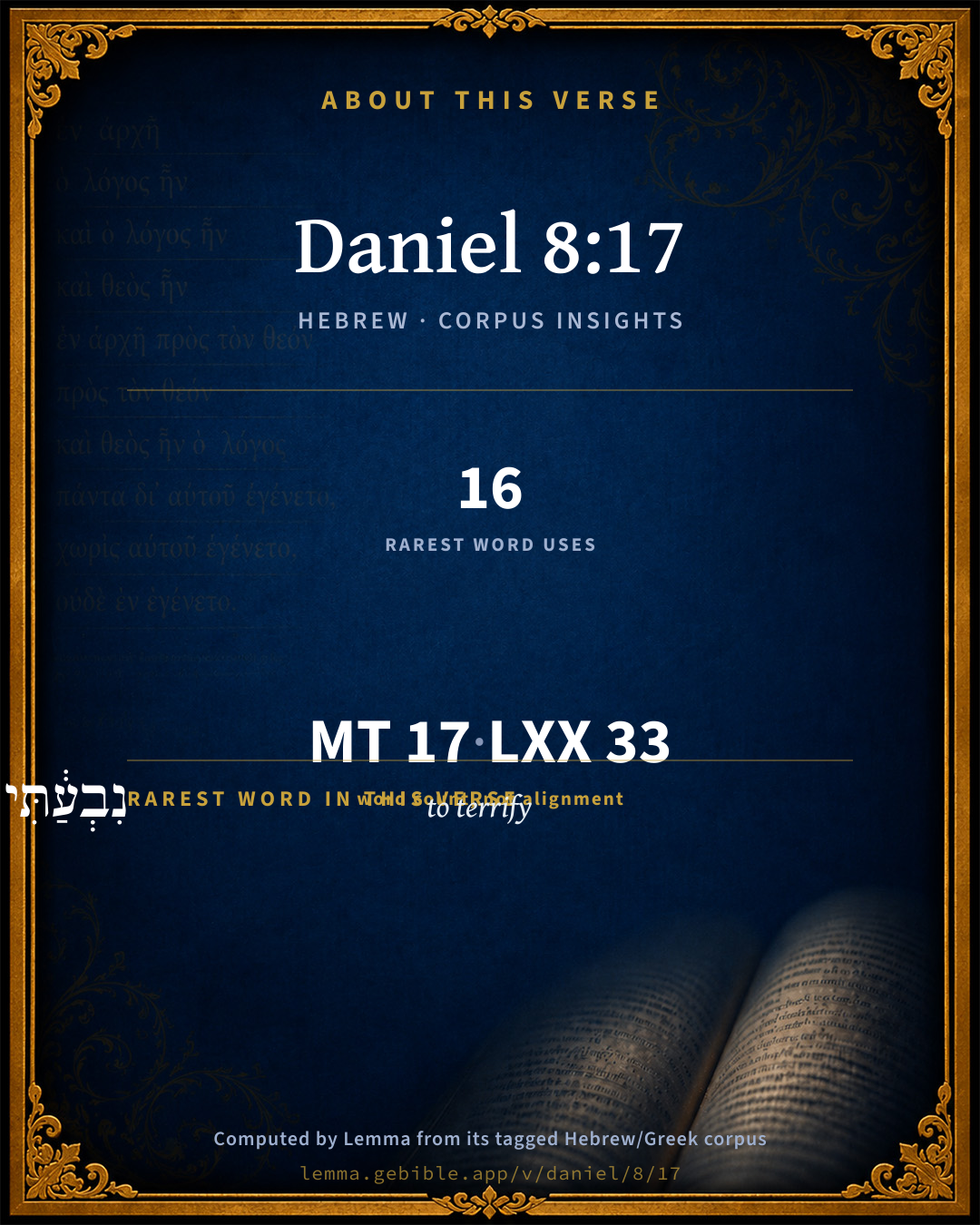
These counts appear in no published source. They are computed here, from the morphology-tagged text and Lemma’s own curated glosses. What Lemma adds →

17
words
16
distinct lemmas
Prophets
section

Notable vocabulary

The rarest word here is נִבְעַ֔תִּי to terrify H1204 — appearing just 16 times in the whole Hebrew Bible.

Shared distinctive vocabulary

נִבְעַ֔תִּי to terrify H1204 occurs in 16 verses of the Hebrew Bible. Also found in:

Grammatical profile

  • 6 verbs
  • 7 nouns
  • 3 prepositions
  • 1 conjunction

Verb forms

  • וַיָּבֹא֙ Qal · Sequential Imperfect
  • וּבְבֹא֣וֹ Qal · Infinitive Construct
  • נִבְעַ֔תִּי Niphal · Perfect
  • וָאֶפְּלָ֖ה Qal · Sequential Imperfect
  • וַיֹּ֤אמֶר Qal · Sequential Imperfect
  • הָבֵ֣ן Hiphil · Imperative

Repetition

A word recurs within this verse — often emphatic in Hebrew:

  • וַיָּבֹא֙ to enter H935 ×2

Hebrew & Septuagint length

In English translation the verse runs 38 words from the Hebrew and 41 from the Septuagint (LXX English) — closely comparable.

A rough comparison of the two English renderings, which tokenize alike — not a word-level alignment.

Word counts can differ between the Hebrew and the Greek without any difference in meaning — e.g. the Hebrew direct-object marker אֵת has no separate Greek word, and Greek often adds the article ὁ.

In the original languages it is 17 Hebrew tokens and 33 Greek tokens — but the two are counted differently (Hebrew bundles its prefixes and suffixes into one token; the Greek is in lemma form), so that isn’t a like-for-like length.

Cross-references

21

Topical passages linked to Daniel 8:17 in the Treasury of Scripture Knowledge — connected by theme and wording, ordered by reader-vote popularity; previews shown in the World English Bible.

  • Daniel 8:19 He said, Behold, I will make you know what shall be in the latter time of the indignation; for it belongs to the appointed time of the end.
  • Daniel 12:4 But you, Daniel, shut up the words, and seal the book, even to the time of the end: many shall run back and forth, and knowledge shall be increased."
  • Daniel 11:35–36 Some of those who are wise shall fall, to refine them, and to purify, and to make them white, even to the time of the end; because it is yet for the time appointed.
  • Daniel 11:40 At the time of the end shall the king of the south contend with him; and the king of the north shall come against him like a whirlwind, with chariots, and with horsemen, and with many ships; and he shall enter into the countries, and shall overflow and pass through.
  • Daniel 12:13 But go you your way until the end be; for you shall rest, and shall stand in your lot, at the end of the days.
  • Habakkuk 2:3 For the vision is yet for the appointed time, and it hurries toward the end, and won't prove false. Though it takes time, wait for it; because it will surely come. It won't delay.
  • Revelation 1:17 When I saw him, I fell at his feet like a dead man. He laid his right hand on me, saying, "Don't be afraid. I am the first and the last,
  • Ezekiel 1:28–2:1 As the appearance of the bow that is in the cloud in the day of rain, so was the appearance of the brightness round about. This was the appearance of the likeness of the glory of Yahweh. When I saw it, I fell on my face, and I heard a voice of one that spoke.
  • Revelation 22:8 Now I, John, am the one who heard and saw these things. When I heard and saw, I fell down to worship before the feet of the angel who had shown me these things.
  • Genesis 17:3 Abram fell on his face. God talked with him, saying,
  • Ezekiel 6:2 Son of man, set your face toward the mountains of Israel, and prophesy to them,
  • Daniel 2:46 Then the king Nebuchadnezzar fell on his face, and worshiped Daniel, and commanded that they should offer an offering and sweet odors to him.
  • Daniel 8:15 It happened, when I, even I Daniel, had seen the vision, that I sought to understand it; and, behold, there stood before me as the appearance of a man.
  • Daniel 9:23 At the beginning of your petitions the commandment went forth, and I am come to tell you; for you are greatly beloved: therefore consider the matter, and understand the vision.
  • Daniel 9:27 He shall make a firm covenant with many for one week: and in the midst of the week he shall cause the sacrifice and the offering to cease; and on the wing of abominations [shall come] one who makes desolate; and even to the full end, and that determined, shall [wrath] be poured out on the desolate.
  • Daniel 10:7–8 I, Daniel, alone saw the vision; for the men who were with me didn't see the vision; but a great quaking fell on them, and they fled to hide themselves.
  • Daniel 10:11 He said to me, Daniel, you man greatly beloved, understand the words that I speak to you, and stand upright; for to you am I now sent. When he had spoken this word to me, I stood trembling.
  • Daniel 10:16 Behold, one in the likeness of the sons of men touched my lips: then I opened my mouth, and spoke and said to him who stood before me, my lord, by reason of the vision my sorrows are turned on me, and I retain no strength.
  • Matthew 17:8 Lifting up their eyes, they saw no one, except Jesus alone.
  • Mark 9:4–5 Elijah and Moses appeared to them, and they were talking with Jesus.
  • Revelation 19:9–10 He said to me, "Write, 'Blessed are those who are invited to the marriage supper of the Lamb.'" He said to me, "These are true words of God."

Cross-references courtesy of OpenBible.info (CC BY 4.0).

Hebrew and Greek witnesses Masoretic Hebrew ↔ Greek Septuagint

The same verse in the two great witnesses to the Old Testament, shown verse-for-verse.

These are two independent witnesses, not word-aligned to each other, and the Septuagint is shown in lemma (dictionary) form.

Hebrew Daniel 8:17 Masoretic · Westminster Leningrad Codex

וַיָּבֹא֙ אֵ֣צֶל עָמְדִ֔י וּבְבֹא֣וֹ נִבְעַ֔תִּי וָאֶפְּלָ֖ה עַל פָּנָ֑י וַיֹּ֤אמֶר אֵלַי֙ הָבֵ֣ן בֶּן אָדָ֔ם כִּ֖י לְעֶת קֵ֥ץ הֶחָזֽוֹן

So he came near where I stood; and when he came, I was frightened, and fell on my face: but he said to me, Understand, son of man; for the vision belongs to the time of the end.

World English Bible · Public Domain

Greek LXX Daniel 8:17 Septuagint · lemma form

καί ἔρχομαι καί ἵστημι ἔχω ἐγώ ὁ στάσις καί ἐν ὁ ἔρχομαι αὐτός θορυβέω καί πίπτω ἐπί πρόσωπον ἐγώ καί εἶπον ἐγώ διανοέομαι υἱός ἄνθρωπος ἔτι γάρ εἰς ὥρα καιρός οὗτος ὁ ὅραμα

And he came and stood near where I stood: and when he came, I was struck with awe, and fell upon my face: but he said to me, Understand, son of man: for yet the vision is for an appointed time.

LXX2012 (modern English Septuagint) · Public Domain

Hebrew: Westminster Leningrad Codex (CC BY 4.0). Greek: Septuagint (public domain); English from LXX2012 (modern English Septuagint) (Public Domain). How the Septuagint differs from the Hebrew →

Commentary

Notes on Daniel 8:17 from classic Christian and Jewish commentators (each source and its license shown beneath its notes). The classic Christian expositions comment on the surrounding passage and are grouped to its opening verse, so a note may address several verses; the Jewish commentaries on the Tanakh (Rashi and others) are per-verse, so they appear only where the commentator wrote on this verse.

Lemma curates 59 commentaries, every one of them public domain or Creative Commons licensed, each selected and text-cleaned for this edition rather than reprinted as found. About our sources →

Trapp's Complete Commentary

John Trapp

Dan 8:17 So he came near where I stood: and when he came, I was afraid, and fell upon my face: but he said unto me, Understand, O son of man: for at the time of the end [shall be] the vision.

Ver. 17. So he came near where I stood.] Let our obedience be like that of the angels, prompt and present.

I was afraid.] Through human frailty and conscience of sin.

Understand, O son of man.] Ezekiel and Daniel only of all the prophets are so called; haply lest they should be "exalted above measure with the abundance of the revelations."

For at the time of the end shall be the vision,] i.e., That this vision of the daily sacrifice intermitted for so many years, and the abomination of desolation, the picture of Jupiter Olympus, set up in the sanctuary, shall be toward the end of the Greek monarchy.

John Trapp, A Commentary or Exposition upon All the Books of the Old and New Testament (1647–1656) — public domain. Text from a community e-Sword module.

Joseph Benson's Commentary

Dan 8:17. So he came near where I stood — That he might speak more familiarly with him. And when he came, I was afraid — This fear was probably occasioned by the effulgent brightness of the heavenly messenger, which quite amazed Daniel upon his drawing near to him. And I fell upon my face — Not to worship the angel, but because he could not bear the lustre of his glory. But he said unto me, Understand, O son of man — We find this is a title given to none of the prophets but Ezekiel and Daniel, who had more frequent converse with angels than any of the rest: and it is given to the prophet here, either to put him in mind that he was but flesh and blood, that he might not be exalted for having these heavenly visions imparted to him; or else it was used as a mark of honour, implying that he was something more than an ordinary man, even one highly favoured and beloved of God. For at the time, or, to the time, of the end shall be the vision — That is, there is a precise time determined for the accomplishment of the vision, when it shall certainly be fulfilled. Or the meaning may be, that the fulfilling of the vision should not come to pass for a considerable space of time; that it was concerning matters at a distance, namely, at the distance of almost four hundred years.

Joseph Benson's Commentary on the Old and New Testaments (1811–1818) — public domain. Text from a community e-Sword module.

Tyndale Open Study Notes

Tyndale Open Resources

8:17 Son of man means “human being,” as opposed to a divine being, “a son of the gods” (cp. 7:13; see, e.g., Ezek 2:1, 3, 6, 8).

Tyndale Open Study Notes — © Tyndale Open Resources, licensed CC BY-SA 4.0. Text via the HelloAO Bible API.

Geneva Bible (1599)

Geneva Bible translators

The effect of this vision shall not yet appear, but a long time after.

Geneva Bible (1599) marginal notes — public domain. Text via Bolls.life.

Jamieson, Fausset & Brown

Robert Jamieson, A. R. Fausset & David Brown

the time of the end--so Dan 8:19; Dan 11:35-36, Dan 11:40. The event being to take place at "the time of the end" makes it likely that the Antichrist ultimately referred to (besides the immediate reference to Antiochus) in this chapter, and the one in Dan 7:8, are one and the same. The objection that the one in the seventh chapter springs out of the ten divisions of the Roman earth, the fourth kingdom, the one in the eighth chapter and the eleventh chapter from one of the four divisions of the third kingdom, Greece, is answered thus: The four divisions of the Grecian empire, having become parts of the Roman empire, shall at the end form four of its ten final divisions [TREGELLES]. However, the origin from one of the four parts of the third kingdom may be limited to Antiochus, the immediate subject of the eighth and eleventh chapter, while the ulterior typical reference of these chapters (namely, Antichrist) may belong to one of the ten Roman divisions, not necessarily one formerly of the four of the third kingdom. The event will tell. "Time of the end" may apply to the time of Antiochus. For it is the prophetic phrase for the time of fulfilment, seen always at the end of the prophetic horizon (Gen 49:1; Num 24:14).

Jamieson, Fausset & Brown — Commentary Critical and Explanatory on the Whole Bible (1871) — public domain (CC PDM 1.0). Text via the HelloAO Bible API.

Adam Clarke's Commentary

Verse 17. At the time of the end shall be the vision.] Or, as Houbigant, "The vision shall have an end at the proper time."

Adam Clarke's Commentary on the Bible (1810–1826) — public domain. Text from a community e-Sword/MySword module.

John Calvin's Commentaries

I will not repeat what I have already explained. I will proceed with what I had commenced, namely, the Prophet’s need of instruction, because he could not understand the vision without an interpreter; wherefore the angel was ordered to explain his revelation of God more fully. But, before he narrates this, he says, he was frightened at the approach of the angel. Without doubt, this reverence was always present to his mind. Whenever he perceived himself called or taught by God, he was doubtless struck with fear; but here some special feeling is expressed, as God desired to influence his mind to set us an example, and to render us more attentive. Here Daniel explains his own mind to us, commending the magnitude and importance of the vision, lest we should read with carelessness what he will afterwards relate, and not treat the occasion with sufficient seriousness. For God used the angel as his servant to explain his intention to the Prophet; at the same time he inwardly touched his mind by his Spirit to show us the way, and thus he would not only train us to docility, but also to fear. He says, then, he was frightened and fell down This, as I have said, was usual with the Prophet, as it ought to be with all the pious. Paul also, in celebrating the effect and power of prophecy, says, if any unbelievers should enter into the assembly and hear a prophet speaking in God’s name, he would prostrate himself, says he, upon his face. (1 Corinthians 14:25.) If this happened to unbelievers, how great will be our troubles, unless we receive most reverently and humbly, what we know to have been uttered by the mouth of God? Meanwhile, we should remember what I have lately touched upon, — the importance of the present oracle as here commended to us by the Prophet; for he fell upon his face through his fright, as he will repeat in the next verse.

Nor is the following exhortation superfluous; understated, says he, O son of Adam It would be of little use to us to be moved and excited for a time, unless our minds were afterwards composed for hearing. For many are touched by fear when God appears to them; that is, when he compels them to feel the force and power of his sway; but they continue in their stupidity, and thus their fright is rendered profitless. But Daniel here makes a difference between himself and the profane, who are only astonished and by no means prepared for obedience. At the same time, he relates how his own excitement was effected by the assistance of the angel. The fear, then, of which we have lately made mention, was preparation for docility; but; this terror would have been useless by itself, unless it had been added, that he might understand We ought to understand how piety does not consist merely in acknowledging the fear of God, but obedience is also required, preparing us to receive with tranquil and composed feelings whatever we shall be taught. We ought diligently to observe this order.

It now follows: Because there shall be an end of the vision at a fixed time. Some join לעת-קף legneth-ketz, making the sense “at the end of the time,” קף ketz, in this sense being in the genitive case by way of an epithet, as the Hebrews commonly use it. They elicit this sense — the vision shall be for a prefixed time. But others prefer — the end of the vision shall be for a time. I think this latter sense is better, as the former seems to me forced. On the whole, it is not of much consequence, yet as that form of expression is the easier, namely, the end or fulfillment of the vision should be at a definite time, I had rather follow that interpretation. The angel asserts, then, that this was no vain speculation, but a cause joined with its effect, which should have its completion at a stated period. There shall be an end, then, of the vision in its time; meaning, what you now behold shall neither vanish away nor be destroyed, but its end shall happen when the time shall arrive which God has determined. קף, ketz, is often taken in this sense. Hence there shall be an end of the vision,; that is, the vision shall be completed when the fitting time shall arrive. We ought to bear in mind this exhortation of the angel, because unless we are certainly persuaded of the fixedness of anything when God speaks, we shall not be ready to receive whatever he pronounces. But when we are convinced of this saying, God never separates his hand from his mouth — meaning, he is never unlike himself, but his power follows up his word, and thus he fulfills whatever he declares; this becomes a sure and firm foundation for our faith. This admonition of the angel ought to be extended generally to the whole of Scripture, since God does not throw words into the air, according to the common phrase. For nothing happens rashly, but as soon as he speaks, his truth, the matter itself and its necessary effect, are all consistent. It follows: —

John Calvin's Commentaries (1540-1563) — public domain. Text from the Calvin Translation Society English edition (1840s-50s) via the Christian Classics Ethereal Library (ccel.org). Calvin's coverage is partial (roughly two-thirds of the Bible); uncommented books and verses are honest gaps, never fabricated. The 19th-century editor's footnotes and remarks are omitted so the notes are faithfully Calvin's own voice.

Ellicott's Commentary for English Readers

(17) The time of the end—i.e., either at the final period of earthly history, or at the time which lies at the limit of the prophetic horizon. St. Jerome observes that what happened in the times of Antiochus was typical of what shall be fulfilled hereafter in Antichrist.

A Bible Commentary for English Readers, edited by Charles John Ellicott (1878–1897) — public domain. Text from a community e-Sword module.

The Cambridge Bible for Schools and Colleges

gen. ed. J. J. S. Perowne

17. afraid] affrighted (R.V.), as Isa_21:4, A.V. (Job_7:14 al. ‘terrify’): ‘afraid’ is not strong enough. At the approach of the celestial being Daniel is terrified.

fell upon my face] a mark of awe or respect (Gen_17:3; Jdg_13:20; Rth_2:10, al.); cf. in the visions of Ezekiel, Eze_1:28; Eze_3:23; Eze_9:8; Eze_11:13; Eze_43:3; Eze_44:4.

son of man] Borrowed, no doubt, from the book of Ezekiel, where it is the standing title by which the prophet is addressed (Dan_2:1; Dan_2:3; Dan_2:6; Dan_2:8, Dan_3:1; Dan_3:3-4; Dan_3:10; Dan_3:17; Dan_3:25, &c.—more than a hundred times altogether).

for the vision belongeth to the time of the end] and therefore deserves attention. The ‘time of the end’ is a standing expression in Daniel (Dan_11:35; Dan_11:40, Dan_12:4; Dan_12:9; cf. ‘the appointed-time [מועד] of the end’ Dan_8:19, and ‘the end’ Dan_9:26 b), and means (spoken from Daniel’s standpoint) the period of Antiochus’s persecution, together with the short interval, consisting of a few months, which followed before his death (Dan_11:35; Dan_11:40), that being, in the view of the author, the ‘end’ of the present condition of things, and the divine kingdom (Dan_7:14; Dan_7:18; Dan_7:22; Dan_7:27, Dan_12:2-3) being established immediately afterwards. This sense of ‘end’ is based probably upon the use of the word in Amo_8:2, Eze_7:2, ‘an end is come, the end is come upon the four corners of the land,’ 3, 6: cf. also ‘in the time of the iniquity of the end,’ Eze_21:25; Eze_21:29; Eze_35:5; and Hab_2:3, ‘For the vision is yet for the appointed-time [has reference to the time of its destined fulfilment], and it hasteth toward the end.’

The Cambridge Bible for Schools and Colleges (gen. ed. J. J. S. Perowne; Cambridge University Press, 1878–1918) — public domain. Text from a community e-Sword module.

John Gill's Exposition

So he came near where I stood,.... The angel immediately obeyed the divine Person in human form, and came near the prophet, in order to instruct him, and carry on a familiar conversation with him:

and when he came, I was afraid, and fell upon my face; not being able to bear the glory that attended him; and especially when he considered him as the messenger of a divine Person sent to instruct him, and being conscious of his own frailty and weakness:

but he said unto me, understand, O son of man: give attention in order to understand the vision, which the angel, by a divine command, was about to give him the full meaning of; and which he could not so well attend unto in his present circumstance and posture; and therefore suggests he should shake off his fear, and stand on his feet, and listen to what he was about to say: he calls him "son of man", a title only given to him and Ezekiel; and so may be considered as a mark of honour and respect, as being one greatly beloved and honoured by the Lord; or to express his tender regard to him, and accommodating himself to him, considering he was a frail mortal man; or to put him in mind that he should so consider himself, though now among angels, and favoured with revelations of secrets, that so he might not be exalted with them above measure:

for at the time of the end shall be the vision; or rather, "for a time is the end of the vision" (l); there is a set, fixed, and determined time, when the vision shall end, and have its full accomplishment; namely, when the 2300 days are expired.

(l) "ad tempus, finis visionis", Munster, Montanus, Calvin.

John Gill's Exposition of the Whole Bible (1746–1763) — public domain (CC PDM 1.0). Text via the HelloAO Bible API.

Albert Barnes' Notes on the Bible

So he came near where I stood - He had seen him, evidently, at first in the distance. He now drew near to Daniel, that he might communicate with him the more readily.

And when, he came, I was afraid, and fell upon my face - Doubtless perceiving that he was a celestial being. See the notes at Rev 1:17. Compare Eze 1:28, and Dan 10:8-9. He was completely overpowered by the presence of the celestial stranger, and sank to the ground.

But he said unto me, Understand, O son of man - Give attention, that you may understand the vision. On the phrase “son of man,” see the notes at Dan 7:13. It is here simply an address to him as a man.

For at the time of the end shall be the vision - The design of this expression is undoubtedly to cheer and comfort the prophet with some assurance of what was to occur in future times. In what way this was done, or what was the precise idea indicated by these words, interpreters have not been agreed. Maurer explains it, “for this vision looks to the last time; that is, the time which would immediately precede the coming of the Messiah, which would be a time of calamity, in which the guilt of the wicked would be punished, and the virtue of the saints would be tried, to wit, the time of Antiochus Epiphanes.” Lengerke supposes that the end of the existing calamities - the sufferings of the Jews - is referred to; and that the meaning is, that in the time of the Messiah, to which the vision is extended, there would be an end of their sufferings and trials. The design of the angel, says he, is to support and comfort the troubled seer, as if he should not be anxious that these troubles were to occur, since they would have an end, or, as Michaelis observes, that the seer should not suppose that the calamities indicated by the vision would have no end.

Perhaps the meaning may be this: “The vision is for the time of the end;” that is, it has respect to the closing period of the world, under which the Messiah is to come, and necessarily precedes that, and leads on to that. It pertains to a series of events which are to introduce the latter times, when the kingdom of God shall be set up on the earth. In justification of this view of the passage, it may be remarked that this is not only the most obvious view, but is sustained by all those passages which speak of the coming of the Messiah as “the end,” the “last days,” etc. Thus 1Co 10:11 : “upon whom the ends of the world are come.” Compare the notes at Isa 2:2. According to this interpretation, the meaning is, “the vision pertains to the end, or the closing dispensation of things;” that is, it has a bearing on the period when the end will come, or will introduce that period. It looks on to future times, even to those times, though now remote (compare Dan 8:26), when a new order of things will exist, under which the affairs of the world will be wound up. Compare the notes at Heb 1:2.

Albert Barnes' Notes on the Bible (1834–1885) — public domain. Text from a community e-Sword/MySword module.

Haydock's Catholic Bible Commentary

Man. So Ezechiel is usually styled, to shew that the human nature is different from that of angels, and would be greatly honoured by Jesus Christ, who takes this appellation. (Worthington) --- Of the end, or determined. This shall take place, (Calmet) but the period is distinct. (Grotius ver. 26.)

George Leo Haydock (1774–1849), Haydock's Catholic Family Bible and Commentary, 1859 edition — public domain. Excludes Psalms (Douay-Rheims chapter numbering differs from Protestant) and Deuterocanonical books (Catholic canon only).

Matthew Poole's English Annotations

He came near, that he might speak more familiarly to him, yet Daniel could not bear the glory of it, Mat 17:6. How much less can we bear the glory of God! and how graciously hath the Lord dealt with us to teach us by men, and not by angels! and how vain are they who aspire to a converse with angels here on earth!

O son of man: he calls him son of man, to make him mind his frailty, and not to be lifted up with visions, and this great condescension and familiarity of Heaven with him.

At the time of the end, i.e. in God’s appointed time, i.e. in the latter generations, but not now in thy lifetime, but about four hundred years hence. See Dan 8:26.

Matthew Poole's English Annotations on the Holy Bible (1683–1685) — public domain. Text from a community e-Sword/MySword module.

Whedon's Commentary on the Bible

Daniel D. Whedon

17. Here, at least, son of man means human as contrasted with angelic or divine. (Compare Dan_7:13.) Daniel, though accustomed to angelic presences (Dan_7:10; Dan_7:16), was “terrified” either at the appearance of this greatest of the angels, or, as Gabriel’s first words may suggest, being overwhelmed with the thought that now at last this most profound mystery is about to be explained. (Compare Dan_8:27.)

At the time of the end — Rather, the vision belongeth to the time of the end. The “end” does not refer to the end of the world; for the vision does not refer to this. Rather, as Dan_8:19 proves and the interpretation of the vision necessitates, the “end” is the “end of the indignation” or “wrath,” which the Jews were then suffering under Antiochus. With this king the power of the fourth brute kingdom is to be broken, after which comes the kingdom of God under the peaceful rule of one who is like the Son of man (Dan_7:13-14).

Daniel D. Whedon (gen. ed.), Commentary on the Old and New Testaments (1874–1909) — public domain. Text from a community e-Sword module.

The Pulpit Commentary

So he came near where I stood: and when he came, I was afraid, and fell upon my face: but he said unto me, Understand, O son of man: for at the time of the end shall be the vision. The versions are here in close agreement with the Massoretic text. On Gabriel"s approach Daniel fell on his face, overwhelmed at contact with the spiritual. It is mentioned as if this were the natural result of such an interview as that vouchsafed to Daniel. At first sight this contradicts Dan_7:16, where Daniel interrogates one of the angelic bystanders. In the first place, Dan_7:15 shows that Daniel had been grieved and disturbed before he ventured on the question; and, next, Gabriel was one of the great angels that stood before God. Gabriel addressed Daniel by the title so often given to Ezekiel, "son of man," ben-adam. Professor Fuller, and also Kranichfeld, remark on the contrast between Gabriel, Hero of God," and ben-adam , son of man" The time of the end does not mean the end of the world, or of the appearance of the Messiah, for in this vision there is no reference to either of these. It is rather to be rendered, after the analogy of Jer_1:2-6, where miqqetz means "from the utmost border," and reaches to a far-off time.

The Pulpit Commentary (1880–1919), ed. H.D.M. Spence-Jones & Joseph S. Exell — public domain. Text from a community e-Sword module.

John Wesley's Explanatory Notes

He came near - That he might speak more familiarly to him, yet Daniel could not bear the glory of it. How much less can we bear the glory of God, and how graciously hath the Lord dealt with us, to teach us by men, and not by angels? O son of man - He calls him son of man, to make him mind his frailty, and not to be lifted up with this great condescension of heaven. At the time - In God's appointed time, in the latter day, but not now in thy life- time.

John Wesley, Explanatory Notes Upon the Whole Bible (1754–1765) — public domain. Text via the GEBible commentary corpus.

Rashi

Rabbi Shlomo Yitzchaki (Rashi)

to the time of the end. For many days this vision will come about.

Rashi on the Tanakh — English translations: “The Judaica Press complete Tanach with Rashi, translated by A. J. Rosenberg” (CC BY 4.0); “Pentateuch with Rashi's commentary by M. Rosenbaum and A.M. Silbermann, 1929-1934” (public domain); “The Metsudah Tanach series, Lakewood, N.J” (CC BY 4.0); and “The Book of Joshua, Metsudah Publications, 1997” (CC BY 4.0). Text via Sefaria.

Lesson kit

Teaching starters — assembled from the data on this page, not authored interpretation. Every prompt links to the verse data it draws on. Edit before teaching.

Daniel, in the Prophets, opens this verse with 17 words (16 distinct Hebrew lemmas). Its most distinctive word is bâʻath (“to terrify”). A historical commentator’s framing appears above. Read the whole chapter for the surrounding context.

Discussion questions

  1. How does “to terrify” (bâʻath) shape what this verse is saying?
  2. How does 1 Samuel 16:14, which shares the word «to terrify», read alongside this verse?
  3. What does the repetition of “to enter” (2× in this one verse) do in this verse?
  4. These translations render this verse differently; the difference is in the English rendering, not the original. What questions does that raise?
  5. «וַיָּבֹא֙» is a Qal Sequential Imperfect verb. How does that grammatical form shape the action described?
  6. Compare how Trapp's Complete Commentary and Joseph Benson's Commentary read this verse. Where do they agree or differ?

Things to notice

Reading settings

Reading text

Shown beneath each verse's original-language words.

Old Testament
Old Testament edition

Read the OT as the Masoretic Hebrew (MT) or the Greek Septuagint (LXX).

English shown for the Greek Septuagint (in the Hebrew ↔ Greek comparison).

Comparing translations? Open the Compare panel on any verse page to stack up to four side by side.