Genesis 16:8

Hebrew (Westminster Leningrad Codex) Genesis 16:8 appears in the Hebrew Old Testament. The text above is from the Westminster Leningrad Codex. Each word links to its Strong’s number, a concise gloss, and parsing drawn from the Open Scriptures Hebrew Bible morphology. Click any word for its full Brown-Driver-Briggs (BDB) entry.
Download image
Cite this verse

Genesis 16:8 (World English Bible). Public Domain. Lemma interlinear Bible study tool, https://lemma.gebible.app/v/genesis/16/8.

Show BibTeX & RIS
BibTeX
RIS
English Translation
He said, "Hagar, Sarai's handmaid, where did you come from? Where are you going?" She said, "I am fleeing from the face of my mistress Sarai."
World English Bible · Public Domain
Highlights
  • 1 first appearance in the Hebrew Bible
Full analysis ↓
Download a study sheet

One document with this verse’s original text, its word-by-word gloss line, the meaning frame, cross-references with their text, attributed commentary, and full source and license credits — printable, and it pastes into notes with its structure intact.

This verse Autodidact and up

Study sheet (.html) Plain text (.txt)

A passage Seminary Student

Up to 50 verses in one chapter. A passage sheet keeps up to 6 commentary sources and 12 cross-references per verse, in the order this page ranks them, and says so on the sheet whenever that leaves anything out. Ask for a single verse and you get the Autodidact verse sheet above.

Everything on this page stays free to read, with no account — the sheet is a download of what is already on screen, not access to it.

Want to remove ads? Support Godless Engineer
Compare translations 3

The same verse in 3 English versions, stacked beneath the original-language interlinear above. Click any original word for its lexicon entry.

Each is an independent rendering of the whole verse — the interlinear is not word-aligned to these translations.

Highlighted words mark where these versions differ — a whole-verse word diff, not a word-by-word alignment.

  • World English Bible Public Domain
    He said, "Hagar, Sarai's handmaid, where did you come from? Where are you going?" She said, "I am fleeing from the face of my mistress Sarai."
  • King James Version Public Domain
    And he said, Hagar, Sarai's maid, whence camest thou? and whither wilt thou go? And she said, I flee from the face of my mistress Sarai.
  • unfoldingWord Literal Text CC BY-SA 4.0
    And he said, “Hagar, maidservant of Sarai, where have you come from, and where are you going?” And she said, “I am fleeing from the face of Sarai, my mistress.”

unfoldingWord Literal Text — © unfoldingWord, licensed CC BY-SA 4.0. Word-aligned USFM3 via Door43 (git.door43.org/unfoldingWord/en_ult).

Versions to compare (up to 4)

3 of 4 selected

Show all 18 translations

Every available English version of this verse, each an independent rendering of the whole verse.

  • World English Bible Public Domain
    He said, "Hagar, Sarai's handmaid, where did you come from? Where are you going?" She said, "I am fleeing from the face of my mistress Sarai."
  • Berean Standard Bible Public Domain
    “Hagar, servant of Sarai,” he said, “where have you come from, and where are you going?” “I am running away from my mistress Sarai,” she replied.
  • Majority Standard Bible Public Domain
    “Hagar, servant of Sarai,” he said, “where have you come from, and where are you going?” “I am running away from my mistress Sarai,” she replied.
  • King James Version Public Domain
    And he said, Hagar, Sarai's maid, whence camest thou? and whither wilt thou go? And she said, I flee from the face of my mistress Sarai.
  • American Standard Version (1901) Public Domain
    And he said, Hagar, Sarai's handmaid, whence camest thou? and whither goest thou? And she said, I am fleeing from the face of my mistress Sarai.
  • Revised Version (1885) Public Domain
    And he said, Hagar, Sarai’s handmaid, whence camest thou? and whither goest thou? And she said, I flee from the face of my mistress Sarai.
  • Geneva Bible (1599) Public Domain
    And he saide, Hagar Sarais maide, whence commest thou? and whither wilt thou goe? And she said, I flie from my dame Sarai.
  • Douay-Rheims (1899) Public Domain
    He said to her: Agar, handmaid of Sarai, whence comest thou? and whither goest thou? And she answered: I flee from the face of Sarai, my mistress.
  • Young's Literal Translation Public Domain
    and he saith, `Hagar, Sarai's handmaid, whence hast thou come, and whither dost thou go?' and she saith, `From the presence of Sarai, my mistress, I am fleeing.'
  • Literal Standard Version CC BY-SA 4.0
    and He says, “Hagar, Sarai’s handmaid, from where have you come, and to where do you go?” And she says, “From the presence of Sarai, my mistress, I am fleeing.”
  • Unlocked Literal Bible CC BY-SA 4.0
    He said, “Hagar, Sarai's servant, where did you come from and where are you going?” Then she said, “I am fleeing from my mistress Sarai.”
  • unfoldingWord Literal Text CC BY-SA 4.0
    And he said, “Hagar, maidservant of Sarai, where have you come from, and where are you going?” And she said, “I am fleeing from the face of Sarai, my mistress.”
  • Darby Bible Public Domain
    And he said, Hagar, Sarai's maidservant, whence comest thou? and whither art thou going? And she said, I am fleeing from the face of my mistress Sarai.
  • World Messianic Bible Public Domain
    He said, “Hagar, Sarai’s servant, where did you come from? Where are you going?” She said, “I am fleeing from the face of my mistress Sarai.”
  • Webster's Bible Public Domain
    And he said, Hagar, Sarai's maid, whence camest thou? and whither wilt thou go? And she said, I flee from the face of my mistress Sarai.
  • Free Bible Version CC BY-SA 4.0
    He asked her, “Hagar, Sarai's slave—where have you come from, and where are you going?” “I'm running away from my mistress Sarai,” she replied.
  • Bible in Basic English Public Domain
    And he said, Hagar, Sarai's servant, where have you come from and where are you going? And she said, I am running away from Sarai, my master's wife.
  • JPS Tanakh (1917) Public Domain
    And he said: 'Hagar, Sarai's handmaid, whence camest thou? and whither goest thou?' And she said: 'I flee from the face of my mistress Sarai.'

Literal Standard Version (2020), Covenant Press — licensed CC BY-SA 4.0. Text via the HelloAO Bible API (eBible.org). Unlocked Literal Bible (unfoldingWord) — licensed CC BY-SA 4.0. Text via the HelloAO Bible API (eBible.org). unfoldingWord Literal Text — © unfoldingWord, licensed CC BY-SA 4.0. Word-aligned USFM3 via Door43 (git.door43.org/unfoldingWord/en_ult). Free Bible Version, Dr. Jonathan Gallagher — licensed CC BY-SA 4.0. Text via the HelloAO Bible API (eBible.org).

Word by word

More ways to search: Search by grammar → Find every occurrence → Compare this word →

Practice this passage: Drill this verse → Learn its vocabulary →

גְּבִרְתִּ֔י
gᵉbereth
H1404
“queen · my”
Noun, Common, Feminine, Singular, Construct + Suffix, Personal, 1st Person, Common, Singular
Part of Speech
Noun
Type
Common
Gender
Feminine
Number
Singular
State
Construct
Full BDB Definition

Origin: from H1376

TWOT: 310e

lady, queen - mistress (of servants)
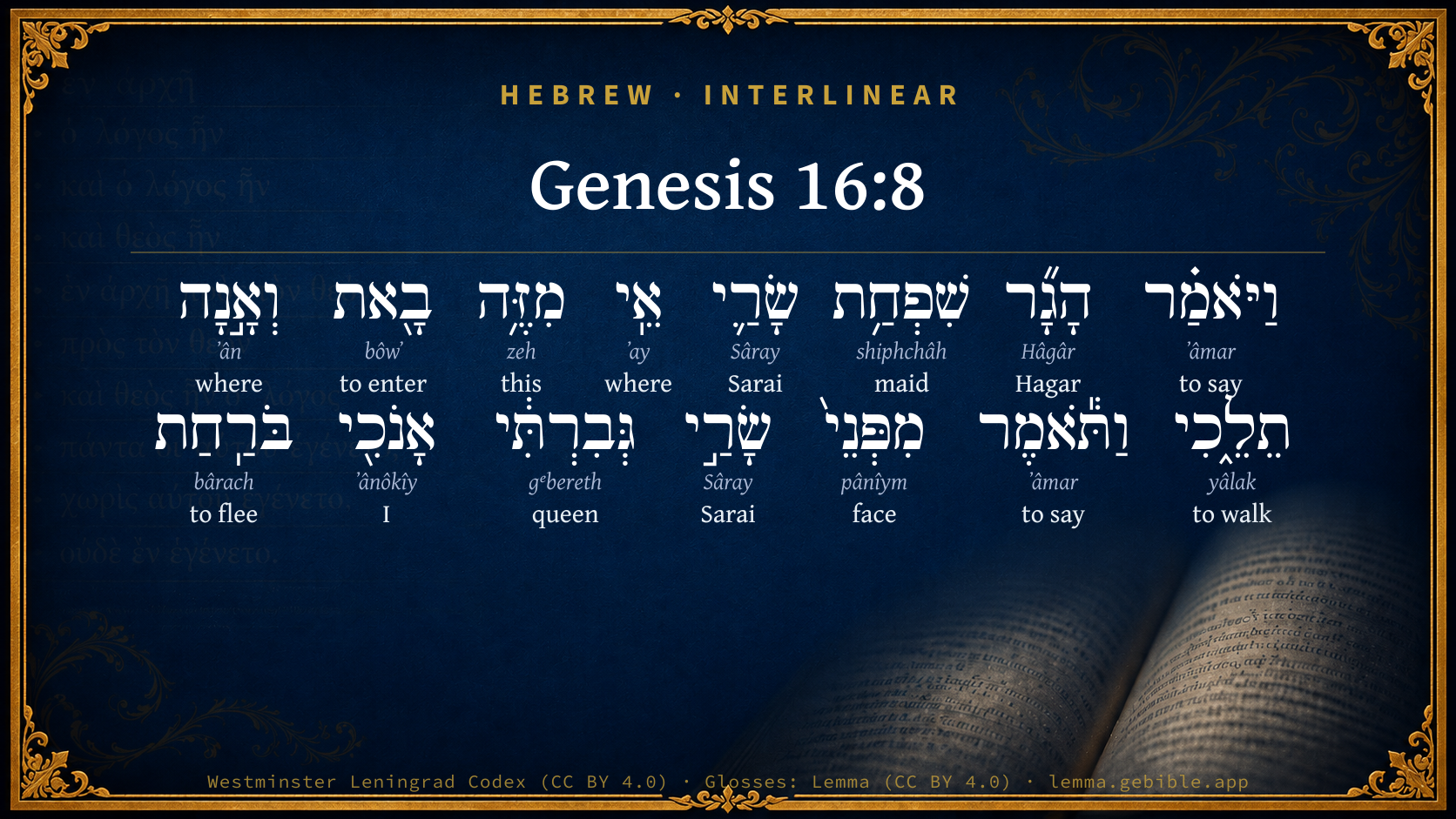
  1. וַיֹּאמַ֗ר ʼâmar H559 “and · to say” Conjunction + Verb, Qal, Sequential Imperfect, 3rd Person, Masculine, Singular
  2. הָגָ֞ר Hâgâr H1904 “Hagar” Noun, Proper
  3. שִׁפְחַ֥ת shiphchâh H8198 “maid of” Noun, Common, Feminine, Singular, Construct
  4. שָׂרַ֛י Sâray H8297 “Sarai” Noun, Proper
  5. אֵֽי ʼay H335 “where” Particle, Interrogative
  6. מִזֶּ֥ה zeh H2088 “from · this” Preposition + Pronoun, Demonstrative, Masculine, Singular
  7. בָ֖את bôwʼ H935 “to enter” Verb, Qal, Perfect, 2nd Person, Feminine, Singular
  8. וְאָ֣נָה ʼân H575 “and · where” Conjunction + Particle, Interrogative
  9. תֵלֵ֑כִי yâlak H3212 “to walk” Verb, Qal, Imperfect, 2nd Person, Feminine, Singular
  10. וַתֹּ֕אמֶר ʼâmar H559 “and · to say” Conjunction + Verb, Qal, Sequential Imperfect, 3rd Person, Feminine, Singular
  11. מִפְּנֵי֙ pânîym H6440 “from · face(s) of” Preposition + Noun, Common, Both, Plural, Construct
  12. שָׂרַ֣י Sâray H8297 “Sarai” Noun, Proper
  13. אָנֹכִ֖י ʼânôkîy H595 “I” Pronoun, Personal, 1st Person, Common, Singular
  14. בֹּרַֽחַת bârach H1272 “fleeing” Verb, Qal, Participle Active, Feminine, Singular, Absolute

About this verse

These counts appear in no published source. They are computed here, from the morphology-tagged text and Lemma’s own curated glosses. What Lemma adds →

15
words
13
distinct lemmas
Pentateuch
section

Notable vocabulary

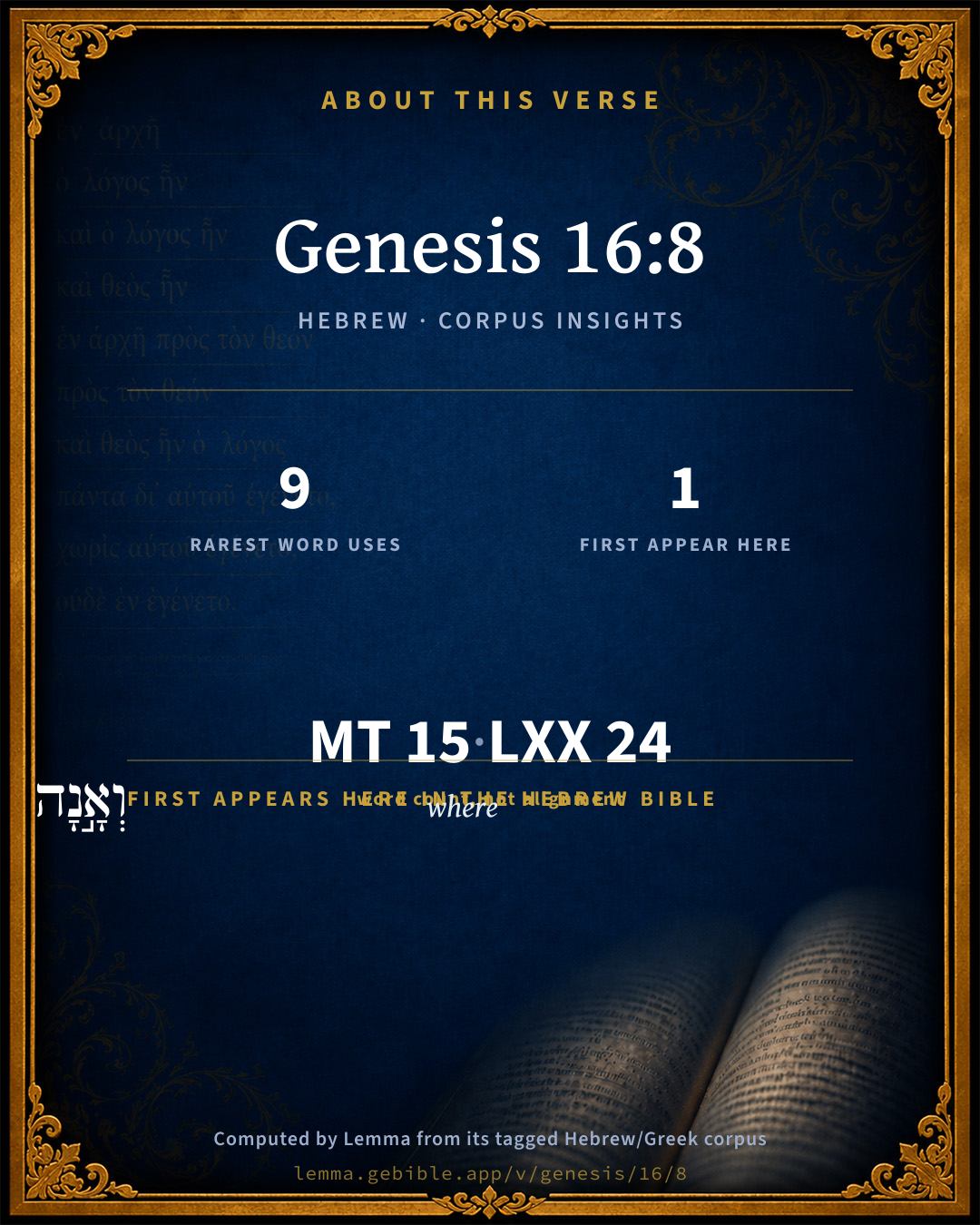
The rarest word here is גְּבִרְתִּ֔י queen H1404 — appearing just 9 times in the whole Hebrew Bible.

First appearance in Scripture

This word makes its first canonical appearance in the Hebrew Bible here:

  • וְאָ֣נָה where H575

Shared distinctive vocabulary

גְּבִרְתִּ֔י queen H1404 occurs in 9 verses of the Hebrew Bible. Also found in:

Grammatical profile

  • 5 verbs
  • 6 nouns
  • 2 pronouns
  • 2 particles

Verb forms

  • וַיֹּאמַ֗ר Qal · Sequential Imperfect
  • בָ֖את Qal · Perfect
  • תֵלֵ֑כִי Qal · Imperfect
  • וַתֹּ֕אמֶר Qal · Sequential Imperfect
  • בֹּרַֽחַת Qal · Participle Active

Repetition

Words recur within this verse — often emphatic in Hebrew:

  • וַיֹּאמַ֗ר to say H559 ×2
  • שָׂרַ֛י Sarai H8297 ×2

Hebrew & Septuagint length

In English translation the verse runs 26 words from the Hebrew and 32 from the Septuagint (LXX English) — closely comparable.

A rough comparison of the two English renderings, which tokenize alike — not a word-level alignment.

Word counts can differ between the Hebrew and the Greek without any difference in meaning — e.g. the Hebrew direct-object marker אֵת has no separate Greek word, and Greek often adds the article ὁ.

In the original languages it is 15 Hebrew tokens and 24 Greek tokens — but the two are counted differently (Hebrew bundles its prefixes and suffixes into one token; the Greek is in lemma form), so that isn’t a like-for-like length.

Cross-references

9

Topical passages linked to Genesis 16:8 in the Treasury of Scripture Knowledge — connected by theme and wording, ordered by reader-vote popularity; previews shown in the World English Bible.

  • Genesis 3:9 Yahweh God called to the man, and said to him, "Where are you?"
  • Genesis 4:10 Yahweh said, "What have you done? The voice of your brother's blood cries to me from the ground.
  • Ecclesiastes 10:4 If the spirit of the ruler rises up against you, don't leave your place; for gentleness lays great offenses to rest.
  • Jeremiah 2:17–18 Haven't you procured this to yourself, in that you have forsaken Yahweh your God, when he led you by the way?
  • 1 Samuel 26:19 Now therefore, please let my lord the king hear the words of his servant. If it be Yahweh that has stirred you up against me, let him accept an offering: but if it be the children of men, cursed be they before Yahweh: for they have driven me out this day that I shouldn't cling to Yahweh's inheritance, saying, Go, serve other gods.
  • Ephesians 6:5–8 Servants, be obedient to those who according to the flesh are your masters, with fear and trembling, in singleness of your heart, as to Christ;
  • 1 Timothy 6:1–2 Let as many as are bondservants under the yoke count their own masters worthy of all honor, that the name of God and the doctrine not be blasphemed.
  • Genesis 16:1 Now Sarai, Abram's wife, bore him no children. She had a handmaid, an Egyptian, whose name was Hagar.
  • Genesis 16:4 He went in to Hagar, and she conceived. When she saw that she had conceived, her mistress was despised in her eyes.

Cross-references courtesy of OpenBible.info (CC BY 4.0).

Hebrew and Greek witnesses Masoretic Hebrew ↔ Greek Septuagint

The same verse in the two great witnesses to the Old Testament, shown verse-for-verse.

These are two independent witnesses, not word-aligned to each other, and the Septuagint is shown in lemma (dictionary) form.

Hebrew Genesis 16:8 Masoretic · Westminster Leningrad Codex

וַיֹּאמַ֗ר הָגָ֞ר שִׁפְחַ֥ת שָׂרַ֛י אֵֽי מִזֶּ֥ה בָ֖את וְאָ֣נָה תֵלֵ֑כִי וַתֹּ֕אמֶר מִפְּנֵי֙ שָׂרַ֣י גְּבִרְתִּ֔י אָנֹכִ֖י בֹּרַֽחַת

He said, "Hagar, Sarai's handmaid, where did you come from? Where are you going?" She said, "I am fleeing from the face of my mistress Sarai."

World English Bible · Public Domain

Greek LXX Genesis 16:8 Septuagint · lemma form

καί εἶπον αὐτός ὁ ἄγγελος κύριος αγαρ παιδίσκη σαρα πόθεν ἔρχομαι καί ποῦ πορεύομαι καί εἶπον ἀπό πρόσωπον σαρα ὁ κυρία ἐγώ ἐγώ ἀποδιδράσκω

And the angel of the Lord said to her, Agar, Sara's maid, whence come you, and wither go you? and she said, I am fleeing from the face of my mistress Sara.

LXX2012 (modern English Septuagint) · Public Domain

Hebrew: Westminster Leningrad Codex (CC BY 4.0). Greek: Septuagint (public domain); English from LXX2012 (modern English Septuagint) (Public Domain). How the Septuagint differs from the Hebrew →

Targum (Aramaic paraphrase)

2

The Targum is the ancient Jewish Aramaic paraphrase of the Hebrew Scriptures — an interpretive translation, not the Hebrew text itself. Onkelos (literal) and Pseudo-Jonathan (expansive) render the Torah, and Jonathan the Prophets. Coverage is partial: where no permissively-licensed English translation exists for a verse, only the Aramaic is shown. This is verse-level text, not a word-by-word alignment to the Hebrew.

  1. Targum Onkelos Torah (Genesis–Deuteronomy)
    וַאֲמַר הָגָר אַמְתָא דְשָׂרַי מְנָן אַתְּ אָתְיָא וּלְאָן אַתְּ אָזְלָא וַאֲמַרַת מִן קֳדָם שָׂרַי רִבָּנְתִּי אֲנָא עֲרָקָא (עֲרָקַת)

    (no public-domain English translation for this verse)

    Targum Onkelos — Aramaic: “Onkelos Genesis” (public domain); “Onkelos Exodus” (public domain); “Onkelos Leviticus” (public domain); “Onkelos Numbers” (public domain); “Onkelos Deuteronomy” (public domain). English: “Sefaria Community Translation” (CC0 1.0 (public-domain dedication)); “J.W. Etheridge. The Targums of Onkelos and Jonathan Ben Uzziel on the Pentateuch. London: Longmans, Green, 1862” (public domain). Text via Sefaria.

  2. Targum Pseudo-Jonathan Torah (Genesis–Deuteronomy)
    וַאֲמַר הָגָר אַמְתָא דְשָרַי מִן הָאן אַנְתְּ אַתְיָא וּלְאָן תֵיזְלִין וַאֲמָרַת מִן קֳדָם שָרַי רִיבּוֹנְתִּי אֲנָא עֲרָקַת

    And He said, Hagar, handmaid of Sara, whence comest thou, and whither does thou go? And she said, From before Sara my mistress I have escaped.

    Targum Pseudo-Jonathan — Aramaic: “Targum Jonathan on Genesis” (public domain); “Targum Jonathan on Exodus” (public domain); “Targum Jonathan on Leviticus” (public domain); “Targum Jonathan on Numbers” (public domain); “Targum Jonathan on Deuteronomy” (public domain). English: “The Targum of Jonathan ben Uzziel, trans. J. W. Etheridge, London, 1862” (public domain). Text via Sefaria.

Commentary

Notes on Genesis 16:8 from classic Christian and Jewish commentators (each source and its license shown beneath its notes). The classic Christian expositions comment on the surrounding passage and are grouped to its opening verse, so a note may address several verses; the Jewish commentaries on the Tanakh (Rashi and others) are per-verse, so they appear only where the commentator wrote on this verse.

Lemma curates 59 commentaries, every one of them public domain or Creative Commons licensed, each selected and text-cleaned for this edition rather than reprinted as found. About our sources →

Trapp's Complete Commentary

John Trapp

Gen 16:8 And he said, Hagar, Sarai’s maid, whence camest thou? and whither wilt thou go? And she said, I flee from the face of my mistress Sarai.

Ver. 8. Hagar, Sarai’s maid.] This was a good item to her, that she was out of her way, because out of her place.

Whence camest thou? and whither wilt thou?] Such is the sweet and secret voice of God’s Spirit, that angelus tutelaris , as I may say, in our hearts, when extravagant, so that we cannot do the evil we would. {Gal 5:17}

I flee from the face of my mistress, Sarai.] Who haply had overdone, as we are all apt to do, when we are judges in our own causes and concernments. She should have thought of that of Job, {Job 31:15} "Did not he that made me in the womb make" her? and that of Paul, Have not I also "a Master in heaven"? {Col 4:1} But passion is headlong, and, like heavy bodies down steep hills, once in motion, rest not till they come to the bottom. Look to it, therefore, in corrections especially.

John Trapp, A Commentary or Exposition upon All the Books of the Old and New Testament (1647–1656) — public domain. Text from a community e-Sword module.

Joseph Benson's Commentary

Gen 16:8-9. And he said, Hagar, Sarai’s maid — 1st, This was to check her pride. Though she was Abram’s wife, yet he calls her Sarai’s maid, to humble her. 2d, It was a rebuke to her flight. Sarai’s maid ought to be in Sarai’s tent, and not wandering in the wilderness. Whence camest thou? — Consider that thou art running away both from the duty thou wast bound to, and the privileges thou wast blest with, in Abram’s tent. She said, I flee from the face of my mistress — She acknowledges her fault in fleeing from her mistress; and yet excuses it, that it was from the face, or displeasure, of her mistress. And the angel said, Return to thy mistress — Go home and humble thyself for what thou hast done amiss, and resolve for the future to behave thyself better.

Joseph Benson's Commentary on the Old and New Testaments (1811–1818) — public domain. Text from a community e-Sword module.

Tyndale Open Study Notes

Tyndale Open Resources

16:8-12 The angel’s rhetorical questions encouraged Hagar to pour out her heart to God. When she did, God commanded her to return and submit (16:9), promising that her son would have innumerable descendants. The angel of the Lord never referred to Hagar as Abram’s wife, only as Sarai’s servant. She would have Abram’s child, but Ishmael was not central to God’s covenant with Abram.

Tyndale Open Study Notes — © Tyndale Open Resources, licensed CC BY-SA 4.0. Text via the HelloAO Bible API.

Adam Clarke's Commentary

Verse 8. Hagar, Sarai's maid] This mode of address is used to show her that she was known, and to remind her that she was the property of another.

Adam Clarke's Commentary on the Bible (1810–1826) — public domain. Text from a community e-Sword/MySword module.

John Calvin's Commentaries

8. And he said, Hagar, Sarai’s maid. By the use of this epithet, the angel declares, that she still remained a servant, though she had escaped the hands of her mistress; because liberty is not to be obtained by stealth, nor by flight, but by manumission. Moreover, by this expression, God shows that he approves of civil government, and that the violation of it is inexcusable. The condition of servitude was then hard; and thanks are to be given to the Lord, that this barbarity has been abolished; yet God has declared from heaven his pleasure, that servants should bear the yoke; as also by the mouth of Paul, he does not give servants their freedom, nor deprive their masters of their use; but only commands them to be kindly and liberally treated. (Ephesians 6:5.) It is to be inferred also, from the circumstance of the time, not only that civil government is to be maintained, as matter of necessity, but that lawful authorities are to be obeyed, for conscience’ sake. For although the fugitive Hagar could no longer be compelled to obedience by force, yet her condition was not changed in the sight of God. By the same argument it is proved, that if masters at any time deal too hardly with their servants, or if rulers treat their subjects with unjust asperity, their rigour is still to be endured, nor is there just cause for shaking off the yoke, although they may exercise their power too imperiously. In short, whenever it comes into our mind to defraud any one of his right, or to seek exemption from our proper calling, let the voice of the angel sound in our ears, as if God would draw us back, by putting his own hand upon us. They who have proudly and tyrannically governed shall one day render their account to God; meanwhile, their asperity is to be borne by their subjects, till God, whose prerogative it is to raise the abject and to relieve the oppressed, shall give them succor. If a comparison be made, the power of magistrates is far more tolerable, than that ancient dominion was. The paternal authority is in its very nature amiable, and worthy of regard. If the flight of Hagar was prohibited by the command of God, much less will he bear with the licentiousness of a people, who rebel against their prince; or with the contumacy of children, who withdraw themselves from obedience to their parents.

Whence camest thou ? He does not inquire, as concerning a doubtful matter, but knowing that no place for subterfuge is left to Hagar, he peremptorily reproves her for her flight; as if he had said, ‘Having deserted thy station, thou shalt profit nothing by thy wandering, since thou canst not escape the hand of God, which had placed thee there.’ It might also be, that he censured her departure from that house, which was then the earthly sanctuary of God. For she was not ignorant that God was there worshipped in a peculiar manner. And although she indirectly charges her mistress with cruelty, by saying that she had fled from her presence; still the angel, to cut off all subterfuges, commands her to return and to humble herself. By which words he first intimates, that the bond of subjection is not dissolved either by the too austere, or by the impotent dominion of rulers; he then retorts the blame of the evil upon Hagar herself, because she had obstinately placed herself in opposition to her mistress, and, forgetful of her own condition, had exalted herself more insolently and boldly than became a handmaid. In short, as she is justly punished for her faults, he commands her to seek a remedy by correcting them. And truly, since nothing is better than, by obedience and patience, to appease the severity of those who are in authority over us; we must more especially labor to bend them to mildness by our humiliation, when we have offended them by our pride.

John Calvin's Commentaries (1540-1563) — public domain. Text from the Calvin Translation Society English edition (1840s-50s) via the Christian Classics Ethereal Library (ccel.org). Calvin's coverage is partial (roughly two-thirds of the Bible); uncommented books and verses are honest gaps, never fabricated. The 19th-century editor's footnotes and remarks are omitted so the notes are faithfully Calvin's own voice.

Ellicott's Commentary for English Readers

(8) Whence camest thou?—It is noteworthy that in these Divine communications God’s knowledge of all the circumstances is not presumed, but the person visited is led on to tell them. This adds very much to the freshness and poetry of the narrative. Here, however, in the address, Hagar, Sarai’s maid, the angel, at least, shows that he is aware who she is, and also reminds her of what she had forgotten, that in bestowing her upon Abram Sarai did not cease to be her mistress.

A Bible Commentary for English Readers, edited by Charles John Ellicott (1878–1897) — public domain. Text from a community e-Sword module.

John Gill's Exposition

And he said, Hagar, Sarai's maid,.... He calls her by her name, which might surprise her, and describes her by her character and condition, in order to check her pride, and put her in mind of her duty to her mistress; and to suggest to her, that she ought to have been not where she was, but in the house of her mistress, and doing her service:

whence camest thou? this question the angel asked, not as ignorant, for he that could call her by her name, and describe her character and state, knew from whence she came; but he said this not only to lead on to what he had further to say to her, but to put her upon considering from whence she came, what she had left behind, and what blessings she had deprived herself of; she had not only left her husband and her mistress, but the house of God; for such Abram's family was, where the worship of God was kept up, and where the Lord granted his presence, and indulged with communion with himself:

and whither wilt thou go? he knew her intention and resolution was to go to Egypt, and he would have her think of the place whither she intended to go, as well as that she had left, as that her journey to it was dangerous, through a wilderness; that the country she was bound for was a wicked and an idolatrous one, where she would not have the free exercise of her religion she had embraced, nor any opportunity of attending the pure worship of God, and would be liable to be drawn into a sinful course of life, and into idolatrous worship:

and she said, I flee from the face of my mistress Sarai; this was very ingenuously said, she acknowledges Sarai to be her mistress, and owns that, she had displeased her, and caused her face to be against her; and confesses the truth, that she had fled from her, not being able to bear her frowns and corrections, at least her spirit was too high to submit to them.

John Gill's Exposition of the Whole Bible (1746–1763) — public domain (CC PDM 1.0). Text via the HelloAO Bible API.

Matthew Poole's English Annotations

By this title he admonisheth her, that though she was Abram’s wife, yet she was Sarai’s maid, to whom she owed subjection and service, from which she could not lawfully withdraw herself. Consider with thyself what thou art doing: what a sad exchange thou art making. Thou forsakest not only an excellent master and husband, but also me and my worship, which thou wilt not find in any other family, and so castest thyself out of the true church, and art running headlong into a place of all idolatry and impiety, to thy utter undoing; and this merely through pride and impatience.

Matthew Poole's English Annotations on the Holy Bible (1683–1685) — public domain. Text from a community e-Sword/MySword module.

Whedon's Commentary on the Bible

Daniel D. Whedon

8. Sarai’s maid — The words were calculated to remind her that she was not her own, nor yet Abram’s wife.

Whence… whither — These questions were adapted to arouse her conscience and her fears.

Daniel D. Whedon (gen. ed.), Commentary on the Old and New Testaments (1874–1909) — public domain. Text from a community e-Sword module.

The Pulpit Commentary

And he said, Hagar, Sarai"s maid. Declining to recognize her marriage with the patriarch, the angel reminds her of her original position as a bondwoman, from which liberty was not to be obtained by flight, but by manumission. Whence camest thou? and whither wilt thou go! And she maid, I flee from the face of my mistress Sarai. "Her answer testifies to the oppression she had experienced, but also to the voice of her own conscience" (Lange).

HOMILIES BY J.F. MONTGOMERY Ver. 8.

God pleading with wanderers.

Sarai"s maid, whence camest thou? and whither wilt thou go?" She knew not, cared not. Undisciplined, smarting under effects of her own willfulness (Ver. 4), she thought only of escaping pain a type of those weary, yet unconverted (cf. Jer_51:13 Jer_5:3) But God saw her. The Shepherd sought her (cf. Gen_3:9; Luk_15:9) Though not of the chosen race, and having no claim upon his care, of his own mercy he calls her (cf. Psa_145:9; Eph_2:4; Tit_3:5) The angel of the Lord; in Ver. 13 called the Lord; the messenger of the covenant (Mal_3:1) sent to carry out the Father"s purpose of Luk_4:18. The same who speaks in the voice of awakened conscience, that he may give peace (cf. Mat_11:28) "Hagar, Sarai"s maid," expresses God"s full knowledge of her (cf. Joh_10:3) The name distinguishes the individual. She astranger, a slave, a fugitive; yet God"s eye upon her; all her life before him. (Psa_139:1-4) A word for those following their own ways, feeling as if hidden in the multitude. Nothing glaring in their lives; men see nothing to find fault with; will God? (cf. Psa_94:7) He knows thee altogether; thy whole life, the selfishness underlying a fair profession, the unconfessed motives, the little duplicities, the love of worldly things; or it may be thy spiritual pride and self-trusting. He sees thee through. But wilt thou seek to escape the thought of him? For what does he search thee out? Is it not to bring thee to peace? A word of comfort to him who is cast down because of weakness in faith, little progress, want of spirituality. He sees all (cf. Luk_19:5) Not as man men see the failures; God Sees the battle, the longing desire for better things, the prayers, (Psa_28:1 Psa_130:1) the searching of heart, the sorrow because of failure. Even in the wilderness he is present to help. (Gal_6:9)

I "WHENCE CAMEST THOU?" Is the wilderness better than the home thou hast left? (cf. Isa_5:4) Thou hast left safety and plenty (cf., Num_21:5) impatient of God"s discipline. A goodly possession was thine the place of a child, (1Jn_3:1) the right always to pray (Luk_18:1; Joh_15:7; Heb_4:16; Jam_4:2) the promise of guidance (Psa_32:8; Isa_30:21) For what hast thougiven up all this? Is thy present lot better? In deepest love these questions are asked. God pleads by providence, (Psa_119:67) by the entering of the word (Psa_119:130; Heb_4:12) by the "still small voice" of the Holy Spirit.

II "WHITHER WILT THOU GO?" How many have never really considered. Hast thou renounced thy heavenly portion? God forbid. Then is thy life heavenward? Are thy sins blotted out? Hast thou accepted the free gift of salvation? I am not sure of that. And why not? Is it not that thou hast not cared enough to entertain the question as a practical one? (cf. Eze_20:49 Eze_33:32) Meanwhile thou art not standing still. The day of grace is passing away (cf. Jer_8:20) Still Christ pleads. (Rev_3:20) But day by day the ear becomes more dull, and the aims and habits of life more hard to change. "Return," was the Lord"s word to Hagar. Take again thy place in God"s family (cf. Luk_15:20) Fear not to bear thy cross. There is a welcome and joy in heaven over every returning wanderer. M.

The Pulpit Commentary (1880–1919), ed. H.D.M. Spence-Jones & Joseph S. Exell — public domain. Text from a community e-Sword module.

John Wesley's Explanatory Notes

And he said, Hagar, Sarai's maid -

1. As a check to her pride. Though she was Abram's wife, yet he calls her Sarai's maid to humble her.

2. As a rebuke to her flight. Sarai's maid ought to be in Sarai's tent, and not wandering in the wilderness. Whence comest thou - Consider that thou art running away both from the duty thou wast bound to, and the privileges thou wast blest with, in Abram's tent. And Whither wilt thou go? - Thou art running thyself into sin in Egypt; if she return to that people, she will return to their gods. And she said, I flee from the face of my mistress - She acknowledges her fault in fleeing from her mistress; and yet, excuses it, that it was from the face, or displeasure, of her mistress.

John Wesley, Explanatory Notes Upon the Whole Bible (1754–1765) — public domain. Text via the GEBible commentary corpus.

Rashi

Rabbi Shlomo Yitzchaki (Rashi)

אי מזה באת WHENCE CAMEST THOU? — He knew it, but he asked this in order to give her a starting-point so that he might converse with her. The expression אי מזה is to be explained thus: Where is (אי) that place of which thou canst say, “From this (מזה) have I come”.

Rashi on the Tanakh — English translations: “The Judaica Press complete Tanach with Rashi, translated by A. J. Rosenberg” (CC BY 4.0); “Pentateuch with Rashi's commentary by M. Rosenbaum and A.M. Silbermann, 1929-1934” (public domain); “The Metsudah Tanach series, Lakewood, N.J” (CC BY 4.0); and “The Book of Joshua, Metsudah Publications, 1997” (CC BY 4.0). Text via Sefaria.

Radak

Rabbi David Kimhi (Radak)

ויאמר, the vowel patach (instead of segol) under the letter מ is used as if there were a colon after the word. This is not unusual, seeing that words with the tone-sign revia occasionally signal that the word is meant to end with a colon or similar, meant to be followed by an explanation. Seeing that here the subject matter itself introduces an interruption, seeing that what follows is not connected to the word ויאמר, we need to understand the word as referring to what preceded it. This is so whenever the word ויאמר appears with the vowel patach.

הגר, the angel called her both by her name and by her station in life, i.e. the slave of Sarai. Seeing that she was supposed to be attending to Sarai's needs, he wanted to know what she was doing in this location. He continued with "where do you come from and where do you think you are headed?"

בורחת, Hagar confirmed that she had no idea, seeing that she was merely fleeing in order to escape the torment Sarai had subjected her to. The vowel patach in the word בורחת, at the end of a verse is most unusual. [the vowel kametz would have been expected. Ed.]

Radak on the Tanakh — English translations: “Sefaria Community Translation” (CC0 1.0 (public-domain dedication)); “Eliyahu Munk, HaChut Hameshulash” (CC BY 4.0); “Rabbi Mike Feuer, Jerusalem Anthology” (CC BY 4.0); and “R. David Kimhi on the first book of Psalms, Translated by R.G. Finch, London, 1919” (public domain). Text via Sefaria.

Lesson kit

Teaching starters — assembled from the data on this page, not authored interpretation. Every prompt links to the verse data it draws on. Edit before teaching.

Genesis, in the Pentateuch, opens this verse with 15 words (13 distinct Hebrew lemmas). Its most distinctive word is gᵉbereth (“queen”). A historical commentator’s framing appears above. Read the whole chapter for the surrounding context.

Discussion questions

  1. How does “queen” (gᵉbereth) shape what this verse is saying?
  2. This is the first place “where” appears in Scripture (first appears here). What does its debut here establish?
  3. How does Genesis 16:4, which shares the word «queen», read alongside this verse?
  4. What does the repetition of “to say” (2× in this one verse) do in this verse?
  5. The translations on this page render this verse differently — a whole-verse word diff, not a word-by-word alignment. What might account for the different wordings?
  6. «וַיֹּאמַ֗ר» is a Qal Sequential Imperfect verb. How does that grammatical form shape the action described?
  7. Compare how Trapp's Complete Commentary and Joseph Benson's Commentary read this verse. Where do they agree or differ?

Things to notice

Reading settings

Reading text

Shown beneath each verse's original-language words.

Old Testament
Old Testament edition

Read the OT as the Masoretic Hebrew (MT) or the Greek Septuagint (LXX).

English shown for the Greek Septuagint (in the Hebrew ↔ Greek comparison).

Comparing translations? Open the Compare panel on any verse page to stack up to four side by side.