Genesis 43:26

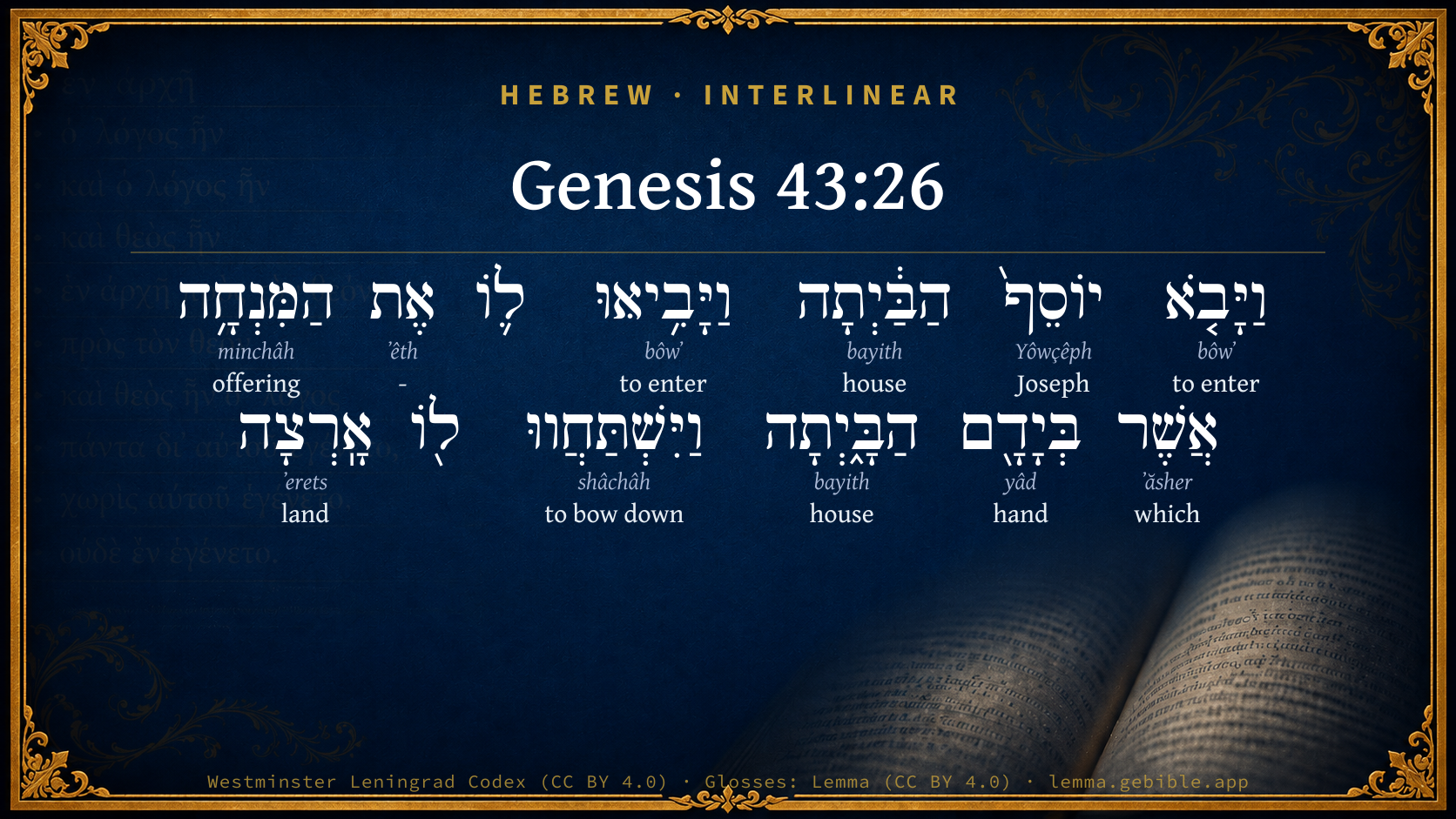
Hebrew (Westminster Leningrad Codex) Genesis 43:26 appears in the Hebrew Old Testament. The text above is from the Westminster Leningrad Codex. Each word links to its Strong’s number, a concise gloss, and parsing drawn from the Open Scriptures Hebrew Bible morphology. Click any word for its full Brown-Driver-Briggs (BDB) entry.
Download image
Cite this verse

Genesis 43:26 (World English Bible). Public Domain. Lemma interlinear Bible study tool, https://lemma.gebible.app/v/genesis/43/26.

Show BibTeX & RIS
BibTeX
RIS
English Translation
When Joseph came home, they brought him the present which was in their hand into the house, and bowed down themselves to him to the earth.
World English Bible · Public Domain
Download a study sheet

One document with this verse’s original text, its word-by-word gloss line, the meaning frame, cross-references with their text, attributed commentary, and full source and license credits — printable, and it pastes into notes with its structure intact.

This verse Autodidact and up

Study sheet (.html) Plain text (.txt)

A passage Seminary Student

Up to 50 verses in one chapter. A passage sheet keeps up to 6 commentary sources and 12 cross-references per verse, in the order this page ranks them, and says so on the sheet whenever that leaves anything out. Ask for a single verse and you get the Autodidact verse sheet above.

Everything on this page stays free to read, with no account — the sheet is a download of what is already on screen, not access to it.

Want to remove ads? Support Godless Engineer
Compare translations 3

The same verse in 3 English versions, stacked beneath the original-language interlinear above. Click any original word for its lexicon entry.

Each is an independent rendering of the whole verse — the interlinear is not word-aligned to these translations.

Highlighted words mark where these versions differ — a whole-verse word diff, not a word-by-word alignment.

  • World English Bible Public Domain
    When Joseph came home, they brought him the present which was in their hand into the house, and bowed down themselves to him to the earth.
  • King James Version Public Domain
    And when Joseph came home, they brought him the present which was in their hand into the house, and bowed themselves to him to the earth.
  • unfoldingWord Literal Text CC BY-SA 4.0
    Then Joseph came to the house, and they brought to him the gift that in their hand into the house, and they bowed down to him to the ground.

unfoldingWord Literal Text — © unfoldingWord, licensed CC BY-SA 4.0. Word-aligned USFM3 via Door43 (git.door43.org/unfoldingWord/en_ult).

Versions to compare (up to 4)

3 of 4 selected

Show all 18 translations

Every available English version of this verse, each an independent rendering of the whole verse.

  • World English Bible Public Domain
    When Joseph came home, they brought him the present which was in their hand into the house, and bowed down themselves to him to the earth.
  • Berean Standard Bible Public Domain
    When Joseph came home, they presented him with the gifts they had brought, and they bowed to the ground before him.
  • Majority Standard Bible Public Domain
    When Joseph came home, they presented him with the gifts they had brought, and they bowed to the ground before him.
  • King James Version Public Domain
    And when Joseph came home, they brought him the present which was in their hand into the house, and bowed themselves to him to the earth.
  • American Standard Version (1901) Public Domain
    And when Joseph came home, they brought him the present which was in their hand into the house, and bowed down themselves to him to the earth.
  • Revised Version (1885) Public Domain
    And when Joseph came home, they brought him the present which was in their hand into the house, and bowed down themselves to him to the earth.
  • Geneva Bible (1599) Public Domain
    When Ioseph came home, they brought the present into the house to him, which was in their handes, and bowed downe to the grounde before him.
  • Douay-Rheims (1899) Public Domain
    Then Joseph came into his house, and they offered him the presents holding them in their hands, and they bowed down with their face to the ground.
  • Young's Literal Translation Public Domain
    And Joseph cometh into the house, and they bring to him the present which `is' in their hand, into the house, and bow themselves to him, to the earth;
  • Literal Standard Version CC BY-SA 4.0
    And Joseph comes into the house, and they bring to him the present which [is] in their hand, into the house, and bow themselves to him, to the earth;
  • Unlocked Literal Bible CC BY-SA 4.0
    When Joseph came home, they brought the gifts which were in their hand into the house, and bowed down before him to the ground.
  • unfoldingWord Literal Text CC BY-SA 4.0
    Then Joseph came to the house, and they brought to him the gift that in their hand into the house, and they bowed down to him to the ground.
  • Darby Bible Public Domain
    When Joseph came home, they brought him the gift that was in their hand, into the house, and bowed themselves to him to the earth.
  • World Messianic Bible Public Domain
    When Joseph came home, they brought him the present which was in their hand into the house, and bowed themselves down to the earth before him.
  • Webster's Bible Public Domain
    \\43:27\\And he asked them of their welfare, and said, Is your father well, the old man of whom ye spoke? Is he yet alive?
  • Free Bible Version CC BY-SA 4.0
    When Joseph arrived at the house they gave him the gifts they had brought for him, and bowed low to the ground before him.
  • Bible in Basic English Public Domain
    And he said, How are you? is your father well, the old man of whom you were talking to me? is he still living?
  • JPS Tanakh (1917) Public Domain
    And when Joseph came home, they brought him the present which was in their hand into the house, and bowed down to him to the earth.

Literal Standard Version (2020), Covenant Press — licensed CC BY-SA 4.0. Text via the HelloAO Bible API (eBible.org). Unlocked Literal Bible (unfoldingWord) — licensed CC BY-SA 4.0. Text via the HelloAO Bible API (eBible.org). unfoldingWord Literal Text — © unfoldingWord, licensed CC BY-SA 4.0. Word-aligned USFM3 via Door43 (git.door43.org/unfoldingWord/en_ult). Free Bible Version, Dr. Jonathan Gallagher — licensed CC BY-SA 4.0. Text via the HelloAO Bible API (eBible.org).

Word by word

More ways to search: Search by grammar → Find every occurrence → Compare this word →

Practice this passage: Drill this verse → Learn its vocabulary →

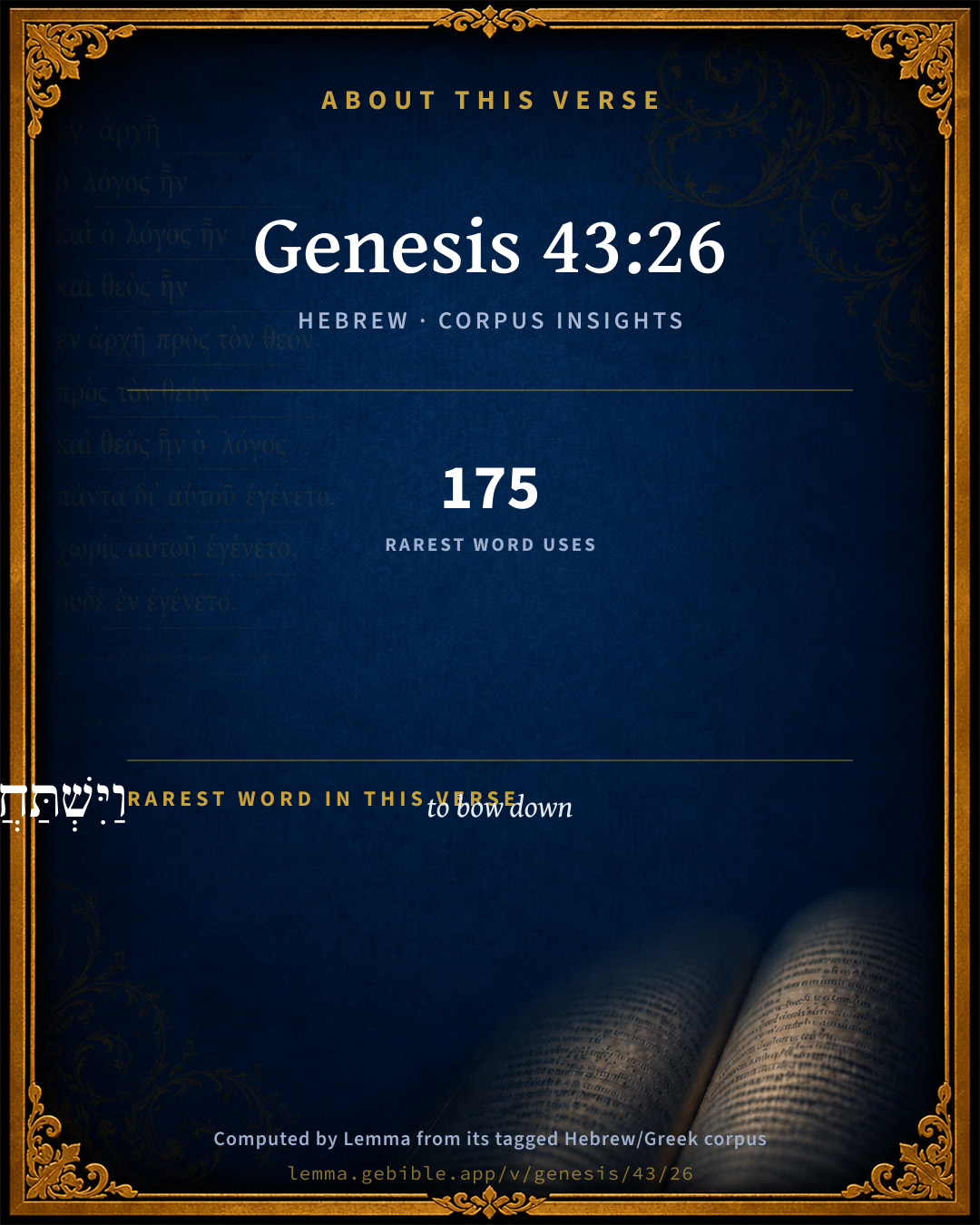
וַיִּשְׁתַּחֲווּ
shâchâh
H7812
“and · to bow down”
Conjunction + Verb, Hithpael, Sequential Imperfect, 3rd Person, Masculine, Plural
Part of Speech
Conjunction + Verb
Stem
Hithpael
Form
Sequential Imperfect
Person
3rd Person
Gender
Masculine
Number
Plural
Full BDB Definition

Origin: a primitive root

TWOT: 2360

to bow down - (Qal) to bow down - (Hiphil) to depress (figuratively) - (Hithpael) - to bow down, prostrate oneself - before superior in homage - before God in worship - before false gods - before angel
  1. וַיָּבֹ֤א bôwʼ H935 “and · to enter” Conjunction + Verb, Qal, Sequential Imperfect, 3rd Person, Masculine, Singular
  2. יוֹסֵף֙ Yôwçêph H3130 “Joseph” Noun, Proper
  3. הַבַּ֔יְתָה bayith H1004 “the · house · toward” Particle, Definite Article + Noun, Common, Masculine, Singular, Absolute + Suffix, Demonstrative
  4. וַיָּבִ֥יאּוּ bôwʼ H935 “and · to enter” Conjunction + Verb, Hiphil, Sequential Imperfect, 3rd Person, Masculine, Plural
  5. אֶת ʼêth H853 “-” Particle, Direct Object
  6. הַמִּנְחָ֥ה minchâh H4503 “the · offering” Particle, Definite Article + Noun, Common, Feminine, Singular, Absolute
  7. אֲשֶׁר ʼăsher H834 “which” Particle, Relative
  8. בְּיָדָ֖ם yâd H3027 “in/at · hand · their” Preposition + Noun, Common, Both, Singular, Construct + Suffix, Personal, 3rd Person, Masculine, Plural
  9. הַבָּ֑יְתָה bayith H1004 “the · house · toward” Particle, Definite Article + Noun, Common, Masculine, Singular, Absolute + Suffix, Demonstrative
  10. אָֽרְצָה ʼerets H776 “land · toward” Noun, Common, Both, Singular, Absolute + Suffix, Demonstrative

About this verse

These counts appear in no published source. They are computed here, from the morphology-tagged text and Lemma’s own curated glosses. What Lemma adds →

13
words
9
distinct lemmas
Pentateuch
section

Grammatical profile

  • 3 verbs
  • 6 nouns
  • 2 prepositions
  • 2 particles

Verb forms

  • וַיָּבֹ֤א Qal · Sequential Imperfect
  • וַיָּבִ֥יאּוּ Hiphil · Sequential Imperfect
  • וַיִּשְׁתַּחֲווּ Hithpael · Sequential Imperfect

Repetition

Words recur within this verse — often emphatic in Hebrew:

  • וַיָּבֹ֤א to enter H935 ×2
  • הַבַּ֔יְתָה house H1004 ×2

Hebrew & Septuagint length

In English translation the verse runs 26 words from the Hebrew and 32 from the Septuagint (LXX English) — closely comparable.

A rough comparison of the two English renderings, which tokenize alike — not a word-level alignment.

Word counts can differ between the Hebrew and the Greek without any difference in meaning — e.g. the Hebrew direct-object marker אֵת has no separate Greek word, and Greek often adds the article ὁ.

Cross-references

8

Topical passages linked to Genesis 43:26 in the Treasury of Scripture Knowledge — connected by theme and wording, ordered by reader-vote popularity; previews shown in the World English Bible.

  • Philippians 2:10–11 that at the name of Jesus every knee should bow, of those in heaven, those on earth, and those under the earth,
  • Genesis 27:29 Let peoples serve you, Nations bow down to you. Be lord over your brothers, Let your mother's sons bow down to you. Cursed be everyone who curses you, Blessed be everyone who blesses you."
  • Genesis 37:19–20 They said one to another, "Behold, this dreamer comes.
  • Genesis 42:6 Joseph was the governor over the land. It was he who sold to all the people of the land. Joseph's brothers came, and bowed themselves down to him with their faces to the earth.
  • Genesis 37:7–10 for, behold, we were binding sheaves in the field, and behold, my sheaf arose and also stood upright; and behold, your sheaves came around, and bowed down to my sheaf."
  • Psalms 72:9 Those who dwell in the wilderness shall bow before him. His enemies shall lick the dust.
  • Romans 14:11 For it is written, "'As I live,' says the Lord, 'to me every knee will bow. Every tongue will confess to God.'"
  • Genesis 43:28 They said, "Your servant, our father, is well. He is still alive." They bowed the head, and did homage.

Cross-references courtesy of OpenBible.info (CC BY 4.0).

Hebrew and Greek witnesses Masoretic Hebrew ↔ Greek Septuagint

The same verse in the two great witnesses to the Old Testament, shown verse-for-verse.

These are two independent witnesses, not word-aligned to each other, and the Septuagint is shown in lemma (dictionary) form.

Hebrew Genesis 43:26 Masoretic · Westminster Leningrad Codex

וַיָּבֹ֤א יוֹסֵף֙ הַבַּ֔יְתָה וַיָּבִ֥יאּוּ ל֛וֹ אֶת הַמִּנְחָ֥ה אֲשֶׁר בְּיָדָ֖ם הַבָּ֑יְתָה וַיִּשְׁתַּחֲווּ ל֖וֹ אָֽרְצָה

When Joseph came home, they brought him the present which was in their hand into the house, and bowed down themselves to him to the earth.

World English Bible · Public Domain

Greek LXX Genesis 43:26 Septuagint · lemma form

εἰςἔρχομαι δέ ιωσηφ εἰς ὁ οἰκία καί προςφέρω αὐτός ὁ δῶρον ὅς ἔχω ἐν ὁ χείρ αὐτός εἰς ὁ οἶκος καί προςκυνέω αὐτός ἐπί πρόσωπον ἐπί ὁ γῆ

And Joseph entered into the house, and they brought him the gifts which they had in their hands, into the house; and they did him reverence with their face to the ground.

LXX2012 (modern English Septuagint) · Public Domain

Hebrew: Westminster Leningrad Codex (CC BY 4.0). Greek: Septuagint (public domain); English from LXX2012 (modern English Septuagint) (Public Domain). How the Septuagint differs from the Hebrew →

Targum (Aramaic paraphrase)

2

The Targum is the ancient Jewish Aramaic paraphrase of the Hebrew Scriptures — an interpretive translation, not the Hebrew text itself. Onkelos (literal) and Pseudo-Jonathan (expansive) render the Torah, and Jonathan the Prophets. Coverage is partial: where no permissively-licensed English translation exists for a verse, only the Aramaic is shown. This is verse-level text, not a word-by-word alignment to the Hebrew.

  1. Targum Onkelos Torah (Genesis–Deuteronomy)
    וְעַל יוֹסֵף לְבֵיתָא וְאַיְתִיאוּ לֵהּ יָת תִּקְרֻבְתָּא דִּי בִידֵיהוֹן לְבֵיתָא וּסְגִידוּ לֵהּ לְאַרְעָא

    (no public-domain English translation for this verse)

    Targum Onkelos — Aramaic: “Onkelos Genesis” (public domain); “Onkelos Exodus” (public domain); “Onkelos Leviticus” (public domain); “Onkelos Numbers” (public domain); “Onkelos Deuteronomy” (public domain). English: “Sefaria Community Translation” (CC0 1.0 (public-domain dedication)); “J.W. Etheridge. The Targums of Onkelos and Jonathan Ben Uzziel on the Pentateuch. London: Longmans, Green, 1862” (public domain). Text via Sefaria.

  2. Targum Pseudo-Jonathan Torah (Genesis–Deuteronomy)
    וְעַל יוֹסֵף לְבֵיתָא וְאָעִילוּ לֵיהּ יַת דוֹרוֹנָא דִי בִידֵיהוֹן לְבֵיתָא וּסְגִידוּ לֵיהּ עַל אַרְעָא

    And Joseph entered the house, and they offered to him the present which was in their hands for the house; and bowed before him upon the ground.

    Targum Pseudo-Jonathan — Aramaic: “Targum Jonathan on Genesis” (public domain); “Targum Jonathan on Exodus” (public domain); “Targum Jonathan on Leviticus” (public domain); “Targum Jonathan on Numbers” (public domain); “Targum Jonathan on Deuteronomy” (public domain). English: “The Targum of Jonathan ben Uzziel, trans. J. W. Etheridge, London, 1862” (public domain). Text via Sefaria.

Commentary

Notes on Genesis 43:26 from classic Christian and Jewish commentators (each source and its license shown beneath its notes). The classic Christian expositions comment on the surrounding passage and are grouped to its opening verse, so a note may address several verses; the Jewish commentaries on the Tanakh (Rashi and others) are per-verse, so they appear only where the commentator wrote on this verse.

Lemma curates 59 commentaries, every one of them public domain or Creative Commons licensed, each selected and text-cleaned for this edition rather than reprinted as found. About our sources →

Matthew Henry's Commentary

Here is, I. The great respect that Joseph's brethren paid to him. When they brought him the present, they bowed themselves before him (Gen 43:26); and again, when they gave him an account of their father's health, they made obeisance, and called him, Thy servant our father, Gen 43:28. Thus were Joseph's dreams fulfilled more and more: and even the father, by the sons, bowed before him, according to the dream, Gen 37:10. Probably Jacob had directed them, if they had occasion to speak of him to the man, the lord of the land, to call him his servant.

II. The great kindness that Joseph showed to them, while they little thought it was a brotherly kindness. Here is,

1. His kind enquiry concerning Jacob: Is he yet alive? - a very fit question to be asked concerning any, especially concerning old people; for we are dying daily: it is strange that we are yet alive. Jacob had said many years before, I will go to the grave to my son; but he is yet alive: we must not die when we will.

2. The kind notice he took of Benjamin, his own brother. (1.) He put up a prayer for him: God be gracious unto thee, my son, Gen 43:29. Joseph's favour, though he was the lord of the land, would do him little good, unless God were gracious to him. Many seek the ruler's favour, but Joseph directs him to seek the favour of the ruler of rulers. (2.) He shed some tears for him, Gen 43:30. His natural affection to his brother, his joy to see him, his concern at seeing him and the rest of them in distress for bread, and the remembrance of his own griefs since he last saw him, produced a great agitation in him, which perhaps was the more uneasy because he endeavoured to stifle and suppress it; but he was forced to retire into his closet, there to give vent to his feeling by tears. Note, [1.] Tears of tenderness and affection are no disparagement at all, even to great and wise men. [2.] Gracious weepers should not proclaim their tears. My soul shall weep in secret, says the prophet, Jer 13:17. Peter went out and wept bitterly. See Mat 26:75.

3. His kind entertainment of them all. When his weeping had subsided so that he could refrain himself, he sat down to dinner with them, treated them nobly, and yet contrived every thing to amuse them.

(1.) He ordered three tables to be spread, one for his brethren, another for the Egyptians that dined with him (for so different were their customs that they did not care to eat together), another for himself, who durst not own himself a Hebrew, and yet would not sit with the Egyptians. See here an instance, [1.] Of hospitality and good house-keeping, which are very commendable, according as the ability is. [2.] Of compliance with people's humours, even whimsical ones, as bishop Patrick calls this of the Egyptians not eating with the Hebrews. Though Joseph was the lord of the land, and orders were given that all people should obey him, yet he would not force the Egyptians to eat with the Hebrews, against their minds, but let them enjoy their humours. Spirits truly generous hate to impose. [3.] Of the early distance between Jews and Gentiles; one table would not hold them.

(2.) He placed his brethren according to their seniority (Gen 43:33), as if he could certainly divine. Some think they placed themselves so, according to their custom; but, if so, I see not why such particular notice is taken of it, especially as a thing they marvelled at.

(3.) He gave them a very plentiful entertainment, sent messes to them from his own table, Gen 43:34. This was the more generous in him, and the more obliging to them, because of the present scarcity of provisions. In a day of famine, it is enough to be fed; but here they were feasted. Perhaps they had not had such a good dinner for many months. It is said, They drank and were merry; their cares and fears were now over, and they ate their bread with joy, concluding they were now upon good terms with the man, the lord of the land. If God accept our works, our present, we have reason to be cheerful. Yet when we sit, as they here did, to eat with a ruler, we should consider what is before us, and not indulge our appetite, nor be desirous of dainties, Pro 23:1-3. Joseph gave them to understand that Benjamin was his favourite; for his mess was five times as much as any of theirs, not as if he would have him eat so much more than the rest, for then he must eat more than would do him good (and it is no act of friendship, but rather an injury and unkindness, to press any either to eat or drink to excess), but thus he would testify his particular respect for him, that he might try whether his brethren would envy Benjamin his larger messes, as formerly they had envied himself his finer coat. And it must be our rule, in such cases, to be content with what we have, and not to grieve at what others have.

Matthew Henry's Commentary on the Whole Bible (1708–1710) — public domain (CC PDM 1.0). Text via the HelloAO Bible API.

Trapp's Complete Commentary

John Trapp

Gen 43:26 And when Joseph came home, they brought him the present which [was] in their hand into the house, and bowed themselves to him to the earth.

Ver. 26. And bowed themselves to him.] In their father’s name, as well as their own. {Gen 43:28} And here Joseph’s dream {Gen 37:9} was accomplished.

John Trapp, A Commentary or Exposition upon All the Books of the Old and New Testament (1647–1656) — public domain. Text from a community e-Sword module.

The Biblical Illustrator

Joseph S. Exell

Gen_43:26-34

And he took and sent messes unto them from before him.

Joseph and his brethren at the banquet

Consider this incident--

I. As IT ILLUSTRATES SOME USEFUL PRINCIPLES OF SOCIAL LIFE.

1. That we should not set up the pretence of loving all alike. Benjamin was specially honoured (Gen_43:34), and greeted with loving words (Gen_43:29).

2. That it is wise to observe the established customs of society when they are not morally wrong.

II. AS IT ILLUSTRATES THE SECRET AND THE OUTWARD LIFE.

1. In the case of the brethren.

2. In the case of Joseph. (T. H. Leale.)

Josephs banquet

1. The banquet of Josephs joy, of his hope, of his trying watch.

2. The feast of reviving hope in Josephs brethren.

3. Their participation without envy in the honouring of Benjamin.

4. An introduction to the last trial, and a preparation for it.

5. The successful issue in the fearful proving of Israels sons. (J. P.Lange.)

The dinner designed to make Joseph known

And now, I apprehend, it was Josephs wish to discover himself m his brethren, or rather to enable them to discover him. There are three things in particular while they were at dinner, each tending to this end, and as I conceive, designed for it.

1. The order of the tables. One for himself, one for the strangers, and one for the Egyptians. The design of this was to set them a thinking of him, and who he was, or could be? That the Egyptians and Hebrews should eat apart they could easily account for: but who, or what is this man? Is he not an Egyptian? Yet if he be, why eat by himself? Surely he must be a foreigner . . .

2. The order in which they themselves were seated; it was before him, so that they had full opportunity of looking at him; and what was astonishing to them, every man was placed according to his age. But who can this be that is acquainted with their ages, so as to be able to adjust things in this order? Surely it must be some one who knows us, though we know not him. Or is he a diviner Who or what can he be? They are said to have marvelled one at another, and well they might. It is marvellous that they did not from hence suspect who he was.

3. The peculiar favour which he expressed to Benjamin, in sending him a mess five times more than the rest. There is no reason to suppose that Benjamin ate more than the rest; but this was the manner of showing special favour in those times. It was therefore saying in effect, I not only know all your ages, but towards that young man I have more than a common regard Look at all this, and look at me Look at me, my brother Benjamin. Dost thou not know me? But all was hid from them. Their eyes, like those of the disciples towards their Lord, seem to have been holden, that they should not know him. Their minds however are eased from an apprehensions, and they drank, and were cheerful in his company. (A. Fuller.)

Lessons

1. Gracious hearts, however sometime they may deal severely, yet they desire their peace.

2. Providence sometimes orders peaceable entertainment, where worse is feared.

3. Nature itself, much more grace, inquire of and desires the peace of parents. He asked of their father, and meaneth his own (Gen_43:27).

4. It is equal that peaceable inquiries should have due answers.

5. In answering for others, Providence orders the accomplishment of his will The sunbows, &c.

6. All humility becomes their answers who are in fear of foreign powers (Gen_43:28.)

7. Sight of near relations moveth to inquire of their condition.

8. Natural affection desires to know its near relations for good.

9. Grace puts souls upon blessing relations as well as knowing them.

10. The best blessing is the grace of God procured upon souls.

11. Brethren may be fathers in blessing the fruit of the same womb (Gen_43:29). (G. Hughes, B. D.)

Lessons

1. Natural affection may speed to vent itself, after gracious benediction.

2. Natural bowels may burn in gracious souls to their relations.

3. Gracious wisdom teacheth to seek time, place, and measure of expressing affection to relations.

4. Secret venting of affections is best at some opportunities (Gen_43:30). (G. Hughes, B. D.)

Benjamins mess

I. PRESENTS FROM HOME. Those made to Joseph by men who little thought what feelings they might excite.

1. They were from his father. He would think of them as being selected by him. An act of homage.

2. They were peculiar to his native country and immediate neighbourhood. How often when a boy had he collected similar gums and nuts. They would take him back to the old time.

3. The presents we may receive from home have more of love in them than homage. We like them the better for that.

4. These presents were the gifts of poor men, who were the poorer by reason of the famine. Presents not to be valued by their intrinsic worth, but by the circumstances under which they were selected, and the feelings with which they are offered.

5. Every good gift is from above. God the author and giver of every good and perfect gift.

6. There is one unspeakable gift, made to us, suited to us; have we accepted this gift?

II. INQUIRIES ABOUT HOME.

1. They are asked concerning their welfare (see Exo_18:7). Such inquiries from us often mean only the welfare of the body, or relate to temporal things. Family greetings pleasant. Should include an interest in highest and best things.

2. They soon regarded the absent. His father in particular, the old man. It was about twenty-two years since he had seen his father. Is he yet alive? A few years work great changes in families. Return to your native town after an absence of twenty-two years, and note the different names, and the vast changes. The father was poorer than when he saw him last by reason of the famine; the son was richer than when he left home to look after the shepherds in Shechem. The coat of many colours exchanged for a robe of state. The shepherd boy become a prince. Absent friends to be remembered.

3. Benjamin specially addressed.

III. THE BANQUET.

1. The president of the feast. Joseph at a raised table by himself. His state and grandeur. Perhaps the presents from home were placed before him. His knowledge of the guests, and their ignorance of him. Jesus at &he last supper knew all, and was little known; after the resurrection He was known in the breaking of bread.

2. The officers of his household. They would show the respect and honour in which he was held.

3. The Israelites. The arrangement of their places at the table. Whence hath this man this knowledge? Benjamins mess. What could this mean? Whether they liked it or not, their fathers regard for the younger son, whether Joseph or Benjamin, was to be respected. They needed to be taught this lesson. And we must honour our parents. As they thus sat and feasted with the prince, did they think of the time when they sat down to eat bread by the side of the pit where Joseph was once imprisoned? Joseph returned good for evil. Learn: Let us remember home, especially the heavenly home. (J. C. Gray.)

.

The Biblical Illustrator, edited by Joseph S. Exell (c. 1880s–1900s) — public domain. Text from a community e-Sword module.

The Preacher's Complete Homiletical Commentary

Joseph S. Exell (gen. ed.)

CRITICAL NOTES.—

Gen_43:27. Is your father well?] Heb. “Is there peace to your father?”—

Gen_43:28. Thy servant, our father, is in good health, he is yet alive?] Heb., “Peace to thy servant our father—he yet lives.”—

Gen_43:29. God be gracious to thee, my son.] “Benjamin was only about a year old when Joseph was sold, as he was sixteen years the younger.”—(Jacobus.)—

Gen_43:32. And they set on for himself, and for them by themselves, and for the Egyptians which did eat with him, by themselves; because the Egyptians might not eat with the Hebrews; for that is an abomination unto the Egyptians.] “The law of caste separated different ranks of Egyptians to different tables. And Herodotus mentions the unwillingness of the Egyptians to have any familiar intercourse with foreigners. The Egyptians were prevented from eating with the Hebrews because the latter slew and ate animals which the former regarded as sacred—the cow, the ox, etc. Besides, the Hebrews did not practise the same religious ceremonies at meals as the Egyptians.”—(Jacobus.)—

Gen_43:34. And he sent messes unto them from before him.] It was the practice in the East to honour guests in this manner. (1Sa_9:23.) Five times as much as any of theirs. “The number five seems to have been in especial regard in Egypt. (Gen_41:34; Gen_45:22; Gen_47:2; Gen_47:24; Isa_19:18.) The reason is stated to have been, that the Egyptians recognized only five planets.”—(Alford.)

MAIN HOMILETICS OF THE PARAGRAPH.—Gen_43:26-34

JOSEPH AND HIS BRETHREN AT THE BANQUET

Consider this incident:—

I. As it illustrates some useful principles of social life.

1. That we should not set up the pretence of loving all alike. When Joseph thus liberally provided for these men he intended it to be a feast of brotherhood, and yet he made a marked difference between them. His brother Benjamin was specially honoured (Gen_43:34), and greeted with loving words. (Gen_43:29). All were not treated alike. The possession of an universal love—a love which does not discriminate is an unreality, a mere sentiment, and nothing more. We should not say that Benjamin, who has offended little and loved much should only receive the same as the rest. Surely those who are most like Christ are the most dear to God, and, therefore, these should be held the most dear to all who are the children of God.

2. That it is wise to observe the established customs of society when they are not morally wrong. In this feast differences of rank were respected, established social customs were not broken through. The Hebrews sat at a table by themselves, the Egyptians also by themselves. Joseph occupied a separate table by himself, for he was governor, and, therefore, of superior rank to the other Egyptians. (Gen_43:32.) Egyptian customs demanded such an arrangement. The equality of Christian brotherhood is quite consistent with this state of things. Christianity teaches principles that tend to make man equal, but in the meantime it does not rudely attack established customs which have a natural propriety in their favour. The pure and elevated principles of Christ’s religion are under present disadvantage in contending with the imperfections of human nature. But they shall prevail in the end, not by declaring a war of extermination against social customs which are not perfect, but by raising and ennobling the idea and the true purpose of life. It was thus that slavery was uprooted in the early ages of the Christian Church; not by declaiming directly against it, but by teaching those principles, which, if they prevailed, would render slavery impossible.

II. As it illustrates the secret and the outward life.

1. In the case of the brethren. Everything outwardly now tended to make them happy. The suspicious circumstances had been cleared up. They had the assurance that those with whom they were dealing feared God. They were treated with a generous hospitality. Joseph sustains throughout the character of an Egyptian nobleman. But he is more than this, he is a tender and considerate man. He remembers what they had said about a venerable old man, and not satisfied with asking in general of their welfare, he adds, “Is your father well, the old man of whom ye spake? Is he yet alive?” (Gen_43:27.) He is moved to tenderness at the sight of Benjamin’s youth. (Gen_43:29.) Thus they were received with kindness, indulged with feasting, and their outward circumstances were such as would render them happy. Yet with all this they had no peace, for the deep foundations of it had not yet been laid in the reconciliation of enmities, and in the complete healing of the past. In the midst of outward enjoyment, they must have felt a conflict of painful emotions within. The conduct of Joseph was, after all, strange and perplexing. They could not help wondering what it all meant. They had their fears. The secret and the outward life are also illustrated.

2. In the case of Joseph. In this conference with his brethren Joseph was getting on tender ground, and could only with difficulty control his feelings. (Gen_43:30). Think of the scene in his chamber, and how he tries to obliterate the traces of it afterwards. (Gen_43:31). He was one man in that chamber, and quite another man in the banqueting room. How great is the difference between the man whom God sees and the man whom the world sees! In human life we have sometimes this double part to play, weeping in the chamber and refraining ourselves below. Joseph had secretly indulged in a sorrow which he could not reveal. There are occasions of sorrow in which we have no need to disguise our feelings, and for these we can find comfort in the sympathy of others. But there are secret sorrows which we must disguise. Such are often the sorrows of the affections. Joseph could not yet declare himself to his brethren, and yet all the while his heart was consuming itself with love. How much anguish in families is often felt on account of love unreturned or unregarded. There are also secret sorrows arising from our anxiety concerning the souls of others. A parent’s anxiety about the spiritual state of a favourite son, wilful disobedience in children, signs of incipient intemperance in husband or wife; and yet, in the midst of all, the face is constrained to wear a smile, and may not tell the tale. There are also spiritual sorrows which are personal. They arise from a sense of imperfection, from the thought of blessings yet unattained. These are the sorrows of the purest and holiest of men, and may not be made known to the stranger. Joseph’s conduct was mysterious to his brethren, but his secret life, had they known it, would explain all. And so many strange characteristics and habits in others might be thus explained. That irritability of temper, that irregularity of spirits, that heaviness, that sullen silence—these might be well accounted for if we only knew all. This fact of human nature should teach us to judge tenderly and considerately of others. Some consuming care, or inward trouble, or self-reproach, some sorrow of the mind we know not of, may account for all that which seems to us so strange. Even where there is outward cheerfulness the chamber may have a sad tale to tell of weeping, watching, doubt, and fear. Jesus bore our griefs and carried our sorrows; and we should learn to bear one another’s burdens, and so fulfil the law of Christ.

SUGGESTIVE COMMENTS ON THE VERSES

Gen_43:26. This was an exact fulfilment of one of his early dreams, when the sun, moon, and eleven stars bowed down before him. But Joseph was now changed; he had been too much saddened by misfortune, and was far too much accustomed to Egyptian homage to find any real pleasure in this, from which he had formerly expected so much. For us this is a pregnant example of the illusiveness of human life. Now that his dream was fulfilled to the very letter, he could not enjoy it. That thing which he had seen before in the prophetic visions of youth, that thing he had got; and now the joy of it was not in that, in the superiority, but in quite other circumstances. So it is we live, looking to an horizon which we reach but cannot enjoy, in which we find not what we expected. And yet observe here the merciful arrangement of God, who thus leaders on. Could we now count the cost of the things we hope for, would it be possible to live?—(Robertson).

Gen_43:27-29. Observe Joseph’s relief in the indirect utterance of his feelings. He asked, “Is your father yet alive, and your youngest brother?” etc. Here is a strange principle of our nature, the necessity of utterance, either by a direct or by an indirect channel. Thus, criminal feeling must find for itself either direct expression in confession, or in speaking of the deed as committed by another.—(Robertson.)

They answer very properly, and call their father his servant, and again make obeisance. Thus, in them, Jacob himself bowed down to Joseph; and thereby that part of his dream was also fulfilled.—(Fuller).

Gen_43:30. After uttering a benediction which, under the disguise of a good wish from a stranger, was in reality the effusion of a bursting heart, he was obliged to retire in order to throw a veil over those feelings which must otherwise have betrayed the secret that for the present he designs to keep. He withdraws, therefore, to give vent to his tears in a private place; and however bitter were the tears which he had formerly shed when exiled from all that was dear to him on earth, he now sheds tears of joy of proportionable sweetness; his grief for what was past was now swallowed up in the ecstacy of what was present and what was to come.—(Bush).

Gen_43:31. We love Joseph for the warm sensibility of his heart, and we respect him as one who knows both when and where to weep, and who could refrain himself and appear cheerful when it was fit. While tears shed on proper occasions throw a grace over the manliest character, yet there is not only “a time to weep, but also a time to laugh; a time to embrace, and a time to refrain from embracing,” and that he whose tears are not in some measure under the control of his judgment, is rather a child than a man.—(Bush).

Gen_43:32-34. It was now Joseph’s wish to discover himself to his brethren, or rather to enable them to discover him. While they were at dinner, three things tend to this end, and were designed for it.

(1) The order of the tables. The design of this was to set them a thinking of him, and who he was, or could be? That the Egyptians and Hebrews should eat apart, they could easily account for: but who, or what is this man? Is he not an Egyptian? Yet, why eat by himself? Surely he must be a foreigner.

(2) The order in which they themselves were seated. Every man was placed “according to his age.” But who can this be that is acquainted with their ages, so as to be able to adjust things in this order? Surely it must be some one who knows us though we know not him. Or is he a diviner? They are said to have “marvelled one at another,” and well they might.

(3) The peculiar favour which he expressed to Benjamin, in sending him a mess five times more than the rest. This was a manner of showing special favour in those times. It was therefore saying in effect, “I not only know all your ages, but towards that young man I have more than a common regard. Look at all this, and look at me. Look at me, my brother Benjamin. Dost thou not know me?” But all was hid from them. Their eyes, like those of the disciples towards their Lord, seem to have been holden that they should not know him.—(Fuller).

And now he feasts with them whom he formerly threatened, and turns their fear into wonder. All unequal love is not partial; all the brethren are entertained bountifully, but Benjamin hath a five-fold portion.—(Bp. Hall.)

Our New Testament Joseph bids us sit at the table which He has richly furnished in His house. He anoints our head with oil in token of honourable reception, and our cup runneth over. (Psa_23:5).—(Jacobus).

1. The banquet of Joseph’s joy, of his hope, of his trying watch.

2. The feast of reviving hope in Joseph’s brethren.

3. Their participation without envy in the honouring of Benjamin.

4. An introduction to the last trial, and a preparation for it.

5. The successful issue in the fearful proving of Israel’s sons.—(Lange.)

The Preacher's Complete Homiletical Commentary (gen. ed. Joseph S. Exell; Funk & Wagnalls, c. 1892) — public domain (pre-1929). A full-Bible homiletical/sermon-outline anthology covering 65 of 66 books (2 John is absent from the source module). Text from a community e-Sword module.

Tyndale Open Study Notes

Tyndale Open Resources

43:26 For the second time, the brothers bowed . . . before Joseph in fulfillment of his first dream (37:7; see 42:6-7; cp. 33:3).

Tyndale Open Study Notes — © Tyndale Open Resources, licensed CC BY-SA 4.0. Text via the HelloAO Bible API.

The Cambridge Bible for Schools and Colleges

gen. ed. J. J. S. Perowne

26. bowed down themselves] A second fulfilment of Joseph’s dreams: see Gen_42:6, Gen_44:14; cf. Gen_37:5-11.

The Cambridge Bible for Schools and Colleges (gen. ed. J. J. S. Perowne; Cambridge University Press, 1878–1918) — public domain. Text from a community e-Sword module.

John Gill's Exposition

And he asked them of their welfare,.... Or "peace" (b), their prosperity, especially of the health of their bodies, whether they were well and in good health after so long a journey:

and said, is your father well, the old man of whom ye spake? when they were with him before, and told him they were all the sons of one man, who dwelt in Canaan:

is he yet alive? which he was very desirous of knowing; for, being advanced in years, he might fear he was removed by death in the time between their going and returning.

(b) "ad pacem", Montanus, "de pace", Vatablus, Drusius, Piscator, Schmidt.

John Gill's Exposition of the Whole Bible (1746–1763) — public domain (CC PDM 1.0). Text via the HelloAO Bible API.

Whedon's Commentary on the Bible

Daniel D. Whedon

26. Bowed themselves — Another act fulfilling Joseph’s dream — all the eleven of his brethren now bowing down. Gen_42:6-9; Gen_37:5-9.

Daniel D. Whedon (gen. ed.), Commentary on the Old and New Testaments (1874–1909) — public domain. Text from a community e-Sword module.

The Pulpit Commentary

And when Joseph came home (after the dispatch of public business), they brought him the present which was in their hand (vide ver. 11) into the house, and bowed themselves to him to the earth. Thus they fulfilled the dream of the sheaves (Gen_37:7; cf. Gen_18:2 Gen_19:1)

The Pulpit Commentary (1880–1919), ed. H.D.M. Spence-Jones & Joseph S. Exell — public domain. Text from a community e-Sword module.

John Wesley's Explanatory Notes

When they brought him the present, they bowed themselves before him, and again, when they gave him an account of their father's health, they made obeisance, and called him, Thy servant, our father - Thus were Joseph's dreams fulfilled more and more; and even the father, by the sons, bowed before him. Probably Jacob had directed them, if they had occasion to speak of him to the man, the Lord of the land, to call him his servant.

John Wesley, Explanatory Notes Upon the Whole Bible (1754–1765) — public domain. Text via the GEBible commentary corpus.

Keil & Delitzsch

C. F. Keil & F. Delitzsch

When Joseph came home, they handed him the present with the most reverential obeisance.

Gen 43:27-29

Joseph first of all inquired after their own and their father's health (שׁלום first as substantive, then as adjective = שׁלם Gen 33:18), whether he was still living; which they answered with thanks in the affirmative, making the deepest bow. His eyes then fell upon Benjamin, the brother by his own mother, and he asked whether this was their youngest brother; but without waiting for their reply, he exclaimed, "God be gracious to thee, my son!" יחנך for יחנך as in Isa 30:19 (cf. Ewald, 251d). He addressed him as "my son," in tender and, as it were, paternal affection, and with special regard to his youth. Benjamin was 16 years younger than Joseph, and was quite an infant when Joseph was sold.

Gen 43:30-31

And "his (Joseph's) bowels did yearn" (נכמרוּ lit., were compressed, from the force of love to his brother), so that he was obliged to seek (a place) as quickly as possible to weep, and went into the chamber, that he might give vent to his feelings in tears; after which, he washed his face and came out again, and, putting constraint upon himself, ordered the dinner to be brought in.

Gen 43:32-33

Separate tables were prepared for him, for his brethren, and for the Egyptians who dined with them. This was required by the Egyptian spirit of caste, which neither allowed Joseph, as minister of state and a member of the priestly order, to eat along with Egyptians who were below him, nor the latter along with the Hebrews as foreigners. "They cannot (i.e., may not) eat (cf. Deu 12:17; Deu 16:5; Deu 17:15). For this was an abomination to the Egyptians." The Hebrews and others, for example, slaughtered and ate animals, even female animals, which were regarded by the Egyptians as sacred; so that, according to Herod. ii. 41, no Egyptian would use the knife, or fork, or saucepan of a Greek, nor would any eat of the flesh of a clean animal which had been cut up with a Grecian knife (cf. Exo 8:22).

Gen 43:33-34

The brothers sat in front of Joseph, "the first-born according to his birthright, and the smallest (youngest) according to his smallness (youth);" i.e., the places were arranged for them according to their ages, so that they looked at one another with astonishment, since this arrangement necessarily impressed them with the idea that this great man had been supernaturally enlightened as to their family affairs. To do them honour, they brought (ישּׂא, Ges. 137, 3) them dishes from Joseph, i.e., from his table; and to show especial honour to Benjamin, his portion was five times larger than that of any of the others (ידות lit., hands, grasps, as in Gen 47:24; Kg2 11:7). The custom is met with elsewhere of showing respect to distinguished guests by giving them the largest and best pieces (Sa1 9:23-24; Homer, Il. 7, 321; 8, 162, etc.), by double portions (e.g., the kings among the Spartans, Herod. 6, 57), and even by fourfold portions in the case of the Archons among the Cretans (Heraclid. polit., 3). But among the Egyptians the number 5 appears to have been preferred to any other (cf. Gen 41:34; Gen 45:22; Gen 47:2, Gen 47:24; Isa 19:18). By this partiality Joseph intended, with a view to his further plans, to draw out his brethren to show their real feelings towards Benjamin, that he might see whether they would envy and hate him on account of this distinction, as they had formerly envied him his long coat with sleeves, and hated him because he was his father's favourite (Gen 37:3-4). This honourable treatment and entertainment banished all their anxiety and fear. "They drank, and drank largely with him," i.e., they were perfectly satisfied with what they ate and drank; not, they were intoxicated (cf. Hag 1:9).

Keil & Delitzsch — Biblical Commentary on the Old Testament (1861–1891) — public domain (CC PDM 1.0). Text via the HelloAO Bible API. (Old Testament only.)

Kretzmann's Popular Commentary

Paul E. Kretzmann

The Meal in Joseph’s House

v. 26. And when Joseph came home, they brought him the present which was in their hand in to the house, and bowed themselves to him to the earth, thus again fulfilling the dream which Joseph had told them about twenty-two years before, Gen 37:7-10.

v. 27. And he asked them of their welfare, literally, he inquired after their peace, and said, Is your father well, the old man of whom ye spake? Is he yet alive? It was a most kind and solicitous inquiry, intended to put them at their ease, while it satisfied the anxiety of Joseph himself.

v. 28. And they answered, Thy servant, our father, is in good health, he is yet alive. And they bowed down their heads, and made obeisance, thus showing the proper courtesy to Joseph and true filial respect for their father.

v. 29. And he lifted up his eyes, and saw his brother Benjamin, his mother’s son, and said, Is this your younger brother, of whom ye spake unto me? It was the first time in twenty-two years that he saw this brother, and the latter had been an infant of about one year when Joseph had been sold into Egypt. And he said, God be gracious unto thee, my son, an expression both of true kindness and of relationship.

v. 30. And Joseph made haste; for his bowels did yearn upon his brother, his love excited his feelings to such an extent that he could no longer control himself; and he sought where to weep; and he entered in to his chamber, and wept there. In the seclusion of his own room he could give free vent to his feelings.

v. 31. And he washed his face, and went out, and refrained himself, he forcibly kept his feelings under control, and said, set on bread; thereby ordering dinner to be served.

v. 32. And they set on for him by himself, and for them by themselves, and for the Egyptians which did eat with him by themselves; because the Egyptians might not eat bread with the Hebrews; for that is an abomination unto the Egyptians. Cf Deu 12:17; Deu 16:5; Deu 17:15. Although they all ate in the same room, they were served at different tables, as the rules of the caste required. Joseph belonged to the priestly caste and could therefore not sit down at the same table with laymen, and the Egyptians would not eat at the same table with members of a nomad tribe.

v. 33. And they sat before him, their table was placed so that he had a full view of it, the first-born according to his birthright, and the youngest according to his youth; and the men marveled one at an other; they wondered where the Egyptians had gotten the information regarding their respective ages.

v. 34. And he took and sent messes unto them from before him, portions from his own table, which was a mark of special distinction; but Benjamin’s mess was five times so much as any of theirs. This, in a way, was again a test, to see whether the brothers were still prone to become jealous. And they drank, and were merry with him, their reserve melted under the influence of the wine, and Joseph had the best opportunity to study them as their fear of the Egyptian ruler gave way to a respectful confidence. Thus the Lord mingles kindness with severity, and lets us taste His favor in full measure after some grievous experience has filled our hearts with fear.

Paul E. Kretzmann, Popular Commentary of the Bible (1921–1924) — public domain. Text from a community e-Sword module.

unfoldingWord translationNotes

Door43 World Missions Community

they brought the gifts which were in their hand

Here "hand" stands for the entire person. AT: "the brothers brought the gifts they had with them" (See: Synecdoche)

bowed down before him

This is a way of showing honor and respect. (See: Symbolic Action)

translationWords

bow

ancestor

unfoldingWord translationNotes — © Distant Shores Media and the Door43 World Missions Community, licensed CC BY-SA 4.0. Source: git.door43.org/Door43/en_tn.

Rashi

Rabbi Shlomo Yitzchaki (Rashi)

הביתה [THEY BROUGHT THE PRESENT] INTO THE HOUSE — from the outer hall into the reception hall.

Rashi on the Tanakh — English translations: “The Judaica Press complete Tanach with Rashi, translated by A. J. Rosenberg” (CC BY 4.0); “Pentateuch with Rashi's commentary by M. Rosenbaum and A.M. Silbermann, 1929-1934” (public domain); “The Metsudah Tanach series, Lakewood, N.J” (CC BY 4.0); and “The Book of Joshua, Metsudah Publications, 1997” (CC BY 4.0). Text via Sefaria.

Radak

Rabbi David Kimhi (Radak)

ויבא...ויביאו, the letter א in the word ויביאו has a dagesh.

הביתה, to the house where they were being dined, for although they were also in the same “house,” they were not in the same compound. In the house or palace of an important personage there are many smaller separate buildings. The brothers at this time had been in one of the outer buildings, whereas Joseph occupied the inner palace, so that the line “they brought the gift they carried with them to the inner palace to him,” is quite justified.

Radak on the Tanakh — English translations: “Sefaria Community Translation” (CC0 1.0 (public-domain dedication)); “Eliyahu Munk, HaChut Hameshulash” (CC BY 4.0); “Rabbi Mike Feuer, Jerusalem Anthology” (CC BY 4.0); and “R. David Kimhi on the first book of Psalms, Translated by R.G. Finch, London, 1919” (public domain). Text via Sefaria.

Lesson kit

Teaching starters — assembled from the data on this page, not authored interpretation. Every prompt links to the verse data it draws on. Edit before teaching.

Genesis, in the Pentateuch, opens this verse with 13 words (9 distinct Hebrew lemmas). Its most distinctive word is shâchâh (“to bow down”). A historical commentator’s framing appears above. Read the whole chapter for the surrounding context.

Discussion questions

  1. What does “to bow down” (shâchâh) contribute to the verse as a whole?
  2. How does Philippians 2:10–11, which shares this passage’s theme, read alongside this verse?
  3. What does the repetition of “to enter” (2× in this one verse) do in this verse?
  4. The translations on this page render this verse differently — a whole-verse word diff, not a word-by-word alignment. What might account for the different wordings?
  5. «וַיָּבֹ֤א» is a Qal Sequential Imperfect verb. How does that grammatical form shape the action described?
  6. Compare how Matthew Henry's Commentary and Trapp's Complete Commentary read this verse. Where do they agree or differ?

Things to notice

  • These translations choose different wording for 9 words in this verse.
  • “to enter” occurs 2× in this single verse.
  • 9 distinct Hebrew lemmas span 13 words in this verse.

Reading settings

Reading text

Shown beneath each verse's original-language words.

Old Testament
Old Testament edition

Read the OT as the Masoretic Hebrew (MT) or the Greek Septuagint (LXX).

English shown for the Greek Septuagint (in the Hebrew ↔ Greek comparison).

Comparing translations? Open the Compare panel on any verse page to stack up to four side by side.