Genesis 46:7

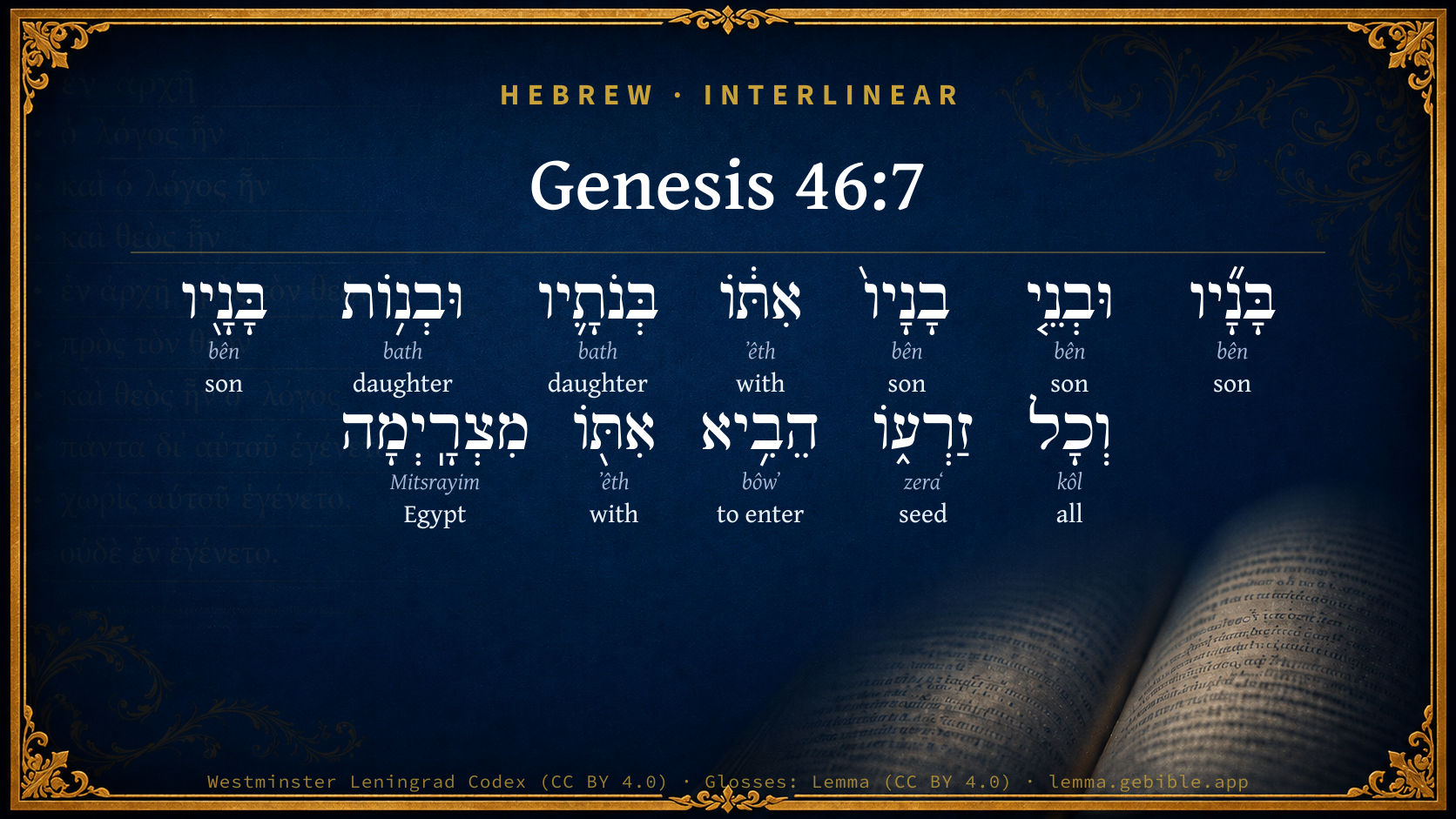
Hebrew (Westminster Leningrad Codex) Genesis 46:7 appears in the Hebrew Old Testament. The text above is from the Westminster Leningrad Codex. Each word links to its Strong’s number, a concise gloss, and parsing drawn from the Open Scriptures Hebrew Bible morphology. Click any word for its full Brown-Driver-Briggs (BDB) entry.
Download image
Cite this verse

Genesis 46:7 (World English Bible). Public Domain. Lemma interlinear Bible study tool, https://lemma.gebible.app/v/genesis/46/7.

Show BibTeX & RIS
BibTeX
RIS
English Translation
his sons, and his sons' sons with him, his daughters, and his sons' daughters, and he brought all his seed with him into Egypt.
World English Bible · Public Domain
Download a study sheet

One document with this verse’s original text, its word-by-word gloss line, the meaning frame, cross-references with their text, attributed commentary, and full source and license credits — printable, and it pastes into notes with its structure intact.

This verse Autodidact and up

Study sheet (.html) Plain text (.txt)

A passage Seminary Student

Up to 50 verses in one chapter. A passage sheet keeps up to 6 commentary sources and 12 cross-references per verse, in the order this page ranks them, and says so on the sheet whenever that leaves anything out. Ask for a single verse and you get the Autodidact verse sheet above.

Everything on this page stays free to read, with no account — the sheet is a download of what is already on screen, not access to it.

Want to remove ads? Support Godless Engineer
Compare translations 3

The same verse in 3 English versions, stacked beneath the original-language interlinear above. Click any original word for its lexicon entry.

Each is an independent rendering of the whole verse — the interlinear is not word-aligned to these translations.

Highlighted words mark where these versions differ — a whole-verse word diff, not a word-by-word alignment.

  • World English Bible Public Domain
    his sons, and his sons' sons with him, his daughters, and his sons' daughters, and he brought all his seed with him into Egypt.
  • King James Version Public Domain
    His sons, and his sons' sons with him, his daughters, and his sons' daughters, and all his seed brought he with him into Egypt.
  • unfoldingWord Literal Text CC BY-SA 4.0
    his sons and his sons’ sons with him, his daughters and his sons’ daughters. So all his offspring he brought with him to Egypt.

unfoldingWord Literal Text — © unfoldingWord, licensed CC BY-SA 4.0. Word-aligned USFM3 via Door43 (git.door43.org/unfoldingWord/en_ult).

Versions to compare (up to 4)

3 of 4 selected

Show all 18 translations

Every available English version of this verse, each an independent rendering of the whole verse.

  • World English Bible Public Domain
    his sons, and his sons' sons with him, his daughters, and his sons' daughters, and he brought all his seed with him into Egypt.
  • Berean Standard Bible Public Domain
    Jacob took with him to Egypt his sons and grandsons, and his daughters and granddaughters—all his offspring.
  • Majority Standard Bible Public Domain
    Jacob took with him to Egypt his sons and grandsons, and his daughters and granddaughters—all his offspring.
  • King James Version Public Domain
    His sons, and his sons' sons with him, his daughters, and his sons' daughters, and all his seed brought he with him into Egypt.
  • American Standard Version (1901) Public Domain
    his sons, and his sons' sons with him, his daughters, and his sons's daughters, and all his seed brought he with him into Egypt.
  • Revised Version (1885) Public Domain
    his sons, and his sons’ sons with him, his daughters, and his sons’ daughters, and all his seed brought he with him into Egypt.
  • Geneva Bible (1599) Public Domain
    His sonnes and his sonnes sonnes with him, his daughters and his sonnes daughters, and al his seede brought he with him into Egypt.
  • Douay-Rheims (1899) Public Domain
    His sons, and grandsons, daughters, and all his offspring together.
  • Young's Literal Translation Public Domain
    his sons, and his sons' sons with him, his daughters, and his sons' daughters, yea, all his seed he brought with him into Egypt.
  • Literal Standard Version CC BY-SA 4.0
    his sons, and his sons’ sons with him, his daughters, and his sons’ daughters, indeed, all his seed he brought with him into Egypt.
  • Unlocked Literal Bible CC BY-SA 4.0
    He brought with him to Egypt his sons and his sons' sons, his daughters and his sons' daughters, and all his descendants.
  • unfoldingWord Literal Text CC BY-SA 4.0
    his sons and his sons’ sons with him, his daughters and his sons’ daughters. So all his offspring he brought with him to Egypt.
  • Darby Bible Public Domain
    his sons and his sons' sons with him, his daughters and his sons' daughters and all his seed he brought with him to Egypt.
  • World Messianic Bible Public Domain
    his sons, and his sons’ sons with him, his daughters, and his sons’ daughters, and he brought all his offspring with him into Egypt.
  • Webster's Bible Public Domain
    His sons, and his sons' sons with him, his daughters, and his sons' daughters, and all his seed brought he with him into Egypt.
  • Free Bible Version CC BY-SA 4.0
    including all his sons and grandsons, daughters and granddaughters.
  • Bible in Basic English Public Domain
    His sons and his sons' sons, his daughters and his daughters' sons and all his family he took with him into Egypt.
  • JPS Tanakh (1917) Public Domain
    his sons, and his sons' sons with him, his daughters, and his sons' daughters, and all his seed brought he with him into Egypt.

Literal Standard Version (2020), Covenant Press — licensed CC BY-SA 4.0. Text via the HelloAO Bible API (eBible.org). Unlocked Literal Bible (unfoldingWord) — licensed CC BY-SA 4.0. Text via the HelloAO Bible API (eBible.org). unfoldingWord Literal Text — © unfoldingWord, licensed CC BY-SA 4.0. Word-aligned USFM3 via Door43 (git.door43.org/unfoldingWord/en_ult). Free Bible Version, Dr. Jonathan Gallagher — licensed CC BY-SA 4.0. Text via the HelloAO Bible API (eBible.org).

Word by word

More ways to search: Search by grammar → Find every occurrence → Compare this word →

Practice this passage: Drill this verse → Learn its vocabulary →

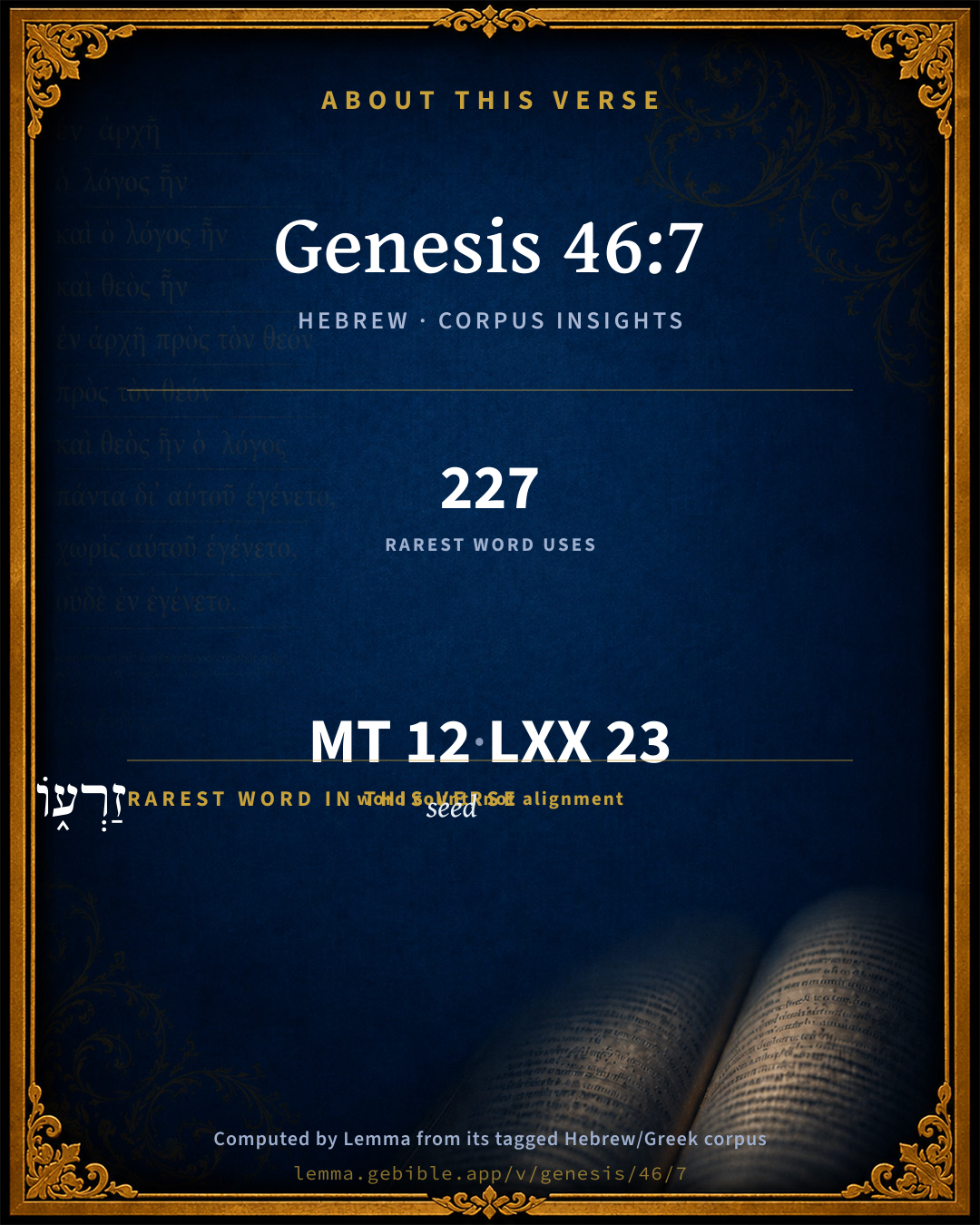
זַרְע֑וֹ
zeraʻ
H2233
“seed · his”
Noun, Common, Masculine, Singular, Construct + Suffix, Personal, 3rd Person, Masculine, Singular
Part of Speech
Noun
Type
Common
Gender
Masculine
Number
Singular
State
Construct
Full BDB Definition

Origin: from H2232

TWOT: 582a

seed, sowing, offspring - a sowing - seed - semen virile - offspring, descendants, posterity, children - of moral quality - a practitioner of righteousness (figuratively) - sowing time (by metonymy)
  1. בָּנָ֞יו bên H1121 “sons · his” Noun, Common, Masculine, Plural, Construct + Suffix, Personal, 3rd Person, Masculine, Singular
  2. וּבְנֵ֤י bên H1121 “and · sons of” Conjunction + Noun, Common, Masculine, Plural, Construct
  3. בָנָיו֙ bên H1121 “sons · his” Noun, Common, Masculine, Plural, Construct + Suffix, Personal, 3rd Person, Masculine, Singular
  4. אִתּ֔וֹ ʼêth H854 “with · him” Preposition + Suffix, Personal, 3rd Person, Masculine, Singular
  5. בְּנֹתָ֛יו bath H1323 “daughters · his” Noun, Common, Feminine, Plural, Construct + Suffix, Personal, 3rd Person, Masculine, Singular
  6. וּבְנ֥וֹת bath H1323 “and · daughters of” Conjunction + Noun, Common, Feminine, Plural, Construct
  7. בָּנָ֖יו bên H1121 “sons · his” Noun, Common, Masculine, Plural, Construct + Suffix, Personal, 3rd Person, Masculine, Singular
  8. וְכָל kôl H3605 “and · all of” Conjunction + Noun, Common, Masculine, Singular, Construct
  9. הֵבִ֥יא bôwʼ H935 “to enter” Verb, Hiphil, Perfect, 3rd Person, Masculine, Singular
  10. אִתּ֖וֹ ʼêth H854 “with · him” Preposition + Suffix, Personal, 3rd Person, Masculine, Singular
  11. מִצְרָֽיְמָה Mitsrayim H4714 “Egypt · toward” Noun, Proper + Suffix, Demonstrative

About this verse

These counts appear in no published source. They are computed here, from the morphology-tagged text and Lemma’s own curated glosses. What Lemma adds →

12
words
7
distinct lemmas
Pentateuch
section

Grammatical profile

  • 1 verb
  • 9 nouns
  • 2 prepositions

Verb forms

  • הֵבִ֥יא Hiphil · Perfect

Repetition

Words recur within this verse — often emphatic in Hebrew:

  • בָּנָ֞יו son H1121 ×4
  • בְּנֹתָ֛יו daughter H1323 ×2
  • אִתּ֔וֹ with H854 ×2

Hebrew & Septuagint length

In English translation the verse runs 24 words from the Hebrew and 26 from the Septuagint (LXX English) — closely comparable.

A rough comparison of the two English renderings, which tokenize alike — not a word-level alignment.

Word counts can differ between the Hebrew and the Greek without any difference in meaning — e.g. the Hebrew direct-object marker אֵת has no separate Greek word, and Greek often adds the article ὁ.

In the original languages it is 12 Hebrew tokens and 23 Greek tokens — but the two are counted differently (Hebrew bundles its prefixes and suffixes into one token; the Greek is in lemma form), so that isn’t a like-for-like length.

Hebrew and Greek witnesses Masoretic Hebrew ↔ Greek Septuagint

The same verse in the two great witnesses to the Old Testament, shown verse-for-verse.

These are two independent witnesses, not word-aligned to each other, and the Septuagint is shown in lemma (dictionary) form.

Hebrew Genesis 46:7 Masoretic · Westminster Leningrad Codex

בָּנָ֞יו וּבְנֵ֤י בָנָיו֙ אִתּ֔וֹ בְּנֹתָ֛יו וּבְנ֥וֹת בָּנָ֖יו וְכָל זַרְע֑וֹ הֵבִ֥יא אִתּ֖וֹ מִצְרָֽיְמָה

his sons, and his sons' sons with him, his daughters, and his sons' daughters, and he brought all his seed with him into Egypt.

World English Bible · Public Domain

Greek LXX Genesis 46:7 Septuagint · lemma form

υἱός καί ὁ υἱός ὁ υἱός αὐτός μετά αὐτός θυγάτηρ καί θυγάτηρ ὁ υἱός αὐτός καί πᾶς ὁ σπέρμα αὐτός ἄγω εἰς αἴγυπτος

The sons, and the sons of his sons with him; his daughters, and the daughters of his daughters; and he brought all his seed into Egypt.

LXX2012 (modern English Septuagint) · Public Domain

On this verse, Haydock's Catholic Bible Commentary discusses the Septuagint’s reading. Read the note in Commentary ↓

Hebrew: Westminster Leningrad Codex (CC BY 4.0). Greek: Septuagint (public domain); English from LXX2012 (modern English Septuagint) (Public Domain). How the Septuagint differs from the Hebrew →

Targum (Aramaic paraphrase)

2

The Targum is the ancient Jewish Aramaic paraphrase of the Hebrew Scriptures — an interpretive translation, not the Hebrew text itself. Onkelos (literal) and Pseudo-Jonathan (expansive) render the Torah, and Jonathan the Prophets. Coverage is partial: where no permissively-licensed English translation exists for a verse, only the Aramaic is shown. This is verse-level text, not a word-by-word alignment to the Hebrew.

  1. Targum Onkelos Torah (Genesis–Deuteronomy)
    בְּנוֹהִי וּבְנֵי בְנוֹהִי עִמֵּהּ בְּנָתֵהּ וּבְנַת בְּנוֹהִי וְכָל זַרְעֵהּ אַיְתִי עִמֵּהּ לְמִצְרָיִם

    (no public-domain English translation for this verse)

    Targum Onkelos — Aramaic: “Onkelos Genesis” (public domain); “Onkelos Exodus” (public domain); “Onkelos Leviticus” (public domain); “Onkelos Numbers” (public domain); “Onkelos Deuteronomy” (public domain). English: “Sefaria Community Translation” (CC0 1.0 (public-domain dedication)); “J.W. Etheridge. The Targums of Onkelos and Jonathan Ben Uzziel on the Pentateuch. London: Longmans, Green, 1862” (public domain). Text via Sefaria.

  2. Targum Pseudo-Jonathan Torah (Genesis–Deuteronomy)
    בְּנוֹי וּבְנֵי בְנוֹי עִמֵיהּ בְּנָתֵיהּ וּבְנַת בְּנוֹי וְכָל זַרְעֵיהּ אַיְיתֵי עִמֵיהּ לְמִצְרָיִם

    his sons and his sons' children with him, his daughters, and the daughters of his sons; and all his seed came with him to Mizraim.

    Targum Pseudo-Jonathan — Aramaic: “Targum Jonathan on Genesis” (public domain); “Targum Jonathan on Exodus” (public domain); “Targum Jonathan on Leviticus” (public domain); “Targum Jonathan on Numbers” (public domain); “Targum Jonathan on Deuteronomy” (public domain). English: “The Targum of Jonathan ben Uzziel, trans. J. W. Etheridge, London, 1862” (public domain). Text via Sefaria.

Commentary

Notes on Genesis 46:7 from classic Christian and Jewish commentators (each source and its license shown beneath its notes). The classic Christian expositions comment on the surrounding passage and are grouped to its opening verse, so a note may address several verses; the Jewish commentaries on the Tanakh (Rashi and others) are per-verse, so they appear only where the commentator wrote on this verse.

Lemma curates 59 commentaries, every one of them public domain or Creative Commons licensed, each selected and text-cleaned for this edition rather than reprinted as found. About our sources →

Trapp's Complete Commentary

John Trapp

Gen 46:7 His sons, and his sons’ sons with him, his daughters, and his sons’ daughters, and all his seed brought he with him into Egypt.

Ver. 7. His daughters, and his sons’ daughters.] That is, by a synecdoche, integri; his niece Serah, and his daughter Dinah, who came down with the rest into Egypt; and therefore was not Job’s wife, as the Jews would persuade us.

John Trapp, A Commentary or Exposition upon All the Books of the Old and New Testament (1647–1656) — public domain. Text from a community e-Sword module.

Joseph Benson's Commentary

Gen 46:7. All his seed — It is probable they continued to live together in common with their father, and therefore when he went, they all went; which, perhaps, they were the more willing to do, because, though they had heard that the land of Canaan was promised them, yet, to this day, they had none of it in possession. We have here a particular account of the names of Jacob’s family; his sons’ sons, most of whom are afterward mentioned as heads of houses in the several tribes. See Num 26:5, &c, The daughters mentioned seem to have been daughters-in-law. The whole number that went down into Egypt were sixty-six, to which add Joseph and his two sons, who were there before, and Jacob himself, the head of the family, and you have the number of seventy. It was now two hundred and fifteen years since God had promised Abraham to make of him a great nation, Gen 41:2; and yet that branch of his seed, on which the promise was entailed, was as yet increased but to seventy, of which this particular account is kept, that the power of God in multiplying these seventy to so vast a multitude, even in Egypt, may be more illustrious. When he pleases, a little one shall become a thousand.

Joseph Benson's Commentary on the Old and New Testaments (1811–1818) — public domain. Text from a community e-Sword module.

Jamieson, Fausset & Brown

Robert Jamieson, A. R. Fausset & David Brown

daughters--As Dinah was his only daughter, this must mean daughters-in-law.

all his seed brought he with him--Though disabled by age from active superintendence, yet, as the venerable sheik of the tribe, he was looked upon as their common head and consulted in every step.

Jamieson, Fausset & Brown — Commentary Critical and Explanatory on the Whole Bible (1871) — public domain (CC PDM 1.0). Text via the HelloAO Bible API.

Adam Clarke's Commentary

Verse 7. All his seed brought he with him into Egypt.] When Jacob went down into Egypt he was in the one hundred and thirtieth year of his age, two hundred and fifteen years after the promise was made to Abraham, Ge 12:1-4, in the year of the world 2298, and before Christ 1706.

Adam Clarke's Commentary on the Bible (1810–1826) — public domain. Text from a community e-Sword/MySword module.

Ellicott's Commentary for English Readers

(7) His daughters.—See Note on Gen_37:35.

A Bible Commentary for English Readers, edited by Charles John Ellicott (1878–1897) — public domain. Text from a community e-Sword module.

John Gill's Exposition

His sons, and his sons' sons with him,.... His eleven sons, and their sons, his grandchildren:

and his daughters; his own daughter Dinah, and his daughters in law, the wives of his sons; for these came with him into Egypt, as appears from Gen 46:5; though the plural may be put for the singular, as in Gen 46:23,

and his sons' daughters; and mention is made of Sarah the daughter of Asher, Gen 46:17; Jarchi adds, Jochebed, the daughter of Levi, but it is certain she was born in Egypt, Num 26:59,

and all his seed brought he with him into Egypt; left none behind him in Canaan, son or daughter; no mention is made of servants, though no doubt many came along with him: the design of the historian is to give an account of Jacob's children, who they were, and their number, when they came into Egypt, that the increase of them might be observed.

John Gill's Exposition of the Whole Bible (1746–1763) — public domain (CC PDM 1.0). Text via the HelloAO Bible API.

Haydock's Catholic Bible Commentary

Daughters. Dina, and grand-daughter Sara, (ver. 17,) and his sons’ wives, &c. (Calmet) --- We may observe, that all here mentioned were not born at the time when Jacob went down into Egypt, but they were before he or Joseph died; that is, during the space of 17 or 71 years. See St. Augustine, q. 151, 173. (Menochius) --- The names of the Hebrew and Septuagint vary some little from the Vulgate, which may be attributed to the difference of pronunciation, or to the same person having many names. The number is also different in the Septuagint as the authors of that version have, perhaps, inserted some names taken from other parts of Scripture, to remove any apparent contradiction. The genealogies of Juda, Joseph, and Benjamin, are carried farther than the rest, as those families were of greater consequence.

George Leo Haydock (1774–1849), Haydock's Catholic Family Bible and Commentary, 1859 edition — public domain. Excludes Psalms (Douay-Rheims chapter numbering differs from Protestant) and Deuterocanonical books (Catholic canon only).

Matthew Poole's English Annotations

His daughters; either his daughter Dinah, the plural number for the singular, as Gen 46:23; 21:7; Num 26:8, or Dinah and her daughters; for grandchildren are commonly called their grandfather’s children, or sons or daughters; or his daughters-in-law, his son’s wives.

Matthew Poole's English Annotations on the Holy Bible (1683–1685) — public domain. Text from a community e-Sword/MySword module.

John Wesley's Explanatory Notes

All his seed - 'Tis probable they continued to live together in common with their father, and therefore when he went they all went; which perhaps they were the more willing to do, because, tho' they had heard that the land of Canaan was promised them, yet to this day they had none of it in possession. We have here a particular account of the names of Jacob's family; his sons sons, most of which are afterwards mentioned, as heads of houses in the several tribes. See Num. xxvi, 5, &c. Issachar called his eldest son Tola, which signifies a worm, probably because when he was born he was a little weak child, not likely to live, and yet there sprang from him a very numerous off-spring, 1Ch vii, 2. The whole number that went down into Egypt were sixty-six, to which add Joseph and his two sons, who were there before, and Jacob himself, the head of the family, and you have the number of seventy. 'Twas now 215 years since God had promised Abraham to make of him a great nation, chap. xii, 2, and yet that branch of his seed, on which the promise was entailed, was as yet increased but to seventy, of which this particular account is kept, that the power of God in multiplying these seventy to so vast a multitude, even in Egypt, may be the more illustrious. When he pleases, A little one shall become a thousand.

John Wesley, Explanatory Notes Upon the Whole Bible (1754–1765) — public domain. Text via the GEBible commentary corpus.

Rashi

Rabbi Shlomo Yitzchaki (Rashi)

ובנות בניו HIS SON’S DAUGHTERS — these were Serah, the daughter of Asher, and Jochebed, the daughter of Levi.

Rashi on the Tanakh — English translations: “The Judaica Press complete Tanach with Rashi, translated by A. J. Rosenberg” (CC BY 4.0); “Pentateuch with Rashi's commentary by M. Rosenbaum and A.M. Silbermann, 1929-1934” (public domain); “The Metsudah Tanach series, Lakewood, N.J” (CC BY 4.0); and “The Book of Joshua, Metsudah Publications, 1997” (CC BY 4.0). Text via Sefaria.

Ramban (Nachmanides)

Rabbi Moshe ben Nachman (Ramban / Nachmanides)

AND HIS SONS’ DAUGHTERS. These were Serah, the daughter of Asher, and Jochebed, the daughter of Levi. This is the language of Rashi. But what will Rashi include in the term, his daughters, [which is also plural, although Jacob only had one daughter, Dinah]? Rather, it is the way of Scripture, when mentioning the genealogy of many people, to refer to an individual in the plural form, as for example, And the sons of Dan: Hushim; And the sons of Palu: Eliab. The same is true here: “daughters” refer to Dinah. “His sons’ daughters” refers to Serah the daughter of Asher, but Jochebed [Moses’ mother] is not mentioned by Scripture [as being among the persons who went down to Egypt], as it is said, All the souls were threescore and six. She is, however, hinted at, according to the opinion of our Rabbis.

Ramban (Nachmanides) on the Tanakh — English translation: “Commentary on the Torah by Ramban (Nachmanides). Translated and annotated by Charles B. Chavel. New York, Shilo Pub. House, 1971-1976” (CC BY 4.0). Text via Sefaria.

Radak

Rabbi David Kimhi (Radak)

בנותיו, his daughter Dinah and his daughters-in-law.

ובנות בניו, His daughters-in-law and Serach the daughter of Asher

Radak on the Tanakh — English translations: “Sefaria Community Translation” (CC0 1.0 (public-domain dedication)); “Eliyahu Munk, HaChut Hameshulash” (CC BY 4.0); “Rabbi Mike Feuer, Jerusalem Anthology” (CC BY 4.0); and “R. David Kimhi on the first book of Psalms, Translated by R.G. Finch, London, 1919” (public domain). Text via Sefaria.

Lesson kit

Teaching starters — assembled from the data on this page, not authored interpretation. Every prompt links to the verse data it draws on. Edit before teaching.

Genesis, in the Pentateuch, opens this verse with 12 words (7 distinct Hebrew lemmas). Its most distinctive word is zeraʻ (“seed”). A historical commentator’s framing appears above. Read the whole chapter for the surrounding context.

Discussion questions

  1. How does “seed” (zeraʻ) shape what this verse is saying?
  2. What does the repetition of “son” (4× in this one verse) do in this verse?
  3. These translations render this verse differently; the difference is in the English rendering, not the original. What questions does that raise?
  4. «הֵבִ֥יא» is a Hiphil Perfect verb. How does that grammatical form shape the action described?
  5. Compare how Trapp's Complete Commentary and Joseph Benson's Commentary read this verse. Where do they agree or differ?

Things to notice

Reading settings

Reading text

Shown beneath each verse's original-language words.

Old Testament
Old Testament edition

Read the OT as the Masoretic Hebrew (MT) or the Greek Septuagint (LXX).

English shown for the Greek Septuagint (in the Hebrew ↔ Greek comparison).

Comparing translations? Open the Compare panel on any verse page to stack up to four side by side.