Numbers 4:3

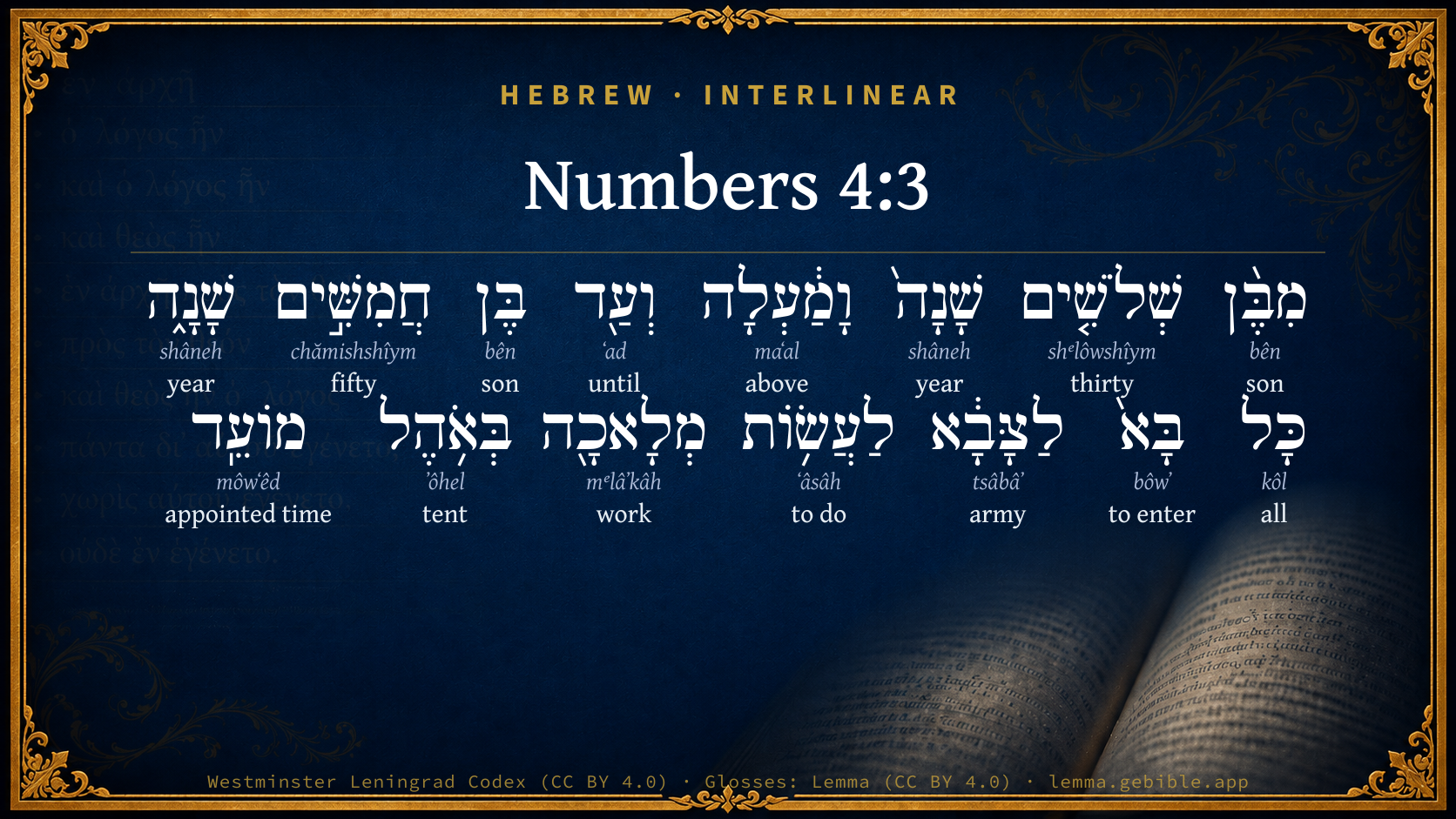
Hebrew (Westminster Leningrad Codex) Numbers 4:3 appears in the Hebrew Old Testament. The text above is from the Westminster Leningrad Codex. Each word links to its Strong’s number, a concise gloss, and parsing drawn from the Open Scriptures Hebrew Bible morphology. Click any word for its full Brown-Driver-Briggs (BDB) entry.
Download image
Cite this verse

Numbers 4:3 (World English Bible). Public Domain. Lemma interlinear Bible study tool, https://lemma.gebible.app/v/numbers/4/3.

Show BibTeX & RIS
BibTeX
RIS
English Translation
from thirty years old and upward even until fifty years old, all who enter into the service, to do the work in the Tent of Meeting.
World English Bible · Public Domain
Download a study sheet

One document with this verse’s original text, its word-by-word gloss line, the meaning frame, cross-references with their text, attributed commentary, and full source and license credits — printable, and it pastes into notes with its structure intact.

This verse Autodidact and up

Study sheet (.html) Plain text (.txt)

A passage Seminary Student

Up to 50 verses in one chapter. A passage sheet keeps up to 6 commentary sources and 12 cross-references per verse, in the order this page ranks them, and says so on the sheet whenever that leaves anything out. Ask for a single verse and you get the Autodidact verse sheet above.

Everything on this page stays free to read, with no account — the sheet is a download of what is already on screen, not access to it.

Want to remove ads? Support Godless Engineer
Compare translations 3

The same verse in 3 English versions, stacked beneath the original-language interlinear above. Click any original word for its lexicon entry.

Each is an independent rendering of the whole verse — the interlinear is not word-aligned to these translations.

Highlighted words mark where these versions differ — a whole-verse word diff, not a word-by-word alignment.

  • World English Bible Public Domain
    from thirty years old and upward even until fifty years old, all who enter into the service, to do the work in the Tent of Meeting.
  • King James Version Public Domain
    From thirty years old and upward even until fifty years old, all that enter into the host, to do the work in the tabernacle of the congregation.
  • unfoldingWord Literal Text CC BY-SA 4.0
    from a son of 30 years and upward and up to a son of 50 years, every one who comes to the army to do work in the tent of meeting.

unfoldingWord Literal Text — © unfoldingWord, licensed CC BY-SA 4.0. Word-aligned USFM3 via Door43 (git.door43.org/unfoldingWord/en_ult).

Versions to compare (up to 4)

3 of 4 selected

Show all 18 translations

Every available English version of this verse, each an independent rendering of the whole verse.

  • World English Bible Public Domain
    from thirty years old and upward even until fifty years old, all who enter into the service, to do the work in the Tent of Meeting.
  • Berean Standard Bible Public Domain
    men from thirty to fifty years old—everyone who is qualified to serve in the work at the Tent of Meeting.
  • Majority Standard Bible Public Domain
    men from thirty to fifty years old—everyone who is qualified to serve in the work at the Tent of Meeting.
  • King James Version Public Domain
    From thirty years old and upward even until fifty years old, all that enter into the host, to do the work in the tabernacle of the congregation.
  • American Standard Version (1901) Public Domain
    from thirty years old and upward even until fifty years old, all that enter upon the service, to do the work in the tent of meeting.
  • Revised Version (1885) Public Domain
    from thirty years old and upward even until fifty years old, all that enter upon the service, to do the work in the tent of meeting.
  • Geneva Bible (1599) Public Domain
    From thirtie yeere olde and aboue, euen vntill fiftie yeere olde, all that enter into the assemblie to do the worke in the Tabernacle of the Congregation.
  • Douay-Rheims (1899) Public Domain
    From thirty years old and upward, to fifty years old, of all that go in to stand and to minister in the tabernacle of the covenant.
  • Young's Literal Translation Public Domain
    from a son of thirty years and upward, even till a son of fifty years, every one going in to the host, to do work in the tent of meeting.
  • Literal Standard Version CC BY-SA 4.0
    from a son of thirty years and upward, even until a son of fifty years, everyone going in to the host, to do work in the Tent of Meeting.
  • Unlocked Literal Bible CC BY-SA 4.0
    Count all the men who are thirty to fifty years old. These men must join the company to serve in the tent of meeting.
  • unfoldingWord Literal Text CC BY-SA 4.0
    from a son of 30 years and upward and up to a son of 50 years, every one who comes to the army to do work in the tent of meeting.
  • Darby Bible Public Domain
    from thirty years old and upward even unto fifty years old, all that enter into the service, to do the work in the tent of meeting.
  • World Messianic Bible Public Domain
    from thirty years old and upward even until fifty years old, all who enter into the service to do the work in the Tent of Meeting.
  • Webster's Bible Public Domain
    From thirty years old and upward, even until fifty years old, all that enter into the host, to do the work in the tabernacle of the congregation.
  • Free Bible Version CC BY-SA 4.0
    Count men aged thirty to fifty—all who are entitled to do the work of serving in the Tent of Meeting.
  • Bible in Basic English Public Domain
    All those from thirty to fifty years old who are able to do the work of the Tent of meeting.
  • JPS Tanakh (1917) Public Domain
    from thirty years old and upward even until fifty years old, all that enter upon the service, to do work in the tent of meeting.

Literal Standard Version (2020), Covenant Press — licensed CC BY-SA 4.0. Text via the HelloAO Bible API (eBible.org). Unlocked Literal Bible (unfoldingWord) — licensed CC BY-SA 4.0. Text via the HelloAO Bible API (eBible.org). unfoldingWord Literal Text — © unfoldingWord, licensed CC BY-SA 4.0. Word-aligned USFM3 via Door43 (git.door43.org/unfoldingWord/en_ult). Free Bible Version, Dr. Jonathan Gallagher — licensed CC BY-SA 4.0. Text via the HelloAO Bible API (eBible.org).

Word by word

More ways to search: Search by grammar → Find every occurrence → Compare this word →

Practice this passage: Drill this verse → Learn its vocabulary →

וָמַ֔עְלָה
maʻal
H4605
“and · above · toward”
Conjunction + Adverb + Suffix, Demonstrative
Part of Speech
Conjunction + Adverb
Full BDB Definition

Origin: from H5927

TWOT: 1624k

higher part, upper part (substantive) - above (adverb) - on the top of, above, on higher ground than (preposition) - upwards, higher, above (with locative)
  1. מִבֶּ֨ן bên H1121 “from · son of” Preposition + Noun, Common, Masculine, Singular, Construct
  2. שְׁלֹשִׁ֤ים shᵉlôwshîym H7970 “thirty” Adjective, Cardinal number, Both, Plural, Absolute
  3. שָׁנָה֙ shâneh H8141 “year” Noun, Common, Feminine, Singular, Absolute
  4. וְעַ֖ד ʻad H5704 “and · until” Conjunction + Preposition
  5. בֶּן bên H1121 “son of” Noun, Common, Masculine, Singular, Construct
  6. חֲמִשִּׁ֣ים chămishshîym H2572 “fifty” Adjective, Cardinal number, Both, Plural, Absolute
  7. שָׁנָ֑ה shâneh H8141 “year” Noun, Common, Feminine, Singular, Absolute
  8. כָּל kôl H3605 “all of” Noun, Common, Masculine, Singular, Construct
  9. בָּא֙ bôwʼ H935 “entering” Verb, Qal, Participle Active, Masculine, Singular, Absolute
  10. לַצָּבָ֔א tsâbâʼ H6635 “to/for the · army” Preposition, Determined + Noun, Common, Both, Singular, Absolute
  11. לַעֲשׂ֥וֹת ʻâsâh H6213 “to do” Preposition + Verb, Qal, Infinitive Construct
  12. מְלָאכָ֖ה mᵉlâʼkâh H4399 “work” Noun, Common, Feminine, Singular, Absolute
  13. בְּאֹ֥הֶל ʼôhel H168 “in/at · tent of” Preposition + Noun, Common, Masculine, Singular, Construct
  14. מוֹעֵֽד môwʻêd H4150 “appointed time” Noun, Common, Masculine, Singular, Absolute

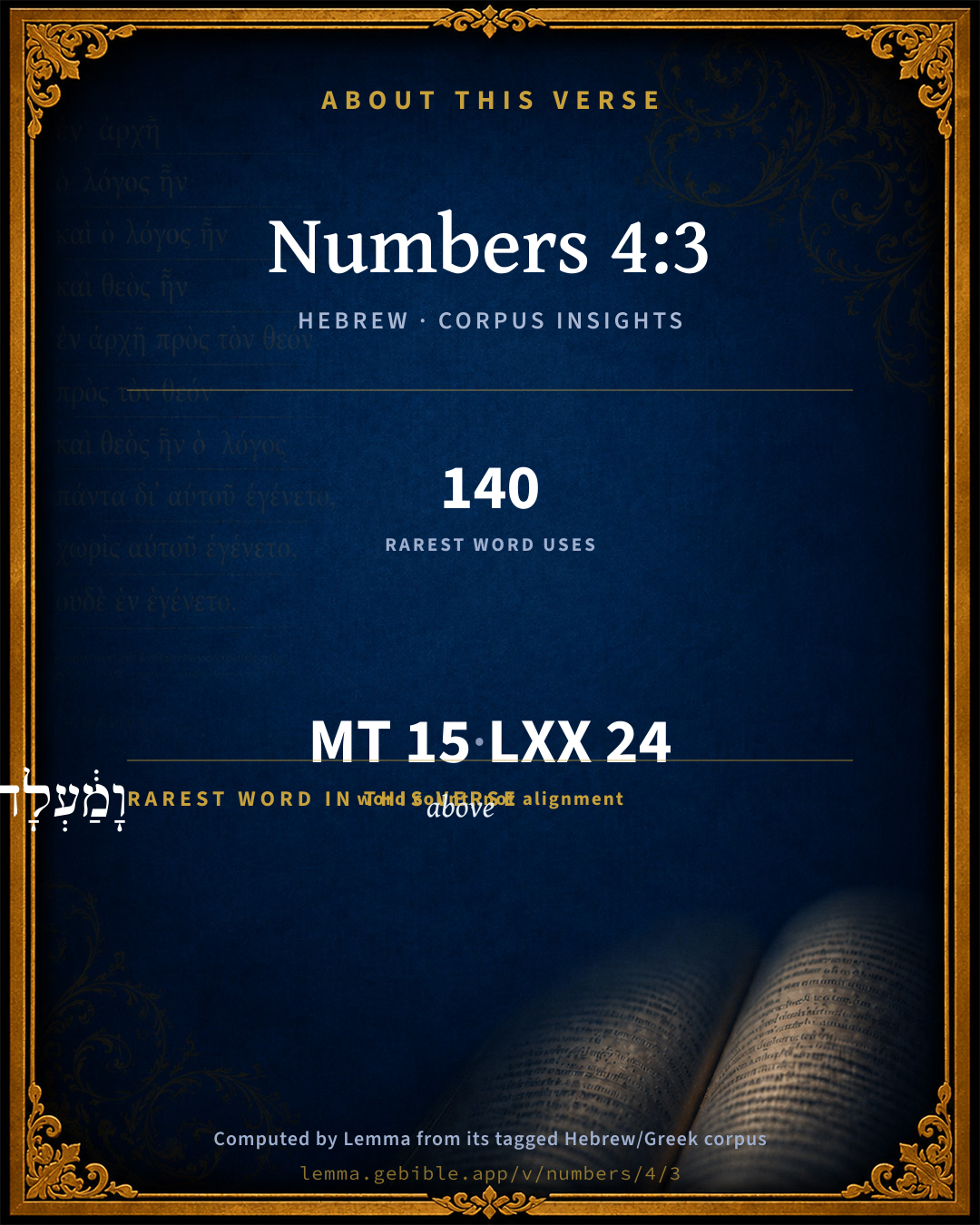
About this verse

These counts appear in no published source. They are computed here, from the morphology-tagged text and Lemma’s own curated glosses. What Lemma adds →

15
words
13
distinct lemmas
Pentateuch
section

Grammatical profile

  • 2 verbs
  • 9 nouns
  • 2 adjectives
  • 1 preposition
  • 1 adverb

Verb forms

  • בָּא֙ Qal · Participle Active
  • לַעֲשׂ֥וֹת Qal · Infinitive Construct

Repetition

Words recur within this verse — often emphatic in Hebrew:

  • מִבֶּ֨ן son H1121 ×2
  • שָׁנָה֙ year H8141 ×2

Hebrew & Septuagint length

In English translation the verse runs 26 words from the Hebrew and 26 from the Septuagint (LXX English) — the same length.

A rough comparison of the two English renderings, which tokenize alike — not a word-level alignment.

Word counts can differ between the Hebrew and the Greek without any difference in meaning — e.g. the Hebrew direct-object marker אֵת has no separate Greek word, and Greek often adds the article ὁ.

In the original languages it is 15 Hebrew tokens and 24 Greek tokens — but the two are counted differently (Hebrew bundles its prefixes and suffixes into one token; the Greek is in lemma form), so that isn’t a like-for-like length.

Cross-references

20

Topical passages linked to Numbers 4:3 in the Treasury of Scripture Knowledge — connected by theme and wording, ordered by reader-vote popularity; previews shown in the World English Bible.

  • Numbers 4:23 from thirty years old and upward until fifty years old shall you number them; all who enter in to wait on the service, to do the work in the Tent of Meeting.
  • Numbers 8:24–26 "This is that which belongs to the Levites: from twenty-five years old and upward they shall go in to wait on the service in the work of the Tent of Meeting;
  • 2 Kings 11:4–12 In the seventh year Jehoiada sent and fetched the captains over hundreds of the Carites and of the guard, and brought them to him into the house of Yahweh; and he made a covenant with them, and took an oath of them in the house of Yahweh, and shown them the king's son.
  • 1 Chronicles 23:3–5 The Levites were numbered from thirty years old and upward: and their number by their polls, man by man, was thirty-eight thousand.
  • 1 Chronicles 23:24–32 These were the sons of Levi after their fathers' houses, even the heads of the fathers' [houses] of those of those who were counted, in the number of names by their polls, who did the work for the service of the house of Yahweh, from twenty years old and upward.
  • Luke 3:23 Jesus himself, when he began to teach, was about thirty years old, being the son (as was supposed) of Joseph, the son of Heli,
  • Ephesians 6:10–18 Finally, be strong in the Lord, and in the strength of his might.
  • Genesis 41:46 Joseph was thirty years old when he stood before Pharaoh king of Egypt. Joseph went out from the presence of Pharaoh, and went throughout all the land of Egypt.
  • Numbers 3:7–8 They shall keep his charge, and the charge of the whole congregation before the Tent of Meeting, to do the service of the tabernacle.
  • Numbers 4:30 from thirty years old and upward even to fifty years old shall you number them, everyone who enters on the service, to do the work of the Tent of Meeting.
  • Numbers 4:35 from thirty years old and upward even to fifty years old, everyone who entered into the service, for work in the Tent of Meeting.
  • Numbers 16:9 [seems it but] a small thing to you, that the God of Israel has separated you from the congregation of Israel, to bring you near to himself, to do the service of the tent of Yahweh, and to stand before the congregation to minister to them;
  • 1 Chronicles 6:48 Their brothers the Levites were appointed for all the service of the tent of the house of God.
  • 1 Chronicles 28:12–13 and the pattern of all that he had by the Spirit, for the courts of the house of Yahweh, and for all the surrounding rooms, for the treasuries of the house of God, and for the treasuries of the dedicated things;
  • 2 Chronicles 23:1–11 In the seventh year Jehoiada strengthened himself, and took the captains of hundreds, Azariah the son of Jeroham, and Ishmael the son of Jehohanan, and Azariah the son of Obed, and Maaseiah the son of Adaiah, and Elishaphat the son of Zichri, into covenant with him.
  • Ezra 3:8 Now in the second year of their coming to the house of God at Jerusalem, in the second month, began Zerubbabel the son of Shealtiel, and Jeshua the son of Jozadak, and the rest of their brothers the priests and the Levites, and all those who were come out of the captivity to Jerusalem, and appointed the Levites, from twenty years old and upward, to have the oversight of the work of the house of Yahweh.
  • 2 Corinthians 10:3–4 For though we walk in the flesh, we don't wage war according to the flesh;
  • 1 Timothy 1:18 This charge I commit to you, my child Timothy, according to the prophecies which led the way to you, that by them you may wage the good warfare;
  • 1 Timothy 3:1 This is a faithful saying: if a man seeks the office of an overseer, he desires a good work.
  • 1 Timothy 3:6 not a new convert, lest being puffed up he fall into the same condemnation as the devil.

Cross-references courtesy of OpenBible.info (CC BY 4.0).

Hebrew and Greek witnesses Masoretic Hebrew ↔ Greek Septuagint

The same verse in the two great witnesses to the Old Testament, shown verse-for-verse.

These are two independent witnesses, not word-aligned to each other, and the Septuagint is shown in lemma (dictionary) form.

Hebrew Numbers 4:3 Masoretic · Westminster Leningrad Codex

מִבֶּ֨ן שְׁלֹשִׁ֤ים שָׁנָה֙ וָמַ֔עְלָה וְעַ֖ד בֶּן חֲמִשִּׁ֣ים שָׁנָ֑ה כָּל בָּא֙ לַצָּבָ֔א לַעֲשׂ֥וֹת מְלָאכָ֖ה בְּאֹ֥הֶל מוֹעֵֽד

from thirty years old and upward even until fifty years old, all who enter into the service, to do the work in the Tent of Meeting.

World English Bible · Public Domain

Greek LXX Numbers 4:3 Septuagint · lemma form

ἀπό εἴκοσι καί πέντε ἔτος καί ἐπάνω καί ἕως πεντήκοντα ἔτος πᾶς ὁ εἰςπορεύομαι λειτουργέω ποιέω πᾶς ὁ ἔργον ἐν ὁ σκηνή ὁ μαρτύριον

from twenty-five years old and upward until fifty years, every one that goes in to minister, to do all the works in the tabernacle of witness.

LXX2012 (modern English Septuagint) · Public Domain

On this verse, Haydock's Catholic Bible Commentary discusses the Septuagint’s reading. Read the note in Commentary ↓

Hebrew: Westminster Leningrad Codex (CC BY 4.0). Greek: Septuagint (public domain); English from LXX2012 (modern English Septuagint) (Public Domain). How the Septuagint differs from the Hebrew →

Targum (Aramaic paraphrase)

2

The Targum is the ancient Jewish Aramaic paraphrase of the Hebrew Scriptures — an interpretive translation, not the Hebrew text itself. Onkelos (literal) and Pseudo-Jonathan (expansive) render the Torah, and Jonathan the Prophets. Coverage is partial: where no permissively-licensed English translation exists for a verse, only the Aramaic is shown. This is verse-level text, not a word-by-word alignment to the Hebrew.

  1. Targum Onkelos Torah (Genesis–Deuteronomy)
    מִבַּר תְּלָתִין שְׁנִין וּלְעֵלָא וְעַד בַּר חַמְשִׁין שְׁנִין כָּל דְאָתֵי לְחֵילָא לְמֶעְבַּד עִבִדְתָּא בְּמַשְׁכַּן זִ מְ נָא

    (no public-domain English translation for this verse)

    Targum Onkelos — Aramaic: “Onkelos Genesis” (public domain); “Onkelos Exodus” (public domain); “Onkelos Leviticus” (public domain); “Onkelos Numbers” (public domain); “Onkelos Deuteronomy” (public domain). English: “Sefaria Community Translation” (CC0 1.0 (public-domain dedication)); “J.W. Etheridge. The Targums of Onkelos and Jonathan Ben Uzziel on the Pentateuch. London: Longmans, Green, 1862” (public domain). Text via Sefaria.

  2. Targum Pseudo-Jonathan Torah (Genesis–Deuteronomy)
    מִבַּר תְּלָתִין שְׁנִין וּלְעֵילָא וְעַד בַּר חַמְשִׁין שְׁנִין כָּל דְאָתֵי לְחֵילָא לְמֶעֱבַד עִבִידְתָּא בְּמַשְׁכַּן זִימְנָא

    from thirty years and upwards to fifty years, every one who cometh by the band to do the work in the tabernacle of ordinance.

    Targum Pseudo-Jonathan — Aramaic: “Targum Jonathan on Genesis” (public domain); “Targum Jonathan on Exodus” (public domain); “Targum Jonathan on Leviticus” (public domain); “Targum Jonathan on Numbers” (public domain); “Targum Jonathan on Deuteronomy” (public domain). English: “The Targum of Jonathan ben Uzziel, trans. J. W. Etheridge, London, 1862” (public domain). Text via Sefaria.

Commentary

Notes on Numbers 4:3 from classic Christian and Jewish commentators (each source and its license shown beneath its notes). The classic Christian expositions comment on the surrounding passage and are grouped to its opening verse, so a note may address several verses; the Jewish commentaries on the Tanakh (Rashi and others) are per-verse, so they appear only where the commentator wrote on this verse.

Lemma curates 59 commentaries, every one of them public domain or Creative Commons licensed, each selected and text-cleaned for this edition rather than reprinted as found. About our sources →

Trapp's Complete Commentary

John Trapp

Num 4:3 From thirty years old and upward even until fifty years old, all that enter into the host, to do the work in the tabernacle of the congregation.

Ver. 3. To do the work.] The work of the ministry is not an idle man’s occupation, but a labouring even to lassitude; compared therefore to harvest work, and to that of cleaving wood, digging in mine pits, rowing with oars, &c. All the comfort is, that God that helped the Levites to bear the ark of the covenant, {1Ch 15:26} will not be wanting to his weak, but willing servants, "that labour in the word and doctrine." {1Ti 5:17}

John Trapp, A Commentary or Exposition upon All the Books of the Old and New Testament (1647–1656) — public domain. Text from a community e-Sword module.

Joseph Benson's Commentary

Num 4:3. From thirty — This age was prescribed, as the age of full strength of body, and therefore most proper for their laborious work of carrying the parts and vessels of the tabernacle, and of maturity of judgment, which is necessary for the right management of holy services. Whence even John and Christ entered not upon their ministry till that age. Indeed, their first entrance upon their work was at their twenty-fifth year, when they began as learners, and acted under the inspection and direction of their brethren; but in their thirtieth year they were completely admitted to a full discharge of their whole office. But David, being a prophet, and particularly directed by God in the affairs of the temple, made a change in this matter, because the magnificence of the temple, and the great multitude of the sacred utensils and sacrifices, required a greater number of attendants than formerly was necessary. Until fifty — When they were exempted from the toilsome work of carrying burdens, but not discharged from the honourable and easy work done within the tabernacle. Num 8:26. All that enter — That is, that do and may enter, having no defect, nor other impediment.

Joseph Benson's Commentary on the Old and New Testaments (1811–1818) — public domain. Text from a community e-Sword module.

Tyndale Open Study Notes

Tyndale Open Resources

4:3 Of the 22,000 Levites (3:39), only men between the ages of thirty and fifty, those in the prime of their life, were allowed to serve in the sanctuary. The summary of this registration (another “numbering”) found in 4:34-49 gives the total number of qualified males as 8,580.

Tyndale Open Study Notes — © Tyndale Open Resources, licensed CC BY-SA 4.0. Text via the HelloAO Bible API.

Geneva Bible (1599)

Geneva Bible translators

The Levites were numbered after three sorts, first at a month old when they were consecrated to the Lord, next at 25 years old when they were appointed to serve in the Tabernacle, and 30 years old to bear the burdens of the Tabernacle.

Geneva Bible (1599) marginal notes — public domain. Text via Bolls.life.

Adam Clarke's Commentary

Verse 3. From thirty years old] In Nu 8:24, the Levites are ordered to enter on the service of the tabernacle at the age of twenty-five years; and in 1Ch 23:24, they were ordered to commence that work at twenty years of age. How can these different times be reconciled?

1. At the time of which Moses speaks here, the Levitical service was exceedingly severe, and consequently required men full grown, strong, and stout, to perform it; the age therefore of thirty years was appointed as the period for commencing this service, the weightier part of which is probably here intended.

2. In Nu 8:24, Moses seems to speak of the service in a general way; the severe, which was to be performed by the full-grown Levites, and the less laborious work which younger men might assist in: hence the age of twenty-five is fixed.

3. In David's time and afterwards, in the fixed tabernacle and temple, the laboriousness of the service no longer existed, and hence twenty years was the age fixed on for all Levites to enter into the work of the sanctuary. The rabbins say that the Levites began to learn to do the service at twenty-five, and that having been instructed five years, they began the public service at thirty, and thus they reconcile the two periods referred to above. We may well suppose that the sons of the prophets continued a considerable time under instructions before they were called fully to exercise themselves in the prophetic office.

Until fifty years old] This was allowing twenty years for public severe service; a very considerate and merciful ordinance. A preacher who devotes his whole time and strength to the service of the Church of God from twenty to fifty or sixty years of age, should be then excused from his severer labour, and maintained at the charge of the sanctuary. This would not only be a great comfort to a worn-out servant of God, but also of great use to the work of the ministry, which, to be faithfully and effectually performed, requires all the powers of the body and mind of man. Old faithful ministers are to be highly respected for their work's sake, and to be supplied with all the necessaries and comforts of life; but how little can they do in the public ministry of the word, however willing to work, when their eye waxes dim and their bodily strength fails! See "Nu 8:25". Both for their own sakes, and for the good of the Church, they should be excused from a labour to which they must be almost every way inadequate. But notwithstanding this comparative inactivity, their counsels, advice, and experience will always be considered as a treasure to the Church of Christ.

Adam Clarke's Commentary on the Bible (1810–1826) — public domain. Text from a community e-Sword/MySword module.

Ellicott's Commentary for English Readers

(3) From thirty years old and upward even until fifty years old.—The previous census of the Levites was from a month old. The present census was with a view to the discharge of duties requiring a considerable amount of physical strength, and hence the prescribed age for entering upon these duties was fixed at this time at thirty, and limited to fifty. It has been supposed by some that five years were spent in preparation for the service, and that it is in this way that the apparent discrepancy between this verse and Num_8:24, where the age for entering upon the service is fixed at twenty-five, is to be reconciled. (See Note on Num_8:24.) In Eastern countries the strength fails at an earlier period than in colder and more temperate climates. Thirty was the age at which John the Baptist and our Lord entered upon their public ministry.

All that enter into the host.—Or, every one who enters upon the service. The word zaba, commonly rendered host, and used elsewhere to denote military service, is here used to denote the service of the sanctuary.

A Bible Commentary for English Readers, edited by Charles John Ellicott (1878–1897) — public domain. Text from a community e-Sword module.

The Cambridge Bible for Schools and Colleges

gen. ed. J. J. S. Perowne

3. The period of active service for the Levites is here laid down as between 30–50 years of age. But in Num_8:23-26 it is between 25–50, though certain duties might be performed after that age. And in 1Ch_23:24; 1Ch_23:27, 2Ch_31:17, Ezr_3:8 it begins at 20, and there is no upward limit of age. The statements appear to represent the customs that were current at three different periods.

the service] This unusual meaning of the word which generally denotes ‘warfare’ or ‘host’ (R.V. marg.) is found again five times in this chapter (Num_4:23; Num_4:30; Num_4:35; Num_4:39; Num_4:43), and elsewhere only in Num_8:24 f., and of women in two very late passages, Exo_38:8, 1Sa_2:22. It perhaps implies that the Levites formed an organized body appointed for God’s work under the command of superior officials, as were the rest of Israel who were numbered for war.

The Cambridge Bible for Schools and Colleges (gen. ed. J. J. S. Perowne; Cambridge University Press, 1878–1918) — public domain. Text from a community e-Sword module.

John Gill's Exposition

From thirty years old and upward even until fifty years old,.... This is the full time of the Levites service, and the prime season of man's life for business; at thirty years of age he is at his full strength, and when fifty it begins to decline: it is said in the Misnah (x),"a son of thirty years for strength,''upon which one of the commentators (y) makes this remark, that the Levites set up the tabernacle and took it down, and loaded the wagons, and carried on their shoulders from thirty years and upwards: thus both John the Baptist, the forerunner of Christ, and Christ himself, entered into their ministry at this age:

all that enter into the host; army or warfare; for though the Levites were exempted from going forth to war, yet their service was a sort of warfare; they were a camp of themselves about the tabernacle, and part of their work was to watch and guard it, that it was neither defiled nor robbed; in allusion to this, the ministry of the word is called a warfare, and ministers of the Gospel good soldiers of Christ, and their doctrines weapons of warfare, Ti1 1:18; some interpret this of the troop, company, or congregation of the Levites, which a man of thirty years of age was admitted into for business:

to do the work in the tabernacle of the congregation; not in the sanctuary, either in the holy place or in the most holy place, where they were never allowed to enter, or do any business in, such as sacrificing, burning incense, &c. but in that part of it which was called "the tabernacle of the congregation", or where the people assembled on occasion, and that was the court, which was so called, as Jarchi observes on Exo 29:32.

(x) Pirke Abot, c. 5. sect. 21. (y) Bartenora in Pirke Abot, c. 5. sect. 21.

John Gill's Exposition of the Whole Bible (1746–1763) — public domain (CC PDM 1.0). Text via the HelloAO Bible API.

Haydock's Catholic Bible Commentary

Thirty. Moses speaks of those who had to carry the sacred vessels. Those of 25 years old might perform some offices; (chap. viii. 24,) and even at 20, they began to serve the tabernacle, in the reign of David, (1 Paralipomenon xxiii. 24,) the fatigue being then diminished, and the splendour of religion increasing. The Septuagint read 25 instead of 30, in this and all other places, and some think that the Hebrew should be so too. The time for the admission of priests to their more august functions is not specified, but was determined by themselves to be at least 20 years of age. (Outram, Sacrif. i. 7.) --- To stand. This was the ordinary posture of the priests in the temple. The king alone was allowed to sit. (Maimonides) --- Hebrew, "all that enter into the host, or army, to do the work in the tabernacle of the assembly," shall be of a competent age and strength. (Haydock)

George Leo Haydock (1774–1849), Haydock's Catholic Family Bible and Commentary, 1859 edition — public domain. Excludes Psalms (Douay-Rheims chapter numbering differs from Protestant) and Deuterocanonical books (Catholic canon only).

Matthew Poole's English Annotations

From thirty years old: this age was prescribed, as the age of full strength of body, and therefore most proper for their present laborious work of carrying the parts and vessels of the tabernacle; and of maturity of judgment, which is necessary for the right management of holy services; whence even John and Christ entered not upon their ministry till that age. And it may still seem to be the fittest season for men’s undertaking the ministry of the gospel, except in case of extraordinary abilities, or the church’s pressing necessity.

Object. They might enter upon this work at their twenty-fifth year, Num 8:24, and in David’s time and afterward at their twentieth year.

Answ. 1. Their first entrance upon their work was at their twenty-fifth year, when they began as learners, and acted only under the inspection and direction of their brethren; but in their thirtieth year they were completely admitted to a full discharge of their whole office.

2. David, being a prophet, and particularly directed by God in the affairs of the temple, might and did make a change in this matter, which he might the better do, both because it was but a change in a circumstance, and because the magnificence of the temple, and the great multitude of sacred utensils and sacrifices, required a greater number of attendants than formerly was necessary.

Until fifty years old, when they were exempted from the toilsome work of carrying burdens, but not discharged from the honourable and easy work done within the tabernacle, Num 8:26.

All that enter, i.e. that do and may enter, having no defect, Lev 21:17, nor other impediment. The society of sacred ministers he calls a host, because of that excellent order which was among them, as to persons, place, time, the matter and manner of their services.

Matthew Poole's English Annotations on the Holy Bible (1683–1685) — public domain. Text from a community e-Sword/MySword module.

Whedon's Commentary on the Bible

Daniel D. Whedon

3. From thirty years old — The minimum limit is fixed at ten years above the military age. This is not surprising when we consider that the sacred service required not only physical strength, but especially intellectual maturity and sound judgment. These are rarely found at twenty, but at thirty the character becomes fixed, and the mind assumes the oaken toughness of manhood. John the Baptist began to preach when thirty. Jesus Christ, though not under the limitations of the Levite, did not enter upon his public mission till thirty years of age. Although the world was in sad need of the Gospel when he was twenty, he waited until he could present to the wondering world a perfect manhood enshrining the Supreme Godhead. Hence the celebrated Hebraist and theologian, Prof. Moses Stuart, has very ably argued, that as a general rule none should be ordained to the responsible office of the ministry of the Gospel till thirty years of age. For a discussion of the discrepancy between the thirty years required here and the twenty-five years in Num_8:24-25, see general remarks at the close of this chapter.

Until fifty years — This is a few years above the usual maximum military age. In ancient Rome this was at forty-six; in the United States a man at forty-five is exempt. The reason for the continuance of the Levite beyond the military age-limit of many nations is, that the intellect and judgment at that age have suffered no deterioration.

All that enter into the host — Hebrew, Every one that enters the army. The service of God is a spiritual warfare; the body of believers constitutes the militant Church. Hence the frequency of martial metaphors in St. Paul’s epistles.

Daniel D. Whedon (gen. ed.), Commentary on the Old and New Testaments (1874–1909) — public domain. Text from a community e-Sword module.

The Pulpit Commentary

From thirty years old and upward. The age at which they became liable for service was shortly after reduced to twenty-five, (Num_8:24) and at a later period to twenty. (1Ch_23:27) In the wilderness a larger number of the men might be required to attend to their own camps, and their own families; but the explanation may probably be found in the unusually large proportion who were at this time between the ages of thirty and fifty. The Septuagint has altered thirty into twenty-five to make it agree with Num_8:24. Thirty years became among the Jews the perfect age at which a man attained to full maturity, and entered upon all his fights and duties. (cf. Luk_3:23) Into the host. Not the military ranks, but the militia sacra of the Lord. To do the work. Literally, "to war the warfare."

The Pulpit Commentary (1880–1919), ed. H.D.M. Spence-Jones & Joseph S. Exell — public domain. Text from a community e-Sword module.

John Wesley's Explanatory Notes

From thirty - This age was prescribed, as the age of full strength of body, and therefore most proper for their labourious work of carrying the parts and vessels of the tabernacle, and of maturity of judgment, which is necessary for the right management of holy services. Whence even John and Christ entered not upon their ministry till that age. Indeed their first entrance upon their work was at their 25th year, when they began as learners, and acted under the inspection and direction of their brethren; but in their 30th year they were compleatly admitted to a full discharge of their whole office. But David, being a prophet, and particularly directed by God in the affairs of the temple, made a change in this matter, because the magnificence of the temple, and the great multitude of sacred utensils and sacrifices, required a greater number of attendants than formerly was necessary. Until fifty - When they were exempted from the toilsome work of carrying burdens, but not discharged from the honourable and easy work done within the tabernacle, chap. viii, 26. All that enter - That is, that do and may enter, having no defect, nor other impediment.

John Wesley, Explanatory Notes Upon the Whole Bible (1754–1765) — public domain. Text via the GEBible commentary corpus.

Lesson kit

Teaching starters — assembled from the data on this page, not authored interpretation. Every prompt links to the verse data it draws on. Edit before teaching.

Numbers, in the Pentateuch, opens this verse with 15 words (13 distinct Hebrew lemmas). Its most distinctive word is maʻal (“above”). A historical commentator’s framing appears above. Read the whole chapter for the surrounding context.

Discussion questions

  1. The word maʻal carries the sense “above.” How does it shape the verse?
  2. How does Numbers 4:23, which shares this passage’s theme, read alongside this verse?
  3. What does the repetition of “son” (2× in this one verse) do in this verse?
  4. These translations render this verse differently; the difference is in the English rendering, not the original. What questions does that raise?
  5. «בָּא֙» is a Qal Participle Active verb. How does that grammatical form shape the action described?
  6. Compare how Trapp's Complete Commentary and Joseph Benson's Commentary read this verse. Where do they agree or differ?

Things to notice

Reading settings

Reading text

Shown beneath each verse's original-language words.

Old Testament
Old Testament edition

Read the OT as the Masoretic Hebrew (MT) or the Greek Septuagint (LXX).

English shown for the Greek Septuagint (in the Hebrew ↔ Greek comparison).

Comparing translations? Open the Compare panel on any verse page to stack up to four side by side.