Daniel 10:3

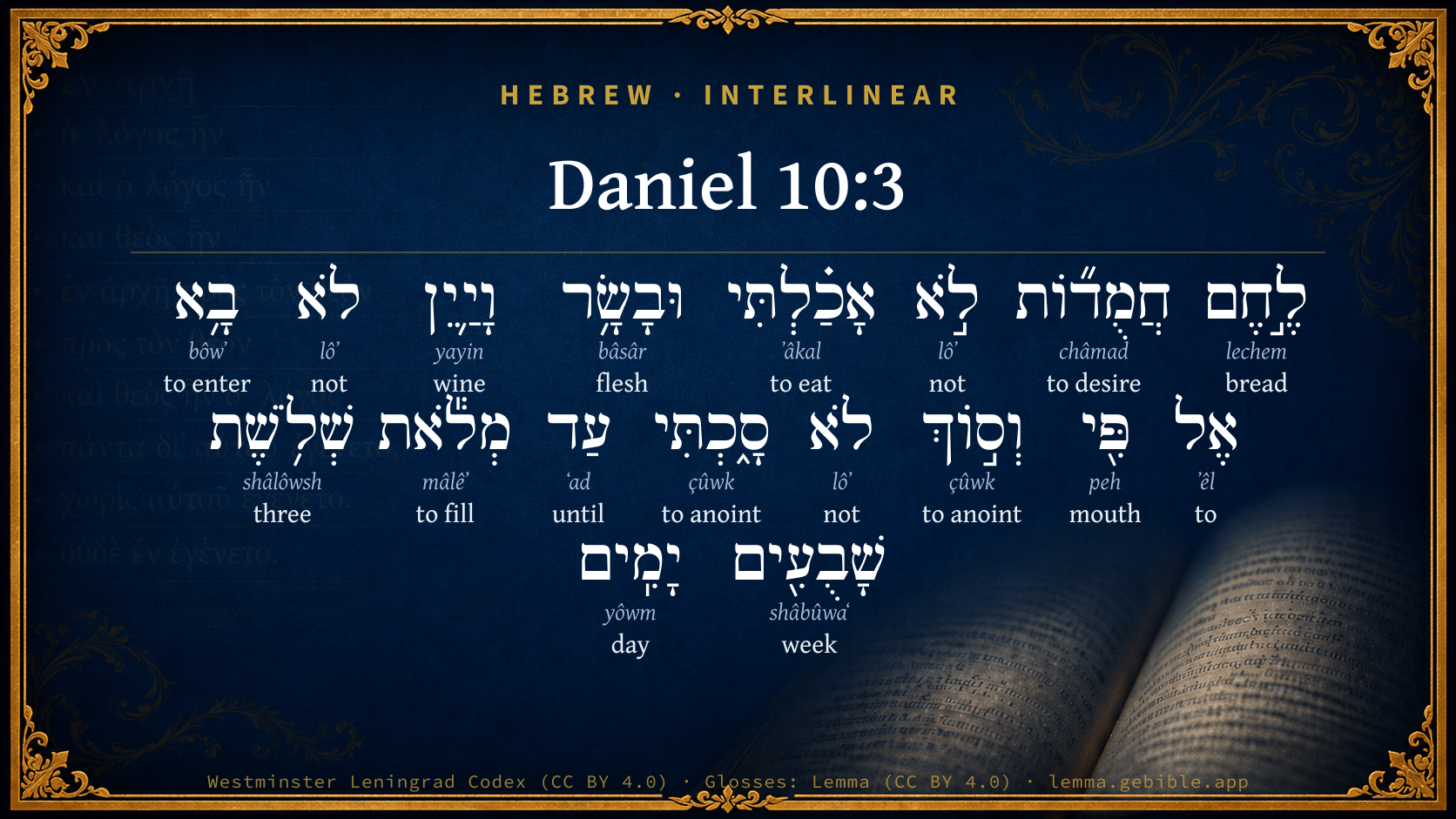
Hebrew (Westminster Leningrad Codex) Daniel 10:3 appears in the Hebrew Old Testament. The text above is from the Westminster Leningrad Codex. Each word links to its Strong’s number, a concise gloss, and parsing drawn from the Open Scriptures Hebrew Bible morphology. Click any word for its full Brown-Driver-Briggs (BDB) entry.
Download image
Cite this verse

Daniel 10:3 (World English Bible). Public Domain. Lemma interlinear Bible study tool, https://lemma.gebible.app/v/daniel/10/3.

Show BibTeX & RIS
BibTeX
RIS
English Translation
I ate no pleasant bread, neither came flesh nor wine into my mouth, neither did I anoint myself at all, until three whole weeks were fulfilled.
World English Bible · Public Domain
Download a study sheet

One document with this verse’s original text, its word-by-word gloss line, the meaning frame, cross-references with their text, attributed commentary, and full source and license credits — printable, and it pastes into notes with its structure intact.

This verse Autodidact and up

Study sheet (.html) Plain text (.txt)

A passage Seminary Student

Up to 50 verses in one chapter. A passage sheet keeps up to 6 commentary sources and 12 cross-references per verse, in the order this page ranks them, and says so on the sheet whenever that leaves anything out. Ask for a single verse and you get the Autodidact verse sheet above.

Everything on this page stays free to read, with no account — the sheet is a download of what is already on screen, not access to it.

Want to remove ads? Support Godless Engineer
Compare translations 3

The same verse in 3 English versions, stacked beneath the original-language interlinear above. Click any original word for its lexicon entry.

Each is an independent rendering of the whole verse — the interlinear is not word-aligned to these translations.

Highlighted words mark where these versions differ — a whole-verse word diff, not a word-by-word alignment.

  • World English Bible Public Domain
    I ate no pleasant bread, neither came flesh nor wine into my mouth, neither did I anoint myself at all, until three whole weeks were fulfilled.
  • King James Version Public Domain
    I ate no pleasant bread, neither came flesh nor wine in my mouth, neither did I anoint myself at all, till three whole weeks were fulfilled.
  • unfoldingWord Literal Text CC BY-SA 4.0
    I ate no tasty food, no meat or wine entered my mouth, nor did I anoint myself at all until three entire weeks were completed.

unfoldingWord Literal Text — © unfoldingWord, licensed CC BY-SA 4.0. Word-aligned USFM3 via Door43 (git.door43.org/unfoldingWord/en_ult).

Versions to compare (up to 4)

3 of 4 selected

Show all 18 translations

Every available English version of this verse, each an independent rendering of the whole verse.

  • World English Bible Public Domain
    I ate no pleasant bread, neither came flesh nor wine into my mouth, neither did I anoint myself at all, until three whole weeks were fulfilled.
  • Berean Standard Bible Public Domain
    I ate no rich food, no meat or wine entered my mouth, and I did not anoint myself with oil until the three weeks were completed.
  • Majority Standard Bible Public Domain
    I ate no rich food, no meat or wine entered my mouth, and I did not anoint myself with oil until the three weeks were completed.
  • King James Version Public Domain
    I ate no pleasant bread, neither came flesh nor wine in my mouth, neither did I anoint myself at all, till three whole weeks were fulfilled.
  • American Standard Version (1901) Public Domain
    I ate no pleasant bread, neither came flesh nor wine into my mouth, neither did I anoint myself at all, till three whole weeks were fulfilled.
  • Revised Version (1885) Public Domain
    I ate no pleasant bread, neither came flesh nor wine in my mouth, neither did I anoint myself at all, till three whole weeks were fulfilled.
  • Geneva Bible (1599) Public Domain
    I ate no pleasant bread, neither came flesh nor wine in my mouth, neither did I anoint my selfe at all, till three weekes of dayes were fulfilled.
  • Douay-Rheims (1899) Public Domain
    I ate no desirable bread, and neither flesh, nor wine entered into my mouth, neither was I anointed with ointment: till the days of three weeks were accomplished.
  • Young's Literal Translation Public Domain
    desirable bread I have not eaten, and flesh and wine hath not come in unto my mouth, and I have not anointed myself at all, till the completion of three weeks of days.
  • Literal Standard Version CC BY-SA 4.0
    I have not eaten desirable bread, and no flesh and wine came into my mouth, and I have not anointed myself at all, until the completion of three weeks of days.
  • Unlocked Literal Bible CC BY-SA 4.0
    I ate no delicacies, I ate no meat, I drank no wine, and I did not anoint myself with oil until the completion of three entire weeks.
  • unfoldingWord Literal Text CC BY-SA 4.0
    I ate no tasty food, no meat or wine entered my mouth, nor did I anoint myself at all until three entire weeks were completed.
  • Darby Bible Public Domain
    I ate no pleasant bread, neither came flesh nor wine into my mouth, neither did I anoint myself at all, till three full weeks were fulfilled.
  • World Messianic Bible Public Domain
    I ate no pleasant food. No meat or wine came into my mouth. I didn’t anoint myself at all, until three whole weeks were fulfilled.
  • Webster's Bible Public Domain
    I ate no pleasant bread, neither came flesh nor wine in my mouth, neither did I anoint myself at all, till three whole weeks were fulfilled.
  • Free Bible Version CC BY-SA 4.0
    I ate no fine food. No meat or wine passed my lips. I used no perfumed oils until those three weeks were over.
  • Bible in Basic English Public Domain
    I had no pleasing food, no meat or wine came into my mouth, and I put no oil on my body till three full weeks were ended.
  • JPS Tanakh (1917) Public Domain
    I ate no pleasant bread, neither came flesh nor wine in my mouth, neither did I anoint myself at all, till three whole weeks were fulfilled.

Literal Standard Version (2020), Covenant Press — licensed CC BY-SA 4.0. Text via the HelloAO Bible API (eBible.org). Unlocked Literal Bible (unfoldingWord) — licensed CC BY-SA 4.0. Text via the HelloAO Bible API (eBible.org). unfoldingWord Literal Text — © unfoldingWord, licensed CC BY-SA 4.0. Word-aligned USFM3 via Door43 (git.door43.org/unfoldingWord/en_ult). Free Bible Version, Dr. Jonathan Gallagher — licensed CC BY-SA 4.0. Text via the HelloAO Bible API (eBible.org).

Word by word

More ways to search: Search by grammar → Find every occurrence → Compare this word →

Practice this passage: Drill this verse → Learn its vocabulary →

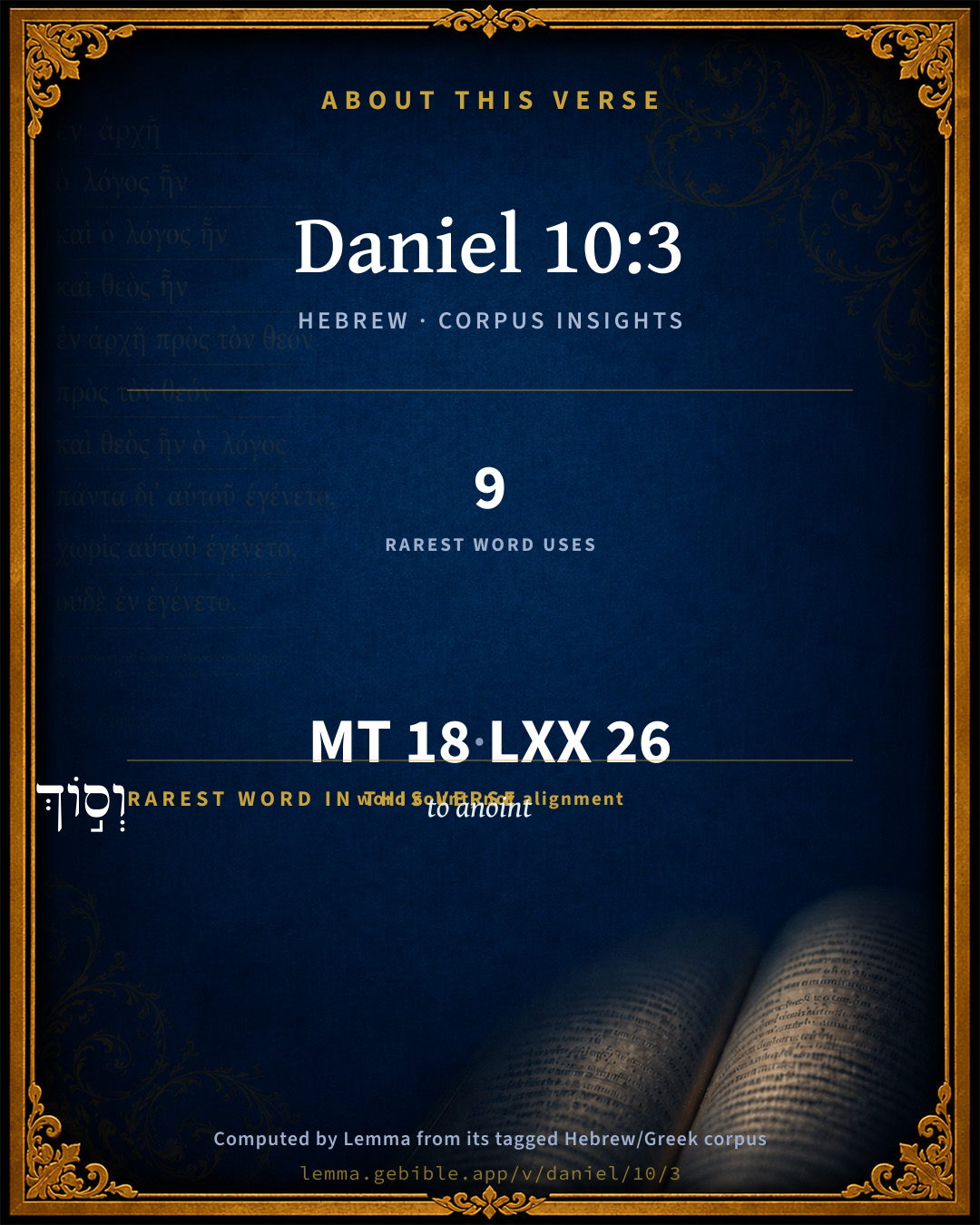
וְס֣וֹךְ
çûwk
H5480
“and · to anoint”
Conjunction + Verb, Qal, Infinitive Absolute
Part of Speech
Conjunction + Verb
Stem
Qal
Form
Infinitive Absolute
Full BDB Definition

Origin: a primitive root

TWOT: 1474

to anoint, pour in anointing - (Qal) to anoint - to anoint oneself - to anoint (another) - to be poured - (Hiphil) to anoint
  1. לֶ֣חֶם lechem H3899 “bread of” Noun, Common, Both, Singular, Construct
  2. חֲמֻד֞וֹת châmad H2530 “desirable things” Noun, Common, Feminine, Plural, Absolute
  3. לֹ֣א lôʼ H3808 “not” Particle, Negative
  4. אָכַ֗לְתִּי ʼâkal H398 “to eat” Verb, Qal, Perfect, 1st Person, Common, Singular
  5. וּבָשָׂ֥ר bâsâr H1320 “and · flesh” Conjunction + Noun, Common, Masculine, Singular, Absolute
  6. וָיַ֛יִן yayin H3196 “and · wine” Conjunction + Noun, Common, Masculine, Singular, Absolute
  7. לֹא lôʼ H3808 “not” Particle, Negative
  8. בָ֥א bôwʼ H935 “to enter” Verb, Qal, Perfect, 3rd Person, Masculine, Singular
  9. אֶל ʼêl H413 “to” Preposition
  10. פִּ֖י peh H6310 “mouth · my” Noun, Common, Masculine, Singular, Construct + Suffix, Personal, 1st Person, Common, Singular
  11. לֹא lôʼ H3808 “not” Particle, Negative
  12. סָ֑כְתִּי çûwk H5480 “to anoint” Verb, Qal, Perfect, 1st Person, Common, Singular
  13. עַד ʻad H5704 “until” Preposition
  14. מְלֹ֕את mâlêʼ H4390 “to fill” Verb, Qal, Infinitive Construct
  15. שְׁלֹ֥שֶׁת shâlôwsh H7969 “three” Adjective, Cardinal number, Masculine, Singular, Construct
  16. שָׁבֻעִ֖ים shâbûwaʻ H7620 “weeks” Noun, Common, Masculine, Plural, Absolute
  17. יָמִֽים yôwm H3117 “days” Noun, Common, Masculine, Plural, Absolute

About this verse

These counts appear in no published source. They are computed here, from the morphology-tagged text and Lemma’s own curated glosses. What Lemma adds →

18
words
15
distinct lemmas
Prophets
section

Notable vocabulary

The rarest word here is וְס֣וֹךְ to anoint H5480 — appearing just 9 times in the whole Hebrew Bible.

Shared distinctive vocabulary

וְס֣וֹךְ to anoint H5480 occurs in 8 verses of the Hebrew Bible. Also found in:

Grammatical profile

  • 5 verbs
  • 7 nouns
  • 1 adjective
  • 2 prepositions
  • 3 particles

Verb forms

  • אָכַ֗לְתִּי Qal · Perfect
  • בָ֥א Qal · Perfect
  • וְס֣וֹךְ Qal · Infinitive Absolute
  • סָ֑כְתִּי Qal · Perfect
  • מְלֹ֕את Qal · Infinitive Construct

Repetition

Words recur within this verse — often emphatic in Hebrew:

  • וְס֣וֹךְ to anoint H5480 ×2
  • לֹ֣א not H3808 ×3

Hebrew & Septuagint length

In English translation the verse runs 26 words from the Hebrew and 27 from the Septuagint (LXX English) — closely comparable.

A rough comparison of the two English renderings, which tokenize alike — not a word-level alignment.

Word counts can differ between the Hebrew and the Greek without any difference in meaning — e.g. the Hebrew direct-object marker אֵת has no separate Greek word, and Greek often adds the article ὁ.

In the original languages it is 18 Hebrew tokens and 26 Greek tokens — but the two are counted differently (Hebrew bundles its prefixes and suffixes into one token; the Greek is in lemma form), so that isn’t a like-for-like length.

Cross-references

9

Topical passages linked to Daniel 10:3 in the Treasury of Scripture Knowledge — connected by theme and wording, ordered by reader-vote popularity; previews shown in the World English Bible.

  • Matthew 6:17 But you, when you fast, anoint your head, and wash your face;
  • Daniel 11:8 Also their gods, with their molten images, [and] with their goodly vessels of silver and of gold, shall he carry captive into Egypt; and he shall refrain some years from the king of the north.
  • Amos 5:11 Forasmuch therefore as you trample on the poor, And take taxes from him of wheat: You have built houses of hewn stone, But you will not dwell in them. You have planted pleasant vineyards, But you shall not drink their wine.
  • 1 Corinthians 9:27 but I beat my body and bring it into submission, lest by any means, after I have preached to others, I myself should be rejected.
  • Isaiah 24:6–11 Therefore has the curse devoured the earth, and those who dwell therein are found guilty: therefore the inhabitants of the earth are burned, and few men left.
  • Daniel 6:18 Then the king went to his palace, and passed the night fasting; neither were instruments of music brought before him: and his sleep fled from him.
  • Nahum 2:9 Take the spoil of silver. Take the spoil of gold, for there is no end of the store, the glory of all goodly furniture.
  • 2 Samuel 19:24 Mephibosheth the son of Saul came down to meet the king; and he had neither dressed his feet, nor trimmed his beard, nor washed his clothes, from the day the king departed until the day he came home in peace.
  • Job 33:20 So that his life abhors bread, And his soul dainty food.

Cross-references courtesy of OpenBible.info (CC BY 4.0).

Hebrew and Greek witnesses Masoretic Hebrew ↔ Greek Septuagint

The same verse in the two great witnesses to the Old Testament, shown verse-for-verse.

These are two independent witnesses, not word-aligned to each other, and the Septuagint is shown in lemma (dictionary) form.

Hebrew Daniel 10:3 Masoretic · Westminster Leningrad Codex

לֶ֣חֶם חֲמֻד֞וֹת לֹ֣א אָכַ֗לְתִּי וּבָשָׂ֥ר וָיַ֛יִן לֹא בָ֥א אֶל פִּ֖י וְס֣וֹךְ לֹא סָ֑כְתִּי עַד מְלֹ֕את שְׁלֹ֥שֶׁת שָׁבֻעִ֖ים יָמִֽים

I ate no pleasant bread, neither came flesh nor wine into my mouth, neither did I anoint myself at all, until three whole weeks were fulfilled.

World English Bible · Public Domain

Greek LXX Daniel 10:3 Septuagint · lemma form

ἄρτος ἐπιθυμία οὐ ἐσθίω καί κρέας καί οἶνος οὐ εἰςἔρχομαι εἰς ὁ στόμα ἐγώ ἔλαιον οὐ ἀλείφω ἕως ὁ συντελέω ἐγώ ὁ τρεῖς ἑβδομάς ὁ ἡμέρα

I ate no pleasant bread, and no flesh or wine entered into my mouth, neither did I anoint myself with oil, until three whole weeks were accomplished.

LXX2012 (modern English Septuagint) · Public Domain

On this verse, The Cambridge Bible for Schools and Colleges discusses the Septuagint’s reading. Read the note in Commentary ↓

Hebrew: Westminster Leningrad Codex (CC BY 4.0). Greek: Septuagint (public domain); English from LXX2012 (modern English Septuagint) (Public Domain). How the Septuagint differs from the Hebrew →

Commentary

Notes on Daniel 10:3 from classic Christian and Jewish commentators (each source and its license shown beneath its notes). The classic Christian expositions comment on the surrounding passage and are grouped to its opening verse, so a note may address several verses; the Jewish commentaries on the Tanakh (Rashi and others) are per-verse, so they appear only where the commentator wrote on this verse.

Lemma curates 59 commentaries, every one of them public domain or Creative Commons licensed, each selected and text-cleaned for this edition rather than reprinted as found. About our sources →

Trapp's Complete Commentary

John Trapp

Dan 10:3 I ate no pleasant bread, neither came flesh nor wine in my mouth, neither did I anoint myself at all, till three whole weeks were fulfilled.

Ver. 3. I ate no pleasant bread.] Bread he ate, for animantis cuiusque vita in fuga est, life will fail if not maintained by food, but coarse bread panem cibarium, atrum, et siligineum, and no more of that either than needs must. He voluntarily abridged himself of lawful delights, macerating and mortifying his flesh, that he might communicate with his poor afflicted brethren, and pray the harder for them. Fasting inflameth prayer, and prayer sanctifieth fasting.

Neither did I anoint myself at all.] All delights of sense must be laid aside in a time of solemn humiliation, but yet without annoyance and uncomeliness, as music, mirth, perfumes, brave apparel; {2Sa 12:20 Joh 3:8 Exo 33:4-6 1Ki 21:27} cheerfulness, outward joy, and pleasure (Mar 2:20 Luk 5:35 cf. Mat 9:15 Jdg 20:26 1Sa 7:6). It is spoken of as a foul sin; Isa 58:3, "Behold in the day of your fast ye find pleasure."

John Trapp, A Commentary or Exposition upon All the Books of the Old and New Testament (1647–1656) — public domain. Text from a community e-Sword module.

The Biblical Illustrator

Joseph S. Exell

Dan_10:3

I ate not pleasant bread.

Intense religion

About a hundred years ago, a man of God thus wrote in his diary: I was enabled to persevere in prayer till I saw so much need of Divine help, that I knew not how to leave off, and had forgot I needed food.

D. Brainerd. Strange intensity of desire! He who felt it must have been far above most Christians of our age. Who of us could thus record the longings of his soul? We feel that this is reality. There is no insobriety or wild excitement here. All is calm and deep. We are listening to the utterances of a soul that has got into conscious contact and vital fellowship with God; and who, in the profound enjoyment thus entered on, has lost the consciousness of this outer world in which he is still a dweller. Happy saint! Who would not tread thy footsteps, and thus get as competely within the veil as thou! All thy religion was amid realties and certainties. There was no distance, no dimness, no vagueness in thy intercourse with the Father of Spirits. How much of our religion is made up of shadows and incoherencies! how much of our intercourse with God is vague and distant; a groping after something which we seem never to reach, instead of being living, personal, conscious intercourse between our souls and God! (The Study.)

The Biblical Illustrator, edited by Joseph S. Exell (c. 1880s–1900s) — public domain. Text from a community e-Sword module.

Jamieson, Fausset & Brown

Robert Jamieson, A. R. Fausset & David Brown

no pleasant bread--"unleavened bread, even the bread of affliction" (Deu 16:3).

anoint--The Persians largely used unguents.

Jamieson, Fausset & Brown — Commentary Critical and Explanatory on the Whole Bible (1871) — public domain (CC PDM 1.0). Text via the HelloAO Bible API.

Adam Clarke's Commentary

Verse 3. I ate no pleasant bread] This fast was rather a general abstinence; living all the while on coarse and unsavoury food; drinking nothing but water; not using the bath, and most probably wearing haircloth next the skin, during the whole of the time.

Adam Clarke's Commentary on the Bible (1810–1826) — public domain. Text from a community e-Sword/MySword module.

Ellicott's Commentary for English Readers

(3) Pleasant bread—i.e., delicate food. Abstaining from this as well as from the use of oil (comp. 2Sa_12:20; Amo_6:6) were the outward signs of Daniel’s grief.

A Bible Commentary for English Readers, edited by Charles John Ellicott (1878–1897) — public domain. Text from a community e-Sword module.

The Cambridge Bible for Schools and Colleges

gen. ed. J. J. S. Perowne

3. pleasant bread] lit. bread of desirablenesses (Dan_9:23). Daniel did not fast absolutely; he only abstained from ‘pleasant’ food. Flesh and wine would, in the East, not be indulged in except at a festivity, or on other special occasions (e.g. Gen_27:25, 1Sa_25:11 [where LXX. followed by many moderns, has wine for water]; Isa_22:13).

neither did I anoint myself at all] The practice of anointing the body with oil or other unguents was common among the Jews, as among other ancient nations: it soothed and refreshed the skin, and was a protection against heat. It was customary after washing, especially in anticipation of a visit, a feast, &c. (Rth_3:3); and so to be anointed was a mark of contentment and joy (Isa_61:3, Ecc_9:8; cf. Mat_6:17), while, conversely, during mourning it was usual not to anoint oneself (2Sa_14:2; cf. 2Sa_12:20).

three whole weeks] The same expression which in Dan_10:2 is rendered full weeks.

The Cambridge Bible for Schools and Colleges (gen. ed. J. J. S. Perowne; Cambridge University Press, 1878–1918) — public domain. Text from a community e-Sword module.

John Gill's Exposition

I ate no pleasant bread,.... Or, "bread of desires" (d); such as was made of the finest of the wheat, and was eaten in the courts of princes where Daniel was: according to some Jewish Rabbins in Ben Melech, hot bread is meant; but in general it means the best of bread, such as had good qualities to make it desirable; and this Daniel refrained from, while he was humbling and afflicting himself on this sorrowful occasion, but ate coarse bread, black and grainy:

neither came flesh nor wine in my mouth; not delicate meat, as of fish, fowl, deer, and the like, as Saadiah observes; but contented himself with meaner fare; nor did he drink generous wine, as he had used to do, living in a king's court, and which his old age made necessary for him, since he could come at it; but he abstained from it, and other lawful pleasures of nature, the more to give himself up to acts of devotion and contemplation:

neither did I anoint myself at all, until three whole weeks were fulfilled; which was wont to be frequently done by the Jews, especially at feasts; and by the Persians every day, among whom he now was; but this he refrained from, as was usual in times of fasting and humiliation; see Mat 6:17.

(d) "panem desideriorum", Pagninus, Montanus; "desiderabilium", Junius & Tremellius; "desiderabilem", V. L. Vatablus, Piscator.

John Gill's Exposition of the Whole Bible (1746–1763) — public domain (CC PDM 1.0). Text via the HelloAO Bible API.

Albert Barnes' Notes on the Bible

I ate no pleasant bread - Margin, “bread of desires.” So the Hebrew. The meaning is, that he abstained from ordinary food, and partook of that only which was coarse and disagreeable.

Neither came flesh nor wine in my mouth - That is, he lived on bread or vegetables. It is not to be inferred from this that Daniel ordinarily made use of wine, for it would seem from Dan. 1: that that was not his custom. What would appear from this passage would be, that he practiced on this occasion the most rigid abstinence.

Neither did I anoint myself - The use of unguents was common in the East (see the notes at Mat 6:17), and Daniel here says that he abstained during these three weeks from what he ordinarily observed as promoting his personal comfort. He gave himself up to a course of life which would be expressive of deep grief. Nature prompts to this when the mind is overwhelmed with sorrow. Not only do we become indifferent to our food, but it requires an effort not to be indifferent to our dress, and to our personal appearance.

Albert Barnes' Notes on the Bible (1834–1885) — public domain. Text from a community e-Sword/MySword module.

Matthew Poole's English Annotations

Fasting and feasting are very inconsistent; Daniel at other times lived magnificently, according to the dignity of his place, he had the best bread, flesh, wine, and anointing after the manner of the East, all which he laid aside, that by austerity he might afflict his body, and quicken his soul suitably to the time of Jacob’s trouble and to a true fasting frame.

Matthew Poole's English Annotations on the Holy Bible (1683–1685) — public domain. Text from a community e-Sword/MySword module.

The Pulpit Commentary

I ate no pleasant bread, neither came flesh nor wine in my mouth, neither did I anoint myself at all, till three whole weeks were fulfilled. The versions are in perfect agreement with the Massoretic text. Pleasant bread; "bread of desires" is the rendering of the Septuagint and of Theodotion; the word is the same in Hebrew and Greek as that applied to Daniel. Neither came flesh nor wine in my mouth. This shows that the practice adopted by Daniel and his fellows during their training was not regarded by Daniel, at least as incumbent on him after he could regulate his own affairs. His ordinary habit was to eat flesh and to drink wine; but during these weeks of fast, he denied himself these dainties. Neither did I anoint myself at all, till three whole weeks were fulfilled. The pleasure of anointing the body with oil was highly esteemed among the ancients. It is impossible to fail to recognize, in this passage, the origin of the Essenian discipline. The Essenes abstained, from flesh, from wine, and from anointing themselves. Daniel thus abstained, as a sign of sorrow for the sin of his people; they made this fast a perpetual discipline. They waited for the salvation of Israel, and endeavoured, by fasting, to hasten the coming of the Lord. The converse of this, that Daniel"s fast is derived from the Essene discipline, is not to be thought of. It is a sign of a later development, when such practices of self-denial, from being the incidents of a life which occur on special occasions, become its rule. As early as B.C. 106 an Essene is mentioned teaching in the temple, and mentioned with no evidence that his sect was a thing of recent origin. The limits are narrow between the critical date of Daniel and this date that within them so prominent a sect as the Essenes should spring up.

The Pulpit Commentary (1880–1919), ed. H.D.M. Spence-Jones & Joseph S. Exell — public domain. Text from a community e-Sword module.

Rashi

Rabbi Shlomo Yitzchaki (Rashi)

white bread Heb. לֶחֶם חֲמֻדֹת, white (lit. clean) bread, as Onkelos rendered (Gen. 27:15): “Esau’s clean clothes (הַחֲמֻדֹת),” דַּכְיָתָא, clean.

Rashi on the Tanakh — English translations: “The Judaica Press complete Tanach with Rashi, translated by A. J. Rosenberg” (CC BY 4.0); “Pentateuch with Rashi's commentary by M. Rosenbaum and A.M. Silbermann, 1929-1934” (public domain); “The Metsudah Tanach series, Lakewood, N.J” (CC BY 4.0); and “The Book of Joshua, Metsudah Publications, 1997” (CC BY 4.0). Text via Sefaria.

Lesson kit

Teaching starters — assembled from the data on this page, not authored interpretation. Every prompt links to the verse data it draws on. Edit before teaching.

Daniel, in the Prophets, opens this verse with 18 words (15 distinct Hebrew lemmas). Its most distinctive word is çûwk (“to anoint”). A historical commentator’s framing appears above. Read the whole chapter for the surrounding context.

Discussion questions

  1. How does “to anoint” (çûwk) shape what this verse is saying?
  2. How does Deuteronomy 28:40, which shares the word «to anoint», read alongside this verse?
  3. What does the repetition of “to anoint” (2× in this one verse) do in this verse?
  4. These translations render this verse differently. What is at stake in choosing one wording over another?
  5. «אָכַ֗לְתִּי» is a Qal Perfect verb. How does that grammatical form shape the action described?
  6. Compare how Trapp's Complete Commentary and The Biblical Illustrator read this verse. Where do they agree or differ?

Things to notice

Reading settings

Reading text

Shown beneath each verse's original-language words.

Old Testament
Old Testament edition

Read the OT as the Masoretic Hebrew (MT) or the Greek Septuagint (LXX).

English shown for the Greek Septuagint (in the Hebrew ↔ Greek comparison).

Comparing translations? Open the Compare panel on any verse page to stack up to four side by side.