
Ezekiel 11:16

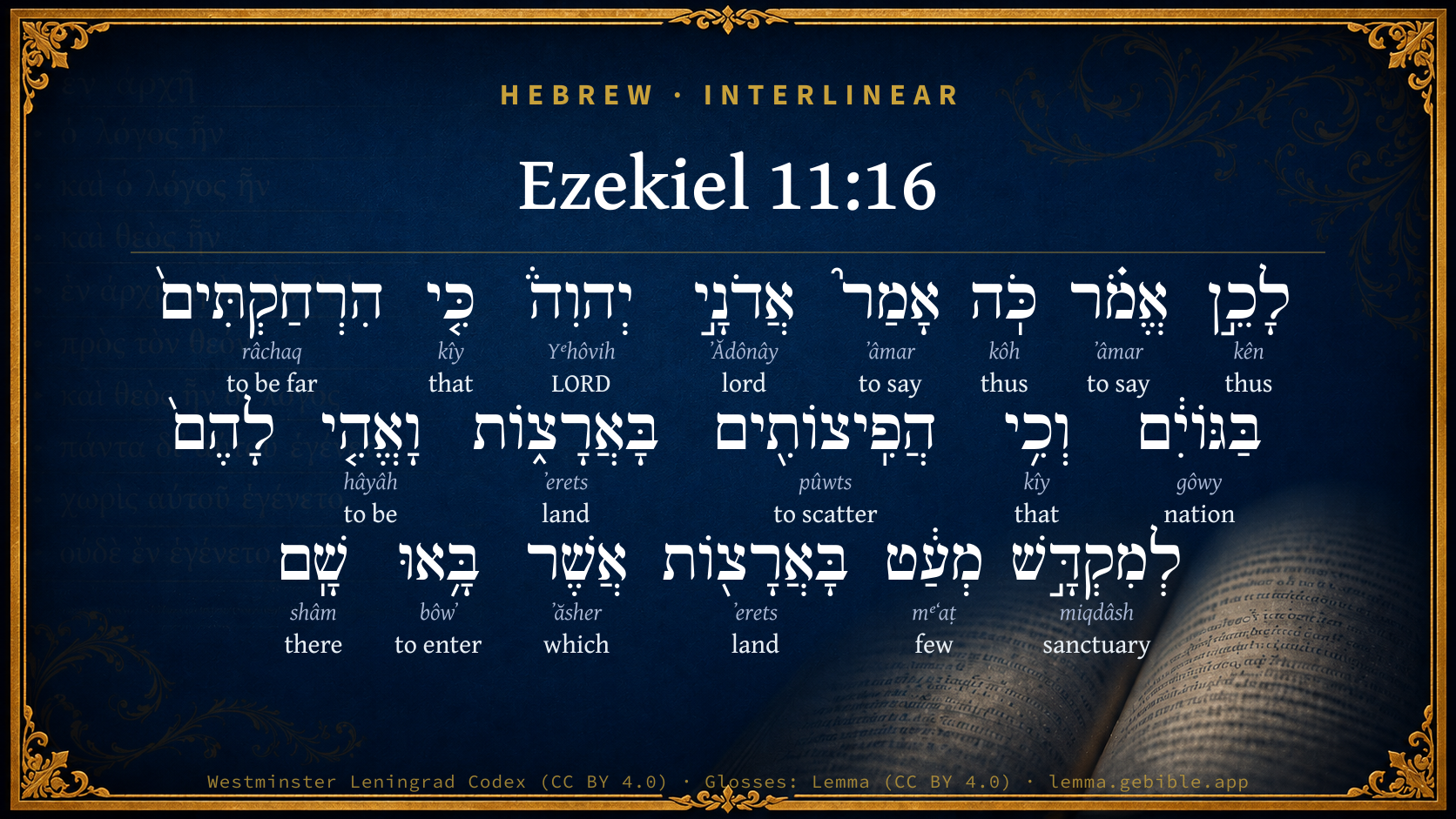
Hebrew (Westminster Leningrad Codex) Ezekiel 11:16 appears in the Hebrew Old Testament. The text above is from the Westminster Leningrad Codex. Each word links to its Strong’s number, a concise gloss, and parsing drawn from the Open Scriptures Hebrew Bible morphology. Click any word for its full Brown-Driver-Briggs (BDB) entry.
Download image
Cite this verse

Ezekiel 11:16 (World English Bible). Public Domain. Lemma interlinear Bible study tool, https://lemma.gebible.app/v/ezekiel/11/16.

Show BibTeX & RIS
BibTeX
RIS
English Translation
Therefore say, Thus says the Lord Yahweh: Whereas I have removed them far off among the nations, and whereas I have scattered them among the countries, yet will I be to them a sanctuary for a little while in the countries where they are come.
World English Bible · Public Domain
Download a study sheet

One document with this verse’s original text, its word-by-word gloss line, the meaning frame, cross-references with their text, attributed commentary, and full source and license credits — printable, and it pastes into notes with its structure intact.

This verse Autodidact and up

Study sheet (.html) Plain text (.txt)

A passage Seminary Student

Up to 50 verses in one chapter. A passage sheet keeps up to 6 commentary sources and 12 cross-references per verse, in the order this page ranks them, and says so on the sheet whenever that leaves anything out. Ask for a single verse and you get the Autodidact verse sheet above.

Everything on this page stays free to read, with no account — the sheet is a download of what is already on screen, not access to it.

Want to remove ads? Support Godless Engineer
Compare translations 3

The same verse in 3 English versions, stacked beneath the original-language interlinear above. Click any original word for its lexicon entry.

Each is an independent rendering of the whole verse — the interlinear is not word-aligned to these translations.

Highlighted words mark where these versions differ — a whole-verse word diff, not a word-by-word alignment.

  • World English Bible Public Domain
    Therefore say, Thus says the Lord Yahweh: Whereas I have removed them far off among the nations, and whereas I have scattered them among the countries, yet will I be to them a sanctuary for a little while in the countries where they are come.
  • King James Version Public Domain
    Therefore say, Thus saith the Lord GOD; Although I have cast them far off among the heathen, and although I have scattered them among the countries, yet will I be to them as a little sanctuary in the countries where they shall come.
  • unfoldingWord Literal Text CC BY-SA 4.0
    Therefore say, ‘The Lord Yahweh says this: Though I have removed them far off among the nations, and though I have scattered them among the lands, yet I have been a sanctuary for them for a little while in the lands where they have gone.’

unfoldingWord Literal Text — © unfoldingWord, licensed CC BY-SA 4.0. Word-aligned USFM3 via Door43 (git.door43.org/unfoldingWord/en_ult).

Versions to compare (up to 4)

3 of 4 selected

Show all 18 translations

Every available English version of this verse, each an independent rendering of the whole verse.

  • World English Bible Public Domain
    Therefore say, Thus says the Lord Yahweh: Whereas I have removed them far off among the nations, and whereas I have scattered them among the countries, yet will I be to them a sanctuary for a little while in the countries where they are come.
  • Berean Standard Bible Public Domain
    Therefore declare that this is what the Lord GOD says: ‘Although I sent them far away among the nations and scattered them among the countries, yet for a little while I have been a sanctuary for them in the countries to which they have gone.’
  • Majority Standard Bible Public Domain
    Therefore declare that this is what the Lord GOD says: ‘Although I sent them far away among the nations and scattered them among the countries, yet for a little while I have been a sanctuary for them in the countries to which they have gone.’
  • King James Version Public Domain
    Therefore say, Thus saith the Lord GOD; Although I have cast them far off among the heathen, and although I have scattered them among the countries, yet will I be to them as a little sanctuary in the countries where they shall come.
  • American Standard Version (1901) Public Domain
    Therefore say, Thus saith the Lord Jehovah: Whereas I have removed them far off among the nations, and whereas I have scattered them among the countries, yet will I be to them a sanctuary for a little while in the countries where they are come.
  • Revised Version (1885) Public Domain
    Therefore say, Thus saith the Lord GOD: Whereas I have removed them far off among the nations, and whereas I have scattered them among the countries, yet will I be to them a sanctuary for a little while in the countries where they are come.
  • Geneva Bible (1599) Public Domain
    Therefore say, Thus saith the Lord God, Although I haue cast them farre off among the heathen, and although I haue scattered them among the countreis, yet wil I be to them as a litle Sanctuarie in ye countreis where they shall come.
  • Douay-Rheims (1899) Public Domain
    Therefore thus saith the Lord God: Because I have removed them far off among the Gentiles, and because I have scattered them among the countries: I will be to them a little sanctuary in the countries whither they are come.
  • Young's Literal Translation Public Domain
    it `is' ours, the land hath been given for an inheritance; therefore say: Thus said the Lord Jehovah: Because I put them afar off among nations, And because I scattered them through lands, I also am to them for a little sanctuary, In lands whither they have gone in.
  • Literal Standard Version CC BY-SA 4.0
    it [is] ours, the land has been given for an inheritance; therefore say, Thus said Lord YHWH: Because I put them far off among nations, || And because I scattered them through lands, I am also for a little sanctuary to them, || In lands to where they have gone in.
  • Unlocked Literal Bible CC BY-SA 4.0
    Therefore say, 'The Lord Yahweh says this: Though I have removed them far off among the nations, and though I have scattered them among the lands, yet I have been a sanctuary for them for a little while in the lands where they have gone.'
  • unfoldingWord Literal Text CC BY-SA 4.0
    Therefore say, ‘The Lord Yahweh says this: Though I have removed them far off among the nations, and though I have scattered them among the lands, yet I have been a sanctuary for them for a little while in the lands where they have gone.’
  • Darby Bible Public Domain
    Therefore say, Thus saith the Lord Jehovah: Although I have removed them far off among the nations, and although I have scattered them among the countries, yet will I be to them as a little sanctuary in the countries whither they are come.
  • World Messianic Bible Public Domain
    “Therefore say, ‘The Lord GOD says: “Whereas I have removed them far off among the nations, and whereas I have scattered them among the countries, yet I will be to them a sanctuary for a little while in the countries where they have come.”’
  • Webster's Bible Public Domain
    Therefore say, Thus saith the Lord GOD; Although I have cast them far off among the heathen, and although I have scattered them among the countries, yet will I be to them as a little sanctuary in the countries where they shall come.
  • Free Bible Version CC BY-SA 4.0
    So tell them that this is what the Lord God says: Even though I sent them far away to live among the foreign nations, scattering them among the different countries, I have been taking care of them for a while in the countries where they went.
  • Bible in Basic English Public Domain
    For this reason say, This is what the Lord has said: Though I have had them moved far off among the nations, and though I have sent them wandering among the countries, still I have been a safe place for them for a little time in the countries where they have come.
  • JPS Tanakh (1917) Public Domain
    therefore say: Thus saith the Lord GOD: Although I have removed them far off among the nations, and although I have scattered them among the countries, yet have I been to them as a little sanctuary in the countries where they are come;

Literal Standard Version (2020), Covenant Press — licensed CC BY-SA 4.0. Text via the HelloAO Bible API (eBible.org). Unlocked Literal Bible (unfoldingWord) — licensed CC BY-SA 4.0. Text via the HelloAO Bible API (eBible.org). unfoldingWord Literal Text — © unfoldingWord, licensed CC BY-SA 4.0. Word-aligned USFM3 via Door43 (git.door43.org/unfoldingWord/en_ult). Free Bible Version, Dr. Jonathan Gallagher — licensed CC BY-SA 4.0. Text via the HelloAO Bible API (eBible.org).

Word by word

More ways to search: Search by grammar → Find every occurrence → Compare this word →

Practice this passage: Drill this verse → Learn its vocabulary →

הִרְחַקְתִּים֙
râchaq
H7368
“to be far · them”
Verb, Hiphil, Perfect, 1st Person, Common, Singular + Suffix, Personal, 3rd Person, Masculine, Plural
Part of Speech
Verb
Stem
Hiphil
Form
Perfect
Person
1st Person
Gender
Common
Number
Singular
Full BDB Definition

Origin: a primitive root

TWOT: 2151

to be or become far, be or become distant, be removed, go far away (verb) - (Qal) to be far, be distant - (Piel) to send far away, extend - (Hiphil) - to make or exhibit distance, be gone far - to remove, put far away - (Niphal) loose (verb) - at a distance (verbal infinitive [as adverb])
  1. לָכֵ֣ן kên H3651 “to/for · thus” Preposition + Adverb
  2. אֱמֹ֗ר ʼâmar H559 “say” Verb, Qal, Imperative, 2nd Person, Masculine, Singular
  3. כֹּֽה kôh H3541 “thus” Adverb
  4. אָמַר֮ ʼâmar H559 “to say” Verb, Qal, Perfect, 3rd Person, Masculine, Singular
  5. אֲדֹנָ֣י ʼĂdônây H136 “Lord · my” Noun, Common, Masculine, Plural, Construct + Suffix, Personal, 1st Person, Common, Singular
  6. יְהוִה֒ Yᵉhôvih H3069 “LORD” Noun, Proper
  7. כִּ֤י kîy H3588 “that” Conjunction
  8. בַּגּוֹיִ֔ם gôwy H1471 “in/at the · nations” Preposition, Determined + Noun, Common, Masculine, Plural, Absolute
  9. וְכִ֥י kîy H3588 “and · that” Conjunction + Conjunction
  10. הֲפִֽיצוֹתִ֖ים pûwts H6327 “to scatter · them” Verb, Hiphil, Perfect, 1st Person, Common, Singular + Suffix, Personal, 3rd Person, Masculine, Plural
  11. בָּאֲרָצ֑וֹת ʼerets H776 “in/at the · lands” Preposition, Determined + Noun, Common, Both, Plural, Absolute
  12. וָאֱהִ֤י hâyâh H1961 “and · to be” Conjunction + Verb, Qal, Sequential Imperfect, 1st Person, Common, Singular
  13. לְמִקְדָּ֣שׁ miqdâsh H4720 “to/for · sanctuary” Preposition + Noun, Common, Masculine, Singular, Absolute
  14. מְעַ֔ט mᵉʻaṭ H4592 “few” Noun, Common, Masculine, Singular, Absolute
  15. בָּאֲרָצ֖וֹת ʼerets H776 “in/at the · lands” Preposition, Determined + Noun, Common, Both, Plural, Absolute
  16. אֲשֶׁר ʼăsher H834 “which” Particle, Relative
  17. בָּ֥אוּ bôwʼ H935 “to enter” Verb, Qal, Perfect, 3rd Person, Common, Plural
  18. שָֽׁם shâm H8033 “there” Adverb

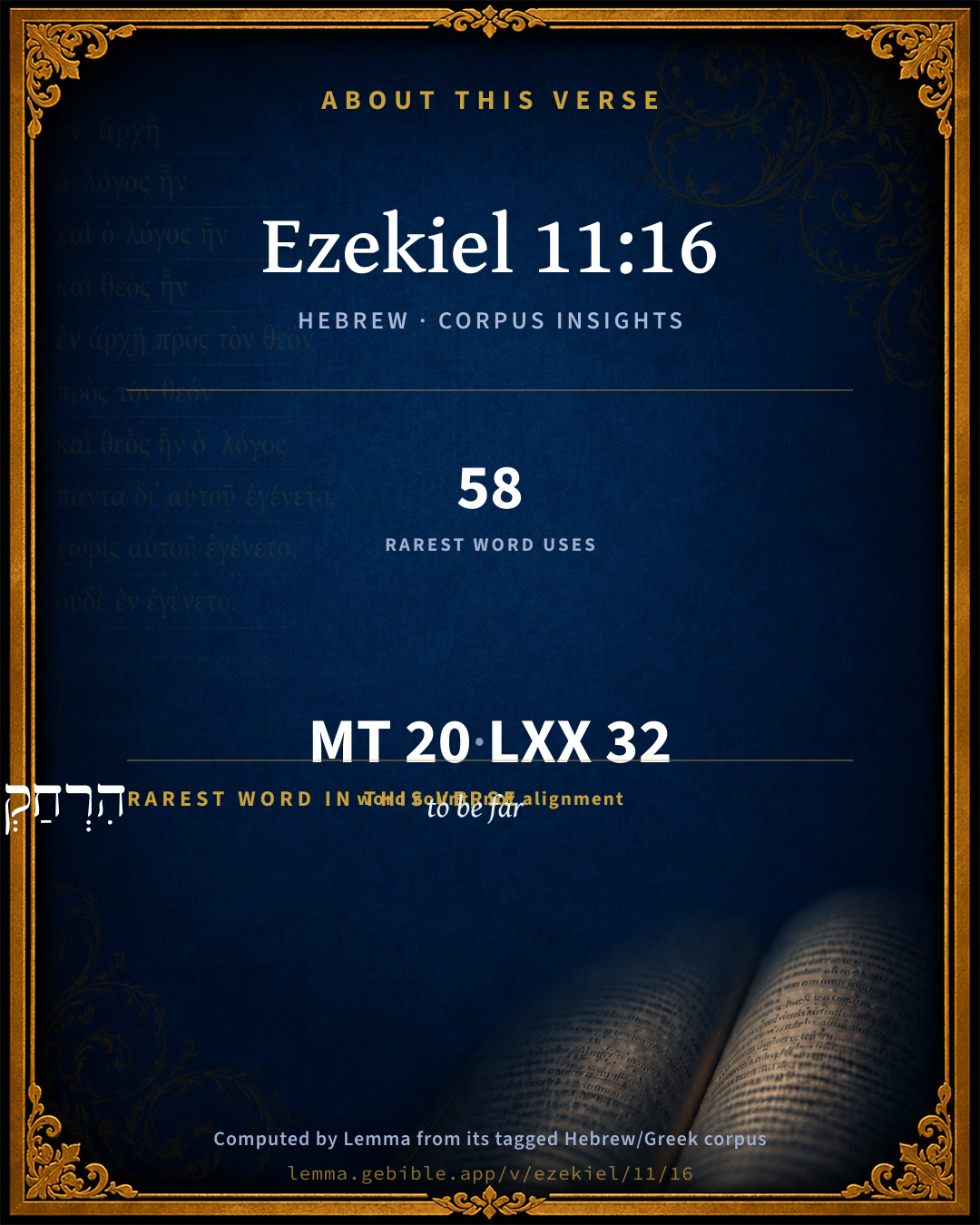
About this verse

These counts appear in no published source. They are computed here, from the morphology-tagged text and Lemma’s own curated glosses. What Lemma adds →

20
words
16
distinct lemmas
Prophets
section

Shared distinctive vocabulary

הִרְחַקְתִּים֙ to be far H7368 occurs in 56 verses of the Hebrew Bible. Also found in:

Grammatical profile

  • 6 verbs
  • 7 nouns
  • 1 preposition
  • 2 conjunctions
  • 3 adverbs
  • 1 particle

Verb forms

  • אֱמֹ֗ר Qal · Imperative
  • אָמַר֮ Qal · Perfect
  • הִרְחַקְתִּים֙ Hiphil · Perfect
  • הֲפִֽיצוֹתִ֖ים Hiphil · Perfect
  • וָאֱהִ֤י Qal · Sequential Imperfect
  • בָּ֥אוּ Qal · Perfect

Repetition

Words recur within this verse — often emphatic in Hebrew:

  • אֱמֹ֗ר to say H559 ×2
  • בָּאֲרָצ֑וֹת land H776 ×2
  • כִּ֤י that H3588 ×2

Hebrew & Septuagint length

In English translation the verse runs 45 words from the Hebrew and 39 from the Septuagint (LXX English) — closely comparable.

A rough comparison of the two English renderings, which tokenize alike — not a word-level alignment.

Word counts can differ between the Hebrew and the Greek without any difference in meaning — e.g. the Hebrew direct-object marker אֵת has no separate Greek word, and Greek often adds the article ὁ.

In the original languages it is 20 Hebrew tokens and 32 Greek tokens — but the two are counted differently (Hebrew bundles its prefixes and suffixes into one token; the Greek is in lemma form), so that isn’t a like-for-like length.

Cross-references

17

Topical passages linked to Ezekiel 11:16 in the Treasury of Scripture Knowledge — connected by theme and wording, ordered by reader-vote popularity; previews shown in the World English Bible.

  • Isaiah 8:14 He shall be for a sanctuary; but for a stone of stumbling and for a rock of offense to both the houses of Israel, for a gin and for a snare to the inhabitants of Jerusalem.
  • Deuteronomy 30:3–4 that then Yahweh your God will turn your captivity, and have compassion on you, and will return and gather you from all the peoples, where Yahweh your God has scattered you.
  • Psalms 90:1 Lord, you have been our dwelling place for all generations.
  • Leviticus 26:44 Yet for all that, when they are in the land of their enemies, I will not reject them, neither will I abhor them, to destroy them utterly, and to break my covenant with them; for I am Yahweh their God;
  • Psalms 31:20 In the shelter of your presence you will hide them from the plotting of man. You will keep them secretly in a dwelling away from the strife of tongues.
  • Psalms 91:1 He who dwells in the secret place of the Most High Will rest in the shadow of the Almighty.
  • Proverbs 18:10 The name of Yahweh is a strong tower: The righteous run to him, and are safe.
  • Jeremiah 30:11 For I am with you, says Yahweh, to save you: for I will make a full end of all the nations where I have scattered you, but I will not make a full end of you; but I will correct you in measure, and will in no way leave you unpunished.
  • Jeremiah 31:10 Hear the word of Yahweh, you nations, and declare it in the isles afar off; and say, He who scattered Israel will gather him, and keep him, as shepherd does his flock.
  • Psalms 44:11 You have made us like sheep for food, And have scattered us among the nations.
  • Psalms 91:9–16 Because you have made Yahweh your refuge, And the Most High your dwelling place,
  • Jeremiah 24:5–6 Thus says Yahweh, the God of Israel: Like these good figs, so will I regard the captives of Judah, whom I have sent out of this place into the land of the Chaldeans, for good.
  • Jeremiah 26:7 The priests and the prophets and all the people heard Jeremiah speaking these words in the house of Yahweh.
  • Jeremiah 26:11 Then spoke the priests and the prophets to the princes and to all the people, saying, This man is worthy of death; for he has prophesied against this city, as you have heard with your ears.
  • Jeremiah 42:11 Don't be afraid of the king of Babylon, of whom you are afraid; don't be afraid of him, says Yahweh: for I am with you to save you, and to deliver you from his hand.
  • 2 Kings 24:12–16 and Jehoiachin the king of Judah went out to the king of Babylon, he, and his mother, and his servants, and his princes, and his officers: and the king of Babylon took him in the eighth year of his reign.
  • Isaiah 4:5 Yahweh will create over the whole habitation of Mount Zion, and over her assemblies, a cloud and smoke by day, and the shining of a flaming fire by night; for over all the glory will be a canopy.

Cross-references courtesy of OpenBible.info (CC BY 4.0).

Hebrew and Greek witnesses Masoretic Hebrew ↔ Greek Septuagint

The same verse in the two great witnesses to the Old Testament, shown verse-for-verse.

These are two independent witnesses, not word-aligned to each other, and the Septuagint is shown in lemma (dictionary) form.

Hebrew Ezekiel 11:16 Masoretic · Westminster Leningrad Codex

לָכֵ֣ן אֱמֹ֗ר כֹּֽה אָמַר֮ אֲדֹנָ֣י יְהוִה֒ כִּ֤י הִרְחַקְתִּים֙ בַּגּוֹיִ֔ם וְכִ֥י הֲפִֽיצוֹתִ֖ים בָּאֲרָצ֑וֹת וָאֱהִ֤י לָהֶם֙ לְמִקְדָּ֣שׁ מְעַ֔ט בָּאֲרָצ֖וֹת אֲשֶׁר בָּ֥אוּ שָֽׁם

Therefore say, Thus says the Lord Yahweh: Whereas I have removed them far off among the nations, and whereas I have scattered them among the countries, yet will I be to them a sanctuary for a little while in the countries where they are come.

World English Bible · Public Domain

Greek LXX Ezekiel 11:16 Septuagint · lemma form

διά οὗτος εἶπον ὅδε λέγω κύριος ὅτι ἀποὠθέω αὐτός εἰς ὁ ἔθνος καί διασκορπίζω αὐτός εἰς πᾶς ὁ γῆ καί εἰμί αὐτός εἰς ἁγίασμα μικρός ἐν ὁ χώρα ὅς ἄν εἰςἔρχομαι ἐκεῖ

Therefore say you, Thus says the Lord; I will cast them off among the nations, and will disperse them into every land, yet will I be to them for a little sanctuary in the countries which they shall enter.

LXX2012 (modern English Septuagint) · Public Domain

Hebrew: Westminster Leningrad Codex (CC BY 4.0). Greek: Septuagint (public domain); English from LXX2012 (modern English Septuagint) (Public Domain). How the Septuagint differs from the Hebrew →

Targum (Aramaic paraphrase)

1

The Targum is the ancient Jewish Aramaic paraphrase of the Hebrew Scriptures — an interpretive translation, not the Hebrew text itself. Onkelos (literal) and Pseudo-Jonathan (expansive) render the Torah, and Jonathan the Prophets. Coverage is partial: where no permissively-licensed English translation exists for a verse, only the Aramaic is shown. This is verse-level text, not a word-by-word alignment to the Hebrew.

  1. Targum Jonathan Prophets (Joshua–Malachi)
    בְּכֵן כִּדְנַן אֲמַר יְיָ אֱלֹהִים אֲרֵי אַרְחֵיקְתִּינוּן לְבֵינֵי עַמְמַיָא וַאֲרֵי בְדַרְתִּינוּן בִמְדִינָתָא וִיהָבֵית לְהוֹן בָתֵּי כְנִשְׁתָּא תִּנְיָן לְבֵית מַקְדְשִׁי וְאִינוּן כִּזְעֵיר בִּמְדִינָתָא דְאִתְגִלִיאוּ לְתַמָן:

    (no public-domain English translation for this verse)

    Targum Jonathan — Aramaic: “Mikraot Gedolot” (public domain). English: “Sefaria Community Translation” (CC0 1.0 (public-domain dedication)); “London "Chaldee Paraphrase," 1871” (public domain). Text via Sefaria.

Commentary

Notes on Ezekiel 11:16 from classic Christian and Jewish commentators (each source and its license shown beneath its notes). The classic Christian expositions comment on the surrounding passage and are grouped to its opening verse, so a note may address several verses; the Jewish commentaries on the Tanakh (Rashi and others) are per-verse, so they appear only where the commentator wrote on this verse.

Lemma curates 59 commentaries, every one of them public domain or Creative Commons licensed, each selected and text-cleaned for this edition rather than reprinted as found. About our sources →

Trapp's Complete Commentary

John Trapp

Eze 11:16 Therefore say, Thus saith the Lord GOD; Although I have cast them far off among the heathen, and although I have scattered them among the countries, yet will I be to them as a little sanctuary in the countries where they shall come.

Ver. 16. Although I have cast them.] What a cornucopia of comfort may this promise be to poor prisoners, forlorn exiles, and such as by sickness or otherwise are necessitated to keep from public ordinances, that they shall have God’s presence and protection, the comfort and conduct of his Spirit, &c.

Yet I will be to them as a little sanctuary.] Sanctuarium modicum. By heating their prayers, sanctifying their natures, bringing to their remembrance what things they have heard and learned touching me and my will, themselves and their duties. They should in Babylon worship God in spirit and in truth; and in the life to come the Lord God Almighty and his Lamb should be their temple. {Rev 21:22}

John Trapp, A Commentary or Exposition upon All the Books of the Old and New Testament (1647–1656) — public domain. Text from a community e-Sword module.

The Biblical Illustrator

Joseph S. Exell

Eze_11:16

Yet will I be to them as a little sanctuary in the countries where they shall come.

God the sanctuary of the afflicted

Philosophers have frequently remarked what may be called the doctrine of compensation: by which they mean, the tendency there is in nature and providence to keep things in a kind of equality; so that, while, on the one hand, there are defects to counterbalance advantages, there are, on the other hand, advantages to counterbalance defects. In what condition can we be found that possesses no advantages? These a grateful mind will always look after; and, however severe the affliction, endeavour to say, It might have been worse. I have lost much; but I am not deprived of all. He has chastened me sore; but He has not given me over unto death. The stroke is painful: but it will be profitable. Tribulation worketh patience; and patience, experience; and experience, hope; and hope maketh not ashamed; because the love of God is shed abroad in our hearts by the Holy Ghost which is given unto us.

I. The calamity: I have cast them far off, etc.

1. The event serves to display the agency of God. He therefore, in the words before us, claims the work as His own. In the dispersion of the Jews He employed instrumentality, and wicked instrumentality; but neither of these detracts from His agency. What does God, without the intervention of any cause between Him and the effect? He blesses us by means; He warms us by the sun; He refreshes us by sleep; He sustains us by food; and He even requires us to prepare, for our use, the supplies He gives us. In a similar way He inflicts evil. And hence an irreligious mind is detained from God by the persons or the events that injure him. He thinks only of the flood, or the fire; of the heedless servant, the uncertain friend, the cruel enemy.

2. The event displays the truth of God. It had been clearly foretold, it had been threatened, as early as the days of Moses. Every successive prophet in the name of God renewed the threatening. In consequence of these denunciations the calamity was identified with the Divine veracity, and became surer than heaven and earth. The Jews imagined that they had nothing to fear: they thought that such a mighty judgment was improbable, if not impossible; and presumptuously cried, The temple of the Lord, the temple of the Lord, the temple of the Lord are we. But the Lord is not a man, that He should lie, etc.

3. The event displays the holiness of God. His conduct towards this people seems severe; and it was severe. But the provocation was peculiar. Much was given, and much was required. Their offences were aggravated by their privileges. Sin is not to be judged of by its grossness, but by its guilt; and guilt arises from knowledge possessed, from obligations violated, from advantages abused.

4. The event displays the wisdom of God. By their dispersion the Scriptures were diffused, and the Desire of all nations was announced and expected.

5. The event displays His goodness. In the midst of judgment He remembered mercy. Though He punished them, it was not to destroy, but to correct and reform.

II. The alleviation. Thus saith the Lord God: Although I have cast them far off, etc. God is never at a loss to serve His people; and that He will compensate them for the want of those very things that seem essential to their welfare. Consider two cases in which this truth may be exemplified.

1. In the loss of outward comforts. God does not require us to be indifferent to our substance, to our health, to our friends and relations: yea, under the removal of them, He allows us to feel. But it is the duty and privilege of a Christian to be able to say, with the Church, Although the fig tree shall not blossom, etc. The believer may well display a superiority over those events that keep others constantly alarmed or distressed, since God is his portion; and in His unchangeableness and all-sufficiency he has a stock of happiness independent of the body and its diseases; time, and its vicissitudes; the world and its dissolution. The design of affliction is to wean us from creatures, and to bring us more entirely to make use of God. A good man, who had endured the wreck of fortune, being asked how he bore the change in his condition so cheerfully, replied, When I had these good things I enjoyed God in all; and now I am deprived of them, I enjoy all in God.

2. In the want of gracious ordinances. God will never countenance the neglect of the means of grace; but He will make up for the want of them. And those should remember this remark who, by accident or sickness, or the care of young children, or the duties of servitude, are wholly or partially denied the privileges of the sanctuary. When we cannot follow Him, He can follow us. (W. Jay.)

The little sanctuary

Sanctuaries--i.e., houses of God, churches and abbeys, and ecclesiastical houses--have always been places of shelter for criminals, for vanquished enemies, for persons in debt. The Jews had cities of refuge; and we may say, in general, that by the ecclesiastical laws of Christendom, through many ages, provision was made by means of church, or abbey, or consecrated ground, to receive criminal and distressed persons into shelter and safety. It is curious, and not without some tender interest, to hear of some places still left in our own land, such as the Sanctuary of Holyrood, in Edinburgh, which retain something of the old virtue, and open a refuge where honourable debtors and distressed persons may live in peace.

I. The idea of asylum and protection. I will be as a little sanctuary--I will be the shield and protector and sure refuge of trusting souls. Asylum! Is not this what every awakened soul needs and seeks? Some safe, sure refuge, from all that threatens, afflicts, alarms; from the thunders, loud or deep, of broken law; from the accusations of conscience, from the troubles of life, from the terrors of death--asylum from them all? When one has been living, or dreaming, in sin, and then awakes, and sees things as they are, and knows himself, and looks with rapid, startled glance at what is coming, and may be near, he feels at first just like one in an enemys country. Look which way he will, there is no shelter or safety for him; none that he can see. He must flee; he must escape for his life. But whither? In what direction does safety lie? In this great strait God reveals Himself as a little sanctuary--a place of protection and safety; and says, Flee, you have need to flee. Life is full of harms, and death broods in the air. In a scene that might have been all friendly to you, you have made yourself many enemies. Flee, but flee to Me: I am the refuge. I am the last asylum of your soul. Those thunders are Mine, but if you pass through them to Myself they will soften and roll away, and leave you in coolness and safety. Turn your face but Godwards, and let your steps be as your face is, and nothing can then surprise or hurt you. Not a hair of your head shall perish.

II. But a sanctuary means something more than a refuge and place of safety. It means, at least in the nomenclature of the Scriptures, a place of purification, where we may wash and be clean: and may so avail ourselves of the helps to goodness which are provided, that the rest of our time may be pure and holy. Our very words tell us this. Sanctity, sanctification,--a sanctuary is not equal to its name if it does not promote these. The whole hunger and thirst of the renewed creature is for righteousness--a righteousness always loved and striven for, yet never perfectly attained--a righteousness no sooner attained in measure, than, in some mysterious manner, it seems to waver, and fail, and begin to pass away; as the snow-white garment quickly loses its purity in a dusty or smoky air; or as the living branch when it is not freshly growing, soon loses the brightness of its green. The heart is deceitful, and the world is defiling, and no enterprise of human life were half so hopeless as the endeavour to be wholly pure and holy, if means of purification were not provided, and brought so closely to hand as to be within the reach of our daily and deepest needs. Would a man be considered very kind and hospitable who, knowing that some travellers were coming to his house, along rocky paths and across burning sands, should send a message to them while yet they are miles off, to say--Do not come any nearer until you have washed and made you clean. Come: by all means come: I am not inhospitable: but be sure you come with ointment on your head, all fragrant with myrrh and spice, and clad in rich evening dress, ready for the banquet. What would the pilgrims think on receiving such a message? They would say in a moment--He doesnt want us. We must seek some other gates than his. The case is even so as between us and God. He does not send a mocking message to frail, disabled men in this dusty, defiling, wilderness world, sinful although they be, by the offer of salvation to them under utterly impossible conditions. He does not say, Come to Me for salvation, but be more than half-saved before you come. He comes to us with a whole salvation, with healing, cleansing, vivifying grace, which will grow in us, and develop us into perfectness.

III. The idea of nourishment. A hospice for the entertainment of strangers, or any hospitable house, is never without bread. Washing is before eating. Dressing is for the banquet. Every living thing must have something to live upon. Even in the far country where men degrade themselves, and spend their substance, there is something to eat--husks, if nothing better--sapless roots dug out of the sand--some-thing that will dull if not satiate the craving of appetite. And will not God feed His refugees? Will He be a little sanctuary in which they may die? Is there no bread on His table? Yes, bread enough, and to spare. Is there no wine in His cups? Yes, the sweet wine of love and strength and consolation. (A. Raleigh, D. D.)

A little sanctuary

The text begins with therefore. There was a reason for Gods speaking in this way. Upon reading the connection, we observe that those who had been carried captive were insulted by those who tarried at Jerusalem. The Lord hears the unkind speeches of the prosperous when they speak bitterly of those who are plunged in adversity. Many a time the cruel word of man has been the cause of a tender word from God. Because of the unkindness of these people, therefore God, in loving kindness, addressed in words of tender grace those whom they despised. Let us take all sharp speeches and cutting criticisms to God. It may be that He will hear what the enemy has said, and that He will be very pitiful to us. Because of the bitterness of the oppressor, He will bring home to our heart by the Spirit, with greater tenderness and power, some sweet word of His which has lain hidden from us in His Book.

I. Where Gods people may be.

1. They may be under chastisement. We may be in great spiritual darkness, and may be compelled to confess that our own sins have procured this unto ourselves. And yet, for all that, the Lord may have sent the chastisement in love, and in nothing else but love; and He may intend by it, not our destruction, but the destruction of the flesh; not our rejection, but our refining; not our curse, but our cleansing.

2. But wherever they are, whether they are under chastisement or not, they are where the Lord has put them. Although I have cast them far off, etc. It is well to look beyond all second causes and instrumentalities. Do not get angry with those who are the nearer agents, but look to the First Cause. Though your trials be peculiar, and your way be hedged up, yet the hand of the Lord is still in everything; and it behoves you to recognise it for your strengthening and consolation.

3. The people of Cod may dwell in places of great discomfort. The Jews were not in those days like the English, who colonise and find a home in the Far West, or even dwell at ease beneath sultry skies. An ancient Hebrew out of his own country was a fish out of water: out of his proper element. It must have been a great discomfort to Gods people to dwell among idolaters, and to be forced to witness obscene rites and revolting practices. Gods own favoured ones in these days may be living where they are as much out of place as lambs among wolves, or doves among hawks.

4. The beloved of God may yet be in a place of great barrenness as to all spiritual good. Our education for eternity may necessitate spiritual tribulation, and bereavement from visible comforts. To be weaned from all reliance on outward means may be for our good, that we may be driven in upon the Lord, and made to know that He is all in all.

5. Worse still, the Lords chosen may be under oppression through surrounding ungodliness and sin. Is it not still true of us, as well as of our Saviour, Out of Egypt have I called My Son?

II. What God will be to his people when they get into these circumstances. Yet will I be to them as a little sanctuary in the countries where they shall come. In using the word little the gracious God would seem to say, I will condescend to them, and I will be as they are. I will bow down to their littleness, and I will be to each little one of them a little sanctuary.

1. A sanctuary was a place of refuge. In past ages, churches and abbeys and altars have been used as places of sanctuary to which men have fled when in danger of their lives. Now, beloved fellow believer, wherever you are, wherever you dwell, God will be to you a constant place of refuge. You shall flee from sin to God in Christ Jesus. You shall flee from an accusing conscience to His pardoning love. You shall flee from daily cares to Him who careth for you. You shall flee from the accusations of Satan to the advocacy of Jesus. You shall flee even from yourselves to your Lord, and He will be to you in all senses a place of refuge. This is the happy harbour of all saints in all weathers.

2. A sanctuary signifies also a place of worship. It is a place where the Divine presence is peculiarly manifested--a holy place. The Lord Jesus Christ Himself is the true place of worship for saved souls.

3. Now, go a little further. Our God is to us a place of stillness. What was the sanctuary: of old? The sanctuary was the most holy place, the third court, the innermost of all within the veil. It was the stillest place that ever was on earth: a closet of absolute silence. Once in the year the high priest went in, and filled it full of the smoke of incense as he waved his censer in the mystic presence; but otherwise it was a chamber in which there was no footfall of living thing, or voice of mortal man. The stillness within the Holy of Holies of the temple must have reached the intensity of awe. What repose one might enjoy who could dwell in the secret place of the Most High! If you can baptize your spirit into the great deeps of Godhead, if you can take a plunge into the fathomless love of the covenant, if you can rise to commune with God, and speak with Him as a man speaketh with His friend, then will He be unto you as a little sanctuary, and you shall enjoy that solemn silence of the soul which hath music in it like the eternal harmonies. The presence of the Lord will be as a calm hand for that fevered brow, and a pillow for that burdened head. Use your God in this way, for so He presents Himself to you.

4. The sanctuary was a place of mercy. When men have no mercy on you, go to God. When you have no mercy on yourself--and sometimes you have not--run away to God.

5. The sanctuary was the house of mercy, and hence a place of condescension - a little sanctuary. To suit our needs the blessings of grace must be given in little forms. When the Lord communes with the greatest of men, He must become little to speak with him.

6. That sanctuary was a place of great holiness. Holiness becometh Thy house. This applied to the whole temple, but the inner shrine was called sanctum sanctorum--the Holy of Holies, for so the Hebrews make a superlative. It was the holiest place that could be. What bliss to enter into the Holy of Holies! Now, you cannot do that by getting into a ceil, or by shutting yourselves up in your room; but you can enter the most holy place by communion with God. Here is the promise; the text means this--I will be to them as a little sanctuary--a little Holy of Holies. I will put them into Myself as into the most holy place, and there will I hide them. In the secret of My tabernacle will I hide them. I will set them up upon a rock.

7. We may regard the Sanctuary as a place of cleansing. That may be gathered, from the other rendering of my text: I will be unto them a little sanctification. We want not only the great blood washing, but also the lesser washing of the feet with water; and the Lord Himself wilt give us this blessing. Did not Jesus take a towel, and gird Himself for this very purpose?

8. God will be to us a place of communion and of revelation. In the Holy of Holies God spoke with man, on that one day in the year, in a wondrous manner; and he that had been there, and came forth alive, came out to bless the congregation. Every day of the year the teaching of the sanctuary was that in God there was everything His people wanted. The joys of this life are like the ice palace of Montreal, which is fair to look upon while the winter lasts, but it all dissolves as the spring comes on. All things round about us here are myths and dreams. This is the land of fancies and of shadows. Pray God to get you out of them, and that you may find in Him your sanctuary, and indeed all that you want. (C. H. Spurgeon.)

God a sanctuary

I. To those who are deprived of the means of grace. Sufferers in sick rooms, travellers in lonely and distant places, missionaries amongst the heathen. How often to such comes the vision of the country church, when the summer air stole into the open window, bringing the breath of flowers; or of the great city church, with the well-known voice of a beloved minister. They long for these again. But God will be all and more.

II. To those who cannot derive benefit from the services they attend. The clergyman is broad in his views, and unsympathetic with the deeper moods of the spirit. Still, it may be your duty to attend for examples sake; but whilst waiting before the Lord, He will draw near and become your sanctuary.

III. To those who are exposed to danger and persecution. In the olden time the sanctuary was a place of refuge. All who fled thither were in safeguard. So let the driven soul haste to the folds of the Tabernacle of Gods presence, None can pursue it into that secret place. No weapon shall smite; and even envying voices shall die into subdued murmurs. (F. B. Meyer, B. A.)

The Biblical Illustrator, edited by Joseph S. Exell (c. 1880s–1900s) — public domain. Text from a community e-Sword module.

Joseph Benson's Commentary

Eze 11:16. Therefore say — In vindication of the captives; Although I have cast them far off — Not from myself, but from you and your polluted land, and out of the way of the dreadful judgments which are approaching; among the heathen — The Chaldeans, or those among whom the Chaldeans have placed them; and have scattered them among the countries — Have separated them from each other, and dispersed them in many countries; yet will I be to them as a little sanctuary — A sanctuary, or a refuge and protection “for a short time,” (so Bishop Newcome,) that is, during the seventy years’ captivity; or a little one in opposition to the great temple at Jerusalem; which, when its inhabitants were in the greatest need, should afford them the least help. But I, says God, will really be to my captives what the proud, self-deceiving Jews promise themselves from their temple, namely, their defence, support, and comfort. To me shall they flee, and in me shall they be safe, as he was that took hold on the horns of the altar. Or rather, they shall have such communion with me in the land of their captivity, as it was thought could be had nowhere but in the temple. They shall have the tokens of my presence with them, and my grace in their hearts shall sanctify their prayers and praises, as truly as ever the altar at the temple sanctified the gift. Observe, reader, they that are deprived of the benefit of public ordinances, if it be not their own fault, may have the want of them abundantly supplied in the immediate communications of divine grace and comforts.

Joseph Benson's Commentary on the Old and New Testaments (1811–1818) — public domain. Text from a community e-Sword module.

Geneva Bible (1599)

Geneva Bible translators

They shall be yet a little Church: showing that the Lord will ever have some to call upon his Name, whom he will preserve and restore, though they be for a time afflicted.

Geneva Bible (1599) marginal notes — public domain. Text via Bolls.life.

Jamieson, Fausset & Brown

Robert Jamieson, A. R. Fausset & David Brown

Although--anticipating the objection of the priests at Jerusalem, that the exiles were "cast far off." Though this be so, and they are far from the outer temple at Jerusalem, I will be their asylum or sanctuary instead (Psa 90:1; Psa 91:9; Isa 8:14). My shrine is the humble heart: a preparation for gospel catholicity when the local and material temple should give place to the spiritual (Isa 57:15; Isa 66:1; Mal 1:11; Joh 4:21-24; Act 7:48-49). The trying discipline of the exile was to chasten the outcasts so as to be meet recipients of God's grace, for which the carnal confidence of the priests disqualified them. The dispersion served the end of spiritualizing and enlarging the views even of the better Jews, so as to be able to worship God everywhere without a material temple; and, at the same time, it diffused some knowledge of God among the greatest Gentile nations, thus providing materials for the gathering in of the Christian Church among the Gentiles; so marvellously did God overrule a present evil for an ultimate good. Still more does all this hold good in the present much longer dispersion which is preparing for a more perfect and universal restoration (Isa 2:2-4; Jer 3:16-18). Their long privation of the temple will prepare them for appreciating the more, but without Jewish narrowness, the temple that is to be (Eze. 40:1-44:31).

a little--rather, "for a little season"; No matter how long the captivity may be, the seventy years will be but as a little season, compared with their long subsequent settlement in their land. This holds true only partially in the case of the first restoration; but as in a few centuries they were dispersed again, the full and permanent restoration is yet future (Jer 24:6).

Jamieson, Fausset & Brown — Commentary Critical and Explanatory on the Whole Bible (1871) — public domain (CC PDM 1.0). Text via the HelloAO Bible API.

Adam Clarke's Commentary

Verse 16. Yet will I be to them as a little sanctuary] Though thus exiled from their own land, yet not forgotten by their God. While in their captivity, I will dispense many blessings to them; and I will restore them to their own land, Eze 11:17, from which they shall put away all idolatry, Eze 11:18.

Adam Clarke's Commentary on the Bible (1810–1826) — public domain. Text from a community e-Sword/MySword module.

Ellicott's Commentary for English Readers

(16) Therefore say.—These words, again repeated in Eze_11:17, refer to what the people of Jerusalem had said in Eze_11:15. Their saying these things was a reason, not for what God would do, but for His declaring His merciful purpose beforehand.

As a little sanctuary.—Rather, as a sanctuary for a little. The original word is to be taken as an adverb rather than an adjective, and in itself may refer either to time or to amount: either a sanctuary for a little time, or a sanctuary in some degree. The connection points to the former as the true sense; for a little while, during the term of their captivity, God’s presence with them spiritually would be instead of the outward symbolical presence in His Temple. The contrast is striking. God has already said that he would abandon the Temple, and give up Jerusalem to destruction, and cast out its people; but now to the exiles, scattered among the heathen, He would Himself be for a sanctuary.

A Bible Commentary for English Readers, edited by Charles John Ellicott (1878–1897) — public domain. Text from a community e-Sword module.

The Cambridge Bible for Schools and Colleges

gen. ed. J. J. S. Perowne

16. yet will I be to them] Rather: and have been to them for a sanctuary but little in the countries where they are come. The expression “for a sanctuary but little” refers to the taunt of the dwellers in Jerusalem that the exiles were far from the sanctuary and had no part in Jehovah. It is true that he had not been to the exiles in great measure that which a “sanctuary” is, viz. a presence of Jehovah, a sanctification, and a religious joy. It is doubtful if “sanctuary” has anywhere (even Isa_8:14) the meaning of asylum, protection; the sanctuary is the abode of Jehovah, and his presence there sanctifies those in the midst of whom he dwells. The exiles longed to be near the sanctuary and mourned their distance from it (Psalms 84, 137); while those left in the land boasted of the possession of it and looked on the exiles as outcasts.

The Cambridge Bible for Schools and Colleges (gen. ed. J. J. S. Perowne; Cambridge University Press, 1878–1918) — public domain. Text from a community e-Sword module.

John Gill's Exposition

Therefore say, thus saith the Lord God,.... Since they were so insulted and ill treated by their brethren the Jews:

although I have cast them afar off among the Heathen; both the ten tribes, even all the house of Israel, who were carried into Assyria, and placed in the cities of the Medes, in Halath and Habor, by the river Gozan, Kg2 17:6; and those of the Jews in Jeconiah's captivity, among whom were Ezekiel, and his brethren, and his kindred:

and although I have scattered them among the countries; and therefore, what with the distance of the place where they were, and the dispersion of them among the people where they resided, their case might seem to be desperate; and that there was no probability, and scarce any possibility, of their being preserved as a people, and of their restoration to their own land:

yet will I be to them a little sanctuary in the countries where they shall come; their dwelling place, as he has been to his people in all generations their protection from all their enemies, in whom, and by whose power, they should be safe; and whose presence they should enjoy, though deprived of public ordinances, of temple worship and service; though they were at a distance from the great sanctuary, the temple, the inhabitants of Jerusalem boasted of, yet the Lord would make up the want of that to them with himself. The Targum, Jarchi, and Kimchi (m) interpret this of the synagogues, which were second to the temple, the Israelites had in foreign countries, where they prayed to the Lord, and worshipped him, and enjoyed his presence. It may be rendered, "the sanctuary of a few" (n); they being but few, especially that were truly godly, that were carried captive: or, "a sanctuary for a little while" (o); that is, during seventy years, and then they should be returned, as follows. The Targum is,

"I have given them synagogues, second to my sanctuary, and they are as few in the provinces where they are carried captive.''

(m) Ex T. Bab. Megilla, fol. 29. 1. (n) "ad sanctuarium paucitatis", Calvin; "in sanctuarium paucorum", Cocceius. So Ben Melech says the word is a substantive in some copies. (o) Paulisper, Junius & Tremellius, Polanus, Castalio.

John Gill's Exposition of the Whole Bible (1746–1763) — public domain (CC PDM 1.0). Text via the HelloAO Bible API.

Albert Barnes' Notes on the Bible

As a little sanctuary - Rather, I will be to them for a little while a sanctuary. The blessing was provisional, they were to look forward to a blessing more complete. For a little while they were to be satisfied with God’s special presence in a foreign land, but they were to look forward to a renewal of His presence in the restored temple of Jerusalem. “sanctuary” means here strictly the holy place, the tabernacle of the Most High: Yahweh will Himself be to the exiles in the place of the local sanctuary, in which the Jews of Jerusalem so much prided themselves (compare the margin reference). Here is the germ from which is developed Ezek. 40–48, the picture of the kingdom of God in its new form.

Albert Barnes' Notes on the Bible (1834–1885) — public domain. Text from a community e-Sword/MySword module.

Haydock's Catholic Bible Commentary

A little. Hebrew, "for a short time, a sanctuary," or temple. They shall find all things in me. The Christian Church was never more pure than during the first persecutions, when her children could not assemble freely, or build temples. (Calmet) --- God will never totally abandon her, Jeremias iv. 27., &c. (Worthington)

George Leo Haydock (1774–1849), Haydock's Catholic Family Bible and Commentary, 1859 edition — public domain. Excludes Psalms (Douay-Rheims chapter numbering differs from Protestant) and Deuterocanonical books (Catholic canon only).

Matthew Poole's English Annotations

Therefore; in apology and vindication of them, backed with excellent promises in the following verses.

Say; say to them, and of them in Babylon.

Although I have cast them far off: the obstinate Jews at Jerusalem will call them apostates and renegades; but let such false accusers know that they were sent thither, and that I the Lord sent them thither, and will own them there too.

Far off; not from myself, but from you, your polluted land, and dreadful approaching judgments.

Among the heathen; the Chaldeans, or such as the Chaldeans placed them among.

Scattered them; dispersed and separated them from one another in many countries which were under the king of Babylon. Yet they are dear to me, and my purposes are for them more gracious than yours are for them, or than mine are for you.

As a little sanctuary; for a little while, i.e. during the seventy years’ captivity; or for a few of them, the remnant was ever little: or, as it refers to the sanctuary, a little one in opposition to that great, rich, splendid, and admired temple at Jerusalem, which when they need most, shall help least; but I, saith God, will be really to my captives what the proud self-deceiving Jews promise their temple shall be to them, both for glory, defence, and for worship, which shall with heart and love be given by these I have sent away; and wherever they are, their prayers, synagogue worship, and obedience shall be to me as well-pleasing as they shall desire. They at a distance weep on Chebar banks; you, O rebellious! pollute the temple by your idolatries. I will comfort the mourners; I will punish you polluters of my temple and worship.

Matthew Poole's English Annotations on the Holy Bible (1683–1685) — public domain. Text from a community e-Sword/MySword module.

Whedon's Commentary on the Bible

Daniel D. Whedon

16. Yet will I be to them as a little sanctuary — R.V., “and have been to them a sanctuary for a little while.” For a time Ezekiel and the exiles were to find the presence of Jehovah manifested as in the vision of Chebar (Eze_1:4-28), or felt spiritually, and this would make the spot where they found themselves as fully a holy place as the temple had been. There also they would have a “house of God.” But this was not to be their permanent lot. There was to be a restoration to the “land of Israel” (Eze_11:17; Eze_37:21), to the visible sanctuary, to a sacred temple no longer desecrated by the pollutions that had defiled the first. “The thought that it is the presence of Jehovah that makes the sanctuary, not the sanctuary that secures the presence, Ezekiel may have learned from the fate of Shiloh (Psa_78:60). In the fact that in John’s vision of the heavenly Jerusalem there is no temple, but the presence of the Lord God Almighty and the Lamb (Rev_21:22), we find the crowning development of Ezekiel’s thought.” — Plumptre.

Where’er they seek Thee Thou art found,

And every place is hallowed ground.

The above explanation seems better than that which would translate this difficult phrase, “and have been to them for a sanctuary but little,” and would thus minimize the privileges given to the exiles (Kautzsch, Davidson, etc.).

Daniel D. Whedon (gen. ed.), Commentary on the Old and New Testaments (1874–1909) — public domain. Text from a community e-Sword module.

The Pulpit Commentary

Yet will I be unto them as a little sanctuary; better, with the Revised Version, a little while, as marking that the state described was transient and provisional. For a time, Ezekiel and the exiles were to find the presence of Jehovah manifested as in the vision of Chebar, (Eze_1:4-28) or felt spiritually, and this would make the spot where they found themselves as fully a holy place as the temple had been. There also they would have a "house of God." But this was not to be their permanent lot. There was to be a restoration to "the land of Israel" (ver. 17; Eze_37:21) to the visible sanctuary, to a second temple no longer desecrated by the pollutions that had defiled the first. As with all such prophecies, the words had "springing and germinant accomplishments." In Ezekiel 40-48, we have Ezekiel"s ideal vision of their fulfilment. A literal but incomplete fulfilment is formed in the work of restoration achieved by Zerubbabel, Ezra, and Nehemiah, and the hopes then cherished by Haggai and Zechariah. A more complete but less literal fulfilment appears in the Church of Christ as the true Israel of God, (Gal_6:16) and in the Jerusalem which is above. (Gal_4:26) In the fact that in the seer"s vision of that heavenly city there is no temple, but the presence of "the Lord God Almighty and the Lamb", (Rev_21:22) we find the crowning development of Ezekiel"s thought. Intermediate expansions are found

(1) in the gradual substitution of the synagogue for the temple in the religious life of Israel;

(2) in our Lord"s words to the woman of Samaria; (Joh_4:21-24) and

(3) in his promise that where two or three are gathered together in his Name, there he would be in the midst of them. (Mat_18:20) The thought that it is the presence of Jehovah that makes the sanctuary, not the sanctuary that secures the presence, Ezekiel may have learnt from the fate of Shiloh. (Psa_78:60)

The sanctuary of the exile.

The Jews of Jerusalem boasted themselves in their temple, but with a false confidence, for that splendid edifice was to be razed. On the other hand, the poor exiles of Babylon looked upon their state of separation from Jerusalem as involving a loss of the privileges of the sanctuary. Daniel prayed with his window open towards Jerusalem, as though God were still to be sought in the sacred city. (Dan_6:10) But Ezekiel gives the captives the assurance that God will be their Sanctuary during the short time of exile in the distant land of their captivity.

I GOD IS THE BEST SANCTUARY. No Solomon can arise by the banks of the Chebar to build a new temple. The splendour of Lebanon and the skill of Hiram, together with the wealth and devotion of the Jewish nation at the height of its glory, produced a wonder of the world, which a feeble band of heartbroken captives could never dream of equalling. Yet the sorrow-stricken remnant of pious Israel were to have something better than gilded walls and cedar pillars. They were to have God as their Sanctuary.

1. God vouchsafes his presence to his people. He does not only give a house of worship; be comes himself.

2. God"s presence sanctifies. It is a sanctuary. The place where Moses stood before the burning bush was "holy ground," for God was there. (Exo_3:5) Chaldea was far from the "Holy Land;" yet if God were there he would make light in the centre of heathen darkness. Wherever God visits us he makes a sanctuary. The workshop is a holy place when God is in it.

3. God"s presence saves. The temple was regarded with a false confidence and a foolish superstition as a charmed asylum, but the event proved the delusiveness of such an assumption. When God is with us anywhere, however, we are safe; for he is "a Sun and a Shield.

II THIS SANCTUARY IS TO BE FOUND IN EXILE.

1. In exile from the native land. The colonist far removed from the home and Church of his fathers, may find God in the bush or on the prairie. Though no "place of worship" may he within his reach, he need not feel banished from gracious influences. If his heart turn to God, God will be with him as his Sanctuary.

2. In exile from the old delights. When trouble comes, a man is, as it were, driven from the land flowing with milk and honey out into a waste howling wilderness. But One is with him, and the God who met the poor fugitive Jacob will make a Bethel in the desert of trouble.

3. In exile from heaven. We seek another country. Here we are pilgrims and strangers; our citizenship is in heaven. Nevertheless, God is with us here and now to train and guard and cheer us with the sanctuary of his presence.

4. For a short season. God would be the Sanctuary in exile "for a little time," not because he would soon desert the banished, but because he would bring them home again. If God is with us in trouble, he will bring us out of trouble. He is with us here for a season, that he may lead us to be with him in heaven forever. Christ came into exile from heaven to be with us here on earth that he might bring us back to God. He "tabernacled with us," was our Sanctuary in exile during his earthly ministry. Now he has gone to prepare a place for us in the eternal home.

Vers. 16, 17. Exile and restoration.

There is a change in the tone of the prophet. A full end shall not be made of the remnant. The metropolis shall fall, the king shall be led captive. The enemy shall prevail. But the children of the Captivity shall not be forgotten; they shall experience the protection and fellowship of their covenant God; and they shall be brought back to the land of Israel, when Divine purposes are fulfilled, and when the time is ripe.

I GOD A SANCTUARY FOR A SEASON IN A FOREIGN LAND. This must have been a precious and encouraging assurance to the captives in their banishment. They loved Jerusalem, and they loved the temple. Far from the scene of their national privileges, they were yet not forsaken by the God of their fathers.

1. Every holy place has its true meaning and value from the residence in itof the Eternal. It is not the costly material of which a sanctuary is built, the labour and art with which it is decorated, the robed priesthoods who minister, or the lavish offerings and sacrifices that are presented; it is not these things that make a temple. It is the presence of God himself to receive and bless the worshippers, that endears the building to the enlightened and pious.

2. God may manifest his presence and favour in p!aces where no sacred edifices exist. So Jacob understood, when he awoke from his slumber and his dream, and exclaimed, "Surely the Lord is in this place, and I knew it not!

Where"er they seek thee, thou art found, And every place is hallowed ground.

Those upon the stormy deep, those in the primeval forests, those in the waterless deserts, those in the caverns of the earth, have met with God in the exercises of devotion. And he was a Sanctuary to his banished ones in their captivity in the East, as near to them as he was to those still permitted to resort to the courts of the temple at Jerusalem. "The tabernacle of God is with men.

3. Thus God"s spiritual presence may be realized and enjoyed even in aworld of sin. Earth is in a sense the scene of exile and of banishment. But for all that, God will be to his people a Sanctuary in the place and during the period of their captivity. His Church is his temple, and from it he never departs.

II GOD THE RESTORER OF HIS BANISHED ONES.

1. The dispersion and banishment are appointed for a time and for apurpose. There were reasons why the sons of Abraham should be exiled from the land promised to their progenitor, the father of the faithful. It was apparent to the wisdom of God that only thus could they be preserved and delivered from the temptations, especially to idolatry, to which they had so often yielded. The discipline was severe, but it was effectual. The period of exile was not prolonged vindictively.

2. The restoration is as providential as the Captivity. The language of thetext is very emphatic upon this Feint: "I will even gather you from the people," etc. "He deviseth means whereby his banished ones may return." It was this prospect which sustained and cheered the Hebrew people amidst disasters at home and exile abroad. The land of their fathers was their land; and in due time they were to enter and possess it.

3. The restoration of the Israelites prefigured the final salvation of allGod"s people. Their exile shall not last forever. There is a better country, even a heavenly, a Jerusalem above; yonder is the promised inheritance, and the eternal abode of the blessed gathered from every land. T.

God the Sanctuary of his people.

will I be to them as a little Sanctuary in the countries where they shall come." Instead of "as a little Sanctuary," it is better to translate, "a Sanctuary for a little." The assurance given in the text seems strange at first. The Lord Jehovah will be a Sanctuary to his people. He is the grand Object of worship: how, then, can he be the place of worship? The exiles in Babylon were far removed from all the joyous privileges of public worship; from their temple, with all its precious and sacred associations, they had been ruthlessly sundered. They had long forsaken God, and at length they became a prey to their enemies. And in this idolatrous country, while the inhabitants of Jerusalem were dividing them, and boasting their own security, Jehovah promises the captives that he himself will be to them a Sanctuary, and in himself he would compensate them for the loss of their religious privileges. All those blessings which they had been accustomed to associate with the sanctuary he would bestow upon them.

I THE SANCTUARY WAS A PLACE OF REFUGE AND SAFETY. Through centuries men had been accustomed to take refuge in sanctuaries from the enemies or persecutors by whom they were pursued, and there every life was held to he inviolably secure. The most implacable foe was compelled to recognize the security afforded by the holy place. (cf. 1Ki_1:50-53) So Jehovah promises to Israel to be to them a sacred and inviolate asylum from all dangers in the land of their captivity. (cf. Isa_8:14; Isa_32:2; Psa_9:9 Psa_46:1, Psa_46:7, Psa_46:11) The Lord was a Sanctuary for his scattered people a Sanctuary from the storm of persecution, from the oppressions of their conquerors, and from the rage of their enemies. He still sustains this relation to his people. He is still "a Refuge for us." How blessed that in a life so stormy as man"s often is, God is a Sanctuary unto him! Let us hide ourselves in him.

II THE SANCTUARY WAS A PLACE OF COMMUNION WITH GOD. There God manifested himself to his people, and made communications of his will to them. (cf. Exo_25:22; Num_7:89) So that the promise to be a Sanctuary unto his people was a promise of communion with himself; that, though they were driven from the temple of their fatherland, yet in their exile God would still commune with them. This assurance involves more than we sometimes recognize. If we commune with God we mast receive his thoughts. "How precious are thy thoughts unto me, O God!" etc. Communion with God involves the realization of his gracious presence. In fellowship there is always friendliness. "Henceforth I call you not servants," etc.. (Joh_15:15) How inspiring and blessed it is to feel the friendly presence of God with us! We may always have this sanctuary of communion with the Highest. In all the rush and roar and turmoil of a busy and troubled life we may realize the safety and comfort of the sanctuary of the Divine presence. We may have a Gerizim or a Zion which none can behold but God and the angels. We may have a holy of holies in our poor hearts, which we may carry with us into the Babylon of the world"s business and strife.

III Let us take hold of the principle involved in the text, which we take to be THAT THE LOSS OF EVEN THE MOST PRECIOUS POSSESSIONS IS MADE UP TO US BY GOD OUT OF THE FULNESS WHICH DWELLETH IN HIM, IF HE IS OUR PORTION. The promise of the text involved as much to the exiles in Babylon. If the Lord is our Portion, he will afford us blessed compensations for any privations we may be called to sustain. Let us take illustrations of this. There are times when some of the people of God are subjected to loss of property; their natural comforts are much diminished; many of the enjoyments of life, which they had regarded as essential to their happiness and almost to their life, are taken away; and they have painful misgivings as to how they shall bear these privations in the future. We dread to meet the shock of reduced position and straitened circumstances. But when the shock comes, we find fall compensation in God. His grace sustains us. His peace grows within us. His comforts delight our soul. lie is "the Strength of our heart, and. our Portion forever." We are enabled to say, with St. Paul, "I have learned, in whatsoever state I am, therewith to be content," etc.. (Php_4:11-13) The Divine comp nations are also given in painful bereavements. In your home there was a beautiful and beloved child; yon held that child as a most precious gift of God; your very worship of God became more impassioned and devout as you thought of that living and dear revelation of his goodness to you. Your child was to you "a little sanctuary;" through his beloved life you drew nearer to God. Yet God took your child away from you; and oh, the anguish of your desolate heart! Perhaps you were in danger of thinking more of the child than of God, of loving the gift more than the Giver, of prizing the sanctuary more than the God of the sanctuary. And so God took away the child whom you almost idolized. At first you were sorely afflicted, but God said, "I will be to thee a Sanctuary," and gradually the troubled heart became still, and was calmed and comforted. And now by his own love God makes up to you for your great loss. And in coming years, when you imagine you will lack the tender filial ministries you had anticipated from your child, he will more than supply the deficiencies by the arrangements of his own infinite tenderness and care. God also compensates his people for the loss of religious privileges. In his providence he sometimes removes us by sickness from the services of the sanctuary, and we have a season of weary waiting for his restoring hand. We anticipate with sadness the Lord"s day, when his people will be worshipping in the courts of his house, and we suffering through the lonely hours at home. But the day arrives, and with it a joyous disappointment. God himself becomes to us a Sanctuary. He compensates us for the loss of psalmody by inspiring diviner music in our heart, for the loss of "common worship" by giving us deeper spiritual communion with himself and with all holy souls, and for the loss of sacred ministrations by the immediate and blessed ministry of his Holy Spirit to our spirit. And so the day we dreaded was rich in present blessing, and bright with gleams of the glory that awaits us in the future. Or in his providence God removes us to a district where we are separated from the influence of a generous and godly friend, or from the ministry of a valued teacher or pastor. Our regret is very keen, our misgivings as to our future progress are serious, and perhaps our dissatisfaction with providential arrangements is in danger of becoming great. But in this also the Lord becomes to us a Sanctuary. To our increased need he gives more of his infinite fulness. And we find that by blessing us with another teacher or pastor, or by means of the devout and earnest study of his holy Word, or by the ministry of good literature, or by the immediate action of his Holy Spirit upon our spirit, he compensates us for all our losses. Herein is one of the great blessednesses of the portion of the godly. As our need grows, God reveals unto us his own infinite sufficiency more and more fully, and out of that sufficiency he giveth more grace. The more loud and fierce the storm, the more closely does he enfold us in his inviolate protection. The more numerous and urgent our requirements, the more abundant and prompt are his supplies. Make him your Portion, and infinite resources are yours. W.J. (cf. Psa_84:11; Lam_3:24; Mat_6:33; 1Ti_4:8)

The Pulpit Commentary (1880–1919), ed. H.D.M. Spence-Jones & Joseph S. Exell — public domain. Text from a community e-Sword module.

John Wesley's Explanatory Notes

Say - In vindication of them. Although - The obstinate Jews at Jerusalem will call them apostates; but I the Lord sent them thither, and will own them there. Scattered - Dispersed them in many countries which are under the king of Babylon: yet they are dear to me. A little sanctuary - A little one in opposition to that great temple at Jerusalem. To him they shall flee, and in him they shall be safe, as he was that took hold on the horns of the altar. And they shall have such communion with God in the land of their captivity, as it was thought could be had no where but in the temple.

John Wesley, Explanatory Notes Upon the Whole Bible (1754–1765) — public domain. Text via the GEBible commentary corpus.

Scofield Reference Notes

C. I. Scofield

scattered

(See Scofield "Jer 15:21").

The Scofield Reference Bible (1917 edition), notes by C. I. Scofield — public domain. Text from a community e-Sword module.

unfoldingWord translationNotes

Door43 World Missions Community

General Information:

Yahweh gives this message to Ezekiel about the Israelites who were in exile.

I have been a sanctuary for them

Yahweh speaks of dwelling among the people who are in exile as if he were a sanctuary for them. AT: "I have been with them" or "I have been like their place of worship" (See: Metaphor)

I will gather you from the peoples, and assemble you from the lands

These two phrases mean basically the same thing. The repetition emphasizes the surety of Yahweh's promise to bring the exiles back to the land of Israel. AT: "I will bring you back from all of the nations" (See: Parallelism)

where you were scattered

This can be stated in active form. AT: "where I scattered you" (See: Active or Passive)

every detestable thing and every abomination

These words have similar meanings and emphasize that God will remove all the idols from Israel. (See: Doublet)

every detestable thing

This means things that cause hatred or disgust. Here it refers to idols.

translationWords

Lord Yahweh

nation

sanctuary

people group

Israel

abomination

unfoldingWord translationNotes — © Distant Shores Media and the Door43 World Missions Community, licensed CC BY-SA 4.0. Source: git.door43.org/Door43/en_tn.

Rashi

Rabbi Shlomo Yitzchaki (Rashi)

a minor sanctuary Synagogues, which are in a position second to the Temple.

Rashi on the Tanakh — English translations: “The Judaica Press complete Tanach with Rashi, translated by A. J. Rosenberg” (CC BY 4.0); “Pentateuch with Rashi's commentary by M. Rosenbaum and A.M. Silbermann, 1929-1934” (public domain); “The Metsudah Tanach series, Lakewood, N.J” (CC BY 4.0); and “The Book of Joshua, Metsudah Publications, 1997” (CC BY 4.0). Text via Sefaria.

Lesson kit

Teaching starters — assembled from the data on this page, not authored interpretation. Every prompt links to the verse data it draws on. Edit before teaching.

Ezekiel, in the Prophets, opens this verse with 20 words (16 distinct Hebrew lemmas). Its most distinctive word is râchaq (“to be far”). A historical commentator’s framing appears above. Read the whole chapter for the surrounding context.

Discussion questions

  1. The word râchaq carries the sense “to be far.” How does it shape the verse?
  2. Genesis 21:16 shares the word «to be far» with this verse. How do the two illuminate each other?
  3. “to say” occurs 2× in this one verse. What is the effect of the repetition?
  4. The translations on this page render this verse differently — a whole-verse word diff, not a word-by-word alignment. What might account for the different wordings?
  5. The verb «אֱמֹ֗ר» is Qal Imperative. How does its form color the action?
  6. Reading how Trapp's Complete Commentary and The Biblical Illustrator read this verse, where do the two commentators agree and where do they part?

Things to notice

Reading settings

Reading text

Shown beneath each verse's original-language words.

Old Testament
Old Testament edition

Read the OT as the Masoretic Hebrew (MT) or the Greek Septuagint (LXX).

English shown for the Greek Septuagint (in the Hebrew ↔ Greek comparison).

Comparing translations? Open the Compare panel on any verse page to stack up to four side by side.