
Genesis 27:30

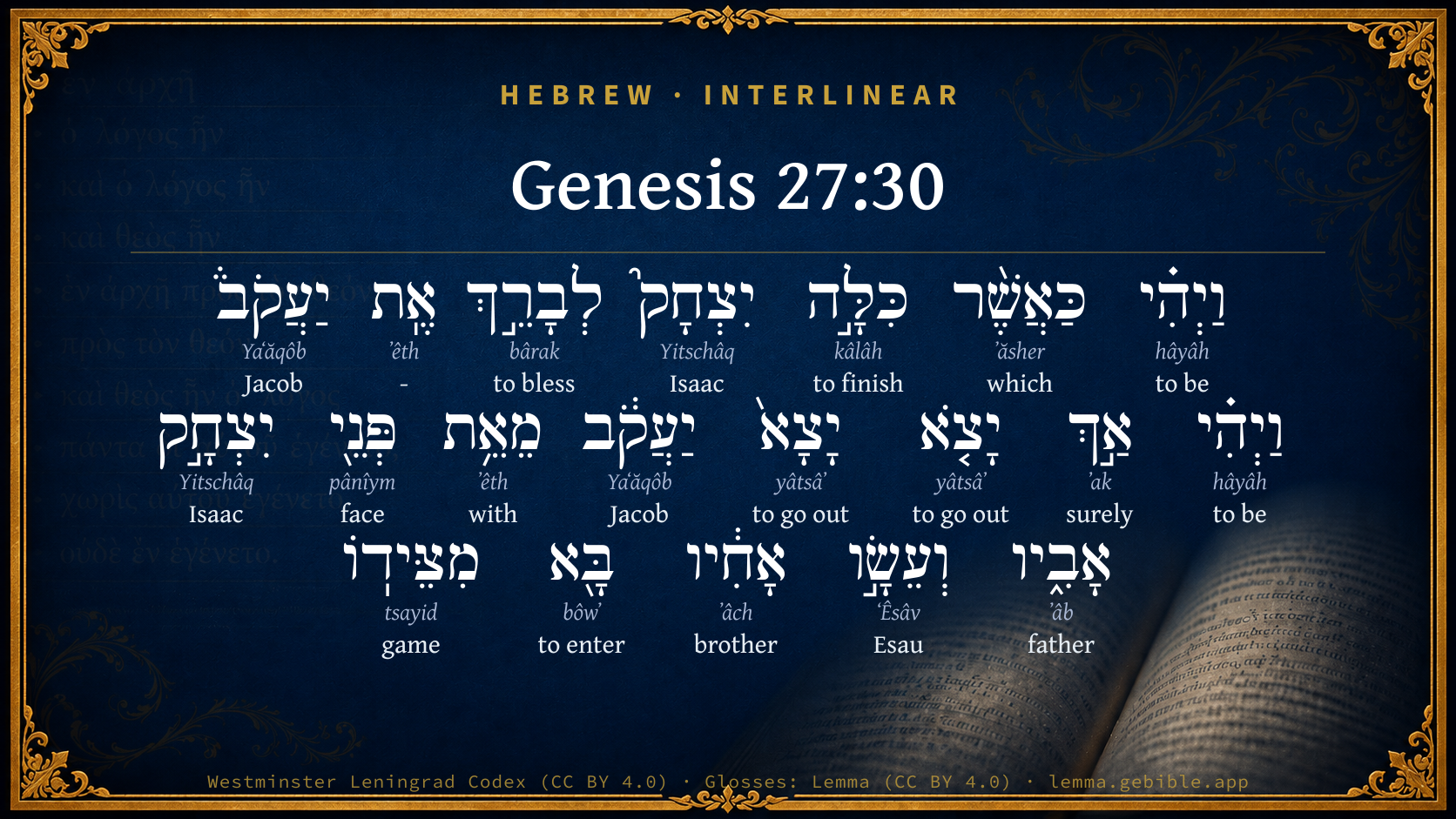
Hebrew (Westminster Leningrad Codex) Genesis 27:30 appears in the Hebrew Old Testament. The text above is from the Westminster Leningrad Codex. Each word links to its Strong’s number, a concise gloss, and parsing drawn from the Open Scriptures Hebrew Bible morphology. Click any word for its full Brown-Driver-Briggs (BDB) entry.
Download image
Cite this verse

Genesis 27:30 (World English Bible). Public Domain. Lemma interlinear Bible study tool, https://lemma.gebible.app/v/genesis/27/30.

Show BibTeX & RIS
BibTeX
RIS
English Translation
It happened, as soon as Isaac had made an end of blessing Jacob, and Jacob had just gone out from the presence of Isaac his father, that Esau his brother came in from his hunting.
World English Bible · Public Domain
Download a study sheet

One document with this verse’s original text, its word-by-word gloss line, the meaning frame, cross-references with their text, attributed commentary, and full source and license credits — printable, and it pastes into notes with its structure intact.

This verse Autodidact and up

Study sheet (.html) Plain text (.txt)

A passage Seminary Student

Up to 50 verses in one chapter. A passage sheet keeps up to 6 commentary sources and 12 cross-references per verse, in the order this page ranks them, and says so on the sheet whenever that leaves anything out. Ask for a single verse and you get the Autodidact verse sheet above.

Everything on this page stays free to read, with no account — the sheet is a download of what is already on screen, not access to it.

Want to remove ads? Support Godless Engineer
Compare translations 3

The same verse in 3 English versions, stacked beneath the original-language interlinear above. Click any original word for its lexicon entry.

Each is an independent rendering of the whole verse — the interlinear is not word-aligned to these translations.

Highlighted words mark where these versions differ — a whole-verse word diff, not a word-by-word alignment.

  • World English Bible Public Domain
    It happened, as soon as Isaac had made an end of blessing Jacob, and Jacob had just gone out from the presence of Isaac his father, that Esau his brother came in from his hunting.
  • King James Version Public Domain
    And it came to pass, as soon as Isaac had made an end of blessing Jacob, and Jacob was yet scarce gone out from the presence of Isaac his father, that Esau his brother came in from his hunting.
  • unfoldingWord Literal Text CC BY-SA 4.0
    Then it happened, just as Isaac finished blessing Jacob, and it happened, scarcely had Jacob just left from the presence of Isaac his father, then Esau his brother came in from his hunt.

unfoldingWord Literal Text — © unfoldingWord, licensed CC BY-SA 4.0. Word-aligned USFM3 via Door43 (git.door43.org/unfoldingWord/en_ult).

Versions to compare (up to 4)

3 of 4 selected

Show all 18 translations

Every available English version of this verse, each an independent rendering of the whole verse.

  • World English Bible Public Domain
    It happened, as soon as Isaac had made an end of blessing Jacob, and Jacob had just gone out from the presence of Isaac his father, that Esau his brother came in from his hunting.
  • Berean Standard Bible Public Domain
    As soon as Isaac had finished blessing him and Jacob had left his father’s presence, his brother Esau returned from the hunt.
  • Majority Standard Bible Public Domain
    As soon as Isaac had finished blessing him and Jacob had left his father’s presence, his brother Esau returned from the hunt.
  • King James Version Public Domain
    And it came to pass, as soon as Isaac had made an end of blessing Jacob, and Jacob was yet scarce gone out from the presence of Isaac his father, that Esau his brother came in from his hunting.
  • American Standard Version (1901) Public Domain
    And it came to pass, as soon as Isaac had made an end of blessing Jacob, and Jacob was yet scarce gone out from the presence of Isaac his father, that Esau his brother came in from his hunting.
  • Revised Version (1885) Public Domain
    And it came to pass, as soon as Isaac had made an end of blessing Jacob, and Jacob was yet scarce gone out from the presence of Isaac his father, that Esau his brother came in from his hunting.
  • Geneva Bible (1599) Public Domain
    And when Izhak had made an ende of blessing Iaakob, and Iaakob was scarce gone out from the presence of Izhak his father, then came Esau his brother from his hunting,
  • Douay-Rheims (1899) Public Domain
    Isaac had scarce ended his words, when Jacob being now gone out abroad, Esau came,
  • Young's Literal Translation Public Domain
    And it cometh to pass, as Isaac hath finished blessing Jacob, and Jacob is only just going out from the presence of Isaac his father, that Esau his brother hath come in from his hunting;
  • Literal Standard Version CC BY-SA 4.0
    And it comes to pass, as Isaac has finished blessing Jacob, and Jacob is only just going out from the presence of his father Isaac, that his brother Esau has come in from his hunting;
  • Unlocked Literal Bible CC BY-SA 4.0
    As soon as Isaac had finished blessing Jacob, and Jacob had scarcely gone out from the presence of Isaac his father, Esau his brother came in from his hunting.
  • unfoldingWord Literal Text CC BY-SA 4.0
    Then it happened, just as Isaac finished blessing Jacob, and it happened, scarcely had Jacob just left from the presence of Isaac his father, then Esau his brother came in from his hunt.
  • Darby Bible Public Domain
    And it came to pass when Isaac had ended blessing Jacob, and when Jacob was only just gone out from Isaac his father, that Esau his brother came from his hunting.
  • World Messianic Bible Public Domain
    As soon as Isaac had finished blessing Jacob, and Jacob had just gone out from the presence of Isaac his father, Esau his brother came in from his hunting.
  • Webster's Bible Public Domain
    And it came to pass, as soon as Isaac had made an end of blessing Jacob, and Jacob had yet scarcely gone out from the presence of Isaac his father, that Esau his brother came in from his hunting.
  • Free Bible Version CC BY-SA 4.0
    After Isaac finished blessing Jacob—in fact Jacob had just left his father—Esau returned from his hunting trip.
  • Bible in Basic English Public Domain
    And when Isaac had come to the end of blessing Jacob, and Jacob had not long gone away from Isaac his father, Esau came in from the field.
  • JPS Tanakh (1917) Public Domain
    And it came to pass, as soon as Isaac had made an end of blessing Jacob, and Jacob was yet scarce gone out from the presence of Isaac his father, that Esau his brother came in from his hunting.

Literal Standard Version (2020), Covenant Press — licensed CC BY-SA 4.0. Text via the HelloAO Bible API (eBible.org). Unlocked Literal Bible (unfoldingWord) — licensed CC BY-SA 4.0. Text via the HelloAO Bible API (eBible.org). unfoldingWord Literal Text — © unfoldingWord, licensed CC BY-SA 4.0. Word-aligned USFM3 via Door43 (git.door43.org/unfoldingWord/en_ult). Free Bible Version, Dr. Jonathan Gallagher — licensed CC BY-SA 4.0. Text via the HelloAO Bible API (eBible.org).

Word by word

More ways to search: Search by grammar → Find every occurrence → Compare this word →

Practice this passage: Drill this verse → Learn its vocabulary →

מִצֵּידֽוֹ
tsayid
H6718
“from · game · his”
Preposition + Noun, Common, Masculine, Singular, Construct + Suffix, Personal, 3rd Person, Masculine, Singular
Part of Speech
Preposition + Noun
Type
Common
Gender
Masculine
Number
Singular
State
Construct
Full BDB Definition

Origin: from a form of H6679 and meaning the same

TWOT: 1885a , 1886a

hunting, game - hunting - game hunted - provision, food - provision, food, food-supply
  1. וַיְהִ֗י hâyâh H1961 “and · to be” Conjunction + Verb, Qal, Sequential Imperfect, 3rd Person, Masculine, Singular
  2. כַּאֲשֶׁ֨ר ʼăsher H834 “like/as · which” Preposition + Particle, Relative
  3. כִּלָּ֣ה kâlâh H3615 “to finish” Verb, Piel, Perfect, 3rd Person, Masculine, Singular
  4. יִצְחָק֮ Yitschâq H3327 “Isaac” Noun, Proper
  5. לְבָרֵ֣ךְ bârak H1288 “to bless” Preposition + Verb, Piel, Infinitive Construct
  6. אֶֽת ʼêth H853 “-” Particle, Direct Object
  7. יַעֲקֹב֒ Yaʻăqôb H3290 “Jacob” Noun, Proper
  8. וַיְהִ֗י hâyâh H1961 “and · to be” Conjunction + Verb, Qal, Sequential Imperfect, 3rd Person, Masculine, Singular
  9. אַ֣ךְ ʼak H389 “surely” Particle, Accusative
  10. יָצֹ֤א yâtsâʼ H3318 “to go out” Verb, Qal, Infinitive Absolute
  11. יָצָא֙ yâtsâʼ H3318 “to go out” Verb, Qal, Perfect, 3rd Person, Masculine, Singular
  12. יַעֲקֹ֔ב Yaʻăqôb H3290 “Jacob” Noun, Proper
  13. מֵאֵ֥ת ʼêth H854 “from · with” Preposition + Preposition
  14. פְּנֵ֖י pânîym H6440 “face(s) of” Noun, Common, Both, Plural, Construct
  15. יִצְחָ֣ק Yitschâq H3327 “Isaac” Noun, Proper
  16. אָבִ֑יו ʼâb H1 “father · his” Noun, Common, Masculine, Singular, Construct + Suffix, Personal, 3rd Person, Masculine, Singular
  17. וְעֵשָׂ֣ו ʻÊsâv H6215 “and · Esau” Conjunction + Noun, Proper
  18. אָחִ֔יו ʼâch H251 “brother · his” Noun, Common, Masculine, Singular, Construct + Suffix, Personal, 3rd Person, Masculine, Singular
  19. בָּ֖א bôwʼ H935 “to enter” Verb, Qal, Perfect, 3rd Person, Masculine, Singular

About this verse

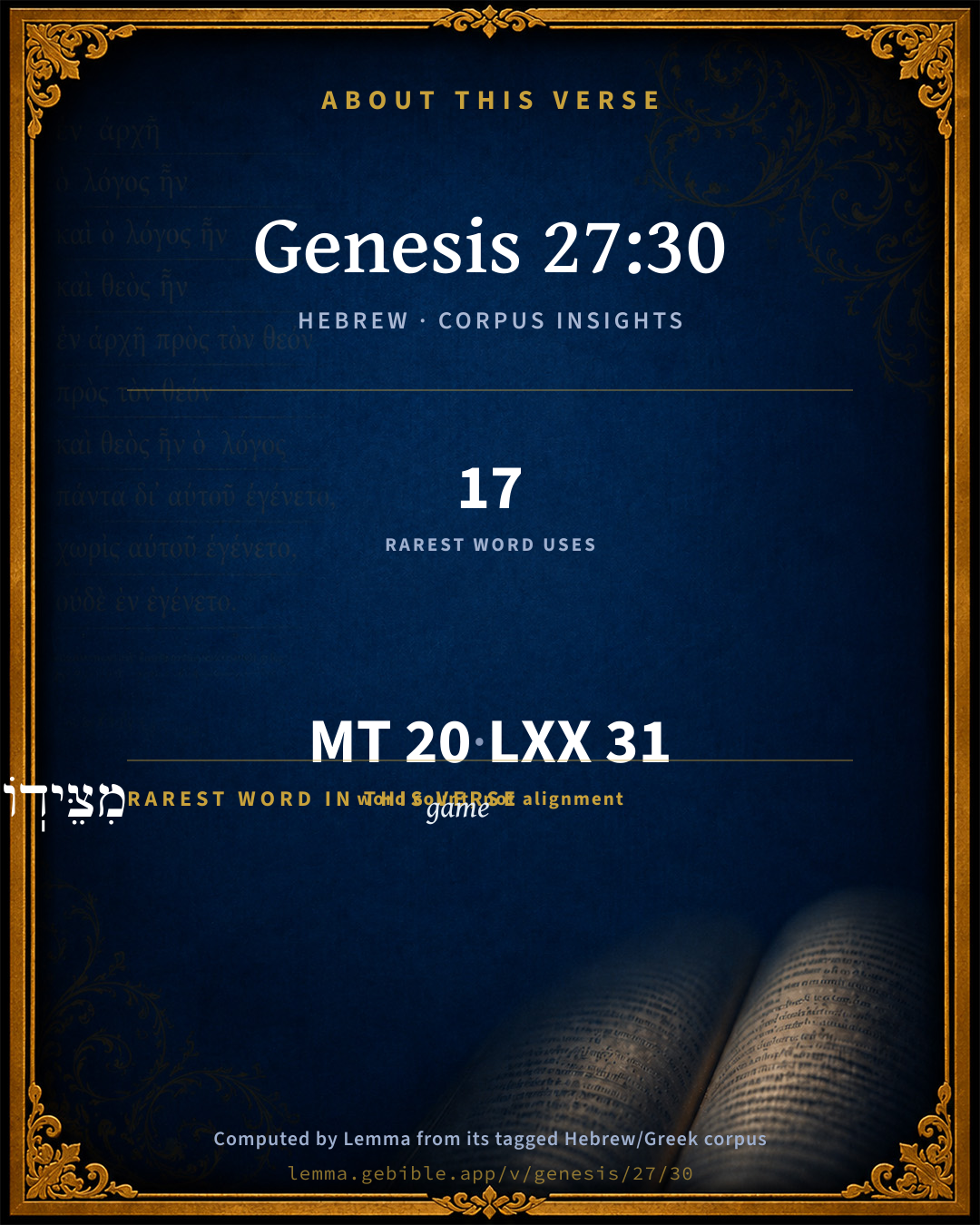
These counts appear in no published source. They are computed here, from the morphology-tagged text and Lemma’s own curated glosses. What Lemma adds →

20
words
16
distinct lemmas
Pentateuch
section

Notable vocabulary

The rarest word here is מִצֵּידֽוֹ game H6718 — appearing just 17 times in the whole Hebrew Bible.

Shared distinctive vocabulary

מִצֵּידֽוֹ game H6718 occurs in 16 verses of the Hebrew Bible. Also found in:

Grammatical profile

  • 7 verbs
  • 9 nouns
  • 1 preposition
  • 3 particles

Verb forms

  • וַיְהִ֗י Qal · Sequential Imperfect
  • כִּלָּ֣ה Piel · Perfect
  • לְבָרֵ֣ךְ Piel · Infinitive Construct
  • וַיְהִ֗י Qal · Sequential Imperfect
  • יָצֹ֤א Qal · Infinitive Absolute
  • יָצָא֙ Qal · Perfect
  • בָּ֖א Qal · Perfect

Repetition

Words recur within this verse — often emphatic in Hebrew:

  • וַיְהִ֗י to be H1961 ×2
  • יִצְחָק֮ Isaac H3327 ×2
  • יַעֲקֹב֒ Jacob H3290 ×2
  • יָצֹ֤א to go out H3318 ×2

Hebrew & Septuagint length

In English translation the verse runs 35 words from the Hebrew and 40 from the Septuagint (LXX English) — closely comparable.

A rough comparison of the two English renderings, which tokenize alike — not a word-level alignment.

Word counts can differ between the Hebrew and the Greek without any difference in meaning — e.g. the Hebrew direct-object marker אֵת has no separate Greek word, and Greek often adds the article ὁ.

In the original languages it is 20 Hebrew tokens and 31 Greek tokens — but the two are counted differently (Hebrew bundles its prefixes and suffixes into one token; the Greek is in lemma form), so that isn’t a like-for-like length.

Hebrew and Greek witnesses Masoretic Hebrew ↔ Greek Septuagint

The same verse in the two great witnesses to the Old Testament, shown verse-for-verse.

These are two independent witnesses, not word-aligned to each other, and the Septuagint is shown in lemma (dictionary) form.

Hebrew Genesis 27:30 Masoretic · Westminster Leningrad Codex

וַיְהִ֗י כַּאֲשֶׁ֨ר כִּלָּ֣ה יִצְחָק֮ לְבָרֵ֣ךְ אֶֽת יַעֲקֹב֒ וַיְהִ֗י אַ֣ךְ יָצֹ֤א יָצָא֙ יַעֲקֹ֔ב מֵאֵ֥ת פְּנֵ֖י יִצְחָ֣ק אָבִ֑יו וְעֵשָׂ֣ו אָחִ֔יו בָּ֖א מִצֵּידֽוֹ

It happened, as soon as Isaac had made an end of blessing Jacob, and Jacob had just gone out from the presence of Isaac his father, that Esau his brother came in from his hunting.

World English Bible · Public Domain

Greek LXX Genesis 27:30 Septuagint · lemma form

καί γίγνομαι μετά ὁ παύω ισαακ εὐλογέω ἰακώβ ὁ υἱός αὐτός καί γίγνομαι ὡς ἐκἔρχομαι ἰακώβ ἀπό πρόσωπον ισαακ ὁ πατήρ αὐτός καί ησαυ ὁ ἀδελφός αὐτός ἔρχομαι ἀπό ὁ θήρα

And it came to pass after Isaac had ceased blessing his son Jacob, it even came to pass, just when Jacob had gone out from the presence of Isaac his father, that Esau his brother came in from his hunting.

LXX2012 (modern English Septuagint) · Public Domain

Hebrew: Westminster Leningrad Codex (CC BY 4.0). Greek: Septuagint (public domain); English from LXX2012 (modern English Septuagint) (Public Domain). How the Septuagint differs from the Hebrew →

Targum (Aramaic paraphrase)

2

The Targum is the ancient Jewish Aramaic paraphrase of the Hebrew Scriptures — an interpretive translation, not the Hebrew text itself. Onkelos (literal) and Pseudo-Jonathan (expansive) render the Torah, and Jonathan the Prophets. Coverage is partial: where no permissively-licensed English translation exists for a verse, only the Aramaic is shown. This is verse-level text, not a word-by-word alignment to the Hebrew.

  1. Targum Onkelos Torah (Genesis–Deuteronomy)
    וַהֲוָה כַּד שֵׁיצֵי יִצְחָק לְבָרָכָא יָת יַעֲקֹב וַהֲוָה בְּרַם מִפַּק נְפַק יַעֲקֹב מִלְּוַת אַפֵּי יִצְחָק אֲבוּהִי וְעֵשָׂו אֲחוּהִי אָתָא (נ''י עַל) מִצֵידֵהּ

    (no public-domain English translation for this verse)

    Targum Onkelos — Aramaic: “Onkelos Genesis” (public domain); “Onkelos Exodus” (public domain); “Onkelos Leviticus” (public domain); “Onkelos Numbers” (public domain); “Onkelos Deuteronomy” (public domain). English: “Sefaria Community Translation” (CC0 1.0 (public-domain dedication)); “J.W. Etheridge. The Targums of Onkelos and Jonathan Ben Uzziel on the Pentateuch. London: Longmans, Green, 1862” (public domain). Text via Sefaria.

  2. Targum Pseudo-Jonathan Torah (Genesis–Deuteronomy)
    וַהֲוָה כַּד שֵׁיצֵי יִצְחָק לְבָרְכָא יַת יַעֲקב וַהֲוָה בְּרַם מֵיפַק נְפַק יַעֲקב כְּתַרְתֵּין טְפוּחִין מִלְוַת יִצְחָק אָבוֹי וְעֵשָו אָחוֹי עַל מִצֵידֵיהּ

    And it was when Izhak had finished blessing Jakob, and Jakob had only gone out about two handbreadths from Izhak his father, that Esau his brother came in from his hunting.

    Targum Pseudo-Jonathan — Aramaic: “Targum Jonathan on Genesis” (public domain); “Targum Jonathan on Exodus” (public domain); “Targum Jonathan on Leviticus” (public domain); “Targum Jonathan on Numbers” (public domain); “Targum Jonathan on Deuteronomy” (public domain). English: “The Targum of Jonathan ben Uzziel, trans. J. W. Etheridge, London, 1862” (public domain). Text via Sefaria.

Commentary

Notes on Genesis 27:30 from classic Christian and Jewish commentators (each source and its license shown beneath its notes). The classic Christian expositions comment on the surrounding passage and are grouped to its opening verse, so a note may address several verses; the Jewish commentaries on the Tanakh (Rashi and others) are per-verse, so they appear only where the commentator wrote on this verse.

Lemma curates 59 commentaries, every one of them public domain or Creative Commons licensed, each selected and text-cleaned for this edition rather than reprinted as found. About our sources →

Trapp's Complete Commentary

John Trapp

Gen 27:30 And it came to pass, as soon as Isaac had made an end of blessing Jacob, and Jacob was yet scarce gone out from the presence of Isaac his father, that Esau his brother came in from his hunting.

Ver. 30. Esau his brother came in.] All too late. Detained he was by the devil, say the Hebrews, who not seldom makes a fool of hunters, and leads them about. A sweet providence of God there was in it, certainly, that he should come in as soon as Isaac had done and Jacob was gone, and no sooner. Like as there was in that which Master Fox {a} reports of Luther, that on a time, as he was sitting in a certain place upon his stool, a great stone there was in the vault, over his head; which being stayed miraculously so long as he was sitting, as soon as he was up, immediately fell upon the place where he sat, able to have crushed him in pieces. A warrant once came down, under seal, for the execution of the Lady Elizabeth: Stephen Gardiner was the engineer, and thought he had been sure of his prey, but God pulled the morsel out of his mouth; for one Master Bridges, mistrusting false play, presently made haste to the queen, who renounced and reversed it. {b} Another time, while Sir Henry Benningfield, her keeper, was at court, one Basset, a gentleman and a great favourite of Stephen Gardiner’s, came, with twenty men well appointed, to Woodstock to have murdered her. But by God’s great providence, Sir Henry had left so strict a charge behind him, that no living soul might have access unto the princess, upon what occasion soever, till his return, that they could not be admitted, whereby their bloody enterprise was utterly disappointed. "The Lord knoweth how to deliver his". {2Pe 2:9} "He keepeth all their bones, not one of them is broken". {Psa 34:20}

{a} Act. and Mon., fol. 793.

{b} England’s Elizabeth, by Heywood.

John Trapp, A Commentary or Exposition upon All the Books of the Old and New Testament (1647–1656) — public domain. Text from a community e-Sword module.

The Pulpit Commentary

CHAPTER 27:30-40

And it came to pass (literally, and it was), as soon as Isaac had made an end of blessing Jacob, and Jacob was yet scarce gone out literally, and it was (sc. as soon as, or when) Jacob only going forth had gone; i.e. had just gone out (Ewald, Keil), rather than was in the act of coming out (Murphy), since the narrative implies that the brothers did not meet on this occasionfrom the presence of Isaac his father, that (literally, and) Esau his brother came in from his hunting.

Vers. 30-40.

The stolen blessing: a domestic drama. 3. Isaac and Esau, or the hunter"s lamentation.

I Isaac"s STARTLING DISCOVERY.

1. Unexpectedly made. The return of Esau from the hunting-field with a dish of venison was a sudden and most unpleasant revelation to the aged patriarch, showing that in some inexplicable manner he had been outmaneuvered, and, as it were, constrained against his will to bestow the blessing upon Jacob. So in common life it is not infrequently seen that the unexpected is that which happens, that wicked schemes prove abortive, that the deceiver is himself deceived engineer hoist on his own petard, and that men are often made the involuntary and unconscious instruments of furthering the will of Heaven.

2. Tremblingly received. Apprehending what had taken place, the blind old invalid feared a great fear exceedingly," saddened with an inward horror, not through disappointment at the failure of his scheme, or indignation at the wicked craft and heartless duplicity of Rebekah"s favorite, but alarm at his own sinful intention which God had thus manifestly seen and thwarted. It is well when the soul trembles at a discovery of its own wickedness. Gracious souls dread nothing "Thy more than standing on the verge of sin.

3. Pathetically acknowledged. Thy brother came with subtlety, and hath taken away thy blessing;" and, "I have blessed him: yea, and he shall be blessed." It becomes parents to commiserate their children"s misfortunes, and especially to sorrow if they miss the blessings of salvation. They who lack these, even when they do not wish to obtain them, are objects of profoundest pity.

4. Meekly acquiesced in. Recognizing the hand of God in the remarkable transaction in which he had been an actor, with true humility and faith the venerable patriarch bowed before the will of the Supreme. Neither Esau"s prayers and tears, nor his own paternal affections, could stimulate so much as a wish to undo what had been done. To a truly pious heart the will of God is final. "Thy will be done" is the language of faith.

II ESAU"S SINGULAR BEHAVIOUR.

1. His bitter lamentation for himself. Esau"s "great and exceeding bitter cry" was expressive not of heartfelt grief for his sinful levity in parting with the birthright, or guileful behavior in attempting to secure the blessing; but

(1) of deep mortification at being over-reached by his crafty brother;

(2) of remorseful chagrin at not recovering the blessing he had practically surrendered in the sale of the birthright;

(3) of earnest desire to induce Isaac to revoke the words he had spoken. The repentance which he sought carefully with tears (Heb_12:17) was not his own change of heart, but his father"s change of mind.

1. His wrathful indignation against his brother. "Is he not rightly named Jacob for he hath supplanted me these two times. A statement not quite accurate; but angry men are seldom remarkable for accuracy of statement; a statement also expressive of hatred against Jacob, and incensed brothers often call each other bad names. Good men should be angry and sin not. Indignation, even when righteous, should be restrained.

2. His tearful request to his father. "Bless me, me also, O my father!" Having lost the blessing of the covenant, he was still desirous of possessing some sort of blessing. Wicked men often covet the material advantages of religion who have no desire to share in its spiritual enrichments.

III ISAAC"S SOLEMN DECLARATION.

1. Of Esaus subjection to Jacob. "Behold, I have made him thy lord." A prediction of

(1) political subordination, afterwards fulfilled in the conquests of Israel; and

(2) of possible salvation to Esau and his descendants through believing recognition of the spiritual ascendancy of Jacob and his seed.

2. Of Esaus portion from God.

(1) A fat soil. God appoints to all men, individuals and nations, the bounds of their habitation. Inhabitants of fertile regions have a special call to thankfulness.

(2) A roving life. Though the warlike character of Esau"s descendants was of God s appointment and permission, it is no just inference that savage tribes are as useful as those of settled and improved habits, or that God does not desire the diffusion of civilization and the elevation of the race.

(3) Ultimate independence. Though some nations have been placed in subjection, it is God"s will that all should aspire to freedom. Revolt, rebellion, insurrection are sometimes a people"s highest duty. Lessons:

1. The blessing of the covenant is not of him that willeth or of him that runneth, but of God that showeth mercy.

2. Those who despise God"s salvation in youth cannot always obtain it in manhood or age.

3. Those who finally come short of eternal life will have no one to blame but themselves.

4. No one need sue in vain for Heaven"s favor, since the blessing is not now for one, but for all.

5. There is a difference between penitence and remorse.

6. Though no man can hope to change the mind of God, it is within the power of all men to desire and to effect a change upon their own hearts.

7. The prediction of a nation"s or a person"s future does not interfere with the free operation of the human will

The Pulpit Commentary (1880–1919), ed. H.D.M. Spence-Jones & Joseph S. Exell — public domain. Text from a community e-Sword module.

The Preacher's Complete Homiletical Commentary

Joseph S. Exell (gen. ed.)

CRITICAL NOTES.—

Gen_27:39. Thy dwelling shall be of the fatness of the earth, and of the dew of heaven from above.] The preposition is here used in a privative sense, apart from the fatness of the earth, etc. “The opening words most likely signify the very contrary of that by which the A. V. renders them. Esau was to dwell in the barren land of Idumea, far off from the fertility of his brother’s lot. Travellers say that Edom is probably the most desolate and barren upland in the world. No words could more accurately describe the habits of its inhabitants than those of living by their sword, existing as robbers and free-booters.” (Alford.)—

Gen_27:40. And it shall come to pass when thou shalt have the dominion, that thou shalt break his yoke from off thy neck.] “The Edomites were to be subjugated by Israel, but would in time assert their liberty and succeed in shaking off the yoke. This they did in the reign of Joram. (2Ki_8:20.) They were brought under again by Amaziah’s. (2Ki_14:7; 2Ch_25:11.) In the latter days of the kingdom of Judah the Edomites were a cause of annoyance. (2Ch_28:17.”) (Alford.)—

MAIN HOMILETICS OF THE PARAGRAPH.—Gen_27:30-40

ESAU DISAPPOINTED OF HIS BLESSING

I. He is overwhelmed by a heart-rending sorrow. He had procured the savoury meat, brought it to his father, and prepared himself to receive the coveted blessing. When he found that his brother had already secured that blessing by treachery, “he cried with a great and exceeding bitter cry, and said unto his father, Bless me, even me also, O my father.” His grief is so sudden and overwhelming that he cannot take in all the sad facts of his position. He vaguely hopes that there is some way of escape from the difficulty. Surely some blessing, at all risks, must be reserved for him!

II. He refers his wrongs to their true author. His brother Jacob, who had taken away his birthright, had now taken away his blessing. (Gen_27:36.) It is true that Esau had freely bartered his birthright for pottage, still the transaction was wrong, for Jacob took advantage of his brother’s necessity. Poor Esau felt that he was the victim of a well-known and practiced deceiver.

III. He pleads pathetically with his father. “And he said, Hast thou not reserved a blessing for me?” He felt that there must be some help for him—some depths of resource in his father’s heart which were still untried. This feeling is almost akin to that faith which is not daunted by impossibilities, and even hopes against hope.

IV. He is contented with an inferior blessing. The superior blessing had already been pronounced upon another, and was irrevocable. “Yea, and he shall be blessed,” said his father. Esau cannot now expect the highest blessing. He might have the crumbs from the table, but not the children’s bread. The blessing pronounced upon him by his father included many things good in themselves, but the highest and best things are absent. He was promised increase, prosperity, pre-eminence, and renown in war. But with this should be mingled the bitter portion of servitude to his brother. He would sometimes get the dominion and break the yoke from off his neck, but he would have only a brief victory, and must return again to subjection. (Gen_27:39-40.) At best, the portion of Esau can only be described as God’s blessings without God. Nothing of heaven enters into it.

SUGGESTIVE COMMENTS ON THE VERSES

Gen_27:30-32. Esau prepared the dish and brought it to his father, and claimed the blessing in very similar terms to those used by Jacob. Esau must have remembered how he had parted with his birthright to Jacob, and therefore in his conscience he could not be entirely unprepared for the discovery of his loss. Esau is too late. Isaac must have been smitten with a sense of his own sin in his carnal preference for Esau, contrary to all indications of the Divine pleasure. He felt, too, that this patriarchal blessing was as the Divine direction and not from any personal preference, and he found himself strangely controlled and overruled by the Divine hand.—(Jacobus.)

Gen_27:33. His emotions were absolutely overwhelming. On the one hand, he could not but feel a degree of just indignation in view of the imposition which had been practised upon him, especially when he remembered the precautions he had taken against being thus deceived; yet, on the other, a moment’s reflection would convince him that the transfer of the blessing must have been “of the Lord,” and, consequently, that he had been all along acting against His will in trying to have it otherwise. Two such considerations rushing on his mind at once, like two impetuous counter-currents coming together, sufficiently account for his feelings, especially when we add his consciousness of the irrevocable nature of the blessing, and the momentous consequences annexed to it. But while he resents the subtlety of Jacob, and the unkindness of Rebekah, he acknowledges and acquiesces in the will of God. The blessing which he had unwittingly pronounced, and which he knows to be irrevocable, he deliberately and solemnly confirms: “I have blessed him, yea, and he shall be blessed.” His feelings would, perhaps, not be inaptly expressed by the language of Balaam, “God is not a man that he should lie,” etc. (Num_33:19-20). Hence the Apostle tells us, that “Esau found no place for repentance, though he sought it carefully with tears”—that is, he found no place for repentance, or change of purpose, in his father, He could not prevail upon him to reverse the word that had proceeded from his lips.—(Bush.)

If anything can excuse a departure from a promise, Isaac might have been excused in this case; for in truth he did not promise to Jacob, though Jacob stood before him. He honestly thought that he was speaking to his first-born; and yet, perhaps partly taught to be punctiliously scrupulous by the rebuke he had received in early life from Abimilech, partly feeling that he had been but an instrument in God’s hands, he felt that a mysterious and irrevocable sacredness belonged to his word once passed; and said, “Yea, and he shall be blessed.” Jesuitism amongst us has begun to tamper with the sacredness of a promise. Men change their creed, and fancy themselves absolved from past promises; the member of the Church of Rome is no longer bound to do what the member of the Church of England stipulated. Just as well might the king refuse to perform the promises or pay the debts of the prince whom he once was. Therefore, let us ponder over such texts as these. Be careful and cautious of pledging yourself to anything; but the money you have once promised, the offer you have once made is irrevocable, it is no longer yours, it is passed from you as much as if it had been given.—(Robertson.)

Though the words and actions of the parties in this transaction were built upon a falsehood, yet a true blessing was obtained. Through all the evil purposes and schemes of men God works out his great designs.

He trembled from the vivid apprehension suddenly flashing across his mind of the Lord’s presence and the Lord’s power, and not from anger, or anxiety, or terror, or blank dismay; though such emotions might well agitate his bosom. He had a startling sense of the interposition of that God without whose warrant he had set himself to perform the solemn prophetic act that was to close his patriarchal ministry, and against whose open and revealed will he had been, so far as his own intention could go, actually performing it. His whole frame receives a shock. The scales fell from his eyes—the eyes of his soul that had been blinded even more than the dim eyes of his body. He awakens as out of a sleep, and feels that surely the Lord is here, though he knew it not.—(Candlish.)

Gen_27:34. When Esau sold his birthright he did not then know what he had lost, but now it is all brought home to him. Those who choose the present world for their portion and spurn the offer of eternal life do not know what they lose, but the time must come when they shall know to their sorrow.

Vengeance wakes up suddenly to startle men when the sin which brought it has been long forgotten.

Why did he not rather weep to his brother for the pottage than to Isaac for a blessing? If he had not then sold, he had not needed now to buy. It is just with God to deny us those favours which we were careless in keeping, and which we undervalued in enjoying. How happy a thing is it to know the seasons of grace, and not to neglect them! How desperate to have known and neglected them! These tears are both late and false.—(Bp. Hall.)

In the midst of all his regrets there was no real contrition, no godly sorrow at heart, but only disappointment and vexation at his loss. We find at the time no self-condemnation, no confession of his sin; but only a severe accusation of his brother, as if he only were to blame for what had happened. Neither does he give any evidence of having been a true penitent afterwards, for his heart was evidently full of rage and enmity towards his brother, under the influence of which he determines, on a fit opportunity, to put an end to his life. All this shows a state of mind at the widest possible remove from sincere repentance.—(Bush.)

He cried not for his sin in selling the birthright, but for his loss in missing the blessing; though having sold the birthright, he had no right to the blessing. This is the guise of the ungoldly. He cries, Perrii, not Peccavi. If he “howl” upon his bed (Hos_7:14), it is for corn and oil, as a dog tied up howls for his dinner. It never troubles him that a good God is offended, which to an honest heart is the prime cause of the greatest sorrow.—(Trapp.)

The sinner cut off from the privileges of the Church can yet claim God as his Father. Repentance and prayer, and a way of return are still left to him.

Gen_27:35-36. It cannot be denied that there was some ground for the reflections thus cast upon Jacob. He had, indeed, acted the part of a supplanter in a way altogether unjustifiable; still the statement was exaggerated. Esau was not warranted in saying, “He took away my birthright,” as though he robbed him of it, for the surrender was his own voluntary act. He parted with it because he practically depised it. But it is no unusual thing for men to act as if accusing others were the most effectual mode of justifying themselves.—(Bush.)

“Hast thou not reserved a blessing for me?” is a prayer which those who have despised their birthright, and justly forfeited it, may still address to the Infinite Father.

Gen_27:37. Isaac, in using this language is not to be considered as giving vent to a self-sufficient or self-complacent spirit, it is the ordinary prophetic style. Men speaking by inspiration are often said to do that which they merely announce shall be done.—(Bush.)

Gen_27:38. These words, taken by themselves, without reference to the character of him who spoke them, are neither good nor evil. Had Esau only meant this: God has many blessings, of various kinds; and looking round the circle of my resources I perceive a principle of compensation, so that what I lose in one department I gain in some other; I will be content to take a second blessing when I cannot have the first: Esau would have said nothing which was not praiseworthy and religious. He would only have expressed what the Syro-Phœnician woman did, who observed that though in this world some have the advantages of children, whereas others are as little favoured as dogs, yet that the dogs have the compensatory crumbs. Superior advantages do not carry salvation nor moral superiority with them, necessarily; nor do inferior ones carry reprobation. But it was not in this spirit at all that Esau spoke. His was the complaining spirit of the man who repines because others are more favoured than he, the spirit of the elder son in the parable, “thou never gavest me a kid.” This character transformed outward disadvantages into a real curse. For, again I say, disadvantages are in themselves only a means to more lustrous excellence. But if to inferior talents we add sloth, and to poverty envy and discontent, and to weakened health querulousness, then we have indeed ourselves converted non-election into reprobation; and we are doubly cursed, cursed by inward as well as outward inferiority—(Robertson.)

Gen_27:39-40. At length in reply to the weeping suppliant, he bestows upon him a characteristic blessing. The preposition is the same as in the blessing of Jacob. But there, after a verb of giving it had a partitive sense; here, after a noun of place, it denotes distance or separation (for example, Pro_20:3). The pastoral life has been distasteful to Esau, and so it shall be with his race. The land of Edom was accordingly a comparative wilderness (Mal_1:3).—(Murphy.)

In this double blessing, of course the destinies of Israel and Edom are prefigured rather than the personal history of Jacob and Esau. For the predicted liberty of Edom, the breaking the yoke off the neck, did not take place till the reign of Jehoram, long after Esau’s death (2Ki_8:22). So that when it is written, “Jacob have I loved, but Esau have I hated,” the selection of nations to outward privileges is meant, not the irrespective election of individuals to eternal life. In these blessings we have the principle of prophecy. We cannot suppose that the Jacob here spoken of as blessed was unmixedly good, nor the Esau unmixedly evil. Nor can we imagine that idolatrous Israel was that in which all the promises of God found their end, or that Edom was the nation on whom the curse of God fell unmixed with any blessing. Prophecy takes individuals and nations as representations for the time being of principles which they only partially represent. They are the basis or substratum of an idea. For instance, Jacob, or Israel, represents the principle of good, the Church of God, the triumphant and blessed principle. To that, the typical Israel, the promises are made; to the literal Jacob or Israel, only as the type of this and so far as the nation actually was what it stood for. Esau is the worldly man, representing for the time the world. To that the rejection belongs, to the literal Esau only so far as is he that. In prophecies therefore, such as these, we are dealing much more with the ideas of which such persons and nations are the type than with the persons or nations themselves.—(Robertson.)

The Preacher's Complete Homiletical Commentary (gen. ed. Joseph S. Exell; Funk & Wagnalls, c. 1892) — public domain (pre-1929). A full-Bible homiletical/sermon-outline anthology covering 65 of 66 books (2 John is absent from the source module). Text from a community e-Sword module.

Tyndale Open Study Notes

Tyndale Open Resources

27:30-40 In scene four, everything is discovered, and the family becomes even more divided.

Tyndale Open Study Notes — © Tyndale Open Resources, licensed CC BY-SA 4.0. Text via the HelloAO Bible API.

Matthew Henry's Commentary

Here is, I. The covenant-blessing denied to Esau. He that made so light of the birthright would now have inherited the blessing, but he was rejected, and found no place of repentance in his father, though he sought it carefully with tears, Heb 12:17. Observe, 1. How carefully he sought it. He prepared the savoury meat, as his father had directed him, and then begged the blessing which his father had encouraged him to expect, Gen 27:31. When he understood that Jacob had obtained it surreptitiously, he cried with a great and exceedingly bitter cry, Gen 27:34. No man could have laid the disappointment more to heart than he did; he made his father's tent to ring with his grief, and again (Gen 27:38) lifted up his voice and wept. Note, The day is coming when those that now make light of the blessings of the covenant, and sell their title to them for a thing of nought, will in vain be importunate for them. Those that will not so much as ask and seek now will knock shortly, and cry, Lord, Lord. Slighters of Christ will then be humble suitors to him. 2. How he was rejected. Isaac, when first made sensible of the imposition that had been practised on him, trembled exceedingly, Gen 27:33. Those that follow the choice of their own affections, rather than the dictates of the divine will, involve themselves in such perplexities as these. But he soon recovers himself, and ratifies the blessing he had given to Jacob: I have blessed him, and he shall be blessed; he might, upon very plausible grounds, have recalled it, but now, at last, he is sensible that he was in an error when he designed it for Esau. Either himself recollecting the divine oracle, or rather having found himself more than ordinarily filled with the Holy Ghost when he gave the blessing to Jacob, he perceived that God did, as it were, say Amen to it. Now, (1.) Jacob was hereby confirmed in his possession of the blessing, and abundantly satisfied of the validity of it, though he obtained it fraudulently; hence too he had reason to hope that God graciously overlooked and pardoned his misconduct. (2.) Isaac hereby acquiesced in the will of God, though it contradicted his own expectations and affection. He had a mind to give Esau the blessing, but, when he perceived the will of God was otherwise, he submitted; and this he did by faith (Heb 11:20), as Abraham before him, when he had solicited for Ishmael. May not God do what he will with his own? (3.) Esau hereby was cut off from the expectation of that special blessing which he thought to have preserved to himself when he sold his birthright. We, by this instance, are taught, [1.] That it is not of him that willeth, nor of him that runneth, but of God that showeth mercy, Rom 9:16. The apostle seems to allude to this story. Esau had a good will to the blessing, and ran for it; but God that showed mercy designed it for Jacob, that the purpose of God according to election might stand, Rom 9:11. The Jews, like Esau, hunted after the law of righteousness (Rom 9:31), yet missed of the blessing of righteousness, because they sought it by the works of the law (Rom 9:32); while the Gentiles, who, like Jacob, sought it by faith in the oracle of God, obtained it by force, with that violence which the kingdom of heaven suffers. See Mat 11:12. [2.] That those who undervalue their spiritual birthright, and can afford to sell it for a morsel of meat, forfeit spiritual blessings, and it is just with God to deny them those favours they were careless of. Those that will part with their wisdom and grace, with their faith and a good conscience, for the honours, wealth, or pleasures, of this world, however they may pretend a zeal for the blessing, have already judged themselves unworthy of it, and so shall their doom be. [3.] That those who lift up hands in wrath lift them up in vain. Esau, instead of repenting of his own folly, reproached his brother, unjustly charged him with taking away the birthright which he had fairly sold to him (Gen 27:36), and conceived malice against him for what he had now done, Gen 27:41. Those are not likely to speed in prayer who turn those resentments upon their brethren which they should turn upon themselves, and lay the blame of their miscarriages upon others, when they should take shame to themselves. [4.] That those who seek not till it is too late will be rejected. This was the ruin of Esau, he did not come in time. As there is an accepted time, a time when God will be found, so there is a time when he will not answer those that call upon him, because they neglected the appointed season. See Pro 1:28. The time of God's patience and our probation will not last always; the day of grace will come to an end, and the door will be shut. Then many that now despise the blessing will seek it carefully; for then they will know how to value it, and will see themselves undone, for ever undone, without it, but to no purpose, Luk 13:25-27. O that we would therefore, in this our day, know the things that belong to our peace!

II. Here is a common blessing bestowed upon Esau.

1. This he desired: Bless me also, Gen 27:34. Hast thou not reserved a blessing for me? Gen 27:36. Note, (1.) The worst of men know how to wish well to themselves; and even those who profanely sell their birthright seem piously to desire the blessing. Faint desires of happiness, without a right choice of the end and a right use of the means, deceive many into their own ruin. Multitudes go to hell with their mouths full of good wishes. The desire of the slothful and unbelieving kills them. Many will seek to enter in, as Esau, who shall not be able, because they do not strive, Luk 13:24. (2.) It is the folly of most men that they are willing to take up with any good (Psa 4:6), as Esau here, who desired but a second-rate blessing, a blessing separated from the birthright. Profane hearts think any blessing as good as that from God's oracle: Hast thou but one? As if he had said, "I will take up with any: though I have not the blessing of the church, yet let me have some blessing."

2. This he had; and let him make his best of it, Gen 27:39, Gen 27:40.

(1.) It was a good thing, and better than he deserved. It was promised him, [1.] That he should have a competent livelihood - the fatness of the earth, and the dew of heaven. Note, Those that come short of the blessings of the covenant may yet have a very good share of outward blessings. God gives good ground and good weather to many that reject his covenant, and have no part nor lot in it. [2.] That by degrees he should recover his liberty. If Jacob must rule (Gen 27:29), Esau must serve; but he has this to comfort him, he shall live by his sword. He shall serve, but he shall not starve; and, at length, after much skirmishing, he shall break the yoke of bondage, and wear marks of freedom. This was fulfilled (Kg2 8:20, Kg2 8:22) when the Edomites revolted.

(2.) Yet it was far short of Jacob's blessing. For him God had reserved some better thing. [1.] In Jacob's blessing the dew of heaven is put first, as that which he most valued, and desired, and depended upon; in Esau's the fatness of the earth is put first, for it was this that he had the first and principal regard to. [2.] Esau has these, but Jacob has them from God's hand: God give thee the dew of heaven, Gen 27:28. It was enough to Esau to have the possession; but Jacob desired it by promise, and to have it from covenant-love. [3.] Jacob shall have dominion over his brethren: hence the Israelites often ruled over the Edomites. Esau shall have dominion, that is, he shall gain some power and interest, but shall never have dominion over his brother: we never find that the Jews were sold into the hands of the Edomites, or that they oppressed them. But the great difference in that there is nothing in Esau's blessing that points at Christ, nothing that brings him or his into the church and covenant of God, without which the fatness of the earth, and the plunder of the field, will stand him in little stead. Thus Isaac by faith blessed them both according as their lot should be. Some observe that Jacob was blessed with a kiss (Gen 27:27), so was not Esau.

Matthew Henry's Commentary on the Whole Bible (1708–1710) — public domain (CC PDM 1.0). Text via the HelloAO Bible API.

Jamieson, Fausset & Brown

Robert Jamieson, A. R. Fausset & David Brown

Esau came in from his hunting--Scarcely had the former scene been concluded, when the fraud was discovered. The emotions of Isaac, as well as Esau, may easily be imagined--the astonishment, alarm, and sorrow of the one; the disappointment and indignation of the other. But a moment's reflection convinced the aged patriarch that the transfer of the blessing was "of the Lord," and now irrevocable. The importunities of Esau, however, overpowered him; and as the prophetic afflatus was upon the patriarch, he added what was probably as pleasing to a man of Esau's character as the other would have been.

Jamieson, Fausset & Brown — Commentary Critical and Explanatory on the Whole Bible (1871) — public domain (CC PDM 1.0). Text via the HelloAO Bible API.

John Calvin's Commentaries

30. Jacob was yet scarce gone out. Here is added the manner in which Esau was repulsed, which circumstance availed not a little to confirm the benediction to Jacob: for if Esau had not been rejected, it might seem that he was not deprived of that honor which nature had given him: but now Isaac declares, that what he had done, in virtue of his patriarchal office, could not but be ratified. Here, truly, it again appears, that the primogeniture which Jacob obtained, at the expense of his brother, was made his by a free gift; for if we compare the works of both together, Esau obeys his father, brings him the produce of his hunting, prepares for his father the food obtained by his own labor, and speaks nothing but the truth: in short, we find nothing in him which is not worthy of praise. Jacob never leaves his home, substitutes a kid for venison, insinuates himself by many lies, brings nothing which would properly commend him, but in many things deserves reprehension. Hence it must be acknowledged, that the cause of this event is not to be traced to works, but that it lies hid in the eternal counsel of God. Yet Esau is not unjustly reprobated, because they who are not governed by the Spirit of God can receive nothing with a right mind; only let it be firmly maintained, that since the condition of all is equal, if any one is preferred to another, it is not because of his own merit, but because the Lord has gratuitously elected him.

John Calvin's Commentaries (1540-1563) — public domain. Text from the Calvin Translation Society English edition (1840s-50s) via the Christian Classics Ethereal Library (ccel.org). Calvin's coverage is partial (roughly two-thirds of the Bible); uncommented books and verses are honest gaps, never fabricated. The 19th-century editor's footnotes and remarks are omitted so the notes are faithfully Calvin's own voice.

The Cambridge Bible for Schools and Colleges

gen. ed. J. J. S. Perowne

30. Jacob was yet … out] These words dramatically represent to us the rapid succession of the two scenes, and remind us that, had Esau arrived a few minutes earlier, the dénouement would have been entirely different. Rebekah’s trick has been wholly successful. Jacob has won the blessing of the firstborn; he has won it with scarcely a minute to spare. A moment earlier; and he would have been detected “flagrante delicto.” The detection was bound to be made. But the risk was run for the sake of the irreversible and sacred “blessing of primogeniture,” conferred by a dying father.

The Cambridge Bible for Schools and Colleges (gen. ed. J. J. S. Perowne; Cambridge University Press, 1878–1918) — public domain. Text from a community e-Sword module.

John Gill's Exposition

And it came to pass, as soon as Isaac had made an end of,

blessing Jacob,.... So that he had the whole entire blessing, and nothing wanting; and takes in blessings of all sorts, temporal, spiritual, and eternal, of which the land of Canaan, and the fruits of it, were typical:

and Jacob was yet scarce gone out from the presence of Isaac his father; which no doubt he made haste to do, as soon as he had got the blessing; partly to avoid his brother, whom he might expect to come in every moment, and partly to relate to his mother the success he had met with: or "scarce in going out was gone out" (z), was just gone out, and that was all; the Targum of Jonathan says, he was gone about two hands' breadths; that is, out of the door of his father's tent, which was a small space indeed. Jarchi interprets this doubling of the word, of the one going out and the other coming in at the same time; but Ainsworth more rightly observes, that it makes the matter the more remarkable, touching God's providence herein:

that Esau his brother came in from his hunting; and not only was come out of the field from hunting, but had been at home some time, and had dressed what he had caught in hunting, and was just coming in with it to his father, as appears from Gen 27:31.

(z) "tantum, vel vix exeundo exierat", Montanus, Piscator, Vatablus, Schmidt.

John Gill's Exposition of the Whole Bible (1746–1763) — public domain (CC PDM 1.0). Text via the HelloAO Bible API.

Keil & Delitzsch

C. F. Keil & F. Delitzsch

Jacob had hardly left his father, after receiving the blessing (יצא אך, was only gone out), when Esau returned and came to Isaac, with the game prepared, to receive the blessing. The shock was inconceivable which Isaac received, when he found that he had blessed another, and not Esau-that, in fact, he had blessed Jacob. At the same time he neither could nor would, either curse him on account of the deception which he had practised, or withdraw the blessing imparted. For he could not help confessing to himself that he had sinned and brought the deception upon himself by his carnal preference for Esau. Moreover, the blessing was not a matter of subjective human affection, but a right entrusted by the grace of God to paternal supremacy and authority, in the exercise of which the person blessing, being impelled and guided by a higher authority, imparted to the person to be blest spiritual possessions and powers, which the will of man could not capriciously withdraw. Regarding this as the meaning of the blessing, Isaac necessarily saw in what had taken place the will of God, which had directed to Jacob the blessing that he had intended for Esau. He therefore said, "I have blessed him; yea, he will be (remain) blessed" (cf. Heb 12:17). Even the great and bitter lamentation into which Esau broke out could not change his father's mind. To his entreaty in Gen 27:34, "Bless me, even me also, O my father!" he replied, "Thy brother came with subtilty, and hath taken away thy blessing." Esau answered, "Is it that (הכי) they have named him Jacob (overreacher), and he has overreached me twice?" i.e., has he received the name Jacob from the fact that he has twice outwitted me? הכי is used "when the cause is not rightly known" (cf. Gen 29:15). To his further entreaty, "Hast thou not reserved a blessing for me?" (אצל, lit., to lay aside), Isaac repeated the substance of the blessing given to Jacob, and added, "and to thee (לכה for לך as in Gen 3:9), now, what can I do, my son?" When Esau again repeated, with tears, the entreaty that Isaac would bless him also, the father gave him a blessing (Gen 27:39, Gen 27:40), but one which, when compared with the blessing of Jacob, was to be regarded rather as "a modified curse," and which is not even described as a blessing, but "introduced a disturbing element into Jacob's blessing, a retribution for the impure means by which he had obtained it." "Behold," it states, "from the fat fields of the earth will thy dwelling be, and from the dew of heaven from above." By a play upon the words Isaac uses the same expression as in Gen 27:28, "from the fat fields of the earth, and from the dew," but in the opposite sense, מן being partitive there, and privative here, "from = away from." The context requires that the words should be taken thus, and not in the sense of "thy dwelling shall partake of the fat of the earth and the dew of heaven" (Vulg., Luth., etc.).

(Note: I cannot discover, however, in Mal 1:3 an authentic proof of the privative meaning, as Kurtz and Delitzsch do, since the prophet's words, "I have hated Esau, and laid his mountains and his heritage waste," are not descriptive of the natural condition of Idumaea, but of the desolation to which the land was given up.)

Since Isaac said (Gen 27:37) he had given Jacob the blessing of the super-abundance of corn and wine, he could not possibly promise Esau also fat fields and the dew of heaven. Nor would this agree with the words which follows, "By thy sword wilt thou live." Moreover, the privative sense of מן is thoroughly poetical (cf. Sa2 1:22; Job 11:15, etc.). The idea expressed in the words, therefore, was that the dwelling-place of Esau would be the very opposite of the land of Canaan, viz., an unfruitful land. This is generally the condition of the mountainous country of Edom, which, although not without its fertile slopes and valleys, especially in the eastern portion (cf. Robinson, Pal. ii. p. 552), is thoroughly waste and barren in the western; so that Seetzen says it consists of "the most desolate and barren mountains probably in the world."

The mode of life and occupation of the inhabitants were adapted to the country. "By (lit., on) thy sword thou wilt live;" i.e., thy maintenance will depend on the sword (על as in Deu 8:3 cf. Isa 28:16), "live by war, rapine, and freebooting" (Knobel). "And thy brother thou wilt serve; yet it will come to pass, as (כּאשׁר, lit., in proportion as, cf. Num 27:14) thou shakest (tossest), thou wilt break his yoke from thy neck." רוּד, "to rove about" (Jer 2:31; Hos 12:1), Hiphil "to cause (the thoughts) to rove about" (Psa 55:3); but Hengstenberg's rendering is the best here, viz., "to shake, sc., the yoke." In the wild, sport-loving Esau there was aptly prefigured the character of his posterity. Josephus describes the Idumaean people as "a tumultuous and disorderly nation, always on the watch on every motion, delighting in mutations" (Whiston's tr.: de bell Judg 4; 1:1-21:25; 1). The mental eye of the patriarch discerned in the son his whole future family in its attitude to its brother-nation, and he promised Edom, not freedom from the dominion of Israel (for Esau was to serve his brother, as Jehovah had predicted before their birth), but only a repeated and not unsuccessful struggle for freedom. And so it was; the historical relation of Edom to Israel assumed the form of a constant reiteration of servitude, revolt, and reconquest. After a long period of independence at the first, the Edomites were defeated by Saul (Sa1 14:47) and subjugated by David (Sa2 8:14); and, in spite of an attempt at revolt under Solomon (Kg1 11:14.), they remained subject to the kingdom of Judah until the time of Joram, when they rebelled. They were subdued again by Amaziah (Kg2 14:7; Ch2 25:11.), and remained in subjection under Uzziah and Jotham (Kg2 14:22; Ch2 26:2). It was not till the reign of Ahaz that they shook the yoke of Judah entirely off (Kg2 16:6; Ch2 28:17), without Judah being ever able to reduce them again. At length, however, they were completely conquered by John Hyrcanus about b.c. 129, compelled to submit to circumcision, and incorporated in the Jewish state (Josephus, Ant. xiii. 9, 1, xv. 7, 9). At a still later period, through Antipater and Herod, they established an Idumaean dynasty over Judea, which lasted till the complete dissolution of the Jewish state.

Thus the words of Isaac to his two sons were fulfilled-words which are justly said to have been spoken "in faith concerning things to come" (Heb 11:20). For the blessing was a prophecy, and that not merely in the case of Esau, but in that of Jacob also; although Isaac was deceived with regard to the person of the latter. Jacob remained blessed, therefore, because, according to the predetermination of God, the elder was to serve the younger; but the deceit by which his mother prompted him to secure the blessing was never approved. On the contrary, the sin was followed by immediate punishment. Rebekah was obliged to send her pet son into a foreign land, away from his father's house, and in an utterly destitute condition. She did not see him for twenty years, even if she lived till his return, and possibly never saw again. Jacob had to atone for his sin against both brother and father by a long and painful exile, in the midst of privation, anxiety, fraud, and want. Isaac was punished for retaining his preference for Esau, in opposition to the revealed will of Jehovah, by the success of Jacob's stratagem; and Esau for his contempt of the birthright, by the loss of the blessing of the first-born. In this way a higher hand prevailed above the acts of sinful men, bringing the counsel and will of Jehovah to eventual triumph, in opposition to human thought and will.

Keil & Delitzsch — Biblical Commentary on the Old Testament (1861–1891) — public domain (CC PDM 1.0). Text via the HelloAO Bible API. (Old Testament only.)

Kretzmann's Popular Commentary

Paul E. Kretzmann

Esau Returns and Receives the Younger Son’s Blessing

v. 30. And it came to pass, as soon as Isaac had made an end of blessing Jacob, and Jacob was yet scarce gone out from the presence of Isaac, his father, that Esau, his brother, came in from his hunting. It was just as Isaac had finished his blessing upon Jacob and the latter had just barely stepped out of the room that Esau returned from the chase.

v. 31. And he also had made savory meat, and brought it unto his father, and said unto his father, Let my father arise, and eat of his son’s venison that thy soul may bless me. Esau, for once, was serious, and therefore lost no time in preparing the game which he had shot and taking it in to his father, with the humble request for the promised blessing.

v. 32. And Isaac, his father, said unto him, Who art thou? And he said, I am thy son, thy first-born, Esau.

v. 33. And Isaac trembled very exceedingly, and said, Who? Where is he that hath taken venison, and brought it me, and I have eaten of all before thou camest, and have blessed him? Yea, and he shall be blessed. Esau’s simple statement, so obviously the truth, caused the greatest agitation in Isaac’s manner; literally, he trembled a great trembling very exceedingly, and then broke out into various questions as to the identity of the person who had so cleverly obtained the chief blessing from him. But even before Isaac pronounces the name of Jacob, he must state that the blessing of the Lord will remain with him. It was not for him to withdraw the blessing which was in fact that of the Lord, and Isaac now realized that his fleshly preference for Esau could not be defended in the sight of God. No matter in what manner the blessing had been obtained, God had guided the affair so that Jacob now actually was the bearer of the patriarchal succession.

v. 34. And when Esau heard the words of his father, he cried with a great and exceeding bitter cry, and said unto his father, Bless me, even me also, O my father. He now realized, when it was too late, what he had lost, what he had formerly foolishly despised. His words seem to indicate that he thought the blessing could still be divided.

v. 35. And he said, Thy brother came with subtlety, and hath taken away thy blessing. That was the human side of the happening, the deception, the error and sin which had crept into the business.

v. 36. And he said, Is not he rightly named Jacob (heel-catcher, supplanter) ? For he hath supplanted me these two times; he took away my birthright; and, behold, now he hath taken away my blessing. Esau was now in a state of mind which prevented his proper repentance, for there was no excuse for his selling his birthright. And he said, Hast thou not reserved a blessing for me? Just as though Isaac was able to set aside such blessings at will.

v. 37. And Isaac answered and said unto Esau, Behold, I have made him thy lord, and all his brethren have I given to him for servants; and with corn and wine have I sustained him; and what shall I do now unto thee, my son? This was an attempt to explain the situation to Esau, to make it clear to him that there was only one patriarchal blessing, which included both the promise of the land of Canaan in its most fruitful form and the special lordship with its culmination in the person of the Messiah.

v. 38. And Esau said unto his father, Hast thou but one blessing, my father? Bless me, even me also, O my father. And Esau lifted up his voice and wept. It is to this scene that Heb 12:17 refers, for Esau could not persuade his father to reconsider his decision, although he made the effort with tears. His were in this case not tears of true repentance over his sin, but merely of bitterness over the result of his folly. This fact Isaac now understood.

v. 39. And Isaac, his father, answered and said unto him, Behold, thy dwelling shall be of the fatness of the earth and of the dew of heaven from above. of the fatness of the earth and of the dew of heaven would Esau’s dwelling place be, that is, away from the fruitful and fat fields of Canaan. There are some fertile valleys in the northeastern part of Idumea, where Esau and his descendants lived, but the greater part of Idumea is one of the dreariest and most sterile deserts in the world.

v. 40. And by thy sword shalt thou live, war, pillage, and robbery being almost necessary in the barren land which would be his habitation, and shalt serve thy brother; and it shall come to pass when thou shalt have the dominion, that thou shalt break his yoke from off thy neck. History shows that this prophecy was fulfilled. "Edom was at first strong and independent as compared to Israel, slower in its development (Num 20:14). Saul first fought against it victoriously (1Sa 14:47); David conquered it (2Sa 8:14). Then followed a conspiracy under Solomon (1Ki 11:14), whilst there was an actual defection under Joram. On the other hand, the Edomites were again subjected by Amaziah (2Ki 14:7; 2Ch 25:11) and remained dependent under Uzziah and Jotham (2Ki 14:22; 2Ch 26:2). But under Ahaz they liberated themselves entirely from Judah (2Ki 16:6; 2Ch 28:17). Finally, however, John Hyrcanus subdued them completely, and incorporated them into the Jewish state and people, whilst the Jews themselves, however, after Antipater, became subject to the dominion of an Idumean dynasty, until the downfall of their state. "

Paul E. Kretzmann, Popular Commentary of the Bible (1921–1924) — public domain. Text from a community e-Sword module.

unfoldingWord translationNotes

Door43 World Missions Community

had scarcely gone out from the presence of Isaac his father

"had just left the tent of Isaac his father"

delicious food

"tasty meat that I love." See how this was translated in Genesis 27:3.

some of your son's game

Here "your son's" was a polite way of Esau referring to his own food he prepared. (See: First, Second, or Third Person)

your son's game

The word "game" refers to wild animals that people hunt to eat. See how "game" was translated in Genesis 27:7.

bless me

This refers to the formal blessing a father pronounces on his children.

translationWords

Isaac

bless

Jacob

Esau

unfoldingWord translationNotes — © Distant Shores Media and the Door43 World Missions Community, licensed CC BY-SA 4.0. Source: git.door43.org/Door43/en_tn.

Rashi

Rabbi Shlomo Yitzchaki (Rashi)

יצא יצא [JACOB] WAS YET SCARCE GONE OUT — this means, as one went out the other came in (Midrash Tanchuma, Toldot 11).

Rashi on the Tanakh — English translations: “The Judaica Press complete Tanach with Rashi, translated by A. J. Rosenberg” (CC BY 4.0); “Pentateuch with Rashi's commentary by M. Rosenbaum and A.M. Silbermann, 1929-1934” (public domain); “The Metsudah Tanach series, Lakewood, N.J” (CC BY 4.0); and “The Book of Joshua, Metsudah Publications, 1997” (CC BY 4.0). Text via Sefaria.

Radak

Rabbi David Kimhi (Radak)

ויהי...מצידו, as if the Torah had written מצודו, “from his hunting expedition.” The Torah chose a noun instead of a verb in its infinitive form. We find a similar construction in Numbers 10,2 ולמסע את המחנות, which means the same as ולהסיע את המחנות, “and to set the camps (army groups) in motion.” We also find such a construction in Ezekiel 17,9 למשאות אותה משרשיה, “and to remove it from its roots.” A third example which comes to mind is Numbers 23,10 ומספר את רבע ישראל, “or number the animals born to the livestock of Israel?” The word מספר is used there as if the Torah (Bileam) had said לספר, “to count.” [I assume that when the Torah quotes a human being, such as here, G’d dictated Bileam’s words to Moses, seeing that neither Moses nor any other Jew had heard a single one of Bileam’s blessings. Ed.]

Radak on the Tanakh — English translations: “Sefaria Community Translation” (CC0 1.0 (public-domain dedication)); “Eliyahu Munk, HaChut Hameshulash” (CC BY 4.0); “Rabbi Mike Feuer, Jerusalem Anthology” (CC BY 4.0); and “R. David Kimhi on the first book of Psalms, Translated by R.G. Finch, London, 1919” (public domain). Text via Sefaria.

Lesson kit

Teaching starters — assembled from the data on this page, not authored interpretation. Every prompt links to the verse data it draws on. Edit before teaching.

Genesis, in the Pentateuch, opens this verse with 20 words (16 distinct Hebrew lemmas). Its most distinctive word is tsayid (“game”). A historical commentator’s framing appears above. Read the whole chapter for the surrounding context.

Discussion questions

  1. The word tsayid carries the sense “game.” How does it shape the verse?
  2. Genesis 10:9 shares the word «game» with this verse. How do the two illuminate each other?
  3. “to be” occurs 2× in this one verse. What is the effect of the repetition?
  4. These translations render this verse differently. What is at stake in choosing one wording over another?
  5. The verb «וַיְהִ֗י» is Qal Sequential Imperfect. How does its form color the action?
  6. Reading how Trapp's Complete Commentary and The Pulpit Commentary read this verse, where do the two commentators agree and where do they part?

Things to notice

Reading settings

Reading text

Shown beneath each verse's original-language words.

Old Testament
Old Testament edition

Read the OT as the Masoretic Hebrew (MT) or the Greek Septuagint (LXX).

English shown for the Greek Septuagint (in the Hebrew ↔ Greek comparison).

Comparing translations? Open the Compare panel on any verse page to stack up to four side by side.