
Genesis 37:2

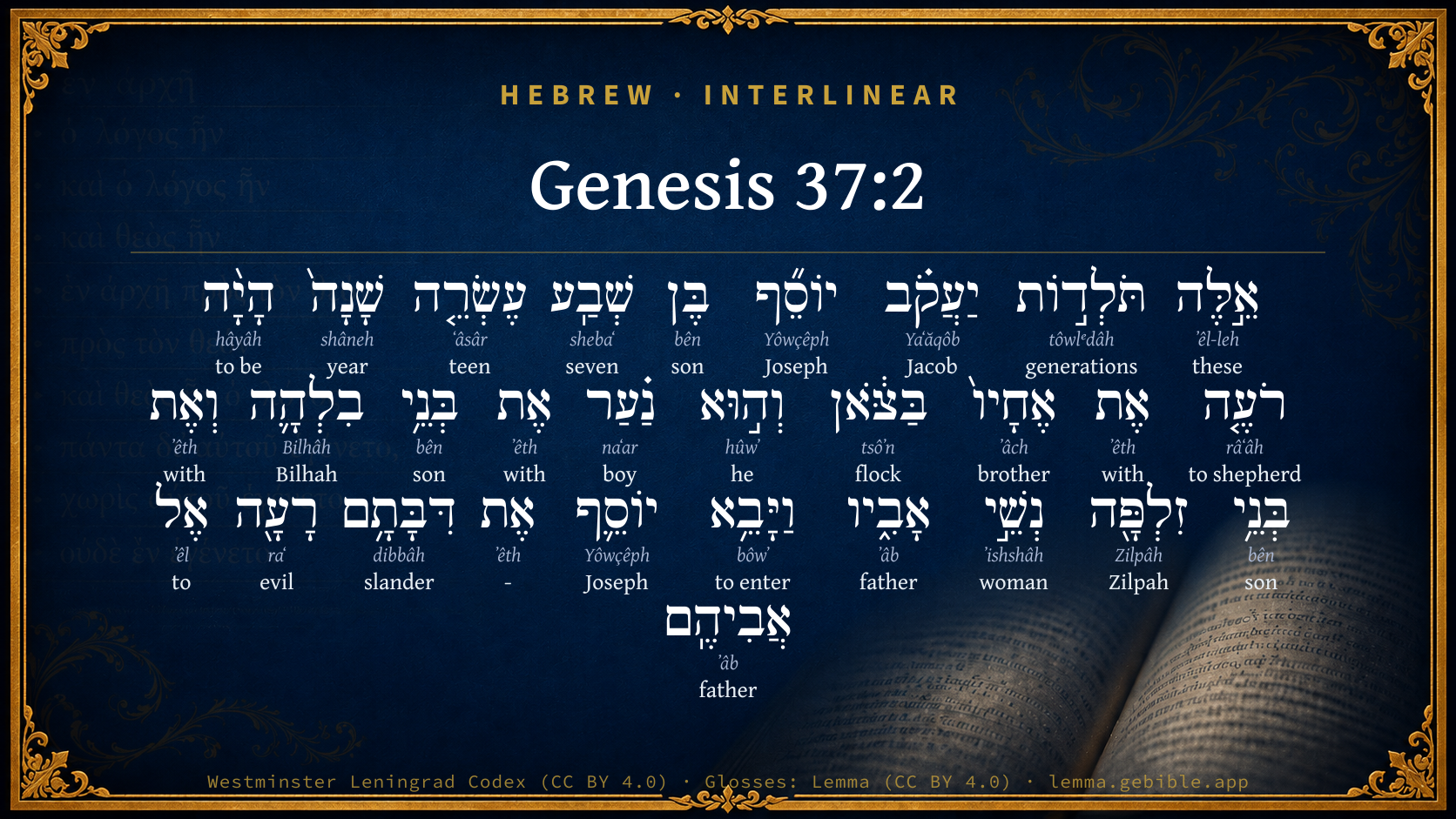
Hebrew (Westminster Leningrad Codex) Genesis 37:2 appears in the Hebrew Old Testament. The text above is from the Westminster Leningrad Codex. Each word links to its Strong’s number, a concise gloss, and parsing drawn from the Open Scriptures Hebrew Bible morphology. Click any word for its full Brown-Driver-Briggs (BDB) entry.
Download image
Cite this verse

Genesis 37:2 (World English Bible). Public Domain. Lemma interlinear Bible study tool, https://lemma.gebible.app/v/genesis/37/2.

Show BibTeX & RIS
BibTeX
RIS
English Translation
This is the history of the generations of Jacob. Joseph, being seventeen years old, was feeding the flock with his brothers. He was a boy with the sons of Bilhah and Zilpah, his father's wives. Joseph brought an evil report of them to their father.
World English Bible · Public Domain
Highlights
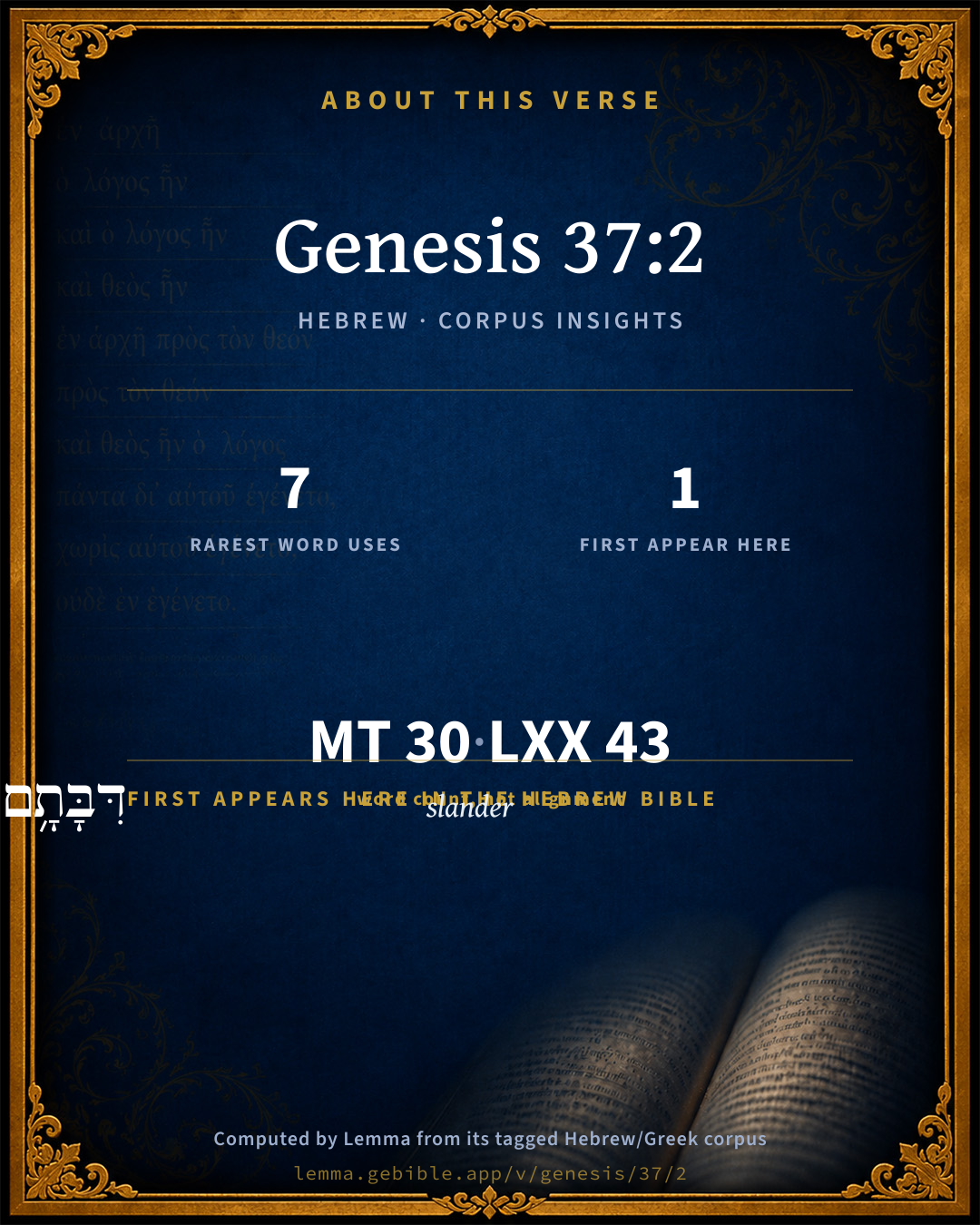
  • 1 first appearance in the Hebrew Bible
Full analysis ↓
Download a study sheet

One document with this verse’s original text, its word-by-word gloss line, the meaning frame, cross-references with their text, attributed commentary, and full source and license credits — printable, and it pastes into notes with its structure intact.

This verse Autodidact and up

Study sheet (.html) Plain text (.txt)

A passage Seminary Student

Up to 50 verses in one chapter. A passage sheet keeps up to 6 commentary sources and 12 cross-references per verse, in the order this page ranks them, and says so on the sheet whenever that leaves anything out. Ask for a single verse and you get the Autodidact verse sheet above.

Everything on this page stays free to read, with no account — the sheet is a download of what is already on screen, not access to it.

Want to remove ads? Support Godless Engineer
Compare translations 3

The same verse in 3 English versions, stacked beneath the original-language interlinear above. Click any original word for its lexicon entry.

Each is an independent rendering of the whole verse — the interlinear is not word-aligned to these translations.

Highlighted words mark where these versions differ — a whole-verse word diff, not a word-by-word alignment.

  • World English Bible Public Domain
    This is the history of the generations of Jacob. Joseph, being seventeen years old, was feeding the flock with his brothers. He was a boy with the sons of Bilhah and Zilpah, his father's wives. Joseph brought an evil report of them to their father.
  • King James Version Public Domain
    These are the generations of Jacob. Joseph, being seventeen years old, was feeding the flock with his brethren; and the lad was with the sons of Bilhah, and with the sons of Zilpah, his father's wives: and Joseph brought unto his father their evil report.
  • unfoldingWord Literal Text CC BY-SA 4.0
    These the generations of Jacob: Joseph, a son of seventeen years, was shepherding the flock with his brothers, and he a young man with the sons of Bilhah and the sons of Zilpah, his father’s wives, and Joseph brought a bad report about them to their father.

unfoldingWord Literal Text — © unfoldingWord, licensed CC BY-SA 4.0. Word-aligned USFM3 via Door43 (git.door43.org/unfoldingWord/en_ult).

Versions to compare (up to 4)

3 of 4 selected

Show all 18 translations

Every available English version of this verse, each an independent rendering of the whole verse.

  • World English Bible Public Domain
    This is the history of the generations of Jacob. Joseph, being seventeen years old, was feeding the flock with his brothers. He was a boy with the sons of Bilhah and Zilpah, his father's wives. Joseph brought an evil report of them to their father.
  • Berean Standard Bible Public Domain
    This is the account of Jacob. When Joseph was seventeen years old, he was tending the flock with his brothers, the sons of his father’s wives Bilhah and Zilpah, and he brought their father a bad report about them.
  • Majority Standard Bible Public Domain
    This is the account of Jacob. When Joseph was seventeen years old, he was tending the flock with his brothers, the sons of his father’s wives Bilhah and Zilpah, and he brought their father a bad report about them.
  • King James Version Public Domain
    These are the generations of Jacob. Joseph, being seventeen years old, was feeding the flock with his brethren; and the lad was with the sons of Bilhah, and with the sons of Zilpah, his father's wives: and Joseph brought unto his father their evil report.
  • American Standard Version (1901) Public Domain
    These are the generations of Jacob. Joseph, being seventeen years old, was feeding the flock with his brethren; and he was a lad with the sons of Bilhah, and with the sons of Zilpah, his father's wives: and Joseph brought the evil report of them unto their father.
  • Revised Version (1885) Public Domain
    These are the generations of Jacob. Joseph, being seventeen years old, was feeding the flock with his brethren; and he was a lad with the sons of Bilhah, and with the sons of Zilpah, his father’s wives: and Joseph brought the evil report of them unto their father.
  • Geneva Bible (1599) Public Domain
    These are the generations of Iaakob, when Ioseph was seuenteene yeere olde: he kept sheepe with his brethren, and the childe was with the sonnes of Bilhah, and with the sonnes of Zilpah, his fathers wiues. And Ioseph brought vnto their father their euill saying.
  • Douay-Rheims (1899) Public Domain
    And these are his generations: Joseph, when he was sixteen years old, was feeding the dock with his brethren, being but a boy: and he was with the sons of and of Zelpha his father's wives: and he accused his brethren to his father of a most wicked crime.
  • Young's Literal Translation Public Domain
    These `are' births of Jacob: Joseph, a son of seventeen years, hath been enjoying himself with his brethren among the flock, (and he `is' a youth,) with the sons of Bilhah, and with the sons of Zilpah, his father's wives, and Joseph bringeth in an account of their evil unto their father.
  • Literal Standard Version CC BY-SA 4.0
    These [are] the generations of Jacob: Joseph, a son of seventeen years, has been enjoying himself with his brothers among the flock (and he [is] a youth), with the sons of Bilhah, and with the sons of Zilpah, his father’s wives, and Joseph brings in an account of their evil to their father.
  • Unlocked Literal Bible CC BY-SA 4.0
    These were the events concerning Jacob. Joseph, who was a young man seventeen years old, was guarding the flock with his brothers. He was with the sons of Bilhah and with the sons of Zilpah, his father's wives. Joseph brought an unfavorable report about them to their father.
  • unfoldingWord Literal Text CC BY-SA 4.0
    These the generations of Jacob: Joseph, a son of seventeen years, was shepherding the flock with his brothers, and he a young man with the sons of Bilhah and the sons of Zilpah, his father’s wives, and Joseph brought a bad report about them to their father.
  • Darby Bible Public Domain
    These are the generations of Jacob. Joseph, being seventeen years old, fed the flock with his brethren; and he was doing service with the sons of Bilhah, and with the sons of Zilpah, his father's wives. And Joseph brought to his father an evil report of them.
  • World Messianic Bible Public Domain
    This is the history of the generations of Jacob. Joseph, being seventeen years old, was feeding the flock with his brothers. He was a boy with the sons of Bilhah and Zilpah, his father’s wives. Joseph brought an evil report of them to their father.
  • Webster's Bible Public Domain
    These are the generations of Jacob. Joseph being seventeen years old, was feeding the flock with his brethren, and the lad was with the sons of Bilhah, and with the sons of Zilpah, his father's wives: and Joseph brought to his father their evil report.
  • Free Bible Version CC BY-SA 4.0
    This is the story of Jacob and his family. Joseph was seventeen, and helped look after the flock with his brothers, the sons of Bilhah and Zilpah, his father's wives. Joseph told his father about some of the bad things his brothers were doing.
  • Bible in Basic English Public Domain
    These are the generations of Jacob: Joseph, a boy seventeen years old, was looking after the flock, together with his brothers, the sons of Bilhah and Zilpah, his father's wives; and Joseph gave their father a bad account of them.
  • JPS Tanakh (1917) Public Domain
    These are the generations of Jacob. Joseph, being seventeen years old, was feeding the flock with his brethren, being still a lad even with the sons of Bilhah, and with the sons of Zilpah, his father's wives; and Joseph brought evil report of them unto their father.

Literal Standard Version (2020), Covenant Press — licensed CC BY-SA 4.0. Text via the HelloAO Bible API (eBible.org). Unlocked Literal Bible (unfoldingWord) — licensed CC BY-SA 4.0. Text via the HelloAO Bible API (eBible.org). unfoldingWord Literal Text — © unfoldingWord, licensed CC BY-SA 4.0. Word-aligned USFM3 via Door43 (git.door43.org/unfoldingWord/en_ult). Free Bible Version, Dr. Jonathan Gallagher — licensed CC BY-SA 4.0. Text via the HelloAO Bible API (eBible.org).

Word by word

More ways to search: Search by grammar → Find every occurrence → Compare this word →

Practice this passage: Drill this verse → Learn its vocabulary →

זִלְפָּ֖ה
Zilpâh
H2153
“Zilpah”
Noun, Proper
Part of Speech
Noun
Type
Proper
Full BDB Definition

Origin: from an unused root apparently mean to trickle, as myrrh

TWOT: None

Zilpah = "a trickling" - the Syrian given by Laban to Leah as a handmaid, a concubine of Jacob, mother of Asher and Gad
  1. אֵ֣לֶּה ʼêl-leh H428 “these” Pronoun, Demonstrative, Common, Plural
  2. תֹּלְד֣וֹת tôwlᵉdâh H8435 “generations of” Noun, Common, Feminine, Plural, Construct
  3. יַעֲקֹ֗ב Yaʻăqôb H3290 “Jacob” Noun, Proper
  4. יוֹסֵ֞ף Yôwçêph H3130 “Joseph” Noun, Proper
  5. בֶּן bên H1121 “son of” Noun, Common, Masculine, Singular, Construct
  6. שְׁבַֽע shebaʻ H7651 “seven” Adjective, Cardinal number, Feminine, Singular, Absolute
  7. עֶשְׂרֵ֤ה ʻâsâr H6240 “teen” Adjective, Cardinal number, Feminine, Singular, Absolute
  8. שָׁנָה֙ shâneh H8141 “year” Noun, Common, Feminine, Singular, Absolute
  9. הָיָ֨ה hâyâh H1961 “to be” Verb, Qal, Perfect, 3rd Person, Masculine, Singular
  10. רֹעֶ֤ה râʻâh H7462 “shepherding” Verb, Qal, Participle Active, Masculine, Singular, Absolute
  11. אֶת ʼêth H854 “with” Preposition
  12. אֶחָיו֙ ʼâch H251 “brothers · his” Noun, Common, Masculine, Plural, Construct + Suffix, Personal, 3rd Person, Masculine, Singular
  13. בַּצֹּ֔אן tsôʼn H6629 “in/at the · flock” Preposition, Determined + Noun, Common, Both, Singular, Absolute
  14. וְה֣וּא hûwʼ H1931 “and · he” Conjunction + Pronoun, Personal, 3rd Person, Masculine, Singular
  15. נַ֗עַר naʻar H5288 “boy” Noun, Common, Masculine, Singular, Absolute
  16. אֶת ʼêth H854 “with” Preposition
  17. בְּנֵ֥י bên H1121 “sons of” Noun, Common, Masculine, Plural, Construct
  18. בִלְהָ֛ה Bilhâh H1090 “Bilhah” Noun, Proper
  19. וְאֶת ʼêth H854 “and · with” Conjunction + Preposition
  20. בְּנֵ֥י bên H1121 “sons of” Noun, Common, Masculine, Plural, Construct
  21. נְשֵׁ֣י ʼishshâh H802 “women of” Noun, Common, Feminine, Plural, Construct
  22. אָבִ֑יו ʼâb H1 “father · his” Noun, Common, Masculine, Singular, Construct + Suffix, Personal, 3rd Person, Masculine, Singular
  23. וַיָּבֵ֥א bôwʼ H935 “and · to enter” Conjunction + Verb, Hiphil, Sequential Imperfect, 3rd Person, Masculine, Singular
  24. יוֹסֵ֛ף Yôwçêph H3130 “Joseph” Noun, Proper
  25. אֶת ʼêth H853 “-” Particle, Direct Object
  26. דִּבָּתָ֥ם dibbâh H1681 “slander · their” Noun, Common, Feminine, Singular, Construct + Suffix, Personal, 3rd Person, Masculine, Plural
  27. רָעָ֖ה raʻ H7451 “evil” Adjective, Adjective, Feminine, Singular, Absolute
  28. אֶל ʼêl H413 “to” Preposition
  29. אֲבִיהֶֽם ʼâb H1 “father · their” Noun, Common, Masculine, Singular, Construct + Suffix, Personal, 3rd Person, Masculine, Plural

About this verse

These counts appear in no published source. They are computed here, from the morphology-tagged text and Lemma’s own curated glosses. What Lemma adds →

30
words
24
distinct lemmas
Pentateuch
section

Notable vocabulary

The rarest word here is זִלְפָּ֖ה Zilpah H2153 — appearing just 7 times in the whole Hebrew Bible.

First appearance in Scripture

This word makes its first canonical appearance in the Hebrew Bible here:

  • דִּבָּתָ֥ם slander H1681

Shared distinctive vocabulary

זִלְפָּ֖ה Zilpah H2153 occurs in 7 verses of the Hebrew Bible. Also found in:

Grammatical profile

  • 3 verbs
  • 17 nouns
  • 3 adjectives
  • 2 pronouns
  • 4 prepositions
  • 1 particle

Verb forms

  • הָיָ֨ה Qal · Perfect
  • רֹעֶ֤ה Qal · Participle Active
  • וַיָּבֵ֥א Hiphil · Sequential Imperfect

Repetition

Words recur within this verse — often emphatic in Hebrew:

  • בֶּן son H1121 ×3
  • יוֹסֵ֞ף Joseph H3130 ×2
  • אָבִ֑יו father H1 ×2
  • אֶת with H854 ×3

Hebrew & Septuagint length

In the original languages it is 30 Hebrew tokens and 43 Greek tokens — but the two are counted differently (Hebrew bundles its prefixes and suffixes into one token; the Greek is in lemma form), so that isn’t a like-for-like length.

Cross-references

13

Topical passages linked to Genesis 37:2 in the Treasury of Scripture Knowledge — connected by theme and wording, ordered by reader-vote popularity; previews shown in the World English Bible.

  • Genesis 35:25–26 The sons of Bilhah (Rachel's handmaid): Dan and Naphtali.
  • Genesis 35:22 It happened, while Israel lived in that land, that Reuben went and lay with Bilhah, his father's concubine, and Israel heard of it. Now the sons of Jacob were twelve.
  • 1 Samuel 2:22–24 Now Eli was very old; and he heard all that his sons did to all Israel, and how that they lay with the women who served at the door of the tent of meeting.
  • 1 Corinthians 11:18 For first of all, when you come together in the assembly, I hear that divisions exist among you, and I partly believe it.
  • Genesis 10:1 Now this is the history of the generations of the sons of Noah and of Shem, Ham, and Japheth. Sons were born to them after the flood.
  • Genesis 30:4 She gave him Bilhah her handmaid as wife, and Jacob went in to her.
  • Genesis 30:9 When Leah saw that she had finished bearing, she took Zilpah, her handmaid, and gave her to Jacob as a wife.
  • John 7:7 The world can't hate you, but it hates me, because I testify about it, that its works are evil.
  • 1 Corinthians 1:11 For it has been reported to me concerning you, my brothers, by those who are from Chloe's household, that there are contentions among you.
  • 1 Corinthians 5:1 It is actually reported that there is sexual immorality among you, and such sexual immorality as is not even named among the Gentiles, that one has his father's wife.
  • Genesis 2:4 This is the history of the generations of the heavens and of the earth when they were created, in the day that Yahweh God made earth and the heavens.
  • Genesis 5:1 This is the book of the generations of Adam. In the day that God created man, he made him in God's likeness.
  • Genesis 6:9 This is the history of the generations of Noah. Noah was a righteous man, blameless among the people of his time. Noah walked with God.

Cross-references courtesy of OpenBible.info (CC BY 4.0).

Hebrew and Greek witnesses Masoretic Hebrew ↔ Greek Septuagint

The same verse in the two great witnesses to the Old Testament, shown verse-for-verse.

These are two independent witnesses, not word-aligned to each other, and the Septuagint is shown in lemma (dictionary) form.

Hebrew Genesis 37:2 Masoretic · Westminster Leningrad Codex

אֵ֣לֶּה תֹּלְד֣וֹת יַעֲקֹ֗ב יוֹסֵ֞ף בֶּן שְׁבַֽע עֶשְׂרֵ֤ה שָׁנָה֙ הָיָ֨ה רֹעֶ֤ה אֶת אֶחָיו֙ בַּצֹּ֔אן וְה֣וּא נַ֗עַר אֶת בְּנֵ֥י בִלְהָ֛ה וְאֶת בְּנֵ֥י זִלְפָּ֖ה נְשֵׁ֣י אָבִ֑יו וַיָּבֵ֥א יוֹסֵ֛ף אֶת דִּבָּתָ֥ם רָעָ֖ה אֶל אֲבִיהֶֽם

This is the history of the generations of Jacob. Joseph, being seventeen years old, was feeding the flock with his brothers. He was a boy with the sons of Bilhah and Zilpah, his father's wives. Joseph brought an evil report of them to their father.

World English Bible · Public Domain

Greek LXX Genesis 37:2 Septuagint · lemma form

οὗτος δέ ὁ γένεσις ἰακώβ ιωσηφ δέκα ἑπτά ἔτος εἰμί ποιμαίνω μετά ὁ ἀδελφός αὐτός ὁ πρόβατον εἰμί νέος μετά ὁ υἱός βαλλα καί μετά ὁ υἱός ζελφα ὁ γυνή ὁ πατήρ αὐτός καταφέρω δέ ιωσηφ ψόγος πονηρός πρός ἰσραήλ ὁ πατήρ αὐτός

No English rendering of this Greek verse — the small residue in the structurally divergent books.

On this verse, Haydock's Catholic Bible Commentary discusses the Septuagint’s reading. Read the note in Commentary ↓

Hebrew: Westminster Leningrad Codex (CC BY 4.0). Greek: Septuagint (public domain); English from a public-domain English Septuagint. How the Septuagint differs from the Hebrew →

Targum (Aramaic paraphrase)

2

The Targum is the ancient Jewish Aramaic paraphrase of the Hebrew Scriptures — an interpretive translation, not the Hebrew text itself. Onkelos (literal) and Pseudo-Jonathan (expansive) render the Torah, and Jonathan the Prophets. Coverage is partial: where no permissively-licensed English translation exists for a verse, only the Aramaic is shown. This is verse-level text, not a word-by-word alignment to the Hebrew.

  1. Targum Onkelos Torah (Genesis–Deuteronomy)
    אִלֵּין תּוּלְדַת יַעֲקֹב יוֹסֵף בַּר שְׁבַע עַסְרֵי שְׁנִין (כַּד) הֲוָה רָעֵי עִם אֲחוֹהִי בַּעֲנָא וְהוּא מְרַבֵּי עִם בְנֵי בִלְהָה וְעִם בְּנֵי זִלְפָּה נְשֵׁי אֲבוּהִי וְאַיְתִי יוֹסֵף יָת דִּבְּהוֹן בִּישָׁא לְוַת אֲבוּהוֹן

    (no public-domain English translation for this verse)

    Targum Onkelos — Aramaic: “Onkelos Genesis” (public domain); “Onkelos Exodus” (public domain); “Onkelos Leviticus” (public domain); “Onkelos Numbers” (public domain); “Onkelos Deuteronomy” (public domain). English: “Sefaria Community Translation” (CC0 1.0 (public-domain dedication)); “J.W. Etheridge. The Targums of Onkelos and Jonathan Ben Uzziel on the Pentateuch. London: Longmans, Green, 1862” (public domain). Text via Sefaria.

  2. Targum Pseudo-Jonathan Torah (Genesis–Deuteronomy)
    אִלֵין זַרְעֲיַת יַעֲקב יוֹסֵף בַּר שַׁבְסְרִי שְׁנִין הֲוָה בְּמִיפְקֵיהּ מִן בֵּית מֶדְרָשָׁא וְהוּא טְלֵה מִתְרַבֵּי עִם בְּנֵי בִּלְהָה וְעִם בְּנֵי זִלְפָּה נְשַׁיָא דְאָבוֹי וְאַיְיתֵי יוֹסֵף יַת טִיבֵיהוֹן בִּישׁ דְחָמְנוּן דְאָכְלִין בִּשְרָא דְתָּלִישׁ מִן חֵיוָא חַיָיא יַת אוּדְנַיָיא וְיַת דִנְבַּיָיא וְאָתָא וְתַנִי לְוַת אֲבוּהוֹן

    These are the generations of Jakob. Joseph was a son of seventeen years. He had come forth from the school, and was a youth brought up with the sons of Bilhah and the sons of Zilpha his fathers wives. And Joseph brought their evil report; for he had seen them eat the flesh that had been torn by wild beasts, the ears and the tails; and he came and told it to his father.

    Targum Pseudo-Jonathan — Aramaic: “Targum Jonathan on Genesis” (public domain); “Targum Jonathan on Exodus” (public domain); “Targum Jonathan on Leviticus” (public domain); “Targum Jonathan on Numbers” (public domain); “Targum Jonathan on Deuteronomy” (public domain). English: “The Targum of Jonathan ben Uzziel, trans. J. W. Etheridge, London, 1862” (public domain). Text via Sefaria.

Commentary

Notes on Genesis 37:2 from classic Christian and Jewish commentators (each source and its license shown beneath its notes). The classic Christian expositions comment on the surrounding passage and are grouped to its opening verse, so a note may address several verses; the Jewish commentaries on the Tanakh (Rashi and others) are per-verse, so they appear only where the commentator wrote on this verse.

Lemma curates 59 commentaries, every one of them public domain or Creative Commons licensed, each selected and text-cleaned for this edition rather than reprinted as found. About our sources →

Trapp's Complete Commentary

John Trapp

Gen 37:2 These [are] the generations of Jacob. Joseph, [being] seventeen years old, was feeding the flock with his brethren; and the lad [was] with the sons of Bilhah, and with the sons of Zilpah, his father’s wives: and Joseph brought unto his father their evil report.

Ver. 2. These are the generations.] That is, Events, begotten of time, after he came to live with his father Isaac, who also wept for Joseph, {Gen 37:35} as Junius.

With the sons of Bilhah, &c.] It is thought that these sons of the handmaids, for the baseness of their birth, were more modest than the rest; and that Joseph therefore, out of his humility, sorted himself with them. Probable it is, they were more unruly than the rest, and ill conditioned, - as such are, commonly, - whereof Joseph made complaint, and was therefore hated. Veritas odium parit. Truth is a good mistress; but he that follows her too close at heels, may hap to have his teeth struck out. An expectas ut Quintillanus ametur? said he. Those that are wakened out of sleep are usually unquiet, ready to brawl with their best friends. So here.

John Trapp, A Commentary or Exposition upon All the Books of the Old and New Testament (1647–1656) — public domain. Text from a community e-Sword module.

Joseph Benson's Commentary

Gen 37:2. These are the generations of Jacob — The events or occurrences which happened to Jacob in his family and issue; as the word is used, chap. Gen 6:9, and Num 3:1. The genealogy of Esau, which was brought in by way of parenthesis, being finished, Moses returns to the family of Jacob, and proceeds in his narration of their concerns. And it is not a barren genealogy like that of Esau, but a memorable, useful history. Joseph brought to his father their evil report — Jacob’s sons did that when they were from under his eye, which they durst not have done if they had been at home with him; but Joseph gave his father an account of their ill carriage, that he might reprove and restrain them.

Joseph Benson's Commentary on the Old and New Testaments (1811–1818) — public domain. Text from a community e-Sword module.

F. W. Grant's Numerical Bible

Section 1. (Gen 37:2-36).

God’s counsel and man’s rebellion.

The first section shows us God’s counsel as to Joseph and man’s rebellion against it. The first view we have of Joseph is, at seventeen years, feeding the flock along with his brethren. The typical ruler for God is ever the shepherd. But He is with the children of the bondmaid, -a significant expression of Israel’s condition, perhaps politically as well as spiritually, when our Lord came in the flesh. Separated too, Joseph is from them morally far, as with the Lord, the ground of the after-separation upon their side, not on his. "Me the world hateth, because I testify of it that its deeds are evil."

He is hated too as the special object of his father’s love, of which the embroidered coat is the expression. It is not precisely "of many colors," nor a seamless robe of one piece such as characteristically the Lord wore. It is a "tunic of pieces," implying variety, and I think would refer to the manifold powers which showed themselves in the Lord in those mighty works which He spoke of as "from the Father" (Joh 10:32; Joh 14:11), and for which His brethren after the flesh pursued Him with hatred.

The dreams come as a third incitement to hatred, -in which God makes known the future supremacy of the beloved of the father. This is easily read. Together, these three signs give us the Holy One, object of the Father’s love, hated for His holiness, hated for His glorious works, hated for the announcement of His coming glory.

Being, then, such as He is, His love-mission to His brethren, as sent of the Father, puts Him into their hands. He goes out of the "vale of Hebron" ("company"), the place of participation with the Father, to find them, not in Shechem ("shoulder"), in subjection to God, taking His yoke; but in Dothan, which some (rightly, I think,) take as meaning "laws;" not in the sense, however, of "precepts" -moral, spiritual guidance, such as the divine law (the thorah) was, -but of imperial "decrees." To Israel after the flesh, away from God and from the true spirit of obedience, such had the divine word become.

At Dothan, then, Joseph’s brethren are found, and at once they counsel to slay him. In fact, they cast him into a pit, but it holds no water -"It is not lawful for us," the Jews said to Pilate, "to put any man to death;" and out of this they draw him, to sell him to the Ishmaelites. So by Israel was the Lord transferred to the Gentiles.

How striking is that touch in this terrible picture, "And they sat down" -with Joseph in their pit -"to eat bread"! How much more terrible the case of the Pharisee-persecutors, who "would not go into the judgment-hall, lest they should be defiled, but that they might eat the passover"! History does indeed repeat itself, because each generation is but the repetition of the one before it: as Ahab, Israel’s worst king, was but after all, what his name signifies, his "father’s brother."

Thus Joseph is "separated from his brethren." In the individual application, though the details are less plain, the general thought is easy. "Elect of God, holy and beloved," in the world through which we pass, all is hostile to the development of that which is of God. He that separateth himself from evil maketh himself a prey;" and separation from evil is a fundamental principle of the divine nature. Hence, persecution for righteousness should be accepted as the necessary result for the people of God in a world such as the present.

But for those true Josephs in whom is developed the soldier-"virtue," which with inflexibility of purpose presses on through whatever difficulties in the path of faith, separation will be found (not invited) from those who are not the world, but, though chosen out of it, still practicing conformity to its ways. Nay, one’s brethren are, alas! often in this case more hostile than the very world, just because their consciences are more awake to a testimony which condemns themselves. Thus, within the circle of professed Christian fellowship, the Josephs have still to be disciples of the cross. Their path is not merely individual, as the path of true faith must always be, but solitary also, save only for the God with whom they walk, and indeed because they have chosen to walk with Him. Yet it is thus a path of deepest blessing.

F. W. Grant, The Numerical Bible (4th ed., 1903) — public domain. Text from a community e-Sword module.

Tyndale Open Study Notes

Tyndale Open Resources

37:2–50:26 The story of Joseph and his brothers comprises a separate unit in Genesis, distinct in tone and emphasis from the preceding material. It traces one continuous series of episodes with Joseph at their center. • Cycles of repeated motifs structure the entire Joseph account. The themes are closely related to those found in wisdom books such as Proverbs, Ecclesiastes, and Daniel. Wisdom literature assures the faithful that God brings good out of evil and joy out of pain—if not in this life, then certainly in the life to come. Though the wicked may prosper for a time, the righteous should hold fast to their integrity because a higher, more enduring principle of life is realized through obedience to God. Everyone who aspires to leadership in God’s plan should observe how wisdom led to Joseph’s success. Christ Jesus embodied the life of wisdom portrayed here as no one else could, for he is the wisdom of God. • Judah is also an important character in the story. He began as irresponsible and mean-spirited as his brothers; but he truly repented, put his life on the line to ransom a child for his father, and received a very important inheritance.

37:2 The account of Jacob and his family tells of Joseph and his brothers. Jacob is still prominent, but the focus is on Joseph, who is introduced as an obedient seventeen-year-old son. • Joseph reported . . . the bad things his brothers were doing: Bringing a bad report has never been popular, but it was the right thing to do and shows that Joseph was faithful from the beginning. As the story progresses, we see more of his brothers’ wickedness displayed until, like Cain, they tried to eliminate the brother who pleased God.

Tyndale Open Study Notes — © Tyndale Open Resources, licensed CC BY-SA 4.0. Text via the HelloAO Bible API.

Geneva Bible (1599)

Geneva Bible translators

That is, the story of such things as came to him and his family, as Gen. 5:1.

He complained of the evil words and injuries which they spake and did against him.

Or, slander.

Geneva Bible (1599) marginal notes — public domain. Text via Bolls.life.

Jamieson, Fausset & Brown

Robert Jamieson, A. R. Fausset & David Brown

generations--leading occurrences, in the domestic history of Jacob, as shown in the narrative about to be commenced.

Joseph . . . was feeding the flock--literally, "Joseph being seventeen years old was a shepherd over the flock"--he a lad, with the sons of Bilhah and Zilpah. Oversight or superintendence is evidently implied. This post of chief shepherd in the party might be assigned him either from his being the son of a principal wife or from his own superior qualities of character; and if invested with this office, he acted not as a gossiping telltale, but as a "faithful steward" in reporting the scandalous conduct of his brethren.

Jamieson, Fausset & Brown — Commentary Critical and Explanatory on the Whole Bible (1871) — public domain (CC PDM 1.0). Text via the HelloAO Bible API.

Adam Clarke's Commentary

Verse 2. These are the generations] תלדות toledoth, the history of the lives and actions of Jacob and his sons; for in this general sense the original must be taken, as in the whole of the ensuing history there is no particular account of any genealogical succession. Yet the words may be understood as referring to the tables or genealogical lists in the preceding chapter; and if so, the original must be understood in its common acceptation.

The lad was with the sons of Bilhah] It is supposed that our word lad comes from the Hebrew ילד yeled, a child, a son; and that lass is a contraction of ladess, the female of lad, a girl, a young woman. Some have supposed that King James desired the translators to insert this word; but this must be a mistake, as the word occurs in this place in Edmund Becke's Bible, printed in 1549; and still earlier in that of Coverdale, printed in 1535.

Brought unto his father their evil report] Conjecture has been busily employed to find out what this evil report might be; but it is needless to inquire what it was, as on this head the sacred text is perfectly silent. All the use we can make of this information is, that it was one cause of increasing his brothers' hatred to him, which was first excited by his father's partiality, and secondly by his own dreams.

Adam Clarke's Commentary on the Bible (1810–1826) — public domain. Text from a community e-Sword/MySword module.

John Calvin's Commentaries

2. These are the generations of Jacob. By the word תולדות toledoth we are not so much to understand a genealogy, as a record of events, which appears more clearly from the context. For Moses having thus commenced, does not enumerate sons and grandsons, but explains the cause of the envy of Joseph’s brethren, who formed a wicked conspiracy against him, and sold him as a slave: as if he had said “Having briefly summed up the genealogy of Esau, I now revert to the series of my history, as to what happened to the family of Jacob.” Moreover, Moses being about to speak of the abominable wickedness of Jacob’s sons, begins with the statement, that Joseph was dear beyond the rest to his father, because he had begotten him in his old age: and as a token of tender love, had clothed him with a coat woven of many colors. But it was not surprising that the boy should be a great favorite with his aged father, for so it is wont to happen: and no just ground is here given for envy; seeing that sons of a more robust age, by the dictate of nature, might well concede such a point. Moses, however, states this as the cause of odium, that the mind of his father was more inclined to him than to the rest. The brethren conceive enmity against the boy, whom they see to be more tenderly loved by their father, as having been born in his old age. If they did not choose to join in this love to their brother, why did they not excuse it in their father? Hence, then, we perceive their malignant and perverse disposition. But, that a manycoloured coat and similar trifles inflamed them to devise a scheme of slaughter, is a proof of their detestable cruelty. Moses also says that their hatred increased, because Joseph conveyed the evil speeches of his brethren to their father. Some expound the word evil as meaning some intolerable crime; but others more correctly suppose, that it was a complaint of the boy that his brothers vexed him with their reproaches; for, what follows in Moses, I take to have been added in explanation, that we may know the cause for which he had been treated so ill and with such hostility. It may be asked, why Moses here accuses only the sons of Bilhah and Zilpah, when, afterwards, he does not exempt the sons of Leah from the same charge? One, indeed, of her sons, Reuben, was milder than any of the rest; next to him was Judah, who was his uterine brother. But what is to be said of Simon? What of Levi? Certainly since they were older, it is probable that they were leaders in the affair. The suspicion may, however, be entertained, that because these were the sons of concubines and not of true wives, their minds would be more quickly moved with envy; as if their servile extraction, on the mother’s side, subjected them to contempt.

John Calvin's Commentaries (1540-1563) — public domain. Text from the Calvin Translation Society English edition (1840s-50s) via the Christian Classics Ethereal Library (ccel.org). Calvin's coverage is partial (roughly two-thirds of the Bible); uncommented books and verses are honest gaps, never fabricated. The 19th-century editor's footnotes and remarks are omitted so the notes are faithfully Calvin's own voice.

Ellicott's Commentary for English Readers

THE TÔLDÔTH JACOB. JOSEPH IS SOLD BY HIS BRETHREN INTO EGYPT.

(2) The generations of Jacob.—This Tôldôth, according to the undeviating rule, is the history of Jacob’s descendants, and specially of Joseph. So the Tôldôth of the heaven and earth (Gen_2:4) gives the history of the creation and fall of man. So the Tôldôth Adam was the history of the flood; and, not to multiply instances, that of Terah was the history of Abraham. (See Note on Gen_28:10.) This Tôldôth, therefore, extends to the end of Genesis, and is the history of the removal, through Joseph’s instrumentality, of the family of Jacob from Canaan into Egypt, as a step preparatory to its growth into a nation.

Joseph being seventeen years old.—He was born about seven years before Jacob left Haran, and as the journey home probably occupied two full years, he would have dwelt in Isaac’s neighbourhood for seven or eight years. Isaac’s life, as we have seen, was prolonged for about twelve years after the sale of Joseph by his brethren.

And the lad was with the sons of Bilhah, and with the sons of Zilpah.—Heb., And he was lad with the sons of Bilhah, &c. The probable meaning of this is, that as the youngest son it was his duty to wait upon his brothers, just as David had to look after the sheep, while his brothers went to the festival; and was also sent to the camp to attend to them (1Sa_16:11; 1Sa_17:17-18). The sons of Jacob were dispersed in detachments over the large extent of country occupied by Jacob’s cattle, and Joseph probably after his mother’s death, when he was about nine years’ old, would be brought up in the tent of Bilhah, his mother’s handmaid. He would naturally, therefore, go with her sons, with whom were also the sons of the other handmaid. They do not seem to have taken any special part in Joseph’s sale.

Joseph brought unto his father their evil report.—Heb., Joseph brought an evil report of them unto their father.

A Bible Commentary for English Readers, edited by Charles John Ellicott (1878–1897) — public domain. Text from a community e-Sword module.

The Cambridge Bible for Schools and Colleges

gen. ed. J. J. S. Perowne

2. These are the generations, &c.] The formula of a new section in P.

2b–36 (JE). Joseph sold into Egypt

2b (J). and he was a lad with, &c.] The English here gives an awkward rendering. The meaning is, “he was keeping sheep, being still a lad, with his brethren, the sons of Bilhah and Zilpah,” i.e. Dan and Naphtali, Gad and Asher. Joseph’s home at this time seems to have been at Hebron (cf. Gen_35:27). The life of Joseph, the elder son of the favourite wife, spent in the field with the sons of the concubines, was not likely to be happy.

the evil report] What this was, does not appear; cf. 1Sa_2:23. But Joseph’s action brought upon him the odium of tale-bearing. On the words for “evil report” cf. Num_13:32; Num_14:36-37 (P).

The Cambridge Bible for Schools and Colleges (gen. ed. J. J. S. Perowne; Cambridge University Press, 1878–1918) — public domain. Text from a community e-Sword module.

John Gill's Exposition

These are the generations of Jacob,.... But no genealogy following, some interpret this of events or of things which befell Jacob, and his family, particularly with respect to his son Joseph, as Aben Ezra and Ben Melech take the sense of the word to be from Pro 27:1; but the words may refer to what goes before in the latter end of chapter 35, where an account is given of Jacob's sons, with regard to which it is here said, "these are the generations of Jacob"; the whole of chapter 36, which contains the genealogy of Esau, being a parenthesis, or at least an interruption of the above account, the history of Jacob and his posterity is here reassumed and carried on:

Joseph being seventeen years old, was feeding his flock with his brethren; or "in the flock" (b); he was with them in the pastures, where the flocks were fed, not so much to assist them in it, as to be taught by them how to feed, they being older than he:

and the lad was with the sons of Bilhah, and with the sons of Zilpah, his father's wives: his secondary wives or concubines, called his wives, because their children shared in the inheritance. These sons of theirs were Dan and Naphtali, the sons of Bilhah; and Gad and Asher, the sons of Zilpah; with these Jacob rather chose Joseph should be, than with the sons of Leah; and especially that he should be with the sons of Bilhah, who was the handmaid of Rachel, Joseph's mother, and she being dead, it might be thought that Bilhah and her sons would have the most respect for Joseph:

and Joseph brought unto his father their evil report; for not being able to bear with their evil deeds, and yet not having authority enough, being a junior, to reprove, correct, and check them, he reported them to his father: what the things were reported is not said, perhaps their quarrels among themselves, their contempt of Joseph, their neglect of their flocks, &c. Some of the Jewish writers make them to be abominable acts of uncleanness (d), others eating of the member of a creature alive, particularly the flesh of the tails of lambs while living (e).

(b) "in pecudibus", Montanus; "in grege", Vatablus. (d) Bereshit Rabba, sect. 84. fol. 73. 1. Jarchi in loc. (e) Targum Jon. in loc. Pirke Eliezer, c. 38.

John Gill's Exposition of the Whole Bible (1746–1763) — public domain (CC PDM 1.0). Text via the HelloAO Bible API.

Haydock's Catholic Bible Commentary

Generations. This connects his history with chap. xxxv. What happened to Jacob and his sons, and particularly to Joseph, forms the subject of the remaining part of Genesis. (Haydock) --- Old; complete, or beginning "his 17th year," as the Hebrew, Chaldean, and Septuagint have it. "He was the son or boy of"---so many years always means the current year unfinished. (Bochart 1. R. xiii. 1.) --- The sons. Perhaps these were not so much enraged against Joseph, till he told his father of their scandalous behaviour, in order that he might put a stop to it. --- He accused. Some editions of the Septuagint read, "they accused him," &c.; but all others confirm the Vulgate and Hebrew. (Calmet) --- Crime: perhaps of sodomy, or bestiality (St. Thomas Aquinas); or of abusive language to Joseph himself. (Calmet)

George Leo Haydock (1774–1849), Haydock's Catholic Family Bible and Commentary, 1859 edition — public domain. Excludes Psalms (Douay-Rheims chapter numbering differs from Protestant) and Deuterocanonical books (Catholic canon only).

Matthew Poole's English Annotations

The generations, i.e. the events or occurrences which happened to Jacob in his family and issue. So that word is used Gen 6:9; Num 3:1. Or the word

these may relate to what is said Gen 35:22, &c. The genealogy of Esau being brought in by way of parenthesis, and that being finished, Moses returns to the generations of Jacob, as his principal business, and proceeds in the history of their concerns.

Jacob placed Joseph with

the sons of Bilhah, and with the sons of Zilpah, rather than with the sons of Leah, either to keep Joseph humble; or for Joseph’s security, because the other sons retained the old grudge of their mother, and were more like to envy, contemn, hate, and abuse him; or as an observer of their actions, whom he most suspected, as the following words may seem to imply.

Joseph brought unto his father their evil report, acquainted him with their lewd and wicked courses, to the dishonour of God and of their family, that so his father might apply such remedies as he thought meet.

Matthew Poole's English Annotations on the Holy Bible (1683–1685) — public domain. Text from a community e-Sword/MySword module.

Whedon's Commentary on the Bible

Daniel D. Whedon

2. Seventeen years old — Or, according to the Hebrew idiom, a son of seventeen years. The historian (according to his usual custom noticed in the earlier parts of Genesis) goes back a little, and commences his new section at a point previous to Isaac’s death. Comp. Gen_35:27, note.

The lad was with the sons — Hebrews, and he a lad, with the sons of Bilhah. Some understand this to mean that he was a lad along with the sons of Bilhah and Zilpah; that is, he was nearer their age than the ages of the sons of Leah, and hence fed the flocks along with them. Others construe the words with the sons of Bilhah, etc., with feeding the flock, and understand that, as he was too young to be trusted alone, he fed the flock in company with these older brothers; perhaps, says Newhall, “because the sons of the concubines agreed with him better than did the sons of Leah.” But a strict rendering of the whole verse is best made by throwing the words and he a lad in parenthesis, and construing the words sons of Bilhah, etc., as appositional and epexegetical of his brethren, thus: Joseph, a son of seventeen years, was (in the habit of) shepherding his brethren in the flock, (and he a mere lad,) — even the sons of Bilhah and the sons of Zilpah, wives of his father. That is, Joseph, when only seventeen, a mere boy, was in the habit of taking care of his brothers as if he were their shepherd; especially did he thus attend to the sons of the concubines. This seems to have been his first offence. The next was, his reporting to his father what was said of them; then his father’s partiality, shown in the costly garment, and, finally, his various dreams.

Their evil report — Rather, “an evil report concerning them, which he had heard from the inhabitants in the neighbourhood of the pasture ground, (Knobel, Lewis,) not their evil report, as A.V., which would require the article with the adjective; not any definite crime, not evil words which his brethren had said about him (Kimchi;) the phrase is purposely indefinite, and refers to a floating rumour which affected the character of his brethren.” (Delitzsch.) — Newhall.

Daniel D. Whedon (gen. ed.), Commentary on the Old and New Testaments (1874–1909) — public domain. Text from a community e-Sword module.

John Wesley's Explanatory Notes

These are the generations of Jacob - It is not a barren genealogy, as those of Esau, but a memorable useful history. Joseph brought to his father their evil report - Jacob's sons did that when they were from under his eye, which they durst not have done if they had been at home with him; but Joseph gave his father an account of their ill carriage, that he might reprove and restrain them.

John Wesley, Explanatory Notes Upon the Whole Bible (1754–1765) — public domain. Text via the GEBible commentary corpus.

Scofield Reference Notes

C. I. Scofield

Joseph

While it is nowhere asserted that Joseph was a type of Christ, the analogies are too numerous to be accidental. They are:

(1) both were especial objects of a father’s love Gen 37:3; Mat 3:17; Joh 3:35; Joh 5:20.

(2) both were hated by their brethren Gen 37:4; Joh 15:25.

(3) the superior claims of both were rejected by their brethren Gen 37:8; Mat 21:37-39; Joh 15:24; Joh 15:25.

(4) the brethren of both conspired against them to slay them Gen 37:18; Mat 26:3; Mat 26:4.

(5) Joseph was, in intent and figure, slain by his brethren, as was Christ Gen 37:24; Mat 27:35-37.

(6) each became a blessing among the Gentiles, and gained a Gentile bride Gen 41:1-45; Act 15:14; Eph 5:25-32.

(7) as Joseph reconciled his brethren to himself, and afterward exalted them, so will it be with Christ and His Jewish brethren Gen 45:1-15; Deu 30:1-10; Hos 2:14-18; Rom 11:1; Rom 11:15; Rom 11:25; Rom 11:26.

The Scofield Reference Bible (1917 edition), notes by C. I. Scofield — public domain. Text from a community e-Sword module.

Rashi

Rabbi Shlomo Yitzchaki (Rashi)

אלה תלדות יעקב THESE ARE THE PROGENY OF JACOB — And these are an account of the generations of Jacob: these are their settlements and the events that happened to them until they formed a permanent settlement. The first cause is found in the narrative, “Joseph being seventeen years old, etc. etc.” — it was through this incident that it came about that they went down to Egypt. This is the real explanation of the text and in it each statement finds its proper setting. The Midrash, however, explains that by the words, “These are the progeny of Jacob — Joseph”, Scripture regards all Jacob’s sons as secondary to Joseph for several reasons: first, the whole purpose of Jacob in working for Laban was only for Rachel, Joseph’s mother, (and all his children were born only in consequence of this); then, again, Joseph’s facial features bore a striking resemblance to those of Jacob. Further, whatever happened to Jacob happened to Joseph: the one was hated, the other was hated; in the case of the one his brother wished to kill him so, too, in the case of the other, his brethren wished to kill him. Many such similarities are pointed out in (Genesis Rabbah 84:5-6; Genesis Rabbah 84:8). Another comment on this verse is: וישב AND HE ABODE — Jacob wished to live at ease, but this trouble in connection with Joseph suddenly came upon him. When the righteous wish to live at ease, the Holy one, blessed be He), says to them: “Are not the righteous satisfied with what is stored up for them in the world to come that they wish to live at ease in this world too! (Genesis Rabbah 84:3)

והוא נער AND HE, BEING A LAD — His actions were childish: he dressed his hair, he touched up his eyes so that he should appear good-looking (Genesis Rabbah 84:7).

את בני בלהה WITH THE SONS OF BILHAH — meaning that he made it his custom to associate with the sons of Bilhah because his brothers slighted them as being sons of a hand-maid; therefore he fraternised with them.

את דבתם רעה THEIR EVIL REPORT — Whatever he saw wrong in his brothers, the sons of Leah, he reported to his father: that they used to eat flesh cut off from a living animal, that they treated the sons of the handmaids with contempt, calling them slaves, and that they were suspected of living in an immoral manner. With three such similar matters he was therefore punished. In consequence of his having stated that they used to eat flesh cut off from a living animal Scripture states, (Genesis 37:31) “And they slew a he-goat" after they had sold him and they did not eat its flesh whilst the animal was still living. And because of the slander which he related about them that they called their brothers slaves — (Psalms 105:17) “Joseph was sold for a slave.” And because he charged them with immorality (Genesis 39:7) “his master’s wife cast her eyes upon him etc.” (Genesis Rabbah 84:7).

דבתם THEIR REPORT — The word דבה always means in old French parleriz; English, gossip: whatever he could speak bad about them he told to his father.

דבה has the same meaning as the verb of the same root in (Song 7:10) “(דובב) making speak the lips of those that are asleep”.

Rashi on the Tanakh — English translations: “The Judaica Press complete Tanach with Rashi, translated by A. J. Rosenberg” (CC BY 4.0); “Pentateuch with Rashi's commentary by M. Rosenbaum and A.M. Silbermann, 1929-1934” (public domain); “The Metsudah Tanach series, Lakewood, N.J” (CC BY 4.0); and “The Book of Joshua, Metsudah Publications, 1997” (CC BY 4.0). Text via Sefaria.

Ramban (Nachmanides)

Rabbi Moshe ben Nachman (Ramban / Nachmanides)

THESE ARE THE ‘TOLDOTH’ (GENERATIONS) OF JACOB. And this is an account of the generations of Jacob. These are their settlements and the events which occurred to them until they attained settlement status. The first cause was Joseph, being seventeen years old, etc. It was through this incident that it happened that they descended to Egypt. This is the literal explanation of the text, which permits each detail to fall into its place. These are the words of Rashi. But the word toldoth cannot apply to a settlement. as having reference to Jacob’s settlement. Mizrachi, however, points out that Rashi’s intent is that the word Eileh (these are) refers to the settlements, while the word toldoth is to be understood in its usual sense as meaning “children.” The sense of the verse thus becomes: “These are the settlements of the children of Jacob.”And Rabbi Abraham ibn Ezra said [that the verse should be interpreted thus]: “These are the events which happened to him, and the occurrences which befell him.” This is similar in meaning to the usage in the verse, For thou knowest not what a day may bring forth. (a day may bring forth). Similarly, according to Ibn Ezra, the word toldoth, which has the same roots as yolad, here means the events which evolved. But a person is not said to bring forth his events; it is only to days that events can be ascribed. can mean events when it modifies a period of time. However, when referring to a person, as in the present verse, it cannot have this meaning. Ramban thus takes issue with Ibn Ezra’s interpretation. Now perhaps the verse, according to Ibn Ezra, is saying, “These are the events which the days of Jacob brought forth.”The correct interpretation in my opinion is as follows: “These are the generations of Jacob: Joseph and his brothers, whom Scripture will mention further on.” Scripture here adopts a concise approach to their names since it already mentioned them above. But the intent of the verse is to say that these are the generations of Joseph and his brothers to whom the following happened. It is also possible that the word Eileh (these are) alludes to all those mentioned in this book: Thy fathers went down into Egypt with threescore and ten persons. Just as in the chapter, These are the generations of Esau, Scripture mentioned sons and sons’ sons, kings and chiefs, including all that there had been among them up to the time the Torah was given, so will Scripture count the generations of Jacob, his sons and grandsons, and all his seed, mentioning only the outstanding details in their generations.

AND THE LAD WAS WITH THE SONS OF BILHAH. His actions were those of youth: he would touch up his eyes and dress his hair. With the sons of Bilhah, that is to say, he associated with the sons of Bilhah because his brothers slighted them as being the sons of handmaids, and he therefore befriended them. Their evil report — he told his father about every wrong which he discerned in his brothers, the sons of Leah. This is the language of Rashi.But if this be so, why did the children of the handmaids not save him later on, inasmuch as he loved and befriended them, and told his father about his brothers’ slighting them. And if we say that they feared their brothers, they were four, and Reuben was with them, and, with Joseph himself, [they made a total of six]. Surely they would have prevailed against them especially when considering that the remaining five sons of Leah would not wage war against them. Moreover, it appears from Scripture that all of the brothers concurred in the sale of Joseph. However, according to our Rabbis in Bereshith Rabbah, he uttered slander against all of them. In my opinion the correct interpretation is that this verse returns to explain that which it mentioned above, and its purport [is as if the phrases in the verse were transposed as follows]: Joseph being a lad of seventeen years, was feeding the flock together with his brothers, the sons of Bilhah and the sons of Zilpah, his father’s wives. A similar case requiring transposition of phrases is found in this Seder: or Parsha (section). And they dreamed a dream both of them in one night, each man according to the interpretation of his dream, the butler and the baker of the king of Egypt, who were bound in the prison. The verse returns to explain the word shneihem (both of them) which it had mentioned at the outset. Its purport, [after the phrases have been suitably transposed, is as follows]: And both of them dreamed a dream, the butler and the baker of the king of Egypt, who were bound in the prison, each man according to the interpretation of his dream. There are many similar verses. It may be that the word v’hu (and he was) requires another similar word, as if it were written: “and he was a lad, and he was with the sons of Bilhah and with the sons of Zilpah, who were his father’s wives.” The verse thus states that because he was a lad he was constantly with the sons of Bilhah and the sons of Zilpah, his father’s wives, never being separated from them on account of his youth, for their father had commanded them to watch over him and serve him, not the sons of the mistresses, and he brought an evil report concerning them to their father. It was for this reason that these four brothers hated Joseph. Following that, the verse says that his father loved him. Now when the other brothers saw that their father loved him more than all, they became jealous of him and they hated him. Thus Joseph is found to be hated by all: the sons of the mistresses were jealous of him because Jacob loved him more than them although they were also sons of a mistress as he was, and the sons of the handmaids, who would otherwise not have been jealous of his superior position over them, hated him because he brought their evil report to their father.The purpose of the redundant expression, dibatham ra’ah (their evil report), is to magnify, for dibah itself connotes evil. (evil)? It does so in order to magnify the evil nature of the report. Now according to the opinion of Rashi it is possible for dibah to be a good report. Thus when Scripture uses the expression, “he brings dibah“, it means that he tells what he sees, but when it uses the term, he bringeth forth ‘dibah,’ it refers to the fool who speaks falsehood. connotes evil only when used in conjunction with the word motzi (bring forth) is borne out by Numbers 13:32.In line with the literal meaning of Scripture, the fact that it calls one a na’ar (lad) when he was seventeen years of age, which is that his actions were those of a youth. presents no difficulty for since he was the youngest among them, it calls him by that name, indicating that he was not as sturdy as his brothers and therefore needed to be with the sons of Bilhah and Zilpah on account of his youth. Now of Rehoboam, Solomon’s son, it is written, And Rehoboam was young and faint-hearted and could not withstand them, yet he was forty-one years old when he began to reign., 12:13. Similarly the verse: Is it well with the lad Absalom?, 3:3-5), and David ruled thirty-three years in Jerusalem. The rebellion of Absalom occurred three years before David’s death (see Seder Hadoroth, year 2921). Hence Absalom, at his death, was at least thirty years old, yet David calls him na’ar. And Benjamin, upon going down to Egypt, was older than Joseph was now, and yet Scripture frequently refers to him as na’ar. Now Onkelos translated v’hu na’ar as “he grew up with the sons of Bilhah.” Thus the verse states that from the time he was a lad he was in their company. They raised him as a father would, and they served him. This interpretation is also correct according to the literal interpretation of Scripture, which I offered as an explanation, namely that Scripture relates that he brought evil report concerning [the sons of the handmaids, who, according to Onkelos, raised him. This is why they hated him, whereas] the sons of the mistresses hated him because of their jealousy, as explained above. The meaning of the expression, His father’s wives, is that they were his “wives” for he took them as such. Scripture calls them “handmaids” only when they are mentioned together with Rachel and Leah, who were their mistresses. Similarly, And he put the handmaids and their children foremost, as if to say that because they were handmaids of Rachel and Leah, Jacob placed them before them in a more exposed position. Similarly, And he lay with Bilhah, his father’s concubine. [The word “concubine” is used to indicate] that if she were a mistress it would not have occurred. It is possible that during the lifetime of Rachel and Leah, Scripture calls them “handmaids” and “concubines,” but now that they had died [Jacob] took them as wives.

Ramban (Nachmanides) on the Tanakh — English translation: “Commentary on the Torah by Ramban (Nachmanides). Translated and annotated by Charles B. Chavel. New York, Shilo Pub. House, 1971-1976” (CC BY 4.0). Text via Sefaria.

Radak

Rabbi David Kimhi (Radak)

אלה תולדות יעקב, the meaning of the word תולדות in our context here is “happenings, developments.” It includes all kinds of traumas Yaakov would experience. Genesis 6,9 similarly introduced what happened to Noach with these words. The philological bridge to the word תולדות when it refers to biological progeny is Proverbs 27,1 כי לא תדע מה ילד היום, “for you do not know what the day will give birth to.”

יוסף בן שבע עשרה שנה, when he was still only 17 years old.

רועה את אחיו בצאן, mark the fact that the Torah wrote בצאן “with the flocks,” instead of הצאן, “the flocks,” for being relatively young he was only allowed to work together with his brothers instead of being allowed to tends flocks all by himself. He was still a trainee.

והוא נער, he was always going with them when they were engaged in tending the flocks.

נשי אביו, the term “wives of,“ emphasises that they were full fledged wives, as had been stated when each of these women became married to Yaakov, i.e. “לאשה.” (compare 30,9; 30,4) Joseph’s keeping company with the sons of these women was in no way something disparaging for him, as he was not only their half brother just as he was a half brother to the sons of Leah, but they were his social equals.

ויבא יוסף את דבתם רעה, he told his father that his brothers hated him, i.e. both the sons of the former servant maids with whom he was being raised, as well as the sons of Leah to whom he felt superior because he enjoyed preferential treatment by his father. As a result, the brothers sought pretexts to treat him meanly. Yaakov was angry at the brothers on behalf of Joseph, interpreting the brothers’ hatred of Joseph as jealousy due to his loving Joseph excessively. (verses 3 and 4). In Bereshit Rabbah 84,7 we are told that according to Rabbi Meir Joseph told his fathers that the brothers were suspect of violating the commandment not to eat flesh from a still living animal, whereas Rabbi Yehudah is supposed to have said that Joseph accused them of treating the sons of Bilhah and Zilpah with disdain, referring to them as “slaves.” Rabbi Shimon is reported as saying that Joseph accused the brothers of casting lustful glances at the local Canaanite girls. Rabbi Yehudah bar Seymon claims that G’d repaid Joseph for all three accusations as we derive from Proverbs 16,11 פלס ומאזני משפט לה', “Honest scales and weights are the Lord’s.” G’d said to him: “you accused your brothers of violating the law of אבר מן החי, you will be a witness that even when they were engaged in a sinful enterprise such as dipping your cloak in blood before presenting it to your father, they first slaughtered the male goat ritually, as is required when they would eat it. You accused them of calling the sons of Zilpah and Bilhah slaves, that is why you yourself were sold into slavery (Psalms 105, 17) You accused your brothers of looking lecherously at the local girls, I will cause you to be tempted by this very phenomenon.” This is why the Torah described the wife of Potiphar attempting to seduce Joseph (39,7)

Radak on the Tanakh — English translations: “Sefaria Community Translation” (CC0 1.0 (public-domain dedication)); “Eliyahu Munk, HaChut Hameshulash” (CC BY 4.0); “Rabbi Mike Feuer, Jerusalem Anthology” (CC BY 4.0); and “R. David Kimhi on the first book of Psalms, Translated by R.G. Finch, London, 1919” (public domain). Text via Sefaria.

Ibn Ezra

Rabbi Abraham ibn Ezra

And the lad. Because of his youth the sons of the maidservants made him their lackey. This was the “bad report” that he brought to their father.

Ibn Ezra on the Tanakh — English translations: “Sefaria Community Translation” (CC0 1.0 (public-domain dedication)); “Yalkut, Sifsei Chachomim Chumash, Metsudah Publications, 2009” (CC BY 4.0); and “Commentary of Ibn Ezra on Isaiah - trans. by M. Friedlander, 1873” (public domain). Text via Sefaria.

Lesson kit

Teaching starters — assembled from the data on this page, not authored interpretation. Every prompt links to the verse data it draws on. Edit before teaching.

Genesis, in the Pentateuch, opens this verse with 30 words (24 distinct Hebrew lemmas). Its most distinctive word is Zilpâh (“Zilpah”). A historical commentator’s framing appears above. Read the whole chapter for the surrounding context.

Discussion questions

  1. How does “Zilpah” (Zilpâh) shape what this verse is saying?
  2. The word “slander” first appears here in Scripture. What is being introduced at this debut?
  3. Genesis 29:24 shares the word «Zilpah» with this verse. How do the two illuminate each other?
  4. “son” occurs 3× in this one verse. What is the effect of the repetition?
  5. These translations render this verse differently. What is at stake in choosing one wording over another?
  6. The verb «הָיָ֨ה» is Qal Perfect. How does its form color the action?
  7. Reading how Trapp's Complete Commentary and Joseph Benson's Commentary read this verse, where do the two commentators agree and where do they part?

Things to notice

Reading settings

Reading text

Shown beneath each verse's original-language words.

Old Testament
Old Testament edition

Read the OT as the Masoretic Hebrew (MT) or the Greek Septuagint (LXX).

English shown for the Greek Septuagint (in the Hebrew ↔ Greek comparison).

Comparing translations? Open the Compare panel on any verse page to stack up to four side by side.