Genesis 46:26

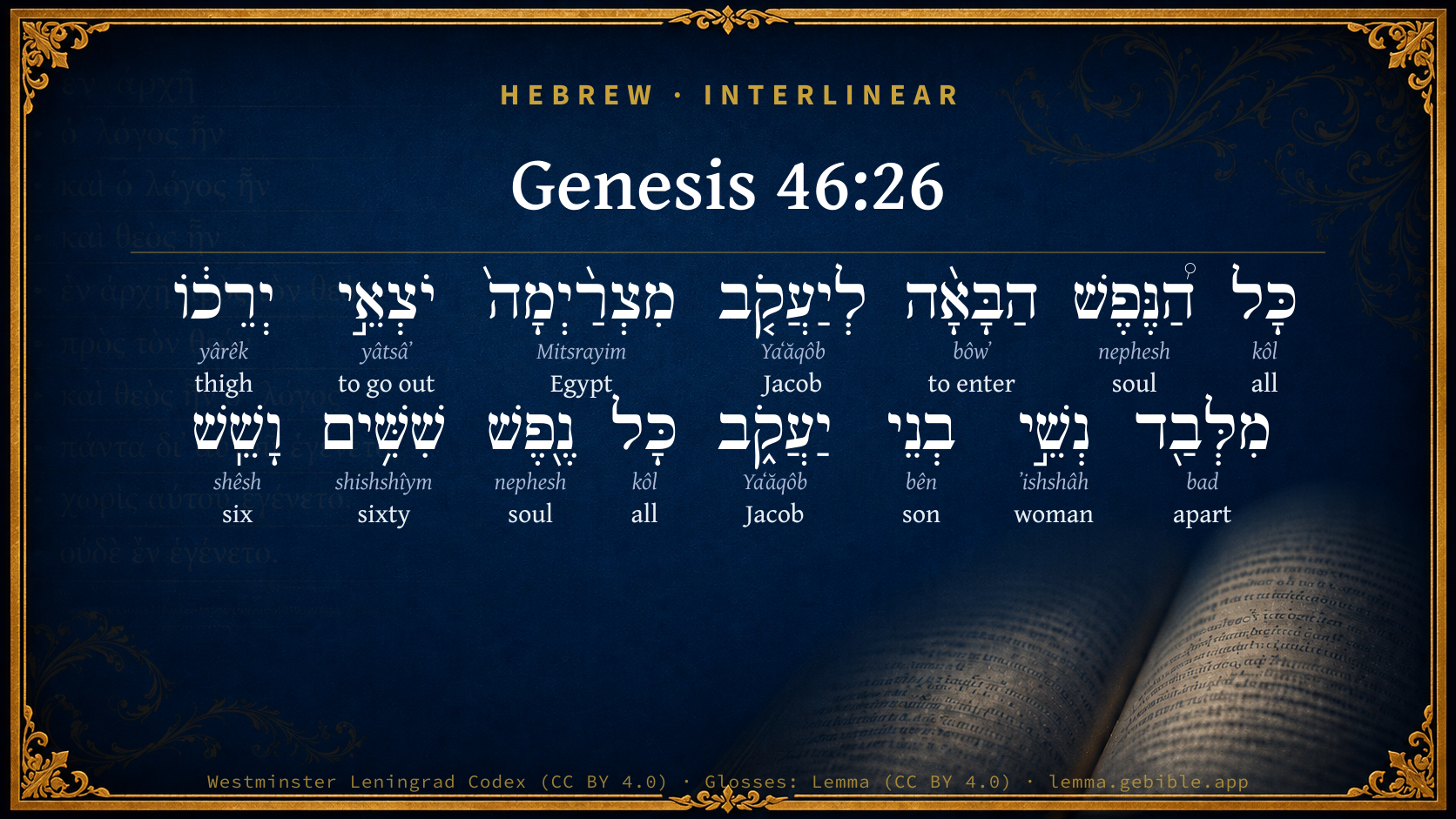
Hebrew (Westminster Leningrad Codex) Genesis 46:26 appears in the Hebrew Old Testament. The text above is from the Westminster Leningrad Codex. Each word links to its Strong’s number, a concise gloss, and parsing drawn from the Open Scriptures Hebrew Bible morphology. Click any word for its full Brown-Driver-Briggs (BDB) entry.
Download image
Cite this verse

Genesis 46:26 (World English Bible). Public Domain. Lemma interlinear Bible study tool, https://lemma.gebible.app/v/genesis/46/26.

Show BibTeX & RIS
BibTeX
RIS
English Translation
All the souls who came with Jacob into Egypt, who were his direct descendants, besides Jacob's sons' wives, all the souls were sixty-six.
World English Bible · Public Domain
Download a study sheet

One document with this verse’s original text, its word-by-word gloss line, the meaning frame, cross-references with their text, attributed commentary, and full source and license credits — printable, and it pastes into notes with its structure intact.

This verse Autodidact and up

Study sheet (.html) Plain text (.txt)

A passage Seminary Student

Up to 50 verses in one chapter. A passage sheet keeps up to 6 commentary sources and 12 cross-references per verse, in the order this page ranks them, and says so on the sheet whenever that leaves anything out. Ask for a single verse and you get the Autodidact verse sheet above.

Everything on this page stays free to read, with no account — the sheet is a download of what is already on screen, not access to it.

Want to remove ads? Support Godless Engineer
Compare translations 3

The same verse in 3 English versions, stacked beneath the original-language interlinear above. Click any original word for its lexicon entry.

Each is an independent rendering of the whole verse — the interlinear is not word-aligned to these translations.

Highlighted words mark where these versions differ — a whole-verse word diff, not a word-by-word alignment.

  • World English Bible Public Domain
    All the souls who came with Jacob into Egypt, who were his direct descendants, besides Jacob's sons' wives, all the souls were sixty-six.
  • King James Version Public Domain
    All the souls that came with Jacob into Egypt, which came out of his loins, besides Jacob's sons' wives, all the souls were threescore and six;
  • unfoldingWord Literal Text CC BY-SA 4.0
    All the souls who went with Jacob to Egypt, who came out of his thigh, apart from the wives of Jacob’s sons; all the souls sixty-six.

unfoldingWord Literal Text — © unfoldingWord, licensed CC BY-SA 4.0. Word-aligned USFM3 via Door43 (git.door43.org/unfoldingWord/en_ult).

Versions to compare (up to 4)

3 of 4 selected

Show all 18 translations

Every available English version of this verse, each an independent rendering of the whole verse.

  • World English Bible Public Domain
    All the souls who came with Jacob into Egypt, who were his direct descendants, besides Jacob's sons' wives, all the souls were sixty-six.
  • Berean Standard Bible Public Domain
    All those belonging to Jacob who came to Egypt—his direct descendants, besides the wives of Jacob’s sons—numbered sixty-six persons.
  • Majority Standard Bible Public Domain
    All those belonging to Jacob who came to Egypt—his direct descendants, besides the wives of Jacob’s sons—numbered sixty-six persons.
  • King James Version Public Domain
    All the souls that came with Jacob into Egypt, which came out of his loins, besides Jacob's sons' wives, all the souls were threescore and six;
  • American Standard Version (1901) Public Domain
    All the souls that came with Jacob into Egypt, that came out of his loins, besides Jacob's sons' wives, all the souls were threescore and six;
  • Revised Version (1885) Public Domain
    All the souls that came with Jacob into Egypt, which came out of his loins, besides Jacob’s sons’ wives, all the souls were threescore and six;
  • Geneva Bible (1599) Public Domain
    Al the soules, that came with Iaakob into Egypt, which came out of his loynes (beside Iaakobs sonnes wiues) were in the whole, three score and sixe soules.
  • Douay-Rheims (1899) Public Domain
    All the souls that went with Jacob into Egypt, and that came out of his thigh, besides his sons' wives, sixty-six.
  • Young's Literal Translation Public Domain
    All the persons who are coming to Jacob to Egypt, coming out of his thigh, apart from the wives of Jacob's sons, all the persons `are' sixty and six.
  • Literal Standard Version CC BY-SA 4.0
    All the persons who are coming to Jacob to Egypt, coming out of his thigh, apart from the wives of Jacob’s sons, all the persons [are] sixty-six.
  • Unlocked Literal Bible CC BY-SA 4.0
    All those who went to Egypt with Jacob, who were his descendants, not counting Jacob's sons' wives, were sixty-six in all.
  • unfoldingWord Literal Text CC BY-SA 4.0
    All the souls who went with Jacob to Egypt, who came out of his thigh, apart from the wives of Jacob’s sons; all the souls sixty-six.
  • Darby Bible Public Domain
    All the souls that came with Jacob to Egypt, that had come out of his loins, besides Jacob's sons' wives: all the souls were sixty-six.
  • World Messianic Bible Public Domain
    All the souls who came with Jacob into Egypt, who were his direct offspring, in addition to Jacob’s sons’ wives, all the souls were sixty-six.
  • Webster's Bible Public Domain
    All the souls that came with Jacob into Egypt, who came out of his loins, besides Jacob's sons' wives, all the souls were sixty and six.
  • Free Bible Version CC BY-SA 4.0
    All those who were part of Jacob's family who came to Egypt (his blood relatives, apart from wives of Jacob's sons) totaled sixty-six.
  • Bible in Basic English Public Domain
    All the persons who came with Jacob into Egypt, the offspring of his body, were sixty-six, without taking into account the wives of Jacob's sons.
  • JPS Tanakh (1917) Public Domain
    All the souls belonging to Jacob that came into Egypt, that came out of his loins, besides Jacob's sons' wives, all the souls were threescore and six.

Literal Standard Version (2020), Covenant Press — licensed CC BY-SA 4.0. Text via the HelloAO Bible API (eBible.org). Unlocked Literal Bible (unfoldingWord) — licensed CC BY-SA 4.0. Text via the HelloAO Bible API (eBible.org). unfoldingWord Literal Text — © unfoldingWord, licensed CC BY-SA 4.0. Word-aligned USFM3 via Door43 (git.door43.org/unfoldingWord/en_ult). Free Bible Version, Dr. Jonathan Gallagher — licensed CC BY-SA 4.0. Text via the HelloAO Bible API (eBible.org).

Word by word

More ways to search: Search by grammar → Find every occurrence → Compare this word →

Practice this passage: Drill this verse → Learn its vocabulary →

יְרֵכ֔וֹ
yârêk
H3409
“thigh · his”
Noun, Common, Feminine, Singular, Construct + Suffix, Personal, 3rd Person, Masculine, Singular
Part of Speech
Noun
Type
Common
Gender
Feminine
Number
Singular
State
Construct
Full BDB Definition

Origin: from an unused root meaning to be soft

TWOT: 916a

thigh, side, loin, base - thigh - outside of thigh (where sword was worn) - loins (as the seat of procreative power) - side (flank) (of object) - base
  1. כָּל kôl H3605 “all of” Noun, Common, Masculine, Singular, Construct
  2. הַ֠נֶּפֶשׁ nephesh H5315 “the · soul” Particle, Definite Article + Noun, Common, Both, Singular, Absolute
  3. הַבָּאָ֨ה bôwʼ H935 “the · entering” Particle, Definite Article + Verb, Qal, Participle Active, Feminine, Singular, Absolute
  4. לְיַעֲקֹ֤ב Yaʻăqôb H3290 “to/for · Jacob” Preposition + Noun, Proper
  5. מִצְרַ֨יְמָה֙ Mitsrayim H4714 “Egypt · toward” Noun, Proper + Suffix, Demonstrative
  6. יֹצְאֵ֣י yâtsâʼ H3318 “going out” Verb, Qal, Participle Active, Masculine, Plural, Construct
  7. מִלְּבַ֖ד bad H905 “from · to/for · apart of” Preposition + Preposition + Noun, Common, Masculine, Singular, Construct
  8. נְשֵׁ֣י ʼishshâh H802 “women of” Noun, Common, Feminine, Plural, Construct
  9. בְנֵי bên H1121 “sons of” Noun, Common, Masculine, Plural, Construct
  10. יַעֲקֹ֑ב Yaʻăqôb H3290 “Jacob” Noun, Proper
  11. כָּל kôl H3605 “all of” Noun, Common, Masculine, Singular, Construct
  12. נֶ֖פֶשׁ nephesh H5315 “soul” Noun, Common, Both, Singular, Absolute
  13. שִׁשִּׁ֥ים shishshîym H8346 “sixty” Adjective, Cardinal number, Both, Plural, Absolute
  14. וָשֵֽׁשׁ shêsh H8337 “and · six” Conjunction + Adjective, Cardinal number, Feminine, Singular, Absolute

About this verse

These counts appear in no published source. They are computed here, from the morphology-tagged text and Lemma’s own curated glosses. What Lemma adds →

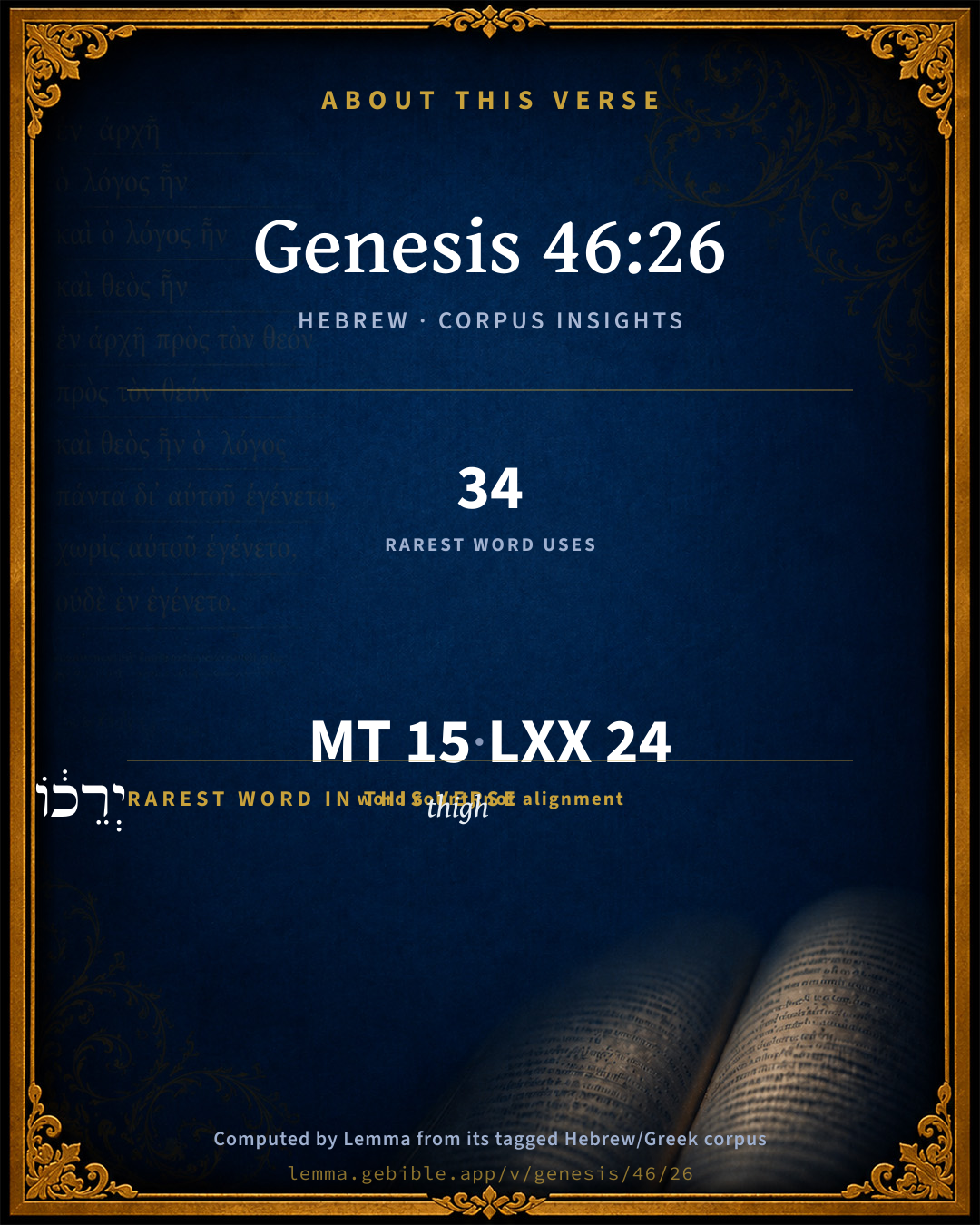
15
words
12
distinct lemmas
Pentateuch
section

Shared distinctive vocabulary

יְרֵכ֔וֹ thigh H3409 occurs in 32 verses of the Hebrew Bible. Also found in:

Grammatical profile

  • 2 verbs
  • 11 nouns
  • 2 adjectives

Verb forms

  • הַבָּאָ֨ה Qal · Participle Active
  • יֹצְאֵ֣י Qal · Participle Active

Repetition

Words recur within this verse — often emphatic in Hebrew:

  • כָּל all H3605 ×2
  • הַ֠נֶּפֶשׁ soul H5315 ×2
  • לְיַעֲקֹ֤ב Jacob H3290 ×2

Hebrew & Septuagint length

In English translation the verse runs 23 words from the Hebrew and 30 from the Septuagint (LXX English) — closely comparable.

A rough comparison of the two English renderings, which tokenize alike — not a word-level alignment.

Word counts can differ between the Hebrew and the Greek without any difference in meaning — e.g. the Hebrew direct-object marker אֵת has no separate Greek word, and Greek often adds the article ὁ.

In the original languages it is 15 Hebrew tokens and 24 Greek tokens — but the two are counted differently (Hebrew bundles its prefixes and suffixes into one token; the Greek is in lemma form), so that isn’t a like-for-like length.

Cross-references

3

Topical passages linked to Genesis 46:26 in the Treasury of Scripture Knowledge — connected by theme and wording, ordered by reader-vote popularity; previews shown in the World English Bible.

  • Exodus 1:5 All the souls who came out of the Jacob's body were seventy souls, and Joseph was in Egypt already.
  • Genesis 35:11 God said to him, "I am God Almighty. Be fruitful and multiply. A nation and a company of nations will be from you, and kings will come out of your loins.
  • Judges 8:30 Gideon had seventy sons conceived from his body; for he had many wives.

Cross-references courtesy of OpenBible.info (CC BY 4.0).

Hebrew and Greek witnesses Masoretic Hebrew ↔ Greek Septuagint

The same verse in the two great witnesses to the Old Testament, shown verse-for-verse.

These are two independent witnesses, not word-aligned to each other, and the Septuagint is shown in lemma (dictionary) form.

Hebrew Genesis 46:26 Masoretic · Westminster Leningrad Codex

כָּל הַ֠נֶּפֶשׁ הַבָּאָ֨ה לְיַעֲקֹ֤ב מִצְרַ֨יְמָה֙ יֹצְאֵ֣י יְרֵכ֔וֹ מִלְּבַ֖ד נְשֵׁ֣י בְנֵי יַעֲקֹ֑ב כָּל נֶ֖פֶשׁ שִׁשִּׁ֥ים וָשֵֽׁשׁ

All the souls who came with Jacob into Egypt, who were his direct descendants, besides Jacob's sons' wives, all the souls were sixty-six.

World English Bible · Public Domain

Greek LXX Genesis 46:26 Septuagint · lemma form

πᾶς δέ ψυχή ὁ εἰςἔρχομαι μετά ἰακώβ εἰς αἴγυπτος ὁ ἐκἔρχομαι ἐκ ὁ μηρός αὐτός χωρίς ὁ γυνή υἱός ἰακώβ πᾶς ψυχή ἑξήκοντα ἕξ

And all the souls that came with Jacob into Egypt, who came out of his loins, besides the wives of the sons of Jacob, even all the souls were sixty-six.

LXX2012 (modern English Septuagint) · Public Domain

On this verse, Ellicott's Commentary for English Readers discusses the Septuagint’s reading. Read the note in Commentary ↓

Hebrew: Westminster Leningrad Codex (CC BY 4.0). Greek: Septuagint (public domain); English from LXX2012 (modern English Septuagint) (Public Domain). How the Septuagint differs from the Hebrew →

Targum (Aramaic paraphrase)

2

The Targum is the ancient Jewish Aramaic paraphrase of the Hebrew Scriptures — an interpretive translation, not the Hebrew text itself. Onkelos (literal) and Pseudo-Jonathan (expansive) render the Torah, and Jonathan the Prophets. Coverage is partial: where no permissively-licensed English translation exists for a verse, only the Aramaic is shown. This is verse-level text, not a word-by-word alignment to the Hebrew.

  1. Targum Onkelos Torah (Genesis–Deuteronomy)
    כָּל נַפְשָׁא דְּעַלָּא לְיַעֲקֹב לְמִצְרַיִם נָפְקֵי יַרְכֵּהּ בַּר מִנְּשֵׁי בְנֵי יַעֲקֹב כָּל נַפְשָׁתָא שִׁתִּין וְשִׁית

    (no public-domain English translation for this verse)

    Targum Onkelos — Aramaic: “Onkelos Genesis” (public domain); “Onkelos Exodus” (public domain); “Onkelos Leviticus” (public domain); “Onkelos Numbers” (public domain); “Onkelos Deuteronomy” (public domain). English: “Sefaria Community Translation” (CC0 1.0 (public-domain dedication)); “J.W. Etheridge. The Targums of Onkelos and Jonathan Ben Uzziel on the Pentateuch. London: Longmans, Green, 1862” (public domain). Text via Sefaria.

  2. Targum Pseudo-Jonathan Torah (Genesis–Deuteronomy)
    כָּל נַפְשָׁתָא דְעָלָא עִם יַעֲקב לְמִצְרַיִם נַפְקֵי יַרְכֵיהּ בַּר מִנְשֵׁי דִבְנֵי יַעֲקב כָּל נַפְשָׁתָא שִׁיתִּין וְשִׁית

    All the souls which went into Mizraim with Jakob which had come forth from his thigh; besides the wives of Jakob's sons, all the souls were sixty and six.

    Targum Pseudo-Jonathan — Aramaic: “Targum Jonathan on Genesis” (public domain); “Targum Jonathan on Exodus” (public domain); “Targum Jonathan on Leviticus” (public domain); “Targum Jonathan on Numbers” (public domain); “Targum Jonathan on Deuteronomy” (public domain). English: “The Targum of Jonathan ben Uzziel, trans. J. W. Etheridge, London, 1862” (public domain). Text via Sefaria.

Commentary

Notes on Genesis 46:26 from classic Christian and Jewish commentators (each source and its license shown beneath its notes). The classic Christian expositions comment on the surrounding passage and are grouped to its opening verse, so a note may address several verses; the Jewish commentaries on the Tanakh (Rashi and others) are per-verse, so they appear only where the commentator wrote on this verse.

Lemma curates 59 commentaries, every one of them public domain or Creative Commons licensed, each selected and text-cleaned for this edition rather than reprinted as found. About our sources →

Trapp's Complete Commentary

John Trapp

Gen 46:26 All the souls that came with Jacob into Egypt, which came out of his loins, besides Jacob’s sons’ wives, all the souls [were] threescore and six;

Ver. 26. Which came out of his loins.] Heb., e femore eius. A modest description of generation, by the instrumental and material cause thereof. And because it is said, that so many souls came out of Jacob’s body, Augustine {a} moves the question here, whether souls also are not begotten, as well as bodies? And when the learned father demurred, and would not presently determine the point, a rash young man, one Vincentius Victor, as Chemnitius relates it, boldly censured the father’s unresolvedness, and vaunted that he would undertake to prove by demonstration that souls are created, de novo, by God; for which peremptory rashness the father returned the young man a sober reprehension. But souls are doubtless here put for persons, which the Latins call capita.

{a} Annon igitur animae propagentur ex traduce; argumenta post triduum demum solvo. - Melancthon.

John Trapp, A Commentary or Exposition upon All the Books of the Old and New Testament (1647–1656) — public domain. Text from a community e-Sword module.

Tyndale Open Study Notes

Tyndale Open Resources

46:26 The total number . . . was sixty-six: This is the number of those who traveled with Jacob to Egypt, excluding his sons’ wives, the servants, and others attached to the household. It also omits Joseph, Ephraim, Manasseh, and Jacob.

Tyndale Open Study Notes — © Tyndale Open Resources, licensed CC BY-SA 4.0. Text via the HelloAO Bible API.

Geneva Bible (1599)

Geneva Bible translators

Hebrew, thighs.

Geneva Bible (1599) marginal notes — public domain. Text via Bolls.life.

Ellicott's Commentary for English Readers

(26) All the souls were threescore and six.—This total is obtained by omitting Jacob, Joseph, and Joseph’s two sons. If we include these, the whole number becomes threescore and ten, as in Gen_46:27. In the LXX. the names of five grandsons are added to Gen_46:20, and thus the total is made seventy-five, as quoted by St. Stephen in Act_7:14.

A Bible Commentary for English Readers, edited by Charles John Ellicott (1878–1897) — public domain. Text from a community e-Sword module.

The Cambridge Bible for Schools and Colleges

gen. ed. J. J. S. Perowne

26. souls that came with Jacob] The rendering of the margin, souls belonging to Jacob that came, is preferable. “With Jacob” (as LXX and Lat.) follows Gen_46:7, but does not translate the Heb.

threescore and six] These and the words in the following verse before “threescore and ten” have the appearance of a gloss. In the preceding list the sons and daughters of Leah were thirty-three (Gen_46:15), the sons of Zilpah sixteen (Gen_46:18), the sons of Rachel fourteen (Gen_46:22), and the sons of Bilhah seven (Gen_46:25); the total of these is seventy. The number, therefore, of sixty-six must be regarded as the result of deducting four persons, presumably Er and Onan, and the “two souls born to Joseph in Egypt” (Gen_46:20).

Note that “sixty-six” is just double that of Leah’s children, thirty-three. Another computation, excluding Er and Onan, and including Dinah, would make Leah’s children “thirty-two,” just double Zilpah’s.

The Cambridge Bible for Schools and Colleges (gen. ed. J. J. S. Perowne; Cambridge University Press, 1878–1918) — public domain. Text from a community e-Sword module.

John Gill's Exposition

And Israel said unto Joseph,.... He broke silence first:

now let me die, since I have seen thy face; not that he was impatient to die, and not desirous to live any longer; for it could not but yield pleasure to him, and make the remainder of his life more comfortable to live with such a son, his darling, and now in so much honour and grandeur; but this he said to express his great satisfaction at the sight of him, that he could now be content to die, having all his heart could wish for, an interview with his beloved son:

because thou art yet alive; whom he had looked upon as dead, and the receiving him now was as life from the dead, and could not but fill him with the greatest joy, see Luk 15:23; Jacob lived after this seventeen years, Gen 47:28.

John Gill's Exposition of the Whole Bible (1746–1763) — public domain (CC PDM 1.0). Text via the HelloAO Bible API.

Haydock's Catholic Bible Commentary

Sixty-six; not including Jacob, Joseph, and his two children, who make up 70, ver. 27. (Deuteronomy x. 22.) The Septuagint taking in Joseph’s grandchildren, read 75; in which they are followed by St. Stephen, Acts. vii. 14. See St. Jerome q. Heb. (Calmet) --- St. Augustine cannot account for these grand-children and great grand-children of Joseph being mentioned as coming with Jacob into Egypt, since some of them were not born during his life-time. He suspects some hidden mystery. (Worthington) See ver. 7. --- Some think St. Stephen excludes Jacob, Joseph, and his sons; and included the 64 men, with 11 wives. (Du Hamel)

George Leo Haydock (1774–1849), Haydock's Catholic Family Bible and Commentary, 1859 edition — public domain. Excludes Psalms (Douay-Rheims chapter numbering differs from Protestant) and Deuterocanonical books (Catholic canon only).

Matthew Poole's English Annotations

Loins, Heb. thigh, which is here put for the secret parts between the thighs, which are called sometimes the feet, as Gen 49:10; Deu 28:57; Eze 16:25, for the like reason, because they are between the feet. From this eastern manner of speech came that passage in the Greek fables, concerning Bacchus being born out of Jupiter’s thigh.

Threescore and six; so many they are, excluding Jacob, as the common parent, and Joseph and his two sons, as being in Egypt before Jacob’s coming thither; which four being included they make up seventy, as it is Gen 46:27.

Matthew Poole's English Annotations on the Holy Bible (1683–1685) — public domain. Text from a community e-Sword/MySword module.

The Pulpit Commentary

Vers. 26, 27. All the souls that came with Jacob into Egypt, which came out of his loins, besides Jacob"s sons" wives, all the souls were threescore and six; and the sons of Joseph, which were born him in Egypt, were two souls: all the souls of the house of Jacob, which came into Egypt, were threescore and ten. According to the LXX the number of Joseph"s sons was nine; and the number of those who came with Jacob into Egypt seventy five, a number adopted by Stephen. (Act_7:14) The apparent confusion in these different numbers, sixty-six, seventy, seventy-five, will disappear if it be observed that the first takes no account of Jacob, Joseph, Manasseh, and Ephraim, while they are as palpably included in the second computation, and that Stephen simply adds to the seventy of ver. 27 the five grandsons of Joseph who are mentioned in the Septuagint version, from which he quoted, or to the sixty-six of ver. 26 the nine mentioned above, consisting of Jacob, Joseph, Manasseh, Ephraim, and Joseph"s five grandsons, thus making seventy five in all. There is thus no irreconcilable contradiction between the Hebrew historian and the Christian orator.

The Pulpit Commentary (1880–1919), ed. H.D.M. Spence-Jones & Joseph S. Exell — public domain. Text from a community e-Sword module.

Scofield Reference Notes

C. I. Scofield

All the souls

(Cf) Gen 46:27. A discrepancy has been imagined. The "souls" that came with Jacob" were 66. The "souls of the house of Jacob" Gen 46:27 i.e. the entire Jacobean family) were 70, viz. the 66 which came with Jacob, Joseph and his two sons, already in Egypt=69; Jacob himself=70. (See Scofield "Act 7:14").

The Scofield Reference Bible (1917 edition), notes by C. I. Scofield — public domain. Text from a community e-Sword module.

unfoldingWord translationNotes

Door43 World Missions Community

sixty-six

"66" (See: Numbers)

seventy

"70" (See: Numbers)

translationWords

Jacob

Egypt

descend

Joseph (OT)

house

unfoldingWord translationNotes — © Distant Shores Media and the Door43 World Missions Community, licensed CC BY-SA 4.0. Source: git.door43.org/Door43/en_tn.

Rashi

Rabbi Shlomo Yitzchaki (Rashi)

כל הנפש הבאה ליעקב EVERY SOUL THAT WAS COMING WITH JACOB — every soul that left Canaan to go to Egypt The word הבאה, here, is not a perfect tense, but a participle with a relative present sense — just as (Ester 2:4) “In the evening she (באה) was coming” and (Genesis 29:7) “and, behold, Rachel his daughter is coming (באה)” and therefore the accent is on the last syllable, on the א, because when they left, coming from the land of Canaan, they were only sixty-six. But at the second mention of this word (Genesis 46:27) — “every soul of the house of Jacob, which came (הבאה) into Egypt were seventy” — it is a perfect tense and therefore it is accented on the last but one syllable, on the ב. The reason is, that when they came there, they were seventy, for they found Joseph and his two sons there, and Jochebed was added to their number “between the walls”. According to the view of the Rabbi (i. e. R. Jehudah, cf. Genesis Rabbah 84) who stated that with each of Jacob’s sons a twin-sister was born, we must say that these died before they (Jacob and his family) went down to Egypt, because they are not enumerated here. In Vayikra Rabbah 4:6 I found the following: When he left Canaan (cf. Genesis 36:6) Esau’s family consisted of only six (himself and his five sons), and Scripture calls them “the souls of his house” (in the plural) and this is because they worshipped many gods (each serving a different god and having as it were, a different soul or religious feeling). But the family of Jacob when he came to Egypt consisted of seventy and Scripture calls them “soul”, in the singular, because they all served One God.

Rashi on the Tanakh — English translations: “The Judaica Press complete Tanach with Rashi, translated by A. J. Rosenberg” (CC BY 4.0); “Pentateuch with Rashi's commentary by M. Rosenbaum and A.M. Silbermann, 1929-1934” (public domain); “The Metsudah Tanach series, Lakewood, N.J” (CC BY 4.0); and “The Book of Joshua, Metsudah Publications, 1997” (CC BY 4.0). Text via Sefaria.

Radak

Rabbi David Kimhi (Radak)

כל הנפש הבאה, we are told about number of the members of Yaakov’s household appearing with the masculine ending twice, such as the number fourteen in verse 22, and the number seven in verse 25. On the other hand, in verse 15 the Torah uses the feminine ending for the number 33 (שלושים ושלוש) and in verse 18 it uses the feminine ending for the number 16 (שש עשרה). The reason for this apparent anomaly is that the noun נפש mentioned in verse 26, for instance is feminine, hence the number associated with that noun has to be in the feminine mode also. The word בני being in the masculine mode, however, determines that the adjective or attribute accompanying it be in the same mode, i.e. masculine.

Radak on the Tanakh — English translations: “Sefaria Community Translation” (CC0 1.0 (public-domain dedication)); “Eliyahu Munk, HaChut Hameshulash” (CC BY 4.0); “Rabbi Mike Feuer, Jerusalem Anthology” (CC BY 4.0); and “R. David Kimhi on the first book of Psalms, Translated by R.G. Finch, London, 1919” (public domain). Text via Sefaria.

Lesson kit

Teaching starters — assembled from the data on this page, not authored interpretation. Every prompt links to the verse data it draws on. Edit before teaching.

Genesis, in the Pentateuch, opens this verse with 15 words (12 distinct Hebrew lemmas). Its most distinctive word is yârêk (“thigh”). A historical commentator’s framing appears above. Read the whole chapter for the surrounding context.

Discussion questions

  1. How does “thigh” (yârêk) shape what this verse is saying?
  2. Genesis 24:2 shares the word «thigh» with this verse. How do the two illuminate each other?
  3. “all” occurs 2× in this one verse. What is the effect of the repetition?
  4. These translations render this verse differently; the difference is in the English rendering, not the original. What questions does that raise?
  5. The verb «הַבָּאָ֨ה» is Qal Participle Active. How does its form color the action?
  6. Reading how Trapp's Complete Commentary and Tyndale Open Study Notes read this verse, where do the two commentators agree and where do they part?

Things to notice

Reading settings

Reading text

Shown beneath each verse's original-language words.

Old Testament
Old Testament edition

Read the OT as the Masoretic Hebrew (MT) or the Greek Septuagint (LXX).

English shown for the Greek Septuagint (in the Hebrew ↔ Greek comparison).

Comparing translations? Open the Compare panel on any verse page to stack up to four side by side.