
Genesis 41:54

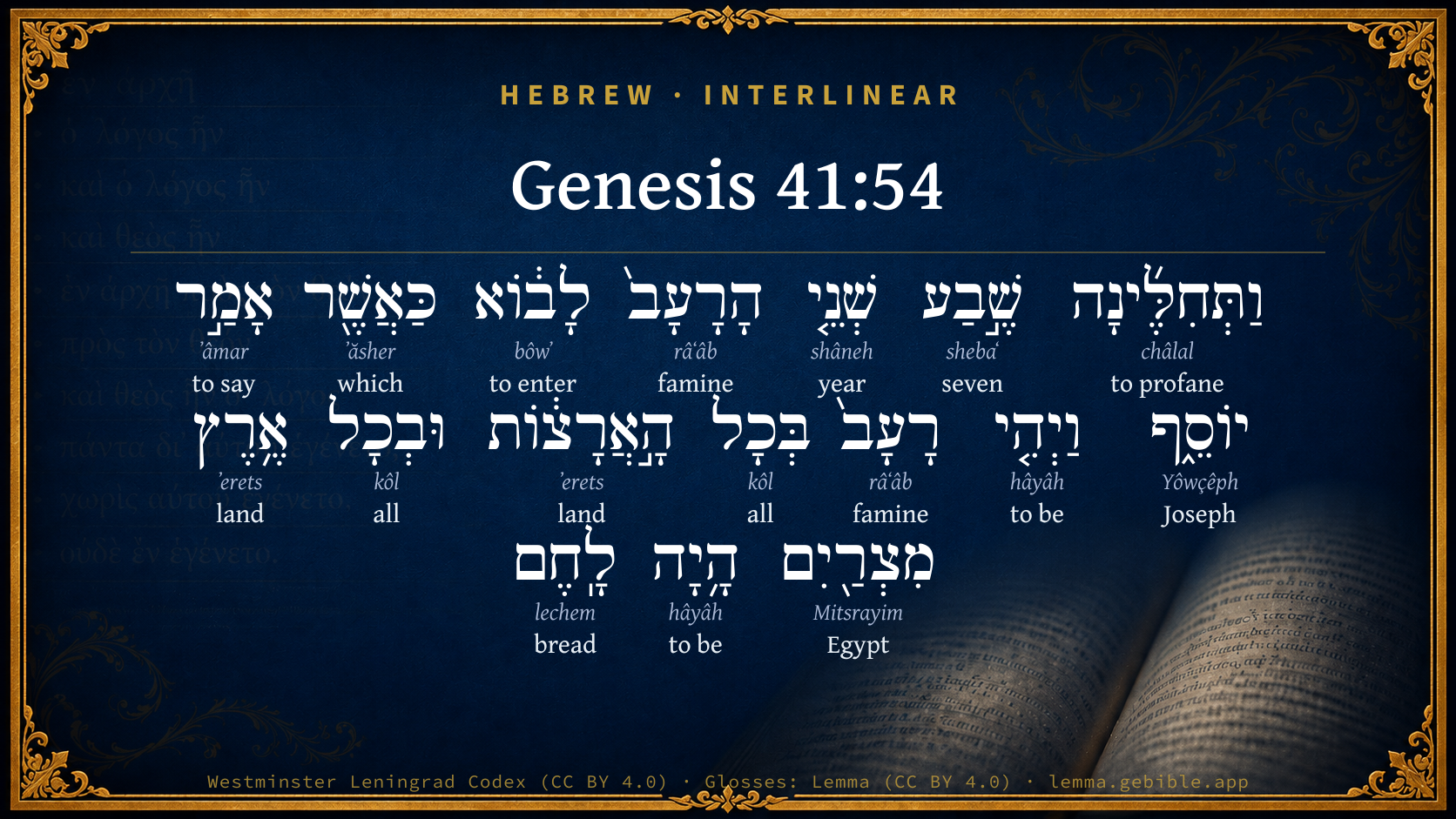
Hebrew (Westminster Leningrad Codex) Genesis 41:54 appears in the Hebrew Old Testament. The text above is from the Westminster Leningrad Codex. Each word links to its Strong’s number, a concise gloss, and parsing drawn from the Open Scriptures Hebrew Bible morphology. Click any word for its full Brown-Driver-Briggs (BDB) entry.
Download image
Cite this verse

Genesis 41:54 (World English Bible). Public Domain. Lemma interlinear Bible study tool, https://lemma.gebible.app/v/genesis/41/54.

Show BibTeX & RIS
BibTeX
RIS
English Translation
The seven years of famine began to come, just as Joseph had said. There was famine in all lands, but in all the land of Egypt there was bread.
World English Bible · Public Domain
Download a study sheet

One document with this verse’s original text, its word-by-word gloss line, the meaning frame, cross-references with their text, attributed commentary, and full source and license credits — printable, and it pastes into notes with its structure intact.

This verse Autodidact and up

Study sheet (.html) Plain text (.txt)

A passage Seminary Student

Up to 50 verses in one chapter. A passage sheet keeps up to 6 commentary sources and 12 cross-references per verse, in the order this page ranks them, and says so on the sheet whenever that leaves anything out. Ask for a single verse and you get the Autodidact verse sheet above.

Everything on this page stays free to read, with no account — the sheet is a download of what is already on screen, not access to it.

Want to remove ads? Support Godless Engineer
Compare translations 3

The same verse in 3 English versions, stacked beneath the original-language interlinear above. Click any original word for its lexicon entry.

Each is an independent rendering of the whole verse — the interlinear is not word-aligned to these translations.

Highlighted words mark where these versions differ — a whole-verse word diff, not a word-by-word alignment.

  • World English Bible Public Domain
    The seven years of famine began to come, just as Joseph had said. There was famine in all lands, but in all the land of Egypt there was bread.
  • King James Version Public Domain
    And the seven years of dearth began to come, according as Joseph had said: and the dearth was in all lands; but in all the land of Egypt there was bread.
  • unfoldingWord Literal Text CC BY-SA 4.0
    and the seven years of famine started to come, just as Joseph had said. And there was famine in all the lands, but in all the land of Egypt there was bread.

unfoldingWord Literal Text — © unfoldingWord, licensed CC BY-SA 4.0. Word-aligned USFM3 via Door43 (git.door43.org/unfoldingWord/en_ult).

Versions to compare (up to 4)

3 of 4 selected

Show all 18 translations

Every available English version of this verse, each an independent rendering of the whole verse.

  • World English Bible Public Domain
    The seven years of famine began to come, just as Joseph had said. There was famine in all lands, but in all the land of Egypt there was bread.
  • Berean Standard Bible Public Domain
    the seven years of famine began, just as Joseph had said. And although there was famine in every country, there was food throughout the land of Egypt.
  • Majority Standard Bible Public Domain
    the seven years of famine began, just as Joseph had said. And although there was famine in every country, there was food throughout the land of Egypt.
  • King James Version Public Domain
    And the seven years of dearth began to come, according as Joseph had said: and the dearth was in all lands; but in all the land of Egypt there was bread.
  • American Standard Version (1901) Public Domain
    And the seven years of famine began to come, according as Joseph had said: and there was famine in all lands; but in all the land of Egypt there was bread.
  • Revised Version (1885) Public Domain
    And the seven years of famine began to come, according as Joseph had said: and there was famine in all lands; but in all the land of Egypt there was bread.
  • Geneva Bible (1599) Public Domain
    Then began the seuen yeeres of famine to come, according as Ioseph had saide: and the famine was in all landes, but in all the land of Egypt was bread.
  • Douay-Rheims (1899) Public Domain
    And he named the second Epharaim, saying: God hath made me to grow in the land of my poverty.
  • Young's Literal Translation Public Domain
    and the seven years of famine begin to come, as Joseph said, and famine is in all the lands, but in all the land of Egypt hath been bread;
  • Literal Standard Version CC BY-SA 4.0
    and the seven years of famine begin to come, as Joseph said, and famine is in all the lands, but in all the land of Egypt has been bread;
  • Unlocked Literal Bible CC BY-SA 4.0
    The seven years of famine began, as Joseph had said. There was famine in all lands, but in all the land of Egypt there was food.
  • unfoldingWord Literal Text CC BY-SA 4.0
    and the seven years of famine started to come, just as Joseph had said. And there was famine in all the lands, but in all the land of Egypt there was bread.
  • Darby Bible Public Domain
    and the seven years of the dearth began to come, according as Joseph had said. And there was dearth in all lands; but in all the land of Egypt there was bread.
  • World Messianic Bible Public Domain
    The seven years of famine began to come, just as Joseph had said. There was famine in all lands, but in all the land of Egypt there was bread.
  • Webster's Bible Public Domain
    And the seven years of dearth began to come, according as Joseph had said: and the dearth was in all lands; but in all the land of Egypt there was bread.
  • Free Bible Version CC BY-SA 4.0
    and the seven years of famine began, just as Joseph had said. There was famine in all the other countries but the whole of Egypt had food.
  • Bible in Basic English Public Domain
    Then came the first of the seven years of need as Joseph had said: and in every other land they were short of food; but in the land of Egypt there was bread.
  • JPS Tanakh (1917) Public Domain
    And the seven years of famine began to come, according as Joseph had said; and there was famine in all lands; but in all the land of Egypt there was bread.

Literal Standard Version (2020), Covenant Press — licensed CC BY-SA 4.0. Text via the HelloAO Bible API (eBible.org). Unlocked Literal Bible (unfoldingWord) — licensed CC BY-SA 4.0. Text via the HelloAO Bible API (eBible.org). unfoldingWord Literal Text — © unfoldingWord, licensed CC BY-SA 4.0. Word-aligned USFM3 via Door43 (git.door43.org/unfoldingWord/en_ult). Free Bible Version, Dr. Jonathan Gallagher — licensed CC BY-SA 4.0. Text via the HelloAO Bible API (eBible.org).

Word by word

More ways to search: Search by grammar → Find every occurrence → Compare this word →

Practice this passage: Drill this verse → Learn its vocabulary →

הָרָעָב֙
râʻâb
H7458
“the · famine”
Particle, Definite Article + Noun, Common, Masculine, Singular, Absolute
Part of Speech
Particle + Noun
Type
Common
Gender
Masculine
Number
Singular
State
Absolute
Full BDB Definition

Origin: from H7456

TWOT: 2183a

famine, hunger - famine (in land, nation) - of Jehovah's word (figuratively) - hunger (of individuals)
  1. וַתְּחִלֶּ֜ינָה châlal H2490 “and · to profane” Conjunction + Verb, Hiphil, Sequential Imperfect, 3rd Person, Feminine, Plural
  2. שֶׁ֣בַע shebaʻ H7651 “seven” Adjective, Cardinal number, Feminine, Singular, Absolute
  3. שְׁנֵ֤י shâneh H8141 “year” Adjective, Cardinal number, Masculine, Dual, Construct
  4. לָב֔וֹא bôwʼ H935 “to enter” Preposition + Verb, Qal, Infinitive Construct
  5. כַּאֲשֶׁ֖ר ʼăsher H834 “like/as · which” Preposition + Particle, Relative
  6. אָמַ֣ר ʼâmar H559 “to say” Verb, Qal, Perfect, 3rd Person, Masculine, Singular
  7. יוֹסֵ֑ף Yôwçêph H3130 “Joseph” Noun, Proper
  8. וַיְהִ֤י hâyâh H1961 “and · to be” Conjunction + Verb, Qal, Sequential Imperfect, 3rd Person, Masculine, Singular
  9. רָעָב֙ râʻâb H7458 “famine” Noun, Common, Masculine, Singular, Absolute
  10. בְּכָל kôl H3605 “in/at · all of” Preposition + Noun, Common, Masculine, Singular, Construct
  11. הָ֣אֲרָצ֔וֹת ʼerets H776 “the · lands” Particle, Definite Article + Noun, Common, Both, Plural, Absolute
  12. וּבְכָל kôl H3605 “and · in/at · all of” Conjunction + Preposition + Noun, Common, Masculine, Singular, Construct
  13. אֶ֥רֶץ ʼerets H776 “land of” Noun, Common, Both, Singular, Construct
  14. מִצְרַ֖יִם Mitsrayim H4714 “Egypt” Noun, Proper
  15. הָ֥יָה hâyâh H1961 “to be” Verb, Qal, Perfect, 3rd Person, Masculine, Singular
  16. לָֽחֶם lechem H3899 “bread” Noun, Common, Both, Singular, Absolute

About this verse

These counts appear in no published source. They are computed here, from the morphology-tagged text and Lemma’s own curated glosses. What Lemma adds →

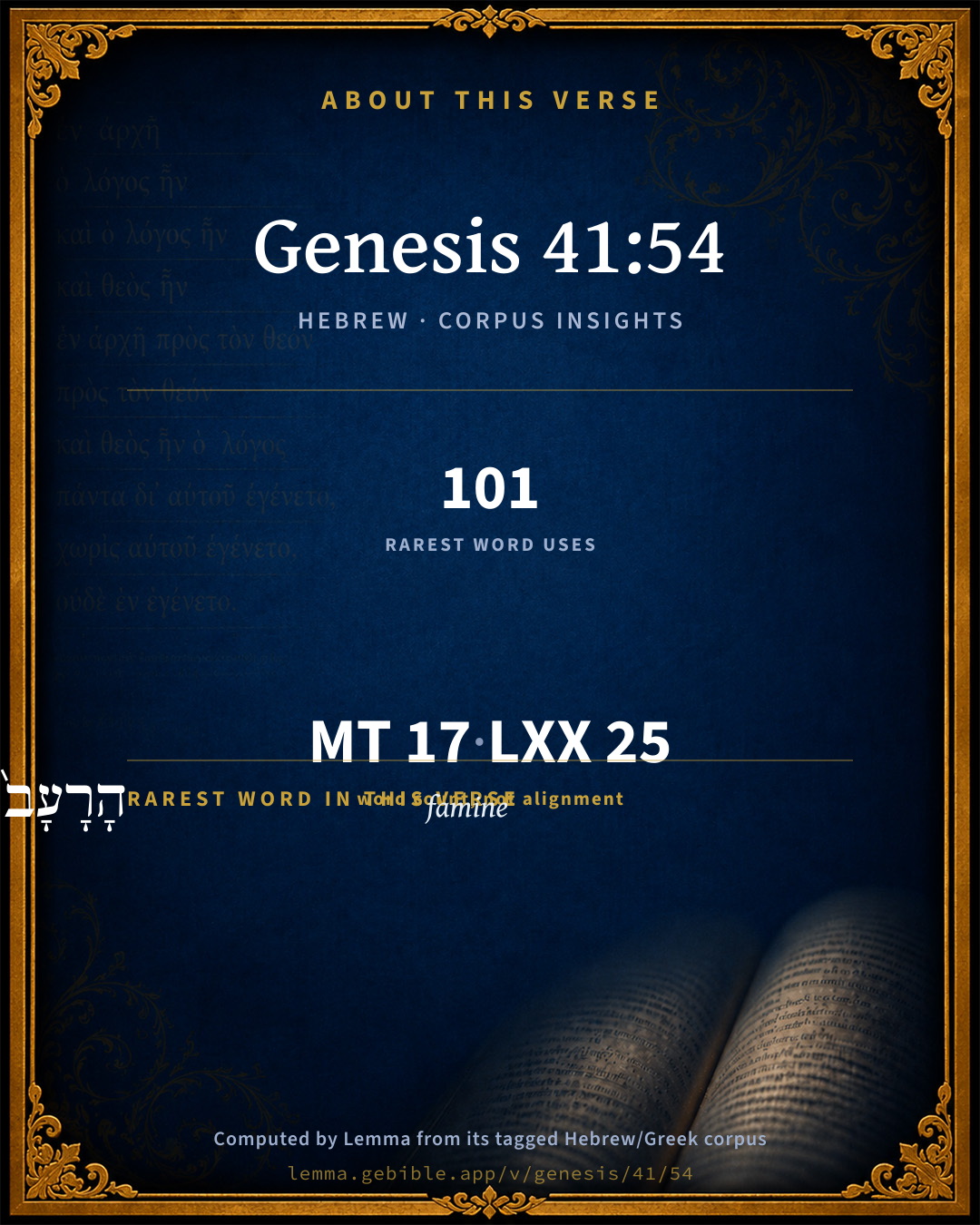
17
words
13
distinct lemmas
Pentateuch
section

Grammatical profile

  • 5 verbs
  • 9 nouns
  • 2 adjectives
  • 1 particle

Verb forms

  • וַתְּחִלֶּ֜ינָה Hiphil · Sequential Imperfect
  • לָב֔וֹא Qal · Infinitive Construct
  • אָמַ֣ר Qal · Perfect
  • וַיְהִ֤י Qal · Sequential Imperfect
  • הָ֥יָה Qal · Perfect

Repetition

Words recur within this verse — often emphatic in Hebrew:

  • הָרָעָב֙ famine H7458 ×2
  • וַיְהִ֤י to be H1961 ×2
  • בְּכָל all H3605 ×2
  • הָ֣אֲרָצ֔וֹת land H776 ×2

Hebrew & Septuagint length

In English translation the verse runs 29 words from the Hebrew and 31 from the Septuagint (LXX English) — closely comparable.

A rough comparison of the two English renderings, which tokenize alike — not a word-level alignment.

Word counts can differ between the Hebrew and the Greek without any difference in meaning — e.g. the Hebrew direct-object marker אֵת has no separate Greek word, and Greek often adds the article ὁ.

In the original languages it is 17 Hebrew tokens and 25 Greek tokens — but the two are counted differently (Hebrew bundles its prefixes and suffixes into one token; the Greek is in lemma form), so that isn’t a like-for-like length.

Cross-references

11

Topical passages linked to Genesis 41:54 in the Treasury of Scripture Knowledge — connected by theme and wording, ordered by reader-vote popularity; previews shown in the World English Bible.

  • Acts 7:11 Now a famine came over all the land of Egypt and Canaan, and great affliction. Our fathers found no food.
  • Genesis 45:11 There I will nourish you; for there are yet five years of famine; lest you come to poverty, you, and your household, and all that you have."'
  • Psalms 105:16 He called for a famine on the land. He destroyed the food supplies.
  • Genesis 41:30 There will arise after them seven years of famine, and all the plenty will be forgotten in the land of Egypt. The famine will consume the land,
  • Genesis 41:3–4 Behold, seven other cattle came up after them out of the river, ill-favored and lean-fleshed, and stood by the other cattle on the brink of the river.
  • Genesis 41:6–7 Behold, seven heads of grain, thin and blasted with the east wind, sprung up after them.
  • Genesis 41:27 The seven lean and ill-favored cattle that came up after them are seven years, and also the seven empty heads of grain blasted with the east wind; they will be seven years of famine.
  • Genesis 42:2 He said, "Behold, I have heard that there is grain in Egypt. Go down there, and buy for us from there, so that we may live, and not die."
  • Genesis 42:5–6 The sons of Israel came to buy among those who came, for the famine was in the land of Canaan.
  • Genesis 43:1 The famine was severe in the land.
  • Genesis 47:13 There was no bread in all the land; for the famine was very severe, so that the land of Egypt and the land of Canaan fainted by reason of the famine.

Cross-references courtesy of OpenBible.info (CC BY 4.0).

Hebrew and Greek witnesses Masoretic Hebrew ↔ Greek Septuagint

The same verse in the two great witnesses to the Old Testament, shown verse-for-verse.

These are two independent witnesses, not word-aligned to each other, and the Septuagint is shown in lemma (dictionary) form.

Hebrew Genesis 41:54 Masoretic · Westminster Leningrad Codex

וַתְּחִלֶּ֜ינָה שֶׁ֣בַע שְׁנֵ֤י הָרָעָב֙ לָב֔וֹא כַּאֲשֶׁ֖ר אָמַ֣ר יוֹסֵ֑ף וַיְהִ֤י רָעָב֙ בְּכָל הָ֣אֲרָצ֔וֹת וּבְכָל אֶ֥רֶץ מִצְרַ֖יִם הָ֥יָה לָֽחֶם

The seven years of famine began to come, just as Joseph had said. There was famine in all lands, but in all the land of Egypt there was bread.

World English Bible · Public Domain

Greek LXX Genesis 41:54 Septuagint · lemma form

καί ἄρχω ὁ ἑπτά ἔτος ὁ λιμός ἔρχομαι καθά εἶπον ιωσηφ καί γίγνομαι λιμός ἐν πᾶς ὁ γῆ ἐν δέ πᾶς γῆ αἴγυπτος εἰμί ἄρτος

And the seven years of famine began to come, as Joseph said; and there was a famine in all the land; but in all the land of Egypt there was bread.

LXX2012 (modern English Septuagint) · Public Domain

Hebrew: Westminster Leningrad Codex (CC BY 4.0). Greek: Septuagint (public domain); English from LXX2012 (modern English Septuagint) (Public Domain). How the Septuagint differs from the Hebrew →

Targum (Aramaic paraphrase)

2

The Targum is the ancient Jewish Aramaic paraphrase of the Hebrew Scriptures — an interpretive translation, not the Hebrew text itself. Onkelos (literal) and Pseudo-Jonathan (expansive) render the Torah, and Jonathan the Prophets. Coverage is partial: where no permissively-licensed English translation exists for a verse, only the Aramaic is shown. This is verse-level text, not a word-by-word alignment to the Hebrew.

  1. Targum Onkelos Torah (Genesis–Deuteronomy)
    וּשְׁרִיאַת שְׁבַע שְׁנֵי כַפְנָא לְמֵיעַל כְּמָא דִּי אֲמַר יוֹסֵף וַהֲוָה כַפְנָא בְּכָל אַרְעֲתָא וּבְכָל אַרְעָא דְמִצְרַיִם הֲוָה לַחְמָא

    (no public-domain English translation for this verse)

    Targum Onkelos — Aramaic: “Onkelos Genesis” (public domain); “Onkelos Exodus” (public domain); “Onkelos Leviticus” (public domain); “Onkelos Numbers” (public domain); “Onkelos Deuteronomy” (public domain). English: “Sefaria Community Translation” (CC0 1.0 (public-domain dedication)); “J.W. Etheridge. The Targums of Onkelos and Jonathan Ben Uzziel on the Pentateuch. London: Longmans, Green, 1862” (public domain). Text via Sefaria.

  2. Targum Pseudo-Jonathan Torah (Genesis–Deuteronomy)
    וּשְׁרִיאָן שְׁבַע שְׁנֵי כַפְנָא לְמֵיתֵי הֵיכְמָא דַאֲמַר יוֹסֵף וַהֲוָה כַפְנָא בְּכָל אַרְעָתָא וּבְכָל אַרְעָא דְמִצְרַיִם הֲוָה לַחְמָא

    and the seven years of famine began to be, as Joseph had said. And there was famine in all lands, but in all the land of Mizraim there was bread.

    Targum Pseudo-Jonathan — Aramaic: “Targum Jonathan on Genesis” (public domain); “Targum Jonathan on Exodus” (public domain); “Targum Jonathan on Leviticus” (public domain); “Targum Jonathan on Numbers” (public domain); “Targum Jonathan on Deuteronomy” (public domain). English: “The Targum of Jonathan ben Uzziel, trans. J. W. Etheridge, London, 1862” (public domain). Text via Sefaria.

Commentary

Notes on Genesis 41:54 from classic Christian and Jewish commentators (each source and its license shown beneath its notes). The classic Christian expositions comment on the surrounding passage and are grouped to its opening verse, so a note may address several verses; the Jewish commentaries on the Tanakh (Rashi and others) are per-verse, so they appear only where the commentator wrote on this verse.

Lemma curates 59 commentaries, every one of them public domain or Creative Commons licensed, each selected and text-cleaned for this edition rather than reprinted as found. About our sources →

Trapp's Complete Commentary

John Trapp

Gen 41:54 And the seven years of dearth began to come, according as Joseph had said: and the dearth was in all lands; but in all the land of Egypt there was bread.

Ver. 54. According as Joseph had said.] Joseph foresaw and foretold the famine, but caused it not: so God’s prescience, &c.

In all the land of Egypt.] Such a revenue is thrift and parsimony, Optimum vectigal parsimonia. - Cic.

John Trapp, A Commentary or Exposition upon All the Books of the Old and New Testament (1647–1656) — public domain. Text from a community e-Sword module.

Joseph Benson's Commentary

Gen 41:54. The seven years of death began to come — Not only in Egypt, but in other lands, that is, all the neighbouring countries.

Joseph Benson's Commentary on the Old and New Testaments (1811–1818) — public domain. Text from a community e-Sword module.

Geneva Bible (1599)

Geneva Bible translators

Or, food.

Geneva Bible (1599) marginal notes — public domain. Text via Bolls.life.

Adam Clarke's Commentary

Verse 54. The seven years of dearth began to come] Owing in Egypt to the Nile not rising more than twelve or thirteen cubits; (See Clarke on Ge 41:31;) but there must have been other causes which affected other countries, not immediately dependent on the Nile, though remotely connected with Egypt and Canaan.

The dearth was in all lands] All the countries dependent on the Nile. And it appears that a general drought had taken place, at least through all Egypt and Canaan; for it is said, Ge 41:57, that the famine was sore in all lands - Egypt and Canaan, and their respective dependencies.

Adam Clarke's Commentary on the Bible (1810–1826) — public domain. Text from a community e-Sword/MySword module.

Ellicott's Commentary for English Readers

(54) The dearth.—As the Nile at this early period was not assisted and regulated in its overflow by dams and canals, famines were much more common in Egypt than when subsequently the kings had done so much to provide against this danger. As, too, this dearth was “in all lands,” in Arabia, Palestine, Ethiopia, &c., there was evidently a long period of excessive drought. Still Egypt is always liable to famine, and Bar Hebræus (Chronicon, p. 260) gives terrible details of the sufferings of Egypt in the year of the Hej’ra 462, when so great was the loss of life, that whereas in the city of Tanis (Zoan) 300,000 men paid poll-tax in the previous year, there remained in it less than a hundred souls at the end of the dearth.

One argument adduced by Canon Cook, Excursus on the Bearings of Egyptian History on the Pentateuch, p. 451, for placing the descent of the Israelites into Egypt in the reign of Amenemha III., is that it was this monarch who “first established a complete system of dykes, canals, locks, and reservoirs, by which the inundations of the Nile were henceforth regulated.” The artificial lake of Moeris was also made by his orders, and other works of extraordinary vastness. Now not only would such works be suggested by a dearth of unusually long continuance, but the measures taken by Joseph during the seven years of famine would place the whole resources of the country at the Pharaoh’s disposal.

A Bible Commentary for English Readers, edited by Charles John Ellicott (1878–1897) — public domain. Text from a community e-Sword module.

The Cambridge Bible for Schools and Colleges

gen. ed. J. J. S. Perowne

53–57. The Years of Famine

54. all lands] Cf. Gen_41:57. The famine is represented as afflicting not only Egypt, but all the neighbouring lands which constituted the known world of the Israelites. Cf. Gen_43:1. For a similar hyperbole, cf. “all the world” (Luk_2:1; Joh_21:25); “a great famine over all the world” (Act_11:28).

The Cambridge Bible for Schools and Colleges (gen. ed. J. J. S. Perowne; Cambridge University Press, 1878–1918) — public domain. Text from a community e-Sword module.

Matthew Poole's English Annotations

In all lands; in all the neighbouring countries, appears by comparing this with Gen 42:1.

Matthew Poole's English Annotations on the Holy Bible (1683–1685) — public domain. Text from a community e-Sword/MySword module.

The Pulpit Commentary

HOMILIES BY F. HASTINGS Ver. 54.

Destitution and abundance.

the dearth was in all lands; but in all the land of Egypt there was bread." The time of harvest is, of all periods of the year, the most important. It is the point to which all previous operations of the cultivator have tended. He knows how much depends on the weather and God"s mercy. Having done all he can, he has to wait, and the harvest-time determines results. Those who are not engaged in agriculture are concerned in a harvest. Suppose there were none; non-producers must starve, Dwelling in great towns and cities, many who are engaged in traffic or manufacture may easily overlook harvest-time, and forget their dependence on God for daily bread. They see not the sown fields, they watch not the springing blade, they seize not the sharp sickle, they join not in piling up the pointed stacks, and are therefore likely to forget dependence on God. It is well that God forgets us not. He has ever kept his promise long as the earth remaineth," &c. No year has passed without harvest-time being stinted in some land. Think over the contrast given in the text. ;

I GENERAL DISTRESS. "The dearth was in all lands," i.e. all the lands then known to be peopled by the descendants of Noah. Their harvests had failed. Rain excessive, or drought prolonged, had ruined their crops. For several years there seems to have been disappointment. Not only did the husbandmen suffer, but those who could not toil. Dearth engenders disease, despair, death. See 2Ki 6, to what straits famine will reduce people. Even mothers consent together to eat their own offspring. In the lamentations of Jeremiah there is a description of the fearful consequences of famine, leading men to say, "Then was our skin black like an oven, because of the terrible famine." How painful must it be to have scanty platters and empty barns; for parents to have children clinging to the skirts of their garments, crying, "Give, oh, give bread," and to have none wherewith to satisfy them I We see the effect of famine on one family in the East. Jacob"s sons "looked on one another, and were sad." Their looks were despairing. They had money, flocks, and herds, but no bread. They could not eat their money, and to have lived on their starving flocks alone would engender disease of frightful character. Many had not even flocks to fall back upon, and the dearth was in all lands. How men at such a time must have looked longingly at the heavens, and prayed that God would send them bread I Sometimes such seasons of trial are sent that men may be reminded of the dependence on God. To have a moral and spiritual dearth is worse than to have outward destitution. The spiritual is more important than the physical. A more terrible death than all is that where there is a lack of a knowledge of God and his love, and of hearing the word of the Lord.

II EXCEPTIONAL ABUNDANCE. But for this plentifulness in Egypt the whole race might have perished. There were several reasons for the abundance in Egypt.

1. God arranged it by that wondrous overflowing of the Nile. A difference in the rising a few feet makes all the difference as to the crops. Even at this date, so do the crops of Egypt affect the markets of the world, that the rising of the Nile is watched, and the height attained telegraphed to all parts. God, at the period referred to, had given seven years of plenty, followed by seven years of dearth; but such had been the previous abundance, owing to the overflow of the river, that in the terrible time of dearth there was abundance of bread in Egypt.

2. The foresight and energy of one man had led to the husbanding of resources and storing of excessive crops.

3. Divine revelation caused Joseph to act. He could not have known of the impending danger unless it had been revealed. He had faith in God when in prison, and main-rained it when he became the governor of Egypt. Indeed that faith shone as brightly when he was the approved of Pharaoh as when he was the slave of Potiphar and the object of passion"s hate. His faith was rewarded when he was able to save multitudes from starving. What a contrast is presented in the text! Dearth of many lands, abundance in one. Such contrasts are often seen. On one side of the ocean there may have been an abundant harvest, on the other side but scanty crops. The world is full of contrasts. Here is a wedding; there is a funeral. In one family is love, thoughtfulness, harmony, and in that perhaps separated only by the thin partition of hasty builders bickering, jealousy, and hastiness of temper. Here sobriety, providence, and religion reign; there nothing but indigence, drunkenness, and utter neglect of the claims of God. In one country is peace, activity in all its branches of industry, commercial confidence, progress-in education and art, thoughtfulness for the untaught and criminal classes, and higher appreciation of the sacredness of life; in another depression, mistrust, plotting of adventurers, rule of the conscienceless, national faithlessness, and the spreading pall of desolation. Forceful is the contrast presented by nations under the influence of a simple Christianity and those enslaved by superstition, as Spain or Austria; or paralyzed by fatalism, as Turkey and Asia Minor; or darkened by idolatry, as India, China, Africa, and some of the islands of the seas. And such contrasts are seen in individuals. There walks one whose soul has no light, no hope, no peace; here one who knows he is pardoned, and is sure of acceptance by Christ. At death what a contrast! See one dying shrinking, doubting, fearing, grasping at any straw of comfort; another rejoicing that he is soon to enter and tread the streets of the New Jerusalem. Let all be prepared for such a change. Seek Christ, who is the "Bread of life," the Savior of our souls. Lack of appetite and numbness may come from excessive exhaustion. Hunger and thirst after righteousness, and be not like a lady who once said, "Sir, I have been so long without religion that I have, I fear, now no desire for it." If we come to Christ he will receive us readily. Joseph was glad to receive and help his brethren. So will Christ supply all our need out of the treasures of his rich grace. Remember, that if the need of other nations tested the charity of Egypt, so the need of souls is to test our earnestness. If we have found the riches in Christ, we are to seek to bless others. If little time remains to some of us in which to do much for Christ, let us act as those who, having much to write and little space, crowd the letters and words the closer. Let us be earnest as the husbandman, who, seeing winter coming apace, hastens in the few fine days remaining to garner his crops. Alas, many of our doings will have to stand useless, like earless, rotten sheaves, blackening dreary fields. H.

The Pulpit Commentary (1880–1919), ed. H.D.M. Spence-Jones & Joseph S. Exell — public domain. Text from a community e-Sword module.

John Wesley's Explanatory Notes

The seven years of dearth began to come - Not only in Egypt, but in other lands, in all lands, that is, all the neighbouring countries.

John Wesley, Explanatory Notes Upon the Whole Bible (1754–1765) — public domain. Text via the GEBible commentary corpus.

Ramban (Nachmanides)

Rabbi Moshe ben Nachman (Ramban / Nachmanides)

AND THE FAMINE WAS IN ALL LANDS. That is, which surrounded Egypt. Otherwise, what could the distant lands do if there was such a famine in them? Thus did the Sages say in Bereshith Rabbah: “The famine was in three lands: Phoenicia, Arabia and Palestine.”

Ramban (Nachmanides) on the Tanakh — English translation: “Commentary on the Torah by Ramban (Nachmanides). Translated and annotated by Charles B. Chavel. New York, Shilo Pub. House, 1971-1976” (CC BY 4.0). Text via Sefaria.

Radak

Rabbi David Kimhi (Radak)

ובכל ארץ מצרים היה לחם, in all the countries bordering on the land of Egypt there was food seeing that everyone had amassed a private hoard. [the author may mean that the individual farmers sold their private hoards to foreigners, knowing that when they would run out they would qualify for the accumulated supply of the state, while in the meantime overcharging the people from the neighbouring countries. Ed.]

Radak on the Tanakh — English translations: “Sefaria Community Translation” (CC0 1.0 (public-domain dedication)); “Eliyahu Munk, HaChut Hameshulash” (CC BY 4.0); “Rabbi Mike Feuer, Jerusalem Anthology” (CC BY 4.0); and “R. David Kimhi on the first book of Psalms, Translated by R.G. Finch, London, 1919” (public domain). Text via Sefaria.

Lesson kit

Teaching starters — assembled from the data on this page, not authored interpretation. Every prompt links to the verse data it draws on. Edit before teaching.

Genesis, in the Pentateuch, opens this verse with 17 words (13 distinct Hebrew lemmas). Its most distinctive word is râʻâb (“famine”). A historical commentator’s framing appears above. Read the whole chapter for the surrounding context.

Discussion questions

  1. How does “famine” (râʻâb) shape what this verse is saying?
  2. Acts 7:11 shares this passage’s theme. How do the two illuminate each other?
  3. “famine” occurs 2× in this one verse. What is the effect of the repetition?
  4. The translations on this page render this verse differently — a whole-verse word diff, not a word-by-word alignment. What might account for the different wordings?
  5. The verb «וַתְּחִלֶּ֜ינָה» is Hiphil Sequential Imperfect. How does its form color the action?
  6. Reading how Trapp's Complete Commentary and Joseph Benson's Commentary read this verse, where do the two commentators agree and where do they part?

Things to notice

Reading settings

Reading text

Shown beneath each verse's original-language words.

Old Testament
Old Testament edition

Read the OT as the Masoretic Hebrew (MT) or the Greek Septuagint (LXX).

English shown for the Greek Septuagint (in the Hebrew ↔ Greek comparison).

Comparing translations? Open the Compare panel on any verse page to stack up to four side by side.