Genesis 38:2

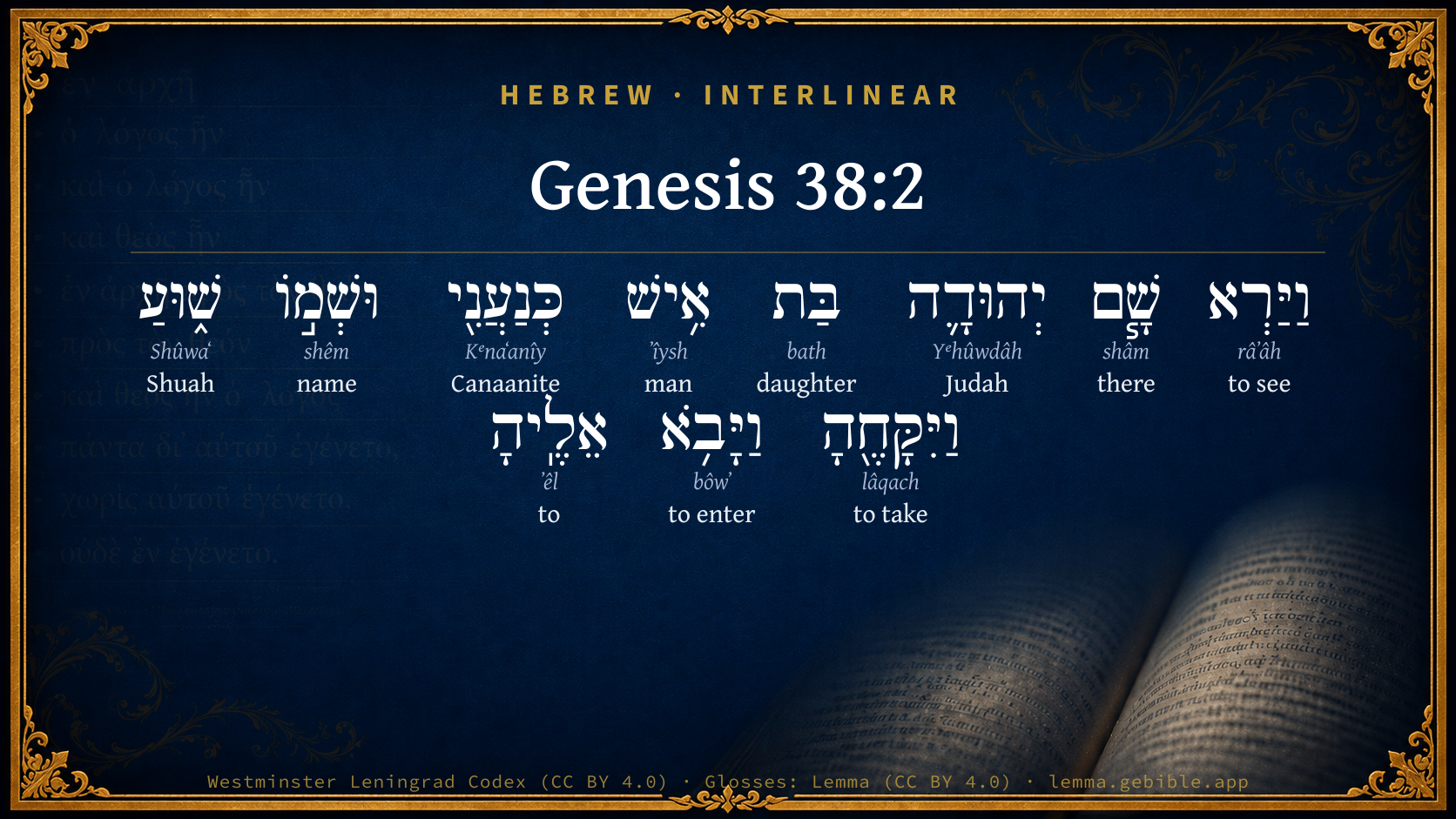
Hebrew (Westminster Leningrad Codex) Genesis 38:2 appears in the Hebrew Old Testament. The text above is from the Westminster Leningrad Codex. Each word links to its Strong’s number, a concise gloss, and parsing drawn from the Open Scriptures Hebrew Bible morphology. Click any word for its full Brown-Driver-Briggs (BDB) entry.
Download image
Cite this verse

Genesis 38:2 (World English Bible). Public Domain. Lemma interlinear Bible study tool, https://lemma.gebible.app/v/genesis/38/2.

Show BibTeX & RIS
BibTeX
RIS
English Translation
Judah saw there a daughter of a certain Canaanite whose name was Shua. He took her, and went in to her.
World English Bible · Public Domain
Highlights
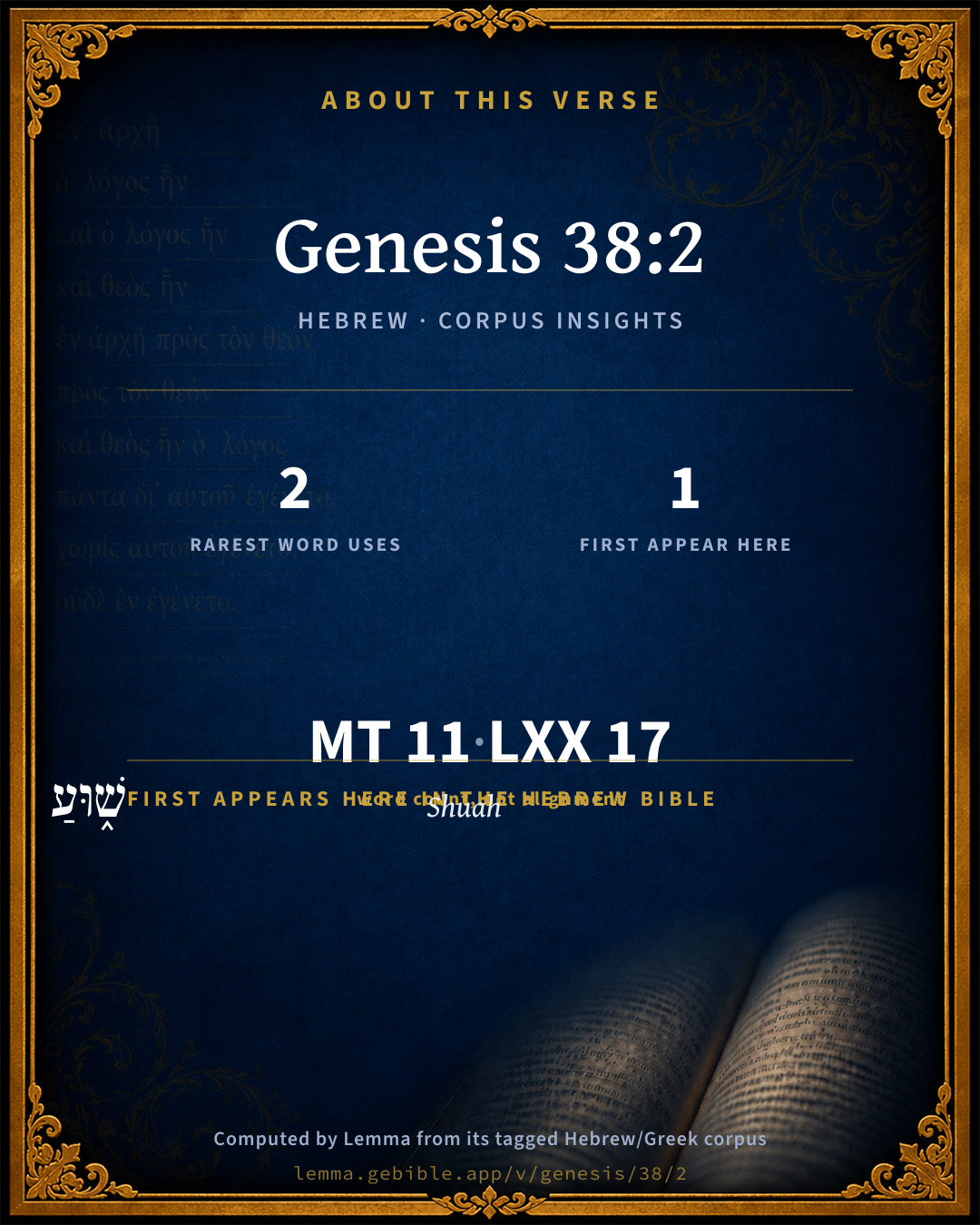
  • 1 first appearance in the Hebrew Bible
Full analysis ↓
Download a study sheet

One document with this verse’s original text, its word-by-word gloss line, the meaning frame, cross-references with their text, attributed commentary, and full source and license credits — printable, and it pastes into notes with its structure intact.

This verse Autodidact and up

Study sheet (.html) Plain text (.txt)

A passage Seminary Student

Up to 50 verses in one chapter. A passage sheet keeps up to 6 commentary sources and 12 cross-references per verse, in the order this page ranks them, and says so on the sheet whenever that leaves anything out. Ask for a single verse and you get the Autodidact verse sheet above.

Everything on this page stays free to read, with no account — the sheet is a download of what is already on screen, not access to it.

Want to remove ads? Support Godless Engineer
Compare translations 3

The same verse in 3 English versions, stacked beneath the original-language interlinear above. Click any original word for its lexicon entry.

Each is an independent rendering of the whole verse — the interlinear is not word-aligned to these translations.

Highlighted words mark where these versions differ — a whole-verse word diff, not a word-by-word alignment.

  • World English Bible Public Domain
    Judah saw there a daughter of a certain Canaanite whose name was Shua. He took her, and went in to her.
  • King James Version Public Domain
    And Judah saw there a daughter of a certain Canaanite, whose name was Shuah; and he took her, and went in unto her.
  • unfoldingWord Literal Text CC BY-SA 4.0
    And there Judah saw the daughter of a Canaanite man, and his name Shua, and he took her. Then he went to her,

unfoldingWord Literal Text — © unfoldingWord, licensed CC BY-SA 4.0. Word-aligned USFM3 via Door43 (git.door43.org/unfoldingWord/en_ult).

Versions to compare (up to 4)

3 of 4 selected

Show all 18 translations

Every available English version of this verse, each an independent rendering of the whole verse.

  • World English Bible Public Domain
    Judah saw there a daughter of a certain Canaanite whose name was Shua. He took her, and went in to her.
  • Berean Standard Bible Public Domain
    There Judah saw the daughter of a Canaanite man named Shua, and he took her as a wife and slept with her.
  • Majority Standard Bible Public Domain
    There Judah saw the daughter of a Canaanite man named Shua, and he took her as a wife and slept with her.
  • King James Version Public Domain
    And Judah saw there a daughter of a certain Canaanite, whose name was Shuah; and he took her, and went in unto her.
  • American Standard Version (1901) Public Domain
    And Judah saw there a daughter of a certain Canaanite whose name was Shua. And he took her, and went in unto her.
  • Revised Version (1885) Public Domain
    And Judah saw there a daughter of a certain Canaanite whose name was Shua; and he took her, and went in unto her.
  • Geneva Bible (1599) Public Domain
    And Iudah sawe there the daughter of a man called Suah a Canaanite: and he tooke her to wife, and went in vnto her.
  • Douay-Rheims (1899) Public Domain
    And he saw there the daughter of a man of Chanaan, called Sue: and taking her to wife, he went in unto her.
  • Young's Literal Translation Public Domain
    and Judah seeth there the daughter of a man, a Canaanite, whose name `is' Shuah, and taketh her, and goeth in unto her.
  • Literal Standard Version CC BY-SA 4.0
    and Judah sees there the daughter of a man, a Canaanite, whose name [is] Shuah, and takes her, and goes in to her.
  • Unlocked Literal Bible CC BY-SA 4.0
    He met there a daughter of a Canaanite man whose name was Shua. He married her and slept with her.
  • unfoldingWord Literal Text CC BY-SA 4.0
    And there Judah saw the daughter of a Canaanite man, and his name Shua, and he took her. Then he went to her,
  • Darby Bible Public Domain
    And Judah saw there the daughter of a Canaanitish man whose name was Shua; and he took her, and went in to her.
  • World Messianic Bible Public Domain
    There, Judah saw the daughter of a certain Canaanite man named Shua. He took her, and went in to her.
  • Webster's Bible Public Domain
    And Judah saw there a daughter of a certain Canaanite, whose name was Shuah; and he took her, and went in to her.
  • Free Bible Version CC BY-SA 4.0
    There Judah happened to see the daughter of a Canaanite man named Shua and married her. He slept with her,
  • Bible in Basic English Public Domain
    And there he saw the daughter of a certain man of Canaan named Shua, and took her as his wife.
  • JPS Tanakh (1917) Public Domain
    And Judah saw there a daughter of a certain Canaanite whose name was Shua; and he took her, and went in unto her.

Literal Standard Version (2020), Covenant Press — licensed CC BY-SA 4.0. Text via the HelloAO Bible API (eBible.org). Unlocked Literal Bible (unfoldingWord) — licensed CC BY-SA 4.0. Text via the HelloAO Bible API (eBible.org). unfoldingWord Literal Text — © unfoldingWord, licensed CC BY-SA 4.0. Word-aligned USFM3 via Door43 (git.door43.org/unfoldingWord/en_ult). Free Bible Version, Dr. Jonathan Gallagher — licensed CC BY-SA 4.0. Text via the HelloAO Bible API (eBible.org).

Word by word

More ways to search: Search by grammar → Find every occurrence → Compare this word →

Practice this passage: Drill this verse → Learn its vocabulary →

שׁ֑וּעַ
Shûwaʻ
H7770
“Shuah”
Noun, Proper
Part of Speech
Noun
Type
Proper
Full BDB Definition

Origin: the same as H7769

TWOT: None

Shuah = "wealth" - father of Judah's wife
  1. וַיַּרְא râʼâh H7200 “and · to see” Conjunction + Verb, Qal, Sequential Imperfect, 3rd Person, Masculine, Singular
  2. שָׁ֧ם shâm H8033 “there” Adverb
  3. יְהוּדָ֛ה Yᵉhûwdâh H3063 “Judah” Noun, Proper
  4. בַּת bath H1323 “daughter of” Noun, Common, Feminine, Singular, Construct
  5. אִ֥ישׁ ʼîysh H376 “man” Noun, Common, Masculine, Singular, Absolute
  6. כְּנַעֲנִ֖י Kᵉnaʻanîy H3669 “Canaanite” Noun, Gentilic, Masculine, Singular, Absolute
  7. וּשְׁמ֣וֹ shêm H8034 “and · name · his” Conjunction + Noun, Common, Masculine, Singular, Construct + Suffix, Personal, 3rd Person, Masculine, Singular
  8. וַיִּקָּחֶ֖הָ lâqach H3947 “and · to take · her” Conjunction + Verb, Qal, Sequential Imperfect, 3rd Person, Masculine, Singular + Suffix, Personal, 3rd Person, Feminine, Singular
  9. וַיָּבֹ֥א bôwʼ H935 “and · to enter” Conjunction + Verb, Qal, Sequential Imperfect, 3rd Person, Masculine, Singular
  10. אֵלֶֽיהָ ʼêl H413 “to · her” Preposition + Suffix, Personal, 3rd Person, Feminine, Singular

About this verse

These counts appear in no published source. They are computed here, from the morphology-tagged text and Lemma’s own curated glosses. What Lemma adds →

11
words
11
distinct lemmas
Pentateuch
section

Notable vocabulary

The rarest word here is שׁ֑וּעַ Shuah H7770 — appearing just 2 times in the whole Hebrew Bible.

First appearance in Scripture

This word makes its first canonical appearance in the Hebrew Bible here:

  • שׁ֑וּעַ Shuah H7770

Shared distinctive vocabulary

שׁ֑וּעַ Shuah H7770 occurs in 2 verses of the Hebrew Bible. Also found in:

Grammatical profile

  • 3 verbs
  • 6 nouns
  • 1 preposition
  • 1 adverb

Verb forms

  • וַיַּרְא Qal · Sequential Imperfect
  • וַיִּקָּחֶ֖הָ Qal · Sequential Imperfect
  • וַיָּבֹ֥א Qal · Sequential Imperfect

Hebrew & Septuagint length

In English translation the verse runs 21 words from the Hebrew and 23 from the Septuagint (LXX English) — closely comparable.

A rough comparison of the two English renderings, which tokenize alike — not a word-level alignment.

Word counts can differ between the Hebrew and the Greek without any difference in meaning — e.g. the Hebrew direct-object marker אֵת has no separate Greek word, and Greek often adds the article ὁ.

In the original languages it is 11 Hebrew tokens and 17 Greek tokens — but the two are counted differently (Hebrew bundles its prefixes and suffixes into one token; the Greek is in lemma form), so that isn’t a like-for-like length.

Cross-references

11

Topical passages linked to Genesis 38:2 in the Treasury of Scripture Knowledge — connected by theme and wording, ordered by reader-vote popularity; previews shown in the World English Bible.

  • 1 Chronicles 2:3 The sons of Judah: Er, and Onan, and Shelah; which three were born to him of Shua's daughter the Canaanitess. Er, Judah's firstborn, was wicked in the sight of Yahweh; and he killed him.
  • Genesis 24:3 I will make you swear by Yahweh, the God of heaven and the God of the earth, that you shall not take a wife for my son of the daughters of the Canaanites, among whom I live.
  • Genesis 3:6 When the woman saw that the tree was good for food, and that it was a delight to the eyes, and that the tree was to be desired to make one wise, she took of the fruit of it, and ate; and she gave some to her husband with her, and he ate.
  • Genesis 6:2 that God's sons saw that men's daughters were beautiful, and they took for themselves wives of all that they chose.
  • Genesis 6:4 The Nephilim were in the earth in those days, and also after that, when God's sons came to men's daughters. They bore children to them: the same were the mighty men who were of old, men of renown.
  • Genesis 34:2 Shechem the son of Hamor the Hivite, the prince of the land, saw her. He took her, lay with her, and humbled her.
  • Genesis 46:12 The sons of Judah: Er, Onan, Shelah, Perez, and Zerah; but Er and Onan died in the land of Canaan. The sons of Perez were Hezron and Hamul.
  • Judges 14:2 He came up, and told his father and his mother, and said, I have seen a woman in Timnah of the daughters of the Philistines: now therefore get her for me as wife.
  • Judges 16:1 Samson went to Gaza, and saw there a prostitute, and went in to her.
  • 2 Samuel 11:2 It happened at evening, that David arose from off his bed, and walked on the roof of the king's house: and from the roof he saw a woman bathing; and the woman was very beautiful to look on.
  • 2 Corinthians 6:14 Don't be unequally yoked with unbelievers, for what fellowship have righteousness and iniquity? Or what communion has light with darkness?

Cross-references courtesy of OpenBible.info (CC BY 4.0).

Hebrew and Greek witnesses Masoretic Hebrew ↔ Greek Septuagint

The same verse in the two great witnesses to the Old Testament, shown verse-for-verse.

These are two independent witnesses, not word-aligned to each other, and the Septuagint is shown in lemma (dictionary) form.

Hebrew Genesis 38:2 Masoretic · Westminster Leningrad Codex

וַיַּרְא שָׁ֧ם יְהוּדָ֛ה בַּת אִ֥ישׁ כְּנַעֲנִ֖י וּשְׁמ֣וֹ שׁ֑וּעַ וַיִּקָּחֶ֖הָ וַיָּבֹ֥א אֵלֶֽיהָ

Judah saw there a daughter of a certain Canaanite whose name was Shua. He took her, and went in to her.

World English Bible · Public Domain

Greek LXX Genesis 38:2 Septuagint · lemma form

καί ὁράω ἐκεῖ ἰούδας θυγάτηρ ἄνθρωπος χαναναῖος ὅς ὄνομα σαυα καί λαμβάνω αὐτός καί εἰςἔρχομαι πρός αὐτός

And Judas saw there the daughter of a Chananitish man, whose name was Sava; and he took her, and went in to her.

LXX2012 (modern English Septuagint) · Public Domain

Hebrew: Westminster Leningrad Codex (CC BY 4.0). Greek: Septuagint (public domain); English from LXX2012 (modern English Septuagint) (Public Domain). How the Septuagint differs from the Hebrew →

Targum (Aramaic paraphrase)

2

The Targum is the ancient Jewish Aramaic paraphrase of the Hebrew Scriptures — an interpretive translation, not the Hebrew text itself. Onkelos (literal) and Pseudo-Jonathan (expansive) render the Torah, and Jonathan the Prophets. Coverage is partial: where no permissively-licensed English translation exists for a verse, only the Aramaic is shown. This is verse-level text, not a word-by-word alignment to the Hebrew.

  1. Targum Onkelos Torah (Genesis–Deuteronomy)
    וַחֲזָא תַמָּן יְהוּדָה בַּת גְּבַר תַּגָּרָא וּשְׁמֵהּ שׁוּעַ וְנָסְבַהּ וְעַל לְוָתַהּ

    (no public-domain English translation for this verse)

    Targum Onkelos — Aramaic: “Onkelos Genesis” (public domain); “Onkelos Exodus” (public domain); “Onkelos Leviticus” (public domain); “Onkelos Numbers” (public domain); “Onkelos Deuteronomy” (public domain). English: “Sefaria Community Translation” (CC0 1.0 (public-domain dedication)); “J.W. Etheridge. The Targums of Onkelos and Jonathan Ben Uzziel on the Pentateuch. London: Longmans, Green, 1862” (public domain). Text via Sefaria.

  2. Targum Pseudo-Jonathan Torah (Genesis–Deuteronomy)
    וַחֲמָא תַמָן יְהוּדָה בְּרַת גְבַר תַּגָר וּשְׁמֵיהּ שׁוּעַ וְגַיְירָהּ וְעַל לְוָתָהּ

    that Jehudah saw there the daughter of a merchant man whose name was Shuva, and he proselyted her, and entered with her.

    Targum Pseudo-Jonathan — Aramaic: “Targum Jonathan on Genesis” (public domain); “Targum Jonathan on Exodus” (public domain); “Targum Jonathan on Leviticus” (public domain); “Targum Jonathan on Numbers” (public domain); “Targum Jonathan on Deuteronomy” (public domain). English: “The Targum of Jonathan ben Uzziel, trans. J. W. Etheridge, London, 1862” (public domain). Text via Sefaria.

Commentary

Notes on Genesis 38:2 from classic Christian and Jewish commentators (each source and its license shown beneath its notes). The classic Christian expositions comment on the surrounding passage and are grouped to its opening verse, so a note may address several verses; the Jewish commentaries on the Tanakh (Rashi and others) are per-verse, so they appear only where the commentator wrote on this verse.

Lemma curates 59 commentaries, every one of them public domain or Creative Commons licensed, each selected and text-cleaned for this edition rather than reprinted as found. About our sources →

Trapp's Complete Commentary

John Trapp

Gen 38:2 And Judah saw there a daughter of a certain Canaanite, whose name [was] Shuah; and he took her, and went in unto her.

Ver. 2. And Judah saw there, &c.] He saw, took, went in, all in haste: Patre inconsulto, forte etiam invite; his father neither willing nor witting. Hence, for a punishment, was so little mercy showed to his sons. These hasty headlong matches seldom succeed well. It is not amiss to marry, but good to be wary. Young men are blamed of folly for following "the sight of their eyes" and "lust of their hearts." {Ecc 11:10} Sed Leo cassibus irretitus dicet, Si praescivissem.

John Trapp, A Commentary or Exposition upon All the Books of the Old and New Testament (1647–1656) — public domain. Text from a community e-Sword module.

Joseph Benson's Commentary

Gen 38:2. He took her — To wife. His father, it should seem, was not consulted, but he acted by the advice of his new friend Hirah.

Joseph Benson's Commentary on the Old and New Testaments (1811–1818) — public domain. Text from a community e-Sword module.

Geneva Bible (1599)

Geneva Bible translators

Which affinity notwithstanding was condemned of God.

Geneva Bible (1599) marginal notes — public domain. Text via Bolls.life.

Jamieson, Fausset & Brown

Robert Jamieson, A. R. Fausset & David Brown

And Judah saw there a daughter of a certain Canaanite--Like Esau [Gen 26:34], this son of Jacob, casting off the restraints of religion, married into a Canaanite family; and it is not surprising that the family which sprang from such an unsuitable connection should be infamous for bold and unblushing wickedness.

Jamieson, Fausset & Brown — Commentary Critical and Explanatory on the Whole Bible (1871) — public domain (CC PDM 1.0). Text via the HelloAO Bible API.

John Calvin's Commentaries

2. And Judah saw there a daughter of a certain Canaanite. I am not satisfied with the interpretation which some give of “merchant” to the word Canaanite. For Moses charges Judah with perverse lust, because he took a wife out of that nation with which the children of Abraham were divinely commanded to be at perpetual strife. For neither he nor his other brethren were ignorant that they sojourned in the land of Canaan, under the stipulation, that afterwards their enemies were to be cut off and destroyed, in order that they might possess the promised dominion over it. Moses, therefore, justly regards it as a fault, that Judah should entangle himself in a forbidden alliance; and the Lord, at length, cursed the offspring thus accruing to Judah, that the prince and head of the tribe of Judah might not be born, nor Christ himself descend, from this connection. This also ought to be numbered among the exercises of Jacob’s patience, that a wicked grandson was born to him through Judah, of whose sin he was not ignorant. Moses says, that the youth was cut off by the vengeance of God. The same thing is not said of others whom a sudden death has swept away in the flower of their age. I doubt not, therefore, that the wickedness, of which death was the immediate punishment, was extraordinary, and known to all men. And although this trial was in itself severe to the holy patriarch; yet nothing tormented his mind more than the thought, that he could scarcely hope for the promise of God to be so ratified that the inheritance of grace should remain in the possession of wicked and abandoned men. It is true that a large family of children is regarded as a source of human happiness. But this was the peculiar condition of the holy patriarch, that, though God had promised him an elect and blessed seed, he now sees an accursed progeny increase and shoot forth together with his offspring, which might destroy the expected grace. It is said, that Er was wicked in the sight of the Lord, (Genesis 38:7.) Notwithstanding, his iniquity was not hidden from men. Moses, however, means that he was not merely infected with common vices, but rather was so addicted to crimes, that he was intolerable in the sight of God.

John Calvin's Commentaries (1540-1563) — public domain. Text from the Calvin Translation Society English edition (1840s-50s) via the Christian Classics Ethereal Library (ccel.org). Calvin's coverage is partial (roughly two-thirds of the Bible); uncommented books and verses are honest gaps, never fabricated. The 19th-century editor's footnotes and remarks are omitted so the notes are faithfully Calvin's own voice.

Ellicott's Commentary for English Readers

(2) Canaanite.—This is rendered in the Targum merchant, and so the Authorised Version translates Canaanite in Pro_31:24. In favour of this view is the fact, that the marriage of Simeon with a Canaanitish woman is regarded as an act so exceptional, as to be worth recording (Gen_46:10). But we may well doubt whether, at so early an age, the terms Canaanite and merchant had become synonymous. “Shuah” was the name of the woman’s father, as appears plainly in the Hebrew. (See also Gen_38:12.)

A Bible Commentary for English Readers, edited by Charles John Ellicott (1878–1897) — public domain. Text from a community e-Sword module.

The Cambridge Bible for Schools and Colleges

gen. ed. J. J. S. Perowne

2. Shua] Note that “Shua,” like Hirah in Gen_38:1, is the name of a man. See Gen_38:12. Bath-Shua, i.e. “the daughter of Shua,” is all the description given of Judah’s wife.

The Cambridge Bible for Schools and Colleges (gen. ed. J. J. S. Perowne; Cambridge University Press, 1878–1918) — public domain. Text from a community e-Sword module.

John Gill's Exposition

And Judah saw there a daughter of a certain Canaanite,.... Onkelos and Jonathan, and so Jarchi and Ben Gersom, interpret it a "merchant", to take off the disgrace of his falling in love with, and marrying a Canaanitish woman, which was forbidden by his ancestors Abraham and Isaac, and which his father avoided:

whose name was Shuah; not the name of the woman he married, but the name of her father, as appears from Gen 38:12; and who very probably was a man of note in the country:

and he took her; to be his wife, with her and her father's consent, not by force:

and went in unto her; cohabited with her as his wife.

John Gill's Exposition of the Whole Bible (1746–1763) — public domain (CC PDM 1.0). Text via the HelloAO Bible API.

Matthew Poole's English Annotations

He married her against the counsel and example of his parents. But when Judah had committed so great a crime as the selling of his brother, and God had forsaken him, no wonder he adds one sin to another.

Shuah was the name, not of the daughter, but of her father, Gen 38:12.

Matthew Poole's English Annotations on the Holy Bible (1683–1685) — public domain. Text from a community e-Sword/MySword module.

Whedon's Commentary on the Bible

Daniel D. Whedon

2. A certain Canaanite — This marriage with a Canaanitish woman was a source of many evils, and, to save his chosen people front complete affiliation with the heathen, and ruin from that cause, Jehovah brought them into Egypt, where years of bondage would prevent further contamination from them.

Shuah — The father of Judah’s wife. See Gen_38:12.

Daniel D. Whedon (gen. ed.), Commentary on the Old and New Testaments (1874–1909) — public domain. Text from a community e-Sword module.

John Wesley's Explanatory Notes

He took her-To wife. His father, it should seem, was not consulted, but by his new friend Hirah.

John Wesley, Explanatory Notes Upon the Whole Bible (1754–1765) — public domain. Text via the GEBible commentary corpus.

Rashi

Rabbi Shlomo Yitzchaki (Rashi)

כנעני means A MERCHANT — (cf. Pesachim 50a and Zachariah 14:21).

Rashi on the Tanakh — English translations: “The Judaica Press complete Tanach with Rashi, translated by A. J. Rosenberg” (CC BY 4.0); “Pentateuch with Rashi's commentary by M. Rosenbaum and A.M. Silbermann, 1929-1934” (public domain); “The Metsudah Tanach series, Lakewood, N.J” (CC BY 4.0); and “The Book of Joshua, Metsudah Publications, 1997” (CC BY 4.0). Text via Sefaria.

Ramban (Nachmanides)

Rabbi Moshe ben Nachman (Ramban / Nachmanides)

A DAUGHTER OF A CERTAIN CANAANITE. [In translating “Canaanite,” Onkelos said “merchant.” That is to say, a merchantman who came to dwell in the land of Canaan for business reasons. His intent is to say that Jacob’s sons guarded themselves from marrying Canaanitish women, as Isaac and Abraham, their fathers, had commanded. And thus did the Sages mention in the Gemara of Tractate Pesachim. They took as wives women from Egypt, Ammon, Moab, and from the noble families of the children of Ishmael and the sons of Keturah. It is for this reason that Scripture singles out Shaul, the son of Simeon, as the son of a Canaanitish woman, as he was the only one among them. And even there the Rabbis expounded that the reference is to Dinah who had relations with a Canaanite [Shechem].Our Rabbis, however, have differed in this matter. Thus they have said:, 84:19. “Rabbi Yehudah says, ‘Twin sisters were born with each of Jacob’s sons, and they took them as wives.’ Rabbi Nechemyah says, ‘Their wives were Canaanitish women.’” It is possible that Rabbi Nechemyah was not particular about [ the term “Canaanitish” and did not mean it to indicate] their genealogy. He meant to say only that they took women from the land of Canaan as wives. However, they were from among the strangers and the sojourners who had come there from all lands, either Ammonite or Moabite women, and other peoples. His purpose was only to differ with Rabbi Yehudah and say that they did not marry their sisters, since a maternal sister is forbidden to the sons of Noah. But according to Rabbi Yehudah it will be necessary to say that the sons of Leah married the twin sisters of the six other brothers, (sons of Noah). Consequently they could marry a paternal sister but not a maternal sister. See Sanhedrin 58 a; Rambam, Hilchoth Melachim 9:5. and they in turn wed the twin sisters of the sons of Leah. It may be that Rabbi Nechemyah does not at all admit the existence of these twins, with Jacob not having any daughter other than Dinah, as the literal interpretation of Scripture would indicate.It is not logically correct to say that they all married Canaanitish women since there would then have been descendants of Canaan, the accursed servant, among those who inherited the land, just as there were representatives of the seed of Abraham, and Scripture has commanded that he be destroyed until neither remnant nor survivor remain.In any case, this man [the Canaanite referred to here] was a merchant, for why should Scripture find it necessary to state that he was a Canaanite by descent when all people of the land were Canaanites, of the Perizzites and Jebusites and their brothers, as all of these traced their genealogy to Canaan? Adullam, [from where this man came] furthermore, was in the land of Canaan. It would then have been proper for the verse to say: “And Judah took there a wife with such-and-such a name,” just as it mentions the names of the women in the case of Tamar, and Esau’s wives, and others. But the true explanation is that he was a merchant, not of the land of Canaan, which belonged to the Hivite or the Amorite. This then is the meaning of the verse: And Judah saw there a daughter of a certain Canaanite, implying that he married her on account of her father., meaning that he saw a man there who was not of the regular community. The word “Canaanite” must therefore mean merchant, for they were all Canaanites, and if “Canaanite” were to refer to his genealogy it would not be significant enough to be mentioned. And concerning the verse which states, The sons of Judah: Er, and Onan, and Shelah; which three were born unto him of Bath-shua the Canaanitess, this is due to the fact that being the daughter of the man called “the Canaanite,” she was also so called, since this man was called “the merchant” by them as he was known for, and expert in, his trade, on account of which he settled there.Rabbi Abraham ibn Ezra says that because this woman was a Canaanitess, and Judah had transgressed the opinion of his fathers, her children were evil and they died. And this is why concerning Shaul, Scripture mentions only that he was the son of a Canaanitish woman, but with respect to Shelah the son of Judah it was not necessary for Scripture to mention it [when enumerating the descendants of Jacob who entered Egypt].If so, the expression, And Judah saw there a daughter, would mean that he saw her and desired her, even as it says of Samson, And he saw a woman in Timnah. And in the Parshah of Vayechi Yaakov, Rashi wrote: “And his sons bore him, but not his sons’ sons. For thus indeed did Jacob command them; ‘My bier shall not be borne by any of your sons since they are children of Canaanitish women.’” It may be that, according to Rashi, Jacob said this of Shaul the son of Simeon, and Shelah the son of Judah, who were of the daughters of Canaan, and therefore Jacob excluded all the other [grandsons although their mothers were not Canaanitish]. However, in all of our texts of Bereshith Rabbah we find this version: “My bier shall not be borne by any of your sons’ sons, as there is among them of the daughters of Canaan.” (46:10).” Thus it is clear from this Midrash that only Shaul was born of a Canaanitish woman, but not Shelah the son of Judah. Tamar likewise was the daughter of one of the strangers living in the land, not the daughter of a man who was a Canaanite by descent. Far be it that our lord David and the Messiah our just one, who will speedily reveal himself to us, be of the seed of Canaan, the accursed servant. Our Rabbis have also said concerning Tamar that she was the daughter of Shem, of whom it is said, And he was a priest of the most high G-d.

Ramban (Nachmanides) on the Tanakh — English translation: “Commentary on the Torah by Ramban (Nachmanides). Translated and annotated by Charles B. Chavel. New York, Shilo Pub. House, 1971-1976” (CC BY 4.0). Text via Sefaria.

Radak

Rabbi David Kimhi (Radak)

בת איש כנעני, we do not know why the woman’s name has not been mentioned although the Torah revealed the name of her father. Her father was a merchant, a resident stranger, an export-import merchant, not a member of one of the local tribes. The sons of Yaakov were very careful in avoiding intermarriage with the local population, and when one of them did so, Shimon, his son Sha-ul is mentioned in a derogatory fashion as the “son of Canaanite” in 46,10. This critical comment on Shimon’s wife sets him apart from all of his brothers.

ויקחה, he first legally married her before having marital relations with her, i.e. ויבא אליה.

וירא, it appears that she was very attractive physically and therefore appeared to him as an appropriate mate.

Radak on the Tanakh — English translations: “Sefaria Community Translation” (CC0 1.0 (public-domain dedication)); “Eliyahu Munk, HaChut Hameshulash” (CC BY 4.0); “Rabbi Mike Feuer, Jerusalem Anthology” (CC BY 4.0); and “R. David Kimhi on the first book of Psalms, Translated by R.G. Finch, London, 1919” (public domain). Text via Sefaria.

Lesson kit

Teaching starters — assembled from the data on this page, not authored interpretation. Every prompt links to the verse data it draws on. Edit before teaching.

Genesis, in the Pentateuch, opens this verse with 11 words (11 distinct Hebrew lemmas). Its most distinctive word is Shûwaʻ (“Shuah”). A historical commentator’s framing appears above. Read the whole chapter for the surrounding context.

Discussion questions

  1. What does “Shuah” (Shûwaʻ) contribute to the verse as a whole?
  2. This is the first place “Shuah” appears in Scripture (first appears here). What does its debut here establish?
  3. How does Genesis 38:12, which shares the word «Shuah», read alongside this verse?
  4. These translations render this verse differently; the difference is in the English rendering, not the original. What questions does that raise?
  5. «וַיַּרְא» is a Qal Sequential Imperfect verb. How does that grammatical form shape the action described?
  6. Compare how Trapp's Complete Commentary and Joseph Benson's Commentary read this verse. Where do they agree or differ?

Things to notice

Reading settings

Reading text

Shown beneath each verse's original-language words.

Old Testament
Old Testament edition

Read the OT as the Masoretic Hebrew (MT) or the Greek Septuagint (LXX).

English shown for the Greek Septuagint (in the Hebrew ↔ Greek comparison).

Comparing translations? Open the Compare panel on any verse page to stack up to four side by side.