
Genesis 43:21

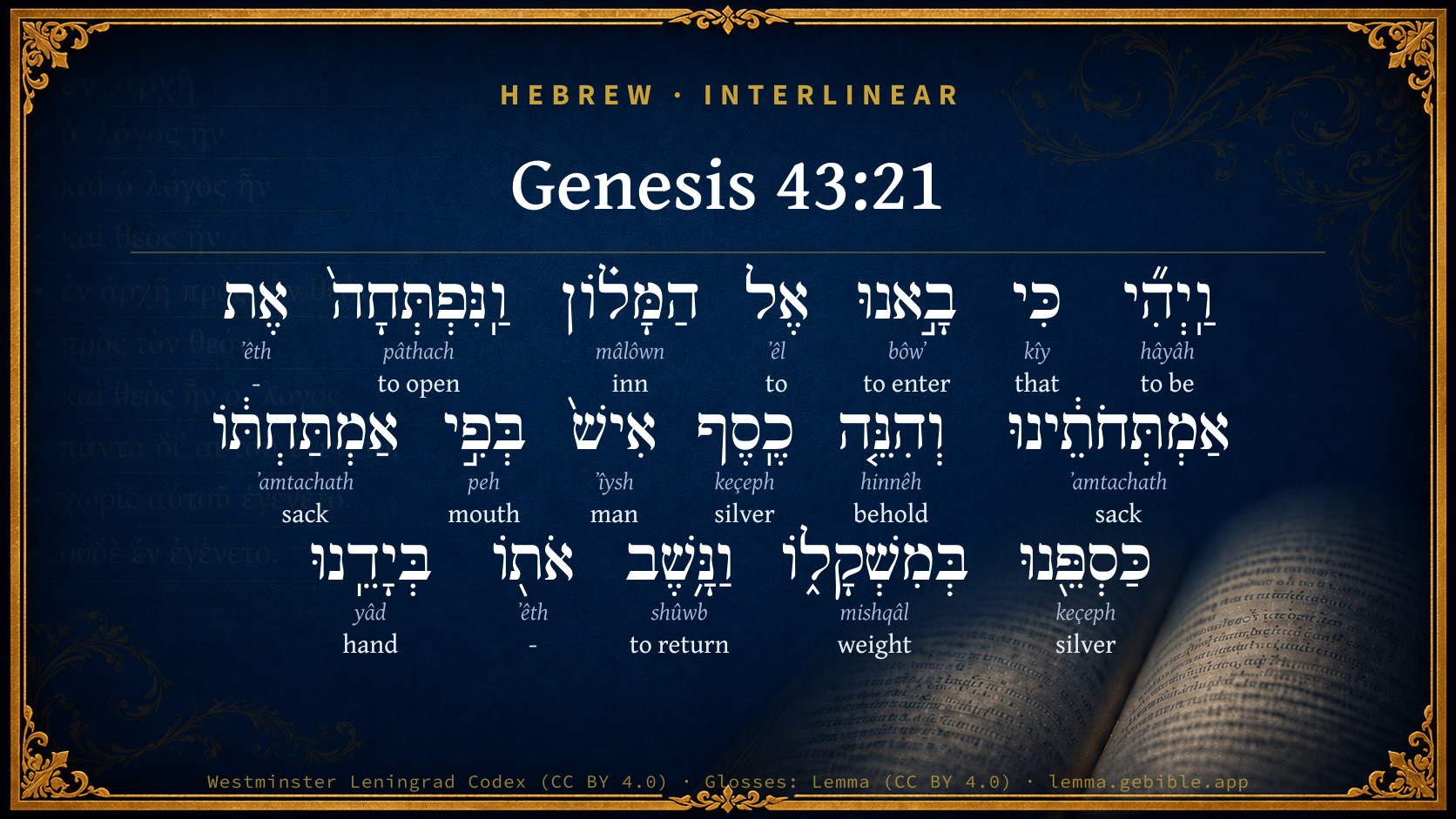
Hebrew (Westminster Leningrad Codex) Genesis 43:21 appears in the Hebrew Old Testament. The text above is from the Westminster Leningrad Codex. Each word links to its Strong’s number, a concise gloss, and parsing drawn from the Open Scriptures Hebrew Bible morphology. Click any word for its full Brown-Driver-Briggs (BDB) entry.
Download image
Cite this verse

Genesis 43:21 (World English Bible). Public Domain. Lemma interlinear Bible study tool, https://lemma.gebible.app/v/genesis/43/21.

Show BibTeX & RIS
BibTeX
RIS
English Translation
and it happened, when we came to the lodging-place, that we opened our sacks, and, behold, every man's money was in the mouth of his sack, our money in full weight. We have brought it again in our hand.
World English Bible · Public Domain
Download a study sheet

One document with this verse’s original text, its word-by-word gloss line, the meaning frame, cross-references with their text, attributed commentary, and full source and license credits — printable, and it pastes into notes with its structure intact.

This verse Autodidact and up

Study sheet (.html) Plain text (.txt)

A passage Seminary Student

Up to 50 verses in one chapter. A passage sheet keeps up to 6 commentary sources and 12 cross-references per verse, in the order this page ranks them, and says so on the sheet whenever that leaves anything out. Ask for a single verse and you get the Autodidact verse sheet above.

Everything on this page stays free to read, with no account — the sheet is a download of what is already on screen, not access to it.

Want to remove ads? Support Godless Engineer
Compare translations 3

The same verse in 3 English versions, stacked beneath the original-language interlinear above. Click any original word for its lexicon entry.

Each is an independent rendering of the whole verse — the interlinear is not word-aligned to these translations.

Highlighted words mark where these versions differ — a whole-verse word diff, not a word-by-word alignment.

  • World English Bible Public Domain
    and it happened, when we came to the lodging-place, that we opened our sacks, and, behold, every man's money was in the mouth of his sack, our money in full weight. We have brought it again in our hand.
  • King James Version Public Domain
    And it came to pass, when we came to the inn, that we opened our sacks, and, behold, every man's money was in the mouth of his sack, our money in full weight: and we have brought it again in our hand.
  • unfoldingWord Literal Text CC BY-SA 4.0
    But it happened when we came to the lodging place, we opened our sacks and behold, man’s silver in the mouth of his sack; our silver in its weight! So we have brought it back in our hand.

unfoldingWord Literal Text — © unfoldingWord, licensed CC BY-SA 4.0. Word-aligned USFM3 via Door43 (git.door43.org/unfoldingWord/en_ult).

Versions to compare (up to 4)

3 of 4 selected

Show all 18 translations

Every available English version of this verse, each an independent rendering of the whole verse.

  • World English Bible Public Domain
    and it happened, when we came to the lodging-place, that we opened our sacks, and, behold, every man's money was in the mouth of his sack, our money in full weight. We have brought it again in our hand.
  • Berean Standard Bible Public Domain
    But when we came to the place we lodged for the night, we opened our sacks and, behold, each of us found his silver in the mouth of his sack! It was the full amount of our silver, and we have brought it back with us.
  • Majority Standard Bible Public Domain
    But when we came to the place we lodged for the night, we opened our sacks and, behold, each of us found his silver in the mouth of his sack! It was the full amount of our silver, and we have brought it back with us.
  • King James Version Public Domain
    And it came to pass, when we came to the inn, that we opened our sacks, and, behold, every man's money was in the mouth of his sack, our money in full weight: and we have brought it again in our hand.
  • American Standard Version (1901) Public Domain
    and it came to pass, when we came to the lodging-place, that we opened our sacks, and, behold, every man's money was in the mouth of his sack, our money in full weight: and we have brought it again in our hand.
  • Revised Version (1885) Public Domain
    and it came to pass, when we came to the lodging place, that we opened our sacks, and, behold, every man’s money was in the mouth of his sack, our money in full weight: and we have brought it again in our hand.
  • Geneva Bible (1599) Public Domain
    And as wee came to an ynne and opened our sackes, behold, euery mans money was in his sackes mouth, euen our money in full weight, but we haue brought it againe in our handes.
  • Douay-Rheims (1899) Public Domain
    And when we had bought, and come to the inn, we opened our sacks, and found our money in the mouths of the sacks: which we have now brought again in the same weight.
  • Young's Literal Translation Public Domain
    and it cometh to pass, when we have come in unto the lodging-place, and open our bags, that lo, each one's money `is' in the mouth of his bag, our money in its weight, and we bring it back in our hand;
  • Literal Standard Version CC BY-SA 4.0
    and it comes to pass, when we have come to the lodging-place, and open our bags, that behold, each one’s money [is] in the mouth of his bag, our money in its weight, and we bring it back in our hand;
  • Unlocked Literal Bible CC BY-SA 4.0
    It came about, when we reached the lodging place, that we opened our sacks, and, behold, every man's money was in the opening of his sack, our money in full weight. We have brought it back in our hands.
  • unfoldingWord Literal Text CC BY-SA 4.0
    But it happened when we came to the lodging place, we opened our sacks and behold, man’s silver in the mouth of his sack; our silver in its weight! So we have brought it back in our hand.
  • Darby Bible Public Domain
    And it came to pass when we came to the inn, that we opened our sacks, and behold, [every] man's money was in the mouth of his sack, our money according to its weight; and we have brought it again in our hand.
  • World Messianic Bible Public Domain
    When we came to the lodging place, we opened our sacks, and behold, each man’s money was in the mouth of his sack, our money in full weight. We have brought it back in our hand.
  • Webster's Bible Public Domain
    \\43:22\\And other money have we brought down in our hands to buy food: we cannot tell who put our money in our sacks.
  • Free Bible Version CC BY-SA 4.0
    and when we stopped for the night, we opened our sacks and each of us found our money—the exact amount—at the top of our sacks. So we've brought it back with us.
  • Bible in Basic English Public Domain
    As well as more money, with which to get food: we have no idea who put our money in our bags.
  • JPS Tanakh (1917) Public Domain
    And it came to pass, when we came to the lodging-place, that we opened our sacks, and, behold, every man's money was in the mouth of his sack, our money in full weight; and we have brought it back in our hand.

Literal Standard Version (2020), Covenant Press — licensed CC BY-SA 4.0. Text via the HelloAO Bible API (eBible.org). Unlocked Literal Bible (unfoldingWord) — licensed CC BY-SA 4.0. Text via the HelloAO Bible API (eBible.org). unfoldingWord Literal Text — © unfoldingWord, licensed CC BY-SA 4.0. Word-aligned USFM3 via Door43 (git.door43.org/unfoldingWord/en_ult). Free Bible Version, Dr. Jonathan Gallagher — licensed CC BY-SA 4.0. Text via the HelloAO Bible API (eBible.org).

Word by word

More ways to search: Search by grammar → Find every occurrence → Compare this word →

Practice this passage: Drill this verse → Learn its vocabulary →

הַמָּל֗וֹן
mâlôwn
H4411
“the · inn”
Particle, Definite Article + Noun, Common, Masculine, Singular, Absolute
Part of Speech
Particle + Noun
Type
Common
Gender
Masculine
Number
Singular
State
Absolute
Full BDB Definition

Origin: from H3885

TWOT: 1096a

place of lodging, inn, khan
  1. וַֽיְהִ֞י hâyâh H1961 “and · to be” Conjunction + Verb, Qal, Sequential Imperfect, 3rd Person, Masculine, Singular
  2. כִּי kîy H3588 “that” Conjunction
  3. בָ֣אנוּ bôwʼ H935 “to enter” Verb, Qal, Perfect, 1st Person, Common, Plural
  4. אֶל ʼêl H413 “to” Preposition
  5. וַֽנִּפְתְּחָה֙ pâthach H6605 “and · to open” Conjunction + Verb, Qal, Sequential Imperfect, 1st Person, Common, Plural + Suffix, h
  6. אֶת ʼêth H853 “-” Particle, Direct Object
  7. אַמְתְּחֹתֵ֔ינוּ ʼamtachath H572 “sacks · our” Noun, Common, Feminine, Plural, Construct + Suffix, Personal, 1st Person, Common, Plural
  8. וְהִנֵּ֤ה hinnêh H2009 “and · behold” Conjunction + Particle, Demonstrative
  9. כֶֽסֶף keçeph H3701 “silver of” Noun, Common, Masculine, Singular, Construct
  10. אִישׁ֙ ʼîysh H376 “man” Noun, Common, Masculine, Singular, Absolute
  11. בְּפִ֣י peh H6310 “in/at · mouth of” Preposition + Noun, Common, Masculine, Singular, Construct
  12. אַמְתַּחְתּ֔וֹ ʼamtachath H572 “sack · his” Noun, Common, Feminine, Singular, Construct + Suffix, Personal, 3rd Person, Masculine, Singular
  13. כַּסְפֵּ֖נוּ keçeph H3701 “silver · our” Noun, Common, Masculine, Singular, Construct + Suffix, Personal, 1st Person, Common, Plural
  14. בְּמִשְׁקָל֑וֹ mishqâl H4948 “in/at · weight · his” Preposition + Noun, Common, Masculine, Singular, Construct + Suffix, Personal, 3rd Person, Masculine, Singular
  15. וַנָּ֥שֶׁב shûwb H7725 “and · to return” Conjunction + Verb, Hiphil, Sequential Imperfect, 1st Person, Common, Plural
  16. אֹת֖וֹ ʼêth H853 “- · him” Particle, Direct Object + Suffix, Personal, 3rd Person, Masculine, Singular
  17. בְּיָדֵֽנוּ yâd H3027 “in/at · hand · our” Preposition + Noun, Common, Both, Singular, Construct + Suffix, Personal, 1st Person, Common, Plural

About this verse

These counts appear in no published source. They are computed here, from the morphology-tagged text and Lemma’s own curated glosses. What Lemma adds →

18
words
15
distinct lemmas
Pentateuch
section

Notable vocabulary

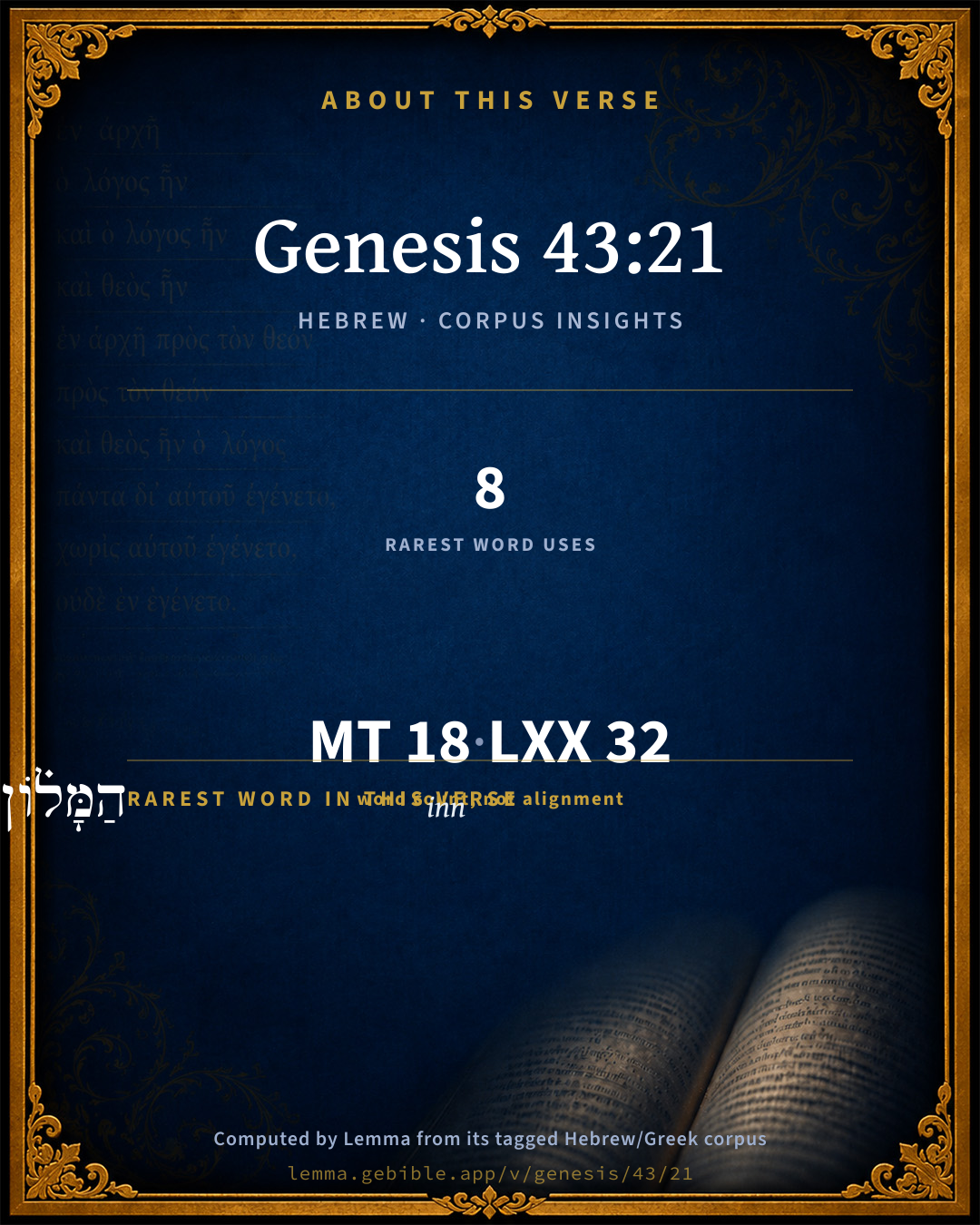
The rarest word here is הַמָּל֗וֹן inn H4411 — appearing just 8 times in the whole Hebrew Bible.

Shared distinctive vocabulary

הַמָּל֗וֹן inn H4411 occurs in 8 verses of the Hebrew Bible. Also found in:

Grammatical profile

  • 4 verbs
  • 9 nouns
  • 1 preposition
  • 1 conjunction
  • 3 particles

Verb forms

  • וַֽיְהִ֞י Qal · Sequential Imperfect
  • בָ֣אנוּ Qal · Perfect
  • וַֽנִּפְתְּחָה֙ Qal · Sequential Imperfect
  • וַנָּ֥שֶׁב Hiphil · Sequential Imperfect

Repetition

Words recur within this verse — often emphatic in Hebrew:

  • אַמְתְּחֹתֵ֔ינוּ sack H572 ×2
  • כֶֽסֶף silver H3701 ×2

Hebrew & Septuagint length

In English translation the verse runs 39 words from the Hebrew and 36 from the Septuagint (LXX English) — closely comparable.

A rough comparison of the two English renderings, which tokenize alike — not a word-level alignment.

Word counts can differ between the Hebrew and the Greek without any difference in meaning — e.g. the Hebrew direct-object marker אֵת has no separate Greek word, and Greek often adds the article ὁ.

In the original languages it is 18 Hebrew tokens and 32 Greek tokens — but the two are counted differently (Hebrew bundles its prefixes and suffixes into one token; the Greek is in lemma form), so that isn’t a like-for-like length.

Cross-references

9

Topical passages linked to Genesis 43:21 in the Treasury of Scripture Knowledge — connected by theme and wording, ordered by reader-vote popularity; previews shown in the World English Bible.

  • Genesis 43:12 and take double money in your hand, with the money that was returned in the mouth of your sacks carry again in your hand. Perhaps it was an oversight.
  • Genesis 42:27–35 As one of them opened his sack to give his donkey food in the lodging-place, he saw his money. Behold, it was in the mouth of his sack.
  • Genesis 43:15 The men took that present, and they took double money in their hand, and Benjamin; and rose up, went down to Egypt, and stood before Joseph.
  • Romans 12:17 Repay no one evil for evil. Respect what is honorable in the sight of all men.
  • Romans 13:8 Owe no one anything, except to love one another; for he who loves his neighbor has fulfilled the law.
  • Hebrews 13:5 Be free from the love of money, content with such things as you have, for he has said, "I will in no way leave you, neither will I in any way forsake you."
  • Hebrews 13:18 Pray for us, for we are persuaded that we have a good conscience, desiring to live honorably in all things.
  • 1 Peter 2:12 having good behavior among the nations, so in that which they speak against you as evil-doers, they may by your good works, which they see, glorify God in the day of visitation.
  • 1 Peter 3:16 having a good conscience; that, while you are spoken against as evildoers, they may be disappointed who curse your good manner of life in Christ.

Cross-references courtesy of OpenBible.info (CC BY 4.0).

Hebrew and Greek witnesses Masoretic Hebrew ↔ Greek Septuagint

The same verse in the two great witnesses to the Old Testament, shown verse-for-verse.

These are two independent witnesses, not word-aligned to each other, and the Septuagint is shown in lemma (dictionary) form.

Hebrew Genesis 43:21 Masoretic · Westminster Leningrad Codex

וַֽיְהִ֞י כִּי בָ֣אנוּ אֶל הַמָּל֗וֹן וַֽנִּפְתְּחָה֙ אֶת אַמְתְּחֹתֵ֔ינוּ וְהִנֵּ֤ה כֶֽסֶף אִישׁ֙ בְּפִ֣י אַמְתַּחְתּ֔וֹ כַּסְפֵּ֖נוּ בְּמִשְׁקָל֑וֹ וַנָּ֥שֶׁב אֹת֖וֹ בְּיָדֵֽנוּ

and it happened, when we came to the lodging-place, that we opened our sacks, and, behold, every man's money was in the mouth of his sack, our money in full weight. We have brought it again in our hand.

World English Bible · Public Domain

Greek LXX Genesis 43:21 Septuagint · lemma form

γίγνομαι δέ ἡνίκα ἔρχομαι εἰς ὁ καταλύω καί ἀναοἴγω ὁ μάρσιππος ἐγώ καί ὅδε ὁ ἀργύριον ἕκαστος ἐν ὁ μάρσιππος αὐτός ὁ ἀργύριον ἐγώ ἐν σταθμός ἀποστρέφω νῦν ἐν ὁ χείρ ἐγώ

And it came to pass, when we came to unlade, and opened our sacks, there was also this money of each in his sack; we have now brought back our money by weight in our hands.

LXX2012 (modern English Septuagint) · Public Domain

Hebrew: Westminster Leningrad Codex (CC BY 4.0). Greek: Septuagint (public domain); English from LXX2012 (modern English Septuagint) (Public Domain). How the Septuagint differs from the Hebrew →

Targum (Aramaic paraphrase)

2

The Targum is the ancient Jewish Aramaic paraphrase of the Hebrew Scriptures — an interpretive translation, not the Hebrew text itself. Onkelos (literal) and Pseudo-Jonathan (expansive) render the Torah, and Jonathan the Prophets. Coverage is partial: where no permissively-licensed English translation exists for a verse, only the Aramaic is shown. This is verse-level text, not a word-by-word alignment to the Hebrew.

  1. Targum Onkelos Torah (Genesis–Deuteronomy)
    וַהֲוָה כַּד אָתֵינָא לְבֵית מְבָתָא וּפְתַחְנָא יָת טוֹעֲנָנָא וְהָא כְסַף גְּבַר בְּפוּם טוֹעֲנֵהּ כַּסְפָּנָא בְּמַתְקְלֵהּ וַאֲתֵיבְנָא יָתֵהּ בִּידָנָא

    (no public-domain English translation for this verse)

    Targum Onkelos — Aramaic: “Onkelos Genesis” (public domain); “Onkelos Exodus” (public domain); “Onkelos Leviticus” (public domain); “Onkelos Numbers” (public domain); “Onkelos Deuteronomy” (public domain). English: “Sefaria Community Translation” (CC0 1.0 (public-domain dedication)); “J.W. Etheridge. The Targums of Onkelos and Jonathan Ben Uzziel on the Pentateuch. London: Longmans, Green, 1862” (public domain). Text via Sefaria.

  2. Targum Pseudo-Jonathan Torah (Genesis–Deuteronomy)
    וַהֲוָה כַּד מַטִינָא לְבֵית מִבְתוֹתָא וּפְתַחְנָא יַת טוֹנָנָא וְהָא כְּסַף גְבַר בְּפוּם טוֹנֵיהּ כַּסְפָּנָא בְּמִתְקְלֵיהּ וְאָתֵיבְנָא יָתֵיהּ בִּידָנָא

    But it was when we had come to our place of lodging, that we opened our sacks, and, behold, the money of a man was in the mouth of his sack: but we have brought it back in our hand.

    Targum Pseudo-Jonathan — Aramaic: “Targum Jonathan on Genesis” (public domain); “Targum Jonathan on Exodus” (public domain); “Targum Jonathan on Leviticus” (public domain); “Targum Jonathan on Numbers” (public domain); “Targum Jonathan on Deuteronomy” (public domain). English: “The Targum of Jonathan ben Uzziel, trans. J. W. Etheridge, London, 1862” (public domain). Text via Sefaria.

Commentary

Notes on Genesis 43:21 from classic Christian and Jewish commentators (each source and its license shown beneath its notes). The classic Christian expositions comment on the surrounding passage and are grouped to its opening verse, so a note may address several verses; the Jewish commentaries on the Tanakh (Rashi and others) are per-verse, so they appear only where the commentator wrote on this verse.

Lemma curates 59 commentaries, every one of them public domain or Creative Commons licensed, each selected and text-cleaned for this edition rather than reprinted as found. About our sources →

Trapp's Complete Commentary

John Trapp

Gen 43:21 And it came to pass, when we came to the inn, that we opened our sacks, and, behold, [every] man’s money [was] in the mouth of his sack, our money in full weight: and we have brought it again in our hand.

Ver. 21. Every man’s money.] This made their hearts even ready to go out of their mouths, as the Heb. hath it. {Gen 42:35}

John Trapp, A Commentary or Exposition upon All the Books of the Old and New Testament (1647–1656) — public domain. Text from a community e-Sword module.

Ellicott's Commentary for English Readers

(21) The inn.—The lodging-place. (See Note on Gen_42:27.)

Our sacks.—Heb., our travelling or forage bags. It is the word used at the end of Gen_42:27. So immediately afterwards the silver was found “in the mouth of the travelling-bag.” And so again in Gen_43:22-23. This is accurate, as the silver was placed in the private bag of each one, and not in the corn sacks; but as we have seen in Gen_42:27; Gen_42:35, only one of them found his money at the lodging-place. This, however, was a matter of no importance, while it was necessary to show that they were a full day’s journey on the route homewards before the mistake was discovered.

A Bible Commentary for English Readers, edited by Charles John Ellicott (1878–1897) — public domain. Text from a community e-Sword module.

The Cambridge Bible for Schools and Colleges

gen. ed. J. J. S. Perowne

21. the lodging place) Cf. Gen_42:27 (J).

every man’s money] According to E, every man’s bundle of money was found, when they emptied their sacks at their journey’s end. Cf. Gen_42:35.

in full weight] Lit. “in its weight.” The money was not in coins, but in metal, probably bars, rings, or ingots, which had to be weighed.

The Cambridge Bible for Schools and Colleges (gen. ed. J. J. S. Perowne; Cambridge University Press, 1878–1918) — public domain. Text from a community e-Sword module.

John Gill's Exposition

And other money have we brought down in our hands to buy food,.... Double money for a double quantity, or because the price of corn was now doubled; and their bringing this besides the other showed their honest and upright intentions:

we cannot tell who put our money in our sacks; we are quite ignorant of it, and can by no means account for it, and therefore hope no blame will be laid on us.

John Gill's Exposition of the Whole Bible (1746–1763) — public domain (CC PDM 1.0). Text via the HelloAO Bible API.

Haydock's Catholic Bible Commentary

We opened. Chap. xlii. 35. They seem to have discovered the whole of their money only when they were in the presence of Jacob; though they had already, perhaps, seen part of it at the inn, and left it in their sacks for the satisfaction of their father. (Haydock)

George Leo Haydock (1774–1849), Haydock's Catholic Family Bible and Commentary, 1859 edition — public domain. Excludes Psalms (Douay-Rheims chapter numbering differs from Protestant) and Deuterocanonical books (Catholic canon only).

unfoldingWord translationNotes

Door43 World Missions Community

Connecting Statement:

The brothers continue speaking to the steward of the house.

It came about

This phrase is used here to mark an important event in the story. If your language has a way for doing this, you could consider using it here.

when we reached the lodging place

"when we came to the place that we were going to stay for the night"

behold

The word "behold" here shows that the brothers were surprised by what they saw.

every man's money was in the opening of his sack, our money in full weight

"each one of us found the full amount of his money in his sack"

We have brought it back in our hands

Here "hands" stands for the whole person. AT: "We have brought the money back with us" (See: Synecdoche)

Other money we have also brought down in our hand to buy food

Here "hand" stands for the whole person. AT: "We have also brought more money to buy food" (See: Synecdoche)

brought down

It common to use the word "down" when speaking of traveling from Canaan to Egypt.

Peace be to you

The abstract noun "Peace" can be stated as a verb. AT: "Relax" or "Calm yourselves" (See: Abstract Nouns)

Your God and the God of your father

The stewards is not speaking about two different Gods. AT: "Your God, the God your father worships"

translationWords

manager

peace

fear

God

Simeon

unfoldingWord translationNotes — © Distant Shores Media and the Door43 World Missions Community, licensed CC BY-SA 4.0. Source: git.door43.org/Door43/en_tn.

Lesson kit

Teaching starters — assembled from the data on this page, not authored interpretation. Every prompt links to the verse data it draws on. Edit before teaching.

Genesis, in the Pentateuch, opens this verse with 18 words (15 distinct Hebrew lemmas). Its most distinctive word is mâlôwn (“inn”). A historical commentator’s framing appears above. Read the whole chapter for the surrounding context.

Discussion questions

  1. What does “inn” (mâlôwn) contribute to the verse as a whole?
  2. Genesis 42:27 shares the word «inn» with this verse. How do the two illuminate each other?
  3. “sack” occurs 2× in this one verse. What is the effect of the repetition?
  4. The translations on this page render this verse differently — a whole-verse word diff, not a word-by-word alignment. What might account for the different wordings?
  5. The verb «וַֽיְהִ֞י» is Qal Sequential Imperfect. How does its form color the action?
  6. Reading how Trapp's Complete Commentary and Ellicott's Commentary for English Readers read this verse, where do the two commentators agree and where do they part?

Things to notice

Reading settings

Reading text

Shown beneath each verse's original-language words.

Old Testament
Old Testament edition

Read the OT as the Masoretic Hebrew (MT) or the Greek Septuagint (LXX).

English shown for the Greek Septuagint (in the Hebrew ↔ Greek comparison).

Comparing translations? Open the Compare panel on any verse page to stack up to four side by side.