
Exodus 7:10

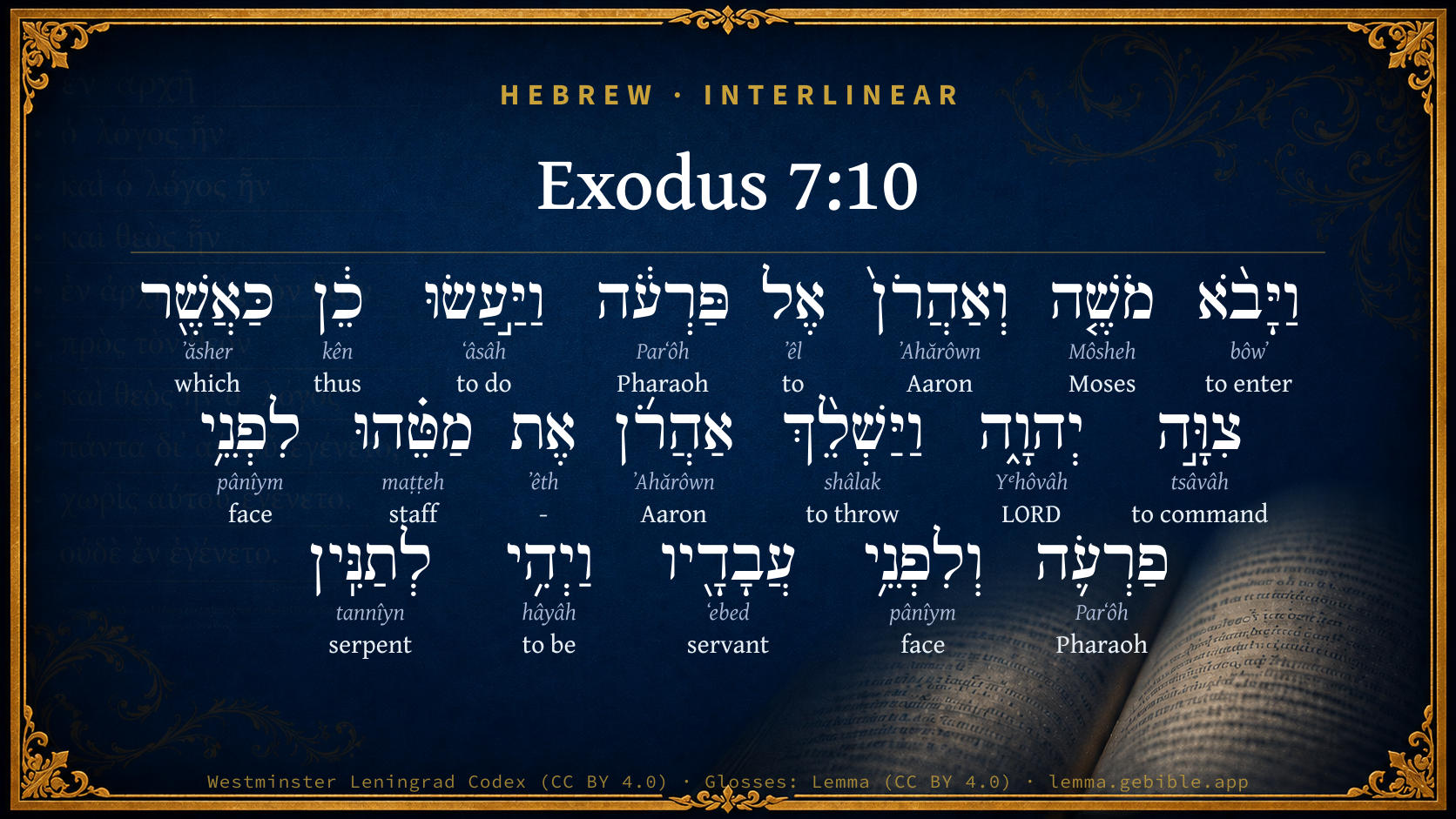
Hebrew (Westminster Leningrad Codex) Exodus 7:10 appears in the Hebrew Old Testament. The text above is from the Westminster Leningrad Codex. Each word links to its Strong’s number, a concise gloss, and parsing drawn from the Open Scriptures Hebrew Bible morphology. Click any word for its full Brown-Driver-Briggs (BDB) entry.
Download image
Cite this verse

Exodus 7:10 (World English Bible). Public Domain. Lemma interlinear Bible study tool, https://lemma.gebible.app/v/exodus/7/10.

Show BibTeX & RIS
BibTeX
RIS
English Translation
Moses and Aaron went in to Pharaoh, and they did so, as Yahweh had commanded: and Aaron cast down his rod before Pharaoh and before his servants, and it became a serpent.
World English Bible · Public Domain
Download a study sheet

One document with this verse’s original text, its word-by-word gloss line, the meaning frame, cross-references with their text, attributed commentary, and full source and license credits — printable, and it pastes into notes with its structure intact.

This verse Autodidact and up

Study sheet (.html) Plain text (.txt)

A passage Seminary Student

Up to 50 verses in one chapter. A passage sheet keeps up to 6 commentary sources and 12 cross-references per verse, in the order this page ranks them, and says so on the sheet whenever that leaves anything out. Ask for a single verse and you get the Autodidact verse sheet above.

Everything on this page stays free to read, with no account — the sheet is a download of what is already on screen, not access to it.

Want to remove ads? Support Godless Engineer
Compare translations 3

The same verse in 3 English versions, stacked beneath the original-language interlinear above. Click any original word for its lexicon entry.

Each is an independent rendering of the whole verse — the interlinear is not word-aligned to these translations.

Highlighted words mark where these versions differ — a whole-verse word diff, not a word-by-word alignment.

  • World English Bible Public Domain
    Moses and Aaron went in to Pharaoh, and they did so, as Yahweh had commanded: and Aaron cast down his rod before Pharaoh and before his servants, and it became a serpent.
  • King James Version Public Domain
    And Moses and Aaron went in unto Pharaoh, and they did so as the LORD had commanded: and Aaron cast down his rod before Pharaoh, and before his servants, and it became a serpent.
  • unfoldingWord Literal Text CC BY-SA 4.0
    And Moses and Aaron entered in to Pharaoh, and they did just as Yahweh commanded. And Aaron threw down his staff before the face of Pharaoh and before the faces of his servants, and it became a serpent.

unfoldingWord Literal Text — © unfoldingWord, licensed CC BY-SA 4.0. Word-aligned USFM3 via Door43 (git.door43.org/unfoldingWord/en_ult).

Versions to compare (up to 4)

3 of 4 selected

Show all 18 translations

Every available English version of this verse, each an independent rendering of the whole verse.

  • World English Bible Public Domain
    Moses and Aaron went in to Pharaoh, and they did so, as Yahweh had commanded: and Aaron cast down his rod before Pharaoh and before his servants, and it became a serpent.
  • Berean Standard Bible Public Domain
    So Moses and Aaron went to Pharaoh and did just as the LORD had commanded. Aaron threw his staff down before Pharaoh and his officials, and it became a serpent.
  • Majority Standard Bible Public Domain
    So Moses and Aaron went to Pharaoh and did just as the LORD had commanded. Aaron threw his staff down before Pharaoh and his officials, and it became a serpent.
  • King James Version Public Domain
    And Moses and Aaron went in unto Pharaoh, and they did so as the LORD had commanded: and Aaron cast down his rod before Pharaoh, and before his servants, and it became a serpent.
  • American Standard Version (1901) Public Domain
    And Moses and Aaron went in unto Pharaoh, and they did so, as Jehovah had commanded: and Aaron cast down his rod before Pharaoh and before his servants, and it became a serpent.
  • Revised Version (1885) Public Domain
    And Moses and Aaron went in unto Pharaoh, and they did so, as the LORD had commanded: and Aaron cast down his rod before Pharaoh and before his servants, and it became a serpent.
  • Geneva Bible (1599) Public Domain
    Then went Moses and Aaron vnto Pharaoh, and did euen as the Lord had commanded: and Aaron cast forth his rod before Pharaoh and before his seruants, and it was turned into a serpent.
  • Douay-Rheims (1899) Public Domain
    So Moses and Aaron went in unto Pharao, and did as the Lord had commanded. And Aaron took the rod before Pharao, and his servants, and it was turned into a serpent.
  • Young's Literal Translation Public Domain
    And Moses goeth in -- Aaron also -- unto Pharaoh, and they do so as Jehovah hath commanded; and Aaron casteth his rod before Pharaoh, and before his servants, and it becometh a monster.
  • Literal Standard Version CC BY-SA 4.0
    And Moses goes in—Aaron also—to Pharaoh, and they do so as YHWH has commanded; and Aaron casts his rod before Pharaoh and before his servants, and it becomes a dragon.
  • Unlocked Literal Bible CC BY-SA 4.0
    Then Moses and Aaron went to Pharaoh, and they did just as Yahweh had commanded. Aaron threw down his staff before Pharaoh and his servants, and it became a snake.
  • unfoldingWord Literal Text CC BY-SA 4.0
    And Moses and Aaron entered in to Pharaoh, and they did just as Yahweh commanded. And Aaron threw down his staff before the face of Pharaoh and before the faces of his servants, and it became a serpent.
  • Darby Bible Public Domain
    And Moses and Aaron went in to Pharaoh, and did so, as Jehovah had commanded; and Aaron cast down his staff before Pharaoh, and before his bondmen, and it became a serpent.
  • World Messianic Bible Public Domain
    Moses and Aaron went in to Pharaoh, and they did so, as the LORD had commanded. Aaron cast down his rod before Pharaoh and before his servants, and it became a serpent.
  • Webster's Bible Public Domain
    And Moses and Aaron went in to Pharaoh, and they did so as the LORD had commanded: And Aaron cast down his rod before Pharaoh, and before his servants, and it became a serpent.
  • Free Bible Version CC BY-SA 4.0
    Moses and Aaron went to Pharaoh and did what the Lord had ordered. Aaron threw down his staff in front of Pharaoh and his officials, and it turned into a snake.
  • Bible in Basic English Public Domain
    Then Moses and Aaron went in to Pharaoh and they did as the Lord had said: and Aaron put his rod down on the earth before Pharaoh and his servants, and it became a snake.
  • JPS Tanakh (1917) Public Domain
    And Moses and Aaron went in unto Pharaoh, and they did so, as the LORD had commanded; and Aaron cast down his rod before Pharaoh and before his servants, and it became a serpent.

Literal Standard Version (2020), Covenant Press — licensed CC BY-SA 4.0. Text via the HelloAO Bible API (eBible.org). Unlocked Literal Bible (unfoldingWord) — licensed CC BY-SA 4.0. Text via the HelloAO Bible API (eBible.org). unfoldingWord Literal Text — © unfoldingWord, licensed CC BY-SA 4.0. Word-aligned USFM3 via Door43 (git.door43.org/unfoldingWord/en_ult). Free Bible Version, Dr. Jonathan Gallagher — licensed CC BY-SA 4.0. Text via the HelloAO Bible API (eBible.org).

Word by word

More ways to search: Search by grammar → Find every occurrence → Compare this word →

Practice this passage: Drill this verse → Learn its vocabulary →

לְתַנִּֽין
tannîyn
H8577
“to/for · serpent”
Preposition + Noun, Common, Masculine, Singular, Absolute
Part of Speech
Preposition + Noun
Type
Common
Gender
Masculine
Number
Singular
State
Absolute
Full BDB Definition

Origin: intensive from the same as H8565

TWOT: 2528b

dragon, serpent, sea monster - dragon or dinosaur - sea or river monster - serpent, venomous snake
  1. וַיָּבֹ֨א bôwʼ H935 “and · to enter” Conjunction + Verb, Qal, Sequential Imperfect, 3rd Person, Masculine, Singular
  2. מֹשֶׁ֤ה Môsheh H4872 “Moses” Noun, Proper
  3. וְאַהֲרֹן֙ ʼAhărôwn H175 “and · Aaron” Conjunction + Noun, Proper
  4. אֶל ʼêl H413 “to” Preposition
  5. פַּרְעֹ֔ה Parʻôh H6547 “Pharaoh” Noun, Proper
  6. וַיַּ֣עַשׂוּ ʻâsâh H6213 “and · to do” Conjunction + Verb, Qal, Sequential Imperfect, 3rd Person, Masculine, Plural
  7. כֵ֔ן kên H3651 “thus” Adverb
  8. כַּאֲשֶׁ֖ר ʼăsher H834 “like/as · which” Preposition + Particle, Relative
  9. צִוָּ֣ה tsâvâh H6680 “to command” Verb, Piel, Perfect, 3rd Person, Masculine, Singular
  10. יְהוָ֑ה Yᵉhôvâh H3068 “LORD” Noun, Proper
  11. וַיַּשְׁלֵ֨ךְ shâlak H7993 “and · to throw” Conjunction + Verb, Hiphil, Sequential Imperfect, 3rd Person, Masculine, Singular
  12. אַהֲרֹ֜ן ʼAhărôwn H175 “Aaron” Noun, Proper
  13. אֶת ʼêth H853 “-” Particle, Direct Object
  14. מַטֵּ֗הוּ maṭṭeh H4294 “staff · his” Noun, Common, Masculine, Singular, Construct + Suffix, Personal, 3rd Person, Masculine, Singular
  15. לִפְנֵ֥י pânîym H6440 “to/for · face(s) of” Preposition + Noun, Common, Both, Plural, Construct
  16. פַרְעֹ֛ה Parʻôh H6547 “Pharaoh” Noun, Proper
  17. וְלִפְנֵ֥י pânîym H6440 “and · to/for · face(s) of” Conjunction + Preposition + Noun, Common, Both, Plural, Construct
  18. עֲבָדָ֖יו ʻebed H5650 “servants · his” Noun, Common, Masculine, Plural, Construct + Suffix, Personal, 3rd Person, Masculine, Singular
  19. וַיְהִ֥י hâyâh H1961 “and · to be” Conjunction + Verb, Qal, Sequential Imperfect, 3rd Person, Masculine, Singular

About this verse

These counts appear in no published source. They are computed here, from the morphology-tagged text and Lemma’s own curated glosses. What Lemma adds →

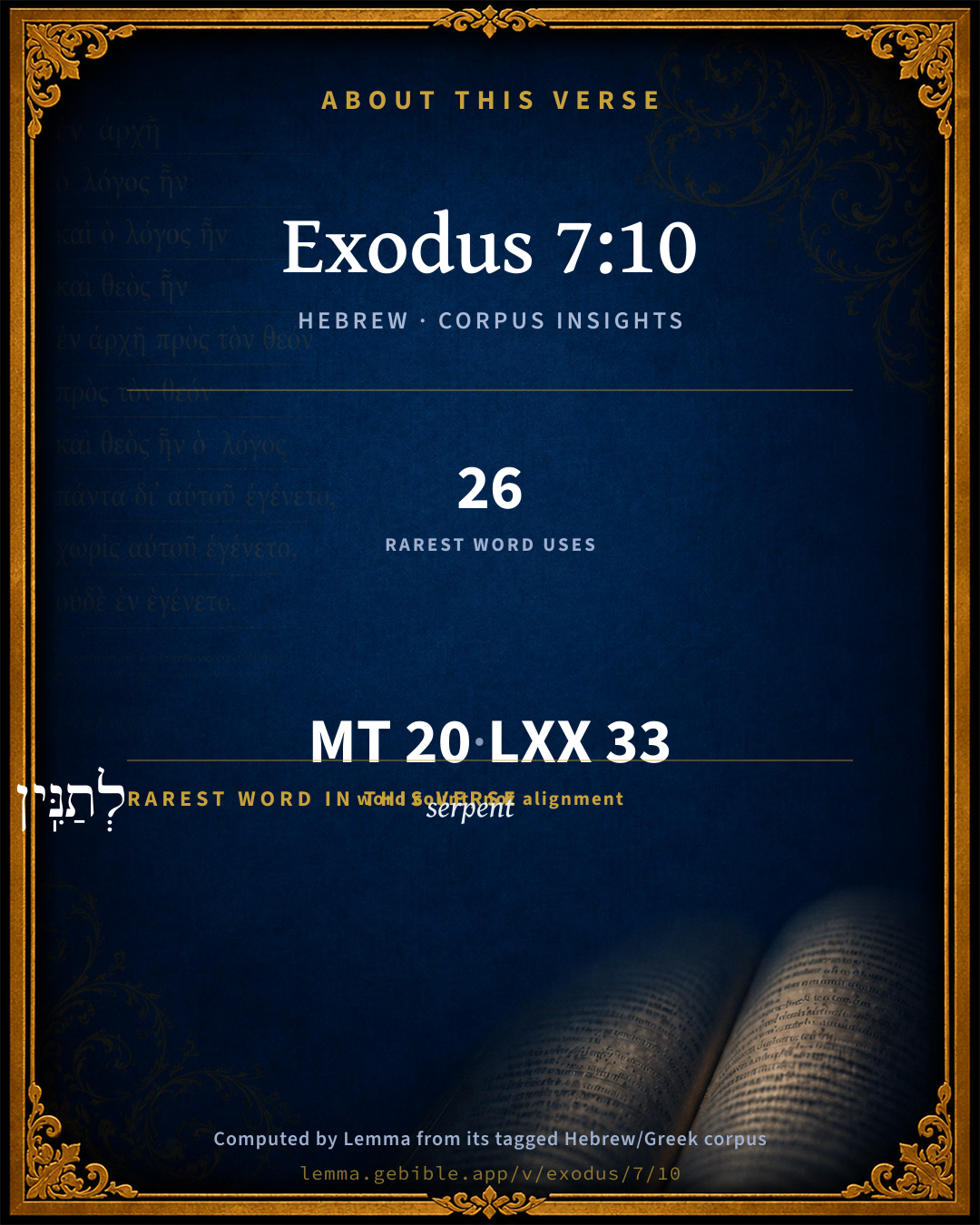
20
words
17
distinct lemmas
Pentateuch
section

Shared distinctive vocabulary

לְתַנִּֽין serpent H8577 occurs in 26 verses of the Hebrew Bible. Also found in:

Grammatical profile

  • 5 verbs
  • 11 nouns
  • 1 preposition
  • 1 adverb
  • 2 particles

Verb forms

  • וַיָּבֹ֨א Qal · Sequential Imperfect
  • וַיַּ֣עַשׂוּ Qal · Sequential Imperfect
  • צִוָּ֣ה Piel · Perfect
  • וַיַּשְׁלֵ֨ךְ Hiphil · Sequential Imperfect
  • וַיְהִ֥י Qal · Sequential Imperfect

Repetition

Words recur within this verse — often emphatic in Hebrew:

  • וְאַהֲרֹן֙ Aaron H175 ×2
  • פַּרְעֹ֔ה Pharaoh H6547 ×2
  • לִפְנֵ֥י face H6440 ×2

Hebrew & Septuagint length

In English translation the verse runs 32 words from the Hebrew and 38 from the Septuagint (LXX English) — closely comparable.

A rough comparison of the two English renderings, which tokenize alike — not a word-level alignment.

Word counts can differ between the Hebrew and the Greek without any difference in meaning — e.g. the Hebrew direct-object marker אֵת has no separate Greek word, and Greek often adds the article ὁ.

In the original languages it is 20 Hebrew tokens and 33 Greek tokens — but the two are counted differently (Hebrew bundles its prefixes and suffixes into one token; the Greek is in lemma form), so that isn’t a like-for-like length.

Cross-references

4

Topical passages linked to Exodus 7:10 in the Treasury of Scripture Knowledge — connected by theme and wording, ordered by reader-vote popularity; previews shown in the World English Bible.

  • Exodus 4:3 He said, "Throw it on the ground." He threw it on the ground, and it became a snake; and Moses ran away from it.
  • Amos 9:3 Though they hide themselves in the top of Carmel, I will search and take them out there; and though they be hid from my sight in the bottom of the sea, there I will command the serpent, and it will bite them.
  • Mark 16:18 they will take up serpents; and if they drink any deadly thing, it will in no way hurt them; they will lay hands on the sick, and they will recover."
  • Luke 10:19 Behold, I give you authority to tread on serpents and scorpions, and over all the power of the enemy. Nothing will in any way hurt you.

Cross-references courtesy of OpenBible.info (CC BY 4.0).

Hebrew and Greek witnesses Masoretic Hebrew ↔ Greek Septuagint

The same verse in the two great witnesses to the Old Testament, shown verse-for-verse.

These are two independent witnesses, not word-aligned to each other, and the Septuagint is shown in lemma (dictionary) form.

Hebrew Exodus 7:10 Masoretic · Westminster Leningrad Codex

וַיָּבֹ֨א מֹשֶׁ֤ה וְאַהֲרֹן֙ אֶל פַּרְעֹ֔ה וַיַּ֣עַשׂוּ כֵ֔ן כַּאֲשֶׁ֖ר צִוָּ֣ה יְהוָ֑ה וַיַּשְׁלֵ֨ךְ אַהֲרֹ֜ן אֶת מַטֵּ֗הוּ לִפְנֵ֥י פַרְעֹ֛ה וְלִפְנֵ֥י עֲבָדָ֖יו וַיְהִ֥י לְתַנִּֽין

Moses and Aaron went in to Pharaoh, and they did so, as Yahweh had commanded: and Aaron cast down his rod before Pharaoh and before his servants, and it became a serpent.

World English Bible · Public Domain

Greek LXX Exodus 7:10 Septuagint · lemma form

εἰςἔρχομαι δέ μωυσῆς καί ααρων ἐναντίον φαραώ καί ὁ θεράπων αὐτός καί ποιέω οὕτως καθάπερ ἐντέλλομαι αὐτός κύριος καί ῥίπτω ααρων ὁ ῥάβδος ἐναντίον φαραώ καί ἐναντίον ὁ θεράπων αὐτός καί γίγνομαι δράκων

And Moses and Aaron went in before Pharao, and before his servants, and they did so, as the Lord commanded them; and Aaron cast down his rod before Pharao, and before his servants, and it became a serpent.

LXX2012 (modern English Septuagint) · Public Domain

On this verse, John Gill's Exposition discusses the Septuagint’s reading. Read the note in Commentary ↓

Hebrew: Westminster Leningrad Codex (CC BY 4.0). Greek: Septuagint (public domain); English from LXX2012 (modern English Septuagint) (Public Domain). How the Septuagint differs from the Hebrew →

Targum (Aramaic paraphrase)

2

The Targum is the ancient Jewish Aramaic paraphrase of the Hebrew Scriptures — an interpretive translation, not the Hebrew text itself. Onkelos (literal) and Pseudo-Jonathan (expansive) render the Torah, and Jonathan the Prophets. Coverage is partial: where no permissively-licensed English translation exists for a verse, only the Aramaic is shown. This is verse-level text, not a word-by-word alignment to the Hebrew.

  1. Targum Onkelos Torah (Genesis–Deuteronomy)
    וְעַל משֶׁה וְאַהֲרֹן לְוָת פַּרְעֹה וַעֲבָדוּ כֵן כְּמָא דְפַקֵיד יְיָ וּרְמָא אַהֲרֹן יָת חוּטְרֵהּ קֳדָם פַּרְעֹה וְקָדָם עַבְדוֹהִי וַהֲוָה לְתַנִינָא:

    (no public-domain English translation for this verse)

    Targum Onkelos — Aramaic: “Onkelos Genesis” (public domain); “Onkelos Exodus” (public domain); “Onkelos Leviticus” (public domain); “Onkelos Numbers” (public domain); “Onkelos Deuteronomy” (public domain). English: “Sefaria Community Translation” (CC0 1.0 (public-domain dedication)); “J.W. Etheridge. The Targums of Onkelos and Jonathan Ben Uzziel on the Pentateuch. London: Longmans, Green, 1862” (public domain). Text via Sefaria.

  2. Targum Pseudo-Jonathan Torah (Genesis–Deuteronomy)
    וְאָעֵל משֶׁה וְאַהֲרן לְוַת פַּרְעה וְעָבָדוּ הֵיכְדֵין הֵיכְמָא דְפַקֵיד יְיָ וּטְלַק אַהֲרן יַת חוּטְרֵיהּ קֳדָם מֵיחְמֵי פַּרְעה וְקָדָם מֵיחְמֵי עַבְדוֹי וַהֲוָה לְחוּרְמָנָא

    And Mosheh and Aharon went in unto Pharoh, and did as the Lord had commanded. And Aharon threw down the rod before the sight of Pharoh, and before the sight of his servants, and it became a basilisk.

    Targum Pseudo-Jonathan — Aramaic: “Targum Jonathan on Genesis” (public domain); “Targum Jonathan on Exodus” (public domain); “Targum Jonathan on Leviticus” (public domain); “Targum Jonathan on Numbers” (public domain); “Targum Jonathan on Deuteronomy” (public domain). English: “The Targum of Jonathan ben Uzziel, trans. J. W. Etheridge, London, 1862” (public domain). Text via Sefaria.

Commentary

Notes on Exodus 7:10 from classic Christian and Jewish commentators (each source and its license shown beneath its notes). The classic Christian expositions comment on the surrounding passage and are grouped to its opening verse, so a note may address several verses; the Jewish commentaries on the Tanakh (Rashi and others) are per-verse, so they appear only where the commentator wrote on this verse.

Lemma curates 59 commentaries, every one of them public domain or Creative Commons licensed, each selected and text-cleaned for this edition rather than reprinted as found. About our sources →

Trapp's Complete Commentary

John Trapp

Exo 7:10 And Moses and Aaron went in unto Pharaoh, and they did so as the LORD had commanded: and Aaron cast down his rod before Pharaoh, and before his servants, and it became a serpent.

Ver. 10. And it became a serpent.] Or a dragon, in token of desolation, if they disobeyed; and that their country should become a den of dragons. {Isa 13:22}

John Trapp, A Commentary or Exposition upon All the Books of the Old and New Testament (1647–1656) — public domain. Text from a community e-Sword module.

Joseph Benson's Commentary

Exo 7:10. It became a serpent — This was proper, not only to affect Pharaoh with wonder, but to strike a terror upon him. This first miracle, though it was not a plague, yet amounted to the threatening of a plague; if it made not Pharaoh feel, it made him fear; and this is God’s method of dealing with sinners; he comes upon them gradually.

Joseph Benson's Commentary on the Old and New Testaments (1811–1818) — public domain. Text from a community e-Sword module.

Whedon's Commentary on the Bible

Daniel D. Whedon

OPENING CONTEST WITH THE MAGICIANS, Exo_7:10-13.

10. And Aaron cast down his rod… and it became a serpent — תנין, a dragon or crocodile, not the serpent (נחשׁ) into which the rod was changed when Moses came before the elders of Israel. Exo_4:3. The shepherd’s staff is changed into the monster of the Nile. Pharaoh is thus warned, by a symbol clear to the Egyptian mind, that the shepherd race of Israel is to be miraculously transformed into a formidable nation, comparable in might with Egypt. The crocodile’s tail is the hieroglyphic symbol of Egypt.

Daniel D. Whedon (gen. ed.), Commentary on the Old and New Testaments (1874–1909) — public domain. Text from a community e-Sword module.

Jamieson, Fausset & Brown

Robert Jamieson, A. R. Fausset & David Brown

Aaron cast down his rod before Pharaoh, &c.--It is to be presumed that Pharaoh had demanded a proof of their divine mission.

Jamieson, Fausset & Brown — Commentary Critical and Explanatory on the Whole Bible (1871) — public domain (CC PDM 1.0). Text via the HelloAO Bible API.

Adam Clarke's Commentary

Verse 10. It became a serpent.] תנין tannin. What kind of a serpent is here intended, learned men are not agreed. From the manner in which the original word is used in Ps 74:13; Isa 27:1; Isa 51:9; Job 7:12; some very large creature, either aquatic or amphibious, is probably meant; some have thought that the crocodile, a well-known Egyptian animal, is here intended. In Ex 4:3 it is said that this rod was changed into a serpent, but the original word there is נחש nachash, and here תנין tannin, the same word which we translate whale, Ge 1:21.

As נחש nachash seems to be a term restricted to no one particular meaning, as has already been shown on Gen. iii.; See Clarke on Ge 3:1. So the words תנין tannin, תנינים tanninim, תנים tannim, and תנות tannoth, are used to signify different kinds of animals in the Scriptures. The word is supposed to signify the jackal in Job 30:29; Ps 44:19; Isa 13:22; Isa 34:13; Isa 35:7; Isa 43:20; Jer 9:11, c., c. and also a dragon, serpent, or whale, Job 7:12; Ps 91:13; Isa 27:1; Isa 51:9; Jer 51:34; Eze 29:3; Eze 32:2; and is termed, in our translation, a sea-monster, La 4:3. As it was a rod or staff that was changed into the tannim in the cases mentioned here, it has been supposed that an ordinary serpent is what is intended by the word, because the size of both might be then pretty nearly equal: but as a miracle was wrought on the occasion, this circumstance is of no weight; it was as easy for God to change the rod into a crocodile, or any other creature, as to change it into an adder or common snake.

Adam Clarke's Commentary on the Bible (1810–1826) — public domain. Text from a community e-Sword/MySword module.

John Gill's Exposition

And Moses and Aaron went in unto Pharaoh,.... Into the palace of Pharaoh boldly, and with intrepidity, clothed with such power and authority, and assured of success:

and they did as the Lord had commanded; they demanded in his name the dismission of the children of Israel, and upon his requiring a miracle to confirm their mission, wrought one as follows:

and Aaron cast down his rod before Pharaoh, and it became a serpent: or a "dragon", as the Septuagint version; this word is sometimes used of great whales, Gen 1:21 and of the crocodile, Eze 29:3 and it is very likely the crocodile is meant here, as Dr. Lightfoot (q) thinks; since this was frequent in the Nile, the river of Egypt, where the Hebrew infants had been cast, and into whose devouring jaws they fell, and which also was an Egyptian deity (r). Though no mention is made of Pharaoh's demanding a miracle, yet no doubt he did, as the Lord had intimated he would, and without which it can hardly be thought it would be done; and Artapanus (s), an Heathen writer, expressly asserts it; for he says,"when the king required of Moses to do some sign or wonder, the rod which he had he cast down, and it became a serpent, to the amazement of all, and then took it by its tail and it be came a rod again;''which is a testimony from an Heathen of the truth of this miracle.

(q) Works, vol. 1. p. 702. (r) Crocodylen adorat, Juvenal, Sat. 15. (s) Apud Euseb. Praepar. Evangel. l. 9. c. 27. p. 435.

John Gill's Exposition of the Whole Bible (1746–1763) — public domain (CC PDM 1.0). Text via the HelloAO Bible API.

Haydock's Catholic Bible Commentary

Took, or "threw down," as the Hebrew and Septuagint read.

George Leo Haydock (1774–1849), Haydock's Catholic Family Bible and Commentary, 1859 edition — public domain. Excludes Psalms (Douay-Rheims chapter numbering differs from Protestant) and Deuterocanonical books (Catholic canon only).

The Pulpit Commentary

Vers. 10-13. THE FIRST SIGN, AND ITS FAILURE TO CONVINCE. Obeying the command given them (vers. 2, 9), Moses and Aaron went to the court a second time, and entering into the royal presence, probably repeated their demand as from God that the king would let the Children of Israel go, (Exo_6:11) when Pharaoh objected that they had no authority to speak to him in God"s name, and required an evidence of their authority, either in the actual words of verse 9 ("Shew a miracle for you"), or in some equivalent ones. Aaron hereupon cast down on the ground the rod which Moses had brought from Midian, and it became a serpent (ver. 10). Possibly Pharaoh may have been prepared for this. He may have been told that this was one among the signs which had been done in the sight of the elders and people of Israel when the two brothers first came back from Midian. (Exo_4:30) If he knew of it, no doubt the "magicians" knew of it, and had prepared themselves. Pharaoh summoned them, as was natural, to his presence, and consulted them with respect to the portent, whereupon they too cast down the rods which they were carrying in their hands, and they "became serpents; but Aaron"s rod swallowed up their rods" (ver. 12). (For the explanation of those facts, see the comment below). Pharaoh was to some extent impressed by the miracle, but not so as to yield. His heart remained hard, and he refused to let the people go.

Aaron cast down his rod. The rod is called indifferently "Aaron"s rod" and "Moses" rod," because, though properly the rod of, (Exo_4:2) yet ordinarily it was placed in the hands of Aaron. (vers. 19, 20; Exo_8:5, Exo_8:17, etc.) It became a serpent. The word for "serpent" is not the same as was used before; (Exo_4:3) but it is not clear that a different species is meant. More probably it is regarded by the writer as a synonym.

Vers. 10-12. False imitations of things Divine not difficult of detection. It is Satan"s wont, in all ages and on all possible occasions, to set up counterfeits of things Divine, in order to confuse men"s minds, and make them mistake the false for the true. Aaron no sooner works a true miracle, a real proof that he is a prophet of God (verse 1), than Satan"s instruments, the magicians of Egypt, are ready with an imitation of the miracle, on which they base a claim that Pharaoh is not to listen to Aaron, but to them. "Curious arts" (Act_19:19) and "lying wonders" (2Th_2:9) were employed to discredit the genuine miracles of the Apostles. False Christs rose up in various places, soon after the lifetime of our Lord, claiming to be the Messiah spoken of by the prophets, who "showed great signs and wonders," capable of deceiving, if it had been possible, even "the very elect" ( . ( Mat_24:24) Apocryphal gospels were put out by the side of the true ones. A new and mystic philosophy was set up as the real "knowledge" which the Son of God had come to reveal, and new religions, like Gnosticism and Manichaeism, disputed with real Christianity the right to be viewed as the actual religion of Jesus. Fanatics, at the time of the Reformation, parodied the Reformed religion, and established "Churches of the True Saints," which while affecting extreme purity fell practically into fearful excesses. Even at the present day rivals are set up to the revelation of God given us in the Bible and the religious books of the Egyptians, or the Hindoos, or the Persians, or the Buddhists, or the Mahometans, are declared to be just as good, just as much from God, just as deserving of our attention, as the Old and New Testaments. But, if men are honest and do not wish to be deceived, it is easy, with a little patience, to detect each spurious imitation. Aaron"s rod swallowed up the rods of the magicians. It remained they ceased to exist altogether. The "curious arts" and "lying wonders" of those who opposed the Apostles, if examined into, would have been found either mere tricks, or weak devices of Satan, with none of the power, the dignity, the awfulness, of a true miracle. And time brought them to nought they built up nothing effected nothing. So with the "false Christs," and the apocryphal gospels, and the religions of Gnosticism and Manichaeism, and the fanatical sects of the Reformation period: they took no hold on the world the truth "swallowed them up they vanished away. With the spurious "revelations," if the case is not the same, it is nearly the same if they have not, all of them, vanished, they are all of them, vanishing. Brought into contact with the truth placed side by side with it they cannot maintain themselves they are "swallowed up" after a while. The ancient pantheism of Egypt perished in the fourth century; the religion of Zoroaster is almost non-existent; that of the Vedas is now crumbling to decay in the schools of Calcutta and Benares. Mahometanism shows signs of breaking up. When Thibet and China are freely opened to Christian missions, the last day of Buddhism will not be far off. The Divine sweeps away the human Aaron"s rod swallows up its rivals.

The Pulpit Commentary (1880–1919), ed. H.D.M. Spence-Jones & Joseph S. Exell — public domain. Text from a community e-Sword module.

John Wesley's Explanatory Notes

And Aaron cast his rod down, and it became a serpent - This was proper not only to affect Pharaoh with wonder, but to strike a terror upon him. This first miracle, though it was not a plague, yet amounted to the threatening of a plague; if it made not Pharaoh feel, it made him fear; this is God's method of dealing with sinners he comes upon them gradually.

John Wesley, Explanatory Notes Upon the Whole Bible (1754–1765) — public domain. Text via the GEBible commentary corpus.

Rashi

Rabbi Shlomo Yitzchaki (Rashi)

לתנין means A SERPENT.

Rashi on the Tanakh — English translations: “The Judaica Press complete Tanach with Rashi, translated by A. J. Rosenberg” (CC BY 4.0); “Pentateuch with Rashi's commentary by M. Rosenbaum and A.M. Silbermann, 1929-1934” (public domain); “The Metsudah Tanach series, Lakewood, N.J” (CC BY 4.0); and “The Book of Joshua, Metsudah Publications, 1997” (CC BY 4.0). Text via Sefaria.

Lesson kit

Teaching starters — assembled from the data on this page, not authored interpretation. Every prompt links to the verse data it draws on. Edit before teaching.

Exodus, in the Pentateuch, opens this verse with 20 words (17 distinct Hebrew lemmas). Its most distinctive word is tannîyn (“serpent”). A historical commentator’s framing appears above. Read the whole chapter for the surrounding context.

Discussion questions

  1. The word tannîyn carries the sense “serpent.” How does it shape the verse?
  2. Genesis 1:21 shares the word «serpent» with this verse. How do the two illuminate each other?
  3. “Aaron” occurs 2× in this one verse. What is the effect of the repetition?
  4. These translations render this verse differently. What is at stake in choosing one wording over another?
  5. The verb «וַיָּבֹ֨א» is Qal Sequential Imperfect. How does its form color the action?
  6. Reading how Trapp's Complete Commentary and Joseph Benson's Commentary read this verse, where do the two commentators agree and where do they part?

Things to notice

Reading settings

Reading text

Shown beneath each verse's original-language words.

Old Testament
Old Testament edition

Read the OT as the Masoretic Hebrew (MT) or the Greek Septuagint (LXX).

English shown for the Greek Septuagint (in the Hebrew ↔ Greek comparison).

Comparing translations? Open the Compare panel on any verse page to stack up to four side by side.