Genesis 25:18

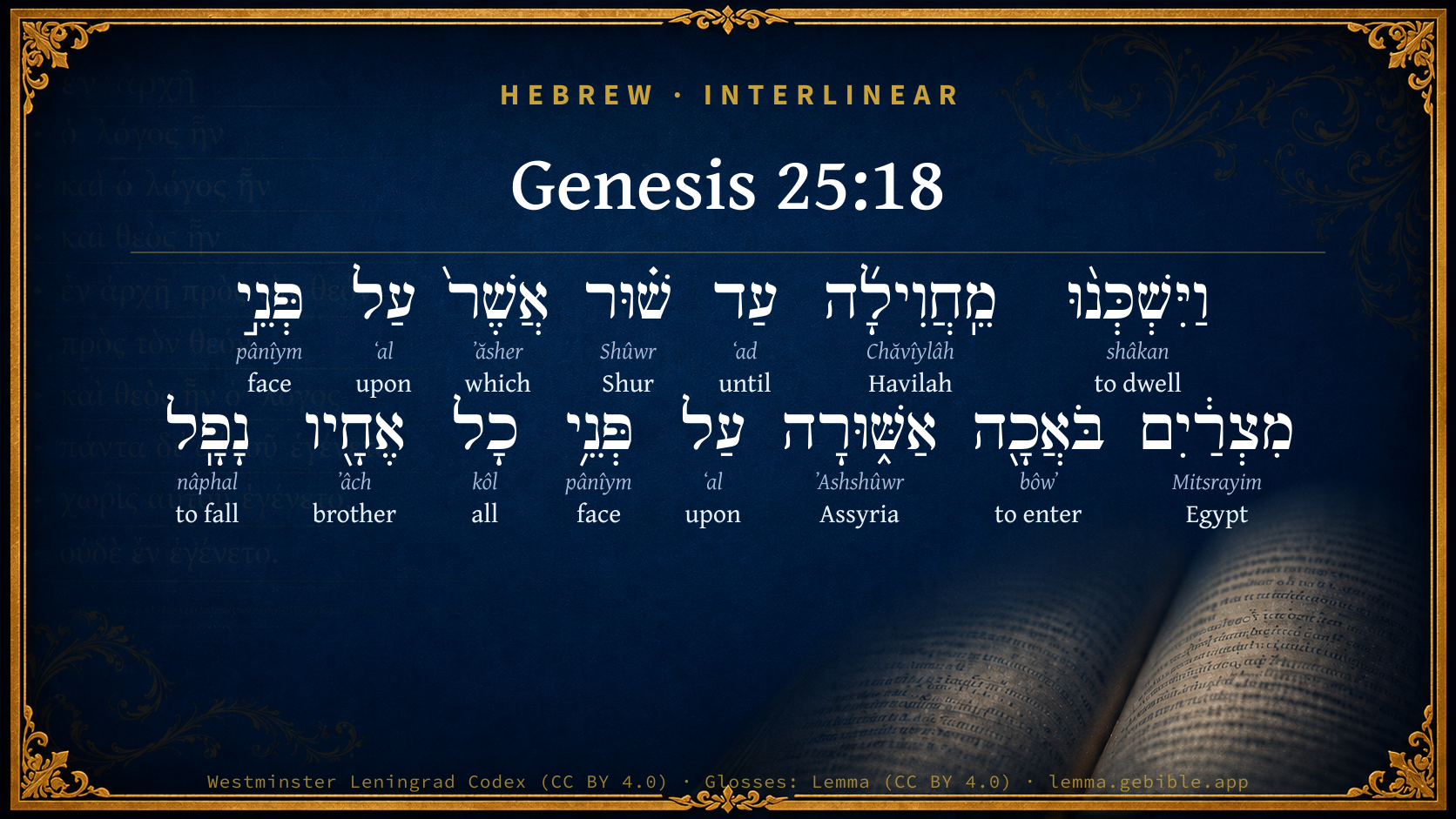
Hebrew (Westminster Leningrad Codex) Genesis 25:18 appears in the Hebrew Old Testament. The text above is from the Westminster Leningrad Codex. Each word links to its Strong’s number, a concise gloss, and parsing drawn from the Open Scriptures Hebrew Bible morphology. Click any word for its full Brown-Driver-Briggs (BDB) entry.
Download image
Cite this verse

Genesis 25:18 (World English Bible). Public Domain. Lemma interlinear Bible study tool, https://lemma.gebible.app/v/genesis/25/18.

Show BibTeX & RIS
BibTeX
RIS
English Translation
They lived from Havilah to Shur that is before Egypt, as you go toward Assyria. He lived opposite all his relatives.
World English Bible · Public Domain
Download a study sheet

One document with this verse’s original text, its word-by-word gloss line, the meaning frame, cross-references with their text, attributed commentary, and full source and license credits — printable, and it pastes into notes with its structure intact.

This verse Autodidact and up

Study sheet (.html) Plain text (.txt)

A passage Seminary Student

Up to 50 verses in one chapter. A passage sheet keeps up to 6 commentary sources and 12 cross-references per verse, in the order this page ranks them, and says so on the sheet whenever that leaves anything out. Ask for a single verse and you get the Autodidact verse sheet above.

Everything on this page stays free to read, with no account — the sheet is a download of what is already on screen, not access to it.

Want to remove ads? Support Godless Engineer
Compare translations 3

The same verse in 3 English versions, stacked beneath the original-language interlinear above. Click any original word for its lexicon entry.

Each is an independent rendering of the whole verse — the interlinear is not word-aligned to these translations.

Highlighted words mark where these versions differ — a whole-verse word diff, not a word-by-word alignment.

  • World English Bible Public Domain
    They lived from Havilah to Shur that is before Egypt, as you go toward Assyria. He lived opposite all his relatives.
  • King James Version Public Domain
    And they dwelt from Havilah unto Shur, that is before Egypt, as thou goest toward Assyria: and he died in the presence of all his brethren.
  • unfoldingWord Literal Text CC BY-SA 4.0
    And they settled from Havilah to Shur that near Egypt as you go toward Asshur. He fell in the face of all his brothers. The Birth of Isaac’s Sons Jacob and Esau 25:19-26

unfoldingWord Literal Text — © unfoldingWord, licensed CC BY-SA 4.0. Word-aligned USFM3 via Door43 (git.door43.org/unfoldingWord/en_ult).

Versions to compare (up to 4)

3 of 4 selected

Show all 18 translations

Every available English version of this verse, each an independent rendering of the whole verse.

  • World English Bible Public Domain
    They lived from Havilah to Shur that is before Egypt, as you go toward Assyria. He lived opposite all his relatives.
  • Berean Standard Bible Public Domain
    Ishmael’s descendants settled from Havilah to Shur, which is near the border of Egypt as you go toward Asshur. And they lived in hostility toward all their brothers.
  • Majority Standard Bible Public Domain
    Ishmael’s descendants settled from Havilah to Shur, which is near the border of Egypt as you go toward Asshur. And they lived in hostility toward all their brothers.
  • King James Version Public Domain
    And they dwelt from Havilah unto Shur, that is before Egypt, as thou goest toward Assyria: and he died in the presence of all his brethren.
  • American Standard Version (1901) Public Domain
    And they dwelt from Havilah unto Shur that is before Egypt, as thou goest toward Assyria. He abode over against all his brethren.
  • Revised Version (1885) Public Domain
    And they dwelt from Havilah unto Shur that is before Egypt, as thou goest toward Assyria: he abode in the presence of all his brethren.
  • Geneva Bible (1599) Public Domain
    And they dwelt from Hauilah vnto Shur, that is towardes Egypt, as thou goest to Asshur. Ishmael dwelt in the presence of all his brethren.
  • Douay-Rheims (1899) Public Domain
    And he dwelt from Hevila as far as Sur, which looketh towards Egypt, to them that go towards the Assyrians. He died in the presence of all his brethren.
  • Young's Literal Translation Public Domain
    and they tabernacle from Havilah unto Shur, which `is' before Egypt, in `thy' going towards Asshur; in the presence of all his brethren hath he fallen.
  • Literal Standard Version CC BY-SA 4.0
    and they dwell from Havilah to Shur, which [is] before Egypt, in [your] going toward Asshur; in the presence of all his brothers has he fallen.
  • Unlocked Literal Bible CC BY-SA 4.0
    They lived from Havilah to Ashhur, which is near Egypt, as one goes toward Assyria. They lived in hostility with each other.
  • unfoldingWord Literal Text CC BY-SA 4.0
    And they settled from Havilah to Shur that near Egypt as you go toward Asshur. He fell in the face of all his brothers. The Birth of Isaac’s Sons Jacob and Esau 25:19-26
  • Darby Bible Public Domain
    And they dwelt from Havilah to Shur, which is opposite to Egypt, as one goes towards Assyria. He settled before the face of all his brethren.
  • World Messianic Bible Public Domain
    They lived from Havilah to Shur that is before Egypt, as you go toward Assyria. He lived opposite all his relatives.
  • Webster's Bible Public Domain
    And they dwelt from Havilah to Shur, that is before Egypt, as thou goest towards Assyria: and he died in the presence of all his brethren.
  • Free Bible Version CC BY-SA 4.0
    Ishmael's descendants inhabited the region from Havilah to Shur, near the border of Egypt in the direction of Asshur. They were forever fighting with one other.
  • Bible in Basic English Public Domain
    And their country was from Havilah to Shur which is east of Egypt: they took their place to the east of all their brothers.
  • JPS Tanakh (1917) Public Domain
    And they dwelt from Havilah unto Shur that is before Egypt, as thou goest toward Asshur: over against all his brethren he did settle.

Literal Standard Version (2020), Covenant Press — licensed CC BY-SA 4.0. Text via the HelloAO Bible API (eBible.org). Unlocked Literal Bible (unfoldingWord) — licensed CC BY-SA 4.0. Text via the HelloAO Bible API (eBible.org). unfoldingWord Literal Text — © unfoldingWord, licensed CC BY-SA 4.0. Word-aligned USFM3 via Door43 (git.door43.org/unfoldingWord/en_ult). Free Bible Version, Dr. Jonathan Gallagher — licensed CC BY-SA 4.0. Text via the HelloAO Bible API (eBible.org).

Word by word

More ways to search: Search by grammar → Find every occurrence → Compare this word →

Practice this passage: Drill this verse → Learn its vocabulary →

שׁ֗וּר
Shûwr
H7793
“Shur”
Noun, Proper
Part of Speech
Noun
Type
Proper
Full BDB Definition

Origin: the same as H7791

TWOT: None

Shur = "wall" - a place southwest of Palestine on the eastern border or within the border of Egypt; the Israelites passed through the wilderness of Shur after crossing the Red Sea - also 'wilderness of Etham'
  1. וַיִּשְׁכְּנ֨וּ shâkan H7931 “and · to dwell” Conjunction + Verb, Qal, Sequential Imperfect, 3rd Person, Masculine, Plural
  2. מֵֽחֲוִילָ֜ה Chăvîylâh H2341 “from · Havilah” Preposition + Noun, Proper
  3. עַד ʻad H5704 “until” Preposition
  4. אֲשֶׁר֙ ʼăsher H834 “which” Particle, Relative
  5. עַל ʻal H5921 “upon” Preposition
  6. פְּנֵ֣י pânîym H6440 “face(s) of” Noun, Common, Both, Plural, Construct
  7. מִצְרַ֔יִם Mitsrayim H4714 “Egypt” Noun, Proper
  8. בֹּאֲכָ֖ה bôwʼ H935 “to enter · you” Verb, Qal, Infinitive Construct + Suffix, Personal, 2nd Person, Masculine, Singular
  9. אַשּׁ֑וּרָה ʼAshshûwr H804 “Assyria · toward” Noun, Proper + Suffix, Demonstrative
  10. עַל ʻal H5921 “upon” Preposition
  11. פְּנֵ֥י pânîym H6440 “face(s) of” Noun, Common, Both, Plural, Construct
  12. כָל kôl H3605 “all of” Noun, Common, Masculine, Singular, Construct
  13. אֶחָ֖יו ʼâch H251 “brothers · his” Noun, Common, Masculine, Plural, Construct + Suffix, Personal, 3rd Person, Masculine, Singular
  14. נָפָֽל nâphal H5307 “to fall” Verb, Qal, Perfect, 3rd Person, Masculine, Singular

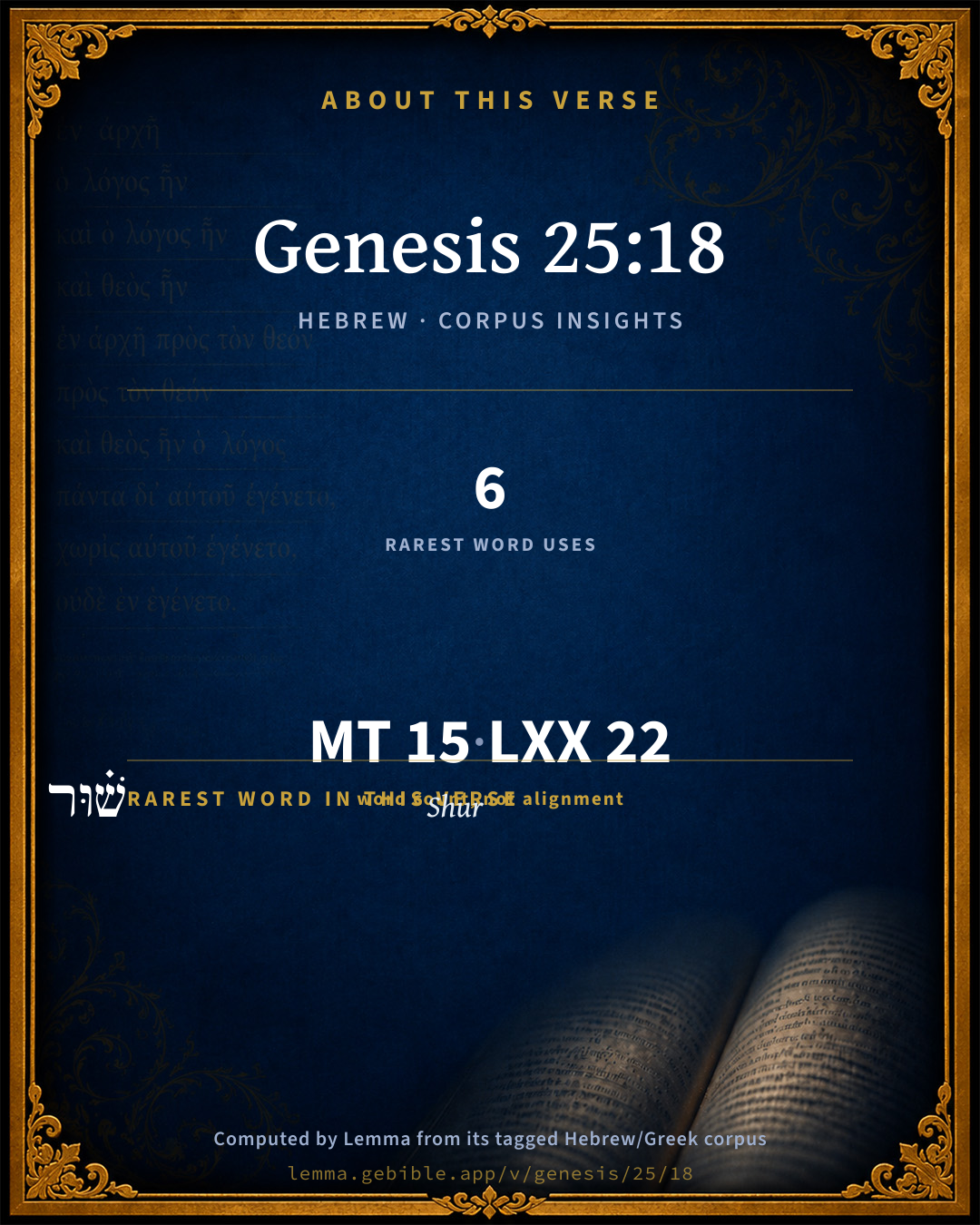
About this verse

These counts appear in no published source. They are computed here, from the morphology-tagged text and Lemma’s own curated glosses. What Lemma adds →

15
words
13
distinct lemmas
Pentateuch
section

Notable vocabulary

The rarest word here is שׁ֗וּר Shur H7793 — appearing just 6 times in the whole Hebrew Bible.

Shared distinctive vocabulary

שׁ֗וּר Shur H7793 occurs in 6 verses of the Hebrew Bible. Also found in:

Grammatical profile

  • 3 verbs
  • 8 nouns
  • 3 prepositions
  • 1 particle

Verb forms

  • וַיִּשְׁכְּנ֨וּ Qal · Sequential Imperfect
  • בֹּאֲכָ֖ה Qal · Infinitive Construct
  • נָפָֽל Qal · Perfect

Repetition

Words recur within this verse — often emphatic in Hebrew:

  • עַל upon H5921 ×2
  • פְּנֵ֣י face H6440 ×2

Hebrew & Septuagint length

In English translation the verse runs 21 words from the Hebrew and 26 from the Septuagint (LXX English) — closely comparable.

A rough comparison of the two English renderings, which tokenize alike — not a word-level alignment.

Word counts can differ between the Hebrew and the Greek without any difference in meaning — e.g. the Hebrew direct-object marker אֵת has no separate Greek word, and Greek often adds the article ὁ.

In the original languages it is 15 Hebrew tokens and 22 Greek tokens — but the two are counted differently (Hebrew bundles its prefixes and suffixes into one token; the Greek is in lemma form), so that isn’t a like-for-like length.

Cross-references

13

Topical passages linked to Genesis 25:18 in the Treasury of Scripture Knowledge — connected by theme and wording, ordered by reader-vote popularity; previews shown in the World English Bible.

  • Genesis 16:12 He will be like a wild donkey among men. His hand will be against every man, and every man's hand against him. He will live opposite all of his brothers."
  • Genesis 20:1 Abraham traveled from there toward the land of the South, and lived between Kadesh and Shur. He lived as a foriegner in Gerar.
  • Genesis 2:11 The name of the first is Pishon: this is the one which flows through the whole land of Havilah, where there is gold;
  • Genesis 10:7 The sons of Cush: Seba, Havilah, Sabtah, Raamah, and Sabteca. The sons of Raamah: Sheba and Dedan.
  • Genesis 10:29 Ophir, Havilah, and Jobab. All these were the sons of Joktan.
  • Genesis 13:10 Lot lifted up his eyes, and saw all the plain of the Jordan, that it was well watered every where, before Yahweh destroyed Sodom and Gomorrah, like the garden of Yahweh, like the land of Egypt, as you go to Zoar.
  • Genesis 14:10 Now the valley of Siddim was full of tar pits; and the kings of Sodom and Gomorrah fled, and they fell there, and those who remained fled to the mountain.
  • Genesis 21:21 He lived in the wilderness of Paran. His mother took a wife for him out of the land of Egypt.
  • 1 Samuel 15:7 Saul struck the Amalekites, from Havilah as you go to Shur, that is before Egypt.
  • 2 Kings 23:29 In his days Pharaoh Necoh king of Egypt went up against the king of Assyria to the river Euphrates: and king Josiah went against him; and [Pharaoh Necoh] killed him at Megiddo, when he had seen him.
  • Psalms 78:64 Their priests fell by the sword, And their widows couldn't weep.
  • Isaiah 19:23–24 In that day shall there be a highway out of Egypt to Assyria, and the Assyrian shall come into Egypt, and the Egyptian into Assyria; and the Egyptians shall worship with the Assyrians.
  • Genesis 21:14 Abraham rose up early in the morning, and took bread and a bottle of water, and gave it to Hagar, putting it on her shoulder, and gave her the child, and sent her away. She departed, and wandered in the wilderness of Beersheba.

Cross-references courtesy of OpenBible.info (CC BY 4.0).

Hebrew and Greek witnesses Masoretic Hebrew ↔ Greek Septuagint

The same verse in the two great witnesses to the Old Testament, shown verse-for-verse.

These are two independent witnesses, not word-aligned to each other, and the Septuagint is shown in lemma (dictionary) form.

Hebrew Genesis 25:18 Masoretic · Westminster Leningrad Codex

וַיִּשְׁכְּנ֨וּ מֵֽחֲוִילָ֜ה עַד שׁ֗וּר אֲשֶׁר֙ עַל פְּנֵ֣י מִצְרַ֔יִם בֹּאֲכָ֖ה אַשּׁ֑וּרָה עַל פְּנֵ֥י כָל אֶחָ֖יו נָפָֽל

They lived from Havilah to Shur that is before Egypt, as you go toward Assyria. He lived opposite all his relatives.

World English Bible · Public Domain

Greek LXX Genesis 25:18 Septuagint · lemma form

καταοἰκέω δέ ἀπό ευιλατ ἕως σουρ ὅς εἰμί κατά πρόσωπον αἴγυπτος ἕως ἔρχομαι πρός ἀσσύριος κατά πρόσωπον πᾶς ὁ ἀδελφός αὐτός καταοἰκέω

And he lived from Evilat to Sur, which is opposite Egypt, until one comes to the Assyrians; he lived in the presence of all his brethren.

LXX2012 (modern English Septuagint) · Public Domain

Hebrew: Westminster Leningrad Codex (CC BY 4.0). Greek: Septuagint (public domain); English from LXX2012 (modern English Septuagint) (Public Domain). How the Septuagint differs from the Hebrew →

Targum (Aramaic paraphrase)

2

The Targum is the ancient Jewish Aramaic paraphrase of the Hebrew Scriptures — an interpretive translation, not the Hebrew text itself. Onkelos (literal) and Pseudo-Jonathan (expansive) render the Torah, and Jonathan the Prophets. Coverage is partial: where no permissively-licensed English translation exists for a verse, only the Aramaic is shown. This is verse-level text, not a word-by-word alignment to the Hebrew.

  1. Targum Onkelos Torah (Genesis–Deuteronomy)
    וּשְׁרוֹ מֵחֲוִילָה עַד חַגְרָא דִּי עַל אַפֵּי מִצְרַיִם מָטֵי לְאָתוּר עַל אַפֵּי כָל אֲחוֹהִי שְׁרָא

    (no public-domain English translation for this verse)

    Targum Onkelos — Aramaic: “Onkelos Genesis” (public domain); “Onkelos Exodus” (public domain); “Onkelos Leviticus” (public domain); “Onkelos Numbers” (public domain); “Onkelos Deuteronomy” (public domain). English: “Sefaria Community Translation” (CC0 1.0 (public-domain dedication)); “J.W. Etheridge. The Targums of Onkelos and Jonathan Ben Uzziel on the Pentateuch. London: Longmans, Green, 1862” (public domain). Text via Sefaria.

  2. Targum Pseudo-Jonathan Torah (Genesis–Deuteronomy)
    וּשְׁרוֹ מִן הִנְדְקִי עַד חֲלוּצָה דְעַל אַנְפֵּי מִצְרַיִם מַעֲלָךְ לְאַתּוּר עַל אַנְפֵּי כָּל אָחוֹי שְׁרָא בְּאַחֲסַנְתֵּיהּ

    And they dwelt from Hindiki unto Chalutsa, which is in face of Mizraim from going up to Athur. Before the face of all his brethren he dwelt in his possession.

    Targum Pseudo-Jonathan — Aramaic: “Targum Jonathan on Genesis” (public domain); “Targum Jonathan on Exodus” (public domain); “Targum Jonathan on Leviticus” (public domain); “Targum Jonathan on Numbers” (public domain); “Targum Jonathan on Deuteronomy” (public domain). English: “The Targum of Jonathan ben Uzziel, trans. J. W. Etheridge, London, 1862” (public domain). Text via Sefaria.

Commentary

Notes on Genesis 25:18 from classic Christian and Jewish commentators (each source and its license shown beneath its notes). The classic Christian expositions comment on the surrounding passage and are grouped to its opening verse, so a note may address several verses; the Jewish commentaries on the Tanakh (Rashi and others) are per-verse, so they appear only where the commentator wrote on this verse.

Lemma curates 59 commentaries, every one of them public domain or Creative Commons licensed, each selected and text-cleaned for this edition rather than reprinted as found. About our sources →

Trapp's Complete Commentary

John Trapp

Gen 25:18 And they dwelt from Havilah unto Shur, that [is] before Egypt, as thou goest toward Assyria: [and] he died in the presence of all his brethren.

Ver. 18. And they dwelt from Havilah unto Shur.] A large tract and territory; but nothing so large as his posterity the Saracens’, called more rightly Hagarenes, {Psa 83:6} proved to be; whose name and empire notwithstanding is now swallowed up in the greatness of the Turkish empire; which laboureth with nothing more, than with the weightiness of itself. {a}

And he died.] Or, dwelt, as some read it. Compare Gen 16:12.

{a} Turk. Hist.

John Trapp, A Commentary or Exposition upon All the Books of the Old and New Testament (1647–1656) — public domain. Text from a community e-Sword module.

Tyndale Open Study Notes

Tyndale Open Resources

25:18 Havilah was a region in north-central Arabia. • Shur was a region between Beersheba and Egypt. • in open hostility toward all their relatives: The wording is close to that of 16:12.

Tyndale Open Study Notes — © Tyndale Open Resources, licensed CC BY-SA 4.0. Text via the HelloAO Bible API.

Geneva Bible (1599)

Geneva Bible translators

He meaneth that his lot fell to dwell among his brethren as the Angel promised, Gen. 16:12.

Or, his lot fell.

Geneva Bible (1599) marginal notes — public domain. Text via Bolls.life.

Jamieson, Fausset & Brown

Robert Jamieson, A. R. Fausset & David Brown

DESCENDANTS OF ISHMAEL. Before passing to the line of the promised seed, the historian gives a brief notice of Ishmael, to show that the promises respecting that son of Abraham were fulfilled--first, in the greatness of his posterity (compare Gen 17:20); and, secondly, in their independence. (Gen 25:12-18)

he died--rather, "it [their lot] fell" in the presence of his brethren (compare Gen 16:12).

Jamieson, Fausset & Brown — Commentary Critical and Explanatory on the Whole Bible (1871) — public domain (CC PDM 1.0). Text via the HelloAO Bible API.

Adam Clarke's Commentary

Verse 18. They dwelt from Havilah unto Shur] The descendants of Ishmael possessed all that country which extends from east to west, from Havilah on the Euphrates, near its junction with the Tigris, to the desert of Shur eastward of Egypt; and which extends along the isthmus of Suez, which separates the Red Sea from the Mediterranean.

As thou goest toward Assyria] "These words," says Calmet, "may refer either to Egypt, to Shur, or to Havilah. The desert of Shur is on the road from Egypt to Assyria in traversing Arabia Petraea, and in passing by the country of Havilah. I know not," adds he, "whether Ashshurah in the text may not mark out rather the Asshurim descended from Keturah, than the Assyrians, who were the descendants of Asshur the son of Shem."

He died in the presence of all his brethren] The original will not well bear this translation. In Ge 25:17 it is said, He gave up the ghost and died, and was gathered to his people. Then follows the account of the district occupied by the Ishmaelites, at the conclusion of which it is added על פני כל אחיו נפל al peney col echaiv naphal, "IT (the lot or district) FELL (or was divided to him) in the presence of all his brethren:" and this was exactly agreeable to the promise of God, Ge 16:12, He shall dwell in the presence of all his brethren; and to show that this promise had been strictly fulfilled, it is here remarked that his lot or inheritance was assigned him by Divine Providence, contiguous to that of the other branches of the family. The same word, נפל naphal, is used Jos 23:4, for to divide by lot.

On the subject of writing the same proper name variously in our common Bibles, the following observations and tables will not be unacceptable to the reader.

"Men who have read their Bible with care," says Dr. Kennicott, "must have remarked that the name of the same person is often expressed differently in different places. Indeed the variation is sometimes so great that we can scarcely persuade ourselves that one and the same person is really meant. A uniform expression of proper names is diligently attended to in other books: perhaps in every other book, except the Old Testament. But here we find strange variety in the expression, and consequently great confusion: and indeed there is scarcely any one general source of error which calls for more careful correction than the same proper names now wrongly expressed. I shall add here, from the Pentateuch, some proper names which are strangely varied: first, twenty-three names expressed differently in the Hebrew text itself, and seventeen of them in our English translation; and then thirty-one names expressed uniformly in the Hebrew yet differently in the English.

SAME NAMES DIFFERING IN THE HEBREW

1

Ge 4:18

Mehujael

Mehijael

in the same verse.

2

Ge 10:3

Riphath

Diphath

1Ch 1:6

3

Ge 10:4

Tarshish

Tarshishah

1Ch 1:7

4

Ge 10:4

Dodanim

Rodanim

1Ch 1:7

5

Ge 10:23

Mash

Meshech

1Ch 1:17

6

Ge 10:28

Obal

Ebal

1Ch 1:22

7

Ge 32:30-31

Peniel

Penuel

in the next verse.

8

Ge 36:11

Zepho

Zephi

1Ch 1:36

9

Ge 36:23

Shepho

Shephi

1Ch 1:40

10

Ge 36:39

Pau

Pai

1Ch 1:50

11

Ge 36:40

Alvah

Aliah

1Ch 1:51

12

Ge 46:10

Jemuel

Nemuel

Nu 26:12

13

Ge 46:10

Jachin

Jarib

1Ch 4:24

14

Ge 46:10

Zohar

Zerah

Nu 26:13, 1Ch 4:24

15

Ge 46:11

Gershon

Gershom

1Ch 4:1, 1Ch 1:16

16

Ge 46:13

Job

Jashub

Nu 26:24

17

Ge 46:16

Ezbon

Ozni

Nu 26:16

18

Ge 46:21

Huppim

Huram

1Ch 8:5

19

Ge 46:21

Ard

Addar

1Ch 8:3

20

Ge 46:23

Hushim

Shuham

Nu 26:42

21

Ex 4:18

Jether

Jethro

in the same verse.

22

Nu 1:14

Deuel

Reuel

Nu 2:14

23

De 32:44

Hoshea

Joshua

De 34:9

NAMES SAME IN HEBREW YET DIFFERENT IN ENGLISH

1

Ge 5:3

Seth

Sheth

1Ch 1:1

2

Ge 5:6

Enos

Enosh

1Ch 1:1

3

Ge 5:9

Cainan

Renan

1Ch 1:2

4

Ge 5:15

Jared

Jered

1Ch 1:2

5

Ge 5:18

Enoch

Henoch

1Ch 1:3

6

Ge 5:21

Methuselah

Mathushelah

1Ch 1:3

7

Ge 10:6

Phut

Put

1Ch 1:8

8

Ge 10:14

Philistim

The Philistines

1Ch 1:12

9

Ge 10:14

Caphtorim

Caphthorim

1Ch 1:12

10

Ge 10:16

Emorite

Amorites

Ge 15:16, Ge 15:21

11

Ge 10:16

Girgasite

Girgashites

Ge 15:21

12

Ge 10:19, Jer 47:5

Gaza

Azzah

De 2:23, Jer 25:20

13

Ge 10:22

Ashur

Asshur

1Ch 1:17

14

Ge 10:24

Salah

Shelah

1Ch 1:18

15

Ge 14:2, Ge 14:8

Zeboiim

Zeboim

De 29:23

16

Ge 14:5, Ge 15:20

Rephairns

Giants

De 2:20, De 3:11

17

Ge 25:15

Naphish

Nephish

1Ch 5:19

18

Ge 29:6

Rachel

Rahel

Jer 31:15

19

Ge 36:34

Temani

The Temanites

1Ch 1:45

20

Ge 36:37

Saul

Shaul

1Ch 1:48

21

Ge 37:25, Ge 37:28

Ishmeelites

Ishmaelites

Jdg 8:24

22

Ex 1:11

Raamses

Rameses

Ex 12:37

23

Ex 6:18

Izhar

Izehar

Nu 3:19

24

Ex 6:19

Mahali

Mahli

1Ch 6:19

25

Le 18:21

Molech

Moloch

Am 5:26

26

Nu 13:8, Nu 13:16

Oshea

Hoshea

De 32:44

27

Nu 13:16

Jehoshua

Joshua

Nu 14:6

28

Nu 21:12

Zared

Zered

De 2:13

29

Nu 32:3

Jazer

Jaazar

Nu 32:13

30

Nu 33:31

Bene-Jaakan

Children of Jaakan

De 10:6

31

De 3:17

Ashdoth-pisgah

Springs of Pisgah

De 4:49

"Nothing can be more clear than that these fifty-four proper names (at least the far greater part of them) should be expressed with the very same letters, in the places where they are now different. In the second list, instances 6, 10, and 13, have been corrected and expressed uniformly in the English Bible printed at Oxford in 1769. And surely the same justice in the translation should be done to the rest of these proper names, and to all others through the Bible; at least, where the original words are now properly the same. Who would not wonder at seeing the same persons named both Simon and Shimon, Richard and Ricard? And can we then admit here both Seth and Sheth, Rachel and Rahel? Again: whoever could admit (as above) both Gaza and Azzak, with Rameses and Raamses, should not object to London and Ondon, with Amsterdam and Amstradam. In short, in a history far more interesting than any other, the names of persons and places should be distinguished accurately, and defined with exact uniformity. And no true critic will think lightly of this advice of Origen, Contemnenda non est accurata circa NOMINA diligentia ei, qui volurit probe intelligere sanctas literas? No person who desires thoroughly to understand the sacred writings, should undervalue a scrupulous attention to the proper names."-Kennicott's Remarks.

Adam Clarke's Commentary on the Bible (1810–1826) — public domain. Text from a community e-Sword/MySword module.

John Calvin's Commentaries

18. He died in the presence of all his brethren The major part of commentators understand this of his death; as if Moses had said that the life of Ishmael was shorter than that of his brethren, who long survived him: but because the word נפל (naphal) is applied to a violent death, and Moses testifies that Ishmael died a natural death, this exposition cannot be approved. The Chaldean Paraphrast supposes the word “lot” to be understood, and elicits this sense, that the lot fell to him, so as to assign him a habitation not far from his brethren. Although I do not greatly differ in this matter, I yet think that the words are not to be thus distorted. The word נפל (naphal) sometimes signifies to lie down, or to rest, and also to dwell. The simple assertion therefore of Moses is, that a habitation was given to Ishmael opposite his brethren, so that he should indeed be a neighbor to them, and yet should have his distinct boundaries: for I do not doubt that he referred to the oracle contained in the sixteenth chapter (Genesis 16:1) where, among other things, the angel said to his mother Hagar, He shall remain, or pitch his tents in the presence of his brethren. Why does he rather speak thus of Ishmael than of the others, except for this reason, that whereas they migrated towards the eastern region, Ishmael, although the head of a nation, separated from the sons of Abraham, yet retained his dwelling in their neighborhood? Meanwhile the intention of God is also to be observed, namely, that Ishmael, though living near his brethren, was yet placed apart in an abode of his own, that he might not become mingled with them, but might dwell in their presence, or opposite to them. Moreover, it is sufficiently obvious that the prediction is not to be restricted personally to Ishmael.

John Calvin's Commentaries (1540-1563) — public domain. Text from the Calvin Translation Society English edition (1840s-50s) via the Christian Classics Ethereal Library (ccel.org). Calvin's coverage is partial (roughly two-thirds of the Bible); uncommented books and verses are honest gaps, never fabricated. The 19th-century editor's footnotes and remarks are omitted so the notes are faithfully Calvin's own voice.

Ellicott's Commentary for English Readers

(18) Havilah was far to the south, on the Persian Gulf. (See Gen_10:29.)

Shur.—This was their western limit towards Egypt. (See Gen_16:7.) In 1Sa_15:7 this same region is assigned to the Amalekites.

As thou goest toward Assyria.—This does not mean that Shur was on the route toward Assyria, but gives the eastern limit of the country inhabited by the descendants of Ishmael.

He died.—But the Hebrew is, he fell—that is, his lot fell; he settled there.

In the presence of.—This means to the east of all his brethren. Just as Assyria was regarded as lying to the north of Palestine, because on starting the traveller journeyed in that direction, so Arabia was considered to be on the east, for a similar reason. (But see Note on Gen_16:12.)

A Bible Commentary for English Readers, edited by Charles John Ellicott (1878–1897) — public domain. Text from a community e-Sword module.

John Gill's Exposition

And they dwelt from Havilah unto Shur,.... That is, the posterity of Ishmael, whose country reached from one place to the other; not from India to Chaluza, as the Targums of Jonathan and Jerusalem; but the extent is that vast desert of Arabia, which eastward was called the wilderness of Havilah, and westward the wilderness of Shur; so that they inhabited it from east to west:

that is before Egypt, as thou goest to Assyria; which last place was over against Egypt, and bordered on that part where lies the way to the land of Assyria:

and he died in the presence of all his brethren; they being present when he died, or in peace with them, in all prosperity along with them: but since his death is spoken of before, and here the situation of his posterity, the words may be read, "it fell (y) in the presence of his brethren"; his lot, or the habitation of his posterity fell by lot between his brethren the Egyptians on one side of him, and the Israelites on the other; or between the sons of Keturah on the east, and the posterity of Isaac on the west.

(y) "cecidit habitatio ipsi", Schmidt; "cecidit sors ejus", Aben Ezra, Kimchi, Ben Gersom, and Ben Melech.

John Gill's Exposition of the Whole Bible (1746–1763) — public domain (CC PDM 1.0). Text via the HelloAO Bible API.

Haydock's Catholic Bible Commentary

In the presence, &c. As he was the eldest, so he died first; having lived unmolested and fearless among his father’s children, chap. xvi. 12. (Calmet)

George Leo Haydock (1774–1849), Haydock's Catholic Family Bible and Commentary, 1859 edition — public domain. Excludes Psalms (Douay-Rheims chapter numbering differs from Protestant) and Deuterocanonical books (Catholic canon only).

Matthew Poole's English Annotations

Before Egypt, as thou goest toward Assyria, i.e. on that part or side of Egypt which leads to Assyria.

He died in the presence of all his brethren; his brethren surviving him, and being his neighbours, and therefore as they had conversation with him in the time of his life, so now they did him honour at his death. But this translation and interpretation may seem improbable,

1. Because his death was related, Gen 25:17, and would not be so presently repeated.

2. Because the foregoing words in this verse speak not of his death, but of his dwelling, to which these words do very well agree. For what we translated

and he died, is commonly rendered and he fell, or it fell, and is most commonly used concerning a lot whereby men’s portions are designed and divided, as Lev 16:9,10; Num 33:54; Jos 16:1; and so the sense may be, it fell, i.e. that country fell to him or his; or he lay, or was stretched out, or posted himself, as the Hebrew word is used, Jdg 7:12, i.e. he dwelt

in the presence of all his brethren; and so indeed his country lay between the children of Keturah on the east, and the children of Isaac and Israel on the west.

Matthew Poole's English Annotations on the Holy Bible (1683–1685) — public domain. Text from a community e-Sword/MySword module.

Whedon's Commentary on the Bible

Daniel D. Whedon

18. From Havilah unto Shur — Or, as we might say, from the Arabian Gulf and the Euphrates to the border of Egypt and the Red Sea. On Havilah see Gen_10:7; Gen_10:29; and on Shur see on Gen_16:7; Gen_20:1, and Exo_15:22.

As thou goest toward Assyria — One journeying most directly from Egypt to Assyria would pass through this broad Ishmaelite territory.

Died — Rather, he fell, or threw himself, נפל. This word is here used somewhat in the sense of the American word squat; he threw himself down upon, or settled in this region, between Havilah and Shur. The word is rendered lay along in Jdg_7:12, where it is said the Midianites and Amalekites and Bene-Kedem fell with their tents and cattle in the valley. That is, they dropped down, flung themselves down, intending to stay. Thus was fulfilled the prophecy of Gen_16:12.

Daniel D. Whedon (gen. ed.), Commentary on the Old and New Testaments (1874–1909) — public domain. Text from a community e-Sword module.

Rashi

Rabbi Shlomo Yitzchaki (Rashi)

נפל (literally, he fell) means ‘‘he dwelt”, as (Judges 7:12) “Now the Midianites and the Amalekites and all children of the East dwelt (נופלים) in the valley.” Here it says “He fell” and there (16:12) it says “In the presence of all his brethren shall he dwell”. But it may be explained thus: before Abraham died it could be said “He would dwell in security: after he died, “he fell” (Genesis Rabbah 62:5).

Rashi on the Tanakh — English translations: “The Judaica Press complete Tanach with Rashi, translated by A. J. Rosenberg” (CC BY 4.0); “Pentateuch with Rashi's commentary by M. Rosenbaum and A.M. Silbermann, 1929-1934” (public domain); “The Metsudah Tanach series, Lakewood, N.J” (CC BY 4.0); and “The Book of Joshua, Metsudah Publications, 1997” (CC BY 4.0). Text via Sefaria.

Radak

Rabbi David Kimhi (Radak)

וישכבו, the descendants of Ishmael mentioned by name in this paragraph resided in different regions extending from Chavilah as far as Shur, as these were the regions which became their ancestral holdings.

על פני כל אחיו נפל, in accordance with the prediction of the angel in 16,12 foretold to his mother even before he had been born. We explained the meaning of the phrase there. The word ונפל is to be understood as similar in meaning to the same word in Judges 7,12, (נופלים) where it means “falling in battle.”

Radak on the Tanakh — English translations: “Sefaria Community Translation” (CC0 1.0 (public-domain dedication)); “Eliyahu Munk, HaChut Hameshulash” (CC BY 4.0); “Rabbi Mike Feuer, Jerusalem Anthology” (CC BY 4.0); and “R. David Kimhi on the first book of Psalms, Translated by R.G. Finch, London, 1919” (public domain). Text via Sefaria.

Lesson kit

Teaching starters — assembled from the data on this page, not authored interpretation. Every prompt links to the verse data it draws on. Edit before teaching.

Genesis, in the Pentateuch, opens this verse with 15 words (13 distinct Hebrew lemmas). Its most distinctive word is Shûwr (“Shur”). A historical commentator’s framing appears above. Read the whole chapter for the surrounding context.

Discussion questions

  1. How does “Shur” (Shûwr) shape what this verse is saying?
  2. Genesis 16:7 shares the word «Shur» with this verse. How do the two illuminate each other?
  3. “upon” occurs 2× in this one verse. What is the effect of the repetition?
  4. These translations render this verse differently. What is at stake in choosing one wording over another?
  5. The verb «וַיִּשְׁכְּנ֨וּ» is Qal Sequential Imperfect. How does its form color the action?
  6. Reading how Trapp's Complete Commentary and Tyndale Open Study Notes read this verse, where do the two commentators agree and where do they part?

Things to notice

Reading settings

Reading text

Shown beneath each verse's original-language words.

Old Testament
Old Testament edition

Read the OT as the Masoretic Hebrew (MT) or the Greek Septuagint (LXX).

English shown for the Greek Septuagint (in the Hebrew ↔ Greek comparison).

Comparing translations? Open the Compare panel on any verse page to stack up to four side by side.