
Genesis 26:32

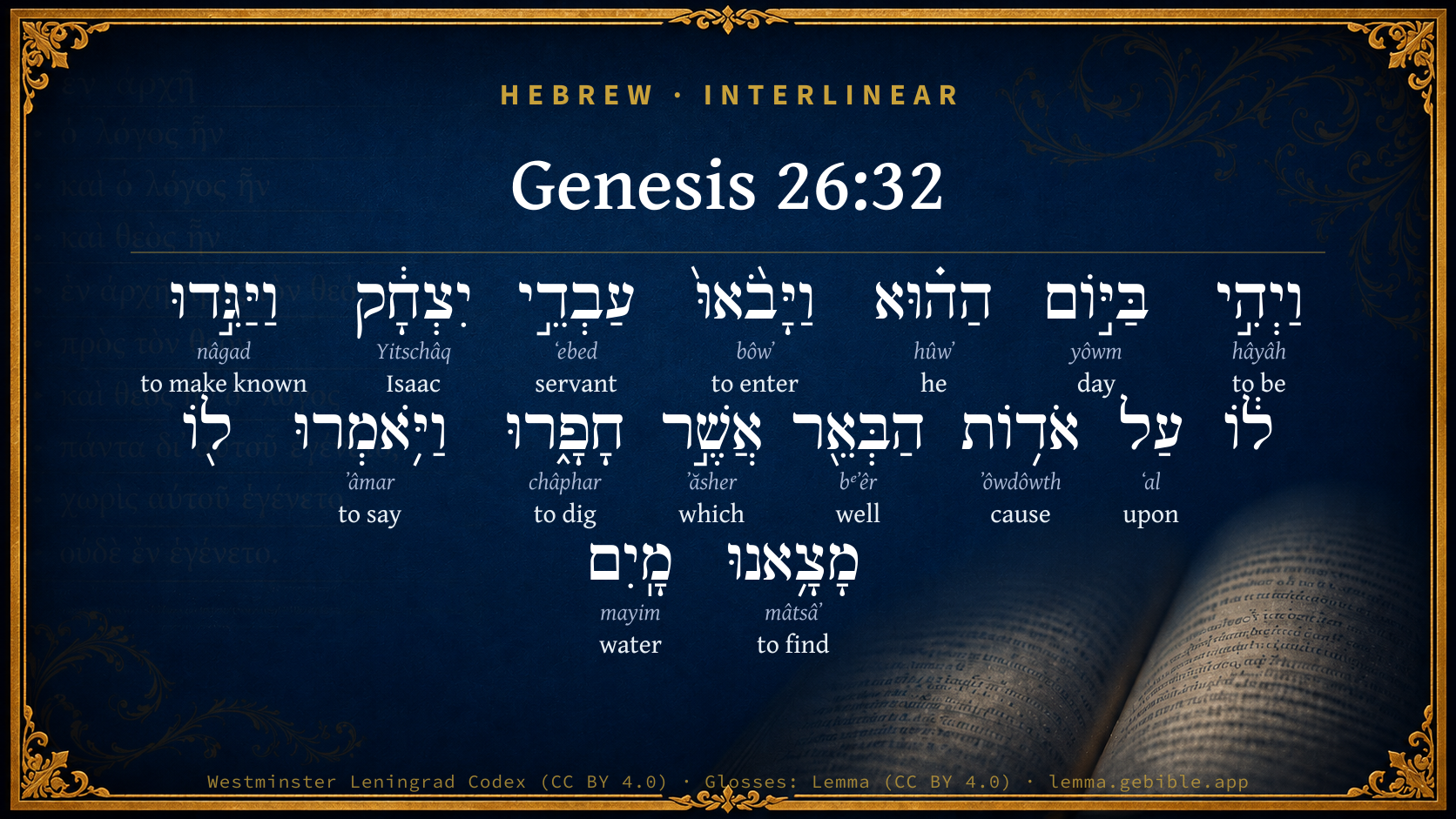
Hebrew (Westminster Leningrad Codex) Genesis 26:32 appears in the Hebrew Old Testament. The text above is from the Westminster Leningrad Codex. Each word links to its Strong’s number, a concise gloss, and parsing drawn from the Open Scriptures Hebrew Bible morphology. Click any word for its full Brown-Driver-Briggs (BDB) entry.
Download image
Cite this verse

Genesis 26:32 (World English Bible). Public Domain. Lemma interlinear Bible study tool, https://lemma.gebible.app/v/genesis/26/32.

Show BibTeX & RIS
BibTeX
RIS
English Translation
It happened the same day, that Isaac's servants came, and told him concerning the well which they had dug, and said to him, "We have found water."
World English Bible · Public Domain
Download a study sheet

One document with this verse’s original text, its word-by-word gloss line, the meaning frame, cross-references with their text, attributed commentary, and full source and license credits — printable, and it pastes into notes with its structure intact.

This verse Autodidact and up

Study sheet (.html) Plain text (.txt)

A passage Seminary Student

Up to 50 verses in one chapter. A passage sheet keeps up to 6 commentary sources and 12 cross-references per verse, in the order this page ranks them, and says so on the sheet whenever that leaves anything out. Ask for a single verse and you get the Autodidact verse sheet above.

Everything on this page stays free to read, with no account — the sheet is a download of what is already on screen, not access to it.

Want to remove ads? Support Godless Engineer
Compare translations 3

The same verse in 3 English versions, stacked beneath the original-language interlinear above. Click any original word for its lexicon entry.

Each is an independent rendering of the whole verse — the interlinear is not word-aligned to these translations.

Highlighted words mark where these versions differ — a whole-verse word diff, not a word-by-word alignment.

  • World English Bible Public Domain
    It happened the same day, that Isaac's servants came, and told him concerning the well which they had dug, and said to him, "We have found water."
  • King James Version Public Domain
    And it came to pass the same day, that Isaac's servants came, and told him concerning the well which they had digged, and said unto him, We have found water.
  • unfoldingWord Literal Text CC BY-SA 4.0
    Then it happened on that day, the servants of Isaac came and told him about the matter of the well that they had dug and said to him, “We have found water!”

unfoldingWord Literal Text — © unfoldingWord, licensed CC BY-SA 4.0. Word-aligned USFM3 via Door43 (git.door43.org/unfoldingWord/en_ult).

Versions to compare (up to 4)

3 of 4 selected

Show all 18 translations

Every available English version of this verse, each an independent rendering of the whole verse.

  • World English Bible Public Domain
    It happened the same day, that Isaac's servants came, and told him concerning the well which they had dug, and said to him, "We have found water."
  • Berean Standard Bible Public Domain
    On that same day, Isaac’s servants came and told him about the well they had dug. “We have found water!” they told him.
  • Majority Standard Bible Public Domain
    On that same day, Isaac’s servants came and told him about the well they had dug. “We have found water!” they told him.
  • King James Version Public Domain
    And it came to pass the same day, that Isaac's servants came, and told him concerning the well which they had digged, and said unto him, We have found water.
  • American Standard Version (1901) Public Domain
    And it came to pass the same day, that Isaac's servants came, and told him concerning the well which they had digged, and said unto him, We have found water.
  • Revised Version (1885) Public Domain
    And it came to pass the same day, that Isaac’s servants came, and told him concerning the well which they had digged, and said unto him, We have found water.
  • Geneva Bible (1599) Public Domain
    And that same day Izhaks seruantes came and tolde him of a well, which they had digged, and said vnto him, We haue found water.
  • Douay-Rheims (1899) Public Domain
    And behold the same day the servants of Isaac came, telling him of a well which they had digged, and saying: We have found water.
  • Young's Literal Translation Public Domain
    And it cometh to pass during that day that Isaac's servants come and declare to him concerning the circumstances of the well which they have digged, and say to him, `We have found water;'
  • Literal Standard Version CC BY-SA 4.0
    And it comes to pass during that day that Isaac’s servants come and declare to him concerning the circumstances of the well which they have dug, and say to him, “We have found water”;
  • Unlocked Literal Bible CC BY-SA 4.0
    That same day Isaac's servants came and told him about the well that they had dug. They said, “We have found water.”
  • unfoldingWord Literal Text CC BY-SA 4.0
    Then it happened on that day, the servants of Isaac came and told him about the matter of the well that they had dug and said to him, “We have found water!”
  • Darby Bible Public Domain
    And it came to pass the same day, that Isaac's servants came, and told him concerning the well that they had dug, and said to him, We have found water.
  • World Messianic Bible Public Domain
    The same day, Isaac’s servants came, and told him concerning the well which they had dug, and said to him, “We have found water.”
  • Webster's Bible Public Domain
    And it came to pass the same day, that Isaac's servants came and told him concerning the well which they had digged, and said to him, We have found water.
  • Free Bible Version CC BY-SA 4.0
    It was that very day when Isaac's servants who'd been digging a well came and told him, “We've found water!”
  • Bible in Basic English Public Domain
    And that day Isaac's servants came to him and gave him word of the water-hole which they had made, and said to him, We have come to water.
  • JPS Tanakh (1917) Public Domain
    And it came to pass the same day, that Isaac's servants came, and told him concerning the well which they had digged, and said unto him: 'We have found water.'

Literal Standard Version (2020), Covenant Press — licensed CC BY-SA 4.0. Text via the HelloAO Bible API (eBible.org). Unlocked Literal Bible (unfoldingWord) — licensed CC BY-SA 4.0. Text via the HelloAO Bible API (eBible.org). unfoldingWord Literal Text — © unfoldingWord, licensed CC BY-SA 4.0. Word-aligned USFM3 via Door43 (git.door43.org/unfoldingWord/en_ult). Free Bible Version, Dr. Jonathan Gallagher — licensed CC BY-SA 4.0. Text via the HelloAO Bible API (eBible.org).

Word by word

More ways to search: Search by grammar → Find every occurrence → Compare this word →

Practice this passage: Drill this verse → Learn its vocabulary →

אֹד֥וֹת
ʼôwdôwth
H182
“cause of”
Noun, Common, Feminine, Plural, Construct
Part of Speech
Noun
Type
Common
Gender
Feminine
Number
Plural
State
Construct
Full BDB Definition

Origin: from the same as H181

TWOT: 38b

cause - cause, reason for - the occasion of
  1. וַיְהִ֣י hâyâh H1961 “and · to be” Conjunction + Verb, Qal, Sequential Imperfect, 3rd Person, Masculine, Singular
  2. בַּיּ֣וֹם yôwm H3117 “in/at the · day” Preposition, Determined + Noun, Common, Masculine, Singular, Absolute
  3. הַה֗וּא hûwʼ H1931 “the · he” Particle, Definite Article + Pronoun, Personal, 3rd Person, Masculine, Singular
  4. וַיָּבֹ֨אוּ֙ bôwʼ H935 “and · to enter” Conjunction + Verb, Qal, Sequential Imperfect, 3rd Person, Masculine, Plural
  5. עַבְדֵ֣י ʻebed H5650 “servants of” Noun, Common, Masculine, Plural, Construct
  6. יִצְחָ֔ק Yitschâq H3327 “Isaac” Noun, Proper
  7. וַיַּגִּ֣דוּ nâgad H5046 “and · to make known” Conjunction + Verb, Hiphil, Sequential Imperfect, 3rd Person, Masculine, Plural
  8. עַל ʻal H5921 “upon” Preposition
  9. הַבְּאֵ֖ר bᵉʼêr H875 “the · well” Particle, Definite Article + Noun, Common, Feminine, Singular, Absolute
  10. אֲשֶׁ֣ר ʼăsher H834 “which” Particle, Relative
  11. חָפָ֑רוּ châphar H2658 “to dig” Verb, Qal, Perfect, 3rd Person, Common, Plural
  12. וַיֹּ֥אמְרוּ ʼâmar H559 “and · to say” Conjunction + Verb, Qal, Sequential Imperfect, 3rd Person, Masculine, Plural
  13. מָצָ֥אנוּ mâtsâʼ H4672 “to find” Verb, Qal, Perfect, 1st Person, Common, Plural
  14. מָֽיִם mayim H4325 “water(s)” Noun, Common, Masculine, Plural, Absolute

About this verse

These counts appear in no published source. They are computed here, from the morphology-tagged text and Lemma’s own curated glosses. What Lemma adds →

17
words
15
distinct lemmas
Pentateuch
section

Notable vocabulary

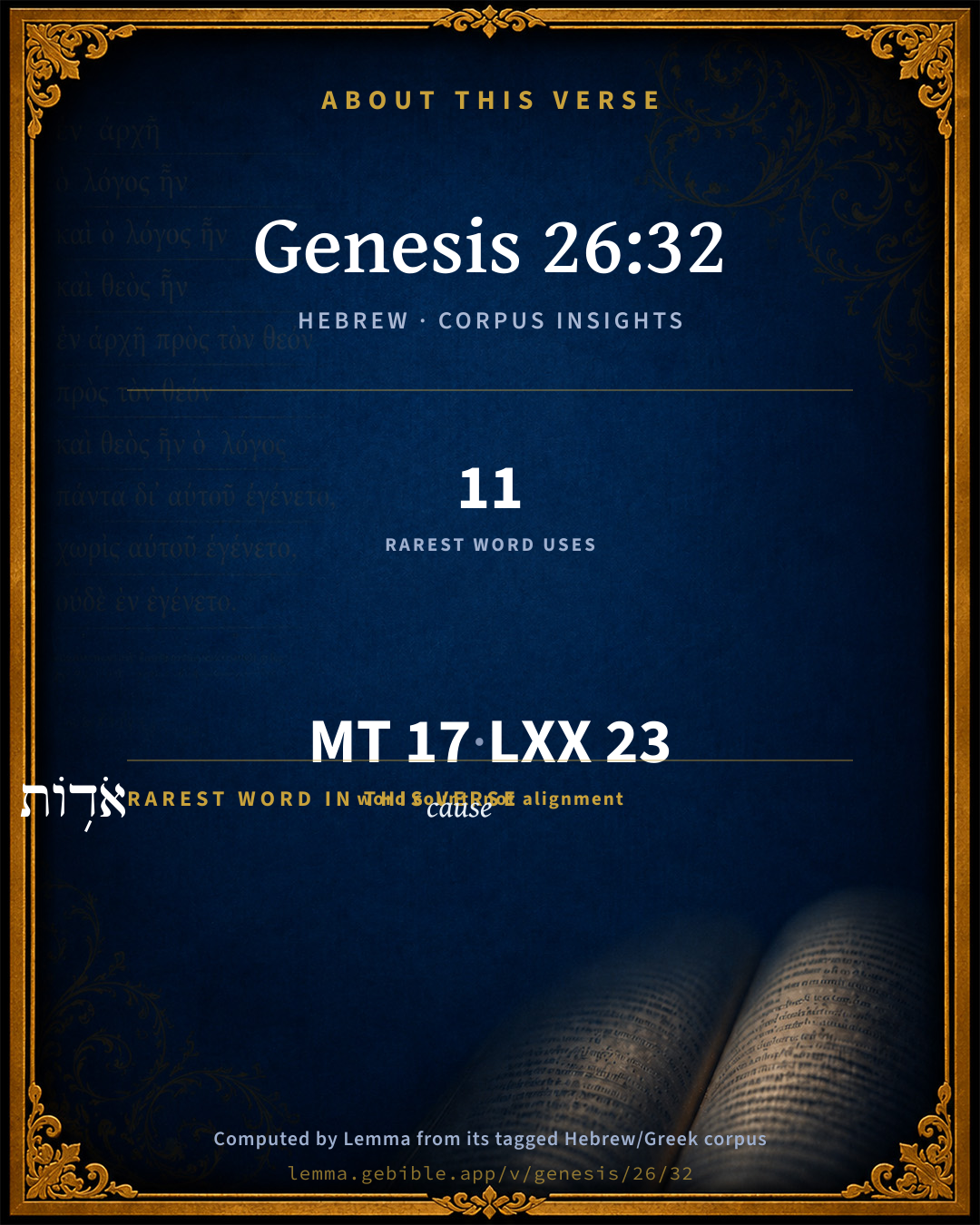
The rarest word here is אֹד֥וֹת cause H182 — appearing just 11 times in the whole Hebrew Bible.

Shared distinctive vocabulary

אֹד֥וֹת cause H182 occurs in 10 verses of the Hebrew Bible. Also found in:

Grammatical profile

  • 6 verbs
  • 6 nouns
  • 1 pronoun
  • 3 prepositions
  • 1 particle

Verb forms

  • וַיְהִ֣י Qal · Sequential Imperfect
  • וַיָּבֹ֨אוּ֙ Qal · Sequential Imperfect
  • וַיַּגִּ֣דוּ Hiphil · Sequential Imperfect
  • חָפָ֑רוּ Qal · Perfect
  • וַיֹּ֥אמְרוּ Qal · Sequential Imperfect
  • מָצָ֥אנוּ Qal · Perfect

Hebrew & Septuagint length

In English translation the verse runs 27 words from the Hebrew and 32 from the Septuagint (LXX English) — closely comparable.

A rough comparison of the two English renderings, which tokenize alike — not a word-level alignment.

Word counts can differ between the Hebrew and the Greek without any difference in meaning — e.g. the Hebrew direct-object marker אֵת has no separate Greek word, and Greek often adds the article ὁ.

In the original languages it is 17 Hebrew tokens and 23 Greek tokens — but the two are counted differently (Hebrew bundles its prefixes and suffixes into one token; the Greek is in lemma form), so that isn’t a like-for-like length.

Cross-references

5

Topical passages linked to Genesis 26:32 in the Treasury of Scripture Knowledge — connected by theme and wording, ordered by reader-vote popularity; previews shown in the World English Bible.

  • Proverbs 10:4 He becomes poor who works with a lazy hand, But the hand of the diligent brings wealth.
  • Genesis 26:25 He built an altar there, and called on the name of Yahweh, and pitched his tent there. There Isaac's servants dug a well.
  • Proverbs 2:4–5 If you seek her as silver, And search for her as for hidden treasures:
  • Proverbs 13:4 The soul of the sluggard desires, and has nothing, But the desire of the diligent shall be fully satisfied.
  • Matthew 7:7 "Ask, and it will be given you. Seek, and you will find. Knock, and it will be opened for you.

Cross-references courtesy of OpenBible.info (CC BY 4.0).

Hebrew and Greek witnesses Masoretic Hebrew ↔ Greek Septuagint

The same verse in the two great witnesses to the Old Testament, shown verse-for-verse.

These are two independent witnesses, not word-aligned to each other, and the Septuagint is shown in lemma (dictionary) form.

Hebrew Genesis 26:32 Masoretic · Westminster Leningrad Codex

וַיְהִ֣י בַּיּ֣וֹם הַה֗וּא וַיָּבֹ֨אוּ֙ עַבְדֵ֣י יִצְחָ֔ק וַיַּגִּ֣דוּ ל֔וֹ עַל אֹד֥וֹת הַבְּאֵ֖ר אֲשֶׁ֣ר חָפָ֑רוּ וַיֹּ֥אמְרוּ ל֖וֹ מָצָ֥אנוּ מָֽיִם

It happened the same day, that Isaac's servants came, and told him concerning the well which they had dug, and said to him, "We have found water."

World English Bible · Public Domain

Greek LXX Genesis 26:32 Septuagint · lemma form

γίγνομαι δέ ἐν ὁ ἡμέρα ἐκεῖνος καί παραγίγνομαι ὁ παῖς ισαακ ἀποἀγγέλλω αὐτός περί ὁ φρέαρ ὅς ὀρύσσω καί εἶπον οὐ εὑρίσκω ὕδωρ

And it came to pass in that day, that the servants of Isaac came and told him of the well which they had dug; and they said, We have not found water.

LXX2012 (modern English Septuagint) · Public Domain

On this verse, The Pulpit Commentary discusses the Septuagint’s reading. Read the note in Commentary ↓

Hebrew: Westminster Leningrad Codex (CC BY 4.0). Greek: Septuagint (public domain); English from LXX2012 (modern English Septuagint) (Public Domain). How the Septuagint differs from the Hebrew →

Targum (Aramaic paraphrase)

2

The Targum is the ancient Jewish Aramaic paraphrase of the Hebrew Scriptures — an interpretive translation, not the Hebrew text itself. Onkelos (literal) and Pseudo-Jonathan (expansive) render the Torah, and Jonathan the Prophets. Coverage is partial: where no permissively-licensed English translation exists for a verse, only the Aramaic is shown. This is verse-level text, not a word-by-word alignment to the Hebrew.

  1. Targum Onkelos Torah (Genesis–Deuteronomy)
    וַהֲוָה בְּיוֹמָא הַהוּא וַאֲתוֹ עַבְדֵי יִצְחָק וְחַוִּיאוּ לֵהּ עַל עֵיסַק בֵּירָא דִּי חֲפָרוּ וַאֲמָרוּ לֵהּ אַשְׁכַּחְנָא מַיָּא

    (no public-domain English translation for this verse)

    Targum Onkelos — Aramaic: “Onkelos Genesis” (public domain); “Onkelos Exodus” (public domain); “Onkelos Leviticus” (public domain); “Onkelos Numbers” (public domain); “Onkelos Deuteronomy” (public domain). English: “Sefaria Community Translation” (CC0 1.0 (public-domain dedication)); “J.W. Etheridge. The Targums of Onkelos and Jonathan Ben Uzziel on the Pentateuch. London: Longmans, Green, 1862” (public domain). Text via Sefaria.

  2. Targum Pseudo-Jonathan Torah (Genesis–Deuteronomy)
    וַהֲוָה בְּיוֹמָא הַהוּא וְאָתוֹ עַבְדֵי יִצְחָק וְתָנוּ לֵיהּ עַל עֵיסַק בֵּירָא דְחָפָסוּ וְאָמְרוּ לֵיהּ אַשְׁכַּחְנָא מוֹי

    And on that day the servants of Izhak came and told him concerning the well they had digged, and said to him, We have found water;

    Targum Pseudo-Jonathan — Aramaic: “Targum Jonathan on Genesis” (public domain); “Targum Jonathan on Exodus” (public domain); “Targum Jonathan on Leviticus” (public domain); “Targum Jonathan on Numbers” (public domain); “Targum Jonathan on Deuteronomy” (public domain). English: “The Targum of Jonathan ben Uzziel, trans. J. W. Etheridge, London, 1862” (public domain). Text via Sefaria.

Commentary

Notes on Genesis 26:32 from classic Christian and Jewish commentators (each source and its license shown beneath its notes). The classic Christian expositions comment on the surrounding passage and are grouped to its opening verse, so a note may address several verses; the Jewish commentaries on the Tanakh (Rashi and others) are per-verse, so they appear only where the commentator wrote on this verse.

Lemma curates 59 commentaries, every one of them public domain or Creative Commons licensed, each selected and text-cleaned for this edition rather than reprinted as found. About our sources →

Trapp's Complete Commentary

John Trapp

Gen 26:32 And it came to pass the same day, that Isaac’s servants came, and told him concerning the well which they had digged, and said unto him, We have found water.

Ver. 32. We have found water.] As crosses, so mercies, seldom come single, but by troops; as she said, when her son Gad was born, "A company cometh". {Gen 30:11}

John Trapp, A Commentary or Exposition upon All the Books of the Old and New Testament (1647–1656) — public domain. Text from a community e-Sword module.

John Calvin's Commentaries

32. And it came to pass the same day. Hence it appears, (as I have said a little before,) that the waters were not found in a moment of time. If it be asked, whence a supply of water had been obtained for his cattle and his household during the intervening days, I doubt not, indeed, that he either bought it, or was compelled to go to a distance to see if any one would be found from whom he might obtain it by entreaty. With respect to the name, (Sheba,) they are mistaken, in my judgment, who deem it to be any other than that which Abraham had first given to the well. For since the Hebrew word is ambiguous, Abraham alluded to the covenant which he had struck with the king of Gerar; but now Isaac recalling this ancient memorial to mind, joins with it the covenant in which he had himself engaged.

John Calvin's Commentaries (1540-1563) — public domain. Text from the Calvin Translation Society English edition (1840s-50s) via the Christian Classics Ethereal Library (ccel.org). Calvin's coverage is partial (roughly two-thirds of the Bible); uncommented books and verses are honest gaps, never fabricated. The 19th-century editor's footnotes and remarks are omitted so the notes are faithfully Calvin's own voice.

Ellicott's Commentary for English Readers

(32) We have found water.—As there are two wells at Beer-sheba, it is uncertain whether this was Abraham’s well, re-opened by Isaac (see Gen_26:25), or a new one.

A Bible Commentary for English Readers, edited by Charles John Ellicott (1878–1897) — public domain. Text from a community e-Sword module.

John Gill's Exposition

And Esau was forty years old,.... The same age his father was of when he married, Gen 25:20,

when he took to wife Judith, the daughter of Beeri the Hittite; Josephus (m) makes her to be the same with Aholibamah; but her father's name was Zibeon, and an Hivite, and must therefore be another person, not only the name being different, but the tribe, Gen 36:2,

and Bashemath the daughter of Elon the Hittite; whom Aben Ezra takes to be the same with Adah, and so does Josephus; and in this they may be right, since the name of her father, and his nation or tribe, agree, Gen 36:2. The fathers of these two women are represented by Josephus as men of great power and authority among the Canaanites, as very probably they were. Esau had another wife of the same name with this last, but she was daughter of Ishmael, and sister of Nebajoth, Gen 36:3; for he had more wives than those; these were his two first, who very probably were not taken together, but one after another, though it may be but at a short distance from each other.

(m) Antiqu. l. 1. c. 18. sect. 4.

John Gill's Exposition of the Whole Bible (1746–1763) — public domain (CC PDM 1.0). Text via the HelloAO Bible API.

The Pulpit Commentary

And it came to pass the same day (i.e. the day of the treaty), that Isaac"s servants came, and told him concerning the well which they had digged, the operation of sinking this well had probably commenced on the day of Abimelech s arrival at Beersheba (vide ver. 25). Almost immediately on the king"s departure the well-diggers returned to the patriarch"s encampment to report the success of their operationsand said unto him, We have found water. The LXX, mistaking wOl, to him, for alo, not, read, "We have not found water;" the incorrectness of which is sufficiently declared by what follows.

The Pulpit Commentary (1880–1919), ed. H.D.M. Spence-Jones & Joseph S. Exell — public domain. Text from a community e-Sword module.

unfoldingWord translationNotes

Door43 World Missions Community

He called the well Shibah

"So he called the well Shibah." Translators may add a footnote that says "The name Shibah sounds like the word that means 'oath.'" (See: How to Translate Names)

Beersheba

Translators may add a footnote saying "Beersheba can mean either "well of the oath" or "well of seven." (See note on Genesis 21:32)

translationWords

servant

cistern

Beersheba

unfoldingWord translationNotes — © Distant Shores Media and the Door43 World Missions Community, licensed CC BY-SA 4.0. Source: git.door43.org/Door43/en_tn.

Ramban (Nachmanides)

Rabbi Moshe ben Nachman (Ramban / Nachmanides)

AND ISAAC’s SERVANTS CAME AND TOLD HIM CONCERNING THE WELL WHICH THEY HAD DIGGED. This is the same well mentioned above in the verse, And there Isaac’s servants digged a well. They had begun to dig it, and Abimelech came to him during that period, and on the day of the making of the covenant, when Abimelech and his retinue had left, Isaac’s servants brought him the tidings that they had found water.It appears feasible to me that this is the same well which Abraham dug, in connection with which he gave Abimelech seven lambs as a witness [to his ownership of the well]. The Philistines, however, stopped it together with the other wells, whereupon Isaac dug it again and called it by the same name which his father had called it. It is for this reason that the name of the city is Beer-sheba: on account of the well (be’er) which both the father and the son called by that name because there they swore both of them., Verse 31. The verse there refers to Abraham and Abimelech. Ramban uses it here only as an expression to indicate that both Abraham and Isaac called the same well by the same name and both had occasion to swear over it. The name of the city “Beer-sheba” thus derives its historical significance from both the first patriarch and his son.This well of theirs alludes to the Tabernacle at Shiloh, which the Philistines stopped when the Ark of G-d was taken captive by them. And they redug it, indicating that the Philistines indeed returned the Ark together with the honorary gift to G-d., 6:11.

Ramban (Nachmanides) on the Tanakh — English translation: “Commentary on the Torah by Ramban (Nachmanides). Translated and annotated by Charles B. Chavel. New York, Shilo Pub. House, 1971-1976” (CC BY 4.0). Text via Sefaria.

Radak

Rabbi David Kimhi (Radak)

ויהי ביום ההוא, before Avimelech and his entourage had departed. This was deliberately timed by G’d to demonstrate to Avimelech the extent of Yitzchok’s success so that they would remain in awe of him.

Radak on the Tanakh — English translations: “Sefaria Community Translation” (CC0 1.0 (public-domain dedication)); “Eliyahu Munk, HaChut Hameshulash” (CC BY 4.0); “Rabbi Mike Feuer, Jerusalem Anthology” (CC BY 4.0); and “R. David Kimhi on the first book of Psalms, Translated by R.G. Finch, London, 1919” (public domain). Text via Sefaria.

Lesson kit

Teaching starters — assembled from the data on this page, not authored interpretation. Every prompt links to the verse data it draws on. Edit before teaching.

Genesis, in the Pentateuch, opens this verse with 17 words (15 distinct Hebrew lemmas). Its most distinctive word is ʼôwdôwth (“cause”). A historical commentator’s framing appears above. Read the whole chapter for the surrounding context.

Discussion questions

  1. What does “cause” (ʼôwdôwth) contribute to the verse as a whole?
  2. How does Genesis 21:11, which shares the word «cause», read alongside this verse?
  3. These translations render this verse differently; the difference is in the English rendering, not the original. What questions does that raise?
  4. «וַיְהִ֣י» is a Qal Sequential Imperfect verb. How does that grammatical form shape the action described?
  5. Compare how Trapp's Complete Commentary and John Calvin's Commentaries read this verse. Where do they agree or differ?

Things to notice

Reading settings

Reading text

Shown beneath each verse's original-language words.

Old Testament
Old Testament edition

Read the OT as the Masoretic Hebrew (MT) or the Greek Septuagint (LXX).

English shown for the Greek Septuagint (in the Hebrew ↔ Greek comparison).

Comparing translations? Open the Compare panel on any verse page to stack up to four side by side.