Genesis 10:19

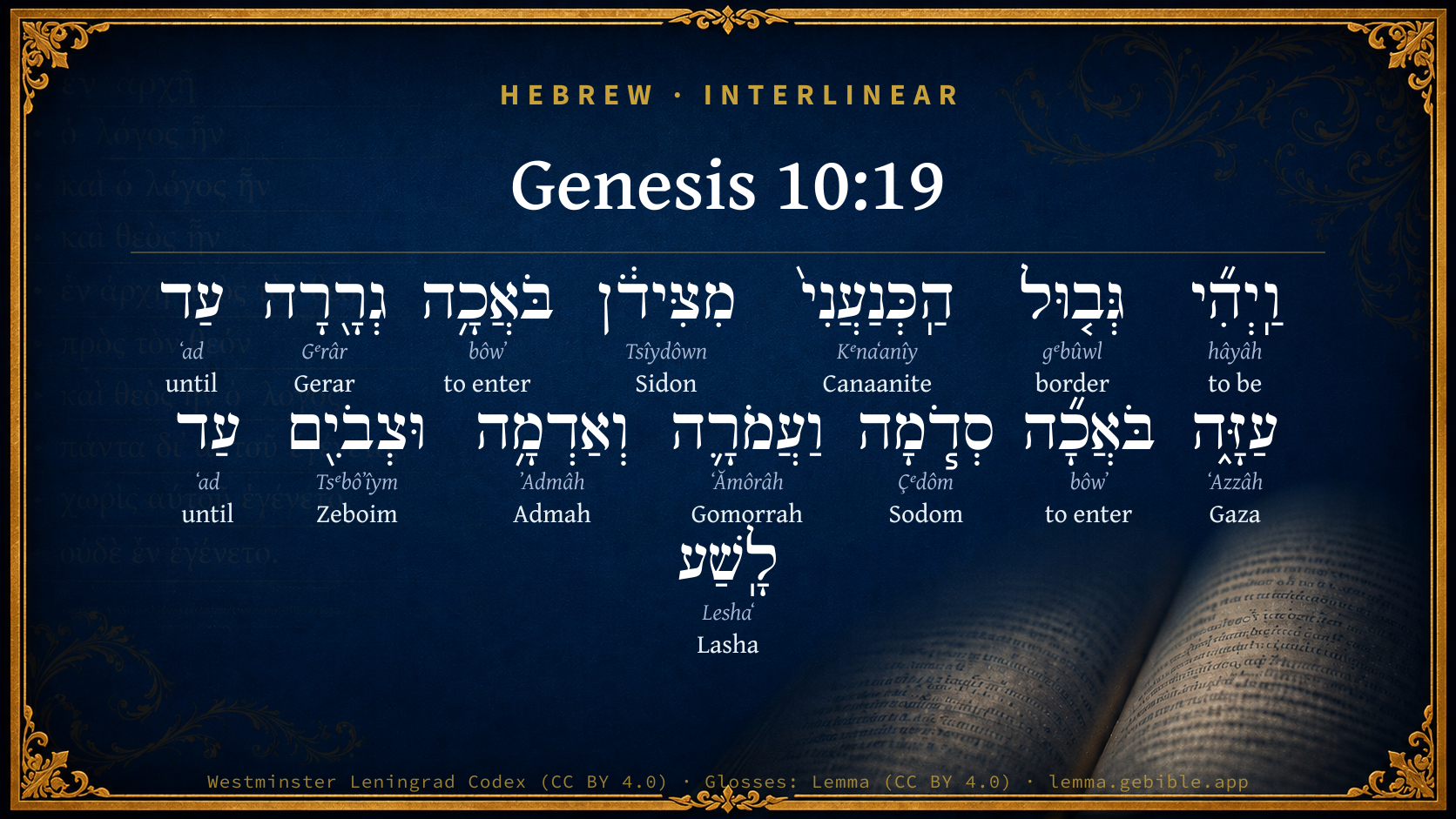
Hebrew (Westminster Leningrad Codex) Genesis 10:19 appears in the Hebrew Old Testament. The text above is from the Westminster Leningrad Codex. Each word links to its Strong’s number, a concise gloss, and parsing drawn from the Open Scriptures Hebrew Bible morphology. Click any word for its full Brown-Driver-Briggs (BDB) entry.
Download image
Cite this verse

Genesis 10:19 (World English Bible). Public Domain. Lemma interlinear Bible study tool, https://lemma.gebible.app/v/genesis/10/19.

Show BibTeX & RIS
BibTeX
RIS
English Translation
The border of the Canaanites was from Sidon, as you go toward Gerar, to Gaza; as you go toward Sodom, Gomorrah, Admah, and Zeboiim, to Lasha.
World English Bible · Public Domain
Highlights
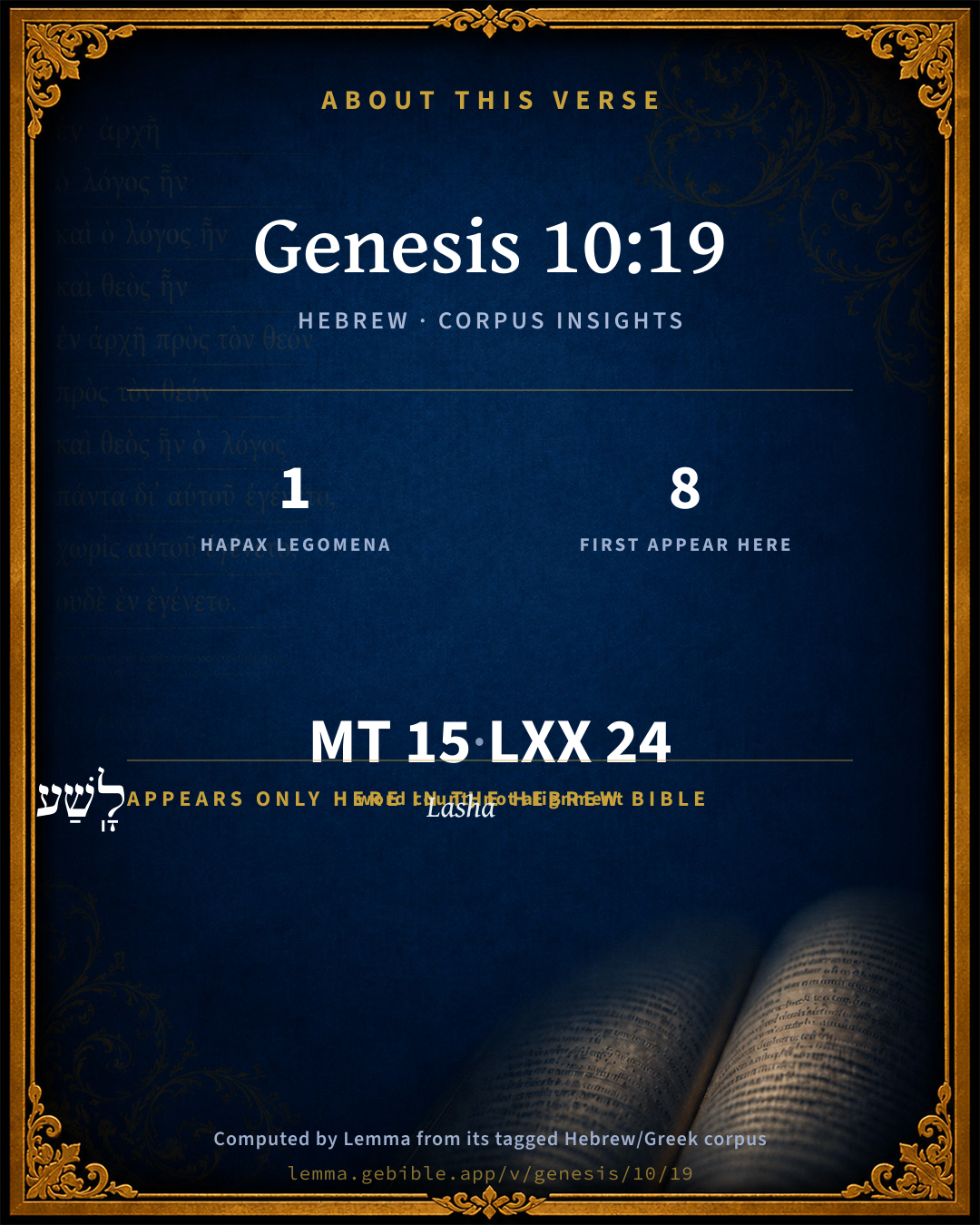
  • 1 hapax legomenon — only here in the Hebrew Bible
  • 8 first appearances in the Hebrew Bible
Full analysis ↓
Download a study sheet

One document with this verse’s original text, its word-by-word gloss line, the meaning frame, cross-references with their text, attributed commentary, and full source and license credits — printable, and it pastes into notes with its structure intact.

This verse Autodidact and up

Study sheet (.html) Plain text (.txt)

A passage Seminary Student

Up to 50 verses in one chapter. A passage sheet keeps up to 6 commentary sources and 12 cross-references per verse, in the order this page ranks them, and says so on the sheet whenever that leaves anything out. Ask for a single verse and you get the Autodidact verse sheet above.

Everything on this page stays free to read, with no account — the sheet is a download of what is already on screen, not access to it.

Want to remove ads? Support Godless Engineer
Compare translations 3

The same verse in 3 English versions, stacked beneath the original-language interlinear above. Click any original word for its lexicon entry.

Each is an independent rendering of the whole verse — the interlinear is not word-aligned to these translations.

Highlighted words mark where these versions differ — a whole-verse word diff, not a word-by-word alignment.

  • World English Bible Public Domain
    The border of the Canaanites was from Sidon, as you go toward Gerar, to Gaza; as you go toward Sodom, Gomorrah, Admah, and Zeboiim, to Lasha.
  • King James Version Public Domain
    And the border of the Canaanites was from Sidon, as thou comest to Gerar, unto Gaza; as thou goest, unto Sodom, and Gomorrah, and Admah, and Zeboim, even unto Lasha.
  • unfoldingWord Literal Text CC BY-SA 4.0
    so the border of the Canaanites were from Sidon, you go toward Gerar as far as Gaza, you go to Sodom and Gomorrah and Admah and Zeboiim, as far as Lasha.

unfoldingWord Literal Text — © unfoldingWord, licensed CC BY-SA 4.0. Word-aligned USFM3 via Door43 (git.door43.org/unfoldingWord/en_ult).

Versions to compare (up to 4)

3 of 4 selected

Show all 18 translations

Every available English version of this verse, each an independent rendering of the whole verse.

  • World English Bible Public Domain
    The border of the Canaanites was from Sidon, as you go toward Gerar, to Gaza; as you go toward Sodom, Gomorrah, Admah, and Zeboiim, to Lasha.
  • Berean Standard Bible Public Domain
    and the borders of Canaan extended from Sidon toward Gerar as far as Gaza, and then toward Sodom, Gomorrah, Admah, and Zeboiim, as far as Lasha.
  • Majority Standard Bible Public Domain
    and the borders of Canaan extended from Sidon toward Gerar as far as Gaza, and then toward Sodom, Gomorrah, Admah, and Zeboiim, as far as Lasha.
  • King James Version Public Domain
    And the border of the Canaanites was from Sidon, as thou comest to Gerar, unto Gaza; as thou goest, unto Sodom, and Gomorrah, and Admah, and Zeboim, even unto Lasha.
  • American Standard Version (1901) Public Domain
    And the border of the Canaanite was from Sidon, as thou goest toward Gerar, unto Gaza; as thou goest toward Sodom and Gomorrah and Admah and Zeboiim, unto Lasha.
  • Revised Version (1885) Public Domain
    And the border of the Canaanite was from Zidon, as thou goest toward Gerar, unto Gaza; as thou goest toward Sodom and Gomorrah and Admah and Zeboiim, unto Lasha.
  • Geneva Bible (1599) Public Domain
    Then the border of the Canaanites was from Zidon, as thou commest to Gerar vntil Azzah, and as thou goest vnto Sodom, and Gomorah, and Admah, and Zeboijm, euen vnto Lasha.
  • Douay-Rheims (1899) Public Domain
    And the limits of Chanaan were from Sidon as one comes to Gerara even to Gaza, until thou enter Sodom and Gomorrha, and Adama, and Seboim even to Lesa.
  • Young's Literal Translation Public Domain
    And the border of the Canaanite is from Sidon, `in' thy coming towards Gerar, unto Gaza; `in' thy coming towards Sodom, and Gomorrah, and Admah, and Zeboim, unto Lasha.
  • Literal Standard Version CC BY-SA 4.0
    And the border of the Canaanite is from Sidon, [in] your coming toward Gerar, to Gaza; [in] your coming toward Sodom, and Gomorrah, and Admah, and Zeboim, to Lasha.
  • Unlocked Literal Bible CC BY-SA 4.0
    The border of the Canaanites was from Sidon, in the direction of Gerar, as far as Gaza, and as one goes toward Sodom, Gomorrah, Admah, and Zeboyim, as far as Lasha.
  • unfoldingWord Literal Text CC BY-SA 4.0
    so the border of the Canaanites were from Sidon, you go toward Gerar as far as Gaza, you go to Sodom and Gomorrah and Admah and Zeboiim, as far as Lasha.
  • Darby Bible Public Domain
    And the border of the Canaanite was from Sidon, as one goes to Gerar, up to Gazah; as one goes to Sodom, and Gomorrah, and Admah, and Zeboim, up to Lesha.
  • World Messianic Bible Public Domain
    The border of the Canaanites was from Sidon—as you go toward Gerar—to Gaza—as you go toward Sodom, Gomorrah, Admah, and Zeboiim—to Lasha.
  • Webster's Bible Public Domain
    And the border of the Canaanites was from Sidon, as thou comest to Gerar, to Gaza; as thou goest to Sodom and Gomorrah, and Admah, and Zeboim, even to Lashah.
  • Free Bible Version CC BY-SA 4.0
    and the territory of the Canaanites stretched from Sidon towards Gerar and all the way to Gaza, then towards Sodom, Gomorrah, Admah, and Zeboiim, all the way to Lasha.
  • Bible in Basic English Public Domain
    Their country stretching from Zidon to Gaza, in the direction of Gerar; and to Lasha, in the direction of Sodom and Gomorrah and Admah and Zeboiim.
  • JPS Tanakh (1917) Public Domain
    And the border of the Canaanite was from Zidon, as thou goest toward Gerar, unto Gaza; as thou goest toward Sodom and Gomorrah and Admah and Zeboiim, unto Lasha.

Literal Standard Version (2020), Covenant Press — licensed CC BY-SA 4.0. Text via the HelloAO Bible API (eBible.org). Unlocked Literal Bible (unfoldingWord) — licensed CC BY-SA 4.0. Text via the HelloAO Bible API (eBible.org). unfoldingWord Literal Text — © unfoldingWord, licensed CC BY-SA 4.0. Word-aligned USFM3 via Door43 (git.door43.org/unfoldingWord/en_ult). Free Bible Version, Dr. Jonathan Gallagher — licensed CC BY-SA 4.0. Text via the HelloAO Bible API (eBible.org).

Word by word

More ways to search: Search by grammar → Find every occurrence → Compare this word →

Practice this passage: Drill this verse → Learn its vocabulary →

לָֽשַׁע
Leshaʻ
H3962
“Lasha”
Noun, Proper
Part of Speech
Noun
Type
Proper
Full BDB Definition

Origin: from an unused root thought to mean to break through

TWOT: None

Lasha = "fissure" - a place in the southeast of Palestine at the limit of the Canaanites territory, near Sodom and Gomorrah
  1. וַֽיְהִ֞י hâyâh H1961 “and · to be” Conjunction + Verb, Qal, Sequential Imperfect, 3rd Person, Masculine, Singular
  2. גְּב֤וּל gᵉbûwl H1366 “border of” Noun, Common, Masculine, Singular, Construct
  3. הַֽכְּנַעֲנִי֙ Kᵉnaʻanîy H3669 “the · Canaanite” Particle, Definite Article + Noun, Gentilic, Masculine, Singular, Absolute
  4. מִצִּידֹ֔ן Tsîydôwn H6721 “from · Sidon” Preposition + Noun, Proper
  5. בֹּאֲכָ֥ה bôwʼ H935 “to enter · you” Verb, Qal, Infinitive Construct + Suffix, Personal, 2nd Person, Masculine, Singular
  6. גְרָ֖רָה Gᵉrâr H1642 “Gerar · toward” Noun, Proper + Suffix, Demonstrative
  7. עַד ʻad H5704 “until” Preposition
  8. עַזָּ֑ה ʻAzzâh H5804 “Gaza” Noun, Proper
  9. בֹּאֲכָ֞ה bôwʼ H935 “to enter · you” Verb, Qal, Infinitive Construct + Suffix, Personal, 2nd Person, Masculine, Singular
  10. סְדֹ֧מָה Çᵉdôm H5467 “Sodom · toward” Noun, Proper + Suffix, Demonstrative
  11. וַעֲמֹרָ֛ה ʻĂmôrâh H6017 “and · Gomorrah” Conjunction + Noun, Proper
  12. וְאַדְמָ֥ה ʼAdmâh H126 “and · Admah” Conjunction + Noun, Proper
  13. וּצְבֹיִ֖ם Tsᵉbôʼîym H6636 “and · Zeboim” Conjunction + Noun, Proper
  14. עַד ʻad H5704 “until” Preposition

About this verse

These counts appear in no published source. They are computed here, from the morphology-tagged text and Lemma’s own curated glosses. What Lemma adds →

15
words
13
distinct lemmas
Pentateuch
section

Notable vocabulary

1 hapax legomenon — a word that appears only here in the entire Hebrew Bible:

  • לָֽשַׁע Lasha H3962

First appearance in Scripture

These words make their first canonical appearance in the Hebrew Bible here:

  • גְּב֤וּל border H1366
  • גְרָ֖רָה Gerar H1642
  • עַזָּ֑ה Gaza H5804
  • סְדֹ֧מָה Sodom H5467
  • וַעֲמֹרָ֛ה Gomorrah H6017
  • וְאַדְמָ֥ה Admah H126
  • וּצְבֹיִ֖ם Zeboim H6636
  • לָֽשַׁע Lasha H3962

Shared distinctive vocabulary

וְאַדְמָ֥ה Admah H126 occurs in 5 verses of the Hebrew Bible. Also found in:

Grammatical profile

  • 3 verbs
  • 10 nouns
  • 2 prepositions

Verb forms

  • וַֽיְהִ֞י Qal · Sequential Imperfect
  • בֹּאֲכָ֥ה Qal · Infinitive Construct
  • בֹּאֲכָ֞ה Qal · Infinitive Construct

Repetition

Words recur within this verse — often emphatic in Hebrew:

  • בֹּאֲכָ֥ה to enter H935 ×2
  • עַד until H5704 ×2

Hebrew & Septuagint length

In English translation the verse runs 26 words from the Hebrew and 30 from the Septuagint (LXX English) — closely comparable.

A rough comparison of the two English renderings, which tokenize alike — not a word-level alignment.

Word counts can differ between the Hebrew and the Greek without any difference in meaning — e.g. the Hebrew direct-object marker אֵת has no separate Greek word, and Greek often adds the article ὁ.

In the original languages it is 15 Hebrew tokens and 24 Greek tokens — but the two are counted differently (Hebrew bundles its prefixes and suffixes into one token; the Greek is in lemma form), so that isn’t a like-for-like length.

Cross-references

14

Topical passages linked to Genesis 10:19 in the Treasury of Scripture Knowledge — connected by theme and wording, ordered by reader-vote popularity; previews shown in the World English Bible.

  • Genesis 14:2 that they made war with Bera, king of Sodom, and with Birsha, king of Gomorrah, Shinab, king of Admah, and Shemeber, king of Zeboiim, and the king of Bela (the same is Zoar).
  • Genesis 19:24–25 Then Yahweh rained on Sodom and on Gomorrah sulfur and fire from Yahweh out of the sky.
  • Genesis 13:10–17 Lot lifted up his eyes, and saw all the plain of the Jordan, that it was well watered every where, before Yahweh destroyed Sodom and Gomorrah, like the garden of Yahweh, like the land of Egypt, as you go to Zoar.
  • Genesis 18:20 Yahweh said, "Because the cry of Sodom and Gomorrah is great, and because their sin is very grievous,
  • Genesis 20:1 Abraham traveled from there toward the land of the South, and lived between Kadesh and Shur. He lived as a foriegner in Gerar.
  • Genesis 26:1 There was a famine in the land, besides the first famine that was in the days of Abraham. Isaac went to Abimelech king of the Philistines, to Gerar.
  • Numbers 34:2–15 Command the children of Israel, and tell them, When you come into the land of Canaan (this is the land that shall fall to you for an inheritance, even the land of Canaan according to the borders of it),
  • Deuteronomy 32:8 When the Most High gave to the nations their inheritance, When he separated the children of men, He set the bounds of the peoples According to the number of the children of Israel.
  • Joshua 12:7–8 These are the kings of the land whom Joshua and the children of Israel struck beyond the Jordan westward, from Baal Gad in the valley of Lebanon even to Mount Halak, that goes up to Seir; and Joshua gave it to the tribes of Israel for a possession according to their divisions;
  • Joshua 14:1–15 These are the inheritances which the children of Israel took in the land of Canaan, which Eleazar the priest, and Joshua the son of Nun, and the heads of the fathers' [houses] of the tribes of the children of Israel, distributed to them,
  • Judges 16:1 Samson went to Gaza, and saw there a prostitute, and went in to her.
  • Jeremiah 25:20 and all the mixed people, and all the kings of the land of the Uz, and all the kings of the Philistines, and Ashkelon, and Gaza, and Ekron, and the remnant of Ashdod;
  • Hosea 11:8 "How can I give you up, Ephraim? How can I hand you over, Israel? How can I make you like Admah? How can I make you like Zeboiim? My heart is turned within me, My compassion is aroused.
  • Genesis 15:18–21 In that day Yahweh made a covenant with Abram, saying, "To your seed have I given this land, from the river of Egypt to the great river, the river Euphrates:

Cross-references courtesy of OpenBible.info (CC BY 4.0).

Hebrew and Greek witnesses Masoretic Hebrew ↔ Greek Septuagint

The same verse in the two great witnesses to the Old Testament, shown verse-for-verse.

These are two independent witnesses, not word-aligned to each other, and the Septuagint is shown in lemma (dictionary) form.

Hebrew Genesis 10:19 Masoretic · Westminster Leningrad Codex

וַֽיְהִ֞י גְּב֤וּל הַֽכְּנַעֲנִי֙ מִצִּידֹ֔ן בֹּאֲכָ֥ה גְרָ֖רָה עַד עַזָּ֑ה בֹּאֲכָ֞ה סְדֹ֧מָה וַעֲמֹרָ֛ה וְאַדְמָ֥ה וּצְבֹיִ֖ם עַד לָֽשַׁע

The border of the Canaanites was from Sidon, as you go toward Gerar, to Gaza; as you go toward Sodom, Gomorrah, Admah, and Zeboiim, to Lasha.

World English Bible · Public Domain

Greek LXX Genesis 10:19 Septuagint · lemma form

καί γίγνομαι ὁ ὅριον ὁ χαναναῖος ἀπό σιδῶν ἕως ἔρχομαι εἰς γεραρα καί γάζα ἕως ἔρχομαι σοδομα καί γομορρα αδαμα καί σεβωιμ ἕως λασα

And the boundaries of the Chananites were from Sidon till one comes to Gerara and Gaza, till one comes to Sodom and Gomorrha, Adama and Seboim, as far as Dasa.

LXX2012 (modern English Septuagint) · Public Domain

Hebrew: Westminster Leningrad Codex (CC BY 4.0). Greek: Septuagint (public domain); English from LXX2012 (modern English Septuagint) (Public Domain). How the Septuagint differs from the Hebrew →

Targum (Aramaic paraphrase)

2

The Targum is the ancient Jewish Aramaic paraphrase of the Hebrew Scriptures — an interpretive translation, not the Hebrew text itself. Onkelos (literal) and Pseudo-Jonathan (expansive) render the Torah, and Jonathan the Prophets. Coverage is partial: where no permissively-licensed English translation exists for a verse, only the Aramaic is shown. This is verse-level text, not a word-by-word alignment to the Hebrew.

  1. Targum Onkelos Torah (Genesis–Deuteronomy)
    וַהֲוָה תְּחוּם כְּנַעֲנָאֵי מִצִידוֹן מָטֵי לִגְרָר עַד עַזָּה מָטֵי לִסְדוֹם וַעֲמוֹרָה וְאַדְמָה וּצְבוֹיִם עַד לָשַׁע

    And the frontier of Kenaanaah was from Zidon, coming to Gerar and to Azza, coming unto Sedom, and Amorah, and Admah, and Zeboim, unto Lasha.

    Targum Onkelos — Aramaic: “Onkelos Genesis” (public domain); “Onkelos Exodus” (public domain); “Onkelos Leviticus” (public domain); “Onkelos Numbers” (public domain); “Onkelos Deuteronomy” (public domain). English: “Sefaria Community Translation” (CC0 1.0 (public-domain dedication)); “J.W. Etheridge. The Targums of Onkelos and Jonathan Ben Uzziel on the Pentateuch. London: Longmans, Green, 1862” (public domain). Text via Sefaria.

  2. Targum Pseudo-Jonathan Torah (Genesis–Deuteronomy)
    וַהֲוָא תְּחוּם כְּנַעֲנָאֵי מִן כּוֹתְנַיִים מַעֲלָךְ לִגְרָר עַד עַזָה מַעֲלָךְ לִסְדוֹם וַעֲמוֹרָה אַדְמָא וּצְבוֹיִים עַד קַלְדָהִי

    And the limit of the Kenaanaee was from Kothanis, going up to Gerar, unto Azah, unto Sedom and Amorah, Admah and Zeboim, unto Kaldahi.

    Targum Pseudo-Jonathan — Aramaic: “Targum Jonathan on Genesis” (public domain); “Targum Jonathan on Exodus” (public domain); “Targum Jonathan on Leviticus” (public domain); “Targum Jonathan on Numbers” (public domain); “Targum Jonathan on Deuteronomy” (public domain). English: “The Targum of Jonathan ben Uzziel, trans. J. W. Etheridge, London, 1862” (public domain). Text via Sefaria.

Commentary

Notes on Genesis 10:19 from classic Christian and Jewish commentators (each source and its license shown beneath its notes). The classic Christian expositions comment on the surrounding passage and are grouped to its opening verse, so a note may address several verses; the Jewish commentaries on the Tanakh (Rashi and others) are per-verse, so they appear only where the commentator wrote on this verse.

Lemma curates 59 commentaries, every one of them public domain or Creative Commons licensed, each selected and text-cleaned for this edition rather than reprinted as found. About our sources →

Trapp's Complete Commentary

John Trapp

Gen 10:19 And the border of the Canaanites was from Sidon, as thou comest to Gerar, unto Gaza; as thou goest, unto Sodom, and Gomorrah, and Admah, and Zeboim, even unto Lasha.

Ver. 19. And the border of the Canaanites.] Which was afterwards enlarged to the Israelites by the addition of two kingdoms beyond Jordan.

John Trapp, A Commentary or Exposition upon All the Books of the Old and New Testament (1647–1656) — public domain. Text from a community e-Sword module.

Tyndale Open Study Notes

Tyndale Open Resources

10:19 The territory of Canaan is specifically marked off because it would be taken from its inhabitants and given to Israel (see 15:18; Num 34:2-12; Ezek 47:15-20; 48:1-28). • An ancient north-south seacoast highway (the Via Maris) extended from Sidon . . . to Gerar, connecting Egypt to Mesopotamia. • Modern Gaza is 11 miles northwest of Gerar. • Sodom and Gomorrah were cities on the border of the land southeast of the Dead Sea. • Admah and Zeboiim are mentioned 15 times in connection with Sodom and Gomorrah (14:2, 8; Deut 29:23; see Hos 11:8). All four cities were destroyed by God to cleanse the land (see Gen 19). • Lasha was possibly in the northern region of the Dead Sea.

Tyndale Open Study Notes — © Tyndale Open Resources, licensed CC BY-SA 4.0. Text via the HelloAO Bible API.

Ellicott's Commentary for English Readers

(19, 20) The border . . . —The boundaries given are Sidon in the north, Gerar and Gaza in the south and south-west, and thence to the Dead Sea. The only Lasha known is a place famous for its hot springs on the east of the Red Sea Though the Phœnicians may-have occupied this town on their way to Palestine, it could not have been one of their boundaries, so that it is probably some place destroyed in the convulsion which overthrew the cities of the plain. We must notice also that while Sidon is Aradus and Hamath were considerably above it. It is probable, therefore, that both the Arvadite and the Hamathite were still wandering tribes without settlements when this table was drawn up.

A Bible Commentary for English Readers, edited by Charles John Ellicott (1878–1897) — public domain. Text from a community e-Sword module.

The Cambridge Bible for Schools and Colleges

gen. ed. J. J. S. Perowne

19. And the border of the Canaanite] This verse describes the geographical limits of the extension of the Canaanite peoples in a southerly direction, with Zidon as the starting-point in the north. As the limit on the south-west, we have “toward Gerar unto Gaza,” and on the south-east “toward Sodom and Gomorrah, &c. unto Lasha.” This would represent a triangle, having Zidon on the north, with Gaza and Lasha on the south-west and south-east. The description is not free from obscurity. “Toward Gerar unto Gaza” is hardly a natural definition; since Gaza lies to the north of Gerar.

“Lasha,” or, as we should read it, “Lesha,” was identified by Jerome with “Callirrhoe” on the east side of the Dead Sea; but, as the name does not occur elsewhere, this is only a traditional conjecture. Kittel (Biblia Hebraica) identifies it with “Bela,” or “Zoar” (Gen_14:2) which is mentioned together with the four “cities of the plain.”

For “Lasha,” Wellhausen conjectures “unto Laish” in the north-east of Palestine, which would give a fourth geographical limit of the Canaanite border, and alter the scheme of delimitation from a triangular to a four-sided area of country.

The Cambridge Bible for Schools and Colleges (gen. ed. J. J. S. Perowne; Cambridge University Press, 1878–1918) — public domain. Text from a community e-Sword module.

John Gill's Exposition

And the border of the Canaanites was from Sidon,.... This is to be understood, not of the Canaanites, properly so called, but of them in general; and is a description of the bounds of the land of Canaan, as possessed by the people of Israel: the northern or north west border of it was Sidon, see Gen 10:15 and is to be understood of the country which reached from that city towards the east almost as far as Jordan:

as thou comest from Gerar unto Gaza; two cities of the Philistines, well known in Scripture, the former for being the place where Abraham and Isaac sometimes sojourned, and the latter for Samson's exploits in it; these were the southern or south west border of the land of Canaan:

as thou goest unto Sodom and Gomorrah, and Admah and Zeboim; four cities destroyed by fire from heaven, as is after related in this book; these lay to the south or south east part of the land:

even unto Lashah; which, according to the Targum of Jonathan, is Callirrhoe, a place famous for hot waters, which run into the Dead sea, and who in this is followed by Jerom; but since it was not in the southern part of Judea, as Lashah was, Bochart proposes (a) Lusa, as being more likely to be the place, a city of the Arabs, which Ptolemy (b) puts in the midway between the Mediterranean and the Red sea; but this is objected to by Reland (c), since the southern borders of the land of Canaan were from the extremity of the Dead sea unto the Mediterranean sea, from which Lusa was at a great distance: the Samaritan version of this verse is very different from the Hebrew, and is this,"and the border of the Canaanites was from the river of Egypt unto the great river, the river Euphrates, and unto the hinder sea:''i.e. the western or Mediterranean.

(a) Phaleg. l. 4. c. 37. col. 309. (b) Geograph. l. 5. c. 17. (c) Palestina Illustrata, tom. 2. p. 871.

John Gill's Exposition of the Whole Bible (1746–1763) — public domain (CC PDM 1.0). Text via the HelloAO Bible API.

Haydock's Catholic Bible Commentary

To Lesa, or Laisa, to the north, on the Jordan, as Sodom was on the southern extremity of that river. Sidon and Gaza were on the Mediterranean sea, north and south; so that these four cities are like four points, determining the extent of the promised land, which, as it was important for the Israelites to know, Moses descends to these particulars in speaking of the Chanaanites.

George Leo Haydock (1774–1849), Haydock's Catholic Family Bible and Commentary, 1859 edition — public domain. Excludes Psalms (Douay-Rheims chapter numbering differs from Protestant) and Deuterocanonical books (Catholic canon only).

Matthew Poole's English Annotations

From Sidon, i.e. the city and country of Sidon, on the north-west.

Unto Gaza, on the south-west.

Zeboim, on the south and south-east.

Lasha, on the north-east.

Matthew Poole's English Annotations on the Holy Bible (1683–1685) — public domain. Text from a community e-Sword/MySword module.

Whedon's Commentary on the Bible

Daniel D. Whedon

19. The territory of the Canaanites is now described, in general terms, as commencing at the Phenician city of Sidon and running southward to Gerer and Gaza, cities of the Philistines, then spreading eastward to the great plain of Siddim, which is now covered by the southern portion of the Dead Sea, but which, at the time this narrative was written, was occupied by the cities of Sodom, Gomorrah, Admah, and Zeboim. This statement shows that this chapter must have been written at least as early as the time of Abraham. The location of Lasha is unknown, although Jerome, and others following him, identify it with Callirhoe, north-east of the Dead Sea. But there are no remains there, and the identification is doubtful.

Daniel D. Whedon (gen. ed.), Commentary on the Old and New Testaments (1874–1909) — public domain. Text from a community e-Sword module.

The Pulpit Commentary

And the border of the Canaanites was from Sidon (its northern boundary), as thou comesti.e. as thou goest, in the direction ofto Gerar, between Kadesh and Shur (Gen_20:1) unto Gaza (now called Guzzeh, at the south-west corner of Palestine); as thou gout, unto Sodom, and Gomorrah, and Admah, and Zeboim, (vide Gen_19:24) Callirrhoe (Hieronymus, Jerusalem Targum, Josephus, Rosenm Keil, Kalisch); possibly a variation of Laish and Leshem, a Sidonian city near the sources of the Jordan (Murphy).

The Pulpit Commentary (1880–1919), ed. H.D.M. Spence-Jones & Joseph S. Exell — public domain. Text from a community e-Sword module.

unfoldingWord translationNotes

Door43 World Missions Community

border

line between one person's land and another person's land

from Sidon, in the direction of Gerar, as far as Gaza

The direction south can be stated explicitly if needed. AT: "from Sidon city in the north as far south as Gaza town, which is near Gerar" (See: Assumed Knowledge and Implicit Information)

as one goes toward Sodom, Gomorrah, Admah, and Zeboyim, as far as Lasha

The direction "east" or "inland" can be stated explicitly if needed. AT: "then east toward Sodom, Gomorrah, Admah, and Zeboyim towns, as far as Lasha" (See: Assumed Knowledge and Implicit Information)

These were the sons of Ham

The word "these" refers to the people and people groups who were listed in verses Genesis 6-19.

by their languages

"broken up according to their different languages"

in their lands

"in their homelands"

translationWords

Canaan

Sidon

Gaza

Sodom

Gomorrah

Ham

nation

unfoldingWord translationNotes — © Distant Shores Media and the Door43 World Missions Community, licensed CC BY-SA 4.0. Source: git.door43.org/Door43/en_tn.

Rashi

Rabbi Shlomo Yitzchaki (Rashi)

גבול הכנעני THE BOUNDARY OF THE CANAANITE means the end of his land: wherever גבול occurs it signifies end and extremity.

באכה AS THOU COMEST - This word is a noun. I think it is a colloquial expression like that used by a person who says to another: This boundary stretches until you come to such and such a boundary.

Rashi on the Tanakh — English translations: “The Judaica Press complete Tanach with Rashi, translated by A. J. Rosenberg” (CC BY 4.0); “Pentateuch with Rashi's commentary by M. Rosenbaum and A.M. Silbermann, 1929-1934” (public domain); “The Metsudah Tanach series, Lakewood, N.J” (CC BY 4.0); and “The Book of Joshua, Metsudah Publications, 1997” (CC BY 4.0). Text via Sefaria.

Radak

Rabbi David Kimhi (Radak)

ויהי, now the Torah mentions the territorial boundaries extending from Tzidon to Sodom, but fails to list all the boundaries, seeing that these will be mentioned independently on future occasions. The story here has as its function to inform us that it had been G’d’s will that the Canaanites settle permanently in one region until the time came for their destruction in the days of Moses and Joshua, seeing that G’d had chosen the Israelites to dwell in that land. In fact, settlement of the Canaanite tribes in the land later to become the land of Israel was for the sake of the Israelites. When the Israelites would take over that country which had been developed agriculturally, and in which their remained most of the infra structure of a wealthy nation, it saved them the trouble of developing virgin land, [as did the Europeans who settled in America. Ed.] The Torah points that out specifically in Deuteronomy 6,11 writing that G’d is bringing the Jewish people to a land with beautiful cities which they did not have to build, houses full of every good thing that the Jews did not have to accumulate, water cisterns full with supplies of drinking water, etc. It is clear from the verse in Deut. 32,8 to which we referred already, that the sections of territory occupied by the Canaanites had been designed from the outset as the territory that would, when the time was ripe, be allocated to the 12 tribes of the Jewish people. The Canaanites preceded the Israelites, seeing that they had been cursed to be slaves to the descendants of Shem, i.e. Israel. A slave prepares things so that his master can subsequently enjoy them.

Radak on the Tanakh — English translations: “Sefaria Community Translation” (CC0 1.0 (public-domain dedication)); “Eliyahu Munk, HaChut Hameshulash” (CC BY 4.0); “Rabbi Mike Feuer, Jerusalem Anthology” (CC BY 4.0); and “R. David Kimhi on the first book of Psalms, Translated by R.G. Finch, London, 1919” (public domain). Text via Sefaria.

Lesson kit

Teaching starters — assembled from the data on this page, not authored interpretation. Every prompt links to the verse data it draws on. Edit before teaching.

Genesis, in the Pentateuch, opens this verse with 15 words (13 distinct Hebrew lemmas). Its most distinctive word is Leshaʻ (“Lasha”). A historical commentator’s framing appears above. Read the whole chapter for the surrounding context.

Discussion questions

  1. The word Leshaʻ carries the sense “Lasha.” How does it shape the verse?
  2. 1 word here appears nowhere else in the Hebrew Bible. Why might the author reach for such rare wording?
  3. 8 words make their first appearance in Scripture here. What does this debut establish?
  4. How does Genesis 14:2, which shares the word «Admah», read alongside this verse?
  5. What does the repetition of “to enter” (2× in this one verse) do in this verse?
  6. These translations render this verse differently; the difference is in the English rendering, not the original. What questions does that raise?
  7. «וַֽיְהִ֞י» is a Qal Sequential Imperfect verb. How does that grammatical form shape the action described?
  8. Compare how Trapp's Complete Commentary and Tyndale Open Study Notes read this verse. Where do they agree or differ?

Things to notice

  • 1 word in this verse appears nowhere else in the Hebrew Bible.
  • 8 words make their first canonical appearance in Scripture here.
  • This verse counts 15 Hebrew ↔ 24 Greek words.
  • These translations choose different wording for 9 words in this verse.
  • “to enter” occurs 2× in this single verse.

Reading settings

Reading text

Shown beneath each verse's original-language words.

Old Testament
Old Testament edition

Read the OT as the Masoretic Hebrew (MT) or the Greek Septuagint (LXX).

English shown for the Greek Septuagint (in the Hebrew ↔ Greek comparison).

Comparing translations? Open the Compare panel on any verse page to stack up to four side by side.