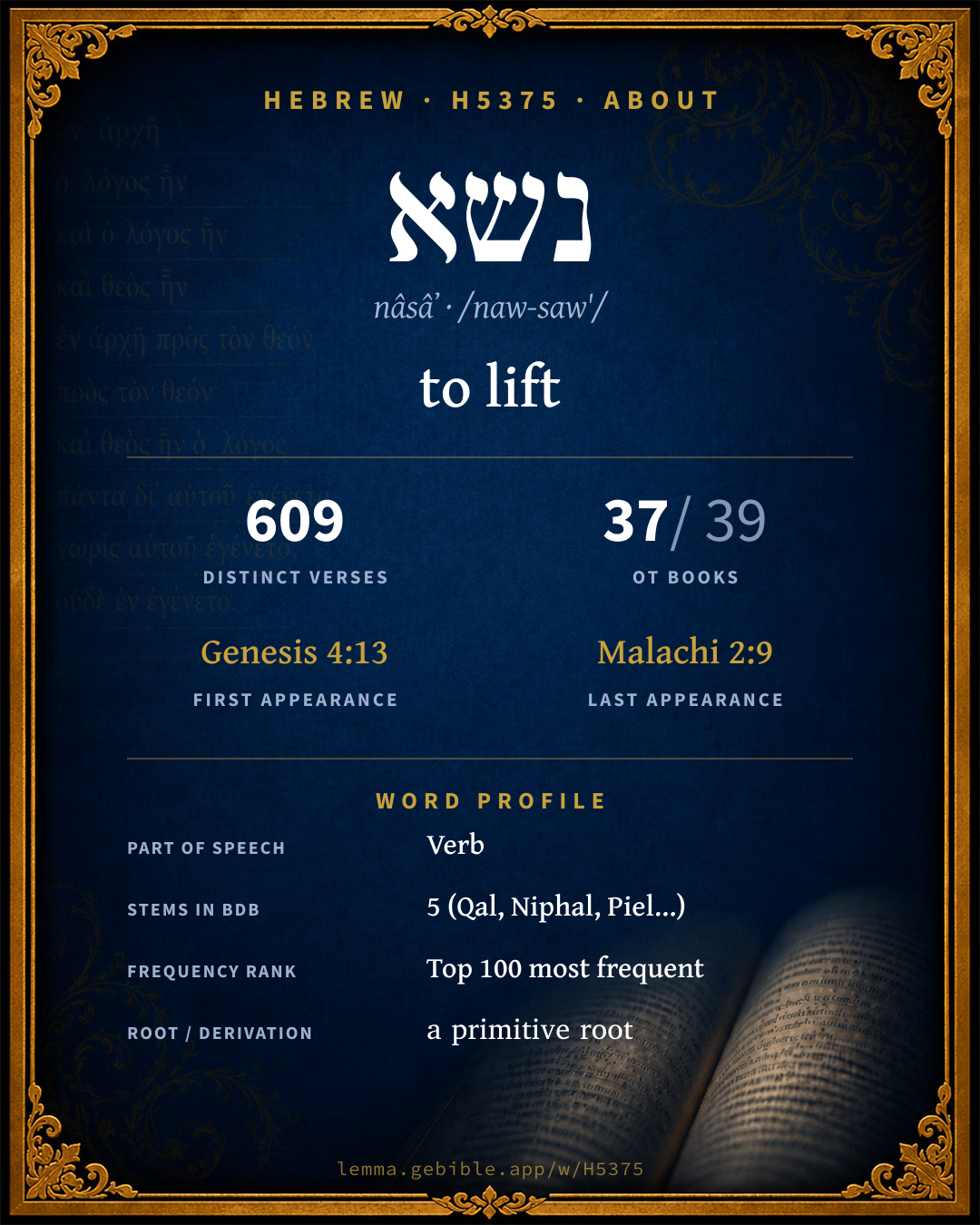
נָשָׂא
to lift
also: bear up, carry, take fuller range ↓
Full lexicon entry — Brown-Driver-Briggs (BDB)
From Brown-Driver-Briggs (BDB)
Where this word appears
See every Qal verb in the Hebrew Bible →
Grammar key — what these labels mean
Part of speech
- Verb
- An action or state-of-being word.
Stem
- Qal
- The basic, simple active stem — the plain form of the verb (“he wrote”). Here: ‘lift’
- Niphal
- Usually the simple passive or reflexive of the Qal (“he was written”). Here: ‘be lifted up’
- Piel
- An intensive or resultative active stem. Here: ‘lift up = exalt’
- Hiphil
- The causative active stem (“he caused / brought about”). Here: ‘cause one to bear iniquity’
- Hithpael
- The reflexive or reciprocal stem (the subject acts on itself).
Form
- Sequential Imperfect
- An imperfect with prefixed waw — the standard past-narrative form (waw-consecutive imperfect).
- Imperfect
- An incomplete, ongoing, or future action (“he will / would write”).
- Infinitive Construct
- A bound verbal noun, frequently with prepositions (“to write / in writing”).
- Participle Active
- A verbal adjective expressing ongoing or characteristic action (“writing / one who writes”).
- Perfect
- A completed action or state — Hebrew marks aspect (completeness) more than strict tense (“he wrote”).
- Imperative
- A direct command (“write!”).
- Sequential Perfect
- A perfect with prefixed waw continuing a preceding imperfect or command (waw-consecutive perfect).
- Participle Passive
- A verbal adjective expressing action received (“written”).
- Infinitive Absolute
- An unbound verbal noun, often intensifying or standing in for a finite verb.
- Jussive
- A third- or second-person volitional form expressing wish or command (“let him write”).
- Cohortative
- A first-person volitional form expressing wish or resolve (“let me / let us write”).
State
- Construct
- A noun bound to a following noun in a possessive / “of” relationship (the construct chain).
- Absolute
- The independent form of a noun, not bound to a following word.
Person
- 3rd Person
- The one spoken about (“he / she / it / they”).
- 1st Person
- The speaker (“I / we”).
- 2nd Person
- The one addressed (“you”).
Gender
- Masculine
- Grammatically masculine.
- Common
- Either gender — not distinguished for this form.
- Feminine
- Grammatically feminine.
Number
- Plural
- More than one (in Hebrew, generally three or more).
- Singular
- One.
Grammatical forms 75 distinct
- Verb, Qal, Sequential Imperfect, 3rd Person, Masculine, Plural 49 times (7%)
- Verb, Qal, Sequential Imperfect, 3rd Person, Masculine, Singular 45 times (7%)
- Verb, Qal, Infinitive Construct 44 times (7%)
- Verb, Qal, Imperfect, 3rd Person, Masculine, Singular 43 times (7%)
- Verb, Qal, Perfect, 3rd Person, Masculine, Singular 33 times (5%)
- Verb, Qal, Imperfect, 3rd Person, Masculine, Plural 32 times (5%)
- Verb, Qal, Participle Active, Masculine, Plural, Construct 27 times (4%)
- Verb, Qal, Imperfect, 1st Person, Common, Singular 26 times (4%)
+67 more forms (355 occurrences)
Parsed forms decoded from the imported morphology (morphhb / Westminster Leningrad Codex — WLC text public domain, morphhb tagging CC BY 4.0), counted across 654 parsed occurrences — not distinct verses.
Page 2 of 4 — showing verses 201–400 of 609 distinct verses where H5375 appears, across 37 books. Click any verse to open its interlinear word-by-word view. Verse text shown in the World English Bible for context — . Each verse’s Hebrew form is shown with its reference; the English is not keyword-highlighted, since the data carries no word-level English alignment. Use “Compare translations” on any verse to read it across multiple English versions. This concordance covers the Hebrew Bible; Septuagint (Greek Old Testament) occurrences are not indexed here.
1 Samuel 27 verses
- 1 Samuel 14:6 נֹשֵׂ֣א Qal ptcp.act ms cs Jonathan said to the young man who bore his armor, Come, and let us go over to the garrison of these uncircumcised: it may be that Yahweh will work for us; for there is no restraint to Yahweh to save by many or by few.
- 1 Samuel 14:7 נֹשֵׂ֣א Qal ptcp.act ms cs His armor bearer said to him, Do all that is in your heart: turn you, behold, I am with you according to your heart.
- 1 Samuel 14:12 נֹשֵׂ֣א נֹשֵׂ֤א Qal ptcp.act ms cs Qal ptcp.act ms cs The men of the garrison answered Jonathan and his armor bearer, and said, Come up to us, and we will show you a thing. Jonathan said to his armor bearer, Come up after me; for Yahweh has delivered them into the hand of Israel.
- 1 Samuel 14:13 וְ/נֹשֵׂ֥א וְ/נֹשֵׂ֥א conj + Qal ptcp.act ms cs conj + Qal ptcp.act ms cs Jonathan climbed up on his hands and on his feet, and his armor bearer after him: and they fell before Jonathan; and his armor bearer killed them after him.
- 1 Samuel 14:14 וְ/נֹשֵׂ֥א conj + Qal ptcp.act ms cs That first slaughter, which Jonathan and his armor bearer made, was about twenty men, within as it were half a furrow's length in an acre of land.
- 1 Samuel 14:17 וְ/נֹשֵׂ֥א conj + Qal ptcp.act ms cs Then said Saul to the people who were with him, Number now, and see who is gone from us. When they had numbered, behold, Jonathan and his armor bearer were not there.
- 1 Samuel 15:25 שָׂ֥א Qal impv 2ms Now therefore, please pardon my sin, and turn again with me, that I may worship Yahweh.
- 1 Samuel 16:21 נֹשֵׂ֥א Qal ptcp.act ms cs David came to Saul, and stood before him: and he loved him greatly; and he became his armor bearer.
- 1 Samuel 17:7 וְ/נֹשֵׂ֥א conj + Qal ptcp.act ms cs The staff of his spear was like a weaver's beam; and his spear's head [weighed] six hundred shekels of iron: and his shield-bearer went before him.
- 1 Samuel 17:20 וַ/יִּשָּׂ֣א conj + Qal wimpf 3ms David rose up early in the morning, and left the sheep with a keeper, and took, and went, as Jesse had commanded him; and he came to the place of the wagons, as the host which was going forth to the fight shouted for the battle.
- 1 Samuel 17:34 וְ/נָשָׂ֥א conj + Qal wpf 3ms David said to Saul, Your servant was keeping his father's sheep; and when there came a lion, or a bear, and took a lamb out of the flock,
- 1 Samuel 17:41 נֹשֵׂ֥א Qal ptcp.act ms The Philistine came on and drew near to David; and the man who bore the shield went before him.
- 1 Samuel 22:18 נֹשֵׂ֖א Qal ptcp.act ms The king said to Doeg, Turn you, and fall on the priests. Doeg the Edomite turned, and he fell on the priests, and he killed on that day eighty-five persons who wore a linen ephod.
- 1 Samuel 24:16 וַ/יִּשָּׂ֥א conj + Qal wimpf 3ms It came to pass, when David had made an end of speaking these words to Saul, that Saul said, Is this your voice, my son David? Saul lifted up his voice, and wept.
- 1 Samuel 25:28 שָׂ֥א Qal impv 2ms Please forgive the trespass of your handmaid: for Yahweh will certainly make my lord a sure house, because my lord fights the battles of Yahweh; and evil shall not be found in you all your days.
- 1 Samuel 25:35 וָ/אֶשָּׂ֖א conj + Qal wimpf 1cs So David received of her hand that which she had brought him: and he said to her, Go up in peace to your house; behold, I have listened to your voice, and have accepted your person.
- 1 Samuel 30:4 וַ/יִּשָּׂ֨א conj + Qal wimpf 3ms Then David and the people who were with him lifted up their voice and wept, until they had no more power to weep.
- 1 Samuel 31:4 לְ/נֹשֵׂ֨א נֹשֵׂ֣א prep + Qal ptcp.act ms cs Qal ptcp.act ms cs Then said Saul to his armor bearer, Draw your sword, and thrust me through therewith, lest these uncircumcised come and thrust me through, and abuse me. But his armor bearer would not; for he was sore afraid. Therefore Saul took his sword, and fell on it.
- 1 Samuel 31:5 נֹשֵֽׂא Qal ptcp.act ms cs When his armor bearer saw that Saul was dead, he likewise fell on his sword, and died with him.
- 1 Samuel 31:6 וְ/נֹשֵׂ֨א conj + Qal ptcp.act ms cs So Saul died, and his three sons, and his armor bearer, and all his men, that same day together.
2 Samuel 23 verses
- 2 Samuel 2:22 אֶשָּׂ֣א Qal impf 1cs Abner said again to Asahel, Turn you aside from following me: why should I strike you to the ground? how then should I hold up my face to Joab your brother?
- 2 Samuel 2:32 וַ/יִּשְׂאוּ֙ conj + Qal wimpf 3mp They took up Asahel, and buried him in the tomb of his father, which was in Bethlehem. Joab and his men went all night, and the day broke on them at Hebron.
- 2 Samuel 3:32 וַ/יִשָּׂ֧א conj + Qal wimpf 3ms They buried Abner in Hebron: and the king lifted up his voice, and wept at the grave of Abner; and all the people wept.
- 2 Samuel 4:4 וַ/תִּשָּׂאֵ֤/הוּ conj + Qal wimpf 3fs + sfx pers 3ms Now Jonathan, Saul's son, had a son who was lame of his feet. He was five years old when the news came of Saul and Jonathan out of Jezreel; and his nurse took him up, and fled: and it happened, as she made haste to flee, that he fell, and became lame. His name was Mephibosheth.
- 2 Samuel 5:12 נִשֵּׂ֣א Piel pf 3ms David perceived that Yahweh had established him king over Israel, and that he had exalted his kingdom for his people Israel's sake.
- 2 Samuel 5:21 וַ/יִּשָּׂאֵ֥/ם conj + Qal wimpf 3ms + sfx pers 3mp They left their images there; and David and his men took them away.
- 2 Samuel 6:3 וַ/יִּשָּׂאֻ֔/הוּ conj + Qal wimpf 3mp + sfx pers 3ms They set the ark of God on a new cart, and brought it out of the house of Abinadab that was in the hill: and Uzzah and Ahio, the sons of Abinadab, drove the new cart.
- 2 Samuel 6:4 וַ/יִּשָּׂאֻ֗/הוּ conj + Qal wimpf 3mp + sfx pers 3ms They brought it out of the house of Abinadab, which was in the hill, with the ark of God: and Ahio went before the ark.
- 2 Samuel 6:13 נֹשְׂאֵ֥י Qal ptcp.act mp cs It was so, that, when those who bore the ark of Yahweh had gone six paces, he sacrificed an ox and a fattened calf.
- 2 Samuel 8:2 נֹשְׂאֵ֥י Qal ptcp.act mp cs He struck Moab, and measured them with the line, making them to lie down on the ground; and he measured two lines to put to death, and one full line to keep alive. The Moabites became servants to David, and brought tribute.
- 2 Samuel 8:6 נוֹשְׂאֵ֣י Qal ptcp.act mp cs Then David put garrisons in Syria of Damascus; and the Syrians became servants to David, and brought tribute. Yahweh gave victory to David wherever he went.
- 2 Samuel 13:34 וַ/יִּשָּׂ֞א conj + Qal wimpf 3ms But Absalom fled. The young man who kept the watch lifted up his eyes, and looked, and, behold, there came much people by the way of the hill-side behind him.
- 2 Samuel 13:36 וַ/יִּשְׂא֥וּ conj + Qal wimpf 3mp It happened, as soon as he had made an end of speaking, that behold, the king's sons came, and lifted up their voice, and wept: and the king also and all his servants wept very sore.
- 2 Samuel 14:14 יִשָּׂ֤א Qal impf 3ms For we must needs die, and are as water split on the ground, which can't be gathered up again; neither does God take away life, but devises means, that he who is banished not be an outcast from him.
- 2 Samuel 15:24 נֹֽשְׂאִים֙ Qal ptcp.act mp Behold, Zadok also [came], and all the Levites with him, bearing the ark of the covenant of God; and they set down the ark of God; and Abiathar went up, until all the people had done passing out of the city.
- 2 Samuel 17:13 וְ/הִשִּׂ֧יאוּ conj + Hiphil wpf 3cp Moreover, if he be gotten into a city, then shall all Israel bring ropes to that city, and we will draw it into the river, until there not be one small stone found there.
- 2 Samuel 18:15 נֹשְׂאֵ֖י Qal ptcp.act mp cs Ten young men who bore Joab's armor compassed about and struck Absalom, and killed him.
- 2 Samuel 18:24 וַ/יִּשָּׂ֤א conj + Qal wimpf 3ms Now David was sitting between the two gates: and the watchman went up to the roof of the gate to the wall, and lifted up his eyes, and looked, and, behold, a man running alone.
- 2 Samuel 18:28 נָשְׂא֥וּ Qal pf 3cp Ahimaaz called, and said to the king, All is well. He bowed himself before the king with his face to the earth, and said, Blessed be Yahweh your God, who has delivered up the men who lifted up their hand against my lord the king.
- 2 Samuel 19:42 נִשָּׂ֖א Niphal pf 3ms All the men of Judah answered the men of Israel, Because the king is a close relative to us: why then are you angry for this matter? have we eaten at all at the king's cost? or has he given us any gift?
- 2 Samuel 20:21 נָשָׂ֤א Qal pf 3ms The matter is not so: but a man of the hill-country of Ephraim, Sheba the son of Bichri by name, has lifted up his hand against the king, even against David; deliver him only, and I will depart from the city. The woman said to Joab, Behold, his head shall be thrown to you over the wall.
- 2 Samuel 23:16 וַ/יִּשְׂא֖וּ conj + Qal wimpf 3mp The three mighty men broke through the host of the Philistines, and drew water out of the well of Bethlehem, that was by the gate, and took it, and brought it to David: but he would not drink of it, but poured it out to Yahweh.
- 2 Samuel 23:37 נשאי נֹשֵׂ֕א Qal ptcp.act mp cs Qal ptcp.act ms cs Zelek the Ammonite, Naharai the Beerothite, armor bearers to Joab the son of Zeruiah,
1 Kings 12 verses
- 1 Kings 2:26 נָשָׂ֜אתָ Qal pf 2ms To Abiathar the priest said the king, Get you to Anathoth, to your own fields; for you are worthy of death: but I will not at this time put you to death, because you bear the ark of the Lord Yahweh before David my father, and because you were afflicted in all in which my father was afflicted.
- 1 Kings 5:9 תִשָּׂ֑א Qal impf 2ms My servants shall bring them down from Lebanon to the sea; and I will make them into rafts to go by sea to the place that you shall appoint me, and will cause them to be broken up there, and you shall receive them; and you shall accomplish my desire, in giving food for my household.
- 1 Kings 5:15 נֹשֵׂ֣א Qal ptcp.act ms cs Solomon had seventy thousand who bore burdens, and eighty thousand who were stone cutters in the mountains;
- 1 Kings 8:3 וַ/יִּשְׂא֥וּ conj + Qal wimpf 3mp All the elders of Israel came, and the priests took up the ark.
- 1 Kings 9:11 נִשָּׂ֨א Piel pf 3ms (now Hiram the king of Tyre had furnished Solomon with cedar trees and fir trees, and with gold, according to all his desire), that then king Solomon gave Hiram twenty cities in the land of Galilee.
- 1 Kings 10:2 נֹשְׂאִ֨ים Qal ptcp.act mp She came to Jerusalem with a very great train, with camels that bore spices, and very much gold, and precious stones; and when she was come to Solomon, she talked with him of all that was in her heart.
- 1 Kings 10:11 נָשָׂ֥א Qal pf 3ms The navy also of Hiram, that brought gold from Ophir, brought in from Ophir great plenty of almug trees and precious stones.
- 1 Kings 10:22 נֹֽשְׂאֵת֙ Qal ptcp.act fs cs For the king had at sea a navy of Tarshish with the navy of Hiram: once every three years came the navy of Tarshish, bringing gold, and silver, ivory, and apes, and peacocks.
- 1 Kings 13:29 וַ/יִּשָּׂ֨א conj + Qal wimpf 3ms The prophet took up the body of the man of God, and laid it on the donkey, and brought it back; and he came to the city of the old prophet, to mourn, and to bury him.
- 1 Kings 14:28 יִשָּׂאוּ/ם֙ Qal impf 3mp + sfx pers 3mp It was so, that as often as the king went into the house of Yahweh, the guard bore them, and brought them back into the guard-chamber.
- 1 Kings 15:22 וַ/יִּשְׂא֞וּ conj + Qal wimpf 3mp Then king Asa made a proclamation to all Judah; none was exempted: and they carried away the stones of Ramah, and the timber of it, with which Baasha had built; and king Asa built therewith Geba of Benjamin, and Mizpah.
- 1 Kings 18:12 יִֽשָּׂאֲ/ךָ֙ Qal impf 3ms + sfx pers 2ms It will happen, as soon as I am gone from you, that the Spirit of Yahweh will carry you I don't know where; and so when I come and tell Ahab, and he can't find you, he will kill me: but I your servant fear Yahweh from my youth.
2 Kings 21 verses
- 2 Kings 2:16 נְשָׂא/וֹ֙ Qal pf 3ms + sfx pers 3ms They said to him, See now, there are with your servants fifty strong men; let them go, we pray you, and seek your master, lest the Spirit of Yahweh has taken him up, and cast him on some mountain, or into some valley. He said, You shall not send.
- 2 Kings 3:14 נֹשֵׂ֑א Qal ptcp.act ms Elisha said, As Yahweh of Hosts lives, before whom I stand, surely, were it not that I regard the presence of Jehoshaphat the king of Judah, I would not look toward you, nor see you.
- 2 Kings 4:19 שָׂאֵ֖/הוּ Qal impv 2ms + sfx pers 3ms He said to his father, My head, my head. He said to his servant, Carry him to his mother.
- 2 Kings 4:20 וַ/יִּשָּׂאֵ֔/הוּ conj + Qal wimpf 3ms + sfx pers 3ms When he had taken him, and brought him to his mother, he sat on her knees until noon, and then died.
- 2 Kings 4:36 שְׂאִ֥י Qal impv 2fs He called Gehazi, and said, Call this Shunammite. So he called her. When she was come in to him, he said, Take up your son.
- 2 Kings 4:37 וַ/תִּשָּׂ֥א conj + Qal wimpf 3fs Then she went in, and fell at his feet, and bowed herself to the ground; and she took up her son, and went out.
- 2 Kings 5:1 וּ/נְשֻׂ֣א conj + Qal ptcp.pass ms cs Now Naaman, captain of the host of the king of Syria, was a great man with his master, and honorable, because by him Yahweh had given victory to Syria: he was also a mighty man of valor, [but he was] a leper.
- 2 Kings 5:23 וַ/יִּשְׂא֖וּ conj + Qal wimpf 3mp Naaman said, Be pleased to take two talents. He urged him, and bound two talents of silver in two bags, with two changes of clothing, and laid them on two of his servants; and they bore them before him.
- 2 Kings 7:8 וַ/יִּשְׂא֣וּ וַ/יִּשְׂא֣וּ conj + Qal wimpf 3mp conj + Qal wimpf 3mp When these lepers came to the outermost part of the camp, they went into one tent, and ate and drink, and carried there silver, and gold, and clothing, and went and hid it; and they came back, and entered into another tent, and carried there also, and went and hid it.
- 2 Kings 9:25 שָׂ֚א נָשָׂ֣א Qal impv 2ms Qal pf 3ms Then said [Jehu] to Bidkar his captain, Take up, and cast him in the portion of the field of Naboth the Jezreelite; for remember how that, when I and you rode together after Ahab his father, Yahweh laid this burden on him:
- 2 Kings 9:26 שָׂ֧א Qal impv 2ms Surely I have seen yesterday the blood of Naboth, and the blood of his sons, says Yahweh; and I will requite you in this plat, says Yahweh. Now therefore take and cast him into the plat [of ground], according to the word of Yahweh.
- 2 Kings 9:32 וַ/יִּשָּׂ֤א conj + Qal wimpf 3ms He lifted up his face to the window, and said, Who is on my side? who? There looked out to him two or three eunuchs.
- 2 Kings 14:10 וּֽ/נְשָׂאֲ/ךָ֖ conj + Qal wpf 3ms + sfx pers 2ms You have indeed struck Edom, and your heart has lifted you up: glory of it, and abide at home; for why should you meddle to [your] hurt, that you should fall, even you, and Judah with you?
- 2 Kings 14:20 וַ/יִּשְׂא֥וּ conj + Qal wimpf 3mp They brought him on horses; and he was buried at Jerusalem with his fathers in the city of David.
- 2 Kings 18:14 אֶשָּׂ֑א Qal impf 1cs Hezekiah king of Judah sent to the king of Assyria to Lachish, saying, I have offended; return from me: that which you put on me will I bear. The king of Assyria appointed to Hezekiah king of Judah three hundred talents of silver and thirty talents of gold.
- 2 Kings 19:4 וְ/נָשָׂ֣אתָ conj + Qal wpf 2ms It may be Yahweh your God will hear all the words of Rabshakeh, whom the king of Assyria his master has sent to defy the living God, and will rebuke the words which Yahweh your God has heard. Therefore lift up your prayer for the remnant that is left.
- 2 Kings 19:22 וַ/תִּשָּׂ֥א conj + Qal wimpf 2ms Whom have you defied and blasphemed? and against whom have you exalted your voice and lifted up your eyes on high? [even] against the Holy One of Israel.
- 2 Kings 20:17 וְ/נִשָּׂ֣א conj + Niphal wpf 3ms Behold, the days come, that all that is in your house, and that which your fathers have laid up in store to this day, shall be carried to Babylon: nothing shall be left, says Yahweh.
- 2 Kings 23:4 וְ/נָשָׂ֥א conj + Qal pf 3ms The king commanded Hilkiah the high priest, and the priests of the second order, and the keepers of the threshold, to bring forth out of the temple of Yahweh all the vessels that were made for Baal, and for the Asherah, and for all the host of the sky, and he burned them outside of Jerusalem in the fields of the Kidron, and carried the ashes of them to Bethel.
- 2 Kings 25:13 וַ/יִּשְׂא֥וּ conj + Qal wimpf 3mp The pillars of brass that were in the house of Yahweh, and the bases and the brazen sea that were in the house of Yahweh, did the Chaldeans break in pieces, and carried the brass of them to Babylon.
- 2 Kings 25:27 נָשָׂ֡א Qal pf 3ms It happened in the seven and thirtieth year of the captivity of Jehoiachin king of Judah, in the twelfth month, on the seven and twentieth day of the month, that Evilmerodach king of Babylon, in the year that he began to reign, did lift up the head of Jehoiachin king of Judah out of prison;
1 Chronicles 22 verses
- 1 Chronicles 5:18 נֹשְׂאֵ֨י Qal ptcp.act mp cs The sons of Reuben, and the Gadites, and the half-tribe of Manasseh, of valiant men, men able to bear buckler and sword, and to shoot with bow, and skillful in war, were forty-four thousand seven hundred and sixty, that were able to go forth to war.
- 1 Chronicles 10:4 נֹשֵׂ֨א נֹשֵׂ֣א Qal ptcp.act ms cs Qal ptcp.act ms cs Then said Saul to his armor-bearer, Draw your sword, and thrust me through therewith, lest these uncircumcised come and abuse me. But his armor-bearer would not; for he was sore afraid. Therefore Saul took his sword, and fell on it.
- 1 Chronicles 10:5 נֹשֵֽׂא Qal ptcp.act ms cs When his armor-bearer saw that Saul was dead, he likewise fell on his sword, and died.
- 1 Chronicles 10:9 וַ/יִּשְׂא֥וּ conj + Qal wimpf 3mp They stripped him, and took his head, and his armor, and sent into the land of the Philistines round about, to carry the news to their idols, and to the people.
- 1 Chronicles 10:12 וַ/יִּשְׂא֞וּ conj + Qal wimpf 3mp all the valiant men arose, and took away the body of Saul, and the bodies of his sons, and brought them to Jabesh, and buried their bones under the oak in Jabesh, and fasted seven days.
- 1 Chronicles 11:18 וַ/יִּשְׂא֖וּ conj + Qal wimpf 3mp The three broke through the host of the Philistines, and drew water out of the well of Bethlehem, that was by the gate, and took it, and brought it to David: but David would not drink of it, but poured it out to Yahweh,
- 1 Chronicles 11:39 נֹשֵׂ֕א Qal ptcp.act ms Zelek the Ammonite, Naharai the Berothite, the armor bearer of Joab the son of Zeruiah,
- 1 Chronicles 12:24 נֹשְׂאֵ֥י Qal ptcp.act mp cs The children of Judah who bore shield and spear were six thousand and eight hundred, armed for war.
- 1 Chronicles 14:2 נִשֵּׂ֤את Niphal pf 3fs David perceived that Yahweh had established him king over Israel; for his kingdom was exalted on high, for his people Israel's sake.
- 1 Chronicles 15:2 לָ/שֵׂאת֙ לָ/שֵׂ֞את prep + Qal inf.cs prep + Qal inf.cs Then David said, None ought to carry the ark of God but the Levites: for them has Yahweh chosen to carry the ark of God, and to minister to him forever.
- 1 Chronicles 15:15 וַ/יִּשְׂא֣וּ conj + Qal wimpf 3mp The children of the Levites bore the ark of God on their shoulders with the poles thereon, as Moses commanded according to the word of Yahweh.
- 1 Chronicles 15:26 נֹשְׂאֵ֖י Qal ptcp.act mp cs It happened, when God helped the Levites who bore the ark of the covenant of Yahweh, that they sacrificed seven bulls and seven rams.
- 1 Chronicles 15:27 הַ/נֹּשְׂאִ֣ים ptcl def.art + Qal ptcp.act mp David was clothed with a robe of fine linen, and all the Levites who bore the ark, and the singers, and Chenaniah the master of the song [with] the singers: and David had on him an ephod of linen.
- 1 Chronicles 16:29 שְׂא֤וּ Qal impv 2mp Ascribe to Yahweh the glory due to his name: Bring an offering, and come before him: Worship Yahweh in holy array.
- 1 Chronicles 18:2 נֹשְׂאֵ֖י Qal ptcp.act mp cs He struck Moab; and the Moabites became servants to David, and brought tribute.
- 1 Chronicles 18:6 נֹשְׂאֵ֣י Qal ptcp.act mp cs Then David put [garrisons] in Syria of Damascus; and the Syrians became servants to David, and brought tribute. Yahweh gave victory to David wherever he went.
- 1 Chronicles 18:11 נָשָׂ֖א Qal pf 3ms These also did king David dedicate to Yahweh, with the silver and the gold that he carried away from all the nations; from Edom, and from Moab, and from the children of Ammon, and from the Philistines, and from Amalek.
- 1 Chronicles 21:16 וַ/יִּשָּׂ֨א conj + Qal wimpf 3ms David lifted up his eyes, and saw the angel of Yahweh standing between earth and the sky, having a drawn sword in his hand stretched out over Jerusalem. Then David and the elders, clothed in sackcloth, fell on their faces.
- 1 Chronicles 21:24 אֶשָּׂ֤א Qal impf 1cs King David said to Ornan, No; but I will most assuredly buy it for the full price: for I will not take that which is your for Yahweh, nor offer a burnt-offering without cost.
- 1 Chronicles 23:22 וַ/יִּשָּׂא֥וּ/ם conj + Qal wimpf 3mp + sfx pers 3mp Eleazar died, and had no sons, but daughters only: and their brothers the sons of Kish took them [to wife].
- 1 Chronicles 23:26 לָ/שֵׂ֧את prep + Qal inf.cs and also the Levites shall no more have need to carry the tent and all the vessels of it for the service of it.
- 1 Chronicles 27:23 נָשָׂ֤א Qal pf 3ms But David didn't take the number of them from twenty years old and under, because Yahweh had said he would increase Israel like the stars of the sky.
2 Chronicles 15 verses
- 2 Chronicles 5:4 וַ/יִּשְׂא֥וּ conj + Qal wimpf 3mp All the elders of Israel came: and the Levites took up the ark;
- 2 Chronicles 6:22 וְ/נָֽשָׁא conj + Qal wpf 3ms If a man sin against his neighbor, and an oath is laid on him to cause him to swear, and he comes and swears before your altar in this house;
- 2 Chronicles 9:1 נֹשְׂאִ֨ים Qal ptcp.act mp When the queen of Sheba heard of the fame of Solomon, she came to prove Solomon with hard questions at Jerusalem, with a very great train, and camels that bore spices, and gold in abundance, and precious stones: and when she was come to Solomon, she talked with him of all that was in her heart.
- 2 Chronicles 9:21 נֹֽשְׂאוֹת֙ Qal ptcp.act fp For the king had ships that went to Tarshish with the servants of Huram; once every three years came the ships of Tarshish, bringing gold, and silver, ivory, and apes, and peacocks.
- 2 Chronicles 11:21 נָשָׂ֔א Qal pf 3ms Rehoboam loved Maacah the daughter of Absalom above all his wives and his concubines: (for he took eighteen wives, and sixty concubines, and became the father of twenty-eight sons and sixty daughters.)
- 2 Chronicles 12:11 וּ/נְשָׂא֔וּ/ם conj + Qal wpf 3cp + sfx pers 3mp It was so, that as often as the king entered into the house of Yahweh, the guard came and bore them, and brought them back into the guard-chamber.
- 2 Chronicles 13:21 וַ/יִּ֨שָּׂא conj + Qal wimpf 3ms But Abijah grew mighty, and took to himself fourteen wives, and became the father of twenty-two sons, and sixteen daughters.
- 2 Chronicles 14:8 נֹשֵׂ֣א נֹשְׂאֵ֤י Qal ptcp.act ms Qal ptcp.act mp cs Asa had an army that bore bucklers and spears, out of Judah three hundred thousand; and out of Benjamin, that bore shields and drew bows, two hundred eighty thousand: all these were mighty men of valor.
- 2 Chronicles 14:13 וַ/יִּשְׂא֥וּ conj + Qal wimpf 3mp Asa and the people who were with him pursued them to Gerar: and there fell of the Ethiopians so many that they could not recover themselves; for they were destroyed before Yahweh, and before his host; and they carried away very much booty.
- 2 Chronicles 16:6 וַ/יִּשְׂא֞וּ conj + Qal wimpf 3mp Then Asa the king took all Judah; and they carried away the stones of Ramah, and the timber of it, with which Baasha had built; and he built therewith Geba and Mizpah.
- 2 Chronicles 24:3 וַ/יִּשָּׂא conj + Qal wimpf 3ms Jehoiada took for him two wives; and he became the father of sons and daughters.
- 2 Chronicles 24:11 וְ/יִשָּׂאֻ֖/הוּ conj + Qal impf 3mp + sfx pers 3ms It was so, that whenever the chest was brought to the king's officers by the hand of the Levites, and when they saw that there was much money, the king's scribe and the chief priest's officer came and emptied the chest, and took it, and carried it to its place again. Thus they did day by day, and gathered money in abundance.
- 2 Chronicles 25:19 וּ/נְשָׂאֲ/ךָ֥ conj + Qal pf 3ms + sfx pers 2ms You say, Behold, you have struck Edom; and your heart lifts you up to boast: abide now at home; why should you meddle to [your] hurt, that you should fall, even you, and Judah with you?
- 2 Chronicles 25:28 וַ/יִּשָּׂאֻ֖/הוּ conj + Qal wimpf 3mp + sfx pers 3ms They brought him on horses, and buried him with his fathers in the city of Judah.
- 2 Chronicles 32:23 וַ/יִּנַּשֵּׂ֛א conj + Hithpael wimpf 3ms Many brought gifts to Yahweh to Jerusalem, and precious things to Hezekiah king of Judah; so that he was exalted in the sight of all nations from thenceforth.
Ezra 5 verses
- Ezra 1:4 יְנַשְּׂא֨וּ/הוּ֙ Piel impf 3mp + sfx pers 3ms Whoever is left, in any place where he sojourns, let the men of his place help him with silver, and with gold, and with goods, and with animals, besides the freewill-offering for the house of God which is in Jerusalem.
- Ezra 8:36 וְ/נִשְּׂא֥וּ conj + Piel pf 3cp They delivered the king's commissions to the king's satraps, and to the governors beyond the River: and they furthered the people and the house of God.
- Ezra 9:2 נָשְׂא֣וּ Qal pf 3cp For they have taken of their daughters for themselves and for their sons, so that the holy seed have mixed themselves with the peoples of the lands: yes, the hand of the princes and rulers has been chief in this trespass.
- Ezra 9:12 תִּשְׂא֣וּ Qal juss 2mp now therefore don't give your daughters to their sons, neither take their daughters to your sons, nor seek their peace or their prosperity forever; that you may be strong, and eat the good of the land, and leave it for an inheritance to your children forever.
- Ezra 10:44 נשא/י נָשְׂא֖וּ Qal pf 3ms + sfx pers 1cs Qal pf 3cp All these had taken foreign wives; and some of them had wives by whom they had children.
Nehemiah 4 verses
- Nehemiah 2:1 וָ/אֶשָּׂ֤א conj + Qal wimpf 1cs It happened in the month Nisan, in the twentieth year of Artaxerxes the king, when wine was before him, that I took up the wine, and gave it to the king. Now I had not been [before] sad in his presence.
- Nehemiah 4:17 וְ/הַ/נֹּשְׂאִ֥ים conj + ptcl def.art + Qal ptcp.act mp They all built the wall and those who bore burdens loaded themselves; everyone with one of his hands worked in the work, and with the other held his weapon;
- Nehemiah 9:15 נָשָׂ֥אתָ Qal pf 2ms and gave them bread from the sky for their hunger, and brought forth water for them out of the rock for their thirst, and commanded those who they should go in to possess the land which you had sworn to give them.
- Nehemiah 13:25 תִּשְׂאוּ֙ Qal impf 2mp I contended with them, and cursed them, and struck certain of them, and plucked off their hair, and made them swear by God, [saying], You shall not give your daughters to their sons, nor take their daughters for your sons, or for yourselves.
Esther 7 verses
- Esther 2:9 וַ/תִּשָּׂ֣א conj + Qal wimpf 3fs The maiden pleased him, and she obtained kindness of him; and he speedily gave her things for her purification, with her portions, and the seven maidens who were meet to be given her out of the king's house: and he removed her and her maidens to the best place of the house of the women.
- Esther 2:15 נֹשֵׂ֣את Qal ptcp.act fs cs Now when the turn of Esther, the daughter of Abihail the uncle of Mordecai, who had taken her for his daughter, was come to go in to the king, she required nothing but what Hegai the king's chamberlain, the keeper of the women, appointed. Esther obtained favor in the sight of all those who looked at her.
- Esther 2:17 וַ/תִּשָּׂא conj + Qal wimpf 3fs The king loved Esther above all the women, and she obtained favor and kindness in his sight more than all the virgins; so that he set the royal crown on her head, and made her queen instead of Vashti.
- Esther 3:1 וַֽ/יְנַשְּׂאֵ֑/הוּ conj + Piel wimpf 3ms + sfx pers 3ms After these things did king Ahasuerus promote Haman the son of Hammedatha the Agagite, and advanced him, and set his seat above all the princes who were with him.
- Esther 5:2 נָשְׂאָ֥ה Qal pf 3fs It was so, when the king saw Esther the queen standing in the court, that she obtained favor in his sight; and the king held out to Esther the golden scepter that was in his hand. So Esther drew near, and touched the top of the scepter.
- Esther 5:11 נִשְּׂא֔/וֹ Piel pf 3ms + sfx pers 3ms Haman recounted to them the glory of his riches, and the multitude of his children, and all the things in which the king had promoted him, and how he had advanced him above the princes and servants of the king.
- Esther 9:3 מְנַשְּׂאִ֖ים Piel ptcp.act mp All the princes of the provinces, and the satraps, and the governors, and those who did the king's business, helped the Jews; because the fear of Mordecai was fallen on them.
Job 27 verses
- Job 2:12 וַ/יִּשְׂא֨וּ וַ/יִּשְׂא֥וּ conj + Qal wimpf 3mp conj + Qal wimpf 3mp When they lifted up their eyes from a distance, and didn't recognize him, they raised their voices, and wept; and they each tore his robe, and sprinkled dust on their heads toward the sky.
- Job 6:2 יִשְׂאוּ Qal impf 3mp "Oh that my anguish were weighed, And all my calamity laid in the balances!
- Job 7:13 יִשָּׂ֥א Qal impf 3ms When I say, 'My bed shall comfort me, My couch shall ease my complaint;'
- Job 7:21 תִשָּׂ֣א Qal impf 2ms Why do you not pardon my disobedience, and take away my iniquity? For now shall I lie down in the dust. You will seek me diligently, but I shall not be."
- Job 10:15 אֶשָּׂ֣א Qal impf 1cs If I am wicked, woe to me. If I am righteous, I still shall not lift up my head, Being filled with disgrace, And conscious of my affliction.
- Job 11:15 תִּשָּׂ֣א Qal impf 2ms Surely then shall you lift up your face without spot; Yes, you shall be steadfast, and shall not fear:
- Job 13:8 תִּשָּׂא֑וּ/ן Qal impf 2mp + sfx n Will you show partiality to him? Will you contend for God?
- Job 13:10 תִּשָּׂאֽוּ/ן Qal impf 2mp + sfx n He will surely reprove you If you secretly show partiality.
- Job 13:14 אֶשָּׂ֣א Qal impf 1cs Why should I take my flesh in my teeth, And put my life in my hand?
- Job 21:3 שָׂ֭אוּ/נִי Qal impv 2mp + sfx pers 1cs Allow me, and I also will speak; After I have spoken, mock on.
- Job 21:12 יִ֭שְׂאוּ Qal impf 3mp They sing to the tambourine and harp, And rejoice at the sound of the pipe.
- Job 22:8 וּ/נְשׂ֥וּא conj + Qal ptcp.pass ms cs But as for the mighty man, he had the earth. The honorable man, he lived in it.
- Job 22:26 וְ/תִשָּׂ֖א conj + Qal impf 2ms For then shall you delight yourself in the Almighty, And shall lift up your face to God.
- Job 24:10 נָ֣שְׂאוּ Qal pf 3cp So that they go around naked without clothing. Being hungry, they carry the sheaves.
- Job 27:1 שְׂאֵ֥ת Qal inf.cs Job again took up his parable, and said,
- Job 27:21 יִשָּׂאֵ֣/הוּ Qal impf 3ms + sfx pers 3ms The east wind carries him away, and he departs; It sweeps him out of his place.
- Job 29:1 שְׂאֵ֥ת Qal inf.cs Job again took up his parable, and said,
- Job 30:22 תִּשָּׂאֵ֣/נִי Qal impf 2ms + sfx pers 1cs You lift me up to the wind, and drive me with it. You dissolve me in the storm.
- Job 31:36 אֶשָּׂאֶ֑/נּוּ Qal impf 1cs + sfx pers 3ms Surely I would carry it on my shoulder; And I would bind it to me as a crown.
- Job 32:21 אֶשָּׂ֣א Qal coh 1cs Please don't let me respect any man's person, Neither will I give flattering titles to any man.
- Job 32:22 יִשָּׂאֵ֥/נִי Qal impf 3ms + sfx pers 1cs For I don't know how to give flattering titles; Or else my Maker would soon take me away.
- Job 34:19 נָשָׂ֨א Qal pf 3ms Who doesn't respect the persons of princes, Nor regards the rich more than the poor; For they all are the work of his hands.
- Job 34:31 נָשָׂ֗אתִי Qal pf 1cs "For has any said to God, 'I am guilty, but I will not offend any more.
- Job 36:3 אֶשָּׂ֣א Qal impf 1cs I will get my knowledge from afar, And will ascribe righteousness to my Maker.
- Job 40:20 יִשְׂאוּ Qal impf 3mp Surely the mountains bring him forth food, Where all the animals of the field do play.
- Job 42:8 אֶשָּׂ֗א Qal impf 1cs Now therefore, take to yourselves seven bulls and seven rams, and go to my servant Job, and offer up for yourselves a burnt offering; and my servant Job shall pray for you, for I will accept him, that I not deal with you according to your folly. For you have not spoken of me the thing that is right, as my servant Job has."
- Job 42:9 וַ/יִּשָּׂ֥א conj + Qal wimpf 3ms So Eliphaz the Temanite and Bildad the Shuhite and Zophar the Naamathite went, and did what Yahweh commanded them, and Yahweh accepted Job.
Psalms 43 verses
- Psalms 4:6 נְֽסָ/ה Qal impv 2ms + sfx h Many say, "Who will show us any good?" Yahweh, let the light of your face shine on us.
- Psalms 7:6 הִ֭נָּשֵׂא Niphal impv 2ms Arise, Yahweh, in your anger. Lift up yourself against the rage of my adversaries. Awake for me. You have commanded judgment.
- Psalms 10:12 נְשָׂ֣א Qal impv 2ms Arise, Yahweh! God, lift up your hand! Don't forget the helpless.
- Psalms 15:3 נָשָׂ֥א Qal pf 3ms He who doesn't slander with his tongue, Nor does evil to his friend, Nor casts slurs against his fellow man;
- Psalms 16:4 אֶשָּׂ֥א Qal impf 1cs Their sorrows shall be multiplied who give gifts to another god. Their drink-offerings of blood I will not offer, Nor take their names on my lips.
- Psalms 24:4 נָשָׂ֣א Qal pf 3ms He who has clean hands and a pure heart; Who has not lifted up his soul to falsehood, And has not sworn deceitfully.
- Psalms 24:5 יִשָּׂ֣א Qal impf 3ms He shall receive a blessing from Yahweh, Righteousness from the God of his salvation.
- Psalms 24:7 שְׂא֤וּ וְֽ֭/הִנָּשְׂאוּ Qal impv 2mp conj + Niphal impv 2mp Lift up your heads, you gates; Be lifted up, you everlasting doors: The King of glory will come in.
- Psalms 24:9 שְׂא֤וּ וּ֭/שְׂאוּ Qal impv 2mp conj + Qal impv 2mp Lift up your heads, you gates; Yes, lift them up, you everlasting doors: The King of glory will come in.
- Psalms 25:1 אֶשָּֽׂא Qal impf 1cs To you, Yahweh, do I lift up my soul.
- Psalms 25:18 וְ֝/שָׂ֗א conj + Qal impv 2ms Consider my affliction and my travail. Forgive all my sins.
- Psalms 28:2 בְּ/נָשְׂאִ֥/י prep + Qal inf.cs + sfx pers 1cs Hear the voice of my petitions, when I cry to you, When I lift up my hands toward your Most Holy Place.
- Psalms 28:9 וְ֝/נַשְּׂאֵ֗/ם conj + Piel impv 2ms + sfx pers 3mp Save your people, And bless your inheritance. Be their shepherd also, And bear them up forever.
- Psalms 32:1 נְֽשׂוּי Qal ptcp.pass ms cs Blessed is he whose disobedience is forgiven, Whose sin is covered.
- Psalms 32:5 נָ֘שָׂ֤אתָ Qal pf 2ms I acknowledged my sin to you. I didn't hide my iniquity. I said, I will confess my transgressions to Yahweh, And you forgave the iniquity of my sin. Selah.
- Psalms 50:16 וַ/תִּשָּׂ֖א conj + Qal wimpf 2ms But to the wicked God says, "What right do you have to declare my statutes, That you have taken my covenant on your lips,
- Psalms 55:12 וְ/אֶ֫שָּׂ֥א conj + Qal impf 1cs For it was not an enemy who insulted me, Then I could have endured it. Neither was it he who hated me who raised himself up against me, Then I would have hid myself from him.
- Psalms 63:4 אֶשָּׂ֥א Qal impf 1cs So I will bless you while I live. I will lift up my hands in your name.
- Psalms 69:7 נָשָׂ֣אתִי Qal pf 1cs Because for your sake, I have borne reproach. Shame has covered my face.
- Psalms 72:3 יִשְׂא֤וּ Qal impf 3mp The mountains shall bring prosperity to the people. The hills bring the fruit of righteousness.
- Psalms 81:2 שְֽׂאוּ Qal impv 2mp Raise a song, and bring here the tambourine, The pleasant lyre with the harp.
- Psalms 82:2 תִּשְׂאוּ Qal impf 2mp "How long will you judge unjustly, And show partiality to the wicked?" Selah.
- Psalms 83:2 נָ֣שְׂאוּ Qal pf 3cp For, behold, your enemies are stirred up. Those who hate you have lifted up their heads.
- Psalms 85:2 נָ֭שָׂאתָ Qal pf 2ms You have forgiven the iniquity of your people. You have covered all their sin. Selah.
- Psalms 86:4 אֶשָּֽׂא Qal impf 1cs Bring joy to the soul of your servant, For to you, Lord, do I lift up my soul.
- Psalms 88:15 נָשָׂ֖אתִי Qal pf 1cs I am afflicted and ready to die from my youth up. While I suffer your terrors, I am distracted.
- Psalms 89:50 שְׂאֵתִ֥/י Qal inf.cs + sfx pers 1cs Remember, Lord, the reproach of your servants, How I bear in my heart the taunts of all the mighty peoples,
- Psalms 91:12 יִשָּׂא֑וּ/נְ/ךָ Qal impf 3mp + sfx n + sfx pers 2ms They will bear you up in their hands, So that you won't dash your foot against a stone.
- Psalms 93:3 נָשְׂא֤וּ נָשְׂא֣וּ יִשְׂא֖וּ Qal pf 3cp Qal pf 3cp Qal impf 3mp The floods have lifted up, Yahweh, The floods have lifted up their voice. The floods lift up their waves.
- Psalms 94:2 הִ֭נָּשֵׂא Niphal impv 2ms Rise up, you judge of the earth. Pay back the proud what they deserve.
- Psalms 96:8 שְׂאֽוּ Qal impv 2mp Ascribe to Yahweh the glory due to his name. Bring an offering, and come into his courts.
- Psalms 99:8 נֹ֭שֵׂא Qal ptcp.act ms You answered them, Yahweh our God. You are a God who forgave them, Although you took vengeance for their doings.
- Psalms 102:10 נְ֝שָׂאתַ֗/נִי Qal pf 2ms + sfx pers 1cs Because of your indignation and your wrath, For you have taken me up, and thrown me away.
- Psalms 106:26 וַ/יִּשָּׂ֣א conj + Qal wimpf 3ms Therefore he swore to them That he would overthrow them in the wilderness,
- Psalms 116:13 אֶשָּׂ֑א Qal impf 1cs I will take the cup of salvation, and call on the name of Yahweh.
- Psalms 119:48 וְ/אֶשָּֽׂא conj + Qal impf 1cs I reach out my hands for your commandments, which I love. I will meditate on your statutes.
- Psalms 121:1 אֶשָּׂ֣א Qal impf 1cs I will lift up my eyes to the hills. Where does my help come from?
- Psalms 123:1 נָשָׂ֣אתִי Qal pf 1cs To you I do lift up my eyes, You who sit in the heavens.
- Psalms 126:6 נֹשֵׂ֪א נֹ֝שֵׂ֗א Qal ptcp.act ms Qal ptcp.act ms He who goes out weeping, carrying seed for sowing, Will assuredly come again with joy, carrying his sheaves.
- Psalms 134:2 שְׂאֽוּ Qal impv 2mp Lift up your hands in the sanctuary. Praise Yahweh!
- Psalms 139:9 אֶשָּׂ֥א Qal impf 1cs If I take the wings of the dawn, And settle in the uttermost parts of the sea;
- Psalms 139:20 נָשֻׂ֖א Qal pf 3cp For they speak against you wickedly. Your enemies take your name in vain.
- Psalms 143:8 נָשָׂ֥אתִי Qal pf 1cs Cause me to hear your loving kindness in the morning, For I trust in you. Cause me to know the way in which I should walk, For I lift up my soul to you.
Proverbs 9 verses
About this entry
At a glance — auto-summarized from this page’s data, not written by a person. Every figure links to its source below. This summary describes the numbers; it doesn’t interpret them.
נשא — transliterated nâsâʼ — is a Hebrew verb carrying the sense “to lift.” Its English rendering has broadened — “lifted up” classically, “lift up” (Berean Standard Bible) in modern versions; see the renderings breakdown. Spanning 609 verses in 37 books, it ranks among the most common words of the Hebrew Bible. Its earliest occurrence is Genesis 4:13. As a verb its force shifts by stem, across 5 stems (Qal, Niphal, and more). Each statement above links to its evidence; the full detail follows below.
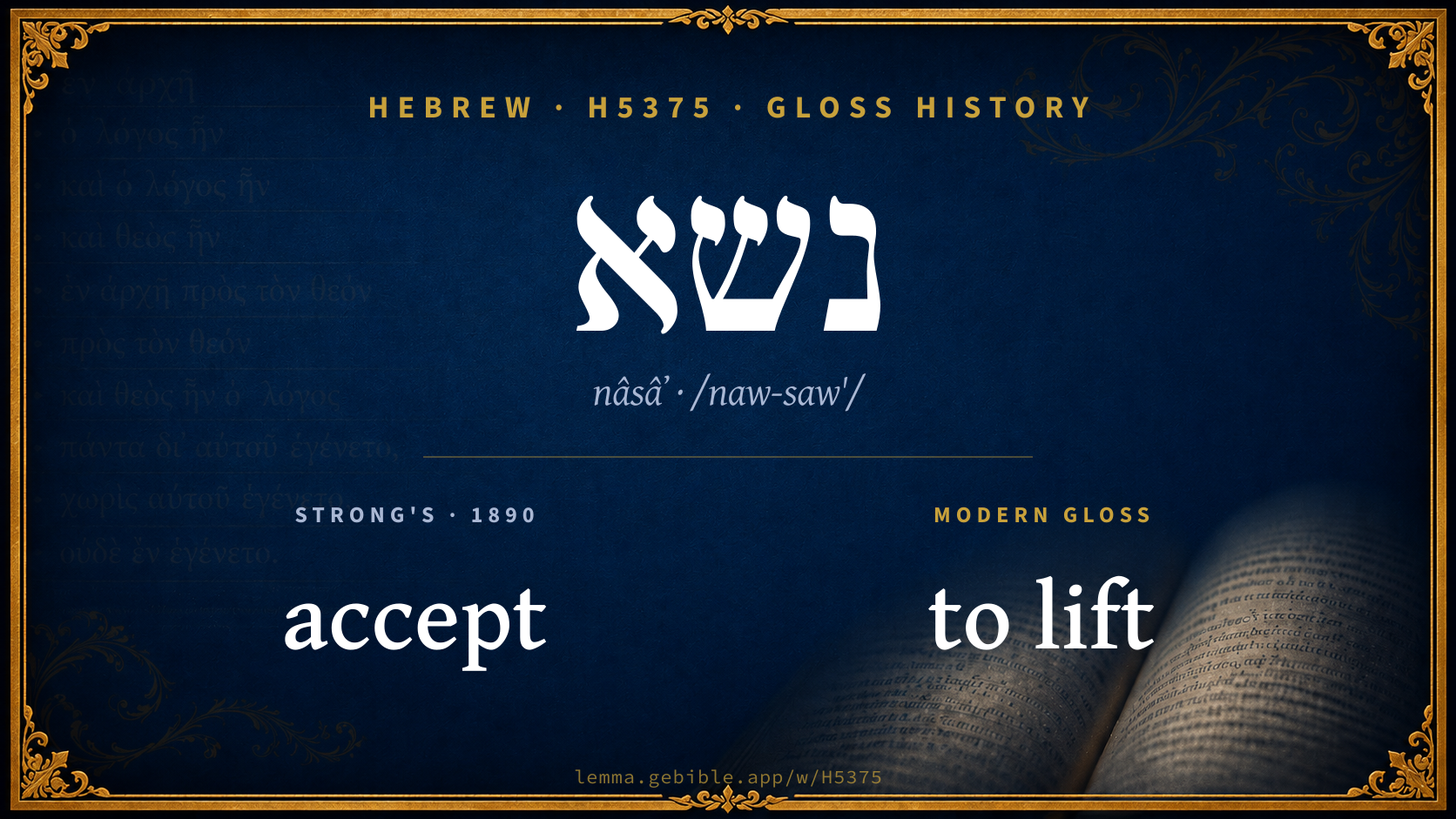
Gloss history
Strong's 1890 vs modern scholarship
About this word
Strong's H5375 catalogs a Hebrew word from the Hebrew Old Testament.
These counts are not copied from any lexicon or concordance. They are computed here, from the morphology-tagged Hebrew Old Testament. What Lemma adds →
- 609
- distinct verses
- The word appears in 609 distinct verses.
- 37 / 39
- OT books
- The word appears in 37 of 39 Old Testament books.
- #74
- by frequency
- Top 100 most frequent Hebrew words (rank 74 of 8,640 Hebrew words by occurrence).
View all 609 occurrences in the concordance →
By section of the Old Testament
By traditional corpus
Conventional, traditional groupings — biblical authorship is debated, so this is a traditional corpus grouping, not an authorship claim. Each share is this word’s portion of its verses in that division of the Hebrew canon. Each figure is a share of the word’s 609 distinct verses.
- Prophets (Nevi'im) 302 verses · 50%
- Torah (Pentateuch) 158 verses · 26%
- Writings (Ketuvim) 149 verses · 24%
How translations render this word
Counts come from each version’s own published word-to-Strong’s tagging or interlinear alignment — an approximate guide to how each version renders this word, not a word-level alignment the data otherwise carries. Because each total is that version’s own tagged count, the per-version totals vary from one another and need not match the appearance or distinct-verse counts above. These counts may also differ from a printed concordance because Lemma counts each distinctly tagged rendering and does not collapse phrase taggings into a single head-word total. This is a fixed set of word-tagged versions (KJV, ASV, BSB, ULT) and does not change with the reading translation you choose elsewhere. Each version’s license is shown beside its name below (and on Sources).
- King James Version: Lifted up 34×, Bear 30×, Lift up 29×
- American Standard Version: Lifted up 30×, Bare 29×, Lift up 27×
- Berean Standard Bible: Lift up 23×, Armor-bearer 18×, Carry 14×
- unfoldingWord Literal Text: Lift up 60×, And 44×, Lifted 24×
King James Version Public Domain
Renders H5375 across 647 tagged occurrences — most commonly:
Plus other, less common renderings. Plus 240 renderings that appear only once — usually multi-word phrases or single function words the recovered tagging swept in, not distinct renderings. Not rendered by a distinct English word in 7 further occurrences.
American Standard Version Public Domain
Renders H5375 across 644 tagged occurrences — most commonly:
Plus other, less common renderings. Plus 249 renderings that appear only once — usually multi-word phrases or single function words the recovered tagging swept in, not distinct renderings.
Berean Standard Bible Public Domain
Renders H5375 across 640 tagged occurrences — most commonly:
Plus other, less common renderings. Plus 272 renderings that appear only once — usually multi-word phrases or single function words the recovered tagging swept in, not distinct renderings. Not rendered by a distinct English word in 15 further occurrences.
unfoldingWord Literal Text CC BY-SA 4.0
Renders H5375 across 764 tagged occurrences — most commonly:
Plus other, less common renderings. Plus 197 renderings that appear only once — usually multi-word phrases or single function words the recovered tagging swept in, not distinct renderings.
35 senses and sub-senses in the full BDB
Hebrew verbs can shift meaning by stem (binyan): Qal is the basic action, Niphal is often passive or reflexive, Piel often intensifies or makes it factitive, and Hiphil is typically causative. The senses below are grouped under the stem BDB assigns to each. This entry also uses Hithpael (reflexive or reciprocal).
What do BDB’s symbols mean?
BDB uses these scholarly abbreviations:
| Symbol | Meaning |
|---|---|
| 𝔊 | the Septuagint (the ancient Greek translation, LXX) |
| 𝔙 | the Vulgate (the Latin translation) |
| 𝔖 | the Syriac version (the Peshitta) |
| 𝔗 | the Targum (the Aramaic translation) |
| ψ | the Psalms |
| √ | root (the underlying root or stem) |
| ‖ | parallel passage (a synonymous or contrasted parallel) |
| † | the dagger: every passage where the word occurs is cited |
The 35 senses and sub-senses the full Brown-Driver-Briggs lexicon distinguishes for this word, in lexicon order (not ranked by frequency), with BDB’s own verbatim wording and sub-sense lettering. Shown in Hebrew script with BDB’s own scholarly abbreviations. The condensed entry is in the Lexicon Entry tab. See also the Forms in the corpus table below.
Qal
- Pf. נ׳ Gn 13:6 +; 2 ms. נָשָׂאתָ 1 K 2:26 +, נָשָׂאתָה Nu 14:19, sf. נְשָׂאתַ֫נִי ψ 102:11; 2 fs. sf. נְשָׂאתִים Ez 16:58; 3 pl. נָֽשְׂאוּ 2 S 18:28 +, נָשׂוּא ψ 139:20, וְנָשׂוּ consec. Ez 39:26, sf. נְשָׂאוּם 2 Ch 12:11, etc.; Impf. 3 ms. יִשָּׂא Gn 32:21 +, וַיִּשָּׂא 13:10 +, sf. יִשָּׂאֵהוּ Dt 32:11 +; 3 mpl. יִשְׂאוּ Ho 4:8 +, יִשָּׂ֑אוּ Hb 2:6 +, וַיִּשְׂאוּ Ju 2:4 +; sf. יִשָּׂאֻנוּ Is 64:5; 3 fpl. תִּשֶּׂ֫נָה Je 9:17, וַתִּשֶּׂ֫אנָה Ru 1:9, וַתִּשֶּׂ֫נָה Zc 5:9; Ru 1:14; 2 fpl. תִּשֶּׂ֫אינָה Ez 23:49, etc.; Imv. ms. שָׂא Gn 13:14 +, נְשָׂא ψ 10:12, נְסָה 4:7; sf. שָׂאֵהוּ Nu 11:12; 2 K 4:19; fs. שְׂאִי Gn 21:18 +, etc.; Inf. abs. נָשׂוֹא Je 10:5, נָשׂא Ho 1:6 + 2 times; cstr. נְשׂא Is 1:14 + 2 times, שׂוֹא ψ 89:10 (read perhaps שְׁאוֹן roar Ri Bi Che, cf. Hi שׁוֹא), usually שְׂאֵת Gn 4:7 + sf. נָשְׂאִי ψ 28:2, שְׂאֵתִי Je 15:15 ψ 89:51, etc.; Aramaizing Inf. לְמַשְׂאוֹת Ez 17:9 (si vera l.; Co Berthol לְיוֹם שְׂאֵת); Pt. act. נֹשֵׁא Ex 34:7 +, f. נֹשְׁאֵת 1 K 10:22, נֹשֵׁאת Est 2:15, etc.; pass. cstr. נְשׂוּא Is 3:3 +, נְשׂוּי ψ 32:1, etc.— e.g. Genesis 13:6
- 1. lift, lift up:
- a. lit., c. acc. pers. vel rei; the flood lifts ark Gn 7:17 (J), י׳ lifts standard (נֵם) Is 5:26; 11:12 + (often sq. ל pers.), rod Is 10:26, c. עַל against v 24, נ׳ חֶרֶב אֶל־ Mi 4:3 = Is 2:4, etc.;—especially lift in order to hold, carry away, etc. Gn 21:18 (E), Ju 9:48; Am 6:10; 2 S 2:32; 4:4; 1 K 13:29; 2 K 9:25, 26 Ez 3:12, 14; 8:3; 11:24 +; lift up wings to fly Ez 10:16, 19; 11:22; †נ׳ רַגְלָיו וַיֵּלֶךְ Gn 29:1 he lifted up his feet and went; lift up, upon (על) Gn 31:17; 42:26 (both E), fig. Jb 31:36; נ׳ בְּמֹאזְנַיִם Jb 6:2 put a thing into scale; נ׳ בוֹ אָלָה put on him (require of him) an oath 1 K 8:31 = 2 Ch 6:22, so van d. H., 𝔊; correct MT נָשָׁא (Baer Ginsb), but sense hardly possible; אֶשָּׂא בְשָׂרִי בְשִׁנָּ֑י Jb 13:14 I will take up my flesh in my teeth (fig. for hazarding life). e.g. Genesis 7:17
- b. in many phr., lit. and fig., e.g.: (1) lift up hand; against (ב) 2 S 18:28; 20:21, c. לְ ψ 106:26; אֶל־ (as signal) Is 49:22; abs., in display of power ψ 10:12; freq. in oath (especially Ez P; of י׳; usually sq. inf., often + ל pers.) Ex 6:8; Nu 14:30; (both P), Ez 20:5(×2), 6, 15, 23, 28, 42; 36:7; 44:12; 47:14 Ne 9:15, + אֶל־שָׁמַיִם Dt 32:40 lift hand to heaven; in prayer (c. אֶל־) ψ 28:2 La 2:19, so (בְּשִׁמְךָ) ψ 63:5, abs. 134:2, and, remarkably, אֶל־מִצְוֹתֶיךָ 119:48; also fig. of the deep (תְּהוֹם) Hb 3:10; in blessing Lv 9:22 (P; c. אֶל). (2) lift up one’s head = shew boldness, independence Ju 8:28; Zc 2:4; Jb 10:15 ψ 83:3; of another = restore to honour Gn 40:13, 20 (E), but lift thy head from off thee (מֵעָלֶיךָ), v 19, by word-play;—+מִבֵּית כֶּלֶא 2 K 25:27 = Je 52:31; fig. of gates, lift up your heads ψ 24:7, 9. (3) lift up one’s face, countenance (פָּנִים), lit., 2 K 9:32 (אֶל־); sign of good conscience 2 S 2:22 (אֶל־), abs. Jb 11:15; of י׳, sign of favour, נ׳ פָּנָיו אֶל־ Nu 6:26 (P; form of benediction); cf. נ׳ אוֹר פָּנֶיךָ עַל־ ψ 4:7; especially lift up face of another (orig. prob. of one prosate in humility; opp. הֵשִׁיב פָּנִים repel), in various shades of meaning = grant a request Gn 19:21 (J; + לַּדָּבָר הַוֶּה), 1 S 25:35; 2 K 3:14 Jb 42:8, 9; = be gracious to, Gn 32:21 (E), Mal 1:8, 9 hence phr. נְשׂוּא פָנִים graciously received, held in honour †2 K 5:1 (of Naaman), and, as subst., honourable, eminent one Is 3:3; 9:14 (but del. as gloss), Jb 22:8†; = shew consideration for Dt 28:50 La 4:16; also in bad sense = be unduly influenced by Jb 32:21, and, specif., = shew partiality (towards) Dt 10:17 (denied of י׳), Lv 19:15 (H), Mal 2:9 (כַּתּוֹרָה), Jb 13:8, 10; 34:19; Pr 18:5 ψ 82:2 (syn. הִכִּיר פ׳); even נ׳ פְּנֵי כָל־כֹּפֶר Pr 6:35 i.e. regard any bribe. (4) lift up eyes, on high 2 K 19:22 = Is 37:23, cf. ψ 121:1 (אֶל־); לַשָּׁמַיִם Is 51:6 (‖ הִבִּיט אֶל־); sq. ה loc. Dt 3:27; 4:19 cf. Ez 8:5(×2); toward (אֶל־) idols Ez 18:6, 12, 15; 33:25, cf. 23:27; toward (אֶל־) י׳ ψ 123:1 (these with implied worship); נ׳ עֵינֶיהָ אֶל־ Gn 39:7 i.e. she gazed at him with desire; usually + vb. of seeing (35 times) Gn 13:10, 14; 18:2 + (Hex only JE), Is 40:26 (+ מָרוֹם), 49:18; 60:4 (both + סָבִיב), Je 3:2 (+ עַל־). (5) lift up voice (קוֹל), give (loud) utterance Is 52:8, of floods ψ 93:3, + and weep Gn 21:16 (E) 27:38; 29:11 (both J), Ju 2:4, + וַתָּשָּׂא וַיִּתְּנוּ אֶת־קוֹלָם וַיִּבְכּוּ Nu 14:1 (P), + 9 times; + יָרֹ֫נּוּ Is 24:14; + קָרָא Ju 9:7; קוֹל om. Is 3:7; 42:2, v 11 (‖ יָרֹ֫נּוּ); also (6) lift up (+ vb. of saying, usually אָמַר), often of formal and solemn utterance, נ׳ מָשָׁל Nu 23:7, 18; 24:3, 15, 20, 21, 23 Jb 27:1; 29:1 + עַל Mi 2:4; Hb 2:6; Is 14:4; ונשׂא־בוֹ אָלָה 1 K 8:31 and he shall lift up against him an oath = 2 Ch 6:22 (MT וְנָשָׂא v. Baer Ginsb, but sense difficult; read rather וְנָשָׂא); י׳ נ׳ עָלָיו הַמַּשָּׂא הַזֶּה 2 K 9:25; נ׳ קִונָה, + עַל־ Je 7:29 Ez 26:17; 27:2; 28:12; 32:2, + אֶל־ 19:1; 27:32; lift up word Am 5:1 (על, + קִינָה); weeping Je 9:9 (עַל־); lamentation (נְהִי) v 17 (עַל־), reproach ψ 15:3 (עַל־). (7) lift up, take up = utter: name of י׳, לַשָּׁוְא Ex 20:7(×2) = Dt 5:11(×2) (Decalogue); cf. ψ 139:20 (read prob. שְׁמֶ֑ךָ Bö Ol Che Kau); בַּל־אֶשָּׂא שְׁמוֹתָם עַל־שְׂפָתָ֑י ψ 16:4; נ׳ בְּרִיתִי עֲלֵי־פִיךָ ψ 50:16; prob. also נ׳ שֵׁמַע שָׁוְא Ex 23:1 (E). (8) lift up prayer in behalf of (בְּעַד) † 2 K 19:4 = Is 37:4, Je 7:16; 11:14. (9) lift up soul (נֶפֶשׁ), i.e. direct the desire (נֶפֶשׁ 6 a) towards (אל) a thing, Dt 24:15 Pr 10:18, אֶל־עָוֹן Ho 4:8, לַשָּׁוְא ψ 24:4 (cf. Pi. and ii. מַשָּׂא 2); אֶל־י׳ ψ 25:1; 86:4 143:8, so the heart La 3:41. (10) take up (incur) sin, iniquity, (only HP) †Ex 28:43 Nu 18:22, c. עַל for Lv 19:17; 22:9 Nu 18:32 (cf. also 2 b). (11) of heart lifting one up, (inciting), Ex 35:21, 26; 36:2 (all P); of presumption 2 K 14:10 = 2 Ch 25:19.—MT appar. requires intrans. or reflex. meaning, lift oneself up, in foll., text dub. in all: Ho 13:1 read perhaps נָשִׂיא Oort We cf. Now; Na 1:5 Now (after Bi) וַתֵּשָׁא (read וַתֵּ֫שֶׁא? √ שׁאה); ψ 89:10 read שְׁאוֹן Bi Ri Che; Hb 1:3 יִשָּׂא queried by We Gr Buhl al., cf. GunkelSchöpfung 33. e.g. 2 Samuel 18:28
- 2. Bear, carry:
- a. lit., a load or burden (usually acc.) Gn 37:25; 44:1 (both J), 45:23(×2) (E), 1 S 10:3(×3) Je 10:5; 17:21, 27 +; subj. רוּחַ Ex 10:13 1 K 18:12; obj. armour נֹשֵׂא כֵלִים 1 S 14:1 + often S; weapons 1 Ch 5:18; 12:24 2 Ch 14:7(×2); La 3:27 (נ׳ עֹל fig.), Is 1:14 (fig., cf. d infr.); a load of care, responsibility Dt 1:9, 12; share a burden with נ׳ אֶת־ Ex 18:22 (E; no acc.); with ב׳, יִשָּׂא בְשִׂיחִי מִשְׁכָּבִי Jb 7:13 my bed shall carry at (help carry) my grief, Nu 11:17; take up and carry (idolatrous images) Am 5:26 Is 46:7; bear ephod, 1 S 2:28; 14:3 + v 18 (𝔊), 22:18 (v. Dr in HastDict. Bib. 726); in triumph Is 8:4. e.g. Genesis 37:25
- b. especially bear guilt, or punishment Gn 4:13 (J, עֲוֹנִי), often Ez HP: †נ׳ עָוֹן Lv 5:1, 17; 7:18 Nu 5:31; 14:34, cf. 15:31 (all P), Lv 17:16; 19:8; 20:17, 19 (H) Ez 14:10; 44:12 (cf. Hiph. Lv 22:16); נ׳ חֵטְא Lv 20:20; 24:15 (H) Nu 9:13 (P), cf. Ez 23:49; cf. נ׳ כְּלִמָּה 16:52(×2), נ׳ עֹנֶשׁ Pr 19:19, נ׳ abs. 9:12; נ׳ עֲוֹן … = be responsible for Ex 28:38 Nu 18:1(×2) cf. v 23; incur guilt Ex 28:43; = bear guilt for others Lv 10:17; 16:22 (of goat), Nu 30:16 (all P), Ez 4:4, 5, 6, cf. נ׳ זְנוּתֵיכֶם Nu 14:33; נ׳ חֵטְא Is 53:12, cf. נ׳ חֳלָיֵנוּ v 4; also נ׳ בַּעֲוֹן … bear at (share in), Ez 18:19, 20(×2). e.g. Genesis 4:13
- c. support, sustain, on (על) wings Ex 19:4 Dt 32:11 ψ 91:12 (all fig.); land could not support them Gn 13:6 (J), 36:7 (P). e.g. Exodus 19:4
- d. endure Je 15:15; 31:19 Ez 36:6 Jb 34:31 ψ 69:8; 88:16 Pr 18:14; 30:21; suffer, bear with, permit Jb 21:3. e.g. Jeremiah 15:15
- e. bear, carry, וַיִּשָּׂא מֵאֵת פָּנָיו אֲלֵהֶם Gn 43:34 (J) and they (indef.) carried portions from his presence unto them; carry gifts as tribute 2 S 8:2, 6; later, bring an offering ψ 96:8 = 1 Ch 16:29, Ez 20:31 (𝔊 Co בראשׁית; Toy foll. MT). e.g. Genesis 43:34
- f. carry = contain, hold: bath to hold 1/10 homer Ez 45:11. e.g. Ezekiel 45:11
- g. bear fruit, of tree Hg 2:19 Jo 2:22, fig. Ez 36:8; boughs 17:23 (in fig.); produce, yield, of mountains Jb 40:20 ψ 72:3 (both c. לְ for). e.g. Haggai 2:19
- 3. Take, take away:
- a. lit. c. מִן 1 S 17:34 Nu 16:15 (unjustly). e.g. 1 Samuel 17:34
- b. take away, carry off, Ju 21:23 1 K 15:22 = 2 Ch 16:6, 1 K 18:12 La 5:13 Mi 2:2 Je 49:29 (ל pers.), Is 40:24; 41:16 +; take away head (מֵעַל pers.) Gn 40:19 (v. supr.); sweep away = destroy Jb 32:22 (cf. Niph. 4); life 2 S 14:14. e.g. Judges 21:23
- c. take away, guilt, iniquity, transgression, etc., i.e. forgive, † c. acc. Gn 50:17 (E), Ex 32:32 (E), 10:17; 34:7 (J), Nu 14:18 (JE), 1 S 15:25 Ho 14:3 Jb 7:21 (‖ הֶעֱבִיר עָוֹן), ψ 32:5; + ל pers. Mi 7:18; ל pers., acc. om., Gn 18:24, 26 (J), Nu 14:19 (JE; ‖ סלח עָוֹן), Ho 1:6 Is 2:9 (prob. gloss.), ψ 99:8; c. ל of sin Gn 50:17 Ex 23:21 Jos 24:19 (both E), 1 S 25:28 ψ 25:18 ψ 25:18; נְשֻׂא עָוֹן Is 33:24; נְשׂוּי־פֶּשַׁע ψ 32:1. [in this sense נ׳ used in E; סלח in D P; both in J; נ׳ also in early proph., S. and Jb, and in earlier and latest ψψ; not in Je K Is 2 La Chr Dn, which use סלח; v. BrHex. 155.] e.g. Genesis 50:17
- d. take as wife (usually c. לְ for), late: Ezr 9:2, 12; 10:44 Ne 13:25 2 Ch 11:21; 13:21; 24:3 Ru 1:4. e.g. Ezra 9:2
- e. take an enumeration, usually c. רֹאשׂ sum Ex 30:12 Nu 1:2, 49; 4:2, 22; 26:2; 31:26, 49 (all P); c. מִסְפָּר Nu 3:40 1 Ch 27:23. e.g. Exodus 30:12
- f. take and carry away, receive, Dt 33:3 1 K 5:23 ψ 24:5; hence, obtain favour (חֶסֶד, חֵן) Est 2:9, 17 (both + לִפְנֵי), 5:2 (+ בְּעֵינָיו).—לְמַשְׂאוֹת אוֹתָהּ מִשָּׁרָשֶׁיהָ Ez 17:9 (Co Berthol לְיוֹם שְׂאֵת וגו׳) is usually rendered plucking it up (tearing it away) by the roots, but dub.; נ׳ not elsewhere in this sense. e.g. Deuteronomy 33:3
Niphal
- Pf. נִשָּׂא Je 51:9, וְנ׳ consec. Ex 25:28 +; Impf. יִנָּשֵׂא Is 40:4; 3 mpl. יִנָּֽשְׂאוּ Ez 1:19, 20, 21, יִנָּשׂוּא Je 10:5, יִנָּשֵׂ֑אוּ Pr 30:13; 3 fpl. תִּנָּשֶׂאנָה Is 49:22, etc.; Imv. הִנָּשֵׂא ψ 7:7; 94:2, mpl. הִנָּֽשְׂאוּ ψ 24:7; Inf. הִנָּשֵׂא Ez 1:19, sf. הִנָּֽשְׂאָם Ez 1:21; Pt. נִשָּׂא Is 2:2 +, f. נִשָּׂאָה Is 30:25, נִשֵּׂאת Zc 5:7 1 Ch 14:2, etc.;—2 S 19:43 is dub., and pt. (Ol§ 192 c Köi 632 f.) inexplicable; read נִשּׂא (Inf. abs. Niph.) Dr (cf. Th), or מַשְׂאֵת portion Gr HPS; > BaNB 90 thinks נִשֵּׂאת Inf. Niph. with compensative ending;— e.g. Jeremiah 51:9
- 1. be lifted up,
- a. lit. Zc 5:7 Ez 1:19, 21 (both מֵעַל הָאָרֶץ), v 19, 20, 21 (all in vision), of valleys Is 40:4; of gates ψ 24:7 + v 9b (read Niph.); of eyelids Pr 30:13 (superciliousness); metaph. of judment on Babylon reaching up to the sky (עַד); pt. = elevated, exalted Is 6:1 (of י׳’s throne, in vision); of lofty hills Is 2:14; 30:25; 57:7, cf. Mi 4:1 = Is 2:2 (מִן, lifted from out the hills), once of trees 2:13 (text dub.); gen., Is 2:12. e.g. Zechariah 5:7
- b. fig., be exalted, of kg., 2 Ch 32:23, kingdom 1 Ch 14:2, servant of י׳ Is 52:13, י׳ himself 57:15. e.g. 2 Chronicles 32:23
- 2. refl. lift oneself up = rise up, of י׳, to display power in judgment: Is 33:10 ψ 94:2. e.g. Isaiah 33:10
- 3. be borne, carried Je 10:5 Ex 25:28 (P), Is 49:22; 66:12. e.g. Jeremiah 10:5
- 4. be taken away carried off, 2 K 20:17 (ה loc.) = Is 39:6; be swept away (of multitude) Dn 11:12 (cf. Bev Behrm, Prince, v. also Qal 3; Ew Hi as 2, v. Dr). e.g. 2 Kings 20:17
Piel
- Pf. נִשֵּׂא 2 S 5:12, נִשָּׂא (anal. of ל׳ ה) 2 S 19:43 1 K 9:11, וְנִשָּׂא consec. Am 4:2, etc.; Impf. 3 ms. sf. וַיְנַשְּׂאֵ֫הוּ Est 3:1, וַיְנַשְּׂאֵם Is 63:9; 3 mpl. sf. יְנַשְּׂאוּהוּ Ezr 1:4; Imv. ms. sf. נַשְּׂאֵם ψ 28:9; Pt. pl. מְנַשְּׂאִים Je 22:27 + 2 times;— e.g. 2 Samuel 5:12
- 1. lift up = exalt, kingdom 2 S 5:12 (‖ Niph. 1 Ch 14:2), pers. Est 5:11 (עַל), cf. 3:1; = support, aid, assist Ezr 8:36 Est 9:3; c. ב aid with trees (supply with) 1 K 9:11, so Ezr 1:4. e.g. 2 Samuel 5:12
- 2. fig. נ׳ נֶפֶשׁ = desire, long, Je 22:27; 44:14. e.g. Jeremiah 22:27
- 3. carry, bear continuously Is 63:9, ψ 28:9. e.g. Isaiah 63:9
- 4. take, take away 2 S 19:43 (ל for; but v. Niph. supr.); Am 4:2 (ב instr.; We Now וְנָֽשְׂאוּ).— e.g. 2 Samuel 19:43
Hithpael
- Impf. יִתְנַשָּׂ֑א Nu 23:24; 3 fs. תִּנַּשֵּׂא 24:7; 2 ms. תִּתְנַשֵּׂא Ez 29:15; 3 mpl. יִנַּשְּׂאוּ Dn 11:14; 2 mpl. תִּתְנַשְּׂאוּ Nu 16:3; Inf. הִתְנַשֵּׂא Ez 17:14 Pr 30:32; Pt. מִתְנַשֵּׂא 1 K 1:5 1 Ch 29:11;—lift oneself up, like a lion Nu 23:24 (JE); pt. he who exalts himself 1 Ch 29:11 (+ לְכֹל לְרֹאשׁ) as human ruler (Kau), > (sc. אַתָּה) of י׳ as ruler; Ew§ 160 e Ke Be as subst. [inf. of Aramaic form], the exaltation; of a kingdom Nu 24:7 (JE), cf. Ez 17:14; in arrogance 1 K 1:5 Nu 16:3 (P; c. עַל־), Ez 29:15 (c. עַל), Pr 30:32 Dn 11:14. e.g. Numbers 23:24
Hiphil
- Pf. 3 ms. consec.
- 1. cause one to bear iniquity (2 acc.) וְהִשִּׂ֫יאוּ Lv 22:16. e.g. Leviticus 22:16
- 2. appar. cause to bring, have brought, וְהִשִּׂיאוּ 2 S 17:13 (c. acc. rei + אֶל loc.), but very dub.; Ki Kit Bu וְיָשִׂימוּ; HPS וְהֵבִיאוּ; > We הֵשִׂימוּ. e.g. 2 Samuel 17:13
Senses from the full Brown-Driver-Briggs lexicon (Brown, Driver, Briggs; Oxford 1906 — public domain), digitized via Sefaria, supplemented by the OpenScriptures HebrewLexicon (CC BY 4.0). Full attribution on Sources.
Word origin
vb. lift, carry, take (NH = BH; Ph. נשא id. Lzb326; Assyrian našû, id. DlHWB484; Biblical Aramaic נְשָׂא (rare); Syriac in ܡܰܐܣܰܐܬܳܐ scales; Palm. נסא, נשא n.pr. Lzb326 Cook81, 83 (cp. נשׁא forget); Arabic نَشَأَ intrans. rise, be high, etc.; Sab. in n.pr., e.g. CISiv. 5. 1; also נשא vb. HalRev. Sém. iv (1896), 69 Min. נשא take, HomSüdar. Chrest. 128; Ethiopic ነሥአ suscipere, tollere Di635, so OEth., DHMEpigr. Denkm. aus Abess. (1894), 52);—
— Brown-Driver-Briggs (Oxford 1906, public domain), digitized via Sefaria, supplemented by the OpenScriptures HebrewLexicon (CC BY 4.0). See Sources.
Origin: a primitive root
Jastrow Dictionary
A second Hebrew/Aramaic lexicon for comparison, covering Aramaic and post-biblical (Talmudic, Targumic, Midrashic) usage that the biblical-Hebrew BDB does not. Matched by lemma rather than by Strong’s number, so a lemma may carry more than one Jastrow headword (shown separately below), and the entries cover usage well beyond the Bible.
נְסֵי
- 1. to lift up. Targ. O. Deut. XXVIII, 56 נְסִיאַת ed. Berl. (oth. ed. נַסִּי׳, Pa.); Y. נַסְיַית (h. text נִסְּתָה). Targ. Ps. IV, 7 נְשָׂא (h. text נְסָה).—[Pesik. B’shall., p. 91ᵃ, v. נְסַח.]
- 2. to take, receive, carry (v. נְסַב). Lam. R. to II, 2 לא נַסְיָין להון they (the areas described) could not receive (would have no room for) them; Y. Taan. IV, 69ᵇ לא נַסְיָיהּ. Y. Maas. Sh. IV, 54ᵈ נַסְתּוֹן בר קפר Bar Ḳ. took them. Lev. R. s. 6 נַסְתֵּיה לקניא וכ׳ he took the cane and knocked it down. Lev. R. s. 34, end נסאתיה וחמאי ליה וכ׳, read: נסא יתיה ואחמי וכ׳ he took him along and showed to him &c.; (Yalk. Is. 355 נסביה ואחמתיה וכ׳).—Pesik. R. s. 22 נשא ואפקדיה וכ׳ he took (his money) and put it in trust with him. Ib. נַסְתָּהּ ויהבה ליה she took it (the deposited money) and gave it to him; a. fr.
- 1. to find out by sign, to divine. Targ. O. Gen. XXX, 27.
- 2. to try, test; to attempt. Targ. O. Deut. XXVIII, 56, v. supra.—Targ. Esth. V, 14 למְנֵסְיָא צליבא to test the (strength of) the gallows. Targ. Ex. XVI, 4; a. fr.—Snh. 107ᵃ מְנַסִּינָא לך I will try thee. Ib. אמר מינסנא לך (corr. acc.). Ab. Zar. 15ᵃ ניסייה ניהלי, read: נִינַסְּיָיהּ let us try the animal for me; a. e.
- same. Targ. Ps. LXXVIII, 56 (Ms. Pa.). Targ. Y. II, Gen. XXII, 1.
- 1. to be lifted up. Targ. Ps. LX, 6.
- 2. to be tried. Targ. II Esth. V, 14.—Snh. l. c. אינהו מִינַּסּוּ לי … מִינַּסְּיַת לי they have been tried (proved true) to me, thou hast not.
נְשָׁא I
- (preced.) woman. Targ. Y. Deut. XXII, 5.—Pl. נְשִׁין, נְשַׁיָּא, נְשֵׁי. Targ. Ruth I, 4. Targ. Gen. VI, 2; a. fr.—Tam. 32ᵃ מחוזא דכוליה נ׳ a place inhabited by women only. Ber. 17ᵃ הני נשי מאי זכיין Ms. M. (ed. נשים) whereby can women acquire merits? M. Kat. 28ᵇ נ׳ דשכנציב the lamenting women of &c.; a. v. fr.—בֵּי נ׳ a) the wife’s family, father-in-law &c.—b) the paternal house after the father’s death. B. Bath. 12ᵇ אמצרא דבי נְשֵׁיה contiguous to the estate of his father-in-law (Rashi: of his deceased father). Sabb. 23ᵇ. Ib. 156ᵃ בי נשיה in the house of his deceased father (Ms. M. נשיאה, v. גַּבָּלָא). Yeb. 35ᵃ בי נְשַׁיְהוּ their (the women’s) paternal home; a. e.
נָשָׁא II
- to forget, v. נשי.
נָשָׁא III
- name of a plant the sap of which is used as a depilatory. B. Kam. 86ᵃ סָכוֹ נ׳ וכ׳ he smeared nasha over it so that the hair will not grow again. Macc. 20ᵇ. Naz. 40ᵃ.—V. נֶשֶׁם.
נָשָׂא
- 1. to lift up, carry. Sot. 35ᵃ נ׳ ארון את נוֹשְׂאָיו the Ark carried its carriers. Ab. ch. VI נוֹשֵׂא בעול וכ׳ helps his brother to bear his yoke. Ber. III, 1 נוֹשְׂאֵי המטה, v. מִטָּה. Meg. 9ᵃ (one of the changes in translating the Bible into Greek) נוֹשֵׂא בני אדם a carrier of men (for חֲמֹר, Ex. IV, 20); a. v. fr.—Pesik. R. s. 6 אני מרומם ונושא את ראשם I will raise and elevate their head; v. infra.—נ׳ כפים, v. כַּף.—נ׳ פנים to lift up the face, to respect, favor, spare, be partial. Ḥag. 14ᵃ (expl. נשוא פנים, Is. III, 3) זה שנוֹשְׂאִין פ׳ לדורו בעבורו he for whose sake his generation is favored in heaven. Sabb. 13ᵇ שלא נ׳ פ׳ לתורה who spared him not for the sake of his scholarship. Yoma 87ᵃ שנָשְׂאוּ לו פ׳ בעה"ז that indulgence was shown him (by the Lord) in this world. Num. R. s. 11 לא אֶשָּׂא פ׳ מפניך shall I not favor thee for thy own sake? Ib. כשם שהם נוֹשְׂאִין לי וכ׳ as they (the Israelites) honor me (by saying grace even after a scanty meal), so do I favor them; a. fr.—נ׳ נפש אל to lift up the soul to, to long for. Midr. Till. to Ps. XXV, 1 למה אתה נושא נפשך אלי why dost thou lift up thy soul to me (why dost thou depend on me)?; Yalk. ib. 701.—נ׳ קרבן to offer up a sacrifice. Ib. 702 אדם חוטא ונושא ק׳ if a man sinned, he offered &c.; Midr. Till. l. c. נושא ומביא ק׳ (corr. acc.)—Part. pass. נָשׂוּא, f. נְשׂוּאָה &c. Ib. עכשו … הרי נפשנו נ׳ לך now that we have no sacrifices, our soul is lifted up to thee. e.g. Exodus 4:20
- 2. to lift, remove. Pesik. R. l. c. (ref. to the double meaning of נ׳, to raise a. to remove) לכו שְׂאוּ את ראשו go and remove (or lift up) his head; a. fr.—נ׳ עון to forgive. Y. Snh. X, beg., 27ᶜ (ref. to Ex. XXXIV, 7) נושא עוונות אין וכ׳ the text does not say, ‘removing iniquities’, but ‘removing iniquity’, the Lord takes away (from the scales) one bond of man’s sins, and the merits prevail &c.; Y. Peah I, 16ᵇ bot. (corr. acc.); Yalk. Ex. 400; v. שְׁטַר. Pesik. R. s. 45; a. e. e.g. Exodus 34:7
- 3. to take, esp. נ׳ ונתן to take and give, to deal; to transact, argue. Sabb. 31ᵃ נָשָׂאתָ ונתת באמונה hast thou (while on earth) been dealing honestly? B. Mets. 48ᵃ הנושא ונותן בדברים he who concludes a bargain verbally. Tanḥ. Sh’moth 18 כשם שנושאין ונותנין בהלכה וכ׳ as well as they debate on the law below, so do they above. Ib. שנושאין ונותנין בדין וכ׳ they argue in court, and the Lord argues with them; a. fr.
- 4. נ׳ אשה, or נ׳ to take a wife into one’s house, to marry. Keth. II, 1 בתולה נְשָׂאתַנִי thou hast married me as a virgin; אלמנה נְשָׂאתִיךְ I married thee as a widow. Yeb. 37ᵇ לא יִשָּׂא אדם וכ׳ one may not marry in one country and go away &c. M. Kat. I, 7 אין נושאין נשים וכ׳ no marriages may take place during the festive week; a. v. fr.—Part. pass. נָשׂוּי (followed by accus.) having married; f. נְשׂוּאָה (followed by ל) being married to; pl. נְשׂוּאִים, … אִין; נְשׂוּאוֹת. Yeb. III, 6 ואחד נ׳ נכרית one of them has married a stranger. Ib. ומתו הנ׳ את האחיות and those brothers who had married two sisters died. Ib. I, 2 (2ᵇ) היתה … נשואה לאחיו Y. ed. (Mish. ed. נשואת, corr. acc.; Bab. ed. נשואות) if his daughter or … was married to &c.; a. fr.—Tosef. ib. VI, 5 נָשׂאוּי.
- 1. to be lifted up, removed &c. Pesik. R. l. c. כבר … שיִנָּשְׂאוּ את ראשם וכ׳ it had been decreed that their head should be lifted (v. supra): turn its meaning and elevate their head.
- 2. f. נִישֵּׂאת, נִשֵּׂ׳, נִישֵּׂת, נִיסֵּת to be married. Keth. I, 1 בתולה נ׳ וכ׳ a virgin’s marriage takes place on the fourth day of the week. Ib. V, 2 הגיע … ולא נִשְּׂאוּ if the time set for marriage expired and they were not taken in marriage. Yeb. II, 10 מותרות לִינָּשֵׂא להם they may marry them. Ib. 88ᵇ הרי זו לא תִנָּשֵׂא ואם ניסת וכ׳ she must not marry again, and if she does &c.; Keth. 22ᵇ; a. v. fr.
- 1. to lift up, to announce by signals (the New Moon). R. Hash. II, 2, a. e. מַשִּׂיאִין, v. מַשּׂוּאָה. Y. ib. II, 58ᵃ top אין משיאין לילי זמנו we do not raise signals in the night of the regular New Moon (from the 29ᵗʰ to the 30ᵗʰ) &c.; a. fr.—Tosef. ib. II (I), 2 מַסִּיעִין את החדש ed. Zuck. (משיא׳ על, מסיא׳) we signalize the New Moon.
- 2. to transfer. Deut. R. s. 11 (ref. to ישא, Ps. IXXV, 5) יַשִּׂיא ברכה לאחרים he will bring blessing upon others.
- 3. to move, remove, pass. Bets. III, 7 מַשִּׂיאָהּ על גבי חברתה he may pass one knife over the other (to whet it). Tosef. Par. X (IX), 3 הִשִּׂיאוֹ לדבר אחר he diverted his mind towards another subject; Ab. Zar. II, 5. Y. ib. II, 41ᶜ bot. היה לו להַשִּׂיאוֹ וכ׳, v. הֶשֵּׂיאָה.
- 4. to transfer, transcribe, translate. Tosef. Sot. VIII, 6 הִשִּׂיאוּ את הכתב וכ׳ they transcribed the inscription on the stones in seventy languages; Sot. 35ᵇ; Y. ib. VII, 21ᵈ bot.
- 5. to give away in marriage; to cause to marry. Keth. 111ᵇ כל המַשִּׂיא בתו וכ׳ he who marries his daughter to a scholar. Ib. 67ᵇ top מַשִּׂיאִין את היתומה וכ׳ we must first help the fatherless maiden to marry, and then the fatherless lad. Kidd. 29ᵃ האב חייב … ולהַשִּׂיאוֹ אשה a father is bound to …, and to provide a wife for him; a. fr.
- to be raised; to exalt one’s self, to boast. Ab. Zar. 44ᵃ, v. הָלַם. Ber. 63ᵇ להִתְנַשֵּׂא, v. נָבַל; a. e.
נְשָׂא
- 1. to lift up, v. נְסֵי.
- 2. to bring, offer. Pesik. B’shall., p. 90ᵇ, sq. אימיה נשא (Ms. O. נַשְׂאָה) his mother was bringing (the bread); v., however, נְסַח.
- 3. (neut. verb) to move, stir. Taan. 24ᵃ; B. Mets. 85ᵇ, v. נְשַׁב.
נשי
- 1. to move, slip. Ḥull. 91ᵃ it is called gid hannasheh (v. גִּיד), שנ׳ ממקזמו וכ׳ because it slipped from its place and went up; Yalk. Gen. 133. Ib. א"ר חנניא … שנשא את מקומו R. Ḥ. said, … because it left its place; Gen. R. s. 78 שנשה ממקומו; a. e.
- 2. to discard, forget. Ned. 50ᵇ אבותינו אמרו נָשִׁינוּ טובה וכ׳ our fathers said (Lam. III, 17), we have forgotten the good times: we have not even seen them &c. Snh. 102ᵇ (play on מנ̇ש̇ה̇) שנ̇ש̇ה יה̇ he forgot Yah. Pesik. R. s. 45 (ref. to נְשׂוּי, Ps. XXXII, 1) אל תהי … ש"ין נְשׁוּי read it not with Samekh (n’suy), but with Shin, n’shuy, whose sin is forgotten; a. e. e.g. Lamentations 3:17
- 3. (with ב, cmp. נְסַק Af.) [to raise, collect,] to have a claim against; to be a creditor of. B. Mets. 75ᵇ נוֹשֶׁה בחבירו מנה he who has a claim &c., to whom his neighbor owes money. Men. 85ᵇ נושה בי וכ׳ I owe him &c.; a. e.
- 1. to carry away; to incite, allure. Gen. R. s. 19 (expl. השיאני, Gen. III, 13) הטעני he led me astray; v. גָּרָה. e.g. Genesis 3:13
- 2. to make a loan to; to collect, distrain; to pledge. Ib. (expl. השיאני) חייבני he made me a debtor (guilty, v. חוּב). Cant. R. to II, 7 (ref. to אֶשָּׂא, Ps. XXV, 1) אַשִּׁיא כתיב it may be read ashshi, I pledge (my soul); שהיו מַשִּׁיאִין נפשם על וכ׳ they (the martyrs) pledged their lives for the sanctification &c. (v. Midr. Till. to Ps. XXV שנתמשכנו וכ); ib. משיאין … מהם they (the torturers) take their lives as pledges; Midr. Till. to Ps. XVI; Yalk. Ps. 667 משיחין (corr. acc.). e.g. Psalms 25:1
- 3. הִנְשִׁי to cause to forget. Snh. l. c. (play on מנ̇ש̇ה) שהנ̇ש̇י את ישראל לאביהם וכ׳ he made Israel forget their Father in heaven; Yalk. Kings 245 שהִנְשִׁיא.
נְשֵׁי
- , to forget. Targ. Deut. VIII, 19 (O. ed. Berl. Ithpe.).
- 1. same. Targ. Ps. CXXXVII, 5; a. e.—Y. Dem. IV, 24ᵃ [read:] דילמא אַנְשִׁיתָה מתקנה perhaps thou didst forget to prepare it (by giving tithes)? Keth. 20ᵃ ומַנְשֵׁי חר וכ׳ and one of the witnesses has forgotten (that he knows of the case). Ḥull. 93ᵇ אַנְשְׁיוּהָ לדר׳ וכ׳ they have forgotten R. Judah’s opinion. Gen. R. s. 77 דילמא אַנְשִׁינָן כלום perhaps we forgot something (left behind). Gen. R. s. 78 אַנְשִׁית מאה I forgot one hundred (of the fables); a. fr.
- 2. to cause to forget. Targ. Lam. II, 6 (ed. Vien. אינשי, corr. acc.); a. e.
- to forget. Targ. O. Deut. VIII, 19 (v. supra); a. e.—Y. Shek. VII, 50ᶜ bot. ואִינְשְׁתָהּ and forgot to take it out; a. e.
A Dictionary of the Targumim, the Talmud Babli and Yerushalmi, and the Midrashic Literature (Marcus Jastrow; London, Luzac, 1903) — Public Domain. Digitized via Sefaria. Digitized via Sefaria. Full attribution on Sources.
Forms in the corpus
The 369 distinct written forms H5375 takes in the Hebrew Bible, most frequent first — each parse links to that stem’s occurrences in the concordance. Hebrew forms include their vowel points and cantillation, so a single lemma takes many written forms.
The 60 most common forms are shown; 309 rarer forms follow in the full concordance.
Same root — word family
Other BDB entries built from the same root as H5375, grouped by Strong’s listed origin. These share a root / origin per the lexicon — not necessarily a shared meaning. Each links to that word’s own entry.
Derived from this word
- משא massâʼ H4853 burden
- משא massôʼ H4856 partiality
- משאה massâʼâh H4858 uplifting
- משאת masʼêth H4864 burden
- מתנשא mithnassêʼ H4984 to exalt oneself
- נשא nᵉsâʼ H5376 to lift
- נשאת nissêʼth H5379 portion
- נשואה nᵉsûwʼâh H5385 load
- נשיא nâsîyʼ H5387 chief
- שאת sᵉʼêth H7613 exaltation
- שוא sôwʼ H7721 rising
Proper names from this root
People and places named from this root — a name, not an additional meaning of the word.
Compare all same-root words → Showing 4 of 13 — not the complete family. 1 of the same-root words is a proper name (a person or place). They share a root, not necessarily a meaning.
Septuagint verse parallels
This word appears in 586 verses that also exist in the Greek Old Testament (Septuagint), out of the 609 Hebrew verses it occurs in. You can read those verses in Greek by switching the Old Testament edition to the Septuagint.
Read these verses in the Septuagint
- Genesis 4:13
- Exodus 6:8
- Leviticus 5:1
- Numbers 1:2
- Deuteronomy 1:9
- Joshua 3:3
- Judges 2:4
- Ruth 1:4
- 1 Samuel 2:28
- 2 Samuel 2:22
- 1 Kings 2:26
- 2 Kings 2:16
This is a verse-level parallel only — the same verses exist in both the Hebrew and Greek Old Testaments. No word-level Hebrew↔Greek correspondence is claimed: the data carries no such alignment, so no Greek word is shown as this Hebrew word’s translation. Coverage is not total — the Septuagint omits the deuterocanon and renumbers the Psalms, so some Hebrew verses have no direct Greek parallel.