
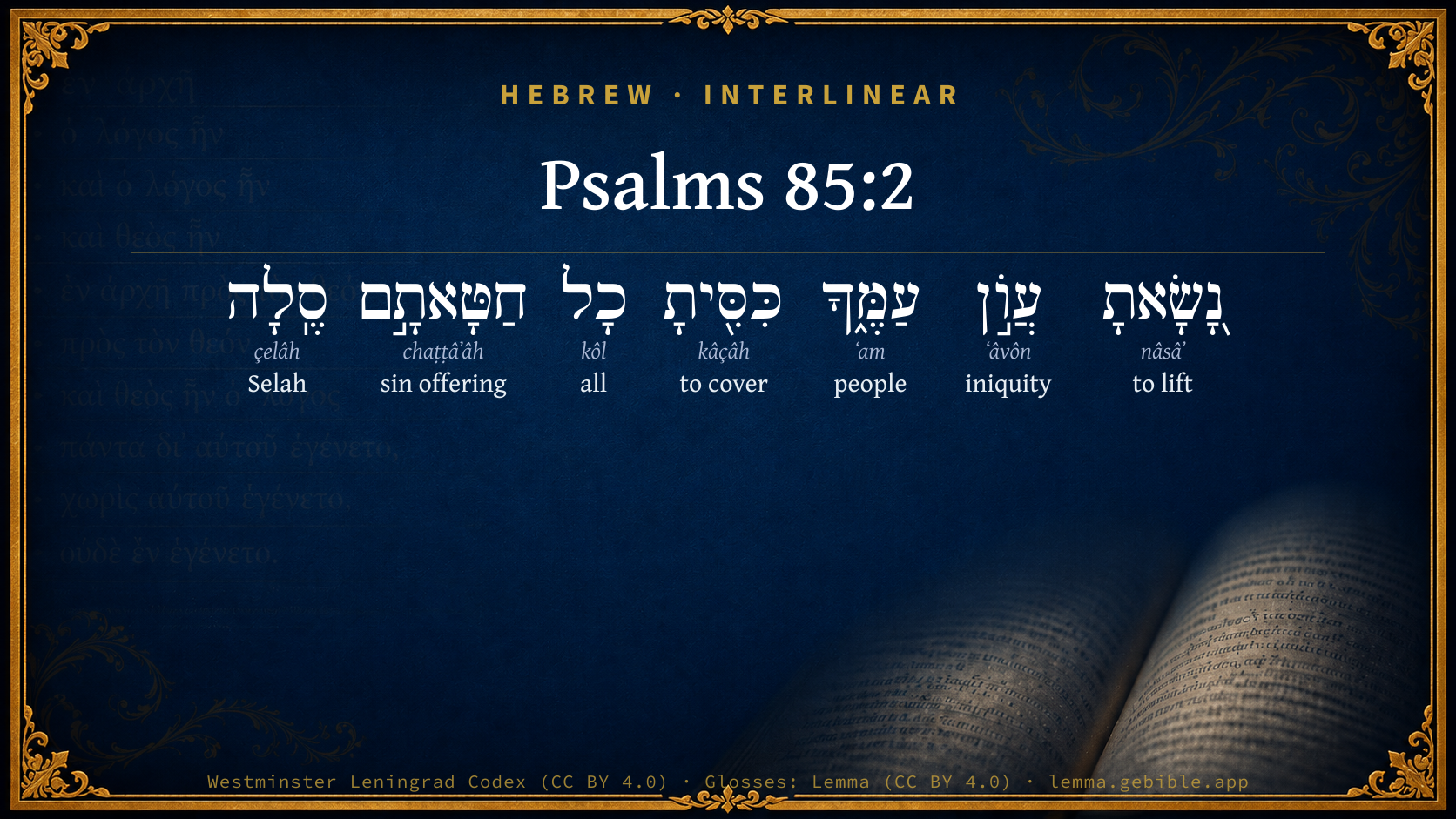
Psalms 85:2

Hebrew (Westminster Leningrad Codex) Psalms 85:2 appears in the Hebrew Old Testament. The text above is from the Westminster Leningrad Codex. Each word links to its Strong’s number, a concise gloss, and parsing drawn from the Open Scriptures Hebrew Bible morphology. Click any word for its full Brown-Driver-Briggs (BDB) entry.
Download image
Cite this verse

Psalms 85:2 (World English Bible). Public Domain. Lemma interlinear Bible study tool, https://lemma.gebible.app/v/psalms/85/2.

Show BibTeX & RIS
BibTeX
RIS
English Translation
You have forgiven the iniquity of your people. You have covered all their sin. Selah.
World English Bible · Public Domain
Download a study sheet

One document with this verse’s original text, its word-by-word gloss line, the meaning frame, cross-references with their text, attributed commentary, and full source and license credits — printable, and it pastes into notes with its structure intact.

This verse Autodidact and up

Study sheet (.html) Plain text (.txt)

A passage Seminary Student

Up to 50 verses in one chapter. A passage sheet keeps up to 6 commentary sources and 12 cross-references per verse, in the order this page ranks them, and says so on the sheet whenever that leaves anything out. Ask for a single verse and you get the Autodidact verse sheet above.

Everything on this page stays free to read, with no account — the sheet is a download of what is already on screen, not access to it.

Want to remove ads? Support Godless Engineer
Compare translations 3

The same verse in 3 English versions, stacked beneath the original-language interlinear above. Click any original word for its lexicon entry.

Each is an independent rendering of the whole verse — the interlinear is not word-aligned to these translations.

Highlighted words mark where these versions differ — a whole-verse word diff, not a word-by-word alignment.

  • World English Bible Public Domain
    You have forgiven the iniquity of your people. You have covered all their sin. Selah.
  • King James Version Public Domain
    Thou hast forgiven the iniquity of thy people, thou hast covered all their sin. Selah.
  • unfoldingWord Literal Text CC BY-SA 4.0
    You bore the iniquity of your people; you covered all of their sin. Selah

unfoldingWord Literal Text — © unfoldingWord, licensed CC BY-SA 4.0. Word-aligned USFM3 via Door43 (git.door43.org/unfoldingWord/en_ult).

Versions to compare (up to 4)

3 of 4 selected

Show all 18 translations

Every available English version of this verse, each an independent rendering of the whole verse.

  • World English Bible Public Domain
    You have forgiven the iniquity of your people. You have covered all their sin. Selah.
  • Berean Standard Bible Public Domain
    You forgave the iniquity of Your people; You covered all their sin. Selah
  • Majority Standard Bible Public Domain
    You forgave the iniquity of Your people; You covered all their sin. Selah
  • King James Version Public Domain
    Thou hast forgiven the iniquity of thy people, thou hast covered all their sin. Selah.
  • American Standard Version (1901) Public Domain
    Thou hast forgiven the iniquity of thy people; Thou hast covered all their sin. Selah
  • Revised Version (1885) Public Domain
    Thou hast forgiven the iniquity of thy people, thou hast covered all their sin. Selah
  • Geneva Bible (1599) Public Domain
    Thou hast forgiuen the iniquitie of thy people, and couered all their sinnes. Selah.
  • Douay-Rheims (1899) Public Domain
    Lord, thou hast blessed thy land: thou hast turned away the captivity of Jacob.
  • Young's Literal Translation Public Domain
    Thou hast borne away the iniquity of Thy people, Thou hast covered all their sin. Selah.
  • Literal Standard Version CC BY-SA 4.0
    You have carried away the iniquity of Your people, || You have covered all their sin. Selah.
  • Unlocked Literal Bible CC BY-SA 4.0
    You have forgiven the sin of your people; you have covered all their sin. Selah
  • unfoldingWord Literal Text CC BY-SA 4.0
    You bore the iniquity of your people; you covered all of their sin. Selah
  • Darby Bible Public Domain
    Thou hast forgiven the iniquity of thy people; thou hast covered all their sin. Selah.
  • World Messianic Bible Public Domain
    You have forgiven the iniquity of your people. You have covered all their sin. Selah.
  • Webster's Bible Public Domain
    \\85:1\\To the chief Musician, A Psalm for the sons of Korah. LORD, thou hast been favorable to thy land: thou hast brought back the captivity of Jacob.
  • Free Bible Version CC BY-SA 4.0
    You took away your people's guilt; you forgave all their sins. Selah.
  • Bible in Basic English Public Domain
    The wrongdoing of your people had forgiveness; all their sin had been covered. (Selah.)
  • JPS Tanakh (1917) Public Domain
    (85-3) Thou hast forgiven the iniquity of Thy people, Thou hast pardoned all their sin. Selah

Literal Standard Version (2020), Covenant Press — licensed CC BY-SA 4.0. Text via the HelloAO Bible API (eBible.org). Unlocked Literal Bible (unfoldingWord) — licensed CC BY-SA 4.0. Text via the HelloAO Bible API (eBible.org). unfoldingWord Literal Text — © unfoldingWord, licensed CC BY-SA 4.0. Word-aligned USFM3 via Door43 (git.door43.org/unfoldingWord/en_ult). Free Bible Version, Dr. Jonathan Gallagher — licensed CC BY-SA 4.0. Text via the HelloAO Bible API (eBible.org).

Word by word

More ways to search: Search by grammar → Find every occurrence → Compare this word →

Practice this passage: Drill this verse → Learn its vocabulary →

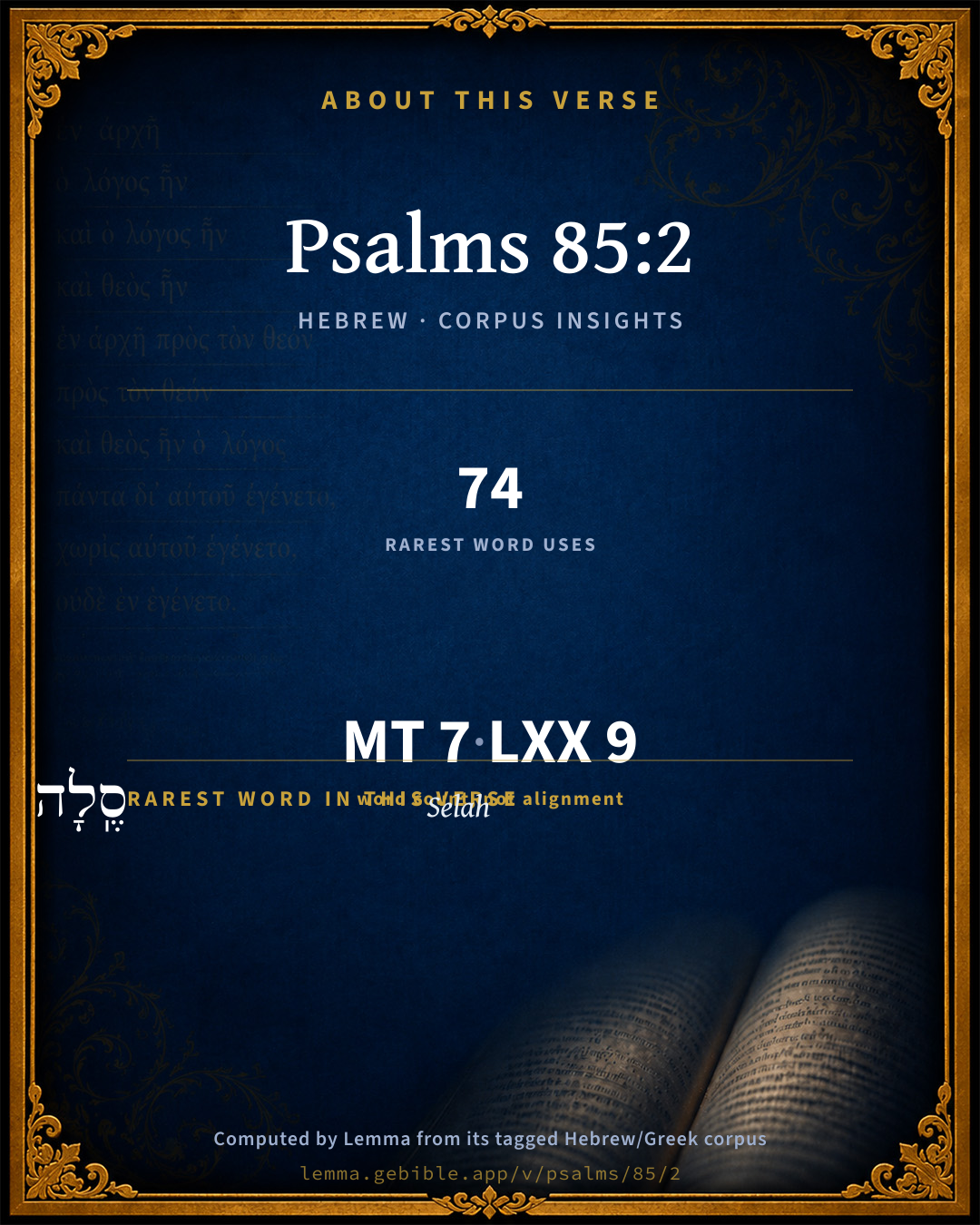
About this verse

These counts appear in no published source. They are computed here, from the morphology-tagged text and Lemma’s own curated glosses. What Lemma adds →

7
words
7
distinct lemmas
Wisdom
section

Grammatical profile

  • 2 verbs
  • 4 nouns
  • 1 particle

Verb forms

  • נָ֭שָׂאתָ Qal · Perfect
  • כִּסִּ֖יתָ Piel · Perfect

Hebrew & Septuagint length

In English translation the verse runs 15 words from the Hebrew and 14 from the Septuagint (LXX English) — closely comparable.

A rough comparison of the two English renderings, which tokenize alike — not a word-level alignment.

Word counts can differ between the Hebrew and the Greek without any difference in meaning — e.g. the Hebrew direct-object marker אֵת has no separate Greek word, and Greek often adds the article ὁ.

In the original languages it is 7 Hebrew tokens and 9 Greek tokens — but the two are counted differently (Hebrew bundles its prefixes and suffixes into one token; the Greek is in lemma form), so that isn’t a like-for-like length.

Cross-references

8

Topical passages linked to Psalms 85:2 in the Treasury of Scripture Knowledge — connected by theme and wording, ordered by reader-vote popularity; previews shown in the World English Bible.

  • Psalms 32:1 Blessed is he whose disobedience is forgiven, Whose sin is covered.
  • Micah 7:18 Who is a God like you, who pardons iniquity, And passes over the disobedience of the remnant of his heritage? He doesn't retain his anger forever, Because he delights in loving kindness.
  • Colossians 2:13 You were dead through your trespasses and the uncircumcision of your flesh. He made you alive together with him, having forgiven us all our trespasses,
  • Numbers 14:19 Pardon, Please, the iniquity of this people according to the greatness of your loving kindness, and according as you have forgiven this people, from Egypt even until now.
  • Acts 13:39 and by him everyone who believes is justified from all things, from which you could not be justified by the law of Moses.
  • Psalms 79:8–9 Don't hold the iniquities of our forefathers against us. Let your tender mercies speedily meet us, For we are in desperate need.
  • Jeremiah 50:20 In those days, and in that time, says Yahweh, the iniquity of Israel shall be sought for, and there shall be none; and the sins of Judah, and they shall not be found: for I will pardon them whom I leave as a remnant.
  • Psalms 78:38 But he, being merciful, forgave iniquity, and didn't destroy them. Yes, many times he turned his anger away, And didn't stir up all his wrath.

Cross-references courtesy of OpenBible.info (CC BY 4.0).

Hebrew and Greek witnesses Masoretic Hebrew ↔ Greek Septuagint

The same verse in the two great witnesses to the Old Testament, shown verse-for-verse.

You’re reading Greek Psalm 84 (Hebrew Psalm 85). The Septuagint counts the superscription, so verse numbers can differ from the Hebrew — chapter-level alignment, not verse-by-verse. Numbering follows Rahlfs.

These are two independent witnesses, not word-aligned to each other, and the Septuagint is shown in lemma (dictionary) form.

Hebrew Psalms 85:2 Masoretic · Westminster Leningrad Codex

נָ֭שָׂאתָ עֲוֺ֣ן עַמֶּ֑ךָ כִּסִּ֖יתָ כָל חַטָּאתָ֣ם סֶֽלָה

You have forgiven the iniquity of your people. You have covered all their sin. Selah.

World English Bible · Public Domain

Greek LXX Greek Psalm 84:2 Septuagint · lemma form

εὐδοκέω κύριος ὁ γῆ σύ ἀποστρέφω ὁ αἰχμαλωσία ἰακώβ

You have forgiven your people their transgressions; you have covered all their sins. Pause.

LXX2012 (modern English Septuagint) · Public Domain

On this verse, The Treasury of David discusses the Septuagint’s reading. Read the note in Commentary ↓

Hebrew: Westminster Leningrad Codex (CC BY 4.0). Greek: Septuagint (public domain); English from LXX2012 (modern English Septuagint) (Public Domain). How the Septuagint differs from the Hebrew →

Commentary

Notes on Psalms 85:2 from classic Christian and Jewish commentators (each source and its license shown beneath its notes). The classic Christian expositions comment on the surrounding passage and are grouped to its opening verse, so a note may address several verses; the Jewish commentaries on the Tanakh (Rashi and others) are per-verse, so they appear only where the commentator wrote on this verse.

Lemma curates 59 commentaries, every one of them public domain or Creative Commons licensed, each selected and text-cleaned for this edition rather than reprinted as found. About our sources →

Trapp's Complete Commentary

John Trapp

Psa 85:2 Thou hast forgiven the iniquity of thy people, thou hast covered all their sin. Selah.

Ver. 2. Thou hast forgiven the iniquity, &c.] This is worthily mentioned as a main mercy, as a chief fruit of free grace.

Thou hast covered all their sins] That that filthy thing may be no longer an eyesore unto thee. In the original there are six homoioteleuta, which is an elegancy not to be translated into English.

John Trapp, A Commentary or Exposition upon All the Books of the Old and New Testament (1647–1656) — public domain. Text from a community e-Sword module.

J. A. Alexander on Psalms

Joseph Addison Alexander

3. (Psa 85:2) Thou didst take away the guilt of thy people; thou didst cover all their sin. Selah. The same form of expression occurs above, in Psa 32:1; Psa 32:5. Both verbs suggest the idea of atonement as well as pardon. Thou didst withdraw all thy wrath; thou didst turn from the heat of thine anger. There is probably an allusion here to the prayer of Moses in Exo 32:12. The Hebrew verb of the second clause corresponds strictly to the English verb in its transitive or causative sense. It is used, however, in the same way by Ezekiel (Eze 18:30; Eze 18:32), who, in one place (Eze 14:6), has the phrase to turn away the face, of which the other may be an abbreviation.

Joseph Addison Alexander, The Psalms Translated and Explained (1850) — public domain. Text from a community e-Sword module.

Tyndale Open Study Notes

Tyndale Open Resources

85:2 When God forgave the guilt of their sins, he gave the people the possibility of fellowship with him (see 32:5).

Tyndale Open Study Notes — © Tyndale Open Resources, licensed CC BY-SA 4.0. Text via the HelloAO Bible API.

Geneva Bible (1599)

Geneva Bible translators

Thou hast buried them that they shall not come into judgment.

Geneva Bible (1599) marginal notes — public domain. Text via Bolls.life.

Adam Clarke's Commentary

Verse 2. Thou hast forgiven the iniquity] נשאת עון nasatha avon, Thou hast borne, or carried away, the iniquity. An allusion to the ceremony of the scapegoat.

Thou hast covered all their sin.] As thou hast freely forgiven it, its offensiveness and abominable nature no longer appear. The whole is put out of sight; and, as we are restored from our captivity, the consequences no longer appear.

Selah.] This is true. Our return to our own land is the full proof.

Adam Clarke's Commentary on the Bible (1810–1826) — public domain. Text from a community e-Sword/MySword module.

John Calvin's Commentaries

2 Thou hast taken away the iniquity of thy people. It was very natural for the faithful to feel alarmed and perplexed on account of their sins, and therefore the prophet removes all ground for overwhelming apprehension, by showing them, that God, in delivering his people, had given an irrefragable proof of free forgiveness. He had before traced this deliverance to the mere good pleasure and free grace of God as its source; but after it was wrought, the iniquities of the people having separated between them and their God, and estranged them from him, it was necessary that the remedy of pardon should be brought to their aid. In saying that their iniquities were taken away, he does not refer to the faithful being reformed and purged from their sins, in other words, to that work by which God, sanctifying them by the Spirit of regeneration, actually removes sin from them. What he intended to say he explains immediately after. The amount, in short, is, that God was reconciled to the Jews by not imputing their sins to them. When God is said to cover sins, the meaning is, that he buries them, so that they come not into judgment, as we have shown more at large on the 32nd psalm, at the beginning. When, therefore, he had punished the sins of his people by captivity, it being his will to restore them again to their own country, he removed the great impediment to this, by blotting out their transgressions; for deliverance from punishment depends upon the remission of sin. Thus we are furnished with an argument in confutation of that foolish conceit of the Sophists, which they set forth as some great mystery, That God retains the punishment although he forgive the fault; whereas God announces in every part of his word, that his object in pardoning is, that being pacified, he may at the same time mitigate the punishment. Of this we have an additional confirmation in the following verse, where we are informed, that God was mercifully inclined towards his people, that he might withdraw his hand from chastising them. What answer in any degree plausible can be given to this by the Sophists, who affirm that God would not be righteous did he not, after he had forgiven the fault, execute punishment according to the strict demands of his justice? The sequence of the pardon of sin is, that God by his blessing testifies that he is no longer displeased.

John Calvin's Commentaries (1540-1563) — public domain. Text from the Calvin Translation Society English edition (1840s-50s) via the Christian Classics Ethereal Library (ccel.org). Calvin's coverage is partial (roughly two-thirds of the Bible); uncommented books and verses are honest gaps, never fabricated. The 19th-century editor's footnotes and remarks are omitted so the notes are faithfully Calvin's own voice.

Ellicott's Commentary for English Readers

(2) Forgiven.—Rather, taken away. (See Psa_32:1.)

A Bible Commentary for English Readers, edited by Charles John Ellicott (1878–1897) — public domain. Text from a community e-Sword module.

The Cambridge Bible for Schools and Colleges

gen. ed. J. J. S. Perowne

2. The Heb. words describe sin (1) as depravity or moral distortion; (2) as a wandering from the way, or missing the mark; and forgiveness (1) as the removal of a burden, (2) as the covering of the offence, which would otherwise meet the eye of the judge and call for punishment. Cp. Psa_32:1-2; Psa_32:5.

The Cambridge Bible for Schools and Colleges (gen. ed. J. J. S. Perowne; Cambridge University Press, 1878–1918) — public domain. Text from a community e-Sword module.

John Gill's Exposition

Thou hast forgiven the iniquity of thy people,.... Took it from them, and laid it on Christ, who has bore it, and took it away, so as it shall never return more to their destruction; and by the application of his blood it is taken away from their own consciences; for this denotes the manifestation and discovery of forgiveness to themselves; it is a branch of redemption, and is in consequence of it; and is a fruit of the free favour and good will of God through Christ; and it only belongs to the Lord's special people, the people he has taken into covenant with him, and for whose iniquity Christ was stricken:

thou hast covered all their sin; this is but another phrase for forgiveness, see Psa 32:1, and this is done by the blood and righteousness, and propitiatory sacrifice of Christ, the antitypical mercy seat, the covering of the law and its transgressions, and the people of God from its curse and condemnation; whose sins are so covered by Christ, as not to be seen by the eye of avenging justice, even all of them, not one remains uncovered.

Selah. See Gill on Psa 3:2.

John Gill's Exposition of the Whole Bible (1746–1763) — public domain (CC PDM 1.0). Text via the HelloAO Bible API.

Albert Barnes' Notes on the Bible

Thou hast forgiven the iniquity of thy people - That is, These calamities came upon them in consequence of their sins, and thou hast dealt with them as if those sins were forgiven. The fact that the tokens of his anger bad passed away, and that his judgments were withdrawn, seemed to prove that their sins had been forgiven. The same form of expression used here - with the same words in Hebrew - occurs in Psa 32:5. See the notes at that passage. The language suggests the idea of an atonement. Literally, “Thou hast lifted up - or borne - the iniquity of thy people.”

Thou hast covered all their sin - So that it is hidden; and therefore thou dost treat them as if they were righteous, or as if there were no sin. The idea of covering is that expressed in the Hebrew word, which is commonly rendered “atonement” - כפר kâphar - to cover; to cover over; then, to cover over sin; to forgive. The idea suggested in this verse is, that when God withdraws the tokens of his displeasure, we may hope that he has pardoned the sin which was the cause of his anger.

Albert Barnes' Notes on the Bible (1834–1885) — public domain. Text from a community e-Sword/MySword module.

Matthew Poole's English Annotations

So as not to impute it to them, or to continue the punishment which thou didst inflict upon them for it.

Matthew Poole's English Annotations on the Holy Bible (1683–1685) — public domain. Text from a community e-Sword/MySword module.

The Treasury of David

Charles H. Spurgeon

Ver. 2. Thou hast forgiven the iniquity of thy people. Often and often had he done this, pausing to pardon even when his sword was bared to punish. Who is a pardoning God like thee, O Jehovah? Who is so slow to anger, so ready for forgive? Every believer in Jesus enjoys the blessing of pardoned sin, and he should regard this priceless boon as the pledge of all other needful mercies. He should plead it with God"Lord, hast thou pardoned me, and wilt thou let me perish for lack of grace, or fall into mine enemies' hands for want of help. Thou wilt not thus leave thy work unfinished."

Thou hast covered all their sin. All of it, every spot, and wrinkle, the veil of love has covered all. Sin has been divinely put out of sight. Hiding it beneath the propitiatory, covering it with the sea of the atonement, blotting it out, making it to cease to be, the Lord has put it so completely away that even his omniscient eye sees it no more. What a miracle is this! To cover up the sun would be easy work compared with the covering up of sin. Not without a covering atonement is sin removed, but by means of the great sacrifice of our Lord Jesus, it is most effectually put away by one act, for ever. What a covering does his blood afford!

Ver. 2. Thou hast forgiven the iniquity. nvs tsn, nasatha avon, Thou hast borne, or carried away, the iniquity. An allusion to the ceremony of the scapegoat. Adam Clarke.

Ver. 2. Thou hast covered all their sin. When God is said to cover sin, he does so, not as one would cover a sore with a plaster, thereby merely hiding it only; but he covers it with a plaster that effectually cures and removes it altogether. Bellarmine.

Ver. 2. Selah. Rabbi Kimchi regards it as a sign to elevate the voice. The authors of the Septuagint translation appear to have regarded it as a musical or rythmical note. Herder regarded it as indicating a change of note; Mathewson as a musical note, equivalent, perhaps, to the word repeat. According to Luther and others, it means silence. Gesenius explains it to mean, "Let the instruments play and the singers stop." Wocher regards it as equivalent to sursum corda up, my soul! Sommer, after examining all the seventy four passages in which the word occurs, recognises in every case "an actual appeal or summons to Jehovah." They are calls for aid and prayers to be heard, expressed either with entire directness, or if not in the imperative, "Hear, Jehovah!" or Awake, Jehovah! and the like, still earnest addresses to God that he would remember and hear, &c. The word itself he regards as indicating a blast of the trumpets by the priests. Selah, itself, he thinks an abridged expression, used for Higgaion SelahHiggaion indicating the sound of the stringed instruments and Selah a vigorous blast of trumpets. From the "Bibliotheca Sacra, "quoted by Plumer.

Ver. 2.

I. The subjects of forgiveness: Thy people.

1. By choice.

2. By redemption.

3. By effectual calling. II. The time of forgiveness: Thou hast forgiven, etc. III. The method of forgiveness.

1. Forgiven. Hebrew, borne, same word as in Le 16:22: "The goat shall bear upon him all their iniquities."

2. Covered; as the mercy seat covered the law that had been broken. IV. The extent of forgiveness: all their sin.

Psalms 85:3*

Charles H. Spurgeon's The Treasury of David (1869–1885) — public domain. Psalms only. Text from a community e-Sword/MySword module.

Whedon's Commentary on the Bible

Daniel D. Whedon

2. Forgiven the iniquity… covered all their sin—Strong expressions. “Forgiven,”—literally, is borne away—where sin is conceived as a burden of the conscience, and the bearing it away an expiation. Isa_53:4; Isa_53:12. The figure is based upon Lev_16:22.

Covered—A Levitical term signifying to atone, expiate; for when God covers sin he cancels it. This view presents sin in its legal answerableness.

Daniel D. Whedon (gen. ed.), Commentary on the Old and New Testaments (1874–1909) — public domain. Text from a community e-Sword module.

The Pulpit Commentary

Thou hast forgiven the iniquity of thy people; thou hast covered all their sin. God"s remission of punishment, and restoration of his people to favour, was a full indication that he had "forgiven their iniquity" and "covered their sins." This was so vast a boon, that a pause for devout acknowledgment and silent adoration seemed fitting. Hence the "selah," which is at the end of the second verse, not of the first, as Hengstenberg states.

The Pulpit Commentary (1880–1919), ed. H.D.M. Spence-Jones & Joseph S. Exell — public domain. Text from a community e-Sword module.

Rashi

Rabbi Shlomo Yitzchaki (Rashi)

O Lord, You have appeased Your land, etc. If You have returned the captivity of Jacob and forgiven their iniquity, and have concealed their sin and withdrawn Your wrath from them and retreated from Your fierce anger, then You have appeased Your land, and Your world will be appeased. But as long as You do not do this, Your land and Your world will not be appeased.

Rashi on the Tanakh — English translations: “The Judaica Press complete Tanach with Rashi, translated by A. J. Rosenberg” (CC BY 4.0); “Pentateuch with Rashi's commentary by M. Rosenbaum and A.M. Silbermann, 1929-1934” (public domain); “The Metsudah Tanach series, Lakewood, N.J” (CC BY 4.0); and “The Book of Joshua, Metsudah Publications, 1997” (CC BY 4.0). Text via Sefaria.

Lesson kit

Teaching starters — assembled from the data on this page, not authored interpretation. Every prompt links to the verse data it draws on. Edit before teaching.

Psalms, in the Wisdom, opens this verse with 7 words (7 distinct Hebrew lemmas). Its most distinctive word is çelâh (“Selah”). A historical commentator’s framing appears above. Read the whole chapter for the surrounding context.

Discussion questions

  1. How does “Selah” (çelâh) shape what this verse is saying?
  2. How does Psalms 32:1, which shares this passage’s theme, read alongside this verse?
  3. These translations render this verse differently; the difference is in the English rendering, not the original. What questions does that raise?
  4. «נָ֭שָׂאתָ» is a Qal Perfect verb. How does that grammatical form shape the action described?
  5. Compare how Trapp's Complete Commentary and J. A. Alexander on Psalms read this verse. Where do they agree or differ?

Things to notice

Reading settings

Reading text

Shown beneath each verse's original-language words.

Old Testament
Old Testament edition

Read the OT as the Masoretic Hebrew (MT) or the Greek Septuagint (LXX).

English shown for the Greek Septuagint (in the Hebrew ↔ Greek comparison).

Comparing translations? Open the Compare panel on any verse page to stack up to four side by side.