2 Samuel 5:12

Hebrew (Westminster Leningrad Codex) 2 Samuel 5:12 appears in the Hebrew Old Testament. The text above is from the Westminster Leningrad Codex. Each word links to its Strong’s number, a concise gloss, and parsing drawn from the Open Scriptures Hebrew Bible morphology. Click any word for its full Brown-Driver-Briggs (BDB) entry.
Download image
Cite this verse

2 Samuel 5:12 (World English Bible). Public Domain. Lemma interlinear Bible study tool, https://lemma.gebible.app/v/2-samuel/5/12.

Show BibTeX & RIS
BibTeX
RIS
English Translation
David perceived that Yahweh had established him king over Israel, and that he had exalted his kingdom for his people Israel's sake.
World English Bible · Public Domain
Download a study sheet

One document with this verse’s original text, its word-by-word gloss line, the meaning frame, cross-references with their text, attributed commentary, and full source and license credits — printable, and it pastes into notes with its structure intact.

This verse Autodidact and up

Study sheet (.html) Plain text (.txt)

A passage Seminary Student

Up to 50 verses in one chapter. A passage sheet keeps up to 6 commentary sources and 12 cross-references per verse, in the order this page ranks them, and says so on the sheet whenever that leaves anything out. Ask for a single verse and you get the Autodidact verse sheet above.

Everything on this page stays free to read, with no account — the sheet is a download of what is already on screen, not access to it.

Want to remove ads? Support Godless Engineer
Compare translations 3

The same verse in 3 English versions, stacked beneath the original-language interlinear above. Click any original word for its lexicon entry.

Each is an independent rendering of the whole verse — the interlinear is not word-aligned to these translations.

Highlighted words mark where these versions differ — a whole-verse word diff, not a word-by-word alignment.

  • World English Bible Public Domain
    David perceived that Yahweh had established him king over Israel, and that he had exalted his kingdom for his people Israel's sake.
  • King James Version Public Domain
    And David perceived that the LORD had established him king over Israel, and that he had exalted his kingdom for his people Israel's sake.
  • unfoldingWord Literal Text CC BY-SA 4.0
    Then David knew that Yahweh had established him as king over Israel and that he had lifted up his kingdom for the sake of his people Israel.

unfoldingWord Literal Text — © unfoldingWord, licensed CC BY-SA 4.0. Word-aligned USFM3 via Door43 (git.door43.org/unfoldingWord/en_ult).

Versions to compare (up to 4)

3 of 4 selected

Show all 18 translations

Every available English version of this verse, each an independent rendering of the whole verse.

  • World English Bible Public Domain
    David perceived that Yahweh had established him king over Israel, and that he had exalted his kingdom for his people Israel's sake.
  • Berean Standard Bible Public Domain
    And David realized that the LORD had established him as king over Israel and had exalted his kingdom for the sake of His people Israel.
  • Majority Standard Bible Public Domain
    And David realized that the LORD had established him as king over Israel and had exalted his kingdom for the sake of His people Israel.
  • King James Version Public Domain
    And David perceived that the LORD had established him king over Israel, and that he had exalted his kingdom for his people Israel's sake.
  • American Standard Version (1901) Public Domain
    And David perceived that Jehovah had established him king over Israel, and that he had exalted his kingdom for his people Israel's sake.
  • Revised Version (1885) Public Domain
    And David perceived that the LORD had established him king over Israel, and that he had exalted his kingdom for his people Israel’s sake.
  • Geneva Bible (1599) Public Domain
    Then Dauid knewe that the Lord had stablished him King ouer Israel, and that he had exalted his kingdome for his people Israels sake.
  • Douay-Rheims (1899) Public Domain
    And Hiram the king of Tyre sent messengers to David, and cedar trees, and carpenters, and masons for walls: and they built a house for David.
  • Young's Literal Translation Public Domain
    and David knoweth that Jehovah hath established him for king over Israel, and that He hath lifted up his kingdom, because of His people Israel.
  • Literal Standard Version CC BY-SA 4.0
    and David knows that YHWH has established him for king over Israel, and that He has lifted up his kingdom, because of His people Israel.
  • Unlocked Literal Bible CC BY-SA 4.0
    David knew that Yahweh had established him as king over Israel, and that he had exalted his kingdom for the sake of his people Israel.
  • unfoldingWord Literal Text CC BY-SA 4.0
    Then David knew that Yahweh had established him as king over Israel and that he had lifted up his kingdom for the sake of his people Israel.
  • Darby Bible Public Domain
    And David perceived that Jehovah had established him king over Israel, and that he had exalted his kingdom because of his people Israel.
  • World Messianic Bible Public Domain
    David perceived that the LORD had established him king over Israel, and that he had exalted his kingdom for his people Israel’s sake.
  • Webster's Bible Public Domain
    And David perceived that the LORD had established him king over Israel, and that he had exalted his kingdom for his people Israel's sake.
  • Free Bible Version CC BY-SA 4.0
    David realized that the Lord had installed him as king of Israel, and had made his kingdom great for the sake of his people Israel.
  • Bible in Basic English Public Domain
    And David saw that the Lord had made his position safe as king over Israel, and that he had made his kingdom great because of his people Israel.
  • JPS Tanakh (1917) Public Domain
    And David perceived that the LORD had established him king over Israel, and that He had exalted his kingdom for His people Israel's sake.

Literal Standard Version (2020), Covenant Press — licensed CC BY-SA 4.0. Text via the HelloAO Bible API (eBible.org). Unlocked Literal Bible (unfoldingWord) — licensed CC BY-SA 4.0. Text via the HelloAO Bible API (eBible.org). unfoldingWord Literal Text — © unfoldingWord, licensed CC BY-SA 4.0. Word-aligned USFM3 via Door43 (git.door43.org/unfoldingWord/en_ult). Free Bible Version, Dr. Jonathan Gallagher — licensed CC BY-SA 4.0. Text via the HelloAO Bible API (eBible.org).

Word by word

More ways to search: Search by grammar → Find every occurrence → Compare this word →

Practice this passage: Drill this verse → Learn its vocabulary →

בַּעֲב֖וּר
ʻâbûwr
H5668
“in/at · because of of”
Preposition + Noun, Common, Masculine, Singular, Construct
Part of Speech
Preposition + Noun
Type
Common
Gender
Masculine
Number
Singular
State
Construct
Full BDB Definition

Origin: pass part of H5674

TWOT: 1556g

for the sake of, on account of, because of, in order to (preposition) - in order that (conjunction)
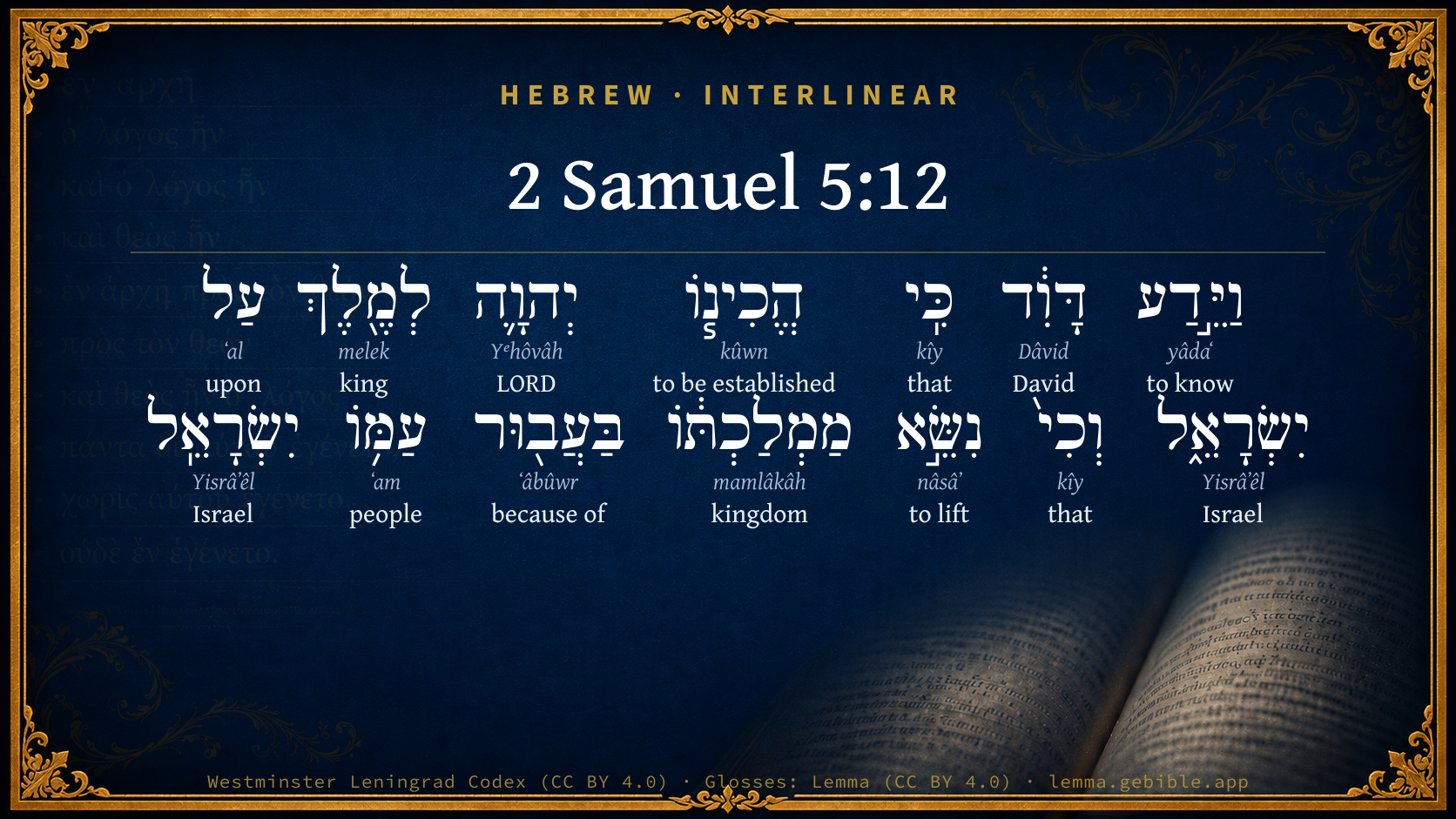
  1. וַיֵּ֣דַע yâdaʻ H3045 “and · to know” Conjunction + Verb, Qal, Sequential Imperfect, 3rd Person, Masculine, Singular
  2. דָּוִ֔ד Dâvid H1732 “David” Noun, Proper
  3. כִּֽי kîy H3588 “that” Conjunction
  4. הֱכִינ֧וֹ kûwn H3559 “to be established · him” Verb, Hiphil, Perfect, 3rd Person, Masculine, Singular + Suffix, Personal, 3rd Person, Masculine, Singular
  5. יְהוָ֛ה Yᵉhôvâh H3068 “LORD” Noun, Proper
  6. לְמֶ֖לֶךְ melek H4428 “to/for · king” Preposition + Noun, Common, Masculine, Singular, Absolute
  7. עַל ʻal H5921 “upon” Preposition
  8. יִשְׂרָאֵ֑ל Yisrâʼêl H3478 “Israel” Noun, Proper
  9. וְכִי֙ kîy H3588 “and · that” Conjunction + Conjunction
  10. נִשֵּׂ֣א nâsâʼ H5375 “to lift” Verb, Piel, Perfect, 3rd Person, Masculine, Singular
  11. מַמְלַכְתּ֔וֹ mamlâkâh H4467 “kingdom · his” Noun, Common, Feminine, Singular, Construct + Suffix, Personal, 3rd Person, Masculine, Singular
  12. עַמּ֥וֹ ʻam H5971 “people · his” Noun, Common, Masculine, Singular, Construct + Suffix, Personal, 3rd Person, Masculine, Singular
  13. יִשְׂרָאֵֽל Yisrâʼêl H3478 “Israel” Noun, Proper

About this verse

These counts appear in no published source. They are computed here, from the morphology-tagged text and Lemma’s own curated glosses. What Lemma adds →

14
words
12
distinct lemmas
Historical
section

Shared distinctive vocabulary

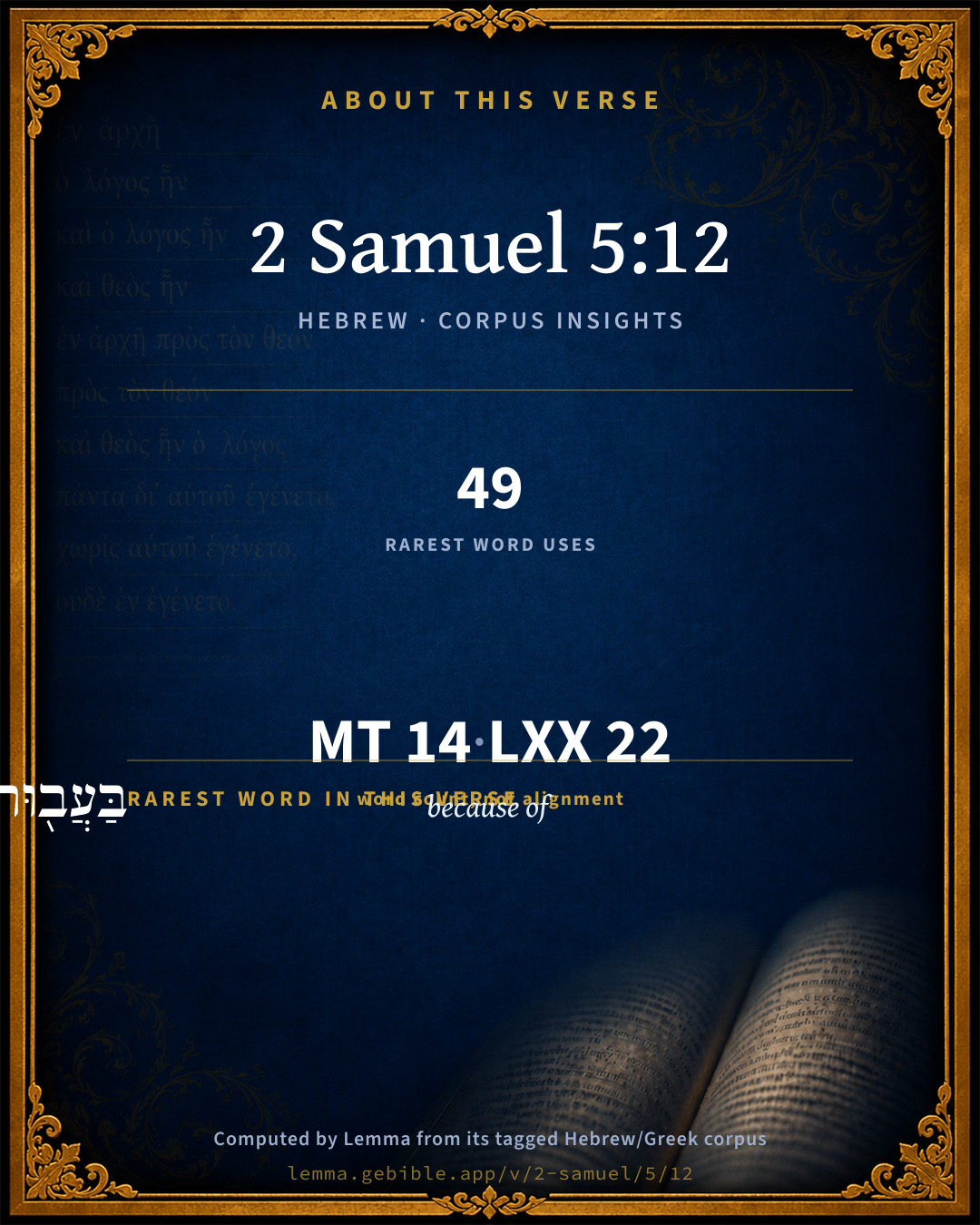
בַּעֲב֖וּר because of H5668 occurs in 47 verses of the Hebrew Bible. Also found in:

Grammatical profile

  • 3 verbs
  • 8 nouns
  • 1 preposition
  • 2 conjunctions

Verb forms

  • וַיֵּ֣דַע Qal · Sequential Imperfect
  • הֱכִינ֧וֹ Hiphil · Perfect
  • נִשֵּׂ֣א Piel · Perfect

Repetition

Words recur within this verse — often emphatic in Hebrew:

  • יִשְׂרָאֵ֑ל Israel H3478 ×2
  • כִּֽי that H3588 ×2

Hebrew & Septuagint length

In English translation the verse runs 22 words from the Hebrew and 27 from the Septuagint (LXX English) — closely comparable.

A rough comparison of the two English renderings, which tokenize alike — not a word-level alignment.

Word counts can differ between the Hebrew and the Greek without any difference in meaning — e.g. the Hebrew direct-object marker אֵת has no separate Greek word, and Greek often adds the article ὁ.

In the original languages it is 14 Hebrew tokens and 22 Greek tokens — but the two are counted differently (Hebrew bundles its prefixes and suffixes into one token; the Greek is in lemma form), so that isn’t a like-for-like length.

Cross-references

7

Topical passages linked to 2 Samuel 5:12 in the Treasury of Scripture Knowledge — connected by theme and wording, ordered by reader-vote popularity; previews shown in the World English Bible.

  • 2 Samuel 7:16 Your house and your kingdom shall be made sure for ever before you: your throne shall be established forever.
  • 1 Kings 10:9 Blessed be Yahweh your God, who delighted in you, to set you on the throne of Israel: because Yahweh loved Israel forever, therefore made he you king, to do justice and righteousness.
  • 1 Chronicles 14:2 David perceived that Yahweh had established him king over Israel; for his kingdom was exalted on high, for his people Israel's sake.
  • 2 Chronicles 2:11 Then Huram the king of Tyre answered in writing, which he sent to Solomon, Because Yahweh loves his people, he has made you king over them.
  • Esther 4:14 For if you altogether hold your peace at this time, then will relief and deliverance arise to the Jews from another place, but you and your father's house will perish: and who knows whether you haven't come to the kingdom for such a time as this?
  • Isaiah 1:25–27 And I will turn my hand on you, Thoroughly purge away your dross, And will take away all your tin.
  • Daniel 2:30 But as for me, this secret is not revealed to me for any wisdom that I have more than any living, but to the intent that the interpretation may be made known to the king, and that you may know the thoughts of your heart.

Cross-references courtesy of OpenBible.info (CC BY 4.0).

Hebrew and Greek witnesses Masoretic Hebrew ↔ Greek Septuagint

The same verse in the two great witnesses to the Old Testament, shown verse-for-verse.

These are two independent witnesses, not word-aligned to each other, and the Septuagint is shown in lemma (dictionary) form.

Hebrew 2 Samuel 5:12 Masoretic · Westminster Leningrad Codex

וַיֵּ֣דַע דָּוִ֔ד כִּֽי הֱכִינ֧וֹ יְהוָ֛ה לְמֶ֖לֶךְ עַל יִשְׂרָאֵ֑ל וְכִי֙ נִשֵּׂ֣א מַמְלַכְתּ֔וֹ בַּעֲב֖וּר עַמּ֥וֹ יִשְׂרָאֵֽל

David perceived that Yahweh had established him king over Israel, and that he had exalted his kingdom for his people Israel's sake.

World English Bible · Public Domain

Greek LXX 2 Samuel 5:12 Septuagint · lemma form

καί γιγνώσκω δαυίδ ὅτι ἑτοιμάζω αὐτός κύριος εἰς βασιλεύς ἐπί ἰσραήλ καί ὅτι ἐπιαἴρω ὁ βασιλεία αὐτός διά ὁ λαός αὐτός ἰσραήλ

And David knew that the Lord had prepared him to be king over Israel, and that his kingdom was exalted for the sake of his people Israel.

LXX2012 (modern English Septuagint) · Public Domain

Hebrew: Westminster Leningrad Codex (CC BY 4.0). Greek: Septuagint (public domain); English from LXX2012 (modern English Septuagint) (Public Domain). How the Septuagint differs from the Hebrew →

Targum (Aramaic paraphrase)

1

The Targum is the ancient Jewish Aramaic paraphrase of the Hebrew Scriptures — an interpretive translation, not the Hebrew text itself. Onkelos (literal) and Pseudo-Jonathan (expansive) render the Torah, and Jonathan the Prophets. Coverage is partial: where no permissively-licensed English translation exists for a verse, only the Aramaic is shown. This is verse-level text, not a word-by-word alignment to the Hebrew.

  1. Targum Jonathan Prophets (Joshua–Malachi)
    וִידַע דָוִד אֲרֵי אַתְקְנֵיהּ יְיָ לְמֶהֱוֵי מַלְכָּא עַל יִשְׂרָאֵל וַאֲרֵי מְנַטְלָא מַלְכוּתֵיהּ בְּדִיל עַמֵיהּ יִשְׂרָאֵל:

    (no public-domain English translation for this verse)

    Targum Jonathan — Aramaic: “Mikraot Gedolot” (public domain). English: “Sefaria Community Translation” (CC0 1.0 (public-domain dedication)); “London "Chaldee Paraphrase," 1871” (public domain). Text via Sefaria.

Commentary

Notes on 2 Samuel 5:12 from classic Christian and Jewish commentators (each source and its license shown beneath its notes). The classic Christian expositions comment on the surrounding passage and are grouped to its opening verse, so a note may address several verses; the Jewish commentaries on the Tanakh (Rashi and others) are per-verse, so they appear only where the commentator wrote on this verse.

Lemma curates 59 commentaries, every one of them public domain or Creative Commons licensed, each selected and text-cleaned for this edition rather than reprinted as found. About our sources →

Trapp's Complete Commentary

John Trapp

2Sa 5:12 And David perceived that the LORD had established him king over Israel, and that he had exalted his kingdom for his people Israel’s sake.

Ver. 12. And David perceived that the Lord had established him.] He partly perceived it by this extraordinary kindness of Hiram toward him; but especially by the inward certification by God’s Holy Spirit, as Lyra noteth.

John Trapp, A Commentary or Exposition upon All the Books of the Old and New Testament (1647–1656) — public domain. Text from a community e-Sword module.

Joseph Benson's Commentary

2Sa 5:12. For his people Israel’s sake — Well would it be for mankind if all kings had the same view of the design of their exaltation to the sovereignty; if they considered themselves as being raised to their high station for the good of their people; that this is the great end of their appointment; the pursuit of this end their great duty; and the attainment of it their true glory. Certainly great and good kings of all ages have been of this way of thinking: they have believed, not that the people were created and ordained by God for the king, but the king for the people.

Joseph Benson's Commentary on the Old and New Testaments (1811–1818) — public domain. Text from a community e-Sword module.

Tyndale Open Study Notes

Tyndale Open Resources

5:12 David realized that his reign as king over Israel was for the sake of God’s people Israel, not just for his personal benefit or enrichment.

Tyndale Open Study Notes — © Tyndale Open Resources, licensed CC BY-SA 4.0. Text via the HelloAO Bible API.

Ellicott's Commentary for English Readers

(12) For his people Israel’s sake.—David’s prosperity had not blinded him to the fact that his blessings came to him as the head of the theocracy, and for the sake of God’s chosen people.

A Bible Commentary for English Readers, edited by Charles John Ellicott (1878–1897) — public domain. Text from a community e-Sword module.

The Cambridge Bible for Schools and Colleges

gen. ed. J. J. S. Perowne

12. And David perceived, &c.] The friendly co-operation of so powerful a king as Hiram, and the success of his enterprises in general, were unmistakeable proofs of divine favour.

The Cambridge Bible for Schools and Colleges (gen. ed. J. J. S. Perowne; Cambridge University Press, 1878–1918) — public domain. Text from a community e-Sword module.

John Gill's Exposition

And David perceived that the Lord had established him king over Israel,.... By the prosperity and success which attended him in everything he set his hand to:

and that he had exalted his kingdom for his people Israel's sake; for their advantage and glory more than for his own.

John Gill's Exposition of the Whole Bible (1746–1763) — public domain (CC PDM 1.0). Text via the HelloAO Bible API.

Haydock's Catholic Bible Commentary

CHAPTER V.

Over. Hebrew, "for." The king is bound to promote the welfare of his people. (Calmet) --- But the same word means "over," as the Protestants allow. (Haydock) --- Success constantly attending David, was an earnest that the Lord had not rejected him. (Calmet)

George Leo Haydock (1774–1849), Haydock's Catholic Family Bible and Commentary, 1859 edition — public domain. Excludes Psalms (Douay-Rheims chapter numbering differs from Protestant) and Deuterocanonical books (Catholic canon only).

Matthew Poole's English Annotations

By reflecting upon the promises which God had made. him, and the constant course of God’s providence favouring him.

Matthew Poole's English Annotations on the Holy Bible (1683–1685) — public domain. Text from a community e-Sword/MySword module.

Whedon's Commentary on the Bible

Daniel D. Whedon

12. David perceived — He was convinced by the signal providences attending his own personal history, and the strength and honour of his kingdom, that his prosperity was of the Lord. How strong is he whose growing greatness is enhanced by the consciousness of Jehovah’s favour!

For his people Israel’s sake — David’s ways were not always right, yet for Israel’s sake, and for his own great Name’s sake, Jehovah blessed him. Marvellous was God’s favour and regard for his chosen people.

Daniel D. Whedon (gen. ed.), Commentary on the Old and New Testaments (1874–1909) — public domain. Text from a community e-Sword module.

The Pulpit Commentary

And David perceived. We may well believe that David had many seasons of despondency and misgiving after he became king. His subjects were brave and energetic, but turbulent, unwilling to obey, and but half-civilized. His election had put an end to civil war at home, but only to arouse the hatred of the enemies who had long oppressed them. The tragical fate, too, of Saul, who, after so many heroic struggles, had seen the earlier glories of his reign fade away, and had sought deliverance from his misery by suicide; all this must have often depressed his spirits. But gradually his fears passed away; and when he had twice defeated the Philistines, and been able to establish his rule, and with it some degree of orderly government throughout the twelve tribes, David saw in all this, and in the embassies from foreign nations, the proof, not of his own ability, but of Jehovah"s purpose to exalt his kingdom for his people Israel"s sake. In this David was still a man after God"s own heart, in that he felt himself to be only an instrument for the doing, not his own will, but the purpose of his Divine Master.

Ver. 12. (1Ch_14:1)

Hiram, King of Tyre.

Hiram was another of those heathen princes with whom David stood in friendly relation (Achish of Gath; the King of Moab, 1Sa_22:3; Talmai of Geshur, 2Sa_3:3; Tel, or Tou, of Hamath, 2Sa_8:9; Joram, or Hadoram, his son, 1Ch_18:10; Nahash, the Ammonite king of Rabbah, ch. 10:1, 2; Shobi, his son,. (2Sa_17:27) He was king of "the strong (fortified) city, Tyre"; (Jos_19:29) chief of those Phoenician cities "whose flag waved at once in Britain and the Indian Ocean" (Humboldt); celebrated alike for its maritime enterprise, commercial activity, and mechanical arts. (Isa_23:8 Eze 27) "Hiram, like David, had just established his throne securely upon the ruins of the rule of the shophetim, or judges, and raised the country to a position of power and independence which it had not previously enjoyed" (A.S. Wilkins, "Phoenicia and Israel"). Notice:

1. His political sagacity. In seeking to secure a "commercial treaty" with the King of Israel, by means of which his people might receive corn, oil, (Act_12:20) in exchange for manufactured goods, Tyrian purple, articles of tin and bronze, weapons of war, jewellery, etc., and might not be prevented from continuing their commercial pursuits along the great caravan lines of traffic with Egypt, Arabia, Babylon, and Assyria, that ran through the country.

1. His peaceable disposition. In sending "messengers" with friendly communications, either of his own accord, or in response to an embassy. "How little David resembled the later Assyrian, Chaldean, and Persian disturbers of the world is most immediately and clearly shown by the fact that he did not, like these great conquerors, seize upon the Phoenician maritime towns, but always remained on the best terms with the little Phoenician states, which were entirely occupied in commerce and the productive arts, and readily sought peace with him" (Ewald).

2. His generous appreciation. Without jealousy or suspicion of David, of whom, doubtless, he had heard much, on account of his ability, energy, and integrity, confirmed by personal intercourse. "God knows how to incline toward pious rulers the minds of neighbouring princes and kings, that they may show them all friendly good will" (Starke).

3. His valuable assistance. With "cedar trees" (from Lebanon, as subsequently, 1Ki 5), "and carpenters, and masons," in building a "house of cedar", (2Sa_7:2 2Sa_6:16:9:13 2Sa_11:2) or stately palace in Zion, the city of David; perhaps in erecting and adorning other houses in the city, and generally promoting the arts and industries of Israel. (1Ch_22:2) The intercourse thus commenced was immensely beneficial, though it ultimately proved an occasion of evil. "Many have excelled in arts and sciences that were strangers to the covenants of promise; yet David"s house was never the worse nor the less fitting to be dedicated to God for its being built by the sons of the stranger" (Matthew Henry).

4. His steadfast friendship with David during his life, afterwards with Solomon, contributing to the maintenance of peace and the increase of prosperity among both peoples. "Hiram was ever a lover of David". (1Ki_5:1)

5. His reverential spirit. "Blessed be Jehovah," etc.. (1Ki_5:7) Without entirely renouncing the worship of "the Lord Melkarth king of the city, Baal of Tyre," he was drawn to the faith of Israel; and, to that extent, represented the gathering of the Gentiles to "the Desire of all nations" (Psa_45:12; Mat_15:27; Act_21:3-6) He was an extraordinary man, eminent in life, honoured in death (by the erection of "the tomb of Hiram," Robinson, 2:456); and he will "rise in the judgment and condemn" the unfaithful under higher privileges. (Mat_11:21) D.

Perception of Divine agency and purpose.

These words are introduced after the narration of the taking of the fortress of Zion, the erection of additional buildings around it, and especially the building of a royal residence for David. It was the establishment of a metropolis for the whole kingdom, and both evidenced and promoted a settled state of things. David"s thoughts upon the matter are given in the text. He recognized that it was God who made him king, and that his exaltation was for the sake of God"s people Israel.

I THE FACTS PERCEIVED.

1. The Divine operation. God had raised David to the throne and settled him on it. At every step the hand of God was clear; especially clear was that hand as the whole series of steps, their connection and issue, were regarded.

2. The Divine purpose. All was "for his people Israel"s sake." Not for the sake of David and his family, that they might be rich, luxurious, and honoured; but for the good of others. That the tribes might be united and consolidated as one nation, free, settled, safe, prosperous, and glorious. That the people might be elevated in their moral and religious life; and that they might be better fitted to fulfil the great end of their election as God"s people, witnessing for him, maintaining his worship, preserving his truth, showing forth his praise, and promoting his kingdom in the world; and that ultimately from them might come the Saviour and salvation. Similarly, the Son of David is exalted, not for himself alone, but that he may deliver, "gather together in one", (Joh_11:52) teach, sanctify, elevate, and eternally save, the people of God. He is "Head over all things to the Church". (Eph_1:22) In like manner, all power, elevation, authority, etc., with which men are endowed are given to them for the sake of others, and ultimately for the sake of God"s people, to whom in Christ all things belong, (1Co_3:21-23) that they may be blessed and be made a blessing to mankind.

II DAVID"S PERCEPTION OF THESE FACTS.

1. He recognized that his exaltation was from God. This would check pride and produce humility and gratitude.

2. He recognized that his exaltation was for the sake of the people. This would check selfish ambition and produce cordial devotement to the good of the nation. And thus should we seek to have a clear perception and deep impression of the agency and purpose of God in our lives. We should regard all we have of being, faculty, position, or possessions, temporal and spiritual alike, as from him; and all as given us, not merely or chiefly for ourselves, but for the sake of others, especially for their salvation that they may become, if they are not, God"s people, and that as God"s people they may prosper, be united, victorious over all the foes of God and man, and powerful to bless mankind. For this is the Divine purpose, and as we make it our own we become intelligent coworkers with God, and our lives are filled with meaning, dignity, and worth, and a fitting preparation for the world where all are consciously, willingly, and habitually engaged in doing the will of God. (Mat_6:10) G.W.

The Pulpit Commentary (1880–1919), ed. H.D.M. Spence-Jones & Joseph S. Exell — public domain. Text from a community e-Sword module.

John Wesley's Explanatory Notes

King over Israel - That he might be a blessing to them, and they might be happy under his administration.

John Wesley, Explanatory Notes Upon the Whole Bible (1754–1765) — public domain. Text via the GEBible commentary corpus.

Rashi

Rabbi Shlomo Yitzchaki (Rashi)

Dovid understood. When he saw all his endeavors succeeding, and the idol worshipping kings sending him a present.

Rashi on the Tanakh — English translations: “The Judaica Press complete Tanach with Rashi, translated by A. J. Rosenberg” (CC BY 4.0); “Pentateuch with Rashi's commentary by M. Rosenbaum and A.M. Silbermann, 1929-1934” (public domain); “The Metsudah Tanach series, Lakewood, N.J” (CC BY 4.0); and “The Book of Joshua, Metsudah Publications, 1997” (CC BY 4.0). Text via Sefaria.

Lesson kit

Teaching starters — assembled from the data on this page, not authored interpretation. Every prompt links to the verse data it draws on. Edit before teaching.

2 Samuel, in the Historical, opens this verse with 14 words (12 distinct Hebrew lemmas). Its most distinctive word is ʻâbûwr (“because of”). A historical commentator’s framing appears above. Read the whole chapter for the surrounding context.

Discussion questions

  1. The word ʻâbûwr carries the sense “because of.” How does it shape the verse?
  2. How does Genesis 3:17, which shares the word «because of», read alongside this verse?
  3. What does the repetition of “Israel” (2× in this one verse) do in this verse?
  4. These translations render this verse differently; the difference is in the English rendering, not the original. What questions does that raise?
  5. «וַיֵּ֣דַע» is a Qal Sequential Imperfect verb. How does that grammatical form shape the action described?
  6. Compare how Trapp's Complete Commentary and Joseph Benson's Commentary read this verse. Where do they agree or differ?

Things to notice

Reading settings

Reading text

Shown beneath each verse's original-language words.

Old Testament
Old Testament edition

Read the OT as the Masoretic Hebrew (MT) or the Greek Septuagint (LXX).

English shown for the Greek Septuagint (in the Hebrew ↔ Greek comparison).

Comparing translations? Open the Compare panel on any verse page to stack up to four side by side.