Ezekiel 18:12

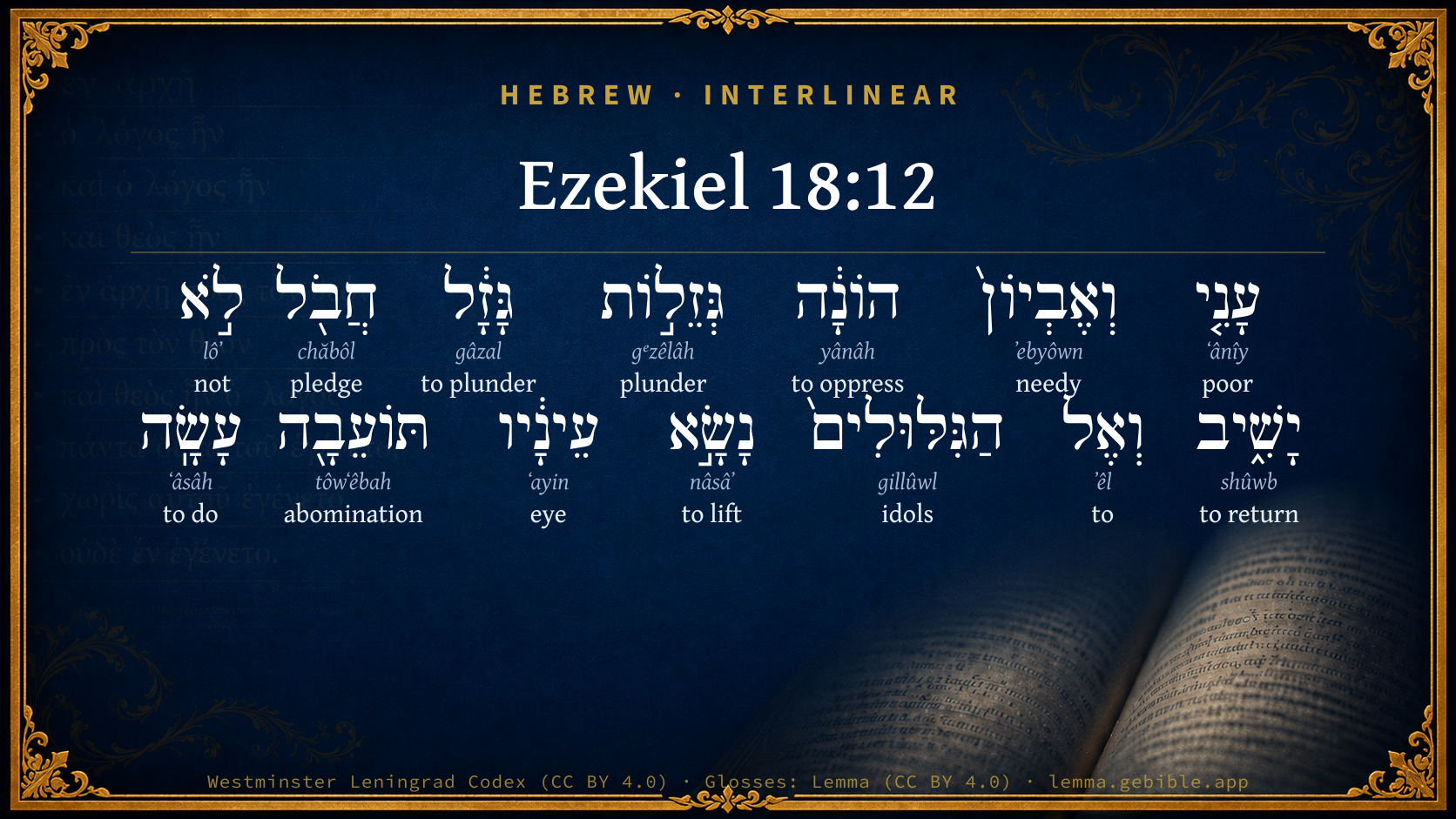
Hebrew (Westminster Leningrad Codex) Ezekiel 18:12 appears in the Hebrew Old Testament. The text above is from the Westminster Leningrad Codex. Each word links to its Strong’s number, a concise gloss, and parsing drawn from the Open Scriptures Hebrew Bible morphology. Click any word for its full Brown-Driver-Briggs (BDB) entry.
Download image
Cite this verse

Ezekiel 18:12 (World English Bible). Public Domain. Lemma interlinear Bible study tool, https://lemma.gebible.app/v/ezekiel/18/12.

Show BibTeX & RIS
BibTeX
RIS
English Translation
has wronged the poor and needy, has taken by robbery, has not restored the pledge, and has lifted up his eyes to the idols, has committed abomination,
World English Bible · Public Domain
Download a study sheet

One document with this verse’s original text, its word-by-word gloss line, the meaning frame, cross-references with their text, attributed commentary, and full source and license credits — printable, and it pastes into notes with its structure intact.

This verse Autodidact and up

Study sheet (.html) Plain text (.txt)

A passage Seminary Student

Up to 50 verses in one chapter. A passage sheet keeps up to 6 commentary sources and 12 cross-references per verse, in the order this page ranks them, and says so on the sheet whenever that leaves anything out. Ask for a single verse and you get the Autodidact verse sheet above.

Everything on this page stays free to read, with no account — the sheet is a download of what is already on screen, not access to it.

Want to remove ads? Support Godless Engineer
Compare translations 3

The same verse in 3 English versions, stacked beneath the original-language interlinear above. Click any original word for its lexicon entry.

Each is an independent rendering of the whole verse — the interlinear is not word-aligned to these translations.

Highlighted words mark where these versions differ — a whole-verse word diff, not a word-by-word alignment.

  • World English Bible Public Domain
    has wronged the poor and needy, has taken by robbery, has not restored the pledge, and has lifted up his eyes to the idols, has committed abomination,
  • King James Version Public Domain
    Hath oppressed the poor and needy, hath spoiled by violence, hath not restored the pledge, and hath lifted up his eyes to the idols, hath committed abomination,
  • unfoldingWord Literal Text CC BY-SA 4.0
    This man oppresses the poor and needy, and he seizes and robs, and he does not return a pledge, and he lifts up his eyes to the idols and commits disgusting actions,

unfoldingWord Literal Text — © unfoldingWord, licensed CC BY-SA 4.0. Word-aligned USFM3 via Door43 (git.door43.org/unfoldingWord/en_ult).

Versions to compare (up to 4)

3 of 4 selected

Show all 18 translations

Every available English version of this verse, each an independent rendering of the whole verse.

  • World English Bible Public Domain
    has wronged the poor and needy, has taken by robbery, has not restored the pledge, and has lifted up his eyes to the idols, has committed abomination,
  • Berean Standard Bible Public Domain
    He oppresses the poor and needy; he commits robbery and does not restore a pledge. He lifts his eyes to idols; he commits abominations.
  • Majority Standard Bible Public Domain
    He oppresses the poor and needy; he commits robbery and does not restore a pledge. He lifts his eyes to idols; he commits abominations.
  • King James Version Public Domain
    Hath oppressed the poor and needy, hath spoiled by violence, hath not restored the pledge, and hath lifted up his eyes to the idols, hath committed abomination,
  • American Standard Version (1901) Public Domain
    hath wronged the poor and needy, hath taken by robbery, hath not restored the pledge, and hath lifted up his eyes to the idols, hath committed abomination,
  • Revised Version (1885) Public Domain
    hath wronged the poor and needy, hath spoiled by violence, hath not restored the pledge, and hath lifted up his eyes to the idols, hath committed abomination,
  • Geneva Bible (1599) Public Domain
    Or hath oppressed the poore and needy, or hath spoyled by violence, or hath not restored the pledge, or hath lift vp his eyes vnto the idoles, or hath committed abomination,
  • Douay-Rheims (1899) Public Domain
    That grieveth the needy and the poor, that taketh away by violence, that restoreth not the pledge, and that lifteth up his eyes to idols, that committeth abomination:
  • Young's Literal Translation Public Domain
    The afflicted and needy he hath oppressed, Plunder he hath taken violently away, A pledge he doth not return, And unto the idols he hath lifted up his eyes, Abomination he hath done!
  • Literal Standard Version CC BY-SA 4.0
    He has oppressed the afflicted and needy, || He has taken away plunder violently, || He does not return a pledge, || And he has lifted up his eyes to the idols, || He has done abomination!
  • Unlocked Literal Bible CC BY-SA 4.0
    This man oppresses the poor and needy, and he seizes and robs, and he does not return a pledge, and he lifts up his eyes to the idols and commits disgusting actions,
  • unfoldingWord Literal Text CC BY-SA 4.0
    This man oppresses the poor and needy, and he seizes and robs, and he does not return a pledge, and he lifts up his eyes to the idols and commits disgusting actions,
  • Darby Bible Public Domain
    hath oppressed the poor and needy, exercised robbery, hath not restored the pledge, and hath lifted up his eyes to the idols, committed abomination,
  • World Messianic Bible Public Domain
    has wronged the poor and needy, has taken by robbery, has not restored the pledge, and has lifted up his eyes to the idols, has committed abomination,
  • Webster's Bible Public Domain
    Hath oppressed the poor and needy, hath stripped by violence, hath not restored the pledge, and hath lifted up his eyes to the idols, hath committed abomination.
  • Free Bible Version CC BY-SA 4.0
    He exploits the poor and those in need. He robs others, and he doesn't give back what a debtor has given him as security. He worships idols. He commits disgusting sins.
  • Bible in Basic English Public Domain
    Has done wrong to the poor and to him who is in need, and taken property by force, and has not given back to one in his debt what is his, and has given worship to images and has done disgusting things,
  • JPS Tanakh (1917) Public Domain
    hath wronged the poor and needy, hath taken by robbery, hath not restored the pledge, and hath lifted up his eyes to the idols, hath committed abomination,

Literal Standard Version (2020), Covenant Press — licensed CC BY-SA 4.0. Text via the HelloAO Bible API (eBible.org). Unlocked Literal Bible (unfoldingWord) — licensed CC BY-SA 4.0. Text via the HelloAO Bible API (eBible.org). unfoldingWord Literal Text — © unfoldingWord, licensed CC BY-SA 4.0. Word-aligned USFM3 via Door43 (git.door43.org/unfoldingWord/en_ult). Free Bible Version, Dr. Jonathan Gallagher — licensed CC BY-SA 4.0. Text via the HelloAO Bible API (eBible.org).

Word by word

More ways to search: Search by grammar → Find every occurrence → Compare this word →

Practice this passage: Drill this verse → Learn its vocabulary →

חֲבֹ֖ל
chăbôl
H2258
“pledge”
Noun, Common, Masculine, Singular, Absolute
Part of Speech
Noun
Type
Common
Gender
Masculine
Number
Singular
State
Absolute
Full BDB Definition

Origin: from H2254

TWOT: 593a

pledge
  1. עָנִ֤י ʻânîy H6041 “poor” Adjective, Adjective, Masculine, Singular, Absolute
  2. וְאֶבְיוֹן֙ ʼebyôwn H34 “and · needy” Conjunction + Adjective, Adjective, Masculine, Singular, Absolute
  3. הוֹנָ֔ה yânâh H3238 “to oppress” Verb, Hiphil, Perfect, 3rd Person, Masculine, Singular
  4. גְּזֵל֣וֹת gᵉzêlâh H1500 “plunder” Noun, Common, Feminine, Plural, Absolute
  5. גָּזָ֔ל gâzal H1497 “to plunder” Verb, Qal, Perfect, 3rd Person, Masculine, Singular
  6. לֹ֣א lôʼ H3808 “not” Particle, Negative
  7. יָשִׁ֑יב shûwb H7725 “to return” Verb, Hiphil, Imperfect, 3rd Person, Masculine, Singular
  8. וְאֶל ʼêl H413 “and · to” Conjunction + Preposition
  9. הַגִּלּוּלִים֙ gillûwl H1544 “the · idols” Particle, Definite Article + Noun, Common, Masculine, Plural, Absolute
  10. נָשָׂ֣א nâsâʼ H5375 “to lift” Verb, Qal, Perfect, 3rd Person, Masculine, Singular
  11. עֵינָ֔יו ʻayin H5869 “eyes · his” Noun, Common, Both, Dual, Construct + Suffix, Personal, 3rd Person, Masculine, Singular
  12. תּוֹעֵבָ֖ה tôwʻêbah H8441 “abomination” Noun, Common, Feminine, Singular, Absolute
  13. עָשָֽׂה ʻâsâh H6213 “to do” Verb, Qal, Perfect, 3rd Person, Masculine, Singular

About this verse

These counts appear in no published source. They are computed here, from the morphology-tagged text and Lemma’s own curated glosses. What Lemma adds →

14
words
14
distinct lemmas
Prophets
section

Notable vocabulary

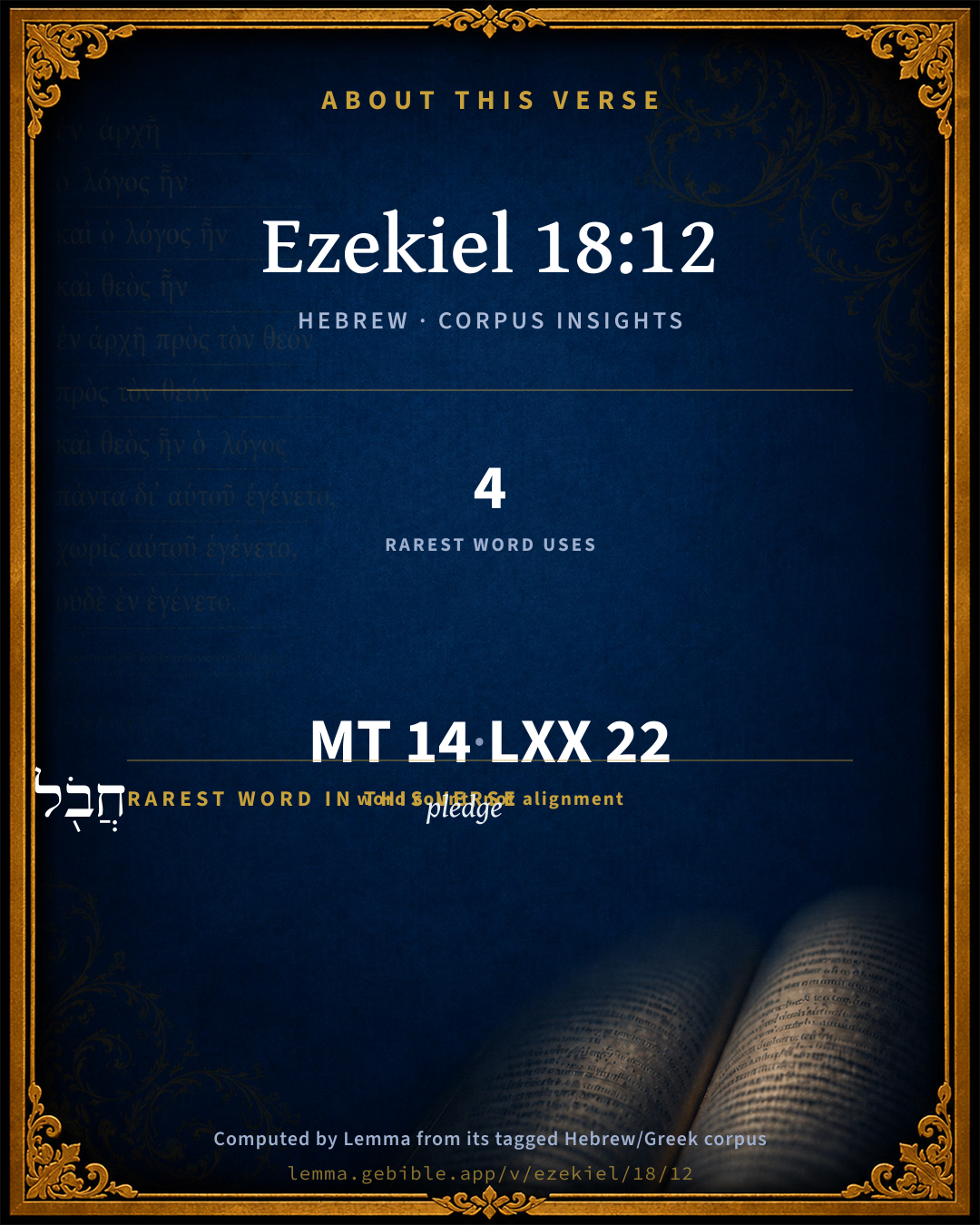
The rarest word here is חֲבֹ֖ל pledge H2258 — appearing just 4 times in the whole Hebrew Bible.

Shared distinctive vocabulary

חֲבֹ֖ל pledge H2258 occurs in 4 verses of the Hebrew Bible. Also found in:

Grammatical profile

  • 5 verbs
  • 5 nouns
  • 2 adjectives
  • 1 preposition
  • 1 particle

Verb forms

  • הוֹנָ֔ה Hiphil · Perfect
  • גָּזָ֔ל Qal · Perfect
  • יָשִׁ֑יב Hiphil · Imperfect
  • נָשָׂ֣א Qal · Perfect
  • עָשָֽׂה Qal · Perfect

Hebrew & Septuagint length

In English translation the verse runs 27 words from the Hebrew and 26 from the Septuagint (LXX English) — closely comparable.

A rough comparison of the two English renderings, which tokenize alike — not a word-level alignment.

Word counts can differ between the Hebrew and the Greek without any difference in meaning — e.g. the Hebrew direct-object marker אֵת has no separate Greek word, and Greek often adds the article ὁ.

In the original languages it is 14 Hebrew tokens and 22 Greek tokens — but the two are counted differently (Hebrew bundles its prefixes and suffixes into one token; the Greek is in lemma form), so that isn’t a like-for-like length.

Cross-references

14

Topical passages linked to Ezekiel 18:12 in the Treasury of Scripture Knowledge — connected by theme and wording, ordered by reader-vote popularity; previews shown in the World English Bible.

  • Ezekiel 8:6 He said to me, Son of man, see you what they do? even the great abominations that the house of Israel do commit here, that I should go far off from my sanctuary? but you shall again see yet other great abominations.
  • Ezekiel 8:17 Then he said to me, Have you seen [this], son of man? Is it a light thing to the house of Judah that they commit the abominations which they commit here? for they have filled the land with violence, and have turned again to provoke me to anger: and, behold, they put the branch to their nose.
  • 2 Kings 21:11 Because Manasseh king of Judah has done these abominations, and has done wickedly above all that the Amorites did, who were before him, and has made Judah also to sin with his idols;
  • Amos 4:1 Listen to this word, you cows of Bashan, who are on the mountain of Samaria, who oppress the poor, who crush the needy, who tell their lords, "Bring, and let us drink."
  • Ezekiel 18:6–7 and has not eaten on the mountains, neither has lifted up his eyes to the idols of the house of Israel, neither has defiled his neighbor's wife, neither has come near to a woman in her impurity,
  • Ezekiel 18:16 neither has wronged any, has not taken anything to pledge, neither has taken by robbery, but has given his bread to the hungry, and has covered the naked with a garment;
  • Zechariah 7:10 Don't oppress the widow, nor the fatherless, the foreigner, nor the poor; and let none of you devise evil against his brother in your heart.'
  • Leviticus 18:22 "'You shall not lie with a man, as with a woman. That is detestible.
  • Leviticus 18:26–30 You therefore shall keep my statutes and my ordinances, and shall not do any of these abominations; neither the native-born, nor the stranger who lives as a foreigner among you;
  • 2 Kings 23:13 The high places that were before Jerusalem, which were on the right hand of the mountain of corruption, which Solomon the king of Israel had built for Ashtoreth the abomination of the Sidonians, and for Chemosh the abomination of Moab, and for Milcom the abomination of the children of Ammon, did the king defile.
  • Isaiah 59:6–7 Their webs shall not become garments, neither shall they cover themselves with their works: their works are works of iniquity, and the act of violence is in their hands.
  • Jeremiah 22:17 But your eyes and your heart are not but for your covetousness, and for shedding innocent blood, and for oppression, and for violence, to do it.
  • Hosea 12:7 A merchant has dishonest scales in his hand. He loves to defraud.
  • James 2:6 But you have dishonored the poor man. Don't the rich oppress you, and personally drag you before the courts?

Cross-references courtesy of OpenBible.info (CC BY 4.0).

Hebrew and Greek witnesses Masoretic Hebrew ↔ Greek Septuagint

The same verse in the two great witnesses to the Old Testament, shown verse-for-verse.

These are two independent witnesses, not word-aligned to each other, and the Septuagint is shown in lemma (dictionary) form.

Hebrew Ezekiel 18:12 Masoretic · Westminster Leningrad Codex

עָנִ֤י וְאֶבְיוֹן֙ הוֹנָ֔ה גְּזֵל֣וֹת גָּזָ֔ל חֲבֹ֖ל לֹ֣א יָשִׁ֑יב וְאֶל הַגִּלּוּלִים֙ נָשָׂ֣א עֵינָ֔יו תּוֹעֵבָ֖ה עָשָֽׂה

has wronged the poor and needy, has taken by robbery, has not restored the pledge, and has lifted up his eyes to the idols, has committed abomination,

World English Bible · Public Domain

Greek LXX Ezekiel 18:12 Septuagint · lemma form

καί πτωχός καί πένης καταδυναστεύω καί ἅρπαγμα ἁρπάζω καί ἐνεχυρασμός οὐ ἀποδίδωμι καί εἰς ὁ εἴδωλον τίθημι ὁ ὀφθαλμός αὐτός ἀνομία ποιέω

and has oppressed the poor and needy, and has committed robbery, and not restored a pledge, and has set his eyes upon idols, has wrought iniquities,

LXX2012 (modern English Septuagint) · Public Domain

Hebrew: Westminster Leningrad Codex (CC BY 4.0). Greek: Septuagint (public domain); English from LXX2012 (modern English Septuagint) (Public Domain). How the Septuagint differs from the Hebrew →

Targum (Aramaic paraphrase)

1

The Targum is the ancient Jewish Aramaic paraphrase of the Hebrew Scriptures — an interpretive translation, not the Hebrew text itself. Onkelos (literal) and Pseudo-Jonathan (expansive) render the Torah, and Jonathan the Prophets. Coverage is partial: where no permissively-licensed English translation exists for a verse, only the Aramaic is shown. This is verse-level text, not a word-by-word alignment to the Hebrew.

  1. Targum Jonathan Prophets (Joshua–Malachi)
    מִסְכֵּן וְחָשִׁיךְ אוֹנִי גְזֵילָא גְזַל מַשְׁכּוֹנָא לָא אֲתֵיב וּלְפוּלְחַן טַעֲוָתָא זְקַף עֵינוֹהִי תּוֹעֵיבָא עָבַד:

    (no public-domain English translation for this verse)

    Targum Jonathan — Aramaic: “Mikraot Gedolot” (public domain). English: “Sefaria Community Translation” (CC0 1.0 (public-domain dedication)); “London "Chaldee Paraphrase," 1871” (public domain). Text via Sefaria.

Commentary

Notes on Ezekiel 18:12 from classic Christian and Jewish commentators (each source and its license shown beneath its notes). The classic Christian expositions comment on the surrounding passage and are grouped to its opening verse, so a note may address several verses; the Jewish commentaries on the Tanakh (Rashi and others) are per-verse, so they appear only where the commentator wrote on this verse.

Lemma curates 59 commentaries, every one of them public domain or Creative Commons licensed, each selected and text-cleaned for this edition rather than reprinted as found. About our sources →

Trapp's Complete Commentary

John Trapp

Eze 18:12 Hath oppressed the poor and needy, hath spoiled by violence, hath not restored the pledge, and hath lifted up his eyes to the idols, hath committed abomination,

Ver. 12. Hath committed abomination.] Such is every of the sins here instanced, whatsoever some can say in defence of them. Hath given forth upon usury, and all.

John Trapp, A Commentary or Exposition upon All the Books of the Old and New Testament (1647–1656) — public domain. Text from a community e-Sword module.

Jamieson, Fausset & Brown

Robert Jamieson, A. R. Fausset & David Brown

oppressed the poor--an aggravation to his oppressions, that they were practised against the poor; whereas in Eze 18:7 the expression is simply "oppressed any."

abomination--singular number referring to the particular one mentioned at the end of Eze 18:6.

Jamieson, Fausset & Brown — Commentary Critical and Explanatory on the Whole Bible (1871) — public domain (CC PDM 1.0). Text via the HelloAO Bible API.

Haydock's Catholic Bible Commentary

Abomination. This refers to the woman, (ver. 6.) or to idolatry.

George Leo Haydock (1774–1849), Haydock's Catholic Family Bible and Commentary, 1859 edition — public domain. Excludes Psalms (Douay-Rheims chapter numbering differs from Protestant) and Deuterocanonical books (Catholic canon only).

Matthew Poole's English Annotations

See Poole "Eze 18:7". In the seventh verse the words are more large, condemning the oppressing of any one; here they do more particularly condemn oppressing

the poor, which have little to maintain and less to defend themselves; and needy is added, to render us more sensible of the greatness of this sin, which takes away right where we should show charity.

Hath spoiled by violence, hath not restored the pledge: see Eze 18:7.

Hath lifted up his eyes to the idols: see Eze 18:6.

Hath committed abomination, i.e. come near to a menstruous woman, which is expressly named Eze 18:6, and here pointed at; or else idolatry.

Matthew Poole's English Annotations on the Holy Bible (1683–1685) — public domain. Text from a community e-Sword/MySword module.

The Pulpit Commentary

The word abomination probably covers the specific sin named in ver. 6, but not here.

The Pulpit Commentary (1880–1919), ed. H.D.M. Spence-Jones & Joseph S. Exell — public domain. Text from a community e-Sword module.

unfoldingWord translationNotes

Door43 World Missions Community

General Information:

Yahweh continues to speak about the violent son.

the poor and needy

The words "poor" and "needy" share similar meanings and emphasize that these are people who cannot help themselves. (See: Doublet)

he lifts up his eyes to the idols

The idiom "lifts up his eyes" refers to looking toward something. With reference to idols, this gesture represents worshiping or praying to idols. See how you translated a similar phrase in Ezekiel 18:6. AT: "he worships the idols" or "he prays to the idols" (See: Symbolic Action)

interest

This word refers to the money paid by a person to use borrowed money. However, some modern versions interpret "any interest" in this passage as "too much interest."

should that man live? Surely he will not!

Yahweh asks this as a leading question in order to emphasize the negative answer. AT: "he will certainly not live!" (See: Rhetorical Question)

his blood will be on him

Here the word "blood" represents death. For blood to be on a person is an idiom that means the person is responsible for that death. AT: "he will be responsible for his own death" (See: Metonymy and Idiom)

translationWords

oppress

seize

pledge

false god

profit

life

die

blood

unfoldingWord translationNotes — © Distant Shores Media and the Door43 World Missions Community, licensed CC BY-SA 4.0. Source: git.door43.org/Door43/en_tn.

Rashi

Rabbi Shlomo Yitzchaki (Rashi)

committed abomination Homosexual relations.

Rashi on the Tanakh — English translations: “The Judaica Press complete Tanach with Rashi, translated by A. J. Rosenberg” (CC BY 4.0); “Pentateuch with Rashi's commentary by M. Rosenbaum and A.M. Silbermann, 1929-1934” (public domain); “The Metsudah Tanach series, Lakewood, N.J” (CC BY 4.0); and “The Book of Joshua, Metsudah Publications, 1997” (CC BY 4.0). Text via Sefaria.

Lesson kit

Teaching starters — assembled from the data on this page, not authored interpretation. Every prompt links to the verse data it draws on. Edit before teaching.

Ezekiel, in the Prophets, opens this verse with 14 words (14 distinct Hebrew lemmas). Its most distinctive word is chăbôl (“pledge”). A historical commentator’s framing appears above. Read the whole chapter for the surrounding context.

Discussion questions

  1. What does “pledge” (chăbôl) contribute to the verse as a whole?
  2. How does Ezekiel 18:7, which shares the word «pledge», read alongside this verse?
  3. The translations on this page render this verse differently — a whole-verse word diff, not a word-by-word alignment. What might account for the different wordings?
  4. «הוֹנָ֔ה» is a Hiphil Perfect verb. How does that grammatical form shape the action described?
  5. Compare how Trapp's Complete Commentary and Jamieson, Fausset & Brown read this verse. Where do they agree or differ?

Things to notice

Reading settings

Reading text

Shown beneath each verse's original-language words.

Old Testament
Old Testament edition

Read the OT as the Masoretic Hebrew (MT) or the Greek Septuagint (LXX).

English shown for the Greek Septuagint (in the Hebrew ↔ Greek comparison).

Comparing translations? Open the Compare panel on any verse page to stack up to four side by side.