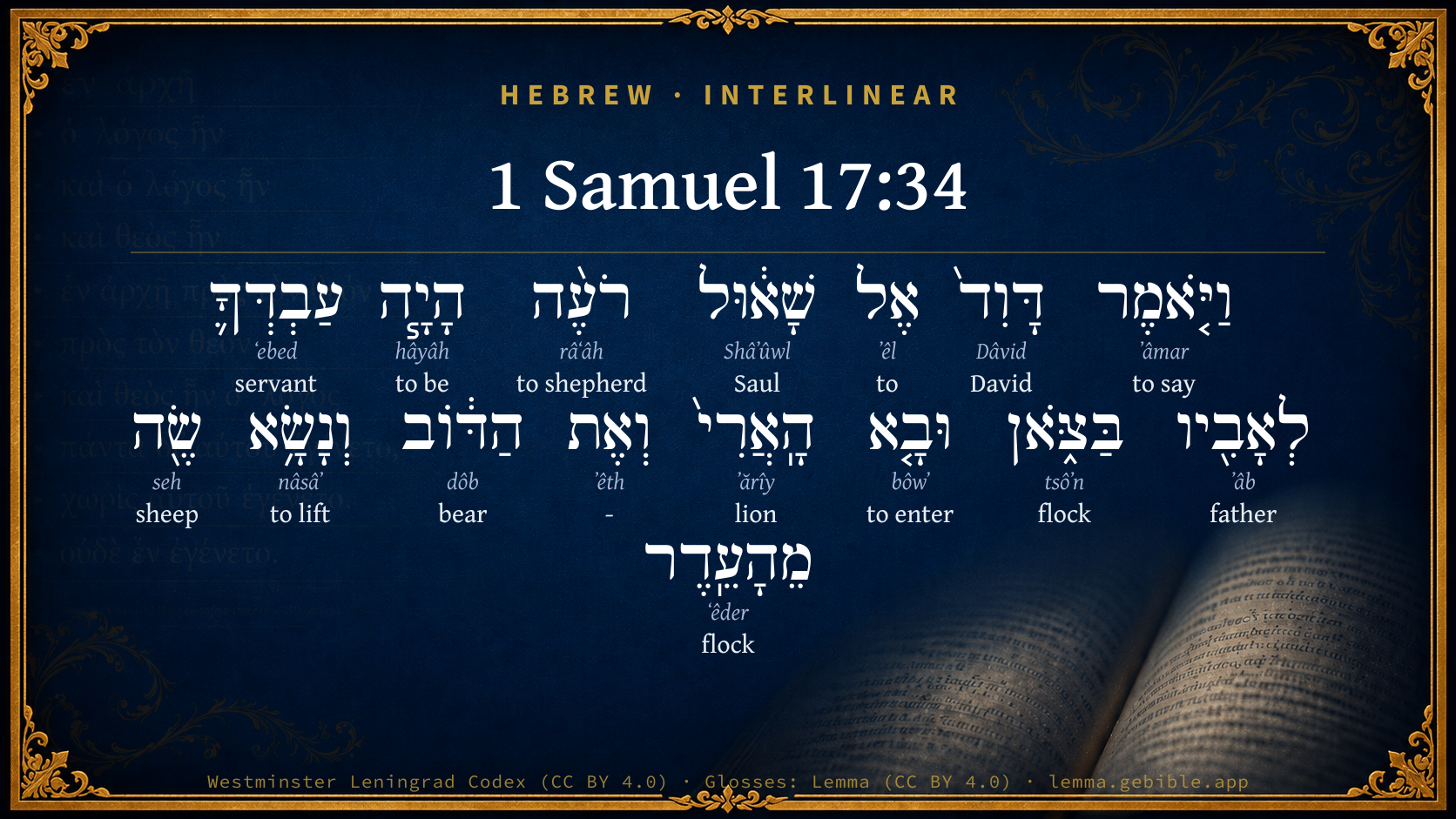
1 Samuel 17:34

Hebrew (Westminster Leningrad Codex) 1 Samuel 17:34 appears in the Hebrew Old Testament. The text above is from the Westminster Leningrad Codex. Each word links to its Strong’s number, a concise gloss, and parsing drawn from the Open Scriptures Hebrew Bible morphology. Click any word for its full Brown-Driver-Briggs (BDB) entry.
Download image
Cite this verse

1 Samuel 17:34 (World English Bible). Public Domain. Lemma interlinear Bible study tool, https://lemma.gebible.app/v/1-samuel/17/34.

Show BibTeX & RIS
BibTeX
RIS
English Translation
David said to Saul, Your servant was keeping his father's sheep; and when there came a lion, or a bear, and took a lamb out of the flock,
World English Bible · Public Domain
Highlights
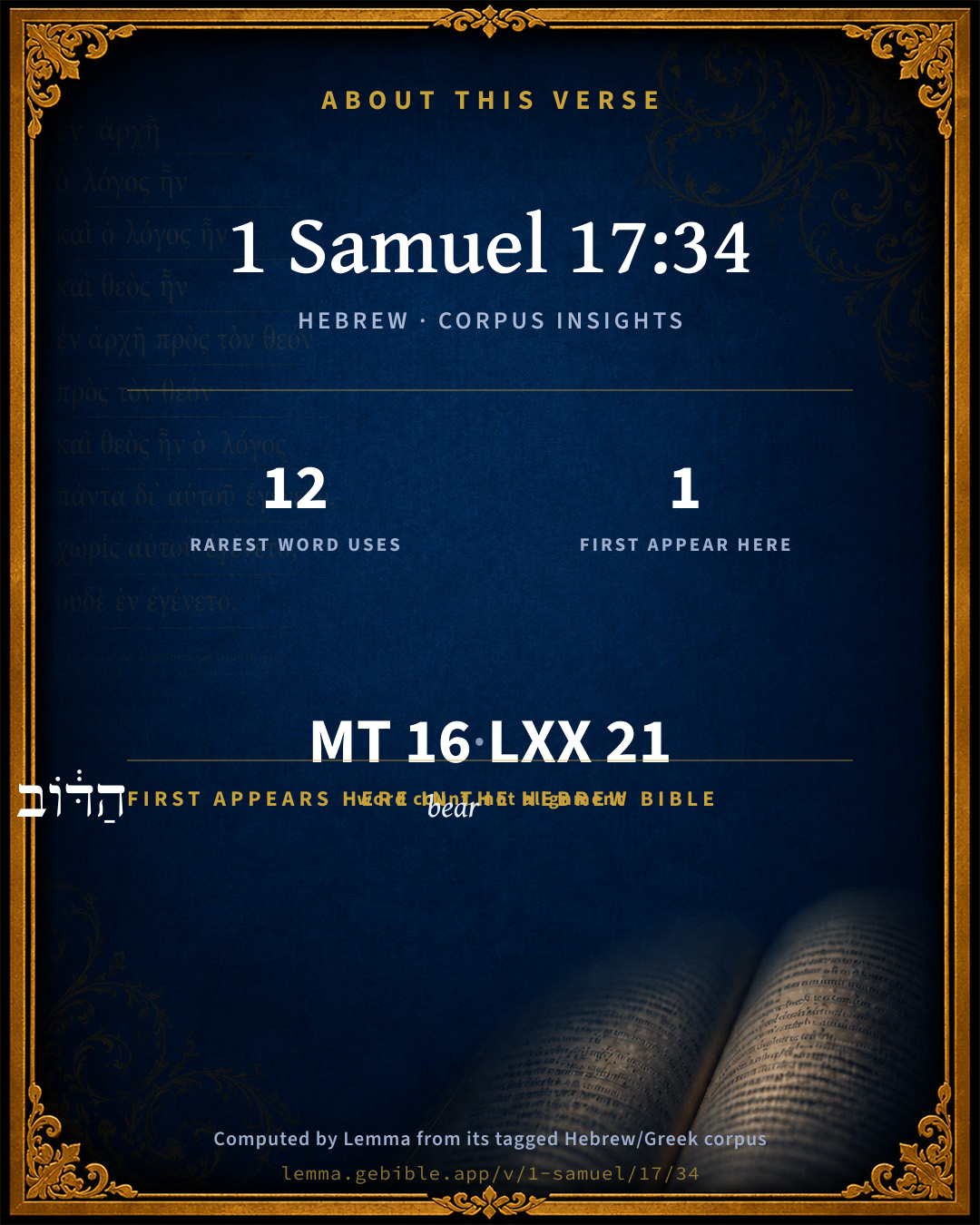
  • 1 first appearance in the Hebrew Bible
Full analysis ↓
Download a study sheet

One document with this verse’s original text, its word-by-word gloss line, the meaning frame, cross-references with their text, attributed commentary, and full source and license credits — printable, and it pastes into notes with its structure intact.

This verse Autodidact and up

Study sheet (.html) Plain text (.txt)

A passage Seminary Student

Up to 50 verses in one chapter. A passage sheet keeps up to 6 commentary sources and 12 cross-references per verse, in the order this page ranks them, and says so on the sheet whenever that leaves anything out. Ask for a single verse and you get the Autodidact verse sheet above.

Everything on this page stays free to read, with no account — the sheet is a download of what is already on screen, not access to it.

Want to remove ads? Support Godless Engineer
Compare translations 3

The same verse in 3 English versions, stacked beneath the original-language interlinear above. Click any original word for its lexicon entry.

Each is an independent rendering of the whole verse — the interlinear is not word-aligned to these translations.

Highlighted words mark where these versions differ — a whole-verse word diff, not a word-by-word alignment.

  • World English Bible Public Domain
    David said to Saul, Your servant was keeping his father's sheep; and when there came a lion, or a bear, and took a lamb out of the flock,
  • King James Version Public Domain
    And David said unto Saul, Thy servant kept his father's sheep, and there came a lion, and a bear, and took a lamb out of the flock:
  • unfoldingWord Literal Text CC BY-SA 4.0
    And David said to Saul, “Your servant has been tending the flock for his father. And a lion or a bear has come and carried away a sheep from the flock,

unfoldingWord Literal Text — © unfoldingWord, licensed CC BY-SA 4.0. Word-aligned USFM3 via Door43 (git.door43.org/unfoldingWord/en_ult).

Versions to compare (up to 4)

3 of 4 selected

Show all 18 translations

Every available English version of this verse, each an independent rendering of the whole verse.

  • World English Bible Public Domain
    David said to Saul, Your servant was keeping his father's sheep; and when there came a lion, or a bear, and took a lamb out of the flock,
  • Berean Standard Bible Public Domain
    David replied, “Your servant has been tending his father’s sheep, and whenever a lion or a bear came and carried off a lamb from the flock,
  • Majority Standard Bible Public Domain
    David replied, “Your servant has been tending his father’s sheep, and whenever a lion or a bear came and carried off a lamb from the flock,
  • King James Version Public Domain
    And David said unto Saul, Thy servant kept his father's sheep, and there came a lion, and a bear, and took a lamb out of the flock:
  • American Standard Version (1901) Public Domain
    And David said unto Saul, Thy servant was keeping his father's sheep; and when there came a lion, or a bear, and took a lamb out of the flock,
  • Revised Version (1885) Public Domain
    And David said unto Saul, Thy servant kept his father’s sheep; and when there came a lion, or a bear, and took a lamb out of the flock,
  • Geneva Bible (1599) Public Domain
    And Dauid answered vnto Saul, Thy seruant kept his fathers sheepe, and there came a lyon, and likewise a beare, and tooke a sheepe out of the flocke,
  • Douay-Rheims (1899) Public Domain
    And David said to Saul: Thy servant kept his father's sheep, and there came a lion, or a bear, and took a ram out of the midst of the flock:
  • Young's Literal Translation Public Domain
    And David saith unto Saul, `A shepherd hath thy servant been to his father among the sheep, and the lion hath come -- and the bear -- and hath taken away a sheep out of the drove,
  • Literal Standard Version CC BY-SA 4.0
    And David says to Saul, “Your servant has been a shepherd among the sheep for his father, and the lion has come—and the bear—and has taken away a sheep out of the drove,
  • Unlocked Literal Bible CC BY-SA 4.0
    But David said to Saul, “Your servant used to keep his father's sheep. When a lion or a bear came and took a lamb out of the flock,
  • unfoldingWord Literal Text CC BY-SA 4.0
    And David said to Saul, “Your servant has been tending the flock for his father. And a lion or a bear has come and carried away a sheep from the flock,
  • Darby Bible Public Domain
    And David said to Saul, Thy servant fed his father's sheep, and there came a lion, and also a bear, and took a lamb out of the flock.
  • World Messianic Bible Public Domain
    David said to Saul, “Your servant was keeping his father’s sheep; and when a lion or a bear came and took a lamb out of the flock,
  • Webster's Bible Public Domain
    And David said to Saul, Thy servant kept his father's sheep, and there came a lion, and a bear, and took a lamb out of the flock:
  • Free Bible Version CC BY-SA 4.0
    David replied, “Your servant has been looking after his father's sheep. When a lion or a bear came and took a lamb from the flock,
  • Bible in Basic English Public Domain
    And David said to Saul, Your servant has been keeper of his father's sheep; and if a lion or a bear came and took a lamb from the flock,
  • JPS Tanakh (1917) Public Domain
    And David said unto Saul: 'Thy servant kept his father's sheep; and when there came a lion, or a bear, and took a lamb out of the flock,

Literal Standard Version (2020), Covenant Press — licensed CC BY-SA 4.0. Text via the HelloAO Bible API (eBible.org). Unlocked Literal Bible (unfoldingWord) — licensed CC BY-SA 4.0. Text via the HelloAO Bible API (eBible.org). unfoldingWord Literal Text — © unfoldingWord, licensed CC BY-SA 4.0. Word-aligned USFM3 via Door43 (git.door43.org/unfoldingWord/en_ult). Free Bible Version, Dr. Jonathan Gallagher — licensed CC BY-SA 4.0. Text via the HelloAO Bible API (eBible.org).

Word by word

More ways to search: Search by grammar → Find every occurrence → Compare this word →

Practice this passage: Drill this verse → Learn its vocabulary →

הַדּ֔וֹב
dôb
H1677
“the · bear”
Particle, Definite Article + Noun, Common, Masculine, Singular, Absolute
Part of Speech
Particle + Noun
Type
Common
Gender
Masculine
Number
Singular
State
Absolute
Full BDB Definition

Origin: from H1680

TWOT: 396a

bear
  1. וַיֹּ֤אמֶר ʼâmar H559 “and · to say” Conjunction + Verb, Qal, Sequential Imperfect, 3rd Person, Masculine, Singular
  2. דָּוִד֙ Dâvid H1732 “David” Noun, Proper
  3. אֶל ʼêl H413 “to” Preposition
  4. שָׁא֔וּל Shâʼûwl H7586 “Saul” Noun, Proper
  5. רֹעֶ֨ה râʻâh H7462 “shepherding” Verb, Qal, Participle Active, Masculine, Singular, Absolute
  6. הָיָ֧ה hâyâh H1961 “to be” Verb, Qal, Perfect, 3rd Person, Masculine, Singular
  7. עַבְדְּךָ֛ ʻebed H5650 “servant · your” Noun, Common, Masculine, Singular, Construct + Suffix, Personal, 2nd Person, Masculine, Singular
  8. לְאָבִ֖יו ʼâb H1 “to/for · father · his” Preposition + Noun, Common, Masculine, Singular, Construct + Suffix, Personal, 3rd Person, Masculine, Singular
  9. בַּצֹּ֑אן tsôʼn H6629 “in/at the · flock” Preposition, Determined + Noun, Common, Both, Singular, Absolute
  10. וּבָ֤א bôwʼ H935 “and · to enter” Conjunction + Verb, Qal, Sequential Perfect, 3rd Person, Masculine, Singular
  11. הָֽאֲרִי֙ ʼărîy H738 “the · lion” Particle, Definite Article + Noun, Common, Masculine, Singular, Absolute
  12. וְאֶת ʼêth H853 “and · -” Conjunction + Particle, Direct Object
  13. וְנָשָׂ֥א nâsâʼ H5375 “and · to lift” Conjunction + Verb, Qal, Sequential Perfect, 3rd Person, Masculine, Singular
  14. שֶׂ֖ה seh H7716 “sheep” Noun, Common, Both, Singular, Absolute
  15. מֵהָעֵֽדֶר ʻêder H5739 “from · the · flock” Preposition + Particle, Definite Article + Noun, Common, Masculine, Singular, Absolute

About this verse

These counts appear in no published source. They are computed here, from the morphology-tagged text and Lemma’s own curated glosses. What Lemma adds →

16
words
16
distinct lemmas
Historical
section

Notable vocabulary

The rarest word here is הַדּ֔וֹב bear H1677 — appearing just 12 times in the whole Hebrew Bible.

First appearance in Scripture

This word makes its first canonical appearance in the Hebrew Bible here:

  • הַדּ֔וֹב bear H1677

Shared distinctive vocabulary

הַדּ֔וֹב bear H1677 occurs in 12 verses of the Hebrew Bible. Also found in:

Grammatical profile

  • 5 verbs
  • 9 nouns
  • 1 preposition
  • 1 particle

Verb forms

  • וַיֹּ֤אמֶר Qal · Sequential Imperfect
  • רֹעֶ֨ה Qal · Participle Active
  • הָיָ֧ה Qal · Perfect
  • וּבָ֤א Qal · Sequential Perfect
  • וְנָשָׂ֥א Qal · Sequential Perfect

Hebrew & Septuagint length

In English translation the verse runs 28 words from the Hebrew and 30 from the Septuagint (LXX English) — closely comparable.

A rough comparison of the two English renderings, which tokenize alike — not a word-level alignment.

Word counts can differ between the Hebrew and the Greek without any difference in meaning — e.g. the Hebrew direct-object marker אֵת has no separate Greek word, and Greek often adds the article ὁ.

In the original languages it is 16 Hebrew tokens and 21 Greek tokens — but the two are counted differently (Hebrew bundles its prefixes and suffixes into one token; the Greek is in lemma form), so that isn’t a like-for-like length.

Hebrew and Greek witnesses Masoretic Hebrew ↔ Greek Septuagint

The same verse in the two great witnesses to the Old Testament, shown verse-for-verse.

These are two independent witnesses, not word-aligned to each other, and the Septuagint is shown in lemma (dictionary) form.

Hebrew 1 Samuel 17:34 Masoretic · Westminster Leningrad Codex

וַיֹּ֤אמֶר דָּוִד֙ אֶל שָׁא֔וּל רֹעֶ֨ה הָיָ֧ה עַבְדְּךָ֛ לְאָבִ֖יו בַּצֹּ֑אן וּבָ֤א הָֽאֲרִי֙ וְאֶת הַדּ֔וֹב וְנָשָׂ֥א שֶׂ֖ה מֵהָעֵֽדֶר

David said to Saul, Your servant was keeping his father's sheep; and when there came a lion, or a bear, and took a lamb out of the flock,

World English Bible · Public Domain

Greek LXX 1 Samuel 17:34 Septuagint · lemma form

καί λαμβάνω δαυίδ ὁ κεφαλή ὁ ἀλλόφυλος καί φέρω αὐτός εἰς ἰερουσαλήμ καί ὁ σκεῦος αὐτός τίθημι ἐν ὁ σκήνωμα αὐτός

And David said to Saul, Your servant was tending the flock for his father; and when a lion came and a she-bear, and took a sheep out of the flock,

LXX2012 (modern English Septuagint) · Public Domain

On this verse, The Pulpit Commentary discusses the Septuagint’s reading. Read the note in Commentary ↓

Hebrew: Westminster Leningrad Codex (CC BY 4.0). Greek: Septuagint (public domain); English from LXX2012 (modern English Septuagint) (Public Domain). How the Septuagint differs from the Hebrew →

Targum (Aramaic paraphrase)

1

The Targum is the ancient Jewish Aramaic paraphrase of the Hebrew Scriptures — an interpretive translation, not the Hebrew text itself. Onkelos (literal) and Pseudo-Jonathan (expansive) render the Torah, and Jonathan the Prophets. Coverage is partial: where no permissively-licensed English translation exists for a verse, only the Aramaic is shown. This is verse-level text, not a word-by-word alignment to the Hebrew.

  1. Targum Jonathan Prophets (Joshua–Malachi)
    וַאֲמַר דָוִד לְשָׁאוּל רַעֲיָא הֲוָה עַבְדָךְ לַאֲבוּהִי בַּעֲנָא וְאָתָא אַרְיָא וְאַף דוּבָּא וּנְסִיב אִמְרָא מֵעִדָרָא:

    (no public-domain English translation for this verse)

    Targum Jonathan — Aramaic: “Mikraot Gedolot” (public domain). English: “Sefaria Community Translation” (CC0 1.0 (public-domain dedication)); “London "Chaldee Paraphrase," 1871” (public domain). Text via Sefaria.

Commentary

Notes on 1 Samuel 17:34 from classic Christian and Jewish commentators (each source and its license shown beneath its notes). The classic Christian expositions comment on the surrounding passage and are grouped to its opening verse, so a note may address several verses; the Jewish commentaries on the Tanakh (Rashi and others) are per-verse, so they appear only where the commentator wrote on this verse.

Lemma curates 59 commentaries, every one of them public domain or Creative Commons licensed, each selected and text-cleaned for this edition rather than reprinted as found. About our sources →

Trapp's Complete Commentary

John Trapp

1Sa 17:34 And David said unto Saul, Thy servant kept his father’s sheep, and there came a lion, and a bear, and took a lamb out of the flock:

Ver. 34. There came a lion, and a bear.] Individually, and at various times.

John Trapp, A Commentary or Exposition upon All the Books of the Old and New Testament (1647–1656) — public domain. Text from a community e-Sword module.

Joseph Benson's Commentary

1Sa 17:34-35. There came a lion and a bear — Not both together, but at different times. I went out after him — I pursued the beast. When he arose against me — Turned again upon me; I caught him by his beard — I had resolution and strength enough given me to close with him, and, catching him by the hair of his beard, smote and killed him on the spot. David does not say with what instrument he did this; but probably it was with a sword or spear. It is not improbable but in that age, and in those countries, it was usual to pursue, with proper arms, those wild beasts that came to devour their flocks. And travellers tell us, that, at this day, a single Arab, that is properly instructed and armed, will pursue a lion, and, if he overtakes him, will overcome him. But that such a youth as David should have such extraordinary courage and strength cannot be accounted for but by supposing, as the Scriptures inform us, that the Spirit of the Lord was upon him, and that God intended by these things to train him up and fit him for the greater things he was to be called to perform.

Joseph Benson's Commentary on the Old and New Testaments (1811–1818) — public domain. Text from a community e-Sword module.

Geneva Bible (1599)

Geneva Bible translators

David by the experience that he hath had in time past of God’s help, nothing doubteth to overcome this danger, seeing he was zealous for God’s honor.

Geneva Bible (1599) marginal notes — public domain. Text via Bolls.life.

Jamieson, Fausset & Brown

Robert Jamieson, A. R. Fausset & David Brown

a lion, and a bear--There were two different rencontres, for those animals prowl alone. The bear must have been a Syrian bear, which is believed to be a distinct species, or perhaps a variety, of the brown bear. The beard applies to the lion alone. Those feats seem to have been performed with no weapons more effective than the rude staves and stones of the field, or his shepherd's crook.

Jamieson, Fausset & Brown — Commentary Critical and Explanatory on the Whole Bible (1871) — public domain (CC PDM 1.0). Text via the HelloAO Bible API.

Adam Clarke's Commentary

Verse 34. Thy servant kept his father's sheep] He found it necessary to give Saul the reasons why he undertook this combat; and why he expected to be victorious.

1. I have courage to undertake it, and strength to perform it.

2. Both have been tried in a very signal manner:

(1.) A lion came upon my flock, and seized a lamb; I ran after him, he attacked me, I seized hold of him by his shaggy locks, smote and slew him, and delivered the lamb.

(2.) A bear came in the same way, and I attacked and slew him.

3. This, with whom I am to fight, is a Philistine, an uncircumcised man; one who is an enemy to God: God therefore will not be on his side. On that ground I have nothing to fear.

4. He has defied the armies of the Lord; and has in effect defied Jehovah himself: therefore the battle is the Lord's, and he will stand by me.

5. I have perfect confidence in his protection and defense; for they that trust in him shall never be confounded.

6. I conclude, therefore, that the Lord, who delivered me out of the paw of the lion, and out of the paw of the bear, will deliver me out of the hand of the Philistine.

Adam Clarke's Commentary on the Bible (1810–1826) — public domain. Text from a community e-Sword/MySword module.

Ellicott's Commentary for English Readers

(34) Thy servant kept his father’s sheep.—Here follows in the colloquy between the king and the boy that simple brave narrative which children listen to with glowing cheeks—that simple story, bearing the stamp of truth on every word—of what had happened to him in past days. Fierce wild animals, the terror of the Hebrew shepherds, had attacked his flock: these he had met and slain, almost without arms. Another had helped him when he did his brave duty then; and he felt that the same invisible Guardian would give him nerve and strength now in this more dangerous encounter. Only let him try. There was nothing to fear; he must succeed, he and his Divine Helper!

A Bible Commentary for English Readers, edited by Charles John Ellicott (1878–1897) — public domain. Text from a community e-Sword module.

The Cambridge Bible for Schools and Colleges

gen. ed. J. J. S. Perowne

34. and there came a lion, &c.] And when a lion came or even a bear (or, and that too with a bear) … I went out after him, &c. “In those early days, when the forests of Southern Palestine had not been cleared, it was the habit of the wild animals which usually frequented the heights of Lebanon or the thickets of the Jordan, to make incursions into the pastures of Judaea. From the Lebanon at times descended the bears. From the Jordan ascended the lion, at that time infesting the whole of Western Asia.” Stanley, Lect. II. 43. The Syrian bear is said to be especially ferocious, and appears to have been more dreaded than the lion. See Amo_5:19. Lions are not now found in Palestine, but the traveller Thevenot says that the Arabs are not afraid of them, and will attack and kill them, with no better arms than a stick. Cp. Amo_3:12.

The Cambridge Bible for Schools and Colleges (gen. ed. J. J. S. Perowne; Cambridge University Press, 1878–1918) — public domain. Text from a community e-Sword module.

John Gill's Exposition

And David said unto Saul,.... In answer to his objection of inability to encounter with one so superior to him; and this answer is founded on experience and facts, and shows that he was not so weak and inexpert as Saul took him to be:

thy servant kept his father's sheep; which he was not ashamed to own, and especially as it furnished him with an stance of his courage, bravery, and success, and which would be convincing to Saul:

and there came a lion and a bear, and took a lamb out of the flock; not that they came together; though Kimchi so interprets it, "a lion with a bear"; but these are creatures that do not use to go together; and besides, both could not be said with propriety to take one and the same lamb out of the flock: to which may be added, that David in Sa1 17:35 speaks only of one, out of whose mouth he took the lamb; wherefore the words may be rendered, "a lion or a bear" (f); and if the copulative "and" is retained, the meaning can only be, that at different times they would come and take a lamb, a lion at one time, and a bear at another.

(f) "leo vel ursus", V. L. "leo aut ursus", Junius & Tremellius, Bochart. Noldius, p. 271.

John Gill's Exposition of the Whole Bible (1746–1763) — public domain (CC PDM 1.0). Text via the HelloAO Bible API.

Albert Barnes' Notes on the Bible

The narrative does not make it certain whether the lion and the bear came on one and the same, or on two different occasions. If it was on one occasion, the probability would be that the bear, having seized a lamb and carrying it off, a lion appeared to dispute the prize with the bear, or with David after he had taken it from the bear, and that David killed first one and then the other.

Albert Barnes' Notes on the Bible (1834–1885) — public domain. Text from a community e-Sword/MySword module.

Matthew Poole's English Annotations

There came a lion, and a bear; not both together, but one after another, at several times.

Matthew Poole's English Annotations on the Holy Bible (1683–1685) — public domain. Text from a community e-Sword/MySword module.

Whedon's Commentary on the Bible

Daniel D. Whedon

34. A lion, and a bear — The prowess of the lion is well known. It is a testimony of Samson’s mighty power that he rent a lion as he would have rent a kid. Jdg_14:6. No ordinary man would, therefore, dare to fight the king of beasts. “The Syrian bear — still found on the higher mountains of this country — is perhaps equally to be dreaded in a close personal encounter. The inhabitants of Hermon say that when he is chased up the mountain he will cast back large stones upon his pursuers with terrible force and unerring aim. The stoutest hunter will not venture to attack him alone, nor without being thoroughly armed for the deadly strife.” — Thomson.

Daniel D. Whedon (gen. ed.), Commentary on the Old and New Testaments (1874–1909) — public domain. Text from a community e-Sword module.

The Pulpit Commentary

Vers. 34-36. David does not appeal to any feat of arms. He may have served with credit in repelling some Philistine foray, but these combats with wild beasts, fought without the presence of spectators, and with no regent necessity (as most shepherds would have been too glad to compound with such enemies by letting them take a lamb without molestation), still more clearly proved David"s fearless nature. Lions and bears were both common in ancient times in Palestine, when the country was more densely covered with wood; and bears are numerous in the mountainous districts now. Lions seem to have been less feared than bears; (Amo_5:19) but Canon Tristram thinks there were two species of the lion in Palestine one short-maned, which was not very formidable, the other long maned, which was more fierce and dangerous ("Nat. Hist. of Bible," p. 117). The Hebrew literally is, "There came the lion and even the bear," the articles implying that they were the well known foes of the shepherd. The written text has zeh, "this," for seh, "a lamb," probably a mere variety of spelling. There can be little doubt that David refers to two different occasions, especially as bears and lions never hunt in company. By his beard. Neither the bear nor the lion has a beard, and the word really means "the chin," "the place where the beard grows." The Chaldee translates the lower jaw, and the Septuagint the throat. It is plain from this description that David slew the beast with his staff. He arose against me. This shows that the combat thus particularly described was with the bear, which does thus rise on its hind legs to grapple with its foe, while the lion crouches and then springs. Pliny also says that the weakest part of a bear is its head, and that it can be killed by a smart blow there. The manner in which David killed the lion is not described. Defied. See on ver. 10.

The Pulpit Commentary (1880–1919), ed. H.D.M. Spence-Jones & Joseph S. Exell — public domain. Text from a community e-Sword module.

unfoldingWord translationNotes

Door43 World Missions Community

Your servant used to keep his father's sheep

David spoke of himself as "your servant" to show respect to Saul. See how you translated this in 1 Samuel 17:32. AT: "I, your servant, used to keep my father's sheep" (See: First, Second, or Third Person)

used to keep his father's sheep

"used to take care of his father's sheep"

a bear

A bear is a large animal with thick fur and long claws and that walks on four legs but can stand on two legs as a person does.

chased after him and attacked him

Here "him" refers to the lion or bear. Some languages would use the word "it" instead of "him."

rescued it out of his mouth

Here "it" refers to the lamb.

he rose up against me

Here "rose up against" is an idiom that refers to attacking. AT: "it attacked me" (See: Idiom)

caught him by his beard

The "beard" refers to the lion's mane or the hair on the bear's face.

translationWords

David

Saul (OT)

servant

ewe

lions

lamb

flocks

raise

unfoldingWord translationNotes — © Distant Shores Media and the Door43 World Missions Community, licensed CC BY-SA 4.0. Source: git.door43.org/Door43/en_tn.

Rashi

Rabbi Shlomo Yitzchaki (Rashi)

The lion came with a bear. The lion and bear came [at the same time].

Rashi on the Tanakh — English translations: “The Judaica Press complete Tanach with Rashi, translated by A. J. Rosenberg” (CC BY 4.0); “Pentateuch with Rashi's commentary by M. Rosenbaum and A.M. Silbermann, 1929-1934” (public domain); “The Metsudah Tanach series, Lakewood, N.J” (CC BY 4.0); and “The Book of Joshua, Metsudah Publications, 1997” (CC BY 4.0). Text via Sefaria.

Lesson kit

Teaching starters — assembled from the data on this page, not authored interpretation. Every prompt links to the verse data it draws on. Edit before teaching.

1 Samuel, in the Historical, opens this verse with 16 words (16 distinct Hebrew lemmas). Its most distinctive word is dôb (“bear”). A historical commentator’s framing appears above. Read the whole chapter for the surrounding context.

Discussion questions

  1. The word dôb carries the sense “bear.” How does it shape the verse?
  2. This is the first place “bear” appears in Scripture (first appears here). What does its debut here establish?
  3. How does 1 Samuel 17:36, which shares the word «bear», read alongside this verse?
  4. The translations on this page render this verse differently — a whole-verse word diff, not a word-by-word alignment. What might account for the different wordings?
  5. «וַיֹּ֤אמֶר» is a Qal Sequential Imperfect verb. How does that grammatical form shape the action described?
  6. Compare how Trapp's Complete Commentary and Joseph Benson's Commentary read this verse. Where do they agree or differ?

Things to notice

Reading settings

Reading text

Shown beneath each verse's original-language words.

Old Testament
Old Testament edition

Read the OT as the Masoretic Hebrew (MT) or the Greek Septuagint (LXX).

English shown for the Greek Septuagint (in the Hebrew ↔ Greek comparison).

Comparing translations? Open the Compare panel on any verse page to stack up to four side by side.