

Ezra 8:36

Hebrew (Westminster Leningrad Codex) Ezra 8:36 appears in the Hebrew Old Testament. The text above is from the Westminster Leningrad Codex. Each word links to its Strong’s number, a concise gloss, and parsing drawn from the Open Scriptures Hebrew Bible morphology. Click any word for its full Brown-Driver-Briggs (BDB) entry.
Download image
Cite this verse

Ezra 8:36 (World English Bible). Public Domain. Lemma interlinear Bible study tool, https://lemma.gebible.app/v/ezra/8/36.

Show BibTeX & RIS
BibTeX
RIS
English Translation
They delivered the king's commissions to the king's satraps, and to the governors beyond the River: and they furthered the people and the house of God.
World English Bible · Public Domain
Highlights
  • 1 first appearance in the Hebrew Bible
Full analysis ↓
Download a study sheet

One document with this verse’s original text, its word-by-word gloss line, the meaning frame, cross-references with their text, attributed commentary, and full source and license credits — printable, and it pastes into notes with its structure intact.

This verse Autodidact and up

Study sheet (.html) Plain text (.txt)

A passage Seminary Student

Up to 50 verses in one chapter. A passage sheet keeps up to 6 commentary sources and 12 cross-references per verse, in the order this page ranks them, and says so on the sheet whenever that leaves anything out. Ask for a single verse and you get the Autodidact verse sheet above.

Everything on this page stays free to read, with no account — the sheet is a download of what is already on screen, not access to it.

Want to remove ads? Support Godless Engineer
Compare translations 3

The same verse in 3 English versions, stacked beneath the original-language interlinear above. Click any original word for its lexicon entry.

Each is an independent rendering of the whole verse — the interlinear is not word-aligned to these translations.

Highlighted words mark where these versions differ — a whole-verse word diff, not a word-by-word alignment.

  • World English Bible Public Domain
    They delivered the king's commissions to the king's satraps, and to the governors beyond the River: and they furthered the people and the house of God.
  • King James Version Public Domain
    And they delivered the king's commissions unto the king's lieutenants, and to the governors on this side the river: and they furthered the people, and the house of God.
  • unfoldingWord Literal Text CC BY-SA 4.0
    And they gave the laws of the king to the satraps of the king and the governors of Beyond-the-River. And they lifted the people and the house of God.

unfoldingWord Literal Text — © unfoldingWord, licensed CC BY-SA 4.0. Word-aligned USFM3 via Door43 (git.door43.org/unfoldingWord/en_ult).

Versions to compare (up to 4)

3 of 4 selected

Show all 18 translations

Every available English version of this verse, each an independent rendering of the whole verse.

  • World English Bible Public Domain
    They delivered the king's commissions to the king's satraps, and to the governors beyond the River: and they furthered the people and the house of God.
  • Berean Standard Bible Public Domain
    They also delivered the king’s edicts to the royal satraps and governors of the region west of the Euphrates, who proceeded to assist the people and the house of God.
  • Majority Standard Bible Public Domain
    They also delivered the king’s edicts to the royal satraps and governors of the region west of the Euphrates, who proceeded to assist the people and the house of God.
  • King James Version Public Domain
    And they delivered the king's commissions unto the king's lieutenants, and to the governors on this side the river: and they furthered the people, and the house of God.
  • American Standard Version (1901) Public Domain
    And they delivered the king's commissions unto the king's satraps, and to the governors beyond the River: and they furthered the people and the house of God.
  • Revised Version (1885) Public Domain
    And they delivered the king’s commissions unto the king’s satraps, and to the governors beyond the river: and they furthered the people and the house of God.
  • Geneva Bible (1599) Public Domain
    And they deliuered the Kings commission vnto the Kings officers, and to the captaines beyond the Riuer: and they promoted the people, and the house of God.
  • Douay-Rheims (1899) Public Domain
    And they gave the king's edicts to the lords that were from the king's court, and the governors beyond the river, and they furthered the people and the house of God.
  • Young's Literal Translation Public Domain
    and they give the laws of the king to the lieutenants of the king and the governors beyond the river, and they have lifted up the people and the house of God.
  • Literal Standard Version CC BY-SA 4.0
    and they give the laws of the king to the lieutenants of the king and the governors beyond the river, and they have lifted up the people and the house of God.
  • Unlocked Literal Bible CC BY-SA 4.0
    Then they gave the king's decrees to the king's high officials and the governors in the Province Beyond the River, and they helped the people and the house of God.
  • unfoldingWord Literal Text CC BY-SA 4.0
    And they gave the laws of the king to the satraps of the king and the governors of Beyond-the-River. And they lifted the people and the house of God.
  • Darby Bible Public Domain
    And they delivered the king's edicts to the king's satraps, and to the governors on this side the river. And they furthered the people and the house of God.
  • World Messianic Bible Public Domain
    They delivered the king’s commissions to the king’s local governors and to the governors beyond the River. So they supported the people and God’s house.
  • Webster's Bible Public Domain
    And they delivered the king's commissions to the king's lieutenants, and to the governors on this side of the river: and they furthered the people, and the house of God.
  • Free Bible Version CC BY-SA 4.0
    They also delivered the king's decrees to the chief officers of the king and the governors of the province west of the Euphrates, who then provided assistance to the people and to God's Temple.
  • Bible in Basic English Public Domain
    And they gave the king's orders to the king's captains and the rulers across the river, and they gave the people and the house of God the help which was needed.
  • JPS Tanakh (1917) Public Domain
    And they delivered the king's commissions unto the king's satraps, and to the governors beyond the River; and they furthered the people and the house of God.

Literal Standard Version (2020), Covenant Press — licensed CC BY-SA 4.0. Text via the HelloAO Bible API (eBible.org). Unlocked Literal Bible (unfoldingWord) — licensed CC BY-SA 4.0. Text via the HelloAO Bible API (eBible.org). unfoldingWord Literal Text — © unfoldingWord, licensed CC BY-SA 4.0. Word-aligned USFM3 via Door43 (git.door43.org/unfoldingWord/en_ult). Free Bible Version, Dr. Jonathan Gallagher — licensed CC BY-SA 4.0. Text via the HelloAO Bible API (eBible.org).

Word by word

More ways to search: Search by grammar → Find every occurrence → Compare this word →

Practice this passage: Drill this verse → Learn its vocabulary →

לַאֲחַשְׁדַּרְפְּנֵי֙
ʼăchashdarpan
H323
“to/for · satraps of”
Preposition + Noun, Common, Masculine, Plural, Construct
Part of Speech
Preposition + Noun
Type
Common
Gender
Masculine
Number
Plural
State
Construct
Full BDB Definition

Origin: of Persian derivation

TWOT: 69

satrap, a governor of a Persian province
  1. וַֽיִּתְּנ֣וּ nâthan H5414 “and · to give” Conjunction + Verb, Qal, Sequential Imperfect, 3rd Person, Masculine, Plural
  2. אֶת ʼêth H853 “-” Particle, Direct Object
  3. דָּתֵ֣י dâth H1881 “decrees of” Noun, Common, Feminine, Plural, Construct
  4. הַמֶּ֗לֶךְ melek H4428 “the · king” Particle, Definite Article + Noun, Common, Masculine, Singular, Absolute
  5. הַמֶּ֔לֶךְ melek H4428 “the · king” Particle, Definite Article + Noun, Common, Masculine, Singular, Absolute
  6. וּפַחֲו֖וֹת pechâh H6346 “and · governors” Conjunction + Noun, Common, Masculine, Plural, Absolute
  7. עֵ֣בֶר ʻêber H5676 “side of” Noun, Common, Masculine, Singular, Construct
  8. הַנָּהָ֑ר nâhâr H5104 “the · stream” Particle, Definite Article + Noun, Common, Masculine, Singular, Absolute
  9. וְנִשְּׂא֥וּ nâsâʼ H5375 “and · to lift” Conjunction + Verb, Piel, Perfect, 3rd Person, Common, Plural
  10. אֶת ʼêth H853 “-” Particle, Direct Object
  11. הָעָ֖ם ʻam H5971 “the · people” Particle, Definite Article + Noun, Common, Masculine, Singular, Absolute
  12. וְאֶת ʼêth H853 “and · -” Conjunction + Particle, Direct Object
  13. בֵּֽית bayith H1004 “house of” Noun, Common, Masculine, Singular, Construct
  14. הָאֱלֹהִֽים ʼĕlôhîym H430 “the · God(s)” Particle, Definite Article + Noun, Common, Masculine, Plural, Absolute

About this verse

These counts appear in no published source. They are computed here, from the morphology-tagged text and Lemma’s own curated glosses. What Lemma adds →

15
words
12
distinct lemmas
Historical
section

Notable vocabulary

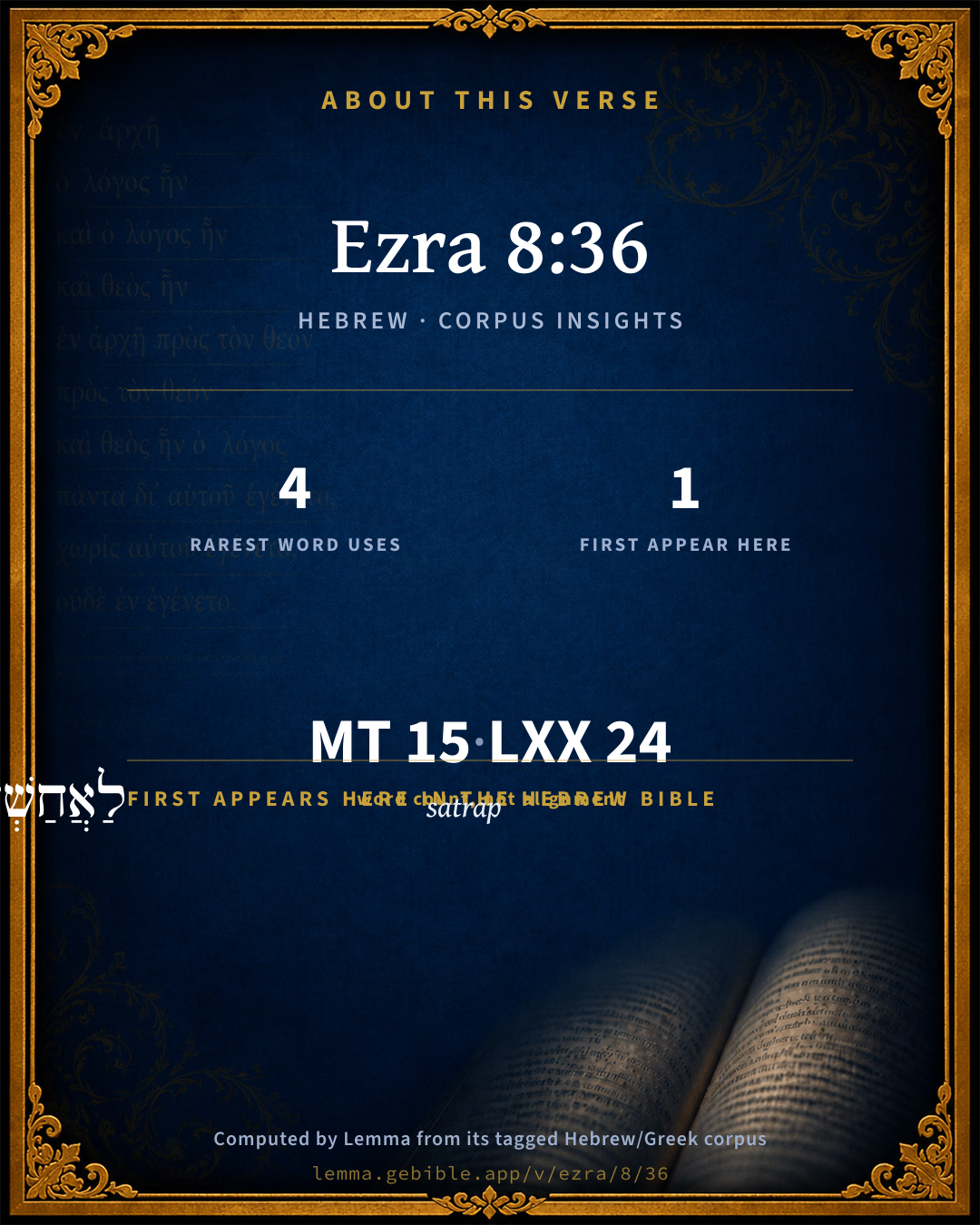
The rarest word here is לַאֲחַשְׁדַּרְפְּנֵי֙ satrap H323 — appearing just 4 times in the whole Hebrew Bible.

First appearance in Scripture

This word makes its first canonical appearance in the Hebrew Bible here:

  • לַאֲחַשְׁדַּרְפְּנֵי֙ satrap H323

Shared distinctive vocabulary

לַאֲחַשְׁדַּרְפְּנֵי֙ satrap H323 occurs in 4 verses of the Hebrew Bible. Also found in:

Grammatical profile

  • 2 verbs
  • 10 nouns
  • 3 particles

Verb forms

  • וַֽיִּתְּנ֣וּ Qal · Sequential Imperfect
  • וְנִשְּׂא֥וּ Piel · Perfect

Repetition

A word recurs within this verse — often emphatic in Hebrew:

  • הַמֶּ֗לֶךְ king H4428 ×2

Hebrew & Septuagint length

In English translation the verse runs 26 words from the Hebrew and 26 from the Septuagint (LXX English) — the same length.

A rough comparison of the two English renderings, which tokenize alike — not a word-level alignment.

Word counts can differ between the Hebrew and the Greek without any difference in meaning — e.g. the Hebrew direct-object marker אֵת has no separate Greek word, and Greek often adds the article ὁ.

In the original languages it is 15 Hebrew tokens and 24 Greek tokens — but the two are counted differently (Hebrew bundles its prefixes and suffixes into one token; the Greek is in lemma form), so that isn’t a like-for-like length.

Cross-references

8

Topical passages linked to Ezra 8:36 in the Treasury of Scripture Knowledge — connected by theme and wording, ordered by reader-vote popularity; previews shown in the World English Bible.

  • Ezra 7:21–24 I, even I Artaxerxes the king, do make a decree to all the treasurers who are beyond the River, that whatever Ezra the priest, the scribe of the law of the God of heaven, shall require of you, it be done with all diligence,
  • Ezra 4:7–23 In the days of Artaxerxes wrote Bishlam, Mithredath, Tabeel, and the rest of his companions, to Artaxerxes king of Persia; and the writing of the letter was written in the Syrian [character], and set forth in the Syrian [language].
  • Ezra 5:6–17 The copy of the letter that Tattenai, the governor beyond the River, and Shetharbozenai, and his companions the Apharsachites, who were beyond the River, sent to Darius the king;
  • Ezra 6:13 Then Tattenai, the governor beyond the River, Shetharbozenai, and their companions, because that Darius the king had sent, did accordingly with all diligence.
  • Isaiah 56:6–7 Also the foreigners who join themselves to Yahweh, to minister to him, and to love the name of Yahweh, to be his servants, everyone who keeps the Sabbath from profaning it, and holds fast my covenant;
  • Acts 18:27 When he had determined to pass over into Achaia, the brothers encouraged him, and wrote to the disciples to receive him. When he had come, he greatly helped those who had believed through grace;
  • Revelation 12:16 The earth helped the woman, and the earth opened its mouth and swallowed up the river which the dragon spewed out of his mouth.
  • Esther 9:3 All the princes of the provinces, and the satraps, and the governors, and those who did the king's business, helped the Jews; because the fear of Mordecai was fallen on them.

Cross-references courtesy of OpenBible.info (CC BY 4.0).

Hebrew and Greek witnesses Masoretic Hebrew ↔ Greek Septuagint

The same verse in the two great witnesses to the Old Testament, shown verse-for-verse.

These are two independent witnesses, not word-aligned to each other, and the Septuagint is shown in lemma (dictionary) form.

Hebrew Ezra 8:36 Masoretic · Westminster Leningrad Codex

וַֽיִּתְּנ֣וּ אֶת דָּתֵ֣י הַמֶּ֗לֶךְ לַאֲחַשְׁדַּרְפְּנֵי֙ הַמֶּ֔לֶךְ וּפַחֲו֖וֹת עֵ֣בֶר הַנָּהָ֑ר וְנִשְּׂא֥וּ אֶת הָעָ֖ם וְאֶת בֵּֽית הָאֱלֹהִֽים

They delivered the king's commissions to the king's satraps, and to the governors beyond the River: and they furthered the people and the house of God.

World English Bible · Public Domain

Greek LXX Ezra 8:36 Septuagint · lemma form

καί δίδωμι ὁ νόμισμα ὁ βασιλεύς ὁ διοικητής ὁ βασιλεύς καί ἔπαρχος πέραν ὁ ποταμός καί δοξάζω ὁ λαός καί ὁ οἶκος ὁ θεός

And they gave the king's mandate to the king's lieutenants, and the governors beyond the river: and they honored the people and the house of God.

LXX2012 (modern English Septuagint) · Public Domain

In the Septuagint this is one book — Esdras B (2 Esdras): Ezra is chapters 1–10, Nehemiah 11–23.

On this verse, The Cambridge Bible for Schools and Colleges discusses the Septuagint’s reading. Read the note in Commentary ↓

Hebrew: Westminster Leningrad Codex (CC BY 4.0). Greek: Septuagint (public domain); English from LXX2012 (modern English Septuagint) (Public Domain). How the Septuagint differs from the Hebrew →

Commentary

Notes on Ezra 8:36 from classic Christian and Jewish commentators (each source and its license shown beneath its notes). The classic Christian expositions comment on the surrounding passage and are grouped to its opening verse, so a note may address several verses; the Jewish commentaries on the Tanakh (Rashi and others) are per-verse, so they appear only where the commentator wrote on this verse.

Lemma curates 59 commentaries, every one of them public domain or Creative Commons licensed, each selected and text-cleaned for this edition rather than reprinted as found. About our sources →

Trapp's Complete Commentary

John Trapp

Ezr 8:36 And they delivered the king’s commissions unto the king’s lieutenants, and to the governors on this side the river: and they furthered the people, and the house of God.

Ver. 36. And they furthered the people] Heb. They gave them a lift, lent them a helping hand; not out of love to the work, but for fear of the king, and in pursuance of his commands and commissions. Thus the devil and his imps sometimes do God’s will, though with an ill will, Psa 109:31. They continue this day according to thine ordinances; for all are thy servants. How much better were it to work from a right principle, not by constraint, but willingly; not for fear of wrath, but of a ready mind, 1Pe 5:2; to love to be God’s servants, taking hold of his covenant, Isa 56:6, and saying to him, as the people did to Joshua, Jos 1:16, or as the rulers and elders to Jehu, 2Ki 10:5, "We are thy servants, and will do all that thou shalt bid us."

John Trapp, A Commentary or Exposition upon All the Books of the Old and New Testament (1647–1656) — public domain. Text from a community e-Sword module.

Joseph Benson's Commentary

Ezr 8:36. They delivered the king’s commissions to the lieutenants, and they furthered the people — Even the enemies of the Jews became their friends, yielded to Ezra’s commission, and, instead of hindering the people of God, furthered them, purely out of complaisance to the king. When he appeared moderate, they all coveted to appear so too. And the house of God — The completion of which they furthered, adorning and furnishing it with these vessels and other conveniences, and promoting God’s worship and service therein.

Joseph Benson's Commentary on the Old and New Testaments (1811–1818) — public domain. Text from a community e-Sword module.

Adam Clarke's Commentary

Verse 36. The king's lieutenants] אחשדרפני achashdarpeney: this is generally understood to mean lieutenant or deputy, and is probably of Persian origin, though here greatly corrupted. The Vulgate renders it regis satrapis, to the satraps of the king, which is the Persian [Persian] satrab. A viceroy in Persian is [Persian] soubah-dar; viceroys, [Persian] soubahdaran. [Persian] darafreen signifies a person in whom one has confidence; and [Persian] achi is an epithet of a vizir. These two words conjoined will make nearly that of the text. But I do not give any of these etymologies with confidence. Other words might be proposed as candidates, but where there is so little certainty, conjecture is useless. Were it necessary a dissertation might be written on the Persian words, and Persian forms of speech, in this and the two following books; but probably after my toil few of my readers would thank me for my pains.

Adam Clarke's Commentary on the Bible (1810–1826) — public domain. Text from a community e-Sword/MySword module.

Ellicott's Commentary for English Readers

(36) And they delivered the king’s commissions.—First came sacrifices of burnt offering to God (Ezr_8:35); then, having rendered to God the things which were God’s, they render to Cæsar the things of Cæsar. They delivered the king’s commission, or firman, to the lieutenants or satraps in military authority, and to the governors, or pechahs, or pashas, in civil authority under them. The firman was of course accepted and acted upon: “they furthered the people.”

A Bible Commentary for English Readers, edited by Charles John Ellicott (1878–1897) — public domain. Text from a community e-Sword module.

The Cambridge Bible for Schools and Colleges

gen. ed. J. J. S. Perowne

36. the king’s commissions] i.e. especially those mentioned in Ezr_7:21-22; Ezr_7:24 which would concern the provincial administration, by requisitioning for supplies and by exemption from taxation.

The word rendered “commissions” occurs elsewhere in the O.T. only in the Aramaic sections, e.g. = ‘law’ Ezr_7:12; Ezr_7:14; Ezr_7:21; Ezr_7:25-26; Dan_2:9; Dan_6:5; Dan_6:8; Dan_6:12; “decree” Dan_2:13; Dan_2:15.

the king’s lieutenants] R.V. the king’s satraps. A Persian word found in Est_3:12; Est_8:9; Est_9:3, and in Dan_3:2-3; Dan_3:27; Dan_6:2-4; Dan_6:7-8. In Hebrew it is transliterated as “akhashdarpan”.

In the Persian inscriptions ‘khshatrapava’ occurs frequently as “governor of a district”. It is probably the same as our satrap, which is derived from the Greek (σατράπης).

The LXX. rendering (διοικηταῖς) reminds us of the original extensive area implied by the word ‘diocese’.

and to the governors] The ‘governor’ or ‘pekhah’, cf. Tatnai Ezr_5:3-4 and Zerubbabel Ezr_6:7; Hag_1:1 &c. (LXX. ἐπάρχοις).

The ‘satrap’ was governor of a province; the ‘pekhah’ administered the affairs of a petty kingdom or a small district.

on this side the river] R.V. beyond the river. See note on Ezr_4:10.

and they furthered the people &c.] The word “furthered” is the same in Hebr. as that rendered “help” in Ezr_1:4; it conveniently reproduces the ‘zeugma’ of the Hebrew construction, by which the same verb is used of assistance to the people and of decoration for the Temple.

The LXX. ἐδόξασαν, Vulg. elevaverunt, give common but here in appropriate renderings.

The royal decree turned the scale in favour of the Jews. Officials now aided them. Foreign countries ceased to be neutral.

The Cambridge Bible for Schools and Colleges (gen. ed. J. J. S. Perowne; Cambridge University Press, 1878–1918) — public domain. Text from a community e-Sword module.

Albert Barnes' Notes on the Bible

The kings commissions - i. e., the orders issued to all governors of provinces near Judaea by Artaxerxes, given in Ezr 7:21-24.

The kings lieutenants - literally, “the king’s satraps.” The word is used in its strict sense, referring to the chief rulers of Persian provinces, from which the “governors” or rulers of smaller districts are distinguished.

Albert Barnes' Notes on the Bible (1834–1885) — public domain. Text from a community e-Sword/MySword module.

Haydock's Catholic Bible Commentary

Lords, (satrapis.) 3 Esdras, "to the royal officers and governors of Cœlosyria and Phenicia; and they glorified," &c. --- Furthered, by their assistance (Haydock) and praise. They formed their sentiments, as is usual, by those of the king. (Calmet)

George Leo Haydock (1774–1849), Haydock's Catholic Family Bible and Commentary, 1859 edition — public domain. Excludes Psalms (Douay-Rheims chapter numbering differs from Protestant) and Deuterocanonical books (Catholic canon only).

Matthew Poole's English Annotations

In the adorning and furnishing of it with these vessels and other conveniences; and in promoting God’s worship and service therein.

Matthew Poole's English Annotations on the Holy Bible (1683–1685) — public domain. Text from a community e-Sword/MySword module.

Whedon's Commentary on the Bible

Daniel D. Whedon

36. Lieutenants — Hebrew, achash-darpenim; satraps. “The genuine form of this name, which has lately been found in the inscriptions of ancient India, is ksatrapa, that is, warrior of the host.” — Gesenius. In the Behistun inscription it is written khshatrapava. These were among the highest officers of the Persian government, and in their several provinces were representatives of the king. Governors, like Tatnai, (see note on Ezr_5:3,) were rulers and superintendents of smaller districts under the satraps.

They furthered the people — Literally, lifted them, or as we say, gave them a lift. They not only gave them no opposition, but even showed them favour, and helped them in their work.

And the house of God — This had been finished and dedicated, (Ezr_8:15-17,) but doubtless needed still much in the way of beautifying and adorning.

Daniel D. Whedon (gen. ed.), Commentary on the Old and New Testaments (1874–1909) — public domain. Text from a community e-Sword module.

The Pulpit Commentary

And they delivered the king"s commissions. Parts of Ezra"s firman concerned vitally the other provincial governors, and had of necessity to be communicated to them. Such were the provisoes concerning Ezra"s power of drawing upon the provincial treasuries for corn, wine, oil, salt, and money, (Ezr_7:22, Ezr_7:23) and concerning the exemption of all ranks of the Jewish sacred order from taxation of any kind whatsoever (ibid. ver. 24). Unto the king"s lieutenants, and to the governors. The word translated "lieutenants" is that which corresponds to the Persian term "satrap," and designates the highest class of the Persian provincial governors. That translated "governor" is the term which has been already applied by Ezra to Tatnai (Ezr_5:3, Ezr_5:4) and Zerubbabel. (Ezr_6:7) It denotes a lower grade of official. They furthered the people. The satraps and lower officials, on being made acquainted with the king"s wishes, readily complied with them, and became supporters and favourers of the Jewish people.

The Pulpit Commentary (1880–1919), ed. H.D.M. Spence-Jones & Joseph S. Exell — public domain. Text from a community e-Sword module.

Rashi

Rabbi Shlomo Yitzchaki (Rashi)

And they gave the king’s decrees These returnees from exile related King Darius’s mandate to the officers of the king, those who see his face.

and the governors Heb. וּפַחֲווֹת, like וְפַחוֹת.

the land beyond the river those on the side of the land of Israel, who are considered as being beyond the river of the inhabitants of Babylon.

and they exalted They were exalting and assisting.

Rashi on the Tanakh — English translations: “The Judaica Press complete Tanach with Rashi, translated by A. J. Rosenberg” (CC BY 4.0); “Pentateuch with Rashi's commentary by M. Rosenbaum and A.M. Silbermann, 1929-1934” (public domain); “The Metsudah Tanach series, Lakewood, N.J” (CC BY 4.0); and “The Book of Joshua, Metsudah Publications, 1997” (CC BY 4.0). Text via Sefaria.

Lesson kit

Teaching starters — assembled from the data on this page, not authored interpretation. Every prompt links to the verse data it draws on. Edit before teaching.

Ezra, in the Historical, opens this verse with 15 words (12 distinct Hebrew lemmas). Its most distinctive word is ʼăchashdarpan (“satrap”). A historical commentator’s framing appears above. Read the whole chapter for the surrounding context.

Discussion questions

  1. The word ʼăchashdarpan carries the sense “satrap.” How does it shape the verse?
  2. This is the first place “satrap” appears in Scripture (first appears here). What does its debut here establish?
  3. How does Esther 3:12, which shares the word «satrap», read alongside this verse?
  4. What does the repetition of “king” (2× in this one verse) do in this verse?
  5. These translations render this verse differently. What is at stake in choosing one wording over another?
  6. «וַֽיִּתְּנ֣וּ» is a Qal Sequential Imperfect verb. How does that grammatical form shape the action described?
  7. Compare how Trapp's Complete Commentary and Joseph Benson's Commentary read this verse. Where do they agree or differ?

Things to notice

Reading settings

Reading text

Shown beneath each verse's original-language words.

Old Testament
Old Testament edition

Read the OT as the Masoretic Hebrew (MT) or the Greek Septuagint (LXX).

English shown for the Greek Septuagint (in the Hebrew ↔ Greek comparison).

Comparing translations? Open the Compare panel on any verse page to stack up to four side by side.