Psalms 28:2

Hebrew (Westminster Leningrad Codex) Psalms 28:2 appears in the Hebrew Old Testament. The text above is from the Westminster Leningrad Codex. Each word links to its Strong’s number, a concise gloss, and parsing drawn from the Open Scriptures Hebrew Bible morphology. Click any word for its full Brown-Driver-Briggs (BDB) entry.
Download image
Cite this verse

Psalms 28:2 (World English Bible). Public Domain. Lemma interlinear Bible study tool, https://lemma.gebible.app/v/psalms/28/2.

Show BibTeX & RIS
BibTeX
RIS
English Translation
Hear the voice of my petitions, when I cry to you, When I lift up my hands toward your Most Holy Place.
World English Bible · Public Domain
Download a study sheet

One document with this verse’s original text, its word-by-word gloss line, the meaning frame, cross-references with their text, attributed commentary, and full source and license credits — printable, and it pastes into notes with its structure intact.

This verse Autodidact and up

Study sheet (.html) Plain text (.txt)

A passage Seminary Student

Up to 50 verses in one chapter. A passage sheet keeps up to 6 commentary sources and 12 cross-references per verse, in the order this page ranks them, and says so on the sheet whenever that leaves anything out. Ask for a single verse and you get the Autodidact verse sheet above.

Everything on this page stays free to read, with no account — the sheet is a download of what is already on screen, not access to it.

Want to remove ads? Support Godless Engineer
Compare translations 3

The same verse in 3 English versions, stacked beneath the original-language interlinear above. Click any original word for its lexicon entry.

Each is an independent rendering of the whole verse — the interlinear is not word-aligned to these translations.

Highlighted words mark where these versions differ — a whole-verse word diff, not a word-by-word alignment.

  • World English Bible Public Domain
    Hear the voice of my petitions, when I cry to you, When I lift up my hands toward your Most Holy Place.
  • King James Version Public Domain
    Hear the voice of my supplications, when I cry unto thee, when I lift up my hands toward thy holy oracle.
  • unfoldingWord Literal Text CC BY-SA 4.0
    Hear the voice of my pleas when I cry to you for help, when I lift up my hands toward your inner sanctuary of holiness.

unfoldingWord Literal Text — © unfoldingWord, licensed CC BY-SA 4.0. Word-aligned USFM3 via Door43 (git.door43.org/unfoldingWord/en_ult).

Versions to compare (up to 4)

3 of 4 selected

Show all 18 translations

Every available English version of this verse, each an independent rendering of the whole verse.

  • World English Bible Public Domain
    Hear the voice of my petitions, when I cry to you, When I lift up my hands toward your Most Holy Place.
  • Berean Standard Bible Public Domain
    Hear my cry for mercy when I call to You for help, when I lift up my hands toward Your holy sanctuary.
  • Majority Standard Bible Public Domain
    Hear my cry for mercy when I call to You for help, when I lift up my hands toward Your holy sanctuary.
  • King James Version Public Domain
    Hear the voice of my supplications, when I cry unto thee, when I lift up my hands toward thy holy oracle.
  • American Standard Version (1901) Public Domain
    Hear the voice of my supplications, when I cry unto thee, When I lift up my hands toward thy holy oracle.
  • Revised Version (1885) Public Domain
    Hear the voice of my supplications, when I cry unto thee, when I lift up my hands toward thy holy oracle.
  • Geneva Bible (1599) Public Domain
    Heare the voyce of my petitions, when I crie vnto thee, when I holde vp mine handes towarde thine holy Oracle.
  • Douay-Rheims (1899) Public Domain
    Hear, O Lord, the voice of my supplication, when I pray to thee; when I lift up my hands to thy holy temple.
  • Young's Literal Translation Public Domain
    Hear the voice of my supplications, In my crying unto Thee, In my lifting up my hands toward thy holy oracle.
  • Literal Standard Version CC BY-SA 4.0
    Hear the voice of my supplications, || In my crying to You, || In my lifting up my hands toward your holy oracle.
  • Unlocked Literal Bible CC BY-SA 4.0
    Hear the sound of my pleading when I call for help from you, when I lift up my hands toward your most holy place!
  • unfoldingWord Literal Text CC BY-SA 4.0
    Hear the voice of my pleas when I cry to you for help, when I lift up my hands toward your inner sanctuary of holiness.
  • Darby Bible Public Domain
    Hear the voice of my supplications, when I cry unto thee, when I lift up my hands toward the oracle of thy holiness.
  • World Messianic Bible Public Domain
    Hear the voice of my petitions, when I cry to you, when I lift up my hands toward your Most Holy Place.
  • Webster's Bible Public Domain
    Hear the voice of my supplications, when I cry to thee, when I lift my hands towards thy holy oracle.
  • Free Bible Version CC BY-SA 4.0
    Listen as I appeal for mercy, as I call for help, as I hold up my hands in prayer towards your holy Temple.
  • Bible in Basic English Public Domain
    Give ear to the voice of my prayer, when I am crying to you, when my hands are lifted up to your holy place.
  • JPS Tanakh (1917) Public Domain
    Hear the voice of my supplications, when I cry unto Thee, when I lift up my hands toward Thy holy Sanctuary.

Literal Standard Version (2020), Covenant Press — licensed CC BY-SA 4.0. Text via the HelloAO Bible API (eBible.org). Unlocked Literal Bible (unfoldingWord) — licensed CC BY-SA 4.0. Text via the HelloAO Bible API (eBible.org). unfoldingWord Literal Text — © unfoldingWord, licensed CC BY-SA 4.0. Word-aligned USFM3 via Door43 (git.door43.org/unfoldingWord/en_ult). Free Bible Version, Dr. Jonathan Gallagher — licensed CC BY-SA 4.0. Text via the HelloAO Bible API (eBible.org).

Word by word

More ways to search: Search by grammar → Find every occurrence → Compare this word →

Practice this passage: Drill this verse → Learn its vocabulary →

דְּבִ֥יר
dᵉbîyr
H1687
“holy of holies of”
Noun, Common, Masculine, Singular, Construct
Part of Speech
Noun
Type
Common
Gender
Masculine
Number
Singular
State
Construct
Full BDB Definition

Origin: from H1696 (apparently in the sense of oracle)

TWOT: 399g

the holy of holies, the innermost room of the temple or tabernacle - hindmost chamber, innermost room of the temple of Solomon, most holy place, holy of holies - (TWOT) oracle
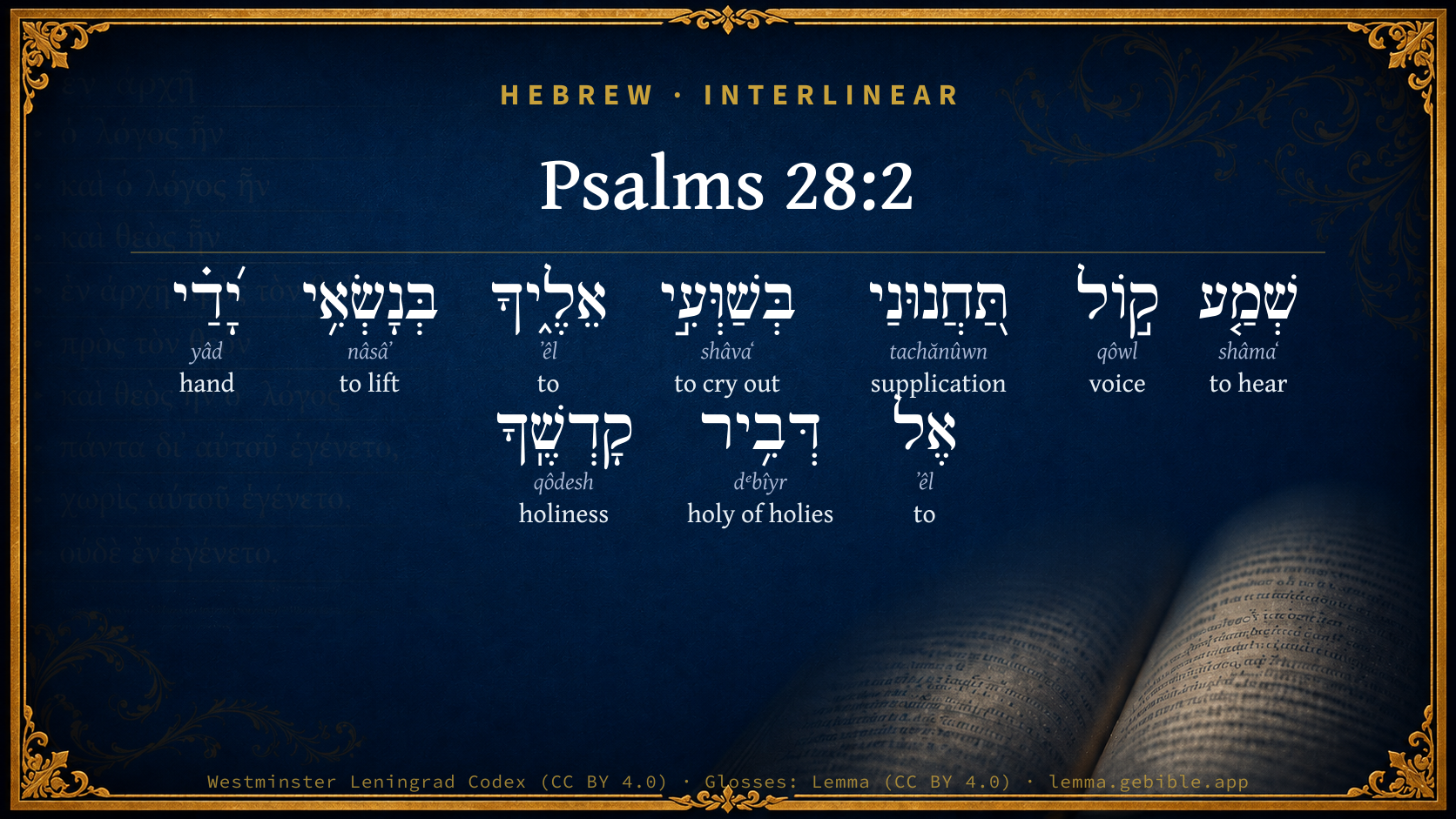
  1. שְׁמַ֤ע shâmaʻ H8085 “hear” Verb, Qal, Imperative, 2nd Person, Masculine, Singular
  2. ק֣וֹל qôwl H6963 “voice of” Noun, Common, Masculine, Singular, Construct
  3. תַּ֭חֲנוּנַי tachănûwn H8469 “supplications · my” Noun, Common, Masculine, Plural, Construct + Suffix, Personal, 1st Person, Common, Singular
  4. בְּשַׁוְּעִ֣י shâvaʻ H7768 “in/at · to cry out · me” Preposition + Verb, Piel, Infinitive Construct + Suffix, Personal, 1st Person, Common, Singular
  5. אֵלֶ֑יךָ ʼêl H413 “to · you” Preposition + Suffix, Personal, 2nd Person, Masculine, Singular
  6. בְּנָשְׂאִ֥י nâsâʼ H5375 “in/at · to lift · me” Preposition + Verb, Qal, Infinitive Construct + Suffix, Personal, 1st Person, Common, Singular
  7. יָ֝דַ֗י yâd H3027 “hands · my” Noun, Common, Both, Dual, Construct + Suffix, Personal, 1st Person, Common, Singular
  8. אֶל ʼêl H413 “to” Preposition
  9. קָדְשֶֽׁךָ qôdesh H6944 “holiness · your” Noun, Common, Masculine, Singular, Construct + Suffix, Personal, 2nd Person, Masculine, Singular

About this verse

These counts appear in no published source. They are computed here, from the morphology-tagged text and Lemma’s own curated glosses. What Lemma adds →

10
words
9
distinct lemmas
Wisdom
section

Notable vocabulary

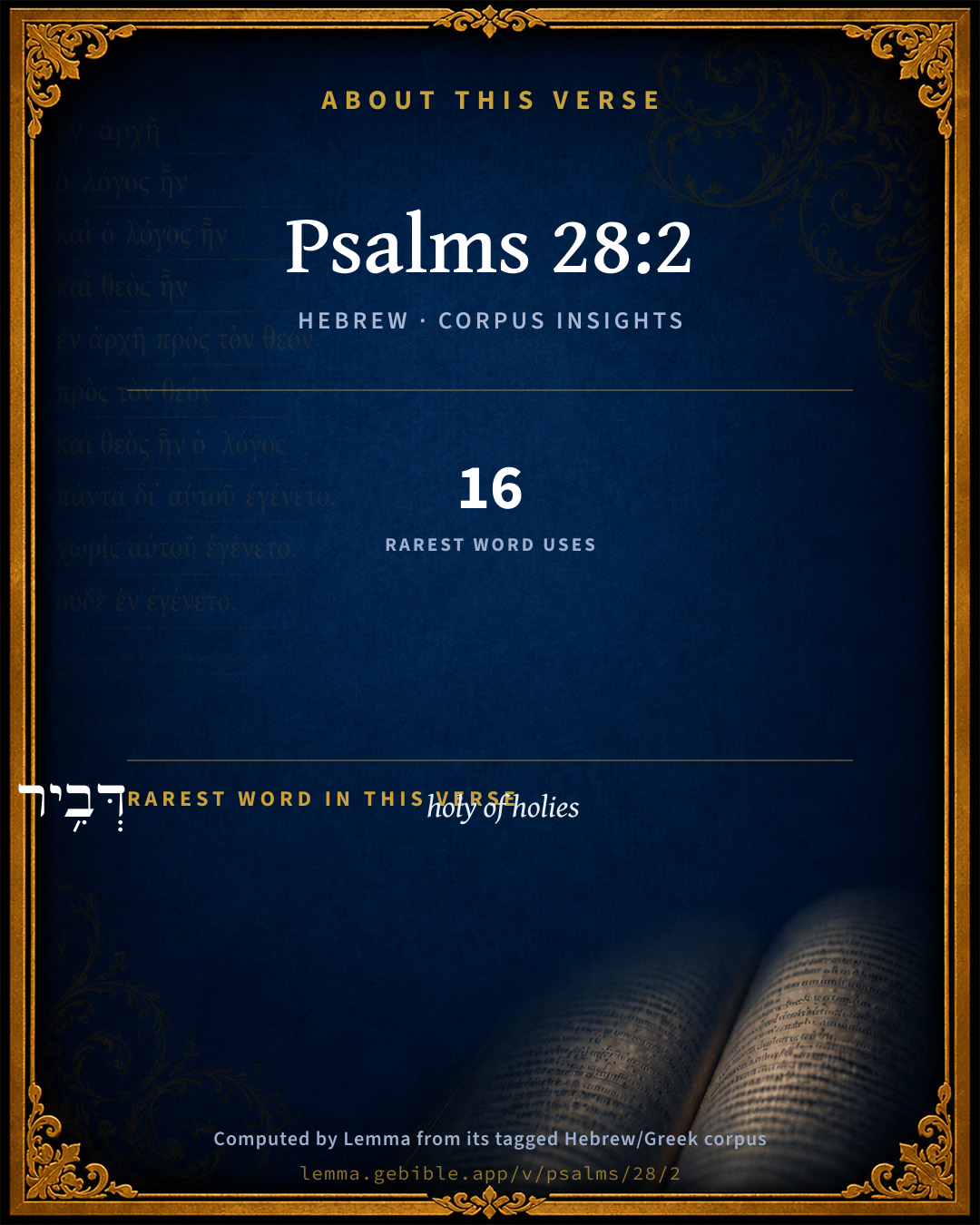
The rarest word here is דְּבִ֥יר holy of holies H1687 — appearing just 16 times in the whole Hebrew Bible.

Shared distinctive vocabulary

דְּבִ֥יר holy of holies H1687 occurs in 16 verses of the Hebrew Bible. Also found in:

Grammatical profile

  • 3 verbs
  • 5 nouns
  • 2 prepositions

Verb forms

  • שְׁמַ֤ע Qal · Imperative
  • בְּשַׁוְּעִ֣י Piel · Infinitive Construct
  • בְּנָשְׂאִ֥י Qal · Infinitive Construct

Repetition

A word recurs within this verse — often emphatic in Hebrew:

  • אֵלֶ֑יךָ to H413 ×2

Hebrew & Septuagint length

In English translation the verse runs 22 words from the Hebrew and 22 from the Septuagint (LXX English) — the same length.

A rough comparison of the two English renderings, which tokenize alike — not a word-level alignment.

Word counts can differ between the Hebrew and the Greek without any difference in meaning — e.g. the Hebrew direct-object marker אֵת has no separate Greek word, and Greek often adds the article ὁ.

Cross-references

17

Topical passages linked to Psalms 28:2 in the Treasury of Scripture Knowledge — connected by theme and wording, ordered by reader-vote popularity; previews shown in the World English Bible.

  • Psalms 138:2 I will bow down toward your holy temple, And give thanks to your Name for your loving kindness and for your truth; For you have exalted your Name and your Word above all.
  • Psalms 141:2 Let my prayer be set before you like incense; The lifting up of my hands like the evening sacrifice.
  • Psalms 140:6 I said to Yahweh, "You are my God." Listen to the cry of my petitions, Yahweh.
  • 1 Timothy 2:8 I desire therefore that the men in every place pray, lifting up holy hands without wrath and doubting.
  • Psalms 5:7 But as for me, in the abundance of your loving kindness I will come into your house: I will bow toward your holy temple in reverence of you.
  • Psalms 134:2 Lift up your hands in the sanctuary. Praise Yahweh!
  • Daniel 6:10 When Daniel knew that the writing was signed, he went into his house (now his windows were open in his chamber toward Jerusalem) and he kneeled on his knees three times a day, and prayed, and gave thanks before his God, as he did before.
  • 1 Kings 6:19 He prepared an oracle in the midst of the house within, to set there the ark of the covenant of Yahweh.
  • 1 Kings 6:22–23 The whole house he overlaid with gold, until all the house was finished: also the whole altar that belonged to the oracle he overlaid with gold.
  • 1 Kings 8:6–8 The priests brought in the ark of the covenant of Yahweh to its place, into the oracle of the house, to the most holy place, even under the wings of the cherubim.
  • 1 Kings 8:28–30 Yet have respect for the prayer of your servant, and for his supplication, Yahweh my God, to listen to the cry and to the prayer which your servant prays before you this day;
  • 1 Kings 8:38 whatever prayer and supplication be made by any man, [or] by all your people Israel, who shall know every man the plague of his own heart, and spread forth his hands toward this house:
  • 2 Chronicles 6:13 (for Solomon had made a brazen scaffold, five cubits long, and five cubits broad, and three cubits high, and had set it in the midst of the court; and on it he stood, and kneeled down on his knees before all the assembly of Israel, and spread forth his hands toward heaven;)
  • Psalms 63:4 So I will bless you while I live. I will lift up my hands in your name.
  • Psalms 125:5 But as for those who turn aside to their crooked ways, Yahweh will lead them away with the workers of iniquity. Peace be on Israel.
  • Psalms 143:6 I spread forth my hands to you. My soul thirsts for you, like a parched land. Selah.
  • Lamentations 2:19 Arise, cry out in the night, at the beginning of the watches; Pour out your heart like water before the face of the Lord: Lift up your hands toward him for the life of your young children, that faint for hunger at the head of every street.

Cross-references courtesy of OpenBible.info (CC BY 4.0).

Hebrew and Greek witnesses Masoretic Hebrew ↔ Greek Septuagint

The same verse in the two great witnesses to the Old Testament, shown verse-for-verse.

You’re reading Greek Psalm 27 (Hebrew Psalm 28). The Septuagint counts the superscription, so verse numbers can differ from the Hebrew — chapter-level alignment, not verse-by-verse. Numbering follows Rahlfs.

These are two independent witnesses, not word-aligned to each other, and the Septuagint is shown in lemma (dictionary) form.

Hebrew Psalms 28:2 Masoretic · Westminster Leningrad Codex

שְׁמַ֤ע ק֣וֹל תַּ֭חֲנוּנַי בְּשַׁוְּעִ֣י אֵלֶ֑יךָ בְּנָשְׂאִ֥י יָ֝דַ֗י אֶל דְּבִ֥יר קָדְשֶֽׁךָ

Hear the voice of my petitions, when I cry to you, When I lift up my hands toward your Most Holy Place.

World English Bible · Public Domain

Greek LXX Greek Psalm 27:2 Septuagint · lemma form

εἰςἀκούω ὁ φωνή ὁ δέησις ἐγώ ἐν ὁ δέω ἐγώ πρός σύ ἐν ὁ ἐγώ αἴρω χείρ ἐγώ πρός ναός ἅγιος σύ

Listen to the voice of my supplication, when I pray to you, when I lift up my hands toward your holy temple.

LXX2012 (modern English Septuagint) · Public Domain

Hebrew: Westminster Leningrad Codex (CC BY 4.0). Greek: Septuagint (public domain); English from LXX2012 (modern English Septuagint) (Public Domain). How the Septuagint differs from the Hebrew →

Commentary

Notes on Psalms 28:2 from classic Christian and Jewish commentators (each source and its license shown beneath its notes). The classic Christian expositions comment on the surrounding passage and are grouped to its opening verse, so a note may address several verses; the Jewish commentaries on the Tanakh (Rashi and others) are per-verse, so they appear only where the commentator wrote on this verse.

Lemma curates 59 commentaries, every one of them public domain or Creative Commons licensed, each selected and text-cleaned for this edition rather than reprinted as found. About our sources →

Trapp's Complete Commentary

John Trapp

Psa 28:2 Hear the voice of my supplications, when I cry unto thee, when I lift up my hands toward thy holy oracle.

Ver. 2. When I lift up my hands] An ordinary gesture in prayer, expressing faith (for they held out their open hands, as craving beggars with the palms upward, 1Ki 8:22) and helping fervency; while hands and heart went up together to God in the heavens, Lam 3:40. Preces fundimus, ecelum tundimus, miserieordiam extorquemus, &c. (Tertul.).

Toward thy holy oracle] Called Debhir, because therehence God spake and gave answer. Toward this (a type of Christ, the Word essential) David lifteth up his hands; that it might be as a ladder whereby his prayer might get up to heaven. The devil also, who delighteth to be God’s ape, but for man’s mischief, gave oracles at Delphi and elsewhere (Herod. Clio); but λοξα et mendacia, doubtful and lying; as to Croesus, Pyrrhus, others. But the eternity of Israel cannot lie, 1Sa 15:29; every word of God is pure, he is a shield to them that put their trust in him, Pro 30:5.

John Trapp, A Commentary or Exposition upon All the Books of the Old and New Testament (1647–1656) — public domain. Text from a community e-Sword module.

Joseph Benson's Commentary

Psa 28:2. When I lift up my hands toward thy holy oracle — Earnestly desiring and confidently expecting an answer of peace from thence. The most holy place within the veil is here, as elsewhere, called the oracle. There the ark and the mercy-seat were; there God was said to dwell between the cherubim, and thence he spake to his people, Num 7:89. This was a type of Christ, and it is to him that we must lift up our eyes and hands, for through him all good comes from God to us. It was also a figure of heaven, Heb 9:24. And from God, as our Father in heaven, we are taught to expect an answer to our prayers.

Joseph Benson's Commentary on the Old and New Testaments (1811–1818) — public domain. Text from a community e-Sword module.

J. A. Alexander on Psalms

Joseph Addison Alexander

2. (Psa 28:2) Hear the voice of my supplications, in my crying unto thee (for help); in my lifting up my hands to thy holy oracle. In my crying, in my lifting, i.e. at the time of my so doing, when I am in the very act. The lifting up of the hands is a natural symbol of the raising of the heart or the desires to God, and is therefore often mentioned in connection with the act of prayer. Exo 9:29; Exo 17:11-12, 1Ki 8:22; 1Ki 8:54, Lam 2:19, iii. 41, Psa 63:5 (4).—The Sword translated oracle is derived from the verb to speak, and seems to mean a place of speaking or conversation, like the English parlour from the French parler. Now we learn from Exo 25:22, Num 7:89, that the place whence God talked with Moses was the inner apartment of the tabernacle; and from 1 Kings 6:19, that the corresponding part of the temple bore the name here used. To this, as the depository of the ark and the earthly residence of God, the ancient saints looked as we look now to Christ, in whom the idea of the Mosaic sanctuary has been realised. See above, on Ps. 5:8 (7).

Joseph Addison Alexander, The Psalms Translated and Explained (1850) — public domain. Text from a community e-Sword module.

Tyndale Open Study Notes

Tyndale Open Resources

28:2 It was common to lift up one’s hands in a gesture of devoted prayer (63:4; 134:2).

Tyndale Open Study Notes — © Tyndale Open Resources, licensed CC BY-SA 4.0. Text via the HelloAO Bible API.

Geneva Bible (1599)

Geneva Bible translators

He used this outward means to help the weakness of his faith: for in that place was the Ark, and there God promised to show the tokens of his favor.

Geneva Bible (1599) marginal notes — public domain. Text via Bolls.life.

Jamieson, Fausset & Brown

Robert Jamieson, A. R. Fausset & David Brown

lift up my hands--a gesture of prayer (Psa 63:4; Psa 141:2).

oracle--place of speaking (Exo 25:22; Num 7:89), where God answered His people (compare Psa 5:7).

Jamieson, Fausset & Brown — Commentary Critical and Explanatory on the Whole Bible (1871) — public domain (CC PDM 1.0). Text via the HelloAO Bible API.

Adam Clarke's Commentary

Verse 2. Toward thy holy oracle.] דביר קדשך debir kodshecha; debir properly means that place in the holy of holies from which God gave oracular answers to the high priest. This is a presumptive proof that there was a temple now standing; and the custom of stretching out the hands in prayer towards the temple, when the Jews were at a distance from it, is here referred to.

Adam Clarke's Commentary on the Bible (1810–1826) — public domain. Text from a community e-Sword/MySword module.

John Calvin's Commentaries

2. Hear the voice of my prayers when I cry to thee. This repetition is a sign of a heart in anguish. David’s ardor and vehemence in prayer are also intimated by the noun signifying voice, and the verb signifying to cry. He means that he was so stricken with anxiety and fear, that he prayed not coldly, but with burning, vehement desire, like those who, under the pressure of grief, vehemently cry out. In the second clause of the verse, by synecdoche, the thing signified is indicated by the sign. It has been a common practice in all ages for men to lift up their hands in prayer. Nature has extorted this gesture even from heathen idolaters, to show by a visible sign that their minds were directed to God alone. The greater part, it is true, contented with this ceremony, busy themselves to no effect with their own inventions; but the very lifting up of the hands, when there is no hypocrisy and deceit, is a help to devout and zealous prayer. David, however, does not say here that he lifted his hands to heaven, but to the sanctuary, that, aided by its help, he might ascend the more easily to heaven. He was not so gross, or so superstitiously tied to the outward sanctuary, as not to know that God must be sought spiritually, and that men then only approach to him when, leaving the world, they penetrate by faith to celestial glory. But remembering that he was a man, he would not neglect this aid afforded to his infirmity. As the sanctuary was the pledge or token of the covenant of God, David beheld the presence of God’s promised grace there, as if it had been represented in a mirror; just as the faithful now, if they wish to have a sense of God’s nearness to them, should immediately direct their faith to Christ, who came down to us in his incarnation, that he might lift us up to the Father. Let us understand, then, that David clung to the sanctuary with no other view than that by the help of God’s promise he might rise above the elements of the world, which he used, however, according to the appointment of the Law. The Hebrew word דביר, debir, which we have rendered sanctuary, דביר, debir, is derived from דבר, dabar, to speak.

John Calvin's Commentaries (1540-1563) — public domain. Text from the Calvin Translation Society English edition (1840s-50s) via the Christian Classics Ethereal Library (ccel.org). Calvin's coverage is partial (roughly two-thirds of the Bible); uncommented books and verses are honest gaps, never fabricated. The 19th-century editor's footnotes and remarks are omitted so the notes are faithfully Calvin's own voice.

Ellicott's Commentary for English Readers

(2) Lift up my hands.—For interesting illustrations of this Oriental custom see Exo_9:29; 1Ki_8:22, &c. Compare the well-known line:—

“If, knowing God, they lift not hands of prayer.”

TENNYSON: Morte d’Arthur.

Holy oracle.—Better, the shrine of thy sanctuary (see margin)—i.e., the holy of holies, the adytum, or inner recess of the Temple in which the ark was placed, as we see from 1Ki_6:19-22. The Hebrew word, which is of doubtful derivation, is, with the exception of this place, only found in Kings and Chronicles. The margin, “the oracle of thy sanctuary,” is a better rendering than the text.

A Bible Commentary for English Readers, edited by Charles John Ellicott (1878–1897) — public domain. Text from a community e-Sword module.

The Cambridge Bible for Schools and Colleges

gen. ed. J. J. S. Perowne

2. The first line recurs in Psa_31:22.

when I cry] A stronger word than that in Psa_28:1, meaning to cry for help.

when I lift up my hands] The attitude of prayer (Psa_63:4; 1Ti_2:8), the outward symbol of an uplifted heart (Psa_25:1).

toward thy holy oracle] Lit., as R.V. marg., toward the innermost place of thy sanctuary, i.e. the most holy place, where the Ark, the symbol of God’s Presence among His people, was. See 1Ki_6:16 ff; 1Ki_8:6. The rendering oracle, following Jerome’s oraculum, rests upon a wrong derivation. The word does not in itself denote the place where God answers. It is used elsewhere only in the accounts of the building of the Temple (1 Kings 6-8; 2 Chronicles 3-5). The worshipper naturally turns as he prays towards Jehovah’s dwelling-place in heaven (1Ki_8:22), or its earthly counterpart (1Ki_8:30 ff.). Cp. Psa_5:7.

The Cambridge Bible for Schools and Colleges (gen. ed. J. J. S. Perowne; Cambridge University Press, 1878–1918) — public domain. Text from a community e-Sword module.

John Gill's Exposition

Hear the voice of my supplications,.... Which proceed from the Spirit of grace and of supplication, and are put up in an humble manner, under a sense of wants and unworthiness, and on the foot of grace and mercy, and not merit;

when I cry unto thee; as he now did, and determined he would, and continue so doing, until he was heard;

when I lift up my hands toward thy holy oracle: the holy of holies, in the tabernacle and in the temple, which was sometimes so called, Kg1 6:23; compared with Ch2 3:10; where were the ark, the mercy seat, and cherubim, between which the Lord dwelt, and gave responses to his people; or heaven itself, which the holy of holies was a figure of; where is the throne of God, and from whence he hears the prayers of his people directed to him; or else Christ himself, who is the most Holy, and the "Debir", or Oracle, who speaks to the Lord for his people; and by whom the Lord speaks to them again, and communes with them. The oracle had its name, "debir", from speaking. Lifting up of the hands is a prayer gesture, and here designs the performance of that duty to God in heaven, through Christ; see Lam 3:41; it was frequently used, even by the Heathens, as a prayer gesture (r); see Psa 141:2.

(r) "Duplices manus ad sidera tendit--et paulo post--et ambas ad coelum tendit palmas", Virgil. Aeneid. 10. vid. Aeneid. 2. "Ad coelum manibus sublatis", Horat. Satyr. l. 2. satyr. 5. v. 97. "Coelo supines si tuleris manus", ib. Carmin. l. 3. Ode 23. v. 1. "Et pandere palmas ante Deum delubra", Lucretius l. 5. prope finem , Homer. Iliad. 5. v. 174.

John Gill's Exposition of the Whole Bible (1746–1763) — public domain (CC PDM 1.0). Text via the HelloAO Bible API.

Albert Barnes' Notes on the Bible

Hear the voice of my supplications - It was not mental prayer which he offered; it was a petition uttered audibly.

When I lift up my hands - To lift up the hands denotes supplication, as this was a common attitude in prayer. See the notes at 1Ti 2:8.

Toward thy holy oracle - Margin, as in Hebrew, “toward the oracle of thy holiness.” The word “oracle” as used here denotes the place where the answer to prayer is given. The Hebrew word - דביר debı̂yr - means properly the inner sanctuary of the tabernacle or the temple, the place where God was supposed to reside, and where He gave responses to the prayers of His people: the same place which is elsewhere called the holy of holies. See the notes at Heb 9:3-14. The Hebrew word is found only here and in 1Ki 6:5, 1Ki 6:16, 1Ki 6:19-23, 1Ki 6:31; 1Ki 7:49; 1Ki 8:6, 1Ki 8:8; 2Ch 3:16; 2Ch 4:20; 2Ch 5:7, 2Ch 5:9. The idea here is that he who prayed stretched out his hands toward that sacred place where God was supposed to dwell. So we stretch out our hands toward heaven - the sacred dwelling-place of God. Compare the notes at Psa 5:7. The Hebrew word is probably derived from the verb to “speak;” and, according to this derivation, the idea is that God spoke to His people; that he “communed” with them; that He answered their prayers from that sacred recess - His special dwelling-place. See Exo 25:22; Num 7:89.

Albert Barnes' Notes on the Bible (1834–1885) — public domain. Text from a community e-Sword/MySword module.

Matthew Poole's English Annotations

i.e. Towards the holy of holies, which is so called, 1Ki 6:23, compared with 2Ch 3:10; compare also 1Ki 6:5; 8:6, because there the ark was; from whence God gave oracular answers to his people; and to which they accordingly directed their prayers, not only when they drew near to it, but when they were at a distance from it, as Dan 6:10.

Matthew Poole's English Annotations on the Holy Bible (1683–1685) — public domain. Text from a community e-Sword/MySword module.

The Treasury of David

Charles H. Spurgeon

Ver. 2. This is much to the same effect as the first verse, only that it refers to future as well as present pleadings. Hear me! Hear me! Hear the voice of my supplications! This is the burden of both verses. We cannot be put off with a refusal when we are in the spirit of prayer; we labour, use importunity, and agonize in supplications until a hearing is granted us. The word "supplications, "in the plural, shows the number, continuance, and variety of a good man's prayers, while the expression "hear the voice, "seems to hint that there is an inner meaning, or heart voice, about which spiritual men are far more concerned than for their outward and audible utterances. A silent prayer may have a louder voice than the cries of those priests who sought to awaken Baal with their shouts. When I lift up my hands toward thy holy oracle: which holy place was the type of our Lord Jesus; and if we would gain acceptance, we must turn ourselves evermore to the blood besprinkled mercy seat of his atonement. Uplifted hands have ever been a form of devout posture, and are intended to signify a reaching upward towards God, a readiness, an eagerness to receive the blessing sought after. We stretch out empty hands, for we are beggars; we lift them up, for we seek heavenly supplies; we lift them towards the mercy seat of Jesus, for there our expectation dwells. O that whenever we use devout gestures, we may possess contrite hearts, and so speed well with God.

Ver. 2. I lift up my hands toward thy holy oracle. Called (rybd), debhir, because there hence God spake and gave answer. Toward this (a type of Christ, the Word essential), David lifteth up his hands, that it might be as a ladder, whereby his prayer might get up to heaven. John Trapp.

Charles H. Spurgeon's The Treasury of David (1869–1885) — public domain. Psalms only. Text from a community e-Sword/MySword module.

Whedon's Commentary on the Bible

Daniel D. Whedon

2. I lift up my hands toward thy holy oracle—The “oracle” was the inner sanctuary, or “holy of holies.” 1Ki_6:16; 1Ki_8:6. On praying with hands outspread towards the most holy place when exiled or absent, see Dan_6:10

Daniel D. Whedon (gen. ed.), Commentary on the Old and New Testaments (1874–1909) — public domain. Text from a community e-Sword module.

The Pulpit Commentary

Hear the voice of my supplications, when I cry unto thee. God is said to hear prayer when he grants it, to be deaf to prayer when he withholds the boon requested. The use of the expressions "voice" and "cry" marks the earnestness of the prayers offered. When I lift up my hands, The usual attitude of a Hebrew in prayer. (see Exo_9:29 Exo_17:11, 12 1Ki_8:22, 54 Psa_63:4 Psa_141:2 Lam_2:19 Lam_3:41) Originally, the idea probably was that the hands should be ready to receive the blessings which God would bestow. But, later on, the lifting up of the hands seems to have been regarded as symbolizing the lifting up of the heart. (Lam_3:41) Towards thy holy oracle. (see the comment on Psa_5:7)

The Pulpit Commentary (1880–1919), ed. H.D.M. Spence-Jones & Joseph S. Exell — public domain. Text from a community e-Sword module.

John Wesley's Explanatory Notes

Towards - Towards the holy of holies, because there the ark was; from whence God gave oracular answers to his people.

John Wesley, Explanatory Notes Upon the Whole Bible (1754–1765) — public domain. Text via the GEBible commentary corpus.

Lesson kit

Teaching starters — assembled from the data on this page, not authored interpretation. Every prompt links to the verse data it draws on. Edit before teaching.

Psalms, in the Wisdom, opens this verse with 10 words (9 distinct Hebrew lemmas). Its most distinctive word is dᵉbîyr (“holy of holies”). A historical commentator’s framing appears above. Read the whole chapter for the surrounding context.

Discussion questions

  1. How does “holy of holies” (dᵉbîyr) shape what this verse is saying?
  2. 1 Kings 6:5 shares the word «holy of holies» with this verse. How do the two illuminate each other?
  3. “to” occurs 2× in this one verse. What is the effect of the repetition?
  4. The translations on this page render this verse differently — a whole-verse word diff, not a word-by-word alignment. What might account for the different wordings?
  5. The verb «שְׁמַ֤ע» is Qal Imperative. How does its form color the action?
  6. Reading how Trapp's Complete Commentary and Joseph Benson's Commentary read this verse, where do the two commentators agree and where do they part?

Things to notice

Reading settings

Reading text

Shown beneath each verse's original-language words.

Old Testament
Old Testament edition

Read the OT as the Masoretic Hebrew (MT) or the Greek Septuagint (LXX).

English shown for the Greek Septuagint (in the Hebrew ↔ Greek comparison).

Comparing translations? Open the Compare panel on any verse page to stack up to four side by side.