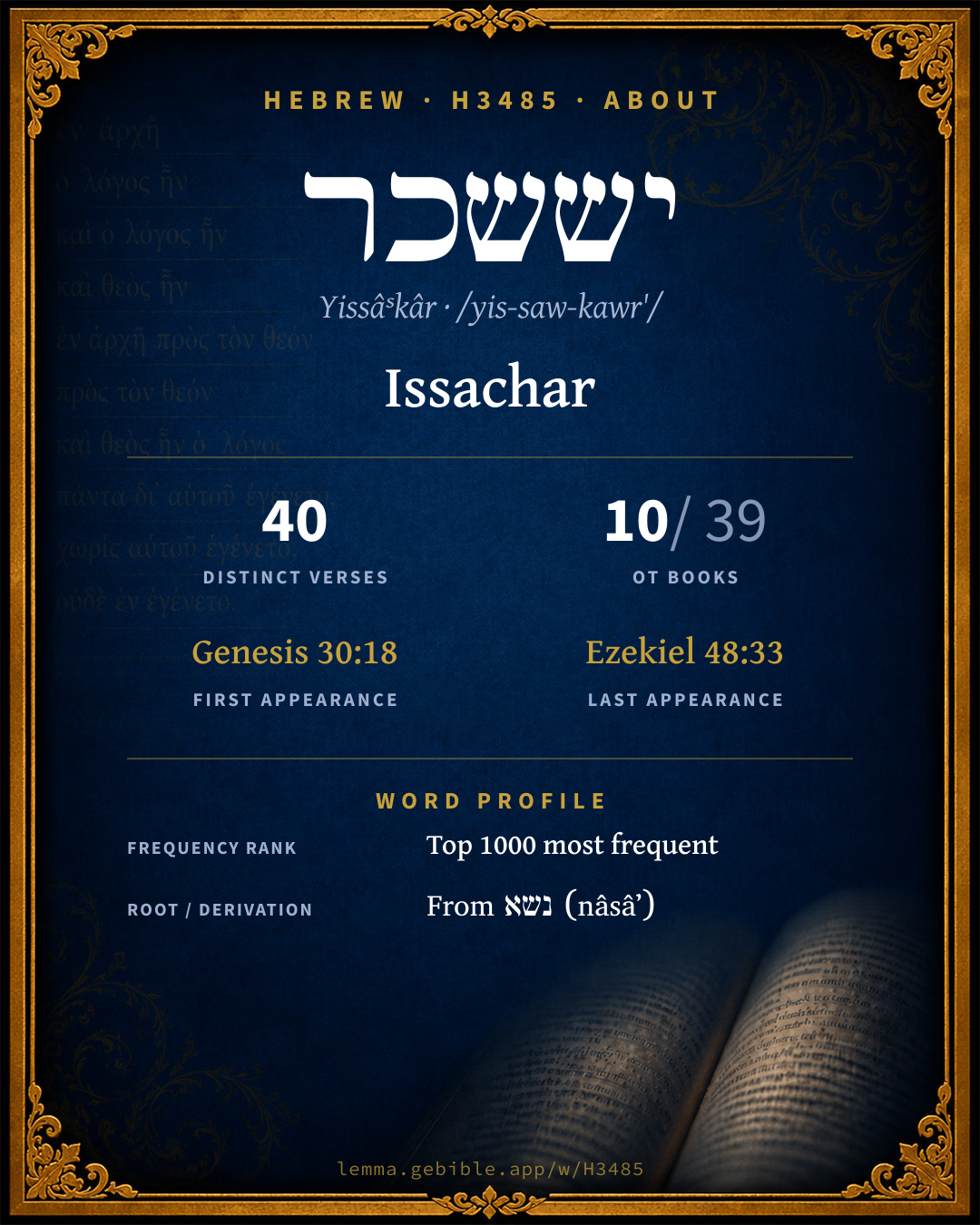
יִשָּׂשכָר
Issachar
BDB lists 5 entries for ‘Issachar’ fuller range ↓
Full lexicon entry — Brown-Driver-Briggs (BDB)
From Brown-Driver-Briggs (BDB)
Where this word appears
Grammar key — what these labels mean
Part of speech
- Noun
- A naming word — a person, place, thing, or idea.
Noun type
- Proper
- A name of a specific person, place, or people (e.g. Abraham, Zion, Israel).
Every verse where H3485 appears — 40 distinct verses across 10 books. Click any verse to open its interlinear word-by-word view. Verse text shown in the World English Bible for context — . Each verse’s Hebrew form is shown with its reference; the English is not keyword-highlighted, since the data carries no word-level English alignment. Use “Compare translations” on any verse to read it across multiple English versions. This concordance covers the Hebrew Bible; Septuagint (Greek Old Testament) occurrences are not indexed here.
Genesis 4 verses
- Genesis 30:18 יִשָּׂשכָֽר n Proper Leah said, "God has given me my hire, because I gave my handmaid to my husband." She named him Issachar.
- Genesis 35:23 וְ/יִשָּׂשכָ֖ר conj + n Proper The sons of Leah: Reuben (Jacob's firstborn), Simeon, Levi, Judah, Issachar, and Zebulun.
- Genesis 46:13 יִשָׂשכָ֑ר n Proper The sons of Issachar: Tola, Puvah, Iob, and Shimron.
- Genesis 49:14 יִשָּׂשכָ֖ר n Proper "Issachar is a strong donkey, Lying down between the saddlebags.
Exodus 1 verse
Numbers 10 verses
- Numbers 1:8 לְ/יִ֨שָּׂשכָ֔ר prep + n Proper Of Issachar: Nethanel the son of Zuar.
- Numbers 1:28 יִשָּׂשכָ֔ר n Proper Of the children of Issachar, their generations, by their families, by their fathers' houses, according to the number of the names, from twenty years old and upward, all who were able to go out to war;
- Numbers 1:29 יִשָּׂשכָ֑ר n Proper those who were numbered of them, of the tribe of Issachar, were fifty-four thousand four hundred.
- Numbers 2:5 יִשָּׂשכָ֑ר יִשָּׂשכָ֔ר n Proper n Proper Those who encamp next to him shall be the tribe of Issachar: and the prince of the children of Issachar shall be Nethanel the son of Zuar.
- Numbers 7:18 יִשָּׂשכָֽר n Proper On the second day Nethanel the son of Zuar, prince of Issachar, gave his offering.
- Numbers 10:15 יִשָׂשכָ֑ר n Proper Over the host of the tribe of the children of Issachar was Nethanel the son of Zuar.
- Numbers 13:7 יִשָּׂשכָ֔ר n Proper Of the tribe of Issachar, Igal the son of Joseph.
- Numbers 26:23 יִשָּׂשכָר֙ n Proper The sons of Issachar after their families: [of] Tola, the family of the Tolaites; of Puvah, the family of the Punites;
- Numbers 26:25 יִשָּׂשכָ֖ר n Proper These are the families of Issachar according to those who were numbered of them, sixty-four thousand three hundred.
- Numbers 34:26 יִשָׂשכָ֖ר n Proper Of the tribe of the children of Issachar a prince, Paltiel the son of Azzan.
Deuteronomy 2 verses
- Deuteronomy 27:12 וְ/יִשָּׂשכָ֖ר conj + n Proper These shall stand on Mount Gerizim to bless the people, when you are passed over the Jordan: Simeon, and Levi, and Judah, and Issachar, and Joseph, and Benjamin.
- Deuteronomy 33:18 וְ/יִשָּׂשכָ֖ר conj + n Proper Of Zebulun he said, Rejoice, Zebulun, in your going out; Issachar, in your tents.
Joshua 6 verses
- Joshua 17:10 וּ/בְ/יִשָּׂשכָ֖ר conj + prep + n Proper southward it was Ephraim's, and northward it was Manasseh's, and the sea was his border; and they reached to Asher on the north, and to Issachar on the east.
- Joshua 17:11 בְּ/יִשָּׂשכָ֣ר prep + n Proper Manasseh had in Issachar and in Asher Beth-shean and its towns, and Ibleam and its towns, and the inhabitants of Dor and its towns, and the inhabitants of En-dor and its towns, and the inhabitants of Taanach and its towns, and the inhabitants of Megiddo and its towns, even the three heights.
- Joshua 19:17 לְ/יִ֨שָּׂשכָ֔ר יִשָּׂשכָ֖ר prep + n Proper n Proper The fourth lot came out for Issachar, even for the children of Issachar according to their families.
- Joshua 19:23 יִשָּׂשכָ֖ר n Proper This is the inheritance of the tribe of the children of Issachar according to their families, the cities with their villages.
- Joshua 21:6 יִשָּׂשכָ֣ר n Proper The children of Gershon had by lot out of the families of the tribe of Issachar, and out of the tribe of Asher, and out of the tribe of Naphtali, and out of the half-tribe of Manasseh in Bashan, thirteen cities.
- Joshua 21:28 יִשָּׂשכָ֔ר n Proper Out of the tribe of Issachar, Kishion with its suburbs, Daberath with its suburbs,
Judges 2 verses
- Judges 5:15 בְּ/יִשָּׂשכָר֙ וְ/יִשָּׂשכָר֙ prep + n Proper conj + n Proper The princes of Issachar were with Deborah; As was Issachar, so was Barak; Into the valley they rushed forth at his feet. By the watercourses of Reuben There were great resolves of heart.
- Judges 10:1 יִשָּׂשכָ֑ר n Proper After Abimelech there arose to save Israel Tola the son of Puah, the son of Dodo, a man of Issachar; and he lived in Shamir in the hill-country of Ephraim.
1 Kings 2 verses
- 1 Kings 4:17 בְּ/יִשָׂשכָֽר prep + n Proper Jehoshaphat the son of Paruah, in Issachar;
- 1 Kings 15:27 יִשָּׂשכָ֔ר n Proper Baasha the son of Ahijah, of the house of Issachar, conspired against him; and Baasha struck him at Gibbethon, which belonged to the Philistines; for Nadab and all Israel were laying siege to Gibbethon.
1 Chronicles 9 verses
- 1 Chronicles 2:1 יִשָׂשכָ֖ר n Proper These are the sons of Israel: Reuben, Simeon, Levi, and Judah, Issachar, and Zebulun,
- 1 Chronicles 6:62 יִ֠שָׂשכָר n Proper To the sons of Gershom, according to their families, out of the tribe of Issachar, and out of the tribe of Asher, and out of the tribe of Naphtali, and out of the tribe of Manasseh in Bashan, thirteen cities.
- 1 Chronicles 6:72 יִשָׂשכָ֔ר n Proper and out of the tribe of Issachar, Kedesh with its suburbs, Daberath with its suburbs,
- 1 Chronicles 7:1 יִשָׂשכָ֗ר n Proper Of the sons of Issachar: Tola, and Puah, Jashub, and Shimron, four.
- 1 Chronicles 7:5 יִשָׂשכָ֔ר n Proper Their brothers among all the families of Issachar, mighty men of valor, reckoned in all by genealogy, were eighty-seven thousand.
- 1 Chronicles 12:32 יִשָּׂשכָ֗ר n Proper Of the children of Issachar, men who had understanding of the times, to know what Israel ought to do, the heads of them were two hundred; and all their brothers were at their commandment.
- 1 Chronicles 12:40 יִשָׂשכָ֨ר n Proper Moreover those who were near to them, [even] as far as Issachar and Zebulun and Naphtali, brought bread on donkeys, and on camels, and on mules, and on oxen, food of meal, cakes of figs, and clusters of raisins, and wine, and oil, and oxen, and sheep in abundance: for there was joy in Israel.
- 1 Chronicles 26:5 יִשָׂשכָ֣ר n Proper Ammiel the sixth, Issachar the seventh, Peullethai the eighth; for God blessed him.
- 1 Chronicles 27:18 לְ/יִ֨שָׂשכָ֔ר prep + n Proper of Judah, Elihu, one of the brothers of David: of Issachar, Omri the son of Michael:
2 Chronicles 1 verse
Ezekiel 3 verses
- Ezekiel 48:25 יִשָׂשכָ֥ר n Proper By the border of Simeon, from the east side to the west side, Issachar, one [portion].
- Ezekiel 48:26 יִשָׂשכָ֗ר n Proper By the border of Issachar, from the east side to the west side, Zebulun, one [portion].
- Ezekiel 48:33 יִשָּׂשכָר֙ n Proper At the south side four thousand and five hundred [reeds] by measure, and three gates: the gate of Simeon, one; the gate of Issachar, one; the gate of Zebulun, one.
About this entry
At a glance — auto-summarized from this page’s data, not written by a person. Every figure links to its source below. This summary describes the numbers; it doesn’t interpret them.
“Issachar” is the headline sense of the Hebrew name יששכר (Yissâˢkâr). Scripture first uses it in Genesis 30:18. It appears 40 verses across 10 books of the Hebrew Bible, among its moderately common vocabulary. More than a quarter of its appearances fall in Numbers. The sections below give every occurrence and version rendering.
Gloss history
Strong's 1890 vs modern scholarship
About this word
Strong's H3485 catalogs a Hebrew word from the Hebrew Old Testament.
These counts are not copied from any lexicon or concordance. They are computed here, from the morphology-tagged Hebrew Old Testament. What Lemma adds →
- 40
- distinct verses
- The word appears in 40 distinct verses.
- 10 / 39
- OT books
- The word appears in 10 of 39 Old Testament books.
- #837
- by frequency
- Top 1000 most frequent Hebrew words (rank 837 of 8,640 Hebrew words by occurrence).
View all 40 occurrences in the concordance →
Most concentrated in
- Numbers 10 verses 25%
- 1 Chronicles 9 verses 23%
- Joshua 6 verses 15%
By section of the Old Testament
By traditional corpus
Conventional, traditional groupings — biblical authorship is debated, so this is a traditional corpus grouping, not an authorship claim. Each share is this word’s portion of its verses in that division of the Hebrew canon. Each figure is a share of the word’s 40 distinct verses.
- Torah (Pentateuch) 17 verses · 43%
- Prophets (Nevi'im) 13 verses · 33%
- Writings (Ketuvim) 10 verses · 25%
How translations render this word
Counts come from each version’s own published word-to-Strong’s tagging or interlinear alignment — an approximate guide to how each version renders this word, not a word-level alignment the data otherwise carries. Because each total is that version’s own tagged count, the per-version totals vary from one another and need not match the appearance or distinct-verse counts above. These counts may also differ from a printed concordance because Lemma counts each distinctly tagged rendering and does not collapse phrase taggings into a single head-word total. This is a fixed set of word-tagged versions (KJV, ASV, BSB, ULT) and does not change with the reading translation you choose elsewhere. Each version’s license is shown beside its name below (and on Sources).
- King James Version: Issachar 42×
- American Standard Version: Issachar 37×
- Berean Standard Bible: Issachar 38×
- unfoldingWord Literal Text: Issachar 43×
King James Version Public Domain
Renders H3485 across 43 tagged occurrences — most commonly:
Plus 1 rendering that appears only once — usually multi-word phrases or single function words the recovered tagging swept in, not distinct renderings.
American Standard Version Public Domain
Renders H3485 across 43 tagged occurrences — most commonly:
Plus 6 renderings that appear only once — usually multi-word phrases or single function words the recovered tagging swept in, not distinct renderings.
Berean Standard Bible Public Domain
Renders H3485 across 40 tagged occurrences — most commonly:
Plus 2 renderings that appear only once — usually multi-word phrases or single function words the recovered tagging swept in, not distinct renderings. Not rendered by a distinct English word in 3 further occurrences.
unfoldingWord Literal Text CC BY-SA 4.0
Renders H3485 across 45 tagged occurrences — most commonly:
Plus 2 renderings that appear only once — usually multi-word phrases or single function words the recovered tagging swept in, not distinct renderings.
Senses in BDB
The 5 senses BDB distinguishes for this word, in lexicon order (not ranked by frequency or importance). The full entry — with sub-senses — is in the Lexicon Entry tab.
- Issachar = "there is recompense"
- the 9th son of Jacob and the 5th by Leah his first wife and the progenitor of a tribe by his name (noun proper…
- a Korahite Levite and the 7th son of Obed-edom and doorkeeper to the temple (noun proper masculine)
- the tribe descended from Issachar the son of Jacob (noun proper collective)
- the territory allocated to the descendants of Issachar when they entered the land of Canaan (noun proper locative)
Word origin
Derived from נשא (nâsâʼ) (H5375) — to lift.
Forms in the corpus
The 25 distinct written forms H3485 takes in the Hebrew Bible, most frequent first — each parse links to that state’s occurrences in the concordance. Hebrew forms include their vowel points and cantillation, so a single lemma takes many written forms.
| Form | Parsing | Example | Uses |
|---|---|---|---|
| יִשָּׂשכָ֔ר | Noun, Proper | 1 Kings 15:27 | 5 |
| יִשָּׂשכָ֖ר | Noun, Proper | Genesis 49:14 | 4 |
| וְ/יִשָּׂשכָ֖ר | Noun, Proper | Deuteronomy 27:12 | 3 |
| יִשָּׂשכָ֑ר | Noun, Proper | Judges 10:1 | 3 |
| יִשָׂשכָ֑ר | Noun, Proper | Genesis 46:13 | 2 |
| יִשָׂשכָ֔ר | Noun, Proper | 1 Chronicles 6:72 | 2 |
| יִשָׂשכָ֖ר | Noun, Proper | 1 Chronicles 2:1 | 2 |
| יִשָׂשכָ֗ר | Noun, Proper | Ezekiel 48:26 | 2 |
| יִשָּׂשכָֽר | Noun, Proper | Genesis 30:18 | 2 |
| יִשָּׂשכָר֙ | Noun, Proper | Ezekiel 48:33 | 2 |
| לְ/יִ֨שָּׂשכָ֔ר | Noun, Proper | Joshua 19:17 | 2 |
| בְּ/יִשָׂשכָֽר | Noun, Proper | 1 Kings 4:17 | 1 |
| בְּ/יִשָּׂשכָ֣ר | Noun, Proper | Joshua 17:11 | 1 |
| בְּ/יִשָּׂשכָר֙ | Noun, Proper | Judges 5:15 | 1 |
| וְ/יִשָּׂשכָר֙ | Noun, Proper | Judges 5:15 | 1 |
| וּ/בְ/יִשָּׂשכָ֖ר | Noun, Proper | Joshua 17:10 | 1 |
| יִ֠שָׂשכָר | Noun, Proper | 1 Chronicles 6:62 | 1 |
| יִשָׂשכָ֣ר | Noun, Proper | 1 Chronicles 26:5 | 1 |
| יִשָׂשכָ֥ר | Noun, Proper | Ezekiel 48:25 | 1 |
| יִשָׂשכָ֨ר | Noun, Proper | 1 Chronicles 12:40 | 1 |
| יִשָּׂשכָ֗ר | Noun, Proper | 1 Chronicles 12:32 | 1 |
| יִשָּׂשכָ֣ר | Noun, Proper | Joshua 21:6 | 1 |
| יִשָּׂשכָ֤ר | Noun, Proper | 2 Chronicles 30:18 | 1 |
| יִשָּׂשכָ֥ר | Noun, Proper | Exodus 1:3 | 1 |
| לְ/יִ֨שָׂשכָ֔ר | Noun, Proper | 1 Chronicles 27:18 | 1 |
Same root — word family
Other BDB entries built from the same root as H3485, grouped by Strong’s listed origin. These share a root / origin per the lexicon — not necessarily a shared meaning. Each links to that word’s own entry.
Derives from
Shares the same root
- משא massâʼ H4853 burden
- משא massôʼ H4856 partiality
- משאה massâʼâh H4858 uplifting
- משאת masʼêth H4864 burden
- מתנשא mithnassêʼ H4984 to exalt oneself
- נשא nᵉsâʼ H5376 to lift
- נשאת nissêʼth H5379 portion
- נשואה nᵉsûwʼâh H5385 load
- נשיא nâsîyʼ H5387 chief
- שאת sᵉʼêth H7613 exaltation
- שוא sôwʼ H7721 rising
Proper names from this root
People and places named from this root — a name, not an additional meaning of the word.
Compare all same-root words → Showing 4 of 14 — not the complete family. 1 of the same-root words is a proper name (a person or place). They share a root, not necessarily a meaning.
Bible dictionary
Public-domain dictionary articles matched to this entry by name (Issachar). A biblical name can be shared by more than one person or place, so an article may treat several.
Easton's Bible Dictionary · M. G. Easton, 1897
Hired (Gen. 30:18). "God hath given me," said Leah, "my hire (Heb. sekhari)...and she called his name Issachar." He was Jacob's ninth son, and was born in Padan-aram (comp. 28:2). He had four sons at the going down into Egypt (46:13; Num. 26:23, 25).
Issachar, Tribe of, during the journey through the wilderness, along with Judah and Zebulun (Num. 2:5), marched on the east of the tabernacle. This tribe contained 54,400 fighting men when the census was taken at Sinai. After the entrance into the Promised Land, this tribe was one of the six which stood on Gerizim during the ceremony of the blessing and cursing (Deut. 27:12). The allotment of Issachar is described in Josh. 19:17-23. It included the plain of Esdraelon (=Jezreel), which was and still is the richest portion of Palestine (Deut. 33:18, 19; 1 Chr. 12:40).
The prophetic blessing pronounced by Jacob on Issachar corresponds with that of Moses (Gen. 49:14, 15; comp. Deut. 33:18, 19).
Smith's Bible Dictionary · William Smith, 1863
(reward). I. The ninth son of Jacob and the fifth of Leah. (Genesis 30:17,18) (B.C. 1753-45) At the descent into Egypt four sons are ascribed to him, who founded the four chief families of the tribes. (Genesis 46:13; Numbers 26:23,25; 1 Chronicles 7:1) The number of the fighting men of Issachar, when taken in the census at Sinai, was 54,400. During the journey they seem to have steadily increased. The allotment of Issachar lay above that of Manasseh. (Joshua 19:17-23) In the words of Josephus, "it extended in length from Carmel to the Jordan, in breadth to Mount Tabor." This territory was, as it still is, among the richest land in Palestine. It is this aspect of the territory of Issachar which appears to be alluded to in the blessing of Jacob.
+ A Korhite Levite, one of the door-keepers of the house of Jehovah, seventh son of Obed-edom. (1 Chronicles 26:5)
Hitchcock's Bible Names Dictionary · Roswell D. Hitchcock, 1869
reward; recompense
Classic public-domain reference works; full attribution on Sources.
Septuagint verse parallels
This word appears in 39 verses that also exist in the Greek Old Testament (Septuagint), out of the 40 Hebrew verses it occurs in. You can read those verses in Greek by switching the Old Testament edition to the Septuagint.
Read these verses in the Septuagint
- Genesis 30:18
- Exodus 1:3
- Numbers 1:8
- Deuteronomy 27:12
- Joshua 17:10
- Judges 5:15
- 1 Kings 4:17
- 1 Chronicles 2:1
- 2 Chronicles 30:18
- Ezekiel 48:25
This is a verse-level parallel only — the same verses exist in both the Hebrew and Greek Old Testaments. No word-level Hebrew↔Greek correspondence is claimed: the data carries no such alignment, so no Greek word is shown as this Hebrew word’s translation. Coverage is not total — the Septuagint omits the deuterocanon and renumbers the Psalms, so some Hebrew verses have no direct Greek parallel.