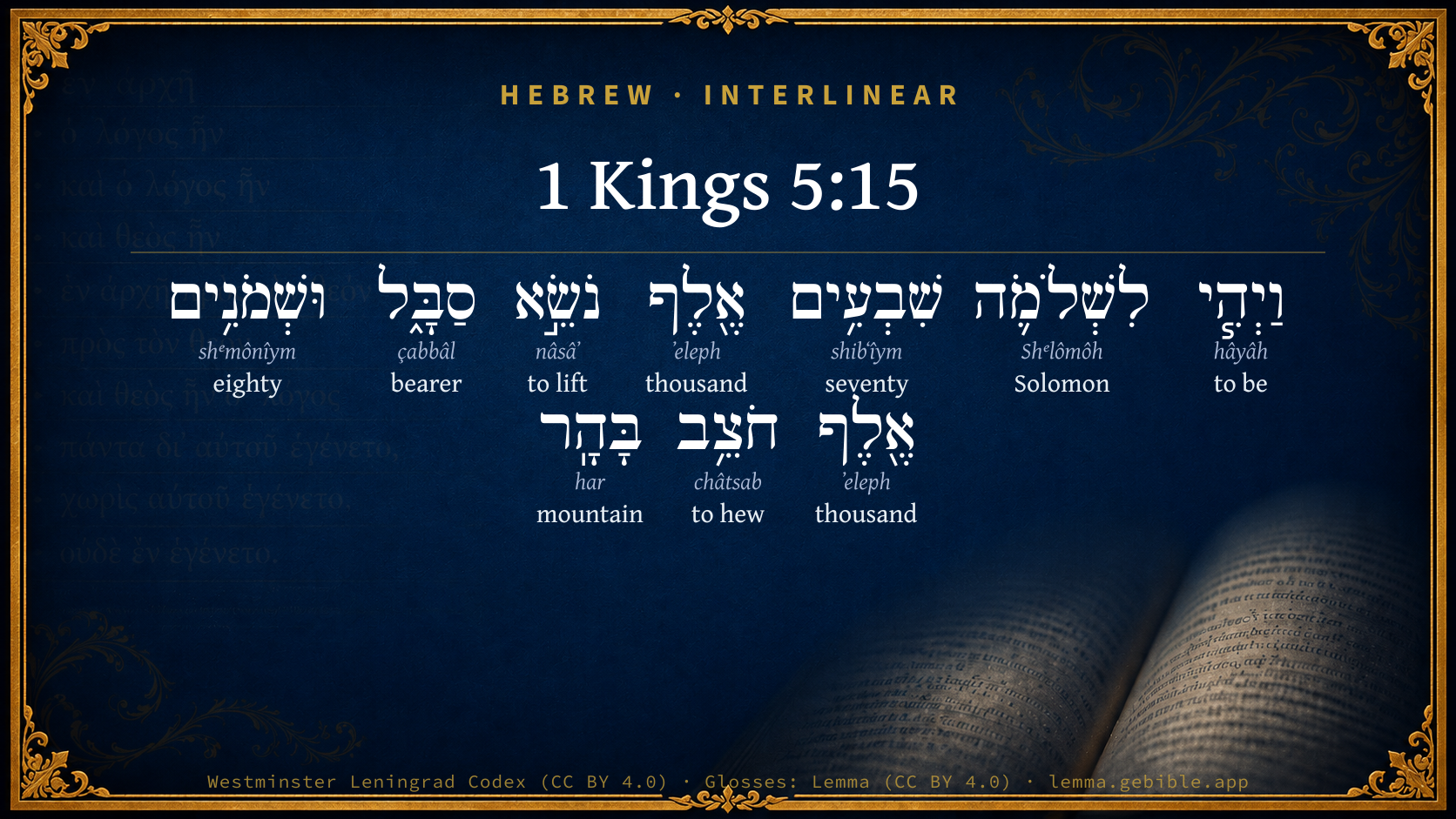
1 Kings 5:15

Hebrew (Westminster Leningrad Codex) 1 Kings 5:15 appears in the Hebrew Old Testament. The text above is from the Westminster Leningrad Codex. Each word links to its Strong’s number, a concise gloss, and parsing drawn from the Open Scriptures Hebrew Bible morphology. Click any word for its full Brown-Driver-Briggs (BDB) entry.
Download image
Cite this verse

1 Kings 5:15 (World English Bible). Public Domain. Lemma interlinear Bible study tool, https://lemma.gebible.app/v/1-kings/5/15.

Show BibTeX & RIS
BibTeX
RIS
English Translation
Solomon had seventy thousand who bore burdens, and eighty thousand who were stone cutters in the mountains;
World English Bible · Public Domain
Highlights
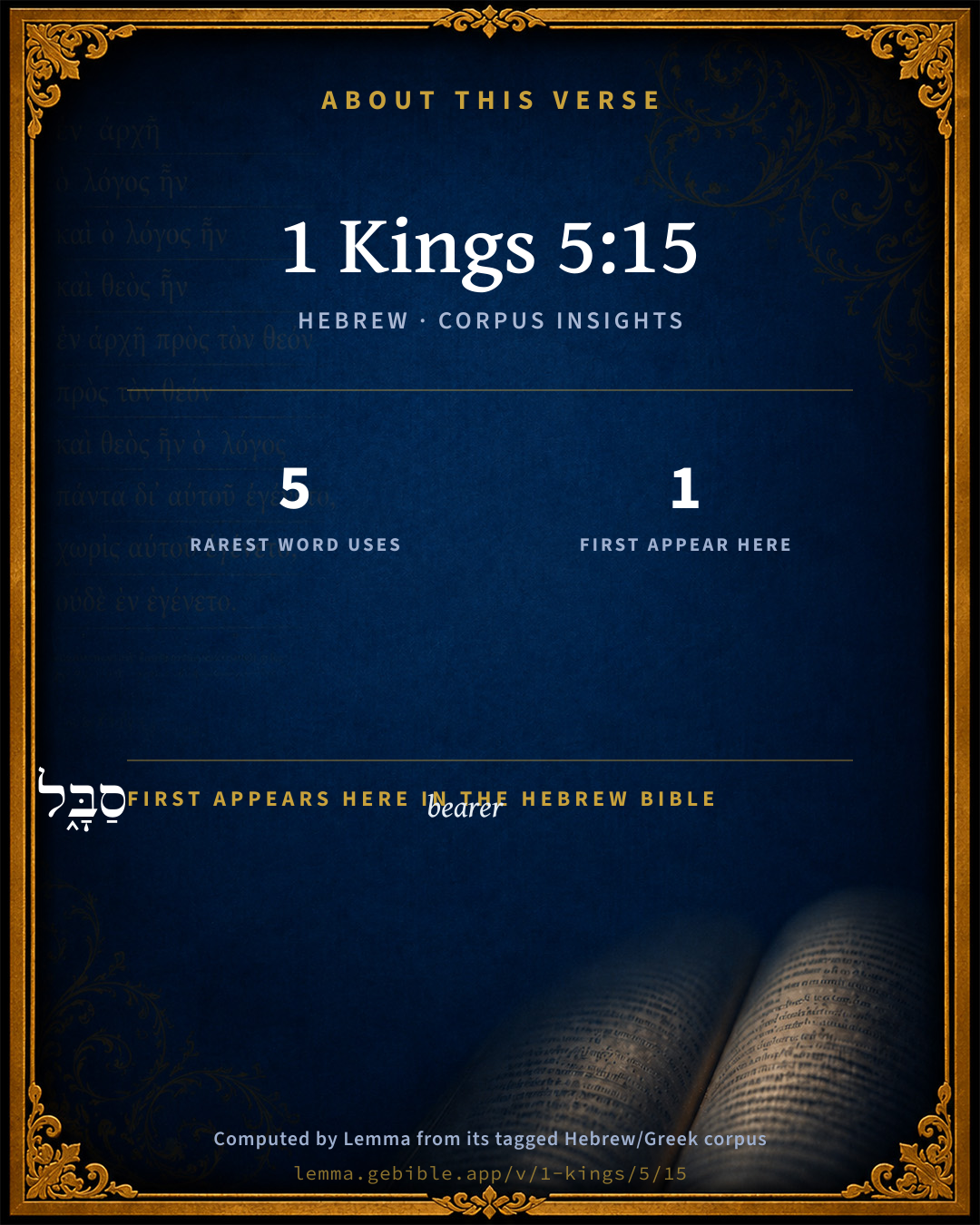
  • 1 first appearance in the Hebrew Bible
Full analysis ↓
Download a study sheet

One document with this verse’s original text, its word-by-word gloss line, the meaning frame, cross-references with their text, attributed commentary, and full source and license credits — printable, and it pastes into notes with its structure intact.

This verse Autodidact and up

Study sheet (.html) Plain text (.txt)

A passage Seminary Student

Up to 50 verses in one chapter. A passage sheet keeps up to 6 commentary sources and 12 cross-references per verse, in the order this page ranks them, and says so on the sheet whenever that leaves anything out. Ask for a single verse and you get the Autodidact verse sheet above.

Everything on this page stays free to read, with no account — the sheet is a download of what is already on screen, not access to it.

Want to remove ads? Support Godless Engineer
Compare translations 3

The same verse in 3 English versions, stacked beneath the original-language interlinear above. Click any original word for its lexicon entry.

Each is an independent rendering of the whole verse — the interlinear is not word-aligned to these translations.

Highlighted words mark where these versions differ — a whole-verse word diff, not a word-by-word alignment.

  • World English Bible Public Domain
    Solomon had seventy thousand who bore burdens, and eighty thousand who were stone cutters in the mountains;
  • King James Version Public Domain
    And Solomon had threescore and ten thousand that bare burdens, and fourscore thousand hewers in the mountains;
  • unfoldingWord Literal Text CC BY-SA 4.0
    And it was to Solomon 70,000, a carrier of a burden, and 80,000, a quarrier in the hill country,

unfoldingWord Literal Text — © unfoldingWord, licensed CC BY-SA 4.0. Word-aligned USFM3 via Door43 (git.door43.org/unfoldingWord/en_ult).

Versions to compare (up to 4)

3 of 4 selected

Show all 18 translations

Every available English version of this verse, each an independent rendering of the whole verse.

  • World English Bible Public Domain
    Solomon had seventy thousand who bore burdens, and eighty thousand who were stone cutters in the mountains;
  • Berean Standard Bible Public Domain
    Solomon had 70,000 porters and 80,000 stonecutters in the mountains,
  • Majority Standard Bible Public Domain
    Solomon had 70,000 porters and 80,000 stonecutters in the mountains,
  • King James Version Public Domain
    And Solomon had threescore and ten thousand that bare burdens, and fourscore thousand hewers in the mountains;
  • American Standard Version (1901) Public Domain
    And Solomon had threescore and ten thousand that bare burdens, and fourscore thousand that were hewers in the mountains;
  • Revised Version (1885) Public Domain
    And Solomon had threescore and ten thousand that bare burdens, and fourscore thousand that were hewers in the mountains;
  • Geneva Bible (1599) Public Domain
    And Salomon had seuentie thousand that bare burdens, and fourescore thousand masons in the mountaine,
  • Douay-Rheims (1899) Public Domain
    And Solomon had seventy thousand to carry burdens, and eighty thousand to hew stones in the mountain:
  • Young's Literal Translation Public Domain
    And king Solomon hath seventy thousand bearing burdens, and eighty thousand hewing in the mountain,
  • Literal Standard Version CC BY-SA 4.0
    And King Solomon has seventy thousand bearing burdens, and eighty thousand hewing in the mountain,
  • Unlocked Literal Bible CC BY-SA 4.0
    Solomon had seventy thousand who carried burdens and eighty thousand who were stonecutters in the mountains,
  • unfoldingWord Literal Text CC BY-SA 4.0
    And it was to Solomon 70,000, a carrier of a burden, and 80,000, a quarrier in the hill country,
  • Darby Bible Public Domain
    And Solomon had seventy thousand that bore burdens, and eighty thousand stone-masons in the mountains;
  • World Messianic Bible Public Domain
    Solomon had seventy thousand who bore burdens, and eighty thousand who were stone cutters in the mountains,
  • Webster's Bible Public Domain
    And Solomon had seventy thousand that bore burdens, and eighty thousand hewers in the mountains;
  • Free Bible Version CC BY-SA 4.0
    Solomon had 70,000 porters and 80,000 stonecutters in the hill country,
  • Bible in Basic English Public Domain
    Then he had seventy thousand for the work of transport, and eighty thousand stone-cutters in the mountains;
  • JPS Tanakh (1917) Public Domain
    (5-29) And Solomon had threescore and ten thousand that bore burdens, and fourscore thousand that were hewers in the mountains;

Literal Standard Version (2020), Covenant Press — licensed CC BY-SA 4.0. Text via the HelloAO Bible API (eBible.org). Unlocked Literal Bible (unfoldingWord) — licensed CC BY-SA 4.0. Text via the HelloAO Bible API (eBible.org). unfoldingWord Literal Text — © unfoldingWord, licensed CC BY-SA 4.0. Word-aligned USFM3 via Door43 (git.door43.org/unfoldingWord/en_ult). Free Bible Version, Dr. Jonathan Gallagher — licensed CC BY-SA 4.0. Text via the HelloAO Bible API (eBible.org).

Word by word

More ways to search: Search by grammar → Find every occurrence → Compare this word →

Practice this passage: Drill this verse → Learn its vocabulary →

About this verse

These counts appear in no published source. They are computed here, from the morphology-tagged text and Lemma’s own curated glosses. What Lemma adds →

10
words
9
distinct lemmas
Historical
section

Notable vocabulary

The rarest word here is סַבָּ֑ל bearer H5449 — appearing just 5 times in the whole Hebrew Bible.

First appearance in Scripture

This word makes its first canonical appearance in the Hebrew Bible here:

  • סַבָּ֑ל bearer H5449

Shared distinctive vocabulary

סַבָּ֑ל bearer H5449 occurs in 5 verses of the Hebrew Bible. Also found in:

Grammatical profile

  • 3 verbs
  • 3 nouns
  • 4 adjectives

Verb forms

  • וַיְהִ֧י Qal · Sequential Imperfect
  • נֹשֵׂ֣א Qal · Participle Active
  • חֹצֵ֥ב Qal · Participle Active

Repetition

A word recurs within this verse — often emphatic in Hebrew:

  • אֶ֖לֶף thousand H505 ×2

Hebrew & Septuagint length

In English translation the verse runs 17 words from the Hebrew and 17 from the Septuagint (LXX English) — the same length.

A rough comparison of the two English renderings, which tokenize alike — not a word-level alignment.

Word counts can differ between the Hebrew and the Greek without any difference in meaning — e.g. the Hebrew direct-object marker אֵת has no separate Greek word, and Greek often adds the article ὁ.

Cross-references

6

Topical passages linked to 1 Kings 5:15 in the Treasury of Scripture Knowledge — connected by theme and wording, ordered by reader-vote popularity; previews shown in the World English Bible.

  • 1 Kings 9:20–22 As for all the people who were left of the Amorites, the Hittites, the Perizzites, the Hivites, and the Jebusites, who were not of the children of Israel;
  • 2 Chronicles 2:17–18 Solomon numbered all the foreigners who were in the land of Israel, after the numbering with which David his father had numbered them; and they were found one hundred fifty-three thousand six hundred.
  • 2 Chronicles 8:7–9 As for all the people who were left of the Hittites, and the Amorites, and the Perizzites, and the Hivites, and the Jebusites, who were not of Israel;
  • Ezra 2:58 All the Nethinim, and the children of Solomon's servants, were three hundred ninety-two.
  • Nehemiah 7:57 The children of Solomon's servants: the children of Sotai, the children of Sophereth, the children of Perida,
  • Nehemiah 7:60 All the Nethinim, and the children of Solomon's servants, were three hundred ninety-two.

Cross-references courtesy of OpenBible.info (CC BY 4.0).

Hebrew and Greek witnesses Masoretic Hebrew ↔ Greek Septuagint

The same verse in the two great witnesses to the Old Testament, shown verse-for-verse.

These are two independent witnesses, not word-aligned to each other, and the Septuagint is shown in lemma (dictionary) form.

Hebrew 1 Kings 5:15 Masoretic · Westminster Leningrad Codex

וַיְהִ֧י לִשְׁלֹמֹ֛ה שִׁבְעִ֥ים אֶ֖לֶף נֹשֵׂ֣א סַבָּ֑ל וּשְׁמֹנִ֥ים אֶ֖לֶף חֹצֵ֥ב בָּהָֽר

Solomon had seventy thousand who bore burdens, and eighty thousand who were stone cutters in the mountains;

World English Bible · Public Domain

Greek LXX 1 Kings 5:15 Septuagint · lemma form

καί ἀποστέλλω χιραμ βασιλεύς τύρος ὁ παῖς αὐτός χρίω ὁ σαλωμών ἀντί δαυίδ ὁ πατήρ αὐτός ὅτι ἀγαπάω εἰμί χιραμ ὁ δαυίδ πᾶς ὁ ἡμέρα

And Solomon had seventy thousand bearers of burdens, and eighty thousand hewers of stone in the mountain;

LXX2012 (modern English Septuagint) · Public Domain

Hebrew: Westminster Leningrad Codex (CC BY 4.0). Greek: Septuagint (public domain); English from LXX2012 (modern English Septuagint) (Public Domain). How the Septuagint differs from the Hebrew →

Targum (Aramaic paraphrase)

1

The Targum is the ancient Jewish Aramaic paraphrase of the Hebrew Scriptures — an interpretive translation, not the Hebrew text itself. Onkelos (literal) and Pseudo-Jonathan (expansive) render the Torah, and Jonathan the Prophets. Coverage is partial: where no permissively-licensed English translation exists for a verse, only the Aramaic is shown. This is verse-level text, not a word-by-word alignment to the Hebrew.

  1. Targum Jonathan Prophets (Joshua–Malachi)
    וּשְׁלַח חִירָם מַלְכָּא דְצוֹר יַת עַבְדוֹהִי לְוַת שְׁלֹמֹה אֲרֵי שְׁמַע אֲרֵי יָתֵיהּ מְשַׁחוּ לְמֶהֱוֵי מַלְכָּא תְּחוֹת אֲבוּהִי אֲרֵי רְחִימָא הֲוָה חִירָם לְדָוִד כָּל יוֹמַיָא:

    (no public-domain English translation for this verse)

    Targum Jonathan — Aramaic: “Mikraot Gedolot” (public domain). English: “Sefaria Community Translation” (CC0 1.0 (public-domain dedication)); “London "Chaldee Paraphrase," 1871” (public domain). Text via Sefaria.

Commentary

Notes on 1 Kings 5:15 from classic Christian and Jewish commentators (each source and its license shown beneath its notes). The classic Christian expositions comment on the surrounding passage and are grouped to its opening verse, so a note may address several verses; the Jewish commentaries on the Tanakh (Rashi and others) are per-verse, so they appear only where the commentator wrote on this verse.

Lemma curates 59 commentaries, every one of them public domain or Creative Commons licensed, each selected and text-cleaned for this edition rather than reprinted as found. About our sources →

Trapp's Complete Commentary

John Trapp

1Ki 5:15 And Solomon had threescore and ten thousand that bare burdens, and fourscore thousand hewers in the mountains;

Ver. 15. That bare burdens.] Under which expression are also contained wagoners, mariners, horse keepers, mule drivers, &c.

Hewers in the mountains.] Hewers both of stone and of wood. Eupolemus counteth upon many more.

John Trapp, A Commentary or Exposition upon All the Books of the Old and New Testament (1647–1656) — public domain. Text from a community e-Sword module.

The Biblical Illustrator

Joseph S. Exell

1Ki_5:15

And Solomon had . . . hewers in the mountains.

The pioneers of civilisation

Alike in its building and furniture the temple of Solomon had an evangelical and a spiritual signification. Our Lord institutes analogies between Himself and the temple, and the apostles constantly refer to it as an image and a foreshadowing of the Church of Christ. There are many hewers in the mountains to-day--servants of Christ working in wild places, difficult places, distant places, so that the temple of humanity may be built up for the indwelling of God.

I. The immense importance of the initial work of the Church of Christ. These hewers in the mountains did the initial work of the temple building. They came before all masons and carpenters; in fact, the building of the glorious shrine was out of the question without the toil of these humble workers. It was so with the old civilisations with Egypt, Assyria, Persia, Greece, and Rome, they all emerged out of, were vitalised by, a spiritual faith. And it is still more clear that the modern civilisations were inspired by a spiritual faith, the faith of Christ. Out of the Gospel of God s love in Jesus Christ preached in Italy, in Greece, in Spain, in the forests of Germany, in the forests of Britain, arose the rich civilisation in which we rejoice, and in which is the hope of mankind. And as our civilisation originated in the Christian faith so it is still sustained, invigorated, and developed by spiritual life. Edgar Quinet says: Any political revolution to be permanent, must be preceded by a religious one, and here is the secret of the comparative failure of the French Revolution. And may we not add, that the success of the modern Reform movement in this country is largely owing to the fact that it was preceded by the Evangelical Revival?

II. The initial work of the Church is attended by much that appears violent and objectionable. The hewers in the mountains had rough work to do--their instruments like the axe and the crowbar, were rough, their methods were rough, and their work was announced by the thunder of the riven rock, the crash of the falling tree. Their action meant noise, dislocation, disruption, destruction. And the superfine critic of the period would turn impatiently from this scene of violence to admire the cunning work in gold, the lily work of the pillars when the temple reached a more advanced stage. So it is still. In certain stages the work of God is almost necessarily attended by much that offends the philosophic mind, the critical taste. When Christ came, He who is the Adoniram, who is over the levy of all the hewers in the mountains, what disturbances He made! He disturbed Church and State. When the apostles commenced their mission it was the same. They were aggressive, they disturbed the existing order, they troubled cities and empires, and soon awoke the protest, These that have turned the world upside down are come hither also. Luther made much noise, which has exasperated the tranquil critics--he fiercely wielded axe and hammer, and tremendous cleavages and crashes followed his blows. It was the same with Wesley; his critics objected to an enthusiasm which often meant ecclesiastical, social, and political rendings. And the evangelical worker in heathen lands has been open to the same criticism. Again and again have the missionaries been accused of violence and imprudence in one form or another. Sometimes they are accused and attacked in the interests of antiquity. The missionary is attempting ruthlessly to destroy creeds and systems, which have existed for thousands of years, and critics with a eructation for antiquity are indignant. No sooner does Gods forester lift his axe to smite some hoary error than they raise the cry, O! woodman spare that tree. But, this is the normal course of the development of the purposes of God Bring together certain chemicals and an explosion is inevitable; bring the truths of God into contact with systems of superstition and idolatry, and terrible consequences ensue--not unlikely, many even perish. In the Book of the Revelation the development of the kingdom of God is dramatised, and it expresses the fact that that kingdom comes largely through antagonisms and martyrdoms. Trumpets peal, lightnings flash, thunders boom; trees are burnt up, rivers become worm-wood, seas turn into blood, and suns and moons are darkened; the redeeming purpose of God unfolds amid battles, earthquakes, plagues, and voices. The regeneration of the earth is not to be worked out in a serene atmosphere. The time comes when civilisations grow silently, as the temple was built without hammer or axe or any tool of iron being heard in the house; but there must be the preliminary stages, when the hewers in the mountains startle and trouble by their blows and cries.

III. The initial work of the church of christ implies tremendous sacrifice. These hewers in the mountains made certain sacrifices and encountered great difficulties that Solomon might be put in possession of the stone and timber essential for his projected house. And so the temple of humanity built on the grandest pattern is possible because certain pioneers are willing deeply to deny themselves.

IV. The splendid hopefulness of this pioneer service. Out of the wild mountain these devoted hewers brought the wonderful temple. Rough, violent, forbidding as their work might seem, it at last took shape as the palace of God. The Papuans, the Polynesians, the Malays, the Amazonian Indians, the aboriginals of Africa, and other uncivilised tribes have distinct and precious powers, although mainly undeveloped. Some excel in poetry, song and music, some in the artistic sense. Richard Semon says: I dare to maintain that the love of artistic ornament is deeper and more general in the poor and naked savages of New Guinea than in ourselves. Now can we believe that all these endowments are in vain? That these peoples will be the curse of the future? If we believe in the rationality of the universe we cannot believe in anything of the kind; it is much more sane to believe that the fulness of the Gentiles will enrich and raise civilisation gloriously. The light and power of the Gospel will work the miracle and develop, uplift, and perfect all nations and tribes. Christ can see the glorious possibilities of men even when they are at their worst. Anybody knows a Rembrandt when he sees it in a sumptuous frame in the National Gallery--even if it isnt one!--but we need a fine eye to detect an immortal masterpiece on a blackened canvas, amid the dirt and lumber of a cellar. But this is the very genius of Jesus Christ, who came to seek and to save that which was lost. When we were without strength, down in a gulf of dark despair, He recognised our essential glory and stooped from heaven to lift us to the throne. And Christ has opened the eyes of His people and caused His Church to recognise the intrinsic greatness of the savage and the slave, whatever the cynic may have to say. A sculptor can see in the rough marble quarries of Carrara a world of glorious imagery, an architect can see in the wild forest of Lebanon palaces and temples, and since Christ has opened our eyes we can see in the forlorn and lapsed classes, in the outlandish and savage nations of the earth, the most splendid possibilities of life and destiny. We hear from critics of a certain sort a great deal about failure in our work, but in all directions we judge of the worth of mens efforts by their triumphs, not by their failures. Just outside Rome there is an ancient artificial mound, formed through long years by the pile of earthenware vessels in which various wares were brought to the great market of Rome, and whose fragments the peasants threw into this rubbish heap. Now if I wished to judge of the art of antiquity I should not waste my time turning over these miserable, worthless potsherds; I should study the vases, wonderful in amplitude, grace and colour, which are the jewels of museums and palaces. So we do not judge the efficacy of missions by what our critics may consider as rubbish cast into the void, but by tens of thousands of noble souls gathered into the Church of Christ, by myriads of glorified saints who are the pride of the palace of the King. (W. L. Watkinson.)

Partakers in the process share in the honour of the result

Imagine how Solomon s temple was built, that went up in Jerusalem without sound of the hammer. In the umbrageous forest of old Lebanon, many and many a day-labourer worked, cleaving and sweating, cleaving and sweating in obscurity, and wondering of what consequence all his work could be. As they toiled, day after day, at the large butt of some century-crowned cedar, with the rude instruments of their time, till at last it came down with a crash; and as they lopped off the limbs, and sawed up the vast trunk into various forms, they said to themselves, We are slaves, labouring here among the mountains unrewarded. And not far from them, in the gorge, were men that wrought in stone. In another place were workers in metal. Some did one thing, and some another; but none knew the plan of the temple, none knew what they wrought, till on a certain day, when they all trooped to Jerusalem. It was the day on which the dedication was to take place. And when they gathered there; when the hewer of wood, the carver of stone, and the worker in metal, from the various seclusions where they had wrought, each on his separate part, came together to see what had been made with all the different parts, they saw in the columns, in the cornices, in the decorations, in all the paraphernalia of the wonderful temple, the result of their toil. They stood entranced, and wondered that out of things so insignificant in the mountains, there should come such glory in Jerusalem. God has sent some to the cedar forest, some to the stone quarry, some to the dark and dank places of this world; but He is collecting materials which will glow with untold splendour in the temple that He is building for the New Jerusalem. What the issue of life is to be you cannot tell now; but you are working for God, and with God, and according to Gods plans; and ere long you will be summoned to see the result of all your work. Before that time, you cannot tell what that result is to be. (H. W. Beecher.)

Scope for every faculty in Christs service

It is impossible to find in one man a summary of all qualifications; take each one in his own sphere and you will discover a vast variety of gifts--there is the polished scholar, the eagle-eyed critic, the eloquent orator, and we ought to recognise and appreciate the ability of each. Do you depreciate the sun because he is destitute of fragrance? Do you undervalue the rose because no light flashes from its leaf of beauty. So each man has his own style of working, and is never so effective as when he is natural. A recognition of this fact will save us from passing adverse criticism upon any individual if he is diligent in cultivating the different gifts God has given into his possession. (R. Venting.)

Men of many types used in the work of God

How many have aided in the erection of Christs spiritual temple? Keenest intellects have toiled, noblest hearts have planned, sweetest, purest lives have been lived in this sublime effort. O varied workers! Paul, with his relentless, flaming logic. John, with eagle eye, scanning and then writing of the future and the past. Augustine, with his pauseless, countless toffs of pen and speech. Chrysostom consecrating his golden eloquence to themes of transcendent and golden worth. Bede labouring on our own northern shore, and in making the blessed Gospel accessible to the Saxon people, finding the last dear service of his parting breath. Luther, with his strong human tenderness and unquailing knowledge. Calvin, with his severe purity and indomitable industry. Latimer, with his home-siren, ready, and racy heart-compelling speech. Bunyan, that true Greatheart of countless pilgrims. Wesley, that statesman. Whitefield, that captain of preachers. And what more shall I say? Time would fail me to tell of the great preachers and teachers with voice and pen who have lived to win souls to Christ. If His service can be ennobled by human associations, it is ennobled by such names as these. Let us be worthy of them. (G. T. Coster.)

The Biblical Illustrator, edited by Joseph S. Exell (c. 1880s–1900s) — public domain. Text from a community e-Sword module.

Joseph Benson's Commentary

1Ki 5:15-16. That bare burdens — Namely, porters, carters, seamen, and such like. Fourscore thousand hewers in the mountains — That is, hewers of stone, for timber was hewed by Hiram’s servants in Lebanon. Officers over the work three thousand three hundred — Whereof three thousand were set over the one hundred and fifty thousand mentioned 1Ki 5:15, each of these over fifty of them, and the odd three hundred were set over these three thousand; each of them to have the oversight of ten, to take an account of the work from them. But in 2Ch 2:18, these overseers are said to be three thousand six hundred. The three hundred added in 2 Chronicles 2. might be a reserve to supply the places of the other three thousand; yea, or of the three thousand six hundred, as any of them should be taken off from the work by death, or sickness, or weakness, or any necessary occasion; which was a prudent provision, and not unusual in like cases. And so there were three thousand six hundred commissioned for the work, but only three thousand three hundred employed at one time; and therefore both computations fairly stand together.

Joseph Benson's Commentary on the Old and New Testaments (1811–1818) — public domain. Text from a community e-Sword module.

Adam Clarke's Commentary

Verse 15. Threescore and ten thousand that bare burdens] These were all strangers, or proselytes, dwelling among the Israelites; as we learn from the parallel place, 1Kg 2:17-18.

Adam Clarke's Commentary on the Bible (1810–1826) — public domain. Text from a community e-Sword/MySword module.

The Cambridge Bible for Schools and Colleges

gen. ed. J. J. S. Perowne

15. threescore and ten thousand that bare burdens] The Chronicler (2Ch_2:17) points out that these 70,000 were of the strangers that dwelt in the land of Israel. These the king compelled to do the harder and more menial work, and the whole number of these non-Israelites was called out for work. Their number is stated in Chronicles to have been 153,600; of these 70,000 were bearers of burdens, 80,000 hewers in the mountains and the other 3600 (see Chronicles l. c.) were overseers to set the people a-work.

The Cambridge Bible for Schools and Colleges (gen. ed. J. J. S. Perowne; Cambridge University Press, 1878–1918) — public domain. Text from a community e-Sword module.

John Gill's Exposition

And Solomon had threescore and ten thousand that bare burdens,.... Seventy thousand to carry the stones from the mountains out of which they were dug, and which were near Jerusalem, to the city; these were strangers in Israel, as were those that follow:

and fourscore thousand hewers in the mountains: eighty thousand that dug the stones out of the quarries, and squared them; these, with the others, made 150,000, see Ch2 2:17; according to Jacob Leon (g), the number of workmen at the temple for seven years was 163,600, and some make them more.

(g) Relation of Memorable Things in the Temple, ch. 3. p. 14.

John Gill's Exposition of the Whole Bible (1746–1763) — public domain (CC PDM 1.0). Text via the HelloAO Bible API.

Albert Barnes' Notes on the Bible

That bare burdens ... - Compare the marginal references. These laborers, whose services were continuous, consisted of “strangers” - “the people that were left of the Amorites, Hittites, Perizzites, Hivites, and Jebusites” - whom Solomon, following the example of his father 1Ch 22:2, condemned to slavery, and employed in this way.

Albert Barnes' Notes on the Bible (1834–1885) — public domain. Text from a community e-Sword/MySword module.

Haydock's Catholic Bible Commentary

Mountain of Libanus. (Calmet) --- Paralipomenon mountains: but the Hebrew is singular in both places. They were all proselytes or strangers.

George Leo Haydock (1774–1849), Haydock's Catholic Family Bible and Commentary, 1859 edition — public domain. Excludes Psalms (Douay-Rheims chapter numbering differs from Protestant) and Deuterocanonical books (Catholic canon only).

Matthew Poole's English Annotations

Either of timber, or rather of stones; for Hiram had taken care of the timber.

Matthew Poole's English Annotations on the Holy Bible (1683–1685) — public domain. Text from a community e-Sword/MySword module.

Whedon's Commentary on the Bible

Daniel D. Whedon

15. Threescore and ten thousand — These, and the others mentioned in this verse and the following, were not Israelites, but foreigners dwelling in the land. The whole number, according to 2Ch_2:17, was 153,600. Of these 70,000 bare burdens, 80,000 were hewers, and the remaining 3,600 were overseers of the others’ work, thus making one overseer to about every forty men.

Daniel D. Whedon (gen. ed.), Commentary on the Old and New Testaments (1874–1909) — public domain. Text from a community e-Sword module.

The Pulpit Commentary

And Solomon had threescore and ten thousand that bare burdens, and fourscore thousand hewers in the mountains. These 150, 000, destined for the more laborious and menial works, were not Israelites, but Canaanites. We learn from 2Ch_2:17, 18 that "all the strangers that were in the land of Israel" were subjected to forced labour by Solomon there were, that is to say, but 150, 000 of them remaining. They occupied a very different position from that of the 30, 000 Hebrews. None of the latter were reduced to bondage, (1Ki_9:22) while the former had long been employed in servile work. The Gibeonites were reduced to serfdom by Joshua, (Jos_9:27) and the rest of the Canaanites as they were conquered (Jos_6:10 Jos_17:13; Jud 1:29, 30) In 1Ch_22:2, we find some of them employed on public works by David. By the "hewers" many commentators have supposed that stonecutters alone are intended (so Jos., Ant., 8:2. 9) partly because stone is mentioned presently, and partly because bxj is mostly used of the quarrying or cutting of stone, as in Deu_6:11 Deu_8:9; 2Ki_12:12, etc. Gesenius understands the word both of stone and wood cutters. But is it not probable that the latter alone are indicated? That the word is sometimes used of woodcutting Isa_10:15 shows. Andthe words, in the mountain (rhB) almost compel us so to understand it here. "The mountain" must be Lebanon. But surely the stone was not transported, to any great extent, like the wood, so great a distance over land and sea, especially when it abounded on the spot. (The tradition that the stone was quarried at Baalbek is quite unworthy of credence. It has no doubt sprung from the huge stones found there. "The temple was built of the beautiful white stone of the country, the hard missal (Warren, p. 60.) It is true the number of wood cutters would thus appear to be very great, but it is to be remembered how few comparatively were the appliances or machines of those days: almost everything must be done by manual labour. And Pliny tells us that no less than 360, 000 men were employed for twenty years on one of the pyramids. It is possible, however, that the huge foundations mentioned below (ver. 17) were brought from Lebanon.

The Pulpit Commentary (1880–1919), ed. H.D.M. Spence-Jones & Joseph S. Exell — public domain. Text from a community e-Sword module.

Keil & Delitzsch

C. F. Keil & F. Delitzsch

And Solomon had 70,000 bearers of burdens and 80,000 hewers of stone on the mountains (of Lebanon). חצב is understood by the older translators as referring simply to hewers of stone. This is favoured both by the context, since Kg1 5:18 speaks of stone-mason's work, and also by the usage of the language, inasmuch as חצב is mostly applied to the quarrying and cutting of stones (Deu 6:11; Isa 5:2; Pro 9:1; Kg2 12:13), and only occurs in Isa 10:15 in connection with the cutting of wood. The hewing and preparing of the wood were amply provided for by 30,000 Israelites. That the 150,000 bearers of burdens and hewers of stone were not taken from the Israelites, is evident from the fact that they are distinguished from the latter, or at all events are not described as Israelites. We obtain certainty on this point from the parallel passages, Kg1 9:20-21; Ch2 2:16-17, and Ch2 8:1-9, according to which Solomon pressed the Canaanites who were left in the land to this bond-service.

Keil & Delitzsch — Biblical Commentary on the Old Testament (1861–1891) — public domain (CC PDM 1.0). Text via the HelloAO Bible API. (Old Testament only.)

unfoldingWord translationNotes

Door43 World Missions Community

General Information:

Solomon continues to force men to build the Temple.

seventy thousand

"70,000" (See: Numbers)

burdens

heavy things that people have to work hard to carry

eighty thousand

"80,000" (See: Numbers)

stonecutters

men who dig stones out of the ground and cut them to the proper shape

3,300 chief officers

"three thousand three hundred chief officers" (See: Numbers)

translationWords

works

unfoldingWord translationNotes — © Distant Shores Media and the Door43 World Missions Community, licensed CC BY-SA 4.0. Source: git.door43.org/Door43/en_tn.

Lesson kit

Teaching starters — assembled from the data on this page, not authored interpretation. Every prompt links to the verse data it draws on. Edit before teaching.

1 Kings, in the Historical, opens this verse with 10 words (9 distinct Hebrew lemmas). Its most distinctive word is çabbâl (“bearer”). A historical commentator’s framing appears above. Read the whole chapter for the surrounding context.

Discussion questions

  1. What does “bearer” (çabbâl) contribute to the verse as a whole?
  2. The word “bearer” first appears here in Scripture. What is being introduced at this debut?
  3. 2 Chronicles 2:2 shares the word «bearer» with this verse. How do the two illuminate each other?
  4. “thousand” occurs 2× in this one verse. What is the effect of the repetition?
  5. These translations render this verse differently; the difference is in the English rendering, not the original. What questions does that raise?
  6. The verb «וַיְהִ֧י» is Qal Sequential Imperfect. How does its form color the action?
  7. Reading how Trapp's Complete Commentary and The Biblical Illustrator read this verse, where do the two commentators agree and where do they part?

Things to notice

  • 1 word makes its first canonical appearance in Scripture here.
  • These translations choose different wording for 22 words in this verse.
  • “thousand” occurs 2× in this single verse.
  • 9 distinct Hebrew lemmas span 10 words in this verse.

Reading settings

Reading text

Shown beneath each verse's original-language words.

Old Testament
Old Testament edition

Read the OT as the Masoretic Hebrew (MT) or the Greek Septuagint (LXX).

English shown for the Greek Septuagint (in the Hebrew ↔ Greek comparison).

Comparing translations? Open the Compare panel on any verse page to stack up to four side by side.