Psalms 50:16

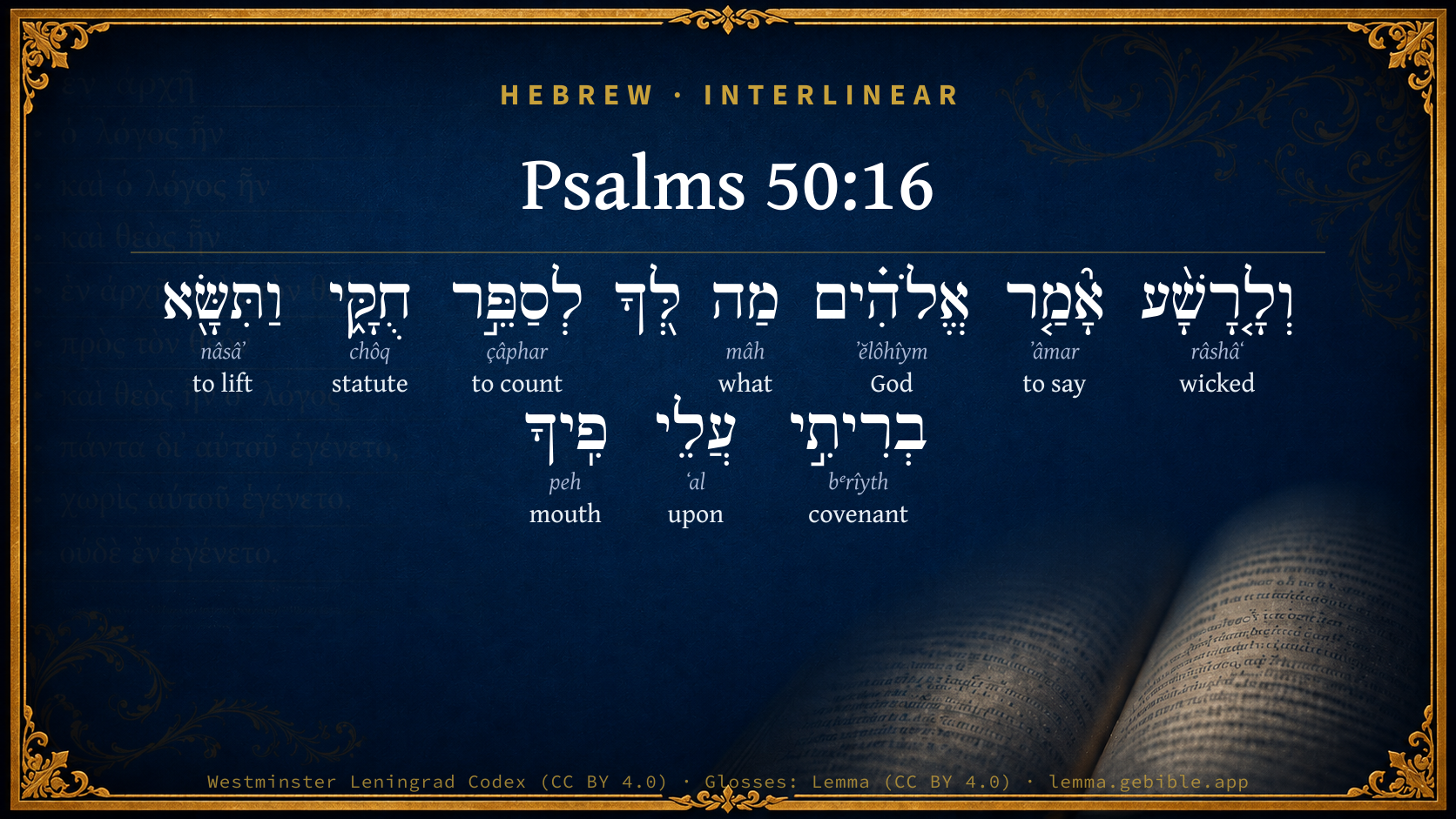
Hebrew (Westminster Leningrad Codex) Psalms 50:16 appears in the Hebrew Old Testament. The text above is from the Westminster Leningrad Codex. Each word links to its Strong’s number, a concise gloss, and parsing drawn from the Open Scriptures Hebrew Bible morphology. Click any word for its full Brown-Driver-Briggs (BDB) entry.
Download image
Cite this verse

Psalms 50:16 (World English Bible). Public Domain. Lemma interlinear Bible study tool, https://lemma.gebible.app/v/psalms/50/16.

Show BibTeX & RIS
BibTeX
RIS
English Translation
But to the wicked God says, "What right do you have to declare my statutes, That you have taken my covenant on your lips,
World English Bible · Public Domain
Download a study sheet

One document with this verse’s original text, its word-by-word gloss line, the meaning frame, cross-references with their text, attributed commentary, and full source and license credits — printable, and it pastes into notes with its structure intact.

This verse Autodidact and up

Study sheet (.html) Plain text (.txt)

A passage Seminary Student

Up to 50 verses in one chapter. A passage sheet keeps up to 6 commentary sources and 12 cross-references per verse, in the order this page ranks them, and says so on the sheet whenever that leaves anything out. Ask for a single verse and you get the Autodidact verse sheet above.

Everything on this page stays free to read, with no account — the sheet is a download of what is already on screen, not access to it.

Want to remove ads? Support Godless Engineer
Compare translations 3

The same verse in 3 English versions, stacked beneath the original-language interlinear above. Click any original word for its lexicon entry.

Each is an independent rendering of the whole verse — the interlinear is not word-aligned to these translations.

Highlighted words mark where these versions differ — a whole-verse word diff, not a word-by-word alignment.

  • World English Bible Public Domain
    But to the wicked God says, "What right do you have to declare my statutes, That you have taken my covenant on your lips,
  • King James Version Public Domain
    But unto the wicked God saith, What hast thou to do to declare my statutes, or that thou shouldest take my covenant in thy mouth?
  • unfoldingWord Literal Text CC BY-SA 4.0
    But to the wicked God says, “What to you to recount my statutes, or that you should lift up my covenant onto your mouth?

unfoldingWord Literal Text — © unfoldingWord, licensed CC BY-SA 4.0. Word-aligned USFM3 via Door43 (git.door43.org/unfoldingWord/en_ult).

Versions to compare (up to 4)

3 of 4 selected

Show all 18 translations

Every available English version of this verse, each an independent rendering of the whole verse.

  • World English Bible Public Domain
    But to the wicked God says, "What right do you have to declare my statutes, That you have taken my covenant on your lips,
  • Berean Standard Bible Public Domain
    To the wicked, however, God says, “What right have you to recite My statutes and to bear My covenant on your lips?
  • Majority Standard Bible Public Domain
    To the wicked, however, God says, “What right have you to recite My statutes and to bear My covenant on your lips?
  • King James Version Public Domain
    But unto the wicked God saith, What hast thou to do to declare my statutes, or that thou shouldest take my covenant in thy mouth?
  • American Standard Version (1901) Public Domain
    But unto the wicked God saith, What hast thou to do to declare my statutes, And that thou hast taken my covenant in thy mouth,
  • Revised Version (1885) Public Domain
    But unto the wicked God saith, What hast thou to do to declare my statutes; and that thou hast taken my covenant in thy mouth?
  • Geneva Bible (1599) Public Domain
    But vnto the wicked said God, What hast thou to doe to declare mine ordinances, that thou shouldest take my couenant in thy mouth,
  • Douay-Rheims (1899) Public Domain
    But to the sinner God hath said: Why dost thou declare my justices, and take my covenant in thy mouth?
  • Young's Literal Translation Public Domain
    And to the wicked hath God said: What to thee -- to recount My statutes? That thou liftest up My covenant on thy mouth?
  • Literal Standard Version CC BY-SA 4.0
    And to the wicked God has said: What to you—to recount My statutes? That you lift up My covenant on your mouth?
  • Unlocked Literal Bible CC BY-SA 4.0
    But to the wicked God says, “What have you to do with declaring my statutes, that you have taken my covenant in your mouth,
  • unfoldingWord Literal Text CC BY-SA 4.0
    But to the wicked God says, “What to you to recount my statutes, or that you should lift up my covenant onto your mouth?
  • Darby Bible Public Domain
    But unto the wicked God saith, What hast thou to do to declare my statutes, or that thou shouldest take my covenant into thy mouth,
  • World Messianic Bible Public Domain
    But to the wicked God says, “What right do you have to declare my statutes, that you have taken my covenant on your lips,
  • Webster's Bible Public Domain
    But to the wicked God saith, What hast thou to do to declare my statutes, or that thou shouldest take my covenant in thy mouth?
  • Free Bible Version CC BY-SA 4.0
    But to the wicked God says, “What's the point of mechanically repeating my laws or making empty promises about obeying the agreement?
  • Bible in Basic English Public Domain
    But to the sinner, God says, What are you doing, talking of my laws, or taking the words of my agreement in your mouth?
  • JPS Tanakh (1917) Public Domain
    But unto the wicked God saith: 'What hast thou to do to declare My statutes, and that thou hast taken My covenant in thy mouth?

Literal Standard Version (2020), Covenant Press — licensed CC BY-SA 4.0. Text via the HelloAO Bible API (eBible.org). Unlocked Literal Bible (unfoldingWord) — licensed CC BY-SA 4.0. Text via the HelloAO Bible API (eBible.org). unfoldingWord Literal Text — © unfoldingWord, licensed CC BY-SA 4.0. Word-aligned USFM3 via Door43 (git.door43.org/unfoldingWord/en_ult). Free Bible Version, Dr. Jonathan Gallagher — licensed CC BY-SA 4.0. Text via the HelloAO Bible API (eBible.org).

Word by word

More ways to search: Search by grammar → Find every occurrence → Compare this word →

Practice this passage: Drill this verse → Learn its vocabulary →

חֻקָּ֑י
chôq
H2706
“statutes · my”
Noun, Common, Masculine, Plural, Construct + Suffix, Personal, 1st Person, Common, Singular
Part of Speech
Noun
Type
Common
Gender
Masculine
Number
Plural
State
Construct
Full BDB Definition

Origin: from H2710

TWOT: 728a

statute, ordinance, limit, something prescribed, due - prescribed task - prescribed portion - action prescribed (for oneself), resolve - prescribed due - prescribed limit, boundary - enactment, decree, ordinance - specific decree - law in general - enactments, statutes - conditions - enactments - decrees - civil enactments prescribed by God
  1. וְלָ֤רָשָׁ֨ע râshâʻ H7563 “and · to/for the · wicked” Conjunction + Preposition, Determined + Adjective, Adjective, Masculine, Singular, Absolute
  2. אָ֘מַ֤ר ʼâmar H559 “to say” Verb, Qal, Perfect, 3rd Person, Masculine, Singular
  3. אֱלֹהִ֗ים ʼĕlôhîym H430 “God(s)” Noun, Common, Masculine, Plural, Absolute
  4. מַה mâh H4100 “what” Particle, Interrogative
  5. לְסַפֵּ֣ר çâphar H5608 “to count” Preposition + Verb, Piel, Infinitive Construct
  6. וַתִּשָּׂ֖א nâsâʼ H5375 “and · to lift” Conjunction + Verb, Qal, Sequential Imperfect, 2nd Person, Masculine, Singular
  7. בְרִיתִ֣י bᵉrîyth H1285 “covenant · my” Noun, Common, Feminine, Singular, Construct + Suffix, Personal, 1st Person, Common, Singular
  8. עֲלֵי ʻal H5921 “upon” Preposition
  9. פִֽיךָ peh H6310 “mouth · your” Noun, Common, Masculine, Singular, Construct + Suffix, Personal, 2nd Person, Masculine, Singular

About this verse

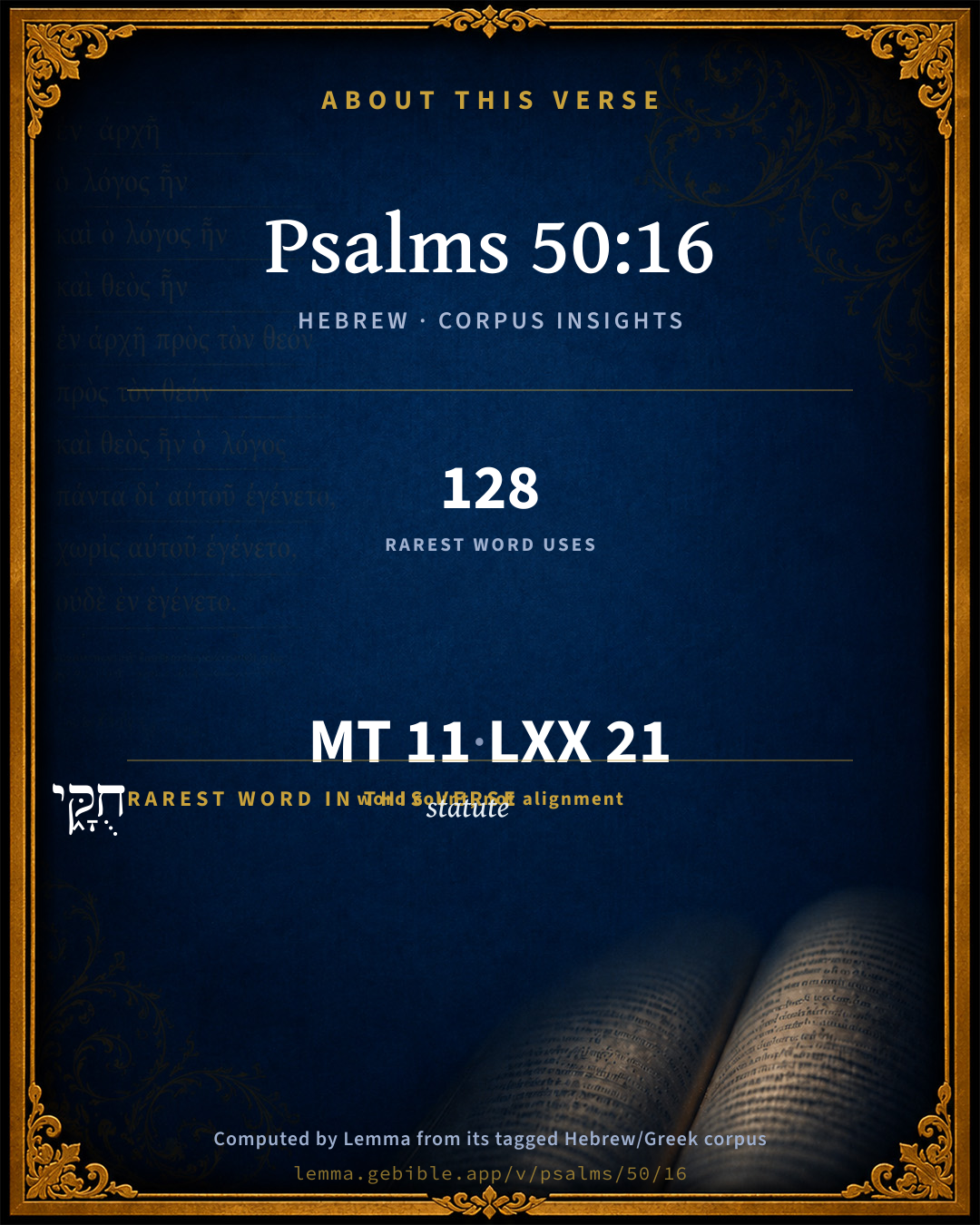
These counts appear in no published source. They are computed here, from the morphology-tagged text and Lemma’s own curated glosses. What Lemma adds →

11
words
10
distinct lemmas
Wisdom
section

Grammatical profile

  • 3 verbs
  • 4 nouns
  • 1 adjective
  • 2 prepositions
  • 1 particle

Verb forms

  • אָ֘מַ֤ר Qal · Perfect
  • לְסַפֵּ֣ר Piel · Infinitive Construct
  • וַתִּשָּׂ֖א Qal · Sequential Imperfect

Hebrew & Septuagint length

In English translation the verse runs 24 words from the Hebrew and 21 from the Septuagint (LXX English) — closely comparable.

A rough comparison of the two English renderings, which tokenize alike — not a word-level alignment.

Word counts can differ between the Hebrew and the Greek without any difference in meaning — e.g. the Hebrew direct-object marker אֵת has no separate Greek word, and Greek often adds the article ὁ.

In the original languages it is 11 Hebrew tokens and 21 Greek tokens — but the two are counted differently (Hebrew bundles its prefixes and suffixes into one token; the Greek is in lemma form), so that isn’t a like-for-like length.

Cross-references

20

Topical passages linked to Psalms 50:16 in the Treasury of Scripture Knowledge — connected by theme and wording, ordered by reader-vote popularity; previews shown in the World English Bible.

  • Isaiah 29:13 The Lord said, Because this people draw near [to me], and with their mouth and with their lips to honor me, but have removed their heart far from me, and their fear of me is a commandment of men which has been taught [them];
  • Psalms 25:14 The friendship of Yahweh is with those who fear him. He will show them his covenant.
  • Psalms 78:36–38 But they flattered him with their mouth, And lied to him with their tongue.
  • Isaiah 55:6–7 Seek you Yahweh while he may be found; call you on him while he is near:
  • Romans 2:17–24 Indeed you bear the name of a Jew, and rest on the law, and glory in God,
  • Isaiah 48:1–2 Hear you this, house of Jacob, who are called by the name of Israel, and are come forth out of the waters of Judah; who swear by the name of Yahweh, and make mention of the God of Israel, but not in truth, nor in righteousness
  • Hebrews 8:9 Not according to the covenant that I made with their fathers, In the day that I took them by the hand to lead them out of the land of Egypt; For they didn't continue in my covenant, And I disregarded them," says the Lord.
  • Proverbs 26:7 Like the legs of the lame that hang loose: So is a parable in the mouth of fools.
  • Isaiah 1:11–15 "What are the multitude of your sacrifices to me?," says Yahweh. "I have had enough of the burnt offerings of rams, And the fat of fed animals. I don't delight in the blood of bulls, Or of lambs, Or of male goats.
  • John 4:24 God is spirit, and those who worship him must worship in spirit and truth."
  • 2 Peter 2:15 forsaking the right way, they went astray, having followed the way of Balaam the son of Beor, who loved the wages of wrong-doing;
  • Isaiah 48:22 There is no peace, says Yahweh, to the wicked.
  • Isaiah 58:1–7 Cry aloud, don't spare, lift up your voice like a trumpet, and declare to my people their disobedience, and to the house of Jacob their sins.
  • Jeremiah 7:4–7 Don't you trust in lying words, saying, The temple of Yahweh, the temple of Yahweh, the temple of Yahweh, are these.
  • Ezekiel 18:27 Again, when the wicked man turns away from his wickedness that he has committed, and does that which is lawful and right, he shall save his soul alive.
  • Ezekiel 20:37–38 I will cause you to pass under the rod, and I will bring you into the bond of the covenant;
  • Matthew 7:3–5 Why do you see the speck that is in your brother's eye, but don't consider the beam that is in your own eye?
  • Matthew 7:22–23 Many will tell me in that day, 'Lord, Lord, didn't we prophesy in your name, in your name cast out demons, and in your name do many mighty works?'
  • Acts 19:13–16 But some of the itinerant Jews, exorcists, took on themselves to name over those who had the evil spirits the name of the Lord Jesus, saying, "We adjure you by Jesus whom Paul preaches."
  • 1 Corinthians 9:27 but I beat my body and bring it into submission, lest by any means, after I have preached to others, I myself should be rejected.

Cross-references courtesy of OpenBible.info (CC BY 4.0).

Hebrew and Greek witnesses Masoretic Hebrew ↔ Greek Septuagint

The same verse in the two great witnesses to the Old Testament, shown verse-for-verse.

You’re reading Greek Psalm 49 (Hebrew Psalm 50). The Septuagint counts the superscription, so verse numbers can differ from the Hebrew — chapter-level alignment, not verse-by-verse. Numbering follows Rahlfs.

These are two independent witnesses, not word-aligned to each other, and the Septuagint is shown in lemma (dictionary) form.

Hebrew Psalms 50:16 Masoretic · Westminster Leningrad Codex

וְלָ֤רָשָׁ֨ע אָ֘מַ֤ר אֱלֹהִ֗ים מַה לְּ֭ךָ לְסַפֵּ֣ר חֻקָּ֑י וַתִּשָּׂ֖א בְרִיתִ֣י עֲלֵי פִֽיךָ

But to the wicked God says, "What right do you have to declare my statutes, That you have taken my covenant on your lips,

World English Bible · Public Domain

Greek LXX Greek Psalm 49:16 Septuagint · lemma form

ὁ δέ ἁμαρτωλός εἶπον ὁ θεός ἵνα τίς σύ διαἡγέομαι ὁ δικαίωμα ἐγώ καί ἀναλαμβάνω ὁ διαθήκη ἐγώ διά στόμα σύ

But to the sinner God has said, Why do you declare my ordinances, and take up my covenant in your mouth?

LXX2012 (modern English Septuagint) · Public Domain

On this verse, Keil & Delitzsch discusses the Septuagint’s reading. Read the note in Commentary ↓

Hebrew: Westminster Leningrad Codex (CC BY 4.0). Greek: Septuagint (public domain); English from LXX2012 (modern English Septuagint) (Public Domain). How the Septuagint differs from the Hebrew →

Commentary

Notes on Psalms 50:16 from classic Christian and Jewish commentators (each source and its license shown beneath its notes). The classic Christian expositions comment on the surrounding passage and are grouped to its opening verse, so a note may address several verses; the Jewish commentaries on the Tanakh (Rashi and others) are per-verse, so they appear only where the commentator wrote on this verse.

Lemma curates 59 commentaries, every one of them public domain or Creative Commons licensed, each selected and text-cleaned for this edition rather than reprinted as found. About our sources →

Matthew Henry's Commentary

God, by the psalmist, having instructed his people in the right way of worshipping him and keeping up their communion with him, here directs his speech to the wicked, to hypocrites, whether they were such as professed the Jewish or the Christian religion: hypocrisy is wickedness for which God will judge. Observe here,

I. The charge drawn up against them. 1. They are charged with invading and usurping the honours and privileges of religion (Psa 50:16): What has thou to do, O wicked man! to declare my statutes? This is a challenge to those that rare really profane, but seemingly godly, to show what title they have to the cloak of religion, and by what authority they wear it, when they use it only to cover and conceal the abominable impieties of their hearts and lives. Let them make out their claim to it if they can. Some think it points prophetically at the scribes and Pharisees that were the teachers and leaders of the Jewish church at the time when the kingdom of the Messiah, and that evangelical way of worship spoken of in the foregoing verses, were to be set up. They violently opposed that great revolution, and used all the power and interest which they had by siting in Moses's seat to hinder it; but the account which our blessed Saviour gives of them (Mt. 23), and St. Paul (Rom 2:21, Rom 2:22), makes this expostulation here agree very well to them. They took on them to declare God's statues, but they hated Christ's instruction; and therefore what had they to do to expound the law, when they rejected the gospel? But it is applicable to all those that are practicers of iniquity, and yet professors of piety, especially if withal they be preachers of it. Note, It is very absurd in itself, and a great affront to the God of heaven, for those that are wicked and ungodly to declare his statutes and to take his covenant in their mouths. It is very possible, and too common, for those that declare God's statutes to others to live in disobedience to them themselves, and for those that take God's covenant in their mouths yet in their hearts to continue their covenant with sin and death; but they are guilty of a usurpation, they take to themselves an honour which they have no title to, and there is a day coming when they will be thrust out as intruders. Friend, how camest thou in hither? 2. They are charged with transgressing and violating the laws and precepts of religion. (1.) They are charged with a daring contempt of the word of God (Psa 50:17): Thou hatest instruction. They loved to give instruction, and to tell others what they should do, for this fed their pride and made them look great, and by this craft they got their living; but they hated to receive instruction from God himself, for that would be a check upon them and a mortification to them. "Thou hatest discipline, the reproofs of the word and the rebukes of Providence." No wonder that those who hate to be reformed hate the means of reformation. Thou castest my words behind thee. They seemed to set God's words before them, when they sat in Moses's seat, and undertook to teach others out of the law (Rom 2:19); but in their conversations they cast God's word behind them, and did not care for seeing that rule which they were resolved not to be ruled by. This is despising the commandment of the Lord. (2.) A close confederacy with the worst of sinners (Psa 50:18): "When thou sawest a thief, instead of reproving him and witnessing against him, as those should do that declare God's statutes, thou consentedst with him, didst approve of his practices, and desire to be a partner with him and to share in the profits of his cursed trade; and thou hast been partaker with adulterers, hast done as they did, and encouraged them to go on in their wicked courses, hast done these things and hast had pleasure in those that do them," Rom 1:32. (3.) A constant persisting in the worst of tongue-sins (Psa 50:19): "Thou givest thy mouth to evil, not only allowest thyself in, but addictest thyself wholly to, all manner of evil-speaking." [1.] Lying: Thy tongue frames deceit, which denotes contrivance and deliberation in lying. It knits or links deceit, so some. One lie begets another, and one fraud requires another to cover it. [2.] Slandering (Psa 50:20): "Thou sittest, and speakest against thy brother, dost basely abuse and misrepresent him, magisterially judge and censure him, and pass sentence upon him, as if you wert his master to whom he must stand or fall, whereas he is thy brother, as good as thou art, and upon the level with thee, for he is thy own mother's son. He is thy near relation, whom thou oughtest to love, to vindicate, and stand up for, if others abused him; yet thou dost thyself abuse him, whose faults thou oughtest to cover and make the best of; if really he had done amiss, yet thou dost most falsely and unjustly charge him with that which he is innocent of; thou sittest and doest this, as a judge upon the bench, with authority; thou sittest in the seat of the scornful, to deride and backbite those whom thou oughtest to respect and be kind to." Those that do ill themselves commonly delight in speaking ill of others.

II. The proof of this charge (Psa 50:21): "These things thou hast done; the fact is too plain to be denied, the fault too bad to be excused; these things God knows, and thy own heart knows, thou hast done." The sins of sinners will be proved upon them, beyond contradiction, in the judgment of the great day: "I will reprove thee, or convince thee, so that thou shalt have not one word to say for thyself." The day is coming when impenitent sinners will have their mouths for ever stopped and be struck speechless. What confusion will they be filled with when God shall set their sins in order before their eyes! They would not see their sins to their humiliation, but cast them behind their backs, covered them, and endeavoured to forget them, nor would they suffer their own consciences to put them in mind of them; but the day is coming when God will make them see their sins to their everlasting shame and terror; he will set them in order, original sin, actual sins, sins against the law, sins against the gospel, against the first table, against the second table, sins of childhood and youth, of riper age, and old age. He will set them in order, as the witnesses are set in order, and called in order, against the criminal, and asked what they have to say against him.

III. The Judge's patience, and the sinner's abuse of that patience: "I kept silence, did not give thee any disturbance in thy sinful way, but let thee alone to take thy course; sentence against thy evil works was respited, and not executed speedily." Note, The patience of God is very great towards provoking sinners. He sees their sins and hates them; it would be neither difficulty nor damage to him to punish them, and yet he waits to be gracious and gives them space to repent, that he may render them inexcusable if they repent not. His patience is the more wonderful because the sinner makes such an ill use of it: "Thou thoughtest that I was altogether such a one as thyself, as weak and forgetful as thyself, as false to my word as thyself, nay, as much a friend to sin as thyself." Sinners take God's silence for consent and his patience for connivance; and therefore the longer they are reprieved the more are their hearts hardened; but, if they turn not, they shall be made to see their error when it is too late, and that the God they provoke is just, and holy, and terrible, and not such a one as themselves.

IV. The fair warning given of the dreadful doom of hypocrites (Psa 50:22): "Now consider this, you that forget God, consider that God knows and keeps account of all your sins, that he will call you to an account for them, that patience abused will turn into the greater wrath, that though you forget God and your duty to him he will not forget you and your rebellions against him: consider this in time, before it be too late; for if these things be not considered, and the consideration of them improved, he will tear you in pieces, and there will be none to deliver." It is the doom of hypocrites to be cut asunder, Mat 24:51. Note, 1. Forgetfulness of God is at the bottom of all the wickedness of the wicked. Those that know God, and yet do not obey him, do certainly forget him. 2. Those that forget God forget themselves; and it will never be right with them till they consider, and so recover themselves. Consideration is the first step towards conversion. 3. Those that will not consider the warnings of God's word will certainly be torn in pieces by the executions of his wrath. 4. When God comes to tear sinners in pieces, there is no delivering them out of his hand. They cannot deliver themselves, nor can any friend they have in the world deliver them.

V. Full instructions given to us all how to prevent this fearful doom. Let us hear the conclusion of the whole matter; we have it, Psa 50:23, which directs us what to do that we may attain our chief end. 1. Man's chief end is to glorify God, and we are here told that whoso offers praise glorifies him; whether he be Jew or Gentile, those spiritual sacrifices shall be accepted from him. We must praise God, and we must sacrifice praise, direct it to God, as every sacrifice was directed; put it into the hands of the priest, our Lord Jesus, who is also the altar; see that it be made by fire, sacred fire, that it be kindled with the flame of holy and devout affection; we must be fervent in spirit, praising the Lord. This he is pleased, in infinite condescension, to interpret as glorifying him. Hereby we give him the glory due to his name and do what we can to advance the interests of his kingdom among men. 2. Man's chief end, in conjunction with this, is to enjoy God; and we are here told that those who order their conversation aright shall see his salvation. (1.) It is not enough for us to offer praise, but we must withal order our conversation aright. Thanksgiving is good, but thanks-living is better. (2.) Those that would have their conversation right must take care and pains to order it, to dispose it according to rule, to understand their way and to direct it. (3.) Those that take care of their conversation make sure their salvation; them God will make to see his salvation, for it is a salvation ready to be revealed; he will make them to see it and enjoy it, to see it, and to see themselves happy for ever in it. Note, The right ordering of the conversation is the only way, and it is a sure way, to obtain the great salvation.

Matthew Henry's Commentary on the Whole Bible (1708–1710) — public domain (CC PDM 1.0). Text via the HelloAO Bible API.

The Cambridge Bible for Schools and Colleges

gen. ed. J. J. S. Perowne

16. What meanest thou by rehearsing my statutes, and by having taken (R.V. rightly, and that thou hast taken) my covenant in thy mouth? The people had pledged themselves to observe the conditions of the covenant as laid down in the ‘book of the covenant,’ of which the Decalogue (‘the tables of the covenant’) was the first and most important part (Exo_24:7), and these men professed to recognise their duty as Israelites. Cp. Isa_29:13; Mat_15:8.

16–21. In the preceding verses God has reproved the formalist:—the man who regarded the offering of sacrifice as the essence of religion. He now turns to address the wicked man:—the hypocrite, who repeated His commandments and professed allegiance to Him, while he deliberately set those commandments at defiance by his conduct. To him God adopts a sterner tone. The offences with which he is charged are breaches of the commandments of the second Table of the Decalogue, neglect of the simplest moral duties toward his neighbour. The general reproof in Psa_50:16-17 is followed by specific charges of breaking the eighth, seventh, and ninth commandments, and the address concludes with a stern warning, Psa_50:21. Comp. generally Hos_4:1-2; Rom_2:17-24.

The Cambridge Bible for Schools and Colleges (gen. ed. J. J. S. Perowne; Cambridge University Press, 1878–1918) — public domain. Text from a community e-Sword module.

Trapp's Complete Commentary

John Trapp

Psa 50:16 But unto the wicked God saith, What hast thou to do to declare my statutes, or [that] thou shouldest take my covenant in thy mouth?

Ver. 16 But unto the wicked God saith] To the fair professor, but foul sinner, to the hypocrites in Sion, Isa 33:14, to the sacrificing Sodomites, Isa 1:10-11, those that take upon them to be teachers of others לומרים especially, Rom 2:20-21. Origen, after his foul fall, opening the book and lighting upon this text, was not able to preach, but brake out into abundance of tears.

What hast thou to do to declare my statutes?] Since they are holy, and ought to be handled by such as are holy, Isa 52:11; else they are dishonoured, 1Sa 2:17, God’s name blasphemed, Rom 2:23-24, foul sinners hardened, Mat 23:15: Ore loqueris de illis, seal corde odisti (Syr. Interp.). Quid verba audiam cam facta videam? say such; dicta factis erubescunt, saith Tertullian, their practice shameth their profession. And, therefore, to such we may say, as Great Alexander did to one Alexander, a soldier of his, but a coward, Either give up thy name or be a soldier; so may we say to such profligate professors. Or as Archidamus, the Lacedemonian, said to his son, rashly conflicting with the Athenians, Aut viribus adde, aut animis adime; so here, Either add practice, or lay away profession.

Or that thou shouldest take my covenant in thy mouth?] Boasting thyself to be one of mine, and blurting out good words, when the root of the matter is not in thee. If that state in story would not hear a good motion from an ill mouth, much less will God.

John Trapp, A Commentary or Exposition upon All the Books of the Old and New Testament (1647–1656) — public domain. Text from a community e-Sword module.

Albert Barnes' Notes on the Bible

But unto the wicked God saith - This commences a second part of the subject. See the introduction. Thus far the psalm had reference to those who were merely external worshippers, or mere formalists, as showing that such could not be approved and accepted in the day of judgment; that spiritual religion - the offering of the “heart” - was necessary in order to acceptance with God. In this part of the psalm the same principles are applied to those who actually “violate” the law which they profess to receive as prescribing the rules of true religion, and which they profess to teach to others. The design of the psalm is not merely to reprove the mass of the people as mere formalists in religion, but especially to reprove the leaders and teachers of the people, who, under the form of religion, gave themselves up to a course of life wholly inconsistent with the true service of God. The address here, therefore, is to those who, while they professed to be teachers of religion, and to lead the devotions of others, gave themselves up to abandoned lives.

What hast thou to do - What right hast thou to do this? How can people, who lead such lives, consistently and properly do this? The idea is, that they who profess to declare the law of a holy God should be themselves holy; that they who profess to teach the principles and doctrines of true religion should themselves be examples of purity and holiness.

To declare my statutes - My laws. This evidently refers rather to the teaching of others than to the profession of their own faith. The language would be applicable to the priests under the Jewish system, who were expected not only to conduct the outward services of religion, but also to instruct the people; to explain the principles of religion; to be the guides and teachers of others. Compare Mal 2:7. There is a striking resemblance between the language used in this part of the psalm Psa 50:16-20 and the language of the apostle Paul in Rom 2:17-23; and it would seem probable that the apostle in that passage had this portion of the psalm in his eye. See the notes at that passage.

Or that thou shouldest take my covenant in thy mouth - Either as professing faith in it, and a purpose to be governed by it - or, more probably, as explaining it to others. The ““covenant”” here is equivalent to the “law” of God, or the principles of his religion; and the idea is, that he who undertakes to explain that to others, should himself be a holy man. He can have no “right” to attempt to explain it, if he is otherwise; he cannot hope to be “able” to explain it, unless he himself sees and appreciates its truth and beauty. This is as true now of the Gospel as it was of the law. A wicked man can have no right to undertake the work of the Christian ministry, nor can he be able to explain to others what he himself does not understand.

Albert Barnes' Notes on the Bible (1834–1885) — public domain. Text from a community e-Sword/MySword module.

The Biblical Illustrator

Joseph S. Exell

Psa_50:16-23

But unto the wicked God saith, What hast thou to do to declare My statutes?

The mere formalist and the spiritualist in religion

I. The mere formalists in religion.

1. They are religiously active--often very busy in preaching and praying. The less heart in religion, generally the more hand; the less vitality, the more voice.

2. They are morally wicked.

(1) No desire for knowledge.

(2) No reverence for Gods Word.

(3) No practical regard for the rights of society. Religious formality crucified the Son of God Himself. Religious form without the genuine spirit is law without justice--a tyranny; language without truth--a deception; an atmosphere without oxygen--a poison.

3. They are God-degrading. The God of the formalist is fashioned after his own character.

4. They are Divinely threatened.

(1) With a terrible conviction of their own guilt (Psa_50:21). What calamity can be greater, than for a sinner to have all his sins, in all their awful enormity, brought before the eye of his conscience; brought into contact with all the tenderest and profoundest sensibilities of his moral being?

(2) With an irremediable destruction (Psa_50:22). The language here is derived from a ravenous beast, tearing its victim limb from limb. None to deliver. I called, and ye refused, etc.

II. The true spiritualist in religion (Psa_50:23, etc.).

1. He worships God acceptably. The sentiments of gratitude, reverence, adoration, that rise out of his regenerated heart are the praise that is well-pleasing to God.

2. He lives an upright life. He walks in all the commandments of the Lord, blameless.

3. He secures the true salvation--from all ignorance, error, selfishness, sin, and sorrow. (Homilist.)

The inconsistency, absurdity, and sin of professing religion without a corresponding conduct

By their talking of the statutes of Jehovah, and having His covenant in their mouths, the psalmist must have intended to denote their religious profession and hopes as Jews. They are men of an unteachable disposition and an untractable temper, rendered, by their vices, averse to religious and moral instruction. So far from attending to the Mosaic revelation, and consulting it as containing the proper rules for the regulation of their conduct, they, in fact, entirely neglected it; they treated it as persons do any worthless thing, which they throw from them with disdain.

I. The expectations and hopes of those, whose characters have been described, and who are here represented as wicked, must be vain and delusive. For the rewards annexed to any law are, certainly, intended to enforce its precepts, and to induce men, from the additional motive of interest, to practise their duty. To consider them in a different light is absurdly supposing the law to be constructed in such a manner as to counteract itself, and to destroy its own authority and influence. If it argued the highest presumption and folly to hope for the benefits and blessings of the Mosaic covenant, although the condition of observing all the commandment of the law to do them were not complied with, then, to retain these hopes, even while the prohibitions and threatenings of the law stood in full force against them, was certainly, of all others, the most unaccountable instance of infatuation.

II. How far the address in the text may, with equal propriety and justice, be applicable to any, who live in the present times, who acknowledge the truth of the Christian religion, and who profess to be the followers of Christ. If we entertain hopes of enjoying the blessings which the Gospel proposes to mankind, while, at the same time, our characters correspond with those described in the text, our profession, when compared with theirs, will be found equally insincere, inconsistent, and contradictory: our hopes, too, will prove to be equally presumptuous and vain. We, indeed, shall be more inexcusably foolish and absurd; because a subsequent revelation, wherever it agrees with the former, should certainly be considered as an additional confirmation of it. Every renewal of its prohibitions reminds us, in a stronger manner, of the offensive nature and dangerous consequences of the particular vices already forbidden. But, alas I how many are there who profess to receive the Gospel that are very impatient of religious and moral discipline I How many are there who sanguinely hope for the salvation which the Gospel offers, and yet knowingly live in direct opposition to its most sacred and important commands, with which alone this salvation stands connected! (A. R. Beard.)

The Biblical Illustrator, edited by Joseph S. Exell (c. 1880s–1900s) — public domain. Text from a community e-Sword module.

Joseph Benson's Commentary

Psa 50:16. But unto the wicked — The same hypocritical professors, whom he called saints, Psa 50:5, in regard of their profession, and here wicked, in respect of their practice; God saith — By his Holy Spirit inspiring his prophets with the knowledge of his will, and commissioning them to declare it; What hast thou to do to declare my statutes? — Having informed them what he would not reprove them for, Psa 50:8, and why, Psa 50:9-13, he now tells them for what he did reprove and condemn them, even for a vain and false profession of religion. That thou shouldest take my covenant in thy mouth — With what confidence darest thou make mention of my grace and favour in giving thee such a covenant and such statutes, pretending to embrace them, and to give up thyself to the observation of them? This concerned not only the instructers of the people, such as the scribes and Pharisees, at whom it prophetically pointed, but the hypocritical and formal Israelites in general, who professed to know God, but by works denied him. And it still concerns all those professors of the true religion, whose practice contradicts their profession, and in an especial manner those ministers of the gospel who, while they teach others, neglect to teach themselves. All such, according to the psalmist here, are guilty of a usurpation, and take unto themselves an honour to which they have no title, and from which therefore they shall soon be removed with shame and disgrace as intruders.

Joseph Benson's Commentary on the Old and New Testaments (1811–1818) — public domain. Text from a community e-Sword module.

J. A. Alexander on Psalms

Joseph Addison Alexander

16. (Psa 50:16) And to the wicked God saith, What hast thou (to do) to declare my statutes, and take thy covenant into thy mouth? Thus far the doctrine of the psalm has had respect to the formal worshipper, whose rites are, mere external services, expressive of no inward faith or love. But now it is applied.to him who actually violates the law which he professes to acknowledge. The wicked, the man of vicious life, who is afterwards described with more particularity. He is not necessarily distinct in real life from the formalist of the foregoing context. The description is not of two individuals, but of two classes, to which one and the same person may belong, or two characters, which one and the same person may exhibit. Saith, said, or hath said, on the same ideal occasion. What (is) to thee, the only Hebrew mode of saying, what hast thou, i.e. what right or reason hast thou? To declare, either by profession of one's own faith, or by authoritative teaching of others. There may perhaps be some allusion to the primary meaning of the Hebrew verb, which is to count or number. See above, on Psa 40:6 (5). To count off or reckon up God's statutes is a very natural expression for censorious or ostentatious iteration, especially in this connection, where an obvious reference to the ten commandments follows. My covenant, my law considered as conditional, or as involving reciprocal engagements upon my part. See above; on Psa 50:5. To take into the mouth, or more literally, to take up on the mouth, is a strong idiomatic phrase for uttering, pronouncing. See above, on Psa 16:4.

Joseph Addison Alexander, The Psalms Translated and Explained (1850) — public domain. Text from a community e-Sword module.

Tyndale Open Study Notes

Tyndale Open Resources

50:16-21 This message is against the wicked, who only pretend to listen to God.

Tyndale Open Study Notes — © Tyndale Open Resources, licensed CC BY-SA 4.0. Text via the HelloAO Bible API.

Geneva Bible (1599)

Geneva Bible translators

Why dost thou feign to be of my people, and talkest of my covenant, seeing thou art but an hypocrite?

Geneva Bible (1599) marginal notes — public domain. Text via Bolls.life.

Jamieson, Fausset & Brown

Robert Jamieson, A. R. Fausset & David Brown

the wicked--that is, the formalists, as now exposed, and who lead vicious lives (compare Rom 2:21, Rom 2:23). They are unworthy to use even the words of God's law. Their hypocrisy and vice are exposed by illustrations from sins against the seventh, eighth, and ninth commandments.

Jamieson, Fausset & Brown — Commentary Critical and Explanatory on the Whole Bible (1871) — public domain (CC PDM 1.0). Text via the HelloAO Bible API.

Adam Clarke's Commentary

Verse 16. But unto the wicked] The bloodthirsty priests, proud Pharisees, and ignorant scribes of the Jewish people.

Adam Clarke's Commentary on the Bible (1810–1826) — public domain. Text from a community e-Sword/MySword module.

John Calvin's Commentaries

16 But unto the wicked, etc. He now proceeds to direct his censures more openly against those whose whole religion lies in an observance of ceremonies, with which they attempt to blind the eyes of God. An exposure is made of the vanity of seeking to shelter impurity of heart and life under a veil of outward services, a lesson which ought to have been received by all with true consent, but which was peculiarly ungrateful to Jewish ears. It has been universally confessed, that the worship of God is pure and acceptable only when it proceeds from a sincere heart. The acknowledgement has been extorted from the poets of the heathen, and it is known that the profligate were wont to be excluded from their temples and from participation in their sacrifices. And yet such is the influence of hypocrisy in choking and obliterating even a sentiment so universally felt as this, that men of the most abandoned character will obtrude themselves into the presence of God, in the confidence of deceiving him with their vain inventions. This may explain the frequency of the warnings which we find in the prophets upon this subject, declaring to the ungodly again and again, that they only aggravate their guilt by assuming the semblance of piety. Loudly as the Spirit of God has asserted, that a form of godliness, unaccompanied by the grace of faith and repentance, is but a sacrilegious abuse of the name of God; it is yet impossible to drive the Papists out of the devilish delusion, that their idlest services are sanctified by what they call their final intention. They grant that none but such as are in a state of grace can possess the meritum de condigno; but they maintain that the mere outward acts of devotion, without any accompanying sentiments of the heart, may prepare a person at least for the reception of grace. And thus, if a monk rise from the bed of his adultery to chant a few psalms without one spark of godliness in his breast, or if a whore-monger, a thief, or any foresworn villain, seeks to make reparation for his crimes by mass or pilgrimage, they would be loath to consider this lost labor. By God, on the other hand, such a disjunction of the form from the inward sentiment of devotion is branded as sacrilege. In the passage before us, the Psalmist sets aside and refutes a very common objection which might be urged. Must not, it might be said, those sacrifices be in some respect acceptable to God which are offered up in his honor? He shows that, on the contrary, they entail guilt upon the parties who present them, inasmuch as they lie to God, and profane his holy name. He checks their presumption with the words, What hast thou to do to declare my statutes? that is, to pretend that you are one of my people, and that you have a part in my covenant. Now, if God in this manner rejects the whole of that profession of godliness, which is unaccompanied by purity of heart, how shall we expect him to treat the observance of mere ceremonies, which hold quite an inferior place to the declaration of the statutes of God?

John Calvin's Commentaries (1540-1563) — public domain. Text from the Calvin Translation Society English edition (1840s-50s) via the Christian Classics Ethereal Library (ccel.org). Calvin's coverage is partial (roughly two-thirds of the Bible); uncommented books and verses are honest gaps, never fabricated. The 19th-century editor's footnotes and remarks are omitted so the notes are faithfully Calvin's own voice.

Ellicott's Commentary for English Readers

(16) But.—The psalm here turns to address a worse class, those who, while undisguisedly wicked, shelter themselves under the name of the covenant.

What hast thou to do?—i.e., how darest thou?

A Bible Commentary for English Readers, edited by Charles John Ellicott (1878–1897) — public domain. Text from a community e-Sword module.

John Gill's Exposition

Seeing thou hatest instruction,.... Or "correction" (z); to be reproved or reformed by the statutes and covenant they declared to others; they taught others, but not themselves, Rom 2:21; or evangelical instruction, the doctrines of grace, and of Christ; for, as concerning the Gospel, they were enemies, Rom 11:28; and since they were haters of that, they ought not to have been teachers of others;

and castest my words behind thee; the doctrines of the Gospel, which they despised and rejected with the utmost abhorrence, as loathsome, and not fit to be looked upon and into; and also the ordinances of it, the counsel of God, which they rejected against themselves, Act 13:45.

(z) "correctionem", Vatablus; "correptionem", Gejerus.

John Gill's Exposition of the Whole Bible (1746–1763) — public domain (CC PDM 1.0). Text via the HelloAO Bible API.

Matthew Poole's English Annotations

Unto the wicked, i.e. the same ungodly and hypocritical professors whom he calleth saints, Psa 50:5, in regard of their profession, and here wicked in respect of their practice, and the truth of the thing. God saith: he told them what he would not reprove them for, Psa 50:8, and why, Psa 50:9,10, &c.; now he tells them for what he did reprove and condemn them, even for a vain and false profession of religion. With what confidence darest thou make mention of or boast of God’s grade and favour vouchsafed unto time, in giving thee such a covenant and statutes, pretending to embrace them, and to give up thyself to the observation of them? This concerns not only the teachers, (of whom some understand these words,) but all the Israelites in general; of whom he rather seems to speak.

Matthew Poole's English Annotations on the Holy Bible (1683–1685) — public domain. Text from a community e-Sword/MySword module.

The Treasury of David

Charles H. Spurgeon

Ver. 16-21. Here the Lord turns to the manifestly wicked among his people; and such there were even in the highest places of his sanctuary. If moral formalists had been rebuked, how much more these immoral pretenders to fellowship with heaven? If the lack of heart spoiled the worship of the more decent and virtuous, how much more would violations of the law, committed with a high hand, corrupt the sacrifices of the wicked?

Ver. 16. But unto the wicked God saith. To the breakers of the second table he now addresses himself; he had previously spoken to the neglectors of the first. What hast thou to do to declare my statutes? You violate openly my moral law, and yet are great sticklers for my ceremonial commands! What have you to do with them? What interest can you have in them? Do you dare to teach my law to others, and profane it yourselves? What impudence, what blasphemy is this! Even if you claim to be sons of Levi, what of that? Your wickedness disqualifies you, disinherits you, puts you out of the succession. It should silence you, and would if my people were as spiritual as I would have them, for they would refuse to hear you, and to pay you the portion of temporal things which is due to my true servants. You count up your holy days, you contend for rituals, you fight for externals, and yet the weightier matters of the law ye despise! Ye blind guides, ye strain out gnats and swallow camels; your hypocrisy is written on your foreheads and manifest to all. Or that thou shouldest take my covenant in thy mouth. Ye talk of being in covenant with me, and yet trample my holiness beneath you feet as swine trample upon pearls; think ye that I can brook this? Your mouths are full of lying and slander, and yet ye mouth my words as if they were fit morsels for such as you! How horrible and evil it is, that to this day we see men explaining doctrines who despise precepts! They make grace a coverlet for sin, and even judge themselves to be sound in the faith, while they are rotten in life. We need the grace of the doctrines as much as the doctrines of grace, and without it an apostle is but a Judas, and a fair spoken professor is an arrant enemy of the cross of Christ.

Ver. 16. Unto the wicked God saith, What hast thou to do to declare my statutes? etc. "As snow in summer, and as rain in harvest, so honour is not seemly for a fool." Is it not? No wonder then that divine wisdom requires us ourselves to put off the old man (as snakes put off their skins) before we take on us the most honourable office of reproving sin; a duty which above any other brings praise to God, and profit to men; insomuch that God hath not a more honourable work that I know of to set us about. And what think you? Are greasy scullions fit to stand before kings? Are dirty kennel rakers fit to be plenipotentiaries or ambassadors? Are unclean beasts fit to be made lord almoners, and sent to bestow the king's favours? Are swine fit to cast pearl, and the very richest pearl of God's royal word? No man dreams it; consequently none can believe himself qualified or commissioned to be a reprover of sin "till he is washed, till he is sanctified, till he is justified in the name of our Lord Jesus Christ, and by the Spirit of our God." A lunatick beggar in Athens would not believe but that all the ships in the harbour were his. His mistake exceeded not theirs, who persuade themselves that this richer office is theirs, before they are "alive from the dead, "and "born of the Spirit, "before they are returned to God or to themselves. The Duke of Alva is said to have complained that `his king sent him in fetters to fight for him; 'because without his pardon given him, and while he was a prisoner, he employed him in war. But the Supreme King is a more merciful one, and orders our charity to begin at home; making it our first duty to break off our sins; and then when we have put off these our shackles, go to fight his battles. Daniel Burgess (16451712-13) in "The Golden Sufferers."

Ver. 16. The wicked. By whom are meant, not openly profane sinners; but men under a profession of religion, and indeed who were teachers of others, as appears from the following expostulations with them: the Scribes, Pharisees, and doctors among the Jews, are designed, and so Kimchi interprets it of their wise men, who learnt and taught the law, but did not act according to it. John Gill.

Ver. 16. What hast thou to do to declare my statutes? etc. All the medieval writers teach us, even from the Mosaic law, concerning the leper, how the writer of this Psalm only put in words what those statutes expressed in fact. For so it is written: "The leper in whom the plague is, ...he shall put a covering upon his upper lip." As they all, following Origen, say: Let them who are themselves of polluted lips, take good heed not to teach others. Or, to take it in the opposite way, see how Isaiah would not speak to his people, because he was a man of polluted lips, and he dwelt among a people of polluted lips, till they had been touched with the living coal from the altar; and by that, as by a sacrament of the Old Testament, a sentence of absolution had been pronounced upon them. J. M. Neale.

Ver. 16. (second clause). Emphasis is laid on the phrase, to declare God's statutes, which both denotes such an accurate knowledge of them as one may obtain by numbering them, and a diligent and public review of them. Properly speaking the word is derived from the Arabic, and signifies to reckon in dust, for the ancients were accustomed to calculate in dust finely sprinkled over tablets of the Abacus. Hermann Venema.

Ver. 16. But unto the wicked God saith, What has thou to do...to take my covenant into thy mouth? For whom is the covenant made but for the wicked? If men were not wicked or sinful what needed there a covenant of grace? The covenant is for the wicked, and the covenant brings grace enough to pardon those who are most wicked; why, then, doth the Lord say to the wicked, What hast thou to do to take my covenant unto thy mouth? Observe what follows, and his meaning is expounded: Seeing thou hatest to be reformed. As if God had said, You wicked man, who protects you sin, and holds it close, refusing to return and hating to reform; what hast thou to do to meddle with my covenant? Lay off thy defiled hands. He that is resolved to hold his sin takes hold of the covenant in vain, or rather he lets it go, while he seems to hold it. Woe unto them who sue for mercy while they neglect duty. Joseph Caryl.

Ver. 16. When a minister does not do what he teaches, this makes him a vile person; nay, this makes him ridiculous, like Lucian's apothecary, who had medicines in his shop to cure the cough, and told others that he had them, and yet was troubled with it himself. With what a forehead canst thou stand in a pulpit and publish the laws of God, and undertake the charge of souls, that when thine own nakedness appears, when thy tongue is of a larger size than thy hands, thy ministry is divided against itself, thy courses give thy doctrine the lie; thou sayest that men must be holy, and thy deeds do declare thy mouth's hypocrisy; thou doest more mischief than a hundred others. William Fenner.

Ver. 16-17.

1. The prohibition given.

1. The prohibited things "declare my statutes." "Take my covenant, "etc. (1.) Preaching. (2.) Teaching, as in Sunday schools. (3.) Praying. (4.) Attending ordinances.

2. Prohibited persons. Wicked preachers, etc., while they continue in wickedness.

2. The reason assigned; Ps 50:17.

1. No self application of the truth.

2. Inward hatred of it.

3. Outward rejection. G. R.

Psalms 50:17*

Ver. 16-17.

1. The prohibition given.

1. The prohibited things "declare my statutes." "Take my covenant, "etc. (1.) Preaching. (2.) Teaching, as in Sunday schools. (3.) Praying. (4.) Attending ordinances.

2. Prohibited persons. Wicked preachers, etc., while they continue in wickedness.

2. The reason assigned; Ps 50:17.

1. No self application of the truth.

2. Inward hatred of it.

3. Outward rejection. G. R.

Charles H. Spurgeon's The Treasury of David (1869–1885) — public domain. Psalms only. Text from a community e-Sword/MySword module.

Whedon's Commentary on the Bible

Daniel D. Whedon

16. But unto the wicked—Hither-to God has addressed and judged the dead formalist—the blind Pharisee. He now speaks to a class who add to the hypocrisy of ritualism an immoral life, still holding the profession of the covenant people of God.

Daniel D. Whedon (gen. ed.), Commentary on the Old and New Testaments (1874–1909) — public domain. Text from a community e-Sword module.

The Pulpit Commentary

Vers. 16-21. While even the more godly among the Israelites have been thus, to a certain extent, reproved (vers. 8-14), the psalmist now addresses to the ungodly, the open and wilful transgressors, a far sterner rebuke. They claim the privileges of God"s covenanted servants (ver. 16), but perform none of the duties (vers. 17-20), thus bringing down upon themselves a terrible menace.

But unto the wicked God saith, What hast thou to do to declare my statutes, or that thou shouldest take my covenant in thy mouth? The wicked assumed that they were true Israelites. They were familiar with the words of God"s statutes, and with the terms of the covenant. They claimed the right of enforcing them against others, (Rom_2:18-20) while in their own persons they set them at nought (vers. 18-20). God declares that they have no right to assume to be teachers of others until they have taught themselves they are unfit even to "take his covenant in their mouth.

Vers. 16-23. Hypocrisy.

God speaks to the whole nation in the previous part of the psalm; here to hypocrites.

I THEY MADE PROFESSION OF RELIGION, WHICH THEIR LIVES CONTRADICTED. (Vers. 16-20)

1. They treated the Divine Law with open contempt. (Ver. 17) Because they "hated" the control that it imposes.

2. They were guilty of the grossest violations of that Law. (Vers. 18-20) Theft, adultery, and false witness, not only against their neighbour, but against their own brothers, showing that they had lost even natural affection. Observe the gradual, progressive power which sin has to corrupt the whole man.

II EVIL MEN MISINTERPRET THE FORBEARANCE OF GOD. (ver. 21) "Because sentence against an evil man is not speedily executed," etc. (Rom_2:1-4)

III GOD WILL ASSUREDLY ENTER INTO JUDGMENT WITH MEN. (Vers. 21, 22) Men are solemnly called upon to consider and remember this truth, that they may repent, and so escape destruction.

IV THE ONLY TRUE WAY OF SALVATION IS DECLARED. (Ver. 23)

1. The love of a grateful heart. This glorifies God.

2. And the love of an obedient life. This only is salvation obedience out of love. "He that hath my Word and keepeth it, he it is that loveth me," etc. S.

The Pulpit Commentary (1880–1919), ed. H.D.M. Spence-Jones & Joseph S. Exell — public domain. Text from a community e-Sword module.

John Wesley's Explanatory Notes

But - With what confidence darest thou make mention of my grace and favour, in giving thee such a covenant and statutes.

John Wesley, Explanatory Notes Upon the Whole Bible (1754–1765) — public domain. Text via the GEBible commentary corpus.

Keil & Delitzsch

C. F. Keil & F. Delitzsch

The accusation of the manifest sinners. It is not those who are addressed in Psa 50:7, as Hengstenberg thinks, who are here addressed. Even the position of the words ולרשׁע אמר clearly shows that the divine discourse is now turned to another class, viz., to the evil-doers, who, in connection with open and manifest sins and vices, take the word of God upon their lips, a distinct class from those who base their sanctity upon outward works of piety, who outwardly fulfil the commands of God, but satisfy and deceive themselves with this outward observance. מה־לּך ל, what hast thou, that thou = it belongs not to thee, it does not behove thee. With ועתּה, in Psa 50:17, an adversative subordinate clause beings: since thou dost not care to know anything of the moral ennobling which it is the design of the Law to give, and my words, instead of having them as a constant test-line before thine eyes, thou castest behind thee and so turnest thy back upon them (cf. Isa 38:17). ותּרץ is not from רוּץ (lxx, Targum, and Saadia), in which case it would have to be pointed ותּרץ, but from רצה, and is construed here, as in Job 34:9, with עם: to have pleasure in intercourse with any one. In Psa 50:18 the transgression of the eighth commandment is condemned, in Psa 50:18 that of the seventh, in Psa 50:19. that of the ninth (concerning the truthfulness of testimony). שׁלח פּה ברעה, to give up one's mouth unrestrainedly to evil, i.e., so that evil issues from it. תּשׁב, Psa 50:20, has reference to gossiping company (cf. Psa 1:1). דּפי signifies a thrust, a push (cf. הדף), after which the lxx renders it ἐτίθεις σκάνδαλον (cf. Lev 19:14), but it also signifies vexation and mockery (cf. גּדף); it is therefore to be rendered: to bring reproach (Jerome, opprobrium) upon any one, to cover him with dishonour. The preposition בּ with דּבּר has, just as in Num 12:1, and frequently, a hostile signification. "Thy mother's son" is he who is born of the same mother with thyself, and not merely of the same father, consequently thy brother after the flesh in the fullest sense. What Jahve says in this passage is exactly the same as that which the apostle of Jesus Christ says in Rom 2:17-24. This contradiction between the knowledge and the life of men God must, for His holiness' sake, unmask and punish, Psa 50:20. The sinner thinks otherwise: God is like himself, i.e., that is also not accounted by God as sin, which he allows himself to do under the cloak of his dead knowledge. For just as a man is in himself, such is his conception also of his God (vid., Psa 18:26.). But God will not encourage this foolish idea: "I will therefore reprove thee and set (it) in order before thine eyes" (ואערכה, not ואערכה, in order to give expression, the second time at least, to the mood, the form of which has been obliterated by the suffix); He will set before the eyes of the sinner, who practically and also in theory denies the divine holiness, the real state of his heart and life, so that he shall be terrified at it. Instead of היה, the infin. intensit. here, under the influence of the close connection of the clauses (Ew. 240, c), is היות; the oratio obliqua begins with it, without כּי (quod). כמוך exactly corresponds to the German deines Gleichen, thine equal.

Keil & Delitzsch — Biblical Commentary on the Old Testament (1861–1891) — public domain (CC PDM 1.0). Text via the HelloAO Bible API. (Old Testament only.)

unfoldingWord translationNotes

Door43 World Missions Community

But to the wicked God says

Here God is still speaking and speaks of himself in the third person. AT: "But to the wicked I say" (See: First, Second, or Third Person)

to the wicked

The word "wicked" refers to wicked people in general. AT: "to wicked people" (See: Nominal Adjectives)

What have you to do with declaring my statutes ... and throw my words away?

God uses this question to rebuke wicked people. This question can be turned into a statement. AT: "It does not make sense that you declare my statutes and my covenant, since you hate my instructions and throw away my words." or "It is not right for you to declare my statutes ... away." (See: Rhetorical Question)

have taken my covenant in your mouth

God speaks of wicked people reciting the words of his covenant as if they are putting the covenant in their mouth. AT: "talk about my covenant" (See: Metaphor)

throw my words away

God speaks of the wicked people rejecting what he says as if they were throwing away trash. AT: "reject what I say" (See: Metaphor)

translationWords

evil

declare

statute

covenant

word

unfoldingWord translationNotes — © Distant Shores Media and the Door43 World Missions Community, licensed CC BY-SA 4.0. Source: git.door43.org/Door43/en_tn.

Rashi

Rabbi Shlomo Yitzchaki (Rashi)

and bring up My covenant on your mouth My Torah.

Rashi on the Tanakh — English translations: “The Judaica Press complete Tanach with Rashi, translated by A. J. Rosenberg” (CC BY 4.0); “Pentateuch with Rashi's commentary by M. Rosenbaum and A.M. Silbermann, 1929-1934” (public domain); “The Metsudah Tanach series, Lakewood, N.J” (CC BY 4.0); and “The Book of Joshua, Metsudah Publications, 1997” (CC BY 4.0). Text via Sefaria.

Lesson kit

Teaching starters — assembled from the data on this page, not authored interpretation. Every prompt links to the verse data it draws on. Edit before teaching.

Psalms, in the Wisdom, opens this verse with 11 words (10 distinct Hebrew lemmas). Its most distinctive word is chôq (“statute”). A historical commentator’s framing appears above. Read the whole chapter for the surrounding context.

Discussion questions

  1. The word chôq carries the sense “statute.” How does it shape the verse?
  2. Isaiah 29:13 shares this passage’s theme. How do the two illuminate each other?
  3. These translations render this verse differently; the difference is in the English rendering, not the original. What questions does that raise?
  4. The verb «אָ֘מַ֤ר» is Qal Perfect. How does its form color the action?
  5. Reading how Matthew Henry's Commentary and The Cambridge Bible for Schools and Colleges read this verse, where do the two commentators agree and where do they part?

Things to notice

Reading settings

Reading text

Shown beneath each verse's original-language words.

Old Testament
Old Testament edition

Read the OT as the Masoretic Hebrew (MT) or the Greek Septuagint (LXX).

English shown for the Greek Septuagint (in the Hebrew ↔ Greek comparison).

Comparing translations? Open the Compare panel on any verse page to stack up to four side by side.