
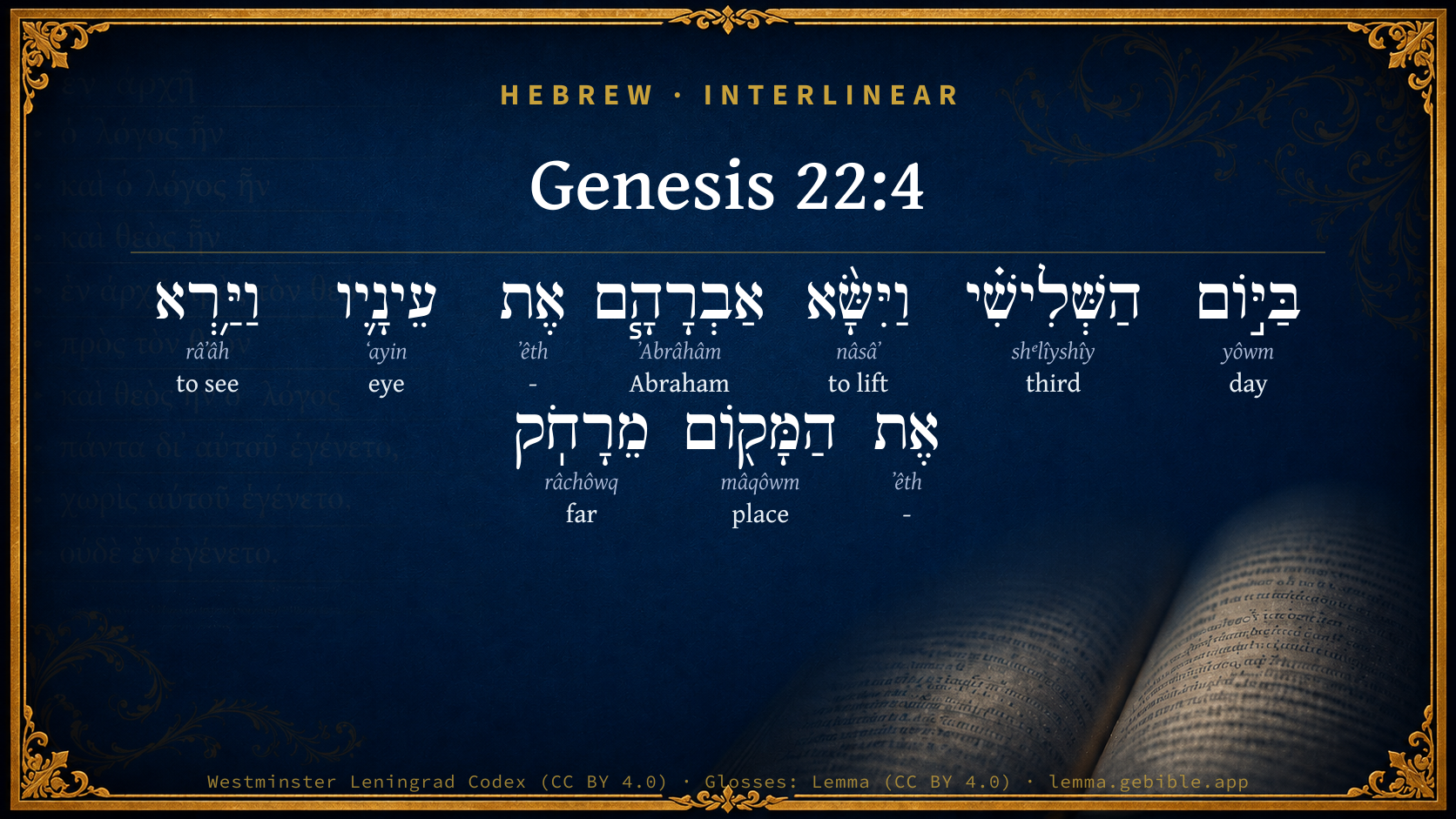
Genesis 22:4

Hebrew (Westminster Leningrad Codex) Genesis 22:4 appears in the Hebrew Old Testament. The text above is from the Westminster Leningrad Codex. Each word links to its Strong’s number, a concise gloss, and parsing drawn from the Open Scriptures Hebrew Bible morphology. Click any word for its full Brown-Driver-Briggs (BDB) entry.
Download image
Cite this verse

Genesis 22:4 (World English Bible). Public Domain. Lemma interlinear Bible study tool, https://lemma.gebible.app/v/genesis/22/4.

Show BibTeX & RIS
BibTeX
RIS
English Translation
On the third day Abraham lifted up his eyes, and saw the place far off.
World English Bible · Public Domain
Highlights
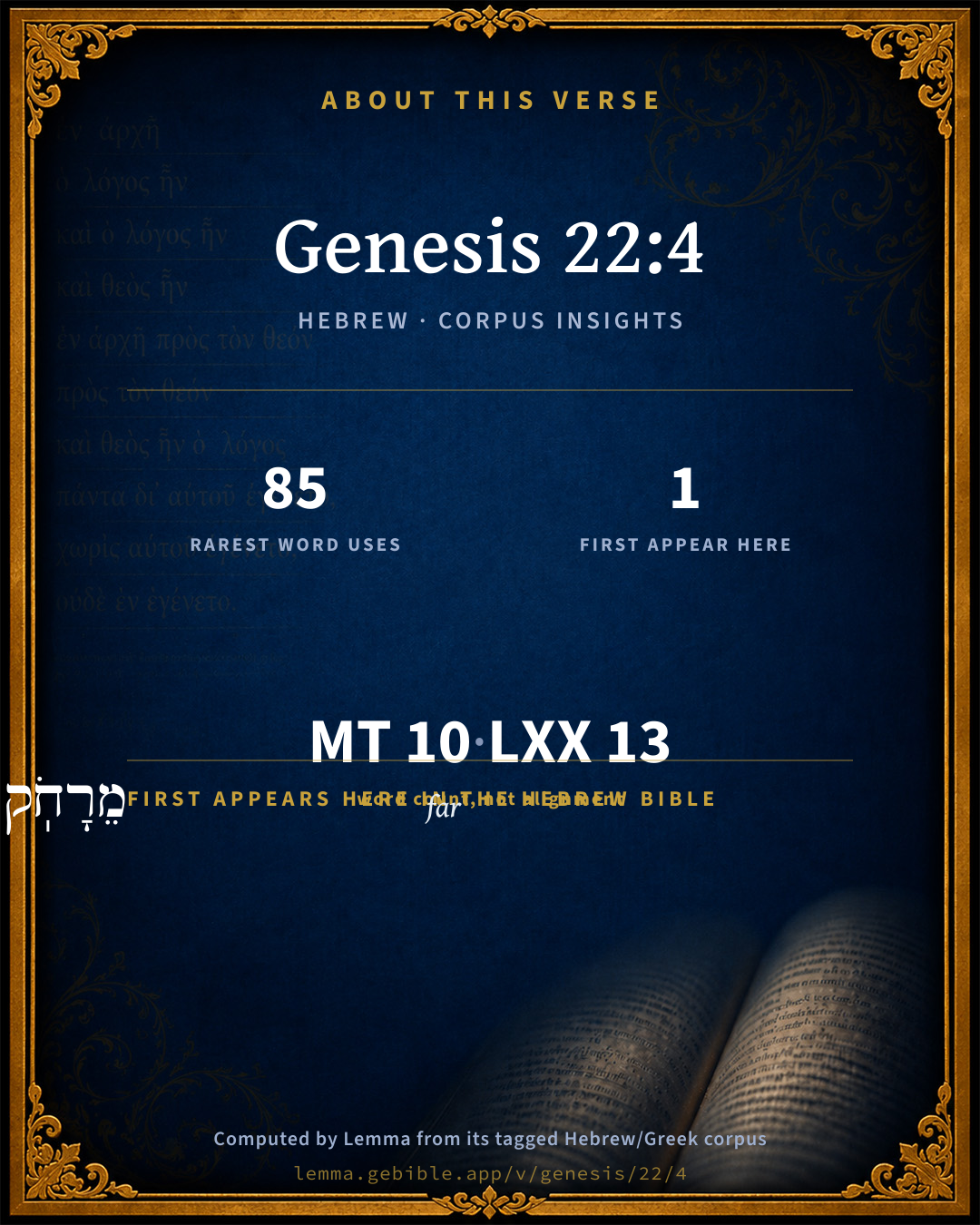
  • 1 first appearance in the Hebrew Bible
Full analysis ↓
Download a study sheet

One document with this verse’s original text, its word-by-word gloss line, the meaning frame, cross-references with their text, attributed commentary, and full source and license credits — printable, and it pastes into notes with its structure intact.

This verse Autodidact and up

Study sheet (.html) Plain text (.txt)

A passage Seminary Student

Up to 50 verses in one chapter. A passage sheet keeps up to 6 commentary sources and 12 cross-references per verse, in the order this page ranks them, and says so on the sheet whenever that leaves anything out. Ask for a single verse and you get the Autodidact verse sheet above.

Everything on this page stays free to read, with no account — the sheet is a download of what is already on screen, not access to it.

Want to remove ads? Support Godless Engineer
Compare translations 3

The same verse in 3 English versions, stacked beneath the original-language interlinear above. Click any original word for its lexicon entry.

Each is an independent rendering of the whole verse — the interlinear is not word-aligned to these translations.

Highlighted words mark where these versions differ — a whole-verse word diff, not a word-by-word alignment.

  • World English Bible Public Domain
    On the third day Abraham lifted up his eyes, and saw the place far off.
  • King James Version Public Domain
    Then on the third day Abraham lifted up his eyes, and saw the place afar off.
  • unfoldingWord Literal Text CC BY-SA 4.0
    On the third day Abraham lifted his eyes and he saw the place from a distance.

unfoldingWord Literal Text — © unfoldingWord, licensed CC BY-SA 4.0. Word-aligned USFM3 via Door43 (git.door43.org/unfoldingWord/en_ult).

Versions to compare (up to 4)

3 of 4 selected

Show all 18 translations

Every available English version of this verse, each an independent rendering of the whole verse.

  • World English Bible Public Domain
    On the third day Abraham lifted up his eyes, and saw the place far off.
  • Berean Standard Bible Public Domain
    On the third day Abraham looked up and saw the place in the distance.
  • Majority Standard Bible Public Domain
    On the third day Abraham looked up and saw the place in the distance.
  • King James Version Public Domain
    Then on the third day Abraham lifted up his eyes, and saw the place afar off.
  • American Standard Version (1901) Public Domain
    On the third day Abraham lifted up his eyes, and saw the place afar off.
  • Revised Version (1885) Public Domain
    On the third day Abraham lifted up his eyes, and saw the place afar off.
  • Geneva Bible (1599) Public Domain
    Then the third day Abraham lift vp his eyes, and sawe the place afarre off,
  • Douay-Rheims (1899) Public Domain
    And on the third day, lifting up his eyes, he saw the place afar off.
  • Young's Literal Translation Public Domain
    On the third day -- Abraham lifteth up his eyes, and seeth the place from afar;
  • Literal Standard Version CC BY-SA 4.0
    On the third day—Abraham lifts up his eyes, and sees the place from afar;
  • Unlocked Literal Bible CC BY-SA 4.0
    On the third day Abraham looked up and saw the place afar off.
  • unfoldingWord Literal Text CC BY-SA 4.0
    On the third day Abraham lifted his eyes and he saw the place from a distance.
  • Darby Bible Public Domain
    On the third day Abraham lifted up his eyes and saw the place from afar.
  • World Messianic Bible Public Domain
    On the third day Abraham lifted up his eyes, and saw the place far off.
  • Webster's Bible Public Domain
    Then on the third day Abraham lifted up his eyes, and saw the place afar off.
  • Free Bible Version CC BY-SA 4.0
    After traveling for three days Abraham could see the place in the distance.
  • Bible in Basic English Public Domain
    And on the third day, Abraham, lifting up his eyes, saw the place a long way off.
  • JPS Tanakh (1917) Public Domain
    On the third day Abraham lifted up his eyes, and saw the place afar off.

Literal Standard Version (2020), Covenant Press — licensed CC BY-SA 4.0. Text via the HelloAO Bible API (eBible.org). Unlocked Literal Bible (unfoldingWord) — licensed CC BY-SA 4.0. Text via the HelloAO Bible API (eBible.org). unfoldingWord Literal Text — © unfoldingWord, licensed CC BY-SA 4.0. Word-aligned USFM3 via Door43 (git.door43.org/unfoldingWord/en_ult). Free Bible Version, Dr. Jonathan Gallagher — licensed CC BY-SA 4.0. Text via the HelloAO Bible API (eBible.org).

Word by word

More ways to search: Search by grammar → Find every occurrence → Compare this word →

Practice this passage: Drill this verse → Learn its vocabulary →

מֵרָחֹֽק
râchôwq
H7350
“from · far”
Preposition + Adjective, Adjective, Masculine, Singular, Absolute
Part of Speech
Preposition + Adjective
Type
Adjective
Gender
Masculine
Number
Singular
State
Absolute
Full BDB Definition

Origin: from H7368

TWOT: 2151b

remote, far, distant, distant lands, distant ones (adjective) - of distance, time - distance (noun masculine) - from a distance (with preposition)
  1. בַּיּ֣וֹם yôwm H3117 “in/at the · day” Preposition, Determined + Noun, Common, Masculine, Singular, Absolute
  2. הַשְּׁלִישִׁ֗י shᵉlîyshîy H7992 “the · third” Particle, Definite Article + Adjective, Ordinal number, Masculine, Singular, Absolute
  3. וַיִּשָּׂ֨א nâsâʼ H5375 “and · to lift” Conjunction + Verb, Qal, Sequential Imperfect, 3rd Person, Masculine, Singular
  4. אַבְרָהָ֧ם ʼAbrâhâm H85 “Abraham” Noun, Proper
  5. אֶת ʼêth H853 “-” Particle, Direct Object
  6. עֵינָ֛יו ʻayin H5869 “eyes · his” Noun, Common, Both, Dual, Construct + Suffix, Personal, 3rd Person, Masculine, Singular
  7. וַיַּ֥רְא râʼâh H7200 “and · to see” Conjunction + Verb, Qal, Sequential Imperfect, 3rd Person, Masculine, Singular
  8. אֶת ʼêth H853 “-” Particle, Direct Object
  9. הַמָּק֖וֹם mâqôwm H4725 “the · place” Particle, Definite Article + Noun, Common, Masculine, Singular, Absolute

About this verse

These counts appear in no published source. They are computed here, from the morphology-tagged text and Lemma’s own curated glosses. What Lemma adds →

10
words
9
distinct lemmas
Pentateuch
section

First appearance in Scripture

This word makes its first canonical appearance in the Hebrew Bible here:

  • מֵרָחֹֽק far H7350

Grammatical profile

  • 2 verbs
  • 4 nouns
  • 2 adjectives
  • 2 particles

Verb forms

  • וַיִּשָּׂ֨א Qal · Sequential Imperfect
  • וַיַּ֥רְא Qal · Sequential Imperfect

Hebrew & Septuagint length

In English translation the verse runs 15 words from the Hebrew and 16 from the Septuagint (LXX English) — closely comparable.

A rough comparison of the two English renderings, which tokenize alike — not a word-level alignment.

Word counts can differ between the Hebrew and the Greek without any difference in meaning — e.g. the Hebrew direct-object marker אֵת has no separate Greek word, and Greek often adds the article ὁ.

In the original languages it is 10 Hebrew tokens and 13 Greek tokens — but the two are counted differently (Hebrew bundles its prefixes and suffixes into one token; the Greek is in lemma form), so that isn’t a like-for-like length.

Cross-references

17

Topical passages linked to Genesis 22:4 in the Treasury of Scripture Knowledge — connected by theme and wording, ordered by reader-vote popularity; previews shown in the World English Bible.

  • Hosea 6:2 After two days will he revive us. On the third day he will raise us up, And we will live before him.
  • Matthew 17:23 and they will kill him, and the third day he will be raised up." They were exceedingly sorry.
  • Luke 13:32 He said to them, "Go and tell that fox, 'Behold, I cast out demons and perform cures today and tomorrow, and the third day I complete my mission.
  • 1 Corinthians 15:4 that he was buried, that he was raised on the third day according to the Scriptures,
  • 1 Samuel 26:13 Then David went over to the other side, and stood on the top of the mountain afar off; a great space being between them;
  • 2 Kings 20:5 Turn back, and tell Hezekiah the prince of my people, Thus says Yahweh, the God of David your father, I have heard your prayer, I have seen your tears: behold, I will heal you; on the third day you shall go up to the house of Yahweh.
  • Esther 5:1 Now it happened on the third day, that Esther put on her royal clothing, and stood in the inner court of the king's house, over against the king's house: and the king sat on his royal throne in the royal house, over against the entrance of the house.
  • Exodus 5:3 They said, "The God of the Hebrews has met with us. Please let us go three days' journey into the wilderness, and sacrifice to Yahweh, our God, lest he fall on us with pestilence, or with the sword."
  • Exodus 15:22 Moses led Israel onward from the Red Sea, and they went out into the wilderness of Shur; and they went three days in the wilderness, and found no water.
  • Exodus 19:11 and be ready against the third day; for on the third day Yahweh will come down in the sight of all the people on Mount Sinai.
  • Exodus 19:15 He said to the people, "Be ready by the third day. Don't have sexual relations with a woman."
  • Leviticus 7:17 but what remains of the flesh of the sacrifice on the third day shall be burned with fire.
  • Numbers 10:33 They set forward from the Mount of Yahweh three days' journey; and the ark of the covenant of Yahweh went before them three days' journey, to seek out a resting-place for them.
  • Numbers 19:12 the same shall purify himself therewith on the third day, and on the seventh day he shall be clean: but if he doesn't purify himself the third day, then the seventh day he shall not be clean.
  • Numbers 19:19 and the clean person shall sprinkle on the unclean on the third day, and on the seventh day: and on the seventh day he shall purify him; and he shall wash his clothes, and bathe himself in water, and shall be clean at even.
  • Numbers 31:19 Encamp you outside of the camp seven days: whoever has killed any person, and whoever has touched any slain, purify yourselves on the third day and on the seventh day, you and your captives.
  • Joshua 1:11 Pass through the midst of the camp, and command the people, saying, Prepare food; for within three days you are to pass over this Jordan, to go in to possess the land, which Yahweh your God gives you to possess it.

Cross-references courtesy of OpenBible.info (CC BY 4.0).

Hebrew and Greek witnesses Masoretic Hebrew ↔ Greek Septuagint

The same verse in the two great witnesses to the Old Testament, shown verse-for-verse.

These are two independent witnesses, not word-aligned to each other, and the Septuagint is shown in lemma (dictionary) form.

Hebrew Genesis 22:4 Masoretic · Westminster Leningrad Codex

בַּיּ֣וֹם הַשְּׁלִישִׁ֗י וַיִּשָּׂ֨א אַבְרָהָ֧ם אֶת עֵינָ֛יו וַיַּ֥רְא אֶת הַמָּק֖וֹם מֵרָחֹֽק

On the third day Abraham lifted up his eyes, and saw the place far off.

World English Bible · Public Domain

Greek LXX Genesis 22:4 Septuagint · lemma form

ὁ ἡμέρα ὁ τρίτος καί ἀναβλέπω αβρααμ ὁ ὀφθαλμός ὁράω ὁ τόπος μακρόθεν

on the third day; and Abraam having lifted up his eyes, saw the place afar off.

LXX2012 (modern English Septuagint) · Public Domain

Hebrew: Westminster Leningrad Codex (CC BY 4.0). Greek: Septuagint (public domain); English from LXX2012 (modern English Septuagint) (Public Domain). How the Septuagint differs from the Hebrew →

Targum (Aramaic paraphrase)

2

The Targum is the ancient Jewish Aramaic paraphrase of the Hebrew Scriptures — an interpretive translation, not the Hebrew text itself. Onkelos (literal) and Pseudo-Jonathan (expansive) render the Torah, and Jonathan the Prophets. Coverage is partial: where no permissively-licensed English translation exists for a verse, only the Aramaic is shown. This is verse-level text, not a word-by-word alignment to the Hebrew.

  1. Targum Onkelos Torah (Genesis–Deuteronomy)
    בְּיוֹמָא תְלִיתָאָה וּזְקַף אַבְרָהָם יָת עֵינוֹהִי וַחֲזָא יָת אַתְרָא מֵרָחִיק

    (no public-domain English translation for this verse)

    Targum Onkelos — Aramaic: “Onkelos Genesis” (public domain); “Onkelos Exodus” (public domain); “Onkelos Leviticus” (public domain); “Onkelos Numbers” (public domain); “Onkelos Deuteronomy” (public domain). English: “Sefaria Community Translation” (CC0 1.0 (public-domain dedication)); “J.W. Etheridge. The Targums of Onkelos and Jonathan Ben Uzziel on the Pentateuch. London: Longmans, Green, 1862” (public domain). Text via Sefaria.

  2. Targum Pseudo-Jonathan Torah (Genesis–Deuteronomy)
    בְּיוֹמָא תְּלִיתָאָה וּזְקַף אַבְרָהָם יַת עֵינוֹי וַחֲמָא עֲנַן אֲיַקְרָא קָטַר עַל טַוְורָא וְאִשְׁתְּמוֹדָעֵיהּ מִן רָחִיק

    On the third day Abraham lifted up his eyes and beheld the cloud of glory fuming on the mount, and it was discerned by him afar off.

    Targum Pseudo-Jonathan — Aramaic: “Targum Jonathan on Genesis” (public domain); “Targum Jonathan on Exodus” (public domain); “Targum Jonathan on Leviticus” (public domain); “Targum Jonathan on Numbers” (public domain); “Targum Jonathan on Deuteronomy” (public domain). English: “The Targum of Jonathan ben Uzziel, trans. J. W. Etheridge, London, 1862” (public domain). Text via Sefaria.

Commentary

Notes on Genesis 22:4 from classic Christian and Jewish commentators (each source and its license shown beneath its notes). The classic Christian expositions comment on the surrounding passage and are grouped to its opening verse, so a note may address several verses; the Jewish commentaries on the Tanakh (Rashi and others) are per-verse, so they appear only where the commentator wrote on this verse.

Lemma curates 59 commentaries, every one of them public domain or Creative Commons licensed, each selected and text-cleaned for this edition rather than reprinted as found. About our sources →

Trapp's Complete Commentary

John Trapp

Gen 22:4 Then on the third day Abraham lifted up his eyes, and saw the place afar off.

Ver. 4. Then on the third day.] A great while for him to be plodding, ere he came to the place. But we must conceive that his brains were better busied, than many of ours would have been therewhile. We must not weigh the cross, for then it will prove heavy: we must not chew the pill, but swallow it whole, else it will prove bitter. We must not plod too much, but ply the throne of grace for a good use and a good issue of all our trials and tribulations.

John Trapp, A Commentary or Exposition upon All the Books of the Old and New Testament (1647–1656) — public domain. Text from a community e-Sword module.

Jamieson, Fausset & Brown

Robert Jamieson, A. R. Fausset & David Brown

on the third day Abraham lifted up his eyes, &c.--Leaving the servants at the foot [Gen 22:5], the father and son ascended the hill, the one bearing the knife, and the other the wood for consuming the sacrifice [Gen 22:6]. But there was no victim; and to the question so naturally put by Isaac [Gen 22:7], Abraham contented himself by replying, "My son, God will provide himself a lamb for a burnt offering." It has been supposed that the design of this extraordinary transaction was to show him, by action instead of words, the way in which all the families of the earth should be blessed; and that in his answer to Isaac, he anticipated some substitution. It is more likely that his words were spoken evasively to his son in ignorance of the issue, yet in unbounded confidence that that son, though sacrificed, would, in some miraculous way, be restored (Heb 11:19).

Jamieson, Fausset & Brown — Commentary Critical and Explanatory on the Whole Bible (1871) — public domain (CC PDM 1.0). Text via the HelloAO Bible API.

Adam Clarke's Commentary

Verse 4. The third day] "As the number SEVEN," says Mr. Ainsworth, "is of especial use in Scripture because of the Sabbath day, Ge 2:2, so THREE is a mystical number because of Christ's rising from the dead the third day, Mt 17:23; 1Co 15:4; as he was crucified the third hour after noon, Mr 15:25: and Isaac, as he was a figure of Christ, in being the only son of his father, and not spared but offered for a sacrifice, Ro 8:32, so in sundry particulars he resembled our Lord: the third day Isaac was to be offered up, so it was the third day in which Christ also was to be perfected, Lu 13:32; Isaac carried the wood for the burnt-offering, Ge 22:6, so Christ carried the tree whereon he died, Joh 19:17; the binding of Isaac, Ge 21:9, was also typical, so Christ was bound, Mt 27:2.

"In the following remarkable cases this number also occurs. Moses desired to go three days' journey in the wilderness to sacrifice, Ex 5:3; and they travelled three days in it before they found water, Ex 15:22; and three days' journey the ark of the covenant went before them, to search out a resting place, Nu 10:33; by the third day the people were to be ready to receive God's law, Ex 19:11; and after three days to pass over Jordan into Canaan, Jos 1:14; the third day Esther put on the apparel of the kingdom, Es 5:1; on the third day Hezekiah, being recovered from his illness, went up to the house of the Lord, 2Kg 20:5; on the third day, the prophet said, God will raise us up and we shall live before him, Ho 6:2; and on the third day, as well as on the seventh, the unclean person was to purify himself, Nu 19:12: with many other memorable things which the Scripture speaks concerning the third day, and not without mystery. See Ge 40:12-13; Ge 42:17-18; Jon 1:17; Jos 2:16; unto which we may add a Jew's testimony in Bereshith Rabba, in a comment on this place: There are many THREE DAYS mentioned in the Holy Scripture, of which one is the resurrection of the Messiah." - Ainsworth.

Saw the place afar off.] He knew the place by seeing the cloud of glory smoking on the top of the mountain. - Targum.

Adam Clarke's Commentary on the Bible (1810–1826) — public domain. Text from a community e-Sword/MySword module.

John Calvin's Commentaries

4. And saw the place. He saw, indeed, with his eyes, the place which before had been shown him in secret vision. But when it is said, that he lifted up his eyes, Moses doubtless signifies, that he had been very anxious during the whole of the three days. In commanding his servants to remain behind, he does it that they may not lay their hands upon him, as upon a delirious and insane old man. And herein his magnanimity appears, that he ties his thoughts so well composed and tranquil, as to do nothing in an agitated manner. When, however, he says, that he will return with the boy, he seems not to be free from dissimulation and falsehood. Some think that he uttered this declaration prophetically; but since it is certain that he never lost sight of what had been promised concerning the raising up of seed in Isaac, it may be, that he, trusting in the providence of God, figured to himself his son as surviving even in death itself. And seeing that he went, as with closed eyes, to the slaughter of his son, there is nothing improbable in the supposition, that he spoke confusedly, in a matter so obscure.

John Calvin's Commentaries (1540-1563) — public domain. Text from the Calvin Translation Society English edition (1840s-50s) via the Christian Classics Ethereal Library (ccel.org). Calvin's coverage is partial (roughly two-thirds of the Bible); uncommented books and verses are honest gaps, never fabricated. The 19th-century editor's footnotes and remarks are omitted so the notes are faithfully Calvin's own voice.

Ellicott's Commentary for English Readers

(4) On the third day.—We may compare the patriarch’s feelings during these two weary days of travel with those of Hagar as she wandered in the wilderness, and each day felt the death of her child growing nearer and more certain. But hers were human sorrows only, while Abraham was giving up the son on whom his spiritual hopes depended.

Afar off.—The summit called the Mountain of the House, usually identified with Mount Moriah, cannot be seen by a traveller from Beer-sheba at a greater distance than three miles (Stanley, Sinai and Palestine, p. 251). Hence it has been argued that some more widely conspicuous hill-top must be meant. But the phrase afar off is used very indefinitely, and three miles exactly agrees with what Abraham did. For he left the servants at the spot, and laid the wood on Isaac, and went the rest of the way on foot. It must have sorely taxed the strength of the lad to be compelled to carry the wood a distance of three miles; while to have carried it from the spot where Gerizim becomes visible would have been impossible.

In Isaac thus carrying the wood on which he was to be sacrificed, the Fathers discerned a type of Christ carrying his cross (Joh_19:17).

A Bible Commentary for English Readers, edited by Charles John Ellicott (1878–1897) — public domain. Text from a community e-Sword module.

The Cambridge Bible for Schools and Colleges

gen. ed. J. J. S. Perowne

4. On the third day … afar off] The “place” was on a lofty eminence visible at a distance. Presumably “the third day” indicates a journey of 30 or 40 miles. The journey from Beer-sheba to Jerusalem is computed to take less than 24 hours.

The Cambridge Bible for Schools and Colleges (gen. ed. J. J. S. Perowne; Cambridge University Press, 1878–1918) — public domain. Text from a community e-Sword module.

John Gill's Exposition

Then on the third day,.... After he had received the command from God, and from his setting out on his journey; for he had now travelled two days, Mount Moriah being forty miles from Beersheba, where Abraham dwelt (s); or, as others compute it, forty: Hebron (t) was twenty miles from Beersheba, and Jerusalem twenty two from Hebron; and to travel twenty miles a day on foot, as Isaac and the servants seem to have done, there being but one ass among them, was far enough in those hot countries. Now all this while Abraham had time to reconsider things in his mind, and deliberate thoroughly what he was going about; and by proceeding in it, after he had such leisure to revolve things in his mind, it appears that he was satisfied it was not an illusion, but an oracle of God he was going to obey; and that he did not do this rashly and hastily, and that his faith and obedience were sufficiently tried, and found genuine. The Jews (u) take great notice of this third day, and compare the passage with Hos 6:2; and which they interpret of the third day of the resurrection; and the deliverance of Isaac on this third day was doubtless typical of Christ's resurrection from the dead on the third day; for from the time that Abraham had the command to offer up his son, he was reckoned no other by him than as one dead, from whence he received him in a figure on this third day, Heb 11:19,

Abraham lift up his eyes, and saw the place afar off; where he was to offer his Son. Baal Hatturim says, the word "place", by gematry, signifies Jerusalem: it seems by this, that as God had signified to Abraham that he would tell him of the place, and show it to him, where he was to sacrifice, so that he gave him a signal by which he might know it, which some of the Jewish writers (w) say was a cloud upon the mount; with which agrees the Targum of Jonathan,"and Abraham lift up his eyes and saw the cloud of glory smoking upon the mountain, and he knew it afar off.''And others say (x), he saw the glory of the divine Majesty standing upon the mount, in a pillar of fire, reaching from earth to heaven; and they further observe, that the place where he was, when he saw this, was Zophim, a place not far from Jerusalem; and from hence, when the city and temple were built, a full view might be taken of them (y), from whence it had its name.

(s) Bunting's Travels, p. 57. (t) Reland. Palestina illustrata, tom. 2. p. 620. (u) Bereshit Rabba, sect. 56. fol. 49. 3. (w) Bereshit Rabba, sect. 56. fol. 49. 3. Jarchi in loc. (x) Pirke Eliezer, ut supra. (c. 31.) (y) Gloss. in T. Bab. Beracot, fol. 49. 2. Schulchan Aruch, par. 1. Crach Chayim, c. 3. sect. 6.

John Gill's Exposition of the Whole Bible (1746–1763) — public domain (CC PDM 1.0). Text via the HelloAO Bible API.

Matthew Poole's English Annotations

Probably on the beginning of the third day. It is true, Moriah was not three days’ journey from Beer-sheba. But it must be considered that the ass, upon which he rode, is a dull and slow creature, and that Abraham went no faster than the rest of his company, who, for aught appears, were on foot; and that the provisions which they carried along with them, both for their own and the ass’s subsistence, and for sacrifice, must needs retard them.

Matthew Poole's English Annotations on the Holy Bible (1683–1685) — public domain. Text from a community e-Sword/MySword module.

Whedon's Commentary on the Bible

Daniel D. Whedon

4. Third day — Two days of journey and reflection did not cause the faith of Abraham to waver, but must have deeply intensified the trial going on within him.

Afar off — These words do not necessarily imply a great distance. Moses’s sister stood afar off to watch the ark of bulrushes, (Exo_2:4,) and Job’s three friends “lifted up their eyes afar off, and knew him not,” (Job_2:12,) but the distances in each case were obviously not great.

Daniel D. Whedon (gen. ed.), Commentary on the Old and New Testaments (1874–1909) — public domain. Text from a community e-Sword module.

The Pulpit Commentary

Then on the third day Jerusalem, being distant from Beersheba about twenty and a half hours" journey according to Robinson, could easily; be within sight on the third dayAbraham lifted up his eyes, not implying that the object of vision was above him (cf. Gen_13:10) and saw the place (which Calvin conjectures he had previously beheld in vision) afar off. Though Mount Moriah cannot be seen by the traveler from Beersheba till within a distance of three miles (Stanley, "Sinai and Palestine," p. 251), the place or region where it is can be detected (Kalisch).

The Pulpit Commentary (1880–1919), ed. H.D.M. Spence-Jones & Joseph S. Exell — public domain. Text from a community e-Sword module.

unfoldingWord translationNotes

Door43 World Missions Community

On the third day

The word "third" is the ordinal number for three. AT: "After traveling for three days" (See: Ordinal Numbers)

saw the place afar off

"saw far away the place that God had spoken of"

young men

"servants"

We will worship

The word "we" refers only to Abraham and Isaac, but not to the young men. (See: Exclusive and Inclusive "We")

come again to you

"return to you"

put it on Isaac his son

"had Isaac, his son, carry it"

He took in his own hand

Here "his own hand" emphasizes that Abraham himself carried these things. AT: "Abraham himself carried" (See: Synecdoche)

the fire

Here "fire" stands for a pan containing burning coals or a torch or lamp. AT: "something for starting a fire" (See: Synecdoche)

they went both of them together

"they left together" or "the two of them went together"

translationWords

day

Abraham

worship

burnt offering

Isaac

unfoldingWord translationNotes — © Distant Shores Media and the Door43 World Missions Community, licensed CC BY-SA 4.0. Source: git.door43.org/Door43/en_tn.

Rashi

Rabbi Shlomo Yitzchaki (Rashi)

ביום השלישי ON THE THIRD DAY — Why did God delay and not show it to him at once? So that people should not say, “He confused and confounded him suddenly and bewildered his mind. If, however, he had had time for consideration, he would not have obeyed” (Midrash Tanchuma, Vayera 22).

וירא את המקום AND HE SAW THE PLACE — He saw a cloud lowering over the mountain (Genesis Rabbah 56:1).

Rashi on the Tanakh — English translations: “The Judaica Press complete Tanach with Rashi, translated by A. J. Rosenberg” (CC BY 4.0); “Pentateuch with Rashi's commentary by M. Rosenbaum and A.M. Silbermann, 1929-1934” (public domain); “The Metsudah Tanach series, Lakewood, N.J” (CC BY 4.0); and “The Book of Joshua, Metsudah Publications, 1997” (CC BY 4.0). Text via Sefaria.

Ramban (Nachmanides)

Rabbi Moshe ben Nachman (Ramban / Nachmanides)

AND HE SAW THE PLACE AFAR OFF. He saw a cloud attached to the mountain, and through this was fulfilled the Divine assurance, which I will tell thee of. It is possible, in line with the simple meaning of Scripture, that the verse, And he saw the place afar off, means that he saw the land of Moriah for he knew that entire land [although he did not know the specific mountain].

Ramban (Nachmanides) on the Tanakh — English translation: “Commentary on the Torah by Ramban (Nachmanides). Translated and annotated by Charles B. Chavel. New York, Shilo Pub. House, 1971-1976” (CC BY 4.0). Text via Sefaria.

Radak

Rabbi David Kimhi (Radak)

ביום השלישי וישא אברהם, the letter ו is something additional, a phenomenon we encounter frequently, such as in Genesis 36,24 ואלה בני צבעון ואיה וענה. The Torah could also have written ביום השלישי נשא אברהם את עיניו, “on the third day Avraham raised his eyes.” (using the ordinary past tense, instead of the future tense with the vav hahipuch. It is possible to justify the use of the form with the letter ו by understanding this verse as a continuation of the previous verse and reading that one as if it had been written: וילך אל המקום ביום השלישי, “he went (arrived) to the place on the third day.” At that time he raised his eyes in the direction of the site in question, i.e. Jerusalem. In other words, once Avraham had entered the general area known as ארץ המוריה, he raised his eyes to look for the specific site G’d must have had in mind. At any rate, he did not yet know which mountain G’d had chosen for him to erect the altar on which to sacrifice Yitzchok. According to Pirkey de Rabbi Eliezer chapter 31 and other Midrashim, the words וירא את המקום מרחוק refer to Avraham actually seeing the mountain in question. He identified it as he saw a column of fire on that mountain. He asked his son if he saw anything specific on any of the mountains, to which Yitzchok replied that he saw a column of fire on one of the mountains. When Avraham repeated the same question to Ishmael and Eliezer previously described as נעריו, his lads, they both answered in the negative. Upon hearing that both of these men did not notice anything out of the ordinary, he told them to remain near the donkey which could also not see anything unusual. שבו לכם עם החמור, with those who are like donkeys.

Radak on the Tanakh — English translations: “Sefaria Community Translation” (CC0 1.0 (public-domain dedication)); “Eliyahu Munk, HaChut Hameshulash” (CC BY 4.0); “Rabbi Mike Feuer, Jerusalem Anthology” (CC BY 4.0); and “R. David Kimhi on the first book of Psalms, Translated by R.G. Finch, London, 1919” (public domain). Text via Sefaria.

Lesson kit

Teaching starters — assembled from the data on this page, not authored interpretation. Every prompt links to the verse data it draws on. Edit before teaching.

Genesis, in the Pentateuch, opens this verse with 10 words (9 distinct Hebrew lemmas). Its most distinctive word is râchôwq (“far”). A historical commentator’s framing appears above. Read the whole chapter for the surrounding context.

Discussion questions

  1. What does “far” (râchôwq) contribute to the verse as a whole?
  2. The word “far” first appears here in Scripture. What is being introduced at this debut?
  3. Hosea 6:2 shares this passage’s theme. How do the two illuminate each other?
  4. The translations on this page render this verse differently — a whole-verse word diff, not a word-by-word alignment. What might account for the different wordings?
  5. The verb «וַיִּשָּׂ֨א» is Qal Sequential Imperfect. How does its form color the action?
  6. Reading how Trapp's Complete Commentary and Jamieson, Fausset & Brown read this verse, where do the two commentators agree and where do they part?

Things to notice

Reading settings

Reading text

Shown beneath each verse's original-language words.

Old Testament
Old Testament edition

Read the OT as the Masoretic Hebrew (MT) or the Greek Septuagint (LXX).

English shown for the Greek Septuagint (in the Hebrew ↔ Greek comparison).

Comparing translations? Open the Compare panel on any verse page to stack up to four side by side.