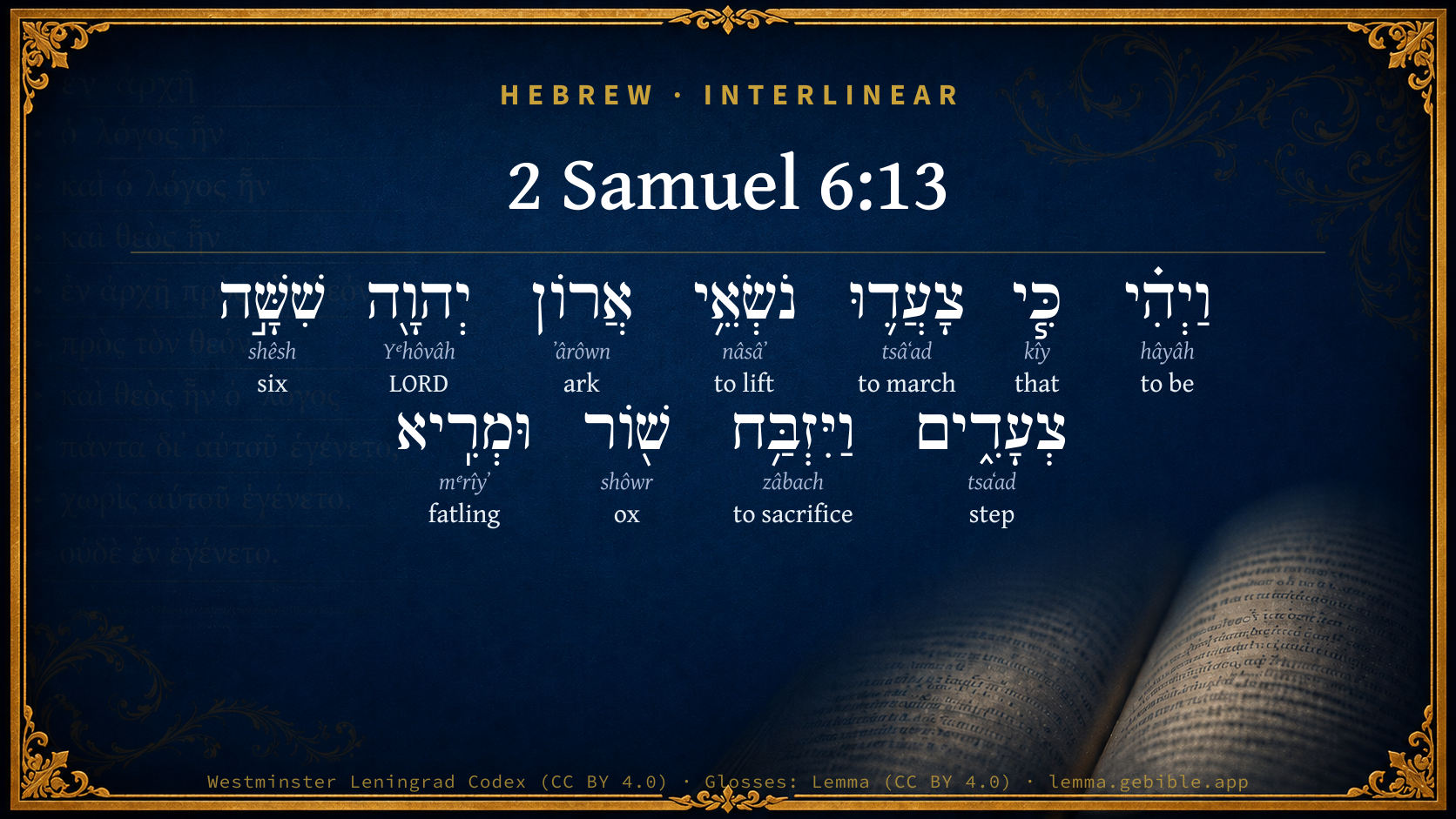
2 Samuel 6:13

Hebrew (Westminster Leningrad Codex) 2 Samuel 6:13 appears in the Hebrew Old Testament. The text above is from the Westminster Leningrad Codex. Each word links to its Strong’s number, a concise gloss, and parsing drawn from the Open Scriptures Hebrew Bible morphology. Click any word for its full Brown-Driver-Briggs (BDB) entry.
Download image
Cite this verse

2 Samuel 6:13 (World English Bible). Public Domain. Lemma interlinear Bible study tool, https://lemma.gebible.app/v/2-samuel/6/13.

Show BibTeX & RIS
BibTeX
RIS
English Translation
It was so, that, when those who bore the ark of Yahweh had gone six paces, he sacrificed an ox and a fattened calf.
World English Bible · Public Domain
Highlights
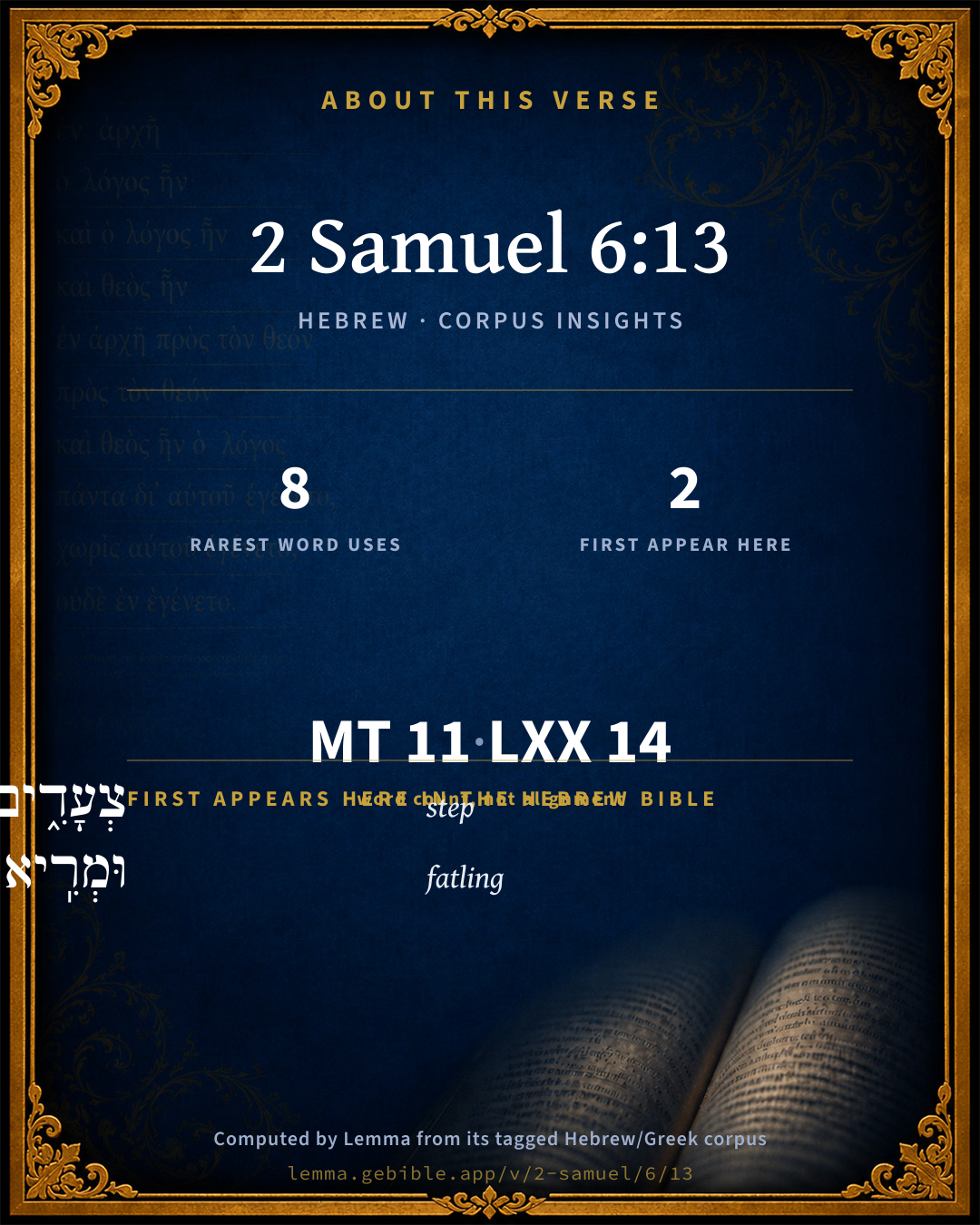
  • 2 first appearances in the Hebrew Bible
Full analysis ↓
Download a study sheet

One document with this verse’s original text, its word-by-word gloss line, the meaning frame, cross-references with their text, attributed commentary, and full source and license credits — printable, and it pastes into notes with its structure intact.

This verse Autodidact and up

Study sheet (.html) Plain text (.txt)

A passage Seminary Student

Up to 50 verses in one chapter. A passage sheet keeps up to 6 commentary sources and 12 cross-references per verse, in the order this page ranks them, and says so on the sheet whenever that leaves anything out. Ask for a single verse and you get the Autodidact verse sheet above.

Everything on this page stays free to read, with no account — the sheet is a download of what is already on screen, not access to it.

Want to remove ads? Support Godless Engineer
Compare translations 3

The same verse in 3 English versions, stacked beneath the original-language interlinear above. Click any original word for its lexicon entry.

Each is an independent rendering of the whole verse — the interlinear is not word-aligned to these translations.

Highlighted words mark where these versions differ — a whole-verse word diff, not a word-by-word alignment.

  • World English Bible Public Domain
    It was so, that, when those who bore the ark of Yahweh had gone six paces, he sacrificed an ox and a fattened calf.
  • King James Version Public Domain
    And it was so, that when they that bare the ark of the LORD had gone six paces, he sacrificed oxen and fatlings.
  • unfoldingWord Literal Text CC BY-SA 4.0
    And it happened, when the carriers of the Box of Yahweh had stepped six steps, that he sacrificed an ox and a fatling.

unfoldingWord Literal Text — © unfoldingWord, licensed CC BY-SA 4.0. Word-aligned USFM3 via Door43 (git.door43.org/unfoldingWord/en_ult).

Versions to compare (up to 4)

3 of 4 selected

Show all 18 translations

Every available English version of this verse, each an independent rendering of the whole verse.

  • World English Bible Public Domain
    It was so, that, when those who bore the ark of Yahweh had gone six paces, he sacrificed an ox and a fattened calf.
  • Berean Standard Bible Public Domain
    When those carrying the ark of the LORD had advanced six paces, he sacrificed an ox and a fattened calf.
  • Majority Standard Bible Public Domain
    When those carrying the ark of the LORD had advanced six paces, he sacrificed an ox and a fattened calf.
  • King James Version Public Domain
    And it was so, that when they that bare the ark of the LORD had gone six paces, he sacrificed oxen and fatlings.
  • American Standard Version (1901) Public Domain
    And it was so, that, when they that bare the ark of Jehovah had gone six paces, he sacrificed an ox and a fatling.
  • Revised Version (1885) Public Domain
    And it was so, that when they that bare the ark of the LORD had gone six paces, he sacrificed an ox and a fatling.
  • Geneva Bible (1599) Public Domain
    And when they that bare the Arke of the Lord had gone sixe paces, he offred an oxe, and a fatte beast.
  • Douay-Rheims (1899) Public Domain
    And when they that carried the ark of the Lord had gone six paces, he sacrificed an ox and a ram:
  • Young's Literal Translation Public Domain
    And it cometh to pass, when those bearing the ark of Jehovah have stepped six steps, that he sacrificeth an ox and a fatling.
  • Literal Standard Version CC BY-SA 4.0
    And it comes to pass, when those carrying the Ark of YHWH have stepped six steps, that he sacrifices an ox and a fatling.
  • Unlocked Literal Bible CC BY-SA 4.0
    When those who were carrying the ark of Yahweh had gone six steps, he sacrificed an ox and a fattened calf.
  • unfoldingWord Literal Text CC BY-SA 4.0
    And it happened, when the carriers of the Box of Yahweh had stepped six steps, that he sacrificed an ox and a fatling.
  • Darby Bible Public Domain
    And it was so, that when they that bore the ark of Jehovah had gone six paces, he sacrificed an ox and a fatted beast.
  • World Messianic Bible Public Domain
    When those who bore the LORD’s ark had gone six paces, he sacrificed an ox and a fattened calf.
  • Webster's Bible Public Domain
    And it was so, that when they that bore the ark of the LORD had gone six paces, he sacrificed oxen and fatlings.
  • Free Bible Version CC BY-SA 4.0
    After those carrying the Ark of the Lord had taken six steps, he sacrificed a bull and a fattened calf.
  • Bible in Basic English Public Domain
    And when those who were lifting the ark of the Lord had gone six steps, he made an offering of an ox and a fat young beast.
  • JPS Tanakh (1917) Public Domain
    And it was so, that when they that bore the ark of the LORD had gone six paces, he sacrificed an ox and a fatling.

Literal Standard Version (2020), Covenant Press — licensed CC BY-SA 4.0. Text via the HelloAO Bible API (eBible.org). Unlocked Literal Bible (unfoldingWord) — licensed CC BY-SA 4.0. Text via the HelloAO Bible API (eBible.org). unfoldingWord Literal Text — © unfoldingWord, licensed CC BY-SA 4.0. Word-aligned USFM3 via Door43 (git.door43.org/unfoldingWord/en_ult). Free Bible Version, Dr. Jonathan Gallagher — licensed CC BY-SA 4.0. Text via the HelloAO Bible API (eBible.org).

Word by word

More ways to search: Search by grammar → Find every occurrence → Compare this word →

Practice this passage: Drill this verse → Learn its vocabulary →

צָעֲד֛וּ
tsâʻad
H6805
“to march”
Verb, Qal, Perfect, 3rd Person, Common, Plural
Part of Speech
Verb
Stem
Qal
Form
Perfect
Person
3rd Person
Gender
Common
Number
Plural
Full BDB Definition

Origin: a primitive root

TWOT: 1943

to step, march, stride - (Qal) to step, march - (Hiphil) to cause to march
  1. וַיְהִ֗י hâyâh H1961 “and · to be” Conjunction + Verb, Qal, Sequential Imperfect, 3rd Person, Masculine, Singular
  2. כִּ֧י kîy H3588 “that” Conjunction
  3. נֹשְׂאֵ֥י nâsâʼ H5375 “lifting” Verb, Qal, Participle Active, Masculine, Plural, Construct
  4. אֲרוֹן ʼârôwn H727 “ark of” Noun, Common, Both, Singular, Construct
  5. יְהוָ֖ה Yᵉhôvâh H3068 “LORD” Noun, Proper
  6. שִׁשָּׁ֣ה shêsh H8337 “six” Adjective, Cardinal number, Masculine, Singular, Absolute
  7. צְעָדִ֑ים tsaʻad H6806 “steps” Noun, Common, Masculine, Plural, Absolute
  8. וַיִּזְבַּ֥ח zâbach H2076 “and · to sacrifice” Conjunction + Verb, Qal, Sequential Imperfect, 3rd Person, Masculine, Singular
  9. שׁ֖וֹר shôwr H7794 “ox” Noun, Common, Masculine, Singular, Absolute
  10. וּמְרִֽיא mᵉrîyʼ H4806 “and · fatling” Conjunction + Noun, Common, Masculine, Singular, Absolute

About this verse

These counts appear in no published source. They are computed here, from the morphology-tagged text and Lemma’s own curated glosses. What Lemma adds →

11
words
11
distinct lemmas
Historical
section

Notable vocabulary

The rarest word here is צָעֲד֛וּ to march H6805 — appearing just 8 times in the whole Hebrew Bible.

First appearance in Scripture

These words make their first canonical appearance in the Hebrew Bible here:

  • צְעָדִ֑ים step H6806
  • וּמְרִֽיא fatling H4806

Shared distinctive vocabulary

צָעֲד֛וּ to march H6805 occurs in 8 verses of the Hebrew Bible. Also found in:

Grammatical profile

  • 4 verbs
  • 5 nouns
  • 1 adjective
  • 1 conjunction

Verb forms

  • וַיְהִ֗י Qal · Sequential Imperfect
  • צָעֲד֛וּ Qal · Perfect
  • נֹשְׂאֵ֥י Qal · Participle Active
  • וַיִּזְבַּ֥ח Qal · Sequential Imperfect

Hebrew & Septuagint length

In English translation the verse runs 24 words from the Hebrew and 18 from the Septuagint (LXX English) — closely comparable.

A rough comparison of the two English renderings, which tokenize alike — not a word-level alignment.

Word counts can differ between the Hebrew and the Greek without any difference in meaning — e.g. the Hebrew direct-object marker אֵת has no separate Greek word, and Greek often adds the article ὁ.

In the original languages it is 11 Hebrew tokens and 14 Greek tokens — but the two are counted differently (Hebrew bundles its prefixes and suffixes into one token; the Greek is in lemma form), so that isn’t a like-for-like length.

Cross-references

8

Topical passages linked to 2 Samuel 6:13 in the Treasury of Scripture Knowledge — connected by theme and wording, ordered by reader-vote popularity; previews shown in the World English Bible.

  • 1 Kings 8:5 King Solomon and all the congregation of Israel, who were assembled to him, were with him before the ark, sacrificing sheep and oxen, that could not be counted nor numbered for multitude.
  • 1 Chronicles 15:15 The children of the Levites bore the ark of God on their shoulders with the poles thereon, as Moses commanded according to the word of Yahweh.
  • Numbers 4:15 "When Aaron and his sons have finished covering the sanctuary, and all the furniture of the sanctuary, as the camp moves forward; after that, the sons of Kohath shall come to carry it: but they shall not touch the sanctuary, lest they die. These things are the burden of the sons of Kohath in the Tent of Meeting.
  • Numbers 7:9 But to the sons of Kohath he gave none, because the service of the sanctuary belonged to them; they carried it on their shoulders.
  • Joshua 3:3 and they commanded the people, saying, When you see the ark of the covenant of Yahweh your God, and the priests the Levites bearing it, then you shall remove from your place, and go after it.
  • 1 Chronicles 15:2 Then David said, None ought to carry the ark of God but the Levites: for them has Yahweh chosen to carry the ark of God, and to minister to him forever.
  • 1 Chronicles 15:25–26 So David, and the elders of Israel, and the captains over thousands, went to bring up the ark of the covenant of Yahweh out of the house of Obed-edom with joy.
  • 2 Chronicles 5:6 King Solomon and all the congregation of Israel, that were assembled to him, were before the ark, sacrificing sheep and oxen, that could not be counted nor numbered for multitude.

Cross-references courtesy of OpenBible.info (CC BY 4.0).

Hebrew and Greek witnesses Masoretic Hebrew ↔ Greek Septuagint

The same verse in the two great witnesses to the Old Testament, shown verse-for-verse.

These are two independent witnesses, not word-aligned to each other, and the Septuagint is shown in lemma (dictionary) form.

Hebrew 2 Samuel 6:13 Masoretic · Westminster Leningrad Codex

וַיְהִ֗י כִּ֧י צָעֲד֛וּ נֹשְׂאֵ֥י אֲרוֹן יְהוָ֖ה שִׁשָּׁ֣ה צְעָדִ֑ים וַיִּזְבַּ֥ח שׁ֖וֹר וּמְרִֽיא

It was so, that, when those who bore the ark of Yahweh had gone six paces, he sacrificed an ox and a fattened calf.

World English Bible · Public Domain

Greek LXX 2 Samuel 6:13 Septuagint · lemma form

καί εἰμί μετά αὐτός αἴρω ὁ κιβωτός ἑπτά χορός καί θῦμα μόσχος καί ἀρνός

And there were with him bearing the ark seven bands, and for a sacrifice a calf and lambs.

LXX2012 (modern English Septuagint) · Public Domain

On this verse, John Gill's Exposition discusses the Septuagint’s reading. Read the note in Commentary ↓

Hebrew: Westminster Leningrad Codex (CC BY 4.0). Greek: Septuagint (public domain); English from LXX2012 (modern English Septuagint) (Public Domain). How the Septuagint differs from the Hebrew →

Targum (Aramaic paraphrase)

1

The Targum is the ancient Jewish Aramaic paraphrase of the Hebrew Scriptures — an interpretive translation, not the Hebrew text itself. Onkelos (literal) and Pseudo-Jonathan (expansive) render the Torah, and Jonathan the Prophets. Coverage is partial: where no permissively-licensed English translation exists for a verse, only the Aramaic is shown. This is verse-level text, not a word-by-word alignment to the Hebrew.

  1. Targum Jonathan Prophets (Joshua–Malachi)
    וַהֲוָה כַּד נְטָלוּ נַטְלֵי אֲרוֹנָא דַייָ שִׁיתָּא זוּגִין וּנְכֵיס תּוֹר וּפַּטִים:

    (no public-domain English translation for this verse)

    Targum Jonathan — Aramaic: “Mikraot Gedolot” (public domain). English: “Sefaria Community Translation” (CC0 1.0 (public-domain dedication)); “London "Chaldee Paraphrase," 1871” (public domain). Text via Sefaria.

Commentary

Notes on 2 Samuel 6:13 from classic Christian and Jewish commentators (each source and its license shown beneath its notes). The classic Christian expositions comment on the surrounding passage and are grouped to its opening verse, so a note may address several verses; the Jewish commentaries on the Tanakh (Rashi and others) are per-verse, so they appear only where the commentator wrote on this verse.

Lemma curates 59 commentaries, every one of them public domain or Creative Commons licensed, each selected and text-cleaned for this edition rather than reprinted as found. About our sources →

Trapp's Complete Commentary

John Trapp

2Sa 6:13 And it was [so], that when they that bare the ark of the LORD had gone six paces, he sacrificed oxen and fatlings.

Ver. 13. Had gone six paces.] Gravi et decenti incessu, in a grave and decent equipage, and had felt by comfortable experience that God helped them to bear the ark, {1Ch 15:16} - supporting it haply together with them by a divine power invisibly, so that it seemed light unto them. David thereupon took order to have sacrifices offered in the place, for the better carrying on of the good work in hand.

John Trapp, A Commentary or Exposition upon All the Books of the Old and New Testament (1647–1656) — public domain. Text from a community e-Sword module.

Joseph Benson's Commentary

2Sa 6:13-14. He sacrificed oxen and fatlings — As a thanksgiving to God for his goodness, upon an altar erected on purpose on this extraordinary occasion. And David danced before the Lord — His joy increased as the procession went happily on. And God having filled his heart with gladness, he was not ashamed to show it, and to express his thankfulness to him by his outward carriage, according to the manner of those times; singing and shouting, and leaping and dancing before the Lord, according as the various measures of the music inspired and directed, till he arrived at the tabernacle, and fixed the ark in its place. Girt with a linen ephod — The usual habit of the priests and Levites in their sacred ministrations, yet sometimes worn by others, as it was by the young child Samuel; and so here by David, who laid aside his royal robes and put on this robe, to declare that although he was king of Israel, yet he willingly owned himself to be the Lord’s minister and servant.

Joseph Benson's Commentary on the Old and New Testaments (1811–1818) — public domain. Text from a community e-Sword module.

Tyndale Open Study Notes

Tyndale Open Resources

6:13 David offered this sacrifice of praise to God immediately, just six steps into the journey.

Tyndale Open Study Notes — © Tyndale Open Resources, licensed CC BY-SA 4.0. Text via the HelloAO Bible API.

Jamieson, Fausset & Brown

Robert Jamieson, A. R. Fausset & David Brown

when they that bare the ark . . . had gone six paces--Some think that four altars were hastily raised for the offering of sacrifices at the distance of every six paces (but see on Ch1 15:26).

Jamieson, Fausset & Brown — Commentary Critical and Explanatory on the Whole Bible (1871) — public domain (CC PDM 1.0). Text via the HelloAO Bible API.

Ellicott's Commentary for English Readers

(13) They that bare the ark.—David no longer presumed to violate the law, but took care that the ark should be borne by the proper persons. In 1 Chronicles 15 a detailed account is given of the sanctification of the priests and Levites for the purpose, and of the musical arrangements.

Had gone six paces.—As soon as the removal of the ark had been successfully begun, David offered sacrifices of thanksgiving and of prayer; and again, when the journey was completed, “they offered burnt sacrifices and peace offerings before God” (2Sa_6:17, 1Ch_16:1). The work was begun and ended with solemn sacrifice. It is quite unnecessary to suppose that offerings were made at each six steps of the way, for although this might have been possible, it is not recorded. Of course, David offered these sacrifices, like all Israel” in 1Ki_8:62, through the ministration of the priests whom he had called together.

A Bible Commentary for English Readers, edited by Charles John Ellicott (1878–1897) — public domain. Text from a community e-Sword module.

The Cambridge Bible for Schools and Colleges

gen. ed. J. J. S. Perowne

13. they that bare the ark of the Lord] The requirements of the law were now duly observed, as is recorded at length in 1 Chronicles 15, where further details are given about the preparation of a tent to receive the Ark, the number of Levites who took part in the ceremony, and the arrangements for the music which accompanied the procession.

had gone six paces] As soon as the procession had started on its way, without any sign of the divine displeasure, David offered a sacrifice as a thank-offering for the prosperous commencement, and an intercession for the successful completion, of his undertaking. Cp. 1Ch_15:26, “And it came to pass, when God helped the Levites that bare the Ark of the covenant of the Lord, that they offered seven bullocks and seven rams.”

The Cambridge Bible for Schools and Colleges (gen. ed. J. J. S. Perowne; Cambridge University Press, 1878–1918) — public domain. Text from a community e-Sword module.

John Gill's Exposition

And David danced before the Lord with all his might,.... That is, before the ark of the Lord; not a set dance, or along with others; but he leaped and skipped as "car", a lamb, does, and that for joy that the ark was like to be brought home to his house, without any token of the divine displeasure, as before; the Targum is,"he praised before the Lord with all his might;''exerted himself to the uttermost in singing the praises of God vocally, or by playing on an instrument; to which sense are the Septuagint, Syriac, and Arabic versions, which is approved of by Castel (p); who observes, it nowhere appears to have been a custom to dance before the ark; but it might be now done, though not usual, and therefore was observed by Michal with contempt, Sa2 6:16; a later writer (q) shows that dancing is the proper sense of the word:

and David was girded with a linen ephod; which others, besides priests, sometimes wore, as Samuel did, and which David might choose to appear in, rather than in his royal robes, as being more agreeable to the service of God, and lighter for him both to walk and dance in on this occasion.

(p) Lexic. col. 1793. (q) Hackman. Praecidan. Sacr. p. 156, 157.

John Gill's Exposition of the Whole Bible (1746–1763) — public domain (CC PDM 1.0). Text via the HelloAO Bible API.

Albert Barnes' Notes on the Bible

The meaning is, not that they sacrificed oxen and fatlings every six steps, which would have been impossible, but that when - after the arrangement made by David for the Levites to carry the ark 1Ch 15:2, 1Ch 15:12, 1Ch 15:15 they had borne it successfully and with visible tokens of God’s favor, out of the house of Obed-edom and six “steps” on the road to the city of David to the sound of the musical instruments - then they stopped and offered solemn sacrifices. Possibly “the step” may have had a technical sense, and denoted a certain distance, say a stadium. Six such distances would have been nearly a mile, and if the ground was difficult and steep, the successful progress of “those that bare the ark,” so far, would have been a fit cause for a thanksgiving sacrifice.

Albert Barnes' Notes on the Bible (1834–1885) — public domain. Text from a community e-Sword/MySword module.

Haydock's Catholic Bible Commentary

Paces. So altars of turf (Grotius) were erected at this distance from each other, on each side of the road. The pagans have sometimes treated their emperors and deities with the like respect. (Suetonius in Otho and Calig.) --- Paris thus addresses Helena in Ovid’s Heroic Epistles. Ibis Dardanias ingens Regina per urbes,

Teque novam vulgus credet adesse Deam,

Quaque feres gressus, adolebunt cynnama flammæ,

Cœsaque sanguineam victima planget humum.

George Leo Haydock (1774–1849), Haydock's Catholic Family Bible and Commentary, 1859 edition — public domain. Excludes Psalms (Douay-Rheims chapter numbering differs from Protestant) and Deuterocanonical books (Catholic canon only).

Matthew Poole's English Annotations

Had gone six paces with safety and comfort. He sacrificed oxen and fatlings, upon an altar suddenly erected, as was usual in such cases. See Exo 20:24. This he did either to appease God for the former miscarriage; or to praise him for his present mercy, that he had not made another breach upon them; or to implore his favour and gracious presence with them in this great affair.

Matthew Poole's English Annotations on the Holy Bible (1683–1685) — public domain. Text from a community e-Sword/MySword module.

Whedon's Commentary on the Bible

Daniel D. Whedon

13. When they… had gone six paces, he sacrificed — Some think such sacrifices were offered all along the way, at the distance of six paces apart, from the house of Obed-edom to Zion. But this is improbable, and the text only affirms that the sacrifice was offered after the bearers of the ark had gone the first six steps. 2Sa_6:17 and 1Ch_16:1, however, inform us that other offerings were made after the ark arrived at Zion.

Daniel D. Whedon (gen. ed.), Commentary on the Old and New Testaments (1874–1909) — public domain. Text from a community e-Sword module.

The Pulpit Commentary

When they that bare the ark of Jehovah had gone six, paces, he sacrificed oxen and fatlings; Hebrew, an ox and a fatling. Many suppose that David sacrificed an ox and a fatling every six paces along the whole way from the house of Obed-Edom, which was probably near or even in Jerusalem, unto the tent prepared for the ark in Zion. "Evidently the way to the holy city was a way of blood. The stained streets of Zion, the rivers of blood, the slaughtered heaps and the blaze of altar fires formed a strange contrast to the dancing, the singing, and the harping of the multitudes who crowded the city" (Sime, "Kingdom of All Israel," p. 288). It is not necessary to suppose, with some objectors, that the ark waited till each sacrifice was completed, or that the road thus lined with victims was many miles in length. The ark did not remain at Perez-Uzzah, but was carried in silent awe to the house of a Levite; and such a house probably was not to be found until they were inside the city walls. There were no country houses in a region lately twice ravaged by the Philistines. But there is an objection to this view, namely, that it is not the sense of the Hebrew. What is there said is that at starting, after stepping six paces, David sacrificed an ox and a fatling (by the hands, of course, of the priests), to ask a blessing upon the removal of the ark, and avert all misfortune. In Chronicles we read nothing of this, but of a sacrifice of seven bullocks and seven rams, offered by the Levites. The one was David"s offering made at the beginning, to consecrate the removal; the other was made at the end, and was a thank offering of the Levites, because they had carried the ark safely. (1Ch_15:26) The Vulgate has a remarkable addition to ver. 12, taken doubtless by Jerome from manuscripts which existed in his day. It is as follows: "There were with David seven choruses and a calf as victim." The fact is not in itself improbable, and means that the musicians and dancers were divided into bands which mutually relieved one another. And as a sacrifice was also a feast, each band had a calf provided for it. The LXX omits the thirteenth verse altogether, and substitutes for it, "And seven choruses accompanied him. bearing the ark, and a calf and Iambs as a sacrifice."

The Pulpit Commentary (1880–1919), ed. H.D.M. Spence-Jones & Joseph S. Exell — public domain. Text from a community e-Sword module.

Keil & Delitzsch

C. F. Keil & F. Delitzsch

The bearers of the ark are not particularly mentioned in this account; but it is very evident that they were Levites, as the Chronicles affirm, from the fact that the ark was carried this time, and not driven, as before. "And it came to pass, when the bearers of the ark of Jehovah had gone six paces, he sacrificed an ox and a fatted calf" (i.e., had them sacrificed). These words are generally understood as meaning, that sacrifices of this kind were offered along the whole way, at the distance of six paces apart. This would certainly have been a possible thing, and there would be no necessity to assume that the procession halted every six paces, until the sacrificial ceremony was completed, but the ark might have continued in progress, whilst sacrifices were being offered at the distances mentioned. And even the immense number of sacrificial animals that would have been required is no valid objection to such an assumption. We do not know what the distance really was: all that we know is, that it was not so much as ten miles, as Kirjath-jearim was only about twelve miles from Jerusalem, so that a few thousand oxen, and the same number of fatted calves, would have been quite sufficient. But the words of the text do not distinctly affirm that sacrifices were offered whenever the bearers advanced six paces, but only that this was done was soon as the bearers had taken the first six steps. So that, strictly speaking, all that is stated is, that when the procession had started and gone six paces, the sacrifice was offered, namely, for the purpose of inaugurating or consecrating the solemn procession. In 1 Chron 15 this fact is omitted; and it is stated instead (Ch1 15:26), that "when God helped the Levites that bare the ark of the covenant of the Lord, they offered seven bullocks and seven rams," i.e., at the close of the procession, when the journey was ended, to praise God for the fact that the Levites had been enabled to carry the ark of God to the place appointed for it, without suffering the slightest harm.

(Note: There is no discrepancy, therefore, between the two different accounts; but the one supplements the other in a manner perfectly in harmony with the whole affair, - at the outset, a sacrifice consisting of one ox and one fatted calf; and at the close, one of seven oxen and seven rams. Consequently there is no reason for altering the text of the verse before us, as Thenius proposes, according to the senseless rendering of the lxx, καὶ ἦσαν μετ ̓ αὐτοῦ αἴροντες τὴν κιβωτὸν ἑπτὰ χοροί, καὶ θῦμα μόσχος καὶ ἄρνες ("with David there were bearers of the ark, seven choirs, and sacrifices of a calf and lambs"), which has also found its way into the Vulgate, though Jerome has rendered our Hebrew text faithfully afterwards (i.e., after the gloss, which was probably taken from the Itala, and inserted in his translation).)

Keil & Delitzsch — Biblical Commentary on the Old Testament (1861–1891) — public domain (CC PDM 1.0). Text via the HelloAO Bible API. (Old Testament only.)

Lesson kit

Teaching starters — assembled from the data on this page, not authored interpretation. Every prompt links to the verse data it draws on. Edit before teaching.

2 Samuel, in the Historical, opens this verse with 11 words (11 distinct Hebrew lemmas). Its most distinctive word is tsâʻad (“to march”). A historical commentator’s framing appears above. Read the whole chapter for the surrounding context.

Discussion questions

  1. How does “to march” (tsâʻad) shape what this verse is saying?
  2. 2 words make their first appearance in Scripture here. What does this debut establish?
  3. How does Genesis 49:22, which shares the word «to march», read alongside this verse?
  4. These translations render this verse differently. What is at stake in choosing one wording over another?
  5. «וַיְהִ֗י» is a Qal Sequential Imperfect verb. How does that grammatical form shape the action described?
  6. Compare how Trapp's Complete Commentary and Joseph Benson's Commentary read this verse. Where do they agree or differ?

Things to notice

Reading settings

Reading text

Shown beneath each verse's original-language words.

Old Testament
Old Testament edition

Read the OT as the Masoretic Hebrew (MT) or the Greek Septuagint (LXX).

English shown for the Greek Septuagint (in the Hebrew ↔ Greek comparison).

Comparing translations? Open the Compare panel on any verse page to stack up to four side by side.